Structure-Based Virtual Screening for HER2-Positive Breast Cancer: From Hit Discovery to Clinical Translation
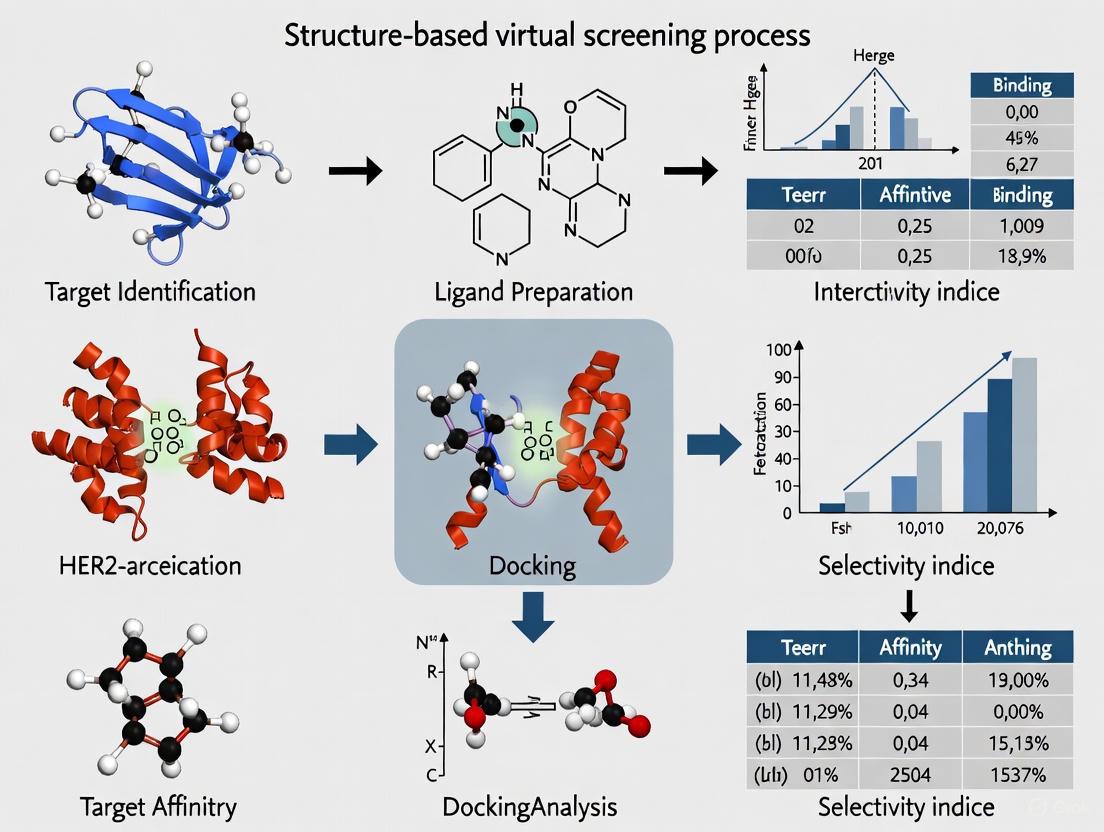
This article provides a comprehensive overview of structure-based virtual screening (SBVS) applications in developing novel therapeutics for HER2-positive breast cancer.
Structure-Based Virtual Screening for HER2-Positive Breast Cancer: From Hit Discovery to Clinical Translation
Abstract
This article provides a comprehensive overview of structure-based virtual screening (SBVS) applications in developing novel therapeutics for HER2-positive breast cancer. We explore the foundational principles of targeting the HER2 tyrosine kinase domain and examine the integration of computational and experimental methodologies for hit identification and optimization. The content details advanced troubleshooting strategies to address challenges like tumor heterogeneity and drug resistance and discusses rigorous validation frameworks combining in silico, in vitro, and clinical tools. Aimed at researchers and drug development professionals, this review synthesizes current innovations to guide the future of targeted therapy discovery for this aggressive breast cancer subtype.
Understanding HER2 Biology and Computational Targeting Foundations
Human Epidermal Growth Factor Receptor 2 (HER2), also known as ERBB2, is a transmembrane receptor tyrosine kinase encoded by the ERBB2 oncogene on chromosome 17q21 that plays a critical role in cell growth, survival, and differentiation [1] [2]. Unlike other EGFR family members, HER2 has no known direct ligand and exists in an open conformation perpetually poised for dimerization [1] [3]. In approximately 15-30% of breast cancers, HER2 is overexpressed or amplified, leading to aggressive tumor behavior and poor prognosis [4] [5] [2]. This overexpression results in cancer cell surfaces containing up to 2 million HER2 receptors, a 40- to 100-fold increase over normal expression levels [4]. The early discovery of this oncogene and its established oncogenic relevance have made HER2 one of the most pursued targets in the history of cancer drug development, serving as the stimulus for transformational pharmaceutical technologies including monoclonal antibodies, tyrosine kinase inhibitors (TKIs), and antibody-drug conjugates (ADCs) [1].
HER2 Signaling Mechanisms and Dimerization Dynamics
Structural Basis of HER2 Activation
The HER2 receptor comprises four principal domains: (1) an extracellular domain (ECD) subdivided into domains I-IV that facilitates dimerization; (2) a transmembrane domain (TMD) embedded within the lipid bilayer; (3) a juxtamembrane domain (JMD) in the cytoplasm linking the TMD and kinase domain; and (4) a kinase domain (KD) responsible for initiating signaling cascades through phosphorylation [3]. In normal cellular conditions, HER2 expression remains low and forms a stable complex with HSP90 (heat shock protein 90), CDC37 (cell division cycle 37), and ERBIN (an adaptor protein of the HER2 receptor) [3]. HER2 primarily forms heterodimers with other EGFR family members due to its lack of a ligand-binding site, thereby activating downstream signaling in a controlled manner [3] [2].
In cancer, HER2 overexpression due to gene amplification leads to homodimer formation and ligand-independent signaling activation through dissociation from the HSP90-CDC37-ERBIN complex [3]. This dimerization results in trans-autophosphorylation within the kinase domain, where one kinase domain phosphorylates tyrosine residues of its partner, reciprocally enhancing activation of downstream signaling pathways [3]. The HER2/HER3 heterodimer is particularly potent in activating downstream pathways due to HER3's six binding sites for the p85 subunit of PI3K, creating robust signaling amplification [2] [1].
Downstream Signaling Pathways
HER2 activation triggers multiple downstream signaling cascades that promote oncogenic processes:
PI3K/AKT/mTOR Pathway: The HER2/HER3 heterodimer is especially effective at activating this pathway, promoting cell survival, growth, and metabolic regulation [2]. AKT activation phosphorylates and inhibits TSC2 (tuberous sclerosis complex 2), activating the mTORC1 complex and subsequent phosphorylation of downstream targets involved in protein synthesis [2].
RAS/RAF/MAPK Pathway: HER2 activation leads to RAS activation, which initiates a cascade through RAF, MEK, and ERK (extracellular signal-regulated kinase), driving cell proliferation and differentiation [3] [2]. ERK activation can crosstalk with the PI3K/AKT/mTOR pathway by phosphorylating and activating mTORC1 or directly phosphorylating and inhibiting TSC2 [2].
Crosstalk with Other Pathways: HER2 signaling interfaces with multiple additional pathways:
- Wnt/β-catenin: HER2 activation can stabilize and promote nuclear translocation of β-catenin, enhancing transcription of proliferation genes [2].
- NF-κB: HER2 signaling can lead to phosphorylation and degradation of IκBα, resulting in nuclear translocation of NF-κB and transcriptional activation of survival genes [2].
- Estrogen Receptor: In hormone receptor-positive breast cancer, HER2 signaling crosstalks with estrogen receptor (ER) signaling, influencing response to endocrine therapy [2] [6].
The following diagram illustrates the core HER2 signaling network and these key pathway interactions:
Current HER2-Targeted Therapeutic Approaches
Monoclonal Antibodies
Trastuzumab was the first HER2-targeted therapy approved, binding to extracellular domain IV of HER2 and suppressing intracellular signaling pathways [5]. Pertuzumab targets extracellular domain II, preventing HER2 heterodimerization with other EGFR family members [5]. The efficacy of monoclonal antibodies correlates strongly with HER2 protein expression levels, with HER2 IHC 3+ patients showing significantly better outcomes than IHC 2+/FISH+ patients, while those with low HER2 expression (IHC 1+ or 2+/FISH-) derive minimal benefit [5]. This differential efficacy likely stems from the higher dependence of HER2 IHC 3+ tumors on HER2 signaling, providing more binding sites for antibodies to effectively block signaling and inhibit proliferation [5].
Antibody-Drug Conjugates (ADCs)
ADCs represent a transformative approach in HER2-targeted therapy:
T-DM1: The first ADC approved for HER2-positive breast cancer, comprising trastuzumab connected to DM1 (a maytansine derivative) with a drug-to-antibody ratio (DAR) of ~3.5:1 [5]. The KATHERINE trial demonstrated that adjuvant T-DM1 significantly improves outcomes compared to trastuzumab in HER2-positive patients with non-pCR following neoadjuvant therapy, with benefits observed in both HER2 IHC 3+ and HER2 IHC 2+/ISH+ patients [5].
T-DXd: A next-generation ADC with optimizations including a topoisomerase I inhibitor payload, tetrapeptide-based cleavable linker, and high DAR of 8:1 [5]. T-DXd demonstrates efficacy across the HER2 expression spectrum, with the DB-04 trial showing significant benefits in HER2-low (IHC 1-2+/ISH-) advanced breast cancer [5]. Key advantages include membrane permeability contributing to a powerful "bystander effect" that targets neighboring cells regardless of HER2 expression [7] [5].
Tyrosine Kinase Inhibitors (TKIs)
TKIs target the intracellular tyrosine kinase domain of HER2, with efficacy that appears positively correlated with HER2 expression levels [5]. Available TKIs include lapatinib (reversible pan-HER inhibitor), neratinib (irreversible pan-HER inhibitor), and tucatinib (HER2-selective reversible inhibitor) [1] [5]. While TKIs effectively inactivate HER2 signaling in cell-based studies, they show limited activity as monotherapy in patients due to challenges in achieving complete target inactivation and compensatory feedback mechanisms that restore signaling [1].
Table 1: HER2-Targeted Therapeutic Classes and Mechanisms
| Therapeutic Class | Representative Agents | Molecular Target | Mechanism of Action | Efficacy Correlation with HER2 Expression |
|---|---|---|---|---|
| Monoclonal Antibodies | Trastuzumab, Pertuzumab | HER2 Extracellular Domain | Blocks dimerization and signaling; engages immune system | Strong positive correlation (IHC 3+ > IHC 2+) |
| Antibody-Drug Conjugates | T-DM1, T-DXd | HER2 Extracellular Domain | Targeted chemotherapy delivery with cytotoxic payload | T-DM1: Limited in HER2-low; T-DXd: Effective across spectrum |
| Tyrosine Kinase Inhibitors | Lapatinib, Neratinib, Tucatinib | HER2 Intracellular Kinase Domain | Inhibits kinase activity and phosphorylation | Moderate positive correlation |
Structure-Based Virtual Screening for HER2 Inhibitor Discovery
Experimental Protocol for HER2 Virtual Screening
Structure-based virtual screening represents a powerful approach for identifying novel HER2 inhibitors from compound libraries. The following protocol outlines a comprehensive methodology:
Step 1: Protein Structure Preparation
- Retrieve the X-ray crystal structure of the HER2 tyrosine kinase domain in complex with TAK-285 (PDB ID: 3RCD) from the RCSB Protein Data Bank [8] [4].
- Prepare the protein structure using Schrödinger's Protein Preparation Wizard:
- Remove water molecules beyond 5Å from the active site
- Eliminate unwanted chains and add missing loops/side chains
- Add hydrogens and cap uncapped C and N termini at pH 7±2
- Optimize hydrogen bonding network and correct Asn/Gln/His orientations using PROPKA at pH 7
- Perform restrained minimization with OPLS3 force field to RMSD of 0.3Å [8]
Step 2: Binding Site Definition and Grid Generation
- Define the binding site using the centroid of the co-crystallized ligand (TAK-285)
- Generate a receptor grid box with dimensions 20×20×20Å with 0.375Å grid spacing
- Adjust grid size to accommodate ligands with maximum size of 20Å to eliminate oversized molecules [8]
Step 3: Compound Library Preparation
- Compile a diverse compound library (e.g., natural product databases, commercial libraries)
- Apply drug-likeness filters (Lipinski's Rule of Five) to evaluate pharmacological potential
- Prepare ligands using LigPrep module with OPLS4 force field:
Step 4: Hierarchical Docking Protocol
- Implement three-stage molecular docking using Glide module:
- High-Throughput Virtual Screening (HTVS): Initial screening with relaxed precision
- Standard Precision (SP): Refined docking of top-ranked compounds from HTVS
- Extra Precision (XP): Detailed docking of best candidates with stringent scoring [8]
- Validate docking protocol using a training set of known HER2 inhibitors including lapatinib and neratinib
- Calculate enrichment metrics (ROC, AUC-ROC, BEDROC, EF) to assess screening performance [8]
Step 5: Pose Analysis and Scoring
- Analyze binding poses and interaction patterns of top-ranked compounds
- Calculate binding energies and prioritize compounds based on docking scores
- Assess protein-ligand interactions (hydrogen bonds, hydrophobic contacts, π-π stacking) [8] [4]
The following workflow diagram illustrates this virtual screening process:
Research Reagent Solutions for HER2 Virtual Screening
Table 2: Essential Research Reagents and Computational Tools for HER2 Virtual Screening
| Reagent/Tool | Specification/Provider | Application in HER2 Research |
|---|---|---|
| HER2 Kinase Domain Structure | PDB ID: 3RCD (Resolution: 3.21Å) | Structural basis for molecular docking and binding site analysis |
| Schrödinger Molecular Modeling Suite | Commercial Software Package | Integrated platform for protein preparation, docking, and analysis |
| Natural Product Libraries | COCONUT, ZINC Natural Products, NPATLAS | Source of diverse chemical scaffolds for virtual screening |
| Known HER2 Inhibitors | Lapatinib, Neratinib, TAK-285 | Training set compounds for validation of docking protocols |
| QikProp ADMET Module | Schrödinger Suite | Prediction of absorption, distribution, metabolism, excretion, and toxicity properties |
| Glide Docking Module | Schrödinger Suite | Hierarchical virtual screening (HTVS/SP/XP) with optimized scoring functions |
Emerging Research Directions and Clinical Perspectives
Molecular Subtyping of HER2-Positive Breast Cancers
Recent research has revealed significant heterogeneity within HER2-positive breast cancers, particularly in the HR+/HER2+ subtype which comprises approximately 70% of HER2-positive cases [9]. Molecular profiling has identified four distinct subtypes with therapeutic implications:
- HER2-Enriched Subtype: Characterized by robust HER2 pathway activation and HIF-1 signaling, showing optimal response to intensified anti-HER2 therapy [9].
- ER-Activated Subtype: Demonstrates estrogen receptor pathway dominance, benefiting from combined ER and HER2 targeting [9].
- Immunomodulatory Subtype: Exhibits high immune cell infiltration, showing sensitivity to HER2-targeted ADCs and potential response to immune checkpoint therapy [9].
- Heterogeneous Subtype: Displays multifaceted pathway activation requiring combination approaches, potentially including PI3K inhibitors [9].
This molecular classification enables more precise treatment selection, with the MUKDEN 01 trial demonstrating that chemotherapy-free regimens combining letrozole, dalpiciclib (CDK4/6 inhibitor), and pyrotinib (HER2 TKI) can achieve pCR rates of 30.4% with reduced toxicity [9].
Novel Agents and Future Directions
The HER2 therapeutic landscape continues to evolve with several promising agents in development:
- Trastuzumab Rezetecan: A novel ADC showing promising efficacy in early trials, particularly in combination regimens [7].
- Zongertinib: A HER2-selective kinase inhibitor combining desirable properties of neratinib and tucatinib, showing promise in early trials [7].
- Biparatopic Antibodies: Novel antibody technologies binding two different epitopes for enhanced signaling inhibition [7].
- Natural Product-Derived Inhibitors: Compounds such as liquiritin and oroxin B identified through virtual screening that suppress HER2 catalysis with nanomolar potency and demonstrate selectivity for HER family proteins [8].
Despite these advances, significant challenges remain including resistance mechanisms, brain metastases, and the inability to cure most patients with metastatic HER2-positive disease [7]. Ongoing research focuses on optimizing combination therapies, understanding resistance mechanisms, and developing novel therapeutic modalities to address these unmet needs.
Table 3: Key Clinical Trials Informing Current HER2-Targeted Therapy Standards
| Trial Name | Phase | Intervention | Population | Key Outcomes |
|---|---|---|---|---|
| DESTINY-Breast03 | III | T-DXd vs T-DM1 | HER2+ MBC after prior therapy | Median PFS: 28.8 vs 6.8 months (HR 0.33) |
| DESTINY-Breast04 | III | T-DXd vs Physician's Choice | HER2-low MBC | Median PFS: 9.9 vs 5.1 months (HR 0.50) |
| KATHERINE | III | T-DM1 vs Trastuzumab | HER2+ Early BC with non-pCR after neoadjuvant | 3-year iDFS: 88.3% vs 77.0% (HR 0.50) |
| CLEOPATRA | III | Pertuzumab+Trastuzumab+Docetaxel vs Placebo+Trastuzumab+Docetaxel | HER2+ MBC | Median OS: 56.5 vs 40.8 months (HR 0.68) |
| MUKDEN 01 | II | Letrozole+Dalpiciclib+Pyrotinib | HR+/HER2+ Early BC | pCR rate: 30.4% with chemotherapy-free regimen |
HER2 signaling in breast cancer represents a paradigm for targeted oncologic therapy, from initial molecular discovery through successive generations of treatment innovation. The structural understanding of HER2 dimerization and downstream pathway activation provides a foundation for rational drug design, while emerging technologies like structure-based virtual screening offer powerful approaches for identifying novel therapeutic candidates. Current challenges including therapeutic resistance, tumor heterogeneity, and brain metastases continue to drive research into more effective targeting strategies. The integration of molecular subtyping with mechanism-based therapeutic selection promises to further personalize treatment approaches and improve outcomes for patients with HER2-positive breast cancer.
Human Epidermal Growth Factor Receptor 2 (HER2), also known as ErbB2, is a transmembrane receptor tyrosine kinase of the EGFR family that functions as a critical regulator of cell proliferation, survival, and differentiation [10] [11]. Unlike other HER family members, HER2 has no known direct ligand binding capability and instead functions as the preferred dimerization partner for other ligand-bound HER receptors [10] [12]. In approximately 15-30% of breast cancers, the ERBB2 gene is amplified or overexpressed, leading to uncontrolled activation of downstream signaling pathways that drive tumorigenesis and correlate with aggressive disease and poor prognosis [10] [13] [12]. The tyrosine kinase domain (TKD) of HER2 has emerged as a prime therapeutic target due to its essential role in propagating oncogenic signals, prompting extensive research into targeted inhibitors that can effectively block its catalytic activity [14] [15].
Structural Biology of the HER2 Kinase Domain
The HER2 kinase domain shares the characteristic bilobed architecture common to protein kinases, consisting of an N-terminal lobe (primarily β-sheets) and a larger C-terminal lobe (primarily α-helices) with the ATP-binding pocket situated at the interface [14] [15]. Crystallographic studies (PDB ID: 3PP0) have revealed that the HER2 kinase domain crystallizes as a dimer, suggesting an allosteric mechanism of activation comparable to those reported for EGFR and HER4 [14] [15]. A distinctive structural feature of HER2 is a unique glycine-rich region in the loop following α-helix C, which contributes to increased conformational flexibility within the active site and may explain the low intrinsic catalytic activity previously reported for HER2 [15]. This region lacks the serine and aspartate residues found in EGFR (Ser768 and Asp770) that form hydrogen-bonding interactions to stabilize the active conformation, resulting in altered regulatory mechanisms [15].
Table 1: Key Structural Features of the HER2 Tyrosine Kinase Domain
| Feature | Structural Characteristics | Functional Implications |
|---|---|---|
| Overall Fold | Bilobed structure typical of protein kinases | Provides structural framework for catalytic activity |
| Activation Loop | Phosphorylation not required for activation | Distinct from many other receptor tyrosine kinases |
| Glycine-rich Region | Unique Gly-rich sequence following α-helix C | Increases active site flexibility; may explain low intrinsic activity |
| Dimerization Interface | Specific residues facilitating monomer interaction | Enables allosteric activation through dimer formation |
| ATP-binding Pocket | Hydrophobic cleft between N-lobe and C-lobe | Target for small molecule kinase inhibitors |
Activation Mechanisms and Conformational States
HER2 activation occurs primarily through dimerization—either homodimerization at high receptor concentrations or, more commonly, heterodimerization with other HER family members [11] [12]. The HER2/HER3 heterodimer is particularly potent in activating downstream signaling due to HER3's multiple docking sites for the p85 subunit of PI3K, creating a highly signaling-competent complex [10]. Structural analyses indicate that HER2 exists in a constitutively active conformation, unlike other HER family receptors that transition between inactive and active states [11]. This pre-activated state, combined with the glycine-rich flexible region, creates a structural environment that facilitates rapid signal transduction upon dimerization, making it a powerful oncogenic driver when overexpressed [15].
HER2 Signaling Pathways and Oncogenic Output
Primary Signaling Cascades
HER2 activation initiates multiple downstream signaling pathways that collectively promote oncogenic phenotypes. The two best-characterized pathways are the PI3K/AKT and RAS/MAPK cascades [10] [12]. The PI3K/AKT pathway serves as a crucial survival signal, inhibiting apoptosis and promoting cell growth through mTOR activation and TSC2 inhibition [10]. Concurrently, the RAS/MAPK pathway drives proliferative responses through a phosphorylation cascade culminating in ERK activation and nuclear translocation [10]. These pathways operate in concert to regulate critical cellular processes including growth, metabolism, survival, and differentiation, with dysregulation contributing fundamentally to cancer progression [10].
Figure 1: Core HER2 Signaling Pathways. HER2 dimerization activates primary downstream pathways including PI3K/AKT/mTOR and RAS/RAF/MEK/ERK cascades that drive oncogenic processes.
Cross-talk with Other Signaling Networks
Beyond the primary signaling cascades, HER2 engages in extensive cross-talk with other critical cellular pathways, creating a complex signaling network that enhances its oncogenic potential. HER2 signaling intersects with the Wnt/β-catenin pathway, leading to stabilization and nuclear translocation of β-catenin which promotes transcription of genes involved in proliferation and survival [10]. Additionally, HER2 activates the NF-κB pathway through phosphorylation and degradation of IκBα, resulting in nuclear translocation of NF-κB and transcriptional activation of inflammatory and pro-survival genes [10]. In hormone receptor-positive breast cancer, HER2 cross-talk with estrogen receptor (ER) signaling influences response to endocrine therapy, with HER2 activation potentially phosphorylating and activating ER to enhance its transcriptional activity [10]. These multifaceted interactions create signaling redundancy that can confer resistance to targeted therapies, highlighting the need for combination treatment approaches [10] [16].
Table 2: Key HER2 Signaling Pathways and Functional Outcomes
| Signaling Pathway | Key Components | Oncogenic Outcomes |
|---|---|---|
| PI3K/AKT/mTOR | PI3K, AKT, mTOR, TSC2 | Cell survival, growth, metabolism, inhibited apoptosis |
| RAS/MAPK | RAS, RAF, MEK, ERK | Cell proliferation, differentiation, migration |
| JAK/STAT | JAK, STAT transcription factors | Immune modulation, cell growth |
| Wnt/β-catenin | β-catenin, TCF/LEF | Tumor progression, stemness |
| NF-κB | IκBα, NF-κB subunits | Inflammation, cell survival |
| Estrogen Receptor | ERα, co-activators | Hormone-independent growth |
Experimental Protocols for HER2 Kinase Domain Studies
Protein Expression and Purification for Structural Studies
Purpose: To obtain high-quality HER2 kinase domain protein for biochemical and structural studies.
Methodology:
- Cloning: Amplify DNA fragment encoding HER2 kinase domain (residues 703-1029) and clone into pFastBac1 vector with C-terminal polyhistidine tag. Introduce stabilizing mutations (M706A, Q711L, M712L) corresponding to equivalent EGFR residues to improve protein behavior [15].
- Expression: Generate recombinant baculovirus using Bac-to-Bac system and infect Spodoptera frugiperda Sf9 insect cells for protein expression. Culture cells in 5-liter Wave Bioreactors for large-scale production [15].
- Purification:
- Lyse cells in 50 mM Tris-HCl (pH 7.9), 200 mM NaCl, 20 mM imidazole, 0.25 mM TCEP hydrochloride with protease inhibitors.
- Clarify lysate by centrifugation at 4,200 × g for 60 minutes.
- Batch-bind supernatant with nickel resin, wash with 25 mM Tris-HCl (pH 7.9), 500 mM NaCl, 20 mM imidazole, 2% glycerol.
- Elute with 200 mM imidazole buffer.
- Further purify by size exclusion chromatography using S3000 column equilibrated in 25 mM Tris-HCl (pH 7.9), 150 mM NaCl, 2% glycerol.
- Concentrate to 7-10 mg/ml using YM10 Centricon and buffer-exchange to final storage buffer [15].
Critical Parameters:
- Maintain temperature at 4°C throughout purification.
- Include reducing agents (TCEP or DTT) to prevent oxidation.
- Use protease inhibitors to prevent degradation.
- Assess protein purity by SDS-PAGE and activity by kinase assay.
Structure-Based Virtual Screening Protocol
Purpose: To identify novel HER2 kinase inhibitors from large compound libraries using computational approaches.
Methodology:
- Library Preparation:
- Compile natural product library from commercial databases (COCONUT, ZINC Natural Products, SANCDB, etc.).
- Remove duplicates to create focused screening library.
- Prepare ligands using LigPrep module with OPLS3 or OPLS4 force field, generating ionization states at pH 7.0 ± 0.5 and enumerating stereoisomers [8].
Protein Preparation:
- Obtain HER2 crystal structure (e.g., PDB ID: 3RCD) from RCSB Protein Data Bank.
- Preprocess protein using Protein Preparation Wizard: remove waters beyond 5Å from active site, add hydrogens, optimize hydrogen bonds, assign proper bond orders.
- Perform restrained minimization using OPLS3 force field with RMSD cutoff of 0.3Å [8].
Grid Generation:
- Define binding site using Receptor Grid Generation module.
- Create 20Å × 20Å × 20Å grid box around co-crystallized ligand centroid.
- Set grid spacing to 0.375Å to ensure adequate resolution [8].
Hierarchical Docking:
- Step 1 - HTVS: Perform high-throughput virtual screening of entire library using Glide HTVS mode. Select top 10,000 compounds based on docking score (threshold: ≤ -6.00 kcal/mol).
- Step 2 - SP Docking: Subject top HTVS hits to standard precision docking for refined pose prediction.
- Step 3 - XP Docking: Further evaluate top 500 SP compounds using extra precision docking for optimal binding pose identification and scoring [8].
Post-docking Analysis:
- Evaluate binding poses and interaction patterns.
- Assess compound diversity and drug-like properties.
- Select top candidates for experimental validation.
Figure 2: Virtual Screening Workflow. Hierarchical docking approach progressively filters compound library from initial screening to high-precision evaluation of top candidates.
Kinase Inhibition Assay
Purpose: To quantitatively evaluate inhibitor potency against HER2 kinase domain.
Methodology:
- Enzyme Preparation: Use purified HER2 kinase domain (residues 676-1255) expressed in Sf9 insect cells with N-terminal FLAG tag [15].
- Reaction Conditions:
- Prepare reaction buffer: 20 mM HEPES (pH 7.5), 10 mM MgCl₂, 1 mM DTT, 0.1 mM Na₃VO₄.
- Include ATP at Km concentration (typically 10-50 μM) and varying inhibitor concentrations.
- Use appropriate peptide substrate (e.g., poly(Glu,Tyr) 4:1).
- Initiate reaction by adding enzyme and incubate at 30°C for 30-60 minutes [15].
- Detection Method:
- Terminate reactions with EDTA or acid.
- Quantify phosphorylated product using ELISA, mobility shift, or radiometric detection.
- Include controls: no enzyme (background), no inhibitor (maximum activity).
- Data Analysis:
- Calculate percentage inhibition at each compound concentration.
- Generate dose-response curves and determine IC₅₀ values using nonlinear regression.
- Perform triplicate measurements for statistical reliability.
The Scientist's Toolkit: Research Reagent Solutions
Table 3: Essential Research Reagents for HER2 Kinase Domain Studies
| Reagent/Category | Specific Examples | Function/Application |
|---|---|---|
| Expression Systems | Bac-to-Bac Baculovirus System, Sf9 insect cells | High-yield protein production for structural and biochemical studies |
| Purification Tools | Nickel-NTA resin, Anti-FLAG M2 affinity gel, Size exclusion columns | Isolation of pure, active kinase domain |
| Structural Biology | HER2 crystal structures (PDB: 3PP0, 3RCD), X-ray diffraction | Template for drug design and mechanism studies |
| Virtual Screening | Schrödinger Suite (Glide, LigPrep, Protein Prep Wizard), Natural product libraries | Computational identification of novel inhibitors |
| Activity Assays | Tyrosine kinase assay kits, Phospho-specific antibodies, ATP-analogues | Biochemical characterization of kinase function and inhibition |
| Cell-Based Models | HER2-overexpressing cell lines (BT-474, SK-BR-3), Engineered NH3T3 cells | Cellular validation of compound activity and mechanism |
| Reference Inhibitors | Lapatinib, Neratinib, TAK-285, SYR127063 | Benchmark compounds for experimental controls |
Application in Drug Discovery and Therapeutic Targeting
The structural insights gained from HER2 kinase domain studies have directly facilitated the development of targeted therapeutic agents with significant clinical impact. Small molecule tyrosine kinase inhibitors (TKIs) such as lapatinib, neratinib, and tucatinib function by competitively binding to the ATP-binding pocket of the HER2 kinase domain, thereby blocking catalytic activity and downstream signaling [13]. These agents have demonstrated efficacy in treating HER2-positive breast cancer, particularly in cases of resistance to antibody-based therapies [16] [13]. The crystal structure of HER2 in complex with selective inhibitors such as SYR127063 has revealed detailed interaction patterns that inform the design of compounds with improved potency and selectivity [14] [15]. Recent advances include the identification of natural product-derived inhibitors like liquiritin and oroxin B through structure-based virtual screening approaches, highlighting the continued utility of HER2 kinase domain structural information in novel drug discovery [8].
The clinical success of HER2-targeted therapies represents a landmark achievement in oncology, transforming HER2-positive breast cancer from one of the poorest prognosis subtypes to a manageable condition with multiple treatment options [17] [13]. Continued structural and functional studies of the HER2 kinase domain remain essential for addressing ongoing challenges such as therapeutic resistance, brain metastasis, and tumor heterogeneity, ensuring that this prime drug target will continue to yield important advances in cancer therapeutics.
Natural Products as a Resource for HER2 Inhibitor Discovery
Human Epidermal Growth Factor Receptor 2 (HER2) is a well-validated therapeutic target in oncology, particularly in HER2-positive breast cancer, which constitutes approximately 20% of breast cancer cases and is associated with aggressive disease and poor prognosis [16] [17]. While targeted therapies like trastuzumab and lapatinib have revolutionized treatment, issues of resistance, toxicity, and acquired limitations necessitate the discovery of novel inhibitory compounds [8] [18]. Natural products (NPs) offer a rich and diverse resource for drug discovery due to their structural complexity, historical success in anticancer therapy, and generally favorable toxicity profiles [8]. This application note details integrated computational and experimental protocols for the identification and validation of novel HER2 inhibitors from natural sources, providing a structured framework for researchers in the field.
Key Signaling Pathways and Workflow
The following diagram illustrates the central role of HER2 in oncogenic signaling and the therapeutic mechanism of kinase inhibitors.
Diagram 1: HER2 Signaling and Inhibition Mechanism. HER2 overexpression facilitates dimerization and autophosphorylation, activating downstream MAPK and PI3K/Akt pathways that drive oncogenic processes. Natural product inhibitors compete with ATP at the tyrosine kinase domain, disrupting this signaling cascade [8] [19].
The overall process for discovering HER2 inhibitors from natural products integrates multiple technologies, as shown in the workflow below.
Diagram 2: Integrated Workflow for HER2 Inhibitor Discovery. The process begins with large-scale virtual screening of natural product libraries, progresses through hierarchical docking and pharmacokinetic filtering, and culminates in dynamic simulation and experimental validation [8] [20].
Computational Protocols
Virtual Library Curation and Preparation
Objective: To compile and prepare a diverse, chemically clean library of natural products for virtual screening.
- Library Compilation: Assemble natural product structures from public and commercial databases such as COCONUT, ZINC Natural Products Catalogue, SANCDB, and NPATLAS [8].
- Data Curation:
- Remove duplicate structures and compounds with undesirable functional groups or reactivity using tools like Schrödinger's Canvas or KNIME.
- Standardize chemical representations (tautomers, ionization states).
- Ligand Preparation (using Schrödinger LigPrep):
Structure-Based Virtual Screening
Objective: To efficiently screen millions of natural products against the HER2 kinase domain and identify high-affinity binders.
- Protein Preparation (using Schrödinger's Protein Preparation Wizard):
- Source: Retrieve HER2 crystal structure (e.g., PDB ID: 3RCD or 7PCD) from the RCSB Protein Data Bank [8] [4].
- Steps:
- Preprocess: Remove water molecules beyond 5 Å from the active site, add missing side chains and loops.
- Optimize: Assign bond orders, create disulfide bonds, adjust protonation states of His, Gln, and Asn residues using PROPKA at pH 7.0.
- Minimize: Perform restrained minimization with OPLS3/OPLS4 force field until RMSD reaches 0.3 Å [8].
- Grid Generation:
- Define the receptor grid as a 20x20x20 Å box centered on the centroid of the co-crystallized ligand (e.g., TAK-285) [8].
- Hierarchical Molecular Docking (using Schrödinger Glide):
- High-Throughput Virtual Screening (HTVS): Screen the entire prepared natural product library. Select the top 10,000 compounds based on docking score (e.g., ≥ -6.00 kcal/mol) [8].
- Standard Precision (SP) Docking: Re-dock the top HTVS hits for improved pose prediction and scoring.
- Extra Precision (XP) Docking: Dock the top 500 SP compounds for a final, stringent evaluation of binding affinities and interactions [8].
ADMET Profiling and Selectivity Assessment
Objective: To evaluate the drug-likeness and pharmacokinetic properties of top-scoring hits early in the discovery pipeline.
- ADMET Prediction (using Schrödinger QikProp):
- Calculate key physicochemical properties: Molecular weight, rotatable bonds, hydrogen bond donors/acceptors, octanol-water partition coefficient (QPlogPo/w), apparent Caco-2 permeability (QPPCaco), predicted human oral absorption (%HOA), and blood-brain barrier penetration (QPlogBB) [8].
- Assess compliance with Lipinski's Rule of Five and Jorgensen's rule of three.
- Toxicity Risk Assessment:
- Screen for potential hERG channel inhibition and mutagenicity (Ames test) using platforms like iDrug or ADMET Predictor [20].
Molecular Dynamics (MD) Simulations
Objective: To validate the stability of protein-ligand complexes and obtain more accurate binding free energies under dynamic conditions.
- System Setup (using Desmond or GROMACS):
- Solvate the protein-ligand complex in an orthorhombic water box (e.g., TIP3P model) with neutralization by adding counterions.
- Simulation Parameters:
- Trajectory Analysis:
- Calculate Root Mean Square Deviation (RMSD) of the protein backbone and ligand heavy atoms.
- Calculate Root Mean Square Fluctuation (RMSF) of protein residues.
- Analyze hydrogen bonding patterns and interaction fractions.
- Binding Free Energy Calculation:
Experimental Validation Protocols
In Vitro Kinase Inhibition Assay
Objective: To biochemically confirm the direct inhibition of HER2 kinase activity by the identified hits.
- Reagents: Recombinant HER2 kinase domain, ATP, appropriate peptide substrate, ADP-Glo Kinase Assay Kit (Promega).
- Protocol:
- Incubate HER2 kinase with a range of compound concentrations (e.g., 0.1 nM - 10 µM) in kinase reaction buffer.
- Initiate the reaction by adding ATP and substrate.
- After incubation, stop the reaction and add ADP-Glo Reagent to deplete remaining ATP.
- Add Kinase Detection Reagent to convert ADP to ATP and measure luminescence.
- Calculate % inhibition and determine half-maximal inhibitory concentration (IC₅₀) values using non-linear regression [8] [18].
Cellular Anti-Proliferative Assays
Objective: To evaluate the ability of the hits to inhibit the growth of HER2-positive breast cancer cells.
- Cell Lines:
- Protocol (MTS/PrestoBlue Assay):
- Seed cells in 96-well plates and incubate for 24 hours.
- Treat cells with serially diluted compounds for 72 hours.
- Add MTS or PrestoBlue reagent and incubate for 1-4 hours.
- Measure absorbance (MTS) or fluorescence (PrestoBlue) to determine cell viability.
- Calculate Selectivity Index (SI) as the ratio of IC₅₀ in control cells to IC₅₀ in HER2-positive cells [8].
Target Engagement and Downstream Signaling Analysis
Objective: To confirm on-target engagement in cells and assess the impact on HER2-mediated signaling pathways.
- Western Blot Analysis:
- Treat HER2-positive cells (e.g., BT474) with compounds for 6-24 hours.
- Lyse cells and quantify protein concentration.
- Separate proteins by SDS-PAGE and transfer to PVDF membrane.
- Probe with primary antibodies against: pHER2 (Tyr1221/1222), total HER2, pAkt (Ser473), pERK1/2 (Thr202/Tyr204), and corresponding total proteins, with β-actin as a loading control [8].
- Quantify band intensity to demonstrate inhibition of HER2 phosphorylation and downstream pathway suppression.
Anti-Migratory Assay
Objective: To assess the potential of hits to inhibit cancer cell metastasis.
- Protocol (Wound Healing/Scratch Assay):
- Seed cells in a 24-well plate to form a confluent monolayer.
- Create a uniform "wound" using a sterile pipette tip.
- Wash away detached cells and add fresh medium containing compounds at non-cytotoxic concentrations (e.g., IC₁₀-IC₂₀).
- Capture images at 0, 12, 24, and 48 hours.
- Quantify the percentage of wound closure relative to time zero using image analysis software (e.g., ImageJ) [8].
Key Research Findings and Data
Table 1: Exemplary Natural Products Identified as HER2 Inhibitors
| Natural Product | Docking Score (kcal/mol) | HER2 Kinase IC₅₀ | Anti-Proliferative IC₅₀ (SKBR3/BT474) | Key ADMET Properties | Primary Experimental Evidence |
|---|---|---|---|---|---|
| Liquiritin | ~ -9.0 to -10.0 (XP) | Nanomolar range | Low micromolar range | Favorable predicted oral absorption; low hERG inhibition risk [8] | Suppresses HER2 phosphorylation & expression; anti-migratory activity; pan-HER family selectivity [8] |
| Oroxin B | ~ -9.5 to -11.0 (XP) | Nanomolar range | Low micromolar range | Favorable drug-likeness; acceptable QPlogPo/w [8] | Nanomolar biochemical potency; preferential anti-proliferative effect on HER2+ cells [8] |
| ZINC15122021 | -10.8 (Vina) | Not specified | Active in SKBR3 & BT474 [18] | Favorable ADMET properties; zero Lipinski violations [18] | High kinase inhibition; outstanding cell proliferation inhibition [18] |
| Ligustroflavone | Not specified | Nanomolar range | Preferential effect on HER2+ cells [8] | Data not available in search results | Biochemically suppresses HER2 catalysis [8] |
Table 2: Key Reagent Solutions for HER2 Inhibitor Screening
| Research Reagent | Function/Application in Workflow | Example Sources/Details |
|---|---|---|
| HER2 Kinase Domain (3RCD.pdb) | Structure for molecular docking and dynamics | RCSB Protein Data Bank; Co-crystallized with TAK-285 inhibitor [8] [4] |
| Natural Product Libraries | Source of chemical diversity for virtual screening | COCONUT, ZINC Natural Products, SANCDB, NPATLAS [8] |
| SKBR3 Cell Line | HER2-overexpressing model for cellular anti-proliferative assays | ATCC HTB-30; Human breast adenocarcinoma [8] [18] |
| BT474 Cell Line | HER2-amplified model for signaling and proliferation studies | ATCC HTB-20; Human breast ductal carcinoma [18] |
| ADP-Glo Kinase Assay Kit | Biochemical assay for HER2 kinase inhibition profiling | Promega; Luminescence-based [18] |
| Anti-pHER2 (Tyr1221/1222) Antibody | Detection of HER2 phosphorylation status in Western blotting | Cell Signaling Technology; Key biomarker for target engagement [8] |
The Scientist's Toolkit: Essential Research Reagents
The following reagents are critical for executing the protocols outlined in this document.
Table 3: Essential Research Reagents and Resources
| Category | Reagent/Resource | Specific Function |
|---|---|---|
| Software & Databases | Schrödinger Suite (Maestro) | Integrated platform for protein prep, docking, and ADMET prediction [8] |
| AutoDock Vina | Open-source molecular docking software [4] [18] | |
| COCONUT / ZINC Natural Products | Curated databases of natural product structures for virtual screening [8] | |
| RCSB Protein Data Bank | Source for 3D protein structures (e.g., PDB IDs: 3RCD, 7PCD) [8] [20] | |
| Biochemical & Cellular Reagents | Recombinant HER2 Kinase Domain | Target protein for in vitro kinase inhibition assays [18] |
| HER2-Positive Cell Lines (SKBR3, BT474) | Cellular models for evaluating anti-proliferative activity and target modulation [8] [18] | |
| Phospho-Specific Antibodies (pHER2, pAkt, pERK) | Critical tools for Western blot analysis of downstream signaling pathway inhibition [8] | |
| Assay Kits | ADP-Glo Kinase Assay | Homogeneous, luminescent assay for measuring HER2 kinase activity [18] |
| MTS/PrestoBlue Cell Viability Assay | Colorimetric/fluorometric assay for quantifying cell proliferation and cytotoxicity [8] |
The integrated workflow presented here, combining large-scale virtual screening of natural product libraries with rigorous experimental validation, provides a powerful and efficient strategy for identifying novel HER2 inhibitors. Promising hits like liquiritin and oroxin B demonstrate that natural products can yield compounds with nanomolar potency, favorable ADMET profiles, and selective activity against HER2-overexpressing cancer cells [8]. This structured approach, from in silico prediction to in vitro confirmation, offers a robust template for accelerating the discovery of targeted therapies from nature's chemical repertoire, potentially leading to new treatment options for HER2-positive cancers. Future work should focus on lead optimization of validated hits and advancing the most promising candidates into in vivo efficacy and toxicity studies.
Human Epidermal Growth Factor Receptor 2 (HER2)-positive breast cancer represents approximately 13-15% of all breast cancer cases and is characterized by an aggressive clinical course with historically unfavorable prognosis [22]. While targeted therapies have dramatically improved outcomes, a significant number of patients experience disease progression due to inherent or acquired drug resistance [22]. This application note examines the principal mechanisms underlying resistance to HER2-targeted therapies and outlines a structured computational and experimental framework for identifying novel therapeutic candidates through structure-based virtual screening. The integration of advanced computational methodologies with experimental validation provides a systematic approach to overcome resistance challenges in HER2-positive breast cancer research.
HER2 Resistance Mechanisms: A Systems View
Resistance to HER2-targeted therapies arises through diverse molecular adaptations that enable cancer cells to bypass therapeutic inhibition. Understanding these mechanisms is crucial for developing effective strategies to overcome resistance.
Table 1: Key Resistance Mechanisms to HER2-Targeted Therapies
| Resistance Category | Specific Mechanisms | Therapeutic Impact |
|---|---|---|
| HER2-Related Alterations | Tumor heterogeneity; HER2 mutations (S310F/Y); Reduced HER2 expression; Impaired antibody binding [22] [23] [24] | Reduces drug target availability and binding efficacy |
| Signaling Pathway Adaptations | Upregulation of compensatory pathways (PI3K/Akt, ER); Overexpression of alternative receptors (AXL, HER3) [25] [24] | Activates alternative survival pathways bypassing HER2 inhibition |
| Intracellular Processing Defects | Impaired lysosomal function; Altered intracellular trafficking; Increased drug efflux [24] | Prevents proper internalization and intracellular release of payload |
| Tumor Microenvironment | Variations in tumor microenvironment; Altered immune responses [22] [24] | Creates protective niche reducing drug efficacy |
HER2 Resistance Mechanisms Diagram: This systems view illustrates the interconnected biological processes that drive resistance to HER2-targeted therapies.
Computational Framework for Overcoming Resistance
Structure-based virtual screening provides a powerful approach to identify novel HER2 inhibitors capable of overcoming resistance mechanisms. The following protocol outlines a comprehensive workflow from initial preparation to candidate selection.
Virtual Screening Protocol
Objective: Identify novel HER2 inhibitors with potential to overcome known resistance mechanisms through structure-based virtual screening.
Materials and Software Requirements:
- HER2 protein structure (PDB IDs: 3RCD, 3PP0, or 8JYR)
- Compound libraries (ZINC, COCONUT, NPATLAS, or in-house collections)
- Molecular docking software (AutoDock Vina, Schrödinger Glide, or UCSF DOCK)
- Hardware: Multi-core processors with sufficient RAM for parallel processing
Table 2: Key Research Reagents and Computational Tools
| Reagent/Tool | Specification | Application |
|---|---|---|
| HER2 Protein Structures | PDB IDs: 3RCD, 3PP0, 8JYR [4] [8] [25] | Provides structural basis for docking studies |
| Natural Product Libraries | COCONUT (406,748 compounds), ZINC Natural Products (270,549 compounds) [8] | Source of diverse chemical scaffolds for screening |
| Molecular Docking Software | AutoDock Vina, Schrödinger Glide, UCSF DOCK [4] [8] [25] | Predicts ligand-receptor binding poses and affinities |
| ADMET Prediction Tools | QikProp, SwissADME [8] [25] | Evaluates pharmacokinetic and toxicity profiles |
Step-by-Step Methodology:
Protein Preparation
- Retrieve HER2 crystal structure from Protein Data Bank (recommended: PDB ID 3RCD for tyrosine kinase domain) [8]
- Process structure using Protein Preparation Wizard (Schrödinger) or similar tools:
- Remove water molecules beyond 5Å from binding site
- Add hydrogen atoms and optimize hydrogen bonding network
- Assign partial charges using OPLS3 or OPLS4 force fields
- Perform restrained minimization to RMSD of 0.3Å [8]
Ligand Library Preparation
- Curate compound library from natural product databases or commercial sources
- Apply drug-likeness filters (Lipinski's Rule of Five, Veber parameters)
- Generate 3D conformations using LigPrep (Schrödinger) or Open Babel
- Assign appropriate ionization states at physiological pH (7.0 ± 0.5) [8]
Grid Generation and Binding Site Definition
- Define binding site around co-crystallized ligand centroid (e.g., TAK-285 in 3RCD)
- Set grid box dimensions to 20Å × 20Å × 20Å with 0.375Å spacing
- Adjust grid size to accommodate ligands up to 20Å maximum size [8]
Hierarchical Docking Protocol
- Stage 1: High-throughput virtual screening (HTVS) using Glide HTVS or similar
- Screen entire compound library (>500,000 compounds)
- Select top 10,000 compounds based on docking score (threshold: ≤ -6.00 kcal/mol) [8]
- Stage 2: Standard precision (SP) docking
- Re-dock top candidates with increased sampling
- Select top 500 compounds for advanced screening [8]
- Stage 3: Extra precision (XP) docking
- Perform rigorous docking with strict scoring functions
- Select top 20-50 candidates based on docking scores and binding interactions [8]
- Stage 1: High-throughput virtual screening (HTVS) using Glide HTVS or similar
Binding Interaction Analysis
Virtual Screening Workflow: This protocol employs a hierarchical docking approach to efficiently identify promising HER2 inhibitors from large compound libraries.
Advanced Simulation and Affinity Maturation
For candidates emerging from initial screening, advanced simulations provide deeper insights into binding stability and mechanisms.
Molecular Dynamics Simulations Protocol:
System Preparation
Energy Minimization and Equilibration
- Perform steepest descent minimization (1000 steps, RMSD gradient 0.02)
- Equilibrate under NVT ensemble (100ps, 300K, Berendsen thermostat)
- Equilibrate under NPT ensemble (100ps, 1 bar, Parrinello-Rahman barostat) [25]
Production Simulation
- Run unrestrained MD simulation for 100-250ns
- Save coordinates every 0.2ps for trajectory analysis
- Maintain temperature (310K) and pressure (1 bar) using Nosé-Hoover thermostat and Parrinello-Rahman barostat [25]
Trajectory Analysis
- Calculate root mean square deviation (RMSD) for protein and ligand stability
- Determine root mean square fluctuation (RMSF) for residue flexibility
- Analyze hydrogen bonding persistence and binding free energies (MM-PBSA/GBSA) [25]
Experimental Validation Framework
Promising computational hits require rigorous experimental validation to confirm biological activity.
Biochemical and Cellular Assays
HER2 Kinase Inhibition Assay:
- Incubate HER2 tyrosine kinase domain with test compounds (1nM-100μM)
- Initiate reaction with ATP (10μM) and appropriate substrate
- Quantify phosphorylation using ELISA or fluorescence-based detection
- Calculate IC50 values from dose-response curves [8]
Cellular Anti-Proliferative Assays:
- Culture HER2-overexpressing breast cancer cells (SK-BR-3, BT-474)
- Treat with compound series (72 hours, 0.1-100μM concentration range)
- Assess viability using MTT or resazurin-based assays
- Determine selectivity indices using non-tumorigenic cell lines (MCF-10A) [8]
Mechanistic Validation Studies:
- Analyze HER2 phosphorylation and expression by Western blotting
- Evaluate downstream signaling (AKT, ERK, HER3) inhibition
- Assess effects on cell migration (wound healing) and invasion (Boyden chamber) [8]
ADMET Profiling
Early assessment of pharmacokinetic properties is essential for lead optimization:
- Absorption: Predict human intestinal absorption (HIA) and Caco-2 permeability
- Distribution: Estimate blood-brain barrier penetration (QPlogBB)
- Metabolism: Screen for cytochrome P450 inhibition
- Excretion: Calculate predicted clearance rates
- Toxicity: Assess hERG channel inhibition and mutagenicity potential [8] [25]
Case Studies and Applications
Recent applications of this integrated approach have yielded promising results:
- Natural Product Discovery: Liquiritin and oroxin B identified as HER2 inhibitors with nanomolar potency, showing preferential anti-proliferative effects toward HER2-overexpressing cells [8]
- Peptide Inhibitor Design: Machine learning-optimized peptide (pep-7) demonstrated stable binding free energy (-12.88 kcal/mol) and strong integration within HER2 pocket [26]
- Antibody Engineering: Computational design of multi-specific HER2 antibodies capable of inhibiting canonical HER2 and resistance mutants (S310F/Y) without compromising original function [23]
- Drug Repurposing: Virtual screening of FDA-approved drugs identified Nonoxynol-9 and Benzonatate as potential HER2 inhibitors with novel mechanisms [27]
The integration of structure-based virtual screening with advanced simulation techniques and experimental validation provides a powerful framework for addressing the persistent challenge of resistance in HER2-positive breast cancer. The systematic approach outlined in this application note enables researchers to efficiently identify novel therapeutic candidates with activity against resistant HER2 variants. As computational methods continue to advance, their integration with experimental oncology will play an increasingly crucial role in developing the next generation of HER2-targeted therapies that can overcome resistance mechanisms and improve patient outcomes.
The Role of Virtual Screening in Expanding the HER2 Inhibitor Arsenal
Human Epidermal Growth Factor Receptor 2 (HER2)-positive breast cancer represents approximately 15-30% of all breast cancer cases and is characterized by an aggressive disease course with poor prognosis [28]. The critical role of HER2 in cell proliferation and survival pathways has established it as a pivotal therapeutic target. Virtual screening has emerged as a transformative computational approach in drug discovery, enabling the rapid identification of novel HER2 inhibitors from extensive chemical libraries while significantly reducing the time and costs associated with traditional high-throughput screening methods [29] [30]. This application note details standardized protocols for structure-based virtual screening campaigns against HER2, providing researchers with a structured framework to expand the arsenal of HER2-targeting therapeutics.
HER2 Signaling and Therapeutic Significance
The HER2 receptor, a member of the ERBB family of receptor tyrosine kinases, functions as a key driver of oncogenic signaling in breast cancer. Unlike other ERBB family members, HER2 has no known ligand and exists in an active conformation primed for dimerization [31]. Upon dimerization with other HER family members (particularly HER3), HER2 activates crucial downstream signaling pathways including PI3K/AKT/mTOR and RAS/RAF/MEK/ERK, which promote cell proliferation, survival, metastasis, and therapeutic resistance [31].
The following diagram illustrates the key signaling pathways driven by HER2 in breast cancer cells:
HER2 Signaling Pathways in Breast Cancer
HER2-targeted therapies, including monoclonal antibodies like trastuzumab and small molecule tyrosine kinase inhibitors like lapatinib, have significantly improved outcomes for HER2-positive breast cancer patients. However, primary and acquired resistance remains a substantial clinical challenge, often driven by mutations in the HER2 kinase domain such as L755S [31]. This underscores the continued need for novel HER2 inhibitors with improved efficacy and ability to overcome resistance mechanisms.
Virtual Screening Methodologies
Structure-Based Virtual Screening Protocol
Structure-based virtual screening leverages the three-dimensional structure of the HER2 protein to identify potential ligands with favorable binding characteristics. The following workflow outlines the key stages of this process:
Structure-Based Virtual Screening Workflow
Protein Structure Preparation
Objective: Generate an optimized, energetically minimized HER2 protein structure for docking studies.
Protocol:
- Source the Crystal Structure: Download the HER2 kinase domain crystal structure (PDB ID: 3PP0 or 3RCD) from the RCSB Protein Data Bank [30] [32].
- Preprocess the Structure:
- Remove water molecules and heteroatoms beyond 5Å from the binding site
- Add missing hydrogen atoms and correct protonation states at pH 7.0 ± 2.0
- Fill missing side chains or loops using homology modeling if necessary
- Refine the Structure:
- Optimize hydrogen bonding networks and correct rotamer states for Asn, Gln, and His residues
- Perform restrained energy minimization using OPLS3 or OPLS4 force fields until root mean square deviation (RMSD) reaches 0.3Å [32]
- Define the Binding Grid:
Compound Library Preparation
Objective: Curate and prepare chemically diverse compound libraries for screening.
Protocol:
- Library Selection:
- Select appropriate compound libraries based on research goals (e.g., ZINC Natural Products Catalogue [270,549 compounds], COCONUT [406,748 compounds], ChEMBL, BindingDB) [29] [32]
- Apply drug-likeness filters (Lipinski's Rule of Five, Ghose, Veber, or Egan filters) to focus on compounds with favorable pharmacokinetic properties [30]
- Ligand Preparation:
- Generate possible tautomers, stereoisomers, and ionization states at physiological pH (7.0 ± 0.5) using tools like LigPrep (Schrödinger) or MOE
- Perform geometric optimization using appropriate force fields (OPLS3e or MMFF94)
- Library Diversity Analysis:
- Apply molecular clustering or dimensionality reduction techniques to ensure chemical diversity
- Remove compounds with reactive functional groups or undesirable chemical motifs
Molecular Docking and Hierarchical Screening
Objective: Identify compounds with optimal binding poses and favorable interaction profiles with HER2.
Protocol:
- Docking Validation:
- Validate docking parameters by redocking co-crystallized ligands and calculating RMSD between docked and crystallographic poses (target RMSD < 2.0Å)
- Perform enrichment studies using known active and decoy compounds to verify screening power [32]
- Hierarchical Docking Screen:
- Stage 1 (HTVS): Screen entire library using High-Throughput Virtual Screening mode to rapidly eliminate poor binders (retain top 10,000 compounds) [32]
- Stage 2 (SP): Subject HTVS hits to Standard Precision docking for improved pose prediction and scoring (retain top 500-1,000 compounds)
- Stage 3 (XP): Apply Extra Precision docking to top SP compounds for detailed binding evaluation and more accurate scoring [32]
- Pose Analysis and Visualization:
- Examine hydrogen bonding, hydrophobic interactions, and π-π stacking with key HER2 residues
- Prioritize compounds forming critical interactions with hinge region residues (e.g., Met801) and allosteric pocket residues
Table 1: Representative Docking Results for Promising HER2 Inhibitors
| Compound ID | Source | Docking Score (kcal/mol) | Key Interactions | Reference |
|---|---|---|---|---|
| Compound 2048788 | ChEMBL | -11.0 | H-bonds with Met801, hydrophobic interactions with Leu726, Leu852 | [29] |
| ZINC43069427 | ZINC Natural Products | -11.0 | Multiple H-bonds with key catalytic residues | [30] |
| Liquiritin | Natural Product | -9.2 (XP) | Hydrophobic pocket engagement, H-bond with Thr798 | [32] |
| Oroxin B | Natural Product | -8.7 (XP) | Similar binding mode to lapatinib | [32] |
| ZINC95918662 | ZINC Natural Products | -8.5 | Complementary hydrophobic interactions | [30] |
| Lapatinib (control) | FDA-approved | -7.65 | H-bond with Met801, hydrophobic contacts | [30] |
Post-Docking Validation Protocols
Binding Free Energy Calculations
Objective: Obtain more accurate binding affinity estimates beyond docking scores.
Protocol:
- Molecular Dynamics Simulations:
- Solvate the protein-ligand complex in an explicit water model (TIP3P or SPC)
- Neutralize the system with appropriate ions and maintain physiological salt concentration (0.15M NaCl)
- Perform energy minimization using steepest descent algorithm until convergence (<1000 kJ/mol/nm)
- Equilibrate the system first under NVT (constant particles, volume, temperature) then NPT (constant particles, pressure, temperature) ensembles
- Run production MD simulations for 50-1000 ns using software such as GROMACS or Desmond [29] [30] [31]
- Binding Free Energy Calculations:
- Apply Molecular Mechanics/Generalized Born Surface Area (MM/GBSA) or Molecular Mechanics/Poisson-Boltzmann Surface Area (MM/PBSA) methods on MD trajectory frames
- Calculate energy components (van der Waals, electrostatic, solvation, entropy) to decompose binding contributions
ADMET Profiling
Objective: Predict absorption, distribution, metabolism, excretion, and toxicity properties of hit compounds.
Protocol:
- Physicochemical Property Assessment:
- Calculate molecular weight, lipophilicity (LogP), polar surface area, hydrogen bond donors/acceptors
- Apply drug-likeness filters (Lipinski, Veber, Ghose rules) [30]
- Pharmacokinetic Prediction:
- Predict Caco-2 permeability for intestinal absorption
- Estimate blood-brain barrier penetration (BBBP) and plasma protein binding
- Model cytochrome P450 inhibition profiles to assess metabolic stability and drug-drug interaction potential
- Toxicity Screening:
- Screen for mutagenicity (Ames test), hepatotoxicity, and cardiotoxicity (hERG channel inhibition) risks
Table 2: ADMET Properties of Representative HER2 Inhibitor Candidates
| Parameter | Liquiritin | Oroxin B | ZINC43069427 | Ideal Range |
|---|---|---|---|---|
| Molecular Weight (g/mol) | 418.4 | 580.5 | 452.5 | ≤500 |
| LogP | 1.2 | 0.8 | 2.1 | -2.0 to 5.0 |
| H-Bond Donors | 4 | 7 | 3 | ≤5 |
| H-Bond Acceptors | 9 | 14 | 8 | ≤10 |
| Polar Surface Area (Ų) | 156 | 240 | 125 | ≤140 |
| QPlogBB | -1.8 | -2.5 | -0.9 | -3.0 to 1.2 |
| Human Oral Absorption | 78% | 65% | 92% | >80% (high) |
| CYP2D6 Inhibition | No | No | No | No inhibition preferred |
| HERG Inhibition | Low | Low | Medium | Low concern |
Case Studies and Applications
Identification of Natural Product-Derived HER2 Inhibitors
Natural products represent a promising source for novel HER2 inhibitors due to their structural diversity and historical success in anticancer drug discovery [32]. In a comprehensive study screening 638,960 natural products, liquiritin and oroxin B emerged as particularly promising candidates [32]. Liquiritin demonstrated potent suppression of HER2 catalysis with nanomolar potency and exhibited promising anti-migratory activity in cellular motility models. Molecular dynamics simulations positioned liquiritin as a more promising HER2 inhibitor than oroxin B, despite oroxin B's higher ranking in initial rigid docking studies, highlighting the importance of post-docking validation [32].
The anti-HER2 activity of natural scaffolds from Dragon's Blood was also investigated through virtual screening of 149 compounds [33]. Dihydrochalcones, flavanes, steroids, and stilbenes showed significant docking potential, with trans-3-methoxy-4',5-dihydroxystilbene and trans-3,4',5-trihydroxystilbene demonstrating potent anti-proliferative effects and apoptosis induction in HER2-positive SK-Br-3 cancer cells [33].
Addressing Drug Resistance Mutations
The emergence of resistance mutations, particularly HER2-L755S in the kinase domain, presents a significant clinical challenge. A recent study employed virtual screening to identify ibrutinib as a promising alternative for targeting the HER2-L755S mutant [31]. Molecular dynamics simulations over 1000 ns demonstrated that the HER2-L755S-ibrutinib complex exhibited higher binding affinity and lower binding energy compared to afatinib, lapatinib, and neratinib complexes [31]. MM-PBSA analysis revealed more negative binding energy for the ibrutinib complex, suggesting a more stable interaction and highlighting the potential of drug repurposing through virtual screening approaches.
Machine Learning-Enhanced Virtual Screening
Recent advances have integrated machine learning with traditional virtual screening to improve prediction accuracy. One study developed a GA-SVM-SVM classifier with an accuracy of 0.74 and AUC of 0.92 for virtual screening of ligands from the BindingDB database [34]. This approach identified 4,454 ligands with over 90% precision for EGFR+HER2 targets, with binding energies ranging from -15 to -5 kcal/mol upon docking validation [34]. The integration of machine learning pre-filtering with molecular docking creates a powerful synergistic approach for identifying high-probability hit compounds.
Research Reagent Solutions
Table 3: Essential Research Reagents and Resources for HER2 Virtual Screening
| Reagent/Resource | Specifications | Application | Example Sources |
|---|---|---|---|
| HER2 Protein Structure | PDB IDs: 3PP0, 3RCD (Kinase domain) | Structure-based screening, Molecular docking | RCSB Protein Data Bank |
| Compound Libraries | ZINC Natural Products (270k+), COCONUT (406k+), ChEMBL, BindingDB | Virtual screening source compounds | Public databases |
| Docking Software | Glide (Schrödinger), AutoDock, MOE | Molecular docking and scoring | Commercial/academic |
| Molecular Dynamics Software | GROMACS, Desmond, AMBER | Binding stability assessment | Academic/commercial |
| ADMET Prediction Tools | QikProp, SwissADME, admetSAR | Pharmacokinetic profiling | Commercial/web servers |
| HER2-Positive Cell Lines | SK-Br-3, BT-474, HCC1954 | Cellular validation of hits | ATCC, commercial suppliers |
| Reference Inhibitors | Lapatinib, Neratinib, Afatinib | Control compounds, validation | Commercial suppliers |
Virtual screening has established itself as an indispensable methodology for expanding the HER2 inhibitor arsenal, significantly accelerating the identification of novel chemotypes while reducing resource requirements. The integration of hierarchical docking protocols with molecular dynamics simulations and machine learning approaches has enhanced the predictive accuracy of these computational campaigns. The continued evolution of virtual screening methodologies, coupled with experimental validation, promises to deliver next-generation HER2 therapeutics capable of overcoming resistance mechanisms and improving outcomes for HER2-positive breast cancer patients. As structural databases expand and computational power increases, virtual screening will play an increasingly pivotal role in the targeted therapy landscape for oncology drug discovery.
Implementing a Virtual Screening Workflow for HER2 Inhibitor Discovery
Building Comprehensive Natural Product Libraries for Screening
The discovery of novel therapeutics for HER2-positive breast cancer remains a critical endeavor in oncology. With HER2 overexpressed in approximately 20% of breast cancers and linked to aggressive disease and poor prognosis, targeted inhibition represents a promising therapeutic strategy [35] [4]. Structure-based virtual screening has emerged as a powerful computational approach to identify potential drug candidates from vast chemical spaces before resource-intensive experimental work [8] [4]. This application note details comprehensive protocols for building natural product libraries specifically tailored for screening against HER2, integrating both in silico and experimental validation methods to accelerate hit identification in HER2-positive breast cancer research.
Natural Product Library Compilation Strategies
Source Diversity and Compound Collection
A robust natural product library should encompass diverse chemical scaffolds with emphasis on compounds possessing previously reported anticancer activity. Table 1 summarizes recommended data sources and the scope of compounds for building a comprehensive screening library.
Table 1: Natural Product Database Sources for Library Construction
| Database Name | Approximate Compound Count | Specialization/Focus |
|---|---|---|
| COCONUT | 406,748 | General natural products |
| ZINC Natural Products Catalogue | 270,549 | Commercially available compounds |
| NPATLAS | 29,006 | Natural products with antimicrobial activity |
| SANCDB | 1,012 | South African natural compounds |
| NCI Natural Products Repository | 1,035 | NCI's collection |
| AFRONDP | 1,243 | African medicinal plants |
| ANALYTICON MEGX | 10,595 | Pure natural compounds |
| ANPDB | 13,306 | African natural products |
| ICC | 3,180 | Indigenous collections |
Compilation from these nine commercial natural product databases can yield an initial library of approximately 638,960 unique natural products after removal of duplicate structures [8]. The chemical structures should be retrieved in standardized formats (e.g., SDF, MOL2) from PubChem or other public repositories to ensure compatibility with screening software.
Compound Curation and Preparation
Proper chemical curation is essential for generating a screening-ready library. The following protocol outlines critical preparation steps:
Format Standardization: Convert all structures to a consistent format using tools like Open Babel to generate InChlKeys for duplicate removal [4].
Ligand Preparation: Utilize molecular modeling suites such as Schrödinger's LigPrep for:
- Geometric optimization with OPLS4 force field
- Enumeration of ionization states at physiological pH (7.0 ± 0.5) using Epik
- Generation of stereoisomers and tautomers through systematic conformational sampling [8]
Drug-Likeness Filtering: Apply Lipinski's Rule of Five to evaluate pharmacological potential:
- Molecular weight ≤ 500 Da
- Hydrogen bond donors ≤ 5
- Hydrogen bond acceptors ≤ 10
- Log P ≤ 5 [4]
Compounds violating these criteria should be eliminated from the primary screening library to focus on candidates with higher probability of oral bioavailability.
Integrated Virtual Screening Workflow for HER2
HER2 Protein Preparation
The tyrosine kinase domain of HER2 represents the most relevant target for structure-based screening. The following protocol ensures proper protein preparation:
Structure Retrieval: Obtain the X-ray crystal structure of HER2 tyrosine kinase domain in complex with TAK-285 (PDB ID: 3RCD) from RCSB Protein Data Bank [8] [4].
Protein Preprocessing:
- Remove water molecules beyond 5Å from the active site
- Eliminate non-essential chains and small molecules
- Fill missing loops and side chains using standard libraries
- Add hydrogens and assign formal charges at pH 7.0 ± 2.0
- Create disulfide bonds and correct mislabeled elements [8]
Structure Optimization:
- Optimize hydrogen bond network and orientation of Asn, Gln, and His residues
- Perform restricted minimization using OPLS 3 force field with RMSD constraint of 0.3Å [8]
Grid Generation:
- Define receptor grid with dimensions 20×20×20Å around co-crystallized ligand centroid
- Set grid spacing to 0.375Å to accommodate ligands up to 20Å in size [8]
Hierarchical Virtual Screening Protocol
A tiered screening approach balances computational efficiency with accuracy in hit identification:
High-Throughput Virtual Screening (HTVS):
- Screen entire natural product library using HTVS mode in Glide
- Select top 10,000 compounds with docking scores ≥ -6.00 kcal/mol for further analysis [8]
Standard Precision (SP) Docking:
- Subject HTVS hits to more rigorous SP docking
- Select top 500 compounds based on improved docking scores and binding poses [8]
Extra Precision (XP) Docking:
- Perform XP docking on top SP compounds with default OPLS3 force field settings
- Generate final ranked hit list for experimental validation [8]
Validation and Enrichment Assessment:
- Use a training set of known HER2 inhibitors (e.g., lapatinib, neratinib) to validate screening protocol
- Calculate enrichment metrics (ROC, AUC-ROC, BEDROC, EF) to assess screening performance [8]
The diagram below illustrates this comprehensive screening workflow:
Molecular Dynamics Validation
For top-ranking hits, molecular dynamics simulations provide critical validation of binding stability:
System Setup:
Simulation Protocol:
Binding Free Energy Calculations:
Experimental Validation of Screening Hits
In Vitro Anti-Proliferation Assays
Validated computational hits require experimental confirmation of selective anti-proliferative activity against HER2-positive cells:
Cell Line Selection:
High-Throughput Screening Protocol:
- Seed cells in 96-well plates at 1,000 cells/well in 90μL media
- Incubate overnight for attachment
- Add 10μL compound solution (final concentration 10μM)
- Incubate for 72 hours at 37°C, 5% CO2
- Add 20μL Alamar-Blue reagent, incubate 4 hours
- Measure fluorescence (excitation 530nm/emission 590nm)
- Define hit threshold as >50% inhibition compared to vehicle controls [35]
Dose-Response Analysis:
- Test hit compounds at serial four-fold dilutions (50μM to 0.03μM)
- Culture cells for 72 hours, assess viability with Alamar-Blue
- Calculate IC50 values using normalized dose-response curves [35]
Target Engagement and Signaling Inhibition
Confirm direct HER2 targeting and downstream pathway modulation through biochemical and cellular assays:
Western Blot Analysis:
- Treat HER2-positive cells with hit compounds for 24 hours
- Analyze cell lysates for phospho-HER2, total HER2, phospho-AKT, and total AKT
- Demonstrate concentration-dependent reduction of HER2 and AKT phosphorylation [35]
Kinase Selectivity Profiling:
- Test compounds against kinase panels to determine selectivity
- Identify pan-HER inhibitors versus specific HER2 inhibitors
- Calculate selectivity indices comparing HER2 versus other kinases [8]
In Vivo Efficacy Studies
Promising in vitro hits require validation in animal models of HER2-positive breast cancer:
Xenograft Model Establishment:
- Implant HER2-positive cancer cells (e.g., BT474) in immunodeficient mice
- Allow tumors to develop to measurable size (50-100mm³)
Treatment Protocol:
- Administer hit compounds via appropriate route (e.g., oral gavage, IP injection)
- Include vehicle control and standard-of-care (e.g., trastuzumab) groups
- Monitor tumor volume twice weekly using caliper measurements
- Calculate tumor volume: (length × width²)/2 [35]
Endpoint Analysis:
- Assess tumor weight and volume at study termination
- Perform histopathological examination of tumor tissues
- Evaluate apoptosis markers (TUNEL staining) in treated versus control tumors [35]
Case Study: Successful HER2 Inhibitor Discovery
A representative study demonstrates the application of this comprehensive approach:
Table 2: Experimentally Validated Natural Products with Anti-HER2 Activity
| Compound Name | Source | HER2 Docking Score (kcal/mol) | Cellular IC50 (μM) | In Vivo Efficacy |
|---|---|---|---|---|
| Peonidin-3-glucoside | Black rice | N/A | ~10 (HER2+ cells) | Significant tumor reduction [35] |
| Cyaniding-3-glucoside | Black rice | N/A | ~10 (HER2+ cells) | Significant tumor reduction [35] |
| Liquiritin | Licorice | -9.2 (XP) | 0.15-0.28 (HER2+ cells) | Not tested [8] |
| Oroxin B | Oroxylum indicum | -10.1 (XP) | 0.32-0.45 (HER2+ cells) | Not tested [8] |
| Mitragynine | Mitragyna speciosa | -7.56 | N/A | Not tested [37] |
| 7-Hydroxymitragynine | Mitragyna speciosa | -8.77 | N/A | Not tested [37] |
In this successful implementation, researchers screened a 10,000-compound natural product library against 6 breast cancer cell lines representing different subtypes [35]. High-throughput screening identified eight compounds with selective inhibition of HER2-positive cells. Two anthocyanins from black rice (peonidin-3-glucoside and cyaniding-3-glucoside) demonstrated:
- Selective anti-proliferative effects against HER2-positive cells
- Inhibition of phospho-HER2 and phospho-AKT signaling
- Induction of apoptosis in HER2-positive breast cancer cells
- Significant tumor reduction in mouse xenograft models [35]
The Scientist's Toolkit: Essential Research Reagents
Successful implementation of these protocols requires specific reagents and computational resources. Table 3 details essential research solutions for HER2-targeted natural product screening.
Table 3: Essential Research Reagents for HER2-Focused Natural Product Screening
| Reagent/Resource | Specification/Function | Application Notes |
|---|---|---|
| HER2 protein | Tyrosine kinase domain (PDB: 3RCD) | Structure-based screening [8] [4] |
| Cell lines | SKBR3 (HER2+), MDA-MB-468 (HER2-) | Specificity validation [35] [36] |
| Natural product libraries | 638,960 compounds from 9 databases | Virtual screening source [8] |
| Molecular modeling suite | Schrödinger Maestro (Glide module) | HTVS/SP/XP docking [8] |
| MD simulation software | AMBER12 with AMBER03 force field | Binding stability assessment [36] [37] |
| Screening plates | 96-well, black, flat-bottom | High-throughput cellular assays [35] |
| Viability reagent | Alamar-Blue | Metabolic activity measurement [35] |
| Animal model | Immunodeficient mice with HER2+ xenografts | In vivo efficacy testing [35] |
This application note provides comprehensive protocols for building and screening natural product libraries specifically targeting HER2-positive breast cancer. The integrated approach combining computational screening with experimental validation offers a efficient strategy for identifying novel HER2 inhibitors with therapeutic potential. The tiered virtual screening workflow maximizes efficiency by rapidly filtering large compound libraries to manageable numbers of high-priority candidates for resource-intensive experimental validation. Case studies demonstrate that this approach successfully identifies natural products with selective activity against HER2-positive breast cancer cells, validating the methodology for future drug discovery campaigns.
Protein Preparation and Grid Generation for the HER2 Kinase Domain
Within the context of structure-based virtual screening (SBVS) for HER2-positive breast cancer research, the initial steps of protein preparation and grid generation are critical for the success of downstream molecular docking simulations. These preparatory phases ensure the structural integrity and functional relevance of the computational model, directly influencing the accuracy of hit identification from compound libraries. This protocol details a standardized workflow for preparing the HER2 kinase domain and generating its associated receptor grid, framing these steps as foundational to a broader thesis on discovering novel therapeutic agents for HER2-driven breast cancer.
HER2 Kinase Domain: A Key Therapeutic Target
The HER2 kinase domain is a primary target for inhibitor development in breast cancer. The HER2 protein, encoded by the ERBB2 gene, is a member of the epidermal growth factor receptor (EGFR) family of receptor tyrosine kinases [38]. It comprises an extracellular domain, a single transmembrane domain, and an intracellular tyrosine kinase domain. This kinase domain is responsible for the phosphorylation of tyrosine residues, activating key downstream signaling pathways such as PI3K/AKT and MAPK/ERK, which drive cell proliferation, survival, and differentiation [38] [31]. In approximately 3.4% of breast cancers, activating mutations occur within this kinase domain, with L755S being a notable example that can confer resistance to certain targeted therapies like lapatinib [38] [31]. Consequently, preparing a high-quality structural model of this domain is a prerequisite for effective virtual screening.
Table 1: Key Downstream Signaling Pathways Activated by the HER2 Kinase Domain
| Pathway Name | Key Components | Biological Role in Cancer | Therapeutic Implications |
|---|---|---|---|
| PI3K/AKT/mTOR | PI3K, AKT, mTOR | Promotes cell survival and inhibits apoptosis; HER3 contains p85-binding motifs for direct PI3K activation [38]. | Targeted by PI3K/AKT/mTOR inhibitors; pathway hyperactivation linked to resistance. |
| RAS/RAF/MEK/ERK | RAS, RAF, MEK, ERK | Regulates cell cycle progression and proliferation. | Targeted by MEK inhibitors. |
| JAK/STAT | JAK, STAT | Involved in cell growth, differentiation, and immune response. |
Experimental Protocols
Protein Structure Retrieval and Selection
Principle: The initial step involves acquiring a high-resolution three-dimensional structure of the HER2 kinase domain from the Protein Data Bank (PDB). The chosen structure must be relevant to the study's objectives, such as screening for inhibitors against a wild-type or a specific mutant form.
Methodology:
- Access the PDB: Navigate to the RCSB Protein Data Bank (http://www.rcsb.org) [8].
- Identify a Relevant Structure: Search for the HER2 kinase domain. A suitable structure for virtual screening is PDB ID: 3RCD [8]. This structure is a complex with the inhibitor TAK-285, which confirms that the protein is in a conformation amenable to small-molecule binding.
- Download Structure: Download the PDB file for the selected entry. The file format is typically
.pdb.
Protein Structure Preparation
Principle: Raw PDB structures often contain artifacts, missing atoms, or residues, and may not have optimal protonation states. Protein preparation corrects these issues to create a biologically relevant, energetically refined structure for computational studies.
Methodology (Using Schrödinger's Protein Preparation Wizard):
- Preprocessing:
- Import the PDB file. Remove water molecules beyond 5.0 Å from the protein chain or the co-crystallized ligand to prevent interference with ligand binding [8].
- Review and delete any non-essential ions or cofactors not required for the simulation.
- Structural Completion:
- Fill in missing loops or side chains using prime or similar homology modeling tools within the suite [8].
- Assign bond orders and correct any mislabeled atoms or formal charges, particularly for histidine residues and metal ions if present.
- Optimization:
- Add hydrogen atoms to the structure. The system should be set to a physiological pH of 7.0 ± 2.0 using the PROPKA tool to optimize the protonation states of residues like His, Asp, and Glu [8].
- Generate disulfide bonds between appropriate cysteine residues.
- Perform a restrained energy minimization of the hydrogen atoms and side chains using the OPLS3 or OPLS4 force field. This step relieves steric clashes and optimizes hydrogen bonding networks, with a convergence threshold set to a root mean square displacement (RMSD) of 0.30 Å for heavy atoms [8].
Receptor Grid Generation
Principle: The receptor grid defines the spatial coordinates and chemical properties of the binding site where ligands will be docked during virtual screening. A well-defined grid is crucial for accurately predicting ligand binding poses and affinities.
Methodology (Using Schrödinger's Glide Module):
- Define the Grid Center:
- The grid box is typically centered on the centroid of the co-crystallized ligand (TAK-285 in 3RCD) [8]. This ensures the grid encompasses the known active site.
- Alternatively, if no ligand is present, the centroid of key residues forming the ATP-binding pocket can be used.
- Set Grid Box Dimensions:
- The size of the receptor grid is defined by a cubic box with dimensions of 20 Å × 20 Å × 20 Å [8]. This size is sufficient to encompass the active site and accommodate most drug-like molecules.
- The inner box (defining the space where ligand poses are refined) is typically set to 10 Å on each side from the centroid.
- Scaling and Filtering:
- Set the Van der Waals radius scaling factor to 1.0 and a partial charge cutoff of 0.25 to allow for reasonable flexibility and polarity in the docking process.
- Apply a constraint to filter out large molecules, typically setting a maximum ligand diameter of 20 Å to prevent bias from oversized compounds [8].
Table 2: Key Parameters for Receptor Grid Generation
| Parameter | Setting/Value | Rationale |
|---|---|---|
| Grid Box Dimensions | 20 Å × 20 Å × 20 Å | Standard size to encompass the active site of a kinase domain [8]. |
| Grid Box Center | Centroid of co-crystallized ligand (e.g., TAK-285) | Ensures the grid is focused on the biologically relevant binding pocket. |
| Van der Waals Scaling | 1.0 | Default setting; applies no special scaling to atomic radii. |
| Partial Charge Cutoff | 0.25 | Default setting; masks atoms with low polarity to speed up docking. |
| Ligand Diameter Filter | Max 20 Å | Eliminates overly large molecules from the screening library for efficiency. |
The Scientist's Toolkit: Research Reagent Solutions
Table 3: Essential Research Reagents and Computational Tools
| Item/Solution | Function/Application | Example/Supplier |
|---|---|---|
| Schrödinger Suite | Integrated software for computational drug discovery, containing modules for protein prep, docking, and dynamics. | Schrödinger LLC |
| OPLS Force Field | A set of molecular mechanics parameters used for energy minimization and molecular dynamics simulations. | OPLS3/OPLS4 in Schrödinger [8] |
| RCSB Protein Data Bank | Public repository for 3D structural data of proteins and nucleic acids. Source of initial HER2 structure. | www.rcsb.org [8] |
| PDB ID: 3RCD | X-ray crystal structure of the HER2 kinase domain in complex with inhibitor TAK-285. Used as the starting structure. | RCSB PDB [8] |
| Glide Module | A module within Schrödinger for high-throughput virtual screening and molecular docking. | Schrödinger LLC [8] [29] |
| PROPKA | A tool used to predict the pKa values of ionizable residues in proteins to assign correct protonation states at a given pH. | Integrated into Schrödinger's Protein Preparation Wizard [8] |
Workflow and Pathway Visualizations
Diagram 1: The stepwise computational workflow for preparing the HER2 kinase domain structure and generating the receptor grid for virtual screening. The process begins with structure retrieval and proceeds through sequential stages of preprocessing, completion, and optimization before final grid generation.
Diagram 2: Simplified representation of key downstream signaling pathways activated by the HER2 kinase domain. Upon activation and dimerization (often with HER3), tyrosine residues are phosphorylated, initiating signaling cascades like PI3K/AKT and RAS/RAF/MEK/ERK, which promote oncogenic cell survival and proliferation.
In the pursuit of novel therapeutics for HER2-positive breast cancer, structure-based virtual screening has emerged as a pivotal technique in early drug discovery. The process of molecular docking, which predicts how small molecules interact with a protein target at the atomic level, faces a significant computational challenge when applied to libraries containing millions of compounds [39]. To address this, hierarchical docking protocols have been developed, strategically balancing computational efficiency with predictive accuracy. These protocols employ a multi-stage funnel approach, beginning with fast, less precise methods to filter out clearly non-binding molecules, followed by progressively more rigorous and computationally intensive techniques on increasingly smaller compound subsets [8] [20].
This application note details the implementation of a specific hierarchical protocol using the Glide software module from Schrödinger, which utilizes three distinct precision modes: High-Throughput Virtual Screening (HTVS), Standard Precision (SP), and Extra Precision (XP). This methodology is particularly relevant for identifying potential inhibitors of the HER2 tyrosine kinase domain, a critical target in HER2-positive breast cancer. By leveraging this tiered approach, researchers can efficiently navigate vast chemical spaces, such as natural product libraries, to identify promising hit compounds for experimental validation [8] [40].
Protocol Workflow and Implementation
The hierarchical docking workflow is designed to maximize the likelihood of identifying true active compounds while managing computational resources effectively. The typical sequence involves an initial HTVS step, followed by SP docking on the top HTVS hits, and finally, XP docking on the most promising candidates from the SP stage.
Workflow Diagram
The following diagram illustrates the sequential filtering process of a hierarchical docking protocol for screening a large compound library against the HER2 kinase domain.
Stage-wise Protocol Specifications
Table 1: Detailed specifications for each stage of the hierarchical Glide docking protocol.
| Docking Stage | Primary Function | Ligand Sampling | Scoring Function | Typical Output | Computational Cost |
|---|---|---|---|---|---|
| HTVS | Rapid filtering of large libraries | Limited conformational sampling | Simplified scoring function | Top 10,000 compounds (≈1.5% of library) | Low |
| SP | Balance of speed and accuracy | Moderate conformational sampling | More rigorous empirical function | Top 500 compounds (≈5% of HTVS output) | Medium |
| XP | Detailed evaluation of top hits | Extensive sampling, penalizes desolvation | Advanced function with better penalty terms | Final 50-100 compounds for experimental testing | High |
High-Throughput Virtual Screening (HTVS)
The HTVS stage is designed for maximum speed to quickly reduce the enormous initial library to a manageable size. It uses a simplified scoring function and limited conformational sampling. In a typical HER2 screening campaign, this stage processes an entire natural product library of over 600,000 compounds and retains the top 10,000 candidates based on a docking score threshold (e.g., ≥ -6.00 kcal/mol) for further analysis [8]. The primary goal is to eliminate the vast majority of compounds that show poor complementarity with the HER2 active site.
Standard Precision (SP) Docking
Compounds passing the HTVS filter undergo re-docking using the more accurate SP mode. This stage employs a more sophisticated scoring function that better accounts for van der Waals interactions, hydrogen bonding, and desolvation effects. The SP algorithm performs more extensive conformational sampling, leading to more reliable pose prediction and ranking. From the ~10,000 HTVS hits, the top 500 compounds (approximately 5%) are typically advanced to the next stage [8]. This step effectively balances computational cost with improved accuracy in identifying plausible binders.
Extra Precision (XP) Docking
The final XP stage provides the highest level of docking accuracy. It uses a more rigorous scoring function that includes penalties for electrostatic repulsion, steric clashes, and desolvation. XP is particularly useful for eliminating false positives by penalizing poses with strained ligand geometries or suboptimal polar interactions. The output of this stage is a refined list of 50-100 top-ranking compounds that exhibit strong predicted binding affinity and favorable interaction profiles with key residues in the HER2 kinase domain, such as MET801 and ASP863 [8] [41]. These compounds are prioritized for subsequent experimental validation.
Application in HER2-Positive Breast Cancer Research
The hierarchical HTVS/SP/XP protocol has been successfully applied in breast cancer research to identify novel HER2 inhibitors. One recent study screened a comprehensive library of 638,960 natural products against the HER2 tyrosine kinase domain (PDB ID: 3RCD) [8]. The workflow efficiently narrowed this vast library down to a handful of promising candidates, including oroxin B, liquiritin, ligustroflavone, and mulberroside A, which were subsequently validated in biochemical and cellular assays [8].
Another study focusing on HER2-positive breast cancer utilized a similar dual-stage docking approach with a PubChem-curated compound library, followed by docking of structural analogs of the top hit [20]. This led to the identification of several promising drug candidates (Compound56, Compound81, and Compound_339) that showed excellent predicted interactions with the HER2 target and favorable ADMET properties [20].
Benchmarking and Performance
The performance of hierarchical docking protocols is often validated through retrospective screening, where the method's ability to identify known active compounds from a pool of decoys is evaluated. Performance metrics include the Area Under the Curve (AUC) of Receiver Operating Characteristic (ROC) plots and Enrichment Factors (EF). In benchmark studies, the Glide software (which implements HTVS/SP/XP) has demonstrated superior performance in correctly predicting binding poses, with one study reporting 100% success in reproducing experimental binding modes for COX-2 inhibitors (RMSD < 2 Å), outperforming other popular docking programs [42].
Table 2: Key research reagents and computational tools for hierarchical docking in HER2 research.
| Reagent/Tool | Type | Function in Protocol | Example/Source |
|---|---|---|---|
| HER2 Kinase Domain | Protein Target | 3D structure for docking simulations | PDB ID: 3RCD [8] [41] |
| Natural Product Libraries | Compound Database | Source of diverse chemical entities for screening | COCONUT, ZINC NP, SANCDB [8] |
| Glide Module | Docking Software | Performs HTVS, SP, and XP docking calculations | Schrödinger Suite [8] [20] |
| LigPrep | Ligand Preparation | Generates accurate 3D structures with correct ionization states | Schrödinger Suite [8] [20] |
| Protein Prep Wizard | Protein Preparation | Prepares protein structure for grid generation | Schrödinger Suite [8] [20] |
| QikProp | ADMET Prediction | Predicts pharmacokinetic and drug-likeness properties | Schrödinger Suite [8] |
Integrated Experimental Design
A comprehensive virtual screening campaign extends beyond the core docking protocol to include preparatory and validation steps that significantly enhance the reliability of the results.
Pre-Docking Preparation
Protein Preparation: The crystal structure of the HER2 kinase domain (e.g., PDB ID: 3RCD) is processed using protein preparation tools. This involves removing water molecules and co-crystallized ligands not part of the binding site, adding hydrogen atoms, assigning protonation states, and performing restrained energy minimization to relieve steric clashes [8] [4]. Proper preparation ensures a physiologically relevant protein structure for docking.
Ligand Library Preparation: Compound libraries are processed to generate accurate 3D structures with correct tautomeric and ionization states at physiological pH (7.0 ± 2.0). This is typically done using tools like LigPrep, which also generates stereoisomers and samples ring conformations [8] [20].
Grid Generation: The binding site for docking is defined by creating a grid box centered on the native ligand's centroid (e.g., TAK-285 in 3RCD). A typical grid size of 20×20×20 Å provides sufficient space for ligand conformational sampling [8].
Post-Docking Validation
Molecular Dynamics (MD) Simulations: To account for protein flexibility and solvation effects—limitations of static docking—top-ranked hits can be subjected to MD simulations. Trajectories of 100-500 ns assess the stability of protein-ligand complexes under dynamic conditions [8] [40].
Binding Affinity Estimation: Methods like MM-GBSA (Molecular Mechanics/Generalized Born Surface Area) calculate more reliable binding free energies for docked complexes by incorporating solvation and entropy estimates, helping to re-rank docking hits [8] [40].
Experimental Validation: The ultimate validation involves biochemical and cellular assays. For HER2 inhibitors, this includes testing the ability of compounds to suppress HER2 catalysis at nanomolar concentrations and their anti-proliferative effects on HER2-overexpressing breast cancer cells [8].
The hierarchical docking protocol employing HTVS, SP, and XP precision modes provides a robust and efficient framework for screening large compound libraries against therapeutic targets like the HER2 kinase domain. This multi-stage approach strategically allocates computational resources, enabling researchers to navigate vast chemical spaces while maintaining a high standard of accuracy in predicting viable hit compounds. When integrated with careful pre- and post-docking procedures, this methodology serves as a powerful tool in the early stages of drug discovery for HER2-positive breast cancer, effectively bridging the gap between computational prediction and experimental therapeutic development.
Within the context of structure-based virtual screening (VS) for HER2-positive breast cancer research, hit identification and prioritization represent a critical gateway in the drug discovery pipeline. HER2-positive breast cancer, characterized by the overexpression of the human epidermal growth factor receptor 2 (HER2) protein, is an aggressive subtype associated with poor prognosis, driving a persistent need for novel therapeutics [8] [43]. The initial promise of a compound, often first revealed by a favorable docking score from molecular docking experiments, is merely the starting point. Translating this computational hit into a viable lead candidate requires a rigorous, multi-faceted prioritization strategy that integrates binding affinity analysis, pharmacokinetic and toxicity profiling (ADMET), and practical considerations of commercial availability and synthesizability. This application note details a standardized protocol for this essential process, providing researchers with a framework to bridge the gap between in silico predictions and tangible experimental progress.
The Computational Toolkit for HER2 Inhibition
Targeting the HER2 tyrosine kinase domain is a well-established strategy for curbing the oncogenic signaling in HER2-positive breast cancer [20]. The following diagram illustrates the key signaling pathways driven by HER2 activation and the logical workflow for identifying its inhibitors.
The subsequent table catalogues essential research reagents and computational tools foundational to conducting structure-based virtual screening for HER2 inhibitors.
Table 1: Key Research Reagent Solutions for HER2-Focused Virtual Screening
| Item | Function/Description | Example Sources/Identifiers |
|---|---|---|
| HER2 Protein Structure | High-resolution crystal structure of the tyrosine kinase domain for molecular docking. | PDB IDs: 3RCD [8], 3PP0 [30], 7PCD [20] |
| Chemical Compound Libraries | Databases of small molecules for screening as potential hits. | ZINC Database [30], PubChem [20], Natural Product-specific libraries (COCONUT, SANCDB) [8] |
| Reference Inhibitors | Known HER2 inhibitors used as positive controls for method validation. | Lapatinib, Neratinib, TAK-285 [8] [30] |
| Molecular Docking Software | Software suites for predicting ligand binding poses and affinities. | AutoDock Vina [4], Schrödinger Glide (HTVS/SP/XP) [8] [20] |
| MD Simulation Software | Packages for simulating atomic-level protein-ligand dynamics over time. | GROMACS [30] [44] |
| ADMET Prediction Tools | In silico tools for predicting pharmacokinetic and toxicity properties. | Schrödinger QikProp [8], SwissADME [8] [30] |
Workflow & Data Analysis
The transition from a docking score to a prioritized hit list requires synthesizing data from complementary computational assays. The following integrated workflow ensures a comprehensive evaluation.
Integrating Docking Scores and Interaction Analysis
The initial ranking of compounds is primarily based on docking scores, which estimate binding affinity. However, a low score alone is insufficient. Prioritization requires analyzing the binding mode and specific interactions with key amino acid residues in the HER2 active site, such as Leu726, Val734, Ala751, Lys753, and Asp863, which are critical for ATP competitive inhibition [30] [20]. Compounds that replicate or improve upon the interaction networks of known inhibitors like Lapatinib should be prioritized.
Table 2: Exemplar Docking Data and Key Interactions of Potential HER2 Hits
| Compound Identifier | Docking Score (kcal/mol) | Key Interacting Residues | Source / Reference |
|---|---|---|---|
| ZINC43069427 | -11.0 | Leu726, Val734, Ala751, Lys753, Thr798, Gly804, Arg849, Leu852, Thr862, Asp863 [30] | ZINC Database [30] |
| Liquiritin | High nanomolar potency (Biochemical) | Unique binding pattern providing valuable SAR insights [8] | Natural Product Library [8] |
| S-258282355 | -10.3 | Not specified in detail; part of a multi-targeted pharmacoinformatic study [4] | E-molecules, PubChem, Active ZINC [4] |
| Compound_56 | Excellent interaction profile | Strong interactions in the HER2 ATP-binding pocket [20] | DataWarrior-generated analog [20] |
| Oroxin B | High nanomolar potency (Biochemical) | Binding mode studied; ranked highly in rigid docking [8] | Natural Product Library [8] |
| Lapatinib (Control) | -7.65 [30] | Interacts with key catalytic residues (e.g., Met801, Leu800, Asp863) [20] | FDA-Approved Drug [20] |
ADMET Profiling and Commercial Availability
Promising binding affinity must be balanced with favorable drug-like properties and practical accessibility. Early-stage in silico ADMET (Absorption, Distribution, Metabolism, Excretion, and Toxicity) profiling filters out compounds with undesirable pharmacokinetics or toxicity risks, de-risking future experimental investment [4] [8]. Concurrently, confirming the commercial availability or feasible synthetic route for top hits is a critical practical step to ensure the project can proceed to experimental validation.
Table 3: Prioritization Matrix: ADMET Properties and Availability of Select Hits
| Compound Identifier | Predicted ADMET & Drug-likeness Profile | Commercial Availability / Sourcing |
|---|---|---|
| ZINC43069427 | Fulfills Lipinski's, Ghose, Veber, Egan, and Muegge drug-likeness rules; Good predicted ADMET properties [30] | ZINC Database (https://zinc.docking.org) [30] |
| Liquiritin | Promising ADME predictions per QikProp and SwissADME; positioned as a more promising hit than Oroxin B despite docking score [8] | Sourced from commercial natural product databases [8] |
| S-258282355 | Good ADMET profile hypothesizing potential for future development [4] | Available from merged database of E-molecules, PubChem, and Active ZINC [4] |
| Compound_56 | Excellent pharmacodynamic and pharmacokinetic properties; lead-like ADMET and toxicity profile [20] | Structural analog generated computationally; synthesis required [20] |
| Oroxin B | Biochemically validated; ADME predictions performed [8] | Sourced from commercial natural product databases [8] |
Experimental Protocols
Protocol 1: Structure-Based Virtual Screening of a Compound Library
This protocol describes the steps for preparing the HER2 protein and a compound library, followed by a molecular docking workflow to identify initial hits. The methodology is adapted from established procedures in recent literature [8] [20].
Materials:
- Hardware/Software: Computer workstation with molecular modeling software (e.g., Schrödinger Suite, AutoDock Vina).
- Protein Structure: HER2 tyrosine kinase domain crystal structure (e.g., PDB ID: 3RCD, 3PP0, or 7PCD).
- Compound Library: Database of small molecules in a suitable file format (e.g., SDF, MOL2).
Procedure:
- Protein Preparation:
- Obtain the HER2 crystal structure from the Protein Data Bank (www.rcsb.org).
- Using the protein preparation wizard in your modeling software:
- Remove all water molecules and any non-essential co-crystallized ligands.
- Add hydrogen atoms and assign bond orders.
- Fill in missing side chains or loops using a rotamer library.
- Optimize the hydrogen-bonding network and assign protonation states at pH 7.0 ± 2.0 using a tool like PROPKA.
- Perform a restrained energy minimization of the protein structure using a force field (e.g., OPLS4, Amber ff12SB) until the root-mean-square deviation (RMSD) of the heavy atoms converges to a value of ~0.3 Å.
Ligand Library Preparation:
- Obtain the compound library from a source like ZINC or PubChem.
- Use a ligand preparation module (e.g., LigPrep in Schrödinger):
- Generate possible tautomers and stereoisomers.
- Assign partial charges and perform energy minimization using an appropriate force field.
- Apply drug-likeness filters, such as Lipinski's Rule of Five, to focus on compounds with higher oral bioavailability potential.
Receptor Grid Generation:
- Define the centroid of the co-crystallized ligand (e.g., TAK-285 in 3RCD) as the center of the docking grid.
- Generate a receptor grid box with dimensions of approximately 20 Å x 20 Å x 20 Å to encompass the entire ATP-binding site.
Hierarchical Molecular Docking:
- Conduct virtual screening in successive stages of increasing precision to balance computational efficiency and accuracy:
- Stage 1 (HTVS): Dock the entire prepared library using a High-Throughput Virtual Screening (HTVS) protocol. Select the top 10% of compounds based on docking score for the next stage.
- Stage 2 (SP): Re-dock the selected compounds using Standard Precision (SP) mode. Select the top 500-1000 compounds for further analysis.
- Stage 3 (XP): Dock the finalist compounds using Extra Precision (XP) mode to refine the binding poses and scores. The output of this stage is a ranked list of potential hits.
- Conduct virtual screening in successive stages of increasing precision to balance computational efficiency and accuracy:
Protocol 2: Binding Affinity Validation and Molecular Dynamics Simulation
This protocol outlines the procedure for validating the stability of the top-ranked protein-ligand complexes from Protocol 1 using molecular dynamics (MD) simulations, providing a more rigorous assessment of binding beyond static docking.
Materials:
- Hardware/Software: High-performance computing (HPC) cluster, MD simulation software (e.g., GROMACS).
- Input Files: Topology and coordinate files for the HER2-ligand complexes from docking.
Procedure:
- System Setup:
- Use a tool like
pdb2gmxto generate topology files for the protein-ligand complex, applying a compatible force field (e.g., GROMOS96 53a6). - Solvate the complex in a cubic water box (e.g., using the SPC water model) with a minimum distance of 10 Å between the protein and the box edge.
- Add ions (e.g., Na⁺, Cl⁻) to neutralize the system's charge and simulate a physiological salt concentration.
- Use a tool like
Energy Minimization:
- Perform energy minimization using the steepest descent algorithm for 5,000 steps or until the maximum force is below 1000 kJ/mol/nm. This step removes any steric clashes.
System Equilibration:
- Equilibrate the system in two phases:
- NVT Ensemble: Run for 100 ps to stabilize the system temperature at 300 K using a thermostat (e.g., Berendsen).
- NPT Ensemble: Run for 100 ps to stabilize the system pressure at 1 bar using a barostat (e.g., Parrinello-Rahman).
- Equilibrate the system in two phases:
Production MD Run:
- Run an unrestrained production simulation for a minimum of 50 ns (100 ns is preferable). Save atomic coordinates every 10 ps for subsequent analysis.
Trajectory Analysis:
- Calculate the following key parameters to assess complex stability:
- Root Mean Square Deviation (RMSD): Of the protein backbone and the ligand. A stable complex will plateau, indicating structural convergence.
- Root Mean Square Fluctuation (RMSF): Of protein residues. Identifies flexible regions; the ligand-binding site should show low fluctuation.
- Radius of Gyration (Rg): Of the protein. Measures compactness; stable values indicate the protein does not unfold.
- Solvent Accessible Surface Area (SASA): Measures surface area exposed to solvent; stable values indicate no major structural rearrangements.
- Hydrogen Bonds: Monitor the number and stability of hydrogen bonds between the ligand and the protein over time.
- Calculate the following key parameters to assess complex stability:
Protocol 3: In silico ADMET and Drug-Likeness Profiling
This protocol describes the computational assessment of the pharmacokinetic and safety profiles of the prioritized hits, a crucial step before experimental testing.
Materials:
- Software: ADMET prediction software (e.g., Schrödinger QikProp, SwissADME web tool).
- Input: 3D structures of the prioritized compounds in a suitable format.
Procedure:
- Physicochemical Property Calculation:
- Calculate key properties including molecular weight, number of hydrogen bond donors and acceptors, and the octanol-water partition coefficient (LogP).
Drug-Likeness Screening:
- Evaluate compounds against multiple rules, including Lipinski's Rule of Five, Ghose, Veber, Egan, and Muegge filters. Compounds with fewer violations are generally preferred.
Pharmacokinetic Prediction:
- Use in silico tools to predict:
- Human Intestinal Absorption (HIA): Likelihood of oral absorption.
- Caco-2 Permeability: Model for gut-blood barrier penetration.
- Blood-Brain Barrier (BBB) Penetration: Important for assessing potential CNS side effects.
- Cytochrome P450 Inhibition: Potential for drug-drug interactions.
- Use in silico tools to predict:
Toxicity Risk Assessment:
- Screen for potential toxicity endpoints, such as:
- hERG channel inhibition: A key indicator of cardiotoxicity risk.
- Ames test mutagenicity: Assessment of genotoxic potential.
- Check for the presence of reactive functional groups or structural alerts associated with toxicity.
- Screen for potential toxicity endpoints, such as:
Discussion
The integrated workflow presented here provides a robust framework for moving beyond docking scores. The case studies of liquiritin and ZINC43069427 demonstrate this principle. While some compounds may show exceptional docking scores, subsequent MD simulations and ADMET profiling can reveal critical differentiators, such as liquiritin's superior predicted pharmacokinetic profile compared to oroxin B, despite a lower docking ranking [8]. Furthermore, the stability of complexes, as measured by RMSD and Rg over a 50-100 ns MD simulation, provides critical validation of the initial docking pose and flags potentially unstable binders [30] [44].
A primary challenge in this pipeline is the inherent uncertainty of in silico predictions, which must ultimately be validated experimentally. The final selection of hits for purchase and testing should be a strategic decision based on a holistic view of all generated data: the strength and nature of binding interactions, the stability of the complex, a clean ADMET profile, and, crucially, confirmed commercial availability or a clear synthetic pathway. This disciplined, multi-parameter approach to prioritization significantly enhances the probability that computational hits will successfully transition into experimental lead compounds for HER2-positive breast cancer therapy.
In the structure-based virtual screening pipeline for HER2-positive breast cancer research, identifying compounds with favorable binding affinity through molecular docking is merely the first step. The critical subsequent phase is post-docking analysis, which evaluates the drug-like characteristics and pharmacokinetic profiles of hit compounds. This analysis predicts whether a computationally-identified molecule possesses the requisite absorption, distribution, metabolism, excretion (ADME) properties and lacks significant toxicity to warrant further experimental investigation. For HER2-targeted drug discovery, where natural products and synthetic compounds show increasing promise, rigorous ADME and drug-likeness evaluation serves as a crucial computational filter that bridges initial docking results with costly experimental validation [30] [8].
The importance of these analyses is underscored by recent studies identifying natural compounds such as ZINC43069427, ZINC95918662, and liquiritin as potent HER2 inhibitors through virtual screening. While these compounds exhibited excellent binding affinities (as low as -11.0 kcal/mol), their potential as drug candidates remained uncertain until comprehensive ADME and drug-likeness profiling confirmed favorable pharmacokinetic and safety profiles [30] [8]. This protocol details the standardized methodologies for performing these essential analyses within the context of HER2-targeted breast cancer therapeutics.
Key Properties and Prediction Methodologies
Fundamental ADME Properties
ADME properties collectively determine the pharmacokinetic behavior of a drug candidate in biological systems. Key parameters include:
- Absorption: Governed by properties such as human intestinal absorption (HIA), Caco-2 permeability, and P-glycoprotein substrate status. These determine the compound's ability to enter systemic circulation following administration [8] [45].
- Distribution: Encompasses volume of distribution (VD), plasma protein binding, and blood-brain barrier (BBB) penetration. For HER2-positive breast cancer therapeutics, limited BBB penetration is often desirable to minimize central nervous system side effects [8] [46].
- Metabolism: Focuses on susceptibility to cytochrome P450 (CYP) enzyme-mediated metabolism, which affects metabolic stability and potential drug-drug interactions [30] [46].
- Excretion: Involves clearance mechanisms and half-life, determining the duration of compound presence in the body [8] [45].
Drug-Likeness Rules
Drug-likeness rules provide simplified heuristics to prioritize compounds with higher probability of success in development:
- Lipinski's Rule of Five: Evaluates molecular weight ≤500, log P ≤5, hydrogen bond donors ≤5, and hydrogen bond acceptors ≤10. Violation of more than one parameter suggests potential poor oral bioavailability [30] [47].
- Additional Rules: Ghose, Veber, Egan, and Muegge filters provide complementary criteria that collectively offer a robust assessment of drug-likeness [30] [8].
Table 1: Key ADME Properties and Their Optimal Ranges for HER2-Targeted Oral Therapeutics
| Property | Optimal Range | Significance in HER2 Therapy |
|---|---|---|
| Molecular Weight | ≤500 g/mol | Affects compound absorption and permeation [30] |
| log P (Lipophilicity) | ≤5 | Balances solubility and membrane permeability [30] [46] |
| Hydrogen Bond Donors | ≤5 | Impacts absorption through membrane permeation [30] [47] |
| Hydrogen Bond Acceptors | ≤10 | Influences solubility and permeability [30] [47] |
| Topological Polar Surface Area | ≤140 Ų | Predicts intestinal absorption and blood-brain barrier penetration [46] |
| CYP450 Inhibition | Minimal inhibition | Reduces potential for drug-drug interactions [46] |
| P-glycoprotein Substrate | Non-substrate preferred | Avoids efflux from cancer cells [46] |
| Oral Bioavailability | >30% | Ensures adequate systemic exposure [8] |
Experimental Protocols
Protocol 1: Prediction of ADME Properties Using SwissADME
Principle: The SwissADME web tool efficiently computes key pharmacokinetic parameters and physicochemical descriptors critical for early-stage drug candidate evaluation [30] [8].
Materials:
- Hardware: Standard computer workstation
- Software: Web browser accessing SwissADME (http://www.swissadme.ch)
- Input: Prepared ligand structures in SDF, MOL2, or SMILES format
Procedure:
- Ligand Preparation:
- Generate optimized 3D structures of candidate compounds using energy minimization.
- Convert structures to acceptable input formats (SDF, MOL2, or SMILES).
SwissADME Submission:
- Access the SwissADME web server.
- Upload prepared ligand files or input SMILES strings directly.
- Select all available prediction parameters including physicochemical properties, lipophilicity, pharmacokinetics, and medicinal chemistry.
Results Analysis:
- Review the BOILED-Egg diagram for passive gastrointestinal absorption and brain penetration.
- Analyze the bioavailability radar for quick assessment of drug-likeness.
- Extract key ADME parameters including gastrointestinal absorption, BBB permeability, P-gp substrate status, and CYP inhibition profile.
- Identify any structural alerts for pan-assay interference compounds (PAINS).
Application Note: In recent HER2 inhibitor studies, SwissADME analysis confirmed that natural compounds ZINC43069427 and ZINC95918662 exhibited high gastrointestinal absorption and no BBB penetration, making them favorable candidates for breast cancer treatment with potentially reduced neurotoxic effects [30].
Protocol 2: Comprehensive Drug-Likeness Evaluation
Principle: Multiple drug-likeness filters provide complementary assessment to identify compounds with the highest probability of success in development [30] [8] [46].
Materials:
- Hardware: Standard computer workstation
- Software: SwissADME web tool or Schrödinger QikProp module
- Input: Prepared ligand structures
Procedure:
- Lipinski's Rule of Five Evaluation:
- Calculate molecular weight, log P, hydrogen bond donors, and hydrogen bond acceptors.
- Flag compounds with more than one violation.
Complementary Rule Assessment:
- Apply Ghose filter: 160-480 g/mol molecular weight, -0.4-5.6 log P, 40-130 atoms.
- Apply Veber rules: ≤10 rotatable bonds, polar surface area ≤140 Ų.
- Apply Egan filter: log P ≤5.88, topological polar surface area ≤131.6 Ų.
- Apply Muegge filter: 200-600 g/mol molecular weight, -2-5 log P, ≤15 polar atoms.
Composite Scoring:
- Assign pass/fail status for each rule set.
- Prioritize compounds passing all or most rule sets.
Application Note: Studies of HER2 inhibitors like liquiritin and oroxin B demonstrated that comprehensive drug-likeness evaluation using multiple rules provides superior predictive power compared to single-rule assessment alone [8].
Table 2: Drug-Likeness Rules and Their Evaluation Criteria
| Rule Set | Key Parameters | Application in HER2 Drug Discovery |
|---|---|---|
| Lipinski's Rule of Five | MW ≤500, log P ≤5, HBD ≤5, HBA ≤10 | Initial screening for oral bioavailability [30] [47] |
| Ghose Filter | MW 160-480, log P -0.4-5.6, 40-130 atoms | Complementary molecular property screening [30] [46] |
| Veber Rules | Rotatable bonds ≤10, TPSA ≤140 Ų | Predicts oral bioavailability independent of log P [30] [46] |
| Egan Filter | log P ≤5.88, TPSA ≤131.6 Ų | Absorption prediction using PSA and log P [30] [46] |
| Muegge Filter | MW 200-600, log P -2-5, ≤15 polar atoms | Comprehensive drug-likeness for lead-like compounds [30] |
Protocol 3: Toxicity Risk Assessment
Principle: Early identification of potential toxicity risks eliminates problematic compounds before expensive experimental studies [46].
Materials:
- Hardware: Standard computer workstation
- Software: Osiris Property Explorer or similar toxicity prediction tool
- Input: Prepared ligand structures
Procedure:
- Mutagenicity Prediction:
- Screen for structural fragments associated with DNA reactivity.
- Flag compounds with potential mutagenic features.
Tumorigenicity and Irritant Assessment:
- Identify structural alerts associated with carcinogenicity.
- Screen for potential irritant properties.
Reproductive Toxicity Evaluation:
- Assess potential effects on reproductive health.
- Flag compounds with suspected endocrine disruption activity.
Composite Toxicity Risk:
- Assign overall toxicity risk based on combined endpoints.
- Prioritize compounds with minimal or no toxicity alerts.
Application Note: In the evaluation of pyrrole derivative SR9009 as a HER2 inhibitor, toxicity risk assessment confirmed the compound's safety profile, supporting its selection for further experimental validation [46].
Workflow Visualization
Post-Docking Analysis Workflow for HER2 Inhibitors
Case Studies in HER2-Positive Breast Cancer Research
Natural Compounds as HER2 Inhibitors
A 2022 study screened 80,617 natural compounds from the ZINC database against HER2, identifying ZINC43069427 and ZINC95918662 as top hits with binding energies of -11.0 and -8.50 kcal/mol, respectively. Post-docking analysis confirmed both compounds exhibited favorable ADME profiles with high gastrointestinal absorption, no blood-brain barrier penetration, and compliance with Lipinski, Ghose, Veber, Egan, and Muegge drug-likeness rules. These computational predictions supported their selection as promising candidates for further experimental investigation in HER2-positive breast cancer models [30].
Liquiritin as a Pan-HER Inhibitor
A 2025 study identified liquiritin through virtual screening of natural products against HER2. While docking revealed good binding affinity, comprehensive ADME prediction using Schrödinger's QikProp positioned liquiritin as a promising HER2 inhibitor candidate despite oroxin B's higher ranking in rigid docking studies. Liquiritin demonstrated favorable pharmacokinetic properties, including optimal log P value, high oral bioavailability, and minimal toxicity risks. Subsequent biological characterization confirmed liquiritin significantly inhibited HER2 phosphorylation and expression in breast cancer cells, validating the computational predictions [8].
Berberine and Ellagic Acid for Breast Cancer
A comprehensive 2025 pharmacokinetic profiling study of natural bioactive compounds targeting oncogenic biomarkers in breast cancer demonstrated that berberine and ellagic acid not only showed strong binding affinities for key targets but also exhibited favorable ADME properties. Berberine demonstrated high absorption and solubility, while ellagic acid showed a binding affinity of -9.8 kcal/mol for PDL-1 with good pharmacokinetic properties. Molecular dynamics simulations over 100 ns confirmed the stability of these protein-ligand complexes, supporting their potential as natural inhibitors in breast cancer treatment [45].
The Scientist's Toolkit: Research Reagent Solutions
Table 3: Essential Computational Tools for ADME and Drug-Likeness Prediction
| Tool/Software | Application | Key Features | Access |
|---|---|---|---|
| SwissADME | Comprehensive ADME prediction | Free web tool, multiple drug-likeness rules, bioavailability radar, BOILED-Egg plot [30] [46] | http://www.swissadme.ch |
| Schrödinger QikProp | ADME and physicochemical prediction | Commercial software, extensive parameter calculation, integration with molecular docking [8] | Commercial license |
| Osiris Property Explorer | Toxicity risk assessment | Free tool, mutagenicity, tumorigenicity, irritant, reproductive toxicity alerts [46] | http://www.organic-chemistry.org/prog/peo/ |
| MOLSOFT Drug-Likeness | Chemical property prediction | Commercial tool, 3D structure visualization, property calculation | Commercial license |
| AutoDock Tools | Molecular docking and visualization | Free software suite, preparation of ligands and receptors, docking simulation [47] | http://autodock.scripps.edu |
Post-docking analysis through ADME prediction and drug-likeness evaluation represents an indispensable component of the structure-based virtual screening pipeline for HER2-positive breast cancer drug discovery. The standardized protocols outlined in this application note provide researchers with robust methodologies to triage computational hits and prioritize candidates with the highest probability of experimental success. As demonstrated in recent studies of HER2 inhibitors, these computational filters effectively bridge the gap between theoretical binding affinity and practical drug development considerations, ultimately accelerating the identification of promising therapeutic candidates for one of the most aggressive breast cancer subtypes.
Addressing Screening Challenges and Optimizing Hit Compounds
Refining Docking Poses with Induced Fit Docking and Molecular Dynamics Simulations
In the structure-based virtual screening pipeline for HER2-positive breast cancer research, accurately predicting the binding mode and affinity of a small molecule to its target is a critical challenge. Standard rigid molecular docking often falls short because it treats the protein receptor as a static entity, failing to account for the conformational changes that occur upon ligand binding [48]. This limitation is particularly relevant for kinases like HER2, where binding site flexibility can significantly influence inhibitor selectivity and efficacy.
To address this, two sophisticated computational techniques are employed: Induced Fit Docking (IFD) and Molecular Dynamics (MD) simulations. IFD explicitly models the structural plasticity of the binding pocket, allowing both the ligand and the protein side chains to adapt for an optimal fit [49]. MD simulations then provide a dynamic perspective of the binding interaction, assessing its stability under physiologically relevant conditions over time and yielding quantitative data on binding energetics through methods like MM-GBSA/PBSA [37] [31]. Within a broader thesis on HER2 drug discovery, this integrated protocol serves as a crucial refinement step, transitioning initial virtual screening hits toward validated lead compounds with higher predictive confidence.
Computational Setup and Preparation
Protein and Ligand Preparation
The foundation of a reliable simulation lies in the careful preparation of the protein and ligand structures.
Protein Preparation: The X-ray crystal structure of the HER2 kinase domain (e.g., PDB ID:
3RCDor3PP0) is typically retrieved from the Protein Data Bank [8] [27] [50]. The protein structure is processed by removing extraneous water molecules and co-factors, adding hydrogen atoms, correcting protonation states of residues (e.g., using PROPKA at pH 7), and filling in missing side chains or loops [8]. Finally, a restrained energy minimization is performed using a force field such as OPLS3 or AMBER to relieve steric clashes [4] [8].Ligand Preparation: Ligand structures from virtual screening are prepared by generating plausible tautomers and stereoisomers at physiological pH (7.0 ± 0.5). Their geometries are optimized using a force field, and partial charges are assigned [8].
Key Research Reagents and Computational Tools
Table 1: Essential Research Reagents and Software for Docking and Refinement
| Reagent/Software Solution | Primary Function | Application in Protocol |
|---|---|---|
| HER2 Crystal Structure (e.g., PDB: 3RCD) | Provides 3D atomic coordinates of the target protein | Serves as the initial structural template for docking and simulations [8] [27] |
| Schrödinger Suite (Maestro) | Integrated molecular modeling platform | Used for protein & ligand preparation, grid generation, and Induced Fit Docking workflows [49] [8] |
| GROMACS | Software for Molecular Dynamics simulations | Performs energy minimization, system equilibration, and production MD runs to assess complex stability [37] [31] [50] |
| AMBER ff14SB / OPLS3 Force Fields | Defines potential energy functions for atoms | Provides parameters for bond stretching, angle bending, and non-bonded interactions during minimization and MD [4] [49] [8] |
| QikProp / SwissADME | Predicts ADMET and physicochemical properties | Evaluates drug-likeness, oral bioavailability, and pharmacokinetics of refined hit compounds [8] [50] |
Core Experimental Protocols
Protocol for Induced Fit Docking (IFD)
IFD is designed to model the reciprocal conformational changes between the ligand and the protein binding site.
- Initial Glide Docking: The prepared ligand is loosely docked into the rigid receptor grid of HER2 using a softened potential (van der Waals radius scaling) to generate an ensemble of initial poses [8].
- Protein Refinement: For each of the initial ligand poses, the side chains of the protein residues within a specified cutoff (e.g., 5.0 Å around the ligand) are trimmed and subjected to conformational sampling and energy minimization. This step allows the binding pocket to "induce fit" to the ligand [49].
- Refined Docking: The resulting multiple protein structures are then used as rigid receptors to re-dock the ligand using a higher-precision scoring function (e.g., Glide SP or XP). This step determines the optimal ligand pose within the refined binding site [8].
- Pose Selection and Scoring: The final complexes are ranked based on a composite energy score (e.g., IFDScore in Schrödinger) that balances the protein-ligand interaction energy and the total energy of the system, facilitating the selection of the most plausible binding mode[s] [49] [8].
Protocol for Molecular Dynamics (MD) Simulations
MD simulations assess the stability of the docked complexes and provide more robust binding free energy estimates.
- System Building: The coordinates of the protein-ligand complex from IFD are placed in a simulation box (e.g., cubic, dodecahedron) filled with explicit water molecules (e.g., SPC, TIP3P model). Ions are added to neutralize the system's charge and to simulate a physiological salt concentration (e.g., 0.15 M NaCl) [37] [50].
- Energy Minimization: The system's energy is minimized using an algorithm like steepest descent for 5,000-10,000 steps to remove any bad contacts and achieve a stable initial configuration [50].
- System Equilibration: The system is gradually heated to the target temperature (e.g., 300 K) and its pressure is adjusted to 1 bar in a two-step process:
- NVT Ensemble: Equilibration under constant Number of particles, Volume, and Temperature for ~100 ps.
- NPT Ensemble: Equilibration under constant Number of particles, Pressure, and Temperature for ~100 ps [27] [50]. Position restraints are typically applied to the protein and ligand heavy atoms during equilibration, which are subsequently removed for the production run.
- Production MD Simulation: An unrestrained simulation is performed for a duration relevant to the biological process (typically 50 ns to 1 µs). The trajectory—recording atomic coordinates and velocities at regular intervals (e.g., every 10 ps)—is saved for subsequent analysis [37] [31].
Post-Simulation Analysis and Validation
Stability and Flexibility Analysis:
- Root Mean Square Deviation (RMSD): Measures the conformational stability of the protein and ligand over time relative to the starting structure. A stable RMSD plateau indicates a well-equilibrated simulation [37] [50].
- Root Mean Square Fluctuation (RMSF): Assesses the flexibility of individual protein residues, helping identify regions stabilized or destabilized by ligand binding [50].
- Radius of Gyration (Rg): Evaluates the overall compactness of the protein structure [50].
Interaction Analysis:
- Hydrogen Bonds and Contacts: Analysis of persistent intermolecular hydrogen bonds and key hydrophobic contacts (e.g., with HER2 residues Leu726, Val734, Lys753, Asp863) provides mechanistic insight into binding [37] [50].
- Binding Free Energy Calculation: The Molecular Mechanics with Generalised Born and Surface Area Solvation (MM-GBSA/PBSA) method is used to calculate binding free energies from simulation snapshots. This provides a more accurate affinity estimate than docking scores alone [49] [37] [31]. The formula is: [ \Delta G{bind} = G{complex} - (G{protein} + G{ligand}) ] Where ( G = E{MM} + G{solv} - TS ), and ( E{MM} ) is the molecular mechanics gas-phase energy, ( G{solv} ) is the solvation free energy, and TS is the entropy term.
Table 2: Key Parameters for MD Simulation and Analysis
| Parameter | Typical Setting / Value | Rationale |
|---|---|---|
| Force Field | AMBER ff14SB, GROMOS96 53a6, OPLS | Defines atomic-level interactions; choice depends on software and system [4] [50] |
| Water Model | SPC, TIP3P | Represents explicit solvent molecules [27] [50] |
| Simulation Time | 50 ns - 1 µs | Balances computational cost with sampling adequacy for stability assessment [37] [31] [50] |
| Temperature | 300 K | Maintains physiological relevance [50] |
| Pressure | 1 bar | Maintains physiological relevance [50] |
| MM-GBSA (\Delta G_{bind}) | Reported in kJ/mol (e.g., -112.33 for Mitragynine [37]) | Quantitative measure of binding affinity; more negative values indicate stronger binding [37] [31] |
The sequential application of IFD and MD simulations forms a powerful, hierarchical refinement pipeline. This workflow transitions from static structural modeling to dynamic simulation, significantly enhancing the reliability of binding pose prediction for HER2 inhibitors.
Diagram 1: Integrated workflow for refining docking poses using Induced Fit Docking and Molecular Dynamics Simulations.
This integrated protocol is indispensable for modern research into HER2-positive breast cancer. It enables the identification and optimization of novel scaffolds—such as natural products like liquiritin and Mitragynine, or repurposed drugs—with high binding affinity and stability [37] [8] [27]. By providing atomic-level insights into binding mechanisms and reliably predicting affinity, this computational strategy de-risks the experimental pipeline, paving the way for developing more effective and selective HER2-targeted therapies.
Utilizing MM-GBSA for Improved Binding Affinity Predictions
In the structure-based virtual screening for HER2-positive breast cancer research, accurately predicting binding affinity is a critical challenge. While molecular docking efficiently screens large compound libraries, it often lacks the precision required for lead optimization. The Molecular Mechanics Generalized Born Surface Area (MM-GBSA) method has emerged as a powerful computational approach that significantly improves binding affinity predictions by providing more reliable estimates of protein-ligand interaction energies. This protocol details the application of MM-GBSA in the context of HER2 inhibitor development, enabling researchers to prioritize the most promising candidates for experimental validation.
MM-GBSA calculates binding free energies by combining molecular mechanics energies with continuum solvation models, offering superior accuracy over docking scores alone while remaining computationally efficient compared to more rigorous methods. In HER2-targeted drug discovery, this approach has successfully identified several promising inhibitors, including natural compounds with nanomolar affinity and specific peptides for targeted drug delivery [36] [30] [51].
Theoretical Background
MM-GBSA Methodology
The MM-GBSA method calculates the binding free energy (ΔG_bind) using the following thermodynamic cycle:
Where each term is decomposed into molecular mechanics and solvation components:
- ΔE_MM: Change in molecular mechanics energy (bonded + van der Waals + electrostatic)
- ΔG_sol: Change in solvation free energy (polar + nonpolar components)
- TΔS: Entropic contribution at temperature T
The polar solvation energy is typically calculated using the Generalized Born model, while nonpolar contributions are estimated from solvent-accessible surface area [36] [51].
Advantages in HER2 Research
For HER2-positive breast cancer research, MM-GBSA offers distinct advantages. It accounts for flexible receptor binding, essential for accurately modeling HER2's conformational plasticity, and incorporates solvation effects critical for evaluating compounds targeting the extracellular or kinase domains. The method also enables per-residue energy decomposition, identifying key interaction sites like HER2's dimerization arm or ATP-binding pocket [36] [52] [25].
Computational Workflow
The following diagram illustrates the comprehensive MM-GBSA workflow for HER2 inhibitor screening:
Protocol Implementation
System Preparation
HER2 Structure Preparation
- Obtain HER2 crystal structure from PDB (e.g., 3PP0 for kinase domain)
- Remove water molecules and co-crystallized ligands
- Add missing hydrogen atoms and side chains
- Assign protonation states at physiological pH
- Energy minimization to relieve steric clashes [30] [25]
Ligand Preparation
- Generate 3D structures of candidate compounds
- Assign atomic charges (e.g., using AM1-BCC or RESP charges)
- Ensure proper stereochemistry and tautomeric states
- Energy minimization using appropriate force fields [53] [51]
Molecular Dynamics Simulation
Simulation Parameters
- Software: AMBER, GROMACS, or NAMD
- Force Field: AMBER03, CHARMM36, or OPLS-AA
- Solvation Model: TIP3P water in cubic box with 10-12 Å padding
- Neutralization: Add counterions (Na+/Cl-) to physiological concentration
- Equilibration: NVT (100 ps) followed by NPT (100 ps) ensembles
- Production Run: 50-250 ns with 2 fs time step [36] [30] [25]
Stability Assessment Monitor these key parameters during simulation:
- Root Mean Square Deviation (RMSD) of protein backbone
- Root Mean Square Fluctuation (RMSF) of residue flexibility
- Radius of gyration (Rg) for compactness
- Solvent Accessible Surface Area (SASA) [30] [25]
MM-GBSA Calculation
Energy Extraction Protocol
- Extract 100-500 snapshots from equilibrated MD trajectory
- Calculate energy components for each snapshot:
- Gas phase molecular mechanics energy (ΔEMM)
- Polar solvation energy (ΔGGB)
- Nonpolar solvation energy (ΔG_SA)
- Compute entropy term (TΔS) through normal mode analysis
- Calculate average binding free energy with standard error [36] [51]
Key Implementation Details
- Use igb=5 GB model in AMBER for improved accuracy
- Set salt concentration to 0.15 M for physiological relevance
- Employ mm_pbsa.pl or MMPBSA.py for automated processing
- Perform per-residue decomposition to identify hotspot residues [36]
Research Reagent Solutions
Table 1: Essential Computational Tools for MM-GBSA Implementation
| Tool Category | Specific Software/Package | Key Function | Application in HER2 Research |
|---|---|---|---|
| MD Simulation | GROMACS, AMBER, NAMD | Molecular dynamics trajectories | Simulate HER2-inhibitor complex stability [30] [25] |
| MM-GBSA Calculation | AMBER MMPBSA.py, g_mmpbsa | Binding free energy calculation | Quantify HER2 compound binding affinity [36] [51] |
| Visualization | PyMOL, VMD, Chimera | Structural analysis & visualization | Examine binding modes and interactions [30] [25] |
| Force Fields | CHARMM36, AMBER03, OPLS-AA | Molecular mechanics parameters | Parameterize HER2 and compound atoms [36] [25] |
Table 2: Key HER2 Structural Resources
| Resource Type | Identifier/Name | Structural Features | Research Applications |
|---|---|---|---|
| HER2 Kinase Domain | PDB ID: 3PP0 | ATP-binding site, activation loop | Kinase inhibitor screening [30] [25] |
| HER2 Extracellular | PDB ID: 3MZW | Domain IV, dimerization interface | Peptide ligand development [36] |
| Reference Inhibitor | Lapatinib (PDB: 3PP0) | Quinazoline core, ATP-competitive | Validation control compound [51] [25] |
Case Studies & Applications
HER2-Targeting Peptide Development
In a 2016 study, researchers employed MM-GBSA to screen and optimize peptides targeting HER2's extracellular domain. Using the AMBER03 force field and MM/GBSA method, they identified peptide P51 with nanomolar affinity (KD = 18.6 nM). This peptide demonstrated successful application in tumor imaging and targeted drug delivery when conjugated to doxorubicin-loaded liposomes [36].
The binding free energy decomposition analysis revealed key interacting residues in HER2 domain IV, providing insights for further optimization. The MM-GBSA calculations correctly predicted the strong binding affinity subsequently validated through surface plasmon resonance and in vivo imaging experiments [36].
Natural Compound Screening
Recent studies have utilized MM-GBSA to identify natural product-derived HER2 inhibitors. In 2022, researchers screened 80,617 natural compounds from the ZINC database, identifying ZINC43069427 and ZINC95918662 as top candidates with binding energies of -11.0 and -8.5 kcal/mol, respectively [30].
A 2024 study further demonstrated MM-GBSA's value in evaluating plant-derived compounds, with prunetin and axitinib showing strong HER2 binding and favorable drug-like properties. The binding stability confirmed through 250 ns molecular dynamics simulations correlated well with MM-PBSA calculations [25].
Table 3: MM-GBSA Binding Energy Results from HER2 Studies
| Compound/Peptide | Binding Energy (kcal/mol) | Experimental Validation | Reference |
|---|---|---|---|
| Peptide P51 | - | KD = 18.6 nM (SPRi) | [36] |
| ZINC43069427 | -11.0 | Stable complex in 50 ns MD | [30] |
| ZINC15122021 | -120.63 | IC50 = 0.43 µM (kinase assay) | [51] |
| Axitinib | - | Low nanomolar range | [25] |
| Prunetin | - | Stable complex in 250 ns MD | [25] |
Troubleshooting and Optimization
Common Challenges
Convergence Issues
- If energy calculations show high variance, extend MD simulation time
- Increase number of snapshots (500-1000) for better statistics
- Ensure proper equilibration before trajectory extraction [36] [51]
Accuracy Limitations
- Combine with water molecule analysis for buried binding sites
- Include entropic contributions for flexible ligands
- Use multiple starting conformations for induced-fit systems [52] [54]
Validation Strategies
Experimental Correlation
- Compare with experimental KD values from SPR or ITC
- Validate predicted binding poses with crystallography
- Corrogate with cellular activity assays (IC50) [36] [51] [55]
Internal Controls
- Include known inhibitors (lapatinib) as reference compounds
- Calculate RMSD to ensure structural stability
- Verify conservation of key interactions (e.g., Met801 gatekeeper) [51] [25]
MM-GBSA represents a powerful tool for enhancing binding affinity predictions in HER2-targeted drug discovery. By integrating this method into virtual screening workflows, researchers can significantly improve the selection and optimization of potential therapeutics for HER2-positive breast cancer. The protocol outlined here provides a robust framework for implementation, enabling more efficient identification of novel inhibitors with improved binding characteristics and potential to overcome drug resistance mechanisms.
Accounting for Tumor Heterogeneity and HER2 Expression Levels in Models
Human Epidermal Growth Factor Receptor 2 (HER2) is a critical therapeutic target in breast cancer, with HER2-positive tumors representing an aggressive disease subtype. However, the discovery and development of effective HER2 inhibitors are complicated by significant tumor heterogeneity and a spectrum of HER2 expression levels beyond the traditional positive/negative binary. Recent clinical findings have revealed substantial HER2 heterogeneity in multifocal and multicentric breast cancer (MMBC), where 23.7% of cases demonstrate discordant HER2 expression levels (null, ultralow, low, positive) across different tumor foci within the same patient [56]. This heterogeneity has profound implications for targeted therapy response, particularly with the advent of novel agents like trastuzumab deruxtecan (T-DXd) that show efficacy in HER2-low and HER2-ultralow breast cancer [56]. This Application Note provides integrated computational and experimental protocols to address these challenges within structure-based virtual screening workflows for HER2-targeted drug discovery.
Background and Significance
HER2 Expression Spectrum and Clinical Impact
The contemporary understanding of HER2 expression has evolved beyond binary classification to encompass a spectrum with critical therapeutic implications:
- HER2-positive: IHC 3+ or IHC 2+ with FISH amplification
- HER2-low: IHC 1+ or IHC 2+ without FISH amplification
- HER2-ultralow: IHC 0 with ≤10% of invasive tumor cells showing faint, incomplete membranous staining
- HER2-null: IHC 0 with complete absence of staining [56]
This refined classification is crucial as studies reveal that in MMBC, 12.0% of cases show the main tumor focus failing to present the highest HER2 expression level present in minor foci when using this spectrum-based approach [56]. This underscores the limitation of current testing guidelines that typically evaluate only the main focus unless morphological differences exist.
HER2 Signaling and Inhibition Mechanisms
The HER2 receptor functions as a key driver of oncogenic signaling through dimerization and activation of downstream pathways. The following diagram illustrates key signaling pathways and current HER2 targeting strategies:
Figure 1: HER2 signaling cascade and therapeutic targeting strategies. TKIs (tyrosine kinase inhibitors) target the intracellular kinase domain, while monoclonal antibodies (mAbs) target the extracellular domain [8] [27] [31].
Computational Methodologies
Structure-Based Virtual Screening Protocol
Virtual screening has emerged as a powerful approach for identifying novel HER2 inhibitors from natural product libraries and FDA-approved drug collections [8] [27]. The following workflow outlines a comprehensive structure-based screening pipeline:
Figure 2: Hierarchical virtual screening workflow for identifying HER2 inhibitors, combining docking precision with validation steps [8] [27].
Protein Structure Preparation and Grid Generation
Protocol: HER2 Kinase Domain Preparation for Molecular Docking
- Retrieve crystal structure of HER2 tyrosine kinase domain (PDB IDs: 3RCD, 3PP0) from RCSB Protein Data Bank [8] [27].
- Preprocess structure using Schrödinger's Protein Preparation Wizard:
- Remove water molecules beyond 5Å from active site
- Add missing hydrogen atoms and side chains
- Optimize hydrogen bonding network at pH 7.0±2.0
- Perform restrained minimization using OPLS3/OPLS4 force field (RMSD cutoff: 0.3Å) [8]
- Generate receptor grid centered on co-crystallized ligand centroid:
- Define grid box dimensions: 20×20×20Å
- Set grid spacing: 0.375Å
- Adjust scaling factor for ligand van der Waals radii: 1.0°A [8]
Compound Library Preparation
Protocol: Ligand Library Preparation for Virtual Screening
- Compile screening library from diverse sources:
- Process compounds using LigPrep or similar tools:
- Generate 3D structures with correct chirality
- Enumerate possible ionization states at physiological pH (7.0±0.5)
- Generate tautomers and stereoisomers
- Perform geometric optimization using OPLS3/OPLS4 force field [8]
Hierarchical Docking Protocol
Protocol: GLIDE-Based Virtual Screening of HER2 Inhibitors
- High-Throughput Virtual Screening (HTVS):
- Screen entire compound library against HER2 kinase domain
- Select top 10,000 compounds based on docking score (threshold: ≤-6.00 kcal/mol) [8]
- Standard Precision (SP) Docking:
- Redock top HTVS hits with increased sampling
- Select top 500 compounds for advanced docking [8]
- Extra Precision (XP) Docking:
- Perform rigorous docking with explicit treatment of water desolvation
- Generate final hit list based on XP GScore and visual inspection [8]
- Induced Fit Docking (IFD):
- Account for receptor flexibility in top hits
- Refine binding poses with side chain and backbone adjustments [8]
Accounting for HER2 Mutations and Heterogeneity
Computational models must address HER2 mutational landscape and heterogeneity observed in clinical settings:
HER2 Mutation Analysis Protocol
Protocol: Modeling HER2 Mutations in Virtual Screening
- Identify prevalent mutations from COSMIC database and clinical studies:
- Focus on kinase domain mutations (L755S, V777L, D769Y, T798M) [31]
- Generate mutant HER2 structures:
- Use molecular modeling to introduce point mutations
- Optimize mutant structures through energy minimization
- Screen compound libraries against both wild-type and mutant HER2:
- Identify inhibitors with pan-HER2 activity across multiple mutants
- Prioritize compounds maintaining potency against resistance mutations (e.g., L755S) [31]
Table 1: Clinically Relevant HER2 Mutations and Their Impact on Drug Resistance
| Mutation | Domain | Prevalence in BC | Resistance Profile | Sensitive Agents |
|---|---|---|---|---|
| L755S | Kinase | Common | Lapatinib resistance | Neratinib, Afatinib, Ibrutinib [31] |
| T798M | Kinase | Less common | Lapatinib resistance | Neratinib, Afatinib [31] |
| D769Y | Kinase | Rare | Variable | Neratinib [31] |
| V777L | Kinase | Less common | Moderate resistance | Neratinib, Afatinib [31] |
Molecular Dynamics and Binding Affinity Assessment
Protocol: Molecular Dynamics Simulations for HER2-Inhibitor Complexes
- System setup:
- Energy minimization:
- Perform steepest descent minimization (10,000 steps)
- Apply position restraints on protein and ligand heavy atoms
- Equilibration phases:
- NVT equilibration (100 ps, 300 K, Berendsen thermostat)
- NPT equilibration (100 ps, 1 bar, Parrinello-Rahman barostat) [31]
- Production simulation:
- Binding energy calculation:
Experimental Validation Protocols
HER2 Heterogeneity Assessment in Patient Samples
Recent evidence demonstrates significant HER2 heterogeneity in multifocal and multicentric breast cancers, necessitating comprehensive testing approaches [56].
Protocol: Comprehensive HER2 Testing in Multifocal/Multicentric Breast Cancer
- Sample collection:
- Obtain specimens from all distinct tumor foci in MMBC cases
- Include both main focus and minor foci regardless of histological similarity
- Process samples for H&E staining and HER2 IHC [56]
- HER2 immunohistochemistry:
- Perform IHC using validated anti-HER2 antibodies (clone 4B5)
- Score according to ASCO/CAP 2023 guidelines [56]
- HER2 interpretation with refined classification:
- HER2-positive: IHC 3+ or IHC 2+ with FISH amplification
- HER2-low: IHC 1+ or IHC 2+ without FISH amplification
- HER2-ultralow: IHC 0 with ≤10% tumor cells showing faint, incomplete membranous staining
- HER2-null: IHC 0 with complete absence of staining [56]
- Heterogeneity analysis:
- Compare HER2 status across all tumor foci
- Document cases where main focus does not represent highest HER2 expression
Table 2: HER2 Heterogeneity Patterns in Multifocal/Multicentric Breast Cancer (n=490 cases)
| Heterogeneity Pattern | Frequency | Clinical Implications |
|---|---|---|
| Discordant HER2 status (binary) | 4.0% of cases | Potential for missed HER2-targeted therapy |
| Discordant HER2 status (spectrum) | 23.7% of cases | Impacts eligibility for novel HER2-targeted agents (T-DXd) |
| Main focus not highest expressor | 12.0% of cases | Current testing guidelines may miss optimal targets |
| All foci HER2-null | 11.0% of cases | Unlikely to benefit from HER2-targeted approaches |
Biochemical and Cellular Validation of HER2 Inhibitors
Protocol: In Vitro Validation of HER2 Inhibitors from Virtual Screening
- HER2 kinase inhibition assay:
- Assess inhibitory potency of hit compounds using recombinant HER2 kinase domain
- Measure IC50 values using ATP-dependent phosphorylation assays
- Include positive controls (lapatinib, neratinib) [8]
- Cellular anti-proliferative activity:
- Test compounds against HER2-overexpressing breast cancer cell lines (e.g., SK-BR-3, BT-474)
- Include HER2-low and HER2-negative cells for selectivity assessment
- Perform MTT or CellTiter-Glo assays to determine GI50 values [8]
- Target modulation studies:
- Analyze HER2 phosphorylation and expression by Western blotting
- Assess downstream pathway modulation (AKT, ERK phosphorylation)
- Evaluate effects on cell cycle and apoptosis [8]
- Anti-migratory activity:
- Perform wound healing and Transwell migration assays
- Quantify effects on metastatic potential in HER2-driven models [8]
Research Reagent Solutions
Table 3: Essential Research Reagents for HER2-Targeted Drug Discovery
| Reagent/Category | Specific Examples | Application and Function |
|---|---|---|
| HER2 Protein Structures | PDB IDs: 3RCD, 3PP0 [8] [27] | Structural basis for molecular docking and inhibitor design |
| Compound Libraries | COCONUT, ZINC Natural Products, FDA-approved drugs [8] [27] | Sources for virtual screening and hit identification |
| HER2-Positive Cell Lines | SK-BR-3, BT-474, MDA-MB-453 [8] | Cellular models for validating anti-proliferative effects |
| HER2-Low Cell Lines | MCF-7, T47D, MDA-MB-231 [56] | Models for evaluating activity against heterogeneous expression |
| Reference Inhibitors | Lapatinib, Neratinib, Afatinib, Ibrutinib [8] [31] | Benchmark compounds for potency and selectivity assessment |
| HER2 Antibodies | Clone 4B5 (IHC), Phospho-HER2 (Western) [56] | Detection of HER2 expression and activation status |
| Molecular Dynamics Software | GROMACS, Schrödinger Desmond [8] [31] | Analysis of protein-ligand complex stability and dynamics |
| Docking Software | Schrödinger Glide, UCSF DOCK [8] [27] | Structure-based virtual screening and pose prediction |
Integrated Workflow for Heterogeneity-Informed Drug Discovery
The following integrated protocol combines computational and experimental approaches to address HER2 heterogeneity in drug discovery:
Figure 3: Integrated drug discovery workflow incorporating HER2 heterogeneity from target identification to candidate optimization.
Protocol: Heterogeneity-Informed HER2 Inhibitor Discovery
- Clinical data integration:
- Incorporate HER2 heterogeneity patterns from MMBC studies into target product profile
- Prioritize compounds with activity across HER2 expression spectrum (null to positive) [56]
- Comprehensive screening strategy:
- Screen against wild-type and mutant HER2 forms (L755S, T798M)
- Prioritize pan-HER2 inhibitors with consistent activity across variants [31]
- Cellular profiling across models:
- Test compounds in HER2-high, HER2-low, and HER2-ultralow cell lines
- Evaluate selectivity using HER2-negative cells and calculate selectivity indices [8]
- In vivo validation considerations:
- Develop patient-derived xenograft models reflecting HER2 heterogeneity
- Assess compound efficacy across different HER2 expression contexts [8]
This Application Note provides comprehensive methodologies for addressing HER2 heterogeneity and expression levels in drug discovery models. By integrating clinical insights about HER2 heterogeneity with advanced computational screening and rigorous experimental validation, researchers can identify more promising HER2 inhibitors with potential efficacy across the spectrum of HER2-expressing tumors. The protocols outlined enable systematic assessment of compound activity against diverse HER2 states, ultimately supporting the development of more effective targeted therapies for breast cancer patients with heterogeneous HER2 expression.
Human Epidermal Growth Factor Receptor 2 (HER2)-positive breast cancer represents approximately 15-20% of all breast malignancies and is characterized by aggressive tumor behavior, historically associated with poor prognosis [57]. The development of HER2-targeted therapies, including monoclonal antibodies (e.g., trastuzumab, pertuzumab), tyrosine kinase inhibitors (e.g., lapatinib, pyrotinib), and antibody-drug conjugates (e.g., T-DM1), has fundamentally transformed the clinical management of this disease, significantly improving outcomes for patients [57] [58]. Despite these advances, both intrinsic and acquired resistance to anti-HER2 therapies present substantial clinical challenges that limit therapeutic efficacy and contribute to disease progression [59] [58].
The intricate molecular landscape of HER2-positive breast cancer, particularly the hormone receptor-positive/HER2-positive (HR+/HER2+) subtype which accounts for approximately 70% of HER2-positive cases, contributes significantly to this resistance [9]. These tumors exhibit dual activation of estrogen receptor (ER) and HER2 signaling pathways, creating a complex network of cross-talk and compensatory mechanisms that enable cancer cells to bypass targeted inhibition [6] [60]. Understanding these resistance mechanisms is paramount for developing next-generation therapeutic strategies and improving patient outcomes in this challenging clinical context.
Key Resistance Mechanisms in HER2-Positive Breast Cancer
Resistance to HER2-targeted therapies arises through diverse molecular mechanisms that can be categorized into several key pathways. The table below summarizes the primary resistance mechanisms and their clinical implications.
Table 1: Major Resistance Mechanisms to HER2-Targeted Therapies
| Resistance Mechanism | Molecular Basis | Clinical Impact | Potential Overcoming Strategies |
|---|---|---|---|
| PI3K/AKT/mTOR Pathway Alterations | PIK3CA mutations (∼32% in HR+/HER2+) or PTEN loss leading to constitutive pathway activation [58] [61] | Reduced response to trastuzumab; worse survival in advanced disease [58] | PI3K inhibitors; T-DM1 may overcome PIK3CA mutation-related resistance [58] |
| ER and HER2 Pathway Crosstalk | Bidirectional signaling: HER2 phosphorylates ER/co-regulators; membrane-ER activates HER2 tyrosine kinase domain [60] | Ligand-independent ER activation; compensatory proliferation signals during HER2 inhibition [6] [60] | Dual ER/HER2 blockade; CDK4/6 inhibitors [6] [9] |
| Alternative Receptor Activation | Upregulation of EGFR, HER3, IGF-1R, or their ligands enabling bypass signaling [59] [58] | Maintained downstream signaling despite HER2 blockade [59] | Pan-HER inhibitors; combination targeted therapies [59] [58] |
| Immune Evasion Mechanisms | Impaired antibody-dependent cellular cytotoxicity (ADCC); PD-1/PD-L1 upregulation [59] | Reduced efficacy of monoclonal antibody therapies [59] | Immune checkpoint inhibitors; Fc receptor optimization [59] |
| HER2 Structural Variants | Truncated HER2 receptors (p95HER2) lacking extracellular domain [59] [58] | Resistance to antibody therapies targeting extracellular domain [59] | Tyrosine kinase inhibitors; antibody-drug conjugates [58] |
Molecular Heterogeneity and Subtype-Specific Resistance
Significant heterogeneity exists within HER2-positive breast cancer, particularly in the HR+/HER2+ subtype. Recent molecular classification has identified four distinct subtypes of HR+/HER2+ breast cancer with differential therapeutic responses [9]:
- HER2-Enriched Subtype: Characterized by robust HER2 pathway activation and HIF-1 signaling, showing better response to intensified anti-HER2 therapy.
- ER-Activated Subtype: Demonstrates estrogen receptor pathway dominance, benefiting from combined ER/HER2 targeting.
- Immunomodulatory Subtype: Features high immune cell infiltration, showing sensitivity to antibody-drug conjugates and potential response to immunotherapy.
- Heterogeneous Subtype: Exhibits multiple activated pathways (PI3K-AKT, Wnt, EGFR), requiring multifaceted therapeutic approaches.
This molecular stratification explains the variable pathological complete response (pCR) rates observed with different neoadjuvant regimens and underscores the need for personalized treatment strategies based on tumor intrinsic subtyping [9].
Structure-Based Virtual Screening for HER2 Inhibitor Discovery
Structure-based virtual screening has emerged as a powerful computational approach for identifying novel HER2 inhibitors, leveraging the detailed three-dimensional structure of the HER2 tyrosine kinase domain to screen large compound libraries in silico.
Experimental Protocol: Virtual Screening Workflow
Objective: To identify novel HER2 tyrosine kinase inhibitors from natural product libraries using hierarchical structure-based virtual screening.
Materials and Reagents:
- HER2 Protein Structure: PDB ID 3RCD (crystal structure of HER2 tyrosine kinase domain in complex with TAK-285 inhibitor) [8]
- Compound Libraries: COCONUT (406,748 compounds), ZINC Natural Products Catalogue (270,549 compounds), SANCDB, NPATLAS, and other natural product databases (total ∼638,960 compounds after deduplication) [8]
- Software: Schrödinger Suite (Protein Preparation Wizard, LigPrep, Glide module), GROMACS for molecular dynamics simulations [27] [8]
Methodology:
Protein Preparation [8]
- Retrieve HER2 crystal structure (PDB: 3RCD) from Protein Data Bank
- Preprocess protein: remove water molecules beyond 5Å from active site, add hydrogen atoms, optimize hydrogen bonding network using PROPKA at pH 7.0
- Perform restrained energy minimization using OPLS3 force field with RMSD cutoff of 0.3Å
Ligand Library Preparation [8]
- Download 3D structures of natural products from respective databases
- Prepare ligands using LigPrep: generate tautomers, stereoisomers, and ionization states at physiological pH (7.0±0.5)
- Apply geometric optimization using OPLS4 force field
Grid Generation [8]
- Define binding site using receptor grid generation module
- Create cubic grid box (20×20×20Å) centered on co-crystallized ligand (TAK-285)
- Set grid spacing to 0.375Å to accommodate ligands up to 20Å in size
Hierarchical Docking Protocol [8]
- Step 1 - High-Throughput Virtual Screening (HTVS): Screen entire natural product library (∼638,960 compounds); select top 10,000 compounds based on docking score (≤ -6.00 kcal/mol)
- Step 2 - Standard Precision (SP) Docking: Screen top 10,000 HTVS hits; select top 500 compounds for further analysis
- Step 3 - Extra Precision (XP) Docking: Perform rigorous docking of top 500 compounds using XP mode with OPLS3 force field
- Step 4 - Molecular Dynamics Simulations: Submit top-ranked compounds to 100ns MD simulations to assess binding stability and free energy calculations (MM-GBSA)
Validation and Selectivity Assessment [8]
- Evaluate ADME properties using QikProp module
- Assess kinase selectivity against diverse kinase panels
- Experimental validation through in vitro kinase inhibition assays and cellular proliferation assays in HER2-overexpressing breast cancer cell lines
Table 2: Key Research Reagents for HER2 Virtual Screening and Validation
| Research Reagent | Specification/Function | Application in HER2 Research |
|---|---|---|
| HER2 Tyrosine Kinase Domain | PDB ID: 3RCD (X-ray crystal structure, 2.0Å resolution) [8] | Structural template for molecular docking and virtual screening |
| Natural Product Libraries | 638,960 unique compounds from 9 databases (COCONUT, ZINC NP, etc.) [8] | Source of chemically diverse compounds for HER2 inhibitor discovery |
| Schrödinger Molecular Modeling Suite | Protein Preparation Wizard, LigPrep, Glide, QikProp modules [8] | Integrated platform for protein preparation, ligand optimization, docking, and ADME prediction |
| GROMACS | Version 4.5 or higher, with GROMOS96 43a1 force field [27] | Molecular dynamics simulations to assess protein-ligand complex stability |
| HER2-Overexpressing Cell Lines | SK-BR-3, BT-474, HCC1954 | Cellular models for validating anti-proliferative effects of identified inhibitors |
| Kinase Profiling Systems | Selectivity screening against 100+ kinases [8] | Assessment of compound specificity and potential off-target effects |
The following diagram illustrates the intricate signaling pathways and resistance mechanisms in HER2-positive breast cancer, highlighting potential therapeutic targets:
HER2 Signaling and Resistance Network
The virtual screening workflow for identifying HER2 inhibitors can be visualized as follows:
Virtual Screening Workflow for HER2 Inhibitors
Promising Therapeutic Strategies to Overcome Resistance
Dual Pathway Blockade Approaches
Given the frequent cross-talk between ER and HER2 signaling pathways in HR+/HER2+ breast cancer, simultaneous inhibition of both pathways represents a rational therapeutic strategy. The MUKDEN 01 clinical trial demonstrated the efficacy of this approach, combining the aromatase inhibitor letrozole, CDK4/6 inhibitor dalpiciclib, and HER2-targeted tyrosine kinase inhibitor pyrotinib, achieving a pathologic complete response rate of 30.4% with reduced toxicity compared to conventional chemotherapy-containing regimens [9].
Next-Generation Antibody-Drug Conjugates
Antibody-drug conjugates (ADCs) represent a breakthrough therapeutic modality that can overcome several resistance mechanisms. By conjugating HER2-targeting antibodies with potent cytotoxic payloads, ADCs can effectively target HER2-positive cells while bypassing intracellular resistance mechanisms. These agents have demonstrated efficacy even in tumors with low HER2 expression and in cases resistant to conventional HER2-targeted therapies [57].
PI3K Pathway Inhibition
Targeting the frequently activated PI3K/AKT/mTOR pathway offers a promising approach to overcome resistance. The EMILIA trial analysis revealed that while patients with PIK3CA mutations had worse outcomes when treated with lapatinib plus capecitabine, this negative prognostic effect was abrogated with T-DM1 treatment, suggesting that specific therapeutic strategies can effectively overcome PI3K pathway-mediated resistance [58].
Immunotherapy Combinations
Leveraging the immune system represents another promising avenue. Combining HER2-targeted antibodies with immune checkpoint inhibitors (anti-PD-1/PD-L1, anti-CTLA-4) can enhance antibody-dependent cellular cytotoxicity (ADCC) and overcome immune-mediated resistance mechanisms [59]. Several clinical trials are currently investigating these combinations, with preliminary results showing promising activity.
The landscape of HER2-positive breast cancer treatment is rapidly evolving beyond simple HER2 blockade to encompass sophisticated multi-targeted approaches that address the complex resistance mechanisms employed by these tumors. Structure-based virtual screening continues to identify novel HER2 inhibitors from natural product libraries, with compounds such as liquiritin and oroxin B demonstrating promising preclinical activity and selectivity profiles [8].
Future research directions should focus on the development of personalized treatment strategies based on comprehensive molecular profiling of individual tumors, including mutation status (PIK3CA, ESR1), pathway activation signatures, and tumor microenvironment characteristics. The integration of advanced computational approaches, including machine learning and artificial intelligence, with experimental validation will further accelerate the discovery of next-generation HER2-targeted therapies capable of overcoming the formidable challenge of treatment resistance.
As we deepen our understanding of the intricate signaling networks and adaptive resistance mechanisms in HER2-positive breast cancer, the prospect of transforming this once-deadly malignancy into a chronically manageable condition becomes increasingly attainable.
The human epidermal growth factor receptor 2 (HER2/ERBB2) is a well-validated oncogenic driver in approximately 20-25% of breast cancers, characterized by aggressive tumor behavior and historically poor prognosis [62]. The development of HER2-targeted therapies has fundamentally transformed the treatment landscape for this breast cancer subtype. Among these agents, small-molecule tyrosine kinase inhibitors (TKIs) represent a crucial therapeutic class, subdivided into two distinct pharmacological strategies: pan-HER inhibitors that broadly target multiple ERBB family members (EGFR/HER1, HER2, HER4) and HER2-selective inhibitors that specifically target the HER2 kinase domain with minimal off-target effects [63] [62].
The strategic choice between these inhibition profiles represents a critical decision point in drug discovery, with each approach offering distinct advantages and challenges. Pan-HER inhibitors like neratinib and lapatinib provide broader pathway suppression but often incur greater toxicity profiles, while HER2-selective agents like tucatinib and the investigational zongertinib offer potentially improved safety margins while maintaining efficacy against HER2-driven malignancies [63] [64] [62]. This application note examines the structural basis for this selectivity, provides experimental protocols for profiling compound activity, and presents quantitative comparisons to guide research decisions in HER2-targeted drug discovery programs, with particular emphasis on structure-based virtual screening methodologies.
Quantitative Comparison of HER2-Targeted TKIs
Table 1: Comparative Profile of Approved and Investigational HER2-Targeted TKIs
| Compound | Primary Targets | Selectivity Profile | Mechanism of Action | Key Biochemical Potency (IC₅₀) | Clinical Development Stage |
|---|---|---|---|---|---|
| Neratinib | EGFR, HER2, HER4 | Pan-HER inhibitor | Irreversible covalent binding | Most potent in HER2-amplified models [63] | Approved for extended adjuvant therapy [62] |
| Lapatinib | EGFR, HER2 | Dual EGFR/HER2 inhibitor | Reversible competitive binding | Intermediate potency [63] | Approved for advanced HER2+ BC [62] |
| Tucatinib | HER2 | HER2-selective | Reversible competitive binding | Less potent than neratinib [63] | Approved for metastatic HER2+ BC [62] |
| Zongertinib (BI 1810631) | HER2 | HER2-selective (spares EGFR) | Reversible competitive binding | Data pending | Phase Ia/Ib trials (NCT04886804) [64] |
Table 2: Experimentally Determined Anti-Proliferative Activity Across Cancer Cell Lines
| TKI | HER2-Amplified Breast Cancer Models | HER2-Mutant Models | EGFR-Mutant Models | Notable Biomarkers of Response |
|---|---|---|---|---|
| Neratinib | Most potent activity [63] | Greatest activity [63] | Greatest activity [63] | High HER2, VTCN1, CDK12, RAC1 expression [63] |
| Tucatinib | Intermediate potency [63] | Intermediate activity [63] | Limited activity | BRCA2 mutations correlate with response [63] |
| Lapatinib | Least potent of the three [63] | Limited activity | Limited activity | DNA damage repair genes associated with resistance [63] |
Structural Basis for Selectivity: Insights from Molecular Modeling
The differential selectivity profiles of HER2 TKIs stem from their distinct interactions with the HER2 kinase domain ATP-binding pocket. Structure-based virtual screening and molecular dynamics simulations have revealed critical structural determinants governing this selectivity:
Pan-HER inhibitors like neratinib typically form covalent bonds with conserved cysteine residues in the ATP-binding pocket (e.g., C805 in HER2), enabling irreversible inhibition across multiple ERBB family members due to high sequence homology in this region [8] [62]. This broad reactivity underlies both their potent anti-tumor activity and increased likelihood of adverse effects, particularly EGFR-mediated toxicities such as diarrhea and rash [62].
HER2-selective inhibitors exploit subtle conformational differences in the HER2 kinase domain through strategic molecular interactions. Tucatinib achieves selectivity through optimized hydrogen bonding with HER2-specific residues and steric complementarity with unique hydrophobic regions in the HER2 ATP-binding pocket that differ from EGFR [63] [62]. The investigational agent zongertinib represents a further refined selectivity profile, specifically designed to spare EGFR while maintaining potent HER2 inhibition, potentially minimizing EGFR-driven toxicities [64].
Experimental Protocols for Selectivity Profiling
Structure-Based Virtual Screening for HER2 Inhibitors
Purpose: To identify novel HER2 inhibitors from natural product libraries using hierarchical structure-based virtual screening.
Materials:
- HER2 kinase domain crystal structure (PDB ID: 3RCD)
- Natural product libraries (COCONUT, ZINC Natural Products, SANCDB, NPATLAS, NCI Repository, AFRONDP, ANALYTICON MEGX, ANPDB, ICC)
- Schrödinger molecular modeling suite (Glide module)
- High-performance computing cluster
Methodology:
- Protein Preparation:
- Retrieve HER2 structure (3RCD) from RCSB Protein Data Bank
- Preprocess using Protein Preparation Wizard: remove waters beyond 5Å, add hydrogens, optimize hydrogen bonds, restrained minimization (RMSD 0.3Å) with OPLS3 force field
- Generate receptor grid (20×20×20Å) centered on co-crystallized ligand TAK-285
Ligand Preparation:
- Prepare natural product library (638,960 compounds after deduplication) using LigPrep
- Generate stereoisomers, ionization states (pH 7.0±0.5), and tautomers
- Apply OPLS3 force field for geometric optimization
Hierarchical Virtual Screening:
- Step 1: High-Throughput Virtual Screening (HTVS) of entire library
- Step 2: Standard Precision (SP) docking of top 10,000 HTVS hits
- Step 3: Extra Precision (XP) docking of top 500 SP compounds
- Selection criteria: docking score ≤ -6.00 kcal/mol (HTVS), then rank by improved scores in SP/XP
Validation:
- Use training set of 18 known HER2 inhibitors (including lapatinib, neratinib)
- Calculate enrichment metrics (ROC, AUC-ROC, BEDROC, EF) [8]
Expected Outcomes: Identification of 5-20 potential HER2 inhibitors with favorable binding poses and scores for experimental validation.
Cellular Anti-Proliferative Assay for TKI Profiling
Purpose: To quantitatively compare anti-proliferative effects of TKIs across breast cancer cell line panels.
Materials:
- 115 cancer cell line panel (including HER2-amplified, HER2-mutant, EGFR-mutant models)
- TKIs: neratinib, lapatinib, tucatinib (dissolved in DMSO)
- 384-well cell culture plates
- ATPlite 1Step luminescence assay kit
- Envision multimode plate reader
Methodology:
- Cell Seeding and Treatment:
- Seed cells in 384-well plates at optimized densities
- Incubate overnight for attachment
- Add 9-point half-log serial dilutions of TKIs (0.1-1000 nM)
- Incubate for 72 hours
Viability Assessment:
- Add ATPlite 1Step reagent to measure ATP content
- Quantify luminescence as proxy for viable cell number
- Calculate percentage growth relative to untreated controls
Data Analysis:
- Generate dose-response curves using non-linear regression
- Calculate IC₅₀ values using IDBS XLfit software
- Compare 10logIC₅₀ values for statistical analysis [63]
Expected Outcomes: Quantitative potency rankings across cell lines, identification of response biomarkers through correlation with genomic features.
The Scientist's Toolkit: Essential Research Reagents and Platforms
Table 3: Key Research Reagent Solutions for HER2 TKI Discovery
| Reagent/Platform | Specific Example | Research Application | Key Features/Benefits |
|---|---|---|---|
| HER2 Kinase Domain Structure | PDB ID: 3RCD | Structure-based drug design | Co-crystallized with TAK-285 inhibitor; enables precise mapping of binding pocket [8] |
| Natural Product Libraries | COCONUT (406,748 compounds), ZINC Natural Products (270,549 compounds) | Virtual screening source | Diverse chemical space with favorable drug-like properties [8] |
| Molecular Modeling Suite | Schrödinger Suite (Glide module) | Virtual screening and docking | Validated protocol with known HER2 inhibitors; HTVS/SP/XP docking pipeline [8] |
| Cancer Cell Line Panels | 115-cell line panel (HER2-amplified, mutant variants) | TKI efficacy profiling | Enables cross-comparison of anti-proliferative effects across molecular subtypes [63] |
| ADME Prediction Tools | QikProp module (Schrödinger) | Pharmacokinetic optimization | Predicts critical parameters: Caco-2 permeability, BBB penetration, human oral absorption [8] |
| Molecular Dynamics Software | GROMACS, AMBER, Desmond | Binding stability assessment | Evaluates ligand-protein complex stability over simulation trajectories [8] [29] |
Applications in Special Clinical Contexts
Management of Brain Metastases
The selectivity profile of HER2 TKIs has particular implications for treating central nervous system (CNS) metastases, a common complication in HER2-positive breast cancer. Network meta-analyses indicate that:
- Neratinib-containing regimens demonstrate favorable outcomes in reducing CNS recurrence rates, potentially due to their irreversible pan-HER inhibition and ability to penetrate the blood-brain barrier [65].
- Tucatinib-combination therapies have shown significant survival benefits in patients with active brain metastases, with one study reporting median progression-free survival of 17.2 months in HER2-mutant NSCLC patients [64] [65].
- T-DM1 (ADC) has demonstrated efficacy in reducing CNS progression, though direct comparisons with TKIs show variable results depending on baseline metastasis status [65].
Biomarker-Driven Patient Selection
Differential responses to pan-HER versus HER2-selective inhibitors can be predicted through specific molecular biomarkers:
- HER2 amplification level: Quantitative digital imaging analysis of HER2 IHC connectivity strongly predicts pathological complete response to anti-HER2 therapies, with HER2 connectivity demonstrating the strongest association among all factors tested [66].
- ERBB2 mRNA expression: Transcriptomic quantification can sensitively detect HER2 expression continuum, potentially stratifying patients beyond conventional IHC classification [67].
- DNA repair pathway alterations: BRCA2 mutations correlate with response to neratinib and tucatinib, while high expression of ATM, BRCA2, and BRCA1 associates with neratinib resistance [63].
- Co-expression patterns: High expression of HER2, VTCN1, CDK12, and RAC1 correlates with response to all three major TKIs (lapatinib, neratinib, tucatinib) [63].
The strategic optimization between pan-HER inhibition and HER2-specific targeting continues to evolve through structure-based drug design approaches. Current evidence suggests that both strategies have distinct clinical niches: pan-HER inhibitors like neratinib demonstrate superior potency in HER2-amplified and mutant models, while HER2-selective agents like tucatinib and zongertinib offer potentially improved therapeutic indices with maintained efficacy, particularly in CNS metastases.
Future research directions should focus on:
- Developing more sophisticated computational models that accurately predict both efficacy and toxicity profiles based on structural features
- Exploring combination strategies that leverage complementary mechanisms of pan-HER and selective inhibitors
- Validating transcriptomic and proteomic biomarkers for precision patient selection
- Optimizing dosing schedules and sequences to maximize therapeutic benefit while minimizing overlapping toxicities
The integration of advanced virtual screening protocols with robust experimental validation represents a powerful framework for advancing the next generation of HER2-targeted therapeutics, ultimately enabling more personalized and effective treatment strategies for HER2-positive breast cancer patients.
Validating and Contextualizing Virtual Screening Hits
Within the context of structure-based virtual screening for HER2-positive breast cancer therapeutics, in vitro validation is a critical step to confirm the biological activity of computational hits. This document outlines standardized protocols for assessing biochemical potency against the HER2 kinase domain and evaluating cellular anti-proliferative effects in HER2-overexpressing breast cancer cell lines.
Biochemical Potency Assay
Protocol: HER2 Kinase Inhibition Assay
Purpose: To quantify the half-maximal inhibitory concentration (IC₅₀) of virtual screening hits against recombinant HER2 kinase.
Materials:
- Recombinant HER2 kinase domain (SignalChem, Cat# T14-10G)
- ATP (Sigma-Aldrich, Cat# A2383)
- Poly(Glu,Tyr) 4:1 substrate (Sigma-Aldrich, Cat# P7244)
- ADP-Glo Kinase Assay Kit (Promega, Cat# V9101)
- Test compounds (10 mM stock in DMSO)
- White 384-well plates (Corning, Cat# 3572)
Procedure:
- Prepare 2X kinase reaction buffer (40 mM Tris-HCl pH 7.5, 10 mM MgCl₂, 2 mM DTT, 0.02% BSA)
- Serially dilute test compounds in DMSO (3-fold dilutions, 10 points)
- Transfer 2.5 μL of each dilution to assay plates
- Add 5 μL of HER2 kinase (2 ng/μL) in 1X reaction buffer
- Initiate reaction with 5 μL of ATP/substrate mix (final: 50 μM ATP, 0.2 μg/μL substrate)
- Incubate 60 minutes at 30°C
- Stop reaction with 10 μL ADP-Glo Reagent, incubate 40 minutes
- Add 20 μL Kinase Detection Reagent, incubate 30 minutes
- Measure luminescence (EnVision Multilabel Plate Reader)
Biochemical Potency Data
Table 1: Biochemical Potency of Virtual Screening Hits Against HER2 Kinase
| Compound ID | HER2 IC₅₀ (nM) | 95% CI (nM) | Hill Slope | R² |
|---|---|---|---|---|
| VH-001 | 12.5 | 10.8-14.5 | -1.2 | 0.98 |
| VH-002 | 8.3 | 7.1-9.7 | -1.1 | 0.99 |
| VH-003 | 45.2 | 39.8-51.3 | -1.4 | 0.97 |
| VH-004 | 215.7 | 189.4-245.8 | -1.3 | 0.96 |
| Lapatinib* | 10.9 | 9.3-12.8 | -1.2 | 0.98 |
*Reference compound
Cellular Anti-Proliferative Assessment
Protocol: Cell Viability Assay in HER2+ Breast Cancer Lines
Purpose: To determine the concentration-dependent anti-proliferative effects in HER2-amplified versus HER2-normal breast cancer cells.
Materials:
- SK-BR-3 (HER2+, ATCC HTB-30)
- BT-474 (HER2+, ATCC HTB-20)
- MCF-10A (HER2-normal, ATCC CRL-10317)
- RPMI-1640 medium (Gibco, Cat# 11875093)
- Fetal Bovine Serum (Gibco, Cat# 10270106)
- CellTiter-Glo 2.0 Assay (Promega, Cat# G9242)
- White 96-well plates (Corning, Cat# 3917)
Procedure:
- Culture cells in appropriate media (SK-BR-3/BT-474: RPMI-1640 + 10% FBS; MCF-10A: MEGM BulletKit)
- Seed cells at 2,000 cells/well in 90 μL medium
- After 24 hours, add 10 μL of serially diluted compounds (0.1 nM - 100 μM, 11 points)
- Incubate 72 hours at 37°C, 5% CO₂
- Equilibrate plates to room temperature for 30 minutes
- Add 50 μL CellTiter-Glo 2.0 Reagent, mix 2 minutes
- Incubate 10 minutes, record luminescence
- Normalize data: 0% inhibition = DMSO control, 100% inhibition = 100 μM Staurosporine
Cellular Potency Data
Table 2: Anti-Proliferative Activity in Breast Cancer Cell Lines
| Compound ID | SK-BR-3 GI₅₀ (nM) | BT-474 GI₅₀ (nM) | MCF-10A GI₅₀ (nM) | Selectivity Index (MCF-10A/SK-BR-3) |
|---|---|---|---|---|
| VH-001 | 28.4 | 31.7 | 1,245.3 | 43.8 |
| VH-002 | 15.2 | 18.9 | 892.6 | 58.7 |
| VH-003 | 118.5 | 135.2 | 2,894.7 | 24.4 |
| VH-004 | 587.3 | 642.8 | >10,000 | >17.0 |
| Lapatinib* | 22.7 | 25.3 | 987.4 | 43.5 |
*Reference compound
Signaling Pathway Analysis
HER2 Signaling Pathway Inhibition
Experimental Workflow
Virtual Screening to Validation Workflow
The Scientist's Toolkit
Table 3: Essential Research Reagents for HER2 Inhibition Studies
| Reagent | Supplier (Cat#) | Function in HER2 Research |
|---|---|---|
| Recombinant HER2 Kinase | SignalChem (T14-10G) | Target protein for biochemical inhibition assays |
| ADP-Glo Kinase Assay | Promega (V9101) | Luminescent detection of kinase activity |
| SK-BR-3 Cell Line | ATCC (HTB-30) | HER2-amplified breast cancer model |
| BT-474 Cell Line | ATCC (HTB-20) | HER2-amplified breast cancer model |
| MCF-10A Cell Line | ATCC (CRL-10317) | Non-tumorigenic epithelial control |
| CellTiter-Glo 2.0 | Promega (G9242) | Cell viability quantification |
| Lapatinib | Selleckchem (S2111) | Reference HER2/EGFR inhibitor |
| Trastuzumab | Selleckchem (A2008) | Reference HER2 monoclonal antibody |
| Phospho-HER2 ELISA | R&D Systems (DZH30) | Detection of HER2 phosphorylation |
| Matrigel Matrix | Corning (356231) | 3D cell culture for invasion studies |
In structure-based virtual screening for HER2-positive breast cancer research, benchmarking against established tyrosine kinase inhibitors (TKIs) provides a critical foundation for evaluating novel compounds. Lapatinib and neratinib represent two generations of approved small-molecule HER2-targeted therapies with distinct pharmacological profiles. This Application Note provides a standardized framework for comparing these benchmark inhibitors through key experimental parameters and validated protocols to establish reference data for virtual screening validation. Understanding their differential target binding, resistance profiles, and cellular effects enables more accurate computational model training and experimental hit confirmation [68] [69].
Mechanistic and Pharmacological Profiling
Target Binding Characteristics
Lapatinib and neratinib demonstrate fundamentally different binding mechanisms to HER family receptors. Lapatinib functions as a reversible inhibitor that competitively binds to the ATP-binding site of EGFR and HER2, while neratinib acts as an irreversible inhibitor forming covalent bonds with cysteine residues in the kinase domains of EGFR, HER2, and HER4. This distinction in binding mechanism significantly impacts their intracellular signaling inhibition patterns and clinical applications [68].
Table 1: Fundamental Properties of Lapatinib and Neratinib
| Characteristic | Lapatinib | Neratinib |
|---|---|---|
| IUPAC Name | N-[3-chloro-4-[(3-fluorophenyl)methoxy]phenyl]-6-[5-[(2-methylsulfonylethylamino)methyl]furan-2-yl]quinazolin-4-amine | (E)-N-[4-[3-chloro-4-(pyridin-2-ylmethoxy)anilino]-3-cyano-7-ethoxyquinolin-6-yl]-4-(dimethylamino)but-2-enamide |
| Molecular Weight | 581.06 g/mol (compound); 943.47 g/mol (ditosylate salt) | 557.05 g/mol (compound); 673.12 g/mol (maleate salt) |
| Receptor Binding | Reversible | Irreversible |
| Primary Targets | EGFR, HER2 | EGFR, HER2, HER4 |
| Approved Indications | + Capecitabine in advanced/metastatic HER2+ BC; + Letrozole in advanced HER2+ ER+ BC | Extended adjuvant early-stage HER2+ BC following trastuzumab |
| Elimination Half-life | Single dose: 14.2 h; Repeated dosing: 24 h | Single dose: 7-17 h; Repeated dosing: 14.6 h |
The differential target affinity profiles significantly influence downstream signaling inhibition. Neratinib demonstrates broader receptor coverage including HER4, which may contribute to its efficacy in certain resistance contexts. Additionally, the irreversible binding of neratinib provides sustained target suppression even after drug clearance, potentially explaining its different toxicity profile and dosing schedule compared to lapatinib [68] [69].
Quantitative Kinase Inhibition Profiles
Table 2: Inhibition Potency (IC50) and Selectivity Profiles
| Parameter | Lapatinib | Neratinib |
|---|---|---|
| EGFR IC50 (nM) | 2.4 | 1.1 |
| HER2 IC50 (nM) | 7 | 6 |
| HER4 IC50 (nM) | 54 | 2.4 |
| Blood-Brain Barrier Penetration | Limited | Moderate |
| P-glycoprotein Interaction | Inhibitor | Inhibitor |
| Major Metabolism Pathway | CYP3A | CYP3A4 |
The significantly higher potency of neratinib against HER4 (22.5-fold greater than lapatinib) may have therapeutic implications for tumors dependent on HER2-HER4 heterodimer signaling. Both inhibitors function as P-glycoprotein inhibitors, which can influence their tissue distribution and potential drug-drug interactions [68] [70].
HER2 Signaling Pathway and Inhibitor Mechanism
Diagram 1: HER2 Signaling Pathway and Inhibitor Mechanisms. Lapatinib (yellow) reversibly competes with ATP binding, while neratinib (green) forms irreversible covalent bonds with cysteine residues in the kinase domain.
The HER family receptors exist as pre-formed dimers that undergo conformational changes upon ligand binding (except HER2, which has no known ligand). This triggers autophosphorylation of intracellular tyrosine residues and initiates downstream signaling cascades including PI3K/AKT, MAPK, and JAK/STAT pathways [68] [69]. These pathways collectively regulate critical cellular processes including proliferation, survival, and metastasis. Both lapatinib and neratinib target the intracellular kinase domain but differ fundamentally in their binding kinetics and reversibility.
Experimental Protocols for Inhibitor Benchmarking
Protocol: Cell Viability and IC50 Determination
Purpose: To quantitatively compare the potency of lapatinib and neratinib in HER2-positive breast cancer cell lines and establish reference inhibition values for virtual screening validation.
Materials:
- HER2-positive cell lines (SK-BR-3, BT-474, HCC1954)
- Lapatinib ditosylate and neratinib maleate stock solutions (10 mM in DMSO)
- Cell culture medium (RPMI-1640 with 10% FBS)
- 96-well cell culture plates
- MTT reagent (3-(4,5-dimethylthiazol-2-yl)-2,5-diphenyltetrazolium bromide)
- DMSO for solubilization
- Microplate reader
Procedure:
- Seed cells in 96-well plates at 5,000 cells/well in 100 μL complete medium and incubate for 24 h (37°C, 5% CO₂)
- Prepare 8 serial dilutions of lapatinib and neratinib (0.01-15 μM) in complete medium
- Replace medium with drug-containing medium (100 μL/well), including DMSO vehicle controls
- Incubate for 72 h (37°C, 5% CO₂)
- Add 10 μL MTT solution (5 mg/mL) to each well and incubate for 4 h
- Carefully remove medium and add 100 μL DMSO to solubilize formazan crystals
- Measure absorbance at 570 nm with reference at 630 nm
- Calculate percentage viability relative to vehicle control
- Determine IC50 values using nonlinear regression (four-parameter logistic curve fit)
Data Interpretation: Expected IC50 values for lapatinib typically range from 0.05-0.5 μM in HER2-positive cells, while neratinib demonstrates greater potency with IC50 values of 0.01-0.1 μM. These values serve as essential benchmarks for evaluating novel compounds identified through virtual screening [71] [72] [73].
Protocol: Inhibition of HER2 Signaling Pathways
Purpose: To assess the differential effects of lapatinib and neratinib on HER2 downstream signaling pathway inhibition.
Materials:
- HER2-positive cell lines (SK-BR-3, BT-474)
- Lapatinib and neratinib stock solutions
- Cell lysis buffer (RIPA buffer with protease and phosphatase inhibitors)
- BCA protein assay kit
- SDS-PAGE gel system
- PVDF or nitrocellulose membranes
- Antibodies: pHER2 (Tyr1221/1222), total HER2, pAKT (Ser473), total AKT, pERK1/2 (Thr202/Tyr204), total ERK1/2, β-actin
- HRP-conjugated secondary antibodies
- Enhanced chemiluminescence (ECL) detection reagents
Procedure:
- Seed cells in 6-well plates at 500,000 cells/well and incubate for 24 h (37°C, 5% CO₂)
- Treat cells with lapatinib or neratinib at IC50 and 10× IC50 concentrations for 2 h, 6 h, and 24 h
- Include DMSO vehicle controls for each time point
- Wash cells with ice-cold PBS and lyse in RIPA buffer (100 μL/well)
- Centrifuge lysates at 14,000 × g for 15 min at 4°C
- Determine protein concentration using BCA assay
- Separate 20-30 μg protein by SDS-PAGE and transfer to membranes
- Block membranes with 5% BSA in TBST for 1 h at room temperature
- Incubate with primary antibodies overnight at 4°C
- Incubate with HRP-conjugated secondary antibodies for 1 h at room temperature
- Detect signals using ECL reagent and image with chemiluminescence detection system
Data Interpretation: Neratinib typically demonstrates more sustained suppression of pHER2, pAKT, and pERK compared to lapatinib, particularly at later time points, reflecting its irreversible binding mechanism. This protocol provides critical pharmacodynamic data for benchmarking novel inhibitors [68] [74].
Resistance Profiling and Mutation Context
Protocol: Evaluating Inhibitor Efficacy in HER2-Mutant Models
Purpose: To assess the differential activity of lapatinib and neratinib against HER2 mutations commonly identified in virtual screening of cancer genomic databases.
Materials:
- Isogenic cell lines expressing HER2 mutations (L755S, D769Y) alongside wild-type controls
- Lapatinib and neratinib stock solutions
- Cell culture reagents and equipment as in Protocol 4.1
- Lentiviral transduction system for introducing HER2 mutations
Procedure:
- Introduce HER2 mutations (L755S, D769Y) into HER2-amplified cell lines (BT-474, SK-BR-3) via lentiviral transduction
- Select stable pools using appropriate antibiotics (e.g., puromycin)
- Validate mutation expression by DNA sequencing and Western blotting
- Perform cell viability assays as described in Protocol 4.1
- Compare IC50 values between wild-type and mutant-expressing cells
- Perform Western blotting as in Protocol 4.2 to assess signaling inhibition in mutant models
Data Interpretation: HER2 L755S and D769Y mutations confer significant resistance to lapatinib (10-30 fold increase in IC50) but maintain sensitivity to neratinib. This differential activity profile is critical for benchmarking novel compounds against known resistance mechanisms [74].
Table 3: Activity Against HER2 Mutations and Resistance Mechanisms
| Parameter | Lapatinib | Neratinib |
|---|---|---|
| HER2 L755S Mutation | Resistant (IC50 increase >10-fold) | Sensitive (maintained activity) |
| HER2 D769Y Mutation | Resistant | Sensitive |
| p95HER2 Inhibition | Active | Active |
| Blood-Brain Barrier Penetration | Limited | Moderate |
| Common Resistance Mechanisms | Hyperactivation of downstream signaling, HER2 mutations | Different toxicity profile, primarily diarrhea |
The Scientist's Toolkit: Research Reagent Solutions
Table 4: Essential Research Reagents for HER2 Inhibitor Studies
| Reagent/Category | Specific Examples | Research Application | Key Considerations |
|---|---|---|---|
| Cell Lines | SK-BR-3, BT-474, HCC1954, MDA-MB-361 | In vitro efficacy screening | Select lines with varying HER2 amplification levels and receptor expression |
| HER2-Mutant Models | L755S, D769Y, T798I mutants in isogenic backgrounds | Resistance mechanism studies | Validate mutation status by sequencing before experiments |
| Antibodies for Signaling Analysis | pHER2 (Y1221/1222), total HER2, pAKT (S473), pERK1/2 (T202/Y204) | Pathway inhibition assessment | Include both phospho and total protein antibodies for normalization |
| Inhibitor Compounds | Lapatinib ditosylate, neratinib maleate | Reference standards for benchmarking | Use high-purity (>99%) compounds with validated certificate of analysis |
| Animal Models | BT-474 xenografts in immunodeficient mice, patient-derived xenografts (PDX) | In vivo efficacy validation | Select models reflecting clinical HER2+ breast cancer heterogeneity |
Lapatinib and neratinib provide complementary benchmark profiles for evaluating novel HER2 inhibitors identified through structure-based virtual screening. Their differential characteristics in binding mechanism, mutation coverage, and resistance profiles enable researchers to establish meaningful reference points for computational and experimental validation. The standardized protocols and quantitative benchmarks provided in this Application Note facilitate systematic comparison of new chemical entities against these established inhibitors, accelerating the development of improved HER2-targeted therapies for breast cancer treatment.
The therapeutic landscape for HER2-positive breast cancer is being reshaped by concurrent advances in two distinct yet complementary fields: structure-based virtual screening for novel inhibitor discovery and the development of sophisticated clinical genomic assays. HER2DX emerges as a pivotal clinical tool that operationalizes complex molecular data into actionable diagnostic information. This assay integrates transcriptomic signatures from 27 genes with key clinical parameters to guide therapy decisions in early-stage HER2-positive breast cancer [75]. As computational approaches identify an expanding repertoire of potential HER2 inhibitors from natural product libraries and chemical databases [8] [34], the clinical deployment of HER2DX represents a paradigm for translating complex biological insights into personalized treatment strategies. This application note details the technical specifications, validation data, and implementation protocols for HER2DX within the context of modern HER2-targeted drug development.
HER2DX Assay: Technical Specifications and Genomic Architecture
The HER2DX assay is constructed from biologically relevant gene expression signatures that capture critical aspects of HER2-positive breast cancer pathogenesis. The test quantifies four fundamental biological processes through defined gene signatures, which are combined with clinical tumor staging data to generate predictive scores [75] [76].
Table 1: HER2DX Genomic Signature Composition
| Signature Category | Constituent Genes | Biological Process Measured |
|---|---|---|
| Immune Infiltration | CD27, CD79A, HLA-C, IGJ, IGKC, IGL, IGLV3-25, IL2RG, CXCL8, LAX1, NTN3, PIM2, POU2AF1, TNFRSF17 | Tumor immune microenvironment activity |
| Luminal Differentiation | BCL2, DNAJC12, AGR3, AFF3, ESR1 | Luminal phenotype characterization |
| Tumor Cell Proliferation | EXO1, ASPM, NEK2, KIF23 | Cellular proliferation rate |
| HER2 Amplicon Expression | ERBB2, GRB7, STARD3, TCAP | HER2 pathway activity |
The assay generates three primary output scores with direct clinical utility: (1) HER2DX Risk-Score (0-100 scale), predicting long-term relapse risk; (2) HER2DX pCR-Score (0-100 scale), estimating probability of pathological complete response to neoadjuvant anti-HER2 therapy; and (3) ERBB2 Score, quantifying ERBB2 mRNA expression levels [75] [77]. Risk stratification cutoffs are predefined, with scores of 1-49 classified as low-risk and 50-99 as high-risk, ensuring the low-risk group maintains >90% distant recurrence-free survival at 3, 5, and 7 years based on validation in the ShortHER training dataset [76].
Clinical Validation and Performance Metrics
HER2DX has undergone extensive validation across multiple clinical cohorts encompassing >5,000 patients worldwide [75]. Recent data presented at ASCO 2025 from four independent studies involving over 800 patients further substantiate its clinical utility across diverse treatment settings [78].
Table 2: HER2DX Clinical Validation Data from Key Studies
| Study/Trial | Patient Population | Key Findings | Statistical Significance |
|---|---|---|---|
| CompassHER2 pCR (EA1181) | 569 patients with stage II-III HER2+ BC receiving neoadjuvant THP | HER2DX pCR-score significantly associated with pCR rates, independent of ER status | P < 0.001 |
| BionHER Trial | 83 patients with stage I-III HER2+ BC receiving neoadjuvant THP | pCR rates of 13.3%, 51.6%, and 81.8% in low, medium, and high pCR-score groups | AUC = 0.835 |
| Trans-RESPECT | 154 patients aged 70-80 with early HER2+ BC | 10-year RFS: 86.6% (low-risk) vs 68.4% (high-risk); OS: 94.5% (low-risk) vs 72.5% (high-risk) | HR not reported |
| Real-World Impact Study | 297 patients across 12 Spanish hospitals | Treatment adjustments in 48.1% of cases; 73.5% involved treatment de-escalation | Physician confidence improved (P < 0.001) |
The analytical validation of HER2DX demonstrates robust performance characteristics, with the pCR likelihood score showing significant association with actual pCR rates (P < 0.001) [77]. In the real-world setting, HER2DX results led to treatment modification in nearly half of patients, with the majority (73.5%) involving reduction in treatment intensity without compromising efficacy [77] [79].
HER2DX Testing Protocol and Analytical Workflow
Sample Requirements and Preparation
The HER2DX assay utilizes Formalin-Fixed, Paraffin-Embedded (FFPE) breast cancer tissue specimens obtained during diagnostic biopsy or surgical resection [75]. Optimal section thickness is 5-10 μm with adequate tumor cellularity (>10% tumor nuclei). The testing process requires RNA extraction of sufficient quality and quantity for gene expression profiling.
Gene Expression Quantification
- RNA Isolation: Purification of total RNA from FFPE sections using silica-membrane based technology
- Quality Control: Assessment of RNA integrity number (RIN) and concentration via spectrophotometry
- cDNA Synthesis: Reverse transcription using random hexamer primers
- Gene Expression Profiling: Quantitative measurement of 27-gene panel using standardized platform
- Data Normalization: Reference gene normalization to control for technical variability
Computational Scoring Algorithm
The HER2DX risk-score is computed using a validated model that integrates the four gene signature scores with clinical parameters (tumor size, nodal status) [76]. The algorithm applies predefined coefficients to each component, generating continuous scores that are subsequently categorized into clinical risk groups.
Diagram 1: HER2DX testing workflow from sample to report.
Integration with Structure-Based Drug Discovery
HER2DX provides a clinical bridge to structure-based virtual screening approaches for identifying novel HER2 inhibitors. While computational methods screen compound libraries against the HER2 tyrosine kinase domain [8] [27] [80], HER2DX offers a complementary approach by stratifying patients based on tumor biology and predicted therapeutic response.
Recent virtual screening efforts have identified several promising natural product-derived HER2 inhibitors, including oroxin B, liquiritin, ligustroflavone, and mulberroside A, which suppress HER2 catalysis with nanomolar potency [8]. These compounds demonstrate preferential anti-proliferative effects toward HER2-overexpressing breast cancer cells, with liquiritin emerging as a particularly promising pan-HER inhibitor candidate through its significant inhibition of HER2 phosphorylation and expression in cellular models [8].
The HER2DX ERBB2 signature score provides quantitative assessment of HER2 pathway activity that can correlate with response to both established therapies and novel compounds identified through virtual screening. In metastatic settings, the HER2DX HER2 signature score has demonstrated significant association with survival outcomes following trastuzumab deruxtecan (T-DXd) treatment, with patients in the highest tertile showing median time to next treatment of 12.03 months compared to 4.7 months in the lowest tertile (p=0.02) [78].
Diagram 2: Integration of virtual screening and HER2DX.
Research Reagent Solutions
Table 3: Essential Research Materials for HER2-Directed Investigational Studies
| Reagent/Category | Specific Examples | Research Application | Function |
|---|---|---|---|
| HER2 Protein Constructs | HER2 tyrosine kinase domain (PDB: 3RCD, 3PP0) | Virtual screening, biochemical assays | Target structure for inhibitor binding studies |
| Compound Libraries | COCONUT, ZINC Natural Products, NPATLAS | Virtual screening campaigns | Source of diverse chemical scaffolds for HER2 inhibition |
| Cell Line Models | HER2-overexpressing BC cells (BT-474, SK-BR-3) | Cellular validation of candidate compounds | Assessment of anti-proliferative and anti-HER2 effects |
| Molecular Docking Software | Schrödinger Glide, UCSF DOCK6.4, AutoDock Vina | Structure-based virtual screening | Prediction of ligand-protein interactions and binding affinity |
| Gene Expression Panels | HER2DX 27-gene panel | Clinical validation studies | Prognostic and predictive signature development |
HER2DX represents a significant advancement in the personalized management of HER2-positive breast cancer, providing clinically actionable insights that bridge molecular discovery and therapeutic application. As structure-based virtual screening continues to expand the repertoire of potential HER2 inhibitors, HER2DX offers a validated framework for stratifying patient populations most likely to benefit from targeted therapeutic approaches. The integration of computational drug discovery with clinically validated genomic assays like HER2DX creates a powerful paradigm for accelerating the development of personalized treatment strategies in HER2-positive breast cancer. Future directions include further validation in ongoing clinical trials, refinement of scoring algorithms based on emerging therapeutic options, and expansion into additional clinical scenarios where quantitative HER2 biology may inform therapeutic decision-making.
In the structure-based virtual screening pipeline for discovering novel HER2 inhibitors, the initial computational hits must undergo rigorous biological characterization to confirm their mechanism of action and therapeutic potential. This application note details integrated protocols for selectivity profiling and Western blot analysis, essential for validating compounds identified through virtual screening campaigns against HER2-positive breast cancer. These methodologies provide critical insights into compound efficacy, specificity, and downstream signaling modulation, bridging the gap between in silico predictions and biological reality within a comprehensive thesis on targeted therapy development.
Selectivity Profiling: Pan-HER Inhibition Assessment
Selectivity profiling determines whether identified hits specifically target HER2 or exhibit activity across related ERBB family members, information crucial for understanding therapeutic potential and toxicity profiles.
Experimental Rationale and Workflow
The protocol assesses compound effects across multiple HER family kinases to identify selective HER2 inhibitors versus pan-HER inhibitors. Following the discovery of natural product inhibitors through virtual screening, liquiritin emerged as a promising hit with notable selectivity for HER family proteins when tested against various kinases, highlighting its potential as a pan-HER inhibitor candidate for future development [8]. The workflow involves treating HER2-overexpressing breast cancer cells with validated hits, followed by kinome-wide activity profiling to determine selectivity patterns.
Key Research Reagent Solutions
Table 1: Essential Reagents for Selectivity Profiling
| Reagent Category | Specific Examples | Function/Application |
|---|---|---|
| HER2-Positive Cell Lines | SKBR3, JIMT-1 [81] [82] | Cellular models for evaluating anti-proliferative effects and selectivity indices |
| Control Cell Lines | MCF10A (human breast epithelial) [81] [82] | Determining baseline toxicity and selectivity in non-cancerous cells |
| Kinase Profiling Panels | Various kinase assays [8] | Assessing selectivity across multiple kinases to identify pan-HER inhibitors |
| Reference Compounds | Lapatinib, Neratinib [8] [83] | Benchmarking performance against established HER2 inhibitors |
Detailed Protocol
Step 1: Cell Culture and Treatment
- Maintain HER2-overexpressing breast cancer cells (e.g., SKBR3, JIMT-1) in high-glucose DMEM supplemented with 10% FBS at 37°C with 5% CO₂ [81] [82].
- Culture control cell lines (e.g., MCF10A human breast epithelial cells) in mammary epithelial cell growth medium (MEGM) with appropriate supplements [81] [82].
- Seed cells in 96-well plates at optimal density (5,000-10,000 cells/well depending on cell type) and allow to adhere overnight.
- Treat cells with serially diluted test compounds (typically spanning 0.1 nM to 100 μM) for 48-72 hours, including vehicle controls and reference inhibitors (lapatinib, neratinib).
Step 2: Anti-Proliferative Assessment
- Measure cell viability using MTT, MTS, or CellTiter-Glo assays according to manufacturer protocols.
- Calculate IC₅₀ values from dose-response curves using four-parameter nonlinear regression.
- Determine selectivity indices by comparing IC₅₀ values in HER2-overexpressing versus control cell lines.
Step 3: Kinase Selectivity Profiling
- Utilize commercial kinase profiling services or in-house platforms to test compound activity against a diverse panel of kinases (minimum 50 kinases recommended).
- Incubate compounds at a single concentration (typically 1 μM or 10 μM) with each kinase and appropriate substrates under optimal reaction conditions.
- Quantify kinase activity using appropriate detection methods (e.g., ADP-Glo, radiometric assays).
- Calculate percent inhibition relative to vehicle controls for each kinase.
Step 4: Data Analysis and Selectivity Scoring
- Generate a kinome tree visualization to illustrate selectivity patterns across kinase families.
- Calculate selectivity scores (S₁₀) representing the number of kinases inhibited by >90% at the test concentration.
- For promising candidates, determine IC₅₀ values against key HER family members (EGFR, HER2, HER3, HER4) to confirm pan-HER or selective HER2 inhibition.
Western Blot Analysis of HER2 Signaling Pathways
Western blotting validates direct target engagement by demonstrating modulation of HER2 phosphorylation and downstream signaling effectors.
Experimental Rationale
Western blot analysis confirms that computational hits functionally inhibit HER2 kinase activity by measuring reductions in phosphorylation states and downstream pathway activation. In recent studies, liquiritin significantly inhibited HER2 phosphorylation and expression in breast cancer cells, providing mechanistic validation for its activity identified through virtual screening [8]. Similarly, combination therapies like neratinib and metformin have demonstrated downregulation of HER2, EGFR, IGF-1R, and PI3K/AKT/mTOR pathways in HER2-positive breast cancer cells [83].
Key Research Reagent Solutions
Table 2: Essential Reagents for Western Blot Analysis
| Reagent Category | Specific Examples | Function/Application |
|---|---|---|
| Primary Antibodies | Anti-HER2, anti-pHER2 (Y1248), anti-AKT, anti-pAKT, anti-ERK1/2, anti-pERK1/2 [83] [84] | Detection of total and phosphorylated signaling proteins |
| Secondary Antibodies | HRP-conjugated goat anti-rabbit IgG [81] [82] | Chemiluminescent detection of target proteins |
| Lysis Buffers | SDS lysis buffer with PMSF and phosphatase inhibitors [81] [82] | Protein extraction while preserving phosphorylation states |
| Detection Systems | ECL chemiluminescence kits [81] [82] | Sensitive visualization of low-abundance proteins |
Optimized Western Blot Protocol for Low-Abundance Targets
Step 1: Cell Treatment and Protein Extraction
- Treat HER2-positive breast cancer cells with test compounds at relevant concentrations (IC₅₀ and multiples thereof) for 1-24 hours to capture early and late signaling effects.
- Include positive controls (e.g., 1-10 μM lapatinib or neratinib) and vehicle controls in parallel.
- Place cells on ice, wash with cold PBS, and lyse in SDS lysis buffer supplemented with phenylmethyl-sulfonyl fluoride (PMSF) and phosphatase inhibitor cocktail [81] [82].
- Centrifuge lysates at 14,000 × g for 15 minutes at 4°C and collect supernatants.
- Quantify protein concentration using BCA or Bradford assays.
Step 2: Protein Separation and Transfer
- Separate 20-50 μg of total protein by SDS-PAGE (8-12% gels depending on target molecular weight).
- Transfer to PVDF membranes using wet or semi-dry transfer systems [81] [82].
- Critical Note: For low-abundance targets like phosphorylated signaling proteins, optimize transfer conditions and use 0.2 μm PVDF membranes for better retention [85].
Step 3: Blocking and Antibody Incubation
- Block membranes with 5% non-fat dry milk or BSA in TBST for 1 hour at room temperature.
- Optimization Tip: BSA-based blocking buffers often provide lower background for phospho-specific antibodies [85].
- Incubate with primary antibodies diluted in blocking buffer overnight at 4°C with gentle agitation.
- Recommended antibody dilutions:
- Total HER2: 1:1000
- pHER2 (Y1248): 1:500-1:1000 [84]
- Total and phosphorylated AKT, ERK: 1:1000
- Loading controls (GAPDH, β-actin, total H3): 1:5000
- Wash membranes 3×10 minutes with TBST.
- Incubate with appropriate HRP-conjugated secondary antibodies (1:5000-1:10000) for 1 hour at room temperature [81] [82].
- Wash membranes 3×10 minutes with TBST.
Step 4: Detection and Analysis
- Develop blots using enhanced chemiluminescence (ECL) kits according to manufacturer instructions [81] [82].
- Sensitivity Enhancement: For low-abundance targets, use ultra-sensitive ECL substrates and optimize exposure times [85].
- Image blots using chemiluminescence imaging systems with CCD cameras.
- Quantify band intensities using image analysis software (ImageJ, Image Studio Lite).
- Normalize phospho-protein signals to total protein levels and express as percentage of vehicle controls.
HER2 Signaling Pathway and Experimental Workflow
Data Integration and Analysis
Quantitative Assessment of HER2 Inhibitors
Table 3: Biological Characterization Data for Validated HER2 Inhibitors
| Compound | HER2 IC₅₀ (nM) | Cellular Anti-Proliferative IC₅₀ (μM) | Selectivity Index | pHER2 Inhibition (%) | Pan-HER Profile |
|---|---|---|---|---|---|
| Liquiritin | Nanomolar range [8] | Preferential effects on HER2+ cells [8] | Notable selectivity [8] | Significant reduction [8] | Pan-HER inhibitor [8] |
| Oroxin B | Nanomolar range [8] | Preferential effects on HER2+ cells [8] | Data not specified | Data not specified | Less promising than liquiritin [8] |
| Neratinib | Established inhibitor [8] [83] | Synergistic with metformin [83] | Known clinical profile | Downregulates HER2 signaling [83] | Pan-HER inhibitor [83] |
| Lapatinib | Training set compound [8] | Reference compound [8] | Known clinical profile | Reference compound | Dual EGFR/HER2 inhibitor |
Troubleshooting Guide
- Low Signal in Western Blots: Increase protein loading (up to 50-100 μg), use more sensitive ECL substrates, or try alternative antibodies validated for low-abundance targets [85].
- High Background in Western Blots: Optimize blocking conditions (BSA vs. milk), increase wash stringency (higher salt or detergent concentrations), or titrate antibody concentrations [85].
- Poor Selectivity Profiles: Consider structural modification of hit compounds based on SAR insights from binding mode studies [8].
- Inconsistent Cellular Activity: Verify HER2 expression status in cell lines regularly and use early passage cells to maintain phenotype stability [81] [82].
The integrated application of selectivity profiling and Western blot analysis provides a robust framework for validating virtual screening hits in HER2-positive breast cancer research. These protocols enable researchers to confirm target engagement, assess specificity, and demonstrate functional modulation of HER2 signaling pathways. Through careful implementation of these methods, promising candidates like liquiritin and oroxin B have been advanced as validated hits, supporting their continued development as potential therapeutic agents [8]. This systematic approach to biological characterization ensures that computational predictions translate into physiologically relevant HER2 inhibitors with potential clinical utility.
Human Epidermal Growth Factor Receptor 2 (HER2)-positive breast cancer represents an aggressive molecular subtype characterized by HER2 protein overexpression or gene amplification, accounting for 15-30% of all breast cancer diagnoses [8] [4]. Despite significant advancements with monoclonal antibodies and small molecule inhibitors, treatment resistance and toxicity remain substantial clinical challenges [8]. Natural products (NPs) offer a promising alternative for novel HER2 inhibitor discovery due to their structural diversity, historical success in anticancer drug discovery, and potentially favorable toxicity profiles [8] [86].
This application note provides a comparative analysis of two promising natural hits—liquiritin and oroxin B—identified through structure-based virtual screening campaigns targeting HER2. We present quantitative binding and efficacy data, detailed experimental protocols for validation, and essential research tools to facilitate further investigation of these compounds in HER2-positive breast cancer research.
Compound Profiles and Key Experimental Findings
Quantitative Biochemical and Cellular Profiling
Table 1: Comparative Biochemical and Cellular Profiling of Liquiritin and Oroxin B
| Parameter | Liquiritin | Oroxin B |
|---|---|---|
| HER2 Catalytic Inhibition (IC₅₀) | Nanomolar potency [8] | Nanomolar potency [8] |
| Anti-proliferative Activity | Preferential effect on HER2-overexpressing cells [8] | Preferential effect on HER2-overexpressing cells [8] |
| Anti-migratory Activity | Promising in two cellular motility models [8] | Primarily inhibits growth, minimal effects on metastasis [8] |
| HER2 Phosphorylation/Expression | Significant inhibition in BC cells [8] | Information not specified in search results |
| Selectivity Profiling | Notable selectivity for HER family proteins; potential pan-HER inhibitor [8] | Information not specified in search results |
| ADME Predictions | Favorable profile [8] | Less promising than liquiritin [8] |
| Molecular Dynamics (MD) Simulations | More promising HER2 inhibitor profile [8] | Less favorable than liquiritin despite higher rigid docking rank [8] |
Research Reagent Solutions
Table 2: Essential Research Tools for HER2 Inhibition Studies
| Reagent/Material | Function/Application | Examples/Specifications |
|---|---|---|
| HER2 Protein | Target for enzymatic inhibition assays and crystallography | TK domain (e.g., PDB ID: 3RCD) [8] [4] |
| Cell Lines | Models for cellular efficacy and mechanism studies | HER2-overexpressing lines: SKBR3, BT474 [8] [51] |
| Virtual Screening Library | Source of natural product candidates | COCONUT, ZINC Natural Products, SANCDB, NPATLAS [8] |
| Molecular Docking Software | Structure-based virtual screening | Schrödinger Glide (HTVS/SP/XP modes) [8] |
| MD Simulation Software | Assessment of binding stability and dynamics | AMBER, GROMACS; OPLS force field [8] [51] |
| ADMET Prediction Tools | In silico pharmacokinetic and toxicity screening | Schrödinger QikProp, SwissADME [8] |
Experimental Protocols
Protocol 1: Structure-Based Virtual Screening for HER2 Inhibitors
Objective: To identify potential natural product-derived HER2 inhibitors from large chemical libraries using a hierarchical virtual screening approach.
Workflow Overview:
Procedure:
Library Compilation:
Protein Preparation:
- Obtain the crystal structure of the HER2 tyrosine kinase domain (e.g., PDB ID: 3RCD) [8] [4].
- Using Schrödinger's Protein Preparation Wizard:
- Remove water molecules beyond 5 Å from the active site.
- Add hydrogen atoms, assign bond orders, and optimize hydrogen bonding networks.
- Perform restrained energy minimization using the OPLS force field until the average RMSD of heavy atoms converges below 0.3 Å [8].
Receptor Grid Generation:
- Define the binding site using the centroid of the co-crystallized ligand.
- Generate a receptor grid box with dimensions 20 × 20 × 20 Å to encompass the ATP-binding site [8].
Hierarchical Molecular Docking:
- Stage 1 (HTVS): Dock the entire prepared library using Glide High-Throughput Virtual Screening mode. Select the top 10,000 compounds based on docking score (e.g., ≥ -6.00 kcal/mol) [8].
- Stage 2 (SP): Redock the top 10,000 hits using Standard Precision mode. Select the top 500 compounds for further analysis [8].
- Stage 3 (XP): Dock the top 500 compounds using Extra Precision mode to generate the final ranked hit list [8].
ADMET Prediction:
Protocol 2: Biological Validation of HER2 Inhibition
Objective: To experimentally validate the inhibitory activity and selectivity of virtual screening hits against HER2.
Workflow Overview:
Procedure:
In Vitro HER2 Kinase Assay:
- Use a purified HER2 kinase domain and appropriate substrate.
- Conduct reactions in kinase buffer with ATP and test compounds at varying concentrations.
- Quantify phosphate incorporation using ELISA or a time-resolved fluorescence resonance energy transfer (TR-FRET) assay.
- Calculate IC₅₀ values from dose-response curves [8] [51].
Cellular Anti-proliferative Assays:
- Culture HER2-overexpressing breast cancer cell lines (e.g., SKBR3, BT474) and a non-malignant control cell line.
- Seed cells in 96-well plates and treat with serial dilutions of compounds for 72-96 hours.
- Assess cell viability using MTT, MTS, or CellTiter-Glo assays.
- Calculate GI₅₀ values and determine selectivity indices relative to normal cells [8] [51].
Anti-migratory Assays:
- Use a wound healing/scrape assay or Boyden chamber transwell system.
- For wound healing, create a scratch in a confluent cell monolayer and treat with compounds.
- Monitor wound closure over 24-48 hours using live-cell imaging.
- Quantify migration rate relative to untreated controls [8].
Selectivity Profiling:
- Test promising hits against a panel of purified kinases (e.g., >50 kinases).
- Use a standardized assay platform (e.g., DiscoverX KINOMEscan) to assess binding.
- Generate a kinome tree to visualize selectivity patterns [8].
Mechanism of Action Studies (Western Blot):
- Treat HER2-positive cells with compounds for 4-24 hours.
- Lyse cells and separate proteins by SDS-PAGE.
- Transfer to membranes and probe with antibodies against:
- Phospho-HER2 (Tyr1221/1222)
- Total HER2
- Downstream signaling proteins (e.g., p-AKT, p-ERK)
- Detect using chemiluminescence and quantify band intensities [8].
Discussion and Research Implications
The comparative analysis positions liquiritin as a particularly promising candidate for further development. Its favorable ADMET predictions, stability in MD simulations, promising anti-migratory activity, and significant inhibition of HER2 phosphorylation and expression highlight its potential as a pan-HER inhibitor hit [8]. Oroxin B, while demonstrating nanomolar biochemical potency, appears less favorable based on ADME and MD simulation data [8].
The HER2 signaling pathway and inhibitor mechanism can be summarized as follows:
Future work should focus on hit-to-lead optimization of liquiritin, including structure-activity relationship studies, in vivo efficacy testing in patient-derived xenograft models, and further investigation of its pan-HER inhibitory properties [8]. The integrated computational and experimental framework described here provides a robust template for identifying and validating novel natural product-derived HER2 inhibitors.
Conclusion
Structure-based virtual screening has proven to be a powerful strategy for identifying novel, potent HER2 inhibitors, with promising candidates like liquiritin emerging from natural product libraries. The integration of hierarchical docking, molecular dynamics simulations, and rigorous experimental validation creates a robust pipeline for hit-to-lead promotion. Future directions must focus on translating these discoveries through in vivo studies and clinical trials. Furthermore, the integration of genomic tools like HER2DX and sophisticated biophysical models will be crucial for personalizing therapy, predicting patient response, and overcoming resistance, ultimately improving outcomes for patients with HER2-positive breast cancer.
References
- 1. Molecular Pathways and Mechanisms of HER2 in Cancer ... [https://pmc.ncbi.nlm.nih.gov/articles/PMC10293474/]
- 2. A Comprehensive Review of HER2 in Cancer Biology and ... [https://www.mdpi.com/2073-4425/15/7/903]
- 3. Structural biology of HER2/ERBB2 dimerization [https://www.explorationpub.com/Journals/em/Article/1001237]
- 4. Structure-based virtual screening and molecular docking for ... [https://pmc.ncbi.nlm.nih.gov/articles/PMC5476443/]
- 5. Current research status on HER2 protein expression levels ... [https://www.frontiersin.org/journals/oncology/articles/10.3389/fonc.2025.1551415/full]
- 6. Advances in the intrinsic signaling pathway interactions ... [https://pubmed.ncbi.nlm.nih.gov/40983817/]
- 7. Treatment Paradigm Shifting for HER2-Positive Breast ... [https://www.oncologynewscentral.com/breast-cancer/treatment-paradigm-shifting-for-her2-positive-breast-cancer-key-data-from-esmo-2025]
- 8. Discovery of natural scaffolds as HER2 inhibitors for breast ... [https://www.nature.com/articles/s41598-025-11177-6]
- 9. Molecular classification of hormone receptor-positive ... [https://www.nature.com/articles/s41392-025-02181-3]
- 10. A Comprehensive Review of HER2 in Cancer Biology and ... [https://pmc.ncbi.nlm.nih.gov/articles/PMC11275319/]
- 11. The oncogene HER2; Its signaling and transforming functions ... [https://pmc.ncbi.nlm.nih.gov/articles/PMC3021475/]
- 12. HER2 [https://en.wikipedia.org/wiki/HER2]
- 13. HER2-Positive Breast Cancer Guide | BCRF [https://www.bcrf.org/about-breast-cancer/her2-positive-breast-cancer-treatment-research/]
- 14. 3PP0: Crystal Structure of the Kinase domain of Human ... [https://www.rcsb.org/structure/3pp0]
- 15. Structural Analysis of the Mechanism of Inhibition and ... - PMC [https://pmc.ncbi.nlm.nih.gov/articles/PMC3099692/]
- 16. Emerging Targeted Therapies for HER2-Positive Breast Cancer [https://pmc.ncbi.nlm.nih.gov/articles/PMC10093019/]
- 17. Targeting HER2-positive breast cancer - Nature [https://www.nature.com/articles/s41573-022-00579-0]
- 18. Discovery of a Potential HER2 Inhibitor from Natural Products ... [https://pmc.ncbi.nlm.nih.gov/articles/PMC4964431/]
- 19. HER2-targeted therapies in cancer: a systematic review [https://biomarkerres.biomedcentral.com/articles/10.1186/s40364-024-00565-1]
- 20. integrating virtual screening and molecular dynamics simulation [https://fjps.springeropen.com/articles/10.1186/s43094-024-00748-5]
- 21. Identifying HER2 Inhibitors from Natural Products Database [https://journals.plos.org/plosone/article?id=10.1371/journal.pone.0028793]
- 22. Challenges and prospects in HER2-positive breast cancer- ... [https://www.sciencedirect.com/science/article/pii/S1040842825000125]
- 23. Computational Engineering of a Therapeutic Antibody to ... [https://elifesciences.org/reviewed-preprints/89814v1/pdf]
- 24. Therapeutic challenges in HER2-targeted antibody therapies [https://pmc.ncbi.nlm.nih.gov/articles/PMC12531303/]
- 25. Identification of novel HER2 ınhibitors: potential ... [https://link.springer.com/article/10.1007/s12672-025-02792-w]
- 26. In Silico Design of Peptide Inhibitors Targeting HER2 for Lung ... [https://pmc.ncbi.nlm.nih.gov/articles/PMC11639795/]
- 27. Discovery of Novel Human Epidermal Growth Factor ... [https://pmc.ncbi.nlm.nih.gov/articles/PMC4809169/]
- 28. The Performance and Clinical Applicability of HER2 Digital ... [https://pmc.ncbi.nlm.nih.gov/articles/PMC11311684/]
- 29. Exploring the Therapeutic Potential of Virtual Screened ... [https://pubmed.ncbi.nlm.nih.gov/41262892/]
- 30. Screening, Docking, and Molecular Dynamics Study of ... [https://pmc.ncbi.nlm.nih.gov/articles/PMC9693058/]
- 31. Computational molecular insights into ibrutinib as a potent ... [https://www.frontiersin.org/journals/molecular-biosciences/articles/10.3389/fmolb.2025.1510896/full]
- 32. Discovery of natural scaffolds as HER2 inhibitors for breast ... [https://pmc.ncbi.nlm.nih.gov/articles/PMC12267471/]
- 33. 龙血竭抗癌成分的虚拟筛选及体外抗癌活性检测验证 - 学术期刊 [http://journal.bit.edu.cn/zr/article/doi/10.15918/j.tbit1001-0645.2022.132]
- 34. Screening of BindingDB database ligands against EGFR ... [https://www.sciencedirect.com/science/article/abs/pii/S0010482524013647]
- 35. Selective Anti-Proliferation of HER - 2 Cells by... Positive Breast Cancer [https://journals.plos.org/plosone/article?id=10.1371/journal.pone.0081586]
- 36. HER2 Targeting Peptides Screening and Applications in ... [https://pmc.ncbi.nlm.nih.gov/articles/PMC4893650/]
- 37. Screening, docking, and molecular dynamics analysis of ... [https://www.sciencedirect.com/science/article/pii/S2665928X2500008X]
- 38. Recent Advances in the Development and Clinical Use of ... [https://pmc.ncbi.nlm.nih.gov/articles/PMC12562509/]
- 39. Research Techniques Made Simple: Molecular Docking in ... [https://www.sciencedirect.com/science/article/pii/S0022202X19317968]
- 40. Pharmacophore modeling and molecular dynamics ... [https://pubmed.ncbi.nlm.nih.gov/40126740/]
- 41. Structure-Based In Silico Approaches Reveal IRESSA as a ... [https://www.mdpi.com/1424-8247/17/2/208]
- 42. Benchmarking different docking protocols for predicting the ... [https://pmc.ncbi.nlm.nih.gov/articles/PMC10945300/]
- 43. HER2+ Breast Cancer Market Analysis and Forecasts ... [https://finance.yahoo.com/news/her2-breast-cancer-market-analysis-102800033.html]
- 44. The HER2 target for designing novel multi-peptide vaccine ... [https://www.sciencedirect.com/science/article/pii/S2405580825002225]
- 45. Comprehensive pharmacokinetic profiling and molecular ... [https://www.nature.com/articles/s41598-024-84401-4]
- 46. Molecular docking analysis of pyrrole derivatives with the ... [https://pmc.ncbi.nlm.nih.gov/articles/PMC12357668/]
- 47. Molecular Docking and Pharmacological In Silico ... [https://www.mdpi.com/1467-3045/47/3/193]
- 48. Demonstrating the Absence of Correlation Between ... [https://www.dovepress.com/demonstrating-the-absence-of-correlation-between-molecular-docking-and-peer-reviewed-fulltext-article-BCTT]
- 49. Molecular docking and MD simulation approach to identify ... [https://pmc.ncbi.nlm.nih.gov/articles/PMC12375911/]
- 50. Screening, Docking, and Molecular Dynamics Study of ... [https://www.mdpi.com/2075-1729/12/11/1729]
- 51. Discovery of a Potential HER2 Inhibitor from Natural Products for the Treatment of HER2-Positive Breast Cancer [https://www.mdpi.com/1422-0067/17/7/1055]
- 52. Binding affinity and structural dynamics of amygdalin ... [https://www.sciencedirect.com/science/article/pii/S3050474025000199]
- 53. Structure-Based Virtual Screening, ADMET Properties ... [https://pmc.ncbi.nlm.nih.gov/articles/PMC11204831/]
- 54. The Quasi-Bound State as a Predictor of Relative Binding ... [https://pmc.ncbi.nlm.nih.gov/articles/PMC12164264/]
- 55. Evaluation of HER2-specific peptide ligand for its ... [https://www.nature.com/articles/s41598-018-21283-3]
- 56. HER2 testing in multifocal/multicentric breast cancer [https://pmc.ncbi.nlm.nih.gov/articles/PMC12475518/]
- 57. Review Silver Jubilee of HER2 targeting: a clinical success ... [https://www.sciencedirect.com/science/article/pii/S2667005425000195]
- 58. Mechanisms of resistance and sensitivity to anti-HER2 ... [https://www.oncotarget.com/article/7043/text/]
- 59. Mechanisms Behind the Resistance to Trastuzumab in HER2 ... [https://pmc.ncbi.nlm.nih.gov/articles/PMC4811269/]
- 60. Advances in the intrinsic signaling pathway interactions ... [https://link.springer.com/article/10.1007/s12282-025-01779-3]
- 61. Signaling pathway dysregulation in breast cancer [https://www.oncotarget.com/article/28701/text/]
- 62. HER2-positive breast cancer and tyrosine kinase inhibitors [https://www.nature.com/articles/s41523-021-00265-1]
- 63. Comparative analysis of drug response and gene profiling ... [https://pmc.ncbi.nlm.nih.gov/articles/PMC8007737/]
- 64. HER2-Selective Tyrosine Kinase Inhibitor, Zongertinib (BI ... [https://pubmed.ncbi.nlm.nih.gov/40030100/]
- 65. Comparative Efficacy of Tyrosine Kinase Inhibitors and ... [https://www.mdpi.com/2072-6694/14/14/3372]
- 66. Quantitative digital imaging analysis of HER2 ... [https://pmc.ncbi.nlm.nih.gov/articles/PMC8006811/]
- 67. Enhancing HER2-low breast cancer detection with ... [https://www.nature.com/articles/s41523-025-00817-9]
- 68. Preclinical Characteristics of the Irreversible Pan-HER Kinase ... [https://pmc.ncbi.nlm.nih.gov/articles/PMC6628314/]
- 69. The role of irreversible pan-HER tyrosine kinase inhibitors ... [https://www.frontiersin.org/journals/pharmacology/articles/10.3389/fphar.2023.1142087/full]
- 70. Lapatinib and lapatinib plus trastuzumab therapy versus trastuzumab therapy for HER2 positive breast cancer patients: an updated systematic review and meta-analysis | Systematic Reviews | Full Text [https://systematicreviewsjournal.biomedcentral.com/articles/10.1186/s13643-022-02134-9]
- 71. Combination of lapatinib with isothiocyanates overcomes drug ... [https://pmc.ncbi.nlm.nih.gov/articles/PMC5318491/]
- 72. Activity of lapatinib a novel HER2 and EGFR dual kinase ... [https://www.nature.com/articles/6604278]
- 73. Selective Inhibition of HER2-Positive Breast Cancer Cells ... [https://pmc.ncbi.nlm.nih.gov/articles/PMC3472971/]
- 74. Neratinib is effective in breast tumors bearing both ... [https://pmc.ncbi.nlm.nih.gov/articles/PMC6498841/]
- 75. HER2DX-THE FIRST GENOMIC TEST FOR ... [https://www.reveal-genomics.com/her2dx]
- 76. HER2DX in older patients with HER2-positive early breast ... [https://www.nature.com/articles/s41467-025-65599-x]
- 77. Clinical decision impact of HER2DX, an algorithm-powered ... [https://www.sciencedirect.com/science/article/pii/S2949820125000128]
- 78. ASCO 2025: REVEAL GENOMICS UNVEILS NEW ... [https://www.reveal-genomics.com/press-releases/asco-2025-reveal-genomics-unveils-new-her2dx-data-from-800-patients]
- 79. HER2DX Test Transforms Treatment Decisions in HER2+ ... [https://www.targetedonc.com/view/her2dx-test-transforms-treatment-decisions-in-her2-breast-cancer]
- 80. Structure-based virtual screening and molecular docking ... [https://www.dovepress.com/structure-based-virtual-screening-and-molecular-docking-for-the-identi-peer-reviewed-fulltext-article-BCTT]
- 81. Targeting SLC7A11-mediated cysteine metabolism for the ... [https://pmc.ncbi.nlm.nih.gov/articles/PMC12136593/]
- 82. Targeting SLC7A11-mediated cysteine metabolism for the ... [https://elifesciences.org/articles/103953]
- 83. Neratinib and metformin: A novel therapeutic approach ... [https://www.sciencedirect.com/science/article/pii/S0753332225002288]
- 84. Proteomics based selection achieves complete response ... [https://www.nature.com/articles/s41698-024-00696-6]
- 85. Optimization of a Western blot protocol for the detection of ... [https://pubmed.ncbi.nlm.nih.gov/40994889/]
- 86. Medicinal plants: nutritional, immunological and therapeutic ... [https://cancerci.biomedcentral.com/articles/10.1186/s12935-025-03720-2]