QIAcuity vs. QX200: A Comprehensive Comparison of Digital PCR Platforms for Biomedical Research
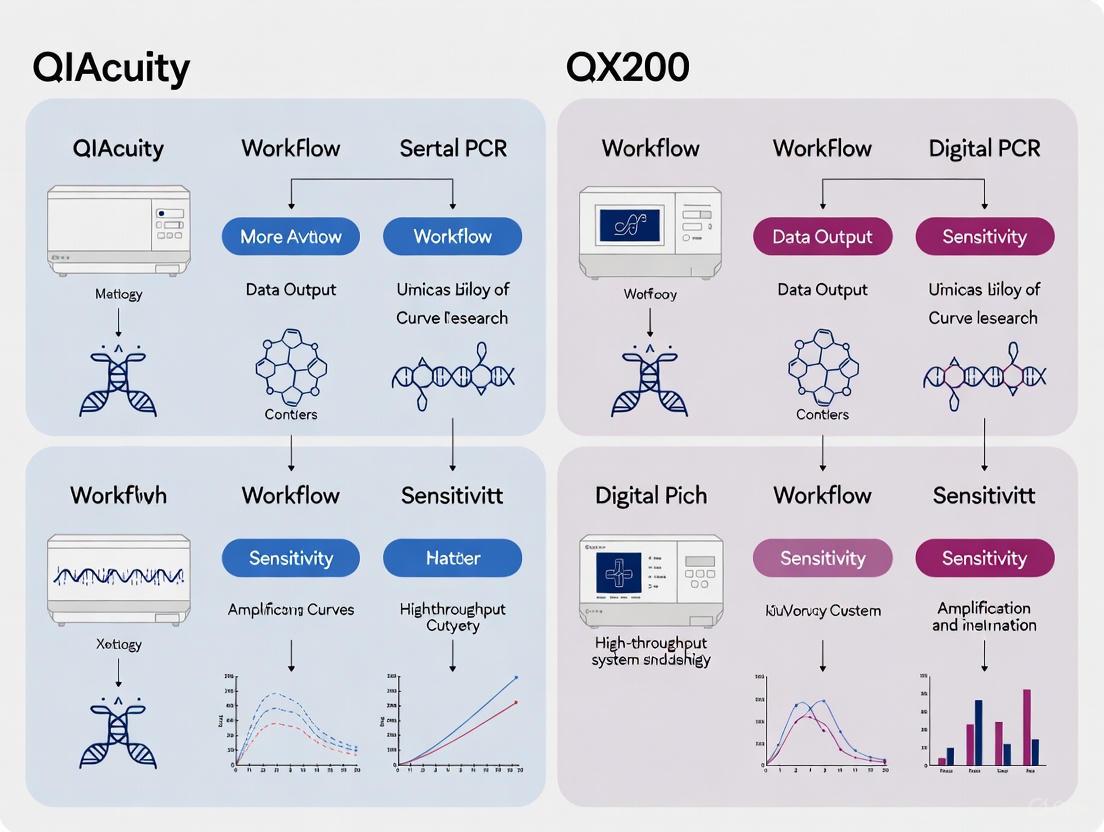
This article provides a detailed comparison of two leading digital PCR platforms, Qiagen's QIAcuity and Bio-Rad's QX200, tailored for researchers, scientists, and drug development professionals.
QIAcuity vs. QX200: A Comprehensive Comparison of Digital PCR Platforms for Biomedical Research
Abstract
This article provides a detailed comparison of two leading digital PCR platforms, Qiagen's QIAcuity and Bio-Rad's QX200, tailored for researchers, scientists, and drug development professionals. It explores the foundational technologies, workflow efficiency, and performance parameters of both systems. Drawing from recent validation studies and real-world applications in GMO quantification, cancer biomarker detection, and cell therapy, it offers practical insights for platform selection. The analysis covers methodological applications, troubleshooting considerations, and a direct performance comparison to guide informed decision-making for both research and quality control environments.
Core Technologies Unveiled: Understanding Nanoplate vs. Droplet Partitioning
In the evolving landscape of molecular diagnostics and genetic analysis, digital PCR (dPCR) has emerged as a powerful technology for absolute nucleic acid quantification. The core principle of dPCR involves partitioning a PCR reaction into thousands of individual reactions, enabling precise target quantification through Poisson statistics [1]. Two dominant partitioning methodologies have emerged: fixed nanoplates (exemplified by the QIAcuity system from Qiagen) and water-oil emulsion droplets (represented by the QX200 system from Bio-Rad). This guide provides an objective comparison of these fundamental partitioning mechanisms, supported by experimental data from recent studies, to assist researchers in selecting the appropriate platform for their specific applications in life science research and drug development.
Fundamental Partitioning Technologies
Fixed Nanoplate Technology (QIAcuity System)
The fixed nanoplate approach utilizes microfluidic chips containing precisely engineered nanoscale chambers. The QIAcuity system integrates partitioning, thermocycling, and imaging into a single instrument [2]. The partitions are physically etched into the plate, typically achieving 8,500 or 26,000 partitions per well depending on the specific nanoplate used [3]. This system employs a fully integrated workflow where the dPCR mixture is loaded into the nanoplate, which is then sealed and placed into the instrument. All subsequent processes—partitioning through capillary action, thermal cycling, and fluorescence imaging—occur automatically within the same device [2] [3]. The fixed geometry ensures consistent partition volume and shape, potentially enhancing measurement reproducibility.
Water-Oil Emulsion Droplet Technology (QX200 System)
The water-oil emulsion droplet method creates partitions through immiscible fluid dynamics. The QX200 system generates a water-in-oio emulsion where the aqueous PCR mixture is dispersed into nanoliter-sized oil-encapsulated droplets [2]. This process requires a droplet generator cartridge to form the droplets, which are then transferred to a standard 96-well plate for thermal cycling. After amplification, the plate is transferred to a droplet reader that measures fluorescence from each droplet individually as they pass in front of a laser [2]. This system typically creates 20,000 droplets per reaction, though the number can vary [3]. The emulsion-based partitioning involves multiple instruments and transfer steps, creating a more complex workflow but generating a higher number of partitions.
Comparative Experimental Data
Performance in GMO Quantification
A 2025 study directly compared both platforms for quantifying genetically modified organisms (GMOs) in soybean, a critical application for food safety and regulatory compliance. Researchers performed an in-house validation of quantitative duplex dPCR methods for MON-04032-6 and MON89788 soybean events with the lectin reference gene [2].
Table 1: Performance Comparison in GMO Quantification
| Performance Parameter | QIAcuity (Nanoplate) | QX200 (Droplet) | Acceptance Criteria |
|---|---|---|---|
| Specificity | Meets criteria | Meets criteria | According to JRC Guidance |
| Dynamic Range | Meets criteria | Meets criteria | According to JRC Guidance |
| Linearity | Meets criteria | Meets criteria | According to JRC Guidance |
| Limit of Quantification | Meets criteria | Meets criteria | According to JRC Guidance |
| Accuracy (Trueness & Precision) | Meets criteria | Meets criteria | According to JRC Guidance |
| Measurement Uncertainty | Meets criteria | Meets criteria | According to ENGL's document |
The study concluded that all evaluated data and validation parameters agreed with acceptance criteria according to JRC Guidance documents for both platforms. The duplex dPCR methods demonstrated equivalent performance to singleplex real-time PCR methods and were deemed suitable for collaborative trials toward full validation [2].
Sensitivity, Precision, and Accuracy Metrics
A comprehensive 2025 study compared the precision and accuracy of both platforms for gene copy number analysis in protists, providing critical performance metrics across dilution series [1].
Table 2: Sensitivity and Precision Metrics Comparison
| Parameter | QIAcuity (Nanoplate) | QX200 (Droplet) |
|---|---|---|
| Limit of Detection (LOD) | 0.39 copies/µL input (15.60 copies/reaction) | 0.17 copies/µL input (3.31 copies/reaction) |
| Limit of Quantification (LOQ) | 1.35 copies/µL input (54 copies/reaction) | 4.26 copies/µL input (85.2 copies/reaction) |
| Precision (CV Range) | 7-11% (synthetic oligos) | 6-13% (synthetic oligos) |
| Accuracy (R²) | R²adj = 0.98 | R²adj = 0.99 |
| Reaction Volume | 40 µL | 20 µL |
Both platforms demonstrated high precision across most analyses, with measured gene copy numbers consistently slightly lower than expected for both systems [1]. The study also found that restriction enzyme choice significantly impacted precision, especially for the QX200 system, where HaeIII demonstrated superior performance compared to EcoRI (CVs <5% with HaeIII versus 2.5%-62.1% with EcoRI) [1].
Clinical Application Concordance
In clinical applications, both platforms have demonstrated strong concordance. A 2022 study detecting H3 K27M mutations in cerebrospinal fluid for central nervous system tumor diagnostics found high agreement between quantitative data generated by both platforms [4]. In three out of four cerebrospinal fluid specimens from patients with H3 K27M-positive diffuse midline glioma, both platforms successfully detected the mutant allele, while all wild-type samples were correctly identified as negative by both systems [4].
Similarly, a 2023 study comparing dPCR platforms for FCGR3B copy number variation analysis found full concordance in copy number determination between the QX200 system, an array-based dPCR system, and traditional qPCR across 32 donors with copy numbers ranging from zero to four [5].
Experimental Workflows and Methodologies
Standardized Experimental Protocol
The following methodology is adapted from comparative studies to ensure reproducible platform comparisons [2] [1]:
Sample Preparation:
- DNA extraction using validated kits (e.g., RSC PureFood GMO kit or QIAamp Circulating Nucleic Acid Kit)
- DNA quantification via fluorometry and quality assessment using spectrophotometry (A260/A280 ratios)
- Preparation of dilution series in nuclease-free water
- Use of certified reference materials (e.g., ERM-BF410 series for GMO analysis)
QIAcuity Nanoplate Protocol:
- Prepare dPCR reaction mixture with 5× multiplex PCR mix, probes/primers, and template DNA
- Load mixture into QIAcuity Nanoplate (26k partitions per well for 24-well plate)
- Seal plate and load into QIAcuity One integrated instrument
- Execute automated partitioning, thermocycling, and imaging in a single instrument
- Analyze data using QIAcuity Software Suite for concentration calculations
QX200 Droplet Protocol:
- Prepare dPCR reaction mixture with 2× ddPCR supermix, probes/primers, and template DNA
- Transfer mixture to DG8 cartridge for droplet generation
- Generate droplets using QX200 Droplet Generator (creating ~20,000 droplets per reaction)
- Transfer emulsion to a 96-well PCR plate and seal
- Perform endpoint PCR on a conventional thermal cycler
- Read droplets using QX200 Droplet Reader
- Analyze data using QX Manager 2.1 Software
Data Analysis:
- Apply Poisson statistics for absolute quantification
- Determine limits of detection and quantification using serial dilutions
- Calculate precision through coefficient of variation across replicates
- Assess accuracy through comparison with expected values or reference methods
Workflow Visualization
Diagram 1: Comparative workflow of nanoplate vs. droplet dPCR systems
Technical Specifications Comparison
Table 3: Comprehensive Platform Specifications
| Specification | QIAcuity (Nanoplate) | QX200 (Droplet) |
|---|---|---|
| Partitioning Method | Microfluidic digital PCR plate | Water-oil emulsion droplets |
| Number of Partitions | 8,500 or 26,000 per well | ~20,000 per reaction |
| Partition Volume | ~10 nL | ~10-100 pL |
| Throughput | 312-1,248 reactions/run | 480 reactions/run (5 plates) |
| Sample Turnaround Time | ~8 hours for 1,248 samples | ~21 hours for 480 samples |
| Multiplexing Capacity | Up to 5-plex | 4-plex |
| Workflow Integration | Fully integrated (partitioning, cycling, imaging) | Multiple instruments (generator, cycler, reader) |
| Instrument Footprint | Single instrument | Multiple components |
| Cost Assessment | €€€ (moderate) | €€€€€ (higher) |
Data source: [3]
Research Reagent Solutions
Table 4: Essential Research Reagents for dPCR Experiments
| Reagent / Material | Function | Application Notes |
|---|---|---|
| Certified Reference Materials (ERM-BF410) | Provide known GM content for method validation | Essential for quantitative accuracy assessment [2] |
| DNA Extraction Kits | Isolate high-quality DNA from samples | Choice affects DNA purity and inhibitor content [2] |
| Restriction Enzymes (HaeIII, EcoRI) | Fragment genomic DNA for better target access | Enzyme choice significantly impacts precision, especially for QX200 [1] |
| dPCR Supermixes | Provide optimized buffers/enzymes for amplification | Platform-specific formulations available |
| Nuclease-free Water | Diluent for reactions | Prevents enzymatic degradation of components |
| Fluorophore-labeled Probes | Target-specific detection | FAM, VIC, HEX common for multiplexing |
Discussion and Platform Selection Guidelines
Performance and Practical Considerations
Both partitioning technologies demonstrate excellent analytical performance when properly optimized. The choice between platforms often depends on specific application requirements and practical laboratory considerations:
The fixed nanoplate system (QIAcuity) offers significant advantages in workflow simplicity and throughput. The fully integrated system reduces hands-on time and potential contamination risks [3]. The standardized partition size and geometry may contribute to more consistent results, though this requires verification in specific applications. The higher throughput and faster turnaround time make it particularly suitable for laboratories processing large sample batches.
The droplet-based system (QX200) provides flexibility in reaction setup and a proven track record across diverse applications. The higher number of partitions potentially offers better precision at very low target concentrations [1]. However, the more complex workflow involving multiple instruments and transfer steps increases hands-on time and contamination risk [3]. The "rain" phenomenon (droplets with intermediate fluorescence) can sometimes complicate data interpretation [3].
Application-Specific Recommendations
For high-throughput routine testing (e.g., GMO quantification in food control laboratories), the integrated workflow and faster turnaround time of the nanoplate system may provide significant operational advantages [2].
For applications requiring maximum sensitivity at very low target concentrations, the higher partition count of droplet systems may be beneficial, though both platforms demonstrate similar limits of detection in comparative studies [1].
For clinical diagnostics where reproducibility is critical, both platforms show strong concordance, though the standardized partitions of the nanoplate system may offer more consistent performance [4] [5].
For laboratories with budget constraints, the overall cost of ownership (including reagents, consumables, and instrument maintenance) should be carefully evaluated alongside performance requirements [3].
Both fundamental partitioning mechanisms—fixed nanoplates and water-oil emulsion droplets—provide robust platforms for digital PCR applications. Experimental evidence demonstrates that both QIAcuity and QX200 systems deliver excellent performance across various applications including GMO quantification, gene copy number analysis, and clinical mutation detection. The choice between these technologies should be guided by specific application requirements, throughput needs, workflow preferences, and available resources. As dPCR technology continues to evolve, both partitioning approaches remain viable for precise nucleic acid quantification in research and diagnostic applications.
This comparison guide provides an objective analysis of the system architecture and workflow integration of two prominent digital PCR (dPCR) platforms: the QIAGEN QIAcuity (nanoplate-based, all-in-one system) and the Bio-Rad QX200 (droplet-based, multi-instrument system). Experimental data from direct comparative studies indicate that while both platforms deliver comparable and highly precise analytical performance [2] [6], their architectural differences significantly impact laboratory workflow, hands-on time, and operational efficiency. The all-in-one QIAcuity system integrates partitioning, thermocycling, and imaging into a single instrument, enabling a walk-away workflow with results in approximately two hours. In contrast, the QX200 system requires multiple dedicated instruments and manual transfer steps, leading to a more complex and time-consuming process [2] [3].
Digital PCR (dPCR) is a sensitive nucleic acid quantification technology that works by partitioning a PCR reaction into tens of thousands of individual reactions, then using endpoint fluorescence to determine the absolute quantity of the target sequence based on Poisson statistics [2]. The core differentiator between modern dPCR platforms lies in their method of partition generation and the resulting system workflow.
The QIAcuity employs a nanoplate-based, all-in-one architecture. It uses microfluidic nanoplates containing either 8,500 or 26,000 partitions. The instrument itself is a fully integrated system that performs partitioning, thermocycling, and imaging sequentially without user intervention between steps [7] [8]. This design mimics a standard qPCR workflow.
The QX200 utilizes a droplet-based, multi-instrument workflow. It generates partitions via a water-oil emulsion, creating nanoliter-sized droplets (typically 20,000 per sample) using a dedicated droplet generator. The emulsion is then transferred to a standard 96-well plate for thermocycling in a separate device. Finally, the plate is moved to a droplet reader for fluorescence detection [2] [3]. This process involves multiple instruments and manual handling steps.
Experimental Comparison: Performance and Workflow
Methodology for Direct Platform Comparison
A 2025 study provided a direct comparison of the QIAcuity One and QX200 platforms for GMO quantification, offering a detailed protocol for cross-platform evaluation [2].
- DNA Samples: Certified Reference Materials (CRMs) for MON-04032-6 and MON89788 soybean lines were used. DNA was extracted using a Promega Maxwell RSC Instrument with the RSC PureFood GMO kit for the QIAcuity platform, while a CTAB buffer-based method (ISO21571:2005) was used for the QX200 platform [2].
- Assay Transfer: Identical primer-probe sets for the MON-04032-6, MON89788, and lectin reference gene assays were used on both platforms. The previously validated MON89788 duplex assay for the QX200 was directly transferred to the QIAcuity without modification [2].
- Reaction Setup:
- QX200: Reaction mixtures were loaded into a DG8 cartridge for droplet generation. The generated droplets were then manually transferred to a 96-well plate, which was heat-sealed before PCR amplification [2].
- QIAcuity: Reaction mixtures were pipetted directly into a 24-well QIAcuity Nanoplate 26k, which was then sealed with a foil and placed into the instrument [2].
- Data Analysis: Performance parameters including dynamic range, linearity, limit of quantification (LOQ), accuracy (trueness and precision), and measurement uncertainty were assessed for both platforms according to JRC Guidance documents and international standards [2].
Key Findings and Performance Metrics
The experimental results demonstrated that both platforms are capable of highly reliable quantification, with the all-in-one workflow offering significant time savings.
Table 1: Summary of Key Performance and Operational Metrics
| Parameter | QIAGEN QIAcuity | Bio-Rad QX200 | Source |
|---|---|---|---|
| System Architecture | All-in-One Integrated | Multi-Instrument Workflow | [2] [3] |
| Partitioning Method | Microfluidic Nanoplate | Water-Oil Emulsion Droplets | [2] |
| Partitions per Reaction | 8,500 or 26,000 | ~20,000 | [7] [3] |
| Time to Result | ~2 hours | 4-6 hours (estimated from workflow) | [7] [3] |
| Hands-on Time | Low (qPCR-like workflow) | Moderate to High (multiple transfer steps) | [3] |
| GMO Quantification Performance | Met all validation parameters | Met all validation parameters | [2] |
| Precision (Comparative Study) | High precision demonstrated | High precision demonstrated | [6] |
| Multiplexing Capability | Up to 12-plex (with specific kit) | Up to 4-plex (QX600 for higher plex) | [7] [9] |
A 2022 study comparing the platforms for SARS-CoV-2 detection further confirmed their analytical equivalence, noting that discrepant results were primarily observed in samples with viral loads near the limit of detection (LoD), a common challenge in ultra-sensitive assays [10].
Workflow Architecture and Visualization
The fundamental difference between the two systems is visually apparent in their workflow diagrams. The QIAcuity streamlines the process into a single, automated instrument, whereas the QX200 workflow is distributed across several specialized devices.
dFigure 1: A comparison of the automated, integrated workflow of the QIAcuity versus the multi-instrument, transfer-heavy workflow of the QX200.
The Scientist's Toolkit: Essential Reagents and Materials
The following table details key consumables and reagents required for operating these dPCR platforms, based on the methodologies described in the cited studies.
Table 2: Essential Research Reagent Solutions for dPCR Workflows
| Item | Function/Description | Platform Context |
|---|---|---|
| dPCR Nanoplates | Microfluidic plates with fixed partitions for reaction setup. | QIAcuity-specific consumable (e.g., 24-well or 96-well format) [7] [8]. |
| DG8 Cartridges & Oil | Cartridges for generating water-in-oil emulsion droplets and the corresponding droplet generation oil. | QX200-specific consumable for the partitioning step [2] [3]. |
| dPCR Supermix | Optimized master mix containing DNA polymerase, dNTPs, and buffers suitable for dPCR chemistry. | Required for both platforms, though formulations may be platform-specific [2] [9]. |
| FAM & HEX/VIC Probes | Hydrolysis probes (TaqMan) for fluorescent detection of target and reference/control genes. | Used for duplex assays on both platforms [2] [9]. |
| Certified Reference Materials (CRMs) | Genomic DNA standards with known characteristics (e.g., GMO percentage) for assay validation and calibration. | Critical for performance validation and ensuring accurate quantification, as used in the cited studies [2]. |
| DNA Extraction Kits | Kits for high-quality DNA isolation from complex samples (e.g., CTAB method, commercial kits). | Essential pre-step for both platforms; purity impacts assay performance [2]. |
The choice between an all-in-one and a multi-instrument dPCR workflow has tangible implications for laboratory practice. The QIAcuity's integrated architecture reduces hands-on time, minimizes the risk of contamination and pipetting errors associated with multiple transfer steps, and simplifies operator training due to its similarity to a qPCR workflow [3]. The ability to process a full plate in approximately two hours is a significant throughput advantage.
The QX200's multi-instrument setup, while more cumbersome, is a well-established technology. Its primary historical advantage was the very high number of partitions, which can theoretically improve precision for low-abundance targets. However, as the cited studies show, newer nanoplate systems with high partition counts (26,000) demonstrate performance that is equivalent in precision and accuracy for a wide range of applications [2] [6]. A noted challenge with droplet-based systems is the phenomenon of "rain" (droplets with intermediate fluorescence), which can complicate data analysis [3].
In conclusion, the experimental evidence confirms that both the QIAcuity and QX200 are highly capable analytical platforms. The decision between them should be guided by specific laboratory priorities. For labs seeking maximum workflow efficiency, minimal manual intervention, and faster time-to-result, the all-in-one architecture of the QIAcuity presents a compelling advantage. For labs that require the specific attributes of droplet-based partitioning or are heavily invested in the established ddPCR ecosystem, the QX200 remains a robust, albeit more labor-intensive, solution.
This guide provides an objective comparison of two prominent digital PCR (dPCR) platforms: the droplet-based Bio-Rad QX200 and the nanoplate-based QIAGEN QIAcuity. We focus on their key technical specifications—partitions, throughput, and detection channels—supported by experimental data and methodological details from recent studies to aid in informed platform selection.
The core difference between these platforms lies in their partitioning technology. The QX200 uses a water-oil emulsion to generate droplets, while the QIAcuity uses microfluidic nanoplates to create individual reaction chambers [2] [3]. This fundamental distinction influences many other specifications and the overall workflow.
The table below summarizes the head-to-head technical specifications of the two systems.
| Specification | Bio-Rad QX200 | QIAGEN QIAcuity |
|---|---|---|
| Partitioning Method | Droplet-based (water-oil emulsion) [2] | Nanoplate-based (microfluidic chambers) [2] |
| Number of Partitions | ~20,000 droplets per reaction [3] [11] | 8,500 or 26,000 partitions per well, depending on the plate used [2] [3] |
| Partition Volume | Not specified in results | Not specified in results |
| Throughput (Reactions/Run) | 96 wells per run (traditional 96-well plate format) [2] | 96-well plate: Up to 1,248 reactions24-well plate: 312 reactions [3] |
| Detection Channels | 2-channel detection [2] | 5-channel optical format [2] |
| Multiplexing Capability | Limited in duplex assays [2] | Up to 5-plex [11] |
| Workflow | Multiple instruments: droplet generator, thermocycler, droplet reader [2] [3] | Fully integrated system: partitioning, thermocycling, imaging in one instrument [2] [3] |
| Sample Turnaround Time (TAT) | Not specified for direct comparison; workflow is more time-consuming [11] | Faster; approximately 2 hours for a full run [3] [11] |
Comparative Experimental Performance Data
Independent studies have directly compared the performance of the QIAcuity and QX200 platforms in various applications. The following table synthesizes key experimental findings from recent peer-reviewed research.
| Application / Study | Key Experimental Findings | Implications for Platform Selection |
|---|---|---|
| GMO Soybean Quantification [2] | Both platforms demonstrated equivalent performance for duplex assays, meeting all validation parameters (specificity, dynamic range, linearity, LOQ, accuracy). | Both platforms are suitable for routine quantitative analysis in food safety controls. |
| Gene Copy Number in Protists [1] | Both showed similar limits of detection (LOD) and quantification (LOQ), and high precision. Precision for QX200 was significantly improved by using the HaeIII restriction enzyme. | Both are precise for environmental DNA; sample prep is critical. QX200 may be more sensitive to reaction chemistry. |
| Liquid Biopsy for Cancer [12] | Moderate agreement between platforms. QIAcuity showed higher clinical sensitivity (100% vs 58.8% for EGFR; 86.4% vs 72.7% for RAS) compared to tissue results. | QIAcuity may offer superior sensitivity for detecting rare mutations in challenging samples like cfDNA. |
Detailed Experimental Protocols from Cited Studies
To ensure reproducibility and provide context for the data, here are the detailed methodologies from the key comparative studies.
- DNA Extraction: DNA was extracted from Certified Reference Materials (CRMs) using either the Promega Maxwell RSC instrument with the RSC PureFood GMO kit or a manual CTAB buffer method.
- Sample Preparation: GM levels (0.05% to 10%) were prepared by mixing GM and non-GM materials based on the absolute copy number of the reference gene (lectin) measured by dPCR.
- dPCR Reaction: Duplex assays for MON-04032-6 and MON89788 soybean events with the lectin reference gene were run on both platforms. Identical primer-probe sets were used for a direct comparison.
- Data Analysis: Validation parameters assessed included specificity, dynamic range, linearity, limit of quantification (LOQ), and accuracy (trueness and precision), following international guidelines.
- Sample Types: The study used both synthetic oligonucleotides and DNA extracted from varying cell numbers of the ciliate Paramecium tetraurelia.
- Enzyme Digestion: The impact of nucleic acid accessibility was tested by using two different restriction enzymes (EcoRI and HaeIII) during sample preparation.
- dPCR Analysis: Samples were run on both platforms to estimate gene copy numbers.
- Statistical Evaluation: The study evaluated the Limit of Detection (LOD), Limit of Quantification (LOQ), accuracy (comparison of expected vs. measured copies), and precision (Coefficient of Variation, CV%).
- Sample Collection: Plasma samples were collected from patients with Non-Small Cell Lung Cancer (NSCLC) and Colorectal Cancer (CRC) as per routine procedures.
- cfDNA Extraction: Cell-free DNA (cfDNA) was extracted from the plasma samples.
- Mutation Detection: The samples were screened for specific EGFR and RAS mutations on both the QX200 (ddPCR) and QIAcuity (dPCR) platforms.
- Data Comparison: The detection rates and agreement (using Cohen's kappa, κ) between the two dPCR platforms and with tissue-based results were calculated.
The Scientist's Toolkit: Essential Research Reagent Solutions
The table below lists key reagents and consumables used in the featured dPCR experiments, which are critical for experimental success.
| Item | Function / Description | Example from Studies |
|---|---|---|
| Certified Reference Materials (CRMs) | Provides a known, standardized quantity of target material for assay validation and calibration. | MON-04032-6 SOYA BEAN ERM-BF410dp (10 g/kg) from JRC [2]. |
| DNA Extraction Kits | Isolates high-quality, inhibitor-free DNA from complex biological samples, crucial for dPCR accuracy. | RSC PureFood GMO kit (Promega) used with Maxwell RSC Instrument [2]. |
| Restriction Enzymes | Digests DNA to reduce viscosity and improve access to target sequences, enhancing amplification efficiency. | HaeIII and EcoRI were tested for their impact on precision in gene copy number analysis [1]. |
| dPCR Supermixes | Optimized buffered solutions containing DNA polymerase, dNTPs, and MgCl₂, tailored for specific dPCR chemistries. | Assay-specific master mixes were used on both QIAcuity and QX200 platforms [2] [1]. |
| Nuclease-Free Water | Serves as a diluent for DNA and reaction mixes, ensuring no enzymatic degradation of nucleic acids. | Used for preparing serial dilutions of DNA extracts [2]. |
dPCR Workflow Comparison
The following diagram illustrates the key procedural differences between the QX200 and QIAcuity workflows, highlighting the more streamlined nature of the nanoplate-based system.
Key Selection Criteria for Your Research
When choosing between the QIAcuity and QX200, consider these core differentiators derived from the experimental data:
- For Maximum Multiplexing and Throughput: The QIAcuity, with its 5-plex capability and potential to run over a thousand reactions in a single automated run, is better suited for high-throughput labs where multiplexing and workflow efficiency are priorities [3] [11].
- For a Proven, Established Workflow: The QX200 is a well-established droplet-based system with a vast body of peer-reviewed literature and a proven track record in diverse applications, including those requiring high partition numbers [1].
- For Workflow Simplicity and Contamination Control: The QIAcuity's integrated, nanoplate-based system minimizes manual handling and transfer steps, reducing hands-on time and the risk of contamination, which is critical in quality control (QC) environments [3] [11].
- For Applications Demanding High Sensitivity: Recent clinical studies suggest that nanoplate-based systems like the QIAcuity may offer superior sensitivity for detecting rare mutations in challenging sample types like cfDNA, though performance is application-dependent [12].
Digital PCR (dPCR) represents the third generation of polymerase chain reaction technology, enabling absolute quantification of nucleic acids without the need for standard curves. This technique partitions samples into thousands of individual reactions, providing precise and sensitive measurements that surpass the capabilities of quantitative real-time PCR (qPCR). Within the context of comparing leading dPCR platforms—Qiagen's QIAcuity and Bio-Rad's QX200—this guide explores the technical foundations, performance advantages, and experimental applications of dPCR for researchers and drug development professionals.
Digital PCR (dPCR) is a breakthrough nucleic acid quantification technology that operates by partitioning a PCR mixture into thousands of nanoliter-sized reactions, each acting as an individual amplification event [13]. This partitioning allows for the absolute quantification of target DNA or RNA molecules based on Poisson distribution statistics applied to the ratio of positive to negative partitions after end-point PCR amplification [11] [13]. Unlike quantitative real-time PCR (qPCR), which relies on standard curves and relative quantification based on amplification kinetics, dPCR provides direct absolute quantification without external calibration [14] [13].
The evolution of dPCR began with foundational work in limiting dilution PCR and Poisson statistics in the early 1990s, with the term "digital PCR" formally coined in 1999 by Bert Vogelstein and colleagues [13]. The technology has since matured through advancements in microfluidics and microfabrication, leading to the development of commercial platforms utilizing different partitioning mechanisms, primarily water-in-oil droplet emulsification (ddPCR) and microchamber-based systems (dPCR) [13]. This technological progression has positioned dPCR as an essential tool for applications requiring high precision, sensitivity, and absolute quantification in research and diagnostic contexts.
Fundamental Advantages of dPCR over qPCR
Absolute Quantification without Standard Curves
The most significant advantage of dPCR is its capability for absolute quantification without requiring standard curves. While qPCR depends on reference samples of known concentration to generate calibration curves for relative quantification, dPCR directly calculates target concentration using Poisson statistics based on the proportion of positive partitions [14]. This eliminates potential inaccuracies from deteriorating reference standards and reduces experimental setup time and complexity [14].
Enhanced Tolerance to PCR Inhibitors
dPCR demonstrates superior performance in the presence of PCR inhibitors compared to qPCR. The massive partitioning of the sample dilutes inhibitors across thousands of individual reactions, reducing their impact on amplification efficiency [14]. Studies have shown that dPCR maintains accurate quantification even at high inhibitor concentrations where qPCR performance dramatically declines [14]. This robustness makes dPCR particularly valuable for analyzing complex samples like soil, food, and clinical specimens that often contain inhibitory substances.
Superior Sensitivity and Precision
dPCR offers enhanced sensitivity for detecting rare genetic events and improved precision in quantification. The partitioning approach allows for reliable detection of single molecules, enabling identification of rare mutations in a background of wild-type DNA [14] [13]. This high sensitivity makes dPCR invaluable for applications such as liquid biopsy in cancer monitoring, where rare tumor DNA must be detected in circulating blood samples [13]. Additionally, dPCR provides greater precision, especially for low-abundance targets, making it suitable for subtle gene expression changes and copy number variations [1] [11].
Comparative Analysis of dPCR Platforms: QIAcuity vs. QX200
Platform Technologies and Workflows
The QIAcuity and QX200 represent two different approaches to dPCR implementation. Bio-Rad's QX200 is a droplet digital PCR (ddPCR) system that utilizes a water-oil emulsion to create approximately 20,000 nanoliter-sized droplets for partitioning [2] [11]. This workflow requires multiple instruments including a droplet generator, thermal cycler, and droplet reader [2]. In contrast, Qiagen's QIAcuity is a nanoplate-based system that integrates partitioning, thermocycling, and imaging into a single automated instrument [2] [7]. The QIAcuity uses microfluidic nanoplates containing up to 26,000 partitions per well, significantly streamlining the workflow and reducing hands-on time [2] [7].
Performance Comparison in Quantitative Applications
Recent studies have directly compared the performance of these platforms for various applications. In GMO quantification studies, both platforms demonstrated excellent performance meeting validation parameters according to JRC Guidance documents [2]. The platforms showed equivalence in performance to singleplex real-time PCR methods while offering the advantages of multiplexing capabilities [2].
A 2025 study comparing precision for copy number analysis in protists found both platforms demonstrated similar detection and quantification limits with high precision across most analyses [1]. The QIAcuity showed a slightly higher limit of detection (0.39 copies/μL) compared to the QX200 (0.17 copies/μL), but the QX200 had a higher limit of quantification (4.26 copies/μL) compared to QIAcuity (1.35 copies/μL) [1]. Both platforms showed good correlation between expected and measured gene copy numbers, though measured values were consistently lower than expected for both systems [1].
Multiplexing and Throughput Capabilities
The QIAcuity offers advanced multiplexing capabilities, supporting detection of up to 12 targets in parallel using six standard channels with amplitude multiplexing [7]. This extensive multiplexing is particularly valuable for complex assays requiring simultaneous quantification of multiple targets. The QX200 typically supports 2-plex detection, though newer models like the QX600 and QX700 have expanded these capabilities [11].
For throughput, the QIAcuity Eight platform can process up to 1,536 samples in a 96-well format during an 8-hour shift, while the QX200 systems require more manual intervention and have lower throughput capabilities [7]. The integrated nature of the QIAcuity reduces hands-on time and streamlines workflows, making it particularly suitable for quality control environments where efficiency and reproducibility are paramount [11].
Table 1: Platform Specification Comparison
| Parameter | QIAcuity One 5plex | QX200 ddPCR System |
|---|---|---|
| Partitioning Mechanism | Nanoplate microchambers | Water-oil emulsion droplets |
| Partitions per Reaction | Up to 26,000 | ~20,000 |
| Multiplexing Capacity | Up to 12-plex | Typically 2-plex (up to 6-plex in newer models) |
| Workflow Integration | Fully integrated system | Multiple instruments required |
| Time to Results | ~2 hours | 6-8 hours |
| Throughput (8-hour shift) | Up to 480 samples (96-well) | Lower throughput due to manual steps |
| Detection Channels | 8 channels (6 standard + 2 hybrid) | 2 channels (FAM and HEX) |
Table 2: Performance Comparison in Experimental Studies
| Performance Metric | QIAcuity | QX200 |
|---|---|---|
| Limit of Detection (copies/μL) | 0.39 [1] | 0.17 [1] |
| Limit of Quantification (copies/μL) | 1.35 [1] | 4.26 [1] |
| Dynamic Range | Linear across 6 orders of magnitude [1] | Linear across 6 orders of magnitude [1] |
| Precision (CV) with Synthetic DNA | 7-11% [1] | 6-13% [1] |
| Precision with Restriction Enzymes | Less affected by enzyme choice [1] | Improved with HaeIII vs. EcoRI [1] |
| Accuracy (R²) | R²adj = 0.98 [1] | R²adj = 0.99 [1] |
Experimental Protocols and Methodologies
GMO Quantification Assay Protocol
Studies comparing dPCR platforms for GMO quantification provide detailed experimental methodologies. For detecting MON-04032-6 and MON89788 soybean events, DNA is typically extracted from certified reference materials using kits such as the RSC PureFood GMO kit with Maxwell RSC Instrument [2]. DNA concentration is measured by dPCR targeting the lectin (lec) reference gene, with inhibition tests performed using three serial dilution levels measured in duplicate [2]. The acceptance criterion requires that the average absolute copies per reaction measured in diluted samples multiplied by the dilution factor should not differ by more than 25% from the average copies measured at the highest concentration [2].
For sample preparation, various GM levels (ranging from 0.05% to 10% mass/mass) are prepared by mixing positive GM material with non-GM material [2]. These mixtures are prepared based on the absolute copy number of the lec reference gene measured by dPCR, ensuring accurate proportioning [2]. Reaction mixtures are prepared according to platform-specific requirements and loaded for analysis. The QIAcuity system uses predefined nanoplates, while the QX200 requires droplet generation cartridges for partition creation [2].
Platform-Specific Optimization Procedures
Optimal performance on both platforms requires specific optimization procedures. For the QIAcuity, reaction mixtures are loaded onto Nanoplate 26k, which provides 24 reactions with approximately 26,000 partitions per well [2]. After sealing, the nanoplate is loaded into the integrated instrument for thermocycling, imaging, and analysis using the QIAcuity Software Suite [2].
For the QX200 system, the workflow involves preparing reaction mixtures and transferring them to a droplet generation cartridge [2]. Droplets are created using the QX200 Droplet Generator, then transferred to a 96-well plate for thermocycling [2]. After amplification, the plate is transferred to a QX200 Droplet Reader for analysis, with data processed using QX Manager software [2]. Method verification and validation should follow established guidelines and international standards to ensure reliability of results [2].
Essential Research Reagent Solutions
Table 3: Key Research Reagents for dPCR Experiments
| Reagent/Category | Function | Platform Compatibility |
|---|---|---|
| Certified Reference Materials (CRMs) | Provide standardized DNA for assay validation and quantification | Both platforms [2] |
| DNA Extraction Kits | Isolate high-quality DNA from various sample types | Both platforms [2] |
| dPCR Master Mixes | Optimized reaction mixtures for partition-based amplification | Platform-specific formulations available |
| Restriction Enzymes | Enhance DNA accessibility, especially for tandem repeats | Both platforms (HaeIII recommended) [1] |
| Fluorescent Probes | Target-specific detection with fluorophore-quencher systems | Both platforms (FAM, HEX compatible) |
| Nuclease-Free Water | Diluent for DNA samples and reaction preparation | Both platforms [2] |
Application Case Studies in Biomedical Research
GMO Detection and Quantification
dPCR has proven particularly valuable in regulatory environments requiring precise GMO quantification. In studies quantifying MON-04032-6 and MON89788 soybean events, both QIAcuity and QX200 platforms demonstrated performance parameters meeting acceptance criteria according to JRC Guidance documents [2]. The duplex dPCR methods showed equivalence to singleplex real-time PCR methods while offering the advantages of multiplexing capabilities and absolute quantification without standard curves [2]. This application highlights dPCR's utility in regulatory science where precise threshold determinations (e.g., the EU's 0.9% GMO labeling requirement) are critical [2].
Gene Copy Number Variation Analysis
Both platforms have demonstrated excellent performance in copy number variation studies. Research on Paramecium tetraurelia showed that both systems could reproducibly estimate gene copy numbers and display linear trends with increasing cell numbers [1]. The study highlighted the importance of restriction enzyme selection, with HaeIII providing higher precision than EcoRI, particularly for the QX200 system [1]. This application underscores dPCR's value in functional genomics studies where accurate gene copy number determination is essential for understanding genotype-phenotype relationships.
Clinical Research Applications
In clinical contexts, dPCR has enabled significant advances in liquid biopsy applications for cancer monitoring [13]. The technology's ability to detect rare mutations against a background of wild-type DNA has facilitated non-invasive tumor genotyping and treatment response monitoring [13]. Additionally, dPCR has found applications in prenatal diagnosis through detection of aneuploidy or inherited mutations, and in infectious disease diagnostics for pathogen identification and antibiotic resistance gene detection [13]. These clinical applications leverage dPCR's superior sensitivity, precision, and robustness compared to qPCR technologies.
Digital PCR represents a significant advancement in nucleic acid quantification technology, offering absolute quantification without standard curves, enhanced resistance to inhibitors, and superior sensitivity for rare variant detection. The comparative analysis of QIAcuity and QX200 platforms reveals distinct strengths: the QIAcuity offers streamlined workflows, advanced multiplexing, and higher throughput, while the QX200 provides exceptional sensitivity and a proven track record in research applications. Platform selection should be guided by specific application requirements, with the integrated nature of the QIAcuity being particularly advantageous for quality control environments, and the QX200 remaining a robust choice for research applications requiring maximum sensitivity. As dPCR technology continues to evolve, its applications in biomedical research, clinical diagnostics, and regulatory science are expected to expand further, solidifying its position as an essential tool for precise nucleic acid quantification.
From Bench to Application: Workflow and Use Cases in Modern Labs
In the context of digital PCR (dPCR) platform comparison, workflow efficiency is a critical differentiator for laboratory productivity. The QIAcuity (QIAGEN) and QX200 (Bio-Rad) systems employ fundamentally different approaches to sample partitioning and analysis. The QIAcuity system utilizes an integrated nanoplate-based technology where partitioning, thermocycling, and imaging occur on a single, automated instrument [2] [15]. In contrast, the QX200 system employs a droplet-based technology that requires multiple separate instruments—a droplet generator, a thermal cycler, and a droplet reader—to complete the analytical process [2] [16]. This fundamental distinction in workflow architecture directly impacts hands-on time, total time-to-results, and potential for operator error.
Direct Workflow Comparison
QIAcuity Integrated Nanoplate Workflow
The QIAcuity system streamlines the dPCR process into a simplified, automated workflow [15]. Following reaction setup in a dedicated nanoplate, the instrument performs all subsequent steps automatically:
- Partitioning: The system partitions the reaction mix into thousands of nanoscale chambers using a microfluidic chip.
- Thermocycling: The plate undergoes PCR amplification within the integrated instrument.
- Imaging and Analysis: A built-in imager captures fluorescence data from each partition, and integrated software performs Poisson-corrected analysis.
This integrated approach typically delivers results in less than 90 minutes post-sample preparation with minimal hands-on intervention [11].
QX200 Droplet Digital PCR Workflow
The QX200 workflow involves multiple discrete steps and instruments [2]:
- Droplet Generation: The prepared reaction mix is transferred to a droplet generation cartridge where an oil-water emulsion creates thousands of nanoliter-sized droplets.
- Thermocycling: The emulsion is carefully transferred to a standard 96-well plate for PCR amplification on a separate thermal cycler.
- Droplet Reading: The amplified plate is transferred to a droplet reader where droplets flow single-file past a fluorescence detector.
- Data Analysis: Results are analyzed using separate software (QuantaSoft or QX Manager).
This multi-instrument process requires 6-8 hours to complete and involves significantly more manual handling [11].
Table 1: Direct Workflow Comparison Between QIAcuity and QX200
| Workflow Parameter | QIAGEN QIAcuity | Bio-Rad QX200 |
|---|---|---|
| Partitioning Method | Integrated microfluidic nanoplate [15] | Water-oil emulsion droplets [2] |
| Instrument Integration | Single instrument (partitioning, cycling, imaging) [15] | Multiple instruments (generator, cycler, reader) [2] |
| Hands-on Time | Minimal after plate loading | Significant for transfers between instruments |
| Total Time-to-Result | < 2 hours [11] | 6-8 hours [11] |
| Risk of Contamination | Lower (closed system) [11] | Higher (multiple open transfers) [11] |
| Workflow Complexity | Low, "sample-in, results-out" [11] | Moderate to high [2] |
Experimental Evidence from Comparative Studies
GMO Quantification Workflow Analysis
A 2025 study directly comparing both platforms for genetically modified organism (GMO) quantification highlighted the workflow differences [2]. Researchers noted that the QIAcuity workflow involved "a fully integrated system with partitioning, thermocycling, and imaging performed on a single instrument," while the QX200 workflow required "transfer of each reaction into a droplet generation cartridge" followed by "transfer to a droplet reader" after thermocycling [2]. This additional handling translated to more opportunities for error and considerably extended the total processing time, despite both platforms producing scientifically equivalent quantification results for MON-04032-6 and MON89788 soybean events.
HIV Transcription Profiling Protocol Comparison
A 2023 study adapting HIV transcription profiling from ddPCR to dPCR provided detailed workflow comparisons [15]. The researchers emphasized that "Qiagen's QIAcuity instrument offers the advantage of performing partitioning, thermocycling, and imaging as a single, fully automated instrument, which considerably reduces hands-on time, with shorter time to results" [15]. This automated integration proved particularly valuable for high-throughput applications requiring multiple target detection, such as comprehensive viral reservoir characterization in patients on antiretroviral therapy.
Essential Research Reagent Solutions
The experimental protocols from comparative studies reveal several consistent reagent requirements across both platforms:
Table 2: Key Research Reagent Solutions for dPCR Workflows
| Reagent/Material | Function | Platform Application |
|---|---|---|
| QIAcuity Probe PCR Master Mix | Provides optimized reaction components for probe-based detection | QIAcuity-specific [15] |
| ddPCR Supermix (no dUTP) | Stable emulsion formation and PCR components for droplet systems | QX200-specific [15] |
| QIAcuity Nanoplates (26k/24-well) | Integrated microfluidic chips for partitioning and amplification | QIAcuity-specific [2] [15] |
| DG32 Cartridges & Droplet Generation Oil | Creates water-oil emulsion for droplet formation | QX200-specific [2] |
| Certified Reference Materials (CRMs) | Provides standardized DNA for assay validation and quantification | Both platforms [2] |
| Restriction Enzymes (EcoRI, HaeIII) | Digests genomic DNA to improve target accessibility | Both platforms [1] |
Workflow Diagram
The following diagram illustrates the core procedural differences between the two platforms' workflows:
Impact on Laboratory Operations
The workflow differences between platforms have practical implications for laboratory efficiency and operational design. The QIAcuity's integrated approach reduces hands-on technical time, allowing staff to pursue other value-added activities [11]. The system's streamlined process also minimizes contamination risk through fewer open-tube manipulations, a crucial consideration for clinical applications and high-sensitivity research [11]. Furthermore, the faster turnaround time (approximately 2 hours versus 6-8 hours) enables same-day experimental repeat or verification when needed, accelerating research cycles [11] [15].
Conversely, while the QX200 workflow requires more manual intervention and longer processing times, studies confirm its analytical performance remains robust across diverse applications from GMO quantification to pathogen detection [2] [10]. The platform benefits from extensive established protocols and widespread institutional familiarity. However, the multi-step process demands more meticulous planning for high-throughput applications and may require specialized training to minimize technical variation introduced during manual handling steps [2].
Workflow efficiency differences between the QIAcuity and QX200 platforms are substantial and technologically inherent. The QIAcuity's integrated nanoplate system provides a streamlined, automated workflow with significantly reduced hands-on time and faster time-to-results (under 2 hours versus 6-8 hours), making it particularly suitable for quality control environments and laboratories prioritizing throughput and operational efficiency [11] [15]. The QX200's droplet-based system, while requiring more manual processing and longer run times, continues to deliver high-quality analytical performance validated across countless research applications [2] [1] [10]. The selection between platforms should be guided by specific laboratory priorities—whether maximizing workflow efficiency and automation or leveraging established droplet-based methodologies with proven performance characteristics.
Digital PCR (dPCR) has revolutionized nucleic acid quantification by enabling absolute target measurement without the need for standard curves [2]. A key advancement in this technology is multiplexing—the ability to simultaneously detect and quantify multiple targets in a single reaction. For researchers investigating complex biological systems, monitoring multiple pathogens, or analyzing genetic variations, multiplexing provides critical advantages including reduced reagent costs, minimized sample input, and increased experimental throughput while delivering highly precise data [17] [18]. The QIAcuity dPCR system (QIAGEN) has significantly advanced these capabilities through recent technological innovations. This guide examines the evolution of multiplexing on the QIAcuity platform, comparing the established 5-plex capabilities with the newly introduced 12-plex technology, while contextualizing these advancements against the background of dPCR platform comparisons, particularly with Bio-Rad's QX200 system.
Technical Comparison: 5-plex vs. 12-plex Capabilities
The QIAcuity platform has undergone substantial improvements in its multiplexing capabilities, largely achieved through a software update and new chemistry rather than hardware modifications [18]. The table below summarizes the key technical specifications of both multiplexing levels:
Table 1: Technical Specifications of QIAcuity Multiplexing Levels
| Feature | Standard 5-plex | High-Order 12-plex |
|---|---|---|
| Maximum Targets | 5 targets/reaction [18] | 12 targets/reaction [18] |
| Hardware Requirements | Existing QIAcuity instruments [18] | Existing QIAcuity instruments [18] |
| Software Requirements | Standard analysis software | QIAcuity Software 3.1 with crosstalk compensation [18] |
| Core Chemistry | Standard probe PCR kits | QIAcuity High Multiplex Probe PCR Kit [18] |
| Key Applications | Pathogen detection, gene expression, CNV analysis [19] [20] | Translational research, microbiome analysis, pathogen detection, cell and gene therapy development [18] |
| Partitioning Method | Nanoplate-based (26,000 partitions/well for 26k plates) [2] | Nanoplate-based (26,000 partitions/well for 26k plates) [2] |
| Workflow Integration | Fully integrated partitioning, thermocycling, and imaging [2] | Fully integrated partitioning, thermocycling, and imaging [2] |
This evolution in multiplexing capacity represents more than a simple numerical increase. The 12-plex technology enables researchers to design more comprehensive panels for complex applications, such as simultaneously screening multiple pathogen markers or analyzing numerous genetic variants in cancer pathways [18] [21]. The implementation of crosstalk compensation in the software is particularly crucial for high-order multiplexing, as it corrects for signal overlap between targets, maintaining data reliability even as the number of simultaneously detected targets increases [18].
Experimental Protocols and Methodologies
Standard 5-plex Workflow
The established 5-plex methodology on the QIAcuity platform typically employs a combination of amplitude-based multiplexing and probe-mixing strategies to distinguish between targets [17]. In amplitude-based multiplexing, primer and/or probe concentrations are varied to create separation between droplet clusters on the 2-D plot [17]. For probe-mixing multiplexing, different ratios of FAM and HEX fluorophores are used for each target, creating unique fluorescent signatures [17]. A typical 5-plex assay might use the following probe ratios: T1 (1:0 FAM:HEX), T2 (3:1), T3 (1:1), T4 (1:3), and T5 (0:1) [17].
The general workflow involves:
- Assay Design: Specific primers and probes for each target are designed, following established guidelines for Tm and specificity [19].
- Reaction Setup: The dPCR reaction mix is prepared using the appropriate supermix, with careful optimization of primer and probe concentrations for each target.
- Loading and Partitioning: The reaction mixture is loaded into a QIAcuity nanoplate, which creates up to 26,000 partitions per well for a 26k plate [2].
- Thermocycling and Imaging: The fully integrated QIAcuity instrument performs PCR amplification and imaging without user intervention [2].
- Data Analysis: The QIAcuity Software Suite analyzes the fluorescence signals in each partition, classifying them according to their target identity [2].
High-Order 12-plex Implementation
The 12-plex workflow builds upon the standard methodology but incorporates specialized reagents and software features:
- Kit-Based Master Mix: The QIAcuity High Multiplex Probe PCR Kit provides a ready-to-use master mix specifically optimized for high-order multiplexing in microfluidic systems [18].
- Advanced Software Features: The QIAcuity Software 3.1 introduces essential features for high-order multiplexing, with crosstalk compensation being particularly critical for accurately distinguishing between 12 different targets [18].
- Assay Validation: QIAGEN has redesigned its dPCR catalog and custom assays for copy number variation analysis and microbial detection to support up to 12-plex reactions, available through the GeneGlobe platform [18].
Table 2: Essential Research Reagent Solutions for QIAcuity Multiplexing
| Reagent/Component | Function in Multiplex dPCR | Application Notes |
|---|---|---|
| QIAcuity High Multiplex Probe PCR Kit | Optimized master mix for high-order multiplexing | Specifically formulated for 12-plex applications; provides enhanced specificity and efficiency [18] |
| QIAcuity Nanoplates | Microfluidic chips for partition generation | Available in different partition densities (e.g., 26k plates); integrated into workflow [2] |
| Target-Specific Primers/Probes | Amplification and detection of specific nucleic acid sequences | Require careful design and concentration optimization; available through GeneGlobe [18] |
| Nuclease-Free Water | Diluent for reaction mixtures | Must be free of contaminants to prevent non-specific amplification |
| DNA/RNA Extraction Kits | Nucleic acid purification from samples | Quality of input material critical for assay performance; examples: RSC PureFood GMO kit, QIAamp Viral RNA Mini Kit [2] [22] |
Diagram 1: Comparative workflow for 5-plex and 12-plex applications on QIAcuity
Performance Comparison and Experimental Data
Sensitivity and Precision Across Platforms
When evaluating multiplexing capabilities, sensitivity and precision are paramount. Comparative studies between dPCR platforms provide valuable insights into these performance metrics:
Table 3: Performance Comparison of dPCR Platforms in Multiplex Applications
| Performance Metric | QIAcuity (Nanoplate dPCR) | QX200 (Droplet ddPCR) |
|---|---|---|
| Limit of Detection (LOD) | ~0.39 copies/μL input (synthetic oligos) [1] | ~0.17 copies/μL input (synthetic oligos) [1] |
| Limit of Quantification (LOQ) | 1.35 copies/μL input (synthetic oligos) [1] | 4.26 copies/μL input (synthetic oligos) [1] |
| Precision (CV) with Environmental DNA | 0.6% to 27.7% (depending on restriction enzyme) [1] | 2.5% to 62.1% (depending on restriction enzyme) [1] |
| Inhibition Resistance | Less susceptible to PCR inhibitors [2] [22] | Good resistance to inhibitors, though variable by sample type [22] |
| Partition Number | 26,000 partitions/well (26k plates) [2] | ~20,000 droplets/reaction (standard) [17] |
| Multiplexing Strategies | Probe-based with fluorophore ratios and amplitude [17] [18] | Amplitude-based and probe-mixing multiplexing [17] |
In practice, both platforms demonstrate robust performance for multiplex applications. A study comparing GMO detection in soybean samples found that both QIAcuity and QX200 platforms produced validation parameters that met acceptance criteria, with the duplex methods showing equivalent performance to singleplex real-time PCR methods [2]. The precision of both platforms was generally high across most analyses, with a noted tendency for higher precision when using specific restriction enzymes (HaeIII instead of EcoRI), particularly for the QX200 system [1].
Application-Specific Performance
In SARS-CoV-2 detection, studies have demonstrated that dPCR platforms generally show superior sensitivity compared to traditional RT-qPCR. One wastewater surveillance study reported that the assay limit of detection using RT-dPCR was approximately 2-5 times lower than with RT-qPCR [22]. When testing clinical samples for SARS-CoV-2, a multiplex ddPCR assay demonstrated better sensitivity than the standard RT-qPCR assay, highlighting the value of multiplex dPCR in diagnostic applications [20].
For complex applications such as cancer mutation detection, multiplex dPCR assays have shown exceptional performance. A study detecting hotspot mutations in KRAS, NRAS, BRAF, and PIK3CA in colorectal cancer patients developed novel multiplex drop-off dPCR assays that detected 69 frequent hotspot mutations with only three reactions, demonstrating high sensitivity (0.084% to 0.182% mutant allelic frequency) and 95.24% sensitivity in patient samples [21].
Platform Integration and Workflow Considerations
The QIAcuity system offers a fully integrated workflow that combines partitioning, thermocycling, and imaging in a single instrument, significantly reducing hands-on time and potential contamination risks [2]. This integrated approach contrasts with the QX200 system, which requires separate instruments for droplet generation, thermocycling, and droplet reading [2]. The workflow efficiency of the QIAcuity reduces total processing times from what could be six hours down to approximately two hours for a complete run [18].
For researchers considering implementing high-order multiplexing, the path to 12-plex capability on existing QIAcuity instruments requires only the software upgrade and the High Multiplex Probe PCR Kit, protecting previous instrument investments [18]. This represents a significant advantage for laboratories looking to enhance their multiplexing capabilities without capital equipment expenditure.
The throughput flexibility of the QIAcuity platform, available in one-, four-, and eight-plate versions, allows laboratories to match the system to their specific workload requirements while maintaining consistent multiplexing performance across scales [18].
The evolution from standard 5-plex to high-order 12-plex capabilities on the QIAcuity dPCR platform represents a significant advancement for researchers requiring comprehensive multiplex nucleic acid analysis. This enhancement enables more comprehensive experimental designs—allowing researchers to ask more complex biological questions within a single reaction—while simultaneously conserving precious samples and reducing reagent costs.
When selecting between dPCR platforms and multiplexing levels, researchers should consider:
- Application Complexity: 12-plex technology is particularly valuable for applications requiring analysis of multiple targets, such as comprehensive pathogen detection panels, complex gene expression profiling, or cancer mutation screening [18] [21].
- Existing Infrastructure: Current QIAcuity users can access 12-plex capabilities through reagents and software updates, while new users can select platforms based on their specific multiplexing requirements [18].
- Workflow Efficiency: The fully integrated nature of the QIAcuity system provides substantial time savings compared to droplet-based systems that require multiple instruments [2] [18].
As molecular analysis continues to evolve toward more comprehensive profiling, high-order multiplexing capabilities will become increasingly essential tools for researchers across diverse fields including oncology, infectious disease, and genetic research.
Digital PCR (dPCR) represents the third generation of Polymerase Chain Reaction technology, enabling absolute quantification of nucleic acids without the need for standard curves [13]. This advanced technique partitions a sample into thousands of individual reactions, allowing precise calculation of target concentration through Poisson statistics based on the ratio of positive to negative partitions [16]. The two dominant dPCR platforms currently available—Qiagen's QIAcuity and Bio-Rad's QX200—employ different technological approaches to achieve this partitioning. The QIAcuity system utilizes a nanoplate-based partitioning method with integrated thermocycling and imaging, while the QX200 relies on droplet generation through water-in-oil emulsion [2] [7]. This comprehensive comparison examines the performance characteristics of both platforms across three critical application areas: GMO quantification, cancer biomarker detection, and pathogen identification, providing researchers with experimental data to inform platform selection.
Platform Specifications and Workflow Comparison
Technical Specifications
Table 1: Comparison of QIAcuity and QX200 Platform Specifications
| Feature | Qiagen QIAcuity | Bio-Rad QX200 |
|---|---|---|
| Partitioning Technology | Nanoplate-based microchambers | Droplet-based (water-in-oil emulsion) |
| Partitions per Reaction | 26,000 (24-well nanoplate) | ~20,000 droplets |
| Throughput | Up to 96 samples per run (varies by model) | 96 samples per run |
| Multiplexing Capacity | Up to 12-plex (depending on model) | Typically 2-plex (up to 4-plex with optimization) |
| Time to Results | Approximately 2 hours | 3-5 hours (including manual droplet generation) |
| Workflow Integration | Fully integrated partitioning, thermocycling, and imaging | Requires separate instruments for droplet generation, thermocycling, and reading |
| Detection Channels | 2-8 channels (depending on model) | 2 channels |
Workflow Diagrams
Integrated vs. Modular dPCR Workflows: The QIAcuity system features a fully integrated workflow where partitioning, thermocycling, and imaging occur within a single instrument, significantly reducing hands-on time [7]. In contrast, the QX200 requires transferring samples between separate instruments for droplet generation, thermocycling, and reading, creating a more modular but labor-intensive process [2].
Application-Specific Performance Comparison
GMO Quantification
Experimental Protocol: A direct comparison study evaluated both platforms for quantifying genetically modified soybean events (MON-04032-6 and MON89788) using certified reference materials [2]. DNA was extracted using either the RSC PureFood GMO kit with Maxwell RSC Instrument (for Bio-Rad platform) or a CTAB buffer method as described in ISO21571:2005 (for Qiagen platform). Duplex dPCR methods were validated with the lectin reference gene according to JRC Guidance documents [2] [23].
Table 2: GMO Quantification Performance Comparison
| Performance Parameter | QIAcuity Results | QX200 Results | Acceptance Criteria |
|---|---|---|---|
| Dynamic Range | 0.05% to 10% GM content | 0.05% to 10% GM content | Meet quantification accuracy across range |
| Linearity | R² > 0.98 | R² > 0.98 | R² ≥ 0.98 |
| Accuracy (Trueness) | 85-115% of expected value | 85-115% of expected value | 80-120% of expected value |
| Precision | ≤25% RSD | ≤25% RSD | ≤25% RSD |
| Limit of Quantification | 0.05% GM content | 0.05% GM content | ≤0.09% GM content |
Both platforms demonstrated equivalent performance in GMO quantification, with all validation parameters meeting acceptance criteria according to JRC Guidance documents [2]. The duplex dPCR methods performed equivalently to singleplex real-time PCR methods traditionally used for GMO testing, while offering the advantages of absolute quantification without standard curves and reduced sensitivity to PCR inhibitors [2] [24].
Cancer Biomarker Detection
Experimental Protocol: In liquid biopsy applications, both platforms were compared for detecting EGFR and KRAS mutations in plasma samples from lung and colorectal cancer patients [12]. Cell-free DNA was extracted from plasma and analyzed using mutation-specific assays on both platforms, with tissue biopsy results serving as the reference standard.
Table 3: Cancer Mutation Detection Performance
| Performance Metric | QIAcuity | QX200 | Clinical Context |
|---|---|---|---|
| EGFR Mutation Detection Rate | 100% | 58.8% | Compared to tissue results (κ = 0.54) |
| KRAS Mutation Detection Rate | 86.4% | 72.7% | Compared to tissue results (κ = 0.34) |
| Sensitivity in Liquid Biopsy | Higher | Moderate | Detection of rare mutations in cfDNA |
| Concordance Between Platforms | Moderate agreement | Moderate agreement | Sampling effect or threshold settings may explain differences |
The QIAcuity system demonstrated superior sensitivity in detecting cancer mutations in liquid biopsy samples, particularly for EGFR mutations where it achieved 100% detection compared to tissue results, versus 58.8% for the QX200 system [12]. This enhanced sensitivity is particularly valuable for monitoring treatment response and disease progression through circulating tumor DNA analysis.
In cervical cancer monitoring, ddPCR (QX200 system) demonstrated exceptional utility in detecting circulating HPV DNA, showing 100% positivity rate in squamous cell cervical cancer patients compared to 69.2% for the conventional squamous cell carcinoma antigen (SCC-Ag) test [25]. The technology enabled precise monitoring of treatment response with 90% concordance with disease status changes.
Pathogen Detection
Experimental Protocol: A SARS-CoV-2 detection study compared both platforms using 22 respiratory samples with low viral loads that showed atypical E-gene negative, N2-gene positive (E-N+) results with the Cepheid Xpert Xpress assay [10]. RNA was extracted from 200μL of samples and eluted in 50μL, with all samples tested in triplicate on both platforms.
Table 4: Pathogen Detection Performance in SARS-CoV-2
| Performance Measure | QIAcuity | QX200 | Reference Standard |
|---|---|---|---|
| Detection of True Positives | 68.2% (15/22) | 81.8% (18/22) | QX200 ddPCR as reference |
| Positive Percent Agreement | 77.78% | 100% (reference) | With QX200 as reference |
| Negative Percent Agreement | 75.00% | 100% (reference) | With QX200 as reference |
| Effective LoD | 100 copies/mL | 100 copies/mL | Using purified viral particles |
While the QX200 system demonstrated slightly higher sensitivity in detecting true positive SARS-CoV-2 samples with low viral loads, both platforms showed 100% concordance when testing external quality assurance samples with higher viral loads [10]. Discordant results primarily occurred in samples with viral loads near the limit of detection (100 copies/mL for both platforms), highlighting the challenges of detecting very low pathogen concentrations.
Research Reagent Solutions
Table 5: Essential Research Reagents for dPCR Experiments
| Reagent Category | Specific Examples | Function in dPCR Workflow |
|---|---|---|
| Nucleic Acid Extraction Kits | RSC PureFood GMO Kit, CTAB buffer method | Sample preparation and DNA isolation [2] |
| dPCR Master Mixes | QIAcuity Probe PCR Kit, ddPCR Supermix | Provides optimized reaction components for amplification |
| Target-Specific Assays | MON-04032-6 and MON89788 assays, Lectin reference gene | Target detection and quantification in samples [2] |
| Reference Materials | ERM-BF410 series CRMs, AOCS reference materials | Method validation and quality control [2] |
| Partitioning Consumables | QIAcuity Nanoplates, DG8 Cartridges | Create individual reaction partitions |
| Quality Controls | Positive and negative controls | Verify assay performance and specificity |
The comparative analysis reveals that both QIAcuity and QX200 dPCR platforms deliver excellent performance across diverse application areas, but with distinct advantages suited to different research priorities. The QIAcuity system offers workflow efficiency through integration, faster time-to-results, and potentially higher sensitivity for cancer mutation detection in liquid biopsy applications [12] [7]. The QX200 platform demonstrates robust performance in GMO quantification and pathogen detection, with a well-established protocol infrastructure and proven reliability across numerous applications [2] [10].
Platform selection should be guided by specific application requirements: the QIAcuity may be preferable for high-sensitivity clinical applications and laboratories prioritizing workflow efficiency, while the QX200 remains a robust choice for conventional quantification studies and laboratories with established droplet-based protocols. Both platforms successfully advance molecular analysis beyond the capabilities of quantitative PCR by providing absolute quantification without standard curves and enhanced resistance to PCR inhibitors [2] [16].
Vector Copy Number (VCN) quantification is a critical quality control and safety requirement for genetically engineered cell products, with regulatory agencies mandating accurate assessment to ensure therapeutic efficacy and minimize risks associated with insertional mutagenesis. Digital PCR (dPCR) platforms have emerged as powerful tools for VCN analysis, offering absolute quantification without standard curves and demonstrating superior sensitivity and precision compared to traditional quantitative PCR (qPCR). This review comprehensively compares the performance characteristics of two leading dPCR platforms—the QIAcuity nanoplate-based dPCR (ndPCR) system and the Bio-Rad QX200 Droplet Digital PCR (ddPCR) system—in the context of VCN quantification for cell and gene therapy applications. We synthesize experimental data from multiple studies directly comparing these platforms, provide detailed methodologies for assay implementation, and offer evidence-based guidance for researchers selecting appropriate dPCR strategies for their therapeutic development programs.
The Critical Role of VCN in Therapeutic Development
Vector Copy Number (VCN) refers to the average number of vector genomes integrated into the genome of genetically modified cells [26]. In cell and gene therapies, particularly those utilizing lentiviral or retroviral vectors for genetic modification, VCN serves as a crucial critical quality attribute (CQA) with significant implications for both product efficacy and safety. The U.S. Food and Drug Administration (FDA) considers vector-mediated genetic modification potentially oncogenic due to the risk of insertional mutagenesis, where vector integration near proto-oncogenes can lead to malignant transformation [27] [28]. Historical precedents from gene therapy trials for X-linked severe combined immunodeficiency (X-SCID), where vector integration near the LMO2 proto-oncogene led to leukemia in several patients, underscore the importance of careful VCN monitoring [27] [28]. Consequently, the FDA mandates that manufacturers ensure VCN remains below five copies per transduced cell for clinical applications [27] [28].
The Transition to Digital PCR for VCN Analysis
Traditional VCN assessment has relied on quantitative PCR (qPCR), which provides reliable quantification across a broad concentration range but depends on standard curves for quantification and has inherent limitations in precision, lower limit of detection, and limit of quantification [27] [28]. Digital PCR (dPCR) represents a significant methodological advancement, enabling absolute quantification of target sequences by partitioning samples into thousands of individual reactions, amplifying target molecules within these partitions, and applying Poisson statistics to determine absolute target concentration without reference to standard curves [2] [27]. This review focuses on two prominent dPCR platforms: the QIAcuity ndPCR system (QIAGEN), which utilizes microfluidic nanoplate partitioning, and the QX200 ddPCR system (Bio-Rad), which employs water-in-oil emulsion droplet technology [2] [27].
Comparative Platform Performance: QIAcuity vs. QX200
Direct Performance Comparison in Validated Studies
Multiple studies have directly compared the performance of QIAcuity and QX200 platforms for VCN quantification, demonstrating equivalent performance in validation parameters while highlighting distinct operational characteristics.
Table 1: Direct Platform Comparison in GMO Quantification (Adapted from [2])
| Parameter | QIAcuity ndPCR | QX200 ddPCR | Acceptance Criteria |
|---|---|---|---|
| Specificity | Equivalent performance | Equivalent performance | No false positives/negatives |
| Dynamic Range | 0.1% to 10% GM | 0.1% to 10% GM | 0.1% to 10% GM |
| Linearity | R² > 0.98 | R² > 0.98 | R² ≥ 0.98 |
| LOQasym | Meets criteria | Meets criteria | Within ±25% of true value |
| Accuracy | Meets criteria | Meets criteria | Within ±25% of true value |
| Trueness | -1.8% to 7.3% bias | -9.3% to 13.7% bias | ≤25% bias |
| Precision | 2.5% to 11.5% RSD | 3.2% to 17.7% RSD | ≤25% RSD |
A comprehensive 2025 study comparing these platforms for genetically modified organism (GMO) quantification—a methodology directly transferable to VCN analysis—found that both platforms demonstrated excellent and equivalent performance across all validated parameters, with data agreeing with acceptance criteria according to JRC Guidance documents [2]. The study reported that "duplex PCR methods here investigated are equivalent in terms of performance to the singleplex real-time PCR method and suitable to perform a collaborative trial for a full validation" [2].
Performance in CAR-T Cell and TCR-Engineered T-Cell Applications
Table 2: Performance Metrics in Cell Therapy Applications
| Application | Sensitivity | Quantification Limit | Precision | Dynamic Range | Source |
|---|---|---|---|---|---|
| CAR-T VCN (Both Platforms) | N/A | Accurate absolute VCN | High test-retest reliability | 4 orders of magnitude | [27] [28] |
| TCR-T Cell Monitoring (ndPCR) | 0.3 copies/μL | 1 cell/10,000 PBMCs | High inter-test reliability | 5 orders of magnitude | [29] |
| CAR-T Monitoring (dPCR) | 0.01% | N/A | Superior to qPCR | N/A | [30] |
Research specifically focused on chimeric antigen receptor T-cell (CAR-T) and T-cell receptor-engineered T-cell (TCR-T) therapies demonstrates that both platforms deliver accurate, precise, and reproducible VCN measurements. A 2023 study by Thielen et al. found that dPCR strategies (across both platforms) could be utilized for absolute quantification of CAR transgenes with "improved test-retest reliability" compared to qPCR [27] [28]. The study concluded that "the primer/probe assay was validated with qPCR, ndPCR and ddPCR using patient samples from preclinical CAR T cell manufacturing production runs, as well as Jurkat cell subclones which stably express this bicistronic CAR construct" with consistent results across platforms [28].
For monitoring engineered cells in patient samples, ndPCR demonstrated exceptional sensitivity in tracking TCR-engineered T cells, with a limit of detection of 0.3 copies/μL reaction and a lower limit of quantification of one engineered T cell per 10,000 peripheral blood mononuclear cells (PBMCs)—outperforming both qPCR and flow cytometry by one log [29]. This heightened sensitivity is particularly valuable for long-term monitoring of persisting cell populations during late follow-up stages when cell numbers become very low [30] [29].
Experimental Protocols and Workflows
Standardized VCN Quantification Methodology
The fundamental workstream for VCN quantification remains consistent across platforms, with variations primarily in the partitioning mechanism and reagent configurations.
Detailed Experimental Protocol
The following protocol synthesizes methodologies from multiple studies that successfully validated VCN assays on both platforms [2] [27] [28]:
Genomic DNA Extraction
- Extract high-quality genomic DNA from transduced cells using standardized methods (e.g., CTAB buffer method or commercial kits like Promega Maxwell RSC) [2].
- Quantify DNA concentration using fluorometric methods and assess purity via absorbance ratios (A260/280 ≈ 1.8-2.0) [31].
- Perform inhibition tests using serial dilutions to ensure PCR compatibility [2].
Assay Design and Validation
- Design primer-probe sets to target unique junction regions of the transgene to ensure specificity [27] [29]. For CAR-T constructs, target sites between distinct CAR domains or linker regions [27] [28].
- Select appropriate reference genes (e.g., RPPH1, RPP30, TERT, PCBP2) present in two copies per diploid genome [31] [29] [32].
- Validate assay specificity using negative controls (non-transduced cells) and positive controls (cells with known VCN) [31] [29].
Reaction Setup
Platform-Specific Partitioning and Amplification
- QX200 ddPCR: Transfer reactions to DG8 cartridges with droplet generation oil for water-in-oil emulsion partitioning (approximately 20,000 droplets per sample) [2] [27]. Transfer droplets to 96-well PCR plates for endpoint amplification [2].
- QIAcuity ndPCR: Load reactions into nanoplates (26k or 8.5k partitions per well) [2] [33]. The integrated instrument performs partitioning, thermocycling, and imaging without manual transfer steps [2].
- Amplify using optimized cycling conditions: initial denaturation (95°C for 10min), 40 cycles of denaturation (95°C for 30s) and annealing/extension (60°C for 60s), followed by a final hold (98°C for 10min) [2] [29].
Data Analysis and VCN Calculation
- Analyze fluorescence amplitude data using platform-specific software (QX Manager for QX200; QIAcuity Software Suite for QIAcuity) [2].
- Set appropriate thresholding to distinguish positive and negative partitions [27] [29].
- Calculate VCN using the formula: VCN = (Concentration of target transgene) / (Concentration of reference gene) [31] [32].
- For mixed cell populations, apply Poisson distribution-based adjustments to determine VCN in transduced subpopulations [34].
Essential Research Reagent Solutions
Table 3: Key Reagents for VCN Quantification Assays
| Reagent Category | Specific Examples | Function & Importance | Platform Compatibility |
|---|---|---|---|
| Reference Assays | RPP30, RPPH1, TERT, PCBP2 | Diploid reference genes for normalization; essential for VCN calculation | Both platforms [31] [29] [32] |
| Custom Assays | Junction-specific primers/probes | Target unique transgene sequences; prevent false positives | Both platforms [27] [29] |
| Master Mixes | QIAcuity Probe PCR Kit, ddPCR Supermix | Optimized reaction chemistry; impact sensitivity and precision | Platform-specific [33] [27] |
| Standards & Controls | ERM certified reference materials, single-copy cell lines | Assay validation; monitor performance across runs | Both platforms [2] [31] |
| Integrated Kits | MiQuant CAR-T Cell Lenti - dPCR | Streamlined workflow; pre-optimized components | Multi-platform [32] |
Discussion and Platform Selection Considerations
Operational Workflow Differences
The most significant distinction between platforms lies in their partitioning mechanisms and associated workflows. The QX200 system employs a droplet generation system requiring manual transfer of emulsions to PCR plates, while the QIAcuity system utilizes integrated nanoplates that incorporate partitioning, thermocycling, and imaging in a single instrument [2]. This integrated approach may reduce hands-on time and potential contamination risks, though both platforms produce scientifically equivalent results for VCN quantification [2] [27].
Throughput and Scalability Considerations
For high-throughput applications, the QIAcuity system offers potential advantages with its plate-based format, enabling parallel processing of 24-96 samples per run depending on the specific nanoplate configuration [2] [33]. The QX200 system processes samples in a 96-well format but requires sequential droplet generation and reading steps [2]. Both systems demonstrate excellent reproducibility and precision, making them suitable for regulated environments where consistent performance is essential [2] [27].
Data Quality and Analytical Performance
Both platforms demonstrate excellent sensitivity, with the QIAcuity system reporting detection down to 0.3 copies/μL and quantification of one engineered cell per 10,000 PBMCs [29], while dPCR overall shows 10-100fold improved sensitivity compared to qPCR [30] [29]. The precision of both platforms meets validation criteria, with relative standard deviations typically below 15% [2]. This high level of precision is particularly valuable for detecting subtle changes in VCN that might impact product safety or efficacy.
Both the QIAcuity ndPCR and QX200 ddPCR platforms provide robust, sensitive, and reproducible solutions for VCN quantification in cell and gene therapy applications. Experimental data from multiple direct comparison studies demonstrate that both platforms meet rigorous validation criteria and deliver scientifically equivalent results, with choice between platforms often depending on specific workflow requirements, throughput needs, and existing laboratory infrastructure rather than analytical performance differences. As the field advances toward more complex engineered cell products and stricter regulatory requirements, both dPCR platforms will continue to play essential roles in ensuring the safety and efficacy of these transformative therapies.
In the realm of digital PCR (dPCR), selecting the appropriate platform is a critical decision that hinges on a laboratory's specific throughput requirements and operational scale. The choice directly impacts a facility's capacity, efficiency, and ability to meet evolving research demands. Among the leading technologies, the QIAcuity One from QIAGEN and the QX200 Droplet Digital PCR System from Bio-Rad represent two distinct approaches to dPCR, each with unique strengths in scalability and workflow integration. This guide provides an objective comparison of these two platforms, drawing on recent experimental studies to help researchers, scientists, and drug development professionals make an informed decision based on their laboratory's size and needs.
The QIAcuity One and Bio-Rad QX200 employ different technological methods to achieve digital PCR. The QIAcuity is a fully integrated, nanoplate-based system that consolidates partitioning, thermocycling, and imaging into a single, automated instrument [7]. In contrast, the QX200 is a droplet-based system that requires separate instruments for droplet generation and reading, utilizing a water-oil emulsion to create partitions [2] [35].
Table 1: Core Technical Specifications for Throughput and Scaling
| Feature | QIAcuity One (2plex) | QIAcuity One (5plex/Four/Eight) | Bio-Rad QX200 |
|---|---|---|---|
| Partitioning Technology | Nanoplate-based [7] | Nanoplate-based [7] | Droplet-based [2] |
| Partitions per Well | 26,000 (8- & 24-well plates) or 8,500 (96-well plate) [36] | 26,000 (8- & 24-well plates) or 8,500 (96-well plate) [7] | ~20,000 droplets per reaction [35] |
| Throughput (8-hour shift) | Up to 480 samples (96-well) / 120 samples (24-well) [7] | Up to 1,536 samples (QIAcuity Eight, 96-well) [7] | 96 samples per run [35] |
| Time to Result | ~2 hours [7] | First plate ~2 hours; subsequent plates every ~40-80 minutes [7] | Not explicitly stated; involves separate steps for droplet generation, PCR, and reading [2] |
| Multiplexing Capability | Up to 4-plex (2 channels) [7] | Up to 12-plex (8 channels) [7] | Optimized for TaqMan probe and EvaGreen assays [35] |
| Workflow | Fully integrated and automated [7] | Fully integrated and automated [7] | Requires droplet generator and reader [35] |
Performance Comparison: Precision, Sensitivity, and Robustness
Independent comparative studies have shown that both the QIAcuity and QX200 platforms deliver high levels of precision and sensitivity, suitable for a wide range of research applications. However, subtle differences in performance and robustness have been observed.
A 2025 study published in Scientific Reports directly compared the two platforms for copy number analysis in protists. The research found that both systems demonstrated similar detection and quantification limits and yielded high precision across most analyses [1]. The Limit of Detection (LOD) for the QX200 was slightly more sensitive (0.17 copies/µL) compared to the QIAcuity (0.39 copies/µL), while the Limit of Quantification (LOQ) was lower for the QIAcuity (1.35 copies/µL) than for the QX200 (4.26 copies/µL) [1]. Both platforms showed high accuracy when quantifying synthetic oligonucleotides, with measured gene copy numbers showing good correlation with expected values (R²adj = 0.98 for ndPCR, 0.99 for ddPCR) [1].
Another critical finding was the impact of restriction enzymes on precision, particularly for the QX200 system. Using HaeIII instead of EcoRI significantly increased precision for the QX200, bringing its Coefficient of Variation (CV) to below 5% for all tested cell numbers. The QIAcuity system showed less variability due to restriction enzyme choice [1]. This highlights the importance of assay optimization, especially for droplet-based systems.
A separate 2025 study on GMO quantification concluded that both platforms performed equivalently and met all acceptance criteria for validation parameters, confirming their suitability for sensitive diagnostic applications [2].
Table 2: Comparative Performance Metrics from Experimental Studies
| Performance Metric | QIAcuity One | Bio-Rad QX200 | Experimental Context |
|---|---|---|---|
| Limit of Detection (LOD) | 0.39 copies/µL [1] | 0.17 copies/µL [1] | Synthetic oligonucleotides [1] |
| Limit of Quantification (LOQ) | 1.35 copies/µL (54 copies/reaction) [1] | 4.26 copies/µL (85.2 copies/reaction) [1] | Synthetic oligonucleotides [1] |
| Accuracy (R²adj) | 0.98 [1] | 0.99 [1] | Comparison of expected vs. measured gene copies [1] |
| Precision (with EcoRI) | CV: 0.6% - 27.7% [1] | CV: 2.5% - 62.1% [1] | DNA from P. tetraurelia cells [1] |
| Precision (with HaeIII) | CV: 1.6% - 14.6% [1] | CV: < 5% (all tests) [1] | DNA from P. tetraurelia cells [1] |
| Application Result | Suitable for GMO detection and quantification validation [2] | Suitable for GMO detection and quantification validation [2] | Duplex dPCR for GM soybean lines [2] |
Experimental Protocols from Cited Studies
To ensure the reproducibility and robustness of data generated on either platform, adherence to optimized experimental protocols is essential. The following methodologies are summarized from key comparative studies.
This study compared the QIAcuity One and QX200 using synthetic oligonucleotides and DNA from the ciliate Paramecium tetraurelia.
- DNA Sources: Synthetic oligonucleotides and DNA extracted from a gradient of P. tetraurelia cell numbers (0, 1, 5, 10, 50, 100 cells).
- Restriction Enzyme Digestion: The impact of DNA template accessibility was tested by using two different restriction enzymes (HaeIII and EcoRI) during sample preparation.
- Reaction Setup:
- QIAcuity: Reactions were set up in 40 µL volumes and loaded into QIAcuity Nanoplates (likely 26K partitions). The fully integrated instrument then handled partitioning, thermocycling, and imaging.
- QX200: Reactions were set up in 20 µL volumes. Droplets were generated using a DG8 cartridge and the QX200 Droplet Generator. PCR amplification was performed on a conventional thermal cycler, followed by endpoint reading using the QX200 Droplet Reader.
- Data Analysis: Concentration in copies/µL was determined by each platform's proprietary software (QIAcuity Software Suite and QuantaSoft). Precision was calculated as the Coefficient of Variation (CV%) across replicates, and accuracy was determined by comparing measured copy numbers against expected values.
This study performed an in-house validation of duplex dPCR methods for two GM soybean lines (MON-04032-6 and MON89788) on both platforms.
- DNA Extraction: Certified Reference Materials (CRMs) were used. DNA was extracted using a commercial kit (Promega) for the QX200 and a CTAB-based method per ISO21571:2005 for the QIAcuity.
- Inhibition Test: DNA quality was verified via an inhibition test with the endogenous lectin gene, involving three serial dilutions measured in duplicate.
- dPCR Setup:
- QIAcuity: Duplex reaction mixtures were loaded into a 24-well Nanoplate 26k. The QIAcuity One with a five-channel optical format was used for the integrated workflow.
- QX200: Duplex reaction mixtures were loaded, and droplets were generated using a droplet generation cartridge. Thermocycling was performed separately, and droplets were read with the droplet reader.
- Validation Parameters: The methods were evaluated for specificity, cross-talk, robustness, dynamic range, linearity, limit of quantification (LOQasym), and accuracy (trueness and precision), in accordance with established guidelines.
Workflow Comparison
The fundamental difference between the two systems lies in their workflow integration. The following diagram illustrates the key steps for each platform.
The Scientist's Toolkit: Essential Research Reagent Solutions
The following table details key reagents and consumables required for operating the QIAcuity and QX200 systems, as referenced in the experimental protocols.
Table 3: Essential Reagents and Consumables for Digital PCR Workflows
| Item | Function/Description | Platform Association |
|---|---|---|
| QIAcuity Nanoplates | Disposable plates with integrated microchannels for generating ~26,000 or ~8,500 partitions. | QIAcuity [7] [2] |
| DG8 Cartridges & Gaskets | Consumables used to generate water-in-oil droplets for sample partitioning. | QX200 [35] |
| dPCR Master Mix | Optimized PCR mix containing polymerase, dNTPs, and buffers. Platform-specific kits are recommended. | Both |
| Hydrolysis Probes (TaqMan) | Sequence-specific fluorescent probes for target detection, enabling multiplexing. | Both [1] [35] |
| EvaGreen Dye | DNA-binding dye that fluoresces upon binding double-stranded DNA. An alternative chemistry for detection. | Both [1] [35] |
| Restriction Enzymes (e.g., HaeIII) | Used to digest DNA and improve access to target sequences, which can critically enhance precision [1]. | Both (especially critical for QX200) |
| Certified Reference Materials (CRMs) | Genomic DNA standards with known characteristics (e.g., GM content), used for method validation and calibration [2]. | Both |
Recommendations for Different Lab Sizes and Needs
Choosing between the QIAcuity and QX200 depends heavily on a laboratory's specific operational priorities.
For High-Throughput and Core Facilities: Laboratories that prioritize maximum sample throughput and walk-away automation will benefit most from the QIAcuity Eight. Its ability to process up to 1,536 samples in an 8-hour shift and its fully integrated workflow significantly reduce hands-on time and increase efficiency [7]. The streamlined nanoplate-based workflow also minimizes potential technical error.
For Low- to Mid-Throughput and Academic Labs: The QIAcuity One and the Bio-Rad QX200 are both suitable. The choice involves a trade-off between workflow simplicity and established flexibility. The QIAcuity One offers faster, integrated runs with less hands-on effort [7]. The QX200's 96-sample format is a familiar workflow for many labs and provides proven reliability for a wide array of applications [35].
For Labs Requiring High Precision with Complex Samples: Both platforms deliver excellent performance, but researchers should note that the QX200's precision can be significantly enhanced by optimizing restriction enzyme digestion [1]. For projects where the highest level of precision is paramount and assay optimization is feasible, the QX200 is an excellent choice.
The comparison between the QIAcuity and QX200 digital PCR systems reveals that both are highly capable technologies for absolute nucleic acid quantification. The decision is not a matter of which platform is universally superior, but which is optimally suited to a laboratory's specific operational demands. The QIAcuity series excels in scalable, high-throughput environments where integrated automation and speed are critical. Conversely, the Bio-Rad QX200 presents a robust and flexible solution with a proven track record across diverse applications, though its precision can benefit greatly from careful assay optimization. Ultimately, by aligning platform strengths—be it the QIAcuity's throughput or the QX200's flexibility—with their specific project needs and lab infrastructure, researchers can make a strategic investment that empowers their scientific discovery.
Maximizing Performance: Precision, Sensitivity, and Assay Optimization
In molecular diagnostics and environmental monitoring, the Limit of Detection (LOD) and Limit of Quantification (LOQ) are fundamental performance parameters that define the capabilities of an analytical method. The LOD represents the lowest concentration of an analyte that can be reliably distinguished from its absence, while the LOQ is the lowest concentration at which the analyte can not only be detected but also quantified with acceptable precision and accuracy [37] [38]. These metrics are particularly crucial for digital PCR (dPCR) applications that demand high sensitivity, such as monitoring minimal residual disease, detecting rare genetic variants, quantifying viral loads in early infection stages, and tracking low-abundance microorganisms in environmental samples [30] [39] [40].
The clinical and analytical significance of these parameters cannot be overstated. For example, in virology, establishing a method with a sufficiently low LOD enables earlier detection of viral reactivation in immunocompromised patients, allowing for timely therapeutic intervention [41] [40]. In oncology, sensitive detection of mutant alleles in liquid biopsies can inform treatment decisions when tumor DNA represents only a tiny fraction of total circulating DNA [42] [39]. Proper determination of LOD and LOQ ensures that data generated by dPCR platforms are "fit for purpose" and can be reliably interpreted for making critical scientific and clinical decisions [37] [38].
Theoretical Foundations of LOD and LOQ
Conceptual Definitions and Distinctions
The Limit of Blank (LOB) is defined as the highest apparent analyte concentration expected to be found when replicates of a blank sample containing no analyte are tested. It represents the background noise of the analytical system [37]. Statistically, LOB is calculated as the mean blank signal plus 1.645 times its standard deviation (assuming a Gaussian distribution), establishing the threshold at which 95% of blank measurements will fall below [37] [38].
The Limit of Detection (LOD) is the lowest analyte concentration likely to be reliably distinguished from the LOB. The LOD is determined by utilizing both the measured LOB and test replicates of a sample containing a low concentration of analyte [37]. According to established guidelines, LOD can be calculated as LOB + 1.645(SD low concentration sample), which ensures that 95% of measurements at the LOD concentration will exceed the LOB, with no more than 5% of results falling below the LOB (false negatives) [37].
The Limit of Quantitation (LOQ) is the lowest concentration at which the analyte can be quantified with stated goals for bias and imprecision [37]. Unlike LOD, which concerns detection, LOQ focuses on obtaining reliable quantitative results. The LOQ may be equivalent to the LOD or at a much higher concentration, but it cannot be lower than the LOD [37]. The LOQ is typically determined through empirical testing where precision (as measured by coefficient of variation) and accuracy meet predefined criteria suitable for the intended application [1] [38].
Methodological Approaches for Determination
Several established approaches exist for determining LOD and LOQ, each with specific applications. The blank determination method uses the mean and standard deviation of blank samples to set limits, with LOB = meanblank + 1.645(SDblank), LOD = meanblank + 3.3(SDblank), and LOQ = meanblank + 10(SDblank) [38]. The standard deviation of response and slope method is preferred when background noise is minimal, with LOD = 3.3σ/slope and LOQ = 10σ/slope, where σ represents the standard deviation of the response at low concentrations and the slope is derived from the calibration curve [38]. For visual evaluation methods, logistic regression is employed where LOD is typically set at 99% detection probability [38].
Experimental Comparison of QIAcuity and QX200 dPCR Platforms
Systematic Evaluation of Sensitivity Metrics
A direct comparative study of the QIAcuity One (nanoplate-based dPCR) and QX200 (droplet-based dPCR) platforms evaluated their performance using synthetic oligonucleotides across a dilution series, with results summarized in Table 1 [1].
Table 1: LOD and LOQ Comparison Between dPCR Platforms
| Platform | Partitioning Method | LOD (copies/μL input) | LOQ (copies/μL input) | Reaction Volume | Partitions per Reaction |
|---|---|---|---|---|---|
| QIAcuity One | Nanoplate-based | 0.39 | 1.35 | 40 μL | 26,000 [2] |
| QX200 | Droplet-based | 0.17 | 4.26 | 20 μL | ~20,000 [39] |
This study demonstrated that while the QX200 system showed a slightly lower (more sensitive) LOD, the QIAcuity platform achieved a lower LOQ, indicating better quantitative performance at low concentrations [1]. The precision for both platforms across most analyses was high, with coefficients of variation (CV) ranging between 6% and 13% for measurements above the LOQ thresholds [1].
Impact of Reaction Conditions on Performance
The choice of restriction enzymes significantly impacted platform precision, particularly for the QX200 system. When using DNA extracted from Paramecium tetraurelia cells, the QX200 showed substantially improved precision with HaeIII restriction enzyme compared to EcoRI, with all CV values below 5% for HaeIII compared to variations between 2.5% and 62.1% for EcoRI across different cell numbers [1]. The QIAcuity system demonstrated more consistent performance with both restriction enzymes, though some improvement with HaeIII was still observed [1].
Both platforms showed excellent linearity across their dynamic ranges. For the QIAcuity, the linear dynamic range extended from 0.9476 cp/μL to 770.4 cp/μL with a coefficient of determination (r²) of 0.9986 in adenovirus detection studies [41]. The QX200 similarly demonstrated strong linear response across its operational range in various applications [1] [39].
Experimental Protocols for LOD/LOQ Determination
Standardized Workflow for Platform Comparison
The following experimental workflow illustrates the standardized approach for determining LOD and LOQ values in comparative studies of dPCR platforms:
Diagram 1: Experimental Workflow for LOD/LOQ Comparison Studies
Detailed Methodology
A representative study comparing the QIAcuity and QX200 platforms for GMO quantification followed this comprehensive methodology [2]:
Sample Preparation: Certified reference materials for MON-04032-6 soybean were obtained from the Joint Research Centre. DNA was extracted from 200 mg of reference material using either the RSC PureFood GMO kit with Maxwell RSC Instrument (for Bio-Rad platform) or a CTAB buffer method according to ISO 21571:2005 (for QIAGEN platform). DNA concentration was measured by dPCR to evaluate the copy number of the lectin reference gene, and an inhibition test was performed with three serial dilution levels, each measured in duplicate [2].
dPCR Reaction Setup: For the QIAcuity system, reaction mixtures were prepared and loaded onto QIAcuity Nanoplate 26k, which provides 24 reactions with approximately 26,000 partitions per well. After sealing, the nanoplate was loaded into the QIAcuity One instrument for fully integrated partitioning, thermocycling, and imaging. Data analysis was performed using the QIAcuity Software Suite [2].
For the QX200 system, reactions were prepared similarly but required transfer to a droplet generation cartridge. Droplets were generated using the QX200 Droplet Generator, transferred to a 96-well plate for thermocycling, then read using the QX200 Droplet Reader. Data were analyzed using QX Manager 2.1 Software [2].
LOD/LOQ Determination: The LOD was established by testing dilution series, including multiple replicates of each dilution and negative template controls in each run. The LOD concentration was determined as the lowest concentration where detection was reliable, typically using the statistical approach of LOB + 1.645(SD low concentration sample) [37] [2]. The LOQ was determined by identifying the lowest concentration that met predefined precision criteria, often set at a coefficient of variation below 25-35% [1] [2].
Application-Specific Performance Variations
Performance Across Different Molecular Targets
The comparative performance of dPCR platforms varies depending on the specific application and target molecules, as illustrated in Table 2.
Table 2: Application-Specific Performance of dPCR Platforms
| Application Domain | Specific Target | QIAcuity Performance | QX200 Performance | Key Findings |
|---|---|---|---|---|
| Viral Detection | Human Adenovirus | LOQ: 0.9476 cp/μL [41] | Not tested in study | Demonstrated quantitative capability at very low copy numbers [41] |
| Viral Detection | Hepatitis D Virus | Not tested in study | LOD: 0.7 copies/mL LOQ: 10 copies/mL [40] | 31% of HDV samples negative by RT-qPCR were positive by RT-dPCR [40] |
| Cancer Diagnostics | EGFR Mutations | Not tested in study | Reliable detection of T790M and L858R mutations [39] | High sensitivity required for liquid biopsy applications [39] |
| Immunotherapy Monitoring | CAR-T Cells | Not tested in study | Sensitivity: 0.01% [30] | Superior to flow cytometry (0.1%) and qPCR (1%) [30] |
| Environmental Monitoring | Protist Gene Copy Numbers | High precision with both restriction enzymes [1] | Precision dependent on restriction enzyme choice [1] | HaeIII restriction enzyme improved QX200 precision [1] |
Multicenter Validation Data
In an interlaboratory validation study focusing on GMO quantification, both platforms demonstrated excellent performance meeting acceptance criteria for validation parameters [2]. The QIAcuity and QX200 systems showed equivalent performance in terms of specificity, dynamic range, linearity, and accuracy when detecting MON-04032-6 and MON89788 soybean events [2]. The measurement uncertainty was evaluated according to ENGL's document, confirming that both platforms produced statistically equivalent results across the validated range [2].
Essential Research Reagent Solutions
Table 3: Key Reagents and Materials for dPCR Experiments
| Reagent/Material | Function | Platform Compatibility | Considerations |
|---|---|---|---|
| Restriction Enzymes (HaeIII, EcoRI) | Enhance DNA accessibility, especially for targets with tandem repeats [1] | Both platforms | HaeIII demonstrated superior performance for protist gene copy numbers [1] |
| DNA Extraction Kits | Nucleic acid purification from various sample matrices [2] [40] | Both platforms | Performance varies between kits; QIAamp Viral RNA Mini Kit and INSTANT virus RNA/DNA kit compared [40] |
| One-Step RT-dPCR Kits | Reverse transcription and amplification in single reaction [40] | Primarily QX200 | Essential for RNA virus detection (HDV, SARS-CoV-2) [39] [40] |
| Probe-Based Master Mixes | Hydrolysis probe assays (TaqMan) for specific detection [39] | Both platforms | FAM/HEX channels available on both platforms [42] [2] |
| EvaGreen Master Mix | Intercalating dye-based detection [42] | QIAcuity | Available as alternative to probe-based detection [42] |
| Certified Reference Materials | Method validation and standardization [2] | Both platforms | Essential for GMO quantification studies [2] |
| WHO International Standards | Conversion factor determination (copies to IU) [40] | Both platforms | Critical for viral load assay standardization [40] |
The comprehensive comparison of QIAcuity and QX200 dPCR platforms reveals a nuanced performance profile regarding LOD and LOQ metrics. The QX200 system generally demonstrates a marginally superior LOD, potentially advantageous for pure detection applications requiring the utmost sensitivity. In contrast, the QIAcuity platform achieves a better LOQ in direct comparisons, indicating stronger quantitative performance at low concentrations [1].
The choice between platforms should be guided by specific application requirements. For applications demanding reliable quantification at very low concentrations, such as viral load monitoring in immunosuppressed patients or minimal residual disease detection, the QIAcuity system may offer advantages [41] [40]. For detection-focused applications where establishing presence/absence at minimal concentrations is paramount, the QX200 might be preferable [1] [39].
Both platforms exhibit some susceptibility to reaction conditions, with restriction enzyme choice significantly impacting precision, particularly for the QX200 system [1]. This underscores the importance of optimizing reaction conditions specific to each application rather than relying solely on manufacturer specifications. The demonstrated equivalence in performance for validated methods across both platforms provides confidence that properly optimized assays can yield comparable results regardless of the platform selection [2].
In the realm of digital PCR (dPCR), the choice of reaction components is as critical as the selection of the platform itself. While comparisons often focus on instrument sensitivity and throughput, the biochemical setup, particularly the use of restriction enzymes, is a fundamental but frequently overlooked factor that directly impacts data precision and reproducibility. This is especially true when quantifying targets from organisms with complex genome structures, such as protists and other microbial eukaryotes, which can possess high and variable gene copy numbers [1] [43]. Within the context of comparing leading dPCR platforms like the QIAGEN QIAcuity (nanoplate-based dPCR) and the Bio-Rad QX200 (droplet-based dPCR), a critical examination of protocol standardization reveals that the choice of restriction enzyme is not merely a procedural detail but a key determinant of measurement quality. This guide objectively analyzes experimental data to demonstrate how restriction enzymes influence precision and performance across these two prominent dPCR systems.
Experimental Protocols & Key Reagents
To ensure a fair and reproducible comparison of dPCR platforms, a standardized experimental approach is essential. The following section outlines the core methodologies and reagents used in the studies that provide the data for this comparison.
Detailed Experimental Protocol
The following methodology is synthesized from cross-platform evaluation studies [1] [43]:
- Sample Preparation: DNA was extracted from varying cell numbers of the ciliate Paramecium tetraurelia. Additionally, synthetic oligonucleotides were used to create a dilution series for assessing limits of detection and quantification.
- Restriction Enzyme Digestion: The extracted DNA was treated with restriction enzymes prior to dPCR analysis. The experiments specifically compared the performance of HaeIII and EcoRI.
- Digital PCR Setup:
- QIAGEN QIAcuity One: Reactions were set up using the nanoplate-based system. The reaction mix was partitioned into nanoscale chambers, followed by thermocycling and imaging on the integrated instrument.
- Bio-Rad QX200: Reactions were set up using a droplet generator to create a water-oil emulsion, partitioning the sample into thousands of nanodroplets. After thermocycling on a conventional PCR machine, droplets were read in a droplet reader.
- Data Analysis: The concentration of the target nucleic acid in copies per microliter was calculated by the instrument's software using Poisson statistics. Precision was evaluated by calculating the Coefficient of Variation (%CV) across replicates.
The Scientist's Toolkit: Essential Research Reagents
The table below details key reagents and their critical functions in the dPCR workflow, based on the cited experimental protocols.
| Item | Function in the Experiment |
|---|---|
| HaeIII Restriction Enzyme | Cuts DNA at specific recognition sites, used to fragment complex genomic DNA and improve precision. |
| EcoRI Restriction Enzyme | Alternative restriction enzyme used for comparative analysis of precision performance. |
| Synthetic Oligonucleotides | Serve as a controlled reference material for determining accuracy, LOD, and LOQ. |
| Paramecium tetraurelia DNA | Complex genomic DNA sample extracted from a model ciliate, used to simulate real-world environmental sampling. |
| dPCR Master Mix | A ready-to-use solution containing DNA polymerase, dNTPs, and optimized buffers for the PCR reaction. |
Comparative Performance Data: Restriction Enzymes and Precision
The core experimental data reveals a significant interaction between the dPCR platform and the choice of restriction enzyme, directly impacting measurement precision.
Quantitative Comparison of Precision
The following table summarizes the precision data, measured by the Coefficient of Variation (%CV), for the QIAcuity and QX200 platforms when using different restriction enzymes on DNA from P. tetraurelia [1] [43].
| Platform | Restriction Enzyme | Precision (CV Range) | Key Observation |
|---|---|---|---|
| QIAGEN QIAcuity | EcoRI | 0.6% to 27.7% | Moderate impact; shows relatively robust performance. |
| QIAGEN QIAcuity | HaeIII | 1.6% to 14.6% | Improved consistency; reduces upper CV limit. |
| Bio-Rad QX200 | EcoRI | 2.5% to 62.1% | High variability; precision is strongly compromised. |
| Bio-Rad QX200 | HaeIII | < 5% (all samples) | Dramatic improvement; ensures high and consistent precision. |
Analysis of Platform-Specific Impacts
The data indicates a platform-dependent effect of the restriction enzyme:
- QX200 Sensitivity: The Bio-Rad QX200 system exhibited a pronounced sensitivity to the choice of restriction enzyme. The precision when using EcoRI was highly variable and unacceptable for many data points (e.g., CV of 62.1% for a 50-cell sample). However, switching to HaeIII resulted in a dramatic improvement, bringing all CV values below 5% [1] [43]. This suggests that HaeIII more effectively disrupts the tandemly repeated genes or complex structures in the ciliate DNA, leading to a more random distribution of targets during droplet partitioning, which is crucial for accurate Poisson modeling [1].
- QIAcuity Robustness: The QIAGEN QIAcuity system demonstrated greater robustness to the choice of restriction enzyme. While HaeIII also improved the worst-case precision for QIAcuity (reducing the maximum CV from 27.7% to 14.6%), the system performed adequately with both enzymes, indicating that its nanoplate-based partitioning may be less susceptible to biases from DNA template structure [1] [43].
Workflow and Impact Visualization
The following diagram illustrates the experimental workflow and how the choice of restriction enzyme critically influences the precision of the final result, particularly for the QX200 system.
The experimental data leads to a clear, evidence-based conclusion: the precision of digital PCR quantification, particularly for targets within complex genomes, is highly dependent on the synergistic combination of the instrument platform and biochemical reaction setup. While both the QIAGEN QIAcuity and Bio-Rad QX200 platforms are capable of high-precision analysis, the QX200 system demonstrates a greater dependency on the specific restriction enzyme used, with HaeIII proving superior to EcoRI for ensuring consistent, high-quality results [1] [43]. In contrast, the QIAcuity system shows greater inherent robustness, with less variability induced by this parameter. Therefore, for researchers, especially in environmental microbiology where protist DNA is common, a one-size-fits-all approach to protocol design is insufficient. Cross-platform evaluations that include biochemical parameters are essential for developing robust, reproducible methods and for ensuring that data generated across different laboratories and platforms can be meaningfully compared [1].
Digital PCR (dPCR) has emerged as a powerful tool for absolute nucleic acid quantification, offering significant advantages for analyzing complex biological samples where PCR inhibitors often compromise results. This guide objectively compares the performance of two leading dPCR platforms—Qiagen's QIAcuity (nanoplate-based) and Bio-Rad's QX200 (droplet-based)—in managing sample inhibition and maintaining robust performance across challenging sample types. We present experimental data from direct comparison studies evaluating sensitivity, precision, and inhibitor tolerance, providing researchers with evidence-based platform selection criteria for drug development and clinical diagnostics.
Sample inhibition remains a significant challenge in molecular diagnostics and environmental testing, particularly when working with complex matrices such as wastewater, formalin-fixed paraffin-embedded (FFPE) tissues, and blood samples. Inhibitory substances present in these samples can interfere with polymerase activity, leading to reduced amplification efficiency, false negatives, and inaccurate quantification in quantitative PCR (qPCR) [44]. Digital PCR addresses these limitations through sample partitioning, which effectively dilutes inhibitors across thousands of individual reactions, thereby increasing the probability of successful amplification in inhibitor-free partitions [2] [44].
The fundamental differences in partitioning technologies between droplet-based (QX200) and nanoplate-based (QIAcuity) systems may influence their relative resistance to inhibitors and overall performance characteristics. As research increasingly relies on dPCR for analyzing challenging samples, understanding platform-specific robustness becomes essential for generating reliable, reproducible data in pharmaceutical development and clinical research.
Platform Comparison: QIAcuity vs. QX200
The QX200 and QIAcuity platforms employ distinct approaches to partition generation and analysis:
Bio-Rad QX200 Droplet Digital PCR utilizes a water-oil emulsion system to generate approximately 20,000 droplets per reaction, with partitioning occurring through a separate droplet generator before thermal cycling [2] [45]. The workflow involves multiple steps: reaction mixture preparation, droplet generation using specialized cartridges, transfer to a 96-well plate for PCR amplification, and subsequent droplet reading on a separate instrument [2].
Qiagen QIAcuity Nanoplate Digital PCR employs integrated microfluidic nanoplates containing 26,000 partitions per well for the 26k plate format [2]. This system performs partitioning, thermal cycling, and imaging within a single instrument, creating a streamlined workflow where researchers simply pipette the reaction mixture into the nanoplate and initiate the run [2] [8].
The integrated nature of the QIAcuity system reduces hands-on time and potential contamination risks, while the QX200's separate droplet generation step offers flexibility in reaction setup but requires additional instrumentation and processing time.
Quantitative Performance Comparison
Direct comparison studies reveal key performance differences between platforms across critical parameters:
Table 1: Performance Comparison of QIAcuity and QX200 dPCR Platforms
| Parameter | QIAcuity ndPCR | QX200 ddPCR | Experimental Context |
|---|---|---|---|
| Partition Number | 26,000 (26k nanoplate) | ~20,000 droplets | Platform specifications [2] [45] |
| Limit of Detection (LOD) | 0.39 copies/µL | 0.17 copies/µL | Synthetic oligonucleotides [1] |
| Limit of Quantification (LOQ) | 1.35 copies/µL (54 copies/reaction) | 4.26 copies/µL (85.2 copies/reaction) | Synthetic oligonucleotides [1] |
| Dynamic Range | Linear across 4 orders of magnitude | Linear across 4 orders of magnitude | GMO quantification [2] |
| Precision (CV) with Restriction Enzymes | EcoRI: 0.6-27.7%; HaeIII: 1.6-14.6% | EcoRI: 2.5-62.1%; HaeIII: <5% | Protist cell quantification [1] |
| Inhibitor Tolerance | High resistance to inhibitors in wastewater samples | High resistance to inhibitors in wastewater samples | Viral detection in wastewater [44] |
| Correlation with Reference Methods | r = 0.954 vs. ddPCR (methylation analysis) | r = 0.97 vs. flow cytometry (CAR-T monitoring) | Clinical sample analysis [45] [30] |
Both platforms demonstrate excellent sensitivity and linearity, with the QX200 showing a marginally better LOD while the QIAcuity achieved a lower LOQ in protist studies [1]. The similar dynamic ranges and inhibitor tolerance make both systems suitable for analyzing complex samples, though precision may vary depending on experimental conditions.
Experimental Evidence in Complex Sample Types
Environmental and Wastewater Samples
Environmental samples represent particularly challenging matrices due to the presence of humic acids, heavy metals, and complex polysaccharides that inhibit PCR amplification. A comprehensive study evaluating PCR inhibition in wastewater samples found that both dPCR platforms demonstrated superior resistance to inhibitors compared to qPCR, with detection frequencies of 100% for SARS-CoV-2 in wastewater samples [44]. The partitioning process in both systems effectively diluted inhibitors, enabling accurate viral load measurements even in heavily inhibited samples.
The study further identified that the addition of enhancers like T4 gene 32 protein (gp32) at 0.2 μg/μL or Bovine Serum Albumin (BSA) could further improve detection in both platforms when analyzing highly inhibited wastewater samples [44]. This suggests that while both platforms offer inherent resistance to inhibition, supplemental enhancement strategies may be beneficial for extreme cases.
Clinical and FFPE Samples
Analysis of clinically relevant samples presents unique challenges, including low target concentrations and degraded nucleic acids. In a study monitoring CAR-T cell persistence in B-cell lymphoma patients, dPCR demonstrated significantly higher sensitivity (0.01%) compared to flow cytometry (0.1%) and qPCR (1%) [30]. The technology enabled precise tracking of treatment response, with a correlation of r = 0.97 between dPCR and flow cytometry measurements.
For DNA methylation analysis in FFPE breast cancer tissue samples, both platforms showed strong correlation (r = 0.954) in quantifying CDH13 gene methylation levels [45]. The QIAcuity system achieved specificity of 99.62% and sensitivity of 99.08%, while the QX200 reached 100% specificity and 98.03% sensitivity, demonstrating comparable performance in analyzing degraded DNA from archived clinical samples [45].
GMO Quantification in Food Matrices
Food and feed samples represent another complex matrix where accurate GMO quantification is essential for regulatory compliance. Both platforms successfully performed duplex detection of MON-04032-6 and MON89788 soybean events with the lectin reference gene, meeting all validated performance parameters according to JRC Guidance documents [2]. The dPCR methods demonstrated equivalence to previously validated singleplex real-time PCR methods while offering the advantage of absolute quantification without standard curves.
Methodologies for Inhibition Testing and Validation
Standardized Inhibition Assessment Protocols
Robust evaluation of dPCR performance in complex samples requires systematic inhibition testing. The following protocol, adapted from multiple comparison studies, provides a framework for assessing platform robustness:
DNA Purity Assessment and Inhibition Testing:
- Extract DNA from target samples using appropriate extraction kits (e.g., RSC PureFood GMO kit, Maxwell RSC Instrument, or QIAamp kits) [2] [44]
- Perform inhibition testing using three serial dilution levels, each measured in duplicate [2]
- Calculate absolute copies per reaction in diluted samples multiplied by dilution factor
- Consider samples non-inhibited if results do not differ more than 25% from the highest concentration measurement [2]
- Use dPCR to evaluate copy number of endogenous reference genes (e.g., lectin for GMO analysis) as internal inhibition controls [2]
Inhibition Mitigation Strategies:
- Implement 10-fold sample dilution to reduce inhibitor concentration [44]
- Add PCR enhancers including T4 gp32 (0.2 μg/μL), BSA, or inhibitor-tolerant polymerases [44]
- Utilize restriction enzymes (e.g., HaeIII instead of EcoRI) to improve precision, particularly for the QX200 system [1]
- Employ commercial inhibitor removal kits for highly problematic samples [44]
Platform-Specific Optimization Approaches
QX200 Optimization:
- Reaction volume: 20-22μL with 10μL Supermix for Probes [45] [46]
- Thermal cycling: Initial denaturation at 95°C for 10 min, 40-50 cycles of denaturation at 94°C for 30s, annealing/extension at 57-60°C for 1 min [45] [47]
- Include negative template controls (NTCs) and positive template controls (PTCs) in each run [46]
- Post-amplification incubation at 12°C for minimum 4 hours before droplet reading [46]
QIAcuity Optimization:
- Reaction volume: 12-40μL with 3μL of 4× Probe PCR master mix [45]
- Thermal cycling: Initial activation at 95°C for 2 min, 40 cycles of denaturation at 95°C for 15s, combined annealing/extension at 57°C for 1 min [45]
- Exposure duration: 500ms for both FAM and HEX channels [45]
- Set threshold manually (typically 45) based on positive controls and binding specificity [45]
Essential Research Reagent Solutions
Successful dPCR analysis of complex samples requires careful selection of reagents and optimization tools. The following table summarizes key solutions for managing sample inhibition:
Table 2: Essential Research Reagents for Managing Sample Inhibition in dPCR
| Reagent Category | Specific Examples | Function & Application | Effectiveness |
|---|---|---|---|
| PCR Enhancers | T4 gene 32 protein (gp32) | Binds inhibitory substances; particularly effective in wastewater samples | Eliminates false negatives at 0.2 μg/μL [44] |
| Bovine Serum Albumin (BSA) | Competes with polymerase for inhibitor binding; versatile application | Effective for various sample types [44] | |
| Dimethyl Sulfoxide (DMSO) | Lowers DNA melting temperature; improves amplification efficiency | Variable effectiveness depending on sample [44] | |
| Restriction Enzymes | HaeIII | Improves DNA accessibility; enhances precision in protist analysis | Superior to EcoRI, especially for QX200 [1] |
| Inhibitor Removal Kits | Commercial columns (e.g., QIAamp) | Removes polyphenolic compounds, humic acids, tannins | Effective but increases processing time and cost [44] |
| Specialized DNA Polymerases | Inhibitor-tolerant master mixes | Resistant to common inhibitors in complex matrices | Platform-specific formulations available [44] |
| Reference Materials | Synthetic oligonucleotides (gBlocks) | Spike-in controls for extraction efficiency calculation | Enables quantification accuracy assessment [46] |
Both the QIAcuity and QX200 dPCR platforms demonstrate robust performance with complex biological samples, offering significant advantages over qPCR in inhibitor resistance and quantification accuracy. The choice between platforms should consider specific application requirements:
- The QIAcuity system provides a streamlined, integrated workflow with excellent precision and lower LOQ in some applications, potentially benefiting high-throughput laboratories analyzing multiple complex samples.
- The QX200 platform offers marginally better LOD and proven performance in rare mutation detection, making it suitable for applications requiring ultimate sensitivity.
Both platforms successfully overcome inhibition challenges through sample partitioning, with supplemental enhancement strategies available for extreme cases. The similar performance metrics between platforms suggest that workflow considerations, throughput needs, and existing laboratory infrastructure may ultimately guide selection as much as technical specifications for most applications involving complex biological samples.
In digital PCR (dPCR), the precision of nucleic acid quantification heavily depends not only on the instrumentation but equally on the sophistication of the data analysis software. The software transforms raw fluorescence data into absolute copy number concentrations, guiding researchers in making critical experimental conclusions. As core components of the QIAcuity (Qiagen) and QX200 (Bio-Rad) platforms, the QIAcuity Software Suite and QuantaSoft represent two different philosophies in managing the dPCR workflow. This guide provides an objective comparison of these software systems, supported by experimental data and structured to help researchers navigate their distinct features, performance characteristics, and suitability for different laboratory applications.
QIAcuity Software Suite: Integrated Nanoplate Analysis
The QIAcuity Software Suite controls Qiagen's fully integrated nanoplate-based dPCR systems. This software manages the entire automated workflow—from partitioning and thermocycling to imaging—within a single instrument [7]. The software is designed to operate with a computer that hosts the suite, functioning as a server accessible to other computers within the same local area network (LAN). This architecture enables multiple users to access the software, define experiments, and analyze data from different locations via a standard browser without requiring software installation on individual computers [7].
QuantaSoft: Droplet Flow Cytometry Analysis
QuantaSoft software is an integral component of Bio-Rad's QX200 Droplet Digital PCR System, which utilizes a water-oil emulsion droplet method [48] [2]. The software analyzes droplets as they pass in front of a laser excitation source one by one, in a manner similar to flow cytometry [3]. This system requires multiple instruments—a droplet generator, thermocycler, and droplet reader—and QuantaSoft manages the data analysis from the droplet reader [2] [3]. The software provides quality assessment of each partition and reads the endpoint fluorescent signal in two available channels [2].
Comparative Performance in Experimental Applications
Quantification Accuracy and Dynamic Range
Both platforms have demonstrated excellent performance in absolute quantification applications. A 2025 study comparing these platforms for GMO quantification found that both systems delivered measurements that met all acceptance criteria for validation performance parameters according to JRC Guidance documents [2]. The evaluated data for MON-04032-6 and MON89788 soybean assays with the lectin reference gene showed equivalent performance in specificity, dynamic range, linearity, and accuracy on both platforms [2].
Table 1: Performance Comparison in GMO Quantification Studies
| Parameter | QIAcuity System | QX200 System |
|---|---|---|
| Specificity | Meets validation criteria | Meets validation criteria |
| Dynamic Range | Equivalent to qPCR methods | Equivalent to qPCR methods |
| Linearity | Acceptable performance | Acceptable performance |
| Trueness | Within acceptance criteria | Within acceptance criteria |
| Precision | Validated parameters | Validated parameters |
| Application | GM soybean quantification | GM soybean quantification |
Multiplexing Capabilities and Fluorescence Detection
The QIAcuity system offers advanced multiplexing capabilities, with the ability to detect up to five targets in a single reaction using its standard channels, and up to 12-plex when combined with amplitude multiplexing [7]. The system features six standard channels plus two hybrid channels for Long Stokes Shift (LSS) dyes [7]. In contrast, the QX200 system using QuantaSoft typically provides two optical detection channels [2], though the newer QX One system offers four channels [3].
Workflow Efficiency and Data Quality Challenges
Analysis of the "Rain" Phenomenon
A significant challenge in dPCR data analysis is the "rain" phenomenon—droplets or partitions that exhibit intermediate fluorescence values, making clear classification difficult [3] [49]. In droplet-based systems, this can result from damaged droplets, non-specific amplification, or irregular droplet size and shape [3]. QuantaSoft requires users to set thresholds to distinguish positive from negative droplets, a process that can be complicated by rain, potentially leading to interpretation errors [3].
Nanoplate-based systems like QIAcuity potentially reduce this issue by providing more uniform partition sizes and shapes [3]. Emerging technologies are addressing this challenge through artificial intelligence; one novel dPCR system uses an artificial neural network (ANN) to implement a "true-positive select" method that selectively identifies only true positives, making positive/negative distinction clearer [49].
Hands-on Time and Operational Efficiency
The QIAcuity software supports a streamlined workflow with minimal hands-on time, as the entire process—partitioning, thermocycling, and imaging—occurs within a single integrated instrument [7]. The software can deliver comprehensive results in approximately 2 hours [7].
In contrast, the QuantaSoft workflow involves multiple discrete steps: reaction preparation, droplet generation using a separate cartridge, thermocycling, and finally droplet reading [2] [3]. This multi-instrument process requires more hands-on time and additional transfer steps, which can increase the risk of cross-contamination and operator errors [3].
Table 2: Software and Workflow Characteristics Comparison
| Characteristic | QIAcuity Software Suite | QuantaSoft |
|---|---|---|
| Workflow Integration | Fully integrated system | Multiple instruments |
| Time to Results | ~2 hours [7] | Longer process with multiple steps [3] |
| Partition Generation | Nanoplates (8,500 or 26,000 partitions) [3] | Droplets (~20,000 droplets) [2] [50] |
| Partition Uniformity | High (consistent size/shape) [3] | Variable (potential size variation) [3] |
| Rain Issues | Reduced by uniform partitions [3] | More pronounced, affecting thresholding [3] |
| Multiplexing Capacity | Up to 12-plex [7] | Typically 2-plex (QX200) to 4-plex (QX One) [3] |
| Data Transfer | LAN accessibility [7] | Instrument-connected computer |
Experimental Protocols: Methodology for Platform Comparison Studies
Protocol 1: GMO Quantification Assay
Studies comparing dPCR platforms for GMO quantification typically follow rigorous methodological standards [2]:
- DNA Extraction: DNA is extracted from certified reference materials (CRMs) using standardized kits.
- Inhibition Testing: DNA concentration is measured by dPCR to evaluate copy number of an endogenous reference gene (e.g., lectin) using an inhibition test with three serial dilution levels.
- Reaction Setup:
- QIAcuity: Reactions prepared in 96- or 24-well nanoplates with integrated partitioning.
- QX200: Reactions prepared in tubes for droplet generation using a DG8 cartridge.
- Thermocycling: Platform-specific cycling protocols optimized for each system.
- Data Analysis: Software calculates target concentration (copies/μL) using Poisson statistics.
Protocol 2: Limit of Detection and Linearity Assessment
Performance validation often includes [2] [49]:
- Serial Dilutions: Preparation of gravimetric serial dilutions of target DNA.
- Replication: Multiple replicates across different concentration levels.
- Linearity Assessment: Comparison of measured vs. expected concentrations across the dynamic range.
- Limit of Detection (LOD): Determination of the lowest concentration reliably detected.
- Precision Evaluation: Calculation of intra-assay and inter-assay variability.
Essential Research Reagent Solutions
Table 3: Key Reagents for Digital PCR Experiments
| Reagent | Function | Platform Compatibility |
|---|---|---|
| dPCR Master Mix | Provides optimized buffer, nucleotides, and enzyme for amplification | System-specific formulations required |
| Hydrolysis Probes | Target-specific fluorescent detection (FAM, VIC, etc.) | Both platforms (channel-dependent) |
| Primer Pairs | Target-specific amplification | Both platforms (require optimization) |
| Nanoplates | Microfluidic plates for partition generation | QIAcuity-specific [7] |
| Droplet Generation Cartridges | Creates water-oil emulsion droplets | QX200-specific [2] |
| Detection Reagents | Dyes for fluorescent signal detection | Platform-specific channel compatibility |
Workflow Visualization
The choice between QIAcuity Suite and QuantaSoft depends largely on the specific requirements of the research laboratory. For high-throughput environments seeking streamlined workflows with minimal hands-on time, the integrated nature of the QIAcuity system offers distinct advantages. Its uniform partitioning reduces analysis complications from rain, and its advanced multiplexing capabilities support complex experimental designs. Conversely, QuantaSoft maintains a strong position in laboratories already invested in droplet-based technology or requiring compatibility with established methodologies.
Both systems deliver excellent quantification accuracy and performance for a wide range of applications, from GMO quantification to clinical diagnostics. As dPCR technology continues to evolve, software enhancements—particularly in artificial intelligence-assisted analysis—will likely further bridge the gap in data interpretation challenges, making absolute quantification increasingly accessible and reliable across platforms.
Optimization Strategies for Reliable Low-Abundance Target Detection
This guide provides an objective comparison of two prominent digital PCR (dPCR) platforms—Qiagen's QIAcuity (nanoplate-based) and Bio-Rad's QX200 (droplet-based)—focusing on their performance in detecting low-abundance targets. The evaluation is based on recent scientific studies and technical data, offering researchers a evidence-based framework for platform selection.
Digital PCR (dPCR) is a powerful nucleic acid quantification technology that enables absolute quantification without the need for a standard curve [51]. By partitioning a PCR reaction into thousands of individual reactions, dPCR allows for the detection and precise counting of single DNA molecules, making it exceptionally suitable for applications requiring high sensitivity, such as rare mutation detection, pathogen identification, and copy number variation analysis [51] [52]. The partitioning process reduces the impact of PCR inhibitors and background noise, significantly enhancing the reliability of detecting targets present at very low concentrations [2] [52]. For low-abundance target detection, the key parameters of platform performance include sensitivity (Limit of Detection), precision, accuracy, and robustness near the limit of quantification.
The QIAcuity and QX200 platforms employ fundamentally different partitioning technologies, which directly influence their workflows and operational characteristics.
Qiagen QIAcuity: A fully integrated nanoplate-based system that consolidates partitioning, thermocycling, and imaging into a single, automated instrument. The system uses microfluidic nanoplates containing fixed networks of channels and chambers to create partitions [7] [51]. The entire workflow, from sample loading to result analysis, can be completed in approximately 2 hours [7] [8]. This streamlined process minimizes hands-on time and reduces potential contamination risks.
Bio-Rad QX200: A droplet-based digital PCR (ddPCR) system that relies on water-in-oil emulsion technology. The workflow involves a multi-step process where the PCR mixture is first dispensed into a cartridge, then droplets are generated using a droplet generator, transferred to a 96-well plate for thermocycling, and finally read by a droplet reader [2] [51]. This process requires more manual intervention and instrument handling compared to the integrated QIAcuity system.
The diagram below illustrates the core operational differences between the two dPCR platforms:
Key Performance Parameters for Low-Abundance Detection
Sensitivity and Detection Limits
For low-abundance targets, the Limit of Detection (LOD) and Limit of Quantification (LOQ) are critical parameters. A 2025 study comparing both platforms for detecting genetically modified organisms (GMOs) in soybean samples found that both systems demonstrated excellent sensitivity, meeting acceptance criteria for validation performance parameters according to JRC Guidance documents [2] [24]. When specifically evaluating synthetic oligonucleotides, another 2025 study reported that the QIAcuity (ndPCR) demonstrated an LOD of approximately 0.39 copies/μL input, while the QX200 (ddPCR) showed a slightly lower LOD of approximately 0.17 copies/μL input [1]. However, the LOQ for QIAcuity was determined to be 1.35 copies/μL input, which was lower than the QX200's LOQ of 4.26 copies/μL input, suggesting potentially more reliable quantification at very low concentrations for the nanoplate-based system [1].
In a SARS-CoV-2 detection study evaluating samples with low viral loads, both platforms demonstrated similar performance characteristics, with the QX200 detecting 81.8% of low-positive samples (18 of 22) and the QIAcuity detecting 68.2% (15 of 22) [10]. The positive percent agreement between the platforms was 77.78%, with discrepancies primarily occurring in samples with viral loads near the limit of detection [10].
Precision and Accuracy
Precision, measured by the coefficient of variation (CV%), is particularly important for reliable low-abundance detection. A 2025 study investigating gene copy number quantification in protists found that both platforms demonstrated high precision across most analyses, with CVs ranging between 6% to 13% for the QX200 and 7% to 11% for the QIAcuity when analyzing synthetic oligonucleotides [1]. The study also highlighted that restriction enzyme choice significantly impacted precision, especially for the QX200 system, where using HaeIII instead of EcoRI reduced all CVs to below 5% [1].
For accuracy, both platforms showed consistently lower measured gene copy numbers compared to expected values, though the QX200 demonstrated slightly better agreement (R²adj = 0.99) than the QIAcuity (R²adj = 0.98) [1]. Both platforms successfully delivered validation parameters that met acceptance criteria for the quantification of GM soybean events, demonstrating their suitability for precise quantification in regulated environments [2].
Table 1: Comparative Performance Metrics for Low-Abundance Target Detection
| Performance Parameter | Qiagen QIAcuity | Bio-Rad QX200 | Experimental Context |
|---|---|---|---|
| Limit of Detection (LOD) | 0.39 copies/μL [1] | 0.17 copies/μL [1] | Synthetic oligonucleotides |
| Limit of Quantification (LOQ) | 1.35 copies/μL [1] | 4.26 copies/μL [1] | Synthetic oligonucleotides |
| Precision (CV Range) | 7%-11% [1] | 6%-13% [1] | Synthetic oligonucleotides |
| Positive Detection Rate | 68.2% (15/22 samples) [10] | 81.8% (18/22 samples) [10] | Clinical SARS-CoV-2 samples |
| Dynamic Range | ~4 orders of magnitude [52] | ~4 orders of magnitude [52] | Technical specification |
Multiplexing Capabilities
Multiplexing efficiency is crucial for detecting multiple low-abundance targets simultaneously while conserving precious samples. The QX200 typically supports 2-color detection capable of up to 4-plex reactions using probe-based assays [2]. In January 2025, QIAGEN announced a significant upgrade to the QIAcuity's multiplexing capabilities, now allowing simultaneous detection of up to 12 targets through a combination of software enhancements (QIAcuity Software 3.1) and a new High Multiplex Probe PCR Kit [18]. This represents a more than two-fold increase from its previous capability of 5-plex reactions and requires no instrument hardware changes [18]. This enhanced multiplexing capacity is particularly valuable for complex analyses such as pathogen detection, microbiome analysis, and development of cell and gene therapies [18].
Experimental Protocols for Platform Comparison
To ensure reliable comparison between platforms, researchers should follow standardized experimental protocols. The methodologies below are derived from recent comparative studies:
DNA Sample Preparation and Quality Control
- Source Material: Use Certified Reference Materials (CRMs) for genetically modified organisms or precisely quantified synthetic oligonucleotides [2] [1].
- Extraction Method: Extract DNA from 200 mg of reference material using validated kits (e.g., RSC PureFood GMO kit) or established buffer-based methods (e.g., 2% CTAB buffer per ISO21571:2005) [2].
- Quality Assessment: Perform DNA concentration measurements via dPCR to evaluate copy number of reference genes (e.g., lectin for soybean). Conduct inhibition tests using three serial dilution levels, each measured in duplicate [2]. Acceptable results should not vary by more than 25% between dilution levels [2].
- Sample Dilution: Prepare dilutions of extracted stock DNA in nuclease-free water. For low-abundance targets, create precise mixtures of positive and non-target materials based on absolute copy numbers measured by dPCR [2].
Platform-Specific Reaction Setup
Table 2: Recommended Reaction Conditions for Low-Abundance Detection
| Parameter | Qiagen QIAcuity | Bio-Rad QX200 |
|---|---|---|
| Partition Type | 26k nanoplates (26,000 partitions/well) [2] | Droplet generation cartridge (∼20,000 droplets/reaction) [2] |
| Reaction Volume | 40μL [1] | 20μL [1] |
| Thermocycling | Integrated instrument program: 95°C for 10 min, 40 cycles of 94°C for 30s + 57°C for 1min, final hold at 12°C [10] | Separate thermocycler: 37°C for 60min, 95°C for 10min, 40 cycles of 94°C for 30s + 57°C for 1min, final holds at 98°C and 12°C [53] |
| Data Analysis Software | QIAcuity Software Suite [7] | QX Manager 2.1 Software [2] |
Data Analysis and Validation
- Partition Quality Control: Ensure partition integrity—for QIAcuity, verify no blocked wells; for QX200, confirm droplet generation quality [2] [7].
- Threshold Determination: Set fluorescence thresholds based on negative controls and positive controls for each target [2]. For clinical applications, establish predetermined thresholds (e.g., ≥4 droplets for RHD, ≥2 droplets for K, RHc, etc.) [53].
- Poisson Correction: Apply Poisson statistics to calculate absolute target concentration, accounting for the possibility of multiple targets per partition [51].
- Validation Metrics: Assess specificity, dynamic range, linearity, limit of quantification, accuracy (trueness and precision), and measurement uncertainty according to international guidelines [2] [1].
Essential Research Reagent Solutions
The following reagents are critical for optimizing low-abundance target detection on both dPCR platforms:
Table 3: Essential Research Reagents for Digital PCR Applications
| Reagent Type | Specific Examples | Function in Low-Abundance Detection |
|---|---|---|
| DNA Extraction Kits | RSC PureFood GMO Kit [2], Quick-cfDNA Serum & Plasma Kit [53] | High-quality DNA extraction with minimal inhibitor carryover |
| Restriction Enzymes | HaeIII, EcoRI [1] | Enhance DNA accessibility and precision, especially for targets with tandem repeats |
| Probe-Based Master Mixes | QIAcuity High Multiplex Probe PCR Kit [18], ddPCR SuperMix for Probes (no dUTP) [53] | Optimized for partitioning efficiency and multiplexing capabilities |
| Reference Assays | Lectin gene for soybean [2], ACTB for human DNA [53] | Quality control and normalization of sample input |
| Positive Controls | Certified Reference Materials (CRMs) [2], Synthetic oligonucleotides [1] | Standard curve generation and assay validation |
The comparative analysis reveals that both the QIAcuity and QX200 platforms offer excellent performance for low-abundance target detection, with each having distinct advantages:
Choose Qiagen QIAcuity when prioritizing an integrated workflow, higher throughput, and advanced multiplexing capabilities (up to 12-plex). The system's nanoplate-based technology provides exceptional ease of use with minimal hands-on time, making it suitable for laboratories processing multiple samples simultaneously [7] [18].
Select Bio-Rad QX200 when requiring maximum sensitivity for extremely low-concentration targets and when working with established droplet-based protocols. The system's proven track record in clinical applications [53] and slightly superior LOD [1] make it valuable for challenging detection scenarios.
For both platforms, successful detection of low-abundance targets depends on rigorous sample preparation, appropriate restriction enzyme selection [1], and careful validation of detection thresholds near the limit of quantification [10]. Researchers should consider their specific application requirements, sample availability, and throughput needs when selecting between these two capable dPCR platforms.
Head-to-Head Validation: Precision, Accuracy, and Real-World Data
Digital PCR (dPCR) represents the third generation of PCR technology, enabling absolute quantification of nucleic acids without the need for standard curves. This technique works by partitioning a PCR reaction into thousands of individual reactions, allowing for the counting of target molecules using Poisson statistics [51]. The QIAcuity (Qiagen) and QX200 Droplet Digital PCR (Bio-Rad) represent two prominent technological approaches in the dPCR landscape. The QX200 system, a droplet digital PCR (ddPCR) platform, employs a water-in-oil emulsion technology to generate approximately 20,000 nanoliter-sized droplets per sample. In contrast, the QIAcuity system utilizes a nanoplate-based technology, where partitions are created in microchambers embedded within a solid chip [2] [51]. This fundamental difference in partitioning methodology influences various aspects of performance, workflow, and application suitability, which are critically examined in this guide using data from recent peer-reviewed studies.
The following table synthesizes key performance metrics for the QIAcuity and QX200 platforms, as reported in recent peer-reviewed publications.
Table 1: Direct Performance Comparison of QIAcuity and QX200 dPCR Platforms
| Performance Metric | QIAcuity (Qiagen) | QX200 (Bio-Rad) | Context & Study Details |
|---|---|---|---|
| Sensitivity (Technical) | 96.0% (for EGFR mutations) [54] | 58.8% (for EGFR mutations) [12] | In detection of EGFR mutations from liquid biopsy samples of NSCLC patients [54] [12]. |
| Sensitivity (Analytical) | 6–17 copies (for HPV16/33) [55] | 6–17 copies (for HPV16/33) [55] | Comparable limit of detection for HPV cfDNA assays [55]. |
| Specificity | 88.0% [54] to 96.7% [56] | 88.0% [54] | Varies by application; higher end for MET amplification detection in NSCLC [54] [56]. |
| Concordance with NGS | 92.0% [54] | Information Missing | For detection of KRAS/EGFR mutations in NSCLC [54]. |
| Agreement with Alternative Platform | κ = 0.34 to 0.54 [12] | κ = 0.34 to 0.54 [12] | Moderate agreement between platforms for liquid biopsy analysis [12]. |
| Key Workflow Advantage | Integrated, walk-away system with automated partitioning, thermocycling, and imaging [2] [54]. | Requires manual droplet generation and transfer steps [2]. | QIAcuity workflow reduces hands-on time and potential for user error [2]. |
| Multiplexing Capability | Five-color optical format available [2]. | Two-color optical format [2]. | QIAcuity offers higher multiplexing potential in a single well. |
Detailed Experimental Protocols from Key Studies
Protocol: In-House Validation for GMO Quantification
This protocol was used to directly compare the performance of both platforms for the quantification of genetically modified organisms (GMOs), a requirement in food and feed labeling [2].
- 1. DNA Extraction: Genomic DNA was extracted from Certified Reference Materials (CRMs) of soybean (MON-04032–6 and MON89788 events) using either a commercial kit (Maxwell RSC Instrument) for the QX200 or a CTAB buffer-based method (ISO21571:2005) for the QIAcuity. DNA concentration was measured via dPCR using the lectin (lec) reference gene [2].
- 2. Sample Preparation: Test samples with various GM percentages (0.05% to 10%) were prepared by gravimetric mixing of GM and non-GM materials. The absolute copy number of the reference gene, previously measured by dPCR, was used to ensure accurate mixing [2].
- 3. dPCR Reaction Setup:
- Duplex Assay: Both single-plex and duplex PCR methods were evaluated. The duplex assay simultaneously targeted the transgenic event (MON-04032–6 or MON89788) and the endogenous lec reference gene in the same reaction [2].
- Platform-Specific Partitioning: On the QX200, reaction mixtures were loaded into a droplet generation cartridge to create ~20,000 droplets per sample via water-in-oil emulsion. These droplets were then manually transferred to a 96-well plate for thermocycling. On the QIAcuity, reactions were loaded into a 26k nanoplate (providing ~26,000 partitions per well), which was then sealed and placed into the integrated instrument [2].
- 4. PCR Amplification & Endpoint Reading: Both platforms performed endpoint PCR amplification. The key difference is the integrated nature of the QIAcuity, which performs thermocycling, imaging, and data analysis within a single instrument. The QX200 requires transferring the post-PCR plate to a separate droplet reader [2].
- 5. Data Analysis: The fraction of positive and negative partitions was used to calculate the absolute concentration (in copies per microliter) of both the transgene and the reference gene using Poisson statistics. The GM percentage was calculated as
[Transgene copies / Reference Gene copies] × 100%. Validation parameters like dynamic range, linearity, limit of quantification, and accuracy were assessed for both platforms [2].
Protocol: Liquid Biopsy Analysis for Oncology
This protocol compares the platforms' efficacy in detecting oncogenic mutations in cell-free DNA (cfDNA) from liquid biopsies, a key application in precision oncology [12].
- 1. Sample Collection & cfDNA Extraction: Plasma samples were collected from patients with non-small cell lung cancer (NSCLC) and colorectal cancer (CRC). cfDNA was extracted from the plasma using standardized commercial kits [12].
- 2. Mutation Detection Assay: Commercially available dPCR assays targeting specific mutations in EGFR (for NSCLC) and KRAS (for CRC) were used. The same extracted cfDNA samples were tested in parallel on both the QIAcuity and QX200 platforms [12].
- 3. Platform-Specific Workflow: The aforementioned workflow differences applied: automated nanoplate-based partitioning and reading for QIAcuity versus manual droplet generation and transfer for QX200 [2] [12].
- 4. Data Analysis & Concordance: The mutation status (positive/negative) and mutant allele frequency were determined for each sample on both platforms. The results were compared to the gold standard of tissue-based genotyping to calculate technical sensitivity and specificity. Inter-platform agreement was statistically evaluated using Cohen's Kappa coefficient (κ) [12].
Technology Workflow Comparison
The core difference between the two platforms lies in their partitioning and reading mechanisms, which directly impacts laboratory workflow, as illustrated below.
The Scientist's Toolkit: Essential Research Reagents
Successful implementation of dPCR assays, as described in the cited studies, relies on several key reagent solutions. The following table lists these essential materials and their critical functions.
Table 2: Essential Research Reagents for dPCR Experiments
| Reagent / Material | Function | Example from Studies |
|---|---|---|
| Certified Reference Materials (CRMs) | Provides a ground truth for assay validation and calibration, especially in quantification applications. | ERM-BF410 series CRMs for GMO soybean quantification [2]. |
| Commercial dPCR Assay Kits | Pre-optimized primer-probe sets for specific targets, ensuring reliability and saving development time. | KRAS and EGFR mutation assays for liquid biopsy analysis [54] [12]. |
| Nucleic Acid Extraction Kits | Isolates high-quality, inhibitor-free DNA or RNA, which is critical for robust dPCR performance. | RSC PureFood GMO kit; EZ2 AllPrep DNA/RNA FFPE Kit; MagNA Pure 96 for cfDNA [2] [56] [55]. |
| Nuclease-Free Water | Serves as the dilution solvent for samples and master mixes, preventing enzymatic degradation of nucleic acids. | Explicitly used in sample preparation for GMO analysis [2]. |
| Probe-Based PCR Master Mix | A chemical formulation optimized for dPCR, containing DNA polymerase, dNTPs, and buffer, often tailored for the specific platform. | Used in all described protocols, though the specific brand (e.g., QIAcuity Probe PCR Kit) is sometimes noted [2] [55]. |
Quantifying Precision and Accuracy in GMO and Methylation Analysis
Digital PCR (dPCR) has emerged as a powerful technology for the absolute quantification of nucleic acids, offering significant advantages over real-time quantitative PCR (qPCR). This guide provides an objective comparison of two prominent dPCR platforms—the nanoplate-based QIAcuity (Qiagen) and the droplet-based QX200 (Bio-Rad)—in the context of genetically modified organism (GMO) quantification and DNA methylation analysis. We summarize performance data from recent studies, present detailed experimental protocols, and visualize key workflows to aid researchers in selecting the appropriate platform for their molecular diagnostics and biomedical research applications.
Digital PCR represents the third generation of PCR technology, enabling absolute quantification of nucleic acids without the need for standard curves. The core principle involves partitioning a PCR reaction into thousands of individual reactions, performing end-point amplification, and applying Poisson statistics to calculate target concentration based on the ratio of positive to negative partitions [51]. This technology demonstrates particular utility in applications requiring high precision, including GMO quantification in food and feed samples and detection of aberrant DNA methylation patterns in cancer diagnostics [2] [45].
The QIAcuity System from Qiagen utilizes a nanoplate-based partitioning approach where reactions are performed in microchambers embedded in a solid chip. This fully integrated system performs partitioning, thermocycling, and imaging within a single instrument [2]. In contrast, the QX200 Droplet Digital PCR System from Bio-Rad employs a droplet-based method, generating water-in-oil emulsion droplets for partitioning, which requires separate instruments for droplet generation and reading [2] [51]. Both platforms have been widely adopted in research and clinical settings, but their performance characteristics differ across applications.
Performance Comparison in GMO and Methylation Analysis
Quantitative Performance Metrics
Table 1: Platform Comparison in GMO Quantification (Soybean Events)
| Performance Parameter | QIAcuity dPCR | QX200 ddPCR | Acceptance Criteria |
|---|---|---|---|
| Specificity | Meets acceptance criteria | Meets acceptance criteria | According to JRC guidance |
| Linearity | Demonstrates linear response | Demonstrates linear response | R² > 0.98 |
| Dynamic Range | Suitable for 0.9% labeling threshold | Suitable for 0.9% labeling threshold | 0.05% - 10% GM content |
| Accuracy (Trueness) | Within acceptance criteria | Within acceptance criteria | ±25% of reference value |
| Precision | Within acceptance criteria | Within acceptance criteria | CV < 25% |
| Workflow Time | ~2 hours (integrated system) | ~3-4 hours (multiple steps) | N/A |
| Partition Number | 26,000 (Nanoplate 26k) | ~20,000 droplets | N/A |
Studies evaluating MON-04032-6 and MON89788 soybean events demonstrated that both platforms exhibited equivalent performance meeting all validation parameters according to JRC Guidance documents, with the duplex dPCR methods performing equivalently to singleplex qPCR methods [2]. Both platforms were able to accurately quantify GMO content around the EU regulatory threshold of 0.9%, making them suitable for official control laboratories operating under ISO/IEC 17025 standards [2].
Table 2: Platform Comparison in DNA Methylation Analysis
| Performance Parameter | QIAcuity dPCR | QX200 ddPCR | Study Details |
|---|---|---|---|
| Specificity | 99.62% | 100% | CDH13 promoter methylation in breast cancer FFPE samples [45] |
| Sensitivity | 99.08% | 98.03% | CDH13 promoter methylation in breast cancer FFPE samples [45] |
| Correlation Between Platforms | r = 0.954 | r = 0.954 | 141 FFPE breast cancer samples [45] |
| Detection Limit | Suitable for low-quality DNA | Suitable for low-quality DNA | FFPE-derived DNA [45] |
| Sample Type | FFPE tissues, serum | FFPE tissues, serum | Clinical samples [57] [45] |
| Methylation Analysis Method | Bisulfite conversion | Bisulfite conversion/MSRE-ddPCR | [57] [45] |
In methylation analysis, both platforms demonstrated high sensitivity and specificity for detecting CDH13 promoter methylation in formalin-fixed, paraffin-embedded (FFPE) breast cancer tissue samples, with a strong correlation between the methylation levels measured by both methods [45]. The Methylation-Sensitive Restriction Enzyme-ddPCR (MSRE-ddPCR) approach on the QX200 platform has shown particular utility for analyzing poor quality and/or low concentration DNA samples (up to 0.625 ng) from various biological matrices, including serum and FFPE tissues [57].
Platform Characteristics and Workflow Considerations
Table 3: Technical and Operational Platform Comparison
| Characteristic | QIAcuity dPCR | QX200 ddPCR |
|---|---|---|
| Partitioning Technology | Nanoplates (solid chips) | Water-in-oil emulsion droplets |
| Partition Number | 8,500 or 26,000 per well | ~20,000 droplets per sample |
| Workflow | Integrated partitioning, thermocycling, and imaging | Separate droplet generation and reading instruments |
| Throughput | 24-96 samples per run (depending on plate) | 96 samples per run |
| Multiplexing Capacity | Up to 5-plex (depending on model) | Up to 2-plex standard |
| Sample Volume Utilization | High efficiency with minimal loss | Potential for minor sample loss during transfer |
| Reagent Loss | Minimal | Moderate during transfer steps |
| Hands-on Time | Reduced | Multiple manual steps |
The QIAcuity system offers a more streamlined workflow with all steps integrated into a single instrument, reducing hands-on time and potential contamination risks [2]. The QX200 requires transferring samples between different instruments for droplet generation, PCR amplification, and droplet reading [2]. While both platforms provide absolute quantification, the partitioning methodology differs significantly—nanoplates versus droplets—which may influence platform selection based on laboratory infrastructure and application requirements.
Experimental Protocols
GMO Quantification Protocol
DNA Extraction and Quality Control
- Extract DNA from reference materials (e.g., ERM-BF410 series for MON-04032-6) using validated kits such as the RSC PureFood GMO kit with Maxwell RSC Instrument [2].
- Quantify DNA concentration by measuring the copy number of an endogenous reference gene (e.g., lectin for soybean).
- Perform inhibition tests using three serial dilution levels, each measured in duplicate. Accept samples if the average absolute copies in diluted samples multiplied by dilution factors do not differ by more than 25% from the average at the highest concentration [2].
Sample Preparation for Calibration Curves
- Prepare GM levels not available as certified reference materials by mixing positive GM material with non-GM material.
- For MON-04032-6, prepare 2%, 0.5%, and 0.05% GM levels (m/m) by diluting 10%, 1%, and 0.1% GM materials with pure non-GM material.
- For MON89788, prepare 10%, 2%, 1%, 0.5%, and 0.1% GM levels as described by Hougs et al., 2017 [2].
- Consider the absolute copy number of the reference gene measured by dPCR when preparing mixtures.
QIAcuity dPCR Analysis
- Prepare reaction mixtures in 12-20 μL volumes containing 1× QIAcuity Probe PCR Master Mix, 900 nM primers, 250 nM probes, and DNA template.
- Load mixtures onto QIAcuity Nanoplates (8.5K or 26K partitions per well).
- Run on QIAcuity instrument with thermal cycling: 95°C for 2 min, 40 cycles of 95°C for 15 s, and 57-60°C for 1 min [45].
- Analyze data using QIAcuity Software Suite with threshold set to distinguish positive and negative partitions.
QX200 ddPCR Analysis
- Prepare 20 μL reaction mixtures containing 1× ddPCR Supermix for Probes, 900 nM primers, 250 nM probes, and DNA template.
- Generate droplets using DG8 cartridges and Droplet Generation Oil.
- Transfer droplets to a 96-well PCR plate, seal, and amplify on a thermal cycler: 95°C for 10 min, 40 cycles of 94°C for 30 s and 57-60°C for 1 min, 98°C for 10 min [45].
- Read droplets on QX200 Droplet Reader and analyze with QuantaSoft software.
Data Analysis
- Calculate target concentration (copies/μL) using Poisson statistics.
- Express GMO content as percentage = (GM target concentration/reference gene concentration) × 100.
- Verify results meet method acceptance criteria (specificity, linearity, accuracy, precision) according to JRC guidance [2].
DNA Methylation Analysis Protocol
DNA Extraction and Bisulfite Conversion
- Extract genomic DNA from samples (FFPE tissues, cell lines, or serum) using appropriate kits (e.g., QIAamp DNA FFPE Tissue kit) [45].
- Quantify DNA using fluorometric methods (e.g., Qubit dsDNA BR Assay).
- Convert 1 μg DNA with bisulfite using commercial kits (e.g., EpiTect Bisulfite Kit) following manufacturer's instructions [45].
MSRE-ddPCR Protocol (QX200)
- Digest DNA with methylation-sensitive restriction enzymes (e.g., HpaII, AatII, or ClaI) that cleave only unmethylated recognition sites [57].
- Set up 20 μL ddPCR reactions containing digested DNA, 1× ddPCR Supermix, and optimized primer-probe sets.
- Generate droplets, perform PCR amplification, and read as described in section 3.1.
- Include methylation control (spike-in template) for normalization and digestion efficiency assessment [57].
Methylation-Specific dPCR Analysis (Both Platforms)
- Design primers and probes to distinguish methylated and unmethylated sequences after bisulfite conversion.
- For CDH13 promoter methylation analysis, use:
- Forward primer: 5'-AAAGAAGTAAATGGGATGTTATTTTC-3'
- Reverse primer: 5'-ACCAAAACCAATAACTTTACAAAAC-3'
- M-Probe (FAM-labeled): 5'-TCGCGAGGTGTTTATTTCGT-3'
- UnM-Probe (HEX-labeled): 5'-TTTTGTGAGGTGTTTATTTTGTATTTGT-3' [45]
- Set up reactions:
- QIAcuity: 12 μL volume with 3 μL 4× Probe PCR Master Mix, 0.96 μL each primer, 0.48 μL each probe, 2.5 μL template
- QX200: 20 μL volume with 10 μL Supermix, 0.45 μL each primer, 0.45 μL each probe, 2.5 μL template
- Perform thermal cycling with combined annealing/extension at 57°C.
- Analyze partitions and calculate methylation percentage as (FAM-positive partitions/(FAM-positive + HEX-positive partitions)) × 100 [45].
Quality Control
- Include positive controls (fully methylated and unmethylated DNA).
- Include no-template controls to detect contamination.
- For nanoplates, require >7,000 valid partitions and ≥100 positive partitions for reliable quantification [45].
- For droplet-based systems, require >10,000 accepted droplets per sample.
Workflow Visualization
The Scientist's Toolkit: Essential Research Reagents
Table 4: Key Research Reagent Solutions for dPCR Analysis
| Reagent/Material | Function | Application Examples |
|---|---|---|
| Certified Reference Materials (ERM-BF410) | Provide standardized GM content for method validation | GMO quantification (e.g., MON-04032-6 soybean) [2] |
| DNA Extraction Kits | Isolate high-quality DNA from various sample types | RSC PureFood GMO kit, QIAamp DNA FFPE Tissue kit [2] [45] |
| Bisulfite Conversion Kits | Convert unmethylated cytosines to uracils for methylation analysis | EpiTect Bisulfite Kit [45] |
| dPCR Master Mixes | Provide optimized buffers, enzymes, and nucleotides for amplification | QIAcuity Probe PCR Master Mix, ddPCR Supermix for Probes [2] [45] |
| Hydrolysis Probes | Target-specific fluorescent probes for detection | FAM-labeled and HEX-labeled probes for multiplex detection [45] |
| Methylation-Sensitive Restriction Enzymes | Digest unmethylated DNA for methylation analysis | HpaII, AatII, ClaI [57] |
| Quality Control Assays | Verify DNA quality and quantity | Fluorometric DNA quantification, inhibition tests [2] |
Both the QIAcuity and QX200 digital PCR platforms demonstrate excellent performance in GMO quantification and DNA methylation analysis, meeting rigorous validation criteria for precision and accuracy. The choice between platforms depends on specific application requirements and laboratory workflows. The QIAcuity offers a streamlined, integrated workflow with reduced hands-on time, while the QX200 provides proven flexibility with established protocols. For GMO quantification around regulatory thresholds, both platforms deliver reliable results compliant with EU legislation. In methylation analysis, both platforms show high sensitivity and specificity with clinical samples, enabling precise detection of epigenetic biomarkers in oncology and other fields.
When comparing digital PCR platforms, the correlation and agreement between the Bio-Rad QX200 and the Qiagen QIAcuity are consistently strong across diverse applications, with observed discrepancies primarily near the limits of detection. The table below summarizes key quantitative findings from recent comparative studies.
| Application Area | Sample Type | Key Agreement Metric | Overall Conclusion | Citation |
|---|---|---|---|---|
| SARS-CoV-2 Detection | Clinical respiratory samples | 77.78% Positive Percent Agreement (PPA); 75% Negative Percent Agreement (NPA) | Good agreement; discordances occurred near the limit of detection. [10] | |
| GMO Quantification | Genomic DNA from soybean | All validation parameters met acceptance criteria on both platforms. | Methods on both platforms are equivalent and suitable for full validation. [2] [23] | |
| HPV cfDNA Detection | Blood plasma | Comparable analytical sensitivity; Limit of Detection (LOD) for HPV16/33: 6-17 copies for both. | Both systems showed comparable performance for detecting HPV. [58] | |
| Oncology Liquid Biopsy | Plasma cfDNA (Lung/Colorectal Cancer) | Moderate agreement (κ = 0.54 for EGFR; κ = 0.34 for RAS). | Moderate agreement; QIAcuity showed a higher detection rate. [12] | |
| Pediatric Brain Tumor | Cerebrospinal Fluid (CSF) | High agreement in quantitative data and variant detection. | Approach is universal across platforms with high agreement. [59] |
Detailed Experimental Protocols
The strong correlation summarized above is supported by rigorous experimental evidence. The methodologies from two key studies are detailed below.
Experiment 1: GMO Quantification in Soybean
This study performed an in-house validation of duplex dPCR methods for quantifying two GM soybean events (MON-04032-6 and MON89788) using the lectin gene as an endogenous reference [2].
- DNA Extraction: Genomic DNA was extracted from Certified Reference Materials (CRMs) using two methods: the RSC PureFood GMO kit with a Maxwell RSC Instrument (for Bio-Rad platform) and a CTAB buffer-based method as per ISO21571:2005 (for Qiagen platform) [2].
- Sample Preparation: GM levels ranging from 0.05% to 10% (by mass) were prepared by mixing GM and non-GM materials based on the absolute copy number of the lectin gene measured by dPCR [2].
- dPCR Workflow:
- QX200: Reactions were set up in a 96-well plate. Droplets were generated using a water-oil emulsion droplet generation cartridge. After thermocycling, droplets were read using a QX200 Droplet Reader. Data was analyzed with QX Manager 2.1 software [2].
- QIAcuity: Reaction mixtures were loaded into a 24-well QIAcuity Nanoplate 26k (26,000 partitions per well). The integrated QIAcuity One instrument performed partitioning, thermocycling, and imaging. Data was analyzed with the QIAcuity Software Suite [2].
- Parameters Assessed: The study evaluated specificity, dynamic range, linearity, limit of quantification (LOQ), and accuracy (trueness and precision). Results from both platforms agreed with established acceptance criteria [2].
Experiment 2: SARS-CoV-2 Detection in Clinical Samples
This study assessed the reliability of discordant clinical results by comparing the two dPCR platforms on samples with a low viral load [10].
- Sample Collection: 22 respiratory samples with previously identified "E gene-negative, N2 gene-positive" results from the Cepheid Xpert Xpress assay were used [10].
- RNA Extraction: 200 μL of each sample was used for RNA extraction, eluted in a 50 μL volume [10].
- dPCR Workflow:
- QX200 ddPCR: Tests were performed according to the manufacturer's recommendations. All samples were run in triplicate. Results were analyzed with QX Manager software, interpreting a sample as positive if ≥1 droplets were detected for either the N1 or N2 target [10].
- QIAcuity dPCR: The Qiagen SARS-CoV-2 N1+N2 assay was used on a Nanoplate 26k with a 24-well protocol. All samples were also run in triplicate. Results were analyzed by the integrated QIAcuity One system [10].
- Reference Method: The QX200 ddPCR was used as the reference method to confirm true positives. The agreement between the two dPCR platforms was then calculated [10].
The Scientist's Toolkit
The table below lists key reagents and materials used in the featured experiments, which are essential for reproducing these comparative studies.
| Item | Function / Application | Specific Examples / Kits |
|---|---|---|
| Certified Reference Materials (CRMs) | Provide standardized, traceable samples for method validation and calibration. | MON-04032-6 SOYA BEAN ERM-BF410 series (from JRC); MON89788 soybean (from AOCS) [2] |
| Nucleic Acid Extraction Kits | Isolate high-quality DNA or RNA from complex sample matrices. | RSC PureFood GMO kit (Promega); CTAB buffer method; QIAamp Circulating Nucleic Acid Kit (for cfDNA) [2] [59] [58] |
| dPCR Assay Kits | Provide optimized primers, probes, and master mixes for specific targets. | Qiagen SARS-CoV-2 N1+N2 assay; custom assays for GMO events (e.g., MON89788, MON-04032-6, lectin gene) [2] [10] |
| dPCR Plates/Cartridges | Create the nanoscale partitions essential for digital quantification. | QIAcuity Nanoplate 26k (Qiagen); DG8 Cartridges for QX200 Droplet Generator (Bio-Rad) [2] [10] |
| Analysis Software | Perform partition identification, fluorescence thresholding, and Poisson-corrected absolute quantification. | QIAcuity Software Suite (Qiagen); QX Manager 2.1 Software (Bio-Rad) [2] [10] |
Visualizing the Core dPCR Workflow
The strong correlation between the QIAcuity and QX200 stems from their shared core principle of digital PCR, despite different partitioning mechanisms. The following diagram illustrates the standard workflow that underpins both platforms.
In summary, the Bio-Rad QX200 and Qiagen QIAcuity platforms demonstrate a high degree of correlation and are largely interchangeable for a wide array of applications, from food safety to clinical diagnostics. Researchers can select either platform with confidence, with the choice potentially leaning towards the QIAcuity for its integrated workflow or the QX200 for its established track record, while remaining aware that the most significant source of discrepancy is samples with very low target concentrations.
This guide objectively compares the operational characteristics and quality control suitability of two prominent digital PCR platforms: Qiagen's QIAcuity (nanoplate-based dPCR) and Bio-Rad's QX200 (droplet-based ddPCR). Based on recent comparative studies and industry implementation data, we analyze workflow complexity, performance metrics, and regulatory readiness to inform platform selection for research and regulated environments.
Table 1: Technical Platform Comparison
| Parameter | Qiagen QIAcuity (Nanoplate dPCR) | Bio-Rad QX200 (Droplet ddPCR) |
|---|---|---|
| Partitioning Mechanism | Fixed microfluidic nanoplate [2] [11] | Water-oil emulsion droplets [2] [11] |
| Partitions per Reaction | ~26,000 (Nanoplate 26k) [2] | ~20,000 [45] |
| Workflow Integration | Fully integrated system (partitioning, thermocycling, imaging) [2] | Multiple instruments (droplet generator, thermocycler, droplet reader) [2] |
| Multiplexing Capability | Available in 4-12 targets [11] | Limited, though newer models can detect up to 12 targets [11] |
| Typical Workflow Time | < 90 minutes [11] | 6-8 hours [11] |
| Key Workflow Steps | Pipetting into nanoplate; automated processing [2] | Manual droplet generation, transfer to thermocycler, transfer to droplet reader [2] |
Workflow Complexity Analysis
The operational workflow differs significantly between the two platforms, impacting hands-on time, potential for error, and suitability for high-throughput environments.
QIAcuity Integrated Workflow
The QIAcuity system integrates partitioning, thermocycling, and imaging into a single instrument [2]. The workflow is streamlined:
- Prepare reaction mixture and load into a dedicated nanoplate [45].
- Seal the plate and load it into the instrument.
- The instrument automatically performs all subsequent steps: partitioning, PCR amplification, and imaging of partitions [2]. This "sample-in, results-out" process significantly reduces hands-on time and manual intervention [11].
QX200 Multi-Instrument Workflow
The QX200 system requires a multi-instrument, multi-step process:
- Prepare the reaction mixture in a standard well [2].
- Transfer the reaction to a DG8 cartridge for droplet generation using a Droplet Generator [45].
- Manually transfer the generated droplet emulsion (40 µL) to a 96-well PCR plate [45].
- Perform endpoint PCR in a separate thermal cycler [45].
- Transfer the plate to a Droplet Reader to analyze each droplet [2]. This workflow involves several manual liquid handling and transfer steps, increasing both hands-on time and the risk of contamination or error [11].
Performance and Validation Data
Recent independent studies directly comparing these platforms demonstrate that both deliver highly comparable and precise analytical performance.
Table 2: Comparative Performance Metrics from Recent Studies
| Study Context | Key Performance Findings | Implications for Operational Use |
|---|---|---|
| GMO Quantification (Soybean, 2025) [2] | Both platforms demonstrated performance parameters (specificity, dynamic range, linearity, accuracy) meeting validation acceptance criteria. Duplex assays were equivalent to singleplex qPCR. | Both systems are suitable for routine quantitative analysis. The choice can be based on workflow preference rather than performance concerns. |
| DNA Methylation Analysis (Breast Cancer FFPE samples, n=141, 2025) [45] [60] | Strong correlation between methylation levels measured by both platforms (r = 0.954). Specificity and sensitivity were >98% for both. | Either platform is suitable for sensitive molecular diagnostic applications, even with challenging samples like FFPE tissue. |
| Gene Copy Number Quantification (Protists, 2025) [1] [6] | Both platforms showed similar limits of detection (LOD) and quantification (LOQ), high precision, and a linear response with increasing cell numbers. | Reproducible results across platforms support cross-study comparisons. Precision can be influenced by sample prep (e.g., restriction enzyme choice). |
GMP and QC Suitability
For quality control (QC) and regulated Good Manufacturing Practice (GMP) environments, operational robustness, compliance features, and workflow reliability are paramount.
QIAcuity in QC: The integrated "sample-in, results-out" process reduces hands-on time, minimizes manual transfer steps and the associated risk of contamination, and lowers the potential for human error [11]. This streamlined workflow is highly suited for QC environments where efficiency, robustness, and reproducibility are critical [11]. The system's higher multiplexing capability also allows for the simultaneous measurement of multiple critical quality attributes in a single run [11].
QX200 in Development: The QX200 system has a strong track record, with extensive peer-reviewed literature and established validation protocols. It holds an advantage of existing precedence in regulatory submissions [11]. Its workflow is highly useful for characterization during process development activities in cell therapy [11].
Both platforms can be validated for use in clinical manufacturing under GMP regulations, demonstrating the required specificity, linearity, accuracy, and robustness [11].
Detailed Experimental Protocols from Cited Studies
Protocol: In-house Validation for GMO Quantification
This protocol was used to validate the duplex dPCR methods for MON-04032-6 and MON89788 soybean events on both QIAcuity and QX200 platforms [2].
- DNA Extraction: DNA was extracted from Certified Reference Materials (CRMs) using either a commercial kit (Maxwell RSC Instrument) for the Bio-Rad platform or a CTAB buffer method (ISO21571:2005) for the Qiagen platform [2].
- Sample Preparation: Various GM mass/mass (%) levels were prepared by mixing positive GM material with non-GM material. Mixtures were based on the absolute copy number of the lectin (lec) reference gene measured by dPCR [2].
- dPCR Reaction Setup:
- QIAcuity: Reactions were prepared in a 12 µL volume and loaded into a 26k nanoplate. The fully integrated instrument performed partitioning, thermocycling, and imaging [2] [45].
- QX200: A 20 µL reaction mixture was used. Droplets were generated with a Droplet Generator, PCR amplification was performed in a separate thermal cycler, and droplets were read using a Droplet Reader [2] [45].
- Validation Parameters: The methods were assessed for specificity, dynamic range, linearity, limit of quantification (LOQ), accuracy (trueness and precision), and measurement uncertainty [2].
Protocol: Methylation Analysis of CDH13 Gene
This protocol compares the detection of DNA methylation in FFPE breast cancer samples across both platforms [45].
- DNA Isolation and Bisulfite Modification: Genomic DNA was isolated from FFPE tissue using the DNeasy Blood and Tissue kit. One µg of DNA was subsequently modified using the EpiTect Bisulfite kit [45].
- dPCR Assay: A single primer pair and two probes (FAM-labeled for methylated, HEX-labeled for unmethylated) were used for simultaneous detection in one reaction [45].
- QIAcuity Setup: A 12 µL reaction volume with 3 µL of 4× Probe PCR master mix, primers, probes, and 2.5 µL of template. Pipetted into a 24-well nanoplate (8,500 partitions/well). Cycling: 95°C for 2 min; 40 cycles of 95°C for 15 s and 57°C for 1 min [45].
- QX200 Setup: A 20 µL reaction volume with 10 µL of Supermix for Probes (No dUTP), primers, probes, and 2.5 µL of template. ~20,000 droplets were generated. Cycling: 95°C for 10 min; 40 cycles of 94°C for 30 s and 57°C for 1 min [45].
- Data Analysis: Methylation level was calculated as the ratio of FAM-positive partitions to the sum of all (FAM + HEX) positive partitions [45].
The Scientist's Toolkit: Essential Research Reagents
Table 3: Key Reagents and Their Functions in dPCR Experiments
| Reagent / Material | Function / Explanation |
|---|---|
| Certified Reference Materials (CRMs) | Provides genetically defined control material with known GM percentage for method validation and calibration [2]. |
| DNA Extraction Kits | For obtaining high-quality, inhibitor-free genomic DNA from complex samples (e.g., tissue, seeds). The choice of kit can impact DNA purity and subsequent dPCR results [2] [45]. |
| dPCR Master Mix | A chemical mixture containing DNA polymerase, dNTPs, and buffers optimized for the partitioning and endpoint detection of dPCR. Specific "No dUTP" mixes are used in probe-based ddPCR [45]. |
| Primers and Hydrolysis Probes | Sequence-specific oligonucleotides for target amplification and detection. Probes are typically labeled with fluorescent dyes (e.g., FAM, HEX) to differentiate targets in multiplex reactions [2] [45]. |
| Bisulfite Conversion Kit | For DNA methylation analysis, this chemically converts unmethylated cytosines to uracils, allowing for the design of primers/probes that distinguish methylated from unmethylated DNA [45]. |
| Restriction Enzymes | Used to digest genomic DNA before dPCR, which can improve access to the target sequence, especially in complex or repetitive regions, and enhance precision [1]. |
Digital PCR (dPCR) has become a cornerstone technology for the absolute quantification of nucleic acids. For researchers and developers choosing between the leading platforms, this guide provides an objective comparison between the QIAcuity nanoplate-based dPCR system (QIAGEN) and the QX200 Droplet Digital PCR system (Bio-Rad), drawing on recent experimental data to inform your decision for both research and regulated environments.
At a Glance: Core Technology and Workflow
The fundamental difference between these platforms lies in their sample partitioning mechanism, which directly influences their workflow and ease of use.
Workflow Comparison
The diagram below illustrates the key procedural differences between the two systems.
The QX200 uses a droplet-based method, generating 20,000 nanoliter-sized droplets per sample through a water-oil emulsion [2] [61]. This process involves multiple instruments: a droplet generator, a thermal cycler, and a droplet reader [61].
The QIAcuity is a nanoplate-based system where partitioning occurs into fixed nanoscale chambers on a dedicated plate [2] [7]. It is a fully integrated system that combines partitioning, thermocycling, and imaging in a single instrument, significantly streamlining the workflow [7] [11].
Performance Face-Off: Quantitative Data from Recent Studies
Independent studies have rigorously compared the analytical performance of these two platforms. The table below summarizes key findings on sensitivity, precision, and agreement.
Table 1: Quantitative Performance Comparison of QIAcuity and QX200
| Performance Parameter | QIAcuity (ndPCR) | QX200 (ddPCR) | Experimental Context & Notes |
|---|---|---|---|
| Limit of Detection (LOD) | ~0.39 copies/µL input [1] | ~0.17 copies/µL input [1] | Measured using synthetic oligonucleotides. |
| Limit of Quantification (LOQ) | ~1.35 copies/µL input [1] | ~4.26 copies/µL input [1] | Determined via a 3rd-degree polynomial model. |
| Precision (CV Range) | 7% - 11% [1] | 6% - 13% [1] | Across dilution series of synthetic DNA. |
| Precision with EcoRI (CV) | 0.6% - 27.7% [1] | 2.5% - 62.1% [1] | Using ciliate DNA; precision varied with cell number. |
| Precision with HaeIII (CV) | 1.6% - 14.6% [1] | < 5% for all samples [1] | Using ciliate DNA; HaeIII improved precision for QX200. |
| Agreement in Mutation Detection | 100% (EGFR), 86.4% (RAS) [12] | 58.8% (EGFR), 72.7% (RAS) [12] | Compared to tissue results in liquid biopsy samples. |
| Dynamic Range | Up to >3000 copies/µL input [1] | Up to >3000 copies/µL input [1] | Both platforms showed similar upper limits. |
Key Experimental Insights
- Sensitivity and Precision: Both platforms demonstrate high sensitivity and precision, suitable for most applications. The choice between them may be influenced by the specific sample type and the required LOD/LOQ [1].
- Impact of Restriction Enzymes: The choice of restriction enzyme can significantly impact precision, especially for the QX200. The use of HaeIII instead of EcoRI dramatically improved the precision of the QX200 system in quantifying gene copies in ciliate DNA [1].
- Clinical Detection Agreement: A study on liquid biopsy for cancer found a moderate agreement between the platforms. The QIAcuity system showed a higher detection rate for EGFR and KRAS mutations compared to tissue results than the QX200, suggesting potential differences in clinical sensitivity [12].
Throughput, Multiplexing, and Operational Considerations
Beyond pure performance, practical considerations like throughput, multiplexing, and workflow integration are critical for laboratory efficiency.
Table 2: Throughput and Operational Specifications
| Feature | QIAcuity | QX200 |
|---|---|---|
| Partitioning Method | Nanoplate (~26k partitions/well) [2] | Droplet (20,000 droplets/sample) [61] |
| Throughput (8-hour shift) | Up to 1,536 samples (96-well) [7] | 96 samples per run [62] |
| Multiplexing Capability | Up to 12-plex (with advanced kits) [7] | Up to 5-plex (QX600) to 12-plex (QX700) [11] |
| Hands-on Time | Lower (integrated system) [11] | Higher (multiple manual steps) [11] |
| Time to Result | ~2 hours [7] | Several hours [11] |
Key Operational Insights
- Workflow Efficiency: The QIAcuity's integrated, "sample-to-result" workflow reduces hands-on time and minimizes the risk of human error, which is a significant advantage in quality control (QC) and high-throughput environments [11].
- Multiplexing: Both platforms offer advanced multiplexing. The QIAcuity can detect up to 12 targets, which is highly valuable for complex assays where multiple quality attributes need to be measured simultaneously [7].
- Throughput: The higher throughput capabilities of the QIAcuity Eight model make it more suitable for large-scale screening studies, whereas the QX200 is well-suited for smaller batch sizes [7] [62].
The Scientist's Toolkit: Essential Reagents and Materials
A successful dPCR experiment relies on a suite of core reagents. The following table details the essential components used in the validation studies cited in this guide.
Table 3: Key Research Reagent Solutions for dPCR Experiments
| Reagent / Material | Function | Examples from Experimental Protocols |
|---|---|---|
| Certified Reference Materials (CRMs) | Provides genetically defined material with known GM percentage for method validation and calibration. | MON-04032-6 SOYA BEAN ERM series [2]; MON89788 from AOCS [2]. |
| DNA Extraction Kit | Ishes high-quality, inhibitor-free genomic DNA from complex sample matrices. | RSC PureFood GMO Kit (Promega) [2]; Exgene Blood SV mini kit (GeneAll) [48]. |
| dPCR Master Mix | Provides optimized buffers, enzymes, and nucleotides for efficient amplification in partitioned reactions. | Naica multiplex PCR Mix (Stilla) [48]; ddPCR Supermix for Probes (Bio-Rad) [48]; QIAcuity PCR Kits [7]. |
| Primers & Hydrolysis Probes | Enables sequence-specific amplification and detection of the target and reference genes. | Event-specific assays for MON-04032-6 and MON89788; Lectin reference gene assay [2]. |
| Restriction Enzymes | Digests long DNA strands to enhance access to the target sequence, improving quantification accuracy and precision. | EcoRI, HaeIII [1]. |
Decision Matrix: Matching the Platform to Your Application
The optimal choice depends heavily on the specific application context—be it research or regulatory.
For Research and Development Applications
- Ideal for: Assay development, characterization studies, and academic research where flexibility and a proven track record in publications are valued.
Consider if: Your lab already has established droplet workflows or your experiments require the specific partitioning characteristics of droplets.
Ideal for: High-throughput screening, gene expression studies, copy number variation, and pathogen detection where speed and workflow integration are priorities.
- Consider if: Your work involves running many samples or requires advanced multiplexing in a single well.
For Regulatory and Quality Control (QC) Applications
In GxP environments, factors like robustness, compliance, and a streamlined, error-proof workflow become paramount.
- Strengths: Extensive precedence in regulatory submissions and a large body of peer-reviewed validation data [11].
Considerations: The multi-step, manual workflow introduces more opportunities for human error, which requires careful control in a QC setting.
Strengths: The fully integrated system reduces manual steps, contamination risk, and hands-on time. It often comes with GMP-ready features, including 21 CFR Part 11 compliant software, making it highly suitable for routine release testing in a QC lab [11].
Both the QIAcuity and QX200 are powerful technologies capable of precise absolute quantification. The decision is not about which platform is universally better, but which is fit-for-purpose for your specific needs.
- Choose the Bio-Rad QX200 if your work is in a research and development setting that values a well-established platform and can accommodate its multi-instrument workflow.
- Choose the QIAGEN QIAcuity for high-throughput environments, applications demanding a streamlined workflow, and, critically, for regulated QC labs where its integrated, automated nature supports data integrity and compliance.
As digital PCR technology continues to evolve, cross-platform evaluations remain essential. Researchers should base their final instrument choice on a careful assessment of performance data, operational needs, and the specific requirements of their scientific or regulatory pathway.
Conclusion
Both the QIAcuity and QX200 platforms demonstrate strong and comparable performance in analytical precision and accuracy, as evidenced by multiple validation studies. The choice between them is less about analytical superiority and more about aligning with specific operational needs. The QIAcuity, with its fully integrated, automated nanoplate workflow and superior high-order multiplexing, offers a compelling solution for high-throughput labs and quality control environments where efficiency, reduced hands-on time, and minimal contamination risk are paramount. The QX200's established droplet-based technology and extensive publication history make it a proven and flexible tool for diverse research applications. Future directions will likely see deeper integration of these platforms into clinical diagnostics and biopharmaceutical development, driven by the ongoing need for absolute nucleic acid quantification in advanced therapies and personalized medicine.
References
- 1. Comparing the precision of two digital PCR applications for ... [https://www.nature.com/articles/s41598-025-13143-8]
- 2. Comparison of two digital PCR platforms for quantification ... [https://pmc.ncbi.nlm.nih.gov/articles/PMC12622311/]
- 3. Comparison of digital PCR methods [https://www.qiagen.com/us/knowledge-and-support/knowledge-hub/bench-guide/pcr/digital-pcr/comparison-of-digital-pcr-methods]
- 4. Methodological Challenges of Digital PCR Detection of the ... [https://pmc.ncbi.nlm.nih.gov/articles/PMC9039021/]
- 5. Comparison of real-time quantitative PCR and two digital ... [https://www.sciencedirect.com/science/article/pii/S0022175924000139]
- 6. Comparing the precision of two digital PCR applications for ... [https://pubmed.ncbi.nlm.nih.gov/40715338/]
- 7. QIAcuity Digital PCR System [https://www.qiagen.com/us/products/instruments-and-automation/pcr-instruments/qiacuity-digital-pcr-system]
- 8. Digital PCR workflow and products [https://www.qiagen.com/us/applications/digital-pcr/workflow-and-products]
- 9. Foundational & Translational Research [https://www.gtmolecular.com/foundational-and-translational-research-testing/]
- 10. Application of digital PCR to determine the reliability of Xpert ... [https://pmc.ncbi.nlm.nih.gov/articles/PMC9119709/]
- 11. dPCR vs. ddPCR: Why Precision Matters in Cell and Gene ... [https://www.roslinct.com/insights/dpcr-vs-ddpcr/]
- 12. Comparison of digital PCR systems for the analysis ... [https://www.sciencedirect.com/science/article/pii/S0009898123000414]
- 13. Digital PCR: from early developments to its future application ... [https://pmc.ncbi.nlm.nih.gov/articles/PMC12278255/]
- 14. When to Choose Digital PCR vs. Real-Time PCR? [https://www.thermofisher.com/blog/behindthebench/when-to-choose-digital-pcr-vs-real-time-pcr/]
- 15. Adaptation of Droplet Digital PCR-Based HIV Transcription ... [https://pmc.ncbi.nlm.nih.gov/articles/PMC10384802/]
- 16. The Role of Digital PCR in Enhancing Diagnostic Power ... [https://www.mdpi.com/2075-4418/14/15/1598]
- 17. Expanded Droplet Digital PCR Multiplexing Capability [https://www.bioradiations.com/expanded-droplet-digital-pcr-multiplexing-capability-using-two-different-strategies/]
- 18. QIAGEN Increases QIAcuity Digital PCR High-Order ... [https://corporate.qiagen.com/English/newsroom/press-releases/press-release-details/2025/QIAGEN-Increases-QIAcuity-Digital-PCR-High-Order-Multiplexing-Capabilities-to-Gain-Deeper-Insights-From-Biological-Samples/default.aspx]
- 19. Development and evaluation of a multiplex droplet digital ... [https://pmc.ncbi.nlm.nih.gov/articles/PMC9366144/]
- 20. Developing multiplex ddPCR assays for SARS-CoV-2 ... [https://pmc.ncbi.nlm.nih.gov/articles/PMC7784781/]
- 21. Development of Multiplex Drop-Off Digital PCR Assays for ... [https://www.sciencedirect.com/science/article/pii/S1525157823000545]
- 22. Comparison of RT-qPCR and RT-dPCR Platforms for the ... [https://pmc.ncbi.nlm.nih.gov/articles/PMC8848507/]
- 23. Comparison of two digital PCR platforms for quantification ... [https://tandf.figshare.com/articles/journal_contribution/Comparison_of_two_digital_PCR_platforms_for_quantification_of_genetically_modified_soybean_events/30597431]
- 24. Comparison of two digital PCR platforms for quantification ... [https://pubmed.ncbi.nlm.nih.gov/41220334/]
- 25. Monitoring circulating cell-free HPV DNA in metastatic or ... [https://elifesciences.org/articles/101887]
- 26. Vector Copy Number and Viral Titer Measurement for Cell ... [https://www.thermofisher.com/us/en/home/life-science/pcr/digital-pcr/education/biopharma/copy-number-titer-measurement.html]
- 27. Digital polymerase chain reaction strategies for accurate ... [https://www.sciencedirect.com/science/article/abs/pii/S1465324922008143]
- 28. Digital polymerase chain reaction strategies for accurate ... [https://pmc.ncbi.nlm.nih.gov/articles/PMC10123956/]
- 29. Quantification of circulating TCR-engineered T cells ... [https://pmc.ncbi.nlm.nih.gov/articles/PMC11419864/]
- 30. Digital PCR Improves Sensitivity and Quantification in ... [https://www.sciencedirect.com/science/article/pii/S2666636723024119]
- 31. Application of Droplet Digital PCR for Estimating Vector Copy ... [https://pmc.ncbi.nlm.nih.gov/articles/PMC5111482/]
- 32. Vector Copy Number Determination [https://minerva-biolabs.com/en/vector-copy-number-determination]
- 33. QIAcuity Cell and Gene Therapy (CGT) dPCR Assays [https://www.qiagen.com/us/products/discovery-and-translational-research/pcr-qpcr-dpcr/dpcr-assays-kits-and-instruments/dpcr-assays/qiacuity-cell-and-gene-therapy-dpcr-assays]
- 34. An adjusted droplet digital PCR assay for quantification of ... [https://www.sciencedirect.com/science/article/pii/S2590018824003289]
- 35. BioRad QX200 Digital PCR System - UF ICBR [https://biotech.ufl.edu/portfolio/biorad-qx200-digital-pcr-system/]
- 36. Qiagen QIAcuity One, 2plex Digital PCR Instrument [https://americanlaboratorytrading.com/lab-equipment-products/qiagen-qiacuity-one-2plex-digital-pcr-instrument-21812/?srsltid=AfmBOopmcXYa0NGkQRrU6vgMS_ghVR_c6ZiuBQOxKr5CSyJYDl3N79bt]
- 37. Limit of Blank, Limit of Detection and Limit of Quantitation [https://pmc.ncbi.nlm.nih.gov/articles/PMC2556583/]
- 38. Method Validation Essentials, Limit of Blank ... [https://www.biopharminternational.com/view/method-validation-essentials-limit-blank-limit-detection-and-limit-quantitation]
- 39. Comparison of two digital PCR methods for EGFR DNA and ... [https://pmc.ncbi.nlm.nih.gov/articles/PMC8206622/]
- 40. Droplet Digital PCR: A Powerful Tool for Accurate ... [https://pmc.ncbi.nlm.nih.gov/articles/PMC12080313/]
- 41. Development of a Nanoplate-Based Digital PCR Test ... [https://pmc.ncbi.nlm.nih.gov/articles/PMC10986707/]
- 42. Webinar wrap up Oncogenic mutation detection on the ... [https://www.qiagen.com/us/knowledge-and-support/knowledge-hub/science-matters/pcr-solutions/webinar-wrap-up-oncogenic-mutation-detection-on-the-qiacuity-digital-pcr-system]
- 43. Comparing the precision of two digital PCR applications for ... [https://pmc.ncbi.nlm.nih.gov/articles/PMC12297429/]
- 44. Evaluation of PCR-enhancing approaches to reduce ... [https://www.sciencedirect.com/science/article/abs/pii/S0048969724069250]
- 45. Comparative Analysis of Two Digital PCR Platforms for ... [https://pmc.ncbi.nlm.nih.gov/articles/PMC12361875/]
- 46. Optimisation of robust singleplex and multiplex droplet ... [https://www.nature.com/articles/s41598-019-49043-x]
- 47. Development and Validation of a High‐Sensitivity Droplet ... [https://pmc.ncbi.nlm.nih.gov/articles/PMC11909581/]
- 48. Comparison of digital PCR platforms using the molecular ... [https://pmc.ncbi.nlm.nih.gov/articles/PMC10326530/]
- 49. Developing centrifugal force real-time digital PCR for detecting... [https://pmc.ncbi.nlm.nih.gov/articles/PMC11636855/]
- 50. Comparison of four digital PCR platforms for accurate ... [https://www.nature.com/articles/srep13174]
- 51. Digital PCR: from early developments to its future application ... [https://pubs.rsc.org/en/content/articlehtml/2025/lc/d5lc00055f]
- 52. When to Choose Quantitative PCR vs Digital PCR [https://kcasbio.com/blogs/quantitative-pcr-vs-digital-pcr-choosing-the-right-platform-for-bioanalysis/]
- 53. Real‐world performance of a clinical droplet digital ... [https://pmc.ncbi.nlm.nih.gov/articles/PMC11839251/]
- 54. Technical evaluation of a novel digital PCR platform for ... [https://www.sciencedirect.com/science/article/pii/S2950195423001339]
- 55. Quantification of human papillomavirus cell-free DNA from ... [https://pmc.ncbi.nlm.nih.gov/articles/PMC11218464/]
- 56. A Novel Digital PCR Assay for Accurate Detection and ... [https://www.mdpi.com/2072-6694/17/5/811]
- 57. Methylation-sensitive restriction enzyme-droplet digital ... [https://pmc.ncbi.nlm.nih.gov/articles/PMC10998716/]
- 58. Quantification of Human Papillomavirus cell - free DNA ... [https://www.medrxiv.org/content/10.1101/2023.09.28.23296267v2.full]
- 59. Methodological Challenges of Digital PCR Detection of the ... [https://www.por-journal.com/journals/pathology-and-oncology-research/articles/10.3389/pore.2022.1610024/full]
- 60. Comparative Analysis of Two Digital PCR Platforms for ... [https://pubmed.ncbi.nlm.nih.gov/40826981/]
- 61. QX200 Droplet Digital PCR System [https://www.cbrnetechindex.com/Print/4342/biorad-laboratories-inc/qx200-droplet-digital-pcr-system]
- 62. Digital Droplet PCR - BioRad QX200 [https://www.unh.edu/research/university-instrumentation-center/digital-droplet-pcr-biorad-qx200]