MSI Testing in Precision Oncology: A Comparative Guide to Immunohistochemistry vs. Molecular Methods for Researchers
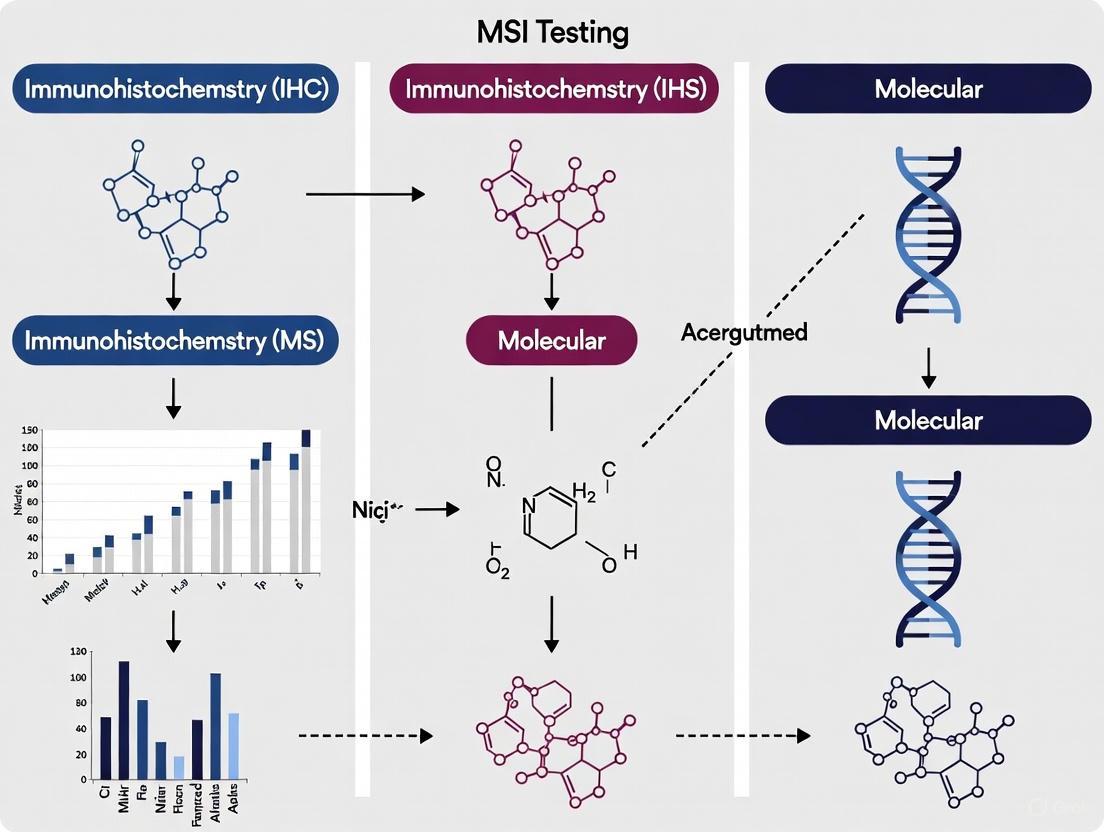
This article provides a comprehensive analysis for researchers and drug development professionals on the two primary methodologies for detecting microsatellite instability (MSI) and mismatch repair deficiency (dMMR)—immunohistochemistry (IHC) and molecular...
MSI Testing in Precision Oncology: A Comparative Guide to Immunohistochemistry vs. Molecular Methods for Researchers
Abstract
This article provides a comprehensive analysis for researchers and drug development professionals on the two primary methodologies for detecting microsatellite instability (MSI) and mismatch repair deficiency (dMMR)—immunohistochemistry (IHC) and molecular techniques (PCR and NGS). We explore the foundational biology of the MMR pathway, detail the technical workflows and applications of each method, address critical challenges like discordant results and indeterminate calls, and present validation data from recent large-scale studies. With the dMMR/MSI-H market expanding due to immunotherapy advances, this resource synthesizes current evidence to inform robust biomarker testing strategies, clinical trial design, and the development of next-generation diagnostics.
The Biological Basis of MSI: From MMR Pathway to Clinical Biomarker
Defining Microsatellites and the DNA Mismatch Repair (MMR) Mechanism
In the era of precision oncology, the accurate assessment of microsatellite instability (MSI) has emerged as a critical diagnostic and predictive tool. Microsatellites, short repetitive DNA sequences, serve as sensitive indicators of genomic stability, while the DNA mismatch repair (MMR) system represents a fundamental cellular mechanism for correcting replication errors. The growing importance of MSI status in predicting response to immunotherapy has intensified the need for reliable testing methodologies. This guide provides a comprehensive comparison of the two principal approaches for MSI detection: immunohistochemistry (IHC) and molecular techniques, offering researchers and clinicians the experimental data necessary to inform methodological selection for both clinical practice and research applications.
Microsatellites and MMR: Fundamental Concepts
What Are Microsatellites?
Microsatellites, also known as short tandem repeats (STRs), are tracts of repetitive DNA in which specific motifs of 1-6 base pairs are repeated in tandem, typically 5-50 times [1] [2]. These sequences are distributed throughout the genome, with the human genome containing approximately 50,000-100,000 dinucleotide microsatellites alone [2]. While many microsatellites reside in non-coding regions and are biologically silent, others are located within regulatory regions and coding sequences where variations can significantly impact gene expression and protein function [2].
The inherent instability of these repetitive sequences makes them particularly prone to replication errors. During normal DNA synthesis, DNA polymerase can slip on these repetitive templates, leading to insertions or deletions of repeat units [2]. In healthy cells, these errors are efficiently corrected by the MMR system, maintaining genomic integrity.
The DNA Mismatch Repair Mechanism
The DNA mismatch repair (MMR) system is a highly conserved biological pathway that plays a fundamental role in maintaining genomic stability by recognizing and repairing base-base mismatches and insertion/deletion mispairs generated during DNA replication and recombination [3] [4]. This system increases replication fidelity by 100- to 1000-fold, serving as a crucial defense against mutagenesis [5].
The core MMR process in eukaryotes involves several key steps and protein complexes:
- Mismatch Recognition: The MutSα heterodimer (MSH2/MSH6) primarily recognizes base-base mismatches and small insertion/deletion loops, while MutSβ (MSH2/MSH3) addresses larger insertion/deletion loops [3] [4].
- Repair Assembly: MutL heterodimers (primarily MutLα composed of MLH1 and PMS2) are recruited to the complex and act as molecular coordinators [3] [4].
- Excision and Resynthesis: The error-containing strand is excised, and the resulting gap is filled by DNA polymerase using the complementary strand as a template [4] [5].
Figure 1: The DNA Mismatch Repair (MMR) Pathway. This diagram illustrates the core steps of the MMR mechanism, from initial mismatch recognition to complete repair.
When the MMR system is defective, errors accumulate rapidly throughout the genome, particularly in microsatellite regions, leading to a condition known as microsatellite instability (MSI) [3] [5]. This hypermutable state drives carcinogenesis and serves as the biological basis for MSI testing in clinical diagnostics.
Methodological Comparison: IHC vs Molecular Techniques
Immunohistochemistry (IHC) Approach
The IHC method detects MMR deficiency indirectly by evaluating the presence or absence of the four core MMR proteins (MLH1, MSH2, MSH6, and PMS2) in tumor tissue sections [6] [7].
Experimental Protocol:
- Tissue Preparation: 3-5μm thick sections are cut from formalin-fixed, paraffin-embedded (FFPE) tumor tissue blocks [8] [7].
- Staining Procedure: Sections are stained with monoclonal antibodies against MLH1, MSH2, MSH6, and PMS2 using automated staining systems [8] [7].
- Interpretation: Tumors are classified as MMR-deficient (dMMR) if nuclear staining is absent for one or more proteins in tumor cells, with preserved staining in internal controls (e.g., stromal cells or lymphocytes) [6] [7]. MMR-proficiency (pMMR) is defined by retained nuclear staining for all four proteins [7].
Molecular Techniques
Molecular methods directly detect MSI by analyzing the length variations in microsatellite markers.
PCR-Based Fragment Analysis:
- Markers: Typically uses 5-8 mononucleotide repeat markers (BAT-25, BAT-26, NR-21, NR-24, MONO-27) sometimes supplemented with dinucleotide or pentanucleotide markers [7] [9].
- Protocol: DNA is extracted from FFPE tissue, PCR-amplified with fluorescent-labeled primers, and separated by capillary electrophoresis [8] [9].
- Interpretation: Instability at ≥2 mononucleotide markers is classified as MSI-High; instability at one marker as MSI-Low; no instability as microsatellite stable (MSS) [9].
Next-Generation Sequencing (NGS):
Fully Automated Systems (e.g., Idylla):
Comparative Performance Data
Diagnostic Accuracy Across Cancer Types
Table 1: Performance Metrics of IHC Versus Molecular MSI Testing Methods
| Cancer Type | Method Comparison | Sensitivity (%) | Specificity (%) | PPV (%) | NPV (%) | Agreement (Kappa) | Citation |
|---|---|---|---|---|---|---|---|
| Colorectal | IHC vs PCR | 91.2 | 87.7 | 79.5 | 95.0 | 0.76 | [7] |
| Endometrial | IHC vs PCR | 89.3 | 87.3 | 78.1 | 94.1 | 0.74 | [6] |
| Endometrial | IHC vs NGS | 75.0 | - | - | - | 0.59 | [6] |
| Mixed Cancers* | IHC vs PCR | - | - | - | - | 0.675 | [8] |
Note: Mixed cancers include gastrointestinal, gynecological, genitourinary, lung, breast, and unknown primary cancers [8]
Technical and Practical Considerations
Table 2: Technical Specifications and Practical Implementation Factors
| Parameter | Immunohistochemistry | PCR-Based Methods | NGS Approaches |
|---|---|---|---|
| What is Detected | Protein expression loss | Length alterations in microsatellite markers | Sequence-level variations in microsatellites |
| Target | MMR proteins (MLH1, MSH2, MSH6, PMS2) | 5-8 mononucleotide markers | 10-15+ microsatellite loci |
| Tumor Content Requirement | ≥10% tumor cells [7] | ≥20-30% tumor cells [7] [9] | ≥30% tumor cells [7] |
| Turnaround Time | ~8-24 hours | ~4-8 hours (plus DNA extraction) | Days to weeks |
| Throughput | Medium to high | Medium | High (multiplexed) |
| Cost | Low to moderate | Moderate | High |
| Additional Information | Identifies specific defective protein | Pure molecular phenotype | Can simultaneously detect mutations, TMB |
| Key Limitations | False negatives with atypical mutations, interpretive variability | Requires normal tissue for some assays, lower sensitivity in endometrial cancer | Cost, complexity, bioinformatics requirements |
Figure 2: MSI Testing Methodological Workflow. This diagram outlines the primary technical approaches for MSI detection, highlighting the parallel pathways of IHC and molecular methodologies.
The Scientist's Toolkit: Essential Research Reagents and Materials
Table 3: Key Research Reagents and Solutions for MSI/MMR Investigation
| Reagent/Solution | Application | Function/Purpose | Examples/Specifications |
|---|---|---|---|
| Anti-MMR Antibodies | IHC | Detection of MLH1, MSH2, MSH6, PMS2 protein expression | Monoclonal clones: MLH1 (ES05), MSH2 (FE11), MSH6 (EP49), PMS2 (EP51) [8] |
| DNA Extraction Kits | Molecular Methods | Isolation of high-quality DNA from FFPE tissues | Cobas DNA Sample Preparation Kit [7]; Automated systems (e.g., Idylla integrated extraction) [7] |
| Microsatellite Markers | PCR-Based Analysis | Amplification of target repetitive sequences | 5 mononucleotide panel: BAT-25, BAT-26, NR-21, NR-24, MONO-27 [9]; Additional dinucleotide markers [7] |
| MSI Analysis Systems | PCR Fragment Analysis | Standardized MSI testing | OncoMate MSI Dx Analysis System [9]; Promega MSI Analysis System [8] |
| NGS Panels | Sequencing Approaches | Targeted capture and sequencing of microsatellites | Custom hybridization capture panels (e.g., NimbleGen SeqCap EZ HyperPlus) with 10-15 microsatellite loci [7] |
| IHC Detection Systems | IHC | Visualization of antibody binding | Ultravision Quanto Detection System HRP DAB [8]; Ventana Benchmark Ultra [7] |
Discussion and Clinical Implications
The comparative data reveal that both IHC and molecular methods demonstrate strong performance for MSI detection, particularly in colorectal cancer where agreement between methods is substantial (Kappa = 0.76) [7]. However, in endometrial cancer, molecular methods show reduced sensitivity (58-75%) compared to IHC, suggesting potential limitations in this specific malignancy [7].
The choice between methodologies depends on specific clinical and research contexts. IHC offers advantages in identifying the specific defective MMR protein, which can guide germline testing for Lynch syndrome [7]. The technique is widely available, cost-effective, and has rapid turnaround times [6]. However, limitations include potential false-negative results with atypical mutations that affect protein function without complete loss of expression, and interpretive variability [7].
Molecular methods directly measure the functional consequence of MMR deficiency and may be more sensitive for detecting certain mutations [8]. NGS approaches provide additional valuable information including tumor mutation burden and specific gene mutations that can inform therapeutic decisions [7]. The main limitations include higher costs, requirements for greater tumor cellularity, and technical complexity [7].
For clinical applications, current evidence suggests that the combined use of both IHC and molecular methods may be optimal, particularly for endometrial cancer and in cases where discordant results are observed [8] [7]. This comprehensive approach leverages the complementary strengths of both techniques to maximize detection sensitivity and provide the most complete molecular characterization for treatment decision-making.
How MMR Deficiency Leads to Genomic Instability and MSI
This guide provides an objective comparison of immunohistochemistry (IHC) and molecular methods for detecting microsatellite instability (MSI), framing this technical comparison within the broader thesis that optimal MSI testing requires understanding both the biological pathway of mismatch repair (MMR) deficiency and the operational characteristics of available assays. We present experimental data and methodologies to inform researchers, scientists, and drug development professionals in their selection and implementation of MSI testing protocols.
The Molecular Mechanism: From MMR Deficiency to Genomic Instability
The DNA mismatch repair (MMR) system is a highly conserved biological pathway that plays a key role in maintaining genomic stability by correcting DNA replication errors [3]. Its primary function is to correct base-base mismatches and insertion/deletion mispairs that arise during DNA synthesis, increasing replication fidelity 100- to 1000-fold [5].
Core Components of the MMR Machinery
The human MMR system operates through specialized protein heterodimers that function in a coordinated manner:
- MutSα Complex: A heterodimer of MSH2 and MSH6 proteins that primarily recognizes base-base mismatches and small insertion-deletion loops [5] [10].
- MutSβ Complex: A heterodimer of MSH2 and MSH3 that primarily recognizes larger insertion-deletion loops [10].
- MutLα Complex: A heterodimer of MLH1 and PMS2 that is recruited after mismatch recognition and coordinates the downstream repair process [5] [10].
The MMR process is bidirectional and can be divided into four main steps: (1) mismatch recognition by MSH complexes, (2) recruitment of MLH complexes, (3) excision of the error-containing DNA strand, and (4) resynthesis of the corrected DNA sequence [5].
The Consequences of MMR Failure
When the MMR system is deficient, errors introduced during DNA replication accumulate throughout the genome [5]. Microsatellites—short, repetitive DNA sequences of 1-10 base pairs distributed throughout the genome—are particularly vulnerable to replication errors due to their repeated structure [11]. A defective MMR system fails to repair these "slippage" errors, leading to alterations in the length of microsatellite sequences, a phenomenon known as microsatellite instability (MSI) [12].
This accumulation of mutations creates a "mutator phenotype" characterized by a 100- to 1000-fold increase in spontaneous mutation rates [5]. This widespread genomic instability drives tumorigenesis through the inactivation of tumor suppressor genes containing microsatellite sequences in their coding regions, such as TGFβ-RII, IGFRII, and BAX [5].
Figure 1: Pathway from MMR deficiency to genomic instability and tumorigenesis.
Detection Methodologies: Experimental Protocols and Workflows
Immunohistochemistry (IHC) Protocol
IHC detects MMR deficiency by visualizing the presence or absence of MMR proteins in tumor tissue [12].
Experimental Workflow:
- Tissue Preparation: Cut 4-5μm thick sections from formalin-fixed, paraffin-embedded (FFPE) tumor tissue blocks [13] [7].
- Antibody Staining: Apply primary antibodies targeting MLH1, MSH2, MSH6, and PMS2 proteins using automated staining systems [14] [13].
- Interpretation Criteria: Nuclear staining in tumor cells compared to internal positive controls (normal mucosa, stromal cells) [13].
- Result Classification:
Pattern Interpretation:
- Loss of MLH1/PMS2: Suggests sporadic MLH1 promoter hypermethylation or Lynch syndrome
- Loss of MSH2/MSH6: Suggests Lynch syndrome
- Isolated loss of PMS2 or MSH6: Suggests Lynch syndrome with specific gene mutations [12] [10]
Molecular PCR-Based MSI Testing
PCR-based methods directly assess microsatellite instability by analyzing length variations in specific marker sequences [13] [11].
Experimental Workflow:
- DNA Extraction: Isolate DNA from FFPE tumor tissue and matched normal tissue using commercial kits [13] [7].
- PCR Amplification: Amplify microsatellite markers using fluorescently labeled primers [13].
- Capillary Electrophoresis: Separate PCR fragments by size using automated sequencers [13].
- Fragment Analysis: Compare peak patterns between tumor and normal DNA using specialized software [13].
Standard Marker Panels:
- Traditional NCI Panel: 5 markers (BAT25, BAT26, D2S123, D5S346, D17S250) [11]
- Monomorphic Mononucleotide Panels: 5-8 markers (BAT-25, BAT-26, NR21, NR24, NR27) that avoid the need for normal tissue comparison [11] [7]
Classification Criteria:
- MSI-High (MSI-H): Instability at ≥2 markers (or >30% of markers in larger panels)
- MSI-Low (MSI-L): Instability at one marker
- Microsatellite Stable (MSS): No unstable markers [12] [11]
Next-Generation Sequencing (NGS) Approaches
NGS-based methods analyze hundreds to thousands of microsatellite loci simultaneously, providing comprehensive genomic profiling [14] [7].
Experimental Workflow:
- Library Preparation: Hybridization capture-based enrichment of target regions including microsatellite loci [14] [7].
- Sequencing: Massively parallel sequencing on platforms such as Illumina MiSeq or similar [14] [7].
- Bioinformatic Analysis:
- MSI Scoring: Calculate percentage of unstable loci using algorithms like mSINGS [7].
Classification Thresholds:
- VariantPlex: MSI-H if >30% unstable loci, MSS if <20% [14]
- mSINGS: >30% unstable loci classified as MSI-H [7]
Figure 2: Experimental workflows for MSI testing methodologies.
Performance Comparison: Quantitative Data Analysis
Concordance Between Testing Methodologies
Table 1: Concordance rates between IHC and molecular MSI detection methods
| Cancer Type | Sample Size | Concordance Rate | Sensitivity | Specificity | Reference |
|---|---|---|---|---|---|
| Colorectal Cancer | 502 | 98.4% (494/502) | 100% | 98.2% | [13] |
| Colorectal Cancer | 28 | 100% | 100% | 100% | [7] |
| Endometrial Cancer | 21 | 75-86% | 58-75%* | 100% | [7] |
| Mixed Cohort | 139 | 92.8% (129/139) | 83.3% | 100% | [14] |
Sensitivity range depends on molecular method used (Idylla 58%, NGS 75%, PCR 67%) *10/12 MSI-H tumors showed MMR protein loss; 2 MSI-H tumors retained protein expression
Technical Characteristics of MSI Testing Methods
Table 2: Technical comparison of MSI detection methodologies
| Parameter | IHC | PCR-Based | NGS-Based |
|---|---|---|---|
| Target | MMR proteins (MLH1, MSH2, MSH6, PMS2) | 5-8 microsatellite markers | 10-100+ microsatellite loci + genomic variants |
| Turnaround Time | ~8-24 hours | ~24-48 hours | 7-10 days |
| Tumor Purity Requirement | Low (can interpret stained cells) | ≥30% | ≥30% |
| DNA Requirement | Not applicable | 50-100ng | 50-100ng |
| Additional Information | Identifies affected protein | Pure MSI status | Comprehensive genomic profile (TMB, mutations) |
| Cost | Low | Moderate | High |
| Lynch Syndrome Screening | Identifies specific gene for testing | Requires follow-up IHC | May detect MMR gene mutations |
| Limitations | False negatives with atypical mutations | Limited markers, requires normal tissue for some panels | Cost, complexity, bioinformatics expertise |
The Research Toolkit: Essential Reagents and Solutions
Table 3: Essential research reagents for MSI/MMR detection
| Reagent/Solution | Function | Example Products/Protocols |
|---|---|---|
| MMR Antibody Panel | IHC detection of MLH1, MSH2, MSH6, PMS2 proteins | DAKO antibodies: MLH1 (ES05), MSH2 (FE11), MSH6 (EP49), PMS2 (EP51) [14] [13] |
| DNA Extraction Kits | Isolation of high-quality DNA from FFPE tissue | QIAamp DNA FFPE Kit, Cobas DNA Sample Preparation Kit [13] [7] |
| Microsatellite Marker Panels | PCR-based MSI detection | Bethesda Panel (5 markers), Promega Panel (5 mononucleotide markers), Idylla MSI Panel (7 markers) [11] [7] |
| NGS Library Prep Kits | Target enrichment and sequencing library preparation | VariantPlex Solid Tumor, AVENIO CGP Kit, TruSight Oncology 500 [14] |
| Bioinformatic Tools | MSI classification from NGS data | mSINGS algorithm, MOSAIC classifier [11] [7] |
| Automated Staining Systems | Standardized IHC processing | Ventana Benchmark Ultra, DAKO OMNIS [14] [7] |
| Capillary Electrophoresis | Fragment analysis for PCR-based MSI | Applied Biosystems 3130/3500 Series [13] |
Research Implications and Clinical Translation
The detection of MMR deficiency and MSI has evolved from primarily identifying Lynch syndrome to predicting response to immunotherapy [15]. Tumors with dMMR/MSI-H accumulate numerous mutations that generate neoantigens recognized by the immune system, making them particularly responsive to immune checkpoint inhibitors [11] [15].
Understanding the technical performance characteristics of different MSI detection methods is crucial for drug development. While IHC remains widely accessible and identifies the specific defective protein, molecular methods directly measure the functional consequence of MMR deficiency [15]. NGS approaches offer the additional advantage of comprehensive genomic profiling, including tumor mutational burden (TMB), which complements MSI status as a biomarker for immunotherapy response [14].
Recent studies suggest that not all dMMR tumors respond equally to immune checkpoint blockade, indicating that the method of MMR deficiency detection may have therapeutic implications [15]. This highlights the importance for researchers to fully characterize the MMR status of preclinical models and clinical trial specimens using complementary methodologies to ensure accurate biomarker assessment.
MSI-H/dMMR as a Predictive Biomarker for Immunotherapy Response
The identification of predictive biomarkers is fundamental to precision oncology, enabling the selection of patients most likely to benefit from specific treatments. Among these, microsatellite instability-high (MSI-H) and mismatch repair deficiency (dMMR) have emerged as critical tumor-agnostic biomarkers for immunotherapy response [16] [17]. A tumor-agnostic biomarker is a molecular characteristic that can guide treatment decisions irrespective of the cancer's tissue or organ of origin [17]. The seminal event in this field was the 2017 U.S. Food and Drug Administration (FDA) approval of pembrolizumab for unresectable or metastatic MSI-H/dMMR solid tumors, marking one of the first tissue-agnostic cancer therapy approvals [17]. This review provides a comprehensive comparison of the primary diagnostic methods for detecting this crucial biomarker—immunohistochemistry (IHC) and molecular techniques—framed within the ongoing scientific debate regarding their equivalence and optimal application in clinical and research settings.
Biological Basis of MSI-H/dMMR and Mechanism of Action
The Mismatch Repair System and Genomic Consequences of Its Deficiency
The DNA mismatch repair (MMR) system is a critical cellular mechanism that corrects errors, such as base-base mispairs and small insertion-deletion loops (indels), spontaneously occurring during DNA replication [18]. Key MMR proteins—MLH1, MSH2, MSH6, and PMS2—function as heterodimers: MLH1 with PMS2 (forming MutLα) and MSH2 with MSH6 (forming MutSα) [19]. This system is indispensable for maintaining genomic stability; when functional, it significantly reduces the mutational rate [19].
dMMR arises when this repair system is compromised, most commonly due to the loss of protein expression (e.g., from epigenetic silencing of MLH1 or germline/somatic mutations in MMR genes) or, more rarely, due to non-functional protein expression. This deficiency results in the inability to correct replication errors, leading to a markedly increased mutational rate [7] [18]. Microsatellites—short, repetitive DNA sequences scattered throughout the genome—are particularly prone to these errors. The accumulation of insertion and deletion mutations at these sites is recognized as MSI [7].
Link to Immunotherapy Response
The high mutational burden resulting from dMMR drives the production of a vast array of novel mutant proteins, which can be processed and presented as neoantigens on the tumor cell surface [16] [19]. This high neoantigen load makes the tumor highly visible to the host's immune system, leading to increased infiltration of lymphocytes [20]. However, tumor cells often upregulate checkpoint proteins like PD-L1 to suppress this immune response, creating an immunosuppressive tumor microenvironment [16]. Immune checkpoint inhibitors (ICIs) targeting the PD-1/PD-L1 axis effectively block this suppression, thereby "releasing the brakes" on the immune system and allowing for a potent, T-cell-mediated destruction of the immunogenic tumor cells [16]. This mechanism explains the profound and durable responses to ICIs observed in patients with MSI-H/dMMR tumors across a wide spectrum of cancer types [16] [17].
The diagram below illustrates this core pathway from MMR deficiency to effective immunotherapy response.
Detection Methodologies: A Technical Comparison
The two primary diagnostic approaches for identifying MSI-H/dMMR status are immunohistochemistry (IHC) and molecular techniques, primarily polymerase chain reaction (PCR) and next-generation sequencing (NGS). The following table provides a high-level comparison of these methodologies.
Table 1: Core Methodologies for MSI/dMMR Detection
| Feature | Immunohistochemistry (IHC) | Molecular Methods (PCR, NGS) |
|---|---|---|
| Target | Protein expression of MMR genes (MLH1, MSH2, MSH6, PMS2) | Genomic DNA at microsatellite loci |
| Underlying Principle | Detects presence or absence of MMR proteins | Detects functional consequence of dMMR (instability at repeats) |
| Key Output | dMMR (deficient MMR) / pMMR (proficient MMR) | MSI-H (High Instability) / MSI-L (Low) / MSS (Stable) |
| Main Advantage | Identifies specific protein loss, guiding germline testing | Directly measures the genomic instability used for immunotherapy prediction |
Immunohistochemistry (IHC) for dMMR
Experimental Protocol:
- Sample Preparation: Consecutive 4-5 µm thick sections are cut from formalin-fixed, paraffin-embedded (FFPE) tumor tissue blocks [7].
- Staining: Automated IHC is performed on these sections using validated monoclonal antibodies against the four core MMR proteins: MLH1, MSH2, MSH6, and PMS2. Protocols typically use a Benchmark Ultra automated stainer (Ventana) with a DAB Ultraview kit for detection [7] [21].
- Interpretation: The staining is evaluated by a pathologist. Tumors are classified as dMMR if there is a complete loss of nuclear staining for one or more of the MMR proteins in the tumor cells, with intact nuclear staining in internal control cells (e.g., stromal cells, lymphocytes). Tumors with intact nuclear expression of all four proteins are classified as pMMR [7] [22]. Unusual patterns, such as subclonal or focal loss, require careful interpretation [21].
Molecular Methods for MSI
PCR-Based MSI Analysis
Experimental Protocol:
- DNA Extraction: DNA is extracted from FFPE tumor tissue and matched normal tissue (or macrodissected tumor areas with a tumor cell percentage ideally ≥30%). Kits like the High Pure PCR Template Preparation Kit (Roche) are commonly used [21].
- PCR Amplification: The extracted DNA is amplified by PCR using panels of fluorescently labeled microsatellite markers. The traditional "Bethesda panel" (two mononucleotide and three dinucleotide repeats) has been largely superseded by more sensitive mononucleotide panels, such as the Promega MSI Analysis System, which uses five mononucleotide markers (BAT-25, BAT-26, NR-21, NR-24, MONO-27) and two pentanucleotide markers for sample identification [7] [21].
- Fragment Analysis: The PCR products are subjected to capillary electrophoresis on a genetic analyzer (e.g., ABI 3730). The resulting fragment sizes are compared between tumor and normal DNA.
- Interpretation: Instability in ≥ 2 of the 5 mononucleotide markers is classified as MSI-H; instability in one marker is MSI-L; and no instability is MSS [7] [21]. The test sensitivity is typically around 10% mutant alleles [21].
Next-Generation Sequencing (NGS)
Experimental Protocol:
- Library Preparation & Sequencing: DNA from FFPE tumor tissue is used to create sequencing libraries, often using hybrid capture-based gene panels (e.g., NimbleGen SeqCap EZ). These panels can include both microsatellite loci and genes for concurrent genomic analysis [7] [17].
- Data Analysis: After alignment to the reference genome (e.g., hg19), specialized algorithms like mSINGS (Microsatellite Instability by NGS) are employed. This software counts the number of discrete indel length peaks at each microsatellite locus and compares this to a reference set of MSS tumors [7].
- Interpretation: The percentage of unstable loci per sample (mSINGS score) is calculated. A sample is called MSI-H if the percentage of unstable loci exceeds a validated cutoff (e.g., >30% or 3/10 loci) [7]. NGS can also simultaneously assess tumor mutational burden (TMB), another relevant biomarker [16] [23].
The workflow below summarizes the key decision points in these testing methodologies.
Comparative Performance Data Across Methodologies
While international guidelines often consider IHC and PCR-based MSI testing equivalent, a growing body of evidence reveals nuanced differences in their performance, which varies significantly by cancer type.
Table 2: Comparative Diagnostic Performance of MSI/dMMR Testing Methods
| Cancer Type | Method Comparison | Concordance & Key Performance Metrics | Supporting Data |
|---|---|---|---|
| Colorectal Cancer (CRC) | IHC vs. PCR vs. NGS (Idylla) | High concordance in samples with tumor cell percentage ≥30%. All molecular assays achieved 100% sensitivity and specificity vs. IHC. | [7] |
| Endometrial Cancer | IHC vs. PCR vs. NGS (Idylla) | Lower sensitivity for molecular methods vs. IHC. Sensitivity ranged from 58% (Idylla) to 75% (NGS), with negative predictive values of 78-86%. | [7] |
| Pan-Cancer Analysis | IHC (4 antibodies) vs. MSI-PCR (Pentaplex) | Overall high discrepancy rate of 19.3%. High specificity but low sensitivity (~60%) of PCR for IHC-defined dMMR. Kappa correlation was suboptimal (~0.5). | [21] |
| Oesogastric Adenocarcinoma | IHC vs. PCR on Biopsies | High concordance between biopsy and surgical specimen. Sensitivity: 85-86%, Specificity: 98%. | [22] |
The data indicates that for colorectal cancer, the three methods are highly concordant and reliable. However, for endometrial cancer and other non-colorectal cancers, molecular methods (particularly PCR) show significantly lower sensitivity compared to IHC [7] [21]. This suggests that a subset of tumors may be classified as dMMR by IHC but MSS by PCR, potentially due to "unusual" dMMR phenotypes (e.g., subclonal loss, mutations in minor MMR genes not detected by standard IHC, or technical factors) [19] [21].
The Clinical and Research Toolkit
Successful detection of MSI-H/dMMR status relies on a suite of carefully validated reagents and platforms. The table below outlines essential research reagent solutions for establishing these assays.
Table 3: Essential Research Reagent Solutions for MSI/dMMR Detection
| Reagent / Solution | Function | Example Products & Kits |
|---|---|---|
| MMR Protein Antibodies | Detect presence/absence of MLH1, MSH2, MSH6, PMS2 in IHC | Ventana ready-to-use mouse monoclonals (anti-MLH1 M1, anti-MSH2 G219-1129, anti-PMS2 A16-4) and rabbit monoclonal (anti-MSH6 SP93) [21] |
| Automated IHC Staining System | Standardized and automated staining of FFPE tissue sections | Ventana Benchmark Ultra series [7] [21] |
| MSI PCR Multiplex Kit | Simultaneous PCR amplification of multiple microsatellite markers | Promega MSI Analysis System (Version 1.2) [21] |
| DNA Extraction Kit | Isolation of high-quality DNA from FFPE tissue | Cobas DNA Sample Preparation Kit (Roche), High Pure PCR Template Preparation Kit (Roche) [7] [21] |
| Genetic Analyzer | Fragment analysis for PCR-based MSI detection | ABI 3730 Genetic Analyzer [21] |
| NGS Hybridization Capture Panel | Targeted enrichment of genomic regions including microsatellites for sequencing | NimbleGen SeqCap EZ HyperPlus (Roche) [7] |
| NGS MSI Analysis Software | Bioinformatics tool to call MSI status from NGS data | mSINGS (Microsatellite Instability by NGS) open-source Python script [7] |
MSI-H/dMMR stands as a paradigm for tumor-agnostic biomarker development, fundamentally changing the treatment landscape for a molecularly defined subset of patients across multiple cancer types. The comparative analysis of detection methods reveals that while IHC and molecular techniques show strong agreement in colorectal cancers, significant discrepancies exist in other malignancies, challenging the presumption of their complete equivalence [19] [21].
For researchers and drug development professionals, the choice of assay carries implications for patient selection in clinical trials and companion diagnostic development. The emerging data suggests that a combined approach using both IHC and a molecular method may be optimal, especially in non-colorectal and non-endometrial cancers, to maximize detection sensitivity [7] [19]. Future research should focus on standardizing testing protocols, understanding the biological and clinical significance of discordant cases (e.g., dMMR/MSS tumors), and validating novel methodologies like NGS that offer the advantage of simultaneously evaluating multiple biomarkers, including TMB and specific gene mutations, from a single assay [16] [23]. As the pipeline of therapies for dMMR/MSI-H tumors continues to expand, robust and reflexive diagnostic strategies will be the cornerstone of translating this powerful biomarker into improved patient outcomes.
Microsatellite Instability (MSI) and Mismatch Repair Deficiency (dMMR) have evolved from specialized research topics into cornerstone biomarkers in oncology, with critical implications for cancer prognosis, prediction of chemotherapy efficacy, and selection of patients for immunotherapy. The prevalence of MSI/dMMR varies dramatically across different malignancies, creating a complex diagnostic landscape that ranges from high-incidence tumors such as colorectal and endometrial cancers to rare tumor types where MSI is an exceptional finding. This variability presents significant challenges for developing universal testing approaches and underscores the importance of understanding the prevalence spectrum across tumors. Within this context, a persistent debate centers on the optimal methodology for MSI/dMMR detection: immunohistochemistry (IHC), which identifies the loss of MMR protein expression, versus molecular techniques such as polymerase chain reaction (PCR) and next-generation sequencing (NGS), which directly assess genomic instability. Each method offers distinct advantages and limitations, with implications for diagnostic accuracy, accessibility, cost, and integration into comprehensive genomic profiling. This guide provides an objective comparison of current MSI testing methodologies, supported by experimental data and structured to inform researchers, scientists, and drug development professionals in their selection of appropriate detection strategies across the tumor prevalence spectrum.
MSI/MMR Prevalence Across Solid Tumors
The prevalence of MMR mutations and the MSI-H phenotype varies significantly across different cancer types, influencing testing strategies and clinical decision-making. A comprehensive cBioPortal study analyzing 19,353 tumors from 11 different cancer types revealed a distinct prevalence hierarchy, with endometrial, bladder, colorectal, and gastroesophageal cancers demonstrating the highest rates of MMR mutations [24].
Table 1: MMR Mutation Prevalence Across Solid Tumors
| Tumor Type | MMR-mutated Cases | Pathogenic Mutations | Key Concordance with MSI |
|---|---|---|---|
| Endometrial Cancer (EC) | 20.5% | 17% (p < 0.001) | 91.2% |
| Bladder Cancer (BLCA) | 8.7% | Not Specified | Not Specified |
| Colorectal Cancer (CRC) | 8.2% | 4.8% (p = 0.01) | 65.7% |
| Gastroesophageal Cancer (GEC) | 5.4% | 3.0% (p = 0.32) | 69.6% |
| Other Solid Tumors | <5% | Variable | Low (e.g., Pancreatic: 0.2%) |
This study highlighted a critical finding: nearly half (48.9%) of MMR-mutated tumors were microsatellite stable (MSS), including 13.2% with pathogenic mutations [24]. This discordance between MMR mutations and MSI status underscores the complexity of the underlying biology and the technical challenges in biomarker assessment. The concordance between MMR-mutated status and MSI was highest in endometrial cancer (91.2%), followed by gastroesophageal (69.6%) and colorectal cancers (65.7%), while pancreatic and lung cancers showed minimal concordance (0.2% and 0.1%, respectively) [24].
A large-scale retrospective analysis of 35,563 pan-cancer cases further refined our understanding of MSI-H prevalence, identifying four distinct clusters [25]:
- Common cancers with high MSI-H prevalence: Uterine, gastric, and bowel cancers contributed approximately 80% of all MSI-H cases.
- Common cancers with lower MSI-H prevalence: Biliary tract, liver, oropharyngeal, and pancreatic cancers.
- Highly prevalent cancers with rare MSI-H: Lung cancer was the most prevalent cancer in the cohort but demonstrated rare MSI-H.
- Uncommon cancers with few MSI-H cases: The remaining cancer types were infrequent, with correspondingly few MSI-H cases reported.
Significant prevalence differences were also observed within cancer subtypes. Colon cancer showed a significantly higher MSI-H rate (10.66%) compared to rectal cancer (2.19%, p = 1.26×10⁻³⁶). Similarly, esophagogastric junction cancer had a higher prevalence (4.04%) than esophageal cancer (0.30%, p = 2.11×10⁻³) [25].
Comparative Analysis of MSI Testing Methodologies
Performance Metrics Across Platforms
The diagnostic landscape for MSI/dMMR detection encompasses multiple platforms, each with distinct performance characteristics, advantages, and limitations. Understanding these differences is crucial for selecting the appropriate testing method based on clinical context, tissue availability, and required throughput.
Table 2: Comparison of MSI Detection Methods
| Method | Principle | Key Performance Metrics | Advantages | Limitations |
|---|---|---|---|---|
| Immunohistochemistry (IHC) | Detects presence/absence of MMR proteins (MLH1, MSH2, MSH6, PMS2) | 5-10% false negative rate; ~97% concordance with PCR in CRC [26] [7] | Shows which gene to investigate; cost-effective; accessible | Indirect measure; not functional; subjective interpretation |
| PCR-Based | Detects fragment size changes in microsatellite loci (functional test) | 0.3-4% false negative rate; 100% sensitivity/specificity in CRC with ≥30% tumor cells [26] [7] | Functional test; low false negative rate; standardized loci | Only characterizes MSI; requires molecular training |
| Next-Generation Sequencing (NGS) | Sequences microsatellites, compares to reference (tumor-only or normal) | 95.6% concordance with PCR in FFPE; lower in liquid biopsy (71.4%) [27] | Comprehensive genomic data; high-throughput; automatable | Lack of standardization; high DNA quality needed; cost |
| Deep Learning (AI) | Analyzes H&E-stained whole slide images using neural networks | Sensitivity: 0.96-0.98; Specificity: 0.46-0.47; NPV: 0.98-0.99 [28] | No additional staining; fast; pre-screening potential | Lower specificity; limited validation across tumor types |
Concordance Between Testing Methodologies
The concordance between different MSI testing methods varies significantly across platforms and tumor types. A 2025 study comparing IHC and NGS in 139 tumor samples found a strong correlation, with 10 of 12 MSI-H tumors exhibiting MMR protein loss. However, two MSI-H tumors (a mucinous adenocarcinoma of omental origin and a mucinous colon adenocarcinoma) retained MMR protein expression, highlighting a potential limitation of IHC [29].
The BLOOMSI prospective trial (2025) provided further insights into method concordance in a clinical setting. The highest concordance was observed between PCR and NGS using FFPE samples (95.6%), while IHC showed lower concordance with both NGS-FFPE (81%) and NGS-liquid biopsy (70%) [27]. NGS-based estimation of MSI in FFPE and liquid biopsy samples was concordant in 80.1% of cases, reflecting the biological and technical challenges of liquid biopsy approaches [27].
For colorectal and endometrial cancers, molecular methods (PCR, Idylla, NGS) demonstrate equivalent diagnostic performance, though with notable differences between these cancer types. In colorectal cancers with tumor cell percentages ≥30%, all three molecular assays achieved 100% sensitivity and specificity versus IHC. In endometrial cancers, however, sensitivity was clearly lower, ranging from 58% for Idylla to 75% for NGS, corresponding to negative predictive values of 78% to 86% [7].
Deep learning approaches represent an emerging methodology for MSI detection. A meta-analysis of 19 studies comprising 33,383 samples found that DL algorithms demonstrated excellent sensitivity in detecting MSI-H in colorectal cancer, with pooled patient-based internal validation showing sensitivity of 0.88 and specificity of 0.86 [30]. External validation revealed even higher sensitivity (0.93) but lower specificity (0.71), suggesting potential overfitting and highlighting the need for algorithm standardization to improve generalizability [30].
Experimental Protocols and Methodologies
Immunohistochemistry Protocol
Standard IHC testing for MMR deficiency follows a well-established protocol across laboratories. The typical methodology involves [7] [29]:
- Tissue Preparation: 4-5μm thick sections from formalin-fixed, paraffin-embedded (FFPE) tumor tissue blocks are mounted on slides.
- Staining Process: Automated staining systems (e.g., Ventana Benchmark Ultra, Dako OMNIS) are used with antibodies targeting the four core MMR proteins: MLH1 (ES05), MSH2 (FE11), MSH6 (EP49), and PMS2 (EP51).
- Interpretation Criteria: Tumors are classified as MMR-deficient if nuclear staining is absent in tumor cells while being present in internal control cells (inflammatory and stromal cells). The threshold for loss of expression is typically defined as nuclear staining in less than 10% of invasive tumor cells.
- Quality Control: Appropriate positive and negative controls are essential, with internal positive controls (non-tumoral cells within the same section) providing critical reference points for interpretation.
Molecular MSI Detection Protocols
PCR-Based MSI Testing:
- DNA Extraction: DNA is extracted from FFPE tissue sections (typically 10μm thick) using commercial kits, with macrodissection guided by H&E staining to ensure adequate tumor cellularity (generally ≥30%) [7].
- Microsatellite Markers: The revised Bethesda panel recommends five quasi-monomorphic mononucleotide repeats (BAT-25, BAT-26, NR-21, NR-24, NR-27). Some laboratories supplement with dinucleotide markers (D2S123, D17S250, D5S346) [26] [7].
- Fragment Analysis: Fluorescently labeled primers amplify fragments from tumor and matched normal samples. The amplified fragments are separated by capillary electrophoresis, and size variations indicate microsatellite instability.
- Interpretation: Instability at ≥2 loci is typically defined as MSI-high, instability at a single locus as MSI-low, and no instability as microsatellite stable (MSS) [7].
NGS-Based MSI Testing:
- Panel Design: Targeted NGS panels include multiple microsatellite loci (ranging from ~100 to 130 loci, depending on the platform). Common implementations include the Illumina TSO-500 (~130 loci), AVENIO CGP Kit (number not disclosed), and VariantPlex Solid Tumor Focus v2 (108-111 loci) [25] [29].
- Bioinformatic Analysis: specialized algorithms (e.g., MSIsensor, mSINGS, MSIDRL) analyze sequencing data to count reads of different repeat lengths and compare them to a reference baseline.
- MSI Scoring: The percentage of unstable loci per sample is calculated, with thresholds for MSI-H classification varying by platform but typically ranging from >30% to algorithm-defined cutoffs [25] [29].
- Validation: Proper validation requires establishing sensitivity and specificity against gold standard methods across various tumor types, with particular attention to samples with low tumor cellularity.
Diagram: MSI Testing Method Workflows. This flowchart illustrates the three primary methodological pathways for MSI detection, highlighting the distinct technical approaches and resulting outputs for each platform.
Research Reagent Solutions and Experimental Materials
Selecting appropriate reagents and materials is fundamental to establishing robust MSI testing protocols. The following table outlines essential research solutions for implementing different MSI detection methodologies.
Table 3: Essential Research Reagents for MSI/MMR Detection
| Category | Specific Product/Platform | Key Components | Research Application |
|---|---|---|---|
| IHC Antibodies | Dako OMNIS Auto-stainer | MLH1 (ES05), MSH2 (FE11), MSH6 (EP49), PMS2 (EP51) | Detection of MMR protein loss in FFPE tissues |
| PCR-Based Kits | Promega MSI Analysis System | 5 mononucleotide markers (BAT-25, BAT-26, NR-21, NR-24, NR-27) | Gold standard fragment analysis for MSI status |
| Rapid PCR Systems | Biocartis Idylla MSI Assay | 7 biomarkers (ACVR2A, BTBD7, DIDO1, MRE11, RYR3, SEC...) | Automated MSI testing with 150-min turnaround |
| NGS Panels | Illumina TSO-500 | 523 genes + ~130 microsatellite loci | Comprehensive genomic profiling with MSI status |
| NGS Panels | AVENIO CGP Kit (Roche) | 324 genes + MSI/TMB/gLOH signatures | Tumor tissue comprehensive genomic profiling |
| NGS Panels | VariantPlex Solid Tumor v2 | 20 genes + 108-111 microsatellite loci | Focused solid tumor profiling with MSI analysis |
| AI-Based Tools | MSIntuit (Owkin) | Self-supervised learning algorithm | MSI pre-screening from H&E whole slide images |
The selection of appropriate MSI testing methodologies must be guided by the tumor prevalence spectrum, available resources, and clinical context. For high-prevalence tumors such as colorectal and endometrial cancers, both IHC and molecular methods demonstrate strong performance, with the choice often depending on whether protein-level or functional assessment is desired. In these settings, the high concordance between methods supports the use of either approach, with reflex testing strategies (IHC followed by PCR for ambiguous cases) providing a cost-effective solution. For rare tumors and those with lower MSI prevalence, NGS-based approaches offer significant advantages due to their broader genomic coverage and higher accuracy in non-colorectal/non-endometrial malignancies. The comprehensive genomic data provided by NGS is particularly valuable when tissue is limited, as it enables simultaneous assessment of multiple biomarkers beyond MSI status. Emerging technologies, particularly deep learning applied to H&E slides, show promise as pre-screening tools to reduce testing burden while maintaining high sensitivity, though their lower specificity currently limits standalone application. As immunotherapy indications expand across tumor types, understanding the strengths and limitations of each MSI detection platform becomes increasingly critical for optimizing patient selection and advancing drug development strategies. Future directions will likely focus on standardizing NGS approaches, validating multi-analyte algorithms, and developing tumor-specific testing frameworks that account for the unique biological and technical considerations across the prevalence spectrum.
Lynch Syndrome (LS) represents a paradigm for understanding how inherited genetic defects manifest in somatic cellular alterations that drive carcinogenesis. This autosomal dominant disorder stems from germline mutations in DNA mismatch repair (MMR) genes—primarily MLH1, MSH2, MSH6, and PMS2—with carriers facing a lifetime colorectal cancer risk of 20-80% and elevated risks for endometrial, gastric, ovarian, and other cancers [31] [32]. The fundamental connection between LS and microsatellite instability (MSI) lies in the biallelic inactivation of MMR genes; while one mutation is inherited, the second "hit" occurs somatically, leading to a complete loss of MMR function in cells [32] [33]. This deficiency allows errors to accumulate during DNA replication, particularly in repetitive microsatellite regions, generating a hypermutated phenotype characterized by frameshift mutations and abundant neoantigen production [33]. These neoantigens create highly immunogenic tumors that are typically densely infiltrated with cytotoxic T-cells, explaining the remarkable sensitivity of MSI-high (MSI-H) tumors to immune checkpoint inhibitors [32] [33]. The detection of MSI thus serves as a reliable somatic marker for identifying underlying MMR deficiency, connecting laboratory diagnostics to targeted therapeutic interventions for LS-associated cancers.
Detection Methodologies: Technical Approaches and Protocols
The accurate identification of MMR deficiency relies on two principal methodological approaches: immunohistochemistry (IHC) for protein expression analysis and molecular techniques including polymerase chain reaction (PCR) and next-generation sequencing (NGS) for direct assessment of genomic instability.
Immunohistochemistry (IHC) for MMR Protein Detection
Experimental Protocol: IHC testing follows a standardized workflow involving formalin-fixed, paraffin-embedded (FFPE) tumor tissue sections [34]. After dewaxing and rehydration, slides undergo heat-induced antigen retrieval using citrate buffer (pH 6.0). Sections are then incubated with primary antibodies targeting the core MMR proteins (MLH1, MSH2, MSH6, PMS2), followed by application of polymer-based detection systems such as the Envision FLEX kit (DAKO) [34]. The chromogenic reaction is typically developed using amino-ethyl-carbazole (AEC) or similar substrates, with Mayer's hematoxylin counterstaining [35].
Interpretation Criteria: Nuclear staining in stromal and epithelial cells of adjacent normal colonic mucosa serves as the internal control [34] [35]. MMR deficiency (dMMR) is defined by complete absence of nuclear staining in tumor cells for one or more MMR proteins while retaining staining in internal control cells [34] [32]. The pattern of protein loss can indicate the specific affected gene: loss of MLH1 typically coincides with PMS2 loss, while MSH2 loss pairs with MSH6 loss, as these proteins form obligate heterodimers [32].
Molecular Methods for MSI Detection
PCR-Based MSI Analysis: The standard PCR protocol utilizes a panel of five quasi-monomorphic mononucleotide repeat markers (BAT-25, BAT-26, NR-21, NR-24, and MONO-27) supplemented with pentanucleotide markers (Penta C and Penta D) for sample identification [34]. DNA is extracted from paired tumor and normal tissue, amplified via PCR, and separated by capillary electrophoresis [34]. Fragment analysis determines microsatellite length variations, with instability defined as shifts of ≥3 base pairs in tumor DNA compared to matched normal DNA [34]. Tumors are classified as MSI-H (instability at ≥2 markers), MSI-L (instability at 1 marker), or MSS (no instability) [34].
NGS-Based Approaches: Next-generation sequencing methods have emerged with expanded marker panels. One algorithm, MSIDRL, analyzes 100 selected noncoding MS loci not overlapping with traditional PCR markers [25]. The method establishes "diacritical repeat lengths" for each locus, distinguishing stable and unstable reads based on background noise calculations from MSS samples [25]. The unstable locus count (ULC) is determined through binomial testing, with a ULC cutoff of ≥11 indicating MSI-H status [25].
The diagram below illustrates the decision pathway for identifying Lynch Syndrome through MSI testing:
Comparative Performance Data: IHC Versus Molecular Methods
Direct comparative studies demonstrate strong overall concordance between IHC and molecular methods for detecting MMR deficiency, though each method offers distinct advantages and limitations.
Table 1: Concordance Between IHC and PCR-Based MSI Testing in Colorectal Cancer
| Study | Sample Size | Concordance Rate | Kappa Statistic | Discordant Cases | IHC Sensitivity | IHC Specificity |
|---|---|---|---|---|---|---|
| Trabelsi et al. (2017) [36] | 47 CRC cases | High association reported | Not specified | Not specified | Identified all dMMR cases | High specificity |
| Diagnostic Pathology Study (2024) [34] | 50 CRC cases | 96% | 0.896 (almost perfect) | 4% (2/50) | Identified 13/14 dMMR cases | 100% (37/37 pMMR cases) |
| PMC Retrospective (2004) [35] | 142 T3N0M0 CRC | Established prognostic value | Not specified | Not specified | 100% for MSH2/MLH1 | 100% for MSH2/MLH1 |
The almost perfect concordance (κ=0.896) reported in recent studies validates both methods as reliable for clinical detection of MMR deficiency [34]. Discordant cases (approximately 4%) may result from technical artifacts in IHC, such as heterogeneous staining, or mutations that do not affect protein expression but impair function [25] [34]. Notably, IHC demonstrated 100% specificity for identifying proficient MMR systems in a 2024 study, correctly classifying all 37 pMMR cases identified by PCR [34].
Table 2: Performance Characteristics of Different MSI Testing Modalities
| Parameter | Immunohistochemistry (IHC) | PCR-Based MSI Analysis | NGS-Based MSI Analysis |
|---|---|---|---|
| Target | MMR protein expression (MLH1, MSH2, MSH6, PMS2) | Length variations in microsatellite markers | Sequence variations in expanded MS loci |
| Method Principle | Antibody-based detection of nuclear proteins | Fragment analysis by capillary electrophoresis | Sequencing-based genotyping |
| Turnaround Time | ~1-2 days | ~2-3 days | ~5-7 days |
| Advantages | Identifies specific affected gene; cost-effective; widely available | High sensitivity; standardized panels | Expanded marker coverage; pan-cancer applicability |
| Limitations | Misses non-truncating mutations; pre-analytical variables | Limited to specific markers; less informative for non-CRC | Higher cost; computational complexity |
| Optimal Use Case | First-line screening; resource-limited settings | Confirmatory testing; clinical trials | Comprehensive profiling; equivocal cases |
NGS-based approaches offer particular advantages in non-colorectal cancers, where traditional PCR panels developed for CRC may have reduced performance [25]. One large-scale retrospective analysis of 35,563 pan-cancer cases validated a 7-loci panel for universal MSI detection across cancer types [25].
Clinical Implications and Therapeutic Applications
The detection of MSI in LS-associated cancers carries significant prognostic and predictive implications that directly impact clinical management decisions across disease stages.
Prognostic Significance
In non-metastatic colorectal cancer, MSI status represents a favorable prognostic factor. A landmark study of 142 patients with stage II (T3N0M0) colon cancer found that MSI determined by IHC was an independent predictive factor of good prognosis (p=0.04, odds ratio 7.9) [35]. Patients with MSI tumors exhibited significantly better recurrence-free survival than those with microsatellite stable (MSS) tumors (p=0.02) [35]. This prognostic advantage is attributed to the robust immune infiltration characteristic of MSI-H tumors, which may enhance immune surveillance and limit metastatic progression [32] [33].
Predictive Biomarker for Therapy
MSI status serves as a critical predictive biomarker for both chemotherapy response and immunotherapy efficacy. In the metastatic setting, MSI-H/dMMR colorectal cancers show remarkable sensitivity to immune checkpoint inhibitors [37] [32] [33]. The CheckMate 8HW trial demonstrated that combination immunotherapy with nivolumab plus ipilimumab significantly improved outcomes compared to nivolumab alone or chemotherapy, with median progression-free survival of 54.1 months versus 18.4 months versus 5.9 months, respectively [37]. This efficacy extends to earlier disease stages, with neoadjuvant immunotherapy achieving pathological complete response rates of 60-95% in locally advanced dMMR colon cancer [33].
The following diagram illustrates the molecular pathway from MMR deficiency to clinical response:
The Scientist's Toolkit: Essential Research Reagents
Table 3: Key Research Reagents for MMR/MSI Investigation
| Reagent/Category | Specific Examples | Research Application | Technical Notes |
|---|---|---|---|
| Primary Antibodies | Anti-MLH1 (G168-728), Anti-MSH2 (FE11), Anti-MSH6, Anti-PMS2 | IHC protein localization and expression | Calbiochem/Pharmingen sources; citrate buffer antigen retrieval [35] |
| DNA Extraction Kits | Maxwell RSC DNA FFPE Kit (Promega) | Nucleic acid isolation from archival tissue | Optimized for degraded FFPE-derived DNA [34] |
| MSI Analysis Systems | MSI Analysis System 1.2 (Promega) | PCR-based fragment analysis | 5 mononucleotide + 2 pentanucleotide markers [34] |
| NGS Panels | MSIDRL algorithm; 733-gene NGS LDT | Sequencing-based MSI detection | 100-loci panel; analyzes unstable locus count (ULC) [25] |
| Viral Vectors | NOUS-209 FSP neoantigen vectors | Immunotherapy development | Delivers 209 shared frameshift peptide neoantigens [38] |
Emerging Research and Clinical Directions
The understanding of Lynch Syndrome and MSI continues to evolve, with several promising research and clinical directions emerging. Cancer interception approaches represent a paradigm shift, aiming to prevent cancer development in high-risk LS carriers rather than treating established malignancies [38]. The NOUS-209 trial, an off-the-shelf neoantigen immunotherapy, has demonstrated potent and durable immune responses in LS carriers, inducing neoantigen-specific T-cell responses in 100% of evaluable participants with a favorable safety profile [38]. This approach leverages viral vectors to deliver 209 shared frameshift peptide neoantigens, training the immune system to recognize and eliminate pre-malignant cells before tumors develop [38].
In the therapeutic arena, combination immunotherapy strategies are showing enhanced efficacy. The recent FDA approval of nivolumab plus ipilimumab for MSI-H metastatic colorectal cancer based on the CheckMate 8HW trial results demonstrates the promise of dual immune checkpoint blockade [37]. However, these regimens require careful management of increased immune-related adverse events, with grade 3-4 side effects occurring in 22% of patients receiving combination therapy versus 14% with monotherapy [37].
Despite these advances, challenges remain in overcoming primary and secondary resistance to immunotherapy, observed in more than 50% of MSI-H/dMMR CRC patients [32]. Research into resistance mechanisms, including mutations in antigen presentation machinery (B2M) and interferon signaling pathways (JAK1/2), may yield biomarkers to guide treatment selection and novel therapeutic combinations [33]. As the field progresses, the connection between germline MMR mutations and somatic MSI will continue to inform both cancer risk management and therapeutic innovation for Lynch Syndrome patients.
Decoding the Assays: IHC, PCR, and NGS Workflows in Practice
Immunohistochemistry (IHC) for detecting mismatch repair (MMR) protein loss represents a cornerstone diagnostic approach in modern oncology, providing critical insights for cancer prognosis, Lynch syndrome screening, and prediction of response to immunotherapy. The MMR system, comprising the proteins MLH1, PMS2, MSH2, and MSH6, functions as a critical safeguard of genomic integrity by correcting DNA replication errors [39]. Loss of function in this system leads to MMR deficiency (dMMR), resulting in elevated mutation rates and microsatellite instability (MSI) [14]. IHC directly assesses the integrity of this system by visualizing the presence or absence of these four key proteins within tumor cell nuclei, serving as both a functional surrogate and a morphological guide for subsequent genetic testing. Despite the emergence of various molecular techniques, IHC remains widely utilized in clinical laboratories due to its relatively low cost, rapid turnaround time, and ability to guide which MMR gene to sequence in suspected Lynch syndrome cases [39] [14]. This guide provides a comprehensive comparison of IHC against emerging molecular techniques for MMR deficiency detection, supported by experimental data and detailed methodologies.
Performance Comparison: IHC Versus Molecular Methods
The diagnostic performance of IHC for detecting MMR deficiency has been extensively evaluated against molecular standard methods, including polymerase chain reaction (PCR) and next-generation sequencing (NGS)-based MSI testing. The table below summarizes key performance metrics from recent studies.
Table 1: Diagnostic Performance of IHC for MMR Protein Loss Detection
| Study & Cancer Type | Reference Standard | Sensitivity | Specificity | Concordance / Kappa | Key Findings |
|---|---|---|---|---|---|
| PedHGG (HIT-HGG-2013 trial) [39] | Germline Sequencing | 100% | 96% | N/A | Identified all Lynch syndrome/CMMRD cases; cost-effective for routine screening. |
| Pan-Cancer (N=502 CRC) [40] | PCR-Capillary Electrophoresis | 100% | 98.2% | Kappa=0.932 | Excellent concordance in colorectal cancer. |
| Pan-Cancer (N=139) [14] [41] [29] | NGS-based MSI | 83.3%* | 100%* | Strong Correlation | Two MSI-H tumors showed retained protein expression. |
| Large Cancer Series (N=703) [21] | MSI Pentaplex PCR | Low Sensitivity* | High Specificity* | Kappa <0.7 | High discrepancy rate (19.3%); PCR showed low sensitivity for IHC status. |
| Colorectal & Endometrial (N=49) [7] | PCR & Idylla & NGS | AUC: 0.91-0.93 | AUC: 0.91-0.93 | Equivalent Performance | Molecular assays showed lower sensitivity in endometrial cancer. |
Calculated values based on study data. *Area Under the Curve (AUC) values for molecular assays (PCR, Idylla, NGS) versus IHC. Abbreviations: PedHGG: Pediatric High-Grade Glioma; CMMRD: Constitutional Mismatch Repair Deficiency; CRC: Colorectal Cancer; AUC: Area Under the Curve.
The data reveals that IHC demonstrates high sensitivity and specificity, particularly in colorectal cancer, making it an excellent screening tool [39] [40]. However, discordant cases exist where tumors exhibit MSI-H via molecular methods but retain MMR protein expression on IHC [14] [41]. These discrepancies can arise from technical artifacts in IHC or, more importantly, from non-truncating mutations in MMR genes that lead to dysfunctional but antigenically intact proteins [25]. Conversely, some studies have reported significant discordance where PCR-based MSI testing showed low sensitivity for the dMMR status identified by IHC, highlighting the impact of pre-analytical factors and phenotypic heterogeneity [21].
Experimental Protocols for MMR IHC
Standardized protocols are essential for reliable and reproducible detection of MLH1, MSH2, MSH6, and PMS2 protein loss. The following section details a typical experimental workflow and methodology as employed in recent clinical studies.
Sample Preparation and Staining Protocol
The foundational step involves processing tumor tissue into formalin-fixed, paraffin-embedded (FFPE) blocks. Sections are cut at a standard thickness of 4-5 μm for immunohistochemical staining [39] [40]. The staining is typically performed on automated platforms, such as the Ventana Benchmark Ultra or Dako OMNIS systems, to ensure consistency [21] [40].
The critical reagents are monoclonal antibodies against the four MMR proteins. Common clones and dilutions used in the cited studies are summarized below.
Table 2: Key Research Reagent Solutions for MMR IHC
| Antibody Target | Common Clones (Supplier) | Typical Dilution | Primary Function |
|---|---|---|---|
| MLH1 | M1 (Ventana) / ES05 (Dako) | Ready-to-use / 1:200 | Forms MutLα complex with PMS2; initiates excision of mispaired bases. |
| PMS2 | A16-4 (Ventana) / EP51 (Dako) | Ready-to-use / 1:300 | Stabilizes MutLα complex with MLH1; essential for repair function. |
| MSH2 | G219-1129 (Ventana/Cell Marque) / FE11 (Dako) | 1:200 / 1:500 | Forms MutSα complex with MSH6; recognizes DNA mismatches. |
| MSH6 | SP93 (Ventana) / EP49 (Dako) | Ready-to-use / 1:200 | Partners with MSH2 in MutSα; specific for base-base mismatches. |
After application of the primary antibody, the immunoreaction is visualized using a detection system, such as the DAB Ultraview kit, which produces a brown chromogenic signal at the site of antibody binding [39] [21]. Counterstaining with hematoxylin provides a blue background that contrasts with the specific nuclear staining.
Interpretation and Scoring Criteria
Interpretation is performed by a pathologist using light microscopy. The current consensus, as per CAP criteria, defines the following:
- Proficient MMR (pMMR): Nuclear staining for all four MMR proteins is present in the tumor cells, with an intensity comparable to internal controls (e.g., stromal cells, lymphocytes, or non-neoplastic epithelium) [40].
- Deficient MMR (dMMR): A complete loss of nuclear staining for one or more MMR proteins in the tumor cell population, in the presence of intact staining in internal positive controls [21] [40].
The loss of expression typically follows a specific pattern due to protein heterodimerization: loss of MLH1 is almost always accompanied by loss of PMS2, and loss of MSH2 is accompanied by loss of MSH6. Isolated loss of PMS2 or MSH6 can also occur [40]. The evaluation often includes a comment on the pattern of deficiency (classic, non-classical, or unusual/focal) which can have implications for the underlying genetic cause [21].
IHC in the Context of Molecular Testing Alternatives
While IHC is a robust screening method, understanding its position relative to PCR and NGS-based approaches is crucial for selecting the optimal testing strategy.
Technical Comparison of Methodologies
- Immunohistochemistry (IHC): Directly assesses protein expression and provides spatial context, showing which specific tumor areas are deficient. It is cost-effective and widely available. Its main limitations are susceptibility to pre-analytical variables (like fixation) and the inability to detect non-truncating mutations that produce dysfunctional but antigenically intact proteins [25] [42].
- PCR-Based MSI Testing: This is a functional test that directly measures the consequence of dMMR by amplifying specific microsatellite loci (e.g., the Promega panel with 5 markers) and detecting length alterations. It requires matched normal DNA for comparison and is considered a gold standard, especially in colorectal cancer. However, its performance may be less optimal in non-colorectal cancers for which the marker panels were not originally designed [25] [7].
- Next-Generation Sequencing (NGS): NGS panels (e.g., Illumina TSO500) analyze dozens to hundreds of microsatellite loci, offering high accuracy and the simultaneous assessment of other genomic biomarkers like tumor mutation burden (TMB) and single nucleotide variants. A key advantage is that some NGS methods do not require a matched normal sample. NGS is particularly valuable when tissue is scarce, as it maximizes information from a single test [14] [42].
Resolving Discrepant Cases and Integrated Workflows
Discordant results between IHC and molecular methods, while infrequent, provide valuable insights. Cases with MSI-H but intact MMR protein expression on IHC suggest the presence of elusive MMR gene mutations or alternative mechanisms driving genomic instability [14] [41]. Conversely, cases with dMMR on IHC but MSS on PCR may reflect technical issues, low tumor purity, or unusual dMMR patterns (e.g., subclonal loss) that challenge the sensitivity of traditional PCR panels [21].
An integrated diagnostic algorithm leverages the strengths of each method. IHC often serves as an excellent first-line screen due to its speed and low cost. Reflex testing—using PCR or NGS—can confirm equivocal IHC results, resolve discordant cases, and provide a more comprehensive genomic profile when needed for therapy selection [14] [42] [7]. The following diagram illustrates a potential testing algorithm.
IHC for MLH1, MSH2, MSH6, and PMS2 remains a highly sensitive, specific, and cost-effective method for initial screening of MMR deficiency across various tumor types. Its unique ability to provide in-situ protein localization and guide subsequent genetic testing solidifies its role in routine diagnostics. The observed high concordance with molecular methods, particularly in colorectal cancer, supports its validity as a surrogate for MSI status. However, the emergence of discordant cases underscores that IHC and molecular techniques are complementary rather than mutually exclusive. A nuanced understanding of their respective strengths and limitations—coupled with an integrated diagnostic approach—empowers researchers and clinicians to accurately identify MMR-deficient tumors, thereby optimizing patient selection for immunotherapy and facilitating the diagnosis of hereditary cancer syndromes.
Microsatellite instability (MSI) has emerged as a critical biomarker in oncology, with implications for cancer prognosis, treatment selection, and identification of hereditary cancer syndromes. MSI refers to alterations in the length of short, repetitive DNA sequences (microsatellites) caused by deficiencies in the DNA mismatch repair (MMR) system [43]. The accurate detection of MSI status is now essential for clinical practice, particularly with the emergence of immune checkpoint inhibitors as highly effective treatments for MSI-high (MSI-H) tumors across multiple cancer types [43] [25]. This review examines the established gold standard for MSI detection—PCR-capillary electrophoresis (PCR-CE)—and objectively compares its performance with alternative methodologies within the ongoing scientific discourse on immunohistochemistry versus molecular methods for MSI testing.
PCR-Capillary Electrophoresis: Methodology and Technical Basis
Fundamental Principles
PCR-CE combines targeted polymerase chain reaction amplification with high-resolution fragment separation. The process begins with DNA extraction from tumor tissue and matched normal samples, followed by PCR amplification of specific microsatellite regions using fluorescently labeled primers [44]. The amplified products are then separated by size via capillary electrophoresis, which detects length variations between tumor and normal DNA at these predefined loci [44] [43]. These length variations, appearing as peak shifts in electrophoregrams, indicate replication errors characteristic of deficient MMR systems.
Standardized Marker Panels and Interpretation Criteria
The current gold standard approach employs a pentaplex PCR panel of five quasi-monomorphic mononucleotide repeat markers (BAT-25, BAT-26, NR-21, NR-24, and MONO-27), often supplemented with two pentanucleotide markers (PentaC and PentaD) for detecting sample mix-ups or contamination [44] [43]. Classification follows established guidelines:
- MSI-High (MSI-H): Instability in ≥2 out of 5 mononucleotide markers (≥40% of loci) [44] [43]
- MSI-Stable (MSS): No unstable loci [45]
- MSI-Low (MSI-L): Instability in only one locus (in systems that retain this classification) [45]
Table 1: Key Mononucleotide Markers in Standard PCR-CE MSI Testing
| Marker | Chromosomal Location | Repeat Type | Role in MSI Classification |
|---|---|---|---|
| BAT-25 | 4q12 | Mononucleotide (A) | Primary marker |
| BAT-26 | 5p13.1 | Mononucleotide (A) | Primary marker |
| NR-21 | Mononucleotide | Primary marker | |
| NR-24 | Mononucleotide | Primary marker | |
| MONO-27 | Mononucleotide | Primary marker | |
| Penta C | Pentanucleotide | Quality control | |
| Penta D | Pentanucleotide | Quality control |
Experimental Workflow
The following diagram illustrates the standardized PCR-Capillary Electrophoresis workflow:
Direct Comparison with Alternative MSI Detection Methods
PCR-CE Versus Immunohistochemistry (IHC)
IHC provides an indirect assessment of MMR status by detecting the presence or absence of four core MMR proteins (MLH1, MSH2, MSH6, and PMS2) in tumor tissue [43]. While IHC offers advantages including rapid turnaround time (approximately 4-6 hours), relatively low cost, and ability to pinpoint the specific deficient protein, it has notable limitations compared to PCR-CE.
Table 2: PCR-CE vs. IHC for MSI/MMR Detection
| Parameter | PCR-Capillary Electrophoresis | Immunohistochemistry (IHC) |
|---|---|---|
| Target | Genomic DNA (microsatellite sequences) | MMR proteins (MLH1, MSH2, MSH6, PMS2) |
| Principle | Direct detection of MMR functional consequences | Indirect assessment of protein expression |
| Turnaround Time | <5 hours [43] | 4-6 hours [43] |
| Advantages | Highly reproducible; Direct functional readout; Multiplexed | Identifies specific deficient protein; Lower cost; Established in pathology |
| Limitations | Requires ≥20% tumor cellularity; No information on specific affected gene | Subjective interpretation; False negatives with non-truncating mutations [43] |
| False Negative Causes | Tumor heterogeneity; DNA quality issues | Non-truncating mutations preserving antigenicity [43] |
Critical studies highlight a 12.3% discordance rate between IHC and PCR-CE in endometrial cancers, with minimal microsatellite shifts (1-3 nucleotide changes) being a significant factor in these discrepancies [45]. When minimal shift criteria were applied, the discordance rate decreased to 7.7%, demonstrating the complementary value of both techniques [45].
PCR-CE Versus Next-Generation Sequencing (NGS)
NGS-based MSI detection has emerged as a comprehensive approach that analyzes dozens to hundreds of microsatellite loci simultaneously, often as part of broader genomic profiling [14] [25]. While NGS offers expanded genomic coverage and the ability to detect other molecular alterations, PCR-CE maintains distinct advantages for focused MSI assessment.
Table 3: PCR-CE vs. NGS for MSI Detection
| Parameter | PCR-Capillary Electrophoresis | Next-Generation Sequencing (NGS) |
|---|---|---|
| Loci Analyzed | 5-10 specific markers [43] | 100+ loci typically [14] [25] |
| Additional Data | MSI status only | Concurrent assessment of TMB, mutations, copy number variations |
| Throughput | Moderate | High |
| Cost | Lower | Higher |
| Tissue Requirements | Requires ≥20% tumor cellularity [43] | Can work with limited tissue [14] |
| Clinical Validation | Extensive for colorectal cancer | Emerging for pan-cancer applications |
| Strengths | Standardized, optimized for specific cancers | Comprehensive genomic profiling; Pan-cancer potential |
| Limitations | Designed primarily for colorectal cancers [25] | Standardization challenges; Computational complexity |
A recent large-scale retrospective analysis of 35,563 pan-cancer cases demonstrated that NGS-based MSI testing identified MSI-H prevalence consistent with historical data, with particularly high rates in endometrial (UTNP), gastric (GACA), and colorectal (BWCA) cancers [25]. However, PCR-CE remains the validated reference method for many clinical applications, particularly in colorectal cancer.
Performance Characteristics and Clinical Validation
Concordance Studies Between Methodologies
Recent investigations have systematically evaluated the agreement between different MSI testing platforms. A 2025 study comparing IHC and NGS-based MSI testing in 139 tumor samples found strong correlation, with only 2 of 12 MSI-H tumors showing retained MMR protein expression by IHC [14] [29]. This translates to a concordance rate of approximately 83.3% for MSI-H cases between methods.
Another study focusing on endometrial cancers revealed that minimal microsatellite shifts (1-3 nucleotide changes) occurred more frequently in specific MMR deficiency patterns: 100% in MSH6-deficient tumors, 85.8% in MLH1/PMS2-deficient cases, and 47.9% in PMS2-deficient cases [45]. These subtle changes may be challenging to detect with some methodologies, potentially explaining certain discordant results.
Diagnostic Performance Across Tumor Types
The performance of PCR-CE varies across cancer types, with the strongest validation in colorectal cancers. In endometrial cancers, the distinctive pattern of minimal shifts presents interpretation challenges. One study found that applying minimal shift criteria reclassified 13 cases from MSI-L to MSI-H, significantly reducing the IHC/PCR discordance rate from 12.3% to 7.7% [45]. This highlights the importance of tumor type-specific interpretation criteria for optimal performance.
The Scientist's Toolkit: Essential Research Reagents and Materials
Table 4: Key Research Reagent Solutions for PCR-CE MSI Testing
| Reagent/Equipment | Function | Examples/Specifications |
|---|---|---|
| DNA Extraction Kits | Isolation of high-quality DNA from FFPE tissues | QIAamp DNA FFPE Tissue Kit [46] |
| MSI PCR Panels | Multiplex amplification of microsatellite markers | Promega MSI Analysis System [43] |
| Fluorescent Primers | Target-specific amplification with detection capability | FAM/VIC-labeled primers for mononucleotide markers |
| Capillary Electrophoresis System | High-resolution fragment separation | ABI 3500dx Genetic Analyzer [45] |
| Fragment Analysis Software | Automated peak detection and sizing | GeneMapper IDX [45] |
| Quality Control Markers | Detection of sample mix-ups and contamination | PentaC and PentaD pentanucleotide markers [43] |
PCR-capillary electrophoresis maintains its position as the established gold standard for MSI detection due to its robust analytical performance, standardized interpretation criteria, and extensive validation in clinical studies. While IHC offers advantages in identifying specific defective MMR proteins and NGS provides comprehensive genomic profiling, PCR-CE delivers unparalleled reliability for direct detection of microsatellite instability. The method's high reproducibility, rapid turnaround time, and cost-effectiveness cement its role in both clinical diagnostics and research settings. As precision oncology continues to evolve, PCR-CE remains the reference method against which emerging technologies are validated, particularly for colorectal cancers and other malignancies where MSI status guides critical therapeutic decisions. Future directions will likely focus on refining interpretation criteria for specific cancer types and establishing optimal integration pathways with complementary methodologies to maximize detection accuracy across diverse patient populations.
The detection of Microsatellite Instability (MSI) has evolved from a predictive biomarker for Lynch syndrome to a tumor-agnostic predictor for response to immune checkpoint inhibitors across multiple cancer types [14]. While immunohistochemistry (IHC) and polymerase chain reaction (PCR)-based methods have established roles in clinical diagnostics, next-generation sequencing (NGS)-based approaches are increasingly advancing due to their comprehensive genomic profiling capabilities [47] [7]. The fundamental advantage of NGS lies in its ability to analyze hundreds to thousands of microsatellite loci simultaneously, far exceeding the 5-7 loci typically assessed in traditional PCR methods [25] [48]. This expanded loci coverage, combined with sophisticated algorithmic scoring, allows NGS to provide a more nuanced assessment of MSI status while simultaneously evaluating other clinically relevant biomarkers such as tumor mutational burden (TMB) and specific genetic alterations [49] [14].
However, this technological advancement introduces new challenges in standardization, particularly regarding optimal cutoff values and algorithm selection [49] [47]. Unlike PCR-based methods that benefit from established consensus recommendations, NGS-based MSI detection lacks standardized guidelines for test performance, result interpretation, and reporting [49]. This comparison guide examines the current landscape of NGS-based MSI detection methodologies, their performance relative to established techniques, and the experimental protocols driving innovation in this rapidly evolving field.
Technical Comparison: NGS Versus Traditional MSI Detection Methods
Methodological Foundations and Performance Characteristics
Table 1: Comparison of MSI Detection Methodologies
| Parameter | IHC | PCR-Based | NGS-Based |
|---|---|---|---|
| Principle | Detects loss of MMR protein expression (MLH1, MSH2, MSH6, PMS2) | Fragment analysis of 5-8 microsatellite markers | Sequencing of dozens to thousands microsatellite loci |
| Measured Outcome | Protein expression (indirect surrogate) | Length variations in amplified loci | Sequence-level variations and instability scores |
| Throughput | Medium | Medium to High | Very High |
| DNA Input | Not applicable | 1-5 ng [47] | 10-50 ng or more [47] |
| Matched Normal Required | No | Yes (except quasimonomorphic panels) | Varies by assay (some do not require) [49] [47] |
| Additional Information | Identifies affected MMR protein | None | Simultaneous detection of TMB, mutations, CNVs [14] |
| Standardization | Well-established | Standardized markers and interpretation [47] | Lack of standardization across platforms [49] [47] |
| Key Limitations | Heterogeneous staining patterns; misses non-truncating mutations [25] | Limited loci; population-specific variability [14] | Inconclusive results in 3.2%-8.9% of cases [47] |
Concordance Between Testing Methodologies
Multiple studies have demonstrated generally high concordance between NGS-based MSI detection and traditional methods, though performance varies by tumor type and specific algorithmic implementation. A 2021 blinded study comparing IHC, PCR, Idylla, and NGS for colorectal and endometrial cancers found that all three molecular assays achieved equivalent diagnostic performance with area under the ROC curves (AUC) of 0.91 for Idylla and PCR, and 0.93 for NGS [7]. In colorectal cancers with tumor cell percentages ≥30%, all three molecular assays achieved 100% sensitivity and specificity (AUC=1) versus IHC [7].
However, in endometrial cancers, all three molecular methods showed lower sensitivity, with NGS at 75%, compared to PCR and Idylla which showed even lower sensitivity [7]. This underscores the continued importance of method selection based on cancer type, with some authors recommending combined use of both IHC and molecular methods for endometrial cancer [7].
A 2024 study of 139 tumor samples found a strong correlation between IHC-based MMR loss and NGS-based MSI detection, with only 2 of 12 MSI-H tumors (a mucinous adenocarcinoma of omental origin and a mucinous colon adenocarcinoma) retaining MMR protein expression despite being MSI-H by NGS [14].
Algorithmic Approaches and Scoring Systems in NGS-Based MSI Detection
Established MSI Detection Algorithms
Table 2: NGS-Based MSI Detection Algorithms and Performance Characteristics
| Algorithm/Panel | Microsatellite Loci Analyzed | Scoring Method | Reported Performance |
|---|---|---|---|
| Illumina TSO 500 | ~130 loci [49] | MSI score (% unstable loci) with recommended cut-off ≥13.8% [49] | AUC 0.922 overall; 0.867 in CRC; 1.00 in prostate cancer [49] |
| MSIsensor [25] | Variable | Read-count distribution of microsatellites with different repeat lengths [50] | Comparable accuracy to PCR-based detection [50] |
| MANTIS [50] | ≥40 loci [50] | Measures MSI levels using read-count distribution | Requires multiple loci for accurate evaluation [50] |
| MSIDRL (Novel algorithm) | 100 most sensitive MS loci [25] | Unstable Locus Count (ULC) with cutoff of 11 [25] | Proper classification in training/validation sets of 35,563 cases [25] |
| MSIPeak (Novel algorithm) | 5 standard Promega loci (BAT-25, BAT-26, NR-21, NR-24, MONO-27) [50] | Peak profile analysis with threshold of 1.10 to distinguish stable/unstable loci [50] | Higher sensitivity vs PCR; better repeatability vs MSISensor2 and MANTIS [50] |
Cutoff Optimization and Borderline Categories
A critical challenge in NGS-based MSI detection is establishing optimal cutoff values for clinical decision-making. A 2024 study of 1942 solid cancers using the Illumina TSO 500 panel investigated this challenge comprehensively, finding that with a ≥12% MSI score cutoff, two MSS cases were falsely classified as MSI-H, while with a ≥20% cutoff, 10 cases categorized as MSS by NGS were MSI-H/dMMR by reference methods [48].
To resolve these discrepancies, the authors proposed a three-tier classification system: MSI-H (≥20%), borderline MSI (≥7% and <20%), and MSS (<7%) [48]. This approach recognizes the biological continuum of microsatellite instability and provides a more nuanced framework for clinical interpretation. Similarly, a 2025 study recommended an MSI score cut-off of ≥13.8% for MSI-H classification, with a borderline group defined as ≥8.7% to <13.8% where integration of TMB significantly improves diagnostic accuracy [49].
The following diagram illustrates the decision workflow for NGS-based MSI interpretation incorporating these borderline categories:
Experimental Protocols for NGS-Based MSI Detection
Standardized Workflow for MSI Detection by NGS
The following diagram illustrates the comprehensive workflow for NGS-based MSI detection, from sample preparation through final interpretation:
Key Research Reagent Solutions
Table 3: Essential Research Reagents and Platforms for NGS-Based MSI Detection
| Reagent/Platform | Manufacturer/Developer | Function in MSI Detection |
|---|---|---|
| TruSight Oncology 500 | Illumina | Targeted NGS panel covering 523 genes and ~130 microsatellite loci for MSI scoring [49] |
| AVENIO CGP Kit | Roche | Comprehensive genomic profiling targeting 324 genes with proprietary MSI algorithm [14] |
| VariantPlex Solid Tumor Focus v2 | ArcherDx | Analyzes 20 cancer-related genes and 108-111 microsatellite loci; uses >30% unstable loci cutoff [14] |
| ColonCore Panel | Burning Rock | Simultaneously detects MSI status and mutations in 37 CRC-related genes [51] |
| GeneRead DNA FFPE Kit | Qiagen | DNA extraction from challenging FFPE tissue samples [50] |
| Cobas DNA Sample Preparation Kit | Roche | DNA extraction from FFPE tumor tissue blocks with macrodissection capability [7] |
Protocol Details for NGS-Based MSI Detection
The experimental protocol for NGS-based MSI detection typically begins with DNA extraction from FFPE tissue using specialized kits designed for degraded samples, such as the GeneRead DNA FFPE kit (Qiagen) or Cobas DNA Sample Preparation Kit (Roche) [7] [50]. For optimal results, tumor macrodissection is recommended to ensure tumor cell percentage meets the assay requirements (typically ≥20-30%) [7].
Following DNA extraction and quality control, libraries are prepared using hybridization capture-based approaches such as the NimbleGen SeqCap EZ HyperPlus (Roche) for customized panels or manufacturer-specific protocols for commercial panels like TruSight Oncology 500 [7]. Sequencing is typically performed on Illumina platforms (MiSeq, NextSeq, or NovaSeq) with coverage depths varying by panel but typically requiring sufficient depth (200-500x) for accurate microsatellite analysis [7].
For the MSIPeak algorithm specifically, researchers add five standard mononucleotide loci (BAT-25, BAT-26, NR-21, NR-24, and MONO-27) to their NGS panel and analyze the data using their proprietary algorithm with a threshold of 1.10 to distinguish stable and unstable loci [50]. This method has demonstrated higher sensitivity compared to traditional PCR and better repeatability compared to other NGS-based methods like MSISensor2 and MANTIS [50].
Emerging Trends and Future Directions
Machine Learning and Computational Advancements
Recent research has explored machine learning approaches to enhance MSI detection and interpretation. One study developed an ensemble machine learning-based MSI-H score using stacked extreme gradient boosting classifiers to quantify the similarity of MSS colorectal cancers to MSI-H profiles based on immune cell distributions, clinical features, and gene mutations [51]. This approach achieved a mean Cohen κ of 0.40 in identifying MSI-H-like MSS samples with similar tumor-infiltrating lymphocyte distributions to genuine MSI-H colorectal cancers [51].
Another innovative approach described MSAI-Path, which predicts MSI status from routine H&E-stained histology slides using a hybrid computational-pathologist methodology that quantifies MSI-associated histological features including intraepithelial lymphocytes, grade of differentiation, mucinous component, and tertiary lymphoid structures [52]. This method achieved an AUC of up to 0.88 across resection cohorts and 0.90 on biopsies, performing on par with published deep learning models while offering greater interpretability [52].
Pan-Cancer Applications and Novel Biomarkers
Large-scale retrospective analyses are further refining our understanding of MSI across cancer types. A study of 35,563 pan-cancer cases revealed a bimodal distribution of unstable locus counts, with distinct patterns across cancer types [25]. The analysis identified UTNP, GACA, and BWCA as common cancers with high MSI-H prevalence, contributing approximately 80% of MSI-H cases [25].
At the variant level, this large-scale study identified a single deletion (ACVR2A: c.1310del) in 66.6% of MSI-H cases, highlighting potential MSI-associated mutational signatures [25]. The expanding application of NGS-based MSI detection across cancer types continues to reveal novel biological insights while presenting ongoing challenges in standardization and interpretation.
NGS-based MSI detection represents a significant advancement in cancer biomarker analysis, offering expanded loci coverage, simultaneous assessment of complementary biomarkers like TMB, and applicability across diverse cancer types. While traditional methods like IHC and PCR remain important in specific clinical contexts, NGS provides a comprehensive genomic profiling approach that aligns with the needs of precision oncology.
The ongoing development of sophisticated algorithms like MSIPeak, MSIDRL, and machine learning-based classifiers addresses the critical need for standardized analysis and interpretation of NGS-derived MSI data. The implementation of borderline categories and integrative approaches that combine MSI scores with TMB and other biomarkers reflects the growing sophistication of this field.
As NGS technologies continue to evolve and become more accessible, the standardization of analytical approaches and interpretation guidelines will be essential for maximizing the clinical utility of NGS-based MSI detection. The current evidence supports NGS as a robust methodology for MSI assessment that provides valuable insights beyond traditional methods, particularly in the context of immunotherapy selection and comprehensive genomic profiling.
The accurate detection of microsatellite instability (MSI) and mismatch repair deficiency (dMMR) has become increasingly critical in oncology, serving as a essential predictive biomarker for immunotherapy response and a diagnostic indicator for hereditary cancer syndromes such as Lynch syndrome [44] [7]. As the clinical utility of MSI/dMMR status has expanded beyond colorectal and endometrial cancers to become a tumor-agnostic biomarker, the demand for reliable, efficient, and accessible testing methodologies has grown correspondingly [14] [25].
Two principal technological approaches currently dominate clinical practice: immunohistochemistry (IHC), which detects the presence or absence of MMR proteins (MLH1, MSH2, MSH6, and PMS2) in tumor tissue, and molecular methods, including polymerase chain reaction (PCR) and next-generation sequencing (NGS), which directly assess instability in microsatellite DNA regions [44] [42]. While IHC remains widely used due to its accessibility and cost-effectiveness, molecular techniques offer potentially higher accuracy and broader genomic insights [14].
This guide provides a comprehensive comparative analysis of the workflow characteristics, technical demands, and performance metrics of these methodologies, offering researchers, scientists, and drug development professionals an evidence-based resource for selecting appropriate testing platforms based on specific research objectives and clinical scenarios.
Methodology Comparison and Workflow Analysis
Immunohistochemistry (IHC) Workflow
IHC detects MMR deficiency indirectly by visualizing the expression of four key proteins (MLH1, MSH2, MSH6, and PMS2) in tumor tissue nuclei through antibody-mediated staining [53] [7]. The process relies on well-preserved tissue architecture and proper antigenicity.
Key Technical Steps:
- Tissue Fixation and Processing: Formalin-fixed, paraffin-embedded (FFPE) tissue sections are standard, requiring careful fixation to preserve antigen integrity [53].
- Antigen Retrieval: Heat-induced epitope retrieval reverses formaldehyde-induced cross-links that mask antigenic sites [53].
- Blocking and Antibody Incubation: Endogenous peroxidase activity is blocked, followed by sequential application of primary antibodies against MMR proteins and enzyme-conjugated secondary antibodies [53].
- Detection and Visualization: Chromogenic substrates produce visible reaction products at antigen sites [53].
- Interpretation: Nuclear staining patterns in tumor cells are compared to internal positive controls; complete loss of nuclear staining indicates MMR deficiency [14] [7].
Figure 1: IHC staining and interpretation workflow
Molecular Method Workflows
Molecular techniques directly assess MSI by analyzing length variations in microsatellite regions through different technological platforms.
PCR-Based MSI Detection
PCR-based methods represent the historical gold standard for MSI detection, using fluorescently labeled primers to amplify specific microsatellite loci followed by capillary electrophoresis to detect size variations [44] [7].
Key Technical Steps:
- DNA Extraction: Isolation of quality DNA from tumor and matched normal tissue [7].
- PCR Amplification: Multiplex PCR using panels of mononucleotide markers (e.g., BAT-25, BAT-26, NR-21, NR-24, MONO-27) [44].
- Fragment Analysis: Capillary electrophoresis separates amplified fragments by size [44].
- Interpretation: Fragment patterns from tumor DNA are compared to normal DNA; instability at ≥2 of 5 markers classifies as MSI-H [44].
NGS-Based MSI Detection
NGS-based approaches represent the most technologically advanced methodology, analyzing dozens to hundreds of microsatellite loci simultaneously while providing additional genomic information [14] [42] [25].
Key Technical Steps:
- Library Preparation: Fragmented DNA undergoes adapter ligation and target enrichment using hybrid capture or amplicon-based approaches [14] [42].
- Sequencing: Massive parallel sequencing on platforms such as Illumina [42].
- Bioinformatic Analysis: Specialized algorithms (e.g., MSIsensor, mSINGS) analyze sequencing data to quantify microsatellite instability [42] [25].
- Interpretation: Samples are classified based on the percentage of unstable loci, with thresholds varying by platform [14] [42].
Figure 2: Targeted NGS workflow for MSI detection
Comparative Workflow Metrics
Turnaround Time Analysis
Turnaround time represents a critical operational metric that varies substantially between methodologies, influenced by technical complexity, hands-on time, and batching requirements.
Table 1: Comparative Workflow Turnaround Time
| Workflow Step | IHC | PCR-Based | NGS-Based |
|---|---|---|---|
| Sample Preparation | 1-2 days (fixation, processing, embedding) | 1 day (DNA extraction) | 1 day (DNA extraction) |
| Assay Setup | 1 day (sectioning, staining) | 4-6 hours (PCR amplification) | 1-2 days (library preparation) |
| Analysis/Sequencing | 2-4 hours (microscopy) | 2-4 hours (capillary electrophoresis) | 1-3 days (sequencing) |
| Data Analysis | Immediate (pathologist review) | 1-2 hours (fragment analysis) | 1-2 days (bioinformatic processing) |
| Total Hands-on Time | 4-6 hours | 6-8 hours | 8-12 hours |
| Total Turnaround Time | 1-2 days | 1-2 days | 3-7 days |
The streamlined PCR workflow enables completion within 1-2 days, making it efficient for focused MSI assessment [44]. IHC similarly offers rapid turnaround of 1-2 days but requires expert pathological interpretation [53]. NGS workflows are considerably longer (3-7 days) due to complex library preparation, sequencing, and bioinformatic analysis steps [44]. However, NGS provides substantially more genomic information beyond MSI status, including tumor mutation burden (TMB), single nucleotide variants (SNVs), and copy number variations (CNVs) in a single assay [14] [42].
Technical and Resource Demands
The methodological approaches differ substantially in their technical requirements, operator expertise, and instrumentation needs.
Table 2: Technical Demands and Resource Requirements
| Parameter | IHC | PCR-Based | NGS-Based |
|---|---|---|---|
| Required Tissue | FFPE sections (entire tissue architecture) | DNA (50-200 ng) | DNA (50-1000 ng) |
| Normal Tissue | Not required (internal controls) | Required for comparison | Not always required |
| Instrumentation | Automated stainers, microscopes | Thermocyclers, capillary electrophoresis | Sequencers, high-performance computing |
| Operator Expertise | Histotechnologists, pathologists | Molecular biologists, technicians | Molecular biologists, bioinformaticians |
| Throughput Capacity | Moderate (batch processing) | High (batch processing) | High (multiplexed) |
| Cost per Sample | $ | $$ | $$$ |
| Consumable Requirements | Antibodies, detection kits | Primers, reagents | Library prep kits, sequencing flow cells |
IHC requires complete tissue sections with preserved architecture but no separate normal tissue sample, utilizing internal controls [53]. PCR methods demand matched normal tissue for accurate interpretation but have moderate technical requirements [44] [7]. NGS platforms offer the advantage of not always requiring matched normal tissue if appropriate bioinformatic thresholds are established but necessitate sophisticated instrumentation and computational infrastructure [14] [42].
Performance Characteristics and Experimental Data
Diagnostic Accuracy Metrics
Multiple comparative studies have evaluated the concordance between IHC and molecular methods for MSI detection across different tumor types.
Table 3: Performance Comparison Across Methodologies
| Study | Cancer Types | IHC Performance | PCR Performance | NGS Performance | Concordance |
|---|---|---|---|---|---|
| Yamamoto & Imai 2019 [44] | Colorectal, Endometrial | Sensitivity: 90-95% | Sensitivity: >95% | Not reported | 95-97% |
| PMC12527557 2025 [14] | Pan-cancer (139 samples) | 8.6% MMR loss | Not performed | 8.6% MSI-H | 83.3% (10/12 MSI-H showed MMR loss) |
| IJMS 2025 [42] | Multi-tumor (314 samples) | AUC: 0.989 (vs PCR) | Reference standard | AUC: 0.922 (vs PCR) | High overall concordance |
| Scientific Reports 2021 [7] | Colorectal, Endometrial | Reference standard | AUC: 0.91 | AUC: 0.93 | Equivalent performance |
The concordance between IHC and molecular methods is generally high but imperfect. In a 2025 pan-cancer study of 139 samples, 10 of 12 MSI-H tumors identified by NGS showed corresponding MMR protein loss by IHC, demonstrating 83.3% concordance [14]. Two discordant cases (mucinous adenocarcinomas) retained MMR protein expression despite being MSI-H by NGS, potentially indicating non-traditional MMR defects [14].
NGS demonstrates particularly strong performance in colorectal cancers, with one study reporting 99.4% concordance with PCR/IHC in colorectal and endometrial cancers, and 96.6% concordance in other cancer types [25]. However, NGS-based MSI classification requires careful threshold determination, with one validation study recommending an MSI score cut-off of ≥13.8% for MSI-H classification and defining a borderline group (≥8.7% to <13.8%) requiring additional verification [42].
Tissue and Tumor-Type Considerations
Method performance varies across tissue types and tumor content. IHC interpretation can be challenging in tumors with heterogeneous staining or weak expression [53] [7]. PCR-based methods typically require a minimum of 30% tumor cell content for reliable detection [7]. NGS approaches demonstrate robustness even with lower tumor content, with some panels requiring as few as 40 evaluable microsatellite loci for reliable calling [14] [42].
Notably, methodological discrepancies appear more common in certain cancer types. In endometrial cancers, molecular MSI analysis demonstrates lower sensitivity (58-75%) compared to IHC, suggesting potential benefits from combined testing approaches [7]. This may reflect biological differences in MMR deficiency mechanisms across tumor types.
The Scientist's Toolkit: Essential Research Reagents and Materials
Successful implementation of MSI testing methodologies requires specific reagent systems and validation approaches.
Table 4: Essential Research Reagents and Materials
| Category | Specific Products/Components | Research Function |
|---|---|---|
| IHC Reagents | Primary antibodies (MLH1, MSH2, MSH6, PMS2); Detection systems (HRP/DAB); Automated staining platforms | Protein expression detection; MMR deficiency screening |
| PCR Components | Fluorescently labeled primers (BAT-25, BAT-26, NR-21, NR-24, MONO-27); Capillary electrophoresis systems; Fragment analysis software | Direct MSI detection; Gold standard validation |
| NGS Solutions | Targeted panels (ArcherDx VariantPlex, Illumina TSO500, Roche AVENIO); Library preparation kits; Bioinformatics pipelines (MSIsensor, mSINGS) | Comprehensive MSI profiling; Simultaneous genomic characterization |
| Control Materials | MMR-proficient and deficient cell lines; Formalin-fixed, paraffin-embedded reference standards | Assay validation; Quality control; Proficiency testing |
| Tissue Processing | Formalin fixation systems; DNA/RNA preservation solutions; Nucleic acid extraction kits | Sample integrity maintenance; Analytical performance optimization |
Commercial IHC antibody clones such as MLH1 (ES05), MSH2 (FE11), MSH6 (EP49), and PMS2 (EP51) have been validated in clinical studies [14]. For PCR-based methods, the Promega MSI Analysis System represents a widely adopted commercial solution targeting five mononucleotide markers [44]. Targeted NGS panels such as Illumina's TruSight Oncology 500 (covering 523 genes) and Roche's AVENIO CGP Kit (targeting 324 genes) provide comprehensive solutions that integrate MSI assessment with broader genomic profiling [14] [42].
The selection between immunohistochemical and molecular methodologies for MSI detection involves careful consideration of multiple factors, including workflow efficiency, technical capabilities, and specific research requirements.
IHC offers advantages in turnaround time, cost-effectiveness, and accessibility, providing protein-level information within the tissue morphological context. Its limitations include potential subjective interpretation and inability to detect non-truncating MMR mutations that preserve antigenicity [14] [7]. PCR-based methods represent the historical gold standard with well-established performance characteristics but require matched normal tissue and offer limited genomic information beyond MSI status [44] [7].
NGS technologies provide the most comprehensive genomic characterization, simultaneously assessing MSI status alongside other clinically relevant biomarkers such as tumor mutation burden, without always requiring matched normal tissue [14] [42] [25]. The trade-offs include longer turnaround times, higher costs, and greater computational demands. Emerging methodologies, including deep learning approaches applied to H&E whole slide images, show promising sensitivity (0.88-0.93) for MSI prediction but require further validation before routine implementation [54].
The optimal methodological approach depends on specific research objectives, available resources, and clinical context. For high-throughput screening with rapid turnaround, IHC remains a valuable tool. For definitive MSI classification, particularly in challenging cases or rare tumor types, molecular methods provide enhanced accuracy. For comprehensive genomic profiling maximizing information from limited tissue, NGS approaches offer unparalleled capabilities. Understanding the comparative workflow attributes and performance characteristics of each methodology enables researchers to align technological capabilities with specific scientific goals in the evolving landscape of cancer biomarker development.
In the era of precision oncology, accurate determination of microsatellite instability (MSI) status has become crucial both for diagnosing Lynch syndrome and for identifying patients eligible for immunotherapy. The reliability of this testing, whether performed via immunohistochemistry (IHC) or molecular methods, hinges on pre-analytical factors related to specimen quality. Formalin-fixed, paraffin-embedded (FFPE) tissues represent the most common specimen source in clinical practice, yet they present significant challenges for nucleic acid extraction and downstream analysis. This guide objectively compares the impact of specimen variables—including preservation method, tumor purity, and DNA input requirements—on the performance of different MSI testing methodologies, providing researchers and drug development professionals with evidence-based recommendations for optimizing testing workflows.
FFPE Versus Frozen Tissue: A DNA Quality Comparison
The preservation method fundamentally impacts the quantity and quality of DNA available for molecular MSI testing. While FFPE specimens are the clinical standard for histopathology, the fixation process introduces molecular alterations that affect downstream analyses.
Table 1: DNA Quantity and Quality Comparison: FFPE vs. Cryopreserved Tissue
| Parameter | FFPE Tissue | Cryopreserved Tissue | Statistical Significance |
|---|---|---|---|
| DNA Yield | Baseline (Lower) | 4.2-fold increase | p < 0.001 [55] |
| DNA Quality Number | Baseline (Lower) | 223% increase | p < 0.0001 [55] |
| DNA Fragments >40,000 bp | Baseline (Lower) | 9-fold increase | p < 0.0001 [55] |
| Major Limitations | Fragmentation, crosslinking, chemical modifications [55] [56] | Storage requirements, logistical challenges |
The formalin fixation process damages DNA through fragmentation and introduces chemical modifications that create sequencing artifacts [55]. These damages manifest as DNA strand breaks and crosslinks between proteins and DNA, ultimately reducing the amplifiable DNA quantity and creating challenges for library preparation in next-generation sequencing (NGS) applications [57] [56]. One study analyzing 38 matched tumor samples found that cryopreserved tissues yielded significantly superior DNA in both quantity and quality metrics compared to FFPE samples [55].
Figure 1: Molecular Impact of Formalin Fixation on DNA Quality
Tumor Purity: The Critical Determinant for Assay Success
Tumor purity, defined as the percentage of tumor nuclei in the specimen, represents perhaps the most critical variable affecting the success of comprehensive genomic profiling (CGP), including MSI testing.
The Tumor Purity Threshold Effect
A 2025 real-world study analyzing 1,204 FoundationOne CDx tests demonstrated that tumor purity had the largest effect on quality check status compared to other factors like storage time or cancer type [56]. The study found that computational tumor purity estimated upon DNA sequencing was the most accurate predictor of test success, with receiver operating characteristic (ROC) analyses revealing an optimal cutoff value of approximately 30% [56]. The authors suggested aiming for greater than 35% tumor nuclei as an ideal submission criterion for CGP tests [56].
Tumor Purity Requirements Across Methods
Different MSI detection methods exhibit varying sensitivities to tumor purity:
Table 2: Tumor Purity Requirements Across MSI Testing Methodologies
| Testing Method | Minimum Tumor Purity | Optimal Tumor Purity | Key Considerations |
|---|---|---|---|
| NGS (Hybrid Capture) | 10% [58] | ≥30-35% [56] | Lower purity may affect copy number variation detection [58] |
| PCR-Based MSI | 10% [21] | ≥30% [7] | Manufacturer-reported sensitivity [21] |
| Immunohistochemistry | Not formally defined | ≥10% invasive tumor cells [7] | Requires internal positive control (stromal/ inflammatory cells) [7] |
For NGS-based approaches, specimens with less than 10% tumor content are generally not eligible because low tumor percentage complicates detection of copy number variations and distinguishes true variants from sequencing artifacts [58]. The PCR-based methods also have demonstrated sensitivity limits, with one study noting that the Promega MSI Analysis System has a documented sensitivity of 10% [21].
DNA Input Requirements: Navigating FFPE-Specific Challenges
The degraded nature of FFPE-derived DNA creates unique challenges for meeting input requirements of molecular assays.
DNA Quantity and Quality Assessment
Accurate DNA quantification is essential for successful MSI testing. Different quantification methods produce substantially different results for the same FFPE DNA preparations [57]. The NanoDrop UV absorbance method typically overestimates DNA quantity due to lack of specificity for DNA, while qPCR-based methods detect functionally amplifiable DNA, which is more biologically relevant for downstream applications [57]. One study demonstrated that as target amplicon size increases from 100bp to 400bp, detectable DNA concentration decreases significantly, reflecting the fragmented nature of FFPE-DNA [57].
Input Requirements for Comprehensive Genomic Profiling
For hybridization capture-based NGS tests like FoundationOne CDx, the minimum DNA input is typically 50ng, with samples yielding less than this amount being rejected prior to sequencing [56]. Tissue requirements for successful NGS vary by specimen type:
Table 3: Tissue and DNA Requirements for Successful Genomic Profiling
| Specimen Type | Minimum Tissue Requirement | DNA Yield Range | Success Rate |
|---|---|---|---|
| FFPE Biopsy | >5 unstained slides [58] | 114-1800ng/slide [58] | Varies by tumor type |
| FFPE Surgical | >1 unstained slide [58] | ~1800ng/slide [58] | Higher than biopsy |
| Fresh Frozen Biopsy | >1mm² [58] | Varies by tumor type [58] | 95.9% overall [58] |
The DNA yield from FFPE specimens shows significant variation across tumor types, with colorectal cancer specimens yielding the highest amounts (mean 2353ng) and hepatobiliary tract tumors yielding the lowest (mean 760.3ng), likely due to smaller biopsy size, extensive hemorrhage, necrosis, and lower tumor volume [58].
MSI Testing Methodologies: Comparative Performance and Specimen Considerations
Understanding how specimen factors differentially affect various MSI testing methodologies is crucial for test selection and interpretation.
IHC Versus Molecular Methods
Both IHC and molecular methods (PCR, NGS) are accepted approaches for MSI/dMMR testing, but they measure different phenomena and exhibit varying performance characteristics across tumor types:
- Concordance Rates: While some large studies in colorectal cancer report high concordance between IHC and PCR methods (up to 96.2%), a 2024 study found an overall 19.3% discrepancy rate across multiple cancer types, with the discrepancy rate for dMMR versus MSI-high reaching 60.9% in the entire cohort [21].
- Tumor Type Variations: Molecular MSI analysis demonstrates lower sensitivity for dMMR detection in endometrial cancer (ranging from 58% for Idylla to 75% for NGS) compared to colorectal cancer, where all three molecular methods achieved 100% sensitivity and specificity versus IHC when tumor cell percentages were ≥30% [7].
- Complementary Strengths: Some unusual dMMR patterns by IHC (focal/subclonal or heterogeneous negativities) may contribute to discordance with molecular methods [21].
Impact of Pre-Analytical Factors
Pre-analytical factors significantly influence test performance:
- FFPE Block Storage Time: FFPE blocks older than three years were significantly associated with qualified status in F1CDx testing, though the effect size was smaller than for tumor purity [56]. The Japanese Society of Pathology recommends submitting FFPE blocks stored for less than three years from harvest [56].
- Fixation Protocols: Prolonged formalin fixation increases DNA fragmentation and cross-linking. Standardized fixation protocols (6-72 hours in 10% neutral buffered formalin) help maintain DNA quality [55].
Optimized Workflows for Superior Results
Addressing FFPE-specific challenges through optimized workflows can dramatically improve testing success rates.
DNA Extraction Methodologies
The DNA extraction method significantly impacts yield and quality. Fully automated, AFA-powered workflows have demonstrated substantial improvements over traditional methods, delivering:
- 6.5-fold higher median RNA yield and improved DNA yields [59]
- Substantially purer nucleic acids (median DNA A260/230 ratio of 2.14 versus 0.16) [59]
- 16% increase in downstream sequencing success rates [59]
These improvements translate to significant operational savings, with estimates suggesting ~$1.3 million annual cost reduction for high-throughput laboratories processing 10,000 samples annually [59].
Experimental Protocols for Reliable MSI Testing
PCR-Based MSI Testing Protocol (Adapted from Promega MSI Analysis System) [57] [60]:
- DNA Extraction: Use automated systems (e.g., Maxwell 16 FFPE Tissue LEV DNA Purification Kit) for consistent results.
- DNA Quantification: Employ qPCR-based methods (e.g., GoTaq qPCR Master Mix) to measure amplifiable DNA rather than total nucleic acid.
- PCR Amplification:
- Reaction Setup: 10μL total volume containing 1X buffer, 1X primer pair mix, 1-2μL template DNA (1ng total), and DNA polymerase (e.g., GoTaq MDx Hot Start Polymerase).
- Cycling Conditions: Initial denaturation at 95°C for 2 minutes; 10 cycles of 96°C for 1 minute, 94°C for 30 seconds, 58°C for 30 seconds, 70°C for 1 minute; 20 cycles of 90°C for 30 seconds, 58°C for 30 seconds, 70°C for 1 minute; final extension at 60°C for 30 minutes.
- Fragment Analysis: Detect amplified fragments using capillary electrophoresis (e.g., ABI PRISM 3100 Genetic Analyzer).
- Interpretation: Instability at ≥2 of 5 mononucleotide markers = MSI-H; instability at 1 marker = MSI-L; no instability = MSS [60].
Figure 2: Optimized MSI Testing Workflow with Critical Quality Control Points
Essential Research Reagent Solutions
Selecting appropriate reagents and systems is fundamental to successful MSI testing workflows.
Table 4: Essential Research Reagent Solutions for MSI Testing
| Reagent/System | Function | Key Features | Applicable Specimens |
|---|---|---|---|
| Maxwell 16 FFPE Tissue LEV DNA Purification Kit | Automated DNA purification | Processes 16 samples in ~30 minutes; consistent yield [57] | FFPE tissues |
| Promega MSI Analysis System | PCR-based MSI detection | 5 mononucleotide markers; 10% sensitivity [60] [21] | FFPE DNA extracts |
| Covaris truXTRAC FFPE SMART Solution | Automated nucleic acid extraction | AFA technology; superior yield/purity [59] | FFPE tissues |
| GoTaq qPCR Master Mix | DNA quantification | Measures amplifiable DNA; functional yield assessment [57] | FFPE DNA extracts |
| Idylla MSI Assay | Fully automated MSI testing | 7 biomarkers; results in 150 minutes [7] | FFPE tissues directly |
Optimal MSI testing outcomes require meticulous attention to specimen requirements across the testing continuum. Tumor purity exceeding 30-35% represents the most critical factor for success, particularly in hybridization capture-based NGS assays [56]. While FFPE specimens remain the clinical standard, their limitations necessitate optimized DNA extraction methods and qPCR-based quantification to ensure adequate amplifiable DNA [57]. The complementary use of both IHC and molecular methods may be warranted in certain tumor types, such as endometrial cancer, where molecular methods show reduced sensitivity [7]. By implementing standardized pre-analytical protocols, utilizing automated extraction technologies, and adhering to specimen quality thresholds, researchers and clinicians can maximize MSI testing accuracy, ultimately supporting improved diagnosis and treatment selection for cancer patients.
Navigating Clinical Challenges and Discordant Results
The detection of microsatellite instability (MSI) and mismatch repair deficiency (dMMR) serves as a critical predictive biomarker for immunotherapy response across multiple cancer types. In clinical practice, immunohistochemistry (IHC) and polymerase chain reaction (PCR)-based methods have emerged as the two primary testing approaches. While these methods generally demonstrate strong correlation, discordant results—where IHC and PCR yield conflicting findings—present significant clinical challenges, potentially leading to misdirected treatment strategies for patients who may otherwise benefit from immune checkpoint inhibitors.
This guide provides a comprehensive comparison of IHC and PCR performance characteristics, with particular focus on the incidence, patterns, and resolution of inter-method discordance. By synthesizing evidence from recent large-scale studies, we aim to equip researchers and clinicians with structured data and methodological insights to optimize MSI/MMR testing protocols, ultimately enhancing patient selection for immunotherapy.
Quantitative Analysis of Discordance Rates
The concordance between IHC and PCR methods for MSI/dMMR testing has been extensively evaluated across various tumor types and study populations. Overall discordance rates typically range between 1-10% in the literature, with specific rates influenced by cancer type, testing protocols, and population characteristics [61] [62].
Table 1: Documented Discordance Rates Between IHC and PCR Testing
| Cancer Type | Sample Size | Discordance Rate | Key Findings | Citation |
|---|---|---|---|---|
| Colorectal Cancer | 855 | 5.3% (45/855) | 17 MSI-H/pMMR, 28 MSS/dMMR cases | [62] |
| Endometrial Cancer | 285 | 12.3% (35/285) | Reduced to 7.7% with minimal shift criteria | [63] [45] |
| Lynch Syndrome (Various) | 26 | 26.9% (IHC alone), 7.7% (PCR alone) | Specific mutational profiles affect interpretation | [61] |
| Pan-Cancer (NGS vs IHC) | 191,767 | 0.31% (590/191,767) | Large cohort showing high concordance | [64] |
The clinical implications of these discordances are substantial. As approximately 10% of patients selected for immunotherapy may experience treatment failure due to incorrect testing, resolving these discrepancies becomes critical for optimizing therapeutic outcomes [61].
Experimental Protocols for Method Comparison
Standardized IHC Testing Protocol
The consensus methodology for MMR protein detection via IHC involves specific reagents and interpretation criteria:
- Tissue Processing: 3-5 μm-thick sections from formalin-fixed paraffin-embedded (FFPE) tumor specimens mounted on poly L-lysine coated slides [61]
- Antibody Panel: Clone ES05 (MLH1), FE11 (MSH2), EP49 (MSH6), and EP51 (PMS2) from Dako/Agilent [61] [14] [29]
- Dilutions: 1:50 for MLH1, MSH2, and MSH6; 1:40 for PMS2 [61]
- Visualization System: EnVision FLEX (Agilent) with Labophot-2 EFD3-Fluorescence light microscope (Nikon) [61]
- Interpretation Criteria: Complete absence of nuclear staining in tumor cells with intact internal control staining indicates protein loss [63] [45]
PCR-Based MSI Detection Methodology
Molecular MSI testing employs distinct technical approaches:
- DNA Extraction: MagCore HF16 Plus automated extractor with dedicated FFPE and whole blood kits [61]
- Marker Panels: Bethesda panel (2 mono/3 dinucleotide markers) or Pentaplex assay (5 quasi-monomorphic mononucleotide markers) [61]
- Supplemental Markers: BAT40, NR21, NR24, and MONO-27 recommended for enhanced sensitivity [61]
- Capillary Electrophoresis: Applied Biosystems 3500 Genetic Analyzer with GeneMapper IDX v.1.6 software [63] [62]
- Classification Criteria: MSI-H with instability at >30% loci; MSI-L with <30% loci showing instability; MSS if all loci stable [61]
Discordance Resolution Workflow
The following diagram illustrates a systematic approach to resolving IHC and PCR discordance:
Patterns and Causes of Discordance
Biological Mechanisms Underlying Discordant Results
Understanding the biological basis for testing discrepancies is essential for appropriate interpretation:
- Minimal Microsatellite Shifts: Endometrial cancers frequently exhibit 1-3 nucleotide repeat shifts, particularly with isolated MSH6 loss (100% frequency) [63] [45]
- Non-Truncating Mutations: ~5-11% of MSI cases caused by non-truncating inactivating MMR gene mutations that retain antigenicity [25]
- Tissue-Specific Patterns: Endometrial cancers show significantly higher frequency of minimal shifts compared to colorectal cancers [63]
- Mutational Profiles: Lynch Syndrome cases with specific mutations (particularly MSH6) demonstrate distinctive discordance patterns [61]
Technical Factors Contributing to Discordance
Several methodological considerations can influence concordance between techniques:
- Tumor Cellularity: Minimum 30-50% tumor cells required for reliable PCR testing [63]
- Pre-Analytical Variables: Tissue fixation, processing, and storage conditions affect IHC antigen preservation [25]
- Marker Selection: Mononucleotide markers (BAT-25, BAT-26) show higher specificity than dinucleotide markers [62]
- Interpretation Thresholds: Varying criteria for defining instability (≥2 nucleotide changes vs. ≥1 nucleotide changes) [63]
Table 2: Research Reagent Solutions for MSI/MMR Testing
| Reagent Category | Specific Product | Application/Function | Technical Notes |
|---|---|---|---|
| Primary Antibodies | MLH1 (Clone ES05) | IHC protein detection | Mouse monoclonal, 1:50 dilution [61] |
| Primary Antibodies | MSH2 (Clone FE11) | IHC protein detection | Mouse monoclonal, 1:50 dilution [61] |
| Primary Antibodies | MSH6 (Clone EP49) | IHC protein detection | Rabbit monoclonal, 1:50 dilution [61] |
| Primary Antibodies | PMS2 (Clone EP51) | IHC protein detection | Rabbit monoclonal, 1:40 dilution [61] |
| DNA Extraction | MagCore Genomic DNA FFPE Kit | Nucleic acid isolation | Automated extraction for FFPE samples [61] |
| MSI PCR Panel | Bethesda Panel | Microsatellite instability detection | 2 mononucleotide + 3 dinucleotide markers [61] |
| Supplemental Markers | BAT40, NR21, NR24, MONO-27 | Enhanced MSI detection | Improves assay sensitivity [61] |
| Methylation Analysis | SALSA MS-MLPA Kit ME011 | MLH1 promoter methylation | Identifies sporadic methylation events [61] |
Emerging Technologies and Resolution Strategies
Next-Generation Sequencing as an Arbitrator
NGS-based approaches are increasingly employed to resolve IHC/PCR discrepancies:
- Comprehensive Loci Analysis: MSI-NGS evaluates hundreds to thousands of microsatellite loci compared to 5-10 for standard PCR [61] [25]
- Quantitative Assessment: Provides continuous MSI scores rather than binary classifications [61]
- Additional Genomic Insights: Simultaneously detects Lynch Syndrome mutations, TMB, and other relevant biomarkers [41] [14]
- Concordance Data: Studies demonstrate 96.6-99.4% concordance with traditional methods across tumor types [25]
Algorithm-Assisted Interpretation
Advanced computational approaches enhance discordance resolution:
- Deep Learning Models: MSIntuit (Owkin) achieves AUC of 0.84-0.98 for MSI detection from H&E whole slide images [54]
- Novel NGS Algorithms: MSIDRL and similar computational methods improve pan-cancer MSI detection [25]
- Integrated Classifiers: Combine histological features with molecular data for improved accuracy [54]
Clinical Implications and Testing Recommendations
The optimal testing strategy for MSI/dMMR assessment depends on clinical context, tissue availability, and institutional resources. Based on current evidence, the following approaches maximize detection accuracy:
- Reflex Testing Protocol: Initial IHC screening followed by PCR or NGS for ambiguous cases [61] [63]
- Tumor-Type Specific Considerations: Endometrial cancers benefit from combined IHC/PCR approaches with minimal shift recognition [63] [45]
- Lynch Syndrome Suspicion: Germline testing recommended for unexplained dMMR, especially with MSH6 loss [63]
- Tissue-Limited Scenarios: NGS preferred when specimen insufficient for multiple assays [41] [14]
The resolution of IHC and PCR discordance represents a critical step toward precision immuno-oncology, ensuring that all eligible patients accurately receive the potential benefits of immune checkpoint inhibitors while avoiding ineffective treatments in misclassified individuals.
Understanding NGS 'Indeterminate' Calls and Technical Limitations
Microsatellite instability (MSI) testing is a critical component of precision oncology, serving as a biomarker for predicting response to immune checkpoint inhibitors and identifying hereditary cancer syndromes like Lynch syndrome [47] [65]. While next-generation sequencing (NGS) offers comprehensive genomic profiling, it introduces diagnostic challenges—particularly the occurrence of "indeterminate" MSI results that provide no actionable clinical interpretation [47]. This guide examines the technical underpinnings of these indeterminate calls, compares NGS performance against established methods, and provides experimental data to inform research and development workflows.
Decoding MSI 'Indeterminate' Calls in NGS
Definition and Clinical Impact
An "indeterminate" MSI result, also termed MSI-I (indeterminate), MSI-E (equivocal), or MSI borderline, occurs when an NGS assay cannot confidently classify a sample as either MSI-High (MSI-H) or microsatellite stable (MSS) [47]. This represents a technical limitation in classification confidence rather than a biological absence of instability [47]. From a clinical perspective, indeterminate calls hinder therapeutic decision-making and trial eligibility assessments, potentially delaying critical treatment decisions for cancer patients [47].
Prevalence and Frequency
Large-scale studies reveal that indeterminate MSI results affect a substantial minority of solid tumor samples. Recent analyses indicate incidence rates ranging from approximately 3.2% to 8.9% of solid tumor samples [47]. One extensive cohort study of 191,767 solid tumor samples found indeterminate results in 16,607 cases (8.66%) [47]. This frequency underscores the importance of understanding and addressing the technical factors contributing to indeterminate calls.
Technical Origins of Indeterminate MSI Calls
The primary technical factors contributing to indeterminate MSI results in NGS testing include:
- Low Tumor Purity: Dilutes the signal of MSI events below detection thresholds [47]
- Insufficient/Degraded DNA: Particularly common with FFPE samples where DNA quality may be compromised [47]
- Low DNA Input: Fails to meet minimum requirements for adequate sequencing coverage [47]
- Insufficient Sequence Coverage: At microsatellite loci, preventing accurate instability assessment [47]
These pre-analytical and analytical challenges are particularly problematic for biopsy specimens where sample availability is inherently limited and retesting may not be feasible [47].
Comparative Performance: NGS vs. Traditional MSI Testing Methods
Technical Comparison of MSI Detection Platforms
Table 1: Technical comparison of PCR-based versus NGS-based MSI detection
| Parameter | PCR-Based MSI Testing | NGS-Based MSI Testing |
|---|---|---|
| Sample Requirements | Minimal (≤1 ng DNA); 20-40% tumor purity [47] | Substantial (>20 ng DNA); more stringent purity requirements [47] |
| DNA Quality Requirements | Moderate stringency [47] | Highly stringent; degraded FFPE samples problematic [47] |
| Throughput | Medium to high (1-96 samples) [47] | High (>96 samples) [47] |
| Method Standardization | Well-established, standardized markers [47] | Lack of standardization across platforms and algorithms [47] |
| Additional Genomic Data | Limited to MSI status [47] | Simultaneous detection of mutations, TMB, CNVs [47] [49] |
| Bioinformatic Requirements | Minimal [47] | Complex pipeline and data storage needed [47] |
| Indeterminate Rate | Rare with adequate samples [47] | 3.2-8.9% of cases [47] |
Concordance Data Across Testing Platforms
Table 2: Performance metrics of NGS-based MSI testing versus reference methods
| Study Context | Sample Size | Concordance with Reference Method | Notes |
|---|---|---|---|
| Pan-Cancer (Chinese Cohort) [25] | 35,563 cases | High concordance with PCR; varies by cancer type | Developed novel MSIDRL algorithm |
| Multiple Tumor Types [14] | 139 tumors | Strong correlation with IHC-based MMR | 12/139 (8.6%) classified as MSI-H |
| Real-World Validation (Illumina Panels) [49] | 314 tumors | AUC = 0.922 overall; AUC = 0.867 for CRC | Recommended MSI score cut-off ≥13.8% |
| Caris Life Sciences Study [66] | 191,767 tumors | 99.69% concordance between NGS-MSI and IHC-MMR | Only 0.31% discordance observed |
| Colorectal Cancer Focus [67] | 30 cases | 97% concordance with conventional method | Single discordant case had MSH6 deficiency |
Experimental Approaches to MSI Detection
NGS-Based MSI Detection Workflow
Key Algorithmic Approaches for NGS-MSI Detection
Different NGS-MSI detection algorithms employ varying strategies for microsatellite analysis:
MSIDRL Algorithm (as described in the large-scale Chinese pan-cancer study):
- Selects top 500 most robust noncoding MS loci
- Defines "diacritical repeat length" (DRLi) for each locus
- Calculates background noise (Bi) for each locus using MSI-L/MSS samples
- Performs binomial testing to identify unstable loci
- Uses unstable locus count (ULC) for classification with cutoff of 11 [25]
MSIsensor:
- Analyzes microsatellite regions in tumor samples with or without matched normals
- Calculates percentage of unstable microsatellites
- Employs statistical models to distinguish MSI-H from MSS [25]
Commercial Panel Approaches:
- VariantPlex: Analyzes 108-111 microsatellite loci, classifies MSI-H if >30% unstable loci [14]
- AVENIO: Uses proprietary algorithm with threshold of ≥0.0124 for MSI-H classification [14]
- TSO-500: Assesses ~130 microsatellite loci, requires ≥40 evaluable loci for MSI calling [14]
Research Reagent Solutions for MSI Detection
Table 3: Essential research reagents and platforms for MSI detection studies
| Reagent/Platform | Type | Primary Research Application | Key Features |
|---|---|---|---|
| Promega MSI Analysis System [47] | PCR-Based Kit | Gold standard validation studies | Five quasimonomorphic mononucleotide repeats |
| Illumina TSO 500 [14] [49] | NGS Panel | Comprehensive genomic profiling | 523 genes, ~130 MS loci, integrated MSI/TMB |
| AVENIO CGP Kit (Roche) [14] | NGS Panel | Large-scale cancer genomics | 324 genes, proprietary MSI algorithm |
| VariantPlex Solid Tumor [14] | NGS Panel | Targeted MSI analysis | 20 cancer genes, 108-111 MS loci |
| Archer MSI Solution [47] | NGS Panel | MSI-specific detection | Optimized for FFPE samples |
| MMR IHC Antibodies [14] [65] | IHC Reagents | Orthogonal confirmation | MLH1, MSH2, MSH6, PMS2 clones |
Optimization Strategies to Minimize Indeterminate Calls
Pre-Analytical Considerations
- Sample Quality Control: Implement rigorous DNA quantification and quality assessment using fluorometric methods rather than spectrophotometry to accurately assess degradated FFPE DNA [47]
- Tumor Enrichment: Employ macrodissection or microdissection to ensure tumor purity exceeds 20-30% before DNA extraction [47]
- Input DNA Optimization: Use a minimum of 50ng high-quality DNA, with 100-200ng ideal for most NGS MSI panels [47]
Analytical and Bioinformatics Enhancements
- Panel Size Optimization: Expand microsatellite loci coverage to 100+ loci while maintaining performance standards [25]
- Integrated Biomarker Analysis: Combine MSI scoring with tumor mutational burden (TMB) assessment to resolve borderline cases [49]
- Algorithm Refinement: Establish tumor-type specific thresholds rather than universal cutoffs [49]
Resolution Pathways for Indeterminate Results
Emerging Solutions and Future Directions
Algorithmic Improvements
Recent studies demonstrate that implementing borderline categories with integrated biomarker analysis significantly improves classification accuracy. One approach establishes:
- Definitive MSI-H: MSI score ≥13.8%
- Borderline/Indeterminate: MSI score ≥8.7% to <13.8%
- Definitive MSS: MSI score <8.7% [49]
In borderline cases, incorporating TMB analysis (with high TMB >10 mut/Mb supporting MSI-H classification) improves diagnostic accuracy [49].
Technology Development
Emerging solutions include:
- Integrated Multi-Modal Platforms: Combining NGS-MSI with IHC-MMR on platforms like Caris MI Cancer Seek, which received FDA approval as a companion diagnostic for pembrolizumab in MSI-H solid tumors [66]
- Enhanced Bioinformatics Pipelines: Novel algorithms like MSIDRL that extract optimal pan-cancer MS loci (e.g., 7 MS loci suitable for pan-cancer detection) [25]
- Single-Molecule Sequencing: Third-generation technologies (PacBio, Oxford Nanopore) that minimize amplification bias and improve microsatellite region sequencing [68] [69]
NGS-based MSI testing offers comprehensive genomic profiling but introduces diagnostic challenges through indeterminate calls affecting 3.2-8.9% of cases. These indeterminate results primarily stem from sample quality issues, insufficient tumor purity, and algorithmic limitations rather than biological phenomena. Through optimized sample processing, validated NGS panels, integrated biomarker analysis, and orthogonal confirmation pathways, researchers can effectively minimize and resolve indeterminate calls. As NGS technologies evolve toward standardization and regulatory approval, the integration of multi-modal approaches will enhance reliable MSI detection across diverse cancer types, ultimately strengthening precision oncology applications.
Strategies for Retesting and Orthogonal Confirmation
In the context of microsatellite instability (MSI) testing, a critical biomarker for predicting immunotherapy response and identifying Lynch syndrome, the choice between immunohistochemistry (IHC) and molecular methods presents significant challenges for clinical laboratories. Orthogonal confirmation—using an alternative method to verify initial results—has become essential for ensuring diagnostic accuracy, particularly as next-generation sequencing (NGS) assumes a larger role in comprehensive genomic profiling. This guide objectively compares the performance of current MSI testing methodologies, analyzes experimental data on retesting strategies, and provides detailed protocols for implementing robust confirmation workflows in research and clinical settings.
Method Comparison: Performance Characteristics
The following tables summarize key performance metrics for major MSI testing methodologies based on recent comparative studies.
Table 1: Overall Diagnostic Performance of MSI Testing Methods
| Method | Sensitivity (Range) | Specificity (Range) | AUC | Best Application Context |
|---|---|---|---|---|
| IHC | 89.3% [6] | 87.3% [6] | 0.989 [49] | First-line screening, protein localization |
| PCR-based | 91.2-100% [6] [7] | 87.7-100% [6] [7] | 0.91-1.00 [49] [7] | Gold standard, definitive MSI status |
| NGS-based | 75-93% [49] [7] | Varies by platform | 0.867-0.922 [49] | Comprehensive profiling, TMB integration |
| Deep Learning | 88-93% [54] | 71-86% [54] | 0.92-0.94 [54] | Pre-screening, resource-limited settings |
Table 2: Tumor-Type Specific Performance Variations
| Method | Colorectal Cancer | Endometrial Cancer | Other Cancers |
|---|---|---|---|
| IHC | High concordance with PCR [7] | Substantial agreement (κ=0.74) [6] | Variable performance |
| PCR-based | 100% sensitivity/specificity (tumor ≥30%) [7] | 58-75% sensitivity [7] | Limited published data |
| NGS-based | AUC 0.867 [49] | Emerging data | Broader application potential |
| Recommended Confirmatory | PCR or IHC | Combined IHC+Molecular [7] | Case-dependent |
Orthogonal Confirmation Strategies
Establishing Laboratory Protocols
Effective orthogonal confirmation strategies must balance diagnostic accuracy with practical considerations of turnaround time and cost. Key approaches include:
Reflex Testing Models: Implement sequential testing algorithms where IHC serves as initial screen with molecular confirmation for ambiguous cases [7] [44]. This approach maximizes resource utilization while maintaining accuracy.
NGS Verification Frameworks: For laboratories using NGS as primary testing modality, establish criteria for orthogonal confirmation of variants. Large-scale studies demonstrate that employing multiple quality metrics can capture 100% of false positives while reducing confirmatory testing by 71-85% [70] [71].
Borderline Result Management: For NGS methods, implementing a "borderline" category (MSI scores 8.7%-13.8%) with integrated tumor mutational burden (TMB) analysis significantly improves diagnostic accuracy [49].
Method-Specific Confirmation Protocols
IHC to Molecular Confirmation
IHC remains a widely used initial screening method, but requires molecular confirmation in specific scenarios:
MLH1 Loss Confirmation: All cases showing loss of MLH1 protein expression should undergo MLH1 promoter methylation analysis to distinguish sporadic from Lynch syndrome-associated cases [49] [44].
Ambiguous Staining Patterns: Heterogeneous or weak staining requires PCR or NGS confirmation to resolve interpretation challenges [7].
Unusual Protein Loss Patterns: Isolated PMS2 or MSH6 loss should trigger germline testing confirmation regardless of molecular MSI status [44].
NGS Orthogonal Validation
For laboratories implementing NGS-based MSI testing:
Establish Platform-Specific Cutoffs: Determine optimal MSI score thresholds through receiver operating characteristic (ROC) analysis against reference methods [49].
Implement Borderline Categories: Define indeterminate ranges (e.g., MSI scores ≥8.7% to <13.8%) that require additional verification through PCR methods [49].
Integrate Complementary Biomarkers: Utilize TMB assessment to improve classification accuracy for borderline cases, as dMMR typically results in hypermutated phenotypes [49].
Experimental Protocols and Workflows
NGS-Based MSI Detection Protocol
The following workflow details the experimental protocol for NGS-based MSI detection and confirmation, adapted from published validation studies [49]:
Key Experimental Details:
- Input Material: 10-50ng DNA from FFPE tissue sections (minimum 40% tumor content) [49]
- Sequencing Parameters: Illumina sequencing platforms with 150bp paired-end reads, minimum 100x coverage [49]
- Bioinformatic Analysis: MSI score calculation based on percentage of unstable microsatellite loci from panel of 10-15 markers [49] [7]
- Quality Thresholds: Minimum of 40 usable MSI loci required for reliable interpretation [49]
PCR-Based Confirmatory Testing
For orthogonal confirmation of borderline or discordant NGS results:
Protocol Specifications:
- Microsatellite Markers: Standard panel includes 5 mononucleotide repeats (BAT-25, BAT-26, NR-21, NR-24, MONO-27) [44]
- Interpretation Criteria: MSI-H defined as instability in ≥30% of markers or ≥2/5 markers in standard panels [49] [44]
- Quality Requirements: Minimum tumor cellularity of 30% with matched normal tissue preferred [7]
The Scientist's Toolkit: Essential Research Reagents
Table 3: Key Research Reagents for MSI Testing Workflows
| Reagent/Category | Specific Examples | Research Function |
|---|---|---|
| IHC Antibody Panels | MLH1, MSH2, MSH6, PMS2 clones | Protein expression detection |
| PCR MSI Panels | Promega MSI Analysis System | Fragment analysis standard |
| NGS Target Panels | Illumina TruSight Tumor 170/500 | Comprehensive MSI profiling |
| DNA Extraction Kits | Cobas DNA Sample Preparation Kit | Nucleic acid isolation |
| Methylation Analysis | MLH1 promoter methylation assays | Sporadic vs hereditary distinction |
| Bioinformatic Tools | mSINGS algorithm, custom scripts | NGS data interpretation |
Emerging Technologies and Future Directions
Artificial Intelligence Integration
Deep learning algorithms applied to whole slide images (WSIs) are emerging as potential pre-screening tools for MSI detection. Recent meta-analysis demonstrates pooled sensitivity of 0.88 and specificity of 0.86 in internal validations, though external validation shows decreased specificity (0.71), indicating ongoing challenges with generalizability [54].
Machine Learning for NGS Confirmation
Machine learning approaches are being developed to reduce orthogonal confirmation burden for NGS-detected variants. Models trained on large datasets (3.2-3.5 million variants) can identify false positives with 99.5% accuracy, potentially reducing confirmatory testing by 71% while maintaining diagnostic accuracy [71].
Standardization Initiatives
Substantial variability persists in NGS-based MSI testing due to absence of standardized thresholds, panel sizes, and interpretation criteria [49]. Recent recommendations from professional organizations emphasize need for laboratory-specific validation and establishment of internal confirmation protocols based on test volume and clinical application [72].
Orthogonal confirmation remains essential for accurate MSI status determination, particularly as testing expands beyond traditional colorectal cancer applications. The optimal strategy incorporates method-specific strengths: IHC for screening efficiency, PCR for definitive classification, and NGS for comprehensive profiling. Laboratories should establish confirmation protocols based on clinical context, resource availability, and patient population characteristics. Emerging technologies including artificial intelligence and machine learning offer promising approaches to streamline confirmation workflows while maintaining diagnostic precision, though require rigorous validation before routine implementation.
Optimizing Testing Pathways for pMMR Patients at Risk for MSI-H
Microsatellite instability (MSI) testing is a critical component of precision oncology, guiding immunotherapy decisions and Lynch syndrome screening. The established clinical paradigm categorizes tumors as either mismatch repair proficient (pMMR) or deficient (dMMR), with the latter typically corresponding to MSI-high (MSI-H) status. However, emerging evidence reveals a significant discordance rate of 3-10% between immunohistochemistry (IHC) and molecular testing methods, creating a diagnostic gray zone where pMMR patients may harbor MSI-H tumors [73] [7]. This methodological discrepancy poses substantial clinical risks, as pMMR&MSI-H patients may miss opportunities for effective immunotherapy and critical genetic counseling.
The underlying causes of this discordance are multifaceted. IHC detects the presence of MMR proteins but cannot identify non-functional proteins that retain antigenicity, potentially leading to false-negative results [27] [44]. Conversely, polymerase chain reaction (PCR)-based MSI testing directly assesses genomic instability but may yield false negatives in cases with low tumor cellularity or specific MMR deficiencies [27]. Next-generation sequencing (NGS) offers a comprehensive approach but presents challenges in standardization and clinical implementation [44].
This article systematically compares current and emerging methodologies for detecting MSI-H in pMMR patients, providing experimental data, technical protocols, and analytical frameworks to optimize testing pathways for researchers and drug development professionals.
Methodological Comparison: Technical Performance and Clinical Utility
Concordance Rates Across Standard Methodologies
Table 1: Methodological concordance for MSI/MMR detection across studies
| Comparison | Concordance Rate | Study Details | Clinical Implications |
|---|---|---|---|
| IHC vs. PCR | 96.8% (2816/2910 concordant); 3.2% (94/2910 discordant) [73] | 2910 CRC patients; pMMR&MSI-H subgroup: 43 cases [73] | 36.4% of pMMR&MSI-H cases had Lynch syndrome mutations [73] |
| Local vs. Central Testing | 81% [27] | BLOOMSI trial; 30 MSI/dMMR+ CRC patients [27] | Highlights inter-laboratory variability in test standardization |
| PCR vs. NGS (FFPE) | 95.6% [27] | 23 FFPE samples analyzed with both methods [27] | Supports NGS as reliable alternative to PCR |
| IHC vs. NGS (FFPE) | 81% [27] | 22 samples with both IHC and NGS-FFPE results [27] | Lower concordance suggests complementary value |
| IHC vs. NGS (Liquid Biopsy) | 70% [27] | Comparison of tissue IHC with plasma NGS [27] | Liquid biopsy shows potential but requires refinement |
Performance Characteristics of Emerging Methodologies
Table 2: Advanced methodologies for MSI detection in pMMR patients
| Methodology | Sensitivity | Specificity | Population | Advantages | Limitations |
|---|---|---|---|---|---|
| Deepath-MSI (AI) | 94.6-95.0% [74] | 90.7-91.7% [74] | 5070 WSIs from 7 cohorts [74] | Non-invasive, cost-effective prescreening | Diminished performance in right-sided, mucinous, large (>6cm) tumors [74] |
| NGS (FFPE) | 91.3% of locally MSI+ cases confirmed [27] | Not reported | 30 CRC patients [27] | Comprehensive genomic profiling | Requires sufficient tumor cellularity |
| NGS (Liquid Biopsy) | 71.4% of locally MSI+ cases confirmed [27] | Not reported | 28 liquid biopsy samples [27] | Non-invasive, enables monitoring | Lower sensitivity than tissue-based methods |
| Idylla MSI Assay | 100% (CRC); 58-75% (Endometrial) [7] | 100% (CRC); 78-86% NPV (Endometrial) [7] | 28 CRC, 21 endometrial cancers [7] | Rapid automated system (150min) | Variable performance across cancer types |
Experimental Protocols for Method Validation
Molecular MSI Testing by PCR and Capillary Electrophoresis
The PCR-based approach remains the gold standard for MSI detection with the following technical workflow [44] [7]:
DNA Extraction and Quality Control
- Extract genomic DNA from FFPE tumor tissue and matched normal tissue using commercial kits (e.g., Cobas DNA Sample Preparation Kit, Roche)
- Assess DNA quality and quantity through spectrophotometry and fluorometry
- Minimum tumor cellularity of 30% required for reliable results [7]
PCR Amplification
- Amplify microsatellite loci using fluorescently labeled primers
- Standard panels include five mononucleotide repeats (BAT-25, BAT-26, NR-21, NR-24, MONO-27)
- Reaction conditions: Initial denaturation at 95°C for 10min; 35 cycles of 95°C for 30s, 55-60°C for 30s, 72°C for 45s; final extension at 72°C for 10min [44]
Fragment Analysis
- Separate PCR products by capillary electrophoresis
- Analyze fragment sizes using genetic analyzer software (e.g., ABI PRISM)
- Compare tumor and normal profiles to identify shifts indicating instability
Interpretation Criteria
- MSI-H: Instability in ≥2 of 5 markers (≥30% of loci in expanded panels)
- MSS: No unstable loci
- MSI-L: Instability in single locus (often grouped with MSS due to similar clinical behavior) [44]
Next-Generation Sequencing for MSI Detection
NGS-based MSI detection offers comprehensive genomic profiling through the following protocol [27] [7]:
Library Preparation and Target Enrichment
- Fragment DNA and ligate sequencing adapters
- Enrich target regions using hybridization capture (e.g., NimbleGen SeqCap EZ HyperPlus)
- Custom panels should include 10-15 microsatellite loci with established diagnostic utility [7]
Sequencing and Data Processing
- Sequence on NGS platform (e.g., Illumina MiSeq) with minimum 100x coverage
- Align reads to reference genome (hg19) using BWA or similar aligners
- Perform quality control metrics including on-target rate and uniformity
MSI Analysis via mSINGS Algorithm
- Apply mSINGS open-source python script to count discrete indel length peaks
- Establish baseline using reference set of MSS/pMMR tumors
- Calculate percentage of unstable loci per sample (mSINGS score)
- Classify as MSI if >30% (3/10) loci unstable [7]
Validation Parameters
- Limit of detection: 30% tumor cellularity
- Analytical sensitivity: >95% for MSI-H detection
- Report inconclusive for MSS calls in samples with <30% tumor content
Deep Learning-Based MSI Prediction from H&E Slides
The Deepath-MSI model demonstrates how artificial intelligence can predict MSI status from routine histology [74]:
Whole Slide Image Processing
- Digitize H&E-stained slides at 20x magnification using slide scanners
- Extract image tiles of predetermined size (e.g., 224×224 or 512×512 pixels)
- Implement quality control to exclude tiles with artifacts, folds, or excessive blur
Feature Extraction and Model Training
- Utilize feature-based multiple instance learning framework
- Employ pre-trained convolutional neural networks for feature extraction
- Train model on slide-level labels without tile-level annotations
- Validate using k-fold cross-validation on multi-institutional datasets
Performance Validation
- Establish sensitivity threshold of 95% to prioritize case finding
- Determine minimum tumor area requirement (≥100 tiles, ~6.6 mm²)
- Validate across diverse scanner types and patient populations
- Assess performance in clinical subgroups with known diagnostic challenges
Clinical and Pathological Characteristics of Discordant Cases
Identification of High-Risk pMMR Populations
Table 3: Clinical and molecular features associated with pMMR&MSI-H discordance
| Characteristic | pMMR&MSI-H (n=43) | pMMR&MSS (n=2867) | Statistical Significance | Clinical Utility |
|---|---|---|---|---|
| Right Colon Location | 55.8% [73] | 20.3% [73] | P<0.001 | Strong predictor for supplemental testing |
| Well-Differentiated Histology | 18.8% [73] | 8.4% [73] | P<0.05 | Contradicts traditional MSI-H association with poor differentiation |
| PIK3CA Exon 20 Mutation | 30.0% [73] | 8.7% [73] | P<0.01 | Molecular marker for discordance |
| Lynch Syndrome Prevalence | 36.4% (4/11) [73] | Expected <5% | P<0.001 | Critical implication for genetic counseling |
| BRAF V600E Mutation | Not elevated | Not elevated | Not significant | Helps distinguish from sporadic MLH1 methylation |
Quantitative MSI Analysis and Tumor Clonality
Emerging methodologies enable quantitative assessment of MSI beyond binary classification:
MSI Clonality Analysis
- Calculate proportion of MSI-positive tumor cells in heterogeneous samples
- NGS approaches enable quantification of allelic fractions at microsatellite loci
- BLOOMSI trial identified MSI clonality in FFPE (HR 0.63) and liquid biopsy (HR 3.05) as independent predictors of progression [27]
Immunological Microenvironment
- Assess tumor-infiltrating lymphocytes (TILs) density and distribution
- Evaluate PD-L1 expression patterns using combined positive score (CPS)
- pMMR/MSS tumors with high CD3+ (P<0.001) and CD8+ (P=0.018) T-cells show better response to combined therapy [75]
Optimized Testing Pathway for pMMR Patients
Based on the accumulated evidence, we propose a refined testing algorithm for detecting MSI-H in pMMR patients:
Stepwise Selection for Supplemental Testing
Primary Screening Criteria
- Right-sided colon cancer location (55.8% identification rate) [73]
- PIK3CA exon 20 mutations (30.0% identification rate) [73]
- Well-differentiated histology (18.8% identification rate) [73]
- Strong family history of Lynch syndrome-associated cancers
Secondary Enrichment Factors
- High tumor mutational burden by NGS
- Elevated CD3+ and CD8+ T-cell infiltration
- Increased PD-L1 expression (CPS ≥5 associated with 50% pCR rate in combination therapy) [75]
Implementation Framework
- Initial pMMR result by IHC triggers assessment of high-risk features
- Patients meeting ≥1 criterion receive supplemental MSI testing by PCR or NGS
- pMMR&MSI-H cases undergo germline testing for Lynch syndrome
- Consideration for immunotherapy based on multidisciplinary evaluation
Cost-Effectiveness and Resource Utilization
The proposed selective testing strategy balances comprehensive case identification with efficient resource utilization:
Testing Efficiency
- Applying right-sided location criterion identifies 55.8% of pMMR&MSI-H cases while testing only ~30% of pMMR population [73]
- Adding PIK3CA exon 20 mutation increases detection to 65.1% with minimal additional testing burden [73]
- AI-based prescreening with Deepath-MSI could reduce molecular testing by >90% while maintaining 95% sensitivity [74]
Clinical Impact
- 36.4% of identified pMMR&MSI-H cases harbor Lynch syndrome mutations [73]
- Immunotherapy opportunity for metastatic patients otherwise classified as ineligible
- Correct prognostic stratification guiding adjuvant treatment decisions
Research Reagent Solutions
Table 4: Essential research reagents for MSI methodology development
| Reagent/Category | Specific Examples | Research Function | Technical Considerations |
|---|---|---|---|
| IHC Antibody Panels | MLH1 (MAB-0789), MSH2 (IR376), MSH6 (ZA-0541), PMS2 (ZA-0542) [73] | Protein expression detection | Optimal antigen retrieval critical; internal controls essential |
| PCR MSI Kits | Promega MSI Analysis v1.2 [76] | Fragment analysis standard | Five mononucleotide markers increase specificity [44] |
| NGS Target Capture | NimbleGen SeqCap EZ HyperPlus [7] | Comprehensive MSI profiling | Must include 10-15 diagnostically informative loci [7] |
| Automated MSI Systems | Idylla MSI Assay [7] | Rapid automated testing | Seven biomarker panel; 150min turnaround [7] |
| AI Development Tools | Deepath-MSI Framework [74] | H&E-based prediction | Requires 100+ tumor tiles (~6.6mm²) for reliability [74] |
| DNA Extraction Kits | Cobas DNA Sample Preparation Kit [7] | Nucleic acid isolation | Macrodissection guided by H&E improves tumor content [7] |
The optimization of testing pathways for pMMR patients at risk for MSI-H represents a critical advancement in molecular pathology. The 3.2% discordance rate between IHC and PCR methodologies translates to substantial clinical consequences, particularly through missed Lynch syndrome diagnoses and inappropriate exclusion from immunotherapy. Through systematic analysis of methodological performance characteristics, clinical correlations, and emerging technologies, we have established that targeted supplemental testing of high-risk pMMR patients represents a cost-effective strategy to address this diagnostic gap.
The integration of artificial intelligence-based prescreening, liquid biopsy monitoring, and quantitative MSI assessment promises to further refine these pathways. Future research directions should focus on standardizing NGS approaches for MSI detection, validating multi-analyte algorithms combining pathological and molecular features, and establishing clinical utility for immunotherapy in discordant cases identified through these optimized pathways.
Addressing Pre-analytical Variables and Sample Quality Issues
Microsatellite instability (MSI) testing is a critical molecular analysis with significant implications for prognostication, therapy selection, and Lynch syndrome identification in colorectal cancer patients [77]. The accuracy of these tests, whether performed via immunohistochemistry (IHC) or molecular methods like PCR-based platforms, is heavily influenced by pre-analytical variables and sample quality issues [77] [78]. This guide objectively compares the performance of different MSI testing methodologies while examining how pre-analytical factors affect their reliability, providing researchers with essential data for method selection and quality assurance.
Experimental Methodology
Study Design and Sample Selection
A 2020 concordance study analyzed 75 cases of mucinous colorectal adenocarcinoma (CRC) and corresponding normal colon tissue samples collected from 2007 to 2019 [77]. Cases undergoing neoadjuvant treatments were excluded [77]. Mucinous CRC histotype was specifically selected due to its intrinsic diagnostic challenges stemming from typically low tumor cellularity [77]. All samples were retrospectively reviewed by two expert gastrointestinal pathologists to confirm mucinous histotype according to WHO 2019 classification [77].
Testing Methodologies
Each case underwent parallel analysis using three different approaches [77]:
- IHC for MMR Status: MMR proteins (MLH1, PMS2, MSH2, and MSH6) were evaluated using the automated Autostainer Link 48 platform following standard protocols [77]. Protein expression was categorized as proficient MMR (pMMR) when moderate to strong nuclear expression was present in ≥10% of tumor cells, and deficient MMR (dMMR) with complete loss of nuclear expression in cancer cells [77].
- Idylla Platform: A fully automated PCR system followed by high-resolution melt curve analysis requiring minimal hands-on time [77].
- TapeStation 4200 System: An automated microfluidic electrophoretic-run chip-based assay [77].
Discordant cases were further analyzed using the Titano MSI test on the Applied Biosystems 3130XL genetic analyzer platform [77].
Assessment of Pre-analytical Variables
Multiple pre-analytical factors were systematically evaluated [77]:
- Neoplastic cell percentage (with >50% considered significant)
- DNA integrity number (DIN ≥4 as cut-off)
- Presence of acellular mucus (>50% of tumor area)
- FFPE block age (year of preparation)
- DNA concentration
Comparative Performance Data
Concordance Rates Between Methodologies
Table 1: Concordance Rates Between MSI Testing Methodologies
| Comparison | MSS/pMMR Cases | MSI/dMMR Cases |
|---|---|---|
| Idylla vs. IHC | 98.0% | 81.8% |
| TapeStation 4200 vs. IHC | 96.0% | 45.4% |
| TapeStation 4200 vs. Idylla | 98.1% | 57.8% |
Impact of Pre-analytical Variables
Table 2: Impact of Pre-analytical Variables on Concordance Rates
| Methodology | Significant Variable | Impact on Concordance | p-value |
|---|---|---|---|
| Idylla | Neoplastic cell percentage >50% | Significant variation with IHC | 0.002 |
| TapeStation 4200 | DNA integrity number (DIN) ≥4 | Significant variation with IHC | 0.009 |
| All Methods | Acellular mucus >50% | No significant variation | NS |
| All Methods | FFPE year preparation | No significant variation | NS |
| All Methods | DNA concentration | No significant variation | NS |
Key Experimental Protocols
Tissue Processing and Fixation Protocol
Proper tissue fixation is fundamental for reliable MSI testing [79]. The recommended protocol includes:
- Tissue Collection: Rapid preservation after collection to prevent degradation of cellular protein and tissue architecture [79].
- Fixation: Use of neutral buffered formalin for approximately 24 hours at room temperature [78]. Prolonged fixation can mask antigenic epitopes, while under-fixation may permit antigen degradation [78].
- Embedding: Standard formalin-fixed, paraffin-embedded (FFPE) processing with 4-5μm sectioning [79].
- Section Mounting: Use of charged or APES-coated slides to ensure section adhesion [80].
IHC Staining Protocol
The IHC methodology followed these essential steps [77] [80]:
- Deparaffinization: Xylene treatment to remove paraffin, followed by rehydration in graded alcohols [77].
- Epitope Retrieval: Heat-induced epitope retrieval (HIER) using DAKO EnVision FLEX Target Retrieval Solution (High pH) at 97°C [77].
- Primary Antibody Incubation: 30-minute incubation with monoclonal antibodies against MLH1 (clone ES05, 1:50), PMS2 (clone EP51, 1:40), MSH2 (clone FE11, 1:50), and MSH6 (clone EP49, 1:50) [77].
- Detection: EnVision FLEX kit with diaminobenzidine (DAB) as chromogen [77].
- Counterstaining: Hematoxylin counterstain to visualize tissue architecture [80].
DNA Quality Assessment
For molecular methods, DNA quality was critically evaluated using [77]:
- DNA Integrity Number (DIN): A DIN ≥4 was considered acceptable for reliable testing [77].
- Tumor Cellularity: Neoplastic cell percentage >50% was optimal, particularly for the Idylla platform [77].
Visualizing MSI Testing Workflow and Variable Impact
MSI Testing Methodological Pathways - This diagram illustrates the parallel pathways for IHC and molecular MSI testing methodologies, highlighting critical pre-analytical steps that impact test accuracy.
Pre-analytical Variables Impact - This visualization demonstrates how specific pre-analytical factors differentially affect various MSI testing platforms, highlighting statistically significant impacts.
The Scientist's Toolkit: Essential Research Reagent Solutions
Table 3: Essential Research Reagents for MSI Testing
| Reagent/Equipment | Function | Specific Application |
|---|---|---|
| Formalin (10% Neutral Buffered) | Tissue fixation and preservation | Primary tissue fixative for both IHC and molecular methods [79] |
| Primary Antibodies (MLH1, PMS2, MSH2, MSH6) | MMR protein detection | IHC-based MSI testing; clones ES05, EP51, FE11, EP49 recommended [77] |
| EnVision FLEX Detection System | Antibody detection and visualization | Chromogenic detection in IHC with DAB substrate [77] |
| Idylla MSI Test | Automated MSI analysis | Fully automated PCR-based MSI testing with minimal hands-on time [77] |
| TapeStation 4200 System | Microfluidic electrophoretic analysis | Fragment separation for MSI determination [77] |
| DAKO Target Retrieval Solution | Epitope unmasking | Heat-induced epitope retrieval for IHC on FFPE sections [77] |
| Titano MSI Kit | Reference standard MSI testing | Resolution of discordant cases using capillary electrophoresis [77] |
Discussion and Research Implications
The significant discordance rates observed between methodologies, particularly for MSI/dMMR cases (as low as 45.4% concordance between TapeStation 4200 and IHC), highlight the critical importance of methodology selection based on sample characteristics [77]. The Idylla platform demonstrated superior performance for MSI/dMMR detection (81.8% concordance with IHC) but showed significant dependence on adequate tumor cellularity [77]. Conversely, the TapeStation 4200 system showed strong performance for MSS/pMMR cases but was substantially impacted by DNA integrity, making it less reliable for suboptimal samples [77].
These findings carry particular significance for researchers and drug development professionals working with mucinous colorectal carcinomas or other samples with inherent challenges like low cellularity [77]. The data support implementing a tiered testing approach where sample quality metrics guide methodology selection. For samples with tumor cellularity below 50%, molecular methods like Idylla may be preferred, while samples with DNA integrity issues (DIN <4) may be better suited to IHC analysis [77].
The demonstrated impact of pre-analytical variables reinforces the necessity of standardized tissue handling protocols in research settings, particularly for multicenter trials where MSI status may determine eligibility for immune checkpoint inhibitor therapies [77]. Future assay development should focus on platforms resilient to common pre-analytical challenges, potentially through integrated quality metrics that automatically flag samples at high risk for inaccurate results.
Data-Driven Method Validation and Future Directions
The detection of microsatellite instability (MSI) is a critical predictive biomarker for immunotherapy response and the identification of Lynch syndrome. In modern molecular diagnostics, three primary methodologies are employed: immunohistochemistry (IHC), polymerase chain reaction (PCR), and next-generation sequencing (NGS). This guide provides an objective comparison of their performance metrics, drawing upon concordance data from large-scale retrospective studies to inform researchers and drug development professionals. The collective evidence indicates that while all three methods show strong overall agreement, their performance varies significantly across different tumor types, with NGS offering the advantage of comprehensive genomic profiling alongside MSI detection.
Table 1: Overall Comparative Performance of MSI/MMR Testing Methods
| Methodology | Primary Target | Typical Concordance with PCR | Key Advantages | Key Limitations |
|---|---|---|---|---|
| IHC | MMR protein expression | ~97-99% [49] [44] | Cost-effective, accessible, identifies affected protein [14] [44] | False negatives possible with non-truncating mutations [25] [44] |
| PCR-based | Microsatellite locus length | Gold Standard | High sensitivity/specificity, standardized panels [47] [81] | Requires matched normal tissue, limited loci [49] [14] |
| NGS-based | Microsatellite locus length & genomic variants | ~92-99% [49] [81] | No matched normal needed, profiles many loci, simultaneous TMB/gene detection [49] [14] | Lack of standardization, indeterminate results [49] [47] |
Experimental Protocols and Methodologies
Immunohistochemistry (IHC) Protocol
Principle: IHC indirectly assesses MSI status by detecting the presence or absence of the four core DNA mismatch repair (MMR) proteins (MLH1, MSH2, MSH6, and PMS2) in tumor cell nuclei [14] [44].
Detailed Workflow:
- Tissue Preparation: 4-μm thick sections are cut from formalin-fixed, paraffin-embedded (FFPE) tumor tissue blocks [14] [45].
- Staining: Sections are stained using automated systems (e.g., Dako OMNIS) with monoclonal antibodies against the MMR proteins. Internal controls (non-tumoral cells) are essential for interpretation [14] [45].
- Interpretation: Tumors are classified as MMR-proficient (pMMR) if nuclear staining for all four proteins is intact and comparable to internal controls. They are classified as MMR-deficient (dMMR) if there is a complete loss of nuclear staining for one or more proteins in the tumor cells, with intact staining in the controls [14] [44].
PCR-Based MSI Testing Protocol
Principle: This method directly assesses MSI by using fluorescently labeled primers to amplify a panel of five to six mononucleotide microsatellite markers (e.g., BAT-25, BAT-26, NR-21, NR-24, MONO-27). Fragment analysis via capillary electrophoresis compares the allele sizes between tumor DNA and matched normal (germline) DNA [44] [47] [81].
Detailed Workflow:
- DNA Extraction: DNA is isolated from macrodissected FFPE tumor tissue and matched normal tissue, requiring a tumor cellularity of at least 30-50% [45] [81].
- PCR Amplification: Multiplex PCR is performed using the fluorescently labeled primer panel.
- Capillary Electrophoresis: The PCR products are separated by size on an automated genetic analyzer (e.g., ABI 3500dx).
- Analysis: The resulting electropherograms are analyzed using software (e.g., GeneMapper). A sample is classified as MSI-High (MSI-H) if ≥2 markers show instability, MSI-Low (MSI-L) if one marker is unstable, and microsatellite stable (MSS) if no unstable markers are found [44] [45].
NGS-Based MSI Testing Protocol
Principle: NGS-based methods analyze a much larger number of microsatellite loci (from ~40 to over 100) via targeted sequencing. Bioinformatic algorithms detect length variations in these loci, often without requiring a matched normal sample [49] [25] [47].
Detailed Workflow:
- Library Preparation: DNA extracted from FFPE tumor tissue is used to prepare sequencing libraries using targeted panels (e.g., Illumina TruSight Oncology 500, AVENIO CGP Kit, FoundationOne CDx) [14] [81].
- Sequencing: Libraries are sequenced on NGS platforms.
- Bioinformatic Analysis: Custom algorithms (e.g., MSIsensor, MSIDRL) analyze the sequencing data to calculate an MSI score based on the percentage of unstable loci [49] [25]. For example, one study using the TruSight Oncology 500 panel defined an MSI score of ≥13.8% as MSI-H and scores between 8.7% and 13.8% as borderline, the latter benefiting from integration with tumor mutational burden (TMB) data [49].
Diagram 1: MSI Testing Workflows. This diagram illustrates the fundamental differences in the detection targets and outputs of the three primary MSI testing methodologies.
Concordance Data from Large Cohort Studies
Large-scale retrospective studies provide robust, real-world data on the concordance between IHC, PCR, and NGS methods. The findings reveal high overall agreement but also highlight context-specific discordances.
Table 2: Concordance Metrics from Recent Large Cohort Studies
| Study Cohort | Testing Comparison | Key Concordance Findings | Notes & Discordance Analysis |
|---|---|---|---|
| 331 Cancer Patients [49] | NGS (Illumina TST170/TSO500) vs. PCR | AUC = 0.922 (Overall)AUC = 0.867 (Colorectal Cancer)AUC = 1.00 (Prostate Cancer) | Broader score variability in CRC. A borderline MSI score (8.7-13.8%) was identified, where TMB integration improved accuracy [49]. |
| 35,563 Pan-Cancer Cases [25] | NGS (MSIDRL Algorithm) vs. PCR | High concordance, though specific rates not detailed. | Study focused on discordance sources and identified 7 optimal pan-cancer MSI loci. ULC (Unstable Locus Count) cutoff of 11 was established for MSI-H calling [25]. |
| 139 Tumor Samples [14] [29] | NGS vs. IHC | 12/12 MSI-H tumors by NGS correlated with MMR loss.2/12 MSI-H tumors retained MMR protein expression by IHC. | Demonstrates strong correlation but identifies rare dMMR cases missed by IHC, potentially due to non-truncating MMR gene mutations [14]. |
| 285 Endometrial Cancers [45] | IHC vs. PCR | 12.3% initial inconsistency rate.7.7% inconsistency after redefining "minimal shifts" (1-3 nucleotide changes). | High frequency of minimal shifts in EC, especially with isolated MSH6 loss. Combining IHC and PCR improved accuracy [45]. |
| 80 Solid Tumors [81] | NGS (F1CDx/PleSSision) vs. PCR | 98.8% overall concordance.PPV: 100% (5/5)NPV: 98.7% (74/75) | One MSI-H pancreatic cancer was detected by NGS but not by PCR. One MSS case had a pathogenic MLH1 mutation [81]. |
Analysis of Discordance and Technical Challenges
Despite high overall concordance, understanding the sources of discordance is crucial for accurate diagnosis and patient stratification.
IHC vs. PCR/NGS Discordance: A primary cause of false negatives with IHC is the presence of non-truncating mutations in MMR genes that lead to dysfunctional proteins which retain their antigenicity and are thus detected by IHC stains [25] [44]. One study found MSI-H tumors with retained MMR protein expression, highlighting this limitation [14].
PCR vs. NGS Discordance: Differences can arise from tumor type-specific variations. For instance, endometrial cancer (EC) frequently exhibits "minimal shifts" (1-3 nucleotide changes) at microsatellite loci, which may be misinterpreted or missed by traditional PCR fragment analysis [45]. One study reported a lower AUC for NGS in colorectal cancer (0.867) compared to other cancers, indicating broader score variability and overlapping distributions [49].
NGS-Specific Challenges: A significant issue with NGS is the rate of indeterminate or borderline results, reported in approximately 3.2% to 8.9% of cases [47]. These occur due to low tumor purity, degraded DNA, or insufficient sequencing coverage, preventing confident classification. For these cases, orthogonal confirmation with PCR or IHC is recommended [49] [47].
Diagram 2: Discordance Resolution Pathways. This chart outlines common causes of discordant results between testing methods and recommended pathways for resolution.
The Scientist's Toolkit: Essential Reagents and Platforms
Table 3: Key Research Reagent Solutions for MSI Testing
| Reagent / Platform | Function in MSI Testing | Example Products / Assays |
|---|---|---|
| MMR Protein Antibodies | Detection of MLH1, MSH2, MSH6, and PMS2 protein expression by IHC. | Clones ES05 (MLH1), FE11 (MSH2), EP49 (MSH6), EP51 (PMS2) [14] [45]. |
| PCR MSI Assay Kits | Amplification and fluorescent labeling of standard microsatellite loci for fragment analysis. | MSI Analysis System (Promega) [44] [81]; MSI-IVD Kit (FALCO) [81]. |
| Targeted NGS Panels | Hybrid capture and sequencing of hundreds of genes and microsatellite loci for comprehensive profiling. | Illumina TruSight Oncology 500 [49] [14]; FoundationOne CDx [81]; AVENIO CGP Kit (Roche) [14]. |
| Bioinformatics Algorithms | Analysis of NGS data to calculate MSI scores and classify MSI status. | MSIsensor [25]; MSIDRL [25]; Proprietary algorithms (FoundationOne, AVENIO) [14] [81]. |
The convergence of MSI diagnostics with comprehensive genomic profiling platforms is a defining trend in precision oncology [82]. While PCR remains the gold standard for single-biomarker detection and IHC a cost-effective and accessible first-line test, NGS is increasingly integral for its ability to provide a holistic genomic profile—including MSI, TMB, and specific gene alterations—from a single, limited tissue sample [14] [47].
Future efforts must focus on the standardization of NGS protocols, bioinformatic algorithms, and reporting criteria to ensure consistent and reliable MSI classification across platforms and laboratories [49] [47]. For now, in cases of uncertainty or borderline results, a reflexive testing strategy that combines the strengths of these orthogonal methods provides the most robust approach for accurate patient stratification in both clinical trials and routine practice.
Analyzing Sensitivity and Specificity Across Tumor Types
Microsatellite instability (MSI) has emerged as a crucial, tumor-agnostic biomarker for predicting response to immune checkpoint inhibitors across multiple cancer types [14] [44]. The detection of MSI status, either indirectly through immunohistochemistry (IHC) assessment of mismatch repair (MMR) protein expression or directly via molecular methods like polymerase chain reaction (PCR) and next-generation sequencing (NGS), is essential for optimal patient selection in immunotherapy [42]. However, the diagnostic performance of these methods varies significantly across different tumor types, creating a pressing need for comparative analysis of their sensitivity and specificity profiles. Understanding these methodological differences is fundamental for researchers and clinicians aiming to implement the most reliable testing protocols in both research and clinical settings, particularly as precision oncology continues to evolve.
The central challenge in MSI testing lies in the biological complexity of MMR deficiency, which can arise through diverse mechanisms including somatic mutations, germline alterations (as in Lynch syndrome), or epigenetic modifications such as MLH1 promoter hypermethylation [44]. This variability contributes to the observed discrepancies between IHC-based protein detection and molecular-based MSI assessment. Furthermore, the historical development of these assays for specific cancers like colorectal and endometrial carcinomas has created limitations when applied to other malignancy types [14] [42]. This article provides a comprehensive comparison of MSI testing methodologies, focusing specifically on their analytical performance across diverse tumor types, with the goal of informing evidence-based test selection for research and clinical applications.
Methodological Approaches to MSI Detection
Immunohistochemistry (IHC) for MMR Protein Detection
Experimental Protocol: IHC testing for MMR deficiency involves staining formalin-fixed, paraffin-embedded (FFPE) tumor tissue sections with antibodies targeting the four core MMR proteins: MLH1, MSH2, MSH6, and PMS2 [14] [29]. The standard protocol includes 4-μm thick tissue sections processed using automated staining systems, with internal non-tumoral cells serving as positive controls [14]. Interpretation relies on assessing nuclear staining patterns, where complete absence of nuclear staining in tumor cells in the presence of intact staining in adjacent normal cells indicates loss of expression for that specific MMR protein [14]. The result is classified as MMR-deficient (dMMR) if one or more proteins are lost, or MMR-proficient (pMMR) if all proteins show retained expression [44].
Recent investigations have explored optimized IHC panels to improve efficiency while maintaining accuracy. A 2024 study comparing four-protein versus two-protein panels in endometrial cancer found that the MSH6/PMS2 combination demonstrated 99.32% sensitivity and a 99.78% negative predictive value compared to the full four-protein panel [83]. This suggests potential for streamlined testing protocols in specific cancer types without significant compromise in detection capability.
Next-Generation Sequencing (NGS) for MSI Detection
Experimental Protocol: NGS-based MSI detection utilizes targeted sequencing panels that analyze dozens to hundreds of microsatellite loci distributed throughout the genome [14] [42] [25]. The general workflow begins with DNA extraction from FFPE tumor tissue, followed by library preparation using panels such as Illumina's TruSight Oncology 500 (assessing ~130 loci), ArcherDx's VariantPlex Solid Tumor Focus v2 (assessing 108-111 loci), or Roche's AVENIO Comprehensive Genomic Profiling Kit [14] [42]. After sequencing, bioinformatics pipelines analyze the microsatellite regions for instability by comparing the proportion of unstable loci to established thresholds [42].
Classification thresholds vary by platform but generally follow similar principles. For example, the VariantPlex panel classifies samples as MSI-H when >30% of loci are unstable, MSI-stable (MSS) when <20% are unstable, and MSI-Intermediate for 20-30% unstable loci [14]. The TruSight Oncology 500 requires at least 40 evaluable microsatellite loci for reliable calling [14]. A 2025 real-world evaluation study recommended an MSI score cut-off of ≥13.8% for classifying tumors as MSI-H, with a borderline range of ≥8.7% to <13.8% requiring additional confirmation [42].
Figure 1: Comparative Workflows for NGS-based and IHC-based MSI/MMR Detection
Comparative Performance Across Tumor Types
Multiple studies have demonstrated generally high concordance between IHC and NGS methods for MSI detection, though important discrepancies exist. A 2025 comparative analysis of 139 tumor samples found a strong correlation between IHC-based MMR protein loss and NGS-based MSI detection [14] [41]. In this cohort, 12 tumors (8.6%) were classified as MSI-H by NGS, of which 10 exhibited corresponding MMR protein loss on IHC [14]. However, two MSI-H tumors (a mucinous adenocarcinoma of omental origin and a mucinous colon adenocarcinoma) retained MMR protein expression on IHC, highlighting scenarios where NGS may detect MSI status that IHC misses [14]. Notably, no MMR-deficient tumors by IHC were classified as MSI-stable by NGS, suggesting IHC rarely produces false-positive results compared to NGS [14].
The real-world performance of NGS-based MSI detection was evaluated in a 2025 study of 314 tumor samples comparing NGS to PCR-based reference methods [42]. The overall area under the curve (AUC) was 0.922, indicating high discriminatory power, though significant variation emerged when analyzed by tumor type [42]. These findings underscore the importance of tumor-specific validation when implementing MSI testing protocols.
Tumor-Specific Performance Characteristics
Table 1: Sensitivity and Specificity of MSI Detection Methods Across Tumor Types
| Tumor Type | Testing Method | Sensitivity | Specificity | AUC | Sample Size | Key Findings |
|---|---|---|---|---|---|---|
| Colorectal Cancer | NGS vs PCR | 0.867* | 0.867* | 0.867 | 201 | Broader score variability and overlapping distributions [42] |
| Prostate Cancer | NGS vs PCR | 1.00* | 1.00* | 1.00 | 58 | Perfect agreement between methods [42] |
| Biliary Tract Cancer | NGS vs PCR | 1.00* | 1.00* | 1.00 | 11 | High reliability (limited sample size) [42] |
| Pan-Cancer | NGS vs PCR | N/A | N/A | 0.922 | 314 | Overall high concordance [42] |
| Colorectal Cancer | DL vs Standard Methods | 0.88 | 0.86 | 0.94 | 14,324 | Internal validation [54] |
| Colorectal Cancer | DL vs Standard Methods | 0.93 | 0.71 | 0.92 | 19,059 | External validation (lower specificity) [54] |
*AUC values used as overall performance indicators where specific sensitivity/specificity values not reported
Large-scale studies have revealed additional nuances in MSI detection performance. A retrospective analysis of 35,563 pan-cancer cases found distinct MSI-H prevalence patterns across cancer types, with clustering into four groups: high-prevalence cancers (including uterine, gastric, and bowel cancers), common cancers with lower prevalence (biliary tract, liver, oropharyngeal, and pancreatic cancers), prevalent cancers with rare MSI-H (lung cancer), and uncommon cancers with few MSI-H cases [25]. This variability in prevalence inherently affects the predictive values of testing methods in different cancer types.
Emerging Methodologies: Deep Learning Approaches
Diagnostic Performance of Deep Learning Models
Deep learning (DL) algorithms using whole slide images (WSIs) of hematoxylin and eosin (H&E)-stained tissue sections represent an emerging methodology for MSI detection [84] [54]. A 2025 meta-analysis of 19 studies comprising 33,383 samples evaluated the diagnostic performance of these approaches specifically for colorectal cancer [54]. For internal validation datasets, DL algorithms achieved a pooled sensitivity of 0.88 (95% CI: 0.82-0.93) and specificity of 0.86 (95% CI: 0.77-0.92) with an AUC of 0.94 [54]. However, performance metrics changed in external validation, with sensitivity increasing to 0.93 (95% CI: 0.88-0.95) but specificity decreasing to 0.71 (95% CI: 0.57-0.82) [54]. This pattern suggests potential overfitting in development datasets and highlights the importance of external validation for assessing real-world performance.
Another systematic review and meta-analysis focused specifically on deep learning-aided detection of MSI in colorectal cancer found similarly promising results, with pathology slice-based deep learning achieving pooled specificity of 0.86, sensitivity of 0.90, and AUC of 0.94 [84]. For external validation of pathology slice-based approaches, the pooled specificity was 0.84, sensitivity was 0.88, and summary receiver operating characteristic curve was 0.93 [84]. The study noted that imaging-based deep learning requires significantly more validation [84].
Advantages and Limitations of Deep Learning Approaches
The primary advantage of DL approaches lies in their potential to reduce time and costs associated with traditional MSI testing while utilizing existing H&E-stained slides without requiring additional specialized staining or molecular assays [54]. This could particularly benefit resource-limited settings and facilitate widespread screening. However, significant challenges remain, including lower specificity in external validation, heterogeneity in performance based on technical factors like tile size and magnification, and the need for standardization and rigorous multicenter validation before routine clinical implementation [54].
Figure 2: Decision Pathway for MSI Testing Method Selection with Advantages and Limitations
Research Reagent Solutions and Essential Materials
Table 2: Key Research Reagents and Platforms for MSI/MMR Detection
| Reagent/Platform | Type | Primary Function | Key Features |
|---|---|---|---|
| Anti-MLH1 (ES05) | Monoclonal Antibody | IHC detection of MLH1 protein expression | Mouse monoclonal; used in automated staining systems [14] |
| Anti-MSH2 (FE11) | Monoclonal Antibody | IHC detection of MSH2 protein expression | Mouse monoclonal; standardized for FFPE tissue [14] |
| Anti-MSH6 (EP49) | Monoclonal Antibody | IHC detection of MSH6 protein expression | Rabbit monoclonal; nuclear staining pattern [14] |
| Anti-PMS2 (EP51) | Monoclonal Antibody | IHC detection of PMS2 protein expression | Rabbit monoclonal; heterodimer with MLH1 [14] |
| TruSight Oncology 500 | NGS Panel | Comprehensive genomic profiling including MSI | ~130 microsatellite loci; 523 genes; assesses TMB and MSI [14] [42] |
| AVENIO CGP Kit | NGS Panel | Tumor tissue comprehensive genomic profiling | 324 genes; proprietary MSI algorithm; reports TMB and gLOH [14] |
| VariantPlex Solid Tumor Focus v2 | NGS Panel | Targeted sequencing for solid tumors | 20 cancer-related genes; 108-111 microsatellite loci [14] |
| Promega MSI Analysis System | PCR Panel | Fragment analysis for MSI detection | 5 mononucleotide markers; gold standard for colorectal cancer [44] |
The selection of appropriate reagents and platforms depends on multiple factors including tumor type, tissue availability, required throughput, and ancillary information needs. For traditional IHC, the four-antibody panel against MLH1, MSH2, MSH6, and PMS2 remains standard, though evidence supports that two-antibody panels (particularly MSH6/PMS2) may provide sufficient accuracy for certain applications like endometrial cancer screening [83]. For NGS approaches, panel choice involves consideration of the number of microsatellite loci covered, additional genomic content (genes included for simultaneous mutation profiling), and compatibility with available bioinformatics pipelines.
Each methodology offers distinct advantages: IHC provides protein localization context and is cost-effective; PCR offers established reliability for colorectal cancer; NGS delivers comprehensive genomic profiling with high accuracy across multiple tumor types; while emerging deep learning approaches promise workflow efficiency using standard H&E slides [14] [42] [54]. The evolving landscape of MSI detection continues to refine these tools, with ongoing research focused on standardizing thresholds, improving pan-cancer applicability, and integrating artificial intelligence solutions to enhance diagnostic precision across diverse tumor types.
The Rise of AI and Deep Learning for MSI Prediction from H&E Images
Microsatellite instability (MSI) is a genomic characteristic caused by defects in the DNA mismatch repair (MMR) system, leading to accumulated errors in repetitive microsatellite regions throughout the genome [85]. This biomarker has transformed from a specialized diagnostic indicator to a crucial predictor of response to immunotherapy across multiple solid tumors [86]. MSI-high (MSI-H) tumors, particularly in colorectal and endometrial cancers, exhibit distinctive pathological features including upregulated expression of immune checkpoint proteins, prominent tumor-infiltrating lymphocytes, and unique histology characterized by poor differentiation with pushing margins, mucinous components, and lack of dirty necrosis [44].
Traditional methods for MSI detection have relied primarily on immunohistochemistry (IHC) for MMR protein expression and polymerase chain reaction (PCR)-based fragment analysis [85] [44]. While PCR with capillary electrophoresis remains the gold standard for determining MSI status, both methods present significant challenges in clinical practice [85]. These techniques are labor-intensive, time-consuming, require specialized expertise, and involve substantial costs that limit accessibility, particularly in resource-constrained settings [87] [88]. Next-generation sequencing (NGS) approaches can also assess MSI status but face issues with standardization, tissue requirements, and indeterminate results that occur in approximately 3-9% of cases [85].
The limitations of conventional testing methods have created an urgent need for more accessible, cost-effective tools for MSI assessment. The emergence of whole-slide imaging (WSI) and advanced computational algorithms has positioned artificial intelligence (AI) as a transformative solution to these challenges [88]. This review comprehensively examines the rising capability of deep learning models to predict MSI status directly from routine hematoxylin and eosin (H&E)-stained histopathological images, comparing performance across architectures and evaluating their potential integration into clinical workflows.
Traditional MSI Testing Methods: Technical Foundations and Limitations
Established Methodologies and Workflows
The current landscape of MSI testing relies on two principal methodologies, each with distinct technical approaches and interpretive frameworks. Immunohistochemistry detects the presence or absence of the four major MMR proteins (MLH1, MSH2, MSH6, and PMS2) in tumor tissue, with deficiency defined as the loss of nuclear expression in one or more proteins [44]. This method provides spatial information about protein expression within the tissue architecture but can yield false negatives in cases where nonfunctional proteins retain antigenicity [44].
PCR-based testing represents the biochemical gold standard, detecting MSI through fragment length analysis of specific microsatellite loci. The National Cancer Institute classification defines MSI-high as instability in at least two out of five standard loci, while MSI-low shows instability in only one locus, and microsatellite stable (MSS) shows no instability [44]. Many laboratories have moved toward binary classification (MSI-H vs. MSS) due to minimal clinical differences between MSI-L and MSS tumors [44].
Table 1: Comparison of Traditional MSI Testing Methodologies
| Parameter | IHC for MMR Proteins | PCR-Based MSI Testing | NGS-Based MSI Testing |
|---|---|---|---|
| Target | Protein expression (MLH1, MSH2, MSH6, PMS2) | DNA fragment length at microsatellite loci | Genomic alterations across multiple regions |
| Interpretation | Loss of nuclear staining indicates dMMR | Size shifts in tumor DNA vs. normal DNA | Computational algorithms comparing to reference |
| Turnaround Time | 1-2 days | 1-2 days | 5-10 days (varies by platform) |
| Tissue Requirements | 1-5 unstained slides, 20-40% tumor purity | 1-5 unstained slides, matched normal often required | 10-50ng DNA, higher tumor purity preferred |
| Advantages | Cost-effective, rapid, provides spatial context | High sensitivity/specificity, gold standard | Comprehensive genomic profiling simultaneously |
| Limitations | False negatives with nonfunctional proteins, subjective interpretation | Requires matched normal (most assays), moderate throughput | Expensive, specialized bioinformatics, indeterminate results in 3-9% of cases |
| Concordance with Other Methods | ~94% with PCR in endometrial cancer, ~98% in colorectal cancer | Reference standard | Varies by platform and algorithm |
Clinical Limitations Driving Innovation
The limitations of traditional MSI testing methods have created significant barriers to comprehensive biomarker assessment. Despite guideline recommendations for universal MSI testing in colorectal cancer patients, many remain untested, particularly in low-income countries and resource-limited settings [88]. The labor-intensive nature of these assays, combined with requirements for specialized equipment and technical expertise, has restricted their widespread implementation [74]. Additionally, visual interpretation of both IHC and PCR results introduces subjectivity and inter-observer variability that can affect diagnostic consistency [87] [86].
These challenges are particularly pronounced in certain cancer types. For example, endometrial cancers demonstrate more complex MSI profiles compared to colorectal cancers, with smaller size deletions or insertions in microsatellite regions that can lead to false negatives in PCR-based testing [89]. The phenomenon of one-nucleotide alterations in endometrial cancers may be missed during standard fragment analysis, reducing test sensitivity [89]. Such limitations across traditional methodologies have accelerated the development of AI-based approaches that can leverage routine H&E stains to predict MSI status with high accuracy.
AI Methodologies for MSI Prediction: Architectures and Experimental Protocols
Technical Foundations of Deep Learning Approaches
Artificial intelligence applications in digital pathology primarily utilize deep learning algorithms, particularly convolutional neural networks (CNNs), to analyze whole-slide images (WSIs) at unprecedented scale and resolution [86]. These models learn hierarchical feature representations directly from pixel data without requiring pre-specified morphological criteria, enabling them to identify subtle patterns potentially invisible to human observers [88]. The multiple instance learning (MIL) framework has emerged as a particularly effective approach for WSI analysis, where each slide is treated as a "bag" containing thousands of smaller image "patches," with slide-level predictions aggregated from patch-level features [90].
More recent architectures have incorporated transformer-based models, initially developed for natural language processing, which use self-attention mechanisms to weight the importance of different regions within a WSI [87]. Advanced approaches like the Kernel Attention Transformer extract hierarchical context information by employing cross-attention between patch-level features and spatially related kernels, demonstrating strong performance across multiple cancer types [90]. Dual-modality frameworks such as DuoHistoNet further extend these capabilities by integrating both H&E and IHC stained images within a unified architecture, leveraging complementary information from different staining modalities [87].
Experimental Protocols and Validation Frameworks
Robust validation methodologies are critical for assessing AI model performance in MSI prediction. Most studies employ retrospective cohorts with confirmed MSI status determined by gold-standard methods (PCR or IHC), with data partitioned into training, validation, and hold-out test sets [74]. The area under the receiver operating characteristic curve (AUROC) serves as the primary performance metric, with additional reporting of sensitivity, specificity, positive predictive value (PPV), and negative predictive value (NPV) at predetermined thresholds [74].
Quality control measures include establishing minimum tumor tissue requirements, with studies typically excluding samples with insufficient tumor content (e.g., <100 tiles or <6.6mm² tumor area) [74]. Data augmentation techniques such as rotation, flipping, and color variation are applied during training to improve model generalization [90]. External validation across multiple independent cohorts from different institutions and geographic regions provides the strongest evidence of clinical utility, testing model robustness against variations in staining protocols, slide scanning systems, and population characteristics [74].
Table 2: Key Research Reagent Solutions for AI-Based MSI Prediction
| Category | Specific Solutions | Function/Role in Workflow |
|---|---|---|
| Tissue Processing | Formalin-fixed paraffin-embedded (FFPE) tissue sections | Standardized tissue preservation for histopathology |
| Staining Reagents | Hematoxylin and Eosin (H&E) stains | Routine histological staining for morphological assessment |
| Slide Scanning Systems | Philips, Leica, 3D Histech, KFBIO scanners | Whole-slide image digitization at 20x-40x magnification |
| Computational Frameworks | PyTorch, TensorFlow | Deep learning model development and training |
| Feature Extraction Backbones | ResNet, ShuffleNet, DenseNet, Transformer architectures | Convolutional neural networks for image feature learning |
| Multiple Instance Learning | CLAM, ClassicMIL, KAT frameworks | Weakly supervised learning for slide-level predictions |
| MSI Ground Truth Assays | PCR fragment analysis, IHC for MMR proteins, NGS | Reference standard determination of MSI status for model training |
Comparative Performance Analysis: AI Models vs. Traditional Methods
Performance Metrics Across Cancer Types
Recent large-scale studies demonstrate that AI models can achieve clinical-grade performance in MSI prediction across multiple cancer types. In colorectal cancer, the Deepath-MSI model trained on 5,070 WSIs from seven diverse cohorts achieved an AUROC of 0.98 in the test set, with 95% sensitivity and 91.7% specificity at a predetermined threshold [74]. This performance remained consistent in a real-world validation cohort (sensitivity 94.6%, specificity 90.7%), leading to its designation as a "Breakthrough Device" by China's National Medical Products Administration [74].
For endometrial cancer, a deep learning framework evaluated on 529 patients from The Cancer Genome Atlas achieved remarkable stratification by tumor grade, with 96% F-measure, 94% accuracy, and 100% sensitivity for endometrioid carcinoma G1G2, and 87% F-measure, 84% accuracy, and 94% sensitivity for endometrioid carcinoma G3 [90]. The method also demonstrated exceptional computational efficiency with an AI inference time of 1.03 seconds per slide, highlighting practical viability for clinical usage [90].
Dual-modality approaches integrating H&E and IHC images have shown further performance improvements. The DuoHistoNet framework achieved AUROCs exceeding 0.97 for MSI/MMRd prediction in colorectal cancer and 0.96 for PD-L1 prediction in breast cancer [87]. Importantly, the model's predictions demonstrated superior prognostic stratification compared to actual biomarker status, with patients identified as biomarker-positive showing significantly prolonged time-on-treatment and overall survival when treated with pembrolizumab [87].
Table 3: Performance Comparison of AI Models for MSI Prediction
| Model/Cancer Type | Dataset Size | Architecture | AUROC | Sensitivity | Specificity | Key Advantages |
|---|---|---|---|---|---|---|
| Deepath-MSI (CRC) | 5,070 WSIs from 7 cohorts | Feature-based MIL | 0.98 | 95.0% | 91.7% | High specificity, real-world validation, breakthrough device designation |
| DuoHistoNet (CRC) | ~20,000 cases | Dual-modality transformer | >0.97 | N/R | N/R | Integrates H&E and IHC, superior prognostic stratification |
| Endometrial Cancer AI | 529 patients | Modified FCN with iterative sampling | 0.94 (G1G2) 0.84 (G3) | 100% (G1G2) 94% (G3) | N/R | Grade-stratified performance, fast inference (1.03 sec/slide) |
| MSINet (CRC) | TCGA cohort | Modified MobileNetV2 | 0.78-0.96 (varies by cohort) | Exceeded pathologist performance | Exceeded pathologist performance | Outperformed gastrointestinal pathologists in prediction accuracy |
| Multitask Model (Pan-cancer) | Multiple TCGA cohorts | Multitask MIL | 0.85-0.95 across alterations | N/R | N/R | Simultaneous prediction of multiple DNA alterations |
Comparative Advantages and Workflow Implications
AI-based MSI prediction offers several distinct advantages over traditional methods. The dramatically reduced turnaround time (seconds to minutes per slide versus days for conventional testing) enables rapid biomarker assessment that could significantly accelerate treatment decisions [90]. The minimal incremental cost of AI analysis once infrastructure is established presents substantial economic benefits compared to reagent-intensive laboratory tests [88]. Additionally, AI models can maintain consistent interpretation standards without inter-observer variability, overcoming a significant limitation of manual pathological assessment [86].
The pre-screening potential of AI models is particularly valuable for optimizing resource utilization in healthcare systems. At the predetermined 95% sensitivity threshold, Deepath-MSI could reduce the need for confirmatory molecular testing by approximately 90% while missing only 5% of MSI-H cases [74]. This approach enables strategic allocation of expensive gold-standard testing to cases with higher probability of MSI-H status, potentially expanding access to biomarker-directed therapies in resource-constrained settings.
Clinical Implementation Challenges and Future Directions
Technical and Regulatory Hurdles
Despite promising performance, several challenges remain for widespread clinical adoption of AI-based MSI prediction. Model generalizability across diverse patient populations, staining protocols, and scanner platforms requires rigorous external validation [74]. Performance variations have been observed across clinicopathological subgroups, with relatively diminished performance in tumors located in the right-sided colon, those larger than 6cm, mucinous tumors, and poorly differentiated tumors [74]. The "black box" nature of deep learning decisions also creates interpretability challenges in clinical contexts where pathological confirmation is expected.
Regulatory approval pathways for AI-based medical devices are evolving, with current frameworks requiring extensive analytical and clinical validation. Only a few AI models for MSI prediction have received regulatory designations, such as Deepath-MSI's "Breakthrough Device" status in China and MSIntuit's CE-IVD marking in Europe [74] [88]. Integration with existing laboratory information systems and pathology workflows presents additional implementation barriers that require collaborative solutions between developers and healthcare institutions.
Emerging Applications and Research Directions
The future development of AI for MSI prediction is expanding toward multi-modal integration and comprehensive biomarker profiling. Approaches that combine histopathological images with genomic, transcriptomic, and clinical data hold promise for more accurate and comprehensive molecular characterization [91]. The multitask learning paradigm, which trains models for simultaneous prediction of multiple DNA alterations from a single WSI, has demonstrated particular value for rare mutations where training data are limited [91].
Federated learning and swarm learning frameworks are emerging as solutions for model development across multiple institutions while preserving data privacy [88]. These approaches enable training on larger, more diverse datasets without transferring sensitive patient information, potentially accelerating model generalization and regulatory approval. As the field advances, prospective clinical validation studies will be essential to establish the definitive role of AI-based MSI prediction in routine oncology practice and its impact on therapeutic decision-making and patient outcomes.
The rise of AI and deep learning for MSI prediction from H&E images represents a paradigm shift in cancer biomarker assessment, potentially transforming how pathologists evaluate and prioritize cases for confirmatory testing. The performance of current models demonstrates clinical-grade accuracy that equals or surpasses traditional methods while offering substantial advantages in speed, cost-efficiency, and accessibility. As these technologies continue to evolve through multimodal integration and robust clinical validation, they hold immense promise for democratizing access to precision oncology and optimizing healthcare resource utilization across diverse clinical settings.
Cost-Effectiveness and Accessibility in Resource-Limited Settings
This guide provides an objective comparison of Immunohistochemistry (IHC) and molecular methods for Microsatellite Instability (MSI) testing, with a specific focus on cost-effectiveness and accessibility constraints in resource-limited environments. Based on current evidence, IHC emerges as the more economically viable initial screening approach, though molecular methods offer complementary benefits that may justify their cost in specific scenarios. The analysis below synthesizes performance metrics, cost considerations, and practical implementation factors to guide selection appropriate to varying resource settings.
Quantitative Performance and Cost Comparison
The table below summarizes key performance and cost parameters for MSI testing methods, synthesized from recent comparative studies.
Table 1: Comprehensive Comparison of MSI Testing Methodologies
| Parameter | Immunohistochemistry (IHC) | PCR-Based MSI | Next-Generation Sequencing (NGS) |
|---|---|---|---|
| Analytical Principle | Detects loss of MMR protein expression (MLH1, MSH2, MSH6, PMS2) in tumor tissue [92] [7] | Detects length alterations in microsatellite markers via fluorescent PCR [7] | Detects MSI by analyzing numerous loci via high-throughput sequencing [41] [7] |
| Reported Sensitivity | 87.6% - 97.4% (varies by antibody panel) [93] | ~100% (in CRC with ≥30% tumor cells) [7] | 93.75% - 100% [94] |
| Reported Specificity | 99.6% - 99.7% [93] | ~100% (in CRC with ≥30% tumor cells) [7] | 92.86% - 100% [94] |
| Relative Cost (Approximate) | $80 (2-antibody panel) to $160 (4-antibody panel) [93] | ~$200 [93] | Highest cost (specific data varies) |
| Throughput & Time | Moderate throughput, ~1-2 days | Moderate throughput, ~1-2 days | High throughput, several days |
| Infrastructure Needs | Standard pathology lab (microscope, IHC stainer) | Molecular lab (PCR equipment, fragment analyzer) | Advanced bioinformatics and sequencing infrastructure |
| Key Advantages | Low cost, identifies target protein for germline testing, widely accessible [93] [95] | High accuracy for CRC, considered gold standard [96] [7] | Detects MSI and simultaneous genomic alterations [41] [94] |
| Key Limitations | Subjective interpretation, false negatives with missense mutations [92] | Requires matched normal tissue, lower sensitivity in endometrial cancer [7] | High cost, complex data analysis, tissue requirements [41] |
Detailed Experimental Protocols for Key Methodologies
Immunohistochemistry (IHC) for MMR Proteins
Protocol Summary based on standardized clinical methods [93] [7]:
- Tissue Sectioning: Cut 4-5 µm thick sections from a Formalin-Fixed, Paraffin-Embedded (FFPE) tumor tissue block.
- Deparaffinization and Antigen Retrieval: Deparaffinize sections and perform heat-induced epitope retrieval using appropriate buffers (e.g., Cell Conditioning 1 buffer). Retrieval time varies by antibody (e.g., 32 minutes for MSH2/MSH6, 64 minutes for MLH1/PMS2) [93].
- Antibody Incubation: Incubate sections with primary monoclonal antibodies against MLH1, MSH2, MSH6, and PMS2. Use an automated immunostaining device (e.g., Ventana Benchmark series) for consistency. Incubation times are antibody-dependent (e.g., 16 minutes for MSH2, MSH6, PMS2; 32 minutes for MLH1) [93].
- Visualization: Detect antigen-antibody reactions using a chromogenic system (e.g., OptiView DAB IHC Detection Kit) with hematoxylin counterstaining.
- Interpretation: Assess nuclear staining in tumor cells. Distinct nuclear staining in >10% of tumor nuclei is interpreted as positive. Loss of nuclear staining in tumor cells, with retained staining in internal control cells (e.g., stromal or inflammatory cells), indicates abnormal/dMMR status [7].
PCR-Based Microsatellite Instability Testing
Protocol Summary based on the reference Promega MSI Analysis System and similar methods [7] [94]:
- DNA Extraction: Extract DNA from FFPE tumor tissue and matched normal tissue (e.g., from margins or blood). Use kits designed for FFPE DNA (e.g., Cobas DNA Sample Preparation Kit) with macrodissection to enrich tumor cell percentage if needed [7].
- PCR Amplification: Amplify DNA using multiplex PCR protocols targeting a panel of 5-8 mononucleotide and dinucleotide markers. The NCI-recommended Bethesda panel includes BAT-25, BAT-26, D5S346, D2S123, and D17S250 [97] [92]. Newer panels often use 5 mononucleotide markers (BAT-25, BAT-26, NR-21, NR-24, MONO-27) for higher sensitivity [7].
- Fragment Analysis: Separate PCR products by capillary electrophoresis on a genetic analyzer.
- Data Analysis: Compare the fragment profiles of tumor DNA versus normal DNA. Instability is defined as the presence of shifted peaks in the tumor DNA.
- Classification:
Signaling Pathways and Experimental Workflows
DNA Mismatch Repair (MMR) Pathway and MSI Consequences
The following diagram illustrates the core MMR pathway and the molecular consequence of its deficiency, which leads to the MSI phenotype.
Algorithm for MSI Testing in Resource-Limited Settings
A strategic, cost-conscious algorithm for implementing MSI testing is outlined below. This approach prioritizes initial low-cost screening to preserve resources for necessary confirmatory testing.
The Scientist's Toolkit: Essential Research Reagents and Materials
Table 2: Key Reagents and Materials for MSI/MMR Testing
| Item | Specific Examples | Function in Experiment |
|---|---|---|
| Primary Antibodies | Monoclonal Anti-MLH1, MSH2, MSH6, PMS2 [93] | IHC: Bind specifically to MMR proteins in tissue sections to visualize expression. |
| Detection Kit | OptiView DAB IHC Detection Kit [93] | IHC: Enzymatically generates a colored precipitate at the site of antibody binding for visualization. |
| Microsatellite Markers | BAT-25, BAT-26, NR-21, NR-24, MONO-27 [7] | PCR-MSI: Target DNA sequences used to assess instability by fragment analysis. |
| PCR Master Mix | Not specified in results, but required | PCR-MSI: Contains enzymes and reagents for targeted amplification of microsatellite markers. |
| NGS Panel | Custom capture-based panels [41] [94] | NGS-MSI: A set of probes designed to capture microsatellite loci and other genes of interest for sequencing. |
| DNA Extraction Kit | Cobas DNA Sample Preparation Kit [7] | Universal: Iserts high-quality DNA from FFPE tissue samples for molecular analysis. |
| Automated Stainer | Ventana Benchmark Ultra [93] [7] | IHC: Provides standardized, high-throughput staining for IHC protocols. |
| Genetic Analyzer | Not specified, but required (e.g., ABI sequencers) | PCR-MSI: Performs capillary electrophoresis to separate and size PCR amplicons for MSI determination. |
| NGS Platform | Illumina MiSeq [7] | NGS-MSI: Conducts high-throughput sequencing of captured DNA libraries. |
Synthesis for Resource-Limited Settings
The body of evidence indicates that IHC provides the most cost-effective entry point for MSI screening in settings where resources are constrained [97] [95]. The choice between a two-antibody panel (PMS2/MSH6) and a four-antibody panel represents a key trade-off between cost and diagnostic sensitivity, with the two-antibody panel being a viable budget-conscious option [93]. Molecular methods, particularly NGS, should be viewed as complementary technologies. Their higher cost can be justified in specific scenarios, such as when IHC results are equivocal, when tissue is scarce and simultaneous genomic profiling is needed, or in a research context where maximal accuracy and additional genomic data are paramount [41] [94]. For many laboratories, an effective strategy involves implementing IHC as a universal screening tool, with strategic partnerships or referral networks for complex cases requiring molecular confirmation or advanced sequencing.
Emerging Technologies and Novel Biomarkers in Clinical Development
Microsatellite Instability (MSI) has evolved from a niche biomarker for identifying Lynch syndrome to a tumor-agnostic predictive biomarker for immunotherapy response. The accurate detection of MSI-high (MSI-H) status is now crucial for treatment decisions, particularly with immune checkpoint inhibitors (ICIs). For years, the clinical landscape has been dominated by two main testing methodologies: immunohistochemistry (IHC), which detects the loss of mismatch repair (MMR) proteins, and PCR-based methods, which directly assess instability in microsatellite regions through fragment analysis. While these methods remain the workhorse of clinical diagnostics, emerging technologies—including next-generation sequencing (NGS) and deep learning (DL) on digital pathology images—are reshaping the diagnostic paradigm. This guide provides an objective comparison of these established and emerging technologies, framing the discussion within the broader thesis of IHC versus molecular methods for MSI testing.
Technology Performance Comparison
The following tables summarize the quantitative performance characteristics of established and emerging MSI testing technologies, based on recent meta-analyses and validation studies.
Table 1: Overall Diagnostic Performance of MSI Testing Technologies
| Technology | Sensitivity (Pooled) | Specificity (Pooled) | AUC (Area Under Curve) | Key Strengths | Key Limitations |
|---|---|---|---|---|---|
| Immunohistochemistry (IHC) | Not formally pooled but high concordance with PCR [41] [49] | Not formally pooled but high concordance with PCR [41] [49] | 0.989 (vs. PCR as reference) [49] | Identifies specific defective MMR protein; cost-effective; widely available [41] [98] | Subjective interpretation; false negatives with non-truncating mutations [25] [41] |
| PCR-Based (Fragment Analysis) | Considered reference standard [49] | Considered reference standard [49] | Reference Standard | High analytical sensitivity; gold standard for years [25] [49] | Requires matched normal DNA; limited to pre-defined loci [25] [49] |
| Next-Generation Sequencing (NGS) | High (≥96.6% in pan-cancer) [25] | High (≥96.6% in pan-cancer) [25] | 0.922 (overall); 0.867 (CRC-specific) [49] | Simultaneous assessment of MSI, TMB, and other genomic alterations; no normal tissue required [25] [49] | Lack of standardized thresholds; higher cost and complexity [49] [82] |
| Deep Learning (DL) on WSIs | 0.88 (Internal); 0.93 (External) [54] [30] | 0.86 (Internal); 0.71 (External) [54] [30] | 0.94 (Internal); 0.92 (External) [54] | Preserves tissue; low marginal cost; fast turnaround [54] [30] | Lower external specificity suggests overfitting; "black box" nature [54] |
Table 2: Clinical Validation and Real-World Concordance Data
| Comparison | Concordance Rate | Study Details / Notes | Source |
|---|---|---|---|
| IHC vs. PCR | ~97% | General concordance reported in literature. | [25] |
| NGS vs. PCR/IHC | 99.4% (CRC/Endometrial); 96.6% (Other Cancers) | Memorial Sloan Kettering Cancer Center study. | [25] |
| NGS vs. PCR (Real-World) | AUC = 0.922 (Overall); AUC = 0.867 (CRC) | Retrospective cohort of 314 tumors. | [49] |
| IHC vs. NGS | Strong Correlation (8.6% MSI-H by NGS) | 10 of 12 MSI-H tumors showed MMR protein loss. Two MSI-H mucinous adenocarcinomas retained expression. | [41] |
Deep Learning for MSI Prediction from Histology
Experimental Protocol and Workflow
The development of a DL model for MSI prediction from Hematoxylin and Eosin (H&E)-stained Whole Slide Images (WSIs) typically follows a standardized, weakly supervised pipeline [54] [30].
- Dataset Curation: Retrospective cohorts of CRC patient samples with paired H&E WSIs and confirmed MSI status (via PCR or IHC) are assembled. The dataset is split into training, internal validation, and external validation sets to ensure robustness [54] [30].
- Whole Slide Preprocessing: Each WSI is divided into smaller, manageable image patches or "tiles" (e.g., 224x224 or 512x512 pixels at 20x magnification). Tiles with insufficient tissue or poor quality are filtered out [54].
- Model Training (Multiple Instance Learning): A deep neural network (often a Convolutional Neural Network or CNN) is trained under a weakly supervised framework. The model learns to predict the slide-level MSI status based on the collective features of its hundreds or thousands of constituent tiles, without needing patch-level annotations [54] [30].
- Validation and Statistical Analysis: The model's performance is evaluated on held-out internal and external validation sets. Metrics such as sensitivity, specificity, Area Under the Curve (AUC), and positive/negative predictive values are calculated using bivariate random-effects models [54].
Performance and Limitations
A 2025 meta-analysis of 19 studies and 33,383 samples provides robust performance data for this emerging technology [54] [30]. DL models demonstrated a sensitivity of 0.88 and specificity of 0.86 on internal validation. However, on external validation, sensitivity increased to 0.93, while specificity dropped to 0.71, indicating potential overfitting and a challenge with generalizability [54]. Key sources of heterogeneity identified by meta-regression were the center (single vs. multi-center), the reference standard (PCR vs. PCR/IHC), and the tile size used for analysis [54]. The first commercial DL-based algorithm, MSIntuit, received regulatory approval in Europe in 2022, marking a significant milestone for clinical adoption [54].
Next-Generation Sequencing (NGS) for MSI Detection
Experimental Protocol and Algorithm Development
NGS-based MSI detection analyzes a much larger number of microsatellite loci than traditional PCR, using a targeted sequencing approach [25] [49].
- Panel Design and Training: A large set of microsatellite loci is selected. A training set of tumor samples with known MSI status (determined by PCR) is sequenced using a prototype panel [25].
- Determining Instability Thresholds: For each locus, a "diacritical repeat length" is calculated. This is the repeat length that maximizes the cumulative read count difference between MSI-H and MSS samples. Reads shorter than or equal to this length are classified as "unstable" [25].
- Noise Calculation and Scoring: Background noise is calculated for each locus using the MSS samples. For a given tumor sample, a binomial test is performed for each locus to determine if its instability score significantly exceeds the background noise. The number of loci deemed unstable is summed to create an "Unstable Locus Count" [25].
- Validation and Cut-off Determination: The final panel of loci (e.g., 100 loci) is validated on a large cohort. The ULC distribution is analyzed (often bimodal), and a cutoff is established to classify samples as MSI-H or MSS [25] [49]. Studies using Illumina's TruSight panels have suggested an optimal MSI score cut-off of ≥13.8%, with a borderline range (≥8.7% to <13.8%) where integration with Tumor Mutational Burden can improve accuracy [49].
Performance in Pan-Cancer Settings
NGS shines in its ability to perform pan-cancer MSI testing. A large-scale retrospective analysis of 35,563 Chinese pan-cancer cases validated a novel NGS algorithm, MSIDRL [25]. The study revealed a distinct bimodal distribution of ULC scores, allowing for a clear cutoff, and detailed the prevalence of MSI-H across different cancer types, with colorectal, gastric, and endometrial cancers contributing approximately 80% of MSI-H cases [25]. Furthermore, NGS can simultaneously identify MSI-associated genomic variants, such as the recurrent somatic mutation ACVR2A: c.1310del, which was detected in 66.6% of MSI-H cases [25].
Clinical Correlation and Predictive Power for Immunotherapy
The ultimate test of any biomarker is its ability to predict patient response to therapy. A key 2025 study within the IMMUNODIG cohort provided critical insights by correlating MMR/IHC phenotypes with immunotherapy outcomes in 571 patients with advanced gastrointestinal cancers [98].
The study highlighted that 15.8% of MMRd tumors exhibit an "unusual phenotype" that deviates from the classical loss of MLH1/PMS2 or MSH2/MSH6. Most importantly, it found a significant difference in progression-free survival based on the MMR/MSI subtype [98]:
- Classical MMRd-IHC/MSI-H and Isolated PMS2/MSH6 loss with MSI-H: Median PFS not reached / 66.4 months; Objective Response Rate (ORR) ~63%.
- Discordant Cases (MMRd-IHC/MSS or Retained IHC/MSI-H): Median PFS 5.5 / 18.3 months; ORR 25% / 50%.
This data strongly suggests that the presence of both MMR protein loss (by IHC) and microsatellite instability (by molecular testing) is associated with the best outcomes on ICB, underscoring the potential complementary value of combined testing [98].
The Scientist's Toolkit: Essential Research Reagents and Materials
Table 3: Key Reagents and Solutions for MSI Technology Development
| Reagent / Material | Function in R&D | Example Context |
|---|---|---|
| Formalin-Fixed Paraffin-Embedded (FFPE) Tissue Sections | The primary source material for DNA extraction (NGS/PCR), protein detection (IHC), and digital slide creation (DL). | Used across all cited studies; essential for retrospective cohort building [41] [49]. |
| MMR Protein Antibody Panel (MLH1, MSH2, MSH6, PMS2) | For IHC-based detection of MMR protein loss. Specific antibodies are used to stain tissue sections. | The standard IHC method for determining MMR deficiency [41] [98]. |
| Multiplex PCR Kit (e.g., Promega) | Amplifies a standard panel of 5-6 mononucleotide markers (e.g., BAT-25, BAT-26) for fragment analysis. | Used as the reference standard method in validation studies for NGS and DL [25] [49]. |
| Targeted NGS Panel (e.g., Illumina TSO500, TruSight Tumor 170) | Designed to simultaneously sequence hundreds of cancer-related genes and microsatellite loci from FFPE-derived DNA. | Utilized in studies to develop and validate NGS-based MSI detection algorithms [25] [49]. |
| Whole Slide Scanner | Digitizes entire H&E-stained glass slides at high resolution, creating WSIs for DL analysis. | Foundational hardware for developing digital pathology AI models [54] [30]. |
| Opal Multiplex IHC Kit | Enables simultaneous detection of multiple immune cell markers on a single tissue section using tyramide signal amplification. | Used in studies profiling the tumor immune microenvironment to correlate with MSI status [99]. |
The field of MSI testing is undergoing a rapid transformation driven by new technologies. While IHC and PCR remain foundational due to their established reliability and lower cost, NGS offers a comprehensive genomic profile that is invaluable in modern oncology, and deep learning presents a disruptive, tissue-preserving alternative with high sensitivity. The choice of technology involves a trade-off between cost, turnaround time, tissue usage, and the breadth of information obtained. Future developments will likely focus on standardizing NGS and DL algorithms, reducing costs, and further validating their predictive power in clinical trials. The integration of these multi-modal data sources—genomic, digital pathological, and clinical—through advanced machine learning models represents the next frontier in optimizing MSI testing and personalizing cancer immunotherapy.
Conclusion
The choice between immunohistochemistry and molecular methods for MSI testing is not a matter of selecting a single superior technology, but rather of understanding their complementary roles in a precision oncology workflow. IHC offers accessibility and cost-effectiveness for initial screening, while PCR remains the gold standard for definitive MSI classification. NGS provides unparalleled comprehensive profiling but must be deployed with an awareness of its limitations, including the potential for indeterminate results. Future directions will be shaped by the integration of artificial intelligence for prescreening, the development of pan-cancer NGS panels with standardized algorithms, and the validation of liquid biopsy approaches for MSI detection. For researchers and drug developers, this evolving landscape underscores the necessity of robust, multi-modal biomarker strategies to accurately identify patients for immunotherapy and advance the next generation of targeted therapies.
References
- 1. Microsatellite [https://www.genome.gov/genetics-glossary/Microsatellite]
- 2. Microsatellite [https://en.wikipedia.org/wiki/Microsatellite]
- 3. Mechanisms and functions of DNA mismatch repair [https://www.nature.com/articles/cr2007115]
- 4. DNA mismatch repair [https://en.wikipedia.org/wiki/DNA_mismatch_repair]
- 5. The mechanism of mismatch repair and the functional analysis ... [https://pmc.ncbi.nlm.nih.gov/articles/PMC4235668/]
- 6. Diagnostic Performance of Immunohistochemistry ... [https://pmc.ncbi.nlm.nih.gov/articles/PMC10002995/]
- 7. Comparison of microsatellite instability detection by ... [https://www.nature.com/articles/s41598-021-91974-x]
- 8. Evaluation of Microsatellite Instability Molecular Analysis ... [https://pmc.ncbi.nlm.nih.gov/articles/PMC9856558/]
- 9. Microsatellite Instability Assay (MSI) [https://labs.iqvia.com/en/genomics/microsatellite-instability-assay]
- 10. Microsatellite instability pathway [https://www.pathologyoutlines.com/topic/colontumormolecularmicrosatellite.html]
- 11. Microsatellite instability in colorectal cancer - PMC [https://pmc.ncbi.nlm.nih.gov/articles/PMC6502181/]
- 12. Mismatch repair deficiency and microsatellite instability [https://www.genomicseducation.hee.nhs.uk/genotes/knowledge-hub/mismatch-repair-deficiency-and-microsatellite-instability/]
- 13. Concordance between microsatellite instability and ... [https://pmc.ncbi.nlm.nih.gov/articles/PMC10325781/]
- 14. Comparative Analysis of Next-Generation Sequencing and ... [https://pmc.ncbi.nlm.nih.gov/articles/PMC12527557/]
- 15. Microsatellite instability and mismatch repair protein ... [https://pmc.ncbi.nlm.nih.gov/articles/PMC11036414/]
- 16. Predictive Biomarkers in Cancer Immunotherapy [https://pmc.ncbi.nlm.nih.gov/articles/PMC12289453/]
- 17. Agnostic Biomarkers and Molecular Signatures in ... [https://pmc.ncbi.nlm.nih.gov/articles/PMC12383588/]
- 18. Pattern of Deficient Mismatch Repair (dMMR)/ High Microsatellite Instability (MSI-H) Testing in India: A Questionnaire-Based Study - PMC [https://pmc.ncbi.nlm.nih.gov/articles/PMC12091257/]
- 19. Pathology & Oncology Research | Microsatellite instability and mismatch repair protein deficiency: equal predictive markers? [https://www.por-journal.com/journals/pathology-and-oncology-research/articles/10.3389/pore.2024.1611719/full]
- 20. Mismatch repair deficiency/microsatellite instability (dMMR/ ... [https://www.sciencedirect.com/science/article/abs/pii/S0305737225001616]
- 21. Comparison of standard mismatch repair deficiency and microsatellite instability tests in a large cancer series | Journal of Translational Medicine | Full Text [https://translational-medicine.biomedcentral.com/articles/10.1186/s12967-024-04960-y]
- 22. Assessment of the reliability of MSI status and dMMR proteins deficiency screening on endoscopic biopsy material in esophagus and gastric adenocarcinoma - PubMed [https://pubmed.ncbi.nlm.nih.gov/37142454/]
- 23. Molecular characteristics by race and ethnicity of patients ... [https://www.sciencedirect.com/science/article/abs/pii/S0090825825009151]
- 24. Mismatch repair (MMR) and microsatellite instability (MSI) ... [https://www.sciencedirect.com/science/article/pii/S0959804925000140]
- 25. Applying next-generation sequencing to detect ... [https://www.nature.com/articles/s41698-025-01096-0]
- 26. Methods of MSI Detection [https://www.promega.com/resources/technologies/microsatellite-instability-resource-center/methods-of-msi-detection/]
- 27. The Role of MSI Testing Methodology and Its Heterogeneity in ... [https://pmc.ncbi.nlm.nih.gov/articles/PMC11989282/]
- 28. Validation of MSIntuit as an AI-based pre-screening tool for ... [https://www.nature.com/articles/s41467-023-42453-6]
- 29. Comparative Analysis of Next-Generation Sequencing and ... [https://www.turkjpath.org/doi.php?doi=10.5146/tjpath.2025.14079]
- 30. Systematic review and meta-analysis of deep learning for MSI ... [https://pmc.ncbi.nlm.nih.gov/articles/PMC12274608/]
- 31. A brief review of Lynch syndrome: understanding the dual ... [https://www.frontiersin.org/journals/oncology-reviews/articles/10.3389/or.2025.1549416/full]
- 32. Deficient mismatch repair/microsatellite unstable colorectal ... [https://www.sciencedirect.com/science/article/pii/S0959804922004464]
- 33. Biology and evolving management of resectable dMMR ... [https://link.springer.com/article/10.1007/s00262-025-04223-9]
- 34. Concordance between immunohistochemistry and MSI ... [https://diagnosticpathology.biomedcentral.com/articles/10.1186/s13000-024-01571-5]
- 35. Prognostic significance of microsatellite instability ... [https://pmc.ncbi.nlm.nih.gov/articles/PMC1773950/]
- 36. Prognostic Values of Detecting MSI Phenotypes in ... [https://pubmed.ncbi.nlm.nih.gov/29878286/]
- 37. Combined drugs benefit MSI-High advanced colorectal ... [https://www.facingourrisk.org/XRAY/treating-unresectable-and-metastatic-CRC]
- 38. Nouscom [https://nouscom.com/2025/04/29/nouscom-presents-positive-final-results-from-completed-phase-ib-ii-study-of-neoantigen-immunotherapy-nous-209-at-aacr-2025-demonstrating-a-highly-potent-and-durable-immune-response-in-lynch-syndrome-2/]
- 39. MSH2, MSH6, MLH1, and PMS2 immunohistochemistry as ... [https://pmc.ncbi.nlm.nih.gov/articles/PMC11788232/]
- 40. Concordance between microsatellite instability and ... [https://www.frontiersin.org/journals/oncology/articles/10.3389/fonc.2023.1178772/full]
- 41. Comparative Analysis of Next-Generation Sequencing and ... [https://pubmed.ncbi.nlm.nih.gov/40748292/]
- 42. Real-World Evaluation of Microsatellite Instability Detection ... [https://www.mdpi.com/1422-0067/26/15/7138]
- 43. Detection of Microsatellite Instability: State of the Art and ... [https://pmc.ncbi.nlm.nih.gov/articles/PMC8037825/]
- 44. Current Gold-Standards for MSI Testing and the Clinical ... [https://www.promega.com/resources/pubhub/2025/current-gold-standards-for-msi-testing/]
- 45. Evaluation of microsatellite instability patterns in mismatch ... [https://pmc.ncbi.nlm.nih.gov/articles/PMC12484153/]
- 46. Comparison of multiplex PCR capillary electrophoresis ... [https://www.frontiersin.org/journals/public-health/articles/10.3389/fpubh.2024.1421774/full]
- 47. Understanding Microsatellite Instability (MSI) Testing [https://www.promega.com/resources/pubhub/2025/understanding-microsatellite-instability-testing/]
- 48. Comparative analysis of microsatellite instability by next- ... [https://www.sciencedirect.com/science/article/abs/pii/S0344033822001170]
- 49. Real-World Evaluation of Microsatellite Instability Detection ... [https://pmc.ncbi.nlm.nih.gov/articles/PMC12345863/]
- 50. A novel algorithm for the detection of microsatellite ... [https://www.spandidos-publications.com/10.3892/ol.2024.14832]
- 51. A Machine Learning–Based Scoring System to Identify ... [https://pmc.ncbi.nlm.nih.gov/articles/PMC12530644/]
- 52. MSAI-Path: Predicting Microsatellite Instability from Routine ... [https://www.sciencedirect.com/science/article/pii/S0893395225002303]
- 53. Review of immunohistochemistry techniques: Applications, ... [https://www.sciencedirect.com/science/article/abs/pii/S0740257024000467?utm_source=chatgpt.com]
- 54. Systematic review and meta-analysis of deep learning for ... [https://www.nature.com/articles/s41746-025-01848-z]
- 55. DNA Quantity and Quality Comparisons between ... [https://pmc.ncbi.nlm.nih.gov/articles/PMC11119490/]
- 56. Real-world data analysis for factors influencing the quality ... [https://www.nature.com/articles/s41598-025-85846-x]
- 57. From FFPE Tissue DNA Extraction to MSI Analysis [https://www.promega.com/resources/pubhub/improving-the-genetic-analysis-workflow-from-ffpe-tissue-dna-to-msi-analysis-pubhub-article/]
- 58. Tissue recommendations for precision cancer therapy ... [https://pmc.ncbi.nlm.nih.gov/articles/PMC5522081/]
- 59. Unlock Your FFPE Samples. Unleash ... [https://www.covaris.com/blogs/unlock-your-ffpe-samples-unleash-your-comprehensive-genomic-profiling-workflow]
- 60. Part II. The Utility of Microsatellite Instability Testing [https://pmc.ncbi.nlm.nih.gov/articles/PMC2438197/]
- 61. Qualitative and Quantitative Aspects of Discrepancies ... [https://pmc.ncbi.nlm.nih.gov/articles/PMC12588059/]
- 62. Evaluation of Inconsistency between PCR and IHC [https://www.jcancer.org/v14p1132.htm]
- 63. Evaluation of microsatellite instability patterns in mismatch ... [https://www.frontiersin.org/journals/immunology/articles/10.3389/fimmu.2025.1628979/full]
- 64. Publications [https://www.carislifesciences.com/research/publications/analysis-of-concordance-between-next-generation-sequencing-assessment-of-microsatellite-instability-and-immunohistochemistry-mismatch-repair-from-solid-tumors/]
- 65. EMQN best practice guidelines for analysis and reporting ... [https://www.nature.com/articles/s41431-025-01913-x]
- 66. Press Release [https://www.carislifesciences.com/about/news-and-media/caris-life-sciences-publishes-large-scale-study-demonstrating-the-critical-role-of-next-generation-sequencing-in-microsatellite-instability-testing/]
- 67. Quantitative evaluation of MSI testing using NGS detects ... [https://pubmed.ncbi.nlm.nih.gov/32949329/]
- 68. Next-Generation Sequencing: A Review of Its Transformative ... [https://pmc.ncbi.nlm.nih.gov/articles/PMC12523276/]
- 69. Next-generation sequencing in the clinic: Promises and ... [https://pmc.ncbi.nlm.nih.gov/articles/PMC5739311/]
- 70. A Rigorous Interlaboratory Examination of the Need to ... [https://pmc.ncbi.nlm.nih.gov/articles/PMC6629256/]
- 71. Reducing Sanger confirmation testing through false ... [https://www.nature.com/articles/s41436-021-01148-3]
- 72. Recommendations for Next-Generation Sequencing ... [https://www.sciencedirect.com/science/article/pii/S1525157823001034]
- 73. Certain pMMR colorectal cancer patients should undergo ... [https://pmc.ncbi.nlm.nih.gov/articles/PMC12210840/]
- 74. Deepath-MSI: a clinic-ready deep learning model for ... [https://www.nature.com/articles/s41698-025-01094-2]
- 75. Neoadjuvant chemoradiotherapy plus sintilimab in pMMR/ ... [https://www.nature.com/articles/s41698-025-01018-0]
- 76. Comparison of Methods for Testing Mismatch Repair ... [https://pmc.ncbi.nlm.nih.gov/articles/PMC10572657/]
- 77. Impact of Pre-Analytical Factors on MSI Test Accuracy in ... [https://pmc.ncbi.nlm.nih.gov/articles/PMC7565496/]
- 78. Quality control in molecular immunohistochemistry - PMC [https://pmc.ncbi.nlm.nih.gov/articles/PMC2522330/]
- 79. Overview of Immunohistochemistry (IHC) [https://www.thermofisher.com/us/en/home/life-science/protein-biology/protein-biology-learning-center/protein-biology-resource-library/pierce-protein-methods/overview-immunohistochemistry.html]
- 80. Intro to Immunohistochemistry (IHC) Staining: Steps & Best ... [https://www.leicabiosystems.com/us/knowledge-pathway/immunohistochemistry-an-overview-steps-to-better-ihc-staining/]
- 81. Concordance analysis of microsatellite instability status ... [https://www.nature.com/articles/s41598-021-99364-z]
- 82. Microsatellite Instability Diagnostics Market [https://www.futuremarketinsights.com/reports/microsatellite-instability-diagnostics-market]
- 83. A comparative analysis of MMR immunohistochemistry ... [https://www.sciencedirect.com/science/article/pii/S0929664624003966]
- 84. Accuracy of Deep Learning-Aided Detection ... [https://pubmed.ncbi.nlm.nih.gov/41260961/]
- 85. Understanding Microsatellite Instability (MSI) Testing [https://www.promega.ca/resources/pubhub/2025/understanding-microsatellite-instability-testing/]
- 86. Artificial intelligence-based digital pathology using H&E ... - PMC [https://pmc.ncbi.nlm.nih.gov/articles/PMC12323524/]
- 87. Synergistic H&E and IHC image analysis by AI predicts ... [https://www.nature.com/articles/s43856-025-01045-9]
- 88. Artificial Intelligence Models for the Detection of Microsatellite ... [https://pmc.ncbi.nlm.nih.gov/articles/PMC11311951/]
- 89. Managing Difficulties of Microsatellite Instability Testing in ... [https://pmc.ncbi.nlm.nih.gov/articles/PMC8000432/]
- 90. Deep learning to assess microsatellite instability directly ... [https://www.nature.com/articles/s41746-024-01131-7]
- 91. Efficient and Generalizable Prediction of Molecular ... [https://www.sciencedirect.com/science/article/pii/S0893395224002710]
- 92. and IHC MSI Testing [https://www.sigmaaldrich.com/US/en/technical-documents/technical-article/clinical-testing-and-diagnostics-manufacturing/diagnostic-immunohistochemistry/msi-testing-and-ihc]
- 93. - Cost screening using a two-antibody panel for detecting... effective [https://pmc.ncbi.nlm.nih.gov/articles/PMC8409214/]
- 94. Evaluation of 3 molecular-based assays for microsatellite instability... [https://www.nature.com/articles/s41598-020-73421-5?error=cookies_not_supported&code=6425bd7a-b2ba-4fb5-9386-a104e1b3c6da]
- 95. Cost-Effectiveness Analysis of Molecular Screening to ... [https://brieflands.com/journals/ijcm/articles/108198]
- 96. Immunohistochemistry versus Microsatellite Instability ... [https://www.sciencedirect.com/science/article/pii/S152515781060164X]
- 97. Cost-effectiveness and Diagnostic effectiveness Analyses ... [https://pmc.ncbi.nlm.nih.gov/articles/PMC4237622/]
- 98. Efficacy of immunotherapy in gastrointestinal (GI) tumors with ... [https://pmc.ncbi.nlm.nih.gov/articles/PMC12574357/]
- 99. A Machine Learning–Based Scoring System to Identify High ... [https://formative.jmir.org/2025/1/e66960]