Molecular Monitoring of Minimal Residual Disease: A 2025 Guide for Precision Oncology and Drug Development
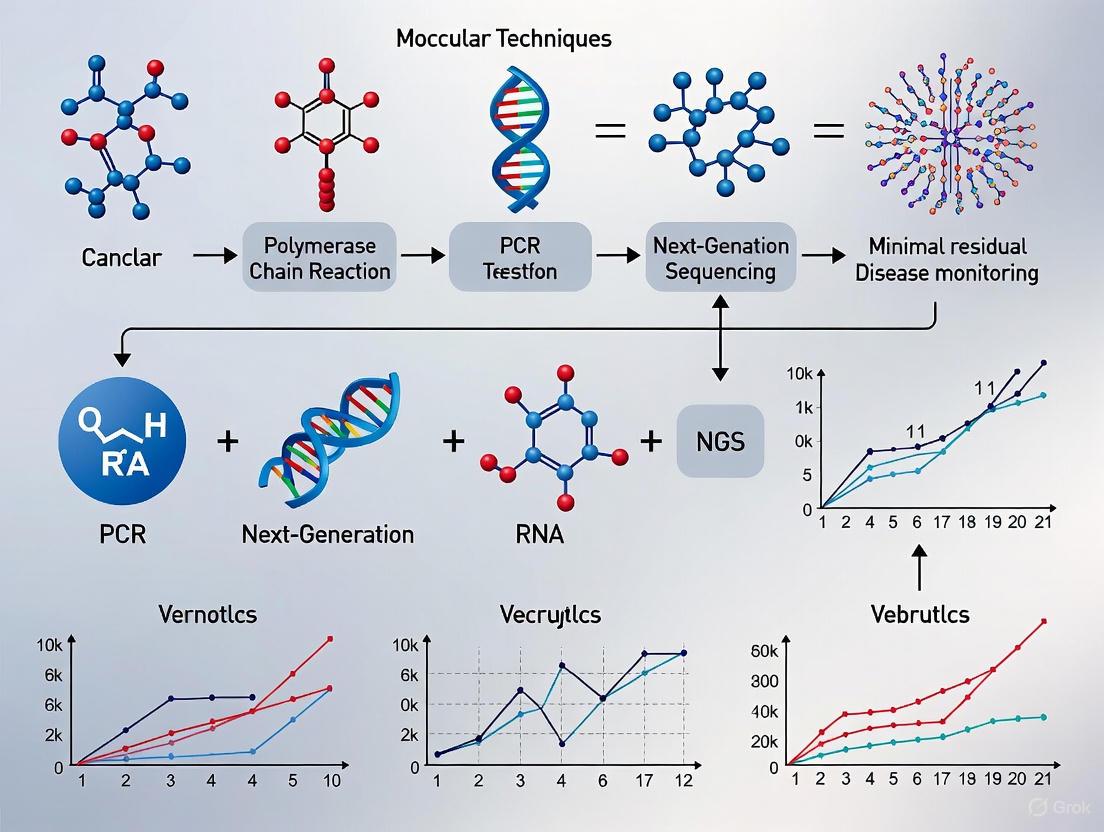
This article provides a comprehensive analysis of current and emerging molecular techniques for Minimal Residual Disease (MRD) monitoring, a critical tool in precision oncology.
Molecular Monitoring of Minimal Residual Disease: A 2025 Guide for Precision Oncology and Drug Development
Abstract
This article provides a comprehensive analysis of current and emerging molecular techniques for Minimal Residual Disease (MRD) monitoring, a critical tool in precision oncology. Tailored for researchers, scientists, and drug development professionals, it explores the foundational principles of MRD, details the methodologies and clinical applications of next-generation sequencing (NGS), digital PCR, and circulating tumor DNA (ctDNA) assays, and addresses key challenges in standardization and optimization. It further offers a comparative validation of technologies and discusses their growing role as endpoints in clinical trials, synthesizing the latest advancements to guide future research and therapeutic development.
Understanding Measurable Residual Disease: From Basic Concepts to Clinical Imperative
Minimal Residual Disease (MRD), also referred to as Measurable Residual Disease, represents the small number of cancer cells that persist in a patient during or after treatment when the patient is in remission and cannot be detected by conventional imaging or routine screening methods [1] [2]. This occult stage of cancer progression constitutes a critical bridge between apparent remission and clinical relapse, as these residual cells possess the potential to multiply and cause disease recurrence [1] [3] [2].
The clinical significance of MRD stems from its powerful prognostic value. The presence and quantity of MRD are strongly associated with cancer recurrence, often providing a lead time of several months relative to other clinical evidence of relapse [4] [2]. In hematological malignancies, MRD assessment has emerged as one of the most important independent predictors of patient outcomes, becoming a key component of therapeutic decision-making in modern treatment regimens [4] [5].
Methodologies for MRD Detection
Multiple highly sensitive techniques have been developed and clinically validated for MRD detection, each with distinct advantages, limitations, and appropriate applications. The current landscape of MRD testing methodologies encompasses several sophisticated approaches.
Table 1: Comparison of Major MRD Detection Techniques
| Technique | Detection Principle | Analytes | Sensitivity | Key Applications |
|---|---|---|---|---|
| Multiparameter Flow Cytometry (MFC) | Immunophenotypic detection of aberrant cell surface proteins [4] [6] | Live cells [7] | 0.01% (1 in 10⁴) [4] | AML, ALL, Multiple Myeloma [4] [6] |
| Next-Generation Sequencing (NGS) | Error-corrected sequencing to detect genetic mutations [3] | DNA | 0.001% (1 in 10⁵) [3] [2] | AML, ALL, Solid Tumors [3] [7] |
| Quantitative PCR (qPCR) | Target amplification of specific genetic sequences [7] | DNA/RNA | 0.001% (1 in 10⁵) [2] | CML (BCR::ABL1), APL (PML::RARA) [7] [2] |
| Digital PCR (dPCR) | Absolute quantification of target molecules [7] | DNA/RNA | 0.001% (1 in 10⁵) [7] | Emerging applications across cancers [7] |
DNA-Based MRD Detection Approaches
DNA-based MRD testing methodologies leverage circulating tumor DNA in blood or bone marrow samples containing cancer-specific DNA sequences [2]. These approaches can be broadly categorized into tumor-informed and tumor-agnostic strategies:
Tumor-Informed Approach: This personalized medicine strategy utilizes mutation information from sequencing an individual's tumor tissue biopsy before subsequent MRD monitoring [2]. Typically, tens to hundreds of patient-specific mutations are selected for monitoring, achieving sensitivity as low as 0.001% (one cell in 100,000) [7] [2]. The selected DNA sequences may contribute to carcinogenesis or simply serve as passenger mutations linked to the cancer clone [2].
Tumor-Agnostic Approach: Also known as "tumor-uninformed," this method employs a fixed panel of known cancer driver mutations when mutation information from primary tumor tissue is unavailable [2]. While less personalized, this approach offers practical advantages in settings where tumor sequencing is not feasible.
Diagram 1: Comprehensive MRD Detection Workflow illustrating the parallel pathways for molecular and cellular detection techniques.
Standardized Multiparameter Flow Cytometry Protocols
For flow cytometric detection of MRD in multiple myeloma, consensus guidelines establish standardized approaches to ensure reproducible and clinically relevant data [6]. The International Clinical Cytometry Society and European Society for Clinical Cell Analysis have developed detailed protocols covering specimen quality, staining processes, reagent combinations, and data acquisition.
Specimen Requirements and Preparation:
- Acceptable Specimens: Bone marrow aspirate (standard for MM MRD), peripheral blood, or fine needle aspirate [6]
- Anticoagulants: EDTA or sodium heparin (ACD is not recommended) [6]
- Specimen Age: Process within 24-48 hours of collection; 24-hour cutoff for multicenter clinical trials [6]
- Viability Threshold: ≥85% viability required; suboptimal viability must be reported [6]
- Preferred Processing Method: Pre-lysis technique to maximize cell delivery per tube and enhance sensitivity [6]
Standardized Antibody Panel for Multiple Myeloma MRD: The consensus panel requires analysis of CD38, CD138, and CD45 in combination with CD19, CD56, CD27, CD81, and CD117 for sensitive and specific identification of aberrant plasma cells [6]. This comprehensive approach enables discrimination of neoplastic from normal plasma cells based on characteristic immunophenotypic aberrancies.
Data Acquisition Parameters:
- Acquisition of large data files is critical for sensitive detection [6]
- The limit of detection depends on the number of cells measured [6]
- Robust hardware/software systems required for data analysis [6]
Clinical Significance and Predictive Value of MRD
The prognostic significance of MRD has been extensively validated across hematological malignancies, with emerging evidence in solid tumors. MRD status provides critical insights that extend beyond conventional remission assessment.
MRD as a Predictor of Clinical Outcomes
Table 2: Prognostic Impact of MRD Status Across Hematological Malignancies
| Cancer Type | MRD Assessment Timing | Relapse Risk with MRD+ | Statistical Evidence |
|---|---|---|---|
| Acute Lymphoblastic Leukemia (ALL) | Post-induction/consolidation [4] | 80% morphological relapse rate [4] | Median DFS: 3.6 months from MRD detection [4] |
| Acute Myeloid Leukemia (AML) | First complete remission [3] | 68% relapse rate with NGS MRD+ vs 13% with MRD- [3] | HR=8.8 for relapse; P<0.001 [3] |
| Multiple Myeloma | Post-treatment [6] | Significantly higher progression risk | Standardized consensus guidelines [6] |
| Various Hematological Cancers | Multiple timepoints [7] | 3.5x higher odds of relapse with MRD+ [7] | Aggregate analysis across studies [7] |
In ALL, MRD relapse detected by multiparameter flow cytometry at any time after achieving complete remission is associated with high risk for morphological relapse [4]. A study of 55 patients who developed MRD recurrence while in morphological CR showed that 80% subsequently developed morphological relapse after a median of 3 months from MRD detection [4]. The median disease-free survival from the time of MRD relapse was only 3.6 months, underscoring the critical importance of early detection [4].
In AML, next-generation sequencing-based MRD testing demonstrates superior prognostic performance compared to multiparameter flow cytometry [3]. A study comparing duplex sequencing (DS) with MFC in 62 AML patients in first complete remission found DS MRD strongly associated with higher relapse rates (68% vs. 13%; HR=8.8; P<0.001) and decreased survival (32% vs. 82%; HR=5.6; P<0.001) at 5 years [3]. In contrast, MFC MRD was only marginally associated with outcomes in the same patient cohort [3].
MRD in Therapeutic Decision-Making
MRD assessment provides critical guidance for treatment intensification, modification, or cessation across various hematological malignancies:
- Treatment Intensification: In leukemia, persistence of MRD after initial chemotherapy cycles may indicate need for more intensive treatment, including stem cell transplantation when otherwise not appropriate [1] [4]
- Pre-emptive Intervention: MRD monitoring offers a powerful tool for detecting subclinical disease, enabling early intervention before morphological relapse [5]
- Therapy Cessation: In non-intensive treatment settings, MRD may help tailor treatment duration and identify patients eligible for therapy cessation [5]
- Novel Agent Evaluation: MRD serves as an early endpoint in clinical trials, accelerating drug development [2]
Recent randomized controlled trials have begun to establish MRD not only as a prognostic biomarker but potentially as a predictive biomarker guiding therapeutic strategies. The UK NCRI AML17 and AML19 trials demonstrated that for patients with NPM1 and FLT3-ITD mutations, MRD-guided therapy resulted in significantly improved 3-year survival rates (69% vs. 58%; HR=0.53; p=0.021) compared to standard care without monitoring [8].
Diagram 2: Clinical Implications of MRD Detection illustrating how MRD status informs both prognostic stratification and therapeutic guidance.
The Scientist's Toolkit: Essential Research Reagents and Materials
Successful MRD detection requires carefully selected and validated reagents, materials, and instrumentation. The following toolkit outlines essential components for establishing robust MRD monitoring protocols.
Table 3: Essential Research Reagent Solutions for MRD Detection
| Category | Specific Reagents/Components | Function/Application | Technical Notes |
|---|---|---|---|
| Specimen Collection | EDTA tubes, Sodium Heparin tubes | Anticoagulated bone marrow/peripheral blood collection | ACD not recommended; affects pH and viability [6] |
| Cell Processing | Ammonium chloride lysing solution, PBS, Fetal Bovine Serum | RBC lysis, cell washing, resuspension | Pre-lysis method preferred for maximum cell delivery [6] |
| Flow Cytometry Antibodies | CD38, CD138, CD45, CD19, CD56, CD27, CD81, CD117 | Identification of aberrant plasma cells (MM) [6] | Fully validated antibody-fluorochrome combinations essential [6] |
| Nucleic Acid Extraction | DNA/RNA extraction kits, Proteinase K, RNase inhibitors | High-quality nucleic acid isolation | Assess quantity and quality spectrophotometrically |
| PCR/NGS Reagents | Primers, Probes, Polymerase enzymes, dNTPs, Master mixes | Target amplification and detection | Patient-specific primers for IG/TCR rearrangements [2] |
| NGS Library Prep | Adaptors, Barcodes, Enzymes for library construction | Preparation of sequencing libraries | Error-corrected methods for enhanced sensitivity [3] |
| Quality Control | Reference standards, Control cell lines, Synthetic targets | Assay validation and quality assurance | Essential for determining limit of detection [6] |
Advanced Technical Protocols
Duplex Sequencing for Ultra-Sensitive MRD Detection
Duplex Sequencing (DS) represents a cutting-edge approach for MRD monitoring, generating double-stranded consensus sequences to reduce false positive errors [3]. The technical protocol involves:
Sample Requirements and Preparation:
- Input Material: 1μg genomic DNA from bone marrow or peripheral blood
- Gene Panel: 29-gene panel recurrently mutated in adult AML
- Controls: Process contrived mutation mixes versus healthy donor DNA for validation
Sequencing Parameters:
- Average Raw Sequencing Depth: 279x at diagnosis
- Mean Duplex Consensus Molecular Depth: 135,065-142,707x from 1.5 μg DNA input
- Variant Calling Threshold: VAF ≥ 5% (≥1% for FLT3-ITD/NPM1 insertions)
Bioinformatic Analysis:
- Germline Variant Exclusion: VAF ≥35% at both diagnosis and remission, or ≥40% at either time point with gnomAD allele frequency ≥0.05
- Somatic Variant Classification: Computational prediction of deleterious impact with manual curation
- MRD Positivity Criteria: Conditions previously identified as prognostic [3]
This ultrasensitive NGS method demonstrated significantly superior performance compared to centralized, high-quality multiparametric flow cytometry, with DS MRD strongly associated with higher relapse rates (HR=8.8; P<0.001) and decreased survival (HR=5.6; P<0.001) at 5 years [3].
Standardized Multiparameter Flow Cytometry for Multiple Myeloma
The consensus guidelines for flow cytometric MM MRD testing provide detailed protocols for optimal detection sensitivity and reproducibility [6]:
Staining Procedure:
- Cell Concentration: Reconstitute at high concentration to deliver 3-10 million cells in 100-200 μL per tube
- Antibody Cocktail: Prepare predefined combinations with appropriate fluorochrome conjugates
- Incubation: Protect from light, follow manufacturer-recommended time and temperature
- Post-staining Processing: Wash cells, resuspend in appropriate buffer for acquisition
Instrument Setup and Quality Control:
- Daily Performance: Check using calibration particles
- Compensation: Set using single-stained controls or compensation particles
- Sensitivity: Monitor using quality control materials with known antigen expression
Data Acquisition and Analysis:
- Acquisition: Collect sufficient events for desired sensitivity (≥3 million nucleated cells recommended)
- Analysis Strategy: Sequential gating to identify abnormal plasma cell population
- Reporting: Include percentage of abnormal plasma cells and total cells acquired
MRD represents the critical biological bridge between clinical remission and disease relapse, with detection and monitoring becoming increasingly integral to modern cancer management. The evolving landscape of MRD assessment technologies, from advanced flow cytometry to error-corrected next-generation sequencing, provides unprecedented sensitivity for quantifying submicroscopic disease burden. As therapeutic options expand across hematological malignancies and solid tumors, MRD monitoring offers a powerful tool for guiding personalized treatment approaches, assessing therapeutic efficacy, and ultimately improving patient outcomes. Standardization of methodologies and continued validation in clinical trials will further establish MRD as an essential component of precision oncology in the coming decade.
Measurable residual disease (MRD), previously known as minimal residual disease, refers to the detection of residual leukemic cells in patients who have achieved complete remission (CR) by conventional morphological assessment [9]. The presence of MRD signifies the persistence of a malignant cell population that remains after treatment and is the strongest independent prognostic predictor of relapse and survival outcomes in acute leukemia [9] [10]. This application note details the methodologies, clinical validation, and practical protocols for MRD detection, providing researchers and drug development professionals with the tools to implement these assessments in both clinical trials and routine practice.
Technological advances have enabled the detection of malignant cells at sensitivity levels as low as 1 in 10,000 to 1 in 1,000,000 cells (10⁻⁴ to 10⁻⁶), far beyond the capability of conventional morphology, which can only detect disease at levels above 1-5% [9]. The shift in terminology from "minimal" to "measurable" emphasizes the clinical importance of these low-level disease detections and acknowledges that results vary depending on the testing method applied [9].
Prognostic Value of MRD Across Hematologic Malignancies
MRD status provides powerful prognostic information across various hematologic malignancies, consistently demonstrating that MRD negativity is associated with superior survival outcomes.
Table 1: Prognostic Impact of MRD Status on Survival Outcomes
| Malignancy | Endpoint | MRD-Negative | MRD-Positive | Hazard Ratio (HR) |
|---|---|---|---|---|
| Acute Myeloid Leukemia (AML) [10] | 5-Year Overall Survival | 68% | 34% | Not Reported |
| Acute Lymphoblastic Leukemia (ALL) [10] | Event-Free Survival | Improved | Worse | HR 0.23 (Pediatric), HR 0.28 (Adult) |
| Chronic Lymphocytic Leukemia (CLL) [10] | Progression-Free Survival | Improved | Worse | HR 0.28 (Overall) |
| Multiple Myeloma [10] | Progression-Free Survival | Improved | Worse | HR 0.33 |
| Multiple Myeloma [10] | Overall Survival | Improved | Worse | HR 0.45 |
The prognostic significance of MRD has been validated in specific treatment contexts. A 2025 real-world study of AML patients treated with venetoclax and hypomethylating agents (VenHMA) confirmed the independent prognostic value of MRD response for both overall survival (OS) and leukemia-free survival (LFS) [11]. The median OS was 23.3 months for MRD responders compared to 15.2 months for non-responders, and median LFS was 20.3 months versus 9.2 months, respectively [11].
MRD Detection Methodologies: Technical Protocols
The primary methods for MRD detection include multiparameter flow cytometry (MFC), next-generation flow cytometry (NGF), polymerase chain reaction (PCR)-based techniques, and next-generation sequencing (NGS). Each method has distinct advantages, limitations, and optimal applications.
Multiparameter Flow Cytometry (MFC)
Experimental Protocol: MFC-MRD Detection in Acute Leukemia
Principle: MFC assesses antigens present on the surface, cytoplasm, or nuclei of cells using fluorochrome-conjugated specific monoclonal antibodies, along with the physical characteristics of cells (size and complexity) by light scatter [9]. The core challenge is to distinguish leukemic cells from their normal counterparts based on immunophenotypic differences.
Key Strategies:
- Leukemia-Associated ImmunoPhenotype (LAIP): Identifies a unique immunophenotype of the leukemic cells at diagnosis and tracks this same phenotype during follow-up. This approach is simple but carries a risk of false negativity due to phenotypic shifts [9].
- Different from Normal (DFN): Identifies malignant cells by recognizing immunophenotypic deviations from normal counterpart populations without requiring a pre-treatment sample. This method is more robust against phenotypic shifts but requires greater expertise and is more subjective [9]. It is recommended to use both strategies together whenever possible [9].
Sample Requirements:
- Sample Type: Bone marrow (BM) aspirate is typically preferred. For B-cell ALL (B-ALL) and AML, MRD levels are typically one or more logs higher in BM than in peripheral blood (PB). For T-cell ALL (T-ALL), MRD levels are comparable in both compartments [9].
- Collection: BM aspirate should be the first pull and less than 5 mL to minimize hemodilution [9].
- Anticoagulant: Ethylenediaminetetraacetic acid (EDTA) or sodium heparin [9].
- Transport and Processing: Transport at room temperature and process as soon as possible, ideally within 48 hours of collection [9].
Sample Preparation Techniques (Two Accepted Methods):
- Bulk Lysis: Bulk lysis of the sample, followed by wash/stain/wash steps.
- Stain/Lyse: Staining of cells, followed by lyse/wash or no-wash procedures [9].
Data Acquisition and Analysis:
- Sensitivity: Varies from 10⁻³ to 10⁻⁵, depending on the disease and panel used [9].
- Instrumentation: Use a flow cytometer capable of detecting the number of fluorochromes in the panel.
- Gating Strategy: Analysis requires expertise to recognize aberrant populations and exclude normal/reactive cell populations. For B-ALL, a core panel including CD34, CD19, CD10, CD20, CD38, and CD45 is recommended to distinguish leukemic blasts from normal B-cell precursors (hematogones) [9].
Flowchart of the MFC-MRD detection workflow, from sample collection to final result.
Next-Generation Sequencing (NGS) and PCR-Based Methods
Experimental Protocol: Molecular MRD Detection
Principle: Molecular methods detect unique genetic sequences or rearrangements specific to the leukemic clone. Quantitative PCR (qPCR) is used for known, recurring genetic targets (e.g., PML-RARA, BCR-ABL, NPM1), while NGS can target a broader range of mutations or track immunoglobulin (Ig) or T-cell receptor (TCR) gene rearrangements [9] [10].
Sample Requirements:
- Sample Type: Bone marrow is the preferred specimen. Peripheral blood may be used for specific diseases like CML and APL, where concordance with BM has been demonstrated [10].
- Cell Count: Sufficient nucleated cells are required to achieve the desired sensitivity.
DNA/RNA Extraction:
- Use standardized, high-quality extraction kits to obtain DNA or RNA of sufficient purity and integrity for amplification.
- For RNA-based assays (e.g., PML-RARA fusion detection), ensure RNA is not degraded.
qPCR Protocol (for known targets, e.g., NPM1):
- Reverse Transcription: If the target is RNA, perform reverse transcription to generate cDNA.
- Amplification: Use sequence-specific primers and probes. The reaction typically includes 40-50 cycles.
- Quantification: Quantify the target relative to a reference gene (e.g., ABL1) to calculate the transcript level. Results are often reported on an international scale (IS) for diseases like CML [10].
- Sensitivity: A sensitivity of 0.01% (10⁻⁴) is typically achieved for well-optimized assays [11].
NGS Protocol (for Ig/TCR rearrangements or gene mutations):
- Library Preparation: Amplify target regions (e.g., VDJ segments of Ig genes, a panel of myeloid mutation hotspots) using multiplexed PCR primers.
- Sequencing: Perform high-throughput sequencing on an NGS platform.
- Bioinformatic Analysis: Align sequences to a reference genome. For Ig/TCR tracking, identify the dominant clonal sequence(s) from the diagnostic sample and track them in the follow-up sample. For mutation tracking, identify variant allele frequencies (VAF) of known mutations.
- Sensitivity: NGS can achieve a sensitivity of 10⁻⁵ to 10⁻⁶ [9].
Flowchart for molecular MRD detection, showing the divergent paths for qPCR and NGS methods.
The Scientist's Toolkit: Essential Research Reagents and Materials
Successful MRD detection requires a suite of carefully validated reagents and instruments. The following table details key solutions for setting up robust MRD assays.
Table 2: Research Reagent Solutions for MRD Detection
| Item Category | Specific Examples | Function and Application Notes |
|---|---|---|
| Monoclonal Antibody Panels | CD34, CD19, CD10, CD20, CD38, CD45, CD117, CD33, CD13, CD7, HLA-DR [9] [11] | Cell surface, cytoplasmic, or nuclear antigen detection for immunophenotyping by MFC. Panels must be optimized for disease type (e.g., B-ALL vs. AML). |
| Nucleic Acid Extraction Kits | High-quality DNA/RNA extraction kits | To obtain pure, intact nucleic acids from BM/PB samples for molecular assays. Critical for achieving high sensitivity and reproducibility. |
| PCR/NGS Reagents | Sequence-specific primers and probes, master mixes, NGS library prep kits | For amplification and detection of genetic targets (e.g., NPM1, RUNX1::RUNX1T1) or Ig/TCR rearrangements. |
| Reference Genes/Controls | ABL1 | A housekeeping gene used as an internal reference for quantification and quality control in qPCR assays [10]. |
| Cell Lysis & Staining Buffers | Bulk lysis buffer, permeabilization buffers | For red blood cell lysis and intracellular staining in MFC sample preparation [9]. |
Statistical Considerations and Clinical Translation
The interpretation of MRD test results requires careful consideration of their statistical properties. Reducing a quantitative MRD result to a simple binary (positive/negative) outcome has several limitations, including decreased statistical power and the loss of ability to identify linear relationships with outcomes [12]. The sensitivity, specificity, positive predictive value (PPV), and negative predictive value (NPV) of an MRD test are critical for understanding its clinical performance [12].
A "perfect" MRD test with 100% sensitivity and specificity does not exist due to several factors, including the incomplete biological understanding of the cancer stem cells that ultimately cause relapse, spatial heterogeneity in disease distribution, and technical limitations in sampling and assay precision [12]. Furthermore, the predictive power of an MRD test is inherently linked to the follow-up period of the analysis, as relapses can occur beyond the observation interval of clinical trials [12].
Despite these challenges, MRD has been successfully integrated into clinical decision-making. It is used to guide risk-adapted therapies, such as the decision to proceed to allogeneic stem cell transplantation in first remission, select conditioning intensity, and determine the need for post-transplant interventions [12] [13]. In diseases like chronic myeloid leukemia (CML) and acute promyelocytic leukemia (APL), MRD monitoring by PCR is a well-established standard of care for guiding therapy [10].
MRD detection represents a paradigm shift in the management of hematologic malignancies, moving beyond morphological remission to a more profound molecular-level assessment of disease burden. The methodologies outlined here—MFC, qPCR, and NGS—provide powerful, complementary tools for predicting patient outcomes, evaluating new therapies, and guiding personalized treatment strategies. As international consortia like EuroFlow and EuroMRD continue to standardize these techniques, the role of MRD in clinical practice and drug development will only expand, solidifying its status as an essential biomarker for precision medicine in oncology.
The term minimal residual disease (MRD)—long used to describe the small number of cancer cells that persist in patients after treatment—is increasingly being supplanted by measurable residual disease, while retaining the same MRD acronym. This semantic shift reflects a pivotal technological evolution in oncology and hematology. MRD refers to the reservoir of residual cancer cells that can lead to relapse, existing at levels undetectable by conventional morphological methods [14]. The progression from "minimal" to "measurable" marks a transition from merely conceptualizing residual disease to precisely quantifying it with advanced molecular techniques, enabling more informed clinical decision-making [14] [15].
This evolution is driven by techniques such as next-generation sequencing (NGS) and high-sensitivity flow cytometry, which allow for the detection and quantification of residual cancer cells at sensitivities of 10⁻⁵ to 10⁻⁶ [14] [15]. For context, this represents the ability to find one cancer cell among 100,000 to 1,000,000 normal cells, far exceeding the sensitivity of traditional morphology, which has a detection limit of approximately 5% (1 in 20 cells) [14]. This enhanced measurement capability has transformed MRD status into a powerful prognostic biomarker, critically informing risk stratification, guiding treatment intensity, and serving as a surrogate endpoint in clinical trials [14] [15].
Application Notes: The Quantitative Foundation of MRD
Comparison of MRD Detection Technologies
The quantification of MRD relies on a suite of complementary technologies, each with distinct performance characteristics, applicability, and limitations. The choice of method depends on cancer type, available resources, and required sensitivity.
Table 1: Comparison of Key MRD Detection Methods
| Method | Applicability | Sensitivity | Key Advantages | Inherent Limitations |
|---|---|---|---|---|
| Multiparameter Flow Cytometry (MFC) | Nearly 100% for hematologic malignancies [15] | 10⁻⁴ to 10⁻⁶ [14] [15] | Fast turnaround (3-4 hours); wide applicability; relatively low cost [14] [15] | Requires fresh cells; potential for immunophenotype changes [14] |
| Next-Generation Sequencing (NGS) | >90-95% [14] [15] | 10⁻⁵ to 10⁻⁶ [14] [15] | Highly sensitive and quantitative; broad detection of clonal rearrangements/somatic mutations [14] | High cost; slower turnaround; complex data analysis [14] |
| qPCR (Fusion Gene or IgH/TCR) | ~40-50% [14] | 10⁻⁴ to 10⁻⁶ [14] | Lower cost; standardized; excellent sensitivity for specific targets [14] | Assesses only one gene per assay; lower applicability [14] |
| Cellular Morphology | N/A | 5 x 10⁻² (5%) [14] | Traditional gold standard; widely available [14] | Very low sensitivity; subjective [14] |
Clinical Implications of Quantitative MRD
The ability to precisely measure residual disease burden has profound clinical implications. In multiple myeloma, for example, achieving MRD negativity is independently prognostic for improved progression-free survival (PFS) and overall survival (OS), regardless of disease stage or cytogenetic risk [15]. The depth of response measurable by NGS or next-generation flow (NGF) allows for refined patient stratification beyond traditional complete response (CR) [15].
In Acute Myeloid Leukemia (AML), the quantitative nature of MRD is critical. A recent study utilizing NGS of circulating cell-free DNA (cfDNA) demonstrated that the detection of mutations during hematological remission, even at very low variant allele frequencies (VAFs as low as 0.08%), was associated with a lower probability of progression-free survival compared to patients with undetectable MRD [16]. This illustrates the power of "measurable" disease to predict relapse earlier than conventional methods.
The technological shift also enables MRD assessment in solid tumors via liquid biopsy. Analysis of circulating tumor DNA (ctDNA) in blood plasma allows for the detection of tumor-specific mutations, in some cases identifying recurrence months earlier than radiographic imaging [17]. This approach is being applied in lung, colorectal, and breast cancers, expanding the utility of MRD monitoring beyond hematologic malignancies [17].
Experimental Protocols
Protocol 1: Next-Generation Flow Cytometry for Multiple Myeloma MRD
This protocol is based on the EuroFlow consensus methodology for standardized, high-sensitivity MRD detection in multiple myeloma [6] [15].
3.1.1 Principle Uses an 8-color, 2-tube antibody panel to identify aberrant plasma cell phenotypes (e.g., CD19-, CD56+, CD45-, CD117+) that distinguish neoplastic from normal plasma cells in bone marrow aspirates [6] [15].
3.1.2 Materials and Reagents
- Specimen: Fresh bone marrow aspirate (≥ 2 mL), anticoagulated with EDTA or heparin [6].
- Antibody Panels (8-color):
- Tube 1: CD138, CD27, CD38, CD56, CD45, CD19, CD117, CD81.
- Tube 2: CD138, CD27, CD38, CD56, CD45, CD19, cIgκ, cIgλ [15].
- Lysing Solution: 155 mM ammonium chloride, 10 mM potassium bicarbonate, 0.2 mM EDTA [6].
- Phosphate-Buffered Saline (PBS)
- Flow Cytometer: Capable of detecting at least 8 fluorochromes and acquiring ≥ 10 million events per tube [15].
3.1.3 Step-by-Step Procedure
- Sample Preparation (Pre-Lysis): Gently incubate the bone marrow sample with ammonium chloride lysing solution at a 1:9 ratio for 10 minutes at room temperature. Pellet cells at 500g, wash with PBS, and reconstitute at a high concentration to deliver 3–10 million cells in 100–200 μL per tube [6].
- Staining: Add the predetermined antibody cocktail to each tube containing the cell sample. Incubate for 15-20 minutes in the dark at room temperature.
- Post-Staining Processing: If required, fix cells after staining to preserve signal stability, particularly for tandem dye conjugates [6].
- Data Acquisition: Acquire a minimum of 5 million nucleated cells per tube (recommended ≥ 10 million) using the flow cytometer. The high cell number is essential for achieving a sensitivity of 10⁻⁵ to 10⁻⁶ [15].
- Data Analysis: Use automated software for plasma cell gating. The limit of detection (LOD) is defined by the identification of ≥20 clonal plasma cells among 10⁷ nucleated cells, and the limit of quantitation (LOQ) is defined by ≥50 clonal plasma cells [15].
3.1.4 Quality Control
- Assess sample viability concomitantly. Do not report results if viability is <85% [6].
- Reject hemodilute, partially clotted, or aged (>48 hours) specimens unless irreplaceable [6].
The following workflow diagram summarizes the key steps in the NGF MRD detection process:
Protocol 2: NGS-Based MRD Detection in Acute Myeloid Leukemia Using cfDNA
This protocol outlines a method for detecting MRD via next-generation sequencing of circulating cell-free DNA, providing a minimally invasive alternative to bone marrow aspiration [16].
3.2.1 Principle Identifies and tracks pre-existing, leukemia-associated somatic mutations (e.g., in NPM1, FLT3, IDH1/2) in cell-free DNA isolated from patient plasma, allowing for quantification of disease burden.
3.2.2 Materials and Reagents
- Blood Collection Tubes: Cell-free DNA blood collection tubes (e.g., Streck tubes) [16].
- cfDNA Isolation Kit: QIAamp Circulating Nucleic Acid Kit or equivalent [16].
- NGS Library Prep Kit: Commercially available targeted gene panels (e.g., ArcherDx VariantPlex Core AML, 37-gene Core Myeloid panel) [16].
- Quantitation Instruments: Qubit Fluorometer and qPCR system for library quantification [16].
- Sequencing Platform: Illumina MiSeq or NextSeq [16].
3.2.3 Step-by-Step Procedure
- Sample Collection and Processing: Collect peripheral blood in cfDNA-stabilizing tubes. Centrifuge to isolate plasma within the stipulated time frame for the tube type.
- cfDNA Isolation: Extract cfDNA from plasma using the isolation kit. Determine cfDNA yield and quality (e.g., using the PreSeq DNA QC Assay). Yields can range from 24 ng to 5.2 µg [16].
- Library Preparation and Sequencing: Prepare sequencing libraries using the targeted myeloid gene panel according to the manufacturer's instructions. Use 1–50 ng of cfDNA as input. Perform paired-end sequencing (e.g., 150 bp) to achieve a minimum of 3 million reads for the 37-gene panel [16].
- Bioinformatic Analysis: Analyze sequencing data using the vendor's bioinformatics pipeline (e.g., Archer Analysis). Manually review mutations previously identified by routine diagnostics, even if they do not pass automatic filters. For previously unknown variants, cross-reference clinical databases (COSMIC, ClinVar) and computational algorithms (FATHMM, PolyPhen2) to determine pathogenicity [16].
- MRD Assessment: A sample is considered MRD-positive if at least one previously known, pathogenic mutation is identified in the cfDNA during clinical remission. The Variant Allele Frequency (VAF) is reported, with detection sensitivity as low as 0.08% VAF demonstrated [16].
3.2.4 Quality Control
- Only mutations classified as pathogenic or likely pathogenic should be considered for MRD evaluation to avoid false positives from variants of unknown significance [16].
- The assay's sensitivity is dependent on overall read count and mutation-specific coverage; ensure sufficient sequencing depth [16].
The following workflow diagram illustrates the NGS-based cfDNA MRD detection process:
The Scientist's Toolkit: Essential Research Reagents & Materials
Successful MRD research requires a carefully selected suite of reagents and tools designed for sensitivity and specificity.
Table 2: Key Research Reagent Solutions for MRD Detection
| Item | Function/Application | Example Products/Components |
|---|---|---|
| cfDNA Library Prep Kit | Prepares sequencing libraries from degraded, low-input cfDNA/FFPE samples, enabling variant identification. | xGen cfDNA & FFPE DNA Library Preparation Kit [17] |
| Targeted Hybridization Panels | Captures and enriches for sequences of a predefined set of cancer-associated genes for deep sequencing. | xGen Acute Myeloid Leukemia (AML) Cancer Panel; xGen MRD Hyb Panel (customizable) [17] |
| Validated Antibody Panels | Enables sensitive identification of aberrant cell populations via multi-parameter flow cytometry. | EuroFlow NGF panel for MM: CD38, CD138, CD45, CD19, CD56, CD27, CD81, CD117 [6] [15] |
| cfDNA Blood Collection Tubes | Stabilizes nucleated blood cells to prevent genomic DNA contamination and preserve cfDNA in plasma. | Cell-free DNA Blood Collection Tubes (e.g., Streck) [16] |
| NGS Bioinformatics Pipeline | Analyzes raw sequencing data, identifies somatic mutations, and quantifies their allele frequency. | ClonoSEQ Assay; Archer Analysis; "in-house" academic pipelines [15] [16] |
Key Hematologic and Solid Tumors Where MRD Monitoring is Revolutionizing Care
Measurable Residual Disease (MRD), also referred to as Minimal Residual Disease, represents the small population of cancer cells that persist in patients after treatment, undetectable by conventional radiographic scans or morphologic assessment of bone marrow [10]. Over the past decade, MRD has emerged as a critical tool for detecting and monitoring a variety of cancers, with its most established applications in hematologic malignancies and rapidly expanding utility in solid tumors [10] [18]. This revolutionary approach offers significantly greater sensitivity than traditional methods, providing a sensitive and quantitative assessment of disease burden that reflects the cumulative effect of tumor biology, treatment tolerability, and safety [10] [19]. The ability to detect molecular relapse months or even years before clinical recurrence creates a valuable window for early intervention, fundamentally transforming cancer care paradigms from reactive to proactive management [20] [21].
Table 1: Key Hematologic Malignancies Where MRD Monitoring is Established
| Malignancy | Prognostic Impact of MRD Negativity | Preferred Assessment Methods | Clinical Applications |
|---|---|---|---|
| Acute Myeloid Leukemia (AML) | 5-year OS: 68% (MRD-) vs 34% (MRD+) [10] | MFC, NGS, qPCR/ddPCR for specific mutations [5] [19] | Risk stratification, transplant decisions, early relapse detection [5] [22] |
| Acute Lymphoblastic Leukemia (ALL) | HR for OS: 0.28 (adults); HR for EFS: 0.23 (pediatric) [10] | MFC, NGS, PCR (EuroMRD standards) [10] | Treatment intensification/de-escalation, strongest predictor of relapse [10] |
| Chronic Lymphocytic Leukemia (CLL) | 72% reduction in risk of progression/death (PFS HR: 0.28) [10] | MFC, NGS (EuroFlow standards) [10] | Guidance for time-limited therapy, treatment response evaluation [10] |
| Multiple Myeloma | PFS HR: 0.33; OS HR: 0.45 [10] | NGF (EuroFlow), NGS [10] | Endpoint in clinical trials, evaluation of deep response [10] |
| Acute Promyelocytic Leukemia (APL) | Predicts relapse, guides therapy duration [10] | RT-PCR for PML-RARα [10] | Therapy guidance, reduced BM biopsies needed [10] |
| Chronic Myeloid Leukemia (CML) | Determines eligibility for treatment-free remission [10] | RT-PCR for BCR-ABL1 [10] | TKI switching decisions, monitoring treatment response [10] |
MRD Assessment Methodologies: A Technical Deep Dive
The clinical utility of MRD monitoring is enabled by sophisticated detection technologies that vary in their principles, applications, and performance characteristics. The selection of an appropriate MRD assessment method depends on multiple factors, including disease type, genetic characteristics, required sensitivity, and available resources [14].
Core Technical Platforms
Multiparametric Flow Cytometry (MFC) utilizes fluorescently labeled antibodies to detect cell surface and intracellular markers, identifying aberrant immunophenotypes indicative of residual malignant cells. Modern approaches employ "different from normal" strategies that detect populations deviating from normal maturation patterns, rather than relying solely on leukemia-associated immunophenotypes identified at diagnosis [10] [19]. Standardization efforts by consortia like EuroFlow have established standardized MFC MRD protocols for ALL, CLL, and multiple myeloma, with the EuroFlow NGF approach regarded as the MFC gold standard for MRD assessment in multiple myeloma according to IMWG guidelines [10].
Next-Generation Sequencing (NGS)-based methods enable comprehensive detection of clonal rearrangements and somatic mutations across a broad spectrum of genetic alterations. For MRD detection in AML, targeted NGS assays can monitor known mutations (e.g., NPM1, FLT3-ITD) with limits of detection as low as 5×10^-5 [19]. NGS methods for lymphoid malignancies often track immunoglobulin (Ig) or T-cell receptor (TCR) gene rearrangements, requiring a diagnostic sample to identify patient-specific clonal sequences [14].
Polymerase Chain Reaction (PCR)-based methods include several variants with different applications and sensitivities. Quantitative PCR (qPCR) is widely used for detecting specific genetic abnormalities, particularly fusion transcripts like BCR-ABL1 in CML and PML-RARA in APL, with sensitivity up to 10^-6 [10] [14]. Digital droplet PCR (ddPCR) offers improved sensitivity over traditional qPCR through partitioning samples into thousands of nanoliter-sized droplets, enabling absolute quantification of nucleic acid targets with up to 10-fold greater sensitivity [19].
Table 2: Technical Comparison of MRD Detection Methodologies
| Method | Sensitivity | Applicability | Advantages | Limitations |
|---|---|---|---|---|
| Multiparametric Flow Cytometry (MFC) | 10^-3 to 10^-6 (increases with panel size) [14] | ~90% of AML patients; nearly 100% for lymphoid malignancies [19] [14] | Rapid, widely available, fresh sample analysis | Lack of standardization, immunophenotypic shifts, requires expertise [19] |
| Next-Generation Sequencing (NGS) | 10^-2 to 10^-6 [14] | >95% of patients [14] | Broad applicability, detects clonal evolution, standardized | High cost, complex data analysis, requires diagnostic sample [19] [14] |
| Quantitative PCR (qPCR) | 10^-4 to 10^-6 [14] | 40-60% of AML patients (molecular subgroups) [19] | High sensitivity for specific targets, standardized, lower cost | Limited to known mutations, cannot detect emerging clones [19] |
| Digital Droplet PCR (ddPCR) | Up to 10-fold more sensitive than qPCR [19] | 40-60% of AML patients (molecular subgroups) [19] | Absolute quantification, improved amplification efficiency | Limited multiplexing capability, higher cost, limited availability [19] |
Emerging Technologies and Platforms
The MRD technological landscape continues to evolve with several promising platforms enhancing detection capabilities. PhasED-seq (Phased Variant Enrichment and Detection Sequencing) from Foresight Diagnostics utilizes phased variants to achieve exceptional sensitivity below 0.0001% tumor fraction, with recent applications in diffuse large B-cell lymphoma demonstrating analytical sensitivity of less than 1 part per million [23]. Tumor-informed approaches like Signatera (Natera) and RaDaR (Inivata/NeoGenomics) use whole-exome or whole-genome sequencing of tumor tissue to create patient-specific assays that track multiple mutations in plasma, achieving limits of detection as low as 0.001-0.02% [18]. Tumor-naïve (agnostic) approaches such as Guardant Reveal (Guardant Health) use predefined panels of recurrent cancer-associated genomic or epigenomic alterations without prior tumor sequencing, offering faster turnaround times and lower costs but potentially reduced sensitivity [18].
Diagram 1: MRD Assessment Workflow
MRD in Hematologic Malignancies: Protocols and Applications
Acute Myeloid Leukemia (AML) MRD Monitoring Protocol
Specimen Requirements: Bone marrow aspirate (preferred) or peripheral blood collected in appropriate anticoagulant tubes. For MFC, fresh samples are required within 24-48 hours of collection. For molecular methods, frozen or stabilized samples may be acceptable [19] [14].
Optimal Timepoints: Assessment after induction therapy (to evaluate initial response), after consolidation therapy (to evaluate depth of response), pre-transplant (for risk stratification), and post-transplant (for early relapse detection) [5] [22].
Method-Specific Protocols:
Multiparameter Flow Cytometry: Utilize standardized antibody panels covering myeloid, lymphoid, and progenitor markers. The EuroFlow consortium has developed standardized protocols, though full standardization in AML remains an unmet need [10]. Acquire a minimum of 500,000 events per tube for adequate sensitivity. Analysis should include both "leukemia-associated immunophenotype" (LAIP) and "different-from-normal" (DfN) approaches to account for immunophenotypic shifts [19].
NGS-based MRD Monitoring: For patients with NPM1 mutations, targeted NGS assays can achieve sensitivity of 5×10^-5. DNA is extracted, and libraries are prepared using targeted panels covering relevant mutations. Sequencing should achieve sufficient coverage (typically >100,000x) for reliable detection of low-frequency variants. Bioinformatic analysis must distinguish true mutations from background errors and clonal hematopoiesis (CHIP) [19].
qPCR/ddPCR for Molecular Subgroups: For AML with specific genetic alterations (e.g., NPM1, RUNX1-RUNX1T1, CBFB-MYH11), design assays targeting the specific mutation or fusion. ddPCR offers absolute quantification without standard curves and can detect variant allele frequencies as low as 0.001% [19].
Interpretation Guidelines: The European LeukemiaNet (ELN) 2022 guidelines provide frameworks for MRD interpretation in AML. Generally, MRD positivity is associated with significantly worse outcomes, with 5-year overall survival of 34% for MRD-positive patients versus 68% for MRD-negative patients [10].
Acute Lymphoblastic Leukemia (ALL) MRD Monitoring Protocol
Specimen Requirements: Bone marrow aspirate is standard, though peripheral blood may have utility in certain contexts. Sample processing should follow EuroMRD or EuroFlow standards for harmonized results [10].
Optimal Timepoints: Early during induction therapy (e.g., day 15-28), at the end of induction, at the end of consolidation, and before transplant. MRD positivity is the strongest predictor of relapse in ALL [10].
Method-Specific Protocols:
Flow Cytometry: EuroFlow has established standardized 8-color antibody panels for B-ALL and T-ALL. Acquisition of at least 1 million cells is recommended for sensitivity of 10^-5. Data analysis should focus on aberrant immunophenotypes differing from normal B-cell or T-cell development patterns [10].
PCR-based Ig/TCR Rearrangement Tracking: DNA is extracted from diagnostic samples to identify clonal immunoglobulin or T-cell receptor gene rearrangements. Patient-specific primers are designed to track these rearrangements during treatment. EuroMRD guidelines provide quality control standards and interpretation criteria for this approach [10].
Clinical Implications: MRD status guides treatment intensification (e.g., blinatumomab in B-ALL) or de-escalation. Meta-analyses demonstrate that MRD negativity associates with significantly improved event-free survival (HR 0.23 for pediatric, 0.28 for adult) and overall survival (HR 0.28 for both groups) [10].
MRD in Solid Tumors: Expanding Applications
While MRD monitoring originated in hematologic malignancies, its application is rapidly expanding to solid tumors, driven primarily by advances in circulating tumor DNA (ctDNA) detection technologies [18] [21]. In solid tumors, MRD assessment typically utilizes liquid biopsy approaches to detect ctDNA in blood, representing a minimally invasive alternative to tissue biopsies [18].
Table 3: MRD Applications in Key Solid Tumors
| Solid Tumor | Clinical Context | Detection Method | Clinical Utility |
|---|---|---|---|
| Non-Small Cell Lung Cancer (NSCLC) | Early-stage, locally advanced [18] | ctDNA-based (Signatera, Guardant Reveal) [18] | Early relapse detection (before imaging), guiding adjuvant therapy decisions [18] |
| Colorectal Cancer | Stage II/III [21] | ctDNA-based (Signatera) [21] | MRD-guided adjuvant chemotherapy (DYNAMIC trial: reduced chemo use without compromising RFS) [21] |
| Breast Cancer | Early-stage [20] | ctDNA-based [20] | Detection of low-level ctDNA despite normal imaging; clinical challenge for intervention [20] |
| Bladder Cancer | Post-cystectomy [21] | ctDNA-based [21] | IMvigor011 trial: testing adjuvant immunotherapy benefits in MRD-positive patients [21] |
NSCLC MRD Monitoring Protocol
Specimen Requirements: Peripheral blood collected in cell-free DNA collection tubes (e.g., Streck, PAXgene). Plasma separation within 48-72 hours of collection is critical to prevent background DNA release [18].
Optimal Timepoints: Pre-surgery (baseline), post-surgery (4-8 weeks), post-adjuvant therapy, and every 3-6 months during surveillance for at least 2 years [18].
Method-Specific Protocols:
Tumor-Informed Approach (e.g., Signatera): Sequencing of tumor tissue (WES or large panel) identifies 16-50 patient-specific somatic variants. A custom assay is designed to track these variants in plasma. Sequencing of plasma DNA using this custom panel, typically achieving sensitivity of 0.001% tumor fraction [18].
Tumor-Naïve Approach (e.g., Guardant Reveal): Plasma DNA is analyzed using a fixed panel of recurrently mutated genes or methylation markers without prior tumor tissue sequencing. Typically achieves sensitivity of 0.1% tumor fraction [18].
Interpretation Guidelines: ctDNA positivity after definitive therapy is strongly associated with recurrence risk. In the DART study for stage III NSCLC, ctDNA-based MRD monitoring during durvalumab consolidation therapy identified patients at high risk of progression [24]. A positive MRD result typically precedes radiographic recurrence by 3-9 months, creating a potential window for early intervention [18] [20].
Diagram 2: MRD in Solid Tumor Management
The Scientist's Toolkit: Essential Research Reagents and Materials
Table 4: Essential Research Reagents for MRD Detection
| Reagent/Material | Function | Application Notes |
|---|---|---|
| Cell-Free DNA Collection Tubes | Stabilizes blood samples for ctDNA analysis | Critical for solid tumor MRD; prevents background DNA release (e.g., Streck, PAXgene) [18] |
| Fluorochrome-Conjugated Antibodies | Cell surface and intracellular marker detection | EuroFlow standardized panels for hematologic malignancies (8+ colors) [10] |
| DNA/RNA Extraction Kits | Nucleic acid purification from tissue/blood | High-quality extraction vital for sensitivity; must preserve nucleic acid integrity [14] |
| PCR/NGS Master Mixes | Amplification and sequencing of targets | Optimized for low-input and low-frequency variant detection [19] [14] |
| Unique Molecular Identifiers (UMIs) | Error correction in NGS | Reduces background errors; essential for ultra-sensitive detection [18] |
| Reference Standard Materials | Assay validation and quality control | Synthetic or cell line-derived standards with known mutation frequencies [19] |
| Bioinformatic Analysis Pipelines | Data processing and variant calling | Customized for low VAF detection; must distinguish true mutations from CHIP [18] [19] |
MRD monitoring represents a transformative approach in oncology, bridging critical gaps between traditional response assessment and ultimate clinical outcomes. In hematologic malignancies, MRD has established profound prognostic value and is increasingly guiding therapeutic decisions [10] [19]. In solid tumors, ctDNA-based MRD detection is rapidly evolving from investigational concept to clinical tool with potential to redefine adjuvant therapy and surveillance paradigms [18] [21].
The future trajectory of MRD monitoring includes several key developments: formal validation as a surrogate endpoint in clinical trials to accelerate drug development [19], refinement of ultra-sensitive detection technologies like PhasED-seq [23], resolution of clinical questions regarding intervention at MRD-positive states [10], and development of standardized guidelines for implementation across malignancies [21]. As the MPAACT consortium and other collaborative efforts continue to generate robust evidence, MRD is poised to become fully integrated into precision oncology, ultimately improving patient outcomes through earlier detection and more personalized treatment approaches [19].
Next-Generation MRD Technologies: From NGS and ctDNA to Clinical Workflows
In the field of minimal residual disease (MRD) monitoring, the ability to detect residual cancer cells after treatment provides a critical window into patient prognosis and therapeutic efficacy. Next-generation sequencing (NGS) technologies have revolutionized this domain by achieving detection sensitivities of 10^-6, enabling the identification of a single cancer cell among one million normal cells [25]. This ultra-sensitive approach, often termed "deep sequencing," represents a significant advancement over conventional methods like multiparameter flow cytometry (MFC) or polymerase chain reaction (PCR), which typically offer sensitivities of only 10^-4 to 10^-5 [25] [26].
The clinical significance of 10^-6 sensitivity is profound, particularly in hematological malignancies. Research demonstrates that patients who achieve MRD negativity at this sensitivity threshold exhibit dramatically improved outcomes. In B-cell acute lymphoblastic leukemia (B-ALL), for instance, patients who achieved NGS-MRD negativity after one induction cycle demonstrated a 2-year relapse-free survival (RFS) of 94%, compared to 66% in MRD-positive patients [25]. Similarly, in multiple myeloma, MRD-negative patients at 10^-6 sensitivity showed significantly improved progression-free survival (PFS) and overall survival (OS) compared to their MRD-positive counterparts [26] [27].
Technical Foundations of High-Sensitivity Clonal Tracking
Core Principles of NGS-Based MRD Detection
NGS-based MRD detection relies on the fundamental principle of tracking cancer-specific genetic sequences, most commonly immunoglobulin (IG) and T-cell receptor (TR) gene rearrangements in hematological malignancies, or somatic mutations in solid tumors [25] [18]. Each malignant clone possesses a unique rearrangement or mutation profile that serves as a "fingerprint," allowing for highly specific tracking of even minute populations of residual cells amid normal hematopoietic recovery.
The exceptional sensitivity of 10^-6 is achieved through several technical advancements: (1) deep sequencing coverage that enables statistical confidence in variant calling; (2) incorporation of unique molecular identifiers (UMIs) to correct for PCR amplification biases and sequencing errors; (3) optimized bioinformatic pipelines specifically designed for low-frequency variant detection; and (4) rigorous error suppression techniques that distinguish true biological signals from technical artifacts [26] [18].
Tumor-Informed vs. Tumor-Naïve Approaches
Two primary methodological frameworks exist for NGS-based MRD detection: tumor-informed and tumor-naïve (or tumor-agnostic) approaches [18]. Tumor-informed approaches, such as those employed by the clonoSEQ assay (Adaptive Biotechnologies) and Signatera (Natera), require initial sequencing of tumor tissue to identify patient-specific clonal markers, which are then tracked in subsequent samples using customized panels [25] [28] [18]. This strategy offers exceptional sensitivity (as low as 0.0001% tumor fraction) and specificity by minimizing false positives from non-tumor sources like clonal hematopoiesis [18].
In contrast, tumor-naïve approaches utilize fixed panels of recurrent cancer-associated genomic alterations without prior tumor sequencing. Examples include Guardant Reveal (Guardant Health) and InVisionFirst-Lung (Inivata) [18]. While these offer faster turnaround times and lower costs, they may sacrifice some sensitivity due to their inability to account for patient-specific mutations unique to heterogeneous tumors [18].
Figure 1: Workflow comparison between tumor-informed and tumor-naïve approaches for NGS-MRD detection, highlighting differences in methodology and resulting sensitivity.
Performance Benchmarks and Clinical Validation
Quantitative Performance of NGS-MRD Across Malignancies
Table 1: Clinical Performance of NGS-MRD at 10^-6 Sensitivity Across Hematologic Malignancies
| Malignancy | Study Design | Key Findings | Clinical Impact | Reference |
|---|---|---|---|---|
| B-cell ALL | 161 patients, retrospective | 2-year RFS: 94% (MRD-) vs 66% (MRD+); High-risk Ph- ALL: 100% 2-year RFS if early MRD- | Early MRD negativity can overcome high-risk cytomolecular features | [25] |
| Multiple Myeloma | 52 patients, prospective | 3-year PFS: NGS MRD- 76.5% vs MRD+; Sustained MRD negativity correlated with superior PFS | Sustained MRD negativity may guide maintenance therapy duration | [27] |
| Multiple Myeloma | Meta-analysis (44 studies) | PFS: 56 months (MRD-) vs 34 months (MRD+); OS: 112 months (MRD-) vs 82 months (MRD+) | MRD status at 10^-6 is strongly prognostic for long-term outcomes | [26] |
| Post-CAR-T B-ALL | NGS-MRD assessment | NGS-MRD predicted relapse risk post-CAR-T more accurately than MFC | Enables early intervention before clinical relapse | [26] |
Comparative Analytical Performance of MRD Platforms
Table 2: Technical Comparison of Leading NGS-MRD Detection Platforms
| Platform/Company | Technology | Sensitivity (LOD) | Approach | Primary Applications | |
|---|---|---|---|---|---|
| clonoSEQ (Adaptive Biotechnologies) | NGS immunosequencing | 10^-6 | Tumor-informed (IG/TR) | FDA-cleared for ALL, CLL, MM | [28] |
| Signatera (Natera) | WES-based targeted NGS | 0.01% MAF | Tumor-informed | Solid tumors, clinical trials | [18] |
| RaDaR (NeoGenomics/Inivata) | Amplicon-based NGS | 0.001% | Tumor-informed | Solid tumors, >50 variants tracked | [18] |
| NeXT Personal (Personalis) | WGS-based | 0.0001% tumor fraction | Tumor-informed | Ultra-sensitive applications | [18] |
| Guardant Reveal (Guardant Health) | Hybrid capture NGS | 0.04% tumor fraction | Tumor-naïve | Solid tumors, tissue-free | [18] |
| Foundation Medicine MRD | Tissue-informed WGS | 0.001% (10ppm) | Tumor-informed | Early to late-stage cancers (RUO) | [29] |
| Seq-MRD (艾沐蒽) | NGS immunosequencing | 10^-6 | Tumor-informed (IG/TR) | B/T-cell leukemias, lymphomas, MM | [26] |
Comprehensive Protocol for NGS-MRD at 10^-6 Sensitivity
Sample Collection and DNA Extraction
Materials Required:
- Bone marrow aspirate (preferred for hematologic malignancies) or peripheral blood
- DNA extraction kits specifically validated for low-input samples (e.g., QIAamp DNA Blood Mini Kit)
- Quality control measures: spectrophotometry (A260/A280) and fluorometry (Qubit dsDNA HS Assay)
Procedure:
- Collect 5-10 mL of bone marrow in EDTA tubes, process within 24 hours of collection
- Isolate mononuclear cells using density gradient centrifugation (Ficoll-Paque PLUS)
- Extract genomic DNA using validated methods, ensuring minimum yield of 1-2 μg
- Assess DNA quality: acceptable criteria include A260/A280 ratio of 1.8-2.0 and minimal degradation on agarose gel electrophoresis
- Aliquot DNA at 50-100 ng/μL and store at -20°C until library preparation
For optimal results, matched tumor samples (diagnostic specimens) should be processed in parallel to establish the clonal fingerprint, particularly for tumor-informed approaches [26].
Library Preparation and Sequencing
Materials Required:
- Target enrichment system (hybrid capture or amplicon-based)
- Library preparation kit (Illumina TruSeq, IDT xGen, or equivalent)
- Unique Molecular Index (UMI) adapters
- Quality control reagents (Agilent Bioanalyzer/TapeStation)
Procedure for Immune Receptor Sequencing (Adaptive clonoSEQ method):
- Target Amplification: Amplify rearranged immune receptor loci (IGH, IGK, IGL, TRB, TRG) using multiplex PCR with primers covering all V, D, J, and C gene segments
- UMI Incorporation: Add unique molecular identifiers during initial amplification steps to enable error correction and quantitative accuracy
- Library Construction: Fragment amplified products, add sequencing adapters, and perform limited-cycle amplification
- Quality Control: Validate library size distribution (250-350 bp expected) and concentration using capillary electrophoresis
- Sequencing: Load onto Illumina platforms (MiSeq, NextSeq, or NovaSeq) to achieve minimum coverage of 1-5 million reads per sample, ensuring adequate depth for 10^-6 sensitivity [25] [26]
Procedure for Tumor-Informed ctDNA Sequencing (Signatera method):
- Tumor Whole Exome Sequencing: Sequence tumor tissue at >100x coverage to identify 16-50 clonal somatic variants
- Custom Panel Design: Synthesize patient-specific panel targeting identified variants
- cfDNA Extraction: Isolate cell-free DNA from plasma using magnetic bead-based methods
- Library Preparation: Construct sequencing libraries with UMIs from 10-30 ng cfDNA
- Hybrid Capture: Enrich target regions using custom baits
- Sequencing: Perform ultra-deep sequencing (>100,000x raw coverage) to detect ctDNA down to 0.01% variant allele frequency [18]
Bioinformatics Analysis and MRD Calling
Materials Required:
- High-performance computing cluster or cloud-based analysis platform
- Specialized MRD analysis software (clonoSEQ Analysis, Archer Analysis, or custom pipelines)
Procedure:
- Data Preprocessing: Demultiplex raw sequencing data, trim adapter sequences, and align to reference genome (GRCh38) using optimized aligners (BWA-MEM, Bowtie2)
- UMI Processing: Group reads by UMI families to generate consensus sequences, correcting for PCR and sequencing errors
- Clonotype Identification: For immune receptor sequencing, assemble productive rearrangements and quantify their frequencies; establish diagnostic clonotypes from baseline samples
- Variant Calling: For tumor-informed approaches, identify and track predefined somatic variants using variant callers (MuTect2, VarScan2) with stringent filtering
- MRD Quantification: Calculate MRD levels using the formula: (number of tracking reads / total evaluable reads) × 100%
- Statistical Validation: Apply Poisson statistics to determine confidence intervals and limit of detection for each sample; true positivity requires detection above background error rate with p<0.01 [26] [18]
Figure 2: End-to-end workflow for NGS-MRD detection at 10^-6 sensitivity, spanning sample collection to clinical reporting.
Quality Control and Validation Framework
Analytical Validation Requirements
Establishing a robust NGS-MRD assay requires comprehensive validation to ensure accuracy, precision, and reproducibility at the 10^-6 sensitivity threshold. Key validation parameters include:
Limit of Detection (LOD) Determination:
- Prepare dilution series of known positive samples in normal genomic DNA (10^-3 to 10^-6)
- Process replicates (n≥5) at each dilution level
- Establish LOD as the lowest concentration detected with ≥95% probability
- Document input DNA requirements and sequencing depth needed for reliable detection
Precision and Reproducibility Assessment:
- Evaluate repeatability (within-run) and reproducibility (between-run, between-operator, between-instrument)
- Process quality control materials across multiple batches
- Acceptable criteria: coefficient of variation <20% for quantitative results
Specificity and Linearity:
- Assess analytical specificity using samples from healthy donors (n≥20)
- Confirm linearity across the measurable range (R^2 > 0.98)
- Validate error rates using samples with known mutations or rearrangements [26] [18]
Implementation in Clinical Trials and Practice
The integration of NGS-MRD monitoring into clinical trials requires careful consideration of timing, frequency, and interpretation criteria. Based on recent studies, the following framework is recommended:
Optimal Sampling Timepoints:
- Baseline: Pre-treatment sample for clonal marker identification
- Post-induction: After initial therapy (1-3 months)
- Post-consolidation: After intensification therapy
- During maintenance: Every 3-6 months for sustained MRD monitoring
- End of treatment: Confirm deep remission status
Interpretation Guidelines:
- MRD-negative: No evidence of tracking clonotypes/variants above the validated LOD
- MRD-positive: Detection of one or more tracking clonotypes/variants above the LOD
- MRD conversion: Change from negative to positive status, typically preceding clinical relapse by 6-24 months
- Sustained MRD negativity: Multiple consecutive negative results over ≥12 months, associated with superior outcomes [25] [27]
The Scientist's Toolkit: Essential Research Reagents and Platforms
Table 3: Essential Research Reagents and Platforms for NGS-MRD Detection
| Category | Specific Product/Platform | Key Features | Application in MRD Research | |
|---|---|---|---|---|
| DNA Extraction | QIAamp DNA Blood Mini Kit (Qiagen) | High yield from low-input samples, removal of PCR inhibitors | gDNA extraction from bone marrow/peripheral blood | [26] |
| Library Preparation | Illumina TruSeq DNA PCR-Free | Minimal amplification bias, maintains representation | Preserves true clone distribution in MRD samples | [18] |
| UMI Adapters | IDT xGen UMI Adapters | Unique molecular identifiers for error correction | Enables accurate quantification and error suppression | [18] |
| Target Enrichment | Archer FusionPlex CTL | Multiplex PCR for immune receptor genes | Simultaneous amplification of IGH, IGK, IGL, TRB, TRG | [26] |
| Sequencing Platforms | Illumina NovaSeq 6000 | Ultra-high throughput, flexible output | Supports deep sequencing requirements for 10^-6 sensitivity | [25] |
| Bioinformatics Tools | clonoSEQ Analysis (Adaptive) | FDA-cleared algorithm, validated sensitivity | Standardized analysis of IG/TR sequencing data | [28] |
| Reference Materials | Seraseq MRD Reference Materials (SeraCare) | Quantified mutations in reference matrix | Assay validation, quality control, proficiency testing | [18] |
| Automation Systems | Hamilton STARlet | Reduced manual processing variability | Improves reproducibility across large sample batches | [28] |
The achievement of 10^-6 sensitivity through NGS-based clonal tracking represents a transformative advancement in MRD monitoring, enabling unprecedented insight into treatment response and disease dynamics. The protocols and applications detailed in this document provide researchers with a comprehensive framework for implementing this powerful technology across both hematologic malignancies and solid tumors.
As the field evolves, several emerging trends promise to further enhance MRD detection: the integration of single-cell sequencing to resolve clonal heterogeneity [30], the application of artificial intelligence to improve variant calling at ultra-low frequencies [30] [18], and the standardization of ctDNA-based MRD assessment for solid tumors [18]. Furthermore, the growing acceptance of MRD as a surrogate endpoint in clinical trials underscores its potential to accelerate drug development and personalize treatment strategies [25] [27].
The implementation of these sophisticated protocols requires meticulous attention to each step of the workflow—from sample collection through bioinformatics analysis—to ensure reliable detection at the 10^-6 threshold. By adhering to the rigorous quality control measures and validation frameworks outlined herein, researchers can confidently employ NGS-MRD monitoring to advance our understanding of cancer biology and improve patient outcomes through earlier intervention and more precise treatment approaches.
Circulating tumor DNA (ctDNA) refers to fragmented DNA derived from tumor cells, which is released into the bloodstream through processes such as apoptosis, necrosis, and active secretion [31] [32]. These fragments typically range from 90-150 base pairs in length and have a short half-life of approximately 16 minutes to 2.5 hours, enabling real-time monitoring of tumor dynamics [33] [34] [32]. In cancer patients, ctDNA typically constitutes only 0.1-1.0% of the total cell-free DNA (cfDNA) circulating in plasma, with even lower concentrations in early-stage diseases and minimal residual disease (MRD) settings [34] [31] [32].
The concept of Minimal Residual Disease (MRD), also termed Molecular Residual Disease, has evolved from its initial application in hematological malignancies to solid tumors [32]. MRD represents the presence of residual tumor cells or their derivatives after curative-intent treatment (surgery, radical radiotherapy, or systemic therapy) that has reduced tumor burden by over 99% [32]. These residual elements are not detectable through standard imaging but can cause disease recurrence [32]. Liquid biopsy-mediated detection of MRD allows monitoring of tumor activity at the molecular level before clinical and radiologic progression, providing a critical window for therapeutic intervention [18].
Technological Platforms for ctDNA-Based MRD Detection
The detection of ctDNA for MRD monitoring presents significant technical challenges due to its extremely low concentration in blood, sometimes representing less than 0.01% of total cfDNA [34] [18]. Two primary methodological approaches have been developed to address this challenge: tumor-informed and tumor-agnostic (tumor-naïve) approaches [18].
Comparison of MRD Detection Approaches
Table 1: Comparison of Tumor-Informed and Tumor-Naïve Approaches for MRD Detection
| Feature | Tumor-Informed Approach | Tumor-Naïve (Agnostic) Approach |
|---|---|---|
| Requirement for Tumor Tissue | Requires prior tumor sequencing via WES, WGS, or large NGS panels | No prior tumor sequencing required |
| Sensitivity | High (LoD as low as 0.0001% tumor fraction) [18] | Moderate (LoD typically 0.07-0.33% MAF) [18] |
| Specificity | High, minimizes false positives from CHIP [18] | Lower, broader coverage may increase background noise [18] |
| Turnaround Time | Longer (weeks) due to custom assay development [18] | Shorter (days) with ready-to-use panels [18] |
| Genomic Coverage | Patient-specific, tracks 16+ personalized mutations [33] | Fixed panels of recurrent cancer-associated alterations [18] |
| Cost Considerations | Higher due to tumor sequencing and custom assay development [18] | Lower, standardized panels [18] |
| Key Platforms | Signatera, RaDaR, ArcherDX PCM, MRDetect, C2i Genomics [18] | Guardant Reveal, InVisionFirst-Lung, Oncomine cfDNA Assay [18] |
| Ability to Capture Emerging Mutations | Limited to initially identified mutations | Can detect novel, therapy-relevant mutations [18] |
Advanced Detection Technologies
Ultrasensitive detection technologies have been developed to identify ctDNA at very low variant allele frequencies:
Structural Variant (SV)-Based Assays: These assays identify karyotype-specific rearrangements (translocations, insertions, or deletions) with breakpoint sequences unique to the tumor, achieving parts-per-million sensitivity [34]. In early-stage breast cancer, an SV-based ctDNA assay detected ctDNA in 96% of participants at baseline with a median variant allele frequency of 0.15% (range: 0.0011%-38.7%) [34].
Phased Variant Approaches: Technologies like PhasED-Seq improve sensitivity by targeting multiple single-nucleotide variants (SNVs) on the same DNA fragment [34] [18].
Electrochemical Biosensors: Utilizing nanomaterials with high surface area and conductive properties, these sensors transduce DNA-binding events to recordable electrical signals, achieving attomolar limits of detection within 20 minutes [34].
Fragment Enrichment Strategies: These exploit the distinct property of tumor-derived cfDNA, which is fragmented to lengths of 90-150 base pairs, whereas DNA from nontumor cells tends to be longer. Size selection of cfDNA for shorter fragments can increase the fractional abundance of ctDNA in sequencing libraries by several folds [34].
Clinical Applications in MRD Monitoring
Detection of Molecular Recurrence
Multiple studies across various cancer types have demonstrated that ctDNA detection can identify molecular recurrence significantly earlier than standard radiographic imaging:
In early-stage NSCLC, ctDNA MRD detection identified disease recurrence up to 5.2 months earlier than radiographic imaging [32]. A prospective study found that MRD positivity in 13 out of 14 patients with recurrence recognized disease recurrence a median of 70 days earlier (range: 10-346 days) [32].
In breast cancer, structural variant-informed ctDNA assays allow assessment of residual disease for several months to years after resection and adjuvant therapy, with clinical relapse occurring much sooner than traditional assessment allows [34].
In colorectal cancer, longitudinal ctDNA monitoring during and after adjuvant chemotherapy has been shown to be significantly faster and more reliable than carcinoembryonic antigen (CEA) and imaging assessment [34].
Guidance for Adjuvant Therapy
ctDNA-based MRD detection shows significant promise in guiding adjuvant therapy decisions:
In NSCLC, MRD-positive patients who received adjuvant chemotherapy achieved longer recurrence-free survival (RFS) than those who did not (median RFS 18.5 vs. 12.3 months, HR=0.63) [32]. Conversely, MRD-negative patients who did not receive adjuvant therapy achieved longer RFS than those who did (median RFS 32.2 vs. 64.8 months, HR=0.09, P=0.028) [32].
The DYNAMIC-III clinical trial, the first prospective randomized study of ctDNA-informed management in resected stage III colon cancer, demonstrated that treatment escalation strategies for ctDNA-positive patients did not improve recurrence-free survival, highlighting potential limitations of current treatment modalities rather than the assay technology [35].
Dynamic monitoring of MRD changes can help identify treatment-resistant populations. Patients with elevated or persistently positive MRD levels after therapy typically do not respond to treatment, while those with reduced or negative MRD show better responses [32].
Clinical Utility Across Cancer Types
Table 2: Clinical Applications of ctDNA in MRD Monitoring Across Cancers
| Cancer Type | Clinical Application | Key Findings |
|---|---|---|
| Non-Small Cell Lung Cancer (NSCLC) | Postoperative recurrence monitoring | ctDNA MRD detection predicts recurrence with median lead time of 5.2 months versus imaging [32] |
| Colorectal Cancer | Adjuvant therapy guidance | DYNAMIC-III trial showed ctDNA-informed management could reduce adjuvant chemotherapy use (15% vs 28%) without compromising DFS [35] [33] |
| Breast Cancer | MRD detection after resection | SV-based assays detect ctDNA in 96% of early-stage patients at baseline; 10% have VAF <0.01% [34] |
| Urothelial Carcinoma | Adjuvant chemotherapy guidance | Ongoing trial: MRD-positive patients receive GC chemotherapy vs standard management [33] |
| Lymphoma | Treatment response monitoring | ctDNA-based MRD assays more sensitive than standard PET/CT imaging for detecting residual disease [34] |
Experimental Protocols for ctDNA-Based MRD Detection
Protocol: Personalized ctDNA MRD Detection in Urothelial Carcinoma
This protocol is adapted from an ongoing pilot randomized controlled trial investigating ctDNA-based MRD detection for guiding adjuvant chemotherapy in postoperative urothelial carcinoma (pT2-4a N0-2 M0) [33].
Sample Collection and Processing
- Blood Collection: Collect 20-30 mL of peripheral blood into Cell-Free DNA Blood Collection Tubes (e.g., Streck Cell-Free DNA BCT)
- Plasma Separation: Centrifuge at 1600 × g for 20 minutes at 4°C within 2 hours of collection. Transfer supernatant to microcentrifuge tubes and perform a second centrifugation at 16,000 × g for 10 minutes at 4°C to remove residual cells
- cfDNA Extraction: Use commercial cfDNA extraction kits (e.g., QIAamp Circulating Nucleic Acid Kit) following manufacturer's instructions
- DNA Quantification: Quantify cfDNA using fluorometric methods (e.g., Qubit dsDNA HS Assay Kit)
Tumor Tissue Whole Exome Sequencing (WES)
- DNA Extraction: Extract genomic DNA from formalin-fixed paraffin-embedded (FFPE) tumor tissue and matched normal samples using commercial kits (e.g., QIAamp DNA FFPE Tissue Kit)
- Library Preparation: Prepare sequencing libraries using Illumina DNA Prep with Exome Panel enrichment
- Sequencing: Perform sequencing on Illumina platform (minimum 100x coverage for tumor, 60x for normal)
- Variant Calling: Identify somatic mutations using bioinformatics pipelines (e.g., GATK Best Practices)
Personalized Panel Design and ctDNA Sequencing
- Variant Selection: Select 16-50 tumor-specific somatic variants (SNVs and indels) for inclusion in patient-specific sequencing panel
- Hybrid Capture Probes: Design and synthesize biotinylated oligonucleotide probes targeting selected variants and flanking regions
- Library Preparation: Prepare sequencing libraries from plasma cfDNA using hybrid capture-based methods with patient-specific probes
- Unique Molecular Identifiers (UMIs): Incorporate UMIs during library preparation to distinguish true variants from PCR/sequencing errors
- Ultra-Deep Sequencing: Sequence to high coverage (typically >50,000x) using Illumina platforms
MRD Calling and Analysis
- Variant Calling: Identify molecules containing tumor-specific mutations using UMI-aware variant callers
- Statistical Significance: Define MRD positivity based on detection of ≥2 tumor-specific mutations with statistical significance (p < 0.01) after accounting for background error rates
- Variant Allele Frequency (VAF) Calculation: Calculate VAF for each mutation as (mutant molecules / total molecules) × 100%
Protocol: Structural Variant-Based ctDNA Detection in Breast Cancer
This protocol utilizes structural variants (SVs) as tumor-specific markers for ultrasensitive MRD detection [34].
SV Identification from Tumor Tissue
- Whole Genome Sequencing (WGS): Perform 30-60x WGS on tumor and matched normal DNA
- SV Calling: Identify tumor-specific SVs (translocations, inversions, large indels) using multiple callers (e.g., Manta, Delly)
- Breakpoint Confirmation: Verify SVs through visual inspection in genome browsers and/or orthogonal validation
Plasma Analysis Using SV-Specific Assays
- Breakpoint-Specific PCR Primer Design: Design primers flanking each breakpoint
- Multiplex PCR Amplification: Amplify breakpoint regions from plasma cfDNA using multiplex PCR approaches
- Next-Generation Sequencing: Sequence amplicons to high depth (>100,000x)
- SV Quantification: Quantify tumor-derived molecules by counting breakpoint-spanning reads
This approach has demonstrated detection of ctDNA in 96% of early-stage breast cancer patients at baseline with median VAF of 0.15% (range: 0.0011%-38.7%), with 10% of patients having VAF <0.01% [34].
The Scientist's Toolkit: Essential Research Reagents and Materials
Table 3: Essential Research Reagents for ctDNA-Based MRD Detection
| Reagent/Material | Function | Examples/Specifications |
|---|---|---|
| Cell-Free DNA Blood Collection Tubes | Stabilize nucleated blood cells to prevent genomic DNA contamination during shipment and storage | Streck Cell-Free DNA BCT PAXgene Blood cDNA Tube |
| cfDNA Extraction Kits | Isolve and purify cell-free DNA from plasma | QIAamp Circulating Nucleic Acid Kit MagMAX Cell-Free DNA Isolation Kit |
| DNA Quantification Assays | Accurately quantify low concentrations of cfDNA | Qubit dsDNA HS Assay Kit TapeStation Genomic DNA Assay |
| Library Preparation Kits | Prepare sequencing libraries from low-input cfDNA | Illumina DNA Prep KAPA HyperPrep Kit |
| Hybrid Capture Probes | Enrich for tumor-specific mutations | IDT xGen Lockdown Probes Twist Custom Panels |
| Unique Molecular Identifiers (UMIs) | Tag individual DNA molecules to distinguish true mutations from technical errors | IDT Unique Dual Indexes Twist Unique Molecular Identifiers |
| Sequencing Platforms | Perform high-depth targeted sequencing | Illumina NovaSeq 6000 Illumina NextSeq 550 |
| Bioinformatics Pipelines | Analyze sequencing data, call variants, and determine MRD status | Signatera Custom Analysis Pipeline Integrated Genomics Viewer |
Workflow and Decision Pathways
MRD Detection and Clinical Decision Workflow
Technology Selection Decision Pathway
Liquid biopsy and ctDNA analysis represent a transformative approach for MRD monitoring in cancer patients. The non-invasive nature of blood-based testing enables serial sampling, providing dynamic insights into tumor evolution and treatment response that were previously inaccessible. Current evidence strongly supports the prognostic value of ctDNA-based MRD detection across multiple solid tumors, with demonstrated ability to predict recurrence months before radiographic evidence.
Despite significant advances, challenges remain in standardizing pre-analytical techniques, reducing costs, and validating clinical utility through large-scale prospective trials [34]. Future directions include the integration of multi-analyte approaches combining ctDNA with other liquid biopsy markers such as circulating tumor cells, extracellular vesicles, and methylation patterns [31]. Emerging technologies such as multiplexed CRISPR-Cas ctDNA assays, microfluidic point-of-care devices, and AI-based error suppression methods promise to further enhance sensitivity and accessibility [34].
The ongoing integration of ctDNA-based MRD monitoring into clinical trial designs and eventual routine practice holds the potential to fundamentally reshape cancer management through personalized adjuvant therapy strategies, ultimately improving patient outcomes through earlier intervention and reduced treatment-related toxicity.
Digital PCR (dPCR) represents the third generation of polymerase chain reaction technology, enabling the absolute quantification of nucleic acids without the need for a standard curve [36]. The core principle involves partitioning a PCR mixture containing the sample into thousands to millions of individual reactions, so that each partition contains either zero, one, or a few nucleic acid targets according to a Poisson distribution [36]. Following end-point PCR amplification, the fraction of positive partitions is counted, allowing for the computation of the absolute target concentration using Poisson statistics [36]. This calibration-free technology presents powerful advantages including high sensitivity, absolute quantification, high accuracy and reproducibility, as well as a rapid turnaround time, making it particularly valuable for minimal residual disease (MRD) monitoring in oncology [36] [37].
MRD refers to the small number of cancer cells that remain in a patient after treatment, which can lead to relapse if undetected [37]. Traditional monitoring methods, such as imaging, lack the sensitivity to detect microscopic disease [37]. The detection of circulating tumor DNA (ctDNA), genetic material shed into the bloodstream by surviving cancer cells, offers a minimally invasive and highly sensitive alternative for MRD assessment [37]. dPCR's exceptional sensitivity and precision make it ideally suited for tracking these rare genetic targets within a high background of wild-type DNA, providing clinicians with a reliable tool for evaluating treatment response, predicting recurrence risk, and guiding personalized treatment strategies [38] [37] [39].
Fundamental Principles of dPCR
The workflow for dPCR consistently follows four key steps across different platforms, as illustrated in Figure 1:
- Partitioning: The PCR mixture, supplemented with the sample, is divided into thousands of parallel, nanoliter-volume reactions.
- Amplification: Each partition undergoes end-point PCR amplification.
- Fluorescence Analysis: Partitions are analyzed for fluorescence to determine if amplification occurred.
- Quantification: The target concentration is absolutely quantified based on the fraction of positive and negative partitions using Poisson statistics [36].
This partitioning step is what grants dPCR its superior sensitivity and precision for low-abundance targets compared to quantitative PCR (qPCR) [40].
Figure 1. Core Digital PCR Workflow. The process involves sample partitioning, amplification, fluorescence detection, and absolute quantification.
Comparison of Major dPCR Platforms
Two major partitioning methodologies have emerged: water-in-oil droplet emulsification and microchambers/nanoplates. Droplet Digital PCR (ddPCR) creates thousands of nanoliter-sized droplets in a water-in-oil emulsion [36] [40]. In contrast, chip- or nanoplate-based dPCR distributes the sample across a fixed array of microscopic wells [36] [37]. Each technology has distinct operational characteristics, as summarized in Table 1.
Table 1: Comparison of dPCR Partitioning Technologies and Representative Platforms
| Parameter | Droplet Digital PCR (ddPCR) | Chip/Nanoplate dPCR |
|---|---|---|
| Partitioning Mechanism | Water-in-oil emulsion droplets [36] [40] | Fixed array of micro-wells or nanoplates [36] [37] |
| Representative Platforms | Bio-Rad QX200/QX600/QX700 [40] | QIAGEN QIAcuity [36] [37], Thermo Fisher Absolute Q [36] [40] |
| Typical Partition Count | 20,000+ droplets [40] | 8,500 - 26,000 nanowells [37] |
| Key Advantages | High-throughput options in research; established history [40] | Integrated, automated system; streamlined workflow; ideal for QC environments [40] [37] |
| Typical Workflow Duration | 6-8 hours (multiple steps/instruments) [40] | < 90 minutes (integrated system) [40] |
| Ideal Setting | Process development research labs [40] | Quality control (QC) and clinical diagnostics [40] |
Application Note: MRD Monitoring in Hematological Malignancies
Experimental Aims and Background
This application note evaluates the use of a droplet digital PCR (ddPCR) assay for monitoring Minimal Residual Disease (MRD) in patients with hematological malignancies driven by rare fusion transcripts and mutations, such as atypical BCR::ABL1 fusions and CEBPA mutations [38]. In acute leukemias, the presence of MRD is a strong negative prognostic indicator for relapse and worse overall survival [38] [39]. The aim was to develop a highly sensitive and personalized MRD monitoring method that could guide clinicians in making prompt decisions on treatment strategies upon detection of early signs of relapsing disease [38].
Key Experimental Findings
A study comparing ddPCR to the traditional gold standard, quantitative PCR (qPCR), demonstrated that ddPCR offers significant methodological advantages [39]. In a prospective blinded study of 88 measurements, ddPCR outperformed qPCR with a significantly better quantitative limit of detection and sensitivity [39]. The number of critical MRD estimates that fell below the quantitative limit was reduced by threefold in the prospective cohort and by sixfold in a retrospective cohort of selected low-positive samples [39]. This enhanced performance allows for more precise tracking of molecular response over time, which is critical for patient management. An example workflow for a fusion transcript detection assay is shown in Figure 2.
Figure 2. Workflow for MRD detection of fusion transcripts/mutations via ddPCR.
Detailed Experimental Protocol
Sample Preparation and Nucleic Acid Extraction
- Sample Type: Peripheral blood or bone marrow aspirates collected in EDTA tubes.
- Nucleic Acid Extraction: Perform RNA and DNA co-extraction from patient samples using a commercial kit (e.g., MagMax Viral/Pathogen kit on a KingFisher Flex system) to ensure high-quality nucleic acids [41]. For blood samples, prior isolation of peripheral blood mononuclear cells (PBMCs) may be performed.
- Quality Control: Quantify and assess the purity of extracted nucleic acids via spectrophotometry. RNA should be reverse-transcribed into complementary DNA (cDNA) using a high-capacity cDNA reverse transcription kit.
ddPCR Assay Design and Optimization
- Primer and Probe Design: Design primers and hydrolysis (TaqMan) probes in-house to specifically target the breakpoint regions of rare fusion transcripts (e.g., PCM1::JAK2, KMT2A::ELL2) or mutation sites [38]. The amplicon size should ideally be kept below 200 bp for optimal amplification efficiency [38].
- Optimization: Optimize the ddPCR thermal cycling conditions for each assay. A common starting point is a two-step protocol: 5 cycles of annealing/extension at 60°C, followed by 35 cycles at 64°C [38]. Test gradient temperatures (e.g., 58°C to 68°C) to achieve the best separation between positive and negative droplet clusters and the highest PCR efficiency [38].
- Validation: Confirm the specificity of the designed primer pairs using conventional PCR and Sanger sequencing on diagnostic patient samples [38].
ddPCR Reaction Setup and Execution
- Reaction Mix: Prepare the ddPCR reaction mix containing:
- 11 μL of 2x ddPCR Supermix for Probes (no dUTP)
- 1.1 μL of 20x primer-probe assay (final concentration 900 nM primers/250 nM probe each)
- 5-100 ng of cDNA or DNA template
- Nuclease-free water to a final volume of 22 μL
- Droplet Generation: Load the reaction mix into a DG8 cartridge alongside Droplet Generation Oil for Probes. Generate droplets using the QX200 Droplet Generator.
- PCR Amplification: Transfer the generated droplets to a 96-well PCR plate. Seal the plate and perform PCR amplification on a conventional thermal cycler using the optimized cycling conditions.
- Droplet Reading: After amplification, place the plate in a QX200 Droplet Reader, which reads the droplets from each well one by one. The reader measures the fluorescence of each droplet (FAM and HEX).
Data Analysis and MRD Quantification
- Absolute Quantification: Use the manufacturer's software (QuantaSoft) to analyze the fluorescence amplitude data. The software applies a threshold to classify each droplet as positive or negative for the target (FAM) and reference (e.g., ABL1, HEX) genes [38].
- Poisson Correction: The software applies Poisson statistics to calculate the absolute concentration of the target and reference genes in copies/μL of the original reaction, correcting for the fact that a partition may contain more than one molecule [36] [38].
- MRD Reporting: Report the MRD level as a ratio: (concentration of fusion transcript or mutant allele / concentration of reference gene) × 100% [38].
The Scientist's Toolkit: Essential Research Reagent Solutions
Table 2: Key Reagents and Materials for dPCR-based MRD Assays
| Item | Function/Description | Example |
|---|---|---|
| Nucleic Acid Extraction Kit | Isolates high-quality DNA and/or RNA from complex clinical samples like blood or bone marrow. | MagMax Viral/Pathogen Kit [41] |
| dPCR Supermix | Optimized buffer containing DNA polymerase, dNTPs, and stabilizers for robust amplification in partitioned reactions. | ddPCR Supermix for Probes [38] |
| Primer-Probe Assays | Target-specific oligonucleotides for detection. Hydrolysis (TaqMan) probes with different fluorescent dyes (FAM, HEX) enable multiplexing. | Custom-designed primers & probes [38] [41] |
| Droplet Generation Oil / Nanoplates | Creates stable, monodisperse partitions. Oil for droplet systems; sealed nanoplates for chip-based systems. | Droplet Generation Oil [38]; QIAcuity Nanoplate [37] |
| Optical Reaction Plate & Seal | A dedicated plate and foil seal are essential to prevent evaporation and cross-contamination during thermocycling. | 96-well PCR plate [38] |
| Reference Gene Assay | A control assay for a constitutively expressed gene used to normalize for sample quality and input. Essential for reporting ratios in MRD. | ABL1 gene assay [38] |
Application Note: Tumor-Informed dPCR for MRD in Solid Tumors
Experimental Aims and Background
This note describes a hybrid, tumor-informed approach for MRD testing in solid tumors using dPCR, which aims to combine the high sensitivity of dPCR with the personalization of next-generation sequencing (NGS) while overcoming the cost and complexity of NGS-only workflows [37]. The strategy leverages dPCR for its precision, cost-effectiveness, and suitability for decentralized laboratory testing, making frequent, long-term patient monitoring feasible [42] [37].
Key Experimental Findings
This approach begins with NGS to identify patient-specific mutations in a tumor tissue sample [37]. These mutations are then translated into a personalized dPCR panel for subsequent monitoring of ctDNA in blood samples [37]. This method offers several key advantages: it is significantly faster and more cost-efficient than repeated NGS testing, with a cost of only a few dollars per test [37]. Furthermore, dPCR demonstrates high precision, generally greater than NGS, giving greater confidence in observed changes in a patient's ctDNA levels over time [37]. This workflow is being advanced through partnerships, such as the one between Tracer Biotechnologies and QIAGEN, to develop companion diagnostics for solid tumors on the QIAcuity dPCR platform [42].
Detailed Experimental Protocol
Tumor Profiling and Assay Design
- Tumor Sequencing: Perform NGS on DNA from a patient's tumor tissue (from a biopsy or surgical resection) using a targeted gene panel or whole-exome sequencing to identify somatic mutations (e.g., single nucleotide variants, indels).
- Assay Selection: Select 2-5 high-confidence, clonal mutations that are specific to the tumor and suitable for dPCR assay design.
- dPCR Assay Design: Design and synthesize dPCR primer-probe sets (TaqMan-style) for each selected patient-specific mutation. A wild-type probe is also designed for each locus to quantify the total DNA background.
Blood Collection and Plasma Processing
- Blood Draw: Collect peripheral blood into dedicated blood collection tubes that stabilize cell-free DNA, such as PAXgene Blood cDNA tubes [42].
- Plasma Separation: Centrifuge the blood within a specified time frame (e.g., within 48 hours) to separate plasma from blood cells. Perform a second, high-speed centrifugation to remove any remaining cellular debris.
- Cell-free DNA (cfDNA) Extraction: Extract cfDNA from the plasma using a commercial kit optimized for low-abundance DNA (e.g., on the QIAsymphony platform) [42]. Elute the cfDNA in a small volume to maximize concentration.
dPCR Analysis for MRD Detection
- Reaction Setup: For each patient-specific mutation assay, set up multiplexed dPCR reactions on a nanoplate-based system (e.g., QIAcuity). Each reaction will contain:
- dPCR Master Mix
- The custom primer-probe set for the mutation (e.g., FAM-labeled) and a reference gene assay (e.g., HEX-labeled)
- A known amount of the extracted patient cfDNA (e.g., 5-20 ng)
- Partitioning and Amplification: Load the reaction mix into the nanoplate. The instrument automatically partitions the sample into thousands of nanowells and performs PCR amplification.
- Imaging and Analysis: After amplification, the instrument performs a plate-wide fluorescence scan. The associated software (e.g., QIAcuity Suite) counts the positive and negative partitions for each channel and uses Poisson statistics to calculate the absolute concentration of the mutant and wild-type alleles in copies/μL.
Data Interpretation and Reporting
- Variant Allele Frequency (VAF) Calculation: For each mutation, calculate the VAF as: (concentration of mutant allele / concentration of total alleles) × 100%.
- Longitudinal Monitoring: The presence or absence of the mutation(s) in plasma, along with their VAFs, is tracked over multiple timepoints (e.g., post-surgery, during adjuvant therapy, during surveillance). A positive result or a rising VAF indicates MRD and potential relapse.
The quantitative performance of dPCR platforms is critical for their application in sensitive MRD monitoring. Table 3 consolidates key performance metrics from recent studies, highlighting the technology's capabilities in both hematological and solid tumor settings, as well as in other diagnostic areas.
Table 3: Summary of dPCR Performance Metrics from Recent Applications
| Application Context | Key Performance Metric | Result / dPCR Advantage |
|---|---|---|
| MRD in ALL (ddPCR vs qPCR) | Quantitative Limit of Detection & Sensitivity [39] | ddPCR significantly outperformed qPCR, reducing "below quantitative limit" results by 3-6 fold [39]. |
| Virus Quantification (dPCR vs RT-PCR) | Accuracy for High Viral Loads (Ct ≤25) [41] | dPCR demonstrated superior accuracy for Influenza A, B, and SARS-CoV-2 [41]. |
| Virus Quantification (dPCR vs RT-PCR) | Precision for Medium Viral Loads (Ct 25.1-30) [41] | dPCR showed greater consistency and precision, especially for RSV [41]. |
| Rare Fusion Transcript Detection | Quantitative Range & Linearity [38] | ddPCR assays demonstrated a wide linear range for absolute quantification of rare targets, validated for MRD monitoring [38]. |
| Tumor-Informed MRD (Solid Tumors) | Cost per Test [37] | A few dollars per dPCR test, enabling frequent long-term monitoring, compared to hundreds-thousands for NGS [37]. |
| Tumor-Informed MRD (Solid Tumors) | Assay Turnaround Time [37] | Results typically available within one day [37]. |
Innovations in Mass Spectrometry for Monitoring Serum Proteins in Myeloma
Mass spectrometry (MS) has emerged as a transformative technology for monitoring serum proteins in multiple myeloma (MM), offering unprecedented sensitivity for detecting monoclonal proteins (M-proteins) and assessing minimal residual disease (MRD). This application note details the methodologies, validation protocols, and clinical applications of MS-based assays that are redefining treatment response assessment. We provide comprehensive experimental workflows for both intact light chain (top-down) and clonotypic peptide (bottom-up) MS approaches, which demonstrate sensitivity comparable to—or surpassing—bone marrow-based techniques like next-generation flow cytometry or sequencing. As these assays transition from research to commercial availability, they address the growing clinical demand for sensitive, non-invasive monitoring tools that circumvent the reliance on serial bone marrow biopsies.
The management of multiple myeloma relies on sensitive techniques to detect and quantify the monoclonal immunoglobulins (M-proteins) produced by malignant plasma cells. Traditional methods, including serum protein electrophoresis (SPE) and immunofixation (IFE), have significant limitations in sensitivity and specificity, creating a critical need for more advanced technologies [43]. Mass spectrometry has now entered the clinical arena as a powerful tool that identifies and quantifies M-proteins in peripheral blood with sensitivity several orders of magnitude greater than conventional techniques [44]. This enhanced capability is particularly valuable for assessing MRD, a powerful prognostic indicator in MM. The International Myeloma Working Group has recognized the importance of MRD monitoring, establishing consensus standards for its assessment and reporting [45]. While bone marrow-based methods like multiparametric flow cytometry (MFC) and next-generation sequencing (NGS) remain important, MS-based serum testing offers a less invasive alternative for frequent monitoring, potentially transforming patient management paradigms.
Technical Approaches and Comparative Analysis
Mass Spectrometry Versus Conventional Techniques
Table 1: Comparison of Methods for M-protein Detection in Multiple Myeloma
| Method | Principle | Sensitivity | Key Advantages | Key Limitations |
|---|---|---|---|---|
| Serum Protein Electrophoresis (SPE) | Separation of serum proteins by electrical charge | ~500-1000 mg/L | Widely available, inexpensive | Low sensitivity, cannot distinguish monoclonal from polyclonal immunoglobulins |
| Immunofixation (IFE) | Antigen-antibody reaction with specific antisera | ~50-150 mg/L | Confirms clonality, identifies heavy and light chain types | Qualitative or semi-quantitative, limited sensitivity |
| Immunoassays | Antibody-based detection | Varies by assay | Automated, high-throughput | Cross-reactivity issues, limited reagent availability, poor for small molecules [43] |
| Mass Spectrometry (MS) | Mass-to-charge ratio measurement of ions | 0.01-0.1 mg/L [44] | High sensitivity and specificity, precise quantification, non-invasive | Requires specialized equipment and expertise, delayed clearance interpretation |
Mass spectrometry addresses several limitations of immunoassays, including cross-reactivity with related molecules, lack of antibodies for known proteins, and inability to identify small molecule analytes effectively [43]. The technology's core strength lies in its capacity to identify and quantify unknown and known compounds while evaluating their molecular structure and chemical composition with superior specificity and sensitivity compared to other methods [43].
Mass Spectrometry Workflow for Myeloma Protein Detection
The following diagram illustrates the comprehensive workflow for MS-based detection and monitoring of monoclonal proteins in multiple myeloma:
Key Mass Spectrometry Methodologies
Table 2: Mass Spectrometry Approaches for Myeloma Protein Analysis
| Parameter | Intact Light Chain (Top-Down) MS | Clonotypic Peptide (Bottom-Up) MS |
|---|---|---|
| Analytical Target | Intact immunoglobulin light chains | Signature peptides from variable regions |
| Sample Processing | Immunoaffinity enrichment, minimal proteolysis | Immunoaffinity enrichment, tryptic digestion |
| MS Platform | MALDI-TOF or LC-ESI-TOF | LC-ESI-MS/MS |
| Sensitivity | Comparable to NGF/NGS (10^-5 to 10^-6) [44] | Comparable to or surpassing NGF/NGS [44] |
| Key Advantage | Direct detection of monoclonal species | Identification of unique clonal signatures |
| Commercial Status | EXENT System with 510(k) clearance [46] | Research use and developing clinical applications |
Experimental Protocols
Protocol 1: Intact Light Chain Analysis (Top-Down Approach)
Principle: This method detects and quantifies intact monoclonal immunoglobulins or light chains in patient serum using high-resolution mass spectrometry, preserving the intact protein structure for analysis.
Materials and Reagents:
- Serum samples from MM patients and controls
- Immunoaffinity beads for immunoglobulin capture (e.g., anti-IgG/IgA/IgM)
- Binding/washing buffers (phosphate-buffered saline, pH 7.4)
- Elution buffer (low pH or competitive elution)
- MALDI matrix solution (for MALDI-TOF) or LC mobile phases
- Calibration standards for mass accuracy
Procedure:
- Sample Preparation: Collect peripheral blood in serum separator tubes. Process within 2 hours of collection by centrifugation at 1,500-2,000 × g for 10 minutes. Aliquot and store at -80°C if not testing immediately.
- Immunoaffinity Enrichment: Incubate 50-100 µL of serum with immunoaffinity beads specific for human immunoglobulins for 1-2 hours with gentle mixing.
- Washing: Pellet beads and wash 3 times with washing buffer to remove non-specifically bound proteins.
- Elution: Elute bound immunoglobulins with 20-50 µL of elution buffer. Neutralize immediately if using low-pH elution.
- MS Analysis:
- For MALDI-TOF: Mix 1 µL of eluate with 1 µL of matrix solution. Spot on target plate and allow to dry. Acquire spectra in positive ion mode.
- For LC-ESI-MS: Inject eluate onto nanoLC system coupled to ESI-TOF mass spectrometer. Use gradient elution for separation.
- Data Analysis: Process raw data using dedicated software. Identify monoclonal peaks by mass and relative abundance compared to internal polyclonal background.
Validation Parameters:
- Limit of detection: ≤0.01 mg/L
- Limit of quantification: ≤0.05 mg/L
- Linearity: 0.05-500 mg/L
- Precision: CV <15%
Protocol 2: Clonotypic Peptide Analysis (Bottom-Up Approach)
Principle: This method identifies and quantifies unique peptide sequences derived from the variable regions of the monoclonal immunoglobulin, providing highly specific detection of the malignant clone.
Materials and Reagents:
- Serum samples from MM patients
- Immunoaffinity purification reagents
- Reduction buffer (dithiothreitol or tris(2-carboxyethyl)phosphine)
- Alkylation buffer (iodoacetamide)
- Trypsin or other proteases for digestion
- Solid-phase extraction cartridges for cleanup
- LC-MS grade solvents and additives
Procedure:
- Immunoglobulin Purification: Isolate immunoglobulins from 100-200 µL serum using immunoaffinity capture as in Protocol 1.
- Reduction and Alkylation: Dissolve purified immunoglobulins in reduction buffer and incubate at 56°C for 30 minutes. Add alkylation buffer and incubate in darkness for 30 minutes.
- Proteolytic Digestion: Add trypsin at 1:20-1:50 enzyme-to-substrate ratio. Incubate at 37°C for 4-16 hours.
- Peptide Cleanup: Desalt digested peptides using solid-phase extraction. Elute peptides in MS-compatible solvent.
- LC-MS/MS Analysis: Separate peptides using nanoflow LC with C18 column and gradient elution. Analyze eluting peptides using high-resolution tandem mass spectrometry.
- Data Analysis: Process MS/MS data using proteomics software to identify clonotypic peptides. Quantify using extracted ion chromatograms of specific transitions.
Validation Parameters:
- Limit of detection: ≤0.01 mg/L
- Limit of quantification: ≤0.05 mg/L
- Specificity: No interference from polyclonal immunoglobulins
- Precision: CV <15%
The Scientist's Toolkit: Essential Research Reagents and Materials
Table 3: Key Research Reagent Solutions for MS-Based Myeloma Monitoring
| Reagent/Material | Function | Application Notes |
|---|---|---|
| Immunoaffinity Resins | Selective capture of immunoglobulins from serum | Critical for reducing sample complexity and enriching low-abundance M-proteins |
| Signature Peptide Standards | Isotope-labeled internal standards for clonotypic peptides | Essential for accurate quantification in bottom-up approaches; should match patient-specific sequences |
| LC-MS Grade Solvents | Mobile phases for chromatographic separation | Minimize background noise and ion suppression; essential for reproducible retention times |
| Mass Calibration Standards | Instrument calibration for accurate mass measurement | Ensure mass accuracy <5 ppm for reliable protein identification |
| Quality Control Materials | Characterized samples for assay validation | Monitor assay performance across multiple runs; should include M-protein positive and negative samples |
| Automated MS Platforms | Integrated systems for clinical MS testing | EXENT System received 510(k) clearance for MM diagnosis [46]; enables higher throughput testing |
Data Analysis and Interpretation
MRD Assessment Using Mass Spectrometry
The exceptional sensitivity of MS assays, capable of detecting M-proteins at levels as low as 0.01 mg/L, enables MRD assessment from peripheral blood, correlating with bone marrow-based techniques [44]. However, a critical consideration in response assessment is the delayed clearance of paraproteins, which necessitates careful timing of evaluation to distinguish active disease from residual circulating M-proteins [44].
The relationship between MS-based MRD assessment and other diagnostic techniques can be visualized as follows:
Studies have demonstrated that MS approaches show sensitivity comparable to bone marrow-based assessments using next-generation flow cytometry or sequencing [44]. When combined with functional imaging techniques like 18F-FDG-PET/CT, which captures tumor expansion at a whole-body level and distinguishes between active and inactive lesions, MS provides an additional layer of MRD interpretation [45]. Patients achieving both complete metabolic response on PET/CT and MRD negativity exhibit significantly prolonged progression-free survival [45].
Clinical Applications and Validation
The transition of MS assays from research settings to commercial availability addresses the clinical demand for sensitive, non-invasive monitoring tools that avoid reliance on bone marrow biopsies [44]. Clinical applications include:
Diagnosis and Classification: The EXENT System has received 510(k) clearance for aiding in multiple myeloma diagnosis, providing an automated mass spectrometry solution for monoclonal gammopathy assessment [46].
Treatment Response Monitoring: MS enables highly sensitive tracking of M-protein levels during therapy, with the potential to detect emerging resistance or early relapse before clinical symptoms appear.
MRD Assessment: MS-based serum testing provides a less invasive alternative to bone marrow biopsies for confirming deep treatment responses, with sensitivity sufficient to inform clinical decision-making.
Prognostic Stratification: The ability to detect minimal residual disease at extremely low levels allows for improved risk stratification and personalized treatment approaches.
Mass spectrometry represents a paradigm shift in the monitoring of serum proteins in multiple myeloma, offering unprecedented sensitivity and specificity for M-protein detection and quantification. The protocols detailed in this application note provide a framework for implementing these advanced methodologies in both research and clinical settings. As automated MS platforms become more widely available and standardized, they are poised to play an increasingly pivotal role in MRD assessment, treatment customization, and ultimately, improved patient outcomes in multiple myeloma. The integration of MS-based serum testing with other diagnostic modalities, including bone marrow studies and functional imaging, provides a comprehensive approach to disease monitoring that aligns with the precision medicine paradigm in oncology.
Measurable Residual Disease (MRD) refers to the small number of cancer cells that can remain in a patient's body after treatment, potentially leading to recurrence. The commercial landscape for MRD testing in 2025 is dominated by advanced molecular techniques that detect circulating tumor DNA (ctDNA) with unprecedented sensitivity. These assays represent a paradigm shift in cancer management, enabling clinicians to detect recurrence months before standard imaging techniques and guiding more personalized treatment decisions [47] [48]. The two primary technological approaches have emerged: tumor-informed assays, which require sequencing of the patient's tumor tissue to create a personalized detection panel, and tumor-naive (also called tumor-agnostic) assays, which detect known cancer-associated mutations without prior tumor sequencing [47].
The clinical significance of MRD detection is well-established across multiple cancer types. In colorectal cancer, for instance, patients with ctDNA-positive results after surgery or definitive therapy demonstrate significantly higher likelihood of disease recurrence compared to those with ctDNA-negative results [47]. This predictive capability enables more risk-adapted treatment approaches, potentially sparing low-risk patients from unnecessary therapies while identifying high-risk patients who may benefit from treatment escalation. The evolving commercial market includes several prominent assays each with distinct technological advantages, clinical validation backgrounds, and specific regulatory approvals that shape their appropriate applications in different clinical and research contexts.
Commercial MRD Assay Comparison
Table 1: Comprehensive Comparison of Leading MRD Assays in 2025
| Assay Feature | Signatera (Natera) | clonoSEQ (Adaptive Biotechnologies) | Oncodetect |
|---|---|---|---|
| Technology Platform | Tumor-informed NGS ctDNA testing | NGS-based B-cell receptor gene sequencing | Tumor-informed MRD testing |
| Approved Cancer Indications | Colorectal cancer, Breast cancer | B-cell malignancies (Multiple Myeloma, ALL, CLL) | Colorectal cancer (research use) |
| Sensitivity Level | High sensitivity (exact level not specified) | Detects 1 cell in 1,000,000 to 1,000,000+ cells | High sensitivity (exact level not specified) |
| Turnaround Time | Initial test: 4 weeks; Subsequent tests: 1 week [49] | Not specified in results | Longer processing time due to tumor sequencing requirement [47] |
| Key Differentiators | Personalized, tumor-informed approach; Multiple timepoint monitoring | FDA-cleared for multiple blood cancers; Standardized workflow | Tumor-informed approach; Validated at multiple timepoints |
| Clinical Utility Evidence | Association with RFS at multiple timepoints [48] | Clinical utility in multiple myeloma and CLL [50] | Association with RFS in colorectal cancer [47] |
Table 2: Technical Specifications and Implementation Considerations
| Parameter | Tumor-Informed Assays (e.g., Signatera) | Tumor-Naive Assays | B-cell Receptor Sequencing (clonoSEQ) |
|---|---|---|---|
| Sensitivity | High sensitivity [47] | Lower sensitivity [47] | High sensitivity (detects 1 in 10^6 cells) |
| Tumor Sequencing Requirement | Required (adds to initial turnaround time) [47] | Not required | Not applicable |
| Optimal Clinical Context | Solid tumors with available tissue; Monitoring over multiple timepoints | Rapid assessment without tissue | Hematologic malignancies (ALL, MM, CLL) |
| Implementation Challenges | Longer initial processing (tumor sequencing) [47] | Reduced sensitivity for low-frequency mutations | Specialized for lymphoid malignancies only |
Application Notes by Cancer Type
Colorectal Cancer
MRD testing in colorectal cancer has demonstrated significant clinical utility for postoperative risk stratification and surveillance. The Signatera assay has been extensively validated in this setting, with studies showing its ability to detect molecular recurrence earlier than standard surveillance techniques such as carcinoembryonic antigen measurement and computed tomography [47] [48]. The assay's tumor-informed approach enables monitoring of patient-specific mutations, providing high sensitivity for detecting residual disease following definitive therapy.
Clinical implementation follows a structured timeline, beginning with tumor tissue collection during surgical resection, followed by personalized test construction and baseline blood draw. Subsequent monitoring occurs at 4-week intervals during active treatment, then every 3 months for the first 2 years, and finally every 6 months for years 3-5 [48]. This rigorous monitoring protocol enabled the detection of molecular recurrence in Stage IV colorectal cancer patients like Jason Randall, allowing for early intervention before radiographic evidence of disease progression [48]. The emotional and clinical benefits of this approach include reduced uncertainty for patients, guidance for treatment decisions, and peace of mind when results are negative [48].
Acute Myeloid Leukemia
In Acute Myeloid Leukemia (AML), MRD assessment prior to allogeneic stem cell transplantation (alloHCT) provides critical prognostic information. The 2021 European LeukemiaNet MRD guidelines recommend using quantitative polymerase chain reaction (qPCR) for patients with validated molecular MRD markers and multiparameter flow cytometry (MFC) for all other patients [51]. The inherent molecular and immunophenotypic heterogeneity of AML has limited development of a single universal MRD test, necessitating multiple approaches based on disease characteristics.
Validated molecular MRD markers are primarily available for favorable-risk AML subtypes including NPM1, t(8;21) RUNX1-RUNX1T1, inv(16) CBFB/MYH11, and t(15;17) PML/RARA [51]. The qPCR assay offers superior sensitivity (~1/100,000 events) compared to MFC (~1/1,000 events) [51]. Emerging evidence from the pre-MEASURE study demonstrates that error-corrected next-generation sequencing (NGS) prior to allogeneic transplant better predicts post-transplant relapse and survival compared to flow cytometry, particularly in patients with FLT3-ITD or NPM1 mutations [51]. This molecular MRD testing can detect mutations at an allele fraction of 0.01% or above, providing ultra-sensitive disease monitoring.
Breast Cancer
MRD testing in breast cancer is revolutionizing patient care through the application of Signatera, which utilizes a tumor-informed approach to detect circulating tumor DNA (ctDNA) for recurrence risk assessment [49]. This technology addresses the critical clinical challenge that up to 30% of breast cancer patients experience disease recurrence, enabling early intervention that may improve survival outcomes while reducing unnecessary treatments [49].
The applications in breast cancer management span three primary settings: neoadjuvant, adjuvant, and surveillance. In the neoadjuvant setting, MRD testing evaluates treatment response early, particularly in triple-negative breast cancer, guiding therapy adjustments before completion of treatment [49]. During surveillance, it detects recurrence before symptoms emerge, prompting imaging for earlier intervention [49]. For therapy optimization, it identifies patients who may benefit from targeted therapies like CDK4/6 inhibitors while minimizing side effects for those without detectable MRD [49]. Real-world implementation has demonstrated clinical success, with cases where MRD detection prompted treatment changes that subsequently led to MRD clearance, showcasing the power of this approach to personalize care [49].
Experimental Protocols
Tumor-Informed MRD Testing Protocol (Signatera)
The Signatera assay employs a comprehensive tumor-informed approach that begins with whole exome sequencing of both tumor tissue and matched normal blood samples to identify approximately 16 patient-specific somatic mutations. These mutations are used to create a personalized multiplex PCR panel for tracking ctDNA in serial blood samples.
Step-by-Step Protocol:
Sample Collection and DNA Extraction: Collect FFPE tumor tissue block (minimum 5-10% tumor content) and matched normal blood (10mL in EDTA or Streck tubes). Extract DNA using validated extraction kits, quantifying yield by fluorometry and assessing quality by fragment analysis.
Whole Exome Sequencing: Process 50-100ng of tumor and normal DNA using Illumina-based whole exome sequencing with minimum 100x coverage. Identify somatic variants through bioinformatic comparison of tumor and normal sequences, selecting approximately 16 clonal, heterozygous mutations distributed across the genome.
Personalized Panel Design: Design patient-specific multiplex PCR primers targeting the identified variants. Synthesize custom primer panel and validate using pre-operative plasma samples to ensure target engagement and amplification efficiency.
Serial Blood Collection and Processing: Collect 10mL blood in Cell-Free DNA collection tubes at each monitoring timepoint. Process within 5 days of collection with double centrifugation (1600xg for 10min, then 16,000xg for 10min) to isolate plasma. Extract ctDNA using magnetic bead-based methods, eluting in 25-50μL of TE buffer.
Library Preparation and Sequencing: Amplify patient-specific targets using multiplex PCR with unique molecular identifiers. Construct sequencing libraries with dual indexing, then sequence on Illumina platforms to achieve minimum 100,000x coverage per marker. Include positive and negative controls in each run.
Bioinformatic Analysis and Reporting: Process raw sequencing data through customized pipeline including adapter trimming, UMI grouping, variant calling, and statistical modeling. Report results as positive (ctDNA detected) or negative (no ctDNA detected) with limit of detection at 0.01% variant allele fraction.
The entire process requires 4 weeks for initial test development and 1 week for subsequent monitoring tests [49]. This protocol has demonstrated clinical utility in multiple cancer types including colorectal cancer and breast cancer [47] [49].
B-cell Receptor Sequencing MRD Protocol (clonoSEQ)
The clonoSEQ assay utilizes next-generation sequencing to identify and track unique B-cell receptor rearrangements in lymphoid malignancies, providing an ultra-sensitive method for MRD detection in hematologic cancers.
Step-by-Step Protocol:
Sample Collection and Processing: Collect bone marrow aspirate (preferred) or peripheral blood samples. For bone marrow, collect 2-4mL in EDTA tubes; for blood, collect 10mL in EDTA tubes. Process within 48 hours of collection, with density gradient centrifugation for mononuclear cell isolation if needed.
DNA Extraction and Quality Control: Extract high-molecular-weight DNA using column-based methods, with minimum yield of 3μg required. Assess DNA quality by spectrophotometry (A260/A280 ratio 1.8-2.0) and fragment analysis. DNA must show minimal degradation with majority of fragments >10kb.
Multiplex PCR Amplification: Amplify B-cell receptor gene rearrangements (IgH, IgK, IgL) and T-cell receptor genes when applicable using multiplex PCR primers targeting V, D, J, and C regions. Use 150-200ng DNA input with 35-40 amplification cycles. Include positive and negative controls with each batch.
Library Preparation and Sequencing: Process amplified products with enzymatic fragmentation, adapter ligation, and sample indexing. Purify libraries using magnetic beads and quantify by qPCR. Pool libraries at equimolar concentrations and sequence on Illumina platforms with minimum 5 million reads per sample.
Bioinformatic Analysis: Align sequences to reference genomes using specialized algorithms for immune receptor sequencing. Identify dominant clonotypes present at diagnosis and quantify their frequency in follow-up samples. The assay achieves sensitivity of 1 in 1,000,000 cells for detection of malignant clones.
MRD Quantification and Reporting: Calculate MRD levels based on the ratio of sequence reads for malignant clones to total reads. Report results as percentage of nucleated cells, with clinical cutoffs established for different disease contexts. The assay is FDA-cleared for multiple B-cell malignancies including multiple myeloma, ALL, and CLL [50].
Research Reagent Solutions
Table 3: Essential Research Reagents for MRD Assay Development
| Reagent Category | Specific Examples | Research Function | Implementation Notes |
|---|---|---|---|
| Sample Collection & Preservation | Cell-Free DNA Blood Collection Tubes (Streck, EDTA) | Preserves blood samples for ctDNA analysis | Enable room temperature transport; Critical for multi-center trials [48] |
| Nucleic Acid Extraction Kits | Magnetic bead-based DNA/RNA extraction kits | Isolate high-quality nucleic acids from various sample types | Must maintain fragment integrity for NGS applications [50] |
| Target Enrichment Reagents | Multiplex PCR primers, Hybridization capture probes | Enrich cancer-specific genomic targets | Tumor-informed assays require patient-specific primers [47] |
| Library Preparation Kits | Illumina DNA Prep kits, UMI adapters | Prepare sequencing libraries from extracted nucleic acids | UMI incorporation essential for error correction [51] |
| Sequencing Reagents | Illumina SBS chemistry, NovaSeq reagents | Perform high-throughput sequencing | Require sufficient depth for rare variant detection [50] |
| Bioinformatic Tools | Alignment algorithms, Variant callers, MRD quantification pipelines | Analyze sequencing data and detect MRD | Must be validated for each assay type and cancer [51] |
The commercial landscape for MRD testing in 2025 reflects a rapidly evolving field where assays like clonoSEQ, Signatera, and Oncodetect are demonstrating significant clinical utility across multiple cancer types. The fundamental distinction between tumor-informed and tumor-naive approaches continues to shape assay selection, with the former offering higher sensitivity at the cost of longer initial turnaround times [47]. As these technologies mature, their integration into standard cancer management pathways is accelerating, particularly for colorectal cancer, breast cancer, and hematologic malignancies.
Future development will focus on expanding the clinical utility of MRD testing beyond recurrence monitoring to include treatment guidance and potentially de-escalation strategies in low-risk patients [49] [51]. Prospective trials like the upcoming MEASURE study in AML will generate centralized data to refine MRD-based clinical decision-making [51]. Additionally, ongoing technical innovations aim to enhance sensitivity, reduce costs, and streamline workflows, making MRD testing more accessible across diverse healthcare settings. As evidence accumulates, these sophisticated molecular techniques are poised to transform cancer management paradigms fundamentally, enabling truly personalized approaches to residual disease monitoring and therapeutic intervention.
Navigating MRD Complexities: Sensitivity Limits, Standardization, and Data Interpretation
Addressing the Sensitivity-Specificity Balance Across Different Platforms
Minimal residual disease (MRD) refers to the presence of a small number of cancer cells that remain in a patient after treatment, which are undetectable by standard imaging methods but can lead to eventual relapse. In the management of early-stage and locally advanced non-small cell lung cancer (NSCLC), liquid biopsy-mediated detection of MRD enables monitoring of tumor activity at the molecular level before clinical and radiologic progression occurs [18]. This capability is crucial because standard imaging and clinical assessments can only detect disease recurrence once millions of cancer cells have accumulated, substantially increasing tumor burden and genetic diversity [18]. The detection of MRD relies on highly sensitive molecular techniques to identify circulating tumor DNA (ctDNA), a tumor-derived subset of cell-free DNA that can constitute as little as 0.01–0.1% of total cfDNA in early-stage cancers or early post-surgical settings [18].
The fundamental challenge in MRD detection lies in optimizing the balance between two critical performance metrics: sensitivity (the test's ability to correctly identify patients with MRD, minimizing false negatives) and specificity (the test's ability to correctly identify patients without MRD, minimizing false positives) [52]. Achieving this balance is essential for clinical utility, as high sensitivity ensures early detection of residual disease, while high specificity prevents unnecessary overtreatment of patients who are truly disease-free. This application note examines how different technological platforms approach this sensitivity-specificity balance and provides guidance for implementing these technologies in MRD research.
Platform Technologies and Methodologies for MRD Detection
Current MRD detection platforms primarily utilize next-generation sequencing (NGS) technologies to identify tumor-specific mutations in blood samples. These platforms can be broadly categorized into tumor-informed and tumor-naïve (agnostic) approaches, each with distinct methodologies and implications for sensitivity-specificity balance [18].
Tumor-Informed Approaches
Tumor-informed methods require prior sequencing of tumor tissue to identify patient-specific mutations that are subsequently tracked in plasma samples using customized assays [18].
- Signatera (Natera): This amplicon-based targeted NGS platform uses whole-exome sequencing (WES) of tumor tissue to identify up to 16 patient-specific mutations, which are then tracked in plasma using a personalized PCR panel with a limit of detection (LoD) as low as 0.001% mutant allele frequency (MAF) [18].
- RaDaR (Inivata/NeoGenomics): Similarly tumor-informed, this platform uses WES of tumor tissue to select up to 48 patient-specific variants, which are tracked in plasma via a highly sensitive amplicon-based NGS assay [18].
- MRDetect (Veracyte): This whole-genome sequencing (WGS)-based tumor-informed platform offers broader genomic coverage (>1000 targetable variants in plasma) and utilizes advanced computational methods to achieve exceptional sensitivity (LoD as low as 0.0001% tumor fraction) [18].
Tumor-Naïve Approaches
Tumor-naïve (agnostic) methods are blood-based assays that do not require prior tumor sequencing, instead using predefined panels of recurrent cancer-associated genomic or epigenomic alterations [18].
- Guardant Reveal (Guardant Health): This hybrid capture-based tumor-naïve ctDNA assay is designed for MRD detection and recurrence monitoring, utilizing a fixed panel of genomic targets without requiring tumor tissue sequencing [18].
- InVisionFirst-Lung (Inivata): An amplicon-based tumor-naïve platform that achieves a LoD of 0.07–0.33% MAF, providing a broader application without the need for tumor tissue [18].
Table 1: Comparison of MRD Detection Platforms
| Platform | Approach | Technology | Sensitivity (LoD) | Specificity Considerations | Tissue Requirement |
|---|---|---|---|---|---|
| Signatera | Tumor-informed | Amplicon-based NGS | 0.001% MAF | High; minimizes false positives from CHIP | Tumor tissue (WES) |
| RaDaR | Tumor-informed | Amplicon-based NGS | 0.001–0.02% MAF | High; patient-specific variants reduce false positives | Tumor tissue (WES) |
| MRDetect | Tumor-informed | WGS-based | 0.0001% tumor fraction | Very high; broad coverage reduces false negatives | Tumor tissue (WGS) |
| Guardant Reveal | Tumor-naïve | Hybrid capture NGS | Not specified | Moderate; predefined panel may increase background noise | None |
| InVisionFirst-Lung | Tumor-naïve | Amplicon-based NGS | 0.07–0.33% MAF | Moderate; potentially higher false positives without tumor comparison | None |
Experimental Protocols for MRD Assessment
Implementing MRD detection requires meticulous protocol adherence across sample collection, processing, and analysis stages to maintain optimal sensitivity and specificity.
Sample Collection and Processing Protocol
- Blood Collection: Collect 20-30mL of peripheral blood into cell-free DNA blood collection tubes (e.g., Streck, PAXgene).
- Plasma Separation: Centrifuge blood samples within 2-6 hours of collection at 1600-2000 × g for 10-20 minutes at 4°C to separate plasma from cellular components.
- Secondary Centrifugation: Perform a second centrifugation step at 16,000 × g for 10 minutes to remove residual cells and debris.
- Plasma Storage: Aliquot cleared plasma and store at -80°C until cfDNA extraction.
- cfDNA Extraction: Isolate cfDNA from 4-10mL of plasma using commercially available cfDNA extraction kits (e.g., QIAamp Circulating Nucleic Acid Kit, MagMAX Cell-Free DNA Isolation Kit) according to manufacturer's instructions.
- cfDNA Quantification: Quantify extracted cfDNA using fluorometric methods (e.g., Qubit dsDNA HS Assay) and qualify using fragment analysis (e.g., Bioanalyzer, TapeStation).
Tumor-Informed MRD Analysis Workflow (Signatera)
- Tumor Whole Exome Sequencing: Extract DNA from FFPE tumor tissue blocks (minimum 5-10 sections of 5-10μm thickness) and matched normal tissue or blood. Perform WES to identify somatic mutations.
- Custom Panel Design: Select 16 patient-specific somatic mutations (prioritizing clonal, high-variant allele frequency mutations) for inclusion in a patient-specific multiplex PCR panel.
- Library Preparation: Prepare sequencing libraries from plasma cfDNA using the custom-designed panel.
- Deep Sequencing: Sequence libraries to high coverage (typically >100,000X) using Illumina sequencing platforms.
- Bioinformatic Analysis: Align sequences to reference genome, identify variants, and quantify mutant molecules using unique molecular identifiers (UMIs) for error correction.
- MRD Calling: Apply a proprietary algorithm to distinguish true positive signals from background noise and report MRD status (positive/negative) and variant allele frequencies.
Tumor-Naïve MRD Analysis Workflow (Guardant Reveal)
- Library Preparation: Prepare sequencing libraries from plasma cfDNA using a fixed panel targeting recurrent cancer-associated genomic alterations.
- Hybrid Capture: Enrich target regions using solution-based hybrid capture methodology.
- Deep Sequencing: Sequence captured libraries to high coverage on Illumina platforms.
- Bioinformatic Analysis: Analyze sequencing data against a reference database of cancer-associated mutations, utilizing UMIs for error correction.
- MRD Assessment: Apply a proprietary algorithm to detect tumor-derived mutations above background noise and report MRD status.
MRD Detection Workflow Comparison
Sensitivity-Specificity Balance Across Platforms
The fundamental trade-off between sensitivity and specificity varies significantly between tumor-informed and tumor-naïve approaches, with important implications for clinical and research applications.
Quantitative Performance Metrics
Table 2: Sensitivity-Specificity Profiles of MRD Platforms
| Platform/Approach | Reported Sensitivity | Reported Specificity | Key Strengths | Key Limitations |
|---|---|---|---|---|
| Tumor-Informed (Overall) | 0.0001% - 0.02% tumor fraction [18] | >99% [18] | Patient-specific variants minimize false positives from CHIP; High sensitivity for low tumor fraction | Requires tumor tissue; Longer turnaround time (2-4 weeks); Higher cost |
| Tumor-Naïve (Overall) | 0.07% - 0.33% MAF [18] | 92-98% [18] | Faster turnaround (1-2 weeks); No tumor tissue required; Lower cost | Potential false positives from CHIP; May miss patient-specific mutations |
| WGS-Based Platforms | Highest (0.0001% tumor fraction) [18] | Highest (>99%) [18] | Broadest genomic coverage; Detects structural variants | Highest cost; Computational complexity |
| Hybrid Capture Platforms | High (0.02% MAF) [18] | High (>98%) [18] | Comprehensive genomic coverage; Flexible target regions | Moderate cost; Complex workflow |
| Amplicon-Based Platforms | Moderate-High (0.001% MAF) [18] | High (>98%) [18] | Cost-effective; Streamlined workflow | Limited to predefined targets; Amplification biases |
Optimizing the Balance in Research Settings
Achieving an optimal balance between sensitivity and specificity requires strategic approach selection based on research objectives:
Maximizing Sensitivity: For early detection studies where identifying true positives is paramount (e.g., recurrence monitoring in high-risk populations), tumor-informed approaches with WGS-based platforms provide the highest sensitivity, capable of detecting tumor fractions as low as 0.0001% [18].
Maximizing Specificity: When minimizing false positives is critical (e.g., de-escalation therapy trials), tumor-informed approaches offer superior specificity by excluding mutations associated with clonal hematopoiesis of indeterminate potential (CHIP) through comparison with matched normal tissue [18].
Balanced Approach: For large-scale screening studies where tissue availability is limited, tumor-naïve approaches provide a practical balance with moderate sensitivity and specificity, faster turnaround times, and lower costs [18].
Statistical methods for threshold optimization can further enhance performance. The Regression Optimum (RO) method, which fine-tunes classification thresholds to minimize the difference between sensitivity and specificity, has demonstrated superior performance in genomic prediction contexts, outperforming other models by 9.62-60.87% in F1 scores [52].
The Scientist's Toolkit: Essential Research Reagents and Materials
Table 3: Essential Research Reagents for MRD Detection
| Reagent/Material | Specifications | Application | Key Considerations |
|---|---|---|---|
| cfDNA Blood Collection Tubes | Streck Cell-Free DNA BCT, PAXgene Blood ccfDNA Tubes | Blood collection for cfDNA preservation | Critical for sample integrity; Maintain cfDNA for up to 7 days at room temperature |
| cfDNA Extraction Kits | QIAamp Circulating Nucleic Acid Kit, MagMAX Cell-Free DNA Isolation Kit | Isolation of high-quality cfDNA from plasma | Optimized for low-abundance DNA; Minimize contamination |
| DNA Quantitation Kits | Qubit dsDNA HS Assay, TapeStation High Sensitivity D5000 | Quantification and qualification of cfDNA | Fluorometric methods preferred over spectrophotometry for accuracy |
| Library Preparation Kits | Illumina DNA Prep, KAPA HyperPrep Kit | NGS library construction | Compatibility with low DNA input; UMI incorporation capability |
| Hybrid Capture Kits | IDT xGen Hybridization Capture, Twist Target Enrichment | Target enrichment for sequencing | Efficiency critical for sensitivity; Blocking reagents reduce off-target capture |
| Sequencing Controls | Seraseq ctDNA Reference Materials, Horizon Multiplex I cfDNA Reference | Process validation and quality control | Essential for quantifying sensitivity and specificity limits |
| Bioinformatic Tools | Unique Molecular Identifiers (UMIs), Variant Callers (MuTect2, VarScan2) | Data analysis and variant calling | Error correction algorithms crucial for specificity |
The balance between sensitivity and specificity in MRD detection represents a fundamental consideration in molecular cancer monitoring research. Tumor-informed approaches typically offer superior performance with higher sensitivity and specificity but require tumor tissue and involve more complex workflows. Tumor-naïve approaches provide practical advantages for broader applications with slightly compromised performance metrics. Platform selection should be guided by specific research objectives, sample availability, and required performance characteristics, with the understanding that methodological choices directly impact the reliability of MRD assessment in both clinical trials and translational research settings.
Minimal residual disease (MRD) monitoring has emerged as an essential prognostic biomarker for patients with multiple myeloma and other hematologic malignancies. Next-generation sequencing (NGS) and next-generation flow cytometry (NGF) can achieve sensitivities of 1-2 × 10⁻⁶, detecting as few as one or two tumor cells in one million normal bone marrow cells [53]. However, this exceptional analytical sensitivity can be completely undermined by pre-analytical variables that compromise specimen quality. The pre-analytical phase—encompassing test selection, patient identification, sample collection, handling, transport, and processing—represents the most error-prone segment of the total testing process, accounting for 46% to 68.2% of all laboratory errors [54]. For MRD testing, where results directly influence therapeutic decisions, controlling these variables is not merely about quality assurance but is fundamental to clinical validity.
Quantitative Analysis of Pre-Analytical Errors
Understanding the frequency and type of pre-analytical errors is crucial for developing effective mitigation strategies. A retrospective study of 113,817 samples in a tertiary care hospital provides illuminating data on error distribution [54].
Table 1: Frequency and Distribution of Pre-Analytical Errors in a Clinical Laboratory
| Type of Error | Number (N) | Frequency (%) |
|---|---|---|
| Unlabeled sample | 604 | 35.8% |
| Sample clotted (EDTA and sodium citrate) | 252 | 14.9% |
| Sample diluted | 200 | 11.8% |
| Wrong medical record number | 172 | 10.2% |
| Sample hemolysed | 164 | 9.7% |
| Incorrect tube | 148 | 8.8% |
| Incorrect quantity or insufficient sample | 148 | 8.8% |
This data reveals that labeling errors constitute the most significant pre-analytical challenge, representing more than one-third of all errors. Such mistakes can lead to delayed diagnosis, additional testing, or treatment for incorrect conditions, with potentially fatal consequences in scenarios like blood transfusion [54]. The high rate of diluted samples (11.8%) further highlights technique-dependent variables that directly impact analytical quality.
Key Pre-Analytical Variables Affecting MRD Assay Performance
For MRD testing specifically, several pre-analytical factors determine whether a specimen will yield valid results at the required sensitivity.
Hemodilution and Specimen Adequacy
Hemodilution represents a particularly insidious challenge for bone marrow aspirates used in MRD testing. Peripheral blood dilution of the bone marrow specimen significantly lowers the concentration of multiple myeloma plasma cells (MM-PCs), potentially creating false-negative results. In a study of 556 MRD tests performed by flow cytometry, 24% of specimens were significantly hemodiluted, directly impacting the achievable sensitivity [53]. The use of an early pull bone marrow aspirate is critical to circumvent this issue.
Biospecimen Collection and Processing Windows
The temporal window between collection and processing significantly impacts biomarker stability. In controlled research settings, samples are processed immediately, but clinical environments introduce unavoidable delays. These delays can degrade circulating tumor DNA, alter cell-free DNA concentrations through ongoing cell lysis, and destabilize protein biomarkers [55]. Establishing maximum tolerable processing windows is therefore essential for protocol development.
Technical Collection Variables
Variations in collection technique and materials introduce substantial variability:
- Collection Tubes: The choice of anticoagulant (EDTA, heparin, or citrate) affects biomarker stability. EDTA tubes may be preferred for DNA-based assays, while heparin tubes might better preserve protein biomarkers [55].
- Processing Protocols: Clinical sites use different centrifuge models operating at varying speeds and durations, affecting biospecimen composition and potentially altering biomarker concentrations [55].
- Shipping Conditions: Temperature fluctuations, vibration, and handling during transport can compromise sample integrity, requiring validation of shipping conditions [55].
Standardized Protocols for MRD Specimen Collection
Technical First Pull Bone Marrow Aspiration Protocol
To overcome the conflict between the need for early pull samples for both clinical response assessment and MRD testing, institutions have developed a standardized workflow utilizing a technical first pull after needle repositioning [53].
Table 2: Standardized Bone Marrow Aspirate Collection Workflow for MRD Testing
| Step | Specimen Type | Collection Details | Purpose |
|---|---|---|---|
| First Needle Position | Morphology Review | 2-3 mL in heparinized syringe | Standard plasma cell disorder assessment |
| Multiple Myeloma FISH Panel | 2 mL in plain syringe into EDTA tube | Cytogenetic analysis | |
| Standard Plasma Cell Flow | 1-2 mL in plain syringe into EDTA tube | Immunophenotyping | |
| Second Needle Position | MRD Testing | 2-3 mL in plain syringe into K₂EDTA tube × 1 | Minimal Residual Disease detection |
| Rotate bevel 45°, aspirate additional 2-3 mL | Adequate cellularity for high-sensitivity testing |
This systematic approach allows for collection of early pull bone marrow aspirates for both standard clinical response assessment and MRD testing, significantly reducing hemodilution. Documentation of the bone marrow pull number on both the specimen requisition form and each collection tube is mandatory for traceability [53].
Sample Handling and Transport Protocol
Following collection, standardized handling procedures maintain sample integrity:
- Anticoagulant Mixing: Gently invert EDTA or citrated tubes 8-10 times immediately after collection to prevent clot formation, which affected 14.9% of samples in the tertiary care study [54].
- Temperature Control: Maintain room temperature (18-25°C) during transport; do not refrigerate bone marrow aspirates for MRD testing by flow cytometry.
- Processing Timeline: Process specimens within 24 hours of collection, with same-day processing ideal for optimal results [53].
- Transport Conditions: Use cushioned transport containers to minimize vibration and maintain stable temperatures during transit between collection and testing sites [55].
Pre-Analytical Validation Protocol
For laboratories implementing new MRD assays, validation of pre-analytical variables is essential:
- A vs. B Collection Studies: Collect and handle biospecimens from the same patients under different conditions (immediate vs. delayed processing, different storage temperatures, various collection tubes) to quantify the impact of each variable on assay performance [55].
- Stability Testing: Establish biomarker stability under various clinical scenarios by testing samples after predetermined time intervals at different temperatures.
- Centrifugation Validation: Validate specific centrifugation protocols (speed, duration, temperature) for your assay to ensure consistency across different laboratory equipment.
The Scientist's Toolkit: Essential Research Reagent Solutions
Table 3: Essential Materials for MRD Specimen Collection and Processing
| Reagent/Material | Function/Application | Key Considerations |
|---|---|---|
| K₂EDTA Tubes | Primary collection tube for MRD testing by NGF | Prevents coagulation; preserves cell surface antigens for flow cytometry [53] |
| Heparinized Syringes | Collection for morphology and cytogenetics | Maintains cell viability for morphological assessment [53] |
| Streck Cell-Free DNA Tubes | Stabilization of blood samples for molecular MRD testing | Preserves cell-free DNA; prevents background genomic DNA release [55] |
| Lysing Reagents | Red blood cell lysis for NGF sample preparation | Must be optimized to preserve target cell populations and antigen integrity [53] |
| Antibody Panels (NGF) | Detection of abnormal plasma cells | Standardized 2-tube/10-marker panels recommended for consistency [53] |
Impact of Pre-Analytical Variables on Data Interpretation
The consequences of pre-analytical errors extend beyond simple test failure to potentially invalidating entire research datasets. In metabolomics studies, for example, improper sample handling can introduce artifacts that profoundly affect statistical analysis. Studies comparing statistical methods for analyzing metabolomics data have found that with increasing sample numbers, univariate methods demonstrate higher apparent false discovery rates due to substantial correlation between metabolites directly associated with outcomes and those not associated [56]. Pre-analytical artifacts can create these spurious correlations, leading to biologically less informative results. Multivariate methods like LASSO and sparse partial least squares (SPLS) demonstrate better performance in high-dimensional data, but cannot completely compensate for poor pre-analytical practices [56].
Robust MRD monitoring requires seamless integration of analytical sophistication with pre-analytical rigor. Even the most sensitive NGS or NGF assays cannot compensate for poor specimen quality resulting from hemodilution, improper handling, or processing delays. The implementation of standardized protocols—particularly the technical first pull bone marrow aspiration technique—significantly improves specimen adequacy, with studies demonstrating that 97.5% of tests can reach the required 10 million cell input when proper procedures are followed [53]. For research and drug development professionals, investment in pre-analytical validation provides substantial returns through reduced clinical validation failures, broader market access, regulatory advantages, and enhanced customer confidence [55]. In the evolving landscape of personalized cancer therapy, mastery of pre-analytical variables represents not merely a technical requirement but a fundamental component of scientific excellence in MRD research.
Tackling Clonal Hematopoiesis and Tumor Heterogeneity in Assay Design
The accurate detection of Minimal Residual Disease (MRD) is paramount for assessing treatment efficacy, predicting relapse, and guiding therapeutic decisions in oncology. However, two fundamental biological complexities—clonal hematopoiesis and tumor heterogeneity—present significant challenges to MRD assay specificity and sensitivity. Clonal hematopoiesis of indeterminate potential (CHIP) can lead to the false-positive detection of mutations originating from age-related expanded blood cell clones, rather than from residual cancer cells [57] [18]. Simultaneously, intra-tumoral heterogeneity (ITH) can cause false negatives if the selected genomic targets for monitoring are lost due to clonal evolution or are not representative of the tumor's diverse subpopulations [58] [59]. This application note details integrated experimental protocols and analytical frameworks designed to mitigate these confounding factors, thereby enhancing the reliability of MRD monitoring in clinical research.
Quantitative Clinical Background
To inform assay design, it is critical to understand the prevalence and genetic landscape of clonal hematopoiesis, as well as the scope of tumor heterogeneity. The following tables summarize key quantitative data from recent clinical studies.
Table 1: Prevalence and Genetic Landscape of Clonal Hematopoiesis in an Elderly Cohort (Prospective 8-Year Study, n=173) [57]
| Parameter | Finding | Clinical Note |
|---|---|---|
| Overall CH Prevalence | 30.6% (54/173 patients) | Highly prevalent in patients >75 years old. |
| Most Frequently Mutated Genes | DNMT3A, TET2, ASXL1 |
Consistent with established CHIP genetics. |
| Association with Osteoporosis | Positive Correlation | CH was correlated with a higher prevalence of osteoporosis. |
| Association with Cytopenias | Not significant for overall CH | High-risk CH was associated with cytopenias. |
| Association with Cardiovascular Disease | Not Significant | No significant association found in this cohort. |
| Mortality Trend | Not Statistically Significant (p=0.09) | A trend toward higher mortality in CH carriers was observed. |
Table 2: Key Concepts and Challenges in Tumor Heterogeneity [58] [59]
| Concept | Description | Impact on MRD Detection |
|---|---|---|
| Intra-tumoral Heterogeneity (ITH) | Coexistence of genetically, epigenetically, and phenotypically distinct subpopulations within a single tumor. | Undermines the assumption that a single molecular signature can guide treatment; leads to diagnostic uncertainty and drug resistance. |
| Clonal Evolution | The process by which tumor subclones are dynamically selected for by therapeutic pressure. | Can lead to false-negative MRD results if the tracked clone is eliminated but a resistant clone expands. |
| Spatial Heterogeneity | Molecular differences between different regions of the same tumor. | A single tumor biopsy may not capture the complete clonal architecture, leading to an incomplete target panel. |
| Multi-omics ITH Analysis | Integration of genomic, transcriptomic, epigenomic, and proteomic data to map ITH. | Enhances biological interpretation, patient stratification, and biomarker discovery by providing a systems-level understanding. |
Experimental Protocols
Protocol 1: A Cost-Effective and Scalable Sequencing Assay for Clonal Hematopoiesis
This protocol is adapted from a validated, high-throughput method designed for large cohort studies and serial monitoring of CHIP, at a cost of approximately $8 per sample [60].
1. Objective: To identify and quantify CHIP-associated mutations in peripheral blood DNA, enabling the creation of a patient-specific CHIP filter for MRD assays.
2. Materials and Reagents:
- DNA Source: Genomic DNA isolated from peripheral blood or buffy coat (minimum 50 ng).
- Library Preparation Kit: Illumina TruSight Myeloid Sequencing Panel or equivalent targeted panel covering CHIP genes (e.g.,
DNMT3A,TET2,ASXL1,TP53,JAK2). - Sequencing Platform: Illumina next-generation sequencer.
- Bioinformatics Tools: Public genomic variant databases (e.g., gnomAD, ExAC) for germline variant filtering.
3. Step-by-Step Procedure: 1. Library Preparation: Prepare sequencing libraries from 50 ng of genomic DNA using the targeted panel, following the manufacturer's instructions [57]. 2. Next-Generation Sequencing: Sequence the libraries to a high average coverage (e.g., 4,000 reads) to ensure sensitivity for low-frequency variants [57]. 3. Variant Calling and Filtering: - Calling Threshold: Identify variants with a Variant Allele Frequency (VAF) ≥ 1.5% for single nucleotide variants and ≥ 2% for insertions/deletions [57]. - Depth Filter: Apply a minimum read depth of 250x. - Germline Filtering: Exclude variants with a population allele frequency ≥ 1% in public databases like gnomAD. - Pathogenicity Classification: Classify remaining variants as oncogenic or likely oncogenic using guidelines from the Variant Interpretation for Cancer Consortium (VICC) [57]. 4. Clonal Dynamics Analysis (for serial samples): For patients with samples from multiple time points, calculate the clonal expansion rate using the VAF from both time points to understand individual-level heterogeneity in clone growth [60].
4. Integration with MRD Analysis: The list of identified CHIP mutations and their corresponding genes for each patient is stored as a "CHIP filter." This filter is applied during MRD bioinformatic analysis to exclude these specific variants from the ctDNA results, preventing false-positive calls.
Protocol 2: A Tumor-Informed, Whole Genome Sequencing (WGS) Approach for MRD Assay Design
This protocol leverages a tumor-informed WGS method to overcome tumor heterogeneity by tracking a large number of patient-specific variants, achieving high sensitivity down to 0.001% tumor fraction [29].
1. Objective: To design a patient-specific MRD assay that comprehensively captures the clonal diversity of a tumor, minimizing the risk of false negatives due to ITH.
2. Materials and Reagents:
- Tumor Tissue: Formalin-fixed, paraffin-embedded (FFPE) tumor tissue specimen with sufficient tumor content.
- Blood Samples: Paired peripheral whole blood for germline DNA control and subsequent plasma collections for ctDNA analysis.
- Reagents: DNA extraction kits for tissue and blood, library preparation kits for WGS, and hybrid capture-based target enrichment systems.
3. Step-by-Step Procedure: 1. Comprehensive Tumor Profiling: - Extract DNA from the FFPE tumor tissue and matched germline blood. - Perform Whole Genome Sequencing (WGS) on both samples to identify hundreds to thousands of somatic mutations (single nucleotide variants, indels, copy number alterations) unique to the tumor [29]. 2. Personalized MRD Panel Design: - Select a high-confidence set of tumor-specific mutations (often hundreds) spanning the dominant and minor subclones, as identified by WGS. - Design a custom, patient-specific NGS panel to track these variants in plasma ctDNA. 3. Longitudinal ctDNA Monitoring: - Isolate cell-free DNA (cfDNA) from patient plasma collected post-treatment. - Use the custom panel for deep sequencing of cfDNA, employing unique molecular identifiers (UMIs) and advanced computational methods to distinguish low-level ctDNA from noise [18] [29]. 4. MRD Calling: A sample is classified as MRD-positive if a statistically significant number of the tracked tumor-specific variants are detected above the assay's background error rate.
The following workflow diagram illustrates the key steps in this integrated assay design.
Figure 1: Integrated workflow for designing a tumor-informed MRD assay that accounts for both tumor heterogeneity and clonal hematopoiesis.
Analytical and Bioinformatics Framework
Differentiating CHIP Mutations from True MRD
The cornerstone of MRD specificity is the robust bioinformatic removal of CHIP-derived signals. This requires a multi-faceted approach:
- VAF and Gene Context: CHIP mutations typically have a VAF that is stable over time and are found in classic CHIP genes (
DNMT3A,TET2,ASXL1). In contrast, true MRD mutations may show an increasing VAF trend and can be in any cancer driver gene. - Paired Cellular DNA Sequencing: The most reliable method is to sequence the cellular DNA (buffy coat) from the same blood draw used for plasma collection. Any mutation found in both the cellular DNA and the ctDNA is likely of hematopoietic origin and should be filtered out [18].
- Leverage CHIP Databases: Utilize existing databases of common CHIP mutations to flag and exclude recurrent false positives during bioinformatic processing.
Accounting for Tumor Heterogeneity in Sensitivity Calculations
To ensure MRD assays are sensitive enough to detect emerging subclones, the following analytical strategy is recommended:
- Subclonal Reconstruction: Use WGS or large-panel sequencing of the primary tumor to reconstruct its clonal and subclonal architecture. This identifies mutations present in the dominant clone (shared by all tumor cells) and in minor subclones.
- Target Selection for Panels: Prioritize clonal mutations (those present in 100% of tumor cells) for inclusion in fixed MRD panels, as their loss is less likely. For tumor-informed assays, select a large number of variants (hundreds) that collectively cover the major subclonal lineages.
- Statistical Power Modeling: Calculate the probability of detecting a tumor (sensitivity) based on the number of tracked mutations, the ctDNA fraction, and the sequencing depth. This models the chance that at least one tumor-specific variant is detected, even if a subclone is missed.
The following diagram visualizes the logical process of analyzing NGS data to produce a specific MRD result.
Figure 2: A bioinformatic decision tree for classifying NGS variants during MRD analysis, enhancing specificity by filtering CHIP.
The Scientist's Toolkit: Research Reagent Solutions
Table 3: Essential Research Tools for Advanced MRD and CHIP Assay Development
| Research Tool / Solution | Function / Application | Example Products / Platforms |
|---|---|---|
| Targeted Sequencing Panels | Focused sequencing of genes associated with hematological malignancies and CHIP for cost-effective screening. | Illumina TruSight Myeloid [57], Thermo Fisher Oncomine Myeloid [28] |
| Tumor-Informed MRD Kits | RUO kits for designing patient-specific MRD assays based on whole-genome or exome sequencing of the tumor. | Foundation Medicine Tissue-informed WGS MRD [29], Natera Signatera [18], Inivata RaDaR [18] |
| Tumor-Naïve ctDNA Assays | Blood-only MRD detection using fixed panels of common cancer mutations; faster but potentially less sensitive. | Guardant Reveal [28] [18] |
| Ultra-Deep Sequencing Platforms | Provide the high sequencing depth required to detect ctDNA fragments at very low frequencies (parts per million). | Platforms supporting Personalis NeXT Personal [28] [18] |
| Unique Molecular Identifiers (UMIs) | Short DNA tags added to each molecule pre-amplification to correct for PCR errors and duplicates, improving sensitivity. | Used in Safe-SeqS, Signatera, RaDaR [18] |
| Bioinformatic CHIP Filters | Computational tools and databases to identify and subtract mutations likely originating from clonal hematopoiesis. | Custom scripts using gnomAD/ExAC [57], PhasED-Seq [18] |
Strategies for Data Analysis and Integrating MRD Results into Clinical Decision-Making
Minimal Residual Disease (MRD) refers to the small number of cancer cells that remain in a patient's body after treatment, which can lead to recurrence if not eradicated [61]. The detection and monitoring of MRD have been revolutionized by advanced molecular techniques, particularly through the analysis of circulating tumor DNA (ctDNA), which provides a non-invasive, real-time method for tracking cancer burden [62]. This paradigm shift enables clinicians to detect recurrence months or even years before it becomes clinically apparent through traditional imaging, creating a critical window for early intervention [20]. The integration of MRD assessment into oncology represents a fundamental advancement toward precision medicine, allowing for more personalized treatment strategies based on individual molecular risk profiles rather than solely on traditional clinical parameters.
The clinical significance of MRD monitoring extends across numerous cancer types, including hematological malignancies like acute myeloid leukemia (AML) and multiple myeloma, as well as solid tumors such as breast, colorectal, and head and neck cancers [63] [5] [61]. MRD status has emerged as one of the strongest prognostic indicators across different treatment settings and disease stages, often independent of baseline genetic risk classification [5] [22]. As the therapeutic landscape of cancer continues to evolve with novel agents and strategies, the role and clinical applications of MRD are becoming increasingly relevant for guiding therapeutic decisions, including consolidation strategies, transplant conditioning, and pre-emptive interventions [5].
MRD Detection Technologies and Methodologies
Core Analytical Techniques
Multiple technologically advanced platforms have been developed and clinically validated for MRD detection, each with distinct operational characteristics, sensitivities, and clinical applications. The current landscape is dominated by several complementary methodologies that can be deployed based on cancer type, available samples, and clinical context.
Table 1: Comparison of Major MRD Detection Technologies
| Technique | Sensitivity | Key Applications | Advantages | Limitations |
|---|---|---|---|---|
| Next-Generation Sequencing (NGS) | 10-6 (1 part per million) [64] [29] | Solid tumors, AML, multiple myeloma | Ultra-sensitive, personalized cancer cell tracking, identifies thousands of alterations [61] [29] | Higher cost, computational complexity |
| Multiparameter Flow Cytometry (MFC) | 10-4 to 10-5 (1 in 10,000 to 100,000 cells) [5] | AML, ALL, multiple myeloma | Rapid turnaround, widely available | Limited sensitivity compared to molecular methods |
| Quantitative PCR (qPCR) | 10-5 to 10-6 [5] | AML with specific mutations (e.g., NPM1) | High sensitivity for known targets, quantitative | Requires prior knowledge of specific mutations |
| PET/CT Imaging | Varies by lesion size | Multiple myeloma, solid tumors | Anatomical localization, functional assessment | Limited sensitivity for microscopic disease |
Next-generation sequencing has revolutionized MRD detection by offering unprecedented sensitivity capable of identifying one cancer cell among a million healthy cells [61]. Foundation Medicine's recently launched Tissue-informed Whole Genome Sequencing MRD test exemplifies this advancement, detecting tumor DNA at levels as low as 1 part per 100,000 (0.001%) by monitoring hundreds to thousands of tumor-specific variants [29]. This approach enables accurate quantification of circulating tumor DNA even in samples with low tumor burden where other methods might fail.
Assay Selection Strategies: Tumor-Informed vs. Tumor-Agnostic Approaches
MRD assays fundamentally fall into two categories with distinct operational characteristics and performance metrics. Tumor-informed assays utilize the primary tumor tissue to identify patient-specific mutations, which then guide the design of a custom assay to track these mutations in blood samples [62]. This approach offers superior sensitivity, particularly in early-stage cancer settings where MRD levels are typically very low. In contrast, tumor-agnostic assays employ computational tools to determine the proportion of ctDNA within the total cell-free DNA without requiring prior tissue analysis [62].
The selection between these approaches depends heavily on the clinical context and monitoring objectives. For treatment de-escalation strategies, which require the highest confidence in negative results, ultra-sensitive tumor-informed assays that track thousands of alterations are preferred [62]. For treatment escalation decisions, where the goal is detecting any evidence of residual disease, less sensitive assays may be sufficient. This strategic selection framework ensures optimal technical performance aligned with clinical decision-making requirements.
Experimental Protocols for MRD Assessment
Tumor-Informed NGS-Based MRD Workflow
The tumor-informed NGS approach represents the current gold standard for sensitive MRD detection, particularly in solid tumors and minimal disease settings. The following protocol outlines the key methodological steps:
Step 1: Tumor Sequencing and Variant Identification
- Obtain FFPE tumor tissue blocks or fresh frozen tissue from diagnostic biopsies
- Extract high-quality DNA using validated extraction kits (e.g., QIAamp DNA FFPE Tissue Kit)
- Perform comprehensive genomic profiling using targeted NGS panels (e.g., FoundationOneCDx) or whole genome sequencing
- Identify somatic mutations (SNVs, indels, copy number alterations) specific to the patient's tumor
- Select 20-500 clonal mutations with high variant allele frequency for MRD assay design [29]
Step 2: Personalized Assay Design
- Design patient-specific primers/probes targeting the identified tumor-specific variants
- Incorporate unique molecular identifiers (UMIs) to correct for PCR and sequencing errors
- Validate assay sensitivity and specificity using control samples with known mutation status
- Establish limit of detection (LOD) and limit of blank (LOB) through dilution series
Step 3: Blood Collection and Processing
- Collect peripheral blood in cell-stabilizing tubes (e.g., Streck Cell-Free DNA BCT)
- Process within 6-24 hours of collection (time-dependent cfDNA degradation)
- Centrifuge at 800-1600 × g for 10-20 minutes to separate plasma from cellular components
- Perform second centrifugation at 16,000 × g for 10 minutes to remove residual cells
- Isolate cell-free DNA using magnetic bead-based extraction methods (e.g., QIAamp Circulating Nucleic Acid Kit)
Step 4: Library Preparation and Sequencing
- Quantify cfDNA yield using fluorometric methods (e.g., Qubit dsDNA HS Assay)
- Assess cfDNA quality via capillary electrophoresis (e.g., Agilent TapeStation)
- Prepare sequencing libraries with patient-specific probes
- Amplify libraries with 10-15 PCR cycles to maintain representation
- Sequence on high-throughput platforms (Illumina NovaSeq or similar) with minimum 50,000x raw coverage
Step 5: Bioinformatic Analysis and MRD Calling
- Demultiplex sequencing data and align to reference genome (GRCh38)
- Apply UMI-based error correction to distinguish technical artifacts from true mutations
- Calculate variant allele frequencies for all tracked mutations
- Use composite scoring algorithms to determine overall MRD status
- Establish significance thresholds based on background error rates and control samples
- Report ctDNA concentration (mean tumor molecules per mL of plasma) with confidence intervals
This workflow enables highly specific monitoring of hundreds to thousands of tumor-specific variants, providing accurate quantification of ctDNA even at minimal levels [29]. The entire process from blood draw to result typically requires 10-14 days for the initial assay development and 7-10 days for subsequent monitoring timepoints.
Molecular MRD Monitoring in Acute Myelemia (AML)
AML MRD assessment requires specialized approaches due to the disease's biological characteristics and available sample types (bone marrow aspirates). The following protocol outlines key methodological considerations:
Sample Collection and Processing:
- Collect bone marrow aspirates (minimum 2-3 mL) in heparin or EDTA tubes
- Process within 24 hours for optimal cell viability
- Perform Ficoll density gradient centrifugation to isolate mononuclear cells
- For molecular methods, extract DNA using column-based methods (e.g., DNeasy Blood & Tissue Kit)
- For flow cytometry, prepare cell suspensions at 1×10⁷ cells/mL in staining buffer
Multiparameter Flow Cytometry Approach:
- Stain cells with antibody panels targeting leukemia-associated immunophenotypes (LAIPs)
- Include at least 8-color cytometry with antibodies to CD34, CD117, CD13, CD33, CD7, CD56, HLA-DR
- Acquire minimum 500,000 events per tube on flow cytometers (e.g., BD FACSymphony)
- Analyze data using differential operator gating strategies
- Define positivity as ≥0.1% of cells with aberrant immunophenotype
Molecular Monitoring for NPM1 Mutations and Fusion Genes:
- Design allele-specific qPCR assays for common mutations (NPM1, FLT3-ITD, etc.)
- Perform RNA extraction and reverse transcription for fusion transcript detection
- Run quantitative PCR with sensitivity standards (10-2 to 10-6 dilutions)
- Calculate copy numbers relative to control genes (ABL1, GUSB)
- Define molecular remission as MRD <0.1% (10-3) [5] [8]
The optimal timing for AML MRD assessment includes after induction therapy, before consolidation therapy, and every 3 months during the first year of follow-up [5]. Both methodologies provide complementary information, with flow cytometry offering broader applicability and molecular methods delivering greater sensitivity for specific genetic subsets.
Data Analysis Strategies and Interpretation Frameworks
Analytical Considerations for MRD Data
The analysis of MRD data requires sophisticated bioinformatic approaches and careful interpretation to distinguish true biological signals from technical artifacts. Key analytical considerations include:
Limit of Detection (LOD) Establishment: Each MRD assay requires rigorous determination of its detection limits through dilution series of positive control samples. For NGS-based approaches, the LOD is typically defined as the lowest ctDNA fraction where 95% of replicates test positive [62]. Tumor-informed assays generally achieve superior sensitivity (10-5 to 10-6) compared to tumor-agnostic approaches, especially in early-stage cancer settings [62].
False Negative Risk Assessment: The risk of false negative results remains a significant challenge, particularly in early-stage disease where ctDNA levels can be extremely low [62]. This risk is influenced by multiple factors including assay sensitivity, tumor DNA shedding characteristics, sampling timing, and spatial heterogeneity. When counseling patients with MRD-negative results, it is essential to communicate the residual risk of undetected disease, which correlates inversely with assay sensitivity [62].
Multi-Technique Discordance Resolution: Discrepancies between different MRD assessment methods are common due to varying sensitivities and methodological approaches [64]. For instance, in multiple myeloma, NGS (sensitivity 10-6) may detect disease at lower levels than next-generation flow cytometry (NGF, sensitivity 10-5-10-6), creating an "MRD paradox" where results conflict between platforms [64]. Similar discordances can occur between bone marrow-based MRD assessments and PET/CT imaging findings. Resolving these discrepancies requires understanding each method's limitations and may necessitate additional testing or closer monitoring.
Quantitative MRD Data and Clinical Correlations
Table 2: MRD Detection Sensitivity and Clinical Implications Across Cancer Types
| Cancer Type | Optimal Technique | Sensitivity Threshold | Clinical Correlation |
|---|---|---|---|
| Acute Myeloid Leukemia | NGS or MFC | 0.1% (10-3) | MRD positivity associated with >80% relapse risk [5] |
| Multiple Myeloma | NGS or NGF | 10-5 to 10-6 | MRD negativity associated with 7.2-year mPFS in NDMM [65] |
| Head & Neck Cancer | ctDNA NGS | 0.01% (10-4) | ctDNA detection precedes radiographic recurrence by median 3-6 months [63] |
| Breast Cancer | Tumor-informed ctDNA | 0.001% (10-5) | MRD positivity confers significantly higher recurrence risk [20] [62] |
The quantitative value of MRD measurement extends beyond simple positive/negative classification, with kinetics and magnitude providing critical prognostic information. In AML, MRD status has emerged as one of the strongest prognostic indicators across different treatment settings, independent of baseline genetic risk classification [5] [22]. Similarly, in multiple myeloma, achieving MRD negativity is associated with significantly improved outcomes, with recent real-world evidence showing median progression-free survival of 7.2 years in newly diagnosed patients who achieve MRD negativity [65].
Longitudinal monitoring of MRD dynamics provides additional prognostic refinement. Rising ctDNA levels typically precede clinical or radiographic recurrence by months, creating a potential window for early intervention [20]. The rate of ctDNA increase may also reflect the aggressiveness of the recurring disease, informing the urgency and intensity of subsequent interventions. This temporal dimension transforms MRD from a static biomarker to a dynamic monitoring tool that captures disease evolution in real-time.
Integration of MRD into Clinical Decision-Making
Current Evidence-Based Applications
The integration of MRD status into clinical decision-making frameworks is supported by growing evidence across multiple cancer types, though the strength of evidence and specific applications vary considerably.
Hematologic Malignancies: In AML, MRD monitoring offers a powerful tool for detecting subclinical disease, enabling early relapse detection and influencing therapeutic decisions including consolidation strategies, transplant conditioning, and pre-emptive interventions [5]. The UK NCRI AML17 and AML19 trials demonstrated that for specific molecular subgroups (NPM1 with FLT3-ITD mutations), MRD-guided therapy significantly improved 3-year survival rates (69% vs. 58%, HR: 0.53; p=0.021) [8]. In multiple myeloma, achieving MRD negativity is increasingly considered a therapeutic goal in first-line therapy, with evidence supporting treatment decisions based on MRD status [65]. Retrospective analyses show that clinical decisions to change therapy based on MRD status in newly diagnosed multiple myeloma were associated with prolonged progression-free survival [65].
Solid Tumors: While MRD assessment in solid tumors is less established than in hematologic malignancies, emerging evidence supports its prognostic value. The detection of ctDNA after curative-intent therapy identifies patients at high risk of recurrence who might benefit from treatment intensification or closer monitoring [20] [63]. Ongoing trials like the EORTC 2148 MRD study are evaluating whether ctDNA monitoring can detect recurrence earlier than standard methods in high-risk solid tumors like head and neck cancer [63]. However, routine clinical use in early-stage solid tumors is not yet recommended outside clinical trials, as prospective evidence demonstrating improved outcomes from MRD-guided interventions remains limited [62].
Clinical Trial Applications and Drug Development
MRD assessment is playing an increasingly important role in oncology drug development, serving as a potential surrogate endpoint that may accelerate regulatory approvals. In multiple myeloma, at least 35 ongoing phase 3 clinical trials include MRD assessment as a primary or secondary endpoint [65]. The use of MRD as a biomarker in clinical trials offers several advantages:
Accelerated Drug Development: Traditional endpoints like overall survival require extended follow-up periods, potentially delaying access to efficacious treatments. MRD status can provide earlier indications of treatment efficacy, potentially shortening drug development timelines [65]. Regulatory agencies are increasingly considering MRD endpoints in oncology drug approvals, particularly when supported by evidence linking MRD status to long-term outcomes.
Trial Enrichment and Stratification: MRD status can identify high-risk populations most likely to benefit from investigational interventions, enriching trial populations for events and enhancing statistical power. In the upfront setting, MRD negativity may identify patients with favorable outcomes who could be candidates for treatment de-escalation strategies.
Biomarker-Driven Therapy Personalization: As novel targeted therapies emerge, MRD monitoring provides a dynamic tool to assess molecular response and emerging resistance. The integration of comprehensive genomic profiling with MRD monitoring can identify resistance mechanisms that inform subsequent therapy selection, creating a continuous feedback loop for treatment optimization.
Essential Research Reagent Solutions
The implementation of robust MRD detection methodologies requires specialized reagents and platforms that ensure analytical performance and reproducibility. The following table outlines key research reagent solutions essential for MRD assessment:
Table 3: Essential Research Reagents for MRD Detection
| Reagent Category | Specific Examples | Function | Key Considerations |
|---|---|---|---|
| Blood Collection Tubes | Streck Cell-Free DNA BCT | Preserves cfDNA integrity | Maintains stability for up to 72 hours post-collection |
| DNA Extraction Kits | QIAamp Circulating Nucleic Acid Kit | Isolates cell-free DNA | Optimized for low-concentration samples |
| DNA Quantification | Qubit dsDNA HS Assay | Fluorometric DNA quantification | Superior sensitivity for dilute samples vs. UV spectroscopy |
| Library Preparation | Illumina DNA Prep Kits | NGS library construction | Compatibility with unique molecular identifiers (UMIs) |
| Hybridization Capture | IDT xGen Lockdown Probes | Target enrichment | Custom panels for tumor-informed approaches |
| Sequencing Platforms | Illumina NovaSeq 6000 | High-throughput sequencing | Enables ultra-deep sequencing (50,000x+ coverage) |
| Bioinformatic Tools | Archer Analysis, PierianDx | Variant calling & interpretation | Specialized algorithms for low-frequency variant detection |
The selection of appropriate reagent systems is critical for achieving the sensitivity and specificity required for reliable MRD detection. Tumor-informed assays require additional specialized reagents for primary tumor sequencing and personalized assay design, including comprehensive genomic profiling platforms like FoundationOneCDx that identify patient-specific mutations for tracking [29]. Quality control reagents, including positive controls with known mutation profiles at varying allele frequencies, are essential for validating assay performance and establishing limits of detection.
For molecular monitoring in hematologic malignancies, specialized reagents for bone marrow processing include density gradient media (e.g., Ficoll-Paque) for mononuclear cell isolation, antibody panels for flow cytometry, and allele-specific PCR assays for common mutations. The integration of artificial intelligence and machine learning platforms represents an emerging category of analytical reagents that enhance the detection of rare variants and improve the prediction of relapse risk [61].
The field of MRD assessment is rapidly evolving, with emerging technologies and applications poised to further transform cancer management. Several key trends are shaping the future landscape of MRD testing and clinical integration. The concept of "molecular metastasis" may become formally incorporated into cancer staging systems, creating opportunities for intervention before radiographic evidence of disease [20]. This paradigm shift would represent a fundamental redefinition of cancer remission, moving beyond anatomical assessment to include molecular disease status.
The ongoing development of ultra-sensitive detection methods continues to push the boundaries of measurable disease. Foundation Medicine's recently launched Tissue-informed Whole Genome Sequencing MRD test exemplifies this trend, monitoring hundreds to thousands of tumor-specific variants with sensitivity down to 0.001% [29]. As these technologies become more accessible and standardized, their integration into routine clinical practice is expected to expand beyond current applications in hematologic malignancies to encompass a broader range of solid tumors.
Critical to the successful implementation of MRD-guided therapy is the resolution of ongoing challenges, including standardization of testing methodologies, interpretation of discordant results between platforms, and development of evidence-based intervention protocols [64]. Additionally, prospective clinical trials must continue to validate the utility of MRD-directed treatment strategies in improving patient outcomes. As these evidence gaps are addressed, MRD assessment is poised to become an integral component of precision oncology, enabling more personalized, dynamic, and effective cancer management throughout the treatment continuum and into survivorship.
Benchmarking MRD Assays: Clinical Validation, Regulatory Status, and Comparative Analysis
In the field of minimal residual disease (MRD) monitoring, the selection of an appropriate analytical technology is paramount for accurate disease prognostication and clinical decision-making. Next-generation sequencing (NGS), polymerase chain reaction (PCR), and flow cytometry represent three cornerstone technologies with distinct advantages and limitations for detecting residual disease cells. These methodologies differ fundamentally in their sensitivity, applicability, throughput, and quantitative capabilities, factors that directly influence their utility in specific clinical and research scenarios. This application note provides a detailed, evidence-based comparison of these technologies, focusing on their operational parameters, experimental protocols, and suitability for MRD detection in various hematological malignancies, with particular emphasis on multiple myeloma as a model disease. The comprehensive data and protocols presented herein aim to equip researchers and drug development professionals with the necessary information to select optimal technological platforms for their specific MRD monitoring requirements.
Technology Comparison: Performance Specifications and Applications
The selection of an appropriate MRD detection technology requires careful consideration of performance characteristics relative to research objectives. Below we present a structured comparison of key technical parameters for NGS, PCR, and flow cytometry methodologies.
Table 1: Performance Characteristics of MRD Detection Technologies
| Parameter | Next-Generation Sequencing (NGS) | Real-Time PCR (qPCR) | Flow Cytometry |
|---|---|---|---|
| Sensitivity | (10^{-5}) to (10^{-6}) [66] | (10^{-4}) to (10^{-5}) [67] | (10^{-4}) to (10^{-5}) (NGF: up to (2\times10^{-6})) [66] |
| Target | Clonotypic Ig gene rearrangements (e.g., IGH) [66] | Specific DNA/RNA sequences, gene expression [68] [67] | Cell surface/intracellular protein markers [69] [66] |
| Throughput | High (multiplexing of samples/targets) [70] [71] | Medium (single-plex or low-plex) [68] | Medium to High (multiparametric analysis) [69] |
| Quantification | Absolute (using spike-in controls) [66] | Relative (Cq values) or absolute [67] | Relative cell counts (%) or absolute counts [72] |
| Key Applications in MRD | Lymphoid malignancies, multiple myeloma [66] | Gene expression, mutation detection, viral load [68] [67] | Immunophenotyping, rare cell detection [72] [66] |
| Applicability | ~90% for B-cell malignancies [66] | Requires patient-specific primers [67] | >90% (depends on sample quality) [66] |
| Turnaround Time | Several days [70] | Few hours [67] | Few hours to 1 day [72] |
The data in Table 1 illustrates the complementary strengths of each technology. NGS offers the deepest theoretical sensitivity and unparalleled multiplexing capability, allowing for the simultaneous tracking of multiple clonal sequences [70]. Real-time PCR provides a rapid, sensitive, and specific platform for quantifying known targets, making it ideal for tracking previously identified mutations [68] [67]. Flow cytometry, particularly next-generation flow (NGF), enables high-throughput multiparametric analysis at the single-cell level without requiring prior target identification, and its sensitivity is now comparable to molecular methods [66].
Table 2: Applicability in Key Research Areas
| Research Area | NGS | PCR | Flow Cytometry |
|---|---|---|---|
| Minimal Residual Disease (MRD) | Primary application [66] | Established application [67] | Primary application [66] |
| Cancer Genomics | Mutation screening, biomarker discovery [70] [71] | Mutation detection, gene expression [68] [73] | Rare cell population analysis [72] |
| Immunology | Immune repertoire sequencing [71] | Cytokine expression profiling [68] | Immunophenotyping, cell signaling [69] |
| Infectious Disease | Pathogen identification, outbreak tracing [71] | Pathogen detection (e.g., SARS-CoV-2) [67] | Functional immune response analysis [69] |
The application profiles in Table 2 demonstrate that while all three technologies are employed in MRD research, their utility extends into complementary domains. NGS excels in comprehensive genomic profiling, PCR in targeted molecular detection, and flow cytometry in functional and phenotypic cellular analysis.
Experimental Protocols for MRD Detection
Next-Generation Sequencing for MRD in Multiple Myeloma
Principle: This protocol uses NGS to track clonal immunoglobulin heavy chain (IGH) gene rearrangements unique to a patient's myeloma cells, enabling highly sensitive detection and quantification of MRD [66].
Procedure:
- Sample Preparation: Collect bone marrow aspirates in EDTA or heparin. Isolate genomic DNA (gDNA) using a commercial automated purification system. Assess DNA quality and quantity using spectrophotometry (e.g., NanoDrop) and fluorometry (e.g., Qubit dsDNA BR Assay) [66].
- Library Preparation:
- Use a commercial NGS MRD panel (e.g., LymphoTrack IGH) with primers targeting the IGH framework regions.
- Perform a one-step PCR amplification to generate amplicons that are simultaneously indexed for sample multiplexing.
- Include a control spike-in of DNA from a clonal B-cell line (e.g., corresponding to 100 cells) in each reaction to allow for absolute quantification of tumor cells.
- Purify the amplified libraries using agentcourt AMPure XP beads [66].
- Sequencing: Pool the purified libraries at 12-20 pM concentration. Sequence on a platform such as the Illumina MiSeq using v3 reagent kits and 2x251 sequencing cycles, targeting approximately one million reads per sample [66].
- Data Analysis: Process the resulting FastQ files with dedicated software (e.g., LymphoTrack MRD Data Analysis tool). The software identifies residual tumor cells by tracking the previously characterized clonotypic IGH CDR3 sequence, using the spike-in control for absolute quantification. A sample is considered MRD-positive if at least two identical clonotypic reads are detected [66].
Diagram 1: NGS MRD Workflow. This diagram outlines the key steps in the NGS-based MRD detection protocol, from sample to result.
High-Sensitivity Flow Cytometry for Rare Cell Detection
Principle: This protocol validates a high-sensitivity flow cytometry (HSFC) panel for the detection and quantification of rare follicular helper T (Tfh) cells in peripheral blood, demonstrating principles applicable to MRD detection of rare malignant cells [72].
Procedure:
- Sample Collection and Stabilization: Collect peripheral blood samples in appropriate anticoagulant tubes. To preserve rare and unstable cell populations, immediately mix the sample with a stabilization reagent such as TransFix and store at room temperature (20-22°C). Process samples within 48 hours [72].
- Cell Enrichment (Optional): To increase the proportion of the target rare population, enrich for the parent population (e.g., CD4+ T cells for Tfh analysis) using an immunomagnetic isolation kit before staining [72].
- Staining and Panel Design:
- Design a multicolor antibody panel based on literature and previous studies. For Tfh cells: anti-CD3, anti-CD4, anti-CXCR5, and viability dye. Subtyping may include anti-CCR6 and anti-CXCR3.
- Incubate the required number of cells (e.g., 10^5 to 10^6) with the antibody cocktail.
- Include isotype controls for setting negative thresholds [72].
- Data Acquisition: Acquire data on a flow cytometer (e.g., Navios), ensuring a minimum of 10^5 total events are collected to achieve a low coefficient of variation (CV) for rare cell populations [72].
- Gating and Analysis: Manually gate the target population according to a predefined strategy (e.g., Tfh cells: CD3+/CD4+/CXCR5+). Compare gating consistency between a laboratory technician and a medical supervisor. The lower limit of quantification (LLOQ) must be established as a critical validation step [72].
Diagram 2: HSFC Rare Cell Analysis. This workflow details the steps for reliable detection of rare cell populations using high-sensitivity flow cytometry.
Real-Time PCR for Mutation Detection
Principle: Real-time PCR (qPCR) is a widely used technology for sensitive and specific detection of mutations, such as single nucleotide variants (SNVs), through the use of target-specific fluorescent probes (e.g., TaqMan Assays) [68] [67].
Procedure:
- Nucleic Acid Extraction: Extract DNA or RNA from the sample (e.g., blood, tissue, cells). If analyzing RNA for fusion genes or expression, perform reverse transcription to generate cDNA [67] [73].
- Assay Preparation:
- Use a commercial SNP genotyping assay or design custom TaqMan probes. The assay typically consists of two allele-specific probes labeled with different fluorescent dyes (e.g., VIC and FAM) and PCR primers.
- Prepare the reaction mix containing the master mix, assay, and the template DNA/cDNA [68].
- Amplification and Detection: Load the plate into a real-time PCR instrument. Run the thermocycling protocol, which includes denaturation, annealing, and extension cycles. Fluorescence is measured in real-time during each cycle [67].
- Result Interpretation: At the end of the run, the software analyzes the amplification curves and assigns a genotype based on the fluorescence signal of the two dyes. The quantification cycle (Cq) is used for quantitative analysis, with a lower Cq indicating a higher initial amount of the target [67].
Essential Research Reagent Solutions
The reliability of MRD detection assays is fundamentally dependent on the quality and performance of core research reagents. The following table catalogues critical materials required for the implementation of protocols described in this application note.
Table 3: Key Research Reagents for MRD Detection Technologies
| Category | Specific Examples | Function | Technology |
|---|---|---|---|
| Nucleic Acid Enzymes | Reverse Transcriptase, High-Fidelity DNA Polymerase [67] [73] | Converts RNA to cDNA; amplifies DNA with high accuracy | PCR, NGS |
| Commercial Assay Kits | LymphoTrack IGH Panel [66] | Provides optimized primers for NGS-based IGH sequencing | NGS |
| Probes & Dyes | TaqMan Probes, Viability Dyes (e.g., aqua viability dye) [68] [72] | Enables specific target detection and viability assessment | qPCR, Flow Cytometry |
| Fluorochrome-conjugated Antibodies | Anti-CD3-APC-H7, Anti-CD4-BV421, Anti-CXCR5-PerCP-Cy5.5 [72] | Labels specific cell surface/intracellular proteins for detection | Flow Cytometry |
| Sample Prep & Stabilization | TransFix [72], Maxwell RSC DNA Purification Kits [66] | Preserves cell integrity and enables automated nucleic acid extraction | Flow Cytometry, NGS, PCR |
| Library Prep & Quantification | Agentcourt AMPure XP Beads, KAPA Library Quantification Kit [66] | Purifies NGS libraries and accurately quantifies them prior to sequencing | NGS |
The head-to-head comparison presented in this application note demonstrates that NGS, PCR, and flow cytometry each occupy a critical and complementary niche in MRD monitoring and oncological research. The choice of technology must be guided by a balanced consideration of required sensitivity, the need for prior target information, sample availability, throughput requirements, and economic constraints. NGS offers the deepest un-biased sensitivity and is ideal for tracking clonal evolution, while qPCR provides a rapid, cost-effective solution for monitoring known targets. Flow cytometry delivers unique insights into cellular phenotype and function at a single-cell level. As evidenced by clinical studies in multiple myeloma, MRD status determined by either NGS or NGF provides powerful prognostic information, underscoring the value of both approaches. Future developments in multiplexing, automation, and data analysis will further enhance the sensitivity, accessibility, and integration of these technologies into comprehensive patient management strategies.
Measurable residual disease (MRD) has emerged as a critical biomarker for evaluating treatment efficacy in hematologic malignancies. This application note details the methodologies, regulatory context, and implementation protocols for utilizing MRD as a surrogate endpoint in accelerated drug approval pathways. We provide comprehensive experimental frameworks for MRD detection and analysis, enabling researchers to standardize approaches across clinical trials and support regulatory submissions for novel therapeutics.
The evolving landscape of drug development for hematologic malignancies has witnessed the emergence of measurable residual disease (MRD) as a transformative biomarker for regulatory decision-making. MRD refers to the detection of residual malignant cells below the threshold of conventional morphological assessment, typically at sensitivities of 10⁻⁴ to 10⁻⁶, representing a state of deep pathological response [74] [75]. The fundamental premise underlying MRD's utility is its powerful prognostic value; across multiple hematologic malignancies, MRD negativity consistently correlates with superior clinical outcomes, including prolonged progression-free survival (PFS) and overall survival (OS) [19] [75].
The traditional drug approval pathway relying solely on overall survival requires extensive follow-up time, particularly in malignancies where existing therapies already yield relatively long survival. This creates significant delays in patient access to novel therapies. MRD offers a paradigm shift by serving as an early efficacy endpoint that can be assessed much sooner than survival outcomes [76] [19]. Recent regulatory milestones underscore this transition. In April 2024, the FDA's Oncologic Drugs Advisory Committee (ODAC) unanimously endorsed MRD-negative complete response as an endpoint for accelerated approvals in multiple myeloma trials [76]. This decision has prompted similar initiatives in acute myeloid leukemia (AML) and acute lymphoblastic leukemia (ALL), with consortiums like MPAACT (MRD Partnership and Alliance in AML Clinical Treatment) actively developing pathways for MRD validation as a surrogate endpoint [19].
For researchers and drug developers, understanding the technical requirements for MRD assessment and its integration into clinical trial design is now essential. This document provides comprehensive methodological guidance and regulatory context to support these endeavors.
Methodological Approaches for MRD Detection
Multiple technologies have been developed for MRD detection, each with distinct advantages, limitations, and appropriate contexts for application in clinical trials. The selection of methodology depends on disease context, available biomarkers, required sensitivity, and infrastructure considerations.
Table 1: Comparison of Major MRD Detection Technologies
| Method | Sensitivity | Applicability | Key Advantages | Major Limitations |
|---|---|---|---|---|
| Multiparameter Flow Cytometry (MFC) | 10⁻⁴ to 10⁻⁵ [75] | ~90% of AML patients [19] | Rapid turnaround (2-3 days); Broad applicability; Cost-effective [19] [75] | Requires fresh samples; Limited standardization across centers; Immunophenotypic shifts may cause false negatives [19] |
| Next-Generation Sequencing (NGS) | 10⁻⁵ to 10⁻⁶ [77] [75] | High proportion of AML/ALL patients [19] | High sensitivity; Ability to detect clonal evolution; Standardizable workflows [77] [19] | High cost; Complex data analysis; Challenging to distinguish CHIP mutations from true residual disease [19] |
| Quantitative PCR (qPCR/ddPCR) | 10⁻⁴ to 10⁻⁶ [19] [78] | 40-60% of AML patients with trackable mutations [19] | Excellent sensitivity for specific mutations; Standardized protocols [19] [78] | Limited to predefined targets; Cannot detect emerging clones [19] |
| Next-Generation Flow (NGF) | 10⁻⁵ to 10⁻⁶ [78] | Broad applicability across myeloma patients [78] | High sensitivity with standardized approach; Automated analysis potential [78] | Requires specialized equipment and expertise [78] |
Next-Generation Sequencing-Based MRD Detection
NGS-based MRD detection has gained prominence due to its high sensitivity and ability to monitor multiple genomic targets simultaneously. The methodology typically involves targeted amplification and deep sequencing of patient-specific genetic alterations, such as immunoglobulin or T-cell receptor gene rearrangements in ALL, or recurrent mutations in AML [77] [75].
Experimental Protocol: NGS-Based MRD Detection
- Sample Requirements: Bone marrow aspirate (5-10 mL) in EDTA, with first-pull specimens preferred for optimal cellularity. Matched diagnostic sample is essential for assay design [75].
- DNA Extraction: High-molecular-weight DNA extraction using validated kits (e.g., QIAamp DNA Blood Maxi Kit). DNA quality assessment via spectrophotometry and agarose gel electrophoresis.
- Library Preparation: Amplification of target regions using multiplex PCR panels covering disease-relevant genes (e.g., IGH, IGK, IGL for B-ALL; NPM1, FLT3-ITD, IDH1/2 for AML). Incorporation of unique molecular identifiers (UMIs) to correct for PCR amplification bias and enable error correction.
- Sequencing: High-depth sequencing (>100,000x coverage) on platforms such as Illumina MiSeq or NovaSeq to achieve desired sensitivity.
- Spike-In Calibrators: Include synthetic internal standards at known concentrations to enable absolute quantification and monitor assay efficiency [77].
- Data Analysis: Bioinformatic pipelines for UMI collapse, sequence alignment, and variant calling. MRD quantification calculated as the ratio of mutant reads to total reads, with reporting in variant allele frequency (VAF) or cells per total nucleated cells.
Table 2: Key Performance Characteristics of NGS-MRD Assays
| Parameter | Target Specification | Validation Approach |
|---|---|---|
| Sensitivity | ≤10⁻⁵ (0.001%) [75] | Dilution series of positive control DNA into normal mononuclear cells |
| Linear Range | 10⁻¹ to 10⁻⁵ | Serial dilutions across expected quantification range |
| Inter-assay Reproducibility | CV < 20% | Repeated testing of identical samples across multiple runs and operators |
| Intra-assay Precision | CV < 15% | Multiple replicates within same sequencing run |
| Specificity | >99% | Analysis of healthy donor samples to establish background signals |
The reproducibility of NGS-MRD assays has been demonstrated in validation studies, with inter-laboratory comparisons showing highly concordant MRD detection (100%) and quantitation (R = 0.97) when using standardized protocols [77].
High-Sensitivity Flow Cytometry Methods
Flow cytometry-based MRD detection utilizes either a "leukemia-associated immunophenotype" (LAIP) approach, which tracks aberrant antigen expression patterns identified at diagnosis, or a "different-from-normal" approach, which identifies populations deviating from normal hematopoietic maturation patterns without requiring diagnostic reference [75].
Experimental Protocol: Next-Generation Flow MRD
- Sample Handling: Process fresh bone marrow samples within 24-48 hours of collection. Use anti-coagulants (EDTA or heparin). Bulk lysis of erythrocytes to concentrate nucleated cells [75] [78].
- Antibody Panels: Employ standardized 8-color, 2-tube panels:
- Tube 1: CD138, CD27, CD38, CD56, CD45, CD19, CD117, CD81
- Tube 2: CD138, CD27, CD38, CD56, CD45, CD19, Cytoplasmic IgK, Cytoplasmic IgL [78]
- Instrument Setup: Standardized cytometer configuration using stable calibration particles. Fluorescence compensation with single-stain controls.
- Data Acquisition: Acquire a minimum of 10⁶ events per tube to achieve sensitivity of 10⁻⁵ to 10⁻⁶ [78].
- Analysis: Use automated gating algorithms (e.g., EuroFlow database-guided analysis) combined with expert manual review. Identify aberrant populations based on differential expression patterns compared to normal reference cells.
The evolution towards standardized high-sensitivity flow methodologies like Next-Generation Flow (NGF) has addressed previous limitations in reproducibility, enabling reliable MRD detection at sensitivities of 10⁻⁵ to 10⁻⁶ with high inter-laboratory concordance [78].
Regulatory Framework and Trial Design Considerations
The integration of MRD as an endpoint in clinical trials requires careful consideration of regulatory guidance, statistical principles, and trial design optimization.
Regulatory Precedents and Pathways
Recent regulatory developments have established a pathway for MRD utilization in drug approval processes:
- ODAC Decision in Multiple Myeloma (April 2024): The committee unanimously supported MRD-negative complete response as an endpoint for accelerated approvals, recognizing that therapies showing higher MRD negativity rates could be approved years earlier than waiting for mature survival data [76].
- Trial Design Modifications: Ongoing trials have amended protocols to include MRD negativity and PFS as co-primary endpoints for accelerated approval [76].
- Cross-Malignity Applications: The success in multiple myeloma has spurred similar initiatives in AML, ALL, CLL, and lymphoma, though each requires disease-specific validation [76] [19].
The MPAACT consortium exemplifies the collaborative approach needed for MRD validation, bringing together industry, academia, regulators, and technology vendors to establish standardized frameworks [19].
Statistical Considerations for MRD Endpoints
Robust statistical design is crucial for trials utilizing MRD endpoints:
- Sensitivity Thresholds: Regulatory guidance typically requires sensitivity of at least 10⁻⁴, with 10⁻⁵ preferred for deeper response assessment [76] [75].
- Surrogate Validation: MRD must demonstrate both individual-level association with clinical outcomes and trial-level correlation across multiple studies to serve as a validated surrogate [19].
- Binary vs. Quantitative Reporting: While early trials often used binary (positive/negative) MRD classification, quantitative MRD assessment provides more statistical power and enables identification of non-linear relationships with outcomes [12].
The statistical framework for MRD validation requires demonstration that treatment effects on MRD status reliably predict effects on the true clinical outcome of interest (PFS or OS) [19].
The Scientist's Toolkit: Essential Research Reagent Solutions
Table 3: Key Research Reagents for MRD Detection Assays
| Reagent/Category | Function/Application | Representative Examples |
|---|---|---|
| NGS Library Prep Kits | Target enrichment and sequencing library construction | Illumina TruSight Myeloid Panel, Archer VariantPlex Panels |
| UMI Adapters | Unique molecular identifiers for error correction | IDT Unique Dual Indexes, Swift Accel-NGS UDI Adapters |
| Flow Cytometry Antibody Panels | Multiparametric cell surface and intracellular staining | EuroFlow NGF MRD panels, BD Horizon dried antibody reagents |
| qPCR/ddPCR Assays | Absolute quantification of specific mutations | Bio-Rad ddPCR Mutation Assays, TaqMan SNP Genotyping Assays |
| Reference Standards | Assay validation and quality control | Seraseq MRD Reference Materials, Horizon Multiplex I MRD Standard |
| DNA/RNA Extraction Kits | Nucleic acid purification from patient specimens | QIAamp DNA Blood Maxi Kit, AllPrep DNA/RNA Kit |
| Cell Preservation Media | Maintenance of cell viability for flow cytometry | CryoStor CS10, Bambanker HLA |
MRD in Clinical Decision Pathways
The following diagram illustrates the role of MRD assessment in therapeutic decision-making and drug development pathways:
Diagram 1: MRD in Clinical and Regulatory Decision Pathways. MRD assessment following morphological complete remission (CR) informs both clinical management and drug development pathways.
MRD has evolved from a research tool to a critical biomarker with validated prognostic utility and emerging regulatory acceptance. The standardization of highly sensitive detection methods, coupled with robust clinical trial designs that incorporate MRD as an endpoint, promises to accelerate the development and approval of novel therapies for hematologic malignancies. Continued collaboration among researchers, clinicians, regulators, and industry partners through initiatives like MPAACT will be essential to fully realize MRD's potential in transforming cancer drug development and patient care.
Measurable Residual Disease (MRD) refers to the presence of cancer cells at levels below the detection limit of conventional morphology-based microscopy, which persists in patients after treatment [79]. In clinical research, the detection of MRD provides a powerful biomarker for predicting relapse risk and evaluating therapeutic efficacy. The field has progressively shifted terminology from "minimal" to "measurable" residual disease to more accurately reflect the quantifiable nature of this disease component using advanced technologies [80]. In the context of acute myeloid leukemia (AML), achieving morphologic complete remission (with <5% blasts in the bone marrow) remains a necessary but insufficient step toward cure, as residual leukemia cells below this threshold are responsible for eventual disease recurrence [81] [80]. The clinical significance of MRD is profound, with MRD-positive status consistently demonstrating strong prognostic value across hematologic malignancies [82] [79].
The technological evolution of MRD detection methodologies has dramatically enhanced sensitivity, allowing researchers to identify one leukemic cell among 10,000 to 1,000,000 normal cells (sensitivities of 10⁻⁴ to 10⁻⁶) [83] [79]. This represents a significant improvement over conventional cytomorphology, which can only detect approximately 5% blasts (sensitivity of 5×10⁻²) [83] [80]. This enhanced sensitivity enables earlier detection of treatment failure and provides critical insights into the dynamics of clonal evolution during therapy [81] [79]. For research applications, MRD assessment has become integral to clinical trial design, drug development, and the evaluation of novel therapeutic agents, with regulatory agencies increasingly recognizing its potential role as an endpoint [84] [85].
Clinical Significance of MRD in AML and Other Cancers
Prognostic Impact of MRD Status
The detection of MRD following chemotherapy consistently predicts increased relapse risk and reduced survival across multiple hematologic malignancies. In AML, MRD positivity after induction therapy is associated with significantly poorer outcomes, with one landmark study demonstrating that MRD-positive patients had worse post-remission outcomes than MRD-negative patients, with hazard ratios of 2.32 for overall survival, 2.28 for relapse-free survival, and 2.17 for relapse risk [82]. Large-scale analyses reveal that the 5-year overall survival rate among MRD-negative patients is approximately 68%, compared to only 34% for MRD-positive patients [79]. Similarly, the 5-year disease-free survival rate is approximately 64% for MRD-negative patients versus 25% for MRD-positive individuals [79].
The prognostic impact of MRD extends beyond AML to other hematologic cancers. In acute lymphoblastic leukemia (ALL), adult patients achieving MRD negativity within the first three chemotherapy cycles demonstrated 64% ten-year event-free survival, compared to only 21% for those remaining MRD-positive [79]. For transplant candidates, pre-transplant MRD status powerfully predicts outcomes, with patients undergoing transplantation while MRD-positive experiencing 33.7% relapse at 12 months versus only 7.3% for those transplanted in MRD-negative status [79]. These consistent findings across studies and malignancies underscore the fundamental importance of MRD as a biomarker of residual treatment-resistant disease.
MRD as a Predictive Biomarker for Treatment Guidance
Beyond its prognostic value, MRD status provides critical information to guide treatment decisions in clinical practice and research settings. The European LeukemiaNet (ELN) guidelines now recognize MRD-negative status as a distinct response category that reflects superior quality of response compared to morphological complete remission alone [80]. Research demonstrates that MRD assessment can identify patients who might benefit from treatment intensification, such as allogeneic hematopoietic stem cell transplantation (HSCT), while potentially sparing MRD-negative patients from excessive toxicity [81].
In clinical trial design, MRD status is increasingly used for patient stratification and as an endpoint for evaluating novel therapies [84] [85]. For instance, the GIMEMA AML1310 trial stratified post-remission therapy based on MRD status, with intermediate-risk AML patients with positive MRD receiving allogeneic HSCT, while MRD-negative cases were treated with consolidation chemotherapy alone [81]. This risk-adapted approach represents a paradigm shift toward MRD-directed therapy, leveraging the sensitivity of MRD detection to optimize treatment intensity based on individual patient response.
Table 1: Clinical Impact of MRD Status Across Hematologic Malignancies
| Malignancy | MRD-Negative Survival | MRD-Positive Survival | Statistical Measure | Study/Reference |
|---|---|---|---|---|
| AML (Overall) | 5-year OS: 68% | 5-year OS: 34% | - | Meta-analysis [79] |
| AML | - | HR: 2.32 | Overall Survival | S0106 Trial [82] |
| AML | - | HR: 2.28 | Relapse-Free Survival | S0106 Trial [82] |
| AML | - | HR: 2.17 | Relapse Risk | S0106 Trial [82] |
| Adult ALL | 10-year EFS: 64% | 10-year EFS: 21% | - | Clinical Study [79] |
| Pre-Transplant | 12-month Relapse: 7.3% | 12-month Relapse: 33.7% | - | Clinical Study [79] |
Technical Approaches for MRD Detection
Methodologies and Sensitivity Ranges
Multiple technologies are available for MRD detection, each with distinct sensitivity ranges, applications, and limitations. The primary methodologies include multiparameter flow cytometry (MFC), polymerase chain reaction (PCR)-based techniques, and next-generation sequencing (NGS). The sensitivity of these methods varies significantly, from 10⁻² for conventional morphology to 10⁻⁶ for advanced NGS approaches [83] [79].
Multiparameter flow cytometry detects leukemia-associated immunophenotypes (LAIPs) or different-from-normal antigen expression patterns that distinguish malignant from normal hematopoietic cells [83] [80]. Conventional MFC typically achieves sensitivities of 10⁻⁴ (0.01%), while next-generation flow cytometry (NGF) with standardized 8-color antibody panels can reach sensitivities of 10⁻⁵ [79]. The EuroFlow Consortium's approaches can achieve sensitivities of 10⁻⁵ to 2×10⁻⁶ when analyzing samples containing more than 4 million cells [79]. MFC offers rapid turnaround time (hours) and broad applicability (approximately 90% of AML patients) but requires fresh samples and faces challenges with phenotypic shifts during treatment [79] [80].
PCR-based methods include real-time quantitative PCR (qPCR) targeting specific fusion transcripts (e.g., PML-RARA, RUNX1-RUNX1T1, CBFB-MYH11) or gene mutations (e.g., NPM1), as well as approaches detecting immunoglobulin (IG) and T-cell receptor (TCR) gene rearrangements [81] [83] [79]. These techniques typically achieve sensitivities of 10⁻⁴ to 10⁻⁵ [83] [79]. qPCR is considered the gold standard for MRD detection in ALL and for specific genetic subsets of AML but is limited to patients with appropriate molecular markers [79] [80].
Next-generation sequencing offers the highest sensitivity (up to 10⁻⁶) and enables comprehensive characterization of the IG/TCR repertoire or mutation profiles [79] [17]. NGS-based MRD detection facilitates clonal tracking and can identify subclones present at low frequency at diagnosis that may expand later [79]. The clonoSEQ assay, which targets IG/TCR rearrangements via NGS, has received FDA clearance for MRD detection in B-cell ALL, chronic lymphocytic leukemia, and multiple myeloma [79].
Table 2: Technical Comparison of MRD Detection Methods
| Method | Sensitivity | Applicability | Advantages | Limitations |
|---|---|---|---|---|
| Cytomorphology | 5-10% (5×10⁻²) | All patients | Standard method | Low sensitivity |
| Conventional Flow Cytometry | 0.01% (10⁻⁴) | ~90% of AML | Rapid, widely available | Phenotypic shifts |
| Next-Generation Flow | 0.001% (10⁻⁵ to 2×10⁻⁶) | ~90% of AML | High sensitivity, standardized | Requires expertise |
| qPCR (Fusion Transcripts) | 0.001-0.01% (10⁻⁵ to 10⁻⁴) | 40-50% of AML | High sensitivity, quantitative | Limited to specific mutations |
| qPCR (Ig/TCR) | 0.001% (10⁻⁵) | >90% of ALL | Gold standard for ALL | Complex standardization |
| Next-Generation Sequencing | 0.0001% (10⁻⁶) | >90% of ALL, ~80% of AML | Highest sensitivity, clonal tracking | Cost, bioinformatics complexity |
Analytical Considerations and Standardization
Accurate MRD detection requires careful consideration of multiple analytical factors, including the optimal timing of assessment, material source (bone marrow versus peripheral blood), and assay standardization. For many AML subtypes, bone marrow remains the preferred specimen for MRD assessment due to higher disease concentration, though peripheral blood monitoring offers advantages for serial assessment [81] [80].
The timing of MRD evaluation significantly impacts its prognostic value. In acute promyelocytic leukemia (APL), the most significant MRD timepoint is the achievement of PCR negativity for PML-RARA at the end of consolidation treatment, which is associated with low relapse risk and long-term survival [81]. For core-binding factor AMLs (CBF-AML), MRD assessment after the completion of consolidation therapy provides greater prognostic information than earlier timepoints [81]. In NPM1-mutated AML, the presence of measurable NPM1 transcripts after at least two cycles of chemotherapy is associated with high relapse risk [81].
Standardization initiatives led by the European LeukemiaNet (ELN) have established consensus guidelines for MRD testing in AML, with recommendations for both flow cytometry and molecular methods [80]. These guidelines address technical specifications, assay validation, and reporting standards to improve consistency across laboratories. Despite these efforts, challenges remain in achieving full standardization, particularly for NGS-based approaches where validation and standardization are ongoing [81] [80].
MRD Assessment in Clinical Trial Design and Drug Development
Regulatory Landscape and Trial Endpoints
The use of MRD in registrational trials for hematologic malignancies has substantially increased, with 28% of drug applications submitted to the FDA between 2014-2021 including MRD data [84]. The FDA has issued guidance documents outlining regulatory considerations for using MRD in drug development programs, highlighting its potential role as a prognostic biomarker, efficacy endpoint, and tool for patient selection [85].
Analysis of FDA submissions reveals that MRD data was proposed for inclusion in U.S. prescribing information (USPI) in 75% of applications containing MRD assessments, with ultimate acceptance in 59% of these proposals [84]. Acceptance rates varied by disease type, with the highest acceptance for chronic myeloid leukemia (CML) trials (100%), followed by acute lymphoblastic leukemia (ALL; 63%), multiple myeloma (42%), and chronic lymphocytic leukemia (CLL; 40%) [84]. This variability reflects differences in assay standardization and clinical validation across malignancies.
MRD endpoints in clinical trials can serve various functions, including as primary endpoints (11% of trials), secondary endpoints (65%), or exploratory endpoints (32%) [84]. In 9% of trials, MRD results were used to guide treatment decisions [84]. The increasing incorporation of MRD assessment in clinical trials underscores its growing importance in drug development and evaluation of novel therapies.
Table 3: MRD in FDA Regulatory Submissions (2014-2021)
| Parameter | Number/Percentage | Details |
|---|---|---|
| Total Submissions with MRD Data | 55/196 (28%) | NDAs/BLAs for hematologic malignancies |
| Proposed for USPI Inclusion | 41/55 (75%) | - |
| Ultimately Included in USPI | 24/41 (59%) | - |
| By Disease Type | ||
| • CML | 100% | - |
| • ALL | 63% | - |
| • MM | 42% | - |
| • CLL | 40% | - |
| Trial Endpoint Status | ||
| • Primary Endpoint | 11% | - |
| • Secondary Endpoint | 65% | - |
| • Exploratory Endpoint | 32% | - |
| Guided Treatment Decisions | 9% | - |
MRD as a Surrogate Endpoint
MRD status holds significant promise as a surrogate endpoint that could accelerate drug development by providing earlier readouts of treatment efficacy compared to traditional survival endpoints [86]. However, regulatory agencies require robust evidence demonstrating strong correlation between MRD status and long-term clinical outcomes before accepting MRD as a validated surrogate endpoint [86].
Key considerations in establishing MRD as a surrogate endpoint include determining the optimal timing of assessment (which may vary by disease and treatment), defining standardized sensitivity thresholds, and validating consistent performance across different assay platforms [86]. The tumor-informed versus tumor-agnostic approach to MRD testing also presents distinct considerations for clinical trial implementation, with tumor-informed assays offering higher sensitivity but requiring custom design and longer turnaround times [86].
Ongoing research initiatives aim to address these challenges through collaborative efforts between test developers, regulatory agencies, and other stakeholders. Organizations like BLOODPAC are working to define standards and validation criteria that will support the use of MRD testing in clinical trials and eventual regulatory decision-making [86].
Experimental Protocols for MRD Detection
Multiparameter Flow Cytometry Protocol for AML MRD
Principle: This protocol detects leukemia-associated immunophenotypes (LAIPs) through aberrant surface antigen expression patterns that differ from normal hematopoietic maturation [83] [80]. LAIPs are identified at diagnosis and tracked during follow-up to quantify residual disease.
Sample Requirements: Bone marrow aspirate (preferred) or peripheral blood collected in EDTA or heparin tubes. Minimum 2-4 mL required, processed within 24-48 hours. Viability >80% recommended.
Reagents and Equipment:
- Monoclonal antibody panels (≥8 colors recommended)
- Erythrocyte lysis solution
- Phosphate-buffered saline (PBS)
- Flow cytometer with capability for ≥8-color analysis
- Flow cytometry data analysis software
Procedure:
- Sample Preparation: Aliquot 100-200 μL of well-mixed bone marrow into staining tubes. Add predetermined antibody panels. Incubate for 15-20 minutes at room temperature in the dark.
- Erythrocyte Lysis: Add 2-3 mL of lysing solution. Incubate for 10 minutes. Centrifuge at 500×g for 5 minutes. Discard supernatant.
- Washing: Resuspend cell pellet in PBS. Centrifuge at 500×g for 5 minutes. Discard supernatant. Repeat wash step.
- Data Acquisition: Resuspend cells in 300-500 μL of PBS. Acquire minimum of 500,000 events per tube on flow cytometer. Higher event counts (1-5 million) improve sensitivity.
- Data Analysis: Identify LAIP population defined at diagnosis. Calculate percentage of LAIP-positive cells among total nucleated cells. Report result as percentage with sensitivity level.
Quality Control: Include normal bone marrow controls for comparison. Validate antibody performance with compensation controls. Establish limit of detection (LOD) and limit of blank (LOB) for assay validation.
Interpretation: MRD positivity typically defined as ≥0.01% (10⁻⁴) LAIP-positive cells, though clinical context may influence interpretation. Phenotypic shifts from diagnosis should be considered during analysis.
qPCR Protocol for NPM1-Mutated AML MRD Detection
Principle: This protocol quantifies mutant NPM1 transcript levels using allele-specific quantitative reverse transcription PCR (RT-qPCR), enabling highly sensitive detection of residual disease in patients with NPM1-mutated AML [81].
Sample Requirements: Bone marrow (preferred) or peripheral blood collected in EDTA tubes. Minimum 2-3 mL for bone marrow, 5-10 mL for peripheral blood. Process within 24 hours for RNA preservation.
Reagents and Equipment:
- RNA extraction kit
- Reverse transcription kit
- qPCR master mix
- NPM1 mutation-specific primers and probes
- Reference gene primers/probes (ABL1 or GUSB recommended)
- Real-time PCR instrument
Procedure:
- RNA Extraction: Extract total RNA from mononuclear cells following manufacturer's protocol. Quantify RNA concentration and assess quality (A260/A280 ratio ~2.0).
- cDNA Synthesis: Use 500 ng-1 μg RNA for reverse transcription in 20 μL reaction volume. Include no-reverse transcription control.
- qPCR Setup: Prepare reaction mixtures containing:
- 5-10 μL cDNA (diluted 1:10)
- 12.5 μL qPCR master mix (2×)
- Mutation-specific primers (300 nM each)
- Mutation-specific probe (200 nM)
- Reference gene primers/probes
- Nuclease-free water to 25 μL
- qPCR Program:
- 95°C for 10 minutes (initial denaturation)
- 45 cycles of:
- 95°C for 15 seconds (denaturation)
- 60°C for 1 minute (annealing/extension)
- Data Analysis: Calculate ΔCq values (Cq[mutant] - Cq[reference]). Use standard curve for absolute quantification. Express results as NPM1 mutant copies/10⁴ ABL1 copies.
Quality Control: Include no-template controls, positive controls (serial dilutions of mutant plasmids), and sensitivity controls. Assay sensitivity should be validated to at least 10⁻⁴.
Interpretation: Persistent NPM1 mutation transcripts after two chemotherapy cycles predicts increased relapse risk [81]. Conversion from positive to negative during treatment indicates favorable response.
Research Reagent Solutions for MRD Detection
Table 4: Essential Research Reagents for MRD Detection
| Reagent Category | Specific Examples | Research Application |
|---|---|---|
| Flow Cytometry Antibodies | CD34, CD117, CD33, CD13, CD45, HLA-DR, CD7, CD19, CD56 | Identification of LAIPs and differentiation from normal hematopoiesis |
| qPCR Assays | NPM1 mutation-specific assays, RUNX1-RUNX1T1 fusion detection, CBFB-MYH11 fusion detection, PML-RARA fusion detection | Quantitative monitoring of specific molecular targets |
| NGS Library Preparation | xGen cfDNA & FFPE DNA Library Preparation Kit, xGen MRD Hyb Panel | Preparation of sequencing libraries from low-input samples |
| NGS Target Enrichment | xGen Acute Myeloid Leukemia (AML) Cancer Hybridization Panel | Hybridization capture for comprehensive mutation profiling |
| Reference Gene Assays | ABL1, GUSB, B2M quantification assays | Normalization and quality control for molecular MRD |
| RNA/DNA Extraction Kits | Circulating nucleic acid extraction kits, bone marrow mononuclear cell isolation kits | Nucleic acid purification from various sample types |
MRD Clinical Decision Pathway
MRD Detection Technical Workflow
Minimal Residual Disease (MRD) testing has transitioned from a research tool to a clinical standard, transforming cancer management by detecting trace amounts of cancer cells that persist after treatment [28]. This evolution is supported by a dynamic regulatory and reimbursement landscape. In 2025, the field is characterized by significant regulatory advancements, increasingly complex payer policies, and a robust market growth trajectory. For researchers and drug developers, understanding this framework is essential for successfully navigating the development, validation, and commercialization of novel MRD assays. This document provides a detailed analysis of the current environment, focusing on regulatory pathways from the U.S. Food and Drug Administration (FDA) and the European Medicines Agency (EMA), alongside emerging reimbursement trends that are shaping clinical adoption and research applications.
Current Regulatory Landscape
FDA Breakthroughs and Clearances in 2025
The FDA has actively engaged with MRD diagnostics, utilizing programs like the Breakthrough Device Designation to accelerate the development and review of promising tests.
Breakthrough Device Designation: In August 2025, the FDA granted Breakthrough Device Designation to Quest Diagnostics' Haystack MRD test for detecting circulating tumor DNA (ctDNA) in stage II colorectal cancer patients following surgery [87]. This designation is intended to expedite the development, assessment, and review of devices that provide more effective diagnosis or treatment of life-threatening or irreversibly debilitating diseases [87]. The goal is to provide patients and healthcare providers with timely access by speeding up the premarket approval, 510(k) clearance, or De Novo authorization processes [87].
510(k) Clearances: The FDA's 510(k) clearance pathway for substantially equivalent devices remained active in 2025. While the provided search results list numerous clearances for blood-related biological devices, specific 510(k) clearances for new MRD assays in 2025 are not detailed [88] [89]. The listed clearances predominantly include blood establishment computer software, automated blood grouping systems, and viral assays (e.g., HIV and CMV tests) [88] [89].
Table 1: Selected FDA Regulatory Actions and Designations Relevant to MRD Testing
| Company/Entity | Test/Platform | Regulatory Action/Status | Indication/Context |
|---|---|---|---|
| Quest Diagnostics | Haystack MRD test | Breakthrough Device Designation (Aug 2025) [87] | Stage II colorectal cancer, post-surgery, to identify patients who may benefit from adjuvant therapy |
| FDA Regulatory Pathway | Breakthrough Devices Program | Expedited Development & Review [87] | For devices treating/diagnosing life-threatening/debilitating conditions |
European Medicines Agency (EMA) Regulatory Advice
For market authorization in the European Economic Area (EEA), the EMA provides extensive pre-submission guidance. The regulatory framework is detailed in the "Rules governing Medicinal Products in the European Union" (Volumes 1-10), which cover pharmaceutical legislation, application procedures, and scientific guidelines [90].
- Marketing Authorisation Holder (MAH): The MAH, who can be a natural or legal person, is legally responsible for marketing the product and must be established within the EEA [90]. This requires a permanent legal structure formed under the law of an EEA member state [90].
- Incentives for SMEs: The EMA offers significant administrative and financial assistance to Small and Medium-sized Enterprises (SMEs), including 90% fee reductions for scientific advice and inspections, fee deferrals for marketing authorisation applications, and conditional fee exemptions [90]. The EMA's SME Office serves as a dedicated contact point [90].
- Extension of Marketing Authorisation: Certain fundamental changes, such as a change to the active substance, strength, pharmaceutical form, or route of administration, require an application for an extension of the marketing authorisation, not just a variation [91]. These applications are supported by substantial data and follow assessment timeframes similar to initial marketing authorisations [91]. Applicants must notify the EMA six months in advance of a planned submission [91].
The following diagram illustrates the key regulatory pathways and strategic considerations for MRD test development in the U.S. and EU.
Reimbursement and Market Trends
Global Market Size and Growth Projections
The MRD testing market is experiencing substantial global growth, driven by the rising prevalence of cancer, a shift toward personalized medicine, and the integration of these tests into clinical trials [92].
Table 2: Global MRD Testing Market Size and Growth Projections
| Market Segment | 2024/2025 Value (USD Billion) | Projected 2030/2034 Value (USD Billion) | Compound Annual Growth Rate (CAGR) | Source |
|---|---|---|---|---|
| Overall MRD Testing Market | 2.5 (2024) [93] | 4.50 (2030) [93] | 10.1% (2025-2030) [93] | Research and Markets |
| Overall MRD Testing Market | 1.70 (2025) [92] | 4.72 (2034) [92] | 12.00% (2025-2034) [92] | Precedence Research |
| Molecular Residual Disease Detection Market | 4.82 (2025) [94] | N/A | 14.9% (2025-2033) [94] | Archive Market Research |
Payer Landscape and Coding Considerations
Reimbursement is a critical factor for the commercial success and clinical adoption of MRD tests. The landscape in 2025 is characterized by evolving payer policies and specific coding requirements.
- Payer Coverage Dynamics: Leading MRD tests from companies like Adaptive Biotechnologies (clonoSEQ), Natera (Signatera), and Guardant Health (Guardant Reveal) have seen expanded payer coverage, which is a key driver of their adoption [28]. However, private payers often require prior authorization for many genetic and molecular tests, and some mandate the use of preferred lab networks [95].
- Coding and Medical Necessity: Accurate use of CPT and ICD-10 codes is essential. In 2025, Medicare Administrative Contractors (MACs) are particularly strict about the linkage between ICD-10 diagnosis codes and CPT procedure codes to justify medical necessity [95].
- Molecular Pathology Codes: Tests are categorized into Tier 1 (established, analyte-specific codes: 81200–81383), Tier 2 (multi-analyte or emerging tests: 81400–81408), and unlisted codes (81479) [95]. Payers heavily scrutinize unlisted codes (81479), often requiring exhaustive documentation and prior authorization [95].
- Modifiers: Correct use of modifiers is crucial to prevent denials. Key modifiers include
-26(Professional Component),-TC(Technical Component), and-91(Repeat Clinical Diagnostic Test) [95]. Incorrect use can lead to automatic claim denials [95].
Table 3: 2025 Reimbursement and Coding Overview for Select Test Types
| Test Category | Common CPT Codes | Key Payer Considerations | Documentation Requirements |
|---|---|---|---|
| Molecular Pathology | 81200-81383 (Tier 1),\n81400-81408 (Tier 2),\n81479 (Unlisted) [95] | Prior auth common for Tier 2 & Unlisted; LCD policies guide coverage [95] | Detailed test rationale; lab certification; for unlisted codes, peer-reviewed support may be needed [95] |
| Anatomic Pathology | 88305 (Level IV Surgical Pathology),\n88342 (IHC, first Ab) [95] | Medical necessity for stains; correct TC/26 modifier split [95] | Signed requisitions; pathologist interpretation report [95] |
Regional Market Analysis
- North America: Dominated the market with a share of approximately 45% in 2024, a position attributed to its advanced healthcare infrastructure, high cancer prevalence, strong R&D investments, and, critically, a well-developed reimbursement ecosystem [92] [93]. The U.S. is a primary hub for innovation, with key players like Adaptive Biotechnologies, Natera, and Guardant Health driving the adoption of NGS and dPCR-based tests [92].
- Asia-Pacific: This region is expected to be the fastest-growing market from 2025 onwards [92]. Growth is fueled by rising cancer rates, a large and aging population, improving healthcare infrastructure, and increasing awareness of advanced diagnostics, particularly in China and India [92].
- Europe: Exhibits strong growth potential, supported by the centralized regulatory procedures of the EMA and evolving national reimbursement frameworks [94].
Experimental Protocols for MRD Assay Development
This section outlines core methodologies underpinning modern MRD tests, with a focus on ctDNA-based liquid biopsy approaches.
Tumor-Informed ctDNA MRD Testing Workflow
The tumor-informed approach leverages whole-exome or whole-genome sequencing of tumor tissue to create a patient-specific assay for tracking ctDNA in blood.
Protocol: Tumor-Informed ctDNA Assay Development and Validation
Principle: Identify patient-specific somatic mutations from tumor tissue and design a custom panel to track these variants in plasma-derived cell-free DNA (cfDNA) with high sensitivity [87] [28].
Materials and Reagents:
- Tumor Tissue Sample: Formalin-fixed, paraffin-embedded (FFPE) block or fresh frozen tissue.
- Matched Normal Sample: Peripheral blood mononuclear cells (PBMCs) or saliva.
- Blood Collection Tubes: Cell-stabilizing tubes (e.g., Streck, PAXgene).
- cfDNA Extraction Kit: Silica-membrane or magnetic bead-based kit.
- DNA Quantitation Assay: Fluorometric kit.
- Library Prep Kit: Hybridization-capture or amplicon-based NGS library preparation kit.
- Sequencing Platform: Illumina NovaSeq or similar high-throughput sequencer.
- Bioinformatics Software: For variant calling, clonal tracking, and MRD quantification.
Procedure:
- Sample Acquisition & DNA Extraction:
- Obtain tumor tissue and matched normal sample. Extract high-molecular-weight DNA.
- Collect peripheral blood (e.g., 10 mL) in cell-stabilizing tubes. Isolate plasma via double centrifugation and extract cfDNA.
Sequencing & Variant Identification:
- Subject tumor and normal DNA to whole-exome or whole-genome sequencing at high coverage (e.g., >100x).
- Perform bioinformatic analysis to identify somatic single nucleotide variants (SNVs) and small insertions/deletions (indels) by comparing tumor to normal.
Personalized Panel Design:
- Select 16-50 clonal, high-quality variants to create a patient-specific tracking panel.
MRD Testing via Liquid Biopsy:
- Prepare NGS libraries from serial patient plasma cfDNA samples.
- Use the custom panel to enrich for the patient-specific variants via hybrid capture or multiplex PCR.
- Sequence the libraries to ultra-high depth (e.g., >50,000x).
- Use a dedicated algorithm to detect the presence of the variant fingerprint and report MRD status.
The workflow for this protocol is visualized in the following diagram.
The Scientist's Toolkit: Key Research Reagent Solutions
Table 4: Essential Research Reagents and Kits for MRD Assay Development
| Research Reagent Solution | Function/Description | Example Use Case in MRD R&D |
|---|---|---|
| Cell-free DNA Blood Collection Tubes | Preserves blood sample integrity by preventing white blood cell lysis and genomic DNA contamination during transport/storage [87]. | Stabilizes peripheral blood samples for reproducible pre-analytical cfDNA yield in multi-center clinical trials. |
| cfDNA Extraction Kits | Isolate and purify short-fragment, low-concentration cfDNA from plasma samples. | Provides high-purity, high-yield cfDNA input for sensitive downstream NGS library preparation. |
| NGS Library Preparation Kits | Prepare cfDNA fragments for sequencing by adding adapters and sample barcodes. | Creates sequencing-ready libraries from low-input cfDNA; choice between hybrid-capture or amplicon-based kits is a key R&D decision. |
| Targeted Hybrid-Capture or PCR Panels | Enrich sequencing libraries for genomic regions of interest, either a fixed panel or a custom-designed one. | Fixed panels used for tumor-agnostic approaches; custom panels are synthesized for patient-specific, tumor-informed MRD tracking. |
| NGS Platform & Reagents | Provide the instrumentation, flow cells, and biochemistry for ultra-deep sequencing. | Enables high-depth sequencing (e.g., >50,000x) necessary to detect trace-level ctDNA fragments in a background of normal cfDNA. |
| Bioinformatics Software Pipelines | Analyze raw NGS data for variant calling, error suppression, and MRD quantification. | The core of MRD detection; distinguishes true tumor-derived variants from technical artifacts using proprietary algorithms [94]. |
The regulatory and payer landscape for MRD testing in 2025 is dynamic and supportive of innovation, yet complex. The FDA's Breakthrough Device Program and the EMA's structured guidance and SME incentives provide clear, albeit rigorous, pathways for approval [87] [90]. Simultaneously, robust market growth and evolving reimbursement policies are creating a viable commercial environment [92] [93]. For researchers and drug developers, success hinges on integrating regulatory strategy early in the development process, designing robust analytical and clinical validation studies, and understanding the nuances of coding and payer requirements. As the technology evolves toward even greater sensitivity and automation, and as regulatory and payer frameworks mature, MRD testing is poised to become further entrenched as an indispensable tool in precision oncology.
Conclusion
Molecular MRD monitoring has unequivocally evolved from a research tool to a cornerstone of precision oncology, providing an unprecedented window into subclinical disease burden. The synergy between advanced NGS, ctDNA analysis, and sophisticated data science is enabling earlier recurrence prediction, more dynamic treatment adjustments, and the use of MRD as a robust endpoint in clinical trials. Future progress hinges on standardizing assays, validating MRD-guided intervention strategies in large-scale trials, and expanding the utility of these powerful techniques across a broader spectrum of solid tumors. For researchers and drug developers, the continued refinement of MRD technologies represents a pivotal pathway to delivering more personalized and effective cancer therapies.
References
- 1. What is minimal residual disease (MRD)? [https://www.mdanderson.org/cancerwise/what-is-minimal-residual-disease--mrd--multiple-myeloma-lymphoma-leukemia-patients.h00-159383523.html]
- 2. Minimal residual disease [https://en.wikipedia.org/wiki/Minimal_residual_disease]
- 3. Quantification of measurable residual disease using duplex ... [https://pmc.ncbi.nlm.nih.gov/articles/PMC10828764/]
- 4. Significance of recurrence of minimal residual disease ... [https://pmc.ncbi.nlm.nih.gov/articles/PMC5851443/]
- 5. Measurable residual disease monitoring in acute myeloid ... [https://pubmed.ncbi.nlm.nih.gov/40617703/]
- 6. Consensus Guidelines for Myeloma Minimal Residual ... [https://pmc.ncbi.nlm.nih.gov/articles/PMC7511978/]
- 7. testing in haematological and solid cancers | Leukemia [https://www.nature.com/articles/s41375-024-02252-4]
- 8. Molecular MRD monitoring in AML [https://www.mll.com/en/molecular-monitoring-in-aml]
- 9. Measurable Residual Disease Testing in Acute Leukemia [https://www.ncbi.nlm.nih.gov/books/NBK586210/]
- 10. Measurable residual disease in hematologic malignancies [https://pmc.ncbi.nlm.nih.gov/articles/PMC12257026/]
- 11. Prognostic value of measurable residual disease (MRD) for ... [https://www.nature.com/articles/s41408-025-01298-6]
- 12. Statistics and Measurable Residual Disease (MRD)-Testing [https://pmc.ncbi.nlm.nih.gov/articles/PMC7462748/]
- 13. Flow cytometric and molecular MRD in AML [https://pubmed.ncbi.nlm.nih.gov/40832937/]
- 14. Minimal Residual Disease Detection: Implications for ... [https://pmc.ncbi.nlm.nih.gov/articles/PMC12079024/]
- 15. Clinical Applications and Future Directions of Minimal ... [https://pmc.ncbi.nlm.nih.gov/articles/PMC7006453/]
- 16. Detection of minimal residual disease in circulating cell ... [https://www.nature.com/articles/s41598-025-20589-3]
- 17. Minimal Residual Disease (MRD) Research | IDT [https://www.idtdna.com/pages/applications/minimal-residual-disease-research]
- 18. A comprehensive overview of minimal residual disease in ... [https://www.nature.com/articles/s41698-025-00984-9]
- 19. Measurable residual disease (MRD) as a surrogate end ... [https://pmc.ncbi.nlm.nih.gov/articles/PMC12203635/]
- 20. Looking Ahead: The Future of MRD Testing and Breast ... [https://www.onclive.com/view/looking-ahead-the-future-of-mrd-testing-and-breast-cancer-management-and-insights-from-asco-2025]
- 21. in solid MRD : The future of oncology sequencing tumors [https://www.simon-kucher.com/en/insights/minimal-residual-disease-solid-tumors-next-big-thing-oncology-diagnostics]
- 22. Measurable residual disease monitoring in acute myeloid ... [https://www.sciencedirect.com/science/article/pii/S0037196325000290]
- 23. Foresight Diagnostics and Partners to Present New Data ... [https://foresight-dx.com/press_releases/foresight-diagnostics-and-partners-to-present-new-data-on-ultra-sensitive-minimal-residual-disease-detection-and-clinical-trial-progress-at-the-2025-american-society-of-clinical-oncology-asco-annual/]
- 24. Medicover Genetics' MRD technology featured in NSCLC ... [https://medicover-genetics.com/news-room/medicover-genetics-mrd-technology-featured-in-nsclc-study-presented-at-asco-2025/]
- 25. 早期NGS-MRD动态与细胞分子风险在新诊断B细胞ALL中的 ... [https://www.ebiotrade.com/newsf/2025-10/20251023003621386.htm]
- 26. 高分综述速览(IF=14.4) | MRD阴性是多发性骨髓瘤治疗的 ... [http://www.immuquad.com/%E9%AB%98%E5%88%86%E7%BB%BC%E8%BF%B0%E9%80%9F%E8%A7%88-if14-4-mrd%E9%98%B4%E6%80%A7%E6%98%AF%E5%A4%9A%E5%8F%91%E6%80%A7%E9%AA%A8%E9%AB%93%E7%98%A4%E6%B2%BB%E7%96%97%E7%9A%84%E9%A6%96%E8%A6%81/]
- 27. 多发性骨髓瘤治疗新进展:高灵敏度MRD检测的预后价值 [https://bydrug.pharmcube.com/news/detail/2aed62d796964029421da56ae42f4e97]
- 28. Minimal Residual Testing Market [https://bisresearch.com/insights/top-companies-and-breakthroughs-in-minimal-residual-disease-mrd-testing-in-2025]
- 29. Foundation Medicine Launches Molecular Residual ... [https://www.foundationmedicine.com/press-release/mrd-test-ruo]
- 30. Single-Cell Sequencing: An Emerging Tool for Biomarker ... [https://pmc.ncbi.nlm.nih.gov/articles/PMC12153836/]
- 31. Liquid biopsy in cancer: current status, challenges and ... [https://www.nature.com/articles/s41392-024-02021-w]
- 32. Clinical application of minimal residual disease detection by ... [https://tlcr.amegroups.org/article/view/98188/html]
- 33. Surveillance of the Genetic Signature in Circulating Tumor ... [https://www.researchprotocols.org/2025/1/e72597]
- 34. Monitoring and Assessment of Circulating Tumor DNA in ... [https://pmc.ncbi.nlm.nih.gov/articles/PMC12550271/]
- 35. Circulating tumour DNA assays in focus: highlights from ... [https://www.nature.com/articles/s44276-025-00181-y]
- 36. Digital PCR: from early developments to its future application ... [https://pubs.rsc.org/en/content/articlehtml/2025/lc/d5lc00055f]
- 37. How dPCR is expanding access to precision cancer ... [https://www.nature.com/articles/d42473-025-00029-6]
- 38. Application of droplet digital PCR in minimal residual ... [https://www.nature.com/articles/s41598-024-57016-y]
- 39. A New View on Minimal Residual Disease Quantification in ... [https://www.sciencedirect.com/science/article/pii/S1525157822001453]
- 40. dPCR vs. ddPCR: Why Precision Matters in Cell and Gene ... [https://www.roslinct.com/insights/dpcr-vs-ddpcr/]
- 41. Comparative Performance of Digital PCR and Real-Time RT ... [https://pmc.ncbi.nlm.nih.gov/articles/PMC12474457/]
- 42. QIAGEN expands portfolio for minimal residual disease ... [https://corporate.qiagen.com/English/newsroom/press-releases/press-release-details/2025/QIAGEN-expands-portfolio-for-minimal-residual-disease-MRD-testing-in-oncology-with-new-strategic-partnerships/default.aspx]
- 43. The rise of clinical mass spectrometry | LabLeaders [https://diagnostics.roche.com/global/en/article-listing/lab-leaders/article/mass-spectrometry-in-clinical-laboratory.html]
- 44. Clinical applications of mass spectrometry in multiple ... [https://pubmed.ncbi.nlm.nih.gov/40921003/]
- 45. Advancing MRD Detection in Multiple Myeloma [https://pmc.ncbi.nlm.nih.gov/articles/PMC12180695/]
- 46. ASH 2025: Transforming Multiple Myeloma Diagnostics ... [https://www.thermofisher.com/bindingsite/us/en/learning-resources/events/ash.html]
- 47. The promise of molecular residual disease (MRD) testing ... [https://pubmed.ncbi.nlm.nih.gov/40590865/]
- 48. How MRD Testing Supports Colorectal Cancer Patients [https://www.natera.com/resource-library/signatera/how-mrd-testing-supports-colorectal-cancer-patients-jason-s-story-and-the-importance-of-regular-monitoring/]
- 49. MRD Testing in Breast Cancer: ASBrS 2025 Impact [https://oncologytube.com/mrd-testing-breast-cancer-asbrs-2025/]
- 50. clonoSEQ MRD Test Resources | Helpful materials about ... [https://www.clonoseq.com/resources-and-support/]
- 51. Molecular MRD testing in patients with acute myeloid ... [https://www.nature.com/articles/s41409-024-02493-y]
- 52. Balancing Sensitivity and Specificity Enhances Top and ... [https://www.mdpi.com/2223-7747/14/3/308]
- 53. Standardizing Clinical Workflow for Assessing Minimal ... [https://pmc.ncbi.nlm.nih.gov/articles/PMC10448729/]
- 54. Challenges in Preanalytical Phase of Laboratory Medicine [https://pmc.ncbi.nlm.nih.gov/articles/PMC7109505/]
- 55. Why Pre-Analytical Variables Can Make or Break Your Assay [https://mtgroupbio.com/the-hidden-challenge-in-assay-development-why-pre-analytical-variables-can-make-or-break-your-assay/]
- 56. Quantitative Comparison of Statistical Methods for ... [https://pmc.ncbi.nlm.nih.gov/articles/PMC9227835/]
- 57. Prospective characterization of clonal hematopoiesis and ... [https://www.nature.com/articles/s41598-025-24475-w]
- 58. Decoding tumor heterogeneity: A spatially informed pan ... [https://www.sciencedirect.com/science/article/pii/S2666379125004896]
- 59. Integration of multi-omics approaches in exploring intra ... [https://pmc.ncbi.nlm.nih.gov/articles/PMC12395700/]
- 60. Cost-Effective and Scalable Clonal Hematopoiesis Assay ... [https://www.sciencedirect.com/science/article/pii/S152515782400076X]
- 61. Minimal Residual Disease (MRD) Testing Market [https://www.marketsandmarketsblog.com/minimal-residual-disease-mrd-testing-market-redefining-precision-oncology-in-2025.html]
- 62. How MRD Is Being Used to Guide Treatment Decisions [https://www.targetedonc.com/view/how-mrd-is-being-used-to-guide-treatment-decisions]
- 63. 2148 MRD Study Reaches Milestone With First Patient In ... [https://www.eortc.org/blog/2025/08/04/2148-mrd-study-first-patient-in/]
- 64. Analysis of discordant results in multi-technique platform ... [https://pubmed.ncbi.nlm.nih.gov/41257443/]
- 65. The Future of MRD [https://pro.campus.sanofi/ae/multiple-myeloma/articles/the-future-of-mrd]
- 66. Comparison of next-generation sequencing (NGS) and ... [https://pmc.ncbi.nlm.nih.gov/articles/PMC7603393/]
- 67. Polymerase Chain Reaction (PCR) - StatPearls - NCBI - NIH [https://www.ncbi.nlm.nih.gov/books/NBK589663/]
- 68. Real-Time PCR Research Applications & Technologies [https://www.thermofisher.com/us/en/home/life-science/pcr/real-time-pcr/real-time-pcr-applications.html]
- 69. Flow Cytometry: An Overview - PMC [https://pmc.ncbi.nlm.nih.gov/articles/PMC5939936/]
- 70. Next-generation sequencing and its clinical application [https://pmc.ncbi.nlm.nih.gov/articles/PMC6528456/]
- 71. Applications of NGS [https://www.illumina.com/science/technology/next-generation-sequencing/beginners/applications.html]
- 72. Validation of High-sensitivity Flow Cytometry for Reliable ... [https://pmc.ncbi.nlm.nih.gov/articles/PMC10345173/]
- 73. PCR Applications—Top Seven Categories [https://www.thermofisher.com/us/en/home/life-science/cloning/cloning-learning-center/invitrogen-school-of-molecular-biology/pcr-education/pcr-reagents-enzymes/pcr-applications.html]
- 74. Current and Emerging Techniques for Diagnosis and MRD ... [https://pmc.ncbi.nlm.nih.gov/articles/PMC10000116/]
- 75. Measurable residual disease in acute lymphoblastic ... [https://haematologica.org/article/view/haematol.2022.280638]
- 76. One Year After ODAC Decision: Myeloma Studies Move to ... [https://www.targetedonc.com/view/one-year-after-odac-decision-myeloma-studies-move-to-adopt-mrd-end-point]
- 77. Quantification of Measurable Residual Disease Detection ... [https://www.sciencedirect.com/science/article/pii/S1525157823002945]
- 78. Comparison of Minimal Residual Disease Detection by ... [https://www.mdpi.com/2077-0383/6/10/91]
- 79. Breaking Research: MRD Positive Status Predicts ... [https://globalrph.com/2025/10/breaking-research-mrd-positive-status-predicts-leukemia-outcomes/]
- 80. The present and future of measurable residual disease ... [https://haematologica.org/article/view/haematol.2022.282034]
- 81. Strategies for minimal residual disease detection [https://pmc.ncbi.nlm.nih.gov/articles/PMC6855617/]
- 82. Effect of Measurable (“Minimal”) Residual Disease (MRD ... [https://pmc.ncbi.nlm.nih.gov/articles/PMC5053842/]
- 83. Measurable Residual Disease (MRD) [https://www.mll.com/en/mrd]
- 84. Minimal Residual Disease Data in Hematologic ... [https://pmc.ncbi.nlm.nih.gov/articles/PMC10440218/]
- 85. Hematologic Malignancies: Regulatory Considerations for ... [https://www.fda.gov/regulatory-information/search-fda-guidance-documents/hematologic-malignancies-regulatory-considerations-use-minimal-residual-disease-development-drug-and]
- 86. Understanding MRD in Clinical Trials [https://www.bloodpac.org/bloodpac-blog/mrd-clinical-trials]
- 87. FDA Grants Breakthrough Device Designation for Haystack ... [https://ir.questdiagnostics.com/press-releases/press-release-details/2025/FDA-Grants-Breakthrough-Device-Designation-for-Haystack-MRD-Circulating-Tumor-DNA-Test-from-Quest-Diagnostics/default.aspx]
- 88. 2025 Biological Device Application Approvals [https://www.fda.gov/vaccines-blood-biologics/development-approval-process-cber/2025-biological-device-application-approvals]
- 89. Cleared 510(k) Submissions with Supporting Documents [https://www.fda.gov/vaccines-blood-biologics/substantially-equivalent-510k-device-information/cleared-510k-submissions-supporting-documents-2025]
- 90. Pre-authorisation guidance [https://www.ema.europa.eu/en/human-regulatory-overview/marketing-authorisation/pre-authorisation-guidance]
- 91. Extensions of marketing authorisations: questions and answers [https://www.ema.europa.eu/en/human-regulatory-overview/post-authorisation/variations-including-extensions-marketing-authorisations/extensions-marketing-authorisations-questions-answers]
- 92. Minimal Residual Disease (MRD) Testing Market Size to ... [https://www.precedenceresearch.com/minimal-residual-disease-testing-market]
- 93. Minimal Residual Disease Testing Market Trends Analysis [https://www.globenewswire.com/news-release/2025/07/25/3121657/28124/en/Minimal-Residual-Disease-Testing-Market-Trends-Analysis-Report-2025-2030-North-America-Leads-in-MRD-Testing-Market-with-Advanced-Reimbursement-Ecosystem.html]
- 94. Molecular Residual Disease Detection 2025 Trends and ... [https://www.archivemarketresearch.com/reports/molecular-residual-disease-detection-140138]
- 95. Pathology Billing in 2025: Cracking the Code to Smarter ... [https://medstarbillingservices.com/blogs/pathology-billing-in-2025-cracking-the-code-to-smarter-reimbursements]