Microarrays vs RNA-Seq: A Strategic Guide to Cancer Biomarker Discovery
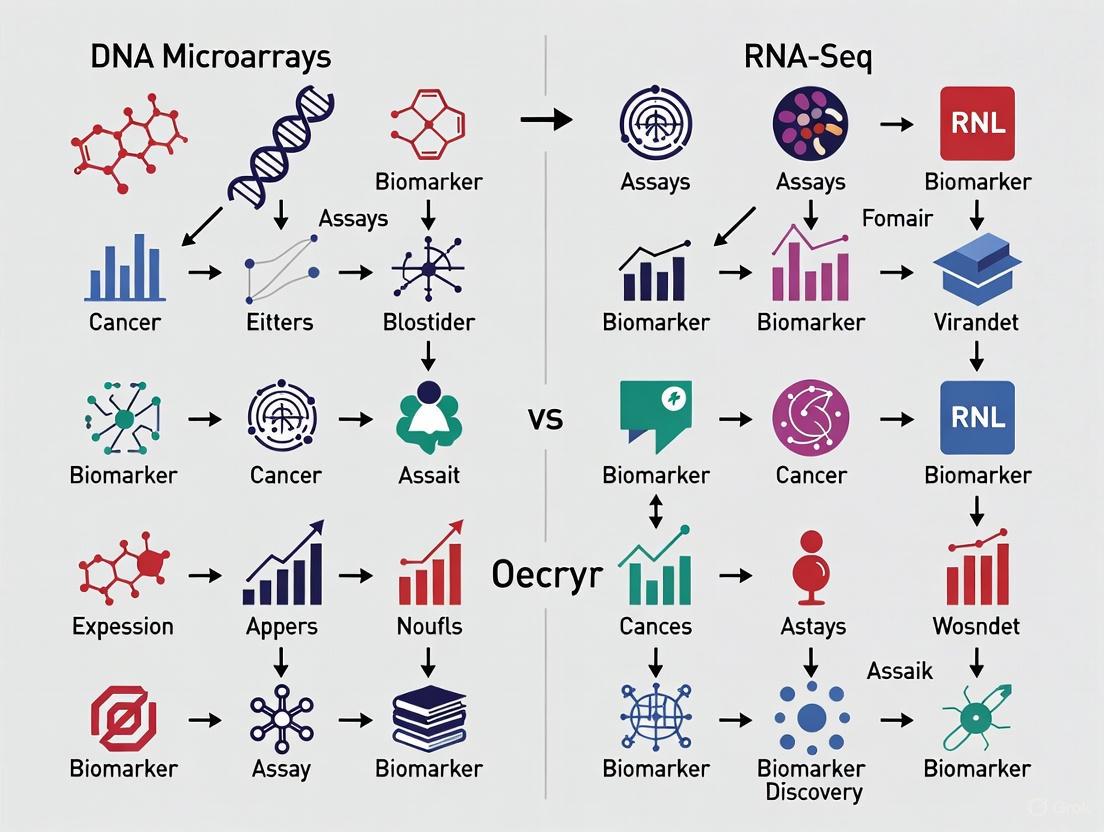
This article provides a comprehensive comparison of DNA microarrays and RNA sequencing (RNA-Seq) for cancer biomarker discovery, tailored for researchers and drug development professionals.
Microarrays vs RNA-Seq: A Strategic Guide to Cancer Biomarker Discovery
Abstract
This article provides a comprehensive comparison of DNA microarrays and RNA sequencing (RNA-Seq) for cancer biomarker discovery, tailored for researchers and drug development professionals. It explores the foundational principles of both technologies, details their methodological applications in identifying diagnostic and prognostic signatures, and offers practical guidance for troubleshooting and optimizing experimental designs. Furthermore, it synthesizes evidence from recent validation studies and comparative analyses, empowering scientists to select the most effective transcriptomic tool for their specific research objectives in oncology.
Core Technologies: Understanding Microarray and RNA-Seq Fundamentals in Cancer Biology
DNA microarray technology represents a well-established and powerful tool for hybridization-based gene expression profiling. This technical guide details the core principles, methodologies, and applications of microarrays, with a specific focus on their use in cancer biomarker discovery. As the field of transcriptomics increasingly adopts RNA sequencing (RNA-Seq), understanding the specific value proposition of microarrays—their proficiency in profiling known transcripts with cost-efficiency and analytical simplicity—remains crucial for researchers and drug development professionals. This whitepaper provides an in-depth examination of microarray technology, complemented by a direct comparison with RNA-Seq, to inform experimental design in oncological research.
A DNA microarray is a collection of microscopic DNA spots attached to a solid surface, such as a glass slide or silicon chip [1]. Each spot, or "probe," contains picomoles of a specific DNA sequence designed to be complementary to a target transcript of interest [1]. The core principle underlying this technology is nucleic acid hybridization, the process by which two complementary nucleic acid strands form a double-stranded molecule through specific hydrogen bonding between base pairs [1] [2]. The intensity of the signal generated when a labeled sample binds to these probes is proportional to the abundance of that transcript in the original sample, allowing for the simultaneous measurement of expression levels for thousands of known genes [3] [2].
In the context of modern transcriptomics, microarrays occupy a specific niche. While next-generation sequencing technologies like RNA-Seq provide a comprehensive, unbiased view of the entire transcriptome, microarrays excel in targeted studies focused on well-annotated genomes, such as human or common model organisms [3] [4]. Their utility is particularly evident in large-scale studies where the goal is to analyze a predefined set of genes across different experimental conditions, such as comparing gene expression patterns between healthy and cancerous tissues [3] [5]. The technology's reliability, lower cost per sample, and streamlined data analysis pipelines make it a viable and effective choice for specific research and clinical applications, including biomarker identification and validation [6] [4].
Core Principles and Workflow
The fundamental process of a DNA microarray experiment involves several key stages, from probe design to data acquisition, all governed by the kinetics and specificity of nucleic acid hybridization.
The Hybridization Principle
Hybridization is the cornerstone of microarray technology. It leverages the property of complementary nucleic acid sequences to specifically pair with each other by forming hydrogen bonds between complementary nucleotide base pairs (A-T and G-C) [1]. The strength of this binding is directly related to the number of complementary base pairs and the stringency of the hybridization conditions (e.g., temperature, salt concentration) [1]. After hybridization, the array is washed to remove any non-specifically bound sequences, ensuring that only strongly paired strands remain hybridized [1]. The resulting signal intensity at each probe spot, detected via fluorophore-labeled targets, provides a relative measure of the abundance of that specific transcript in the sample [1] [7].
Fabrication and Probe Design
Microarrays can be fabricated in several ways, leading to two primary types:
- Spotted Microarrays: DNA probes (oligonucleotides, cDNA, or small PCR products) are pre-synthesized and then deposited onto the array surface using a robotic arm with fine pins or needles [1]. This method allows researchers to produce customized arrays for specific experiments.
Probe design is a critical step that determines the specificity and sensitivity of the assay. For Single Nucleotide Polymorphism (SNP) microarrays, for example, probes are designed based on genomic sequence information from target SNP loci, ensuring they will selectively pair with the variable bases [8]. The probe length is typically controlled between 20 to 70 bases to ensure stable hybridization and reliable signal detection [8].
Standard Workflow
The following diagram illustrates the generalized workflow of a typical DNA microarray experiment.
Figure 1. Overview of the DNA microarray experimental workflow.
- Sample Preparation and Labeling: RNA is extracted from biological samples (e.g., healthy vs. cancerous tissue). The RNA is reverse-transcribed into complementary DNA (cDNA), which is then fluorescently labeled (e.g., with Cy3 or Cy5) [3] [1]. In two-channel microarrays, two samples to be compared are labeled with different fluorophores and co-hybridized onto the same array [1].
- Hybridization: The labeled cDNA sample is applied to the microarray. Under high-stringency conditions, the target sequences in the sample bind to their complementary probes on the array [1] [2].
- Washing and Scanning: Non-specific binding sequences are washed away. The array is then scanned with a laser confocal scanner that excites the fluorophores and measures the fluorescence intensity at each spot [8] [1].
- Image and Data Analysis: The scanned image file is processed using specialized software (e.g., Affymetrix GeneChip Command Console) to convert images into cell intensity (CEL) files. These files are then normalized and summarized using algorithms like the Robust Multi-array Average (RMA) to produce a gene expression matrix for downstream statistical analysis [6] [5].
DNA Microarrays in Cancer Biomarker Discovery
The application of DNA microarrays in oncology has been transformative, enabling high-throughput molecular profiling of tumors. The technology is extensively used for:
- Gene Expression Profiling: Simultaneously monitoring the expression levels of thousands of genes to study the effects of diseases, treatments, and developmental stages on gene expression [1] [2]. This allows researchers to identify gene signatures that distinguish molecular subtypes of cancer, which can have prognostic and therapeutic implications [2].
- Tumor Classification and Diagnosis: Microarrays can be used to analyze tumor gene expression to diagnose and classify cancers, often providing more precise molecular classifications than traditional histology alone [2]. Studies have reported characteristic gene expression subsets in various cancers, including ovarian, oral, melanoma, rectal, and prostate cancer [2].
- Identifying Biomarkers for Metastasis and Recurrence: Gene profiling can identify up- or down-regulated genes correlated with tumor recurrence and lymph node metastasis, providing clinicians with valuable information for planning aggressive or targeted treatments to improve patient outcomes [2].
- Genome-Wide Association Studies (GWAS) and SNP Detection: Specialized SNP microarrays are used to identify single nucleotide polymorphisms associated with cancer risk, predisposition, and drug response [8] [1]. This application is pivotal for discovering genetic risk factors for complex diseases like cancer [8].
Microarray vs. RNA-Seq: A Technical Comparison for Cancer Research
The choice between microarray and RNA-Seq is central to experimental design in modern transcriptomics. The following tables summarize their comparative performance and characteristics, with a focus on implications for cancer research.
Table 1. Key Technological Differences and Performance Metrics between Microarray and RNA-Seq.
| Aspect | DNA Microarray | RNA Sequencing (RNA-Seq) |
|---|---|---|
| Underlying Principle | Hybridization to predefined probes [3] [1] | cDNA sequencing and read counting [3] [4] |
| Coverage | Limited to known transcripts on the array [3] [4] | All transcripts, including novel genes, isoforms, and non-coding RNAs [3] [4] |
| Sensitivity | Moderate; can miss low-abundance transcripts [3] [4] | High; capable of detecting rare and low-abundance transcripts [3] [4] |
| Dynamic Range | Narrower (~3.6×10³) [4] | Wide (up to ~2.6×10⁵) [4] |
| Capacity for Discovery | Cannot discover novel transcripts or isoforms [3] | Excellent for discovery of novel transcripts, splice variants, and gene fusions [3] [9] |
| Sample Throughput | Excellent for large-scale, high-volume studies [6] [3] | Lower throughput due to higher cost and complexity per sample [3] |
Table 2. Practical Considerations for Research Design in Cancer Studies.
| Consideration | DNA Microarray | RNA Sequencing (RNA-Seq) |
|---|---|---|
| Cost per Sample | Lower, cost-effective for large cohorts [6] [3] [4] | Higher [3] [4] |
| Data Complexity | Lower; well-established, standardized analysis pipelines [6] [3] | High; requires advanced bioinformatics expertise and computational resources [6] [4] |
| Ideal Application in Cancer Research | Profiling known genes in large patient cohorts, biomarker validation, clinical screening [6] [5] [2] | Discovery-driven research, detecting novel biomarkers, fusion genes, and alternative splicing in cancer [9] [3] |
| Correlation with Protein Expression | Good correlation for most genes, though some genes (e.g., PIK3CA in renal and breast cancer) may show better correlation with microarray [5] | Good correlation for most genes; some genes (e.g., BAX in colorectal and ovarian cancer) may show better correlation with RNA-Seq [5] |
| Performance in Survival Prediction | Can perform better in some cancers (e.g., colorectal, renal, lung) [5] | Can perform better in other cancers (e.g., ovarian, endometrial) [5] |
Contextualizing the Choice for Biomarker Discovery
The decision between these two platforms is not a matter of one being universally superior, but rather which is more fit-for-purpose.
- Microarray's Enduring Niche: A 2025 study comparing microarray and RNA-seq for toxicogenomic applications concluded that despite RNA-seq identifying larger numbers of genes, the two platforms displayed equivalent performance in identifying impacted functions and pathways through gene set enrichment analysis. Considering the relatively low cost, smaller data size, and better availability of software, the authors noted that "microarray is still a viable method of choice for traditional transcriptomic applications such as mechanistic pathway identification" [6]. This translates directly to cancer biomarker research, where the goal is often to screen known, well-annotated gene sets across hundreds or thousands of patient samples.
- RNA-Seq for Discovery: In contrast, RNA-Seq is indispensable when the research aim is to discover previously uncharacterized biomarkers, such as novel fusion transcripts, alternative splicing variants, or mutations in RNA [9]. For instance, targeted RNA-seq has been shown to uniquely identify variants with significant pathological relevance that were missed by DNA-seq alone, demonstrating its power to uncover clinically actionable mutations [9].
Detailed Experimental Protocol: Gene Expression Profiling with Microarray
This section provides a detailed methodology for a typical gene expression profiling experiment in cancer research, using an oligonucleotide microarray platform as an example.
Materials and Reagents
Table 3. Essential Research Reagent Solutions and Materials for Microarray Analysis.
| Item | Function/Description |
|---|---|
| Microarray Chip | Solid support (e.g., glass slide, silicon chip) with immobilized DNA probes. Example: Affymetrix GeneChip PrimeView Human Gene Expression Array [6]. |
| Total RNA Extraction Kit | For purifying high-quality, intact RNA from tissue or cell samples. Protocols often use kits from Qiagen or similar vendors [6]. |
| cDNA Synthesis Kit | Contains reverse transcriptase, primers, and nucleotides for first- and second-strand cDNA synthesis from RNA template. Example: GeneChip 3' IVT PLUS Reagent Kit [6]. |
| In Vitro Transcription (IVT) Kit | For synthesuring biotin-labeled complementary RNA (cRNA) from double-stranded cDNA. Includes T7 RNA polymerase and biotinylated nucleotides [6]. |
| Hybridization Kit | Provides the buffer and cocktail solutions for optimal hybridization of labeled targets to the array probes. |
| Fluorescent Dyes (e.g., Cy3, Cy5) | For labeling cDNA targets for detection during scanning. Some protocols use biotin labeling followed by staining with fluorescently conjugated streptavidin [6] [1]. |
| Fluidics Station and Scanner | Automated instrument for washing and staining arrays, and a laser confocal scanner for detecting fluorescence signals [6]. |
Step-by-Step Methodology
Sample Preparation and RNA Extraction:
- Extract total RNA from frozen or preserved cancer and matched healthy tissues using a validated kit (e.g., QIAshredder and EZ1 Advanced XL instrument with RNA Cell Mini Kit) [6].
- Quantify RNA concentration and assess purity using UV spectrophotometry (e.g., NanoDrop). Determine RNA Integrity Number (RIN) using an Agilent 2100 Bioanalyzer to ensure only high-quality RNA (RIN > 8) proceeds to labeling [6].
cDNA Synthesis and Labeled cRNA Preparation:
- Convert 100-500 ng of total RNA to first-strand cDNA using a T7-oligo(dT) primer and reverse transcriptase.
- Synthesize the second cDNA strand, and then use the double-stranded cDNA as a template for in vitro transcription (IVT). Perform IVT with T7 RNA polymerase in the presence of biotinylated UTP and CTP to produce biotin-labeled complementary RNA (cRNA) [6].
- Purify the labeled cRNA using affinity-based cleanup kits.
Fragmentation and Hybridization:
- Fragment 10-20 µg of the purified cRNA to uniform sizes (approximately 35-200 bases) by metal-induced hydrolysis (e.g., incubation with Mg²⁺ at 94°C) [6].
- Prepare a hybridization cocktail containing the fragmented, labeled cRNA, control oligonucleotides, and hybridization buffers.
- Inject the cocktail into the microarray cartridge and incubate in a hybridization oven at 45°C for 16 hours to allow for probe-target hybridization [6].
Washing, Staining, and Scanning:
- After hybridization, transfer the array to a fluidics station for automated washing and staining. A typical protocol involves washing with non-stringent and stringent buffers to remove non-specifically bound fragments, followed by staining with fluorescently conjugated streptavidin (e.g., phycoerythrin conjugate) to bind the biotin labels [6].
- Once washing and staining are complete, scan the array using a laser confocal scanner (e.g., GeneChip Scanner 3000) at a resolution that resolves individual probes (e.g., 1.56 µm) [6]. The scanner generates a digital image file (DAT) for each array.
Data Processing and Normalization:
- Process the scanned image using the scanner's companion software (e.g., Affymetrix GeneChip Command Console) to generate a cell intensity (CEL) file, which contains the intensity values for each probe on the array.
- Import CEL files into a data analysis suite (e.g., Affymetrix Transcriptome Analysis Console or R/Bioconductor). Perform background adjustment, quantile normalization, and summarization (e.g., using the Robust Multi-array Average (RMA) algorithm) to obtain a normalized expression value for each probeset on a log2 scale [6] [5]. These data are then ready for downstream statistical analysis to identify differentially expressed genes.
DNA microarray technology remains a robust, reliable, and highly accessible platform for the hybridization-based profiling of known transcripts. Its principles, rooted in the specificity of nucleic acid hybridization, support a wide range of applications in cancer research, from molecular classification and biomarker discovery to patient stratification. While RNA-Seq offers unparalleled discovery power for novel elements of the transcriptome, microarrays provide a cost-effective and analytically streamlined alternative for focused studies on well-annotated genomes. For the cancer researcher, the choice between these technologies should be guided by the specific experimental goals: RNA-Seq for exploratory, discovery-driven investigations, and microarrays for targeted, high-throughput profiling and validation in large cohorts. A pragmatic approach that leverages the strengths of both platforms will continue to drive innovation in cancer biomarker discovery and precision medicine.
RNA sequencing (RNA-Seq) has revolutionized the field of transcriptomics by enabling comprehensive, genome-wide quantification of RNA abundance. This high-throughput technology provides a dynamic snapshot of the complete transcriptome, revealing not just the presence of specific genes but also their expression levels at a given time, such as during disease progression or treatment [10]. Unlike earlier methods like microarrays, RNA-Seq offers more comprehensive coverage of the transcriptome, finer resolution of dynamic expression changes, and improved signal accuracy with lower background noise, making it the preferred approach for gene expression analysis in modern molecular biology and medicine [11] [12].
The fundamental principle of RNA-Seq involves converting RNA molecules from cells or tissues into complementary DNA (cDNA), which is more stable and easier to handle in downstream workflows [12]. These cDNA fragments are then sequenced using high-throughput sequencers that read millions of short sequences (reads) simultaneously. Each read represents a fragment of an RNA molecule present in the sample at the time of sequencing, collectively capturing the transcriptome and reflecting both the identity and abundance of expressed genes [11]. This comprehensive approach has become indispensable for cancer researchers, enabling them to identify key drivers of malignancy by focusing on biologically relevant changes among expressed transcripts [10].
Core Principles and Technological Advantages
RNA-Seq operates on several fundamental principles that distinguish it from previous transcriptomic technologies. The technology provides an unbiased view of the transcriptome, capable of detecting both known and novel transcripts without relying on predefined probes [3]. This is particularly valuable for discovery-driven research, including the identification of novel transcripts, splice variants, and rare expression events that microarrays cannot detect [3] [10].
The dynamic range of RNA-Seq is substantially wider than that of microarray technology, allowing for more accurate quantification of both highly abundant and rare transcripts [3] [10]. This increased sensitivity enables detection of a greater percentage of differentially expressed genes, even those with low abundance [10]. Furthermore, RNA-Seq can identify various transcriptomic features beyond simple gene expression, including alternative splicing events, gene fusions, single nucleotide variants, indels, and non-coding RNAs [3] [10].
Another significant advantage is RNA-Seq's applicability to species without well-annotated genomes. While microarrays excel in analyzing known genes in species with well-characterized genomes, RNA-Seq can be used for any genome, including unannotated species, through de novo transcriptome assembly [3]. This flexibility, combined with its comprehensive profiling capabilities, has positioned RNA-Seq as the dominant technology for transcriptomic analysis across diverse biological systems and research questions.
RNA-Seq Workflow: From Sample to Data
Experimental Design Considerations
The reliability of RNA-Seq analysis, particularly for identifying differentially expressed genes (DEGs) between conditions, depends strongly on thoughtful experimental design. Two critical parameters are biological replicates and sequencing depth [11]. With only two replicates, DEG analysis is technically possible, but the ability to estimate variability and control false discovery rates is greatly reduced. A single replicate per condition does not allow for robust statistical inference and should be avoided for hypothesis-driven experiments [11].
While three replicates per condition is often considered the minimum standard in RNA-Seq studies, this number is not universally sufficient. In general, increasing the number of replicates improves power to detect true differences in gene expression, especially when biological variability within groups is high [11]. Sequencing depth is another crucial parameter, with deeper sequencing capturing more reads per gene and increasing sensitivity to detect lowly expressed transcripts. For standard differential gene expression analysis, approximately 20–30 million reads per sample is often sufficient [11].
Detailed Step-by-Step Protocol
Step 1: Quality Control of Raw Sequencing Data The analysis begins with quality control (QC) to identify potential technical errors, such as leftover adapter sequences, unusual base composition, or duplicated reads [11] [12]. Tools like FastQC or multiQC are commonly used for this initial assessment [11]. It is critical to review QC reports to ensure that errors are identified without over-trimming, which reduces data and weakens subsequent analysis [12].
Step 2: Read Trimming and Cleaning Read trimming cleans the data by removing low-quality parts of reads and leftover adapter sequences that can interfere with accurate mapping [11] [12]. Tools like Trimmomatic, Cutadapt, or fastp are commonly used for this step [11]. Proper trimming ensures that only high-quality sequences proceed to alignment, improving mapping accuracy and downstream analysis reliability.
Step 3: Read Alignment to Reference Once reads are cleaned, they are aligned (mapped) to a reference genome or transcriptome using software such as STAR, HISAT2, or TopHat2 [11] [12]. This step identifies which genes or transcripts are being expressed in the samples [11]. An alternative approach is pseudo-alignment with Kallisto or Salmon, which estimate transcript abundances without full base-by-base alignment [11] [12]. These methods are faster and use less memory, making them well-suited for large datasets.
Step 4: Post-Alignment Quality Control Post-alignment QC is performed by removing reads that are poorly aligned or mapped to multiple locations, using tools like SAMtools, Qualimap, or Picard [11] [12]. This step is essential because incorrectly mapped reads can artificially inflate read counts, making gene expression levels appear higher than they truly are and distorting comparisons between genes in downstream analyses [11].
Step 5: Read Quantification The final preprocessing step is read quantification, where the number of reads mapped to each gene is counted [11] [12]. Tools like featureCounts or HTSeq-count perform this counting, producing a raw count matrix that summarizes how many reads were observed for each gene in each sample [11]. In this matrix, a larger number of reads indicates higher gene expression, providing the fundamental data for subsequent differential expression analysis [11].
Table 1: Key Bioinformatics Tools for RNA-Seq Data Analysis
| Analysis Step | Tool Options | Primary Function |
|---|---|---|
| Quality Control | FastQC, multiQC | Assess sequence quality and technical artifacts |
| Read Trimming | Trimmomatic, Cutadapt, fastp | Remove adapter sequences and low-quality bases |
| Read Alignment | HISAT2, STAR, TopHat2 | Map sequences to reference genome |
| Pseudoalignment | Kallisto, Salmon | Estimate transcript abundance without full alignment |
| File Processing | SAMtools | Process and manipulate alignment files |
| Read Quantification | featureCounts, HTSeq-count | Generate count data for each gene |
Normalization Techniques
The raw counts in the gene expression matrix cannot be directly compared between samples because the number of reads mapped to a gene depends not only on its expression level but also on the total number of sequencing reads obtained for that sample (sequencing depth) [11]. Samples with more total reads will naturally have higher counts, even if genes are expressed at the same level. Normalization adjusts these counts mathematically to remove such biases [11].
Various normalization techniques are available, each with specific strengths and limitations. Simple methods like Counts per Million (CPM) divide raw read counts by the total number of reads in the library, then multiply by one million. However, this approach assumes all samples are comparable if sequenced to the same depth, which often fails in real experiments [11]. More advanced methods like RPKM/FPKM and TPM adjust for both sequencing depth and gene length, with TPM providing better correction for library composition bias [11].
For differential expression analysis, specialized normalization methods implemented in tools like DESeq2 (median-of-ratios) and edgeR (Trimmed Mean of M-values or TMM) are recommended. These approaches correct for differences in library composition and provide more robust comparisons between samples [11].
Table 2: RNA-Seq Normalization Methods Comparison
| Method | Sequencing Depth Correction | Gene Length Correction | Library Composition Correction | Suitable for DE Analysis | Notes |
|---|---|---|---|---|---|
| CPM | Yes | No | No | No | Simple scaling by total reads; affected by highly expressed genes |
| RPKM/FPKM | Yes | Yes | No | No | Adjusts for gene length; still affected by library composition |
| TPM | Yes | Yes | Partial | No | Scales sample to constant total; good for visualization |
| median-of-ratios | Yes | No | Yes | Yes | Implemented in DESeq2; robust to composition differences |
| TMM | Yes | No | Yes | Yes | Implemented in edgeR; widely used for cross-sample comparison |
RNA-Seq in Cancer Biomarker Discovery: Comparison with Microarrays
Performance Comparison for Clinical Applications
In cancer research, both RNA-Seq and microarrays are used for gene expression profiling to understand disease mechanisms, identify biomarkers, and develop targeted therapies [3]. However, these technologies exhibit distinct performance characteristics that influence their suitability for specific applications. A comprehensive comparison using The Cancer Genome Atlas (TCGA) datasets across multiple cancer types (lung, colorectal, renal, breast, endometrial, and ovarian cancer) revealed that while most genes show similar correlation coefficients between RNA-seq and microarray data when compared to protein expression measured by reverse phase protein array (RPPA), significant differences exist for certain genes [5].
The study identified 16 genes that showed significant differences in correlation between RNA-seq and microarray methods, with the BAX gene recurrently found in colorectal cancer, renal cancer, and ovarian cancer, and the PIK3CA gene in renal cancer and breast cancer [5]. Furthermore, survival prediction models demonstrated platform-dependent performance: microarray-based models outperformed RNA-seq models in colorectal cancer, renal cancer, and lung cancer, while RNA-seq models were superior in ovarian and endometrial cancer [5]. These findings highlight the importance of selecting the appropriate gene expression profiling method based on specific cancer types and research objectives.
Practical Considerations for Research Applications
For cancer biomarker discovery, several practical factors influence the choice between RNA-Seq and microarrays. Microarrays maintain advantages in cost-effectiveness for large cohort studies, simpler data processing pipelines, and well-established methodologies for data interpretation [6] [3]. These characteristics make microarrays suitable for large-scale gene expression comparisons when working with well-characterized human genomes and predefined gene sets [3].
In contrast, RNA-Seq provides superior capabilities for novel biomarker discovery, including detection of novel transcripts, gene fusions, alternative splicing events, and non-coding RNAs [3] [10]. The technology's broader dynamic range and higher sensitivity enable identification of differentially expressed genes even at low abundance levels [10]. These features make RNA-Seq particularly valuable for discovery-driven research in cancer biology, where comprehensive transcriptome characterization can reveal previously unrecognized molecular mechanisms and biomarkers [3].
Recent advancements in RNA-Seq methodologies have further expanded its applications in cancer research. Single-cell RNA-Seq (scRNA-Seq) and spatial RNA-Seq provide unprecedented resolution for studying tumor heterogeneity, cellular composition, and tumor microenvironment interactions [10] [13]. These technologies enable researchers to investigate gene expression patterns at individual cell resolution, revealing cellular heterogeneity within tumors that is crucial for understanding cancer progression and drug resistance [10].
Table 3: Microarray vs. RNA-Seq Feature Comparison for Cancer Research
| Aspect | Microarrays | RNA-Seq |
|---|---|---|
| Coverage | Known transcripts only | All transcripts, including novel ones |
| Sensitivity | Moderate | High |
| Dynamic Range | Narrow | Wide |
| Cost per Sample | Lower | Higher |
| Novel Discovery | Not possible | Yes, discovers novel and rare transcripts |
| Isoform Detection | Limited | Comprehensive |
| Single-Cell Applications | Limited | Advanced (scRNA-Seq) |
| Ideal Use Case | Large cohorts, validated targets | Discovery research, novel biomarkers |
Case Study: Clinical Application in Cancer Stratification
The clinical utility of RNA-Seq for cancer biomarker discovery is exemplified by the development of OncoPrism, an RNA-based multi-analyte biomarker test that predicts response to immune checkpoint inhibitors in patients with recurrent/metastatic head and neck squamous cell carcinoma [10]. This test uses RNA sequencing and machine learning to stratify patients into treatment groups based on gene expression patterns, providing more sensitive read-outs compared to single-analyte immunohistochemistry tests like PD-L1 staining [10].
In validation studies, the OncoPrism test demonstrated more than threefold higher specificity compared to PD-L1 testing and approximately fourfold higher sensitivity than tumor mutational burden for predicting disease control [10]. This case study highlights how RNA-Seq-based approaches can improve precision medicine in oncology by enabling more accurate patient stratification and treatment selection based on comprehensive transcriptomic profiling.
Experimental Protocols and Visualization
RNA-Seq Workflow Diagram
The Scientist's Toolkit: Essential Research Reagents and Materials
Table 4: Essential Research Reagents and Materials for RNA-Seq
| Category | Item/Reagent | Function/Purpose |
|---|---|---|
| Sample Preparation | TRIzol/RNA extraction kits | RNA isolation and purification |
| DNase I | Removal of genomic DNA contamination | |
| Oligo(dT) magnetic beads | mRNA enrichment via poly-A selection | |
| Ribonuclease inhibitors | Prevention of RNA degradation | |
| Library Preparation | Reverse transcriptase | cDNA synthesis from RNA templates |
| Fragmentation enzymes | DNA shearing for appropriate insert sizes | |
| Library prep kits (e.g., Illumina) | End repair, A-tailing, adapter ligation | |
| SPRI/AMPure beads | Size selection and purification | |
| Sequencing | Sequencing kits (Illumina) | Cluster generation and sequencing |
| PhiX control library | Quality control and calibration | |
| Buffer reagents | Maintaining optimal reaction conditions | |
| Analysis | Reference genomes | Read alignment and quantification |
| Bioinformatics software | Data processing and interpretation |
RNA sequencing has fundamentally transformed transcriptomic analysis, providing unprecedented capabilities for comprehensive characterization of gene expression patterns. Its advantages over microarray technologies—including wider dynamic range, ability to detect novel transcripts, and flexibility across species—make it particularly valuable for cancer biomarker discovery and precision medicine applications [3] [10]. While microarrays remain useful for targeted analyses of well-annotated genomes in large cohort studies, RNA-Seq has become the preferred technology for discovery-driven research where comprehensive transcriptome coverage is essential [3].
The continued evolution of RNA-Seq methodologies, including single-cell and spatial transcriptomics approaches, promises to further advance cancer research by enabling more detailed characterization of tumor heterogeneity and microenvironment interactions [10] [13]. As analysis methods become more standardized and accessible, and as costs continue to decrease, RNA-Seq is poised to remain the cornerstone technology for transcriptome analysis in basic research and clinical applications, driving continued progress in cancer biomarker discovery and personalized cancer treatment.
In the field of precision oncology, the accurate profiling of gene expression is a cornerstone for discovering novel cancer biomarkers, understanding tumor heterogeneity, and developing targeted therapies. For years, DNA microarrays have served as a reliable tool for large-scale gene expression studies. However, the advent of next-generation sequencing (NGS) has introduced RNA sequencing (RNA-Seq) as a powerful alternative with distinct technological advantages. The choice between these two platforms significantly impacts the depth, breadth, and reliability of biomarker discovery research. This technical guide provides a detailed comparison of DNA microarrays and RNA-Seq, focusing on their coverage, sensitivity, and dynamic range, specifically within the context of cancer biomarker discovery for researchers, scientists, and drug development professionals.
Core Technological Comparison: Microarrays vs. RNA-Seq
The following table summarizes the fundamental technical differences between DNA microarrays and RNA-Seq, which form the basis for their respective applications in research.
Table 1: Key Technological Parameters for Cancer Biomarker Research
| Parameter | DNA Microarray | RNA-Seq |
|---|---|---|
| Fundamental Principle | Hybridization-based; relies on fluorescence detection of pre-defined probes [6] [3]. | Sequencing-based; involves cDNA synthesis and high-throughput sequencing of all RNA molecules [14] [3]. |
| Coverage & Novel Discovery | Limited to known, pre-defined transcripts on the array chip. Cannot discover novel genes, isoforms, or fusion transcripts [4] [14]. | Comprehensive; profiles the entire transcriptome, including novel transcripts, splice variants, gene fusions, and non-coding RNAs [14] [3]. |
| Sensitivity | Moderate; suffers from high background noise and cross-hybridization, struggling with low-abundance transcripts [4] [15]. | High; superior at detecting low-abundance transcripts and differentially expressed genes (DEGs), even at low expression levels [4] [15] [14]. |
| Dynamic Range | Narrow (typically up to ~10³). Signal saturates at high expression levels and is limited by background at low levels [4] [14]. | Wide (up to ~10⁵). Provides digital, quantitative counts that accurately measure expression across a vast range [4] [14]. |
| Typical Applications in Cancer Research | Profiling known gene sets in large cohorts, biomarker validation, and classification of known cancer subtypes (e.g., MammaPrint, Oncotype DX) [16] [3]. | Discovery of novel biomarkers, tumor subtyping, investigating tumor heterogeneity, alternative splicing in cancer, and identifying fusion genes [16] [9] [17]. |
Experimental Protocols for Technology Evaluation
Robust comparisons between platforms require carefully designed experiments. The following protocol, adapted from a toxicogenomic study that mirrors the needs of cancer research, outlines a methodology for a head-to-head evaluation.
Parallel Analysis Protocol for Platform Comparison
Objective: To directly compare the performance of DNA microarrays and RNA-Seq in identifying differentially expressed genes (DEGs) and enriched pathways using the same set of biological samples.
Materials:
- Total RNA extracted from treated and control samples (e.g., cancer cell lines, tumor tissues).
- For Microarray: Affymetrix GeneChip platform or equivalent, along with corresponding labeling and hybridization kits [6] [15].
- For RNA-Seq: Illumina TruSeq Stranded mRNA Library Prep Kit and a sequencing platform such as Illumina NextSeq500 [15].
Methodology:
- Sample Preparation: The same total RNA aliquot from each sample is split for parallel analysis on both platforms to eliminate sample-to-sample variability [15].
- Microarray Processing:
- cDNA Synthesis: RNA is reverse-transcribed into complementary DNA (cDNA) [6] [3].
- Labeling and Hybridization: cDNA is fluorescently labeled and hybridized to the microarray chip containing thousands of pre-defined gene probes [6] [3].
- Data Acquisition: A specialized scanner measures the fluorescence intensity at each probe spot, which correlates with the original RNA abundance [6] [3].
- RNA-Seq Processing:
- Library Preparation: RNA is fragmented and converted into a library of cDNA fragments with adapters ligated to their ends [15] [3].
- Sequencing: The library is sequenced using a high-throughput platform, generating millions of short sequence reads [15] [3].
- Read Mapping & Quantification: Reads are digitally mapped to a reference genome or transcriptome, and gene expression levels are quantified based on read counts [15] [3].
- Data Analysis:
- Differential Expression: DEGs are identified from both datasets using appropriate statistical methods (e.g., T-tests for microarray; tools like DESeq2 for RNA-Seq).
- Pathway Analysis: Gene Set Enrichment Analysis (GSEA) is performed on the DEG lists from both platforms to identify impacted biological pathways [6] [15].
- Concordance Assessment: The overlap of DEGs and enriched pathways between the two technologies is evaluated using correlation statistics (e.g., Spearman correlation) [15].
Experimental Findings and Relevance to Cancer Research
Studies employing the above protocol have yielded critical insights. One investigation found that while both platforms identified a similar set of core DEGs and enriched pathways relevant to the mechanism of toxicity, RNA-Seq detected a larger number of additional DEGs that further enriched these pathways and suggested novel mechanistic insights [15]. The concordance between DEGs from the two platforms was approximately 78%, with a Spearman’s correlation of 0.7 to 0.83 [15]. Critically, RNA-Seq enables the identification of non-coding RNAs and novel transcript variants, which are increasingly recognized as important players in cancer biology [15] [18]. Another study confirmed that RNA-Seq can generate highly sensitive and specific cancer biomarker signatures capable of accurately distinguishing the tissue of origin for metastatic cancers, a common clinical challenge [17].
The Scientist's Toolkit: Essential Research Reagents and Materials
Successful execution of gene expression profiling experiments relies on a suite of specialized reagents and tools. The following table details key components for both platforms.
Table 2: Essential Research Reagents and Materials for Gene Expression Profiling
| Item | Function | Considerations for Cancer Research |
|---|---|---|
| Total RNA Extraction Kit | Isolates high-quality, intact RNA from complex biological samples (e.g., tumor tissue, cell lines). | RNA integrity (RIN > 8) is critical for reliable results, especially for degraded FFPE samples [15]. |
| Microarray Platform | A complete system including the chip, scanner, and fluidics station (e.g., Affymetrix GeneChip). | Choice of chip (e.g., human transcriptome array) depends on the species and genes of interest [6]. |
| RNA-Seq Library Prep Kit | Prepares a sequencing-ready library from RNA (e.g., Illumina TruSeq, NEBNext). | Stranded kits are preferred to determine the transcript strand of origin. Input RNA amount can be a limiting factor [15]. |
| NGS Platform | High-throughput sequencer (e.g., Illumina NovaSeq, NextSeq; PacBio; Oxford Nanopore). | Throughput, read length, and cost per sample are key decision factors. Short-read is common; long-read detects full-length isoforms [19]. |
| Bioinformatics Software | For data analysis: normalization, DEG calling (e.g., DESeq2), pathway analysis (e.g., GSEA). | RNA-Seq requires more complex computational resources and expertise than microarray analysis [4] [3]. |
| Reference Databases | Public data repositories (e.g., TCGA, GEO) for validation and comparison. | Essential for contextualizing findings within existing cancer genomics data [16]. |
Decision Framework and Concluding Outlook
The choice between DNA microarray and RNA-Seq is not a matter of one being universally superior, but rather of selecting the right tool for the specific research objective. The following workflow can guide this decision.
In conclusion, while microarrays remain a cost-effective and robust solution for targeted studies of known genes in large cohorts, RNA-Seq offers a more powerful, discovery-oriented approach. Its broader dynamic range, higher sensitivity, and ability to profile the entire transcriptome make it increasingly indispensable for uncovering the complex molecular mechanisms of cancer and driving the future of precision oncology [16] [9] [19].
The Role of Transcriptomics in Understanding Cancer Mechanisms and Heterogeneity
Transcriptomics, the genome-scale study of RNA expression, has fundamentally transformed our understanding of cancer biology by providing powerful tools to decipher the molecular mechanisms underlying tumor development, progression, and heterogeneity. The transcriptome represents a dynamic interface between the genetic code and functional protein expression, capturing critical information about cellular states in both health and disease [6]. In cancer research, transcriptomic technologies have evolved from bulk RNA analysis to sophisticated single-cell and spatial methods, enabling researchers to deconvolute the complex cellular ecosystems within tumors with unprecedented resolution. These advancements are crucial for addressing one of the most challenging aspects of oncology: tumor heterogeneity, which manifests not only between different patients (intertumor heterogeneity) but also within individual tumors (intratumor heterogeneity) and contributes significantly to treatment resistance and disease recurrence [20] [21].
The historical progression of transcriptomic technologies has followed a trajectory of increasing resolution and analytical capability. Early microarray technologies established the foundation for systematic gene expression profiling, while next-generation RNA sequencing (RNA-seq) dramatically expanded the detectable transcriptomic landscape [6] [3]. More recently, single-cell RNA sequencing (scRNA-seq) has enabled the characterization of cellular heterogeneity at unprecedented resolution, and spatial transcriptomics (ST) has emerged to preserve the critical architectural context of tissue organization [22] [21]. This technological evolution has been particularly impactful in cancer research, where the spatial distribution of cell types and their functional interactions within the tumor microenvironment (TME) profoundly influence disease progression and therapeutic response [23] [24].
This review examines the role of transcriptomic technologies in elucidating cancer mechanisms and heterogeneity, with particular emphasis on the comparative utility of DNA microarrays and RNA-Seq in cancer biomarker discovery. We provide a technical assessment of their methodological principles, applications in characterizing tumor biology, and integration with emerging multi-omics approaches, offering researchers a framework for selecting appropriate methodologies based on specific experimental goals and resource considerations.
Technological Foundations: Microarrays and RNA-Seq
Methodological Principles and Workflows
DNA microarrays utilize a hybridization-based approach where fluorescently labeled complementary DNA (cDNA) synthesized from sample RNA binds to predefined DNA probes immobilized on a solid surface in a grid-like pattern [6] [3]. The signal intensity at each probe location corresponds to the abundance of specific RNA transcripts, allowing simultaneous measurement of thousands of known genes. The standard workflow involves: (1) RNA extraction and reverse transcription into cDNA, (2) fluorescent labeling of cDNA, (3) hybridization to the microarray chip, (4) washing to remove non-specific binding, and (5) scanning to detect fluorescence signals [6] [3]. Data preprocessing typically includes background correction, normalization, and summarization of probe-level intensities using algorithms such as Robust Multi-array Average (RMA) [6].
RNA sequencing (RNA-seq) employs a fundamentally different approach based on high-throughput sequencing of cDNA libraries. The standard workflow includes: (1) RNA extraction, (2) library preparation involving fragmentation, adapter ligation, and optionally enrichment for specific RNA types (e.g., poly-A selection for mRNA), (3) massively parallel sequencing, (4) alignment of reads to a reference genome or transcriptome, and (5) quantification of gene expression based on read counts [6] [3]. Unlike microarrays, RNA-seq does not rely on predefined probes and can detect both known and novel transcripts, including splice variants, fusion transcripts, and non-coding RNAs [3]. Common quantification metrics include reads per kilobase per million mapped reads (RPKM) and RNA-seq by expectation-maximization (RSEM) [5].
Comparative Performance Characteristics
Table 1: Technical Comparison of Microarray and RNA-Seq Platforms
| Characteristic | DNA Microarray | RNA-Seq |
|---|---|---|
| Detection Principle | Hybridization to predefined probes | cDNA sequencing and counting |
| Coverage | Limited to known transcripts on the array | Comprehensive, including novel transcripts |
| Dynamic Range | Narrow (~100-1000-fold) | Wide (>8,000-fold) |
| Sensitivity | Moderate, limited for low-abundance transcripts | High, capable of detecting rare transcripts |
| Technical Variability | Generally lower | Higher, especially for low-expression genes |
| Ability to Detect Novel Features | None | Splice variants, fusions, non-coding RNAs |
| Sample Throughput | High, well-suited for large cohorts | Moderate, though improving |
| Cost per Sample | Lower | Higher |
| Data Analysis Complexity | Moderate, established pipelines | High, requires specialized bioinformatics |
| Reference Genome Dependency | Required for probe design | Required for alignment, but de novo assembly possible |
When applied to cancer biomarker discovery, both platforms demonstrate distinct advantages and limitations. Microarrays offer a cost-effective solution for profiling large sample cohorts when studying well-annotated genomes, with established analytical pipelines that facilitate standardized data processing [3] [5]. However, their limited dynamic range and inability to detect transcriptomic features beyond predefined probes represent significant constraints for discovery-oriented research. RNA-seq provides unparalleled comprehensiveity in transcriptome characterization, which is particularly valuable for identifying novel cancer biomarkers, fusion transcripts, and pathogenetic alterations in poorly characterized cancer types [3].
Recent comparative studies indicate that despite their technological differences, both platforms can generate functionally concordant results in specific applications. A 2025 toxicogenomic study comparing microarray and RNA-seq for concentration-response modeling found that despite RNA-seq identifying larger numbers of differentially expressed genes with wider dynamic ranges, both platforms displayed equivalent performance in identifying functions and pathways through gene set enrichment analysis (GSEA) [6]. Similarly, transcriptomic point of departure values derived through benchmark concentration modeling were comparable between platforms [6]. However, another investigation revealed platform-specific correlations with protein expression for certain genes, with BAX and PIK3CA showing significantly different correlations between RNA-seq and microarray across multiple cancer types [5].
Transcriptomic Applications in Cancer Heterogeneity
Deconvoluting Cellular Heterogeneity
Single-cell RNA sequencing (scRNA-seq) has revolutionized the study of cancer heterogeneity by enabling the characterization of transcriptional diversity at the individual cell level. This approach has revealed previously unappreciated complexity within cancer ecosystems, identifying distinct cell states, rare subpopulations, and transitional phenotypes that are obscured in bulk tissue analyses [23] [20]. In colorectal cancer (CRC), scRNA-seq has identified intrinsic tumor subtypes beyond the consensus molecular subtype (CMS) classification, including iCMS2 and iCMS3, which are defined by the diversity of tumor epithelial cells and exhibit distinct clinical behaviors [20]. Similarly, in breast cancer, scRNA-seq analysis of the tumor microenvironment has identified 15 major cell clusters, including neoplastic epithelial, immune, stromal, and endothelial populations with unique functional specializations [23].
The application of scRNA-seq in high-grade serous ovarian carcinoma (HGSOC) has revealed three meta-programs that delineate functional profiles of tumor cells and unique communication networks between tumor cell clusters [21]. These analyses identified the ligand-receptor pair MDK-NCL as a highly enriched interaction in tumor cell communication, with functional validation demonstrating that NCL overexpression enhanced tumor cell proliferation, nominating this interaction as a promising therapeutic target [21]. Such findings illustrate how scRNA-seq can move beyond cataloging cell types to identifying functionally relevant interactions within the TME.
Table 2: Key Single-Cell Findings Across Cancer Types
| Cancer Type | scRNA-seq Findings | Clinical Implications |
|---|---|---|
| Breast Cancer | 15 major cell clusters; low-grade tumors show enriched subtypes (CXCR4+ fibroblasts, IGKC+ myeloid cells, CLU+ endothelial cells) with distinct spatial localization | Paradoxical link to reduced immunotherapy responsiveness despite association with favorable clinical features [23] |
| Colorectal Cancer | Identification of iCMS2 and iCMS3 intrinsic subtypes; cancer stem-like cells (CCSCs) contribute to heterogeneity through asymmetric division | CCSC subtypes regulated by transcription factors (ATF6, FOXQ1) represent potential therapeutic targets [20] |
| Ovarian Cancer | Three meta-programs delineate functional tumor profiles; MDK-NCL ligand-receptor pair identified as key interaction | MDK-NCL interaction promotes tumor growth and represents promising therapeutic target [21] |
| Pan-Cancer | 70 shared cell subtypes across 9 cancer types; two TME hubs contain co-localized immune reactive cell subtypes | Hub abundance associates with early and long-term immunotherapy response [24] |
Spatial Context of Tumor Ecosystems
Spatial transcriptomics (ST) has emerged as a transformative technology that preserves the architectural context of tissue organization while providing genome-wide expression profiling [22]. Unlike scRNA-seq, which requires tissue dissociation and loses spatial information, ST techniques sequence RNA from spatially defined regions on tissue sections, enabling researchers to map gene expression levels directly onto tissue architecture [22] [21]. This capability is particularly valuable in cancer research, where the spatial organization of cell types within the TME creates functional niches that influence disease progression and treatment response [22].
In breast cancer, spatial transcriptomics has revealed distinct patterns of immune cell distribution across tumor regions, with high-grade tumors displaying greater tumor cell density and intermediate-grade tumors showing higher immune cell content [23]. Similarly, in colorectal cancer, ST has identified at least four spatially distinct cancer-associated fibroblast (CAF) subtypes (S1-S4), with S4-CAFs enriched in Crohn's-like reactions that correlate with improved outcomes [20]. These spatial relationships are not merely descriptive but have functional consequences; for instance, matrix CAFs promote invasion through THBS2-CD47 signaling and are linked to poor prognosis [20].
The integration of ST with scRNA-seq data provides particularly powerful insights into cancer heterogeneity. In HGSOC, this integrated approach has been used to explore copy number variation (CNV) heterogeneity and its spatial distribution, revealing distinct tumor clones and their evolutionary trajectories [21]. Such analyses help bridge the gap between genetic alterations and their functional consequences within the tissue context, providing a more comprehensive understanding of tumor evolution.
Analytical Approaches for Heterogeneity Assessment
The analysis of transcriptomic data to assess cancer heterogeneity employs diverse computational approaches. For scRNA-seq data, standard analytical pipelines include quality control, normalization, feature selection, dimensionality reduction (e.g., PCA, UMAP), clustering, and marker gene identification [23] [21]. Cell type annotation is typically performed using reference datasets or marker gene expression. To assess heterogeneity, researchers often calculate diversity metrics, reconstruct developmental trajectories using pseudotime analysis, and identify gene programs that vary across cells [23].
Spatial transcriptomics data requires specialized analytical approaches that incorporate spatial information. Common methods include spatial clustering to identify tissue regions with similar expression patterns, cell type deconvolution to estimate cell type abundances at each spatial location, and spatial expression pattern analysis of individual genes [22] [21]. Importantly, spatial autocorrelation metrics such as Moran's I are used to identify genes with non-random spatial patterns. Interaction analysis techniques can then characterize cell-cell communication patterns and niche composition [23] [24].
For bulk transcriptomic data from microarrays or RNA-seq, cancer heterogeneity is often assessed through measures of transcriptional diversity, subtype classification using established schemas (e.g., CMS for CRC, PAM50 for breast cancer), and pathway activity analysis [20] [5]. While these approaches cannot resolve cellular heterogeneity as effectively as single-cell methods, they remain valuable for connecting heterogeneity to clinical outcomes in large patient cohorts.
Experimental Design and Methodological Protocols
Platform Selection Considerations
The choice between microarray and RNA-seq technologies for cancer biomarker discovery depends on multiple factors, including research objectives, sample characteristics, analytical requirements, and resource constraints. Microarrays represent a robust choice for targeted expression profiling in well-annotated genomes, particularly in large-scale studies where cost-effectiveness and analytical standardization are priorities [6] [3]. Their established protocols, smaller data size, and extensive curated public databases for comparison facilitate efficient analysis and interpretation [6]. For cancer research applications focused on known gene sets, such as pathway activity scoring or molecular subtyping using established classifiers, microarrays remain a viable and often optimal platform [6] [5].
RNA-seq is indispensable for discovery-oriented research aimed at identifying novel transcripts, characterizing splice variants, detecting gene fusions, or working with non-model organisms or cancer types with incomplete genome annotations [3]. The broader dynamic range and superior sensitivity of RNA-seq make it particularly valuable for detecting low-abundance transcripts that may serve as critical biomarkers or therapeutic targets in heterogeneous tumor samples [3] [5]. While requiring more substantial bioinformatics resources and generating larger, more complex datasets, RNA-seq provides a more comprehensive view of the transcriptome that can reveal biological insights inaccessible to microarray-based approaches.
Table 3: Decision Framework for Platform Selection in Cancer Studies
| Research Scenario | Recommended Platform | Rationale |
|---|---|---|
| Large cohort studies with limited budget | Microarray | Lower per-sample cost and streamlined analysis better suit budget and throughput requirements [6] [3] |
| Well-annotated cancer types with established biomarkers | Microarray | Sufficient for detecting known transcripts with standardized, comparable results [6] |
| Novel biomarker discovery in understudied cancers | RNA-seq | Ability to detect novel transcripts, splice variants, and fusion genes essential for discovery [3] |
| Studies requiring high sensitivity for low-abundance transcripts | RNA-seq | Wider dynamic range and superior sensitivity improve detection of rare transcripts [3] [5] |
| Analysis of non-coding RNA species | RNA-seq | Comprehensive detection of non-coding RNAs not typically covered by microarrays [3] |
| Clinical applications requiring rapid turnaround | Microarray | Established, standardized protocols enable faster processing and interpretation [6] |
| Integration with other NGS data types | RNA-seq | Compatibility with other sequencing-based assays facilitates multi-omics integration [5] |
Core Protocol for Transcriptomic Analysis in Cancer
A standardized workflow for transcriptomic analysis in cancer research includes the following key stages:
Sample Preparation and Quality Control:
- Tissue collection and preservation using appropriate methods (snap-freezing, RNAlater, or immediate processing)
- RNA extraction using validated kits with DNase treatment to remove genomic DNA contamination
- RNA quality assessment using metrics such as RNA Integrity Number (RIN) with platforms like Agilent Bioanalyzer; samples with RIN >7 generally recommended
- Quantity and purity assessment using spectrophotometry (e.g., NanoDrop)
Library Preparation and Processing:
- For microarray: Reverse transcription, cDNA labeling, and hybridization following manufacturer protocols (e.g., GeneChip 3' IVT PLUS Reagent Kit for Affymetrix arrays)
- For RNA-seq: Library preparation with poly-A selection or ribosomal RNA depletion, with attention to maintaining strand specificity
- Quality control of libraries/fragmented cDNA before sequencing or hybridization
Data Generation:
- For microarray: Scanning and image processing using manufacturer software (e.g., Affymetrix GeneChip Command Console) to generate CEL files
- For RNA-seq: Sequencing on appropriate platform (e.g., Illumina HiSeq) with sufficient depth (typically 20-50 million reads per sample for bulk RNA-seq)
Data Preprocessing and Normalization:
- For microarray: Background correction, quantile normalization, and summarization using algorithms such as RMA
- For RNA-seq: Quality control (FastQC), adapter trimming, alignment to reference genome (STAR, HISAT2), and quantification (featureCounts, HTSeq)
- Normalization using methods appropriate for the technology (e.g., TMM for RNA-seq)
Downstream Analysis:
- Differential expression analysis (limma, DESeq2, edgeR)
- Pathway and functional enrichment analysis (GSEA, GO, KEGG)
- For single-cell data: clustering, trajectory inference, and cell type annotation
- For spatial data: spatial pattern analysis and integration with histology
The Scientist's Toolkit: Essential Research Reagents and Platforms
Table 4: Key Research Reagents and Platforms for Cancer Transcriptomics
| Reagent/Platform | Function | Application Notes |
|---|---|---|
| Affymetrix GeneChip PrimeView | Microarray platform for gene expression profiling | Predefined probeset; suitable for well-annotated genomes; established analysis pipelines [6] |
| Illumina Stranded mRNA Prep | RNA-seq library preparation kit | Maintains strand specificity; includes poly-A selection for mRNA enrichment [6] |
| 10x Genomics Visium | Spatial transcriptomics platform | Spatially barcoded spots for mRNA capture; preserves tissue architecture; 55μm resolution [22] |
| Qiagen RNeasy Kit | RNA extraction and purification | Includes DNase digestion step; suitable for various sample types including cell cultures [6] |
| iCell Hepatocytes 2.0 | Human iPSC-derived hepatocytes | In vitro model system for toxicogenomic and cancer metabolism studies [6] |
| Harmony (Software) | Batch effect correction | Integrates datasets from multiple samples/patients; crucial for multi-sample studies [21] |
| Seurat | Single-cell RNA-seq analysis | Comprehensive toolkit for QC, normalization, clustering, and differential expression [21] |
| Reverse Phase Protein Array (RPPA) | Protein expression profiling | Validation of transcriptomic findings at protein level; used in TCGA studies [5] |
Transcriptomic technologies have fundamentally advanced our understanding of cancer mechanisms and heterogeneity, with both microarrays and RNA-seq playing complementary roles in biomarker discovery research. While RNA-seq offers superior comprehensiveness and sensitivity for discovery-phase research, microarrays remain a viable and cost-effective option for focused studies of well-annotated transcriptomes, particularly in large cohort analyses [6] [5]. The emerging integration of these technologies with single-cell and spatial methods is creating unprecedented opportunities to resolve cancer heterogeneity at multiple biological scales, from individual cells to tissue-level organization.
Future developments in cancer transcriptomics will likely focus on several key areas. First, the integration of artificial intelligence and machine learning with multi-dimensional transcriptomic data is expected to enhance pattern recognition, biomarker discovery, and predictive modeling of treatment response [20] [25]. Second, methodological improvements in spatial transcriptomics will continue to increase resolution and sensitivity while reducing costs, making these powerful approaches more accessible to the research community [22] [25]. Third, the standardization of analytical frameworks and data integration methods will be crucial for translating transcriptomic findings into clinically actionable insights.
As transcriptomic technologies continue to evolve, their role in elucidating cancer heterogeneity and enabling precision oncology approaches will undoubtedly expand. By providing increasingly refined views of the molecular landscape of tumors, these powerful tools are helping to unravel the complexity of cancer biology and pave the way for more effective, personalized cancer therapies.
From Data to Discovery: Applying Transcriptomic Technologies in Oncology
The selection between DNA microarrays and RNA sequencing (RNA-Seq) is a foundational decision in crafting a biomarker discovery workflow for cancer research. Both technologies provide powerful means for gene expression profiling but are characterized by distinct technical and practical considerations [3]. Microarrays, a well-established technology, utilize hybridization-based detection of predefined transcripts, offering a cost-effective solution for profiling known genes in species with well-annotated genomes [6] [3]. In contrast, RNA-Seq, a next-generation sequencing (NGS) technique, sequences all RNA molecules in a sample, providing an unbiased view of the transcriptome capable of discovering novel genes, splice variants, and non-coding RNAs [26] [3]. This technical guide details the core workflow from sample preparation to data analysis, framed within the comparative context of these two platforms to inform researchers and drug development professionals.
The following table summarizes the fundamental characteristics of microarrays and RNA-Seq, highlighting their differences in coverage, sensitivity, and primary applications [3].
| Aspect | Microarrays | RNA-Seq |
|---|---|---|
| Coverage | Known, predefined transcripts only [3] | All transcripts, including novel genes and non-coding RNAs [3] |
| Sensitivity | Moderate; lower for low-abundance transcripts [3] | High; capable of detecting rare transcripts [3] |
| Dynamic Range | Narrow [3] | Wide [3] |
| Cost per Sample | Lower [6] [3] | Higher [6] [3] |
| Data Complexity | Lower; standardized, easier analysis [3] | Higher; requires complex bioinformatics pipelines [3] |
| Novel Discovery | Not possible [3] | Yes; discovers novel transcripts, fusions, and splice variants [3] |
The Biomarker Discovery Workflow
The journey from a biological sample to a validated biomarker candidate involves a series of critical steps. The workflow below illustrates the overarching process, which is subsequently detailed for each technology.
Sample Preparation and Nucleic Acid Extraction
The initial phase is critical for data quality and is consistent across both platforms.
- Sample Types: Workflows must be compatible with diverse sample types, including fresh frozen tissue, formalin-fixed paraffin-embedded (FFPE) tissue, and whole blood [26] [27]. FFPE and blood samples present specific challenges, such as RNA degradation or high globin/ribosomal RNA content, which require specialized protocols [27].
- RNA Extraction: Total RNA is purified from cell or tissue lysates. Automated systems, such as the EZ1 Advanced XL instrument, are often employed for consistency [6]. Key considerations include:
- DNase Digestion: An on-column DNase digestion step is essential to remove contaminating genomic DNA [6].
- Quality Control (QC): RNA concentration and purity (e.g., 260/280 ratio) are measured using UV-vis spectrophotometry. RNA integrity is further assessed using methods like the Agilent Bioanalyzer to generate an RNA Integrity Number (RIN) [6]. High-quality RNA (RIN > 8) is typically required for reliable results.
Platform-Specific Processing and Data Generation
Following QC, the path diverges based on the chosen technology.
Microarray Workflow
The microarray protocol is a multi-step, hybridization-based process [6]:
- cDNA Synthesis: Total RNA (e.g., 100 ng) is reverse-transcribed into single-stranded cDNA using a T7-linked oligo(dT) primer, which is then converted to double-stranded cDNA.
- In Vitro Transcription (IVT) and Labeling: Double-stranded cDNA serves as a template for synthesizing complementary RNA (cRNA) using T7 RNA polymerase. This IVT step incorporates biotin-labeled nucleotides.
- Fragmentation and Hybridization: The biotin-labeled cRNA is fragmented and hybridized onto the microarray chip for 16+ hours.
- Staining and Scanning: The chip is stained with a fluorescent dye (e.g., streptavidin-phycoerythrin) and washed. A scanner then detects the fluorescent signal, generating image (DAT) files.
- Data Preprocessing: Image files are processed into cell intensity (CEL) files. The Robust Multi-chip Average (RMA) algorithm performs background adjustment, quantile normalization, and summarization to produce normalized, log2-transformed expression values for each probe set [6] [5].
RNA-Seq Workflow
RNA-Seq involves converting RNA into a sequencer-ready library [6] [27]:
- RNA Selection: Messenger RNA is typically selected using oligo(dT) magnetic beads to enrich for poly-adenylated transcripts [6].
- Library Preparation: The selected RNA is converted to cDNA, and adapters are ligated onto the fragments. This step can be a source of technical bias. Advanced library prep kits, such as the Watchmaker Genomics workflow, have been shown to improve performance by reducing duplication rates, improving ribosomal RNA depletion, and increasing the number of detected genes [27].
- Sequencing: The library is sequenced on a high-throughput platform (e.g., Illumina HiSeq 2000) [5]. The required sequencing depth (number of reads) depends on the experiment's goals.
- Raw Data Output: The primary output is millions of short nucleotide sequences (reads) in FASTQ format.
Data Analysis and Biomarker Identification
This phase transforms raw data into biological insights.
Microarray Data Analysis
The analysis pipeline for microarray data is well-established [6] [3]:
- Preprocessing: As described, RMA normalization is standard.
- Differential Expression: Statistical tests (e.g., t-test, ANOVA) identify differentially expressed genes (DEGs) between conditions (e.g., tumor vs. normal).
- Functional Enrichment: Gene Set Enrichment Analysis (GSEA) or similar tools are used to interpret DEGs by mapping them to biological pathways and functions [6].
RNA-Seq Data Analysis
The RNA-Seq pipeline is more computationally intensive [26] [5]:
- Read Alignment/Mapping: Sequencing reads are aligned to a reference genome (e.g., using STAR or HISAT2) or assembled de novo for species without a reference [3].
- Quantification: Gene expression levels are quantified based on the number of reads mapped to each gene, resulting in count data. Common metrics include Reads per Kilobase per Million mapped reads (RPKM) or Transcripts per Million (TPM) [5].
- Differential Expression: Tools like DESeq2 or edgeR are used to model count data and identify statistically significant DEGs.
- Advanced Detection: A key advantage of RNA-Seq is the ability to detect novel transcripts, alternative splicing, gene fusions, and single nucleotide variants (SNVs) [26] [3].
Biomarker Validation and Clinical Translation
After computational identification, candidate biomarkers must be rigorously validated.
- Functional Validation: Assays confirm the biological relevance of candidates, strengthening the case for clinical utility [28].
- Independent Cohort Validation: Candidates are tested in a new, independent set of patient samples to ensure they are not artifacts of the discovery cohort [29].
- Multi-omics Integration: Correlating findings with other data layers (e.g., proteomics via Reverse Phase Protein Array - RPPA) is powerful. One study found that while most genes showed similar mRNA-protein correlation between RNA-Seq and microarray, some genes (e.g., BAX, PIK3CA) showed significant differences, underscoring the need for careful platform selection [5].
- Predictive Modeling: For clinical endpoints like survival, machine learning models (e.g., Random Survival Forest) can be built. Performance between platforms appears cancer-type dependent; one study found microarray models outperformed in colorectal and renal cancer, while RNA-Seq was better in ovarian and endometrial cancer [5].
The Scientist's Toolkit: Essential Research Reagents and Materials
The following table catalogs key materials required for the biomarker workflow experiments described.
| Item | Function/Description |
|---|---|
| iPSC-derived Hepatocytes (iCell 2.0) | A human-relevant in vitro cell model system for toxicogenomic and biomarker studies [6]. |
| EZ1 RNA Cell Mini Kit | Automated purification of high-quality total RNA, including a DNase digestion step to remove genomic DNA [6]. |
| Agilent Bioanalyzer with RNA 6000 Nano Kit | Microfluidics-based system for assessing RNA integrity (RIN), a critical quality control step [6]. |
| GeneChip PrimeView Human Gene Expression Array | A specific microarray platform with predefined probes for transcriptome-wide gene expression profiling [6]. |
| GeneChip 3' IVT PLUS Reagent Kit | Reagent kit for converting RNA into biotin-labeled, fragmented cRNA for microarray hybridization [6]. |
| Illumina Stranded mRNA Prep Kit | Kit for preparing sequencing libraries from poly-A-enriched RNA, compatible with Illumina sequencers [6]. |
| Watchmaker RNA Library Prep with Polaris Depletion | An advanced library preparation kit shown to improve data quality by reducing duplication rates and increasing gene detection, especially in challenging samples like FFPE and whole blood [27]. |
| Reverse Phase Protein Array (RPPA) | A high-throughput immunoassay technology used to validate biomarker discoveries by measuring the abundance and modification of proteins [5]. |
The choice between DNA microarrays and RNA-Seq for cancer biomarker discovery is not a matter of one being universally superior, but rather which is fit-for-purpose. Microarrays remain a viable, cost-effective choice for focused studies on well-annotated genomes, especially in large-scale, budget-sensitive cohorts where standardized analysis is key [6] [3]. Conversely, RNA-Seq is indispensable for discovery-driven research, offering unparalleled depth for identifying novel transcripts, splice variants, and rare expression events [3]. As the field advances, the integration of these transcriptomic data with other omics layers—proteomics, epigenomics, metabolomics—through multi-omics strategies is becoming crucial for uncovering robust, clinically actionable biomarkers and advancing personalized oncology [16].
This technical guide examines the enduring role of DNA microarray technology in large-cohort transcriptomic studies and validation of predefined gene sets within cancer biomarker discovery. While RNA-Seq offers undeniable advantages in novel transcript discovery, microarrays provide a cost-effective, robust, and analytically stable platform for targeted gene expression profiling. This whitepaper details experimental protocols, analytical frameworks, and specific applications where microarray technology delivers reliable, interpretable data for researchers and drug development professionals, supported by quantitative comparisons and pathway visualizations.
In the evolving landscape of cancer genomics, DNA microarrays maintain significant utility despite the rise of RNA sequencing (RNA-Seq). Microarray technology, which matured in the mid-1990s, fundamentally transformed pathology research by enabling simultaneous measurement of mRNA levels across thousands of genes [30]. The technology's strength lies in its hybridization-based approach using predefined probes, providing analytical stability that remains valuable for specific research contexts [6].
Microarrays are particularly well-suited for studies prioritizing known gene sets over novel transcript discovery, especially when working with large sample cohorts where cost-effectiveness, standardized analysis pipelines, and data interoperability are paramount [6] [31]. Their continued viability is evidenced by recent comparative studies showing equivalent performance to RNA-Seq in identifying enriched biological pathways and deriving transcriptomic points of departure for chemical risk assessment [6]. For cancer researchers focused on validating defined gene signatures or analyzing extensive sample collections, microarrays offer a strategically advantageous platform that balances comprehensive gene coverage with practical experimental considerations.
Technical Foundations: Microarray Methodology for Cancer Research
Core Technology and Workflow
DNA microarrays operate on nucleic acid hybridization principles, with fluorescently labeled complementary RNA (cRNA) samples hybridizing to DNA probes immobilized on chips or slides. The fundamental workflow encompasses:
- Probe Design: Manufacturing slides or chips containing thousands of DNA probes arrayed within a small surface area (<1 cm²) targeting predefined transcript sequences [30].
- Sample Preparation: Total RNA isolation, quality assessment (RIN ≥ 7), and conversion to biotin-labeled cRNA through reverse transcription and in vitro transcription (IVT) [6].
- Hybridization and Scanning: Fragmented cRNA hybridization to microarray chips, followed by fluorescent staining and scanning to generate intensity images [6].
- Data Extraction: Image processing to produce cell intensity files and subsequent normalization using algorithms like Robust Multi-chip Average (RMA) [6].
Essential Research Reagents and Platforms
Table 1: Key Research Reagent Solutions for Microarray Experiments
| Reagent/Platform | Function | Examples/Specifications |
|---|---|---|
| Gene Expression Arrays | Predefined transcript profiling | Affymetrix GeneChip PrimeView, Agilent SurePrint G3 |
| RNA Isolation Kits | High-quality total RNA purification | QIAGEN RNeasy with DNase treatment |
| cRNA Synthesis Kits | Sample amplification and labeling | Affymetrix GeneChip 3' IVT PLUS Reagent Kit |
| Hybridization Systems | Controlled sample hybridization | GeneChip Hybridization Oven 645 |
| Fluidics Stations | Array washing and staining | GeneChip Fluidics Station 450 |
| Scanning Systems | Fluorescence detection | GeneChip Scanner 3000 with image capture |
| Analysis Software | Data normalization and QC | Affymetrix Transcriptome Analysis Console (TAC) |
Applications in Large-Cohort Cancer Studies
Cancer Classification and Subtype Discovery
Microarrays have enabled seminal advances in cancer classification through unsupervised analysis of large patient cohorts. Early landmark studies demonstrated that expression profiles could "rediscover" known leukemic classes and identify previously unrecognized tumor subtypes indistinguishable by histology alone [30].
- Diffuse Large B-Cell Lymphoma (DLBCL): Unsupervised hierarchical clustering identified two molecularly distinct subtypes with different cellular origins and clinical outcomes, refining classification beyond morphological assessment [30].
- Breast Cancer: Microarray analysis subdivided estrogen receptor-positive tumors into luminal A and B subtypes with significantly different prognoses, and revealed a previously underappreciated basal epithelial subtype within ER-negative tumors [30].
- Prostate Cancer: Expression profiling defined three clinically relevant tumor subtypes predictive of recurrence independent of standard clinical parameters [30].
These classification schemas, developed through microarray analysis of large cohorts, have provided both biological insights and clinically relevant stratification systems.
Outcome Prediction and Prognostic Signatures
Microarray technology has been extensively applied to derive gene expression signatures predictive of clinical outcomes. By analyzing expression patterns in large patient cohorts with annotated clinical data, researchers have identified multi-gene signatures that outperform traditional prognostic indicators.
- 70-Gene Breast Cancer Signature: Van't Veer et al. identified a 70-gene signature predictive of distant metastases within 5 years in lymph node-negative patients, outperforming clinical and histological parameters [30].
- 133-Gene AML Signature: A 133-gene signature predicted overall survival independent of cytogenetics, particularly valuable for the substantial subset of AML cases with no karyotypic abnormality [30].
- 17-Gene Metastasis Signature: Ramaswamy et al. defined a signature expressed in primary tumors that predicted metastatic potential across multiple solid tumor types, challenging conventional paradigms about metastasis development [30].
These prognostic applications demonstrate microarrays' capacity to extract clinically actionable insights from large-scale gene expression data.
Experimental Protocols for Microarray Studies
Cohort Design and Sample Preparation
Optimal Cohort Sizing:
- Discovery cohorts: 50-100 samples per group for robust signature identification
- Validation cohorts: Minimum 30-50 independent samples for signature verification
- Multicenter studies: Implement batch effect correction and standardized RNA extraction protocols
RNA Quality Control Protocol:
- Extract total RNA using column-based purification systems (e.g., QIAGEN RNeasy)
- Determine concentration and purity (260/280 ratio ≥1.8) via spectrophotometry
- Assess RNA integrity using Bioanalyzer (RIN ≥7.0 required, ≥8.0 optimal)
- Aliquot and store at -80°C until use; avoid repeated freeze-thaw cycles
Microarray Processing and Data Generation
Labeling and Hybridization Workflow:
- Convert 100-500ng total RNA to double-stranded cDNA using T7-oligo(dT) primers
- Perform in vitro transcription with biotin-labeled nucleotides (IVT reaction: 16h at 37°C)
- Fragment labeled cRNA (35-200 base fragments) using Mg²⁺ at 94°C
- Hybridize 10-15μg fragmented cRNA to arrays for 16h at 45°C with rotation
- Wash and stain arrays with streptavidin-phycoerythrin conjugate
- Scan arrays using calibrated laser scanners to generate intensity images
Quality Assessment Metrics:
- Background signal: <100 relative fluorescence units
- Scale factors: <3-fold variation between arrays
- 3'/5' ratios for housekeeping genes: <3.0
- Present calls: >30% of all probe sets
Figure 1: Microarray Experimental Workflow. The process encompasses sample preparation (yellow), hybridization and detection (green), and data analysis (blue) phases, concluding with quality assessment (red).
Quantitative Performance Comparison with RNA-Seq
Technical Capabilities and Analytical Performance
Table 2: Platform Comparison - Microarray vs. RNA-Seq for Biomarker Studies
| Parameter | DNA Microarray | RNA-Seq | Research Implications |
|---|---|---|---|
| Dynamic Range | Limited (∼10³) [15] | Wide (∼10⁵) [15] | RNA-Seq superior for low-abundance transcripts |
| Protein Coding Gene Detection | 10,000-15,000 genes [32] | 12,000-16,000 genes [32] | RNA-Seq detects 15-25% more coding genes |
| Non-Coding RNA Detection | Limited to predefined probes | Comprehensive (lncRNA, miRNA, etc.) | RNA-Seq enables novel ncRNA discovery |
| Differential Expression Concordance | ∼78% overlap with RNA-Seq [15] | Reference standard | High agreement for strong signals |
| Pathway Enrichment Identification | Equivalent performance [6] | Equivalent performance [6] | Both platforms identify similar biological pathways |
| Transcriptomic Point of Departure | Equivalent values [6] | Equivalent values [6] | Both suitable for concentration-response modeling |
Practical Considerations for Large-Cohort Studies
Table 3: Practical Considerations for Study Design
| Consideration | DNA Microarray | RNA-Seq |
|---|---|---|
| Cost Per Sample | $200-$500 [6] | $500-$2000 [31] |
| Data Storage Requirements | 10-50 MB/sample | 500 MB-2 GB/sample [15] |
| Analysis Pipeline Maturity | Well-established, standardized [6] | Evolving, complex computational needs [15] |
| Batch Effect Management | Well-characterized, correction algorithms | Significant, requires specialized normalization |
| Public Database Availability | Extensive (GEO, ArrayExpress) [6] | Growing (TCGA, SRA) |
| Platform Standardization | High (commercial platforms) | Variable (protocol-dependent) |
| Turnaround Time (Sample to Data) | 3-5 days | 5-10 days (includes extended bioinformatics) |
Recent comparative studies indicate that despite RNA-Seq's broader dynamic range and detection capabilities, both platforms yield equivalent results in pathway enrichment analysis and transcriptomic benchmark concentration (BMC) modeling [6]. For traditional transcriptomic applications like mechanistic pathway identification and concentration-response modeling, microarrays remain a viable method considering their lower cost, smaller data size, and better availability of analytical software and public databases [6].
Case Study: Validating a Cross-Cancer Gene Signature
Signature Identification and Validation Framework
A large-scale RNA-Seq study analyzing 4,043 cancers and 548 normal tissues across 12 TCGA cancer types identified seven cross-cancer gene signatures consistently altered across multiple cancer types [32]. These signatures, significantly enriched in cell cycle regulation pathways, present ideal candidates for microarray validation due to their predefined gene sets and pan-cancer relevance.
Validation Protocol:
- Signature Transfer: Map RNA-Seq identified genes (e.g., CLUSTER241, CLUSTER514) to corresponding microarray probes
- Cohort Selection: Utilize existing microarray datasets (200-500 samples) representing multiple cancer types
- Expression Quantification: Extract and normalize expression values for signature genes
- Classifier Training: Develop prediction algorithms (SVM, random forest) using signature expression values
- Performance Assessment: Evaluate classification accuracy against known diagnoses
Analytical Approach for Signature Validation
Figure 2: Signature Validation Workflow. Cross-cancer gene signatures identified through RNA-Seq are translated to microarray platforms and validated using independent cohorts.
This validation approach leverages microarrays' cost-effectiveness for analyzing large validation cohorts, confirming the pan-cancer relevance of signatures initially discovered through RNA-Seq. The resulting validated signatures achieve high prediction accuracy - for example, a 14-gene signature differentiated cancerous from normal samples with 88-99% accuracy across multiple cancer types [32].
Integration with Machine Learning and Advanced Analytics
Modern microarray analysis increasingly incorporates machine learning to handle high-dimensional data. The "wide-data" challenge (more features than samples) necessitates specialized algorithms like the Relevance Feature and Vector Machine (RFVM), which enforces sparsity in both features and samples to yield compact, interpretable models [33].
Machine Learning Integration Protocol:
- Feature Selection: Apply RFVM or similar algorithms to identify minimal predictive gene sets
- Model Training: Implement support vector machines (SVMs) or random forests using expression values
- Cross-Validation: Employ k-fold (typically 5-10 fold) validation to assess generalizability
- Independent Validation: Test final model on completely held-out sample sets
This approach has demonstrated exceptional performance in cancer classification tasks, with SVMs achieving up to 99.87% accuracy in distinguishing cancer types based on gene expression patterns [34].
DNA microarrays maintain distinct advantages for large-cohort studies and validation of known gene sets in cancer research. Their standardized workflows, cost-effectiveness at scale, mature analytical pipelines, and extensive public database support make them particularly suitable for applications prioritizing predefined transcriptional targets over novel discovery.
As precision medicine advances, microarrays will continue serving vital roles in biomarker validation, clinical assay development, and large-scale population studies where analytical stability and interoperability outweigh the need for comprehensive transcriptome characterization. Strategic researchers will leverage both microarray and RNA-Seq technologies according to their complementary strengths - using RNA-Seq for discovery phases and microarrays for validation and clinical application of defined gene signatures.
For cancer researchers focused on translating genomic insights into clinically applicable biomarkers, microarrays provide a robust, economically viable platform for verifying and implementing expression signatures across extensive patient cohorts, ultimately accelerating the development of precision oncology approaches.
The advent of RNA sequencing (RNA-Seq) has fundamentally transformed cancer research by providing an unprecedented view of the transcriptome. This high-throughput technology enables researchers to move beyond the limitations of traditional DNA microarrays, which rely on predefined probes for known sequences. Within the context of cancer biomarker discovery, RNA-Seq offers distinct advantages through its ability to digitally quantify gene expression across a wider dynamic range, detect novel transcripts without prior sequence knowledge, and identify specific molecular alterations like fusion genes and splice variants that drive oncogenesis [6] [10]. While microarrays remain a viable tool for some applications due to lower cost and established analysis pipelines [6], the comprehensive nature of RNA-Seq has positioned it as the superior technology for discovering novel cancer biomarkers, particularly as costs have decreased and bioinformatic tools have matured.
This technical guide examines the core applications of RNA-Seq in oncology, focusing on its capabilities for identifying biomarker signatures, fusion genes, and alternative splicing events. We present quantitative comparisons with microarray technology, detailed experimental methodologies, and visualization of key workflows to provide researchers with a practical framework for implementing RNA-Seq in cancer research and drug development programs.
Comparative Analysis: RNA-Seq vs. Microarrays in Cancer Biomarker Discovery
Technical Performance and Analytical Capabilities
Table 1: Platform Comparison for Biomarker Discovery Applications
| Feature | RNA-Seq | Microarray | Implication for Cancer Research |
|---|---|---|---|
| Dynamic Range | Wide dynamic range [10] | Limited dynamic range [6] | RNA-Seq better quantifies highly abundant and low-abundance transcripts |
| Novel Transcript Discovery | Can identify novel transcripts, splice variants, and fusion genes without prior knowledge [10] [35] | Limited to pre-designed probes for known sequences [10] | Crucial for finding novel biomarkers and cancer drivers |
| Background Signal | Low background noise [10] | Higher background noise and nonspecific binding [6] | Improved signal-to-noise ratio for detecting true differential expression |
| Sample Requirements | Can be used with degraded samples (e.g., FFPE) with specialized protocols [10] [35] | Requires high-quality RNA [6] | RNA-Seq enables analysis of valuable clinical archives |
| Differentially Expressed Gene (DEG) Detection | Detects a larger number of DEGs with higher sensitivity, especially for low-abundance genes [6] [10] | Fewer DEGs detected, particularly those with low expression [6] | More comprehensive biomarker signatures |
| Protein Expression Correlation | Good correlation with protein levels, though some genes show better correlation with microarray [5] | Good correlation for most genes, with some platform-specific advantages for certain genes (e.g., BAX, PIK3CA) [5] | Platform choice may depend on target genes; both show utility for predicting protein function |
Functional Output and Clinical Utility
Despite technical differences, both platforms can yield similar functional insights. A 2025 comparative study of cannabinoids found that while RNA-seq identified more differentially expressed genes and non-coding RNAs, both platforms displayed equivalent performance in identifying impacted functions and pathways through Gene Set Enrichment Analysis (GSEA). Furthermore, transcriptomic point of departure (tPoD) values derived through benchmark concentration (BMC) modeling were equivalent for both platforms [6]. This suggests that for traditional toxicogenomic applications like mechanistic pathway identification, microarrays remain viable, though RNA-Seq provides a more comprehensive view of the transcriptomic landscape.
Experimental Framework: RNA-Seq Protocols for Oncological Applications
Core RNA-Seq Wet-Lab Workflow
A robust RNA-Seq workflow is critical for generating high-quality data capable of detecting subtle molecular alterations characteristic of cancer.
Title: RNA-Seq Experimental Workflow
Step 1: Sample Preparation and Quality Control
- Input Material: Fresh frozen tissue, FFPE sections, or liquid biopsies (e.g., blood, urine). For FFPE samples, a minimum tumor content of >20% is recommended, with 10 sections of 5x5mm tissue [35].
- RNA Extraction: Use of silica-membrane based kits (e.g., RNeasy FFPE Kit) with mandatory on-column DNase digestion to remove genomic DNA contamination [6] [35].
- RNA QC: Critical step for clinical samples. Assess concentration (NanoDrop/Qubit) and integrity (Agilent Bioanalyzer). Key metrics:
Step 2: Library Preparation The choice of library prep kit depends on RNA quality and research goals:
- Poly-A Selection: For high-quality RNA (RIN>7). Enriches for mRNA using oligo(dT) beads, ideal for gene expression quantification. Used in the Lexogen QuantSeq protocol for 3' mRNA-Seq [10].
- Ribosomal RNA Depletion: For degraded RNA (e.g., FFPE) or when studying non-coding RNAs. Uses probes to remove abundant rRNA, preserving the complete transcriptome. Essential for fusion detection in clinical samples [35].
- Strandedness: Strand-specific protocols are standard, allowing determination of the originating DNA strand.
Step 3: Sequencing
- Platform: Illumina platforms (e.g., NovaSeq) are industry standards.
- Depth and Read Length: For fusion and splice variant detection in cancer samples, recommended sequencing depth is >80 million mapped reads per sample with 100bp paired-end reads to adequately cover transcript junctions [35].
Bioinformatic Analysis Pipeline
The computational analysis of RNA-Seq data involves multiple steps to translate raw sequencing reads into biological insights.
Title: RNA-Seq Bioinformatic Pipeline
Key Analytical Steps:
- Quality Control and Trimming: Tools like FastQC assess read quality. Adapters and low-quality bases are trimmed with tools like Trimmomatic.
- Alignment: Spliced aligners like STAR or HISAT2 map reads to the reference genome, crucial for detecting splice junctions.
- Quantification: Tools like featureCounts or RSEM generate count data for each gene, which is normalized (e.g., TPM, FPKM) for cross-sample comparison.
- Specialized Detection:
- Fusion Genes: Tools like STAR-Fusion and Arriba are specifically designed for sensitive and accurate fusion detection from RNA-Seq data.
- Splice Variants: rMATS and Cufflinks identify and quantify alternative splicing events.
- Differential Expression: Tools like DESeq2 and edgeR perform statistical analysis to identify genes significantly altered between conditions (e.g., tumor vs. normal).
- Functional Enrichment: Gene Set Enrichment Analysis (GSEA) identifies pathways and biological processes impacted by the observed transcriptomic changes [6].
Application 1: Discovering Novel Biomarker Signatures
RNA-Seq's ability to profile the entire transcriptome without bias makes it powerful for identifying multi-gene biomarker signatures for cancer diagnosis, prognosis, and treatment prediction.
Case Study: Predicting Immunotherapy Response
A key clinical application is predicting patient response to immune checkpoint inhibitors (ICIs). The OncoPrism test for recurrent/metastatic head and neck squamous cell carcinoma (HNSCC) exemplifies this. Developed using a 3' mRNA-Seq protocol (QuantSeq), it employs machine learning on a 62-gene immunomodulatory signature to stratify patients into low, medium, and high likelihood of disease control with anti-PD-1 therapy. This RNA-based classifier demonstrated >3-fold higher specificity compared to standard PD-L1 immunohistochemistry and ~4-fold higher sensitivity than tumor mutational burden, showcasing the superior predictive power of RNA expression patterns over single-analyte tests [10].
Integration with Machine Learning
Artificial intelligence (AI) and machine learning (ML) are revolutionizing biomarker discovery from RNA-Seq data. These algorithms can process complex, high-dimensional transcriptomic data to identify subtle patterns that elude conventional analysis. For example:
- Random Forest and XGBoost algorithms have been effectively used to identify key hub genes (e.g., COL1A1, SOX2, SPP1) in lung cancer pathogenesis [18].
- AI-driven platforms like PandaOmics analyze multimodal omics data to identify therapeutic targets and biomarkers, uncovering intricate correlations often missed by traditional statistics [36].
- A bioinformatics pipeline for breast cancer used LASSO and Feature Importance Score methods to whittle down gene panels to an 8-gene set while maintaining ≥80% classification accuracy for diagnosing triple-negative breast cancer, demonstrating the power of ML for biomarker prioritization [37].
Table 2: Key Research Reagents for RNA-Seq Biomarker Discovery
| Reagent / Kit | Function | Considerations for Biomarker Discovery |
|---|---|---|
| RNeasy FFPE Kit (Qiagen) | RNA extraction from archived FFPE samples. | Preserves RNA from precious clinical cohorts; requires DV200 QC [35]. |
| NEBNext rRNA Depletion Kit | Removes ribosomal RNA. | Essential for analyzing degraded samples and non-coding RNAs [35]. |
| Illumina Stranded mRNA Prep | Library prep with poly-A selection. | Ideal for high-quality RNA; focuses on protein-coding genes [6]. |
| QuantSeq 3' mRNA-Seq (Lexogen) | Focused 3' sequencing for gene counting. | Streamlined workflow, cost-effective for large biomarker validation cohorts [10]. |
| Agilent Bioanalyzer RNA Nano Kit | Assesses RNA integrity (RIN). | Critical QC step; predicts library complexity and sequencing success [6]. |
Application 2: Detection of Actionable Fusion Genes
Fusion genes, resulting from chromosomal rearrangements, are key drivers in many cancers and prime targets for therapy. RNA-Seq is the optimal method for their comprehensive detection.
Clinical Detection Protocol
A validated whole transcriptome sequencing (WTS) assay for fusions demonstrates the rigorous requirements for clinical application [35]:
- Sensitivity and Specificity: The assay successfully identified 62/63 (98.4%) known gene fusions with 100% specificity (no fusions detected in 21 negative controls).
- Quality Thresholds: Defined minimum thresholds for reliable detection:
- RNA Input: >100 ng
- Fusion Transcript Abundance: >40 copies/ng
- Mapped Reads: >80 million
- Reportable Genes: To reduce false positives and focus on clinically relevant findings, a curated list of 553 reportable genes (from ~22,000) is used, including known oncogenes and tumor suppressors frequently involved in pathogenic fusions [35].
Actionable Fusions in Oncology
RNA-Seq has proven highly effective in identifying fusions with direct clinical utility. In a pan-cancer analysis, 68.9% (20/29) of fusions identified in NSCLC samples were potentially actionable, compared to 20% in a broader pan-cancer cohort [35]. This highlights the particular impact in lung cancer, where fusions in ALK, ROS1, RET, and NTRK are established biomarkers guiding targeted therapy. Beyond these, the same assay can detect MET exon 14 skipping, an important splicing variant in NSCLC, demonstrating the multi-analyte capability of RNA-Seq.
Application 3: Identification of Splice Variants
Alternative splicing is a hallmark of cancer, generating diverse protein isoforms that can drive tumor progression and therapy resistance. RNA-Seq enables genome-wide profiling of these events.
Technical Advantage over Microarrays
Unlike microarrays, which are limited by predefined exon probes, RNA-Seq uses sequencing reads that span splice junctions to directly identify and quantify specific splice variants. This allows for the discovery of novel, unannotated splicing events that may be unique to cancer cells [10]. Tools like rMATS (replicate Multivariate Analysis of Transcript Splicing) statistically compare splicing patterns across samples to detect differential splicing events such as exon skipping, alternative 5'/3' splice sites, and mutually exclusive exons.
Clinical Relevance
The detection of MET exon 14 skipping (MET EX14) in NSCLC is a prime example of a splice variant with major clinical implications. This event leads to a stabilized MET receptor that constitutively activates oncogenic signaling pathways (e.g., RAS-RAF-MEK-ERK, PI3K/AKT). Patients with MET EX14 skipping show better responses to MET inhibitors like crizotinib and cabozantinib, making its accurate detection critical for treatment selection [35]. RNA-Seq is ideally suited to identify such splicing variants concurrently with gene expression and fusion data, providing a comprehensive molecular profile from a single assay.
RNA-Seq has unequivocally established itself as the cornerstone technology for modern transcriptomic analysis in cancer research. Its ability to provide a comprehensive, unbiased view of the transcriptome enables the discovery of novel biomarkers, actionable fusion genes, and critical splice variants in a single assay. While microarrays retain utility for targeted, cost-effective studies where the relevant biology is well-understood [6] [5], the superior sensitivity, dynamic range, and discovery power of RNA-Seq make it the preferred platform for pioneering cancer biomarker research. The integration of RNA-Seq with advanced AI-driven analytical pipelines is set to further accelerate the development of precise diagnostic tools and personalized therapeutic strategies, ultimately improving outcomes for cancer patients.
The development of predictive biomarkers for immunotherapy represents a critical frontier in precision oncology. For years, DNA microarrays served as the workhorse technology for gene expression profiling in cancer research, enabling the discovery of early biomarkers by hybridizing fluorescently-labeled cDNA to pre-designed, sequence-specific probes on a chip. However, this approach possesses inherent limitations, including a limited dynamic range, reliance on prior knowledge of genomic sequences, and an inability to detect novel transcripts or gene fusions [10]. These constraints proved particularly challenging in immunotherapy, where the tumor immune microenvironment (TIME) is highly dynamic and complex.
The advent of RNA sequencing (RNA-Seq) has fundamentally transformed the landscape. This high-throughput technology sequences and quantifies all mRNA molecules in a transcriptome, providing a comprehensive, unbiased view of gene expression. Unlike microarrays, RNA-Seq boasts a much larger dynamic range, higher sensitivity for detecting low-abundance transcripts, and the crucial capability to identize novel genes, splice variants, and fusion transcripts without predefined probes [10]. In the context of immunotherapy, these advantages are paramount. The technology effectively "sorts the needles in the haystack," enabling researchers to pinpoint the key gene alterations that drive tumor-immune interactions and treatment response [10].
This case study explores how RNA-Seq is being leveraged to develop robust predictive biomarkers for immunotherapy response, overcoming the limitations of earlier technologies and paving the way for more personalized cancer treatment.
Technological Comparison: RNA-Seq vs. DNA Microarrays
The selection between RNA-Seq and microarrays is a foundational decision in any biomarker discovery pipeline. The table below provides a systematic comparison of their core characteristics.
Table 1: Technical Comparison of RNA-Seq and DNA Microarrays for Biomarker Discovery
| Feature | RNA-Seq | DNA Microarray |
|---|---|---|
| Underlying Principle | Direct sequencing of cDNA fragments | Hybridization to pre-defined probes |
| Throughput | High | High |
| Dynamic Range | >8,000-fold [10] | Limited (~1000-fold) [10] |
| Sensitivity | High (can detect low-abundance transcripts) [10] | Lower [10] |
| Discovery Capability | Can detect novel transcripts, gene fusions, SNVs, and indels [10] | Limited to known sequences on the array |
| Background Noise | Low | Higher, due to cross-hybridization |
| Sample Input/Quality | Requires high-quality RNA (RNI >8); typically ≥1μg total RNA [38] | More tolerant of moderate RNA degradation; requires less input than standard RNA-Seq [38] |
| Data Analysis | Complex; requires significant bioinformatics expertise [38] | Relatively simpler |
| Cost | Higher per sample | Lower per sample |
While microarrays remain a viable, cost-effective option for profiling known genes, RNA-Seq is superior for discovery-phase research, particularly in the complex field of immunotherapy, where novel immune cell states and interactions are continually being identified.
Core Experimental Protocol for RNA-Seq Biomarker Discovery
A typical pipeline for developing RNA-Seq-based immunotherapy biomarkers involves a multi-stage process, integrating wet-lab and computational steps.
Diagram 1: Core RNA-Seq biomarker discovery workflow.
Sample Collection and RNA Extraction
The process begins with the collection of tumor biopsies, ideally pre-treatment, from patients who will subsequently receive immunotherapy. Matched blood samples or adjacent normal tissue can serve as controls. Total RNA is then extracted, and its quality is rigorously assessed using metrics like the RNA Integrity Number (RIN), with a value >8.0 often recommended for standard RNA-Seq [38]. For degraded samples from formalin-fixed paraffin-embedded (FFPE) tissues, specific RNA-Seq kits designed for shorter fragments are available.
Library Preparation and Sequencing
This is a critical step where the application dictates the best approach. The extracted RNA is converted into a sequencing library.
- Whole Transcriptome Sequencing: Provides the most comprehensive data, capturing coding and non-coding RNA, and enabling the discovery of novel transcripts and splice variants [10].
- 3' mRNA Sequencing (e.g., QuantSeq): A targeted approach that focuses on the 3' end of transcripts. It is more cost-effective, robust for lower-quality RNA (e.g., FFPE), and ideal for focused gene expression quantification [10].
- Single-Cell RNA-Seq (scRNA-seq): Tissue is dissociated into a single-cell suspension, and cells are individually captured and barcoded using microfluidic devices. This allows for the deconvolution of the TIME's cellular heterogeneity, revealing rare but critical immune cell subpopulations [39] [40].
The prepared libraries are then sequenced on a high-throughput platform (e.g., Illumina NovaSeq).
Bioinformatic Analysis and Biomarker Identification
Raw sequencing data (FASTQ files) undergo a multi-step computational pipeline:
- Quality Control & Preprocessing: Tools like FastQC are used to assess read quality, followed by trimming of adapters and low-quality bases.
- Alignment: Reads are aligned to a reference genome (e.g., GRCh38) using splice-aware aligners like STAR.
- Quantification: Gene expression levels are quantified as counts (e.g., HTSeq) or normalized values like TPM (Transcripts Per Million).
- Differential Expression & Signature Discovery: Statistical models (e.g., in R/Bioconductor packages) identify genes differentially expressed between responders and non-responders to immunotherapy. Machine learning algorithms (e.g., XGBoost, random forest) are then trained on this data to build multi-gene predictive models [41].
- Functional Analysis: Pathway analysis tools (e.g., GSEA) interpret the biological significance of the gene signatures.
Case Study: Predicting ICI Response in TNBC with scRNA-Seq
A seminal 2024 study by Mao et al. exemplifies the power of scRNA-Seq for biomarker discovery [39]. The research aimed to dissect the immune landscape of triple-negative breast cancer (TNBC) to find predictors of response to immune checkpoint inhibitors (ICIs).
Experimental Workflow and Key Findings
The researchers performed scRNA-seq on tumor samples from TNBC patients. Using computational clustering and annotation, they mapped the entire cellular composition of the TIME.
Diagram 2: Key findings from the TNBC scRNA-seq study.
The analysis revealed that CD8 effector T cells (CD8Teff) were significantly enriched in "hot" tumors from patients who responded to ICI therapy. These cells were correlated with improved progression-free and overall survival [39]. A deeper dive into the data identified the cytokine CXCL13, produced by CD8Teff cells, as a pivotal regulator of an immune-active TIME favorable to ICI efficacy [39].
Development and Validation of a Predictive Model
To translate this finding into a clinically applicable biomarker, the team developed a pathology-based artificial intelligence model to recognize CD8Teff cells from standard tissue samples. This model achieved an Area Under the Curve (AUC) of 0.823 in the training cohort and 0.805 in the validation cohort, demonstrating robust predictive power for ICI response in TNBC [39]. This study highlights how scRNA-seq can uncover critical cellular and molecular players, which can then be leveraged to build practical diagnostic tools.
Case Study: The OncoPrism Assay - A Targeted RNA-Seq Approach
While scRNA-seq is powerful for discovery, targeted RNA-Seq approaches are emerging for robust clinical stratification. The OncoPrism assay for recurrent/metastatic head and neck squamous cell carcinoma (HNSCC) is a prime example [10].
Protocol and Performance
This test uses a targeted 3' RNA-Seq method (QuantSeq) on pre-treatment FFPE tumor biopsies to quantify a predefined set of genes. A machine learning model then analyzes the expression patterns of 62 immunomodulatory features to generate an OncoPrism Score (0-100) that stratifies patients into low, medium, and high likelihood of disease control with anti-PD-1 monotherapy [10].
In a multicenter validation study (PREDAPT), the OncoPrism assay demonstrated superior performance compared to standard PD-L1 immunohistochemistry (IHC), showing more than a threefold higher specificity and approximately fourfold higher sensitivity than tumor mutational burden for predicting disease control [10]. This case underscores that targeted, RNA-based classifiers can outperform single-analyte protein-based tests like PD-L1 IHC.
Table 2: Key RNA-Seq-Derived Biomarker Signatures in Immunotherapy
| Cancer Type | Biomarker Signature / Technology | Key Finding / Predictive Power | Source |
|---|---|---|---|
| Triple-Negative Breast Cancer (TNBC) | scRNA-seq of CD8Teff cells & CXCL13 | AI model for CD8Teff recognition: AUC 0.823 (Training), AUC 0.805 (Validation) [39] | Mao et al. |
| Head and Neck Squamous Cell Carcinoma (HNSCC) | OncoPrism Assay (Targeted RNA-Seq of 62 features) | 3x higher specificity than PD-L1 IHC; predicts disease control and overall survival [10] | Flanagan et al. |
| Melanoma | PRECISE framework (scRNA-seq + XGBoost) | 11-gene signature predicting ICI response across cancer types: AUC 0.89 [41] | npj Precision Oncology |
| Lung Adenocarcinoma (LUAD) | Progression Gene Signature (PGS) from integrated RNAi/RNA-seq | More accurate prediction of patient survival and chemotherapy response than prior biomarkers [42] | Scientific Reports |
The Scientist's Toolkit: Essential Reagents and Solutions
The following table details key reagents and technologies central to implementing the RNA-Seq workflows described in this case study.
Table 3: Research Reagent Solutions for RNA-Seq Biomarker Discovery
| Item / Solution | Function / Application | Key Characteristics |
|---|---|---|
| QuantSeq 3' mRNA-Seq Library Prep Kit (Lexogen) | Targeted library preparation for gene expression quantification. | Focused on 3' ends; efficient for FFPE and low-quality RNA; streamlined 5-step protocol [10]. |
| NanoString nCounter Platform | Multiplexed gene expression analysis without amplification. | Ideal for FFPE; requires only 100ng RNA; uses color-coded molecular barcodes for ~800 pre-selected genes [38]. |
| 10x Genomics Single Cell RNA-seq Kits | High-throughput partitioning and barcoding of single cells for scRNA-seq. | Enables analysis of cellular heterogeneity in the TIME; can profile thousands of cells per sample [40]. |
| Agilent Clear-seq / Roche Comprehensive Cancer Panels | Targeted DNA/RNA sequencing panels for cancer. | Focuses on known cancer-related genes; offers deep coverage for sensitive variant detection [9]. |
| DNase I Treatment Kit | Removal of genomic DNA contamination during RNA extraction. | Critical for RNA-seq to prevent amplification of genomic DNA, which can confound results [38]. |
| Bioinformatic Tools (e.g., STAR, HTSeq, XGBoost) | Data alignment, gene quantification, and predictive model building. | Essential for transforming raw sequence data into interpretable biomarkers; XGBoost is a key algorithm for classification [41]. |
RNA-Seq has unequivocally surpassed the capabilities of DNA microarrays for the discovery of predictive biomarkers in immunotherapy. Its unparalleled resolution—from bulk tissue analysis down to the single-cell level—enables researchers to decode the complex biology of the tumor immune microenvironment. The case studies in TNBC and HNSCC demonstrate a clear trajectory: from initial discovery with comprehensive scRNA-seq to the development of robust, targeted RNA-based clinical assays. As machine learning integration deepens and delivery systems for RNA-based therapeutics and vaccines advance, RNA-Seq will continue to be the cornerstone technology for developing the next generation of personalized immunotherapies, ultimately improving outcomes for cancer patients worldwide [43].
The advent of large-scale molecular profiling has revolutionized our understanding of cancer biology, shifting the research paradigm from single-omics analyses to integrative multi-omics approaches. Cancer initiation and progression involve complex, dynamic interactions across genomic, transcriptomic, proteomic, and epigenomic layers [44]. While traditional single-omics studies have identified numerous cancer-associated mutations and expression signatures, they often fail to capture the complete molecular landscape of tumorigenesis [45]. Integrative multi-omics analysis addresses this limitation by combining data from various molecular levels to identify patterns and relationships not apparent from individual analyses [44] [45]. This approach is particularly valuable for biomarker discovery, as it can reveal functional consequences of genetic alterations and provide a more comprehensive view of the molecular mechanisms driving cancer [10].
The integration of DNA and RNA data represents a fundamental component of multi-omics strategies, enabling researchers to connect genetic variants with their transcriptional outcomes. This combination is especially powerful in cancer research, where DNA-level alterations (mutations, copy number variations) may not perfectly predict RNA expression levels due to complex regulatory mechanisms [44]. Furthermore, RNA sequencing (RNA-Seq) provides capabilities beyond traditional microarray technologies, including the detection of novel transcripts, splice variants, gene fusions, and non-coding RNAs that may serve as valuable biomarkers [3] [10]. As the field moves toward personalized cancer therapies, effectively integrating multi-omics data has become crucial for identifying robust biomarkers, understanding therapeutic resistance, and developing targeted treatment strategies [45] [10].
DNA Microarrays vs. RNA-Seq: Technical Foundations and Capabilities
Technology Comparison
Understanding the fundamental differences between DNA microarrays and RNA-Seq is essential for selecting appropriate technologies for multi-omics studies. DNA microarrays utilize a hybridization-based approach where fluorescently labeled cDNA from samples binds to predefined DNA probes immobilized on a chip, with signal intensity indicating expression levels [3]. This technology is limited to detecting known transcripts included in the array design and has a relatively narrow dynamic range. In contrast, RNA-Seq is a sequencing-based method that involves converting RNA to cDNA, followed by high-throughput sequencing and mapping of reads to a reference genome or transcriptome [3] [10]. This approach provides a comprehensive, unbiased view of the transcriptome with a much wider dynamic range and higher sensitivity for low-abundance transcripts [15] [10].
The table below summarizes the key technical differences between these platforms:
Table 1: Comparison of DNA Microarray and RNA-Seq Technologies
| Feature | DNA Microarray | RNA-Seq |
|---|---|---|
| Principle | Hybridization-based | Sequencing-based |
| Coverage | Limited to predefined probes | Comprehensive, including novel transcripts |
| Dynamic Range | Narrow (~100-1000 fold) | Wide (>8,000 fold) |
| Sensitivity | Moderate, limited for low-abundance transcripts | High, can detect rare transcripts |
| Background Noise | Higher due to non-specific hybridization | Lower with proper normalization |
| Novel Transcript Discovery | Not possible | Excellent capability |
| Alternative Splicing Detection | Limited with exon arrays | Excellent resolution |
| Sample Requirement | 50-100 ng total RNA | 10 ng - 1 µg total RNA (method dependent) |
| Cost per Sample | Lower | Higher |
| Data Analysis Complexity | Moderate, established pipelines | High, requires specialized bioinformatics |
Performance in Biomarker Discovery
Comparative studies have yielded important insights into the performance of microarrays and RNA-Seq for biomarker discovery. A 2024 study comparing these technologies across six cancer types found that while most genes showed similar correlation coefficients between mRNA expression and protein levels, 16 genes exhibited significant differences between the two methods [5]. Notably, the BAX gene showed recurrent differences in colorectal, renal, and ovarian cancers, while PIK3CA displayed platform-dependent correlations in renal and breast cancers [5]. This suggests that biomarker performance may be both gene-specific and cancer-type dependent.
In survival prediction modeling, the same study reported that microarray-based models outperformed RNA-Seq for colorectal, renal, and lung cancers, while RNA-Seq showed superior performance for ovarian and endometrial cancers [5]. This contradicts the common assumption that RNA-Seq universally provides better predictive performance, highlighting the need for careful platform selection based on specific research contexts.
RNA-Seq demonstrates particular advantages in detecting differentially expressed genes (DEGs). A toxicogenomic study found that RNA-Seq identified more DEGs with a wider quantitative range compared to microarrays, although approximately 78% of microarray-identified DEGs overlapped with RNA-Seq findings [15]. The additional DEGs detected by RNA-Seq often enrich known biological pathways and may provide deeper mechanistic insights [15]. Furthermore, RNA-Seq enables the identification of non-coding RNAs and splice variants that may serve as valuable biomarkers but are undetectable by microarray technologies [10].
Multi-Omics Integration Methodologies
Data Integration Strategies
Multi-omics integration strategies can be categorized into three primary approaches, each with distinct advantages and applications:
Early Integration involves combining raw or preprocessed data from different omics layers at the beginning of the analysis pipeline. This approach can reveal cross-omics correlations but may introduce technical artifacts and requires careful normalization to address platform-specific biases [45]. For example, when integrating microarray-based DNA data with RNA-Seq transcriptomic data, batch effects and different data distributions must be addressed.
Intermediate Integration incorporates data from different omics levels at the feature selection or dimensionality reduction stage. This approach offers greater flexibility and can identify complex relationships while preserving some omics-specific characteristics [45]. Methods include joint matrix factorization, multi-omics clustering, and genetic programming-based feature selection [45].
Late Integration involves analyzing each omics dataset separately and combining the results at the final interpretation stage. This approach preserves the unique characteristics of each data type but may miss important cross-omics interactions [45]. An example would be identifying DNA mutations and RNA expression changes independently, then correlating them during pathway analysis.
Table 2: Multi-Omics Integration Strategies and Applications
| Integration Strategy | Key Features | Best Applications | Limitations |
|---|---|---|---|
| Early Integration | Combines raw data; May introduce biases; Requires extensive normalization | Pattern recognition; Correlation analysis | Information loss; Amplification of technical variability |
| Intermediate Integration | Flexible; Balances data specificity and integration; Uses feature selection | Biomarker discovery; Subtype classification | Complex implementation; May overfit without proper validation |
| Late Integration | Preserves data-specific features; Simpler implementation; Modular | Validation studies; Pathway analysis; Hypothesis testing | May miss subtle cross-omics relationships; Less discovery power |
Advanced Integration Frameworks
Recent advances in multi-omics integration have introduced sophisticated computational frameworks that leverage machine learning and network-based approaches. Network-based methods model molecular features as nodes and their functional relationships as edges, capturing complex biological interactions and identifying disease-associated subnetworks [44]. These approaches can incorporate prior biological knowledge to enhance interpretability and predictive power [44].
The adaptive multi-omics integration framework employs genetic programming to evolve optimal combinations of molecular features associated with cancer outcomes [45]. This approach has demonstrated promising results in breast cancer survival analysis, achieving a concordance index (C-index) of 78.31 during cross-validation and 67.94 on test sets [45]. Similarly, MOGLAM (Multi-Omics Graph Learning and Attention Method) uses dynamic graph convolutional networks with feature selection to generate omic-specific embeddings and identify important biomarkers [45].
For spatial multi-omics integration, methods like stMVC employ AI-enabled multi-view graph learning to integrate gene expression, spatial location, histology images, and pathological annotations [46]. This approach has been used to construct spatiotemporal profiles of disease progression and identify critical tipping points in early gastric cancer development [46].
Experimental Design and Workflow
Sample Preparation and Quality Control
Robust multi-omics studies begin with careful experimental design and sample preparation. For integrative DNA-RNA analyses, sample quality and integrity are paramount. Total RNA is typically extracted using column-based methods (e.g., Qiagen RNeasy) with DNase I treatment to remove genomic DNA contamination [15]. RNA quality should be assessed using metrics such as RNA Integrity Number (RIN), with values ≥7.0 generally required for RNA-Seq and ≥8.0 for microarrays [15].
For DNA analysis, sources include whole blood, fresh-frozen tissue, or formalin-fixed paraffin-embedded (FFPE) samples. DNA quality is assessed through spectrophotometry (A260/280 ratio ~1.8) and fragment analysis. When working with FFPE samples, which are common in clinical cancer research, special extraction and quality control methods are necessary due to nucleic acid fragmentation and cross-linking [10].
The table below outlines essential reagents and their functions in multi-omics workflows:
Table 3: Essential Research Reagents for Multi-Omics Studies
| Reagent/Kit | Function | Application Notes |
|---|---|---|
| TruSeq Stranded mRNA Prep | RNA-Seq library preparation | Poly-A selection; Strand-specific; Suitable for fresh-frozen samples |
| QuantSeq 3' mRNA-Seq | Targeted RNA-Seq library prep | 3' end sequencing; Fewer protocol steps; Works with FFPE samples |
| GeneChip PrimeView | Microarray analysis | Predefined probe sets; Well-established for human transcripts |
| RNeasy Kit (Qiagen) | RNA extraction | Column-based purification; Includes DNase treatment |
| Qiazol | RNA extraction | Liquid-phase separation; Higher yields for difficult samples |
| Illumina HiSeq 3000/4000 | High-throughput sequencing | ~150 bp read length; Suitable for transcriptome sequencing |
| EZ1 DNA Tissue Kit | DNA extraction | Automated purification; Consistent yields |
| 10X Genomics Visium | Spatial transcriptomics | Tissue section analysis; Combines morphology and gene expression |
Workflow Integration
The following diagram illustrates a representative multi-omics workflow integrating DNA and RNA data:
Workflow for Multi-Omics Biomarker Discovery
Case Studies in Cancer Research
Breast Cancer Survival Prediction
A 2025 study demonstrated the power of adaptive multi-omics integration for breast cancer survival analysis [45]. Researchers developed a framework integrating genomics, transcriptomics, and epigenomics data from TCGA using genetic programming for feature selection and integration optimization. This approach identified robust multi-omics signatures predictive of patient outcomes, achieving a concordance index of 78.31 during cross-validation and 67.94 on test sets [45]. The integration of DNA methylation data with gene expression profiles provided particularly valuable insights into regulatory mechanisms influencing cancer progression.
The methodology involved:
- Data Preprocessing: Normalization and batch effect correction across different omics platforms
- Feature Selection: Genetic programming to evolve optimal feature combinations from each omics layer
- Model Development: Survival prediction using random survival forests with multi-omics features
- Validation: 5-fold cross-validation and independent test set evaluation
This approach outperformed single-omics models, highlighting how DNA-RNA integration captures complementary biological information that enhances prognostic accuracy [45].
Early Gastric Cancer Detection
A spatiotemporal multi-omics study of early gastric cancer (EGC) provided remarkable insights into cancer initiation [46]. Researchers employed single-cell RNA sequencing (scRNA-seq) and spatial transcriptomics (ST) on endoscopic submucosal dissection specimens from nine patients. AI-enabled integration of multimodal data identified a critical transition zone (PMC_P region) between intestinal metaplasia and carcinoma characterized by an immune-suppressive microenvironment [46].
Key findings from this integrative approach included:
- Identification of inflammatory pit mucous cells (PMC_2) with stemness properties as tumor-initiating cells
- Discovery of NAMPT→ITGA5/ITGB1 and AREG→EGFR/ERBB2 signaling networks driving cancer initiation
- PD-L1 upregulation in the PMC_P region, creating an immune-suppressive niche
- Validation of NAMPT and AREG as potential therapeutic targets for early intervention
The analytical workflow for this study is summarized below:
Spatiotemporal Multi-Omics Analysis Workflow
Immunotherapy Response Prediction
The OncoPrism study exemplifies the clinical translation of RNA-based multi-omics biomarkers for cancer immunotherapy [10]. This approach used 3' mRNA sequencing (QuantSeq) and machine learning to develop a biomarker classifier predicting response to immune checkpoint inhibitors in head and neck squamous cell carcinoma. The test analyzed expression patterns in the tumor immune microenvironment from formalin-fixed patient samples, significantly outperforming PD-L1 immunohistochemistry in predicting disease control (65% vs. 17% in predicted non-progressors vs. progressors, p<0.001) and correlating with overall survival (p=0.004) [10].
The success of this approach relied on:
- Robust RNA-Seq Workflow: QuantSeq library preparation enabling analysis of degraded RNA from FFPE samples
- Multi-Analyte Modeling: Machine learning integration of 62 immunomodulatory features
- Clinical Validation: Multicenter study across 17 healthcare systems with independent cohorts
- Analytical Performance: High sensitivity (0.79) and specificity (0.70) for predicting treatment response
This case study demonstrates how RNA-Seq-based biomarkers, when properly validated, can outperform traditional protein-based assays and inform personalized treatment decisions [10].
The integration of DNA and RNA data through multi-omics approaches represents a powerful strategy for enhancing biomarker discovery in cancer research. While microarrays offer cost-effectiveness and analytical simplicity for focused studies, RNA-Seq provides comprehensive transcriptome coverage and superior ability to detect novel biomarkers [5] [3] [10]. The choice between these technologies should be guided by research objectives, sample characteristics, and available resources rather than assuming the superiority of either platform.
Future developments in multi-omics integration will likely focus on several key areas. Single-cell and spatial multi-omics technologies are rapidly advancing, enabling unprecedented resolution of cellular heterogeneity and tissue context [46]. Machine learning and AI methods will continue to evolve, providing more sophisticated tools for integrating complex, high-dimensional datasets [45]. Standardization of analytical frameworks across laboratories will be crucial for reproducibility and clinical translation [45] [10]. Finally, longitudinal multi-omics profiling will enhance our understanding of dynamic biomarker changes during disease progression and treatment [46].
As these technologies mature, multi-omics approaches integrating DNA, RNA, and other molecular layers will increasingly guide precision oncology, moving beyond descriptive studies to predictive models that inform clinical decision-making and ultimately improve patient outcomes.
Navigating Practical Challenges in Biomarker Research
In the field of cancer biomarker discovery, researchers stand at a critical technological crossroads: the choice between established DNA microarrays and increasingly pervasive RNA sequencing (RNA-seq). This decision profoundly influences a study's diagnostic yield, analytical depth, and financial footprint. While RNA-seq offers a compelling comprehensive transcriptome snapshot, microarrays remain a robust, cost-effective solution for targeted profiling. The selection process extends beyond mere technological capability to encompass experimental goals, budgetary constraints, and analytical resources. This guide provides a structured framework for this decision-making process, empowering researchers to align their technology choices with specific scientific objectives within practical resource constraints. By synthesizing current evidence and technical specifications, we aim to equip cancer researchers with the insights needed to optimize their experimental designs for maximum impact in biomarker discovery.
Technology Comparison: Microarrays vs. RNA-Seq
A nuanced understanding of the fundamental differences between microarrays and RNA-seq is prerequisite to informed experimental design. The table below summarizes their core technical characteristics and performance metrics.
Table 1: Core Technology Comparison: Microarrays vs. RNA-Seq
| Aspect | DNA Microarrays | RNA Sequencing (RNA-Seq) |
|---|---|---|
| Fundamental Principle | Hybridization-based measurement using predefined probes [6] | Sequencing-based counting of reads aligned to a reference [6] |
| Transcriptome Coverage | Limited to known, predefined transcripts [3] | All transcripts, including novel genes, splice variants, and non-coding RNAs [6] [3] |
| Dynamic Range | Narrower [6] [3] | Wide [6] [3] |
| Sensitivity | Moderate; lower for low-abundance transcripts [3] | High; capable of detecting rare transcripts [3] |
| Cost per Sample | Lower [6] [3] | Higher [6] [3] |
| Data Analysis Complexity | Lower, with well-established, standardized pipelines [6] [3] | Higher, requires more complex bioinformatics pipelines [3] |
| Potential for Novel Discovery | Not possible [3] | Yes, discovers novel and rare transcripts [6] [3] |
Performance in Practical Applications
Recent comparative studies provide critical insights into real-world performance. A 2024 study comparing the prediction of protein expression and survival found that for most genes, correlation coefficients between mRNA and protein expression were not significantly different between the two platforms [5]. However, a small subset of genes (e.g., BAX, PIK3CA) showed significant differences in correlation, indicating that the optimal platform can be gene-specific and cancer-type dependent [5].
Furthermore, a 2025 toxicogenomic study concluded that despite RNA-seq identifying larger numbers of differentially expressed genes with wider dynamic ranges, the two platforms displayed equivalent performance in identifying impacted functions and pathways through gene set enrichment analysis (GSEA). Crucially, the transcriptomic point of departure values derived for risk assessment were on the same level for both technologies [6]. This suggests that for many traditional transcriptomic applications like pathway analysis, microarrays remain a scientifically viable and cost-effective choice [6].
Decision Framework: Aligning Technology with Study Goals
The choice between microarray and RNA-seq is not a matter of which technology is universally superior, but which is optimal for a specific research context. The following workflow and table provide a structured decision framework.
Figure 1: A strategic workflow for choosing between microarray and RNA-seq technologies.
Table 2: Decision Matrix for Technology Selection in Cancer Biomarker Studies
| Experimental Scenario | Recommended Technology | Rationale |
|---|---|---|
| Large cohort studies (e.g., epidemiological studies) | Microarray [6] [3] | Lower per-sample cost and simpler data analysis are decisive for large-scale, targeted profiling. |
| Discovery-driven research | RNA-seq [3] | Essential for identifying novel biomarkers, splice variants, fusion transcripts, and non-coding RNAs not covered by arrays. |
| Well-defined pathway analysis | Microarray [6] | If the goal is to measure expression of known genes in well-annotated pathways, both platforms perform equally in functional enrichment [6]. |
| Limited bioinformatics capacity | Microarray [6] [3] | Established, user-friendly analysis pipelines and smaller data sizes simplify interpretation. |
| Non-model organism or poorly annotated genome | RNA-seq [3] | Does not require predefined probes; enables de novo transcriptome assembly. |
| Requiring high sensitivity for low-abundance transcripts | RNA-seq [3] | Broader dynamic range offers superior detection of rare transcripts. |
Experimental Protocols and Methodologies
Detailed Protocol: Microarray Analysis
The microarray workflow is a well-standardized process, as exemplified by the Affymetrix GeneChip platform used in recent studies [6].
Key Steps:
- RNA Preparation & cDNA Synthesis: Total RNA is extracted and purified. Using a reverse transcriptase and a T7-linked oligo(dT) primer, single-stranded cDNA is generated from 100-200 ng of total RNA. This is then converted to double-stranded cDNA [6].
- IVT and Labeling: The double-stranded cDNA serves as a template for in vitro transcription (IVT) using T7 RNA polymerase. This reaction incorporates biotin-labeled nucleotides (UTP and CTP) to produce labeled complementary RNA (cRNA) [6].
- Fragmentation and Hybridization: The biotin-labeled cRNA is purified and fragmented into segments of approximately 35-200 bases. The fragmented cRNA is then hybridized onto the microarray chip at 45°C for 16 hours, allowing the labeled transcripts to bind to their complementary DNA probes [6].
- Washing, Staining, and Scanning: The chip is washed and stained with a fluorescent dye (e.g., streptavidin-phycoerythrin) that binds to the biotin labels. The chip is then scanned with a laser to detect the fluorescence signal, generating a digital image file (DAT) [6].
- Data Preprocessing: The image file is processed into a cell intensity file (CEL). Using software like the Affymetrix Transcriptome Analysis Console, the data undergoes background adjustment, quantile normalization, and summarization using the Robust Multi-array Average (RMA) algorithm to produce normalized, log-transformed expression values for each probe set [6].
Detailed Protocol: RNA-Sequencing
The RNA-seq protocol, based on Illumina's stranded mRNA Prep kit, involves the following key stages [6].
Key Steps:
- Poly-A Selection and Library Prep: Total RNA is extracted. Messenger RNA (mRNA) with poly-A tails is purified from total RNA (typically 100 ng - 1 µg) using oligo(dT) magnetic beads. The mRNA is then fragmented and reverse-transcribed into double-stranded cDNA [6].
- Adapter Ligation: Adapters containing sequencing primer binding sites and sample-specific indices (barcodes) are ligated to the ends of the cDNA fragments. This step is crucial for multiplexing and sequencing [6].
- Library Amplification and Quantification: The adapter-ligated cDNA library is amplified via PCR to enrich for properly ligated fragments. The final library is quantified and its quality is assessed (e.g., using Bioanalyzer) to ensure appropriate fragment size distribution [6].
- Sequencing: The library is loaded onto an Illumina sequencing flow cell, where fragments are clonally amplified and sequenced using a high-throughput platform (e.g., NovaSeq X) to generate millions of short reads [47].
- Bioinformatic Analysis:
- Quality Control: Raw sequence reads are assessed for quality (e.g., using FastQC).
- Alignment: Reads are aligned to a reference genome (e.g., using STAR or HISAT2).
- Quantification: Gene-level expression is quantified by counting the number of reads aligned to each gene, producing normalized values like Reads per Kilobase per Million (RPKM) or Transcripts per Million (TPM) [5].
Figure 2: Comparative experimental workflows for microarray and RNA-seq analysis.
The Scientist's Toolkit: Essential Research Reagents and Materials
Successful execution of transcriptomic studies requires careful selection of reagents and kits. The following table details key solutions for both platforms.
Table 3: Essential Research Reagent Solutions for Transcriptomic Profiling
| Item | Function/Description | Example Application |
|---|---|---|
| Total RNA Extraction Kit (e.g., with silica-membrane columns) | Purifies high-quality, intact total RNA from cell or tissue lysates; includes DNase digestion step to remove genomic DNA contamination. | Mandatory initial step for both microarray and RNA-seq protocols to ensure input RNA integrity (RIN > 8) [6]. |
| Microarray Platform-Specific Kit (e.g., GeneChip 3' IVT PLUS Kit) | Provides optimized reagents for cDNA synthesis, in vitro transcription for biotin-labeled aRNA amplification, and fragmentation. | Required for preparing labeled target for hybridization on specific microarray platforms like Affymetrix GeneChip [6]. |
| Stranded mRNA Library Prep Kit (e.g., Illumina Stranded mRNA Prep) | Facilitates poly-A mRNA enrichment, fragmentation, and synthesis of double-stranded cDNA with strand-specific adapters for NGS. | Core reagent for creating sequencing-ready libraries for Illumina RNA-seq platforms [6]. |
| Tumor Tissue Microarray (TMA) | A single paraffin block containing multiple embedded tumor tissue cores, arranged in a grid pattern for high-throughput analysis [48]. | Validating biomarker expression across hundreds of tumor samples simultaneously using IHC or FISH on consecutive TMA sections [48]. |
| Reverse Transcription Enzyme Master Mix | Converts RNA templates into first-strand cDNA using reverse transcriptase; often includes RNase inhibitor. | Used in cDNA synthesis steps for both microarray (initial step) and RNA-seq (after fragmentation) workflows [6]. |
| Quality Control Assays (Bioanalyzer/TapeStation) | Microfluidics-based systems for assessing RNA Integrity Number (RIN) and library fragment size distribution. | Critical QC check for input RNA quality and final NGS library validation before sequencing [6]. |
Application in Cancer Biomarker Discovery: A Practical Synthesis
The choice of technology directly influences the strategy and outcomes in cancer biomarker discovery. RNA-seq is unparalleled for comprehensive discovery, identifying novel fusion genes in sarcomas or long non-coding RNAs with prognostic value in glioblastoma that are invisible to microarrays. However, if the goal is to validate a defined gene signature—such as a 50-gene panel for breast cancer prognosis—across a large, multi-institutional cohort of thousands of patients, microarrays offer a cost-effective and analytically robust solution [6] [3].
The integration of artificial intelligence is further refining these applications. Machine learning models, particularly Support Vector Machines (SVM), have demonstrated exceptional accuracy (exceeding 99%) in classifying cancer types based on RNA-seq data [49]. This highlights the growing synergy between high-dimensional transcriptomic data (from either platform) and advanced computational analysis for biomarker development.
Furthermore, the emergence of liquid biopsies has created a new frontier. While DNA methylation in cell-free DNA is a prominent biomarker, novel methods like LIME-seq are now profiling transfer RNA (tRNA) modifications in blood-based cell-free RNA, revealing distinct methylation patterns in patients with colorectal cancer compared to healthy controls [50]. This underscores that the optimal "technology" may evolve beyond standard RNA-seq to more specialized assays for specific biomarker classes.
In the dynamic landscape of cancer research, the decision between DNA microarrays and RNA-seq is not a binary choice between obsolete and superior technologies. It is a strategic selection process based on a clear-eyed assessment of study objectives, sample characteristics, and available resources. RNA-seq provides an unparalleled, discovery-oriented lens for exploring the complete transcriptomic landscape, while microarrays offer a efficient, precise, and economically viable tool for focused, large-scale investigations on predefined targets. By applying the structured framework, technical protocols, and practical considerations outlined in this guide, researchers can make informed, defensible decisions that robustly support their mission to uncover the next generation of cancer biomarkers.
The choice between microarray technology and RNA sequencing (RNA-Seq) is a critical initial decision in cancer biomarker discovery research. This guide provides a structured framework to help researchers, scientists, and drug development professionals select the optimal transcriptomic profiling technology based on their specific research objectives, resources, and constraints. While RNA-Seq offers superior technical capabilities including a wider dynamic range and ability to detect novel transcripts, microarray technology remains a viable, cost-effective option for focused studies on well-characterized genes, with recent multi-platform studies showing comparable performance in clinical endpoint prediction for many applications [31] [51] [6]. By aligning platform capabilities with project goals, researchers can maximize research efficiency and biomarker discovery potential.
Technology Comparison: Core Technical Specifications
The following table summarizes the fundamental technical differences between these platforms, which form the basis for research decisions.
Table 1: Core Technical Comparison of Microarray and RNA-Seq
| Feature | Microarray | RNA-Seq |
|---|---|---|
| Fundamental Principle | Hybridization-based measurement using predefined DNA probes [4] | Sequencing-based counting of cDNA reads [4] |
| Throughput | Targeted analysis limited to probes on the array [15] | Comprehensive profiling of the entire transcriptome [4] |
| Dynamic Range | Narrower (~3.6×10³) [4] | Wider (up to ~2.6×10⁵) [4] |
| Sensitivity for Low-Abundance Transcripts | Limited; can miss weakly expressed genes [4] | Higher; better detection of rare transcripts [4] |
| Ability to Detect Novel Features | Restricted to known, pre-designed probes; cannot discover new genes or isoforms [4] | Can identify novel genes, splice variants, fusion transcripts, and non-coding RNAs [51] [4] |
| Background Noise | Susceptible to cross-hybridization and high background noise [6] | Generally low background [6] |
Performance Evaluation in Cancer Biomarker Discovery
Empirical evidence from comparative studies provides critical insight into real-world performance for biomarker development.
Table 2: Performance in Predictive Modeling and Biomarker Discovery
| Research Context | Microarray Performance | RNA-Seq Performance | Key Research Findings |
|---|---|---|---|
| Clinical Endpoint Prediction | Models perform similarly to RNA-seq for various endpoints; superior in some cancers (e.g., colorectal, renal) [31] | Models perform similarly to microarrays for various endpoints; superior in other cancers (e.g., ovarian, endometrial) [31] | A 2024 TCGA data analysis found prediction accuracy was most strongly influenced by the clinical endpoint itself, not the technology platform [31]. |
| Differentially Expressed Gene (DEG) Detection | Identifies a robust set of DEGs for known genes, sufficient for pathway analysis in many contexts [51] [6] | Identifies a larger number of DEGs, including novel genes, with wider dynamic range [51] [15] | In a neuroblastoma study, RNA-seq provided more detailed transcript expression but models from both platforms performed similarly [51]. |
| Correlation with Protein Expression | Shows good correlation with RPPA protein data for most genes [31] | Shows good correlation with RPPA protein data for most genes [31] | For a small subset of genes (e.g., BAX, PIK3CA), significant differences in correlation with protein levels were observed between platforms [31]. |
Experimental Design and Workflow Considerations
Decision Framework for Platform Selection
The following diagram illustrates the key decision points for selecting the appropriate technology.
Typical Experimental Workflows
The standard laboratory workflows for both platforms share some common steps but diverge in their core analytical processes.
The Scientist's Toolkit: Essential Research Reagents and Materials
Table 3: Key Research Reagents and Materials for Transcriptomic Profiling
| Reagent/Material | Function in Workflow | Platform Application |
|---|---|---|
| Total RNA Extraction Kit (e.g., Qiazol with DNase I treatment) [15] | Isolation of high-quality, intact RNA from biological samples; DNase treatment removes genomic DNA contamination. | Both platforms (critical first step) |
| Biotin-Labeled Nucleotides (e.g., from GeneChip 3' IVT PLUS Kit) [6] | Incorporation into cRNA during in vitro transcription for fluorescent detection on microarrays. | Microarray only |
| Oligo(dT) Magnetic Beads [6] | Enrichment of messenger RNA (mRNA) with poly-A tails from total RNA. | RNA-Seq (stranded mRNA protocol) |
| cDNA Library Prep Kit (e.g., Illumina Stranded mRNA Prep) [6] | Construction of sequencing libraries, including fragmentation, adapter ligation, and index incorporation. | RNA-Seq only |
| Sequence-Specific Probes (pre-designed on array) [4] | Target-specific hybridization for quantifying predefined transcripts. | Microarray only |
| Flow Cells & Sequencing Reagents (e.g., for Illumina NextSeq) [15] | Template amplification and cyclic sequencing-by-synthesis on NGS platforms. | RNA-Seq only |
Bioinformatics and Data Analysis Requirements
The computational demands and analysis pipelines differ significantly between these two technologies.
Table 4: Bioinformatics and Data Management Comparison
| Aspect | Microarray | RNA-Seq |
|---|---|---|
| Data Volume per Sample | Megabytes to a few gigabytes [4] | Up to hundreds of gigabytes [4] |
| Primary Analysis Tools | R/Bioconductor, GeneSpring, Transcriptome Analysis Console [4] [6] | STAR, HISAT2 (alignment); Cufflinks, DESeq2, edgeR (quantification) [51] [52] [4] |
| Core Analytical Steps | Background correction, normalization (RMA), summarization [6] | Read alignment, quality control, transcript assembly/quantification, normalization [15] [4] |
| Expertise Requirements | Standard statistical knowledge; manageable on desktop computers [4] | Advanced bioinformatics skills; often requires high-performance computing clusters [4] |
| Analysis Time | Hours to days [4] | Days to weeks for full processing [4] |
Cost-Benefit Analysis and Practical Implementation
When evaluating total project costs, consider both direct sequencing/reagent costs and indirect computational/bioinformatics expenses. While microarrays typically have lower per-sample direct costs, RNA-Seq can be more cost-effective for discovery research by providing more comprehensive data from fewer samples and reducing the need for follow-up experiments [4].
For large-scale targeted studies focused on well-characterized gene panels, particularly in clinical validation or toxicogenomic applications, microarrays provide a cost-efficient and analytically straightforward solution [6]. For exploratory biomarker discovery where novel transcript detection, alternative splicing analysis, or comprehensive transcriptome characterization is required, RNA-Seq is the unequivocal choice despite higher computational demands [51] [4].
An emerging strategy in precision oncology involves integrating both technologies, using RNA-Seq for initial discovery and microarrays for large-scale validation of biomarker panels in clinical cohorts [9]. This hybrid approach leverages the respective strengths of each platform to maximize both discovery potential and translational impact.
In the pursuit of reliable cancer biomarkers, the choice of transcriptomic profiling technology is paramount. Two dominant technologies—DNA microarrays and RNA sequencing (RNA-seq)—offer distinct paths for gene expression analysis, each with significant implications for detecting low-abundance transcripts and discovering novel RNA species. Low-abundance transcripts, which include key regulatory molecules and potential biomarkers, present a formidable technical challenge, while the ability to discover novel transcripts can unveil previously unknown mechanisms of oncogenesis. This technical guide examines the core limitations and capabilities of microarrays and RNA-seq within the context of cancer biomarker discovery, providing researchers with a clear framework for technology selection based on experimental goals and resource constraints.
Sensitivity in Low-Abundance Transcript Detection
The accurate detection and quantification of low-abundance transcripts are critical in cancer research, as many potent regulatory molecules, including non-coding RNAs and transcription factors, are expressed at low levels but can drive significant biological consequences.
Technical Performance Comparison
Table 1: Performance Comparison for Low-Abundance Transcript Detection
| Feature | Microarray | RNA-Seq |
|---|---|---|
| Dynamic Range | ~3.6×10³ [4] | ~2.6×10⁵ [4] |
| Detection Principle | Hybridization-based, analog signal | Sequencing-based, digital counts |
| Key Limitation | Background noise and signal saturation [14] | Poisson sampling noise at low depths [53] |
| Impact on Low-Abundance RNAs | Variable performance; some studies show better detection for certain lncRNAs [53] | Struggles with reliable quantification without sufficient depth [53] |
| Typical LncRNAs Detected | 7,000-12,000 [53] | 1,000-4,000 (at 120 million reads) [53] |
Methodological Considerations for Enhancing Sensitivity
Microarray Protocols for Enhanced Sensitivity: For microarray analysis, the protocol begins with RNA extraction using TRIzol-chloroform methodology followed by purification using Minispin columns [54]. RNA quality must be ascertained using an Agilent 2100 Bioanalyzer to determine RNA Integrity Number (RIN), with typical values ranging from 4.7 in clinical specimens to ≥9 in controlled animal studies [54] [15]. For low-abundance transcript detection, the labeling protocol is crucial: 30-100 ng of RNA is amplified, reverse-transcribed into cDNA, and fluorescently labeled using kits such as the Kreatech ULS labeling kit [54]. The labeled cDNA is then hybridized to arrays (e.g., Agilent Human 8×60K chips) at 65°C for 20 hours, followed by stringent washing to reduce non-specific binding [54]. Signal detection is performed using a scanner (e.g., Agilent SureScan) to detect Cy5 fluorescence, with gridding and analysis using feature extraction software [54]. The robustness of microarrays for low-abundance RNA detection stems from the fact that high-abundance transcripts behave similarly to carrier RNA in the hybridization solution, having minimal effect on the detection of poorly-expressed targets [53].
RNA-Seq Protocols for Enhanced Sensitivity: RNA-seq library preparation varies significantly based on transcript focus. For standard mRNA sequencing, the Illumina TruSeq Stranded mRNA Prep kit is used with 10-100 ng of total RNA, featuring poly-A selection to enrich for coding transcripts [15]. For total RNA sequencing including non-coding RNAs, kits like the Illumina Stranded Total RNA Prep are employed, often with ribosomal RNA depletion to retain non-polyadenylated transcripts [6]. Following library preparation, sequencing is performed on platforms such as Illumina NextSeq500, with recommended depths of 100-500 million reads for adequate low-abundance transcript detection [53]. The computational pipeline involves alignment to a reference genome using tools like STAR or OSA4, followed by transcript quantification using count-based methods [15]. A key limitation for low-abundance transcripts is the Poisson sampling noise, which becomes the dominant source of error at low expression levels [53]. While increasing sequencing depth improves accuracy for abundant transcripts, it has diminishing returns for low-abundance RNAs, as highly expressed "housekeeping" genes dominate the read alignments [53].
Figure 1: Technology Comparison for Low-Abundance Transcript Detection
Capabilities in Novel Transcript Discovery
The unbiased discovery of novel transcripts represents a significant advantage in cancer biomarker research, where previously unannotated RNA species may serve as diagnostic or therapeutic targets.
Discovery Potential Comparison
Table 2: Novel Discovery Capabilities of Microarrays vs RNA-Seq
| Discovery Category | Microarray | RNA-Seq |
|---|---|---|
| Novel Genes/Transcripts | Not possible [3] | Yes [3] [14] |
| Alternative Splicing Isoforms | Limited detection [54] | Comprehensive detection [3] [4] |
| Non-Coding RNAs | Limited to predefined probes | Extensive detection including lncRNAs [15] |
| Fusion Transcripts | Not detectable [3] | Read alignment reveals fusions [14] |
| Single Nucleotide Variants | Not detectable [14] | Identifiable from sequence data [9] |
| Species with Reference Genome | Requires complete annotation [3] | Works with or without annotation [3] |
Methodological Approaches for Novel Discovery
Microarray Limitations in Discovery: The fundamental constraint of microarrays in novel transcript discovery stems from their dependency on predefined probes. Microarray design involves immobilizing short, synthetic DNA sequences corresponding to known genes on a solid surface in a grid-like pattern [3]. These probes serve as anchors for complementary sequences from the sample, allowing measurement of transcript abundance through fluorescence intensity [3]. This approach excels for analyzing known genes in species with well-annotated genomes but cannot detect transcripts absent from the probe design [3]. In practice, researchers using microarrays must rely on previously established genome annotations, making the technology unsuitable for discovery-driven research where novel transcripts, splice variants, or fusion genes are of interest [3] [4].
RNA-Seq Advantages in Discovery: RNA-seq employs a fundamentally different approach that enables comprehensive novel discovery. The process begins with RNA extraction and conversion to cDNA, followed by adapter ligation and high-throughput sequencing [3]. The resulting sequences are mapped to a reference genome or assembled de novo without reliance on predefined probes [3]. This methodology enables detection of various novel elements: novel transcripts through identification of unannotated exonic regions; alternative splicing isoforms through discontinuous read alignment across exon junctions; fusion transcripts through chimeric reads aligning to different genes; and non-coding RNAs through intergenic and antisense transcription detection [14] [15]. In cancer research specifically, RNA-seq has demonstrated particular value in identifying expressed mutations that may be missed by DNA sequencing alone, as it confirms which mutations are actually transcribed and potentially functional [9].
Figure 2: Novel Transcript Discovery Capabilities Comparison
Experimental Protocols for Cancer Biomarker Studies
Integrated Workflow for Transcriptomic Analysis
Figure 3: Experimental Workflow for Cancer Transcriptomic Analysis
Research Reagent Solutions for Transcriptomic Profiling
Table 3: Essential Research Reagents and Platforms for Transcriptomic Studies
| Reagent/Platform | Function | Application Notes |
|---|---|---|
| TRIzol Reagent | RNA extraction and stabilization | Maintains RNA integrity in clinical specimens; suitable for degraded RNA from archive tissues [54] |
| Agilent 2100 Bioanalyzer | RNA quality assessment | Provides RNA Integrity Number (RIN); critical for evaluating sample quality pre-processing [54] |
| Agilent Microarray Chips (e.g., 8×60K format) | Hybridization platform for expression profiling | Contains probes for known genes; suitable for well-annotated genomes [54] |
| Illumina Stranded mRNA Prep | RNA-seq library preparation | Poly-A selection enriches for mRNA; suitable for coding transcript analysis [6] |
| Illumina Stranded Total RNA Prep | RNA-seq library preparation with rRNA depletion | Retains non-coding RNAs; essential for lncRNA and novel transcript discovery [6] |
| TruSeq Stranded mRNA Kit | Library prep on Neo-Prep System | Automated library preparation; reduces technical variability [15] |
| Next-Generation Sequencers (e.g., Illumina NextSeq500) | High-throughput sequencing | Generates 25-75 million reads per sample; depth adjustable based on discovery needs [15] |
The selection between DNA microarrays and RNA-seq for cancer biomarker research involves careful consideration of technical capabilities relative to research objectives. Microarrays offer a cost-effective, standardized approach for profiling known genes, with particular utility in large cohort studies and contexts where low-abundance transcript detection may be challenging for RNA-seq at conventional sequencing depths. Conversely, RNA-seq provides unprecedented capability for novel transcript discovery, including splice variants, fusion transcripts, and non-coding RNAs, with a wider dynamic range for quantification. For cancer biomarker discovery where novel targets are sought, RNA-seq generally provides superior capabilities, though at increased computational and analytical complexity. The optimal technology choice ultimately depends on the specific research context, balancing discovery needs against practical constraints.
For researchers engaged in cancer biomarker discovery, the choice between DNA microarrays and RNA sequencing (RNA-Seq) extends far beyond biological considerations to encompass significant computational challenges. The management of data complexity, analysis pipelines, and computational resources directly influences the reliability, reproducibility, and ultimate success of research outcomes. While RNA-Seq provides unprecedented resolution for detecting novel transcripts and splice variants, it demands sophisticated computational infrastructure and expertise that may not be readily available in all research settings [6] [3]. Conversely, microarrays offer a more streamlined analytical pathway with established protocols but are limited to interrogating predefined transcripts [55] [3].
This technical guide examines the core computational hurdles associated with both platforms within the context of cancer biomarker research. We provide structured comparisons, detailed methodologies, and practical frameworks to help research teams navigate the complexities of transcriptomic data management, enabling informed decision-making aligned with both research objectives and available computational resources.
Computational Complexity: A Comparative Analysis
Data Volume and Infrastructure Requirements
The data burden differs substantially between platforms, directly impacting storage solutions and processing capabilities. A typical microarray experiment generates files ranging from 10-100 MB per sample after processing, while RNA-Seq produces substantially larger files, with raw sequencing data often requiring 1-5 GB per sample [3]. This orders-of-magnitude difference necessitates careful planning for data storage, backup, and transfer capabilities, especially in large-scale cancer studies involving hundreds of samples.
Table 1: Computational Resource Comparison Between Platforms
| Computational Factor | DNA Microarray | RNA-Seq |
|---|---|---|
| Raw Data per Sample | 10-100 MB | 1-5 GB |
| Primary Data Format | Intensity files (.CEL, .GPR) | Sequence reads (.FASTQ) |
| Processing Hardware | Standard workstation | High-performance computing (HPC) often required |
| Analysis Pipeline Complexity | Low to moderate | High |
| Specialized Bioinformatics Expertise | Minimal | Extensive |
| Cloud Computing Suitability | Less necessary | Often essential |
| Reference Database Dependency | Predefined probe sets | Comprehensive genomic annotations |
Processing Pipelines and Analytical Complexity
Microarray data analysis follows relatively standardized workflows typically involving background correction, normalization, and summarization using established algorithms like Robust Multi-array Average (RMA) [6] [56]. This maturity provides stability but offers less flexibility for custom analytical approaches.
In contrast, RNA-Seq analysis encompasses multiple, complex steps with numerous tool options at each stage, including quality control, adapter trimming, read alignment, gene quantification, and normalization [57] [12]. A 2020 systematic comparison evaluated 192 alternative methodological pipelines constructed from different combinations of trimming algorithms, aligners, counting methods, and normalization approaches, highlighting the profound impact of computational choices on final results [57]. This complexity introduces variability but enables customized analytical strategies tailored to specific research questions.
Performance Benchmarking in Cancer Research Context
Correlation with Protein Expression and Clinical Endpoints
In cancer biomarker discovery, the ultimate goal often involves predicting protein expression or clinical outcomes from transcriptomic data. A 2024 study compared RNA-Seq and microarray performance in predicting protein expression measured by reverse phase protein array (RPPA) across six cancer types using The Cancer Genome Atlas (TCGA) datasets [5]. The research revealed that most genes showed similar correlation coefficients between mRNA and protein expression regardless of platform. However, 16 genes exhibited significant differences in correlation, with BAX and PIK3CA showing platform-dependent performance across multiple cancer types [5].
For survival prediction modeling using random forest algorithms, the study yielded mixed results: microarray-based models outperformed RNA-Seq in colorectal cancer, renal cancer, and lung cancer, while RNA-Seq showed superior performance in ovarian and endometrial cancer [5]. This cancer-type-specific performance highlights the importance of considering both the molecular context and intended application when selecting a platform for biomarker development.
Reproducibility and Inter-laboratory Variability
A comprehensive 2024 multi-center RNA-Seq benchmarking study across 45 laboratories revealed significant inter-laboratory variations, particularly when detecting subtle differential expression patterns highly relevant to cancer biomarker discovery [58]. The study employed Quartet reference materials with small biological differences designed to mimic the challenging task of distinguishing closely related disease subtypes or stages.
Experimental factors including mRNA enrichment protocols, library strandedness, and sequencing depth emerged as primary sources of variation. Bioinformatics pipelines contributed substantially to variability, with choices in gene annotations, alignment tools, quantification methods, and normalization approaches all significantly impacting results [58]. These findings underscore the critical need for standardized protocols and quality control measures, especially in multi-center cancer studies where consistency is paramount for biomarker validation.
Table 2: Performance Metrics for Biomarker Discovery Applications
| Performance Metric | Microarray Performance | RNA-Seq Performance | Implications for Cancer Biomarker Discovery |
|---|---|---|---|
| Subtle Differential Expression Detection | Moderate (lower signal-to-noise) | High (but variable across labs) | RNA-Seq superior for fine subtype distinctions |
| Cross-laboratory Reproducibility | High (established protocols) | Variable (requires strict standardization) | Microarrays advantageous for multi-center trials |
| Protein Expression Prediction | Equivalent for most genes | Equivalent for most genes | Platform choice depends on specific genes of interest |
| Survival Prediction Accuracy | Cancer-type dependent | Cancer-type dependent | Platform selection should be cancer-specific |
| Novel Biomarker Discovery | Limited to known transcripts | High (unbiased detection) | RNA-Seq essential for novel transcript discovery |
Analysis Pipelines: Best Practices and Protocols
RNA-Seq Computational Workflow Framework
For research teams implementing RNA-Seq analysis, the following structured protocol provides a robust foundation for cancer biomarker studies:
Experimental Design Considerations:
- Replicates: Include a minimum of three biological replicates per condition, increasing to five or more for heterogeneous cancer samples or when expecting subtle expression changes [12].
- Sequencing Depth: Target 20-30 million reads per sample for standard differential expression analysis, increasing to 50-100 million for splice variant detection or low-abundance transcripts [12].
- Batch Effects: Randomize sample processing and sequencing across batches to minimize technical confounders.
Quality Control and Preprocessing:
- Raw Read QC: Execute FastQC for initial quality assessment, evaluating per-base sequence quality, adapter contamination, and GC content [57] [12].
- Adapter Trimming: Employ Trimmomatic or Cutadapt with conservative parameters (Phred score >20, read length >50bp) to preserve data integrity while removing technical sequences [57].
- Alignment: Utilize STAR or HISAT2 with appropriate genome annotations (GENCODE recommended for human studies) [12].
- Post-alignment QC: Implement Qualimap or RSeQC to assess mapping statistics, gene body coverage, and ribosomal RNA content.
Quantification and Normalization:
- Gene-level Counting: Apply featureCounts or HTSeq-count with unique mapping and quality filters [12].
- Normalization Method Selection: Choose appropriate normalization based on data characteristics—TMM for population-level RNA composition differences, RLE for symmetric differential expression, or variance stabilizing transformation (VST) for heteroscedastic data [12].
Microarray Analysis Protocol
For microarray data analysis in cancer biomarker studies:
Quality Control and Preprocessing:
- Array Quality Metrics: Assess RNA degradation plots, relative log expression (RLE), and normalized unscaled standard errors (NUSE) to identify outlier arrays [56].
- Background Correction: Implement robust multi-array average (RMA) for Affymetrix platforms, which includes background adjustment, quantile normalization, and summarization [6] [56].
- Batch Effect Correction: Apply ComBat or remove unwanted variation (RUV) methods when processing samples in multiple batches [55].
Differential Expression Analysis:
- Statistical Testing: Employ linear models with empirical Bayes moderation (limma package) to enhance sensitivity for small sample sizes common in cancer studies [56].
- Multiple Testing Correction: Use Benjamini-Hochberg false discovery rate (FDR) control with threshold of FDR <0.05 for biomarker identification [56].
The Scientist's Toolkit: Essential Research Reagents and Computational Solutions
Table 3: Research Reagent Solutions and Computational Tools
| Category | Item | Function in Research |
|---|---|---|
| Wet Lab Reagents | PAXgene Blood RNA Tubes | Stabilizes RNA in whole blood samples for clinical biomarker studies |
| GLOBINclear Kit | Depletes globin mRNA from blood samples to improve sensitivity | |
| TruSeq Stranded mRNA Prep | Prepares RNA-Seq libraries with strand specificity | |
| GeneChip 3' IVT Express Kit | Prepares labeled cDNA for microarray hybridization | |
| Computational Tools | FastQC/MultiQC | Quality control assessment of raw sequencing data |
| STAR/HISAT2 | Read alignment to reference genome | |
| featureCounts/HTSeq | Quantification of gene-level expression | |
| DESeq2/edgeR | Differential expression analysis for RNA-Seq | |
| Limma | Differential expression analysis for microarrays | |
| SAMtools | Processing and interrogation of aligned reads | |
| Reference Resources | GENCODE annotations | Comprehensive gene annotations for human transcriptomes |
| Quartet reference materials | Quality control standards for cross-laboratory reproducibility | |
| ERCC spike-in controls | External RNA controls for normalization validation |
Strategic Implementation Framework
Platform Selection Decision Algorithm
Managing Computational Complexity in Resource-Limited Settings
For research teams with constrained computational resources, several strategies can facilitate effective transcriptomic analysis:
Cloud Computing Solutions: Platforms like Amazon Web Services (AWS) and Google Cloud Genomics provide scalable infrastructure that eliminates upfront hardware investments [47]. These services offer pre-configured bioinformatics environments and comply with regulatory standards like HIPAA, essential for clinical cancer research [47].
Pipeline Optimization Techniques:
- Employ pseudoalignment tools like Kallisto or Salmon that provide faster processing with reduced memory requirements [12].
- Implement selective analysis approaches focusing on coding transcripts only when non-coding RNAs are not directly relevant to research questions.
- Utilize multi-threading and parallel processing capabilities inherent in modern bioinformatics tools.
Data Reduction Strategies:
- Apply expression-level filters to remove uninformative genes with minimal expression across samples.
- Implement feature selection methods prior to advanced analysis to reduce dimensionality.
- Utilize data compression formats like CRAM for efficient storage of aligned sequencing data.
Successfully navigating the computational complexities of transcriptomic analysis requires a strategic approach aligned with both research objectives and available resources. For cancer biomarker discovery focused on known transcripts with limited computational infrastructure, microarrays provide a robust, cost-effective solution with standardized analytical pathways. For discovery-oriented research requiring comprehensive transcriptome characterization, RNA-Seq offers unparalleled capability despite its substantial computational demands.
The evolving landscape of computational tools and cloud-based solutions is progressively lowering barriers to sophisticated analysis, making robust transcriptomic profiling increasingly accessible to cancer researchers. By implementing the structured frameworks and best practices outlined in this guide, research teams can effectively manage data hurdles and focus on the primary goal: advancing cancer biomarker discovery to improve patient outcomes.
Best Practices for Sample Quality Control and Library Preparation
In the context of cancer biomarker discovery research, the choice between DNA microarrays and RNA-Seq represents a fundamental methodological crossroad. While the statistical and computational comparisons of these platforms are often discussed, the quality of the initial biological sample and its subsequent preparation is the most critical, yet frequently overlooked, factor determining the success of any genomic study [59]. The integrity of your samples forms the foundation upon which all downstream data and conclusions are built; even the most sophisticated analytical pipeline cannot compensate for degraded or contaminated starting material. This guide details the best practices for sample quality control and library preparation, providing a robust framework to ensure that your research data is both reliable and reproducible.
Sample Quality Control: The Non-Negotiable First Step
Rigorous quality control (QC) of nucleic acid samples is an absolute prerequisite for any genomic application. The quality of the initial samples is by far the single-most important factor in the whole process, as variations introduced at this stage can be misidentified as biologically significant changes, particularly in sensitive cancer biomarker studies [59].
Pre-Isolation Considerations: Tissue and Cell Handling
The journey to high-quality data begins even before RNA or DNA is extracted. Investigators need to carefully choose their methods of tissue and cell isolation, as these methods directly impact the quality and quantity of RNA that is subsequently obtained [59].
- Immediate Stabilization: If possible, total RNA purification should immediately follow tissue/cell isolation to prevent alterations in the transcript profile. When immediate isolation is not feasible, the use of stabilization reagents like RNALater is strongly recommended to preserve RNA integrity [59].
- Protocol Consistency: Once an isolation protocol is established, it is crucial that all samples for a given project are collected using this same protocol. Variance in these techniques may result in differences that could later be misidentified as treatment effects rather than recognized as technical artifacts [59].
- Pilot Studies: The core facility strongly encourages pilot projects to confirm that chosen methods will reproducibly yield sufficient quantities of high-quality RNA from the specific tissue or cell type being studied [59].
Determining RNA Concentration and Purity
Accurate assessment of nucleic acid concentration and purity is essential before proceeding to library preparation. Several complementary methods should be employed for a comprehensive evaluation.
- Spectrophotometric Analysis (NanoDrop): This method provides initial estimates of concentration and purity through absorbance ratios. The 260/280 ratio for RNA should be approximately 2.0, indicating minimal protein contamination, while the 260/230 ratio should be 2.0-2.2, indicating the absence of residual organics or salts. Ratios above 1.8 are generally acceptable, but significant deviations warrant further purification [60] [59].
- Fluorometric Quantitation (Qubit): Unlike spectrophotometry, which measures all nucleic acids, fluorometric systems use dyes that bind specifically to DNA or RNA, providing a more accurate concentration measurement free from contamination by other nucleotides [61] [60].
Table 1: Quality Control Methods and Their Applications
| Method | Principle | Measures | Ideal Values | Advantages/Limitations |
|---|---|---|---|---|
| NanoDrop | Spectrophotometry | Concentration, Purity (260/280, 260/230 ratios) | 260/280 ≈ 2.0; 260/230 = 2.0-2.2 | Quick, easy; cannot distinguish between RNA and DNA contamination |
| Qubit | Fluorometry | Accurate RNA/DNA concentration | N/A | Highly specific; requires specialized equipment and dyes |
| Bioanalyzer/TapeStation | Microfluidics-electrophoresis | RNA Integrity Number (RIN), Degradation | RIN 7-10 | Objective quality measure; requires specialized equipment |
Assessing Sample Integrity
For RNA-seq and microarray applications, the integrity of RNA is perhaps the most critical parameter. The quality of an RNA sample (its level of degradation) cannot be determined using the NanoDrop alone [59].
- RNA Integrity Number (RIN): Systems like the Agilent Bioanalyzer or TapeStation provide an objective measure of RNA quality through the RNA Integrity Number (RIN), which ranges from 1 (completely degraded) to 10 (perfectly intact) [60] [59]. Most protocols require RIN scores of 8.0 or higher, though some challenging sample types may necessitate lower thresholds [60] [62].
- Sample Consistency: In addition to high absolute RIN scores, it is important to maintain a narrow range of RIN values (typically 1-1.5) within a set of experimental samples. Large outliers from the average RIN should be re-isolated to prevent misinterpretation of degradation patterns as differential expression [59].
Library Preparation: From Sample to Sequence-Ready Library
Library preparation is the process of converting purified nucleic acids into a format compatible with sequencing platforms or microarray hybridization. The specific protocols differ significantly between RNA-Seq and microarrays, each with distinct considerations.
Setting the Scope: Strategic Planning
Before beginning library preparation, researchers must establish a clear experimental scope, as this dictates the appropriate methods and kits [61].
- Application Definition: NGS applications such as RNA-Seq have specialized library kit options designed to enrich for mRNA or deplete rRNA. The choice between poly(A) selection and ribosomal depletion depends on sample quality and research goals [62]. Poly(A) selection requires high-quality RNA but provides cleaner mRNA data, while ribosomal depletion is more suitable for degraded samples or bacterial transcriptomes where mRNA lacks polyA tails [62].
- Experimental Scale and Resources: Considerations include project size, available budget, timeline, and the researcher's technical experience with library preparation protocols [61].
- Platform Considerations: The choice between sequencing-based methods (ideal for discovery) and array-based methods (ideal for profiling known targets) should align with the research objectives and available genomic annotations for the organism under study [61].
RNA-Seq Library Preparation Protocols
RNA-Seq library construction involves multiple steps to convert RNA into sequencing-ready cDNA libraries. The TruSeq Stranded mRNA Kit described below represents a typical workflow for Illumina platforms [15] [57].
Diagram 1: RNA-Seq Library Preparation Workflow
Detailed Methodology: TruSeq Stranded mRNA Library Prep
This protocol, used in toxicogenomic studies comparing RNA-Seq and microarrays, exemplifies a standardized approach for generating high-quality RNA-Seq libraries [15]:
- mRNA Enrichment: Seventy-five nanograms of total RNA is used as input. Poly(A)-containing mRNA is purified using poly(T) oligo-attached magnetic beads, selectively enriching for coding transcripts while removing ribosomal RNA [15].
- RNA Fragmentation and Priming: The purified mRNA is fragmented into small pieces using divalent cations at elevated temperature, breaking the RNA into strands of 100-400 bases. This fragmentation step is crucial for optimal sequencing efficiency [15].
- cDNA Synthesis: First strand cDNA is synthesized using random hexamer priming and reverse transcriptase, followed by second strand synthesis to create double-stranded cDNA. The dUTP method is incorporated during second strand synthesis to preserve strand information - this allows differentiation between sense and antisense transcripts [62].
- Library Construction: The double-stranded cDNA fragments undergo end repair, where the ends are converted to blunt ends. This is followed by adenylation of the 3' ends and ligation of sequencing adapters containing unique indexes for sample multiplexing [15] [57].
- Library Amplification and Cleanup: The adapter-ligated DNA fragments are PCR amplified to enrich for properly ligated fragments and to add necessary sequences for cluster generation on the sequencer. The final library is purified using magnetic beads to remove unwanted reagents and fragments [15].
Microarray Sample Processing
While microarray processing shares the initial requirement for high-quality RNA input, the subsequent steps differ substantially from RNA-Seq:
- Target Preparation: Total RNA is reverse-transcribed into cDNA, which is then in vitro transcribed to produce biotin-labeled complementary RNA (cRNA). This amplification step allows detection of low-abundance transcripts [31].
- Fragmentation and Hybridization: The labeled cRNA is fragmented to a consistent size and hybridized to the microarray chip containing gene-specific probes. Sufficient fragmentation is critical for specific hybridization [31].
- Washing and Staining: After hybridization, the array undergoes stringent washing to remove non-specifically bound material, followed by staining with a fluorescent dye (e.g., streptavidin-phycoerythrin) that binds to the biotin labels [31].
- Scanning and Data Extraction: The array is scanned using a laser to excite the fluorescent dye, generating a quantitative signal for each probe that corresponds to the abundance of that transcript in the original sample [31].
Platform Selection: RNA-Seq vs. Microarray in Context
The choice between RNA-Seq and microarrays for cancer biomarker discovery depends on multiple factors, including research goals, budget, and analytical resources. A systematic comparison of their performance characteristics is essential for informed decision-making.
Technical Performance Comparison
Recent large-scale studies, including analyses of The Cancer Genome Atlas (TCGA) datasets, have provided detailed insights into the relative strengths and limitations of each platform.
Table 2: RNA-Seq vs. Microarray Technical Comparison for Biomarker Discovery
| Feature | RNA-Seq | Microarray | Implications for Cancer Biomarker Research |
|---|---|---|---|
| Sensitivity & Dynamic Range | Higher sensitivity, wider dynamic range (up to 2.6×10⁵); better detection of low-abundance transcripts [4] | Limited sensitivity, narrower dynamic range (up to 3.6×10³) [4] | RNA-Seq superior for detecting rare transcripts and subtle expression changes in heterogeneous tumor samples |
| Transcriptome Coverage | Comprehensive; detects novel genes, isoforms, splice variants, and non-coding RNAs [4] [15] | Restricted to predefined probes for known genes [4] | RNA-Seq enables discovery of novel biomarkers; microarrays limited to known targets |
| Correlation with Protein Expression | Comparable to microarray for most genes; some cancer-relevant genes (e.g., BAX, PIK3CA) show platform-specific correlations [31] | Comparable to RNA-Seq for most genes; potentially stronger for specific genes in certain cancers [31] | Platform choice may affect biomarker validation for specific gene targets |
| Survival Prediction Performance | Superior in ovarian and endometrial cancer [31] | Superior in colorectal, renal, and lung cancer [31] | Cancer type influences optimal platform selection for prognostic biomarker development |
| Sample Requirements | Can generate full profiles with 10-20 μg RNA; compatible with low-input protocols [4] | Requires sufficient sample for hybridization; typically more input material needed | RNA-Seq advantageous for precious clinical specimens with limited material |
| Cost and Infrastructure | Higher sequencing costs; extensive bioinformatics infrastructure required [4] [15] | Lower upfront costs; simpler data analysis [4] | Microarrays more accessible for high-throughput targeted screening with limited computational resources |
Analytical and Validation Considerations
Beyond technical specifications, the analytical workflow and validation requirements differ substantially between platforms, impacting their suitability for biomarker development.
- Data Complexity and Bioinformatics: RNA-Seq generates massive datasets (often reaching 200 GB per sample) and requires complex bioinformatic analysis involving read alignment, transcript quantification, and statistical analysis using tools like STAR, Cufflinks, and DESeq2 [4] [62]. This demands advanced bioinformatics expertise and substantial computational resources. In contrast, microarray data analysis is more straightforward, primarily involving normalization and differential expression testing with tools like R/Bioconductor, making it more accessible for labs without dedicated bioinformaticians [4].
- Concordance and Validation: Studies show approximately 78% overlap in differentially expressed genes identified by both platforms, with Spearman's correlation coefficients ranging from 0.7 to 0.83 [15]. Both technologies can identify key cancer-relevant pathways such as Nrf2 signaling, cholesterol biosynthesis, and hepatic cholestasis, though RNA-Seq typically identifies additional genes that enrich these pathways and reveals additional modulated pathways [15].
- Toxicogenomic Applications: In regulatory and toxicology settings, RNA-Seq has demonstrated advantages for mechanistic investigations, identifying more differentially expressed protein-coding genes and enabling detection of non-coding RNAs that provide improved mechanistic clarity for compound-induced toxicity [15].
Diagram 2: Platform Selection Decision Framework
The Scientist's Toolkit: Essential Research Reagents and Materials
Successful genomic studies require specific reagents and tools at each stage of the workflow. The following table details key solutions and their applications.
Table 3: Essential Research Reagents and Materials
| Reagent/Material | Function/Application | Examples/Specifications |
|---|---|---|
| RNA Stabilization Reagents | Preserve RNA integrity in tissues/cells when immediate extraction is impossible | RNALater (Qiagen) or similar products [59] |
| Total RNA Isolation Kits | Purify high-quality RNA free from protein, DNA, and organic contaminants | Qiagen RNeasy columns; Trizol with RNeasy cleanup recommended over Trizol alone [60] [59] |
| DNase I Treatment | Remove contaminating genomic DNA from RNA preparations | On-column DNase treatment recommended during RNA purification [60] |
| RNA-Seq Library Prep Kits | Convert RNA to sequence-ready libraries with mRNA enrichment | TruSeq Stranded mRNA Library Prep Kit (Illumina) [15] |
| Microarray Systems | Profile expression of predefined gene sets | Affymetrix, Agilent, or Illumina microarray platforms [31] |
| Quality Control Instruments | Assess RNA concentration, purity, and integrity | NanoDrop (spectrophotometry), Qubit (fluorometry), Bioanalyzer/TapeStation (RIN analysis) [61] [60] [59] |
| Quantitative PCR Assays | Validate gene expression findings from transcriptomic studies | TaqMan qRT-PCR assays; used for technical validation of RNA-Seq and microarray results [57] |
The successful application of genomic technologies in cancer biomarker discovery hinges on recognizing that data quality is predetermined at the sample preparation stage. Both RNA-Seq and microarray technologies have distinct advantages that make them suitable for different research scenarios: RNA-Seq offers unparalleled discovery power for novel biomarkers and transcript variants, while microarrays provide a cost-effective solution for focused profiling of known gene sets. The emerging consensus from comparative studies indicates that platform performance can be cancer-type specific, with each method showing superiority for specific applications. Regardless of the chosen platform, implementing rigorous quality control measures and standardized library preparation protocols remains fundamental to generating reliable, reproducible data that can effectively guide biomarker development and clinical translation.
Benchmarking Performance: Validation and Real-World Comparative Analysis
In the pursuit of precision oncology, biomarkers serve as essential navigational tools, guiding diagnosis, prognosis, and therapeutic decisions. While proteins typically represent the functional effectors in cellular processes and the primary targets for therapeutics, their direct quantification can be technologically challenging and costly. Consequently, mRNA levels, measured via technologies like DNA microarrays and RNA-Seq, are often investigated as potential surrogate biomarkers under the assumption that they predict protein abundance. This technical guide examines the correlation between mRNA and protein expression, evaluates the performance of microarray and RNA-Seq technologies in predicting functional protein biomarkers, and frames these findings within the context of cancer biomarker discovery research.
The central premise of using transcriptomic data to infer proteomic status is deceptively simple. According to the central dogma of molecular biology, information flows from DNA to RNA to protein. However, this flow is regulated by a complex array of biological mechanisms that significantly decouple mRNA levels from protein abundance. As noted in a 2015 review, "It is now recognized that biological systems will regulate processes by modification, binding, concentration, and/or localization of nearly any biological molecule," and that "protein abundance is regulated by a variety of complex mechanisms" [63]. By measuring mRNA abundance, researchers observe only the early steps in an extensive chain of regulatory events.
Technological Platforms: Microarray vs. RNA-Seq
Fundamental Technological Differences
The choice between microarray and RNA-Seq technologies represents a fundamental decision point in transcriptomic biomarker discovery, with significant implications for data quality, biological insights, and ultimately, correlation with protein expression.
Microarray technology operates on a hybridization principle. A microarray consists of a grid of thousands of tiny DNA probes designed to bind with specific RNA sequences from a biological sample. When RNA from the sample hybridizes with these probes, it produces a fluorescence signal whose intensity correlates with gene expression levels. This technology is inherently targeted, as it can only detect transcripts corresponding to the pre-designed probes on the array [4].
RNA-Sequence (RNA-Seq) employs next-generation sequencing to provide a comprehensive, digital readout of the transcriptome. The process involves converting RNA into complementary DNA (cDNA), followed by high-throughput sequencing and mapping of these sequences to a reference genome or transcriptome. Unlike microarrays, RNA-Seq does not require prior knowledge of gene sequences, enabling discovery of novel transcripts and variants [4].
Comparative Performance Characteristics
A direct comparison of these technologies reveals distinct advantages and limitations for each approach in the context of biomarker discovery.
Table 1: Comparison of Microarray and RNA-Seq Technical Characteristics
| Feature | RNA-Seq | Microarray |
|---|---|---|
| Sensitivity & Specificity | Higher sensitivity and specificity; detects low-abundance transcripts and novel genes/isoforms | Limited sensitivity; can miss low-abundance transcripts; restricted to known gene probes |
| Dynamic Range | Wider dynamic range (up to 2.6×10⁵) enabling accurate detection of both high and low expression genes | Narrower dynamic range (up to 3.6×10³) limiting detection of low-abundance transcripts |
| Genomic Coverage | Comprehensive transcriptome coverage including coding, non-coding RNA, and novel transcripts | Limited to pre-designed probes for known sequences |
| Additional Capabilities | Identifies alternative splicing, gene fusions, novel isoforms, and allele-specific expression | Limited capability for novel transcript discovery |
| Cost Considerations | Higher upfront sequencing costs but potentially more cost-effective for discovery research due to richer data from fewer samples | Lower initial cost, suitable for large-scale studies focused on known genes |
RNA-Seq demonstrates superior performance in multiple domains. Its wider dynamic range allows for more accurate quantification across the full spectrum of gene expression levels [4]. Furthermore, a 2019 toxicogenomic study comparing both platforms found that "RNA-Seq identified more differentially expressed protein-coding genes and provided a wider quantitative range of expression level changes when compared to microarrays" [15]. The same study noted that while approximately 78% of differentially expressed genes identified with microarrays overlapped with RNA-Seq data, RNA-Seq provided additional biological insights through the identification of non-coding differentially expressed genes [15].
mRNA-Protein Correlation: Biological Complexities and Limitations
The Imperfect Relationship Between Transcript and Protein
The assumption that mRNA levels reliably predict protein abundance represents a significant oversimplification of biological reality. Extensive research has revealed only moderate correlations between transcriptomic and proteomic data, with numerous factors contributing to this discrepancy.
A comprehensive 2024 study leveraging The Cancer Genome Atlas (TCGA) data across six cancer types (lung, colorectal, renal, breast, endometrial, and ovarian cancer) systematically compared how well RNA-Seq and microarray data predict protein expression measured by reverse phase protein array (RPPA). The findings revealed that "most genes showed similar correlation coefficients between RNA-seq and microarray," indicating comparable performance between the two technologies for most genes [31]. However, the study identified 16 genes with significant differences in correlation between the two methods, with the BAX gene recurrently found in colorectal cancer, renal cancer, and ovarian cancer, and the PIK3CA gene in renal cancer and breast cancer [31].
The fundamental biological processes that disrupt simple mRNA-protein correlation include:
- Translation Rate Regulation: Cellular mechanisms control the efficiency with which mRNAs are translated into proteins, independent of transcript abundance [63].
- Protein Degradation Rates: Proteins have vastly different half-lives (from minutes to years), independently regulated from their corresponding mRNA stability [63].
- Post-translational Modifications: Proteins undergo extensive modifications after synthesis that affect their function and stability without changing transcript levels [16].
- MicroRNA Regulation: MicroRNAs can affect protein abundance either through mRNA destabilization or through translational repression without altering mRNA abundance [63].
As noted in a 2015 review, "It is clear from numerous reports that proteome and transcriptome abundances are not sufficiently correlated to act as proxies for each other," and that "the majority of this difference is rooted in fundamental biological regulation, and not measurement bias or platform-specific error" [63].
Quantitative Correlation Analysis
The 2024 TCGA study provides specific quantitative insights into the correlation between mRNA and protein expression across different cancer types. The researchers calculated Pearson correlation coefficients between gene expression (using both RNA-Seq and microarray) and protein expression (measured by RPPA) for each gene in each cancer type [31].
Table 2: mRNA-Protein Correlation Analysis Across Cancer Types
| Cancer Type | Technology | General Correlation | Notable Exceptions |
|---|---|---|---|
| Colorectal Cancer | Both | Similar for most genes | BAX gene showed significant correlation differences |
| Renal Cancer | Both | Similar for most genes | BAX and PIK3CA genes showed significant correlation differences |
| Breast Cancer | Both | Similar for most genes | PIK3CA gene showed significant correlation differences |
| Ovarian Cancer | Both | Similar for most genes | BAX gene showed significant correlation differences |
| Lung Cancer | Both | Similar for most genes | CCNE1 and CCNB1 genes showed significant correlation differences |
The overall conclusion from this comprehensive analysis was that "the correlation between gene expression and protein expression was stronger when using RNA-seq data for certain genes or cancer types, whereas microarray data exhibited stronger correlation in other gene or cancer types" [31]. This nuanced finding emphasizes the importance of context-specific evaluation when selecting transcriptomic technologies for biomarker discovery.
Methodologies for Evaluating mRNA-Protein Correlation
Experimental Workflow for Correlation Analysis
The following diagram illustrates a generalized experimental workflow for evaluating mRNA-protein correlation in biomarker discovery research:
Detailed Methodological Protocols
Data Collection and Processing (Based on TCGA Study)
The 2024 TCGA study provides a robust methodological framework for comparing transcriptomic technologies in their ability to predict protein expression [31]:
Sample Preparation and Data Generation:
- Collect matched mRNA and protein expression data from the same patient samples
- For RNA-Seq: Use Illumina HiSeq 2000 RNA Sequencing platform, generate gene-level transcription estimates as log2(x+1) transformed RSEM (RNA-seq by expectation-maximization) normalized counts
- For Microarray: Perform gene level normalization using Robust Multi-array Average (RMA) algorithm on GenePattern
- For Protein Quantification: Utilize Reverse Phase Protein Array (RPPA) data
Data Analysis Protocol:
- Calculate Pearson correlation coefficients (R) between gene expression and protein expression for each gene using RNA-Seq data (RRNA-seq)
- Repeat correlation calculation using microarray data (Rmicroarray)
- Compute correlation differences (RRNA-seq - Rmicroarray) for each gene
- Perform statistical testing to identify genes with significant differences in correlation between platforms
- Validate findings through additional analyses at exon level and copy number variations
Survival Prediction Model Methodology
The TCGA study also employed survival analysis to evaluate the clinical relevance of transcriptomic technologies [31]:
- Feature Selection: Identify top survival-related genes (e.g., top 103 genes) through Cox univariate analysis
- Data Partitioning: Randomly divide datasets into training (80%) and test (20%) sets
- Model Development: Build survival prediction models using Random Survival Forest (RSF) algorithm with default parameters
- Model Validation: Apply trained models to test sets and evaluate prognostic performance using Concordance index (C-index)
- Robustness Testing: Repeat the entire process multiple times (e.g., 103 repetitions) for each core set
- Statistical Comparison: Use Wilcoxon signed-rank test to compare performance across technologies
The Scientist's Toolkit: Essential Research Reagents and Platforms
Table 3: Essential Research Tools for mRNA-Protein Correlation Studies
| Category | Specific Tools/Platforms | Function/Application |
|---|---|---|
| Sequencing Platforms | Illumina HiSeq 2000/3000, NovaSeq | RNA-Seq library preparation and sequencing |
| Microarray Systems | Affymetrix GeneChip, Agilent Microarrays | Targeted transcriptome profiling |
| Protein Quantification | Reverse Phase Protein Array (RPPA), Liquid Chromatography-Mass Spectrometry (LC-MS/MS) | High-throughput protein abundance measurement |
| Computational Tools | RSEM, STAR, DESeq2, Cufflinks, R/Bioconductor, GeneSpring | Data processing, normalization, and differential expression analysis |
| Survival Analysis | Random Survival Forest (RSF), Cox Proportional Hazards | Clinical endpoint prediction and validation |
| Data Resources | The Cancer Genome Atlas (TCGA), Clinical Proteomic Tumor Analysis Consortium (CPTAC) | Reference datasets with multi-omics data |
Clinical Applications and Predictive Performance
Survival Prediction Across Cancer Types
The clinical utility of transcriptomic technologies extends beyond correlation with protein expression to direct prediction of patient outcomes. The 2024 TCGA study compared the performance of RNA-Seq and microarray in predicting survival across multiple cancer types, with intriguing results [31]:
- Microarray Superior Performance: Survival prediction models using microarray data outperformed RNA-Seq models in colorectal cancer, renal cancer, and lung cancer
- RNA-Seq Superior Performance: RNA-Seq models demonstrated better performance in ovarian and endometrial cancer
- Controversial Results: The authors noted that their "survival prediction model results were controversial," suggesting context-dependent utility of each technology [31]
This cancer-type-specific performance highlights the nuanced relationship between transcriptomic measurements and clinical outcomes, reinforcing that neither technology is universally superior for all applications.
Emerging Approaches: Bridging the DNA to Protein Divide
Recent advances in multi-omics integration and targeted sequencing approaches offer promising avenues for enhancing the predictive value of transcriptomic measurements:
Targeted RNA-Seq for Expressed Mutation Detection: Targeted RNA-Seq panels represent an emerging approach that bridges the gap between DNA alterations and protein expression activity. As noted in a 2025 study, "RNA may be an effective mediator for bridging the 'DNA to protein divide' and provide more clarity and therapeutic predictability for precision oncology" [9]. This approach offers several advantages:
- Identifies whether DNA variants are actually expressed at the transcript level
- Provides stronger mutation signals for moderately to highly expressed genes
- Helps prioritize clinically relevant mutations by filtering out non-expressed variants
- Enables detection of transcript-specific alterations like alternative splicing and fusion transcripts
Multi-Omics Integration Strategies: The integration of multiple data types represents the most promising path forward for biomarker discovery. As reviewed in 2025, "multi-omics strategies, integrating genomics, transcriptomics, proteomics, and metabolomics, have revolutionized biomarker discovery and enabled novel applications in personalized oncology" [16]. Such integration moves beyond simple correlation to build comprehensive models of biological systems.
The relationship between mRNA levels and protein expression is complex and context-dependent, reflecting the intricate regulatory mechanisms that govern information flow from gene to functional product. Both DNA microarrays and RNA-Seq technologies offer distinct advantages for biomarker discovery, with neither platform demonstrating universal superiority for predicting protein abundance or clinical outcomes.
RNA-Seq provides broader transcriptome coverage, higher sensitivity for low-abundance transcripts, and the ability to discover novel transcripts and isoforms. Microarrays offer cost-efficiency for large-scale studies focused on known genes and simpler data analysis workflows. The choice between these technologies should be guided by specific research objectives, sample characteristics, and computational resources.
The future of biomarker discovery lies in sophisticated multi-omics integration that moves beyond simple correlation to model the complex regulatory networks connecting genomic variation, transcript abundance, protein expression, and ultimately, clinical phenotypes. As noted by Vogel and Marcotte in their extensive review of protein-mRNA correlations, "observing this lack of strict correlation provides clues for new research topics, and has the potential for transformative biological insight" [63]. Rather than wrestling with the differences between transcriptomic and proteomic measurements, researchers should leverage these differences to elucidate the underlying biological mechanisms that drive cancer pathogenesis and treatment response.
For translational researchers, the practical implication is that mRNA-based biomarkers can provide valuable insights but should be interpreted with an understanding of their limitations. When possible, orthogonal validation of protein expression or functional activity remains essential for developing robust clinical biomarkers. The continuing evolution of single-cell technologies, spatial omics, and artificial intelligence-driven integrative analytics promises to further enhance our ability to extract clinically actionable insights from transcriptomic measurements while properly contextualizing their relationship to functional protein biomarkers.
The choice between microarray and RNA-Seq technologies for building cancer survival prediction models remains a critical consideration for researchers and drug development professionals. Contrary to initial expectations that RNA-Seq's comprehensive transcriptome coverage would uniformly superior performance, recent evidence indicates that predictive accuracy is more strongly influenced by the specific clinical endpoint and cancer type than by the technology platform itself. This technical analysis synthesizes current findings to guide strategic decisions in cancer biomarker discovery, revealing a complex landscape where each technology offers distinct advantages depending on the research context.
Performance Comparison in Survival Prediction
Empirical studies directly comparing the predictive power of survival models built from microarray and RNA-Seq data reveal a nuanced performance landscape. The following table synthesizes key quantitative findings from recent investigations:
Table 1: Comparison of Survival Model Performance (C-index) by Technology and Cancer Type
| Cancer Type | RNA-Seq Performance (C-index) | Microarray Performance (C-index) | Superior Platform | Source Study |
|---|---|---|---|---|
| Colorectal Cancer | Lower | Higher | Microarray | [5] [31] |
| Renal Cancer | Lower | Higher | Microarray | [5] [31] |
| Lung Cancer | Lower | Higher | Microarray | [5] [31] |
| Ovarian Cancer | Higher | Lower | RNA-Seq | [5] [31] |
| Endometrial Cancer | Higher | Lower | RNA-Seq | [5] [31] |
| Neuroblastoma | Equivalent | Equivalent | Neither | [51] |
| Breast Cancer | Inconclusive/Context-dependent | Inconclusive/Context-dependent | Varies | [5] [64] |
A landmark study within the MAQC-III/SEQC consortium demonstrated that for neuroblastoma endpoint prediction, the nature of the clinical endpoint itself was the most influential factor on model accuracy, with technological platforms showing no significant difference in performance [51]. This suggests that established biomarkers for certain endpoints can be reliably measured with either technology.
Technological Strengths and Analytical Capabilities
Beyond direct survival prediction, the fundamental differences between platforms influence their suitability for various research objectives.
Table 2: Core Technological Comparison for Biomarker Discovery
| Feature | RNA-Seq | Microarray |
|---|---|---|
| Transcriptome Coverage | Entire transcriptome; discovers novel genes, isoforms, and non-coding RNAs [14] [51] | Pre-defined probeset; limited to known, annotated sequences [4] |
| Dynamic Range | > 105 [4] | ~103 [4] |
| Sensitivity | High; excels at detecting low-abundance transcripts [14] [4] | Moderate; can miss low-expression genes [4] |
| Data Type & Complexity | Digital read counts; massive, complex data (GBs per sample) [4] | Fluorescence intensity; simpler, smaller data (MBs per sample) [4] |
| Best Application in Biomarker Discovery | Discovery of novel biomarkers, splicing variants, and complex signatures [14] [51] | Validation of known signatures, large-scale targeted studies [6] [4] |
RNA-Seq provides a more powerful tool for determining the complete transcriptomic characteristics of cancer, revealing novel transcripts and alternative splicing events that are invisible to microarrays [51]. However, for the specific task of predicting predefined clinical endpoints, this additional information does not always translate into superior predictive power [51].
Detailed Experimental Protocol: A Representative Study
The following workflow is derived from a 2024 study that directly compared RNA-Seq and microarray for predicting protein expression and survival.
Experimental Workflow for Predictive Model Comparison
Data Sourcing and Pre-processing
- Data Origin: Publicly available data was retrieved from The Cancer Genome Atlas (TCGA) Data Portal, encompassing 4,747 samples across multiple cancer types including lung squamous cell carcinoma (LUSC), colon adenocarcinoma (COAD), and breast invasive carcinoma (BRCA) [5] [31].
- Expression Data: Both RNA-seq (Illumina HiSeq 2000, log2(x+1) transformed RSEM normalized counts) and microarray (Affymetrix, normalized with Robust Multi-array Average - RMA) data were obtained [5] [31].
- Protein Expression: Reverse Phase Protein Array (RPPA) data was used as a proteomic validation benchmark [5].
- Pre-processing: For survival analysis, the dataset was limited to genes common to both technological platforms and available in RPPA to ensure a fair comparison [31].
Correlation with Protein Expression
- Method: Pearson correlation coefficients (R) were calculated between gene expression (from each platform) and protein expression (from RPPA) for each gene in each cancer type [5] [31].
- Comparison: The two correlation coefficients (RRNA-seq and RMicroarray) for each gene were directly compared to identify significant differences [31].
- Key Finding: While most genes showed similar correlations, 16 genes exhibited significant platform-dependent differences. The BAX gene showed recurrent differences in colorectal, renal, and ovarian cancers, while PIK3CA showed differences in renal and breast cancers [5] [31].
Survival Model Construction and Validation
- Feature Selection: The top 103 survival-related genes were identified through univariate Cox analysis [31].
- Data Splitting: The dataset was randomly divided into training (80%) and test (20%) sets [5] [31].
- Model Training: Random Survival Forest (RSF) models were built using the training set via the "RandomSurvivalForest" R package with default parameters [5] [31].
- Performance Validation: The trained models were applied to the test set, and prognostic performance was evaluated using the Concordance index (C-index). The entire process was repeated 103 times for robustness, and the Wilcoxon signed-rank test was used to compare the C-index distributions between platforms [5] [31].
Essential Research Reagent Solutions
The following table details key materials and computational tools required for executing such a comparative study.
Table 3: Essential Research Reagents and Tools for Comparative Transcriptomic Studies
| Item Category | Specific Examples | Function & Application Notes |
|---|---|---|
| RNA Profiling Platforms | Illumina HiSeq 2000 RNA Sequencing; Affymetrix GeneChip Microarray | Core transcriptome quantification. RNA-seq offers unbiased discovery; microarrays provide cost-effective targeted profiling [5] [31]. |
| Protein Validation Array | Reverse Phase Protein Array (RPPA) | Independent protein-level validation of mRNA-protein expression correlations [5] [31]. |
| Bioinformatics Tools | R/Bioconductor; RandomSurvivalForest R package; DESeq2; STAR | Data normalization, differential expression, and survival model construction. RNA-seq requires more complex pipelines than microarrays [5] [4]. |
| Reference Datasets | The Cancer Genome Atlas (TCGA) | Publicly available, multi-platform data essential for benchmark studies and model training [5] [31] [64]. |
| Quality Control Materials | ERCC RNA Spike-In Controls; Quartet Project Reference Materials | Critical for assessing technical performance, especially for detecting subtle differential expression with clinical relevance [58]. |
Best Practices and Implementation Framework
Strategic Technology Selection
The decision to use RNA-Seq or microarray should be guided by the study's primary aim, as illustrated below:
Decision Framework for Technology Selection
Critical Success Factors
- Focus on Clinical Endpoint Characteristics: The predictability of the clinical endpoint itself often outweighs technological considerations. Invest significant effort in endpoint definition and characterization before selecting a platform [51].
- Implement Rigorous Quality Control: For RNA-Seq especially, employ reference materials like those from the Quartet project to ensure detection of subtle differential expression with clinical relevance [58].
- Prioritize Computational Infrastructure: RNA-Seq demands substantial bioinformatics resources and expertise for data management and analysis, which must be factored into project planning [4].
- Leverage Existing Microarray Data: The vast amount of legacy microarray data in public repositories remains a valuable resource for biomarker validation and AI model training when analyzed with appropriate statistical methods [6] [56].
The integration of RNA-Seq and microarray technologies provides a powerful approach for cancer survival prediction. RNA-Seq offers superior capabilities for novel biomarker discovery and comprehensive transcriptome characterization, while microarrays provide a cost-effective solution for validating known signatures, particularly in resource-constrained environments. The most effective strategy for cancer biomarker discovery involves selecting the technology based on specific research objectives, clinical endpoints, and available resources, with the understanding that predictive power is influenced more by biological context than by technical platform alone.
Analytical Validation Frameworks for Clinical-Grade Biomarker Assays
The integration of biomarkers into drug development and clinical trials has made quality assurance, particularly analytical validation, essential for ensuring the reliability of data used in critical decision-making processes [65]. Within cancer biomarker discovery, the choice of transcriptional profiling technology—DNA microarrays or RNA sequencing (RNA-Seq)—represents a foundational decision that directly influences the validation strategy. A biomarker is formally defined as "a characteristic that is objectively measured and evaluated as an indicator of normal biological processes, pathogenic processes, or pharmacological responses to a therapeutic intervention" [66]. The process of analytical method validation specifically assesses the assay's performance characteristics and determines the optimal conditions that will generate reproducible and accurate data [65]. This distinguishes it from clinical qualification, which is the evidentiary process of linking a biomarker with biological processes and clinical endpoints [65]. For clinical-grade assays, this validation process must be "fit-for-purpose," meaning the level of validation is sufficient to support the biomarker's proposed use in regulatory decision-making [67].
Core Principles of Biomarker Analytical Validation
Fit-for-Purpose Validation Framework
The analytical validation of clinical-grade biomarker assays follows a fit-for-purpose approach, which aligns the extent of validation with the intended application of the data [66]. This philosophy recognizes that the stringent requirements for biomarkers supporting primary endpoints in regulatory filings differ from those used in exploratory research. The framework is guided by several key considerations [67] [66]:
- Regulatory Requirements: Biomarker data supporting safety and efficacy for regulatory filings require validated methods from bioanalytical laboratories, while biomarkers used for inclusion/exclusion criteria often need CLIA laboratory certification.
- Level of Validation: The determination between full validation versus qualification depends on the intended use, with exploratory endpoints typically requiring only qualification, while definitive endpoints demand complete validation.
- Clinical Relevance: Validation parameters must account for physiological variability and clinical significance specific to each biomarker, moving beyond one-size-fits-all acceptance criteria.
Key Validation Parameters
For a biomarker assay to be considered clinically valid, it must demonstrate adequate performance across multiple technical parameters. The specific acceptance criteria should be clinically relevant and statistically justified for each biomarker, rather than applying uniform standards across all assays [66].
Table 1: Essential Analytical Validation Parameters for Clinical-Grade Biomarker Assays
| Validation Parameter | Description | Considerations for Genomic Biomarkers |
|---|---|---|
| Accuracy | Degree of closeness between measured value and true value | Requires reference materials with known transcript concentrations; complicated by lack of gold standard for many novel biomarkers |
| Precision | Degree of scatter between repeated measurements | Should evaluate within-run, between-run, and between-operator precision; must account for technical replicates |
| Specificity | Ability to measure analyte exclusively in presence of interfering substances | Critical for microarray hybridization specificity; for RNA-Seq, involves mapping specificity and uniqueness of reads |
| Sensitivity | Lowest amount of analyte reliably detected | RNA-Seq generally offers higher sensitivity for low-abundance transcripts compared to microarrays [3] |
| Dynamic Range | Interval between upper and lower analyte concentrations with demonstrated accuracy | RNA-Seq provides wider dynamic range than microarrays [6] [3] |
| Robustness | Capacity to remain unaffected by small, deliberate variations in method parameters | Especially important for complex methods like RNA-Seq library preparation [10] |
Technology Comparison: Microarrays vs. RNA-Seq in Cancer Biomarker Discovery
Technical and Performance Characteristics
The selection between microarray and RNA-Seq technologies represents a critical decision point in cancer biomarker development, with significant implications for validation strategies.
Table 2: Comparative Analysis of Microarray and RNA-Seq Platforms for Biomarker Discovery
| Aspect | Microarray | RNA-Seq |
|---|---|---|
| Coverage | Limited to predefined probes for known transcripts [3] | Comprehensive detection of all transcripts, including novel genes, isoforms, and non-coding RNAs [6] [3] |
| Dynamic Range | Narrower dynamic range due to background noise and saturation [6] [3] | Wider dynamic range with higher sensitivity, particularly for low-abundance transcripts [6] [3] [10] |
| Sample Requirements | Well-established protocols for limited sample inputs | Variable input requirements; specialized protocols available for degraded samples (e.g., FFPE) [10] |
| Cost Considerations | Lower per-sample cost, advantageous for large-scale studies [6] [3] | Higher per-sample cost, though decreasing; requires greater bioinformatics investment [3] |
| Data Analysis Complexity | Standardized, user-friendly analysis pipelines [6] [3] | Complex analysis requiring specialized bioinformatics expertise [3] |
| Novel Discovery Potential | Limited to known, annotated transcripts [3] [10] | Enables discovery of novel transcripts, fusion genes, and alternative splicing events [3] [10] |
Correlation with Protein Expression and Clinical Endpoints
While both platforms measure transcript abundance, their correlation with functionally relevant endpoints differs. A 2024 comprehensive comparison using The Cancer Genome Atlas (TCGA) data evaluated how effectively each technology predicts protein expression and clinical outcomes [5]. For most genes, both platforms showed similar correlations with protein expression measured by reverse phase protein array (RPPA). However, 16 genes exhibited significant differences in correlation between RNA-Seq and microarray data. The BAX gene showed consistently different correlations in colorectal, renal, and ovarian cancers, while PIK3CA exhibited platform-dependent correlations in renal and breast cancers [5].
In survival prediction modeling using random survival forest algorithms, the performance varied by cancer type rather than showing clear platform superiority. Microarray-based models outperformed in colorectal, renal, and lung cancers, while RNA-Seq models demonstrated better predictive performance in ovarian and endometrial cancers [5]. This cancer-type-specific performance highlights the importance of considering disease context when selecting genomic platforms for biomarker development.
Experimental Protocols for Platform Evaluation
Concentration-Response Study Design for Transcriptomic Biomarkers
Modern toxicogenomics and biomarker development increasingly employ concentration-response modeling to derive quantitative points of departure. A 2025 study compared microarray and RNA-Seq using two cannabinoids (cannabichromene and cannabinol) as case studies, following this rigorous experimental workflow [6]:
Cell Culture and Exposure Protocol:
- Cell Model: iPSC-derived hepatocytes (iCell Hepatocytes 2.0) cultured in 24-well plates coated with rat tail collagen type I.
- Culture Conditions: Maintenance in RPMI 1640 medium with B27 supplement, oncostatin M (20 ng/ml), dexamethasone (0.1 μM), and gentamicin (25 μg/ml).
- Compound Exposure: Cells exposed to varying concentrations of cannabinoids in triplicate on day 6 of culture for 24 hours at 37°C, 5% CO₂.
- Vehicle Control: 0.5% DMSO maintained across all treatments to control for vehicle effects.
RNA Extraction and Quality Control:
- Lysis and Homogenization: Cell lysis in RLT buffer with 1% β-mercaptoethanol, homogenization using QIAshredder.
- RNA Purification: Automated purification using EZ1 Advanced XL system with DNase digestion to remove genomic DNA.
- Quality Assessment: Concentration and purity measurement via NanoDrop, RNA integrity number (RIN) determination using Agilent 2100 Bioanalyzer.
Figure 1: Experimental workflow for transcriptomic concentration-response studies
Platform-Specific Processing Protocols
Microarray Processing (Affymetrix GeneChip):
- cDNA Synthesis: 100 ng total RNA converted to double-stranded cDNA with T7-linked oligo(dT) primer.
- In Vitro Transcription: Biotin-labeled cRNA synthesis using T7 RNA polymerase.
- Fragmentation and Hybridization: 12 µg cRNA fragmented and hybridized to GeneChip PrimeView arrays at 45°C for 16 hours.
- Scanning and Processing: Arrays scanned with GeneChip Scanner 3000, data processed using Robust Multi-array Average (RMA) algorithm for background adjustment, quantile normalization, and summarization [6].
RNA-Seq Library Preparation:
- PolyA Selection: Messenger RNA purification from 100 ng total RNA using oligo(dT) magnetic beads.
- Library Construction: Illumina Stranded mRNA Prep kit with adapter ligation and PCR amplification.
- Sequencing: High-throughput sequencing on Illumina platforms.
- Data Processing: Read alignment to reference genome, gene-level quantification using RSEM (RNA-seq by Expectation-Maximization), log2(x+1) transformation of normalized counts [6] [5].
Validation in Practice: Case Study of a Clinical RNA-Seq Biomarker
OncoPrism: An RNA-Seq-Based Clinical Biomarker Test
The development and validation of OncoPrism for head and neck squamous cell carcinoma (HNSCC) demonstrates the application of rigorous analytical validation for a clinical-grade RNA-Seq biomarker [10]. This test addresses the critical need to predict response to immune checkpoint inhibitors (ICI) by moving beyond single-analyte immunohistochemistry tests to a multi-analyte RNA expression approach.
Clinical Validation Study Design:
- Patient Cohorts: 99-patient training cohort with two independent validation cohorts (62 and 50 patients) across 17 healthcare systems.
- Sample Requirements: Pre-treatment formalin-fixed paraffin-embedded (FFPE) tumor biopsies.
- Technology Platform: QuantSeq 3' mRNA-Seq with streamlined 5-step library preparation protocol optimized for degraded FFPE RNA.
- Analytical Performance: More than threefold higher specificity compared to PD-L1 immunohistochemistry and approximately fourfold higher sensitivity than tumor mutational burden for predicting disease control [10].
Figure 2: Clinical validation workflow for OncoPrism RNA-Seq biomarker test
Research Reagent Solutions for Biomarker Assay Development
Table 3: Essential Research Reagents and Platforms for Biomarker Validation Studies
| Reagent/Platform | Function | Application Notes |
|---|---|---|
| iCell Hepatocytes 2.0 | Human iPSC-derived hepatocytes for toxicogenomic studies | Maintains hepatocyte functionality; suitable for concentration-response modeling [6] |
| Affymetrix GeneChip PrimeView | Microarray platform for gene expression profiling | Well-established with standardized protocols; limited to annotated transcripts [6] |
| Illumina Stranded mRNA Prep | RNA-Seq library preparation kit | Maintains strand specificity; enables comprehensive transcriptome coverage [6] |
| QuantSeq 3' mRNA-Seq | Targeted RNA-Seq for gene expression quantification | Streamlined workflow; optimized for degraded FFPE RNA; suitable for clinical samples [10] |
| QIAshredder & EZ1 RNA Kit | RNA purification and homogenization system | Automated RNA purification with DNase treatment; ensures RNA quality for downstream applications [6] |
| Agilent Bioanalyzer RNA Nano Kit | RNA quality control assessment | Provides RNA Integrity Number (RIN) critical for data quality assurance [6] |
Regulatory Considerations and Implementation Framework
Evolving Regulatory Landscape for Genomic Biomarkers
The regulatory pathway for biomarker validation continues to evolve, with recognition that traditional PK validation guidelines are insufficient for biomarker assays [66]. The FDA has established classifications for genomic biomarkers based on their degree of validity [65]:
- Exploratory Biomarkers: Preliminary findings used for internal decision-making, requiring minimal validation.
- Probable Valid Biomarkers: Measured using analytically validated assays with established scientific evidence framework, but lacking independent replication.
- Known Valid Biomarkers: Measured using analytically validated assays with widespread scientific consensus about clinical significance.
The fit-for-purpose validation approach has gained regulatory acceptance, emphasizing that the level of validation should be appropriate for the intended use and stage of development [66]. This approach acknowledges that biomarker assays used in early discovery require different validation rigor than those supporting regulatory submissions or clinical decision-making.
Strategic Implementation Framework
Implementing a successful biomarker analytical validation program requires strategic planning and cross-functional expertise:
- Technology Selection Criteria: Base platform selection on study objectives—microarrays for targeted, cost-effective studies of known transcripts; RNA-Seq for discovery-phase projects requiring comprehensive transcriptome coverage [6] [3].
- Staged Validation Approach: Implement progressive validation stringency aligned with biomarker development phase, from exploratory qualification to full validation for regulatory submissions [67].
- Multidisciplinary Expertise: Combine bioanalytical, clinical, and regulatory perspectives to ensure validation parameters address both technical and clinical requirements [66].
- Quality by Design: Incorporate robustness testing under variable conditions (operators, reagents, instruments) to ensure assay reliability in clinical settings [10].
The continuous advancement of both microarray and RNA-Seq technologies necessitates ongoing re-evaluation of validation frameworks. While RNA-Seq offers superior technical capabilities for novel biomarker discovery, microarrays remain viable for focused applications where their cost-effectiveness and analytical simplicity provide practical advantages [6]. The ultimate selection between platforms should be guided by the specific clinical context, intended use of the biomarker data, and validation requirements appropriate for the stage of development.
The pursuit of reliable cancer biomarkers is complicated by a fundamental challenge: molecular signatures and technological platforms often perform inconsistently across different cancer types. This inter-cancer variability presents a significant obstacle in translational research, particularly when comparing established microarray technology with newer RNA sequencing (RNA-Seq) approaches. Performance discrepancies arise from multiple sources, including tumor biology heterogeneity, platform-specific technical limitations, and analytical methodologies. Understanding these sources of variability is crucial for researchers and drug development professionals selecting appropriate genomic technologies for specific cancer contexts. The choice between microarray and RNA-Seq platforms significantly impacts the detection of clinically relevant biomarkers, with each method offering distinct advantages depending on the cancer type, research objectives, and available resources. This technical guide examines the mechanistic basis for performance differences across cancer types, providing evidence-based guidance for technology selection in cancer biomarker discovery.
Technology Platforms: Microarray vs. RNA-Seq Fundamental Differences
Core Technological Principles
Microarray technology operates on hybridization principles, where fluorescently-labeled cDNA from experimental samples binds to complementary DNA probes fixed on a solid surface. The signal intensity at each probe location corresponds to the abundance of specific RNA transcripts. This technology is inherently limited to detecting predefined sequences for which probes have been designed, restricting discovery to known genomic elements [4].
In contrast, RNA-Seq utilizes next-generation sequencing to directly determine cDNA sequences from RNA samples. This approach provides a digital, quantitative measure of transcript abundance by counting sequence reads aligned to genomic regions. RNA-Seq captures the entire transcriptome without prior knowledge of sequence elements, enabling discovery of novel transcripts, splice variants, and non-coding RNAs [14] [15].
Performance Characteristics Across Platforms
Table 1: Key Technical Differences Between Microarray and RNA-Seq Platforms
| Characteristic | Microarray | RNA-Seq |
|---|---|---|
| Sensitivity | Limited for low-abundance transcripts [4] | Higher sensitivity, especially for rare transcripts [14] [54] |
| Dynamic Range | Narrow (~10³) due to background and saturation [4] | Wide (>10⁵) with digital quantification [14] |
| Transcript Coverage | Limited to predefined probes for known genes [15] | Comprehensive, including novel genes, isoforms, and non-coding RNAs [14] [4] |
| Background Signal | Substantial, requiring background subtraction [54] | Minimal with appropriate filtering [15] |
| Dependence on Genome Annotation | Complete dependence for probe design [4] | Can operate without reference genome (de novo assembly) [14] |
Evidence of Performance Variability Across Cancer Types
Differential Correlation with Protein Expression
A 2024 multi-cancer analysis of The Cancer Genome Atlas (TCGA) data revealed significant platform-dependent performance variations across cancer types when correlating gene expression with protein levels measured by reverse phase protein array (RPPA). While most genes showed similar correlation coefficients between RNA-Seq and microarray data, 16 genes exhibited significant differences in specific cancer contexts [31].
The BAX gene demonstrated notably different correlation patterns between mRNA and protein expression in three cancer types: colorectal cancer, renal cancer, and ovarian cancer. Similarly, PIK3CA showed platform-dependent correlations in renal cancer and breast cancer. These findings indicate that certain genes exhibit technology-specific expression measurements that vary by tissue of origin, potentially due to differences in transcript stability, isoform complexity, or regulatory mechanisms active in different cancer types [31].
Survival Prediction Model Performance
The same TCGA analysis compared random survival forest models built from RNA-Seq and microarray data across six cancer types, with controversial results that highlighted inter-cancer variability. Surprisingly, microarray-based models outperformed RNA-Seq models in predicting survival for colorectal cancer, renal cancer, and lung cancer. In contrast, RNA-Seq models demonstrated superior performance in ovarian and endometrial cancer [31].
This cancer-type-specific pattern suggests that technological performance depends on biological context, possibly influenced by factors such as tumor mutational burden, microenvironment composition, or dominant signaling pathways that differ across malignancies. The superior performance of microarrays in certain cancers may relate to their established normalization methods and lower technical variance for highly expressed, well-annotated transcripts prominent in those cancer types.
Detection of Differentially Expressed Genes
Studies comparing transcriptome profiling in controlled toxicology models demonstrate that RNA-Seq consistently identifies more differentially expressed protein-coding genes than microarrays, with a wider quantitative range of expression level changes [15]. However, the degree of concordance between platforms varies by biological context.
In ligament tissue studies, cross-platform concordance for differentially expressed transcripts or enriched pathways was moderately correlated (r=0.64), with RNA-Seq demonstrating superior detection of low-abundance transcripts and biologically critical isoforms [54]. This pattern appears consistent across tissue types, though the specific transcripts detected vary by pathological context.
Table 2: Platform Performance in Different Cancer Research Contexts
| Cancer Type/Context | Microarray Performance | RNA-Seq Performance | Notable Observations |
|---|---|---|---|
| Colorectal Cancer | Better survival prediction [31] | Lower predictive performance [31] | Possible advantage for established gene sets |
| Ovarian/Endometrial Cancer | Lower predictive performance [31] | Better survival prediction [31] | Potential for novel biomarker discovery |
| Renal Cancer | Better survival prediction [31] | Lower predictive performance [31] | BAX gene correlation differences |
| Breast Cancer | Variable performance [31] | Variable performance [31] | PIK3CA correlation differences |
| Lung Cancer | Better survival prediction [31] | Lower predictive performance [31] | Tissue-specific advantages |
| Toxicogenomics | Identifies key pathways [15] | Additional pathway enrichment [15] | RNA-Seq provides mechanistic clarity |
Biological Drivers of Inter-Cancer Variability
Tumor Microenvironment and Immune Context
The cellular composition of tumors varies significantly across cancer types, influencing technological performance. Tumors with abundant immune infiltration, such as renal cell carcinoma or melanoma, present complex transcriptomes with diverse cell-type-specific expression patterns that may be better characterized by RNA-Seq's comprehensive profiling capabilities. The presence of inflammatory cells introduces transcripts that may not be well-represented on microarray platforms designed primarily for cancer epithelial cells [68].
Quantitative systems pharmacology (QSP) models of anti-PD-1 and anti-PD-L1 responses have identified several tumor microenvironment factors that contribute to variability in treatment response measurements, including PD-1 expression on CD8+ T cells, PD-L1 expression on tumor cells, and the binding affinity of PD-1:PD-L1 interactions [68]. These elements vary across cancer types and influence the detection of clinically relevant biomarkers.
Transcriptional Complexity and Isoform Diversity
Cancer types exhibit distinct patterns of alternative splicing and isoform expression that impact platform performance. For example, cancers with high transcriptional complexity, such as brain tumors or prostate cancer, may benefit from RNA-Seq's ability to detect splice variants and novel transcripts. A study on anterior cruciate ligament tissues demonstrated RNA-Seq's superiority in differentiating biologically critical isoforms, a capability particularly relevant for cancers with aberrant splicing patterns [54].
Microarrays, limited by predetermined probes, may miss disease-specific isoforms that serve as important biomarkers. The inability to detect novel transcripts represents a significant limitation in cancer types with less characterized molecular landscapes or those driven by viral oncogenes with distinct transcription patterns.
General Levels of Drug Sensitivity (GLDS) and Multi-Drug Resistance
Variability in general levels of drug sensitivity represents a confounding factor in pharmacogenomic studies that manifests differently across technology platforms. Research has demonstrated that cancer cell lines exhibit consistent patterns of sensitivity or resistance to multiple drugs, driven by biological processes such as drug efflux pump expression, cell growth rate, and apoptotic pathway activity [69].
This GLDS phenomenon affects biomarker discovery differently across platforms. RNA-Seq's wider dynamic range may better capture transcripts associated with multi-drug resistance, while microarrays might demonstrate more consistent performance for well-characterized resistance markers. The influence of GLDS on biomarker detection varies by cancer type due to tissue-specific resistance mechanisms.
Methodological Considerations for Cross-Cancer Studies
Experimental Design and Platform Selection
Table 3: Platform Selection Guidelines for Different Research Objectives
| Research Objective | Recommended Platform | Rationale | Implementation Considerations |
|---|---|---|---|
| Validation of Known Biomarkers | Microarray | Cost-effective for targeted analysis [4] | Ensure comprehensive probe coverage for genes of interest |
| Novel Biomarker Discovery | RNA-Seq | Unbiased transcriptome coverage [14] [15] | Sufficient sequencing depth (≥30M reads/sample) |
| Splicing Variant Analysis | RNA-Seq | Direct detection of isoforms [54] [4] | Stranded protocols, paired-end sequencing |
| Multi-Cancer Comparative Studies | Platform-specific considerations per cancer type | Performance varies by tissue [31] | May require cross-platform validation |
| Low Abundance Transcript Detection | RNA-Seq | Superior sensitivity [14] [54] | Increase sequencing depth, use ribosomal RNA depletion |
Experimental Protocols for Cross-Technology Validation
For studies comparing platform performance across cancer types or validating findings between technologies, the following methodological approach ensures rigorous results:
Sample Preparation Protocol:
- Use identical RNA samples for both platforms to eliminate biological variability
- Ensure high RNA quality (RIN ≥ 8) using Agilent BioAnalyzer [15]
- For RNA-Seq: 10-1000ng total RNA input using TruSeq Stranded mRNA Library Prep Kit [15]
- For microarray: 30ng RNA amplification using Whole Transcriptome Amplification kits [54]
Platform-Specific Processing:
- RNA-Seq: Sequence on Illumina platforms (NextSeq500 or higher) with minimum 25 million reads per sample, 75bp single-end or longer paired-end reads [15]
- Microarray: Hybridize on Agilent 8×60K chips using recommended labeling and hybridization conditions [54]
Data Analysis Pipeline:
- RNA-Seq: Align reads with STAR or OSA4 aligners, quantify gene expression with RSEM, normalize using TMM or RLE methods [31] [15]
- Microarray: Process with Robust Multi-array Average (RMA) normalization, perform quality control with arrayQualityMetrics [31] [54]
- Cross-platform comparison: Limit analysis to genes common to both platforms, calculate concordance metrics, and validate differentially expressed genes with PCR [54]
Visualization of Experimental Workflows and Analytical Processes
Platform Comparison Workflow
Inter-Cancer Variability Factors
Essential Research Reagent Solutions
Table 4: Key Research Reagents and Platforms for Cross-Cancer Transcriptomics
| Reagent/Platform | Function | Application Notes |
|---|---|---|
| TruSeq Stranded mRNA Library Prep Kit (Illumina) | RNA-Seq library preparation | Maintains strand information, critical for antisense transcript detection [15] |
| Agilent 8×60K Microarray Chips | Hybridization-based expression profiling | Comprehensive coverage of known transcripts, cost-effective for large studies [54] |
| Qiazol Reagent | RNA extraction from tissues | Maintains RNA integrity across diverse sample types [15] |
| Agilent BioAnalyzer | RNA quality assessment | Essential for ensuring input quality (RIN scores) for both platforms [15] [54] |
| Whole Transcriptome Amplification Kits | RNA amplification for microarrays | Required for limited clinical samples, may introduce bias [54] |
| RPPA Arrays | Protein expression measurement | Critical validation for transcriptomic findings [31] |
Inter-cancer variability in platform performance stems from complex interactions between technological limitations and cancer-type-specific biology. RNA-Seq generally offers superior sensitivity, dynamic range, and discovery potential, while microarrays provide cost-effective solutions for focused studies of known genes. However, the consistent advantage of either platform across all cancer types remains uncertain, with evidence demonstrating cancer-specific performance patterns.
The future of cancer biomarker research lies in platform selection informed by cancer-type-specific considerations, research objectives, and validation requirements. As single-cell technologies advance and multi-omics integration becomes standard practice, understanding the fundamental strengths and limitations of each transcriptomic platform will remain essential for generating reliable, reproducible biomarkers across the spectrum of human malignancies. Researchers must consider inter-cancer variability as a fundamental design factor rather than a confounding variable in biomarker discovery pipelines.
In the pursuit of precision oncology, the discovery and validation of reliable biomarkers have become paramount for enhancing cancer diagnosis, prognosis, and therapeutic monitoring. Biomarkers—measurable indicators of biological processes, pathological states, or responses to therapeutic interventions—serve as critical tools for personalized treatment strategies [70]. The trajectory of biomarker science has evolved remarkably from basic tumor markers like carcinoembryonic antigen (CEA) in the 1970s to today's comprehensive analyses of thousands of molecular features that create detailed portraits of individual tumors [70]. Within this landscape, two pivotal technologies have emerged for transcriptome analysis: DNA microarrays and RNA sequencing (RNA-Seq). DNA microarrays, utilizing a hybridization-based approach to profile gene expression through fluorescence intensity of predefined transcripts, offer advantages of relatively simple sample preparation, low per-sample cost, and well-established methodologies for data processing and analysis [6]. In contrast, RNA-Seq, based on counting reads that can be aligned to a reference sequence, provides a broader dynamic range, higher sensitivity for detecting low-abundance transcripts, and the ability to identify novel transcripts, including splice variants and non-coding RNAs [6] [4].
The integration of artificial intelligence (AI) and machine learning (ML) is now revolutionizing biomarker refinement, offering sophisticated computational approaches to overcome traditional limitations. AI-powered biomarker discovery combines machine learning algorithms with multi-omics data to uncover biomarker patterns that traditional methods often miss, potentially reducing discovery timelines from years to months or even days [70]. This technical guide explores the transformative role of AI and ML in biomarker validation, framed within the ongoing comparison between DNA microarrays and RNA-Seq technologies for cancer biomarker research. By examining experimental protocols, performance metrics, and implementation frameworks, we provide researchers and drug development professionals with a comprehensive roadmap for leveraging these integrated technologies in precision oncology.
Technological Foundations: Microarrays vs. RNA-Seq in Cancer Research
Technical Specifications and Performance Characteristics
The selection between microarray and RNA-Seq technologies requires careful consideration of their respective technical capabilities and limitations for biomarker discovery. Table 1 summarizes the key characteristics of both platforms, highlighting their differences in sensitivity, dynamic range, and applications.
Table 1: Comparison of Microarray and RNA-Seq Technologies for Biomarker Discovery
| Feature | RNA-Seq | Microarray |
|---|---|---|
| Sensitivity & Specificity | Higher sensitivity and specificity; detects low-abundance transcripts and novel genes/isoforms not present in pre-defined probe sets [4] | Limited sensitivity; can miss low-abundance transcripts; restricted to known gene probes [4] |
| Dynamic Range & Detection Limits | Wider dynamic range (up to 2.6×10⁵) detecting both high and low expression genes accurately [4] | Narrower dynamic range (up to 3.6×10³), limiting detection of low-abundance transcripts [4] |
| Transcriptome Coverage | Provides data on entire transcriptome, including novel genes, alternative splicing, and non-coding RNAs [6] [4] | Limited to previously annotated transcripts represented on the array [6] |
| Cost Considerations | Higher upfront sequencing costs but offers richer data from fewer samples; cost-effective for discovery-based research [4] | Lower initial cost but may require larger sample sizes; only covers known genes [6] [4] |
| Data Complexity & Computational Requirements | Generates massive datasets (~200 GB per sample); requires advanced bioinformatics expertise and substantial computational power [4] | Smaller datasets (megabytes to gigabytes); simpler analysis with standard computing setups [4] |
| Ideal Application Context | Exploratory research, novel biomarker discovery, detection of splice variants and non-coding RNAs [4] | Targeted studies focusing on known genes or well-defined pathways; large-scale validation studies [6] [4] |
Despite these technical differences, recent comparative studies have revealed surprising convergences in practical outcomes. For concentration-response transcriptomic studies, both platforms have demonstrated equivalent performance in identifying functions and pathways impacted by compound exposure through gene set enrichment analysis (GSEA) [6]. Furthermore, transcriptomic point of departure (tPoD) values derived through benchmark concentration (BMC) modeling were comparable between platforms for tested compounds [6]. This suggests that for traditional transcriptomic applications like mechanistic pathway identification and concentration-response modeling, microarrays remain a viable choice, particularly considering their relatively low cost, smaller data size, and better availability of software and public databases for data analysis and interpretation [6].
Correlation with Protein Expression and Clinical Endpoints
The ultimate validation of transcriptomic biomarkers often lies in their ability to predict protein expression and clinically relevant endpoints. A comprehensive comparison of RNA-Seq and microarray technologies in predicting protein expression and survival outcomes across six cancer types revealed nuanced performance differences [5]. For most genes, correlation coefficients between gene expression and protein expression measured by reverse phase protein array (RPPA) were not significantly different between platforms. However, 16 genes exhibited significant differences in correlation between the two methods, with the BAX gene recurrently found in colorectal cancer, renal cancer, and ovarian cancer, and the PIK3CA gene in renal cancer and breast cancer [5].
In survival prediction modeling using random survival forest algorithms, performance varied by cancer type rather than showing clear platform superiority. The survival prediction model using microarray data outperformed RNA-Seq models in colorectal cancer, renal cancer, and lung cancer, while RNA-Seq models demonstrated better performance in ovarian and endometrial cancer [5]. These findings underscore the importance of context-specific platform selection and highlight that technological differences in quantifying gene expression can translate to variable clinical correlations.
AI and Machine Learning in Biomarker Refinement
Algorithmic Approaches for Multi-Omics Integration
The integration of AI and ML has transformed biomarker discovery from a hypothesis-driven to a data-driven paradigm, enabling systematic exploration of massive datasets to uncover patterns that traditional methods miss [70]. Machine learning methodologies in biomarker discovery encompass both supervised and unsupervised approaches, each with distinct strengths for different aspects of biomarker refinement. Supervised learning trains predictive models on labeled datasets to classify disease status or predict clinical outcomes, while unsupervised learning explores unlabeled datasets to discover inherent structures or novel subgroupings without predefined outcomes [71].
Table 2 outlines key ML techniques and their applications in transcriptomic biomarker discovery.
Table 2: Machine Learning Approaches for Transcriptomic Biomarker Discovery
| ML Technique | Category | Key Applications in Biomarker Discovery | Advantages for Transcriptomic Data |
|---|---|---|---|
| Random Forests | Supervised | Feature selection, biomarker prioritization, classification [71] | Robust against noise and overfitting; provides feature importance rankings [71] |
| Support Vector Machines (SVM) | Supervised | Cancer subtype classification, biomarker selection [18] [71] | Effective for high-dimensional data with small sample sizes [71] |
| XGBoost/LightGBM | Supervised | Predictive biomarker development, survival analysis [5] [71] | High accuracy with complex non-linear relationships; handles missing data well [71] |
| Convolutional Neural Networks (CNN) | Deep Learning | Histopathology image analysis, integration with transcriptomic data [71] | Extracts spatial patterns from imaging data complementary to molecular biomarkers [71] |
| Recurrent Neural Networks (RNN) | Deep Learning | Time-series gene expression analysis, treatment response prediction [71] | Captures temporal dynamics in longitudinal transcriptomic data [71] |
| Autoencoders | Deep Learning | Dimensionality reduction, identification of latent biomarker signatures [70] | Discovers hidden patterns in high-dimensional transcriptomic data [70] |
| K-means/Hierarchical Clustering | Unsupervised | Disease subtyping, patient stratification [71] | Identifies novel molecular subtypes without pre-defined labels [71] |
In oncology, AI-powered approaches have demonstrated remarkable capabilities in categorizing cancer subtypes based on miRNA expression profiles, enhancing diagnostic accuracy beyond traditional histopathological methods [18]. Predictive models employing long non-coding RNA (lncRNA) signatures have shown considerable effectiveness in forecasting patient outcomes and treatment responses, facilitating personalized intervention strategies [18]. The power of AI lies in its ability to integrate and analyze multiple data types simultaneously, where traditional approaches might examine one biomarker at a time. AI can consider thousands of features across genomics, imaging, and clinical data to identify meta-biomarkers—composite signatures that capture disease complexity more completely [70].
AI-Enhanced Validation Workflows
The validation of transcriptomic biomarkers has been significantly accelerated through AI-driven workflows that enhance each step of the analytical pipeline. A typical AI-powered biomarker discovery pipeline follows a systematic approach encompassing data ingestion, preprocessing, model training, validation, and deployment [70]. In the preprocessing phase, quality control, normalization, and feature engineering are critical steps that can dramatically impact model performance. Batch effects from different sequencing platforms or sample processing must be corrected, and feature engineering may involve creating derived variables, such as gene expression ratios, that capture biologically relevant patterns [70].
For RNA-Seq data analysis specifically, AI tools have been developed to enhance various processing steps. DeepVariant applies deep neural networks to improve the accuracy of variant calling from sequencing data, surpassing traditional heuristic-based approaches [72]. In the context of CRISPR-based validation experiments, AI-powered platforms like Synthego's CRISPR Design Studio offer automated guide RNA design, editing outcome prediction, and end-to-end workflow planning, while tools like DeepCRISPR use deep learning to maximize editing efficiency and minimize off-target effects [72]. These AI-enhanced workflows not only improve the efficiency of biomarker validation but also help identify and mitigate potential issues before they arise in wet-lab experiments, thus enhancing overall research success [72].
Experimental Protocols for AI-Enhanced Biomarker Validation
Integrated Transcriptomics and AI Analysis Pipeline
The following protocol outlines a comprehensive approach for biomarker discovery and validation that integrates transcriptomic profiling with AI-driven analysis:
Step 1: Sample Preparation and Quality Control
- Extract total RNA from patient samples (tissue, blood, or liquid biopsy) using standardized kits (e.g., RNeasy Plus Mini Kit from QIAGEN) [57].
- Assess RNA integrity using Agilent 2100 Bioanalyzer with RNA Integrity Number (RIN) > 8.0 required for sequencing [6].
- For microarray analysis, use 100 ng of total RNA processed with GeneChip 3' IVT PLUS Reagent Kit [6].
- For RNA-Seq, prepare sequencing libraries using Illumina Stranded mRNA Prep kit with 100 ng total RNA [6].
Step 2: Transcriptomic Profiling
- For microarray: Hybridize biotin-labeled cRNA to GeneChip PrimeView Human Gene Expression Arrays, stain, wash, and scan using GeneChip Scanner 3000 7G [6].
- For RNA-Seq: Sequence libraries on Illumina HiSeq 2500 system with paired-end reads (101 bp), generating 36-78 million total reads per sample [57].
Step 3: Data Preprocessing and Normalization
- Microarray data: Process CEL files using Robust Multi-array Average (RMA) algorithm for background adjustment, quantile normalization, and summarization [6] [5].
- RNA-Seq data: Perform quality control with FASTQC, adapter trimming with Trimmomatic or Cutadapt, alignment to reference genome (STAR or HISAT2), and gene-level quantification (featureCounts or HTSeq) [57].
- Normalize read counts using TMM (trimmed mean of M-values) or DESeq2's median of ratios method [57].
Step 4: AI-Driven Biomarker Identification
- Implement feature selection using LASSO regression or Random Forests to identify candidate biomarkers from differentially expressed genes [71].
- Apply unsupervised learning (k-means clustering) for patient stratification based on expression patterns [71].
- Train supervised models (XGBoost, SVM) to predict clinical endpoints using expression signatures [5] [71].
Step 5: Validation and Functional Annotation
- Validate candidate biomarkers in independent cohorts using both technical platforms [5].
- Perform functional enrichment analysis (GSEA, GO, KEGG) to interpret biological significance [6].
- Integrate with protein expression data (RPPA) to confirm translational relevance [5].
Table 3: Essential Research Reagents and Computational Tools for AI-Enhanced Biomarker Discovery
| Category | Item/Platform | Function/Application |
|---|---|---|
| Wet-Lab Reagents | RNeasy Plus Mini Kit (QIAGEN) | Total RNA extraction with genomic DNA removal [57] |
| Agilent RNA 6000 Nano Kit | RNA quality assessment using Bioanalyzer [6] | |
| GeneChip 3' IVT PLUS Reagent Kit (Affymetrix) | Microarray sample preparation and labeling [6] | |
| Illumina Stranded mRNA Prep Kit | RNA-Seq library preparation [6] | |
| Computational Tools | Trimmomatic/Cutadapt | Read quality trimming and adapter removal [57] |
| STAR/HISAT2 | RNA-Seq read alignment to reference genome [57] | |
| DESeq2/edgeR | Differential expression analysis [57] | |
| Random Forests/XGBoost | Machine learning for biomarker selection [5] [71] | |
| TensorFlow/PyTorch | Deep learning implementation frameworks [70] | |
| Analysis Platforms | Benchling | AI-assisted experimental design and data management [72] |
| Illumina BaseSpace Sequence Hub | Cloud-based RNA-Seq analysis with AI components [72] | |
| DNAnexus | Bioinformatic platform for multi-omics data integration [72] |
Visualization of AI-Enhanced Biomarker Validation Workflow
The following diagram illustrates the integrated experimental and computational workflow for AI-enhanced biomarker validation using transcriptomic data:
Diagram 1: AI-Enhanced Biomarker Validation Workflow
The integration of AI and machine learning with transcriptomic technologies represents a paradigm shift in biomarker refinement, enabling more precise, efficient, and clinically relevant biomarker discovery. As the field advances, several key trends are emerging that will shape the future of biomarker validation. Federated learning approaches are enabling secure analysis across distributed datasets without moving sensitive patient data, addressing critical privacy concerns while leveraging multi-institutional data [70]. Explainable AI (XAI) methods are increasing model interpretability, providing transparent results that clinicians can trust and act upon [70]. The growing integration of multi-modal data—combining transcriptomics with genomics, proteomics, metabolomics, and digital pathology—is yielding more comprehensive biomarker signatures that better capture disease complexity [18] [71].
While RNA-Seq offers distinct technical advantages for discovery-phase research, microarrays remain a viable and cost-effective option for targeted studies and validation in large cohorts, particularly when combined with advanced AI analytics [6]. The convergence of these technologies, powered by sophisticated machine learning algorithms, promises to accelerate the development of robust biomarkers that will ultimately enhance precision oncology and improve patient outcomes. As these methodologies continue to evolve, researchers must maintain rigorous validation standards, ensure model interpretability, and address ethical considerations to facilitate successful translation into clinical practice.
Conclusion
The choice between DNA microarrays and RNA-Seq is not a matter of one being universally superior, but rather of strategic selection based on research goals. Microarrays offer a cost-effective, robust solution for high-throughput studies focused on pre-defined gene sets in well-annotated genomes. In contrast, RNA-Seq provides unparalleled depth and discovery power for novel transcripts, splice variants, and complex biomarkers, proving particularly valuable in precision oncology, such as predicting immunotherapy response. Future directions will see increased integration of multi-omic data, the application of AI to uncover complex biomarker signatures from transcriptomic data, and the development of standardized clinical validation frameworks for RNA-based assays. Both technologies will continue to be indispensable in the evolving landscape of cancer biomarker research, driving innovations in early detection, personalized treatment, and improved patient outcomes.
References
- 1. DNA microarray [https://en.wikipedia.org/wiki/DNA_microarray]
- 2. DNA Microarray - an overview [https://www.sciencedirect.com/topics/medicine-and-dentistry/dna-microarray]
- 3. Microarray vs RNA Sequencing: Which Gene Expression ... [https://www.labmanager.com/microarray-vs-rna-sequencing-which-gene-expression-analysis-technique-is-more-effective-33683]
- 4. Microarray vs. RNA-Seq: Which Is Better for Gene ... [https://rna.cd-genomics.com/resource/microarray-vs-rna-seq-gene-expression-profiling.html]
- 5. Comparison of RNA-Seq and microarray in the prediction ... [https://www.frontiersin.org/journals/genetics/articles/10.3389/fgene.2024.1342021/full]
- 6. An updated comparison of microarray and RNA-seq for ... [https://pmc.ncbi.nlm.nih.gov/articles/PMC12016467/]
- 7. Quantitative quality control in microarray image processing ... [https://pmc.ncbi.nlm.nih.gov/articles/PMC55840/]
- 8. The Principles and Workflow of SNP Microarray [https://www.cd-genomics.com/the-principles-and-workflow-of-snp-microarray.html]
- 9. Augmenting precision medicine via targeted RNA-Seq ... [https://www.nature.com/articles/s41698-025-00993-8]
- 10. RNA-Seq in Cancer Research: Driving Precision Medicine ... [https://www.lexogen.com/blog/how-rna-sequencing-is-revolutionizing-cancer-research-bringing-precision-medicine-to-cancer-patients/]
- 11. a practical guide to RNA sequencing data analysis [https://pmc.ncbi.nlm.nih.gov/articles/PMC12599993/]
- 12. From bench to bytes: a practical guide to RNA sequencing ... [https://www.frontiersin.org/journals/genetics/articles/10.3389/fgene.2025.1697922/full]
- 13. High-throughput transcriptomics [https://www.nature.com/collections/fihdgdhjhi]
- 14. RNA-Seq vs Microarrays | Compare technologies [https://www.illumina.com/science/technology/next-generation-sequencing/beginners/advantages/rna-seq-vs-arrays.html]
- 15. Comparison of RNA-Seq and Microarray Gene Expression ... [https://www.frontiersin.org/journals/genetics/articles/10.3389/fgene.2018.00636/full]
- 16. Multi-omics strategies for biomarker discovery and application ... [https://pmc.ncbi.nlm.nih.gov/articles/PMC12638490/]
- 17. RNA-Seq Accurately Identifies Cancer Biomarker ... [https://www.sciencedirect.com/science/article/pii/S1476558614001420]
- 18. Integrating AI and RNA biomarkers in cancer: advances in ... [https://biosignaling.biomedcentral.com/articles/10.1186/s12964-025-02434-2]
- 19. NGS-Based RNA-Sequencing Market Size 2024 - 2034 [https://www.towardshealthcare.com/insights/ngs-based-rna-sequencing-market-sizing]
- 20. Multidimensional decoding of colorectal cancer heterogeneity [https://pmc.ncbi.nlm.nih.gov/articles/PMC12531813/]
- 21. Deciphering ovarian cancer heterogeneity through spatial ... [https://journals.plos.org/plosone/article?id=10.1371/journal.pone.0317115]
- 22. Current Role and Future Frontiers of Spatial ... [https://pmc.ncbi.nlm.nih.gov/articles/PMC12427188/]
- 23. Machine learning analysis reveals tumor heterogeneity ... [https://www.nature.com/articles/s41746-025-01967-7]
- 24. Decoding tumor heterogeneity: A spatially informed pan ... [https://www.sciencedirect.com/science/article/pii/S2666379125004896]
- 25. Experts Forecast Cancer Research and Treatment ... [https://www.aacr.org/blog/2025/01/10/experts-forecast-cancer-research-and-treatment-advances-in-2025/]
- 26. Drug Response RNA Biomarker Discovery and Profiling [https://www.illumina.com/areas-of-interest/genomics-in-drug-development/ngs-for-drug-development/rna-biomarker-discovery-profiling.html]
- 27. Improving RNA-Seq Library Preparation for Accuracy [https://cellcarta.com/science-hub/rna-seq-library-preparation-watchmaker-workflow/]
- 28. Bridging the Gap: Translating Preclinical Biomarkers to ... [https://blog.crownbio.com/bridging-the-gap-translating-preclinical-biomarkers-to-clinical-success]
- 29. a roadmap for DNA methylation biomarkers in liquid biopsies [https://www.nature.com/articles/s41388-025-03624-5]
- 30. A Perspective on DNA Microarrays in Pathology Research ... [https://pmc.ncbi.nlm.nih.gov/articles/PMC1934527/]
- 31. Comparison of RNA-Seq and microarray in the prediction of ... [https://pmc.ncbi.nlm.nih.gov/articles/PMC10920353/]
- 32. Large-scale RNA-Seq Transcriptome Analysis of 4043 ... [https://www.nature.com/articles/srep13413]
- 33. Addressing wide-data studies of gene expression ... [https://www.sciencedirect.com/science/article/pii/S001048252501337X]
- 34. Machine learning approach to identify significant genes ... [https://pmc.ncbi.nlm.nih.gov/articles/PMC12547461/]
- 35. Development and application of a whole transcriptome ... [https://pmc.ncbi.nlm.nih.gov/articles/PMC12063385/]
- 36. AI-driven biomarker discovery: enhancing precision in cancer ... [https://pmc.ncbi.nlm.nih.gov/articles/PMC11906928/]
- 37. Biomarker discovery for early breast cancer diagnosis ... [https://www.sciencedirect.com/science/article/pii/S0010482525009357]
- 38. Genome-Wide RNA - seq and Array-Based NanoString Transcriptomic... [https://blog.crownbio.com/genome-wide-rna-seq-and-array-based-nanostring-transcriptomic-technologies]
- 39. Single-cell RNA sequencing identifies CD8Teff ... [https://pubmed.ncbi.nlm.nih.gov/40971094/]
- 40. single-cell RNA sequencing in cancer immunotherapy [https://www.sciencedirect.com/science/article/abs/pii/S0304383525005828]
- 41. Uncovering gene and cellular signatures of immune ... [https://www.nature.com/articles/s41698-025-00883-z]
- 42. An integrated approach to biomarker reveals gene... discovery [https://www.nature.com/articles/s41598-020-78126-3?error=cookies_not_supported&code=e8322c5a-4b53-42f2-9f52-f1cba18c0f2b]
- 43. Current Progress and Future Perspectives of RNA-Based ... [https://pmc.ncbi.nlm.nih.gov/articles/PMC12153701/]
- 44. Navigating Cancer Complexity: Integrative Multi-Omics ... [https://pmc.ncbi.nlm.nih.gov/articles/PMC12553891/]
- 45. Adaptive multi-omics integration framework for breast ... [https://www.nature.com/articles/s41598-025-22202-z]
- 46. Spatiotemporal multi-omics analysis uncovers NAD ... [https://www.nature.com/articles/s41392-025-02390-w]
- 47. 2025 and Beyond: The Future of Genomic Data Analysis ... [https://blog.crownbio.com/2025-and-beyond-the-future-of-genomic-data-analysis-and-innovations-in-genomics-services]
- 48. Tumor Tissue Microarrays (TMAs): Importance, ... [https://blog.crownbio.com/tumor-tissue-microarrays-cancer-research]
- 49. Machine learning approach to identify significant genes ... [https://pubmed.ncbi.nlm.nih.gov/41142322/]
- 50. Novel Approach May Improve Early Cancer Detection [https://news.feinberg.northwestern.edu/2025/09/23/novel-approach-may-improve-early-cancer-detection/]
- 51. Comparison of RNA-seq and microarray-based models for ... [https://genomebiology.biomedcentral.com/articles/10.1186/s13059-015-0694-1]
- 52. Analysis of Microarray and Single-Cell RNA-Seq Finds ... [https://www.mdpi.com/1422-0067/26/17/8575]
- 53. Microarrays Are More Adept at Low Abundance RNA ... [https://www.arraystar.com/reviews/microarrays-are-more-adept-at-low-abundance-rna-profiling/]
- 54. Advantages of RNA-seq Compared to RNA Microarrays for ... [https://pmc.ncbi.nlm.nih.gov/articles/PMC5787041/]
- 55. Challenges and Future Trends in DNA Microarray Analysis [https://www.sciencedirect.com/science/article/abs/pii/B9780444626516000027]
- 56. The Role of Microarray in Modern Sequencing [https://www.mdpi.com/2673-6284/14/3/55]
- 57. Systematic comparison and assessment of RNA-seq ... [https://www.nature.com/articles/s41598-020-76881-x]
- 58. A real-world multi-center RNA-seq benchmarking study ... [https://www.nature.com/articles/s41467-024-50420-y]
- 59. RNA-seq Sample Guidelines | Genomics Core Facility [https://www.huck.psu.edu/core-facilities/genomics-core-facility/sample-recommendations/rna-seq-sample-guidelines]
- 60. DNA/RNA Sample Preparation and Quality Control [https://www.rockefeller.edu/genomics/sampleprepqc/]
- 61. The 5 Golden Tips for Library Preparation [https://www.goldbio.com/blogs/articles/5-golden-tips-library-preparation?srsltid=AfmBOorX8Z7nwvqrSd8VtzSn1qCpsbQHh6np3fZmg_J9HFwo8_5O4MPg]
- 62. A survey of best practices for RNA-seq data analysis [https://genomebiology.biomedcentral.com/articles/10.1186/s13059-016-0881-8]
- 63. The utility of protein and mRNA correlation - PMC [https://pmc.ncbi.nlm.nih.gov/articles/PMC4776753/]
- 64. Multi-omics prognostic marker discovery and survival ... [https://www.nature.com/articles/s41598-025-20572-y]
- 65. Validation of Analytical Methods for Biomarkers Employed ... [https://pmc.ncbi.nlm.nih.gov/articles/PMC2744124/]
- 66. Biomarker Assay Validations – A Time for Change? [https://drug-dev.com/assay-validation-biomarker-assay-validations-a-time-for-change/]
- 67. Key Considerations in Bioanalytical Biomarker Analysis [https://kcasbio.com/blogs/considerations-during-bioanalytical-biomarker-development/]
- 68. Sources of inter-individual variability leading to significant ... [https://www.frontiersin.org/journals/pharmacology/articles/10.3389/fphar.2022.1056365/full]
- 69. Cancer biomarker discovery is improved by accounting for ... [https://pmc.ncbi.nlm.nih.gov/articles/PMC5031330/]
- 70. AI-Powered Biomarker Discovery: 7 ... [https://lifebit.ai/blog/ai-powered-biomarker-discovery/]
- 71. Machine Learning in Biomarker Discovery for Precision ... [https://esmed.org/machine-learning-in-biomarker-discovery-for-precision-medicine/]
- 72. Integrating Artificial Intelligence in Next-Generation Sequencing [https://pmc.ncbi.nlm.nih.gov/articles/PMC12191491/]