Digital PCR vs. Next-Generation Sequencing: A Strategic Guide to ctDNA Analysis for Precision Oncology
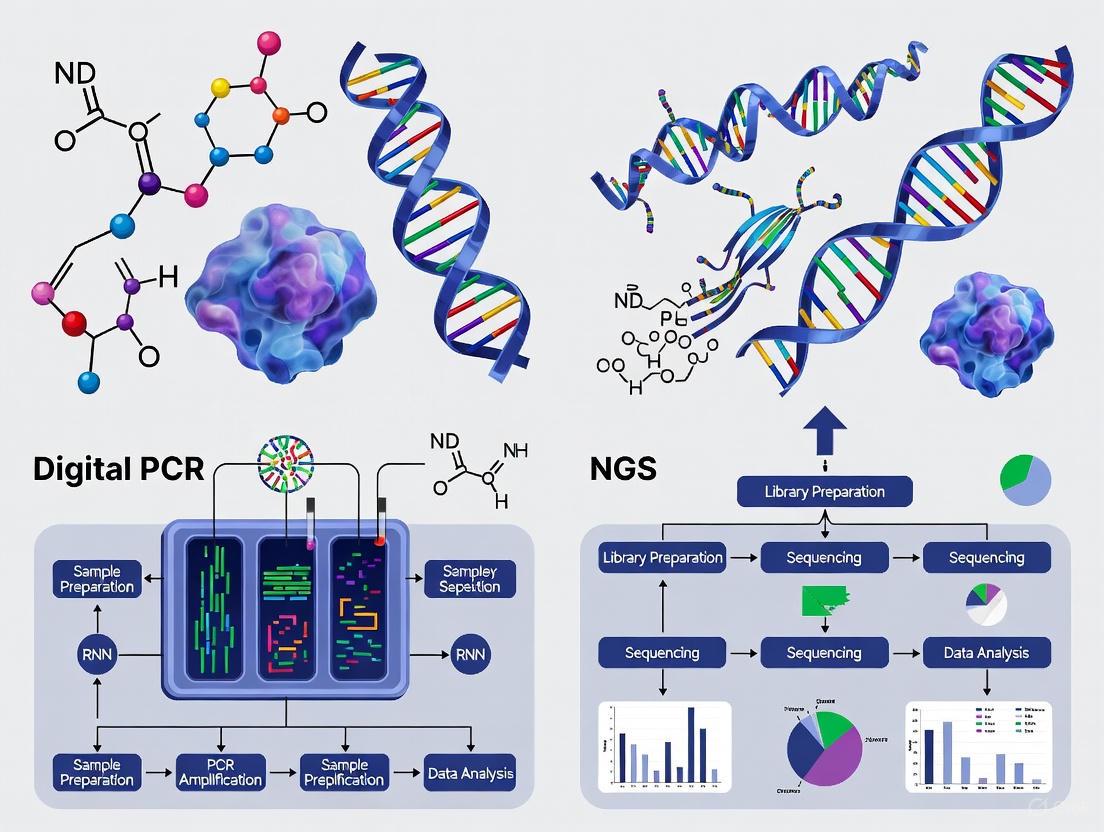
The analysis of circulating tumor DNA (ctDNA) via liquid biopsy is revolutionizing cancer research and drug development.
Digital PCR vs. Next-Generation Sequencing: A Strategic Guide to ctDNA Analysis for Precision Oncology
Abstract
The analysis of circulating tumor DNA (ctDNA) via liquid biopsy is revolutionizing cancer research and drug development. This article provides a comprehensive comparison of two cornerstone technologies—Digital PCR (dPCR) and Next-Generation Sequencing (NGS)—for ctDNA detection. We explore their foundational principles, methodological workflows, and specific applications in areas like minimal residual disease (MRD) monitoring and therapy response assessment. Drawing on recent comparative studies and market analyses, we offer a strategic framework for troubleshooting, optimization, and technology selection. This guide is designed to empower researchers and scientists in making informed decisions to advance biomarker discovery and clinical trial strategies in precision oncology.
Understanding ctDNA and the Technological Battlefield in Liquid Biopsies
What is ctDNA? Defining a Key Biomarker in Precision Oncology
Circulating tumor DNA (ctDNA) refers to short, double-stranded fragments of DNA that are released by tumor cells into the bloodstream and other body fluids [1] [2]. As a minimally invasive biomarker, ctDNA carries the unique genetic mutations and alterations of the original tumor, providing a real-time snapshot of the tumor's molecular profile [3] [4]. The analysis of ctDNA, often called a liquid biopsy, has emerged as a powerful tool in precision oncology, enabling clinicians to detect cancer, guide targeted treatment decisions, monitor treatment response, and identify emerging drug resistance without the need for invasive tissue biopsies [3] [5] [2].
The Biology and Origin of Circulating Tumor DNA
The presence of cell-free DNA in the blood of cancer patients was first observed in 1977, but significant progress in characterizing ctDNA only became possible with advances in genomic technologies [1]. It was not until 1994 that researchers confirmed the tumor-derived nature of this DNA by identifying characteristic cancer mutations within it [1].
CtDNA is distinguished from normal cell-free DNA (cfDNA) by the presence of tumor-specific genetic alterations, such as single-nucleotide mutations, methylation changes, copy number variations, and cancer-derived viral sequences [1]. These fragments are typically shorter than non-tumor cfDNA and can vary in concentration, sometimes constituting less than 0.01% of the total cell-free DNA in peripheral blood, making their detection technically challenging [1] [6].
The release of ctDNA into the circulation occurs through several mechanisms, primarily involving:
- Apoptosis (Programmed Cell Death): As tumor cells undergo apoptosis, their DNA is packaged into apoptotic bodies and subsequently released into the bloodstream upon phagocytosis by macrophages. This process typically produces DNA fragments of around 166 base pairs, reflecting a characteristic nucleosomal ladder pattern [1] [4].
- Necrosis: Unlike the controlled process of apoptosis, necrosis results from traumatic cell death due to factors like hypoxia and metabolic stress, leading to the release of larger, more random DNA fragments [1] [4].
- Active Secretion: Viable tumor cells can also actively release DNA through extracellular vesicles or other secretory mechanisms, though this pathway is less well-characterized [1] [4].
The following diagram illustrates the primary mechanisms of ctDNA release into the bloodstream:
Detection Technologies: Digital PCR vs. Next-Generation Sequencing
The clinical utility of ctDNA depends on highly sensitive detection methods capable of identifying rare tumor-specific mutations amidst a background of predominantly normal cfDNA. The two primary technologies for ctDNA analysis are droplet digital PCR (ddPCR) and next-generation sequencing (NGS), each with distinct advantages and limitations.
Digital PCR (ddPCR)
Droplet digital PCR is an ultrasensitive, targeted approach that detects specific DNA mutations by partitioning a sample into thousands of nanodroplets and performing PCR amplification on each droplet individually. This method allows for absolute quantification of target mutations without the need for standard curves [7] [8].
Key advantages of ddPCR include:
- High sensitivity for detecting low-frequency mutations (as low as 0.01% variant allele frequency)
- Absolute quantification without requiring calibration curves
- Rapid turnaround time and lower operational costs compared to NGS
- Robust performance with low DNA input amounts [9] [7] [8]
Limitations of ddPCR include:
- Low multiplexing capability - typically limited to a few mutations per assay
- Requirement for prior knowledge of specific mutations to target
- Inability to detect novel or unexpected mutations [7] [8]
Next-Generation Sequencing (NGS)
NGS-based approaches enable comprehensive profiling of multiple genes simultaneously through various methodologies including targeted panels, whole-exome sequencing, and whole-genome sequencing [3] [6]. These methods can be broadly categorized as:
- Tumor-informed approaches: Require prior sequencing of tumor tissue to identify patient-specific mutations to track in circulation
- Tumor-agnostic approaches: Detect ctDNA without prior knowledge of tumor mutations using features like methylation patterns or fragmentomics [10] [5]
Key advantages of NGS include:
- High multiplexing capacity - able to monitor hundreds to thousands of genomic regions simultaneously
- Discovery power - can identify novel mutations and resistance mechanisms
- Comprehensive genomic profiling - detects various alteration types including SNVs, Indels, CNVs, and fusions [3] [6] [8]
Limitations of NGS include:
- Higher cost and longer turnaround times
- Greater bioinformatics complexity for data analysis
- Generally lower sensitivity for detecting very low-frequency variants compared to ddPCR [9] [7] [6]
The following workflow diagram illustrates the key steps in ctDNA analysis using both ddPCR and NGS approaches:
Performance Comparison: ddPCR vs. NGS
Recent studies have directly compared the performance of ddPCR and NGS for ctDNA detection across various cancer types, providing valuable insights for researchers selecting appropriate methodologies.
Table 1: Performance Comparison of ddPCR vs. NGS in Rectal Cancer Detection
| Metric | ddPCR Performance | NGS Performance | Study Details |
|---|---|---|---|
| Detection Rate (Baseline) | 24/41 patients (58.5%) | 15/41 patients (36.6%) | Development group (n=41), p=0.00075 [9] [7] |
| Detection Rate (Validation) | 21/26 patients (80.8%) | Not reported | Validation group (n=26) [7] |
| Association with Disease Stage | Positive correlation with higher clinical tumor stage and lymph node positivity | Similar association observed | Based on MRI assessment [7] |
| Postoperative Monitoring | Did not detect ctDNA before most recurrences | Not reported | Limited utility for early recurrence detection [7] |
Table 2: Analytical Performance of NGS Assays Across Multiple Variant Types
| Variant Type | Sensitivity at VAF 0.5% | Sensitivity at VAF 0.1% | Key Observations |
|---|---|---|---|
| SNVs | ~95% for most assays | Substantially lower | Assays B, D, G showed highest sensitivity [6] |
| InDels | Variable between assays | Significantly reduced | Highly dependent on bioinformatics pipeline [6] |
| CNVs | Challenging at low VAF | Limited detection | Requires higher ctDNA fraction [6] |
| Structural Variants | Variable between assays | Limited detection | Dependent on panel design [6] |
A 2025 study comparing ddPCR and targeted NGS for detecting ERBB2, ESR1, and PIK3CA mutations in metastatic breast cancer demonstrated 95% concordance (90/95 mutations) between the two techniques with a strong correlation (R² = 0.9786) for the 44 mutations identified by both platforms [8]. Discordant results primarily involved mutations at low variant allele frequencies (0.14% to 0.33%), highlighting the technical challenges at the limit of detection for both methods [8].
Essential Research Reagent Solutions
The following table outlines key reagents and materials required for implementing ctDNA analysis in research settings:
Table 3: Essential Research Reagents for ctDNA Analysis
| Reagent/Material | Function | Examples/Specifications |
|---|---|---|
| Blood Collection Tubes | Stabilize cfDNA for transport and processing | Streck Cell-Free DNA BCT, EDTA tubes, CellSave tubes [10] [7] |
| cfDNA Extraction Kits | Isolate cell-free DNA from plasma | QiaAmp cfDNA Kit (Qiagen) [10] |
| DNA Quantification Assays | Measure cfDNA concentration and quality | Quant-IT dsDNA High-Sensitivity Assay [10] |
| ddPCR Supermixes | Enable droplet-based digital PCR | Bio-Rad ddPCR Supermix for Probes [7] [8] |
| NGS Library Prep Kits | Prepare sequencing libraries | Ion AmpliSeq Library Kit, Custom targeted panels [7] [6] |
| Unique Molecular Identifiers | Reduce sequencing errors and enable error correction | Integrated UMIs in library preparation [3] |
Experimental Protocols for ctDNA Analysis
Protocol 1: Tumor-Informed ddPCR Analysis
This protocol outlines the steps for detecting ctDNA using a tumor-informed ddPCR approach, as employed in recent rectal cancer studies [7]:
Tumor Tissue Sequencing: Sequence primary tumor tissue using a targeted NGS panel (e.g., Ion AmpliSeq Cancer Hotspot Panel v2) to identify somatic mutations present in the tumor.
Probe Design: Design mutation-specific ddPCR probes targeting 1-2 mutations with the highest variant allele frequencies identified in tumor tissue.
Blood Collection and Processing:
- Collect blood in cfDNA stabilization tubes (e.g., Streck Cell-Free DNA BCT)
- Process within 4-96 hours of collection with two centrifugation steps (10 min at 1711 g followed by 10 min at 12,000 g)
- Store plasma at -80°C until cfDNA extraction
cfDNA Extraction: Extract cfDNA using the QiaAmp cfDNA Kit according to manufacturer's instructions.
ddPCR Assay:
- Partition 2-9 μL of extracted DNA into approximately 20,000 droplets
- Perform endpoint PCR amplification with mutation-specific probes
- Quantify absolute target DNA concentration based on positive and negative droplets
- Set detection threshold at 0.01% variant allele frequency [7]
Protocol 2: Tumor-Agnostic NGS Analysis
This protocol describes a tumor-agnostic approach for ctDNA detection using multiple methods, as implemented in breast cancer studies [10]:
Sample Collection: Collect blood from patients before neoadjuvant chemotherapy treatment using appropriate collection tubes.
cfDNA Extraction: Isolate cfDNA from plasma using standardized extraction methods, with concentration estimated using fluorometric assays (e.g., Quant-IT dsDNA High-Sensitivity Assay).
Multimodal Analysis:
- Oncomine Breast cfDNA NGS Panel: Use 10 ng cfDNA input with median 20,000x read depth coverage, targeting 150 hotspots in 10 breast cancer genes
- mFAST-SeqS Method: Amplify LINE-1 sequences from 1 ng cfDNA, sequence to obtain ≥90,000 reads per sample, calculate genome-wide aneuploidy score
- Shallow Whole-Genome Sequencing: Detect copy number variations and estimate tumor fraction through fragment size analysis
- MeD-Seq Assay: Digest 10 ng cfDNA with LpnPI enzyme, ligate adaptors, sequence to ~20 million reads for genome-wide methylation profiling [10]
Data Analysis:
- For targeted NGS: Consider variants above the limit of detection based on unique fragments
- For mFAST-SeqS: Classify samples with genome-wide aneuploidy score ≥5 as ctDNA-positive
- Integrate results from multiple methods to enhance detection sensitivity [10]
Circulating tumor DNA represents a transformative biomarker in precision oncology, offering non-invasive access to tumor-specific genetic information for cancer detection, monitoring, and treatment selection. The choice between ddPCR and NGS detection platforms involves careful consideration of research objectives, with ddPCR offering superior sensitivity for tracking known mutations and NGS providing comprehensive genomic profiling capabilities. As detection technologies continue to advance and standardization improves, ctDNA analysis is poised to play an increasingly central role in cancer research and clinical practice, enabling more personalized and dynamic cancer management strategies.
The evolution from invasive tissue biopsies to minimally invasive liquid biopsies represents a transformative advancement in oncology. Liquid biopsy, which involves the analysis of tumor-derived components from biofluids like blood, provides a dynamic platform for personalized therapeutic interventions [11]. Among the various analytes, circulating tumor DNA (ctDNA)—fragmented DNA released into the bloodstream by tumor cells—has demonstrated significant clinical utility for molecular profiling, treatment monitoring, and minimal residual disease (MRD) detection [12] [3]. Two primary technologies have emerged for ctDNA analysis: droplet digital PCR (ddPCR) and next-generation sequencing (NGS). This guide provides an objective, data-driven comparison of their performance characteristics, experimental protocols, and suitability for specific research applications to inform scientists, researchers, and drug development professionals.
Digital Droplet PCR (ddPCR)
ddPCR is a third-generation PCR technology that enables absolute nucleic acid quantification without requiring a standard curve. The technique partitions a PCR reaction into thousands of nanoliter-sized water-in-oil droplets, effectively creating individual reaction chambers. Following PCR amplification, the fraction of positive partitions is analyzed using Poisson statistics to calculate the absolute target concentration [13]. This partitioning enables single-molecule detection with high sensitivity and precision, making it particularly suitable for detecting rare mutations in a background of wild-type DNA [13].
Next-Generation Sequencing (NGS)
NGS encompasses several high-throughput sequencing methodologies that can simultaneously analyze multiple genomic regions or even entire genomes. For ctDNA analysis, targeted NGS panels are commonly employed to identify somatic mutations across dozens to hundreds of cancer-associated genes. These methods typically involve library preparation, amplification, and massively parallel sequencing, followed by sophisticated bioinformatic analysis [3] [14]. The key advantage of NGS lies in its multiplexing capability, allowing comprehensive profiling of heterogeneous tumors from a single assay [3].
Comparative Workflow Visualization
The experimental workflows for ddPCR and NGS in ctDNA analysis involve distinct processes, from sample preparation to data analysis, as illustrated below.
Direct Performance Comparison: Experimental Data
Detection Sensitivity in Rectal Cancer
A 2025 study directly compared ddPCR and NGS for ctDNA detection in localized rectal cancer, providing robust performance data [7] [9]. The research employed a standardized protocol with matched plasma and tumor samples from development (n=41) and validation (n=26) cohorts.
Table 1: ctDNA Detection Rates in Pre-therapy Plasma (Development Cohort)
| Technology | Detection Rate | Statistical Significance | Variant Allele Frequency (VAF) Range |
|---|---|---|---|
| ddPCR | 24/41 (58.5%) | p = 0.00075 | As low as 0.01% |
| NGS Panel | 15/41 (36.6%) | Reference | Typically >0.1% |
The significantly higher detection rate with ddPCR highlights its superior sensitivity for low-frequency mutation detection, a critical factor for early-stage cancer monitoring and MRD assessment [7].
Concordance Studies in Breast Cancer
A comparative performance analysis in metastatic breast cancer evaluated targeted NGS against multiplex dPCR assays for detecting ERBB2, ESR1, and PIK3CA mutations in 32 plasma samples [8].
Table 2: Method Concordance in Breast Cancer Mutation Detection
| Performance Metric | Result | Implications |
|---|---|---|
| Overall Concordance | 95% (90/95) | High technical agreement between platforms |
| Correlation Coefficient | R² = 0.9786 | Excellent quantitative correlation |
| Discordant Cases | 5 mutations (4 samples) | All at low VAF (0.14%-0.33%) |
| Additional Mutations Detected | NGS identified PIK3CA p.P539R | Confirmed with newly designed dPCR assay |
This study demonstrates that both technologies can deliver highly concordant results, with targeted NGS offering advantages in novel mutation discovery, while dPCR provides accessible validation [8].
Technical Specifications and Methodological Considerations
Key Performance Parameters
Table 3: Technical Specifications Comparison
| Parameter | ddPCR | NGS |
|---|---|---|
| Limit of Detection | 0.01% VAF [7] | 0.1%-0.5% VAF [14] |
| Multiplexing Capacity | Limited (typically 2-4 targets) [8] | High (dozens to hundreds of genes) [3] |
| Input DNA Requirements | 1-10 ng cfDNA [13] | 10-60 ng cfDNA [14] |
| Turnaround Time | 4-8 hours [13] | 3-7 days (including analysis) [14] |
| Cost per Sample | Low (5-8.5 fold lower than NGS) [7] | High (reagents, sequencing, bioinformatics) [7] |
| Quantitative Output | Absolute quantification without standards [13] | Relative quantification requiring normalization [14] |
| Target Discovery | Requires prior knowledge of specific mutations [7] | Can identify novel/unknown mutations [8] |
Experimental Protocol Details
ddPCR Methodology for ctDNA Analysis
The rectal cancer study employed a tumor-informed ddPCR approach [7]:
- Tissue Genotyping: Primary tumor tissue underwent NGS using Ion AmpliSeq Cancer Hotspot Panel v2 (covering 50 oncogenes and tumor suppressor genes) to identify somatic mutations.
- Probe Design: One to two predesigned probes were selected based on the highest variant allele frequencies in the matched primary tumor.
- Plasma Processing: Blood samples were collected in Streck Cell Free DNA BCT tubes, with plasma separated within 2 hours of collection.
- cfDNA Extraction: Using the QIAamp Circulating Nucleic Acid Kit (Qiagen), followed by quantification.
- Droplet Generation: 2-9 μL of extracted DNA was partitioned into approximately 20,000 droplets using a QX200 Droplet Generator.
- PCR Amplification: Endpoint PCR with target-specific fluorescent probes (FAM/HEX).
- Droplet Reading: Analysis using QX200 Droplet Reader, with quantification of positive and negative droplets.
- Data Analysis: Absolute quantification using Poisson statistics, with threshold for positivity set at ≥3 mutant droplets per well.
Targeted NGS Methodology for ctDNA Analysis
The breast cancer comparison study utilized the Plasma-SeqSensei (PSS) BC targeted NGS assay [8]:
- Library Preparation: Cell-free DNA underwent end-repair, A-tailing, and adapter ligation with unique molecular identifiers (UMIs).
- Target Enrichment: Hybridization capture using a custom panel covering ERBB2, ESR1, and PIK3CA genes.
- Sequencing: Illumina NextSeq 500 system with minimum 15,000× raw coverage.
- Bioinformatic Processing:
- Read alignment to reference genome (hg19)
- UMI-based deduplication to eliminate PCR artifacts
- Variant calling with threshold of ≥3 supporting reads for low-frequency mutations
- Annotation and filtering against population databases
- Validation: Mutations detected by NGS were confirmed with newly designed dPCR assays when discordant.
Research Reagent Solutions
Table 4: Essential Materials for ctDNA Analysis
| Reagent/Kit | Function | Application Notes |
|---|---|---|
| Streck Cell Free DNA BCT Tubes | Blood collection tube with preservatives | Maintains cfDNA stability for up to 7 days at room temperature [7] |
| QIAamp Circulating Nucleic Acid Kit | cfDNA extraction from plasma | High recovery efficiency for low-concentration samples [7] |
| Ion AmpliSeq Cancer Hotspot Panel v2 | Tumor tissue mutation screening | Covers ~2800 COSMIC variants across 50 cancer genes [7] |
| ddPCR Supermix for Probes (Bio-Rad) | PCR reaction mixture | Optimized for droplet generation and stability [7] |
| Unique Molecular Identifiers (UMIs) | Molecular barcoding | Tags individual DNA molecules pre-amplification to distinguish true mutations from PCR errors [14] |
| Plasma-SeqSensei Breast Cancer Panel | Targeted NGS capture | Custom hybridization panel for breast cancer-associated mutations [8] |
Application-Specific Recommendations
Clinical and Research Use Cases
The choice between ddPCR and NGS depends heavily on the specific research question and application requirements:
- Treatment Response Monitoring: ddPCR excels at tracking known mutations during therapy with high sensitivity and rapid turnaround [3].
- Comprehensive Profiling: NGS is superior for initial molecular characterization of tumors, especially when tissue is limited [14].
- Minimal Residual Disease Detection: Both technologies have utility, with ddPCR offering lower limits of detection for specific mutations, while NGS provides broader coverage [12].
- Clinical Trial Biomarker Development: NGS enables discovery of novel resistance mechanisms, while ddPCR facilitates high-throughput patient screening [8].
Emerging Technological Developments
Future directions in ctDNA analysis include:
- Ultra-sensitive NGS protocols utilizing duplex sequencing to achieve ddPCR-level sensitivity while maintaining multiplexing advantages [3].
- Integrated bioinformatic pipelines with dynamic limits of detection calibrated to sequencing depth [14].
- Multi-analyte approaches combining ctDNA with other liquid biopsy components like circulating tumor cells and extracellular vesicles [11] [3].
- Standardization initiatives addressing pre-analytical variables and analytical validation requirements [14].
The liquid biopsy revolution continues to transform cancer research and clinical practice. Both ddPCR and NGS offer distinct advantages for ctDNA analysis, with the optimal choice dependent on specific research goals, required sensitivity, multiplexing needs, and resource constraints. ddPCR provides unparalleled sensitivity and affordability for tracking known mutations, while NGS offers comprehensive genomic profiling capabilities. As both technologies evolve, their complementary strengths will likely expand the applications of blood-based analysis in precision oncology, ultimately advancing drug development and patient care.
Digital PCR (dPCR) represents a transformative advancement in nucleic acid quantification, enabling absolute measurement of target sequences without the need for standard curves. This technology achieves unparalleled precision by partitioning a sample into thousands of individual reactions, following Poisson distribution statistics to calculate absolute target concentration from the ratio of positive to negative partitions. Particularly in circulating tumor DNA (ctDNA) analysis, dPCR's exceptional sensitivity (detecting variants at 0.01% allele frequency) and absolute quantification capabilities make it indispensable for liquid biopsy applications, minimal residual disease monitoring, and treatment response assessment. This review examines the core principles underlying dPCR technology and provides a comprehensive performance comparison with next-generation sequencing (NGS) for ctDNA analysis in oncology research, supported by experimental data and technical workflows.
Digital PCR (dPCR) constitutes the third generation of PCR technology, succeeding conventional PCR and real-time quantitative PCR (qPCR) [13]. The fundamental breakthrough emerged from foundational work in the 1990s when researchers combined limiting dilution PCR with Poisson statistics to isolate, detect, and quantify single nucleic acid molecules [13]. The term "digital PCR" was formally coined in 1999 by Bert Vogelstein and colleagues, who developed a workflow involving limiting dilution distributed on 96-well plates combined with fluorescence readout to detect RAS oncogene mutations in colorectal cancer patients [13]. This pioneering work established the core principle that underlies all modern dPCR systems: the partitioning of nucleic acid samples to such an extent that individual molecules can be amplified and detected in isolation.
The technology has evolved significantly from its initial microtiter plate format. In 1997, volume miniaturization was introduced using microcapillaries (∼10 nL) for the partition process, reducing reagent costs and improving amplification efficiency [13]. A major advancement came in 2003 with the development of BEAMing technology (beads, emulsion, amplification, and magnetics), which simplified compartmentalization through water-in-oil droplet formation [13]. Modern dPCR platforms now primarily utilize two partitioning approaches: water-in-oil droplet emulsification (droplet digital PCR or ddPCR) and microchamber-based systems using arrays of microscopic wells or chambers embedded in a solid chip [13]. These technological advances have made dPCR increasingly accessible for research and clinical applications requiring absolute quantification of nucleic acids.
Fundamental Principles of Digital PCR
The Partitioning Principle and Poisson Statistics
The core innovation of dPCR lies in its partitioning strategy, which enables the transition from analog to digital measurement. The process begins with dividing a PCR mixture containing the sample into thousands to millions of discrete partitions, resulting in a random distribution of target molecules among these compartments according to Poisson statistics [13]. Following endpoint PCR amplification, each partition is analyzed for fluorescence signals, classifying them as positive (containing the target sequence) or negative (lacking the target). The absolute concentration of the target molecule is then calculated using Poisson distribution mathematics based on the proportion of negative partitions, as the probability of a partition being negative corresponds to the zero term of the Poisson distribution [13].
This digital approach to quantification eliminates the reliance on external standards and reference curves that are required for qPCR, thereby providing absolute quantification without calibration. The massive partitioning enables single-molecule detection, granting dPCR exceptional sensitivity and precision for detecting rare mutations and low-abundance targets [13]. The statistical power of dPCR increases with the number of partitions, with modern systems generating up to millions of data points per sample to ensure highly accurate concentration measurements.
Comparative Workflow: dPCR vs. qPCR vs. NGS
The following diagram illustrates the fundamental workflow of dPCR in comparison to traditional qPCR and NGS:
Diagram 1: Comparative workflows of dPCR, qPCR, and NGS technologies highlighting fundamental differences in quantification approaches.
Experimental Comparison: dPCR vs. NGS for ctDNA Analysis
Performance Metrics in Cancer Detection
Recent studies have directly compared the analytical performance of dPCR and NGS for circulating tumor DNA (ctDNA) detection across various cancer types. The following table summarizes key performance metrics from experimental comparisons:
Table 1: Performance comparison of dPCR versus NGS in ctDNA detection across cancer types
| Cancer Type | Study Details | dPCR Detection Rate | NGS Detection Rate | Key Performance Findings | Reference |
|---|---|---|---|---|---|
| Rectal Cancer | Development group (n=41) localized cancer | 58.5% (24/41) | 36.6% (15/41) | dPCR demonstrated significantly higher detection rate (p=0.00075) in baseline plasma | [7] |
| Metastatic Breast Cancer | 32 plasma samples, 44 mutations | N/A | N/A | 95% overall concordance (90/95) between multiplex dPCR and targeted NGS with R²=0.9786 correlation | [8] |
| Colorectal Cancer (KRAS) | 33 studies meta-analysis | Pooled sensitivity: 0.77Specificity: 0.87 | Included in meta-analysis | dPCR, ARMS, and NGS showed high accuracy in cfDNA KRAS detection (AUC: 0.8992) | [15] |
| Advanced NSCLC | 56 studies meta-analysis | N/A | Tissue: EGFR sensitivity 93%Liquid: EGFR sensitivity 80% | NGS effective for point mutations in liquid biopsy but limited sensitivity for fusions | [16] |
Technical Parameters and Limitations
The performance differences between dPCR and NGS stem from their fundamental technical characteristics. dPCR achieves exceptional sensitivity with a variant allele frequency (VAF) detection limit as low as 0.01%, enabled by partitioning that allows detection of single molecules [7]. This makes it particularly suitable for minimal residual disease monitoring where ctDNA fractions are extremely low. In contrast, NGS panels typically achieve a limit of detection around 0.5% VAF with standard sequencing depths of ~15,000x, which can be improved to approximately 0.1% with ultra-deep sequencing of 20,000 unique reads or higher [14].
The operational characteristics also differ substantially. dPCR offers rapid turnaround times of 1-2 days with 5-8.5-fold lower operational costs compared to NGS [7]. However, dPCR is limited to monitoring known mutations with low multiplexing capacity, while NGS provides comprehensive profiling of hundreds of genes simultaneously, making it suitable for discovery applications and detecting novel resistance mechanisms [3]. NGS turnaround times typically range from 8-20 days depending on the platform and workflow complexity [16].
Methodologies: Experimental Protocols for ctDNA Analysis
Sample Collection and Processing
Proper sample collection and processing are critical for reliable ctDNA analysis. For dPCR applications, blood samples should be collected in specialized cell-free DNA blood collection tubes (e.g., Streck Cell Free DNA BCT or Roche Cell-Free DNA collection tubes) to prevent nucleic acid degradation and preserve sample integrity [7] [17]. The recommended blood volume is typically 3 × 9 mL tubes to ensure sufficient cfDNA yield for analysis [7]. Plasma separation should be performed through a two-step centrifugation process: initial centrifugation at 1,600×g for 10 minutes to separate cellular components, followed by a second centrifugation of the supernatant at 16,000×g for 10 minutes to remove remaining debris [17]. Processed plasma should be stored at -80°C until cfDNA extraction.
cfDNA extraction is typically performed using commercial kits optimized for low-concentration samples, such as the QIAamp Circulating Nucleic Acid kit [17]. Extraction should be conducted in dedicated pre-amplification areas to prevent contamination. DNA concentration should be quantified using fluorescence-based methods (e.g., Qubit High Sensitivity dsDNA kit) rather than spectrophotometry to ensure accurate measurement of low-concentration samples [17].
dPCR Assay Design and Optimization
For tumor-informed dPCR assays, mutations are first identified in tumor tissue using NGS panels such as the Ion AmpliSeq Cancer Hotspot Panel v2, which covers hotspot regions in 50 oncogenes and tumor suppressor genes [7]. Based on the NGS results, one to two mutations with the highest variant allele frequencies are selected for dPCR detection [7]. Predesigned or custom probes are then developed against these specific mutations.
The dPCR reaction mixture typically contains 2-9 μL of extracted cfDNA partitioned into 20,000 droplets [7]. Optimal DNA input should be determined empirically to avoid reaction inhibition while ensuring sufficient target molecules for reliable detection. Proper controls including no-template controls, wild-type controls, and positive controls for the specific mutations should be included in each run. For rare mutation detection, sufficient input DNA (recommended minimum of 10,000 genome equivalents) is critical to ensure adequate representation of mutant alleles in the sample [14].
Data Analysis and Interpretation
Following endpoint PCR amplification, droplets are analyzed using a droplet reader that measures fluorescence in each partition [13]. Data analysis involves setting appropriate fluorescence thresholds to distinguish positive from negative partitions, typically using manufacturer-provided software. The absolute concentration of target molecules is calculated using Poisson statistics based on the fraction of positive partitions, with correction for partition volume [13].
For ctDNA analysis, results are typically reported as variant allele frequency (VAF), calculated as the ratio of mutant molecules to total (mutant + wild-type) molecules. The limit of blank (LOB) should be established using healthy donor plasma samples, with thresholds set to exceed the mean VAF of controls by 20-fold to minimize false positives [17]. In clinical monitoring applications, significant changes in ctDNA levels (typically >2-fold) are considered biologically relevant, though laboratory-specific validation should establish precise thresholds for response and progression.
Essential Research Reagent Solutions
Table 2: Key reagents and materials for dPCR-based ctDNA analysis
| Reagent Category | Specific Examples | Function & Importance | Technical Considerations | |
|---|---|---|---|---|
| Blood Collection Tubes | Streck Cell-Free DNA BCTRoche Cell-Free DNA Collection Tubes | Preserves cfDNA integrity by preventing white blood cell lysis and nuclease activity | Critical for preventing genomic DNA contamination; samples stable for up to 5 days at room temperature | [7] [17] |
| cfDNA Extraction Kits | QIAamp Circulating Nucleic Acid KitMagMax Viral/Pathogen Kit | Isolate high-purity cfDNA from plasma with optimized yield for low-abundance targets | Superior recovery of short-fragment cfDNA (~170 bp) compared to standard DNA kits | [7] [17] |
| dPCR Master Mixes | ddPCR Supermix for ProbesQIAcuity Probe PCR Kit | Provides optimized reaction components for partition-based amplification | Buffer composition affects partition stability and amplification efficiency | [13] [18] |
| Assay Formulations | Custom TaqMan AssaysPrimer/Probe Sets | Target-specific detection of mutations identified in tumor tissue | Requires careful optimization of primer/probe concentrations and annealing temperatures | [7] [8] |
| Partitioning Media | Droplet Generation OilNanowell Plates | Creates stable, monodisperse partitions for digital amplification | Surfactant composition crucial for preventing droplet coalescence during thermal cycling | [13] |
| Quantification Standards | Qubit dsDNA HS AssayDroplet Digital Quantification Standards | Accurate measurement of input DNA quality and quantity | Fluorescence-based methods essential for low-concentration cfDNA samples | [17] |
Applications in Precision Oncology
The unique capabilities of dPCR have established its role in specific clinical research applications, particularly where ultrasensitive detection of known mutations is required. In rectal cancer, dPCR detected ctDNA in 58.5% of patients compared to 36.6% with NGS, demonstrating its superior sensitivity for baseline assessment in localized cancer [7]. This high detection sensitivity makes dPCR particularly valuable for identifying molecular residual disease after curative-intent surgery, where ctDNA levels are typically extremely low (<0.1%) [3].
In metastatic breast cancer, dPCR has shown excellent concordance (95%) with targeted NGS for detecting ESR1, PIK3CA, and ERBB2 mutations, supporting its utility for therapy selection and resistance monitoring [8]. The technology's precision enables accurate monitoring of mutation dynamics during treatment, allowing researchers to correlate changes in specific mutant allele frequencies with treatment response and emergence of resistance [3]. Additionally, dPCR serves as an ideal orthogonal validation method for NGS findings, particularly for low-frequency variants where confirmation is essential [8].
Digital PCR represents a paradigm shift in nucleic acid quantification, providing absolute measurement through partitioning and Poisson statistical analysis. Its exceptional sensitivity (detection down to 0.01% VAF), precision, and calibration-free quantification make it uniquely suited for ctDNA applications requiring detection of rare mutations, particularly in minimal residual disease monitoring and therapy response assessment. While NGS offers broader genomic coverage for discovery applications, dPCR provides superior sensitivity and cost-effectiveness for tracking known mutations. The complementary strengths of both technologies underscore their synergistic value in comprehensive cancer genomic research programs. As precision oncology continues to evolve, dPCR's role in validating and quantifying specific genomic biomarkers will remain indispensable for translational research and clinical trial applications.
The analysis of circulating tumor DNA (ctDNA) has emerged as a cornerstone of precision oncology, enabling minimally invasive tumor genotyping, therapy monitoring, and minimal residual disease (MRD) detection [12] [3]. Two primary technological approaches have been developed for ctDNA analysis: digital PCR (dPCR) and next-generation sequencing (NGS). While both methods can detect tumor-derived genetic alterations in blood, they differ fundamentally in scope, application, and information yield [14]. dPCR, including droplet digital PCR (ddPCR), provides ultra-sensitive detection for a limited set of predefined mutations, making it ideal for tracking known variants during treatment monitoring or MRD assessment [7]. In contrast, NGS enables comprehensive profiling across multiple genomic regions simultaneously, capturing a broader spectrum of alterations without prior knowledge of specific mutations [14] [19]. This article compares the performance characteristics, experimental methodologies, and clinical applications of these complementary technologies within ctDNA analysis research.
Performance Comparison: NGS vs. Digital PCR
Direct comparative studies reveal distinct performance characteristics for NGS and dPCR technologies in ctDNA analysis, with significant implications for their research and clinical applications.
Table 1: Performance Characteristics of NGS vs. Digital PCR for ctDNA Analysis
| Parameter | Next-Generation Sequencing (NGS) | Digital PCR (dPCR/ddPCR) |
|---|---|---|
| Genomic Coverage | Broad; can interrogate dozens to hundreds of genes simultaneously [14] | Narrow; limited to a few predefined mutations per assay [7] |
| Detection Sensitivity | Varies with sequencing depth; typically 0.1% - 0.5% VAF [14] | High; can reach 0.01% variant allele frequency (VAF) [7] |
| Mutation Types Detected | Single nucleotide variants (SNVs), insertions/deletions (indels), copy number variations (CNVs), fusions [19] | Primarily SNVs and small indels [8] |
| Throughput | High-throughput, capable of multiplexing many samples [17] | Low-throughput, typically limited to few samples and targets per run [7] |
| Tumor-Informed Requirement | Can be either tumor-informed or tumor-uninformed [3] | Typically requires tumor tissue sequencing first to identify targets [7] |
| Cost Considerations | Higher per-sample cost, but lower cost per data point [7] | Lower per-sample cost for limited targets, but higher cost for multiple targets [7] |
Table 2: Experimental Findings from Direct Comparison Studies
| Study Context | Detection Rate (NGS) | Detection Rate (dPCR) | Concordance | Key Findings |
|---|---|---|---|---|
| Localized Rectal Cancer [7] | 36.6% (15/41 patients) | 58.5% (24/41 patients) | Not specified | ddPCR demonstrated significantly higher detection rates in pre-therapy plasma (p=0.00075) |
| Metastatic Breast Cancer [8] [20] | 44 mutations detected | 44 mutations detected | 95% (90/95 mutations) | High correlation between techniques (R²=0.9786); each method identified mutations missed by the other |
Experimental Protocols for Technology Comparison
Protocol 1: Rectal Cancer Study Comparing ddPCR and NGS
A 2025 study directly compared ddPCR and NGS for ctDNA detection in localized rectal cancer, providing a robust methodological framework for technology assessment [7].
Sample Collection and Processing:
- Blood samples were collected in Streck Cell-Free DNA BCT tubes before any neoadjuvant therapy.
- Plasma was separated via a two-step centrifugation process (10 minutes at 1,600g, followed by 10 minutes at 16,000g).
- Cell-free DNA was extracted from plasma using the QIAamp Circulating Nucleic Acid kit.
Tissue Sequencing and Target Selection:
- Tumor DNA from surgical specimens or biopsies was sequenced using the Ion AmpliSeq Cancer Hotspot Panel v2 (HS1).
- This panel covers hotspot regions in 50 oncogenes and tumor suppressor genes with theoretical coverage of 99% in rectal cancer patients.
- For ddPCR, one to two mutations with the highest variant allele frequencies in the tumor tissue were selected as targets.
ctDNA Detection Methods:
- ddPCR: Custom probes were designed for the selected mutations, partitioning 2-9μL of extracted DNA into approximately 20,000 droplets to achieve high sensitivity (VAF 0.01%).
- NGS: The same HS1 panel was used, with a bioinformatician lowering the variant calling threshold to 0.01% VAF to match ddPCR sensitivity.
- All ctDNA analyses were performed by an experienced hospital geneticist, with samples classified as ctDNA-positive if any oncogenic mutation was detected.
Protocol 2: Breast Cancer Study Comparing Multiplex dPCR and Targeted NGS
A comparative performance analysis in metastatic breast cancer evaluated multiplex dPCR against a targeted NGS assay for detecting ERBB2, ESR1, and PIK3CA mutations [8] [20].
Sample Cohort:
- The study utilized 32 plasma samples from patients with metastatic breast cancer.
- Cell-free DNA was extracted from plasma, with input amounts ranging from 4.0 to 43 ng.
Multiplex dPCR Methodology:
- Researchers employed previously developed and validated multiplex dPCR assays.
- For ESR1 mutations, a drop-off system was implemented to detect specific variants (p.D538N and p.536LYD>P).
Targeted NGS Methodology:
- The Plasma-SeqSensei Breast Cancer (PSS BC) NGS assay was used.
- This targeted NGS solution is designed for highly sensitive multigene analysis with ready-to-use reagents.
Concordance Assessment:
- Results from both techniques were compared for the 44 mutations detected.
- Discordant findings with low mutant allele frequencies (0.14% to 0.33%) were further investigated.
- An additional PIK3CA mutation (p.P539R) initially detected by NGS was confirmed with a newly designed dPCR assay.
Workflow Visualization: NGS vs. Digital PCR
The following diagrams illustrate the fundamental operational differences between NGS and digital PCR workflows for ctDNA analysis.
NGS Workflow for Broad Profiling
dPCR Workflow for Targeted Detection
Essential Research Reagents and Platforms
Successful implementation of ctDNA analysis requires specific reagent systems and instrumentation optimized for detecting low-frequency variants in circulating DNA.
Table 3: Essential Research Solutions for ctDNA Analysis
| Category | Product/Technology | Research Application |
|---|---|---|
| Blood Collection Tubes | Streck Cell-Free DNA BCT [7], Roche Cell-Free DNA Collection Tubes [17] | Preserves blood samples during transport, prevents genomic DNA contamination from white blood cell lysis |
| NGS Library Prep | Twist Library Preparation Kit [17], Illumina TruSight Oncology UMI Reagents [19] | Prepares cfDNA for sequencing; UMIs reduce background noise and enable detection of low-frequency variants |
| Target Enrichment | Custom Hybrid Capture Panels (e.g., Twist Biosciences) [17], TruSight Oncology 500 ctDNA [19] | Enriches for genomic regions of interest; hybrid capture provides uniform coverage across targeted regions |
| Sequencing Platforms | Illumina NovaSeq 6000 System [17] [19] | Provides high-throughput sequencing capacity with the depth required for low VAF detection in ctDNA |
| dPCR Systems | Bio-Rad Droplet Digital PCR Systems [7] | Enables absolute quantification of target mutations through sample partitioning and endpoint PCR |
Discussion and Research Implications
The comparative data demonstrate that NGS and digital PCR serve complementary roles in ctDNA research. NGS excels in discovery applications and comprehensive profiling, while digital PCR provides superior sensitivity for monitoring specific known mutations [7] [8]. The choice between technologies depends on the research question: hypothesis-generating studies benefit from NGS's broad coverage, whereas longitudinal monitoring of established biomarkers is better served by digital PCR's sensitivity and cost-effectiveness for limited targets [7].
Technical challenges remain for both platforms. For NGS, achieving sufficient sequencing depth to detect variants at very low frequencies (below 0.1%) requires substantial resources, with calculations suggesting that 10,000× coverage after deduplication is necessary to detect 0.1% VAF variants with 99% probability [14]. Input DNA quantity presents another constraint, as the absolute number of mutant DNA fragments in a sample ultimately limits detection sensitivity, particularly in early-stage cancers or low-shedding tumors [14]. Digital PCR faces different limitations, primarily its inability to detect novel or unexpected mutations not included in the assay design [7].
Future directions in ctDNA analysis technology development include optimizing unique molecular identifiers (UMIs) for improved error correction, developing dynamic limit-of-detection approaches calibrated to sequencing depth, and implementing strategic bioinformatics pipelines to enhance accuracy while minimizing false positives [14]. As these technologies evolve, they will continue to expand our understanding of cancer dynamics and treatment response across diverse patient populations [21].
The analysis of circulating tumor DNA (ctDNA) has emerged as a pivotal innovation in modern cancer management, enabling non-invasive monitoring of tumor dynamics through a simple blood draw. This liquid biopsy approach captures tumor-derived DNA fragments circulating in the bloodstream, providing a real-time snapshot of tumor heterogeneity and genomic evolution that overcomes the limitations of traditional tissue biopsies [3]. The clinical applications of ctDNA analysis span the entire cancer care continuum, from early detection and diagnosis to monitoring treatment response and detecting minimal residual disease (MRD) following curative-intent therapy [19] [3].
Two principal technologies dominate the ctDNA analysis landscape: digital PCR (dPCR) and next-generation sequencing (NGS). dPCR, including its droplet-based format (ddPCR), represents an ultra-sensitive, mutation-specific approach that excels at detecting rare variants in a background of wild-type DNA through massive sample partitioning [13]. In contrast, NGS offers a broader, more comprehensive genomic profile, capable of identifying multiple mutation types across many genes simultaneously, albeit often with higher input requirements and computational complexity [14] [3]. The evolving clinical landscape demands a thorough understanding of the respective strengths, limitations, and optimal applications of each technology to effectively harness ctDNA analysis for advancing precision oncology.
Technology Face-Off: Digital PCR versus NGS in ctDNA Analysis
Fundamental Principles and Technical Characteristics
Digital PCR (dPCR/ddPCR) operates on the principle of limiting dilution, partitioning a PCR reaction into thousands to millions of individual droplets or microchambers, effectively creating a digital map of target molecules. Each partition undergoes endpoint amplification, and the fraction of positive partitions enables absolute quantification of target DNA without need for standard curves [13]. This partitioning allows dPCR to detect rare mutations with variant allele frequencies (VAFs) as low as 0.01%, making it exceptionally suited for detecting low-abundance ctDNA [7] [13]. The technology offers rapid turnaround times, relatively low operational costs for targeting individual mutations, and simplified data analysis workflows [7] [13].
Next-generation sequencing (NGS) employs a fundamentally different approach, fragmenting DNA molecules and simultaneously sequencing millions of fragments in parallel. For ctDNA analysis, targeted NGS panels focus on genes frequently mutated in specific cancers, with sequencing depths typically ranging from 2,000× to 20,000× to enable detection of low-frequency variants [14] [3]. The incorporation of unique molecular identifiers (UMIs) is critical for NGS-based ctDNA analysis, as these molecular barcodes tagged onto DNA fragments before amplification help distinguish true mutations from PCR and sequencing artifacts, significantly improving detection sensitivity and specificity [14] [3]. Unlike dPCR, NGS can detect a broad spectrum of genetic alterations—including single nucleotide variants, insertions/deletions, copy number variations, and fusions—without prior knowledge of specific mutations [14] [19].
Table 1: Fundamental Technical Characteristics of dPCR and NGS for ctDNA Analysis
| Parameter | Digital PCR (dPCR/ddPCR) | Next-Generation Sequencing (NGS) |
|---|---|---|
| Detection Principle | Sample partitioning & endpoint PCR | Parallel sequencing & bioinformatics analysis |
| Sensitivity | 0.01% VAF [7] | 0.1%-0.5% VAF (standard panels); <0.1% (with UMIs) [14] |
| Multiplexing Capability | Limited (typically 1-5 targets per reaction) [13] | High (dozens to hundreds of genes simultaneously) [14] [19] |
| Genomic Coverage | Targeted known mutations only | Comprehensive (can discover novel variants) |
| Input DNA Requirements | Low (can work with limited material) | Higher (minimum 60ng recommended for reliable low-VAF detection) [14] |
| Turnaround Time | Rapid (hours to 1 day) | Longer (several days to weeks) |
| Cost per Sample | Lower for few targets; increases with multiple mutations | Higher initial investment; cost-effective for multi-gene analysis [7] |
| Data Complexity | Low (direct quantification) | High (requires specialized bioinformatics) |
| Ideal Application | Tracking known mutations; MRD monitoring | Comprehensive profiling; unknown mutation detection |
Direct Performance Comparison in Clinical Studies
Recent head-to-head comparisons in various cancer types provide compelling evidence of the differential performance characteristics between dPCR and NGS technologies. In localized rectal cancer, a 2025 study demonstrated significantly different detection rates between the two platforms: ddPCR detected ctDNA in 24/41 (58.5%) of baseline plasma samples, while NGS panels identified ctDNA in only 15/41 (36.6%) of the same samples (p = 0.00075) [7]. This superior detection sensitivity of ddPCR for known mutations came with an additional advantage: operational costs for ctDNA detection with ddPCR were 5–8.5-fold lower than with NGS [7].
In metastatic breast cancer, a comparative performance analysis showed remarkable concordance between the technologies when detecting ERBB2, ESR1, and PIK3CA mutations. The study reported 95% overall concordance (90/95 mutations) and a high degree of correlation (R² = 0.9786) between multiplex dPCR and targeted NGS assays [8]. Notably, each method detected mutations missed by the other: NGS identified a PIK3CA mutation (p.P539R) not initially detected by dPCR, while dPCR's drop-off system identified ESR1 mutations (p.D538N and p.536LYD>P) that were subsequently confirmed by NGS [8]. This complementary performance highlights how these technologies can be leveraged synergistically in clinical practice.
Similar convergence has been observed in epithelial ovarian cancer (EOC), where a tumor-informed approach combining both technologies proved highly effective. Researchers first used targeted NGS panels to identify patient-specific mutations in tumor tissue, then designed custom ddPCR assays to monitor these mutations in plasma. This strategy successfully detected ctDNA in 8 of 10 mutations across 7 patients, with ctDNA levels showing strong correlation with CA-125 levels and treatment response [22]. In one instructive case, ddPCR detected PTEN-mutated ctDNA during disease recurrence while CA-125 levels remained within normal range, demonstrating the superior sensitivity of ctDNA analysis for early recurrence detection [22].
Table 2: Clinical Performance Comparison Across Cancer Types
| Cancer Type | ddPCR Performance | NGS Performance | Concordance & Key Findings |
|---|---|---|---|
| Rectal Cancer [7] | 58.5% detection in baseline plasma (24/41 patients) | 36.6% detection in baseline plasma (15/41 patients) | Significantly higher detection with ddPCR (p = 0.00075); ddPCR cost 5-8.5× lower |
| Metastatic Breast Cancer [8] | Detected specific ESR1 mutations (p.D538N, p.536LYD>P) using drop-off system | Identified additional PIK3CA mutation (p.P539R) | 95% overall concordance (90/95 mutations); R² = 0.9786 |
| Epithelial Ovarian Cancer [22] | Detected 8 of 10 tumor-informed mutations in plasma; identified recurrence before CA-125 elevation | Identified tumor mutations for ddPCR assay design (TP53, PIK3CA, PTEN, KRAS, RB1) | Combined approach effective; ddPCR monitoring correlated with treatment response |
| Colorectal Cancer [23] | Comparable monitoring results to NGS panel when probes available | Detected mutations in KRAS (65%), APC (35%), TP53 (30%), PIK3CA (22%) | Both technologies showed VAF changes correlated with clinical course |
Methodological Deep Dive: Experimental Protocols for ctDNA Analysis
Standardized Workflow for ctDNA Analysis
The following diagram illustrates the core workflow for ctDNA analysis, highlighting the procedural divergences between dPCR and NGS approaches:
Critical Experimental Considerations
Pre-analytical Variables: Blood collection tube selection significantly impacts ctDNA analysis quality. Streck Cell-Free DNA BCT tubes are widely recommended for ctDNA preservation [7]. Plasma separation should occur within 6 hours of collection using double centrifugation (e.g., 800-1600×g for 10 minutes, followed by 16,000×g for 10 minutes) to remove cellular contaminants [7]. cfDNA extraction methods should be optimized for recovery of short fragments (∼167 bp), with column-based methods typically yielding sufficient quality for both dPCR and NGS applications [7].
Input Requirements and Quality Control: dPCR demonstrates superior performance with limited input material, potentially detecting mutations with as little as 5-10ng of cfDNA. NGS requires higher inputs (recommended minimum of 60ng) to achieve reliable detection of low-frequency variants, as the number of mutant molecules must be sufficient for statistical detection after deduplication [14]. For a 0.1% VAF variant, approximately 10,000× coverage after deduplication is needed for 99% detection probability, requiring substantial input DNA [14]. Quality control should assess cfDNA fragmentation patterns and quantify total cfDNA concentration, with abnormally high concentrations potentially indicating cellular contamination.
Tumor-Informed vs. Tumor-Uninformed Approaches: Tumor-informed dPCR assays (using NGS-identified mutations from tumor tissue to design patient-specific probes) significantly enhance detection sensitivity for MRD monitoring [7] [22]. This approach achieved 80.8% detection in pre-therapy plasma of rectal cancer patients [7]. Tumor-uninformed NGS panels screen for recurrent mutations without prior tumor sequencing, offering broader applicability but potentially reduced sensitivity for patient-specific mutations [7].
Essential Research Reagent Solutions
Successful implementation of ctDNA analysis requires careful selection of reagents and platforms optimized for low-abundance variant detection. The following table details key solutions for the research pipeline:
Table 3: Essential Research Reagents and Platforms for ctDNA Analysis
| Category | Specific Products/Technologies | Key Features & Applications |
|---|---|---|
| Blood Collection Tubes | Streck Cell-Free DNA BCT | Preserves cfDNA by stabilizing nucleated blood cells [7] |
| cfDNA Extraction Kits | QIAamp Circulating Nucleic Acid Kit, Maxwell RSC ccfDNA Plasma Kit | Optimized for recovery of low-molecular-weight DNA |
| dPCR Platforms | Bio-Rad QX200 ddPCR, Qiagen QIAcuity, Thermo Fisher QuantStudio | Absolute quantification without standards; high sensitivity for rare variants [13] |
| NGS Library Prep | TruSight Oncology UMI Reagents | Unique Molecular Identifiers for error correction [19] |
| Targeted NGS Panels | TruSight Oncology 500 ctDNA, Ion AmpliSeq Cancer Hotspot Panel | Comprehensive coverage of cancer-related genes; TMB and MSI analysis [7] [19] |
| Sequencing Platforms | Illumina NovaSeq 6000, Illumina NextSeq | High-throughput deep sequencing capabilities [19] [24] |
| Bioinformatics Tools | UMI-aware alignment pipelines, Duplex sequencing analysis | Error suppression; low-VAF variant calling [14] [3] |
Clinical Applications and Technology Selection Guidelines
Minimal Residual Disease (MRD) Detection
MRD detection represents perhaps the most technically challenging application of ctDNA analysis, requiring exceptional sensitivity to identify molecular traces of cancer after curative-intent therapy. In this setting, tumor-informed dPCR approaches have demonstrated remarkable performance, with studies showing that patients with ctDNA detected after surgery have up to 80-100% recurrence risk in stage II-III colorectal cancers [7]. The high sensitivity (0.01% VAF) and absolute quantification capabilities of dPCR make it ideally suited for tracking known mutations during MRD monitoring [7] [13].
NGS-based MRD assessment offers complementary advantages, particularly for hematological malignancies like acute myeloid leukemia (AML), where it enables comprehensive tracking of multiple mutations simultaneously. A 2025 study demonstrated that NGS detected mutations in 84.31% of AML patients during MRD monitoring, with specific mutation patterns (e.g., ETV6) showing significant association with relapse [24]. The study further established that combining NGS with multiparameter flow cytometry provided superior prognostic stratification, with patients negative by both techniques experiencing significantly longer survival [24].
Therapy Response Monitoring and Resistance Detection
Therapies targeting specific molecular pathways create selective pressure that often leads to acquired resistance mutations detectable in ctDNA. NGS technologies excel in this application by enabling broad surveillance of the genomic landscape to identify emerging resistance mechanisms. In estrogen receptor-positive breast cancer, ctDNA monitoring can detect acquired ESR1 mutations associated with endocrine therapy resistance, with FDA-approved NGS tests (Guardant360 CDx) now available to guide subsequent treatment decisions [14]. Similarly, in NSCLC, ctDNA NGS can identify the emergence of EGFR T790M resistance mutations during treatment with first- or second-generation EGFR inhibitors, enabling timely intervention with third-generation inhibitors like osimertinib [14].
For monitoring known mutations during targeted therapy, dPCR provides a cost-effective and highly sensitive alternative. Studies in colorectal cancer have demonstrated that changes in KRAS and TP53 VAFs strongly correlate with treatment response, with each 1% increase in VAF associated with 48% and 32% increased mortality risk, respectively [23]. The real-time quantification capability of dPCR makes it ideal for serial monitoring of these key driver mutations throughout treatment.
Technology Selection Framework
The following decision framework guides technology selection based on clinical context and research objectives:
The evolving clinical landscape of ctDNA analysis continues to refine the complementary roles of digital PCR and next-generation sequencing technologies. While dPCR maintains advantages in sensitivity, cost-effectiveness, and turnaround time for tracking known mutations, NGS offers unparalleled breadth for comprehensive genomic profiling and mutation discovery [7] [14] [8]. The emerging paradigm of combined approaches—using NGS for initial tumor mutation discovery followed by dPCR for sensitive longitudinal monitoring—represents a powerful strategy that leverages the strengths of both platforms [22].
Future developments will likely focus on enhancing detection sensitivity through improved error-correction technologies, standardizing analytical protocols across platforms, and validating clinical utility through large-scale prospective trials [14] [3]. As these technologies mature and integrate further into clinical practice, they promise to transform cancer management through increasingly precise, personalized, and dynamic monitoring of treatment response and disease evolution.
Market Dynamics and Adoption Trends for dPCR and NGS Platforms
The analysis of circulating tumor DNA (ctDNA) has emerged as a cornerstone of precision oncology, enabling non-invasive cancer monitoring, treatment response assessment, and minimal residual disease detection. As a library, NLM provides access to scientific literature. Inclusion in an NLM database does not imply endorsement of, or agreement with, the contents by NLM or the National Institutes of Health. Learn more: PMC Disclaimer | PMC Copyright Notice [7]. Two principal technologies have dominated this field: digital PCR (dPCR) and next-generation sequencing (NGS). These platforms offer complementary strengths for ctDNA analysis, with dPCR providing exceptional sensitivity for targeted mutation detection and NGS enabling comprehensive genomic profiling. The global ctDNA market size, calculated at USD 7.96 billion in 2025 and predicted to reach approximately USD 27.67 billion by 2034, reflects the growing clinical adoption of these technologies [25]. This comparison guide examines the performance characteristics, experimental methodologies, and market dynamics of dPCR and NGS platforms to inform researchers, scientists, and drug development professionals in their technology selection process.
Technology Comparison: dPCR vs. NGS
Performance Characteristics and Detection Capabilities
Table 1: Direct Performance Comparison of dPCR and NGS in Rectal Cancer Detection
| Parameter | dPCR | NGS | Study Context |
|---|---|---|---|
| Detection Rate (Baseline) | 24/41 (58.5%) | 15/41 (36.6%) | Localized rectal cancer (n=41) [7] |
| Statistical Significance | p = 0.00075 | [7] | |
| Variant Allele Frequency (VAF) Range | As low as 0.01% [7] | Threshold: 0.01% (optimized) [7] | |
| Limit of Detection (LoD) | Ultra-sensitive for known mutations [13] | ~0.5% with standard panels [14] | |
| Multiplexing Capability | Limited (1-2 mutations per assay) [7] | High (50+ genes simultaneously) [7] [14] | |
| Operational Cost | 5–8.5-fold lower than NGS [7] | Higher | |
| Concordance Rate | 95% (90/95 mutations) [8] | 95% (90/95 mutations) [8] | Metastatic breast cancer (n=32) |
dPCR demonstrates superior sensitivity for detecting known mutations at ultra-low frequencies, making it particularly valuable for minimal residual disease monitoring where ctDNA concentrations are minimal. The technology's partitioning approach enables absolute quantification of mutant DNA molecules without requiring calibration curves [13]. However, this high sensitivity comes at the cost of multiplexing capability, as dPCR assays typically target only one or two predefined mutations simultaneously [7].
NGS platforms offer a fundamentally different value proposition through their ability to detect multiple somatic alterations across many genes in a single assay. While traditionally less sensitive than dPCR for individual mutation detection, advancements in error-correction methods and unique molecular identifiers (UMIs) have significantly improved NGS sensitivity [14] [26]. The comprehensive genomic profiling capability of NGS makes it indispensable for tumor-uninformed analyses and identifying emerging resistance mutations during targeted therapy.
Market Dynamics and Adoption Trends
Table 2: Market Overview and Segment Analysis of ctDNA Technologies
| Market Segment | Leading Technology | Market Share (2024) | Growth Projections |
|---|---|---|---|
| Overall Technology | Next-Generation Sequencing (NGS) | 48% share [25] | |
| Fastest Growing Technology | PCR-based assays | Significant CAGR (2025-2034) [25] | |
| Key Application (Largest Share) | Cancer diagnosis and screening | 53% share [25] | |
| Fastest Growing Application | Minimal Residual Disease (MRD) | Fastest CAGR [25] | |
| Dominating Region | North America | 51% share [25] | |
| Fastest Growing Region | Asia Pacific | Fastest CAGR [25] |
The ctDNA testing market demonstrates robust growth, with the NGS segment currently holding the largest market share (48% in 2024) due to its comprehensive genomic analysis capabilities [25]. However, PCR-based assays are projected to grow at a significant compound annual growth rate, driven by their cost-effectiveness, regulatory approvals for companion diagnostics, and ability to provide rapid, sensitive detection of known biomarkers [25]. The clinical applications market is segmented into cancer diagnosis/screening (largest share) and MRD monitoring (fastest growing), reflecting the expanding utility of ctDNA testing throughout the cancer care continuum.
Geographically, North America dominated the ctDNA market in 2024 (51% share), attributed to advanced healthcare infrastructure, high adoption of precision oncology, and favorable reimbursement landscapes [25]. The Asia-Pacific region is anticipated to be the fastest-growing market, driven by increasing healthcare investments, rising cancer prevalence, and expanding access to advanced genomic technologies. Major investors in ctDNA technologies include Exact Sciences Corporation, Bio-Rad Laboratories, Guardant Health, and Illumina Inc., who are driving innovation through significant research and development investments [25].
Experimental Protocols and Workflows
Standardized Experimental Methodology
To ensure valid comparisons between dPCR and NGS platforms, researchers must implement standardized experimental protocols across key processing stages:
Sample Collection and Processing:
- Blood samples should be collected in specialized cell-free DNA collection tubes (e.g., Streck Cell Free DNA BCT) to preserve sample integrity [7].
- For each patient, collect 3 × 9 mL of blood to ensure sufficient cfDNA yield for parallel analyses [7].
- Process plasma samples within specified timeframes using double-centrifugation protocols to eliminate cellular contamination.
- Extract cell-free DNA using validated kits optimized for low-concentration samples, with elution in low-TE buffer to minimize DNA degradation.
Tumor-Informed Assay Design:
- For dPCR: Sequence primary tumor tissue using NGS panels (e.g., Ion AmpliSeqTM Cancer Hotspot Panel v2) to identify clonal mutations [7].
- Select 1-2 mutations with the highest variant allele frequencies in tumor tissue for dPCR assay design [7].
- For NGS: Utilize the same NGS panel optimized for ctDNA analysis with lowered variant calling thresholds (0.01% VAF) [7].
- Incorporate unique molecular identifiers (UMIs) during library preparation to distinguish true mutations from PCR/sequencing errors [14] [26].
Quantification and Data Analysis:
- For dPCR: Use Poisson statistics to calculate absolute mutant copy numbers based on positive and negative droplet counts [13].
- For NGS: Implement bioinformatics pipelines with "allowed" and "blocked" lists to minimize false positives while maintaining sensitivity [14].
- For quantitative NGS: Incorporate quantification standards (QSs) - synthetic DNA sequences spiked at known concentrations - to enable absolute quantification [26].
Workflow Visualization
Figure 1: Comparative Workflows for dPCR and NGS ctDNA Analysis. Both methods begin with standardized blood collection and plasma processing, then diverge into technology-specific procedures. dPCR focuses on targeted mutation detection with absolute quantification, while NGS enables broad mutation profiling. Tumor tissue sequencing informs assay design for both approaches [7] [13].
Essential Research Reagent Solutions
Table 3: Key Research Reagents and Materials for ctDNA Analysis
| Reagent/Material | Function | Example Products | Critical Specifications |
|---|---|---|---|
| Cell-Free DNA Blood Collection Tubes | Preserves blood sample integrity during transport/storage | Streck Cell Free DNA BCT [7] | Prevents white blood cell lysis and genomic DNA contamination |
| DNA Extraction Kits | Isolation of high-quality cfDNA from plasma | QIAamp Circulating Nucleic Acid Kit [7] | Optimized for low DNA concentrations (<10 ng/mL) |
| dPCR Mutation Assays | Detection of specific tumor mutations | Bio-Rad ddPCR Mutation Assays [7] | Must target mutations identified in tumor sequencing |
| NGS Library Preparation Kits | Preparation of sequencing libraries | Ion AmpliSeq Library Kit 2.0 [7] | Should incorporate UMI barcoding [14] |
| Targeted Sequencing Panels | Capture of cancer-relevant genes | Ion AmpliSeq Cancer Hotspot Panel v2 [7] | Covers >2800 COSMIC variants across 50 genes |
| Quantification Standards (QS) | Absolute quantification in NGS | Synthetic DNA fragments [26] | Size-matched to native cfDNA (~190 bp) with unique identifiers |
| dPCR Reaction Mixes | Partitioned PCR amplification | ddPCR Supermix for Probes [7] | Optimized for water-in-oil emulsion stability |
The selection of appropriate research reagents significantly impacts assay performance and reproducibility. Blood collection tubes with cell-stabilizing properties are essential for accurate ctDNA analysis, as they prevent the release of wild-type genomic DNA from white blood cells that could dilute the mutant allele fraction [7]. For dPCR applications, mutation-specific probes and primers must be designed against mutations verified in tumor tissue sequencing to ensure assay relevance [7]. NGS workflows benefit substantially from incorporating unique molecular identifiers (UMIs) during library preparation, which enables bioinformatic correction of PCR amplification biases and sequencing errors [14] [26].
For absolute quantification using NGS, the incorporation of quantification standards (QSs) - synthetic DNA molecules spiked at known concentrations before extraction - provides a robust method for correlating sequencing reads with original molecule counts [26]. These 190bp double-stranded DNA fragments are designed with unique identifiers that distinguish them from endogenous DNA in sequencing data, enabling normalization for sample loss during processing and providing absolute quantification comparable to dPCR [26].
dPCR and NGS platforms offer complementary capabilities for ctDNA analysis, with selection dependent on specific research objectives and clinical contexts. dPCR provides superior sensitivity and absolute quantification for monitoring known mutations, particularly in minimal residual disease settings where ctDNA concentrations are minimal [7]. NGS enables comprehensive genomic profiling and discovery of novel mutations, making it invaluable for tumor-uninformed analyses and tracking tumor evolution [14]. The market dynamics reflect this complementary relationship, with NGS currently holding the largest market share while PCR-based assays demonstrate rapid growth [25].
Future methodology developments will likely focus on improving sensitivity through techniques like quantitative NGS with UMIs and quantification standards [26], reducing costs to enhance accessibility, and standardizing protocols across platforms to ensure result comparability. As both technologies continue to evolve, their integration into multi-analyte liquid biopsy approaches will further advance precision oncology by providing comprehensive molecular profiles from non-invasive blood samples.
dPCR and NGS in Action: Workflows, Strengths, and Targeted Applications
The detection of circulating tumor DNA (ctDNA) in patient blood represents one of the most promising applications of liquid biopsy in precision oncology. Among available technologies, digital PCR (dPCR) has emerged as a particularly robust and sensitive method for detecting rare tumor-specific mutations in blood samples, especially in minimal residual disease monitoring and therapy response assessment. While next-generation sequencing (NGS) offers broader genomic coverage, dPCR provides superior sensitivity for tracking known mutations, with detection limits reaching 0.001%-0.01% variant allele frequency (VAF)—essential for detecting the scant ctDNA fragments that can constitute as little as 0.01% of total cell-free DNA in early-stage cancers [27] [3]. This guide provides a comprehensive comparison of dPCR workflows and performance characteristics relative to NGS, empowering researchers to implement optimized protocols for ctDNA detection in clinical research.
Pre-Analytical Phase: Blood Collection to Plasma Processing
The pre-analytical phase is critical for reliable ctDNA detection, as improper handling can drastically reduce sensitivity by contributing background DNA or degrading target ctDNA fragments.
Blood Collection and Sample Handling
- Collection Tubes: For optimal ctDNA preservation, specialized blood collection tubes (BCTs) containing cell-stabilizing preservatives are recommended. Tubes such as Streck cfDNA, PAXgene Blood ccfDNA (Qiagen), and Roche cfDNA allow sample stability for up to 3-7 days at room temperature, facilitating transportation between sites [28] [29]. Standard EDTA tubes are acceptable but require plasma separation within 2-6 hours of collection to prevent leukocyte lysis and genomic DNA contamination [28].
- Sample Volume: For single-analyte ctDNA detection, drawing 2 × 10 mL of blood is generally sufficient. However, screening, minimal residual disease (MRD) detection, or multi-analyte studies may necessitate larger volumes [28].
- Pre-collection Considerations: Patient physiological status significantly impacts ctDNA levels. Recent surgery, trauma, inflammatory conditions, and even circadian rhythms (with higher ctDNA levels reported at night) can affect baseline ctDNA measurements [28].
Plasma Processing and ctDNA Extraction
- Centrifugation Protocols: A two-step centrifugation protocol is widely recommended:
- Plasma Storage: Processed plasma should be aliquoted and stored at -80°C to preserve ctDNA integrity. Avoid repeated freeze-thaw cycles, as more than three cycles can significantly degrade DNA [28] [29].
- ctDNA Extraction: Silica membrane-based columns (e.g., QIAamp Circulating Nucleic Acids Kit) generally yield higher ctDNA quantities compared to magnetic bead-based methods, though the latter offer advantages for automation [28]. Recent advancements include magnetic ionic liquid (MIL)-based extraction and nanotechnology-enhanced methods showing superior recovery of low-abundance ctDNA fragments [29].
The following workflow diagram summarizes the optimal path from blood collection to ctDNA analysis:
dPCR Technologies: Platform Comparisons and Experimental Protocols
Digital PCR achieves exceptional sensitivity by partitioning a PCR reaction into thousands of individual droplets or wells, allowing absolute quantification of target DNA molecules without standard curves.
dPCR Platform Performance Comparison
Recent studies have directly compared the performance of different dPCR systems for ctDNA detection:
Table 1: Comparison of Digital PCR Platforms for ctDNA Analysis
| Platform | Technology | Sensitivity (VAF) | Concordance with Reference | Key Advantages | Limitations |
|---|---|---|---|---|---|
| QX200 ddPCR (Bio-Rad) | Droplet-based | ≤ 0.1% [30] | Gold standard | High sensitivity, widely validated | Higher workflow variability, longer process [30] |
| Absolute Q pdPCR (Thermo Fisher) | Plate-based | ≤ 0.1% [30] | >90% vs. ddPCR [30] | Stable compartment number, less hands-on time [30] | Lower partitioning density |
| Multiplex dPCR Assays | Drop-off systems | ~0.1-0.3% [8] | 95% with targeted NGS [8] | Detects multiple mutations simultaneously | Complex assay design |
Experimental Protocol: Tumor-Informed ctDNA Detection by ddPCR
The following protocol, adapted from recent studies, outlines a robust approach for tumor-informed ctDNA detection [7]:
Tumor Sequencing and Assay Design:
- Perform targeted NGS (e.g., Ion AmpliSeq Cancer Hotspot Panel v2) on primary tumor tissue to identify somatic mutations.
- Select 1-2 mutations with the highest variant allele frequencies in the tumor for ddPCR assay design.
- Design and validate mutation-specific ddPCR probes (FAM-labeled for mutant, HEX/VIC-labeled for wild-type).
Reaction Setup and Partitioning:
- Prepare 20 μL ddPCR reaction mixture containing:
- 10 μL ddPCR Supermix for Probes (No dUTP)
- 1 μL of each primer/probe assay (final concentration 900 nM primers, 250 nM probes)
- 2-9 μL of extracted cfDNA (typically 5-20 ng)
- Nuclease-free water to volume
- Generate ~20,000 droplets per sample using the QX200 Droplet Generator.
- Prepare 20 μL ddPCR reaction mixture containing:
Amplification and Analysis:
- Perform endpoint PCR on a thermal cycler with optimized cycling conditions.
- Transfer plates to the QX200 Droplet Reader for fluorescence readout of each droplet.
- Analyze data using QuantaSoft software to determine the absolute concentration (copies/μL) of mutant and wild-type alleles.
- Calculate Mutant Allele Frequency (MAF): MAF = [Mutant copies / (Mutant copies + Wild-type copies)] × 100.
dPCR vs. NGS: Direct Performance Comparisons in Cancer Detection
Multiple recent studies have directly compared the analytical performance of dPCR and NGS for ctDNA detection across different cancer types, providing valuable insights for researchers selecting appropriate methodologies.
Table 2: Direct Performance Comparison: dPCR versus NGS for ctDNA Detection
| Cancer Type | Study Details | dPCR Detection Rate | NGS Detection Rate | Key Findings | Reference |
|---|---|---|---|---|---|
| Localized Rectal Cancer | Development cohort (n=41), baseline plasma | 24/41 (58.5%) | 15/41 (36.6%) p=0.00075 | ddPCR demonstrated significantly higher detection sensitivity in non-metastatic disease [7] [9] | |
| Metastatic Breast Cancer | 32 plasma samples, ERBB2, ESR1, PIK3CA mutations | 95% concordance with targeted NGS (44 mutations) | 95% concordance with dPCR (R²=0.9786) | Excellent concordance; each method identified additional low-frequency mutations [8] | |
| Early-Stage Breast Cancer | 46 patient samples, two dPCR platforms | >90% concordance between ddPCR and pdPCR | Not tested | Both dPCR platforms showed association between ctDNA levels and aggressive clinicopathological features [30] |
Strategic Implications for Method Selection
The comparative data reveals distinct advantages for each technology:
- dPCR excels in scenarios requiring maximum sensitivity for tracking known mutations, particularly in early-stage cancers where ctDNA levels are minimal [7]. Its operational costs are also 5–8.5-fold lower than NGS, making it economically attractive for longitudinal monitoring [7].
- NGS provides value through broader genomic coverage, enabling detection of novel mutations and comprehensive genotyping without requiring prior tumor tissue analysis [3] [31]. Targeted NGS panels like the Plasma-SeqSensei show comparable performance to dPCR for specific mutation panels in metastatic disease [8].
The following decision pathway aids in selecting the appropriate technology based on research objectives:
Essential Research Reagent Solutions
Successful implementation of ctDNA analysis requires carefully selected reagents and tools throughout the workflow:
Table 3: Essential Research Reagents for ctDNA Workflows
| Application | Product/Technology | Key Features | Research Utility |
|---|---|---|---|
| Blood Collection | Streck cfDNA BCT | Prevents leukocyte lysis, enables room temp transport for 3-7 days [7] [28] | Maintains sample integrity for multi-site studies |
| ctDNA Extraction | QIAamp Circulating Nucleic Acid Kit (Qiagen) | Silica-membrane technology, optimized for low-concentration cfDNA [28] | High-yield recovery of short DNA fragments |
| dPCR Master Mix | ddPCR Supermix for Probes (Bio-Rad) | Optimized for droplet formation and endpoint PCR | Reliable partitioning and amplification |
| Mutation Assays | Custom TaqMan Assays | Target-specific primers and FAM/HEX-labeled probes | Quantitative detection of known mutations |
| Reference Assays | Reference Gene Assays (e.g., RPP30) | Quantifies total cfDNA input | Normalization and quality control |
dPCR represents a powerful tool in the ctDNA analysis arsenal, particularly when optimized workflows are implemented from blood collection through final analysis. For applications demanding ultra-sensitive detection of known mutations—especially in minimal residual disease monitoring and therapy response assessment in early-stage cancers—dPCR provides superior performance compared to NGS. The significantly lower operational costs of dPCR further enhance its practicality for longitudinal monitoring studies. However, NGS maintains a crucial role in discovery applications and comprehensive genomic profiling. The evolving landscape of ctDNA research suggests that complementary use of both technologies, leveraging their respective strengths, will provide the most robust approach for advancing precision oncology in the coming years.
Next-generation sequencing (NGS) has fundamentally transformed the landscape of molecular diagnostics and genomic research, enabling high-throughput, parallel analysis of genetic material with unprecedented speed and accuracy [32]. Within research contexts such as circulating tumor DNA (ctDNA) analysis, selecting the appropriate NGS workflow architecture is paramount to achieving accurate, reliable, and clinically actionable results. The three primary NGS approaches—targeted gene panels, whole exome sequencing (WES), and whole genome sequencing (WGS)—each possess distinct technical configurations, performance characteristics, and applications [32].
Targeted gene panels represent a focused, hypothesis-driven approach, sequencing a predefined set of genes known to be associated with specific disease phenotypes or biological pathways. In contrast, WES adopts a broader discovery-oriented strategy by capturing and sequencing all protein-coding regions of the genome (approximately 1-2%), enabling investigation of conditions with poorly defined genetic etiologies [32] [33]. WGS provides the most comprehensive view by sequencing the entire genome, both coding and non-coding regions, but with higher associated costs and data management challenges [32]. The choice between these architectures involves careful consideration of multiple factors, including diagnostic yield, analytical sensitivity, cost-effectiveness, and data interpretability, particularly when compared to alternative technologies like digital PCR in ctDNA analysis applications.
A critical component across all NGS workflows is the management of sequencing errors, which can confound downstream analysis and limit clinical applicability. NGS technologies are inherently error-prone, with error rates varying across platforms [34]. Computational error-correction methods have thus become essential for improving data quality, especially for detecting low-frequency variants in heterogeneous samples like tumors or viral populations [35] [34]. This guide provides a comprehensive comparison of NGS workflow architectures, their performance metrics, experimental validation methodologies, and error-correction techniques relevant to clinical research applications.
Comparative Analysis of NGS Workflow Architectures
Technical Specifications and Performance Metrics
The selection of an NGS workflow architecture involves strategic trade-offs between breadth of coverage, analytical depth, cost efficiency, and data management requirements. Targeted panels, WES, and WGS differ fundamentally in their technical design principles and performance characteristics, making each suitable for distinct research scenarios [32].
Targeted Panels employ either hybridization capture or amplicon-based methods to enrich specific genomic regions of interest prior to sequencing. This focused approach enables extremely high-depth sequencing (typically 500-1000× or higher), which is crucial for detecting low-frequency variants in heterogeneous samples—a key requirement in ctDNA analysis where variant allele frequencies can be below 0.1% [32] [36]. The streamlined data output facilitates faster analysis turnaround times and reduces incidental findings, making targeted panels particularly valuable in clinical settings where specific mutation profiles guide therapeutic decisions [32] [37].
Whole Exome Sequencing captures approximately 1-2% of the genome encompassing all protein-coding exons. While providing broader coverage than targeted panels, WES typically achieves lower average depths (80-150×), which can limit sensitivity for detecting low-frequency variants [32]. The technology faces additional challenges related to coverage uniformity, with certain exonic regions potentially being undercovered due to capture inefficiencies [33] [38]. A study evaluating WES coverage across vendors found substantial interindividual variability, with only 56 of 63 pharmacogenes achieving 100% coverage at 10× across all samples, highlighting potential gaps in clinical application [38].
Whole Genome Sequencing provides the most comprehensive genomic coverage by sequencing both coding and non-coding regions. However, this comes with significantly higher data volumes (600-900 million mapped reads) and greater computational resources for storage and analysis [32]. At standard coverages of 30-50×, WGS has limited sensitivity for detecting low-frequency variants compared to deep-panel sequencing, though it excels in identifying structural variants and variants in non-coding regions that may be missed by other approaches [32].
Table 1: Comparative Analysis of NGS Workflow Architectures
| Feature | Targeted Gene Panels | Whole Exome Sequencing (WES) | Whole Genome Sequencing (WGS) |
|---|---|---|---|
| Analyzed Region | 50-500 selected genes [32] | All coding exons (~1-2% of genome) [32] | Entire genome (coding + non-coding) [32] |
| Average Coverage Depth | 500-1000× [32] [36] | 80-150× [32] | 30-50× [32] |
| Variant Detection Sensitivity | High for low-frequency variants (ideal for VAF < 10% or mosaicism) [32] | Moderate (limited by coverage depth) [32] | Lower at standard coverage; better with >60× sequencing [32] |
| Ability to Detect CNVs/Structural Variants | Limited [32] | Partial (depends on bioinformatics pipeline) [32] [33] | Excellent [32] |
| Risk of Incidental Findings | Low [32] | Moderate [32] | High [32] |
| Data Management Burden | Low [32] | Moderate [32] | High (large data volume) [32] |
| Primary Clinical/Research Applications | Conditions with clear phenotype and known genes; ctDNA monitoring [32] [37] | Rare diseases, neurodevelopmental disorders, complex phenotypes [32] [39] | Unresolved cases, complex/multifactorial diseases [32] |
Experimental Performance and Validation Data
Empirical studies provide critical insights into the real-world performance characteristics of different NGS architectures. A comprehensive evaluation of a 61-gene targeted oncology panel demonstrated exceptional performance metrics, with sensitivity at 98.23%, specificity at 99.99%, precision at 97.14%, and accuracy at 99.99% at 95% confidence intervals [37]. The assay successfully detected 794 mutations across 43 unique samples, including all 92 known variants previously identified by orthogonal methods, while reducing turnaround time to just 4 days—significantly faster than the typical 3-week timeframe for external laboratory testing [37].
For WES, analytical performance was evaluated in a study comparing it with Sanger sequencing for pulmonary arterial hypertension (PAH) genetic testing. The agreement between WES and Sanger sequencing was 98.3% (118/120) with a near-perfect κ coefficient of 0.848 [39]. Importantly, WES corrected both false-positive and false-negative results from Sanger sequencing, improving the overall testing accuracy. Specifically, WES detected a false-negative rate of 4.8% (1/21) and a false-positive rate of 1% (1/99) in the Sanger sequencing results [39].
The limit of detection for targeted NGS panels has been rigorously evaluated through dilution studies. One investigation established that the minimum detectable variant allele frequency (VAF) was 2.9% for both single nucleotide variants (SNVs) and insertion-deletion mutations (indels) [37]. Performance remained robust at DNA inputs ≥50ng, with all 13 expected mutations detected within expected allelic frequencies, while sensitivity decreased substantially with inputs ≤25ng [37].
Table 2: Experimental Performance Metrics of NGS Architectures
| Performance Metric | Targeted Panel (61-gene oncology panel) | Whole Exome Sequencing (WES vs. Sanger) | Error-Correction Methods (Computational) |
|---|---|---|---|
| Sensitivity | 98.23% (at 95% CI) [37] | 98.9–99.9% for SNVs [38] | Varies by method and dataset (no single best performer) [34] |
| Specificity | 99.99% (at 95% CI) [37] | >99.1% for SNVs [38] | Method-dependent; some tools offer good balance [34] |
| Precision/Accuracy | 97.14% precision; 99.99% accuracy [37] | >99.1% aPPV for SNVs [39] | Precision varies; higher k-mer sizes typically offer increased accuracy [34] |
| Limit of Detection (VAF) | 2.9% for SNVs and INDELs [37] | Limited by depth (~80-150×); higher for heterozygous indels [32] [38] | Dependent on coverage and heterogeneity of sample [34] |
| Reproducibility | 99.99% (inter-run precision) [37] | Substantial interindividual and intervendor variability [38] | Consistent performance across replicates when parameters are fixed [34] |
| Key Limitations | Limited to predefined genes; cannot discover novel associations [32] | Incomplete exome coverage; poor performance for structural variants [33] | Performance varies substantially across dataset types [34] |
NGS Workflow Diagrams and Error-Correction Mechanisms
NGS Method Selection and Experimental Workflow
The strategic selection of an NGS workflow begins with clearly defining research objectives, which dictates the choice between targeted, exome, or genome-wide approaches. Each pathway involves distinct laboratory and computational processes tailored to its specific applications and limitations. The following diagram illustrates the decision-making framework and experimental workflow for implementing NGS methodologies in clinical research.
The NGS experimental workflow encompasses both laboratory processing ("wet lab") and computational analysis ("dry lab") components. Sample preparation begins with DNA extraction and quality control assessment using methods such as Qubit fluorometry or agarose gel electrophoresis to ensure DNA integrity and purity [32] [39]. Library preparation involves DNA fragmentation, end repair, and adapter ligation, with potential biases in representation based on ligation efficiency [32]. The target enrichment strategy diverges at this stage, with targeted panels and WES requiring either amplicon-based or hybridization capture methods, while WGS proceeds without enrichment [32] [36].
Following high-throughput sequencing on platforms such as Illumina or MGI instruments, the raw data undergoes computational processing [32] [37]. Bioinformatics pipelines perform sequence alignment, variant calling, and annotation using tools like BWA (Burrows-Wheeler Aligner) and GATK (Genome Analysis Toolkit) [32] [39]. Error correction methods are then applied to improve data quality before final clinical interpretation and reporting according to established guidelines such as those from the American College of Medical Genetics and Genomics (ACMG) [32].
Error-Correction Evaluation Framework
Sequencing errors present significant challenges in NGS data analysis, particularly for clinical applications requiring high accuracy. These errors can arise from various sources including sample preparation, amplification biases, and the sequencing process itself, with error rates varying across platforms [34]. Computational error-correction methods have been developed to address these issues, but their performance must be rigorously evaluated using standardized metrics and frameworks.
The SPECTACLE (Software Package for Error Correction Tool Assessment on nuCLEic acid sequences) provides a comprehensive evaluation framework that works across sequencing technologies and error models [35]. This methodology uses both simulated and real sequencing reads to assess error-correction tool performance, with specific attention to challenging scenarios such as heterozygous sites, coverage variations, and repetitive regions [35]. The evaluation process involves preparing input data with known error locations, applying correction tools, and calculating performance metrics based on the changes observed.
Error-correction tools employ diverse algorithmic approaches, with k-mer-based methods being particularly common [34]. The evaluation of these tools involves classifying base changes into true positives (errors correctly fixed), false positives (correct bases erroneously changed), false negatives (errors not fixed), and true negatives (correct bases unaffected) [34]. Performance is quantified using metrics such as sensitivity (proportion of true errors corrected), precision (proportion of corrections that were proper), and gain (overall positive effect of the correction algorithm) [34].
A comprehensive benchmarking study evaluating 10 error-correction methods revealed that performance varies substantially across different types of datasets, with no single method performing best on all data types [34]. The efficacy of error correction is particularly challenged in highly heterogeneous populations, such as immune receptor repertoires or viral quasispecies, where distinguishing true biological variation from sequencing errors becomes increasingly difficult [34]. For ctDNA analysis, where detecting low-frequency variants is critical, effective error correction is essential for accurate mutation profiling.
Research Reagent Solutions and Methodologies
Essential Research Materials and Platforms
Implementing robust NGS workflows requires carefully selected reagents, platforms, and computational tools validated for specific research applications. The following table catalogues key solutions employed in targeted sequencing, whole exome sequencing, and error-correction methodologies.
Table 3: Research Reagent Solutions for NGS Workflows
| Category | Product/Platform | Specific Application | Key Features |
|---|---|---|---|
| Targeted Enrichment | Illumina DNA Prep with Enrichment [36] | Targeted sequencing library prep | Rapid, flexible solution for genomic DNA, tissue, blood, saliva, and FFPE samples |
| Hybridization Capture | Illumina Custom Enrichment Panel v2 [36] | Custom targeted enrichment | Fully customized enrichment solution for 20 kb–62 Mb target regions |
| Amplicon Sequencing | AmpliSeq for Illumina Custom Panels [36] | Targeted sequencing | Create custom panels optimized for content of interest; ideal for <50 genes |
| Sequencing Platforms | MGI DNBSEQ-G50RS [37] | High-throughput sequencing | cPAS sequencing technology for precise SNP and Indel detection |
| Automated Library Prep | MGI SP-100RS [37] | Library preparation system | Automated processing with reduced human error and contamination risk |
| Reference Materials | NIST Genome in a Bottle (GIAB) [40] | Method validation | Reference materials with high-confidence variant calls for benchmarking |
| Variant Analysis | Sophia DDM Software [37] | Variant calling & interpretation | Machine learning for rapid variant analysis; four-tier clinical significance classification |
| Error-Correction Tools | Fiona, Musket, Racer, others [34] | Computational error correction | Various algorithms for eliminating sequencing errors from NGS data |
Experimental Protocols and Validation Methodologies
Targeted Panel Validation Using Reference Materials
The National Institute of Standards and Technology (NIST) Genome in a Bottle (GIAB) reference materials provide validated genomic DNA with high-confidence variant calls for benchmarking targeted sequencing panels [40]. The experimental protocol involves:
- DNA Sample Preparation: Using NIST reference materials (RM 8398, RM 8392, RM 8393) containing extracted DNA from characterized cell lines [40].
- Library Preparation: Employing either hybrid capture (e.g., TruSight Rapid Capture kit) or amplicon-based (e.g., Ion AmpliSeq Library Kit 2.0) methods according to manufacturer protocols [40].
- Sequencing: Performing high-throughput sequencing on platforms such as Illumina MiSeq or Ion Torrent PGM with appropriate quality controls [40].
- Variant Calling: Generating variant call format (VCF) files using platform-specific software (e.g., MiSeq Reporter, Torrent Suite) [40].
- Performance Assessment: Comparing results to GIAB high-confidence calls using the GA4GH Benchmarking Tool to calculate sensitivity, precision, and other quality metrics [40].
This methodology enables laboratories to validate the analytical performance of their targeted panels, establishing sensitivity, specificity, and precision metrics essential for clinical applications [40].
Error-Correction Benchmarking Framework
The SPECTACLE methodology provides a standardized approach for evaluating error-correction tools across different sequencing technologies [35]. The protocol includes:
- Data Preparation: Generating both simulated reads (with known error locations) and real reads aligned to reference genomes. For complex scenarios, diploid genomes can be simulated using two reference sequences with different variant sets [35].
- Gold Standard Creation: Using unique molecular identifier (UMI)-based high-fidelity sequencing protocols to generate error-free reads for experimental datasets. This involves attaching UMIs to DNA fragments prior to amplification, then grouping reads by UMI tags and generating consensus sequences within each cluster [34].
- Tool Execution: Running error-correction algorithms (e.g., Coral, Bless, Fiona, Musket) with optimized parameters on the prepared datasets [34].
- Performance Metrics Calculation: Classifying changes into true positives, false positives, false negatives, and true negatives, then calculating sensitivity, precision, and gain metrics [34].
- Stratified Analysis: Evaluating performance across different variant types, genomic contexts, and coverage levels to understand tool-specific strengths and limitations [34].
This comprehensive framework enables realistic evaluation of error-correction methods, highlighting their performance across diverse biological contexts including immunogenomics and virology [34].
The selection of an appropriate NGS workflow architecture represents a critical decision point in genomic research, with targeted panels, whole exome sequencing, and whole genome sequencing each offering distinct advantages and limitations. Targeted panels provide the deep coverage necessary for detecting low-frequency variants in heterogeneous samples like ctDNA, with demonstrated sensitivity for variants at allele frequencies as low as 2.9% [37]. WES offers a broader discovery-based approach but with more limited sensitivity for rare variants due to lower coverage depths [32] [38]. WGS delivers the most comprehensive genomic coverage but requires substantial computational resources and has higher costs [32].
Error-correction methodologies have become essential components of robust NGS workflows, particularly for clinical applications requiring high accuracy. Benchmarking studies reveal that error-correction tool performance varies significantly across different dataset types, with no single method performing optimally in all scenarios [34]. Researchers must therefore select correction strategies based on their specific data characteristics and analytical requirements.
For ctDNA analysis and other applications requiring detection of rare variants, targeted sequencing panels with integrated error-correction methods provide an optimal balance of sensitivity, specificity, and practical efficiency. The continuing evolution of NGS technologies, error-correction algorithms, and analytical validation frameworks will further enhance the precision and clinical utility of these approaches in personalized medicine and drug development.
This guide provides an objective comparison between tumor-informed and tumor-naïve methodologies for circulating tumor DNA (ctDNA) analysis, situating them within the broader research context of digital PCR (dPCR) versus Next-Generation Sequencing (NGS). Designed for researchers and drug development professionals, it synthesizes current experimental data and detailed protocols to inform strategic decisions in assay development and clinical application.
The following table summarizes the core characteristics and performance metrics of the two main approaches for ctDNA analysis, drawing on recent, peer-reviewed evidence.
Table 1: Strategic comparison of tumor-informed and tumor-naïve approaches
| Feature | Tumor-Informed Approach | Tumor-Naïve Approach |
|---|---|---|
| Core Principle | Customized assay based on patient-specific mutations identified from sequencing tumor tissue [41] [42]. | Pre-designed, "off-the-shelf" assay targeting recurrent genomic or epigenetic features common to a cancer type [41] [43]. |
| Key Strengths | Highest sensitivity for low-level ctDNA/MRD detection; high specificity [42] [44]. | Overcomes tissue availability issues; faster turnaround time; monitors tumor evolution in real-time [41]. |
| Key Limitations | Requires high-quality tumor tissue; longer turnaround time; higher cost and complexity [41] [42]. | Lower overall sensitivity, particularly in low ctDNA-shedding cancers; risk of false positives from clonal hematopoiesis [41] [42]. |
| Reported Sensitivity (MRD) | Highest sensitivity for MRD detection (detection down to 0.00024% allele fraction) [42] [44]. | Variable; 54.5% in breast cancer; 80.0% in colorectal cancer for predicting recurrence [41] [45]. |
| Reported Specificity (MRD) | Highest specificity for MRD detection [42]. | High; 98.8% in breast cancer; 100% in colorectal cancer [41] [45]. |
| Typical Technology | Often uses dPCR for tracking 1-2 mutations or NGS for tracking dozens to thousands of mutations [7] [42]. | Multimodal NGS integrating mutation panels, copy-number alteration (CNA), and fragmentomics (FLEN, EM) [41] [43]. |
| Ideal Use Case | Minimal Residual Disease (MRD) detection in early-stage cancer where maximum sensitivity is critical [42]. | Situations with unavailable tissue; monitoring high ctDNA-shedding or metastatic cancers; cost-effective serial monitoring [41]. |
Technical Performance and Clinical Validity Data
Quantitative data from recent comparative studies highlight the performance trade-offs between these approaches across different cancer types and clinical scenarios.
Table 2: Quantitative performance comparison across recent studies
| Study (Cancer Type) | Approach & Technology | Key Performance Metrics | Strategic Implication |
|---|---|---|---|
| Santonja et al. (Breast Cancer) [42] [44] | Tumor-Informed (SNV-Hybrid Capture) | Detected ctDNA down to 0.00024% allele fraction (2.4 ppm) [42] [44]. | The gold standard for ultra-sensitive MRD detection. |
| Santonja et al. (Breast Cancer) [42] [44] | Tumor-Informed (SV-Multiplex PCR) | Detected ctDNA down to 0.00047% allele fraction (4.7 ppm) [42]. | A highly sensitive tumor-informed alternative with a simpler workflow. |
| Tumor-naïve multimodal (Breast Cancer) [41] [45] | Tumor-Naïve (Multimodal NGS) | 54.5% sensitivity, 98.8% specificity for recurrence prediction (HR=23.3) [41] [45]. | A reliable alternative for breast cancer when tissue is unavailable. |
| Tumor-naïve multimodal (Colorectal Cancer) [41] [45] | Tumor-Naïve (Multimodal NGS) | 80.0% sensitivity, 100% specificity for recurrence prediction (HR=35.6) [41] [45]. | Better performance in high-shedding cancers like CRC. |
| ddPCR vs. NGS (Rectal Cancer) [7] | Tumor-Informed ddPCR vs. Tumor-Naïve NGS | Pre-therapy ctDNA detection: ddPCR: 58.5% vs. NGS: 36.6% (p=0.00075) [7]. | ddPCR offers higher sensitivity for targeting limited mutations. |
Experimental Protocols and Workflows
Understanding the detailed methodologies is crucial for evaluating the data and implementing these assays.
Tumor-Informed Approach Workflow
The tumor-informed approach is a multi-step process that prioritizes personalization for maximum sensitivity.
- Tumor and Germline Sequencing: DNA is extracted from formalin-fixed paraffin-embedded (FFPE) tumor tissue and matched white blood cells (WBCs). These undergo deep sequencing, typically Whole Exome Sequencing (WES) or Whole Genome Sequencing (WGS), to identify tumor-specific mutations [42] [43].
- Bioinformatic Analysis and Assay Design: Somatic mutations (SNVs, SVs) are identified by comparing tumor and germline sequences. A personalized assay is designed to track the most promising mutations (typically 10s to 1000s) [42]. For dPCR, 1-2 top mutations are selected for designing specific probes [7].
- Plasma Analysis: Cell-free DNA (cfDNA) is extracted from patient plasma. The personalized assay is deployed using ultra-deep sequencing (e.g., >100,000x coverage) or dPCR to track the selected mutations with extremely high sensitivity [41] [42].
Tumor-Naïve Multimodal Approach Workflow
This approach foregoes tissue sequencing in favor of a standardized, multi-analyte assay.
- Multimodal Library Preparation: cfDNA is extracted from plasma and converted into sequencing libraries, often using unique molecular identifiers (UMIs) for error suppression [41].
- Parallel Sequencing Assays: The cfDNA libraries are simultaneously subjected to different sequencing assays:
- Hybridization Capture: Uses a pre-designed panel of cancer-related genes (e.g., 22 genes) for broad mutation detection [41].
- Multiplex PCR: Amplifies a panel of known hotspot mutations (e.g., ~500 sites) with ultra-deep sequencing (100,000x coverage) to find low-VAF variants [41].
- Shallow Whole-Genome Sequencing (sWGS): Performed at low depth (~0.5x) to analyze genome-wide non-mutation features [41].
- Integrated Bioinformatic Analysis: Features are extracted from each dataset:
- Mutation Calling: Variants are called and filtered against WBC sequencing data to exclude clonal hematopoiesis (CHIP) variants, a critical step for specificity [41].
- Copy Number Alteration (CNA): Analyzed from sWGS data using tools like ichorCNA to estimate tumor fraction [41].
- Fragmentomics: Fragment length profiles (FLEN) and end-motif (EM) signatures are calculated from sWGS data [41].
- Machine Learning Classification: A classifier (e.g., non-negative matrix factorization for FLEN, SVM for methylation) trained on cancer and non-cancer samples integrates these features to produce a final ctDNA detection score [41] [43].
The Emerging Hybrid: Tumor-Type Informed Approach
An emerging strategy leverages large-scale molecular knowledge of specific cancers to create a middle-ground assay. For example, in epithelial ovarian cancer (EOC), a "tumor-type informed" approach uses DNA methylation patterns consistently observed in EOC compared to healthy tissue [43]. A custom methylation panel is designed, and a support vector machine classifier is trained to distinguish EOC from healthy plasma cfDNA profiles. This method requires no patient-specific tissue but is optimized for the cancer type, potentially offering better sensitivity than generic tumor-naïve assays [43].
The Scientist's Toolkit: Essential Research Reagents & Solutions
Table 3: Key reagents and materials for ctDNA assay development
| Reagent / Solution | Critical Function | Exemplars from Literature |
|---|---|---|
| Specialized Blood Collection Tubes | Preserves cell-free DNA and prevents genomic DNA contamination from white blood cells during transport and storage. | Streck Cell-Free DNA BCT tubes are widely used [7] [43]. |
| cfDNA Extraction Kits | Isolates high-quality, short-fragment cfDNA from plasma with high yield and purity. | Not explicitly stated, but a critical step in all protocols [41] [7]. |
| Library Prep Kits (with UMI) | Prepares sequencing libraries from low-input cfDNA while incorporating Unique Molecular Identifiers (UMIs) to tag original molecules for error correction. | xGen cfDNA Library Prep v2 MC kit [41]; NEBNext Enzymatic Methyl-seq kit for methylation studies [43]. |
| Target Enrichment Panels | Focuses sequencing power on regions of interest. | Custom probes for hybridization capture (e.g., 22-gene panel) [41]; Twist Human Methylome Panel for methylation [43]; Ion AmpliSeq Cancer Hotspot Panel v2 [7]. |
| Digital PCR Assays | Provides absolute quantification of specific mutations with high sensitivity without the need for NGS. | Custom-designed ddPCR assays (Bio-Rad QX200) and Absolute Q plate-based systems (Thermo Fisher) are used [7] [30]. |
| Bioinformatic Tools | Analyzes raw sequencing data for variant calling, CNA, fragmentomics, and methylation analysis. | ichorCNA (for CNA/TF estimation) [41]; Picard, BWAmeth, MethylKit (for methylation data) [43]; INVAR (for ultra-sensitive SNV detection) [42]. |
In the rapidly advancing field of precision oncology, the analysis of circulating tumor DNA (ctDNA) has emerged as a transformative approach for cancer management. As a component of cell-free DNA (cfDNA), ctDNA carries tumor-specific genetic alterations and provides a minimally invasive window into tumor dynamics [46]. Two leading technologies have dominated this space: digital PCR (dPCR) and next-generation sequencing (NGS). While both enable sensitive detection of tumor-derived DNA in blood samples, they offer distinct advantages and limitations for specific clinical applications [3] [13].
The critical challenge in molecular residual disease (MRD) monitoring and resistance mutation detection lies in the extremely low abundance of ctDNA, which can constitute less than 0.01% of total cfDNA, especially in early-stage cancers or following treatment [47] [46]. This technological race centers on achieving unprecedented sensitivity and specificity while maintaining practical considerations of cost, throughput, and turnaround time. dPCR, as the third generation of PCR technology, provides absolute quantification without calibration by partitioning samples into thousands of individual reactions [13]. Meanwhile, NGS-based approaches leverage tumor-informed or tumor-agnostic panels to track multiple mutations simultaneously, offering a more comprehensive view of tumor heterogeneity [3] [47].
This review provides a detailed comparison of these technological paradigms, focusing on their application for ultra-sensitive MRD detection and therapy resistance monitoring, with specific experimental protocols and performance metrics to guide researchers and clinicians in technology selection.
Technology Comparison: dPCR versus NGS for ctDNA Analysis
Table 1: Core Characteristics of dPCR and NGS for ctDNA Analysis
| Feature | Digital PCR (dPCR) | Next-Generation Sequencing (NGS) |
|---|---|---|
| Sensitivity | ~0.001%-0.01% VAF [13] [48] | ~0.0017% VAF with advanced error correction [47] |
| Multiplexing Capacity | Limited (typically 2-6 targets per reaction) [13] | High (dozens to hundreds of targets) [3] [47] |
| Quantification | Absolute quantification without standards [13] | Relative quantification requiring calibration |
| Tumor Informed Required | No (but enhances performance) | Yes (for highest sensitivity applications) [47] [5] |
| Turnaround Time | Rapid (hours to 1 day) [13] | Longer (3-4 weeks for tumor-informed approaches) [47] |
| Cost per Sample | Lower for limited targets | Higher, especially for tumor-informed panels |
| Primary Applications | Tracking known mutations, therapy monitoring [48] | MRD detection, comprehensive profiling, heterogeneity assessment [3] [5] |
| Key Limitations | Limited to known targets, lower multiplexing | Longer turnaround, higher cost, complex bioinformatics [3] |
Table 2: Performance Benchmarking in Clinical Applications
| Parameter | dPCR Performance | NGS Performance | Context |
|---|---|---|---|
| MRD Detection Sensitivity | 90.5% specificity in breast cancer [48] | 94% sensitivity with longitudinal multi-mutation tracking [5] | Stage I-III NSCLC post-surgery |
| VAF Quantification Accuracy | High precision at >0.1% VAF [13] | Accurate down to 0.001% VAF with UMIs [47] | Using reference standards |
| Resistance Mutation Detection | Excellent for known hotspots (e.g., EGFR, ESR1) [48] | Comprehensive across multiple genes [3] [49] | Therapy monitoring |
| Early Relapse Detection | 2.8-5.2 months lead time over imaging [46] | Correlates with imaging confirmation [47] | Melanoma and lung cancer studies |
Experimental Protocols for Ultra-Sensitive ctDNA Detection
Tumor-Informed NGS Approach (GeneBits Protocol)
The GeneBits workflow represents the cutting edge in tumor-informed NGS for MRD detection, achieving a remarkable limit of detection as low as 0.0017% variant allele frequency (VAF) through sophisticated molecular barcoding and error correction [47].
Sample Collection and Processing:
- Collect liquid biopsies at baseline (therapy start), every 2-6 weeks during treatment, and during follow-up for relapse detection
- Process blood samples within 2-4 hours of collection with double centrifugation (3,000 rpm for 10 minutes at 4°C, then 16,000 ×g for 10 minutes at 4°C) to remove cellular contaminants [47] [48]
- Extract cfDNA from 2-4 mL plasma using specialized kits (QIAamp Circulating Nucleic Acid Kit) with elution in 60 μL buffer [47] [48]
- Quantify using high-sensitivity assays (Qubit dsDNA HS Assay Kit) with typical yields of 1-100 ng total cfDNA [48]
Tumor Sequencing and Panel Design:
- Perform whole-exome sequencing (WES) on tumor DNA (400 million reads) and matched normal DNA (140 million reads) [47]
- Identify somatic variants using standardized bioinformatics pipelines (megSAP/GSvar)
- Select 20-100 high-quality SNVs and indels for monitoring, prioritizing exonic variants while avoiding repetitive regions and clustered mutations [47]
- Design custom hybridization capture panels (IDT or Twist) with 120-bp biotinylated oligonucleotide probes at 1x-3x tiling densities [47]
Library Preparation and Sequencing:
- Use 10-30 ng cfDNA input with UMI adapter ligation (xGen cfDNA & FFPE DNA Library Prep Kit) [47]
- Enrich targets using tumor-informed panels with hybridization capture
- Sequence on Illumina platforms (NovaSeq) at ultra-high depth (>100,000x raw coverage) with paired-end 150 bp reads [47]
Bioinformatic Analysis:
- Process data with umiVar pipeline featuring UMI-based barcode correction and consensus building
- Apply error correction models (7.4×10^-7 to 7.5×10^-5 error rates for duplex reads) [47]
- Calculate variant allele frequencies and implement statistical models for MRD detection
Methylation-Specific ddPCR Approach
For laboratories seeking a more accessible entry into ultra-sensitive ctDNA detection, methylation-specific ddPCR offers a robust alternative without requiring prior tumor sequencing.
Sample Processing and Bisulfite Conversion:
- Extract cfDNA from 4 mL plasma using the DSP Circulating DNA Kit on automated systems (QIAsymphony SP) [50]
- Concentrate DNA to 20 μL using Amicon Ultra-0.5 Centrifugal Filter units
- Perform bisulfite conversion using the EZ DNA Methylation-Lightning Kit with elution in 15 μL M-Elution Buffer [50]
Multiplex Assay Design:
- Identify lung cancer-specific methylation markers through bioinformatic analysis of public datasets (TCGA, GEO)
- Select 5 hypermethylated regions showing >0.5 mean beta-value differences between tumor and normal samples [50]
- Design primers and probes targeting these differentially methylated CpG islands
- Include quality controls: exogenous spike-in DNA for extraction efficiency, immunoglobulin gene assay for lymphocyte contamination, and EMC7 assays for total cfDNA and high-molecular-weight DNA contamination [50]
ddPCR Setup and Analysis:
- Prepare reaction mixtures with bisulfite-converted DNA, primers, probes, and ddPCR Supermix
- Generate droplets using automated droplet generators (20,000 droplets per sample)
- Amplify with optimized thermal cycling conditions
- Read plates on droplet readers and analyze using QuantaSoft software [50]
- Determine ctDNA positivity using statistical cut-offs based on negative control populations
Workflow Visualization
Diagram 1: Comparative workflows for dPCR and tumor-informed NGS approaches in ctDNA analysis. The dPCR pathway offers rapid turnaround for focused questions, while NGS provides comprehensive profiling through a more complex, tumor-informed process.
Diagram 2: Decision framework for selecting between dPCR and NGS technologies based on research objectives and application requirements.
The Scientist's Toolkit: Essential Research Reagents and Platforms
Table 3: Key Research Reagent Solutions for ctDNA Analysis
| Product Category | Specific Examples | Key Features & Applications |
|---|---|---|
| cfDNA Extraction Kits | QIAamp Circulating Nucleic Acid Kit [48], DSP Circulating DNA Kit [50], MagMAX Cell-Free DNA Isolation Kit [46] | Optimized for low-concentration cfDNA from plasma/serum; compatibility with downstream dPCR and NGS |
| dPCR Systems | QX200 Droplet Digital PCR System [48], Ion Absolute Q [13] | High sensitivity (~0.001% VAF), absolute quantification, minimal calibration required |
| NGS Library Prep | xGen cfDNA & FFPE DNA Library Prep Kit [47], Oncomine Breast cfDNA Assay [48] | UMI integration, low input compatibility, targeted panels available |
| Target Enrichment | IDT & Twist hybridization capture [47] | Flexible panel design, high uniformity, 1x-3x tiling density options |
| Bisulfite Conversion | EZ DNA Methylation-Lightning Kit [50] | Rapid conversion (<90 minutes), high recovery of fragmented DNA |
| Automated Purification | KingFisher Instruments [46] | High-throughput, reproducible cfDNA isolation for large cohorts |
The choice between dPCR and NGS for MRD and resistance mutation monitoring depends heavily on research context, resources, and specific clinical questions. dPCR excels in scenarios requiring rapid, cost-effective tracking of known mutations with exceptional sensitivity and turnaround time measured in hours [13] [48]. Its technical simplicity and absolute quantification make it ideal for focused monitoring applications and clinical trial biomarker assessment.
Conversely, tumor-informed NGS approaches provide superior comprehensive profiling capabilities, especially for MRD detection where tracking multiple mutations simultaneously significantly enhances sensitivity [47] [5]. The ability to monitor dozens to hundreds of variants in parallel offers a more complete picture of tumor heterogeneity and evolving resistance mechanisms, albeit with longer turnaround times and higher costs [3] [47].
Future developments will likely see increased integration of both technologies, with NGS identifying relevant targets for subsequent monitoring by dPCR. Additionally, emerging approaches like fragmentomics and methylation patterning may complement existing mutation-based methods, further enhancing the sensitivity and specificity of liquid biopsy applications in precision oncology [3] [50]. As standardization improves and costs decrease, these ultra-sensitive ctDNA detection methods will become increasingly accessible for both research and clinical applications, ultimately advancing personalized cancer management.
NGS for Comprehensive Genomic Profiling and Heterogeneity Studies
The analysis of circulating tumor DNA (ctDNA) has emerged as a pivotal component in precision oncology, enabling non-invasive monitoring of tumor dynamics and therapeutic response. Two principal technologies dominate this space: next-generation sequencing (NGS) and digital PCR (dPCR), each offering distinct advantages for specific clinical and research applications. While dPCR provides exceptional sensitivity for tracking known mutations, NGS offers a comprehensive approach to genomic profiling that captures the full complexity of tumor heterogeneity. This guide objectively compares the performance characteristics of these technologies, supported by recent experimental data, to inform researchers and drug development professionals in selecting appropriate methodologies for their ctDNA analysis needs.
The fundamental distinction between these approaches lies in their scope and application. Droplet digital PCR (ddPCR) is a mutation-driven, ultrasensitive assay that measures absolute quantities of targeted DNA mutations through physical partitioning of samples into thousands of droplets [7]. In contrast, NGS-based methods enable parallel sequencing of numerous DNA molecules, allowing simultaneous assessment of multiple genomic alterations across many genes [51]. This capability makes NGS particularly valuable for comprehensive genomic profiling (CGP), which can detect therapeutically actionable alterations in the majority of solid tumor samples [52].
Performance Comparison: NGS vs. Digital PCR in ctDNA Analysis
Direct Comparative Studies in Rectal and Breast Cancers
Recent head-to-head comparisons reveal context-dependent performance differences between NGS and dPCR technologies. In localized rectal cancer, ddPCR demonstrated significantly higher baseline detection rates compared to a targeted NGS panel (58.5% vs. 36.6%, p = 0.00075) in a development cohort of 41 patients [9] [7]. This sensitivity advantage makes ddPCR particularly suited for minimal residual disease (MRD) detection where mutant allele frequencies can be extremely low.
However, in metastatic breast cancer, a comparative study of 32 plasma samples showed remarkable concordance (95%) between multiplex dPCR and targeted NGS for detecting ERBB2, ESR1, and PIK3CA mutations [8]. The high correlation coefficient (R² = 0.9786) between mutant allele frequencies measured by both techniques underscores their reliability for quantifying known mutations in advanced disease settings.
Table 1: Performance Comparison of NGS and ddPCR in Clinical Studies
| Parameter | NGS | ddPCR | Study Context |
|---|---|---|---|
| Detection Rate | 36.6% (15/41) | 58.5% (24/41) | Localized rectal cancer (baseline) [9] [7] |
| Concordance | 95% overall | 95% overall | Metastatic breast cancer (ERBB2, ESR1, PIK3CA) [8] |
| Variant Allele Frequency Range | 0.14% - 0.33% (discordant cases) | 0.14% - 0.33% (discordant cases) | Metastatic breast cancer [8] |
| Therapeutic Actionability | 92.0% of samples [52] | Limited to predefined targets | Comprehensive genomic profiling [52] |
| Mutations Detected per Assay | Broad spectrum (523 genes in TSO500) [53] | 1-2 mutations typically [7] | Technical scope |
Comprehensive Genomic Profiling Capabilities
The breadth of NGS enables detection of diverse genomic alterations beyond point mutations, including copy number variations, gene fusions, and transcriptomic changes. In an analysis of 11,091 solid tumor samples, the OncoExTra assay (whole exome and whole transcriptome) detected therapeutically actionable alterations in 92.0% of samples [52]. Single nucleotide variants were the most frequent alteration type (85.3% of samples), followed by copy number amplifications (20.2%) and deletions (6.6%), with gene fusions identified in 3.9% of samples [52].
This comprehensive profiling capability directly impacts therapeutic decision-making. In a study of 1,000 Indian cancer patients, CGP revealed a greater number of druggable genes (47%) compared to small panels (14%), with tumor-agnostic immunotherapy markers observed in 16% of the cohort [53]. This expanded detection directly influenced treatment decisions, with therapy changes implemented in 43% of patients based on CGP findings [53].
Table 2: Comprehensive Genomic Alterations Detected by NGS in Solid Tumors
| Alteration Type | Detection Frequency | Clinical Implications | Study |
|---|---|---|---|
| Therapeutically Actionable Alterations | 92.0% of samples | Biomarkers for matched therapies | [52] |
| On-label FDA-approved Therapy Biomarkers | 29.2% of samples | Indications for approved targeted therapies | [52] |
| Off-label FDA-approved Therapy Biomarkers | 28.0% of samples | Opportunities for targeted therapy repurposing | [52] |
| Gene Fusions | 7.5% of samples (highest in prostate cancer: 42.0%) | Targets for TRK inhibitors, ALK inhibitors, etc. | [52] |
| TMB-High | 16% of cohort | Predictor of immunotherapy response | [53] |
| MSI-High | Part of 16% tumor-agnostic markers | Immunotherapy eligibility | [53] |
Experimental Protocols and Methodologies
Targeted NGS for ctDNA Analysis in Rectal Cancer
The performance comparison study between ddPCR and NGS in non-metastatic rectal cancer employed specific methodologies for each technology [7]. For NGS-based ctDNA detection, researchers used the Ion AmpliSeq Cancer Hotspot Panel v2 (HS1) sequencing by ThermoFisher, which covers >2800 COSMIC variants from 50 oncogene and tumor suppressor gene hotspot regions [7]. Library preparation utilized the IonAmpliseq Library Kit 2.0 with Library Equalizer. The theoretical coverage for rectal cancer mutations was 99%, with a validated detection range from 98% to 5% variant allele frequency (VAF) at average 2000× coverage [7]. For ctDNA analysis specifically, the variant calling threshold was lowered to 0.01% VAF to enhance sensitivity, with all analyses performed by an experienced hospital geneticist [7].
Multiplex dPCR and Targeted NGS in Breast Cancer
The breast cancer comparison study employed multiplex dPCR assays specifically designed to detect ERBB2, ESR1, and PIK3CA mutations, compared against the Plasma-SeqSensei (PSS) breast cancer targeted NGS assay [8]. The PSS BC NGS assay utilizes unique molecular identifiers (UMIs) for error correction, enabling highly sensitive detection of low-frequency variants. For cfDNA extraction, blood samples were collected in Streck Cell-Free DNA BCT tubes, processed within specified timeframes, and extracted using commercial kits [8]. The study noted that cfDNA amounts assayed ranged from 4.0 to 43 ng, with all assays performed on sample remnants, which occasionally necessitated adjustments to recommended protocols [8].
Comprehensive Genomic Profiling Protocol
The large-scale CGP study utilizing the OncoExTra assay implemented whole exome and whole transcriptome sequencing from matched tumor-normal samples [52]. This approach enabled discrimination of germline versus somatic alterations, preventing overestimation of tumor mutational burden and enabling referral for genetic counseling when pathogenic germline variants were identified. The assay was validated to detect alterations above 5% VAF across the entire exome with high sensitivity, though it also identified alterations at lower frequencies (13.7% of samples had ≥1 alteration at VAF <5%) [52]. For the Indian cohort study, the TruSight Oncology 500 assay was employed, analyzing 523 cancer-relevant genes from both DNA and RNA in an integrated workflow [53].
Visualizing Methodological Approaches and Clinical Applications
The Scientist's Toolkit: Essential Research Reagent Solutions
Table 3: Key Research Reagents and Platforms for ctDNA Analysis
| Reagent/Platform | Function | Application Context |
|---|---|---|
| Ion AmpliSeq Cancer Hotspot Panel v2 (HS1) | Targeted NGS panel covering 50 genes and >2800 COSMIC variants | Mutation detection in rectal cancer studies [7] |
| Streck Cell-Free DNA BCT Tubes | Blood collection tube preservative for cfDNA stabilization | Pre-analytical blood collection across multiple studies [7] [3] |
| OncoExTra Assay | Whole exome and whole transcriptome tumor-normal profiling | Comprehensive genomic profiling in 11,091 samples [52] |
| TruSight Oncology 500 | Targeted NGS panel analyzing 523 cancer-relevant genes | Comprehensive genomic profiling in Indian cohort [53] |
| Plasma-SeqSensei Breast Cancer NGS Assay | Targeted NGS with UMI error correction | Mutation detection in metastatic breast cancer [8] |
| Unique Molecular Identifiers (UMIs) | Molecular barcodes for error correction in NGS | Discrimination of true mutations from sequencing artifacts [3] |
Clinical Decision Pathways and Applications
The comparative data presented in this guide demonstrates that the choice between NGS and dPCR technologies depends fundamentally on the specific research or clinical question. dPCR systems offer superior sensitivity for tracking known mutations in minimal residual disease settings and situations requiring absolute quantification of low-frequency variants [7]. Their operational simplicity and lower costs (5-8.5 fold lower than NGS) make them ideal for high-throughput monitoring of established biomarkers [7].
Conversely, NGS-based approaches provide unparalleled comprehensive genomic profiling capabilities, detecting therapeutically actionable alterations in >90% of solid tumor samples [52]. The ability to simultaneously assess single nucleotide variants, copy number alterations, gene fusions, and immunotherapy biomarkers like TMB and MSI makes NGS indispensable for initial tumor characterization and elucidating resistance mechanisms [52] [53]. The expanding landscape of tumor-agnostic therapies further reinforces the value of comprehensive genomic profiling in precision oncology.
For research and drug development applications, a combined approach often yields optimal results: utilizing NGS for broad biomarker discovery and initial patient stratification, followed by dPCR for cost-effective longitudinal monitoring of specific identified alterations. As ctDNA analysis continues to evolve, both technologies will maintain crucial roles in advancing precision oncology and improving patient outcomes through personalized therapeutic approaches.
Circulating tumor DNA (ctDNA) analysis has emerged as a transformative tool in oncology, enabling minimally invasive monitoring of tumor dynamics through liquid biopsy. The selection of an appropriate detection platform is critical for research and clinical applications, with droplet digital PCR (ddPCR) and next-generation sequencing (NGS) representing two leading technologies. This case study provides a direct performance comparison between ddPCR and NGS for ctDNA detection in non-metastatic rectal cancer, a context where sensitive molecular monitoring can guide neoadjuvant and adjuvant therapy decisions [7] [9]. Understanding the relative strengths and limitations of each platform is essential for researchers and drug development professionals aiming to implement ctDNA analysis in precision oncology workflows.
Performance Comparison in Rectal Cancer
A 2025 study directly compared ddPCR and NGS for detecting ctDNA in patients with localized rectal cancer, offering crucial head-to-head data [7] [9].
Key Findings and Detection Rates
Table 1: ctDNA Detection Rates in a Rectal Cancer Cohort
| Patient Group | Detection Method | ctDNA Detection Rate | Statistical Significance |
|---|---|---|---|
| Development Group (n=41) | ddPCR | 24/41 (58.5%) | p = 0.00075 |
| Development Group (n=41) | NGS Panel | 15/41 (36.6%) | |
| Validation Group (n=26) | ddPCR | 21/26 (80.8%) | Not reported |
In the development cohort, ddPCR demonstrated a significantly higher detection rate for ctDNA in pre-therapy plasma samples compared to NGS [7]. This superior sensitivity was observed despite the NGS assay being optimized with a lowered variant calling threshold of 0.01% variant allele frequency (VAF) [7]. The study also found that a positive ctDNA result, detected pre-operatively, was associated with more advanced disease, showing correlation with higher clinical tumor stage and lymph node positivity identified by MRI [7] [9].
Concordance and Methodological Advantages
Despite differing absolute detection rates, studies across cancer types have reported high concordance between ddPCR and NGS when measuring known variants. A 2018 study on metastatic colorectal cancer patients receiving cetuximab treatment demonstrated a strong correlation (R² = 0.98) in variant allele frequency (VAF) measurements between the two platforms [54] [55]. This high concordance underscores ddPCR's reliability for absolute quantification of specific mutations once they are identified.
The primary advantage of NGS lies in its broad profiling capability. While ddPCR requires prior knowledge of specific mutations to design probes, NGS can simultaneously interrogate numerous genes and mutation types without needing tumor-informed assay design [54] [3]. This difference makes NGS particularly valuable for discovering novel resistance mechanisms and tracking dynamic clonal evolution during therapy [54] [55].
Experimental Protocols
Sample Collection and Processing
The rectal cancer study employed standardized protocols for sample collection and processing to ensure reproducible ctDNA analysis [7]. For both development and validation cohorts, baseline plasma samples were collected before any neoadjuvant therapy was administered [7]. Blood samples were drawn into Streck Cell Free DNA BCT vacuum tubes (3 × 9 mL per patient) to stabilize cfDNA [7]. Tumor tissue specimens for the development cohort were obtained from surgical resection specimens, while for the validation cohort, tumor DNA was isolated from pre-therapy biopsies [7].
Tumor Mutation Profiling
The initial step in the ctDNA analysis workflow involved comprehensive mutation profiling of tumor tissue. Researchers used the Ion AmpliSeq Cancer Hotspot Panel v2 for targeted sequencing of tumor DNA [7]. This panel provides wide coverage of hotspot regions in 50 oncogenes and tumor suppressor genes, with particular relevance to rectal cancer including KRAS, BRAF, APC, and EGFR [7]. The panel covers over 2800 COSMIC variants with theoretical coverage of 99% in rectal cancer patients and average sequencing coverage of 2000× [7].
ctDNA Detection Methodologies
Table 2: Key Methodological Specifications for ddPCR and NGS
| Parameter | Droplet Digital PCR (ddPCR) | Next-Generation Sequencing (NGS) |
|---|---|---|
| Assay Design | Tumor-informed, custom probes for 1-2 top mutations | Tumor-uninformed, fixed hotspot panel |
| Sensitivity | ~0.01% VAF | ~0.01% VAF (with optimized calling) |
| Throughput | Low (1-2 mutations per assay) | High (50-gene panel) |
| Quantification | Absolute quantification without standards | Relative variant allele frequency |
| Workflow | 5-8.5x lower operational costs [7] | More complex, higher cost |
For ddPCR analysis, researchers designed custom assays targeting the one or two mutations with the highest variant allele frequencies identified in the matched primary tumor NGS data [7]. The ddPCR technique partitioned 2-9 μL of extracted DNA into approximately 20,000 droplets, enabling absolute quantification of mutant DNA molecules based on PCR-positive and PCR-negative droplets [7]. This approach provides exceptional sensitivity for detecting rare mutant alleles in a background of wild-type DNA.
For the NGS-based ctDNA detection, the same Ion AmpliSeq Cancer Hotspot Panel v2 used for tumor tissue analysis was employed, but with optimization for liquid biopsy applications [7]. A key adaptation was the implementation of a lowered variant calling threshold (0.01% VAF) based on parallel ddPCR results, enhancing the sensitivity of the NGS approach beyond its typical performance characteristics [7].
Diagram 1: Experimental workflow for comparative ctDNA analysis showing parallel paths for ddPCR (green) and NGS (red) approaches, with shared initial processing steps.
Technological Strengths and Limitations
Sensitivity and Cost Considerations
ddPCR offers exceptional sensitivity for detecting low-frequency mutations, with studies consistently demonstrating its ability to reliably detect VAFs as low as 0.01% [7] [30]. This technical superiority in sensitivity is complemented by significant cost advantages, with ddPCR operational costs reported to be 5-8.5-fold lower than NGS approaches [7]. The technique also provides absolute quantification of mutant DNA molecules without requiring standard curves, making it particularly suitable for monitoring minimal residual disease and early recurrence [56].
However, a critical limitation of ddPCR is its low multiplexing capacity. The technology typically analyzes only 1-2 mutations per reaction, requiring prior knowledge of target mutations from tumor tissue sequencing [7]. This constraint makes ddPCR suboptimal for discovery applications or for monitoring heterogeneous tumors with evolving mutation profiles. Additionally, while individual ddPCR reactions are inexpensive, designing custom probes for rare mutations may become cost-prohibitive [7].
Comprehensiveness and Discovery Potential
NGS platforms excel in their ability to simultaneously interrogate multiple genomic alterations across dozens of genes in a single assay [54] [3]. This comprehensive profiling capability is particularly valuable for tracking dynamic changes in mutation profiles during therapy, including the emergence of acquired resistance mutations [54] [55]. One study highlighted that NGS could identify dynamic changes in multiple genes, including TP53 mutations, that correlated with treatment response and disease progression [54].
The primary limitations of NGS include its higher cost and generally lower sensitivity compared to ddPCR, especially for detecting very low-frequency variants (<0.1% VAF) [7] [6]. NGS workflows are also more complex, requiring sophisticated bioinformatics pipelines and unique molecular identifiers (UMIs) to distinguish true low-frequency mutations from sequencing artifacts [3].
Diagram 2: Decision pathway for selecting between ddPCR and NGS platforms based on research objectives and practical constraints.
The Scientist's Toolkit
Table 3: Essential Research Reagents and Solutions for ctDNA Analysis
| Category | Specific Product/Technology | Research Function |
|---|---|---|
| Blood Collection | Streck Cell Free DNA BCT Tubes [7] | Stabilizes nucleated blood cells prevents genomic DNA contamination |
| DNA Extraction | cfDNA extraction kits (varied by vendor) [6] | Isulates short-fragment cfDNA from plasma |
| Tumor Sequencing | Ion AmpliSeq Cancer Hotspot Panel v2 [7] | Identifies tumor-specific mutations for informed assay design |
| ddPCR Systems | Bio-Rad QX200 ddPCR System [30] | Partitions samples into droplets for absolute quantification |
| ddPCR Reagents | ddPCR Supermix, custom TaqMan assays [54] | Enables target-specific amplification and detection |
| NGS Platforms | Illumina NextSeq 500 [54] | Provides ultra-deep sequencing for variant detection |
| NGS Library Prep | Unique Molecular Identifiers (UMIs) [3] | Tags original molecules to correct PCR errors |
The head-to-head comparison in rectal cancer reveals a clear trade-off between analytical sensitivity and genomic comprehensiveness in ctDNA detection technologies. ddPCR demonstrated superior detection rates for known mutations (58.5% vs. 36.6%) with significantly lower operational costs, making it ideal for monitoring specific mutations in minimal residual disease detection and recurrence monitoring [7]. Conversely, NGS provides broader genomic profiling capabilities that are invaluable for discovering resistance mechanisms and tracking tumor evolution during therapy [54] [55].
For research applications requiring maximum sensitivity to track known mutations, particularly in resource-limited settings, ddPCR represents the optimal choice. For discovery-phase research or monitoring heterogeneous tumors with dynamic mutation profiles, NGS offers unparalleled comprehensiveness. Future directions likely involve integrated approaches that leverage both technologies—using NGS for initial mutation discovery and ddPCR for highly sensitive longitudinal monitoring of the most clinically relevant mutations.
The shift toward precision oncology in breast cancer management necessitates reliable methods for detecting tumor-specific mutations that guide targeted therapies. Circulating tumor DNA (ctDNA) has emerged as a pivotal biomarker for non-invasive liquid biopsy, enabling real-time monitoring of tumor dynamics and treatment response [3]. Two primary technologies dominate ctDNA mutation profiling: droplet digital PCR (ddPCR) and next-generation sequencing (NGS). While ddPCR offers ultra-sensitive quantification of known mutations, NGS provides a broader genomic landscape view, enabling hypothesis-free exploration [3] [57]. This case study objectively compares the performance characteristics, experimental protocols, and clinical concordance of ddPCR versus NGS for breast cancer mutation detection, contextualized within the broader thesis of optimizing ctDNA analysis for research and clinical applications.
Technology Performance Comparison
Key Performance Metrics
Direct comparison studies reveal distinct performance advantages and limitations for each platform, influencing their suitability for specific research or clinical applications.
Table 1: Performance Characteristics of ddPCR vs. NGS in ctDNA Analysis
| Parameter | Droplet Digital PCR (ddPCR) | Next-Generation Sequencing (NGS) |
|---|---|---|
| Sensitivity | High (detection down to 0.01% VAF) [7] | Variable; panel-dependent (can detect down to 0.01% VAF with optimized protocols) [7] [54] |
| Multiplexing Capability | Limited (typically 1-4 mutations per reaction) | High (dozens to hundreds of genes simultaneously) [54] [3] |
| Throughput | Lower | Higher [3] |
| Turnaround Time | Shorter (hours) | Longer (days to weeks) |
| Cost per Sample | 5–8.5-fold lower than NGS for targeted detection [7] | Higher, especially for large panels [7] [58] |
| Mutation Discovery | Only pre-specified mutations | Capable of detecting novel and unexpected mutations [54] [55] |
| Best Application | Tracking known mutations during treatment monitoring and MRD assessment [3] | Comprehensive profiling, discovery of resistance mechanisms, and heterogeneous tumors [54] [3] |
A 2025 study directly comparing both technologies in localized rectal cancer demonstrated that ddPCR detected ctDNA in 58.5% (24/41) of baseline plasma samples, significantly higher than the 36.6% (15/41) detected by an NGS panel (p = 0.00075) [7]. This suggests ddPCR may offer superior sensitivity for detecting very low VAF mutations in specific clinical contexts. However, a separate study in metastatic colorectal cancer patients reported high concordance between the technologies (R² = 0.98 for VAF comparison), with NGS demonstrating 87.5% sensitivity and 100% specificity when using ddPCR as a reference [54] [55]. Crucially, this study highlighted NGS's ability to uncover additional mutation information, such as dynamic changes in TP53 that correlated with disease progression, which were not targeted by the ddPCR assay [54] [55].
Concordance and Discordance Analysis
Concordance between ddPCR and NGS is generally high for mutations present at sufficient VAF. Discordant results often arise from technical and biological factors:
- Limit of Detection Effects: Discrepancies frequently occur near the assay's detection limit. The extreme partitioning in ddPCR can provide superior sensitivity for ultra-low frequency variants compared to some NGS panels, depending on sequencing depth and error correction [7] [59].
- Panel Design Limitations: Tumor-informed, patient-specific ddPCR assays are inherently biased toward detecting mutations previously identified in the tumor tissue. In contrast, tumor-uninformed NGS panels may fail to detect mutations if the specific genomic region is not covered by the panel design [7].
- Biological Context: The "shedding" phenotype of the tumor significantly impacts concordance. Low ctDNA concentration in plasma, common in early-stage disease or low-shedding tumors, remains a primary challenge for all detection technologies [3] [59].
Table 2: Sources of Discordance in Mutation Detection
| Source of Discordance | Impact on ddPCR | Impact on NGS |
|---|---|---|
| Low Variant Allele Frequency (VAF) | Higher sensitivity for known targets due to absolute quantification [7] | Risk of missing very low VAF variants without sufficient depth or advanced error suppression [3] |
| Tumor Heterogeneity | Can only detect clones harboring the pre-specified mutation(s) | Can profile multiple subclones simultaneously if mutations are covered by the panel [54] |
| Panel/Coverage Limitations | Cannot detect mutations not included in the probe design | May miss mutations outside targeted regions or in poorly covered areas [7] |
| Pre-analytical Variables | Affected by cfDNA yield and quality; input requirements typically lower | More susceptible to sample quality issues, especially with larger input requirements [59] |
Experimental Protocols
Sample Collection and Processing
Standardized pre-analytical protocols are critical for reliable ctDNA analysis, regardless of the detection platform.
- Blood Collection: Collect 2-4 × 10 mL of peripheral blood into Streck Cell-Free DNA BCT or similar cell-stabilizing tubes [7] [59]. These tubes prevent leukocyte lysis and release of wild-type genomic DNA, preserving the ctDNA fraction.
- Plasma Separation: Perform double centrifugation within recommended timeframes (within 2-6 hours for EDTA tubes; up to 7 days for specialized BCTs [59]).
- cfDNA Extraction: Use commercial cfDNA extraction kits (e.g., QIAamp Circulating Nucleic Acid Kit) following manufacturer protocols. Elute in a low-volume buffer (e.g., 20-50 µL) to maximize concentration [54].
- Quality Control: Quantify cfDNA using fluorometry (e.g., Qubit dsDNA HS Assay) and assess fragment size distribution (e.g., Bioanalyzer/TapeStation). Expected cfDNA fragment size peak is ~166 bp [59].
Droplet Digital PCR Workflow
The following protocol is adapted from studies comparing ddPCR and NGS for ctDNA analysis [7] [54]:
- Assay Design: Design TaqMan assays targeting specific mutations previously identified in tumor tissue (tumor-informed approach). For breast cancer, common targets include ESR1, PIK3CA, and TP53 hotspots [3].
- Reaction Setup: Combine 2-9 µL of extracted cfDNA with 20,000 droplets generated from a reaction mixture containing ddPCR Supermix, target-specific primers, and fluorescent probes (900 nM probes, 250 nM primers) [54].
- PCR Amplification: Perform endpoint PCR on a C1000 Touch Thermal Cycler with the following protocol: 95°C for 10 min; 40 cycles of 94°C for 30 s and 58°C for 1 min; 98°C for 10 min; 4°C hold [54].
- Droplet Reading and Analysis: Read the plate on a QX200 Droplet Reader. Use QuantaSoft software to analyze fluorescence amplitudes and quantify the absolute number of mutant and wild-type DNA molecules. Calculate variant allele frequency (VAF) as [mutant copies/(mutant + wild-type copies)] × 100% [54].
Next-Generation Sequencing Workflow
The following protocol describes a targeted NGS approach for ctDNA analysis, adapted from methodologies used in comparative studies [54] [3]:
- Library Preparation: Use a targeted panel (e.g., Ion AmpliSeq Cancer Hotspot Panel v2 or similar). Incorporate Unique Molecular Identifiers (UMIs) during library construction to tag individual DNA molecules for error correction [3].
- Library Amplification and Quantification: Amplify libraries and quality control using methods such as qPCR to ensure adequate concentration and size distribution.
- Sequencing: Sequence on a high-throughput platform (e.g., Illumina NextSeq). Sequence to a high mean coverage (e.g., 3,000x) to enhance sensitivity for low-frequency variants [54].
- Bioinformatic Analysis:
- Alignment: Align sequencing reads to the reference genome (hg19) using tools like Burrows-Wheeler Aligner (BWA) [54].
- Umi Processing: Group reads by UMI to generate consensus sequences and correct for PCR and sequencing errors [3].
- Variant Calling: Identify somatic mutations (SNVs, indels) using variant callers like MuTect. The variant calling threshold may be adjusted based on the assay's validated sensitivity (e.g., down to 0.01% VAF) [7] [54].
The Scientist's Toolkit
Essential Research Reagent Solutions
Successful implementation of ddPCR and NGS workflows requires specific reagents and tools. The following table details key solutions for robust ctDNA analysis in breast cancer research.
Table 3: Essential Research Reagents for ctDNA Analysis
| Reagent Solution | Function | Example Products/Assays |
|---|---|---|
| Cell-Free DNA Blood Collection Tubes | Preserves blood sample integrity by stabilizing nucleated blood cells, preventing background genomic DNA release during transport/storage [59]. | Streck Cell-Free DNA BCT, PAXgene Blood ccfDNA Tubes (Qiagen) [7] [59] |
| cfDNA Extraction Kits | Isolves short-fragment, low-concentration cfDNA from plasma with high efficiency and purity. | QIAamp Circulating Nucleic Acid Kit (Qiagen), Maxwell RSC ccfDNA Plasma Kit (Promega) |
| ddPCR Mutation Assays | Target-specific reagents for ultrasensitive detection and absolute quantification of known hotspot mutations. | Bio-Rad ddPCR Mutation Assays (e.g., for PIK3CA, ESR1), Custom TaqMan Assays [54] |
| Targeted NGS Panels | Designed to comprehensively sequence cancer-relevant genes with high coverage, often including UMIs for error correction. | Ion AmpliSeq Cancer Hotspot Panel v2 [7], Illumina TruSight Oncology 500 [3] |
| UMI Adapters | Molecular barcodes that enable bioinformatic distinction of true low-frequency mutations from PCR/sequencing errors [3]. | Integrated DNA Technologies (IDT) UMI Adapters, Twist UMI Adapters |
| NGS Library Prep Kits | Facilitate the preparation of sequencing libraries from low-input cfDNA, often incorporating UMI tagging. | KAPA HyperPrep Kit, Swift Accel-NGS Methyl-Seq Kit |
This case study demonstrates that ddPCR and NGS offer complementary, rather than mutually exclusive, value in breast cancer mutation detection. The choice between technologies should be guided by the specific research or clinical question. DdPCR is the optimal tool for high-sensitivity, cost-effective longitudinal monitoring of a limited set of known mutations, such as tracking ESR1 mutations during endocrine therapy or assessing minimal residual disease. NGS, while potentially less sensitive for any single ultra-low frequency variant in some configurations, provides an unparalleled broad genomic overview, enabling discovery of resistance mechanisms and comprehensive profiling in treatment-naïve or progressing patients. The emerging paradigm in precision oncology leverages the strengths of both platforms—using NGS for initial comprehensive profiling and ddPCR for subsequent high-frequency monitoring of key mutations identified by the NGS screen. As ctDNA analysis continues to advance, standardization of pre-analytical protocols and rigorous validation of both technologies will be paramount for translating these powerful tools into robust clinical applications that ultimately improve patient outcomes.
Navigating Technical Challenges and Optimizing Assay Performance
The analysis of circulating tumor DNA (ctDNA) from blood plasma represents a transformative approach in oncology, enabling non-invasive molecular profiling, monitoring of treatment response, and detection of minimal residual disease. This liquid biopsy approach relies on the detection of trace amounts of tumor-derived DNA fragments that circulate within a much larger background of wild-type cell-free DNA (cfDNA) derived from normal cells. In early-stage cancers, ctDNA can represent ≤ 0.1% of total cfDNA, presenting a significant analytical challenge [30]. The pre-analytical phase—encompassing blood collection, sample processing, and DNA extraction—critically influences the sensitivity and reliability of all subsequent molecular analyses, whether by digital PCR (dPCR) or next-generation sequencing (NGS).
Technical variability in these initial steps can profoundly impact the ability to detect low-frequency variants, potentially leading to false-negative results or inaccurate quantification of tumor burden. For instance, the release of genomic DNA from lysed blood cells during sample storage dilutes the ctDNA fraction, while inefficient extraction methods may fail to recover the short DNA fragments characteristic of ctDNA. This guide systematically compares commercially available technologies and methodologies for blood collection, plasma processing, and cfDNA extraction, providing experimental data and protocols to inform robust liquid biopsy workflow design for clinical research and drug development.
Blood Collection Tube Comparison and Performance
The choice of blood collection tube is the first critical decision in the liquid biopsy workflow, as it determines the stability of the sample between venipuncture and laboratory processing.
Types of Blood Collection Tubes
Blood collection tubes are broadly categorized by their additives and their intended sample fraction (serum or plasma). For cfDNA analysis, plasma is the preferred matrix because it provides greater yield and avoids the potential loss of DNA during clot formation [60]. The main tube types relevant for liquid biopsy include:
- K₂EDTA Tubes (Purple-top): These standard tubes prevent coagulation by chelating calcium. They require plasma processing within 4-6 hours of blood draw to prevent white blood cell lysis and the subsequent release of genomic DNA that would dilute the ctDNA fraction [61].
- Cell-Stabilizing Tubes (e.g., Streck cfDNA BCT): These proprietary tubes contain additives that preserve nucleated blood cells and inhibit nuclease activity, preventing gDNA release and cfDNA degradation. They allow room temperature storage for up to 3-14 days before processing, facilitating sample shipping [62] [61].
- Other Preservative Tubes: Tubes from other manufacturers (e.g., Norgen, PAXgene) employ different stabilization mechanisms but share the goal of extending sample stability [62].
Comparative Performance Data
Recent studies have quantitatively compared the performance of different blood collection tubes, with a focus on cfDNA yield and the prevention of genomic DNA contamination.
Table 1: Comparison of Blood Collection Tube Performance
| Tube Type | Stabilization Mechanism | Max Storage Time (RT) | cfDNA Yield at 0h (ng/mL plasma) | Key Advantages | Key Limitations |
|---|---|---|---|---|---|
| K₂EDTA | Calcium chelation | 4-6 hours [61] | 2.41 [62] | Low cost; suitable for multi-analyte studies | Very short processing window; yield increases significantly with delay [62] |
| Streck cfDNA BCT | Chemical cross-linking | 3-14 days [61] | 2.74 [62] | Excellent stability for up to 3 days; suitable for shipping [61] | Higher cost than K₂EDTA |
| PAXgene Blood ccfDNA | Apoptosis prevention | 7 days [62] | 1.66 [62] | Good stability | Lower initial yield compared to Streck and K₂EDTA [62] |
| Norgen cf-DNA/cf-RNA | Osmotic cell stabilization | 7 days [62] | 0.76 [62] | Good stability | Significantly lower initial yield [62] |
A 2025 study evaluating automatic cfDNA extraction from 649 plasma samples demonstrated that cfDNA yield is highly dependent on both the tube type and the time between sampling and plasma isolation [62]. For K₂EDTA tubes, cfDNA concentrations increased dramatically over time, from 2.41 ng/mL at 0h to 68.19 ng/mL after 168h (7 days), indicating significant leukocyte lysis and gDNA contamination. In contrast, the three preservative tube types showed significantly more stable yields, with Streck tubes showing only a 13.1% decrease after 168h [62].
Another study focusing on oncology applications found that plasma prepared from Streck BCTs after 3 days of storage showed highly comparable cfDNA yields, gDNA contamination levels, and mutational loads to those from K₂EDTA tubes processed within 2 hours [61]. This demonstrates that for clinical workflows requiring sample shipping, cell-stabilizing tubes are essential for reliable ctDNA analysis.
Plasma Processing Protocols and Centrifugation Optimization
Proper plasma processing is crucial for obtaining a clean, cell-free sample without compromising yield.
Standardized Plasma Processing Workflow
A validated protocol for plasma preparation from both K₂EDTA and Streck BCTs involves the following steps [61]:
- Initial Inversion: After blood collection, invert tubes 10 times to ensure proper mixing with additives.
- First Centrifugation: Centrifuge tubes at 1600 × g for 10 minutes at room temperature using a swing-out rotor with a smooth braking profile.
- Plasma Transfer: Carefully transfer the upper plasma layer to a fresh 15 mL tube, leaving approximately 500 µL of plasma above the buffy coat to avoid cellular contamination.
- Second Centrifugation: Centrifuge the transferred plasma at a higher force of 6000 × g for 10 minutes at room temperature, again with a smooth braking profile.
- Aliquoting and Storage: Transfer the supernatant to a cryotube, leaving about 300 µL above the pellet, and store plasma aliquots at -80°C until cfDNA extraction.
Impact of Centrifugation Steps
The number of centrifugation steps can influence cfDNA yield. A 2025 study found that for K₂EDTA, Norgen, and PAXgene tubes, a single centrifugation step resulted in higher cfDNA concentrations compared to double centrifugation, whereas no significant difference was observed for Streck tubes [62]. This suggests that the optimal plasma preparation protocol may need to be tailored to the specific blood collection tube used. The double-centrifugation protocol remains the recommended standard to minimize cellular contamination, which is critical for sensitive downstream applications.
cfDNA Extraction Kits: Efficiency and Yield Comparison
The method used to isolate cfDNA from plasma directly impacts the quantity, quality, and fragment representation of the recovered DNA, which in turn affects the sensitivity of ctDNA detection.
Performance Metrics for Extraction Kits
Several studies have compared the performance of commercially available cfDNA extraction kits. Key evaluation parameters include:
- Total DNA Yield: The concentration of DNA recovered, typically measured by fluorometry (e.g., Qubit).
- Integrity and Fragment Size Distribution: The ratio of short to long DNA fragments, assessed by capillary electrophoresis (e.g., Fragment Analyzer) or multi-amplicon PCR.
- Variant Allele Frequency (VAF) Accuracy: The ability to accurately detect and quantify mutant alleles, assessed by dPCR.
Comparative Extraction Kit Data
A 2020 study compared three extraction kits using 21 cancer patient-derived plasma samples [63]:
Table 2: Comparison of cfDNA Extraction Kit Performance
| Extraction Kit | Average Yield (ng/mL plasma) | Performance on Short Fragments (137 bp) | Variant Allele Frequency (VAF) | Key Characteristics |
|---|---|---|---|---|
| QIAamp CNA Kit | Highest [63] | Significantly higher copy number for 137 bp and 420 bp fragments vs. RSC and Z kits [63] | Lower in some cases [63] | Highest overall DNA yield; best for maximizing input material |
| Maxwell RSC ccfDNA Plasma Kit | Lowest [63] | Lower copy number for 137 bp fragment vs. CNA [63] | Higher in 3 out of 4 samples [63] | May provide better VAF for mutation detection despite lower yield |
| Zymo Quick ccfDNA Serum & Plasma Kit | Intermediate [63] | Lowest copy number for 137 bp fragment [63] | Not specifically reported | Simpler manual protocol |
The study revealed that while the CNA kit consistently yielded the highest total cfDNA and the highest number of short-fragment copies, the RSC kit demonstrated higher VAFs in most of the tested patient samples [63]. This counterintuitive finding suggests that the RSC kit might be more effective at excluding longer, wild-type genomic DNA fragments, thereby relatively enriching the tumor-derived signal. This highlights that total yield alone is an insufficient metric; the efficiency of recovering the diagnostically relevant short fragments is paramount.
For high-volume plasma processing, a comparison between the CNA kit (2 mL input) and the QIAamp MinElute ccfDNA kit (ME kit, 8 mL input) using leukapheresis samples showed that the ME kit with higher input volume can produce highly concentrated eluates suitable for demanding downstream applications like NGS [63].
Impact of Pre-analytical Variables on Downstream ctDNA Analysis
The choices made in the pre-analytical phase have a direct and measurable impact on the results of both dPCR and NGS analyses, influencing key performance metrics such as variant detection sensitivity and the limit of detection (LoD).
Effect on dPCR Analysis
dPCR is a highly sensitive and precise method for detecting known mutations. In a 2024 study comparing droplet-digital PCR (ddPCR) and absolute Q digital PCR (pdPCR) for early-stage breast cancer, both platforms showed >90% concordance in ctDNA detection, indicating that either can be reliably used with well-processed samples [30]. The pre-analytical steps directly influence the number of mutant genome equivalents available for analysis. Inefficient cfDNA extraction or sample degradation reduces the absolute count of mutant molecules, potentially dropping it below the statistical detection threshold of the assay, especially in early-stage disease with ultra-low VAFs.
Effect on NGS Analysis
NGS is capable of detecting a broader spectrum of mutations but is highly dependent on input DNA quality and quantity. Key technical hurdles in ctDNA NGS include [14]:
- Limits of Detection: The LoD is fundamentally constrained by the number of mutant DNA molecules in the sample. With a typical 10 mL blood draw from a lung cancer patient (yielding ~5 ng/mL cfDNA), the total cfDNA is only about ~8000 haploid genome equivalents. A ctDNA fraction of 0.1% equates to just 8 mutant molecules in the entire sample, making detection statistically challenging [14].
- Sequencing Depth and Deduplication: To detect a VAF of 0.1% with 99% probability, a deduplicated sequencing depth of approximately 10,000x is required [14]. As raw sequencing coverage is reduced after UMI-based deduplication (typically to ~10% of raw reads), the initial input DNA mass and library efficiency become critical bottlenecks.
- Input DNA Mass: Achieving a deduplicated depth of 20,000x requires a minimum of 60 ng of input cfDNA (equivalent to ~18,000 haploid genome equivalents) [14]. This is often not feasible from standard blood volumes in patients with low cfDNA levels, directly limiting sensitivity.
Table 3: Impact of Pre-analytical Steps on Downstream Analysis
| Pre-analytical Factor | Impact on dPCR | Impact on NGS | Recommended Mitigation |
|---|---|---|---|
| Delayed Processing (K₂EDTA) | Dilution of mutant allele frequency due to wild-type gDNA release | Same as dPCR; reduced VAF and sensitivity | Use cell-stabilizing tubes; process within 4h if using K₂EDTA [61] |
| Inefficient cfDNA Extraction | Reduced copies of mutant molecules, lower precision and sensitivity | Reduced library complexity; lower effective sequencing depth | Select kits validated for high short-fragment recovery [63] |
| Low Plasma Input Volume | Fewer total mutant molecules for analysis, higher error | Inability to meet input mass requirements for ultra-deep sequencing | Increase plasma input volume where possible; use extraction kits designed for larger volumes (e.g., 8 mL) [63] |
| Cellular Contamination | Higher wild-type background, lower effective VAF | Same as dPCR; increased sequencing cost per informative read | Optimize double-centrifugation protocol [61] |
A 2019 study in gastric cancer underscores these challenges, where the sensitivity of ctDNA detection for predicting relapse was only 21%, largely attributed to pre-analytical and biological factors that limited the abundance of detectable ctDNA [64]. This highlights that even with highly sensitive detection technologies, the pre-analytical phase sets the fundamental upper limit on performance.
The Scientist's Toolkit: Essential Reagents and Materials
Table 4: Key Research Reagent Solutions for cfDNA Analysis
| Item | Function/Description | Example Products |
|---|---|---|
| Cell-Stabilizing Blood Tubes | Prevents white blood cell lysis and nuclease degradation for extended sample stability. | Streck cfDNA BCTs, PAXgene Blood ccfDNA Tubes, Norgen cf-DNA/cf-RNA Preservative Tubes [62] [61] |
| Magnetic Bead-based cfDNA Kits | Automated, high-throughput purification of cfDNA using magnetic particle technology. | QIAsymphony SP kits (Qiagen), Maxwell RSC ccfDNA Plasma Kit (Promega) [62] [63] |
| Silica-Membrane cfDNA Kits | Manual or semi-automated purification of cfDNA based on binding to silica membranes. | QIAamp Circulating Nucleic Acid Kit (Qiagen), QIAamp MinElute ccfDNA Kit (Qiagen) [63] [61] |
| Digital PCR Assays | Ultra-sensitive detection and absolute quantification of known mutations. | Bio-Rad ddPCR, Thermo Fisher Absolute Q pdPCR [7] [30] |
| Targeted NGS Panels | Multiplexed detection of a wide range of genetic alterations from cfDNA. | Ion AmpliSeq Cancer Hotspot Panel v2, Guardant360 CDx, FoundationOne Liquid CDx [7] [14] |
| Fragment Size Analyzers | Quality control of extracted cfDNA to assess size distribution and gDNA contamination. | Fragment Analyzer (Agilent), Bioanalyzer (Agilent) [63] |
| Fluorometric Quantitation Kits | Accurate quantification of low-concentration, fragmented DNA. | Qubit dsDNA HS Assay Kit (Thermo Fisher) [63] |
Workflow Diagrams
Integrated Pre-analytical Workflow for ctDNA Analysis
The following diagram summarizes the key decision points and steps in an optimal pre-analytical workflow for ctDNA analysis, integrating the choices of tubes, processing, and extraction covered in this guide.
Downstream Impact of Pre-analytical Choices
This diagram illustrates how decisions in the pre-analytical phase directly affect the key analytical parameters of dPCR and NGS.
The journey of a liquid biopsy sample from blood draw to molecular result is fraught with pre-analytical challenges that can make the difference between detection and missed opportunity. This guide demonstrates that the choice of blood collection tube, plasma processing protocol, and cfDNA extraction method are not mere technicalities but are foundational to assay performance. The experimental data presented reveals that no single product is superior in all metrics; rather, the choice depends on the specific needs of the workflow. For instance, Streck tubes are indispensable for logistical flexibility, while the choice between the CNA and RSC extraction kits involves a trade-off between total yield and potential VAF enhancement.
Ultimately, the pre-analytical phase sets the absolute sensitivity ceiling for both dPCR and NGS. Inadequate attention to these steps can invalidate even the most sophisticated analytical technology. Therefore, robust standardization, rigorous validation of the entire workflow, and a deep understanding of how each component influences the final result are non-negotiable for generating reliable, clinically actionable data in ctDNA analysis.
Circulating tumor DNA (ctDNA) analysis has emerged as a transformative tool in oncology, enabling non-invasive tumor genotyping, monitoring of treatment response, and detection of minimal residual disease. However, the core challenge limiting its widespread clinical adoption is the vanishingly low concentration of tumor-derived DNA in the bloodstream, particularly in early-stage cancers or low-shedding tumors. ctDNA often constitutes less than 0.1% of total cell-free DNA (cfDNA), posing significant demands on the sensitivity of detection technologies [14] [59].
The two predominant technologies for ctDNA analysis are droplet digital PCR (dPCR) and next-generation sequencing (NGS), each with distinct advantages and limitations in the context of low-abundance targets. dPCR offers exceptional sensitivity for detecting known mutations, while NGS provides a broader genomic landscape but has traditionally faced sensitivity challenges at ultra-low variant frequencies. This guide objectively compares the performance of these platforms and details the experimental strategies developed to push their sensitivity boundaries, providing researchers and drug development professionals with a practical framework for technology selection and protocol optimization.
Technology Comparison: dPCR versus NGS for ctDNA Analysis
The selection between dPCR and NGS is often dictated by the clinical or research question. The table below summarizes their core performance characteristics based on recent comparative studies.
Table 1: Performance comparison of dPCR and NGS for ctDNA analysis
| Feature | Droplet Digital PCR (dPCR) | Next-Generation Sequencing (NGS) |
|---|---|---|
| Principle | Absolute quantification by partitioning samples into thousands of droplets [54] | High-throughput, massively parallel sequencing [54] [3] |
| Typical Limit of Detection (LoD) | As low as 0.01% Variant Allele Frequency (VAF) [7] [15] | Approximately 0.1% - 0.5% VAF with standard panels [14] [65] |
| Throughput | Low; limited to a few known mutations per assay [54] | High; capable ofinterrogating dozens to hundreds of genes simultaneously [54] [3] |
| Concordance with Tissue | High concordance reported; e.g., 94% sensitivity for EGFR mutations in lung cancer [66] | Slightly lower but high concordance; e.g., 100% sensitivity in same lung cancer cohort [66] |
| Key Advantage | Ultra-sensitive for targeted mutations; cost-effective for known variants [7] [65] | Discovery power; detects novel/unexpected mutations and resistance mechanisms [54] [66] |
| Major Limitation | Unable to detect mutations outside predefined assays [54] | Higher cost and complexity; bioinformatic challenges [14] [67] |
Quantitative Performance Data from Comparative Studies
Independent studies and meta-analyses have quantitatively assessed the real-world diagnostic accuracy of these platforms. The following table consolidates key findings from such comparisons.
Table 2: Summary of quantitative performance data from comparative studies
| Study Context | Technology | Reported Sensitivity | Reported Specificity | Key Finding |
|---|---|---|---|---|
| CRC, ctDNA vs. Tissue (Meta-analysis) [15] | dPCR / NGS / ARMS | 0.77 (Pooled) | 0.87 (Pooled) | Overall high accuracy for KRAS mutation detection in cfDNA |
| mCRC, Cetuximab Treatment [54] | NGS (Custom Panel) | 87.5% | 100% | High concordance with dPCR (R² = 0.98) |
| Localized Rectal Cancer [7] | dPCR | 58.5% (Baseline detection rate) | N/A | Higher detection rate than NGS (36.6%) in pre-therapy plasma |
| Lung Cancer [65] | NGS (MAPs method) | 98.5% | 98.9% | Accuracy similar to dPCR down to 0.1% VAF |
| Advanced Lung Cancer [66] | NGS (Amplicon) | 100% (vs. tissue) | N/A | High concordance of allelic fractions with dPCR (R² = 0.92) |
| Advanced Lung Cancer [66] | dPCR | 94% (vs. tissue) | N/A | Highly concordant with NGS |
Detailed Experimental Protocols from Key Studies
Protocol 1: NGS-based ctDNA Assay for Monitoring mCRC
This protocol, derived from a 2018 study, outlines a validated NGS method for dynamic monitoring of ctDNA in metastatic colorectal cancer patients treated with cetuximab [54].
- Sample Collection: Collect 10 mL of peripheral blood into Streck Cell-Free DNA BCT tubes. Process with two rounds of centrifugation to isolate platelet-poor plasma. Store plasma at -80°C until DNA extraction.
- cfDNA Extraction: Extract cfDNA from 2-4 mL of plasma using a commercial circulating nucleic acid kit (e.g., QIAamp Circulating Nucleic Acid Kit from Qiagen). Elute DNA in a 20 μL volume.
- Library Preparation & Sequencing: Use a custom, targeted NGS panel (e.g., 300-500 gene cancer panel). Dilute libraries and sequence on an Illumina NextSeq-500 Platform to a mean coverage of 3000x.
- Bioinformatic Analysis: Align sequences to the human reference genome (hg19) using Burrows-Wheeler Aligner (BWA). Remove PCR duplicates with Picard. Call single nucleotide variants (SNVs) and indels using MuTect and Pindel. Use customized algorithms for copy number variations (CNVs) and fusions.
Protocol 2: Orthogonal dPCR and NGS Testing in Lung Cancer
This 2021 study established a high-accuracy workflow using Molecular Amplification Pools (MAPs) for NGS, with orthogonal dPCR validation [65].
- Sample Batching: Split each patient's cfDNA sample into two separate pools for independent library preparation. This enables a consensus-based variant calling approach to reduce false positives.
- Library Prep & Target Enrichment: Prepare NGS libraries from cfDNA. Use a targeted pan-cancer panel (e.g., 56-gene panel) for hybrid capture-based enrichment.
- Sequencing and Variant Calling: Sequence the libraries and analyze data with the ERASE-Seq variant caller, which utilizes the MAPs consensus strategy to filter sequencing artifacts.
- Orthogonal dPCR Validation: Test the same plasma samples using ddPCR (Bio-Rad QX200) or BEAMing for specific, clinically-actionable mutations (e.g., EGFR T790M, L858R). This serves as a high-sensitivity reference standard for the NGS assay.
Strategies for Enhancing Sensitivity of dPCR and NGS
Enhancing the sensitivity of both dPCR and NGS requires a multi-faceted approach, addressing pre-analytical, analytical, and post-analytical factors. The following diagram illustrates the strategic decision-making process for pushing the limits of detection.
Pre-Analytical Optimization
The accuracy of ctDNA analysis is fundamentally constrained by pre-analytical variables. Standardizing blood collection and processing is critical.
- Blood Collection Tubes: Use specialized cfDNA blood collection tubes (BCT), such as those from Streck or Qiagen, which contain preservatives to stabilize nucleated blood cells and prevent the release of wild-type genomic DNA during storage or transport. This allows for processing delays of up to 7 days at room temperature without significant degradation [59].
- Plasma Processing: Employ a double-centrifugation protocol to generate platelet-poor plasma, minimizing contamination with cellular DNA. Consistent handling is essential, as surgical trauma, intense physical activity, or underlying inflammatory conditions can elevate background wild-type cfDNA levels [59].
- Inducing ctDNA Shedding: Emerging techniques aim to transiently increase ctDNA concentration before a blood draw. Studies have shown that irradiation of tumor masses can induce apoptosis and cause a spike in ctDNA levels 6-24 hours post-procedure, thereby enhancing the signal available for detection [59].
Enhancing NGS Sensitivity
For NGS, the primary path to higher sensitivity involves deeper sequencing and sophisticated error-correction methods.
- Ultra-Deep Sequencing: Increasing the depth of sequencing is directly correlated with the ability to detect lower-frequency variants. To achieve a 99% probability of detecting a variant at a 0.1% VAF, a depth of coverage of approximately 10,000x is theoretically required. In practice, commercial panels achieve a raw coverage of ~15,000x to support a limit of detection (LoD) of ~0.5% [14].
- Unique Molecular Identifiers (UMIs): Incorporating UMIs (short DNA barcodes attached to each original DNA fragment prior to PCR amplification) is now considered essential. UMIs allow for bioinformatic discrimination of true mutations from PCR or sequencing errors by grouping and consensus-building reads derived from the same original molecule [14] [67].
- Advanced Error-Correction Methods: Techniques beyond standard UMI consensus are pushing sensitivities further. These include:
- Molecular Amplification Pools (MAPs): This method uses consensus from two physically separated amplification pools to achieve high accuracy (98.5% sensitivity, 98.9% specificity) down to 0.1% VAF [65].
- Duplex Sequencing: This gold-standard method sequences both strands of a DNA duplex, requiring a mutation to be present on both strands to be considered real, thereby reducing errors by several orders of magnitude [3].
Optimizing dPCR Workflows
While dPCR is inherently sensitive, its performance can be maximized through careful optimization.
- Maximize Input DNA: The absolute number of mutant DNA fragments is the ultimate constraint. Therefore, using the maximum possible volume of extracted cfDNA in the dPCR reaction is critical, especially when analyzing samples with very low tumor fraction [14].
- Assay Design: Careful design and validation of primers and TaqMan probe pairs are required to ensure high efficiency and specificity, which directly impacts the accuracy of absolute quantification and the effective LoD [54].
The Scientist's Toolkit: Essential Reagents and Materials
Successful ctDNA analysis requires a suite of specialized reagents and materials. The following table details key solutions for setting up a robust laboratory workflow.
Table 3: Essential Research Reagent Solutions for ctDNA Analysis
| Reagent/Material | Function | Example Products & Notes |
|---|---|---|
| cfDNA Stabilizing Blood Collection Tubes | Preserves blood sample integrity, prevents leukocyte lysis and release of wild-type DNA during storage/transport. | Streck cfDNA BCT, Qiagen PAXgene Blood ccfDNA Tubes [59]. |
| Circulating Nucleic Acid Extraction Kit | Isolves short-fragment, low-concentration cfDNA from plasma with high efficiency and purity. | QIAamp Circulating Nucleic Acid Kit (Qiagen) [54]. |
| dPCR Supermix & Assays | Enzymes, buffers, and fluorescence reagents optimized for digital PCR partitioning and amplification. | Bio-Rad ddPCR Supermix for Probes, custom-designed TaqMan assays [54]. |
| NGS Library Prep Kit | Prepares cfDNA for sequencing by adding adapters and (optionally) molecular barcodes. | Kits supporting UMI incorporation are essential for sensitive NGS (e.g., Swift Biosciences) [65]. |
| Targeted Hybrid Capture Panel | Enriches sequencing libraries for a selected set of cancer-related genes, allowing for deeper coverage. | Custom or commercial pan-cancer panels (e.g., Ion AmpliSeq Cancer Hotspot Panel) [7] [65]. |
| Bioinformatic Pipelines | Software for sequence alignment, UMI consensus building, variant calling, and error suppression. | BWA-MEM, GATK, Picard, and specialized callers like ERASE-Seq or tools for Duplex Sequencing [54] [3] [65]. |
The relentless challenge of low ctDNA abundance continues to drive innovation in both dPCR and NGS technologies. dPCR remains the gold standard for ultra-sensitive detection of a limited number of known mutations, offering a straightforward and cost-effective solution for longitudinal monitoring of specific variants. In contrast, NGS provides a comprehensive, hypothesis-free exploration of the tumor genome, and through advancements in sequencing depth, UMI-based error correction, and sophisticated bioinformatics, its sensitivity is steadily approaching that of dPCR for targeted applications.
The choice between these technologies is not a simple matter of superiority but depends on the specific research or clinical objective. For applications requiring the deepest possible detection of known markers, such as monitoring minimal residual disease, dPCR is currently unmatched. For discovery-oriented applications, such as identifying mechanisms of therapy resistance, the broad genomic view provided by NGS is indispensable. Future progress will likely involve greater integration of these platforms, leveraging their complementary strengths, and continued refinement of pre-analytical and bioinformatic protocols to fully realize the potential of liquid biopsy in precision oncology.
In the evolving field of precision oncology, the analysis of circulating tumor DNA (ctDNA) has emerged as a transformative approach for cancer monitoring and treatment response assessment. ctDNA consists of fragmented DNA released by tumor cells into the bloodstream, typically representing only 0.01% to <10% of total cell-free DNA (cfDNA) in patients with cancer [7] [3]. This minimal abundance necessitates detection methods of exceptional sensitivity and specificity. Among available technologies, droplet digital PCR (dPCR) has established itself as a powerful tool for ctDNA analysis, particularly when targeting known mutations, while next-generation sequencing (NGS) offers broader genomic coverage [3] [51]. dPCR achieves single-molecule sensitivity by partitioning a PCR reaction into thousands of nanoliter-sized droplets, effectively creating a digital readout of target molecules [13]. However, despite its impressive performance, dPCR is subject to several technical error sources that can compromise result accuracy. This guide provides a systematic comparison of dPCR and NGS technologies, with particular focus on three critical error sources in dPCR: droplet generation, multiplexing capabilities, and background noise, contextualized within ctDNA analysis for cancer research.
Fundamental Principles of dPCR Technology
Digital PCR represents the third generation of PCR technology, succeeding conventional PCR and real-time quantitative PCR (qPCR) [13]. Its fundamental principle involves partitioning a PCR mixture into thousands to millions of discrete compartments so that each contains zero, one, or a few nucleic acid target molecules according to a Poisson distribution [13]. Following endpoint amplification, the fraction of positive partitions is counted, enabling absolute quantification of target concentration without requiring calibration curves [51] [13]. This partitioning provides dPCR with significant advantages in sensitivity and tolerance to PCR inhibitors compared to conventional methods [51].
The two primary dPCR partitioning methodologies are:
- Droplet Digital PCR (ddPCR): Utilizes water-in-oil emulsion to create monodisperse droplets (pL to nL volume) at high speeds (1-100 kHz) [13].
- Chip-based dPCR: Employs microchamber arrays embedded in solid chips, offering higher reproducibility but with fixed partition numbers [13].
Table 1: Commercial dPCR Platforms and Their Key Characteristics
| Brand/Platform | Partitioning Method | Launch Date | Key Features |
|---|---|---|---|
| Fluidigm IFC | Microchambers | 2006 | Integrated fluidic controller with automatic loading |
| Applied Biosystems QS3D | Microchambers | 2013 | Later replaced by Absolute Q system in 2022 |
| Qiagen QIAcuity | Chip-based | 2020 | Integrated thermocycler and imaging |
| Roche Digital LightCycler | Unknown | 2022 | Unknown specific partitioning details |
Droplet Generation and Partitioning Efficiency
The process of droplet generation represents a fundamental potential error source in ddPCR systems. According to Poisson statistics, effective partitioning requires that most droplets contain either zero or one target molecule to ensure accurate quantification [13]. In practice, achieving this ideal distribution is technically challenging. Key issues include:
- Droplet Size Variation: Non-uniform droplet size directly impacts quantification accuracy, as larger droplets have higher probabilities of containing multiple molecules [13].
- Droplet Stability: Water-in-oil droplets are prone to coalescence, particularly during the thermal cycling process, which can alter partition statistics [13]. Appropriate surfactant formulations are critical for maintaining droplet integrity throughout amplification.
- Partitioning Efficiency: The random distribution of molecules follows Poisson statistics, meaning some partitions will inevitably contain multiple molecules, especially at high target concentrations, leading to underestimation of actual concentration [13].
The following workflow illustrates the ddPCR process and potential error introduction points:
Diagram 1: ddPCR Workflow and Potential Error Sources in Partitioning. The droplet generation step introduces several technical challenges that can affect quantification accuracy.
Multiplexing Limitations
While NGS panels can simultaneously analyze hundreds of genomic regions, dPCR faces significant constraints in multiplexing capacity due to its dependence on specific fluorescent probes [51] [14]. Each target requires a distinct fluorescence channel, with most commercial systems limited to 2-6 colors [51]. This limitation has practical consequences for ctDNA analysis:
- Target Prioritization: Researchers must carefully select a limited number of known mutations to monitor, typically focusing on high-prevalence driver mutations such as KRAS G12/G13 or BRAF V600 [51].
- Workflow Complexity: Interrogating multiple mutations requires separate reactions, increasing sample volume requirements, reagent costs, and analysis time [14].
- Incomplete Mutation Coverage: The restricted multiplexing capacity means dPCR cannot comprehensively capture the full heterogeneity of advanced tumors, potentially missing clinically relevant subclones [14].
Background Noise and False Positives
Background noise in dPCR primarily stems from nonspecific amplification and polymerase errors that occur during the amplification process [68]. While dPCR generally exhibits excellent specificity, several factors contribute to background signal:
- Primer-Dimer Formation: Non-specific primer interactions can generate fluorescent signal in target-negative partitions, particularly when analyzing low-concentration samples [68].
- Polymerase Errors: DNA polymerase incorporation errors, though rare per cycle, become statistically significant across thousands of amplification cycles, potentially creating false-positive signals [68].
- Probe Degradation: Compromised fluorescent probes can release fluorophores, generating background fluorescence that elevates false-positive rates [13].
Research has demonstrated that PCR stochasticity represents the most significant source of quantitative distortion in amplification-based technologies, with polymerase errors having less impact on overall sequence representation as they typically affect only small copy numbers [68].
Direct Performance Comparison: dPCR vs. NGS in ctDNA Analysis
Experimental Data from Rectal Cancer Studies
A recent 2025 study directly compared ddPCR and NGS for ctDNA detection in non-metastatic rectal cancer, providing robust experimental data for performance comparison [7] [69]. The study utilized a development group (n=41) and validation group (n=26), with pre-therapy plasma and tumor samples collected from all patients [7].
Table 2: Performance Comparison of ddPCR vs. NGS in Rectal Cancer ctDNA Detection
| Parameter | ddPCR Performance | NGS Performance | Statistical Significance |
|---|---|---|---|
| Detection Rate (Development Group) | 24/41 (58.5%) | 15/41 (36.6%) | p = 0.00075 |
| Detection Rate (Validation Group) | 21/26 (80.8%) | Not reported | Not applicable |
| Association with Clinical Factors | Positive correlation with higher tumor stage and lymph node positivity | Not reported | Not applicable |
| Postoperative Recurrence Detection | Limited sensitivity (did not detect ctDNA before most recurrences) | Not assessed | Not applicable |
| Variant Allele Frequency (VAF) Detection | Can detect down to 0.01% [7] | Typically 0.1-0.5% with standard panels [14] | Not directly compared |
The significantly higher detection rate with ddPCR (58.5% vs. 36.6%, p=0.00075) highlights its superior analytical sensitivity for detecting low-frequency variants in localized cancer [7]. This performance advantage is particularly relevant in early-stage cancers and minimal residual disease monitoring, where ctDNA fractions are exceptionally low.
Methodological Approaches and Workflows
The experimental protocols from the rectal cancer study illustrate the methodological differences between these technologies:
Tumor-Informed ddPCR Workflow [7]:
- Tumor Sequencing: Identification of somatic mutations in tumor tissue using NGS cancer hotspot panel
- Probe Design: Selection of 1-2 mutations with highest variant allele frequencies for ddPCR assay design
- Plasma Analysis: ctDNA detection in plasma using mutation-specific ddPCR assays
- Quantification: Absolute counting of mutant molecules using Poisson statistics
NGS-Based ctDNA Detection Workflow [7] [14]:
- Library Preparation: Fragmentation and adapter ligation, potentially including unique molecular identifiers (UMIs)
- Target Enrichment: Hybridization capture or amplicon-based approach targeting cancer-related genes
- High-Throughput Sequencing: Parallel sequencing of millions of DNA fragments
- Bioinformatic Analysis: Variant calling with error correction, typically requiring 3-5 supporting reads for confidence
The following diagram compares these fundamental workflows:
Diagram 2: Comparison of dPCR and NGS Workflows for ctDNA Analysis. dPCR utilizes a targeted, tumor-informed approach, while NGS employs a broader sequencing strategy with bioinformatic error correction.
Essential Research Reagent Solutions
Successful implementation of dPCR for ctDNA analysis requires specific reagent systems optimized for detecting rare mutations in a background of wild-type DNA.
Table 3: Essential Research Reagents for dPCR-based ctDNA Analysis
| Reagent Category | Specific Examples | Function and Importance |
|---|---|---|
| Blood Collection Tubes | Streck Cell-Free DNA BCT Tubes [7] | Preserves blood sample integrity, prevents white blood cell lysis and genomic DNA contamination |
| DNA Polymerase Systems | Accuprime Pfx SuperMix [68] | High-fidelity amplification critical for minimizing polymerase errors during amplification |
| Probe Chemistry | TaqMan Hydrolysis Probes [13] | Sequence-specific fluorescence detection with high specificity for mutant alleles |
| Droplet Generation Oil | ddPCR Droplet Generation Oil [13] | Creates stable water-in-oil emulsion with appropriate surfactants to prevent coalescence |
| Reference Assays | Wild-type reference assays [7] | Quality control for total cfDNA quantification and reaction efficiency monitoring |
Integrated Discussion: Strategic Technology Selection
The choice between dPCR and NGS for ctDNA analysis involves balancing multiple performance characteristics, each with distinct advantages for specific research applications.
Sensitivity and Detection Limits
dPCR demonstrates superior sensitivity for detecting known low-frequency mutations, with the rectal cancer study showing significantly higher detection rates (58.5% vs. 36.6%) in pre-therapy plasma samples [7]. This advantage stems from dPCR's ability to detect variant allele frequencies as low as 0.01%, while standard NGS panels typically achieve limits of detection around 0.1-0.5% without specialized error correction methods [7] [14]. However, advanced NGS approaches utilizing unique molecular identifiers (UMIs) and duplex sequencing can improve sensitivity to near-dPCR levels, though with substantially increased cost and complexity [3].
Multiplexing Capacity and Breadth of Analysis
NGS maintains a decisive advantage in multiplexing capacity, enabling simultaneous assessment of hundreds of genes across the genome [14]. This comprehensive profiling is particularly valuable for heterogeneous tumors and when tracking evolving resistance mechanisms. In contrast, dPCR is typically limited to 2-6 targets per reaction, constrained by fluorescence channel availability [51]. This fundamental limitation means dPCR cannot discover novel mutations or comprehensively profile tumors with high mutational burden.
Practical Implementation Considerations
From a practical perspective, dPCR offers several operational advantages:
- Cost Effectiveness: dPCR operational costs are 5-8.5-fold lower than NGS approaches [7].
- Turnaround Time: dPCR protocols can be completed within hours compared to days for NGS workflows [51].
- Technical Accessibility: dPCR requires less specialized bioinformatics expertise compared to the complex computational pipelines needed for NGS data analysis [14].
However, NGS provides more comprehensive genomic information per sample, potentially offering better value when broad genomic assessment is required.
dPCR technology provides exceptional sensitivity for detecting known low-frequency mutations in ctDNA analysis, making it particularly valuable for monitoring minimal residual disease and treatment response in settings where target mutations are well-defined. However, researchers must carefully account for its technical limitations, including droplet generation artifacts, limited multiplexing capacity, and background noise in low-input samples. The comparative data from recent rectal cancer research demonstrates dPCR's superior detection rate compared to NGS (58.5% vs. 36.6%), validating its role as a highly sensitive detection platform [7].
The future evolution of dPCR technology will likely focus on expanding multiplexing capabilities through advanced fluorescence encoding systems, improving droplet stability and uniformity, and developing integrated workflows that combine the targeted sensitivity of dPCR with the comprehensive profiling power of NGS. For research applications requiring ultrasensitive tracking of known mutations, dPCR remains the technology of choice, while NGS provides an essential tool for discovery-phase research and comprehensive genomic profiling. Understanding the specific error sources and technical limitations of each platform enables researchers to make informed technology selections and appropriately interpret experimental results within the context of their specific research objectives in ctDNA analysis and precision oncology.
The analysis of circulating tumor DNA (ctDNA) via next-generation sequencing (NGS) has emerged as a powerful, non-invasive tool for cancer genomic profiling, treatment monitoring, and minimal residual disease (MRD) detection. However, the exceptional sensitivity required to detect rare mutant alleles present at frequencies often below 0.1% is fundamentally challenged by various error sources inherent to NGS workflows. These errors—introduced during sample preparation, PCR amplification, and the sequencing process itself—can generate false-positive variant calls and obscure true low-frequency somatic variants, thereby compromising the clinical utility of liquid biopsy.
This challenge frames a critical thesis in modern precision oncology: while digital PCR (dPCR) offers a highly sensitive and specific solution for tracking known mutations, the breadth of multigene analysis provided by NGS is indispensable for comprehensive genomic profiling. The central question is not which technology is superior, but how to understand and mitigate the specific error profiles of NGS to reliably unlock its full potential for ctDNA analysis. This guide objectively compares the performance of these platforms, dissects the primary sources of NGS error, and details the experimental and computational strategies employed to overcome them, providing researchers with a framework for robust liquid biopsy assay design.
Head-to-Head: A Performance Comparison of dPCR and NGS for ctDNA Detection
Direct comparative studies reveal a clear trade-off between the sheer mutational breadth of NGS and the superior sensitivity and affordability of dPCR for targeting predefined mutations.
Table 1: Comparative Performance of dPCR versus NGS for ctDNA Analysis
| Performance Metric | Digital PCR (dPCR) | Next-Generation Sequencing (NGS) |
|---|---|---|
| Typical Limit of Detection (LoD) | As low as 0.001% to 0.01% VAF [7] [15] | Approximately 0.1% to 0.5% VAF for standard panels; can reach 0.01% with UMI-enhanced methods [14] [8] |
| Multiplexing Capability | Low to moderate; typically up to 4-5 plex in a single reaction [8] | Very high; can profile hundreds to thousands of genomic regions simultaneously [12] |
| Throughput & Breadth | Targeted, low-throughput analysis of known mutations | Broad, high-throughput discovery of known and novel variants [12] |
| Cost Per Sample | Lower operational costs; 5 to 8.5-fold lower than NGS for targeted detection [7] | Higher cost, especially for ultra-deep sequencing required for low VAF detection [14] |
| Best-Suited Applications | MRD monitoring, therapy response tracking, and validation of specific mutations [7] [12] | Comprehensive genomic profiling, discovery of resistance mechanisms, and tumor mutational burden (TMB) analysis [12] |
A 2024 study on rectal cancer starkly illustrated this performance gap, finding that dPCR detected ctDNA in 58.5% (24/41) of baseline plasma samples, compared to only 36.6% (15/41) detected by an NGS panel, a statistically significant difference (p=0.00075) [7]. This disparity is largely attributed to the higher background error rate of standard NGS protocols. Conversely, a 2025 study on metastatic breast cancer demonstrated that with optimized targeted NGS panels, concordance with multiplex dPCR can be remarkably high (95%) for detecting key mutations in ERBB2, ESR1, and PIK3CA [8]. This indicates that tailored, small NGS panels can bridge the performance gap for specific clinical questions.
The accuracy of NGS is confounded by errors introduced at multiple stages. Understanding their origins is the first step toward mitigation.
PCR-Derived Artifacts
PCR amplification is a major source of errors that manifest as low-frequency false-positive variants. These artifacts arise from two primary mechanisms:
- Polymerase Misincorporation: DNA polymerases can incorporate incorrect nucleotides during amplification. The error rate differs by substitution type, ranging from 10⁻⁵ for A>C/T>G changes to 10⁻⁴ for A>G/T>C changes [70]. Target-enrichment PCR can increase the overall error rate by approximately six-fold [70].
- Template-Switching and Chimeric Molecules: Both sonication and enzymatic DNA fragmentation can generate chimeric artifacts. Research has shown that sonication can create artifacts through inverted repeat sequences (IVSs), while enzymatic fragmentation often produces artifacts centered on palindromic sequences (PS) [71]. A proposed Pairing of Partial Single Strands from a Similar Mole (PDSM) model explains how these chimeric molecules form during library preparation, leading to misalignment of sequencing reads and false indel/SNV calls [71].
Sequencing Depth and Input DNA Constraints
The limit of detection in NGS is mathematically tied to sequencing depth and the absolute quantity of input material.
- Variant Detection Probability: The probability of detecting a true variant is a function of its Variant Allele Frequency (VAF) and the depth of sequencing. To achieve a 99% probability of detecting a variant at 0.1% VAF, an effective depth of coverage of approximately 10,000x is required after bioinformatic processing [14]. Commercial liquid biopsy panels with a reported LoD of ~0.5% typically achieve a raw coverage of ~15,000x, which reduces to an effective ~2,000x after deduplication [14].
- Input DNA as a Fundamental Limit: The ultimate sensitivity constraint is the number of mutant DNA fragments in a sample. For example, a 10 mL blood draw from a lung cancer patient (with ~5 ng/mL cfDNA) yields only ~8000 haploid genome equivalents (GEs). If the ctDNA fraction is 0.1%, this provides a mere 8 mutant GEs for the entire assay, making detection statistically improbable regardless of sequencing depth [14].
Key Experimental Protocols for Error Suppression
Researchers have developed sophisticated wet-lab protocols to combat these errors, primarily revolving around molecular barcoding.
Protocol 1: Unique Molecular Identifier (UMI) Integration for Hybridization Capture This common ligation-based method is widely used in large panels [14].
- Library Preparation: Cell-free DNA is extracted from plasma.
- UID Ligation: Double-stranded adapters containing a random UMI sequence are ligated to each cfDNA fragment. This tags every original molecule with a unique identifier.
- Hybridization Capture: The library is enriched for target regions using biotinylated probes.
- Amplification & Sequencing: The captured library is amplified and sequenced to a high depth.
- Bioinformatic Deduplication: Reads originating from the same original DNA molecule are grouped by their UMI. A consensus sequence is generated for each group, effectively canceling out random PCR and sequencing errors introduced during amplification and sequencing [14].
Protocol 2: SPIDER-seq for Amplicon-Based Sequencing To address the cost and time of hybridization capture, the SPIDER-seq protocol was developed for sensitive, amplicon-based NGS [72].
- Initial Tagging PCR: A few PCR cycles are performed using target-specific primers that contain a UMI sequence.
- Amplification: Further PCR cycles amplify the tagged products. Unlike ligation, the UMI is overwritten in daughter strands, creating a complex network of related molecules.
- Sequencing & Cluster Identity (CID) Construction: After sequencing, a peer-to-peer network algorithm links all daughter molecules back to their original "first-copied" strand, creating a Cluster Identifier (CID).
- CID-Based Consensus Calling: A consensus sequence is generated for each CID, which dramatically reduces errors. This method has demonstrated reliable detection of mutations at frequencies as low as 0.125% [72].
The following diagram illustrates the core conceptual difference between these two major barcoding approaches.
Essential Bioinformatic Filtering Strategies
Post-sequencing, bioinformatic pipelines are critical for final error suppression. These strategies move beyond basic filters like base quality scores.
- Artifact "Blacklisting": Tools like ArtifactsFinder can systematically scan reference genomes within targeted BED regions to identify locations prone to artifacts from inverted repeats (IVSs) or palindromic sequences (PSs). These locations are compiled into a custom "blacklist" of variants that should be automatically filtered out from downstream analysis, significantly reducing false positives [71].
- Error Modeling and In Silico Suppression: Advanced computational methods can model the specific error profiles of a given NGS workflow. By evaluating read-specific error distributions, the substitution error rate can be computationally suppressed to 10⁻⁵ to 10⁻⁴, a 10 to 100-fold improvement over the often-cited error rate of 10⁻³ [70]. This enables the detection of more than 70% of hotspot variants at frequencies between 0.01% and 0.1% [70].
- Dynamic Limit of Detection (LoD): Instead of a fixed VAF cutoff, some pipelines implement a dynamic LoD that is calibrated based on the final, deduplicated sequencing depth at each genomic position. This enhances the reliability of clinical interpretations by accounting for coverage variability [14].
The Scientist's Toolkit: Key Reagents and Materials
Table 2: Essential Research Reagents for ctDNA NGS Analysis
| Reagent / Material | Critical Function | Example Use-Case |
|---|---|---|
| Cell-Free DNA BCT Tubes | Preserves blood sample integrity by stabilizing nucleated cells, preventing genomic DNA contamination and cfDNA degradation during transport. | Blood collection for all liquid biopsy studies [7]. |
| UID-Containing Adapters | Ligation of unique barcodes to each original cfDNA molecule for error correction and accurate quantification. | Hybridization capture-based NGS library prep [14]. |
| UID-Containing PCR Primers | Incorporates molecular barcodes during amplification for error correction in amplicon-based sequencing. | SPIDER-seq and other high-plex amplicon protocols [72] [73]. |
| High-Fidelity DNA Polymerase | Minimizes nucleotide misincorporation errors during PCR amplification, reducing polymerase-derived artifacts. | Any PCR-based enrichment or library amplification step [70]. |
| Biotinylated Capture Probes | Enriches sequencing libraries for specific genomic regions of interest via hybridization. | Targeted sequencing using panels like cancer hotspot or custom gene sets [71]. |
The journey toward ultra-sensitive ctDNA detection using NGS is a continuous battle against technical noise. PCR artifacts, the statistical limitations of sequencing depth, and bioinformatic challenges collectively define the current frontier of liquid biopsy research. While dPCR remains the gold standard for sensitivity in tracking one or a few known mutations, the multigene discovery power of NGS is unmatched.
The path forward lies not in choosing one technology over the other, but in the strategic integration of robust wet-lab protocols—like UMI barcoding and high-fidelity amplification—with sophisticated bioinformatic pipelines that can model and subtract error. As these methods mature and standardize, the gap between dPCR's sensitivity and NGS's breadth will narrow, ultimately fulfilling the promise of liquid biopsy as a comprehensive, precise, and routine tool in clinical oncology.
The Role of Unique Molecular Identifiers (UMIs) and Error Suppression in NGS
In the field of precision oncology, the analysis of circulating tumor DNA (ctDNA) presents a significant technical challenge: detecting true tumor-derived mutations present at frequencies as low as 0.01% within a vast background of wild-type cell-free DNA (cfDNA) [3]. Conventional next-generation sequencing (NGS) methods typically achieve variant detection limits of only 1-5%, which is insufficient for most liquid biopsy applications [74]. This limitation has driven the development of digital sequencing technologies, particularly those utilizing Unique Molecular Identifiers (UMIs), which enable error correction and ultrasensitive mutation detection by tracking individual DNA molecules through the sequencing workflow [75].
The competition between digital PCR (dPCR) and UMI-enhanced NGS represents a fundamental trade-off in ctDNA analysis. While dPCR offers exceptional sensitivity for detecting predefined mutations, UMI-based NGS provides a much broader genomic landscape view, enabling comprehensive tumor profiling without prior knowledge of specific mutations [13] [76]. This comparison guide objectively examines the performance characteristics, experimental requirements, and applications of both technologies within ctDNA research.
Principles of Digital Sequencing with UMIs
How UMIs Enable Error Correction
Unique Molecular Identifiers, also known as molecular barcodes, are short random nucleotide sequences (typically 8-12 bases) that are ligated to individual DNA molecules before any PCR amplification steps [75]. This fundamental innovation enables digital sequencing by allowing bioinformatic tracing of sequenced reads back to their original template molecules.
The UMI workflow follows these critical steps:
- Molecular Tagging: Each cfDNA fragment receives a unique barcode during library preparation
- PCR Amplification: All copies derived from the same original molecule inherit identical UMIs
- Consensus Building: Bioinformatic pipelines group reads with identical UMIs and genomic coordinates
- Error Correction: True mutations are distinguished from polymerase errors by requiring presence in multiple reads from the same original molecule [74] [75]
This process suppresses sequencing errors by approximately two orders of magnitude, enabling confident detection of variants present at just 0.1% variant allele frequency (VAF) or lower [77].
Advanced UMI Architectures: Structured UMIs
Recent innovations in UMI design have demonstrated that structured UMIs with predefined nucleotides at specific positions can significantly improve assay performance. A 2025 study systematically evaluated 19 different structured UMI designs and found that the best-performing structures reduced formation of non-specific PCR products by up to 36 times compared to conventional randomized UMIs [74].
The superior UMI designs (particularly designs III and X in the referenced study) minimized unwanted primer interactions while maintaining high PCR efficiency through balanced GC content and reduced capacity to form internal secondary structures [74]. These advances address a key limitation in digital sequencing protocols and contribute to enhanced sensitivity and specificity.
Performance Comparison: UMI-NGS vs. Digital PCR
Table 1: Technical Performance Comparison for ctDNA Analysis
| Parameter | UMI-based NGS | Digital PCR |
|---|---|---|
| Limit of Detection | 0.0017% - 0.1% VAF [47] [77] | 0.01% - 0.2% VAF [77] [76] |
| Multiplexing Capacity | High (10-500+ targets simultaneously) [47] | Limited (1-4 targets per reaction) [77] |
| Throughput | High (multiple samples batched) | Medium to low (sample-by-sample analysis) |
| Target Flexibility | Flexible (can discover novel variants) | Fixed (requires prior knowledge of targets) |
| Input DNA Requirements | 14-60 ng cfDNA [47] | Can work with ≤1 ng [76] |
| Quantification | Relative (VAF) | Absolute (copies/μL) [76] |
| Turnaround Time | 3-4 weeks for tumor-informed approaches [47] | 1-2 days [13] |
| Error Correction | Molecular consensus (simplex/duplex) [47] | Physical partitioning [13] |
Table 2: Application-Based Technology Selection Guide
| Research Application | Recommended Technology | Rationale |
|---|---|---|
| Treatment Response Monitoring | UMI-NGS (tumor-informed panels) | Tracks multiple mutations simultaneously; higher sensitivity for dynamic changes [47] [3] |
| Minimal Residual Disease Detection | Both (context-dependent) | dPCR for known targets; UMI-NGS for comprehensive profiling [47] [76] |
| Therapy Selection | UMI-NGS (larger panels) | Identifies multiple actionable mutations across many genes [14] |
| Early Relapse Detection | dPCR (for known mutations) | Rapid turnaround; high sensitivity for specific targets [76] |
| Resistance Mechanism Discovery | UMI-NGS (hybrid capture) | Ability to detect novel/uncharacterized resistance mutations [3] |
Experimental Protocols for UMI-Based NGS
Tumor-Informed ctDNA Monitoring (GeneBits Protocol)
The GeneBits approach represents a sophisticated implementation of UMI-based NGS for ultrasensitive ctDNA monitoring [47]. The complete workflow encompasses:
Step 1: Tumor Normal Sequencing
- Input: 10-100 ng FFPE tumor DNA and 50-100 ng normal DNA from blood
- Library Preparation: Twist Library Preparation EF Kit 2.0
- Target Enrichment: Whole-exome or comprehensive cancer panel (Twist Standard Hybridization Reagent Kit v2)
- Sequencing: Illumina NovaSeq (2×150 bp), 400M reads for tumor, 140M for normal
- Analysis: megSAP pipeline for somatic variant calling [47]
Step 2: Patient-Specific Panel Design
- Selection of 20-100 somatic single-nucleotide variants (SNVs) and short indels
- Prioritization of exonic variants while avoiding repetitive elements and low-complexity regions
- Inclusion of tumor-specific driver and passenger mutations
- Probe synthesis: 120-bp biotinylated oligonucleotides (IDT or Twist) with 1x-3x tiling densities [47]
Step 3: Liquid Biopsy Processing and Sequencing
- Plasma collection at baseline, during treatment (every 2-6 weeks), and follow-up
- cfDNA isolation from plasma (14-60 ng input)
- Library preparation: xGen cfDNA & FFPE DNA Library Prep Kit (IDT) with UMI adapter ligation
- Target enrichment using tumor-informed panels
- Ultra-deep sequencing: Effective depth ~4,000× after deduplication [47]
Step 4: Bioinformatics Analysis with umiVar
- UMI-based barcode correction and consensus building
- Variant calling with exceptionally low error rates (7.4×10⁻⁷ to 7.5×10⁻⁵ for duplex reads)
- Molecular residual disease detection
- Kinetic tracking of variant allele frequencies [47]
UMI-Enhanced Hybrid Capture Workflow
For broader mutation profiling without prior tumor tissue information, UMI-enhanced hybrid capture panels provide an effective alternative:
Library Preparation
- Input: 1-30 ng cfDNA
- Technology: NEXTFLEX Cell-free DNA-Seq Library Prep Kit 2.0 with UDI-UMI Barcodes
- Key Feature: Each ~167 bp plasma molecule individually barcoded with forward and reverse strands sharing the same UMI
- Orthogonal i5/i7 UDI pairs unique to each sample to prevent cross-contamination [77]
Sequencing and Analysis
- Target Coverage: ~25,000× raw coverage for targeted panels
- Effective Depth: ~4,000× after UMI deduplication
- Variant Calling: Detection sensitivity to ~0.1% VAF
- Applications: Minimal residual disease, transplant monitoring, early relapse surveillance [77]
Visualizing the UMI Workflow and Technology Landscape
UMI-Based Error Correction Workflow
Technology Selection Decision Tree
The Researcher's Toolkit: Essential Reagents and Solutions
Table 3: Key Research Reagents for UMI-Based ctDNA NGS
| Reagent Category | Specific Examples | Function | Performance Impact |
|---|---|---|---|
| Library Prep Kits | xGen cfDNA & FFPE DNA Library Prep Kit (IDT) [47], NEXTFLEX Cell-free DNA-Seq Library Prep Kit 2.0 [77] | Fragments end-repair, A-tailing, UMI adapter ligation | Determines library complexity and UMI incorporation efficiency |
| UMI Adapters | IDT UMI Adapters, NEXTFLEX UDI-UMI Barcodes [77] | Unique molecular barcoding of original DNA molecules | Enables error correction and accurate molecule counting |
| Hybridization Capture Reagents | Twist Hybridization Reagent Kit [47], IDT Panels | Target enrichment for focused sequencing | Affects coverage uniformity and off-target rates |
| Targeted Panels | Custom tumor-informed panels (20-100 SNVs) [47], Commercial panels (Guardant360, FoundationOne Liquid CDx) | Mutation-specific enrichment | Critical for sensitivity and multiplexing capacity |
| Bioinformatics Tools | umiVar [47], megSAP [47], Commercial pipelines | UMI consensus building, variant calling, error suppression | Directly determines final detection sensitivity and specificity |
The choice between UMI-enhanced NGS and digital PCR for ctDNA analysis is not a matter of superior technology but rather appropriate application matching. UMI-based NGS technologies provide researchers with unparalleled comprehensive profiling capabilities, enabling discovery of novel mutations and monitoring of complex tumor evolution patterns. The structured UMI designs and advanced bioinformatics pipelines like umiVar now enable error rates as low as 7.4×10⁻⁷, approaching the theoretical limits of detection [47] [74].
Digital PCR maintains its advantage for rapid, absolute quantification of known mutations, particularly in clinical monitoring scenarios where specific biomarker tracking is sufficient. The emerging research trend leverages both technologies complementarily—using NGS for comprehensive discovery and dPCR for focused longitudinal monitoring [3] [76].
For research applications requiring broad genomic characterization, particularly in therapeutic development and resistance mechanism studies, UMI-based NGS provides an indispensable toolset. The continuing evolution of UMI architectures, bioinformatics algorithms, and experimental protocols promises to further push the boundaries of detectable ctDNA fractions, ultimately enabling earlier cancer detection and more precise monitoring of treatment response.
The advent of liquid biopsy has revolutionized oncology by enabling the non-invasive detection and analysis of circulating tumor DNA (ctDNA), a fragmented DNA molecule shed by tumor cells into the bloodstream. This powerful biomarker provides critical insights into tumor genetics, facilitating early cancer detection, therapy selection, minimal residual disease (MRD) monitoring, and the identification of resistance mechanisms. The short half-life of ctDNA, approximately one to two hours, allows for real-time assessment of tumor dynamics and therapeutic response, offering a significant advantage over traditional tissue biopsies and imaging [78]. Within this field, two primary molecular technologies have emerged as cornerstone analytical methods: Digital PCR (dPCR) and Next-Generation Sequencing (NGS). Each platform possesses distinct technical characteristics, making them differentially suited to specific research and clinical applications.
The core challenge for researchers and drug development professionals lies in selecting the optimal technological platform that balances analytical sensitivity, multiplexing capability, throughput, and cost. This guide provides a objective, data-driven comparison of dPCR and NGS for ctDNA analysis, framing the discussion within a practical cost-benefit analysis. The decision is not merely about choosing the "best" technology, but rather identifying the most appropriate tool for a specific experimental or clinical question, budget, and workflow requirement. We will delve into quantitative performance metrics, detailed experimental protocols, and strategic considerations to guide this critical decision-making process, ensuring that resources are allocated efficiently without compromising scientific rigor.
Technical Comparison: dPCR vs. NGS
Digital PCR and Next-Generation Sequencing operate on fundamentally different principles, which directly translates into their respective performance profiles. dPCR is a targeted, mutation-specific method that partitions a DNA sample into thousands of individual reactions. Through endpoint PCR amplification, it allows for the absolute quantification of nucleic acids without the need for a standard curve, as the fraction of positive partitions is used to calculate the original concentration using Poisson statistics [79]. In contrast, NGS is a high-throughput, massively parallel sequencing technology that can simultaneously analyze millions of DNA fragments, providing a broad view of the genomic landscape across multiple genes and alteration types from a single assay [80].
The following table summarizes the core technical and operational characteristics of both platforms, highlighting their fundamental differences.
Table 1: Core Technical Characteristics of dPCR and NGS for ctDNA Analysis
| Feature | Digital PCR (dPCR) | Next-Generation Sequencing (NGS) |
|---|---|---|
| Primary Principle | Target-specific amplification and absolute quantification via sample partitioning [78] | Massively parallel sequencing of multiple DNA fragments [78] |
| Multiplexing Capacity | Low to moderate (typically 1-6 targets per reaction) [79] | High (can interrogate dozens to hundreds of genes simultaneously) [80] |
| Typical Turnaround Time | ~2-3 days for ddPCR [78] | Several days to over a week, depending on panel size and depth [79] |
| Data Output | Absolute copy number and variant allele frequency for predefined targets [7] | Comprehensive genomic profile (SNVs, Indels, CNVs, fusions) for a wide gene set [81] [82] |
| Ideal Application | Tracking known, low-frequency mutations; MRD monitoring [7] [78] | Discovery of novel alterations; comprehensive tumor profiling [80] [81] |
Performance Metrics: Sensitivity, Specificity, and Throughput
When selecting a platform, understanding its limits of detection and capacity is paramount. Direct comparative studies provide the most insightful data.
Sensitivity and Limit of Detection (LOD): dPCR is renowned for its exceptional sensitivity, robustly detecting variants at frequencies as low as 0.01% and, in some optimized NGS assays, as low as 0.02% [7] [82]. A 2025 study on rectal cancer directly compared the pre-therapy ctDNA detection rates of droplet digital PCR (ddPCR) and an NGS panel. The results were striking: in the development cohort, ddPCR detected ctDNA in 24/41 (58.5%) of baseline plasma samples, significantly outperforming the NGS panel, which detected ctDNA in only 15/41 (36.6%) of the same samples [7]. This demonstrates dPCR's superior sensitivity for low-abundance targets in a controlled, tumor-informed setting.
Specificity and Concordance: Both platforms can achieve high specificity when properly optimized. A large-scale validation study in non-small cell lung cancer (NSCLC) established that with a 0.2% variant allele frequency cutoff and rigorous quality control, NGS demonstrated a strong concordance with ddPCR, achieving >80% Positive Percentage Agreement (PPA) and >95% Negative Percentage Agreement (NPA) [81]. Furthermore, in a real-world NSCLC study, the AlphaLiquid100 NGS assay showed a Positive Percent Agreement (PPA) of 85.3% against NGS-based tissue results for all key mutations, with performance for individual genes like EGFR reaching 95.7% [82].
Throughput and Scalability: This is a key differentiator. NGS excels in population-scale studies and when comprehensive genomic information is needed. dPCR, while highly sensitive, faces throughput limitations. As noted in market analyses, droplet systems plateau at roughly 480 samples per day, making them less suitable for state-wide newborn screening or large epidemiological studies that process tens of thousands of samples weekly, a niche where NGS and qPCR arrays have an advantage [79].
Table 2: Quantitative Performance Comparison from Recent Studies
| Performance Metric | Digital PCR (dPCR) | Next-Generation Sequencing (NGS) | Study Context |
|---|---|---|---|
| Detection Rate (Baseline) | 58.5% (24/41 patients) [7] | 36.6% (15/41 patients) [7] | Localized rectal cancer [7] |
| Positive Percent Agreement (PPA) vs. Tissue | n/a | 85.3% (all key mutations) [82] | NSCLC (Real-world) [82] |
| PPA for EGFR vs. Tissue | n/a | 95.7% [82] | NSCLC (Real-world) [82] |
| Limit of Detection (LOD) | 0.01% VAF [7] | 0.02% - 0.2% VAF (varies by assay) [81] [82] | Various solid tumors [7] [81] [82] |
| Operational Cost per Sample | 5–8.5-fold lower than NGS [7] | Higher (cost varies with panel size and depth) [7] | Cost comparison for ctDNA detection [7] |
Economic and Operational Considerations
Beyond technical performance, the economic and operational implications of choosing dPCR or NGS are critical for laboratory planning and budget allocation.
Instrument and Reagent Costs: The initial capital investment for a dPCR system is significant, with entry-level instruments starting around $38,000. This cost escalates when accounting for annual maintenance, proprietary consumables, and specialized training [79]. Despite this, the operational cost per sample for dPCR can be substantially lower than NGS for targeted applications. One study noted that the operational costs of ctDNA detection with ddPCR are 5–8.5-fold lower than with NGS [7]. However, the high per-sample reagent costs remain a barrier, particularly in emerging markets. In contrast, while NGS instruments are more expensive, their cost-effectiveness improves with scale and multiplexing. A 2024 systematic review in Value in Health concluded that targeted NGS panel testing becomes cost-effective compared to sequential single-gene testing when four or more genes require analysis [80].
Workflow and Labor: dPCR workflows are generally simpler and more automated, with benchtop systems capable of reducing sample-prep time from hours to minutes and delivering results in under 35 minutes for some rapid protocols [79]. This facilitates decentralization to hospital or even outpatient settings. NGS workflows are inherently more complex, involving library preparation, target capture or amplification, and lengthy sequencing runs, requiring more specialized expertise and longer turnaround times [79] [83].
Table 3: Cost and Operational Factor Analysis
| Factor | Digital PCR (dPCR) | Next-Generation Sequencing (NGS) |
|---|---|---|
| Initial Instrument Cost | From ~$38,000 [79] | Higher than dPCR |
| Per-Sample Cost (Operational) | Low (for targeted tests); 5-8.5x lower than NGS [7] | Higher, but cost-effective when >4 genes tested [80] |
| Consumables Contribution | Dominates market revenue (57.38% share) [79] | Significant, but shared across many data points |
| Workflow Complexity | Low to Moderate; increasing automation [79] | High; requires specialized expertise [83] |
| Staff Training Needs | Moderate | High |
Experimental Protocols for ctDNA Analysis
To ensure reliable and reproducible results, adherence to a standardized protocol from sample collection to data analysis is essential. The following workflow outlines the critical steps for both dPCR and NGS-based ctDNA analysis.
Detailed Methodologies
1. Sample Collection and Plasma Preparation:
- Blood Collection: A minimum of 10-20 mL of peripheral blood should be collected into cell-free DNA blood collection tubes (e.g., Streck Cell-Free DNA BCT) to prevent nucleased degradation and preserve cfDNA integrity [7] [81].
- Plasma Separation: A two-step centrifugation protocol is critical. An initial centrifugation at 1,600-2,000 x g for 10-20 minutes at room temperature separates plasma from blood cells. The supernatant (plasma) is then transferred to a new tube and subjected to a second, high-speed centrifugation at 16,000 x g for 10 minutes to remove any remaining cellular debris [81]. The resulting purified plasma can be stored at -80°C or processed immediately.
2. Cell-free DNA (cfDNA) Extraction:
- Protocol: cfDNA is isolated from plasma (typically 2-4 mL) using commercial silica-membrane or magnetic bead-based kits (e.g., from Qiagen, Roche, or other suppliers) according to the manufacturer's instructions [81] [82].
- Elution: The extracted cfDNA is often eluted in a small volume (e.g., 50-100 µL) of a low-EDTA or TE buffer to maximize concentration and is stored at -20°C.
- Quality Control: The concentration and quality of the extracted cfDNA are assessed using fluorescence-based assays (e.g., Qubit dsDNA HS Assay), which are more accurate for quantifying fragmented DNA than spectrophotometric methods [81].
3. Platform-Specific Analysis:
For Digital PCR (ddPCR):
- Assay Design: Predesigned, mutation-specific hydrolysis probes (e.g., TaqMan) are selected based on known tumor mutations from prior sequencing.
- Reaction Setup: The reaction mixture includes ddPCR Supermix, primers, fluorescent probes (FAM/HEX labeled), and the cfDNA template (typically 1-10 ng/µL input) [7] [81].
- Droplet Generation and PCR: The reaction mixture is partitioned into ~20,000 nanoliter-sized droplets using a droplet generator (e.g., Bio-Rad QX200). The emulsified sample is then transferred to a PCR plate and amplified to endpoint in a thermal cycler.
- Droplet Reading and Analysis: The amplified plate is read by a droplet reader, which counts the number of fluorescence-positive and negative droplets for each target. Software (e.g., QuantaSoft) applies Poisson statistics to determine the absolute concentration (copies/µL) and variant allele frequency (VAF) of the target mutation in the original sample [7].
For Next-Generation Sequencing:
- Library Preparation: cfDNA (minimum 20 ng) is used to generate sequencing libraries. This involves end-repair, adapter ligation, and PCR amplification [81] [82].
- Target Enrichment: For targeted panels, hybridization-based capture is used to enrich for genes of interest (e.g., a 21-gene NSCLC panel) [81].
- Sequencing: The enriched libraries are sequenced on a high-throughput platform (e.g., Illumina, USCISEQ-200) to a high mean effective depth (>1400x) to ensure sufficient coverage for low-VAF variant detection [81].
- Bioinformatic Analysis: Raw sequencing reads are processed through a pipeline including:
- Trimming & Alignment: Tools like Trimmomatic and BWA align reads to a reference genome (e.g., GRCh37) [81].
- Variant Calling: Somatic mutations are identified using specialized callers like VarScan or GATK, with a defined VAF cutoff (e.g., 0.2%) and filters to remove artifacts and common polymorphisms [81].
The Scientist's Toolkit: Essential Reagent Solutions
Successful ctDNA analysis relies on a suite of specialized reagents and kits. The following table details key materials and their functions in the experimental workflow.
Table 4: Essential Research Reagents for ctDNA Analysis
| Reagent / Kit Name | Primary Function in Workflow | Critical Specification / Note |
|---|---|---|
| Streck Cell-Free DNA BCT Tubes [7] [81] | Blood collection & cfDNA stabilization | Preserves cfDNA integrity for up to 7 days at room temperature, critical for logistics. |
| Nucleic Acid Extraction Kit (e.g., QIAamp, Roche Cobas) [81] | Isolation of pure cfDNA from plasma | High recovery yield from low-volume samples is essential for sensitivity. |
| ddPCR Supermix for Probes (No dUTP) [7] [81] | PCR amplification mix for droplet digital PCR | Formulated for optimal performance in partitioned reactions. |
| TaqMan Mutation Detection Assays [7] | Target-specific detection in dPCR | FAM/HEX-labeled probes for wild-type and mutant alleles; requires prior knowledge of mutation. |
| NGS Library Prep Kit (e.g., Ion AmpliSeq, USCI UgenDX) [7] [81] | Preparation of sequencing-ready libraries from cfDNA | Must be optimized for fragmented, low-input DNA. |
| Targeted Hybridization Capture Panel (e.g., 21-gene lung panel) [81] | Enrichment of genes of interest prior to NGS | Panel size and content dictate the breadth of genomic interrogation. |
| Qubit dsDNA HS Assay Kit [81] | Accurate quantification of low-concentration cfDNA | More reliable for fragmented cfDNA than UV spectrophotometry. |
Choosing between dPCR and NGS is not a matter of superiority but of strategic alignment with research goals and constraints. The following decision pathway synthesizes the key comparative data to guide researchers in selecting the most appropriate technology.
The cost-benefit analysis between dPCR and NGS reveals a clear, application-dependent dichotomy. Digital PCR is the unequivocal choice for applications demanding the highest possible sensitivity and quantitative precision for a limited set of predefined targets, where cost-per-sample and rapid turnaround are primary concerns. This makes it ideal for longitudinal monitoring of minimal residual disease (MRD), tracking specific resistance mutations (e.g., EGFR T790M), and validating findings from NGS in a clinical trial context [7] [78]. Its operational cost advantage is significant for these focused applications.
Conversely, Next-Generation Sequencing is indispensable when the research question requires breadth—discovering novel mutations, comprehensively profiling tumors at baseline, or detecting a wide array of resistance mechanisms simultaneously. It becomes cost-effective when the number of genes to be tested exceeds three, as it consolidates multiple single-gene tests into one workflow [80]. This makes NGS the engine for precision oncology initiatives, biomarker discovery, and comprehensive genomic stratification in drug development.
For research programs requiring both the sensitivity of dPCR and the breadth of NGS, a sequential or complementary strategy is often most powerful. A common approach is to use NGS for initial broad profiling to identify tumor-specific mutations, followed by the use of inexpensive, highly sensitive dPCR assays to track those specific mutations over time for response monitoring [7] [78]. By understanding the inherent strengths and trade-offs of each platform, researchers and drug developers can make informed, cost-effective decisions that optimally balance throughput, sensitivity, and budget to advance their scientific and clinical objectives.
Direct Performance Comparison and Validation for Clinical Research
The detection of low variant allele fraction (VAF) mutations in circulating tumor DNA (ctDNA) presents a significant challenge in precision oncology. This guide provides a data-driven comparison of two primary technologies—digital PCR (dPCR) and next-generation sequencing (NGS)—for identifying these critical biomarkers. We objectively evaluate their performance characteristics, supported by experimental data, and detail the methodologies required to achieve high sensitivity and specificity. This analysis is framed within the broader thesis that while dPCR offers superior sensitivity for tracking known mutations, NGS provides a comprehensive genomic landscape, making the technologies complementary in ctDNA research and clinical applications.
Liquid biopsy, the analysis of tumor-derived components in blood, has emerged as a pivotal tool for non-invasive cancer monitoring. Circulating tumor DNA (ctDNA) refers to the fragmented DNA released by tumor cells into the bloodstream, typically representing 0.01% to less than 10% of total cell-free DNA (cfDNA) in patients with cancer [7] [3]. The detection of low VAF variants is clinically imperative, as a significant fraction of clinically actionable mutations fall below 5% VAF [84]. For instance, in a cohort of 5,095 clinical samples, 24% of EGFR T790M resistance mutations and 17% of PIK3CA E545 mutations had VAFs under 5% [84]. The half-life of cfDNA is remarkably short (estimated between 16 minutes and several hours), enabling real-time monitoring of tumor dynamics and treatment response [3]. However, this advantage is contingent upon highly sensitive detection methods capable of identifying rare mutant molecules amidst a vast background of wild-type DNA.
Performance Comparison: Digital PCR vs. NGS
Quantitative Performance Metrics
The table below summarizes key performance metrics for dPCR and NGS based on recent clinical studies.
Table 1: Performance Comparison of dPCR and NGS for ctDNA Analysis
| Performance Metric | Digital PCR (dPCR/ddPCR) | Next-Generation Sequencing (NGS) |
|---|---|---|
| Typical Limit of Detection (VAF) | 0.01%–0.1% [7] [65] | 0.1%–2% (varies by protocol) [67] [15] |
| Analytical Sensitivity (Pooled) | High (Part of 0.77 pooled sensitivity for KRAS) [15] | High (Part of 0.77 pooled sensitivity for KRAS) [15] |
| Analytical Specificity (Pooled) | High (Part of 0.87 pooled specificity for KRAS) [15] | High (Part of 0.87 pooled specificity for KRAS) [15] |
| Multiplexing Capability | Low (Typically 1-4 mutations per assay) [3] | High (Can profile dozens to hundreds of genes simultaneously) [3] [55] |
| Throughput | Targeted, low-plex | Broad, high-plex |
| Key Advantage | Ultralow detection limit for known variants; cost-effective for single variants [7] | Comprehensive genomic profiling; discovery of novel/unspecified alterations [55] |
Head-to-Head Clinical Study Data
Direct comparative studies highlight the contextual superiority of each method. In a study on rectal cancer, ddPCR detected ctDNA in 58.5% (24/41) of baseline plasma samples, significantly outperforming a targeted NGS panel which detected ctDNA in only 36.6% (15/41) of the same samples [7]. This underscores ddPCR's superior sensitivity for detecting known mutations when ctDNA levels are very low.
Conversely, other studies demonstrate high concordance and complementary value. One study comparing a custom NGS assay to ddPCR for monitoring colorectal cancer patients reported a sensitivity of 87.5% and specificity of 100% for the NGS method, with variant allele frequencies (VAFs) showing high correlation (R² = 0.98) between the two platforms [55]. Furthermore, the same NGS assay successfully identified additional dynamic changes in TP53 mutations that were not tracked by ddPCR, showcasing the advantage of NGS in capturing a broader mutational landscape [55]. Another study utilizing Molecular Amplification Pools (MAPs) for NGS reported a sensitivity of 98.5% and specificity of 98.9% compared to ddPCR as a reference standard, down to a 0.1% VAF [65].
Experimental Protocols for Low VAF Detection
Digital PCR Workflow for ctDNA
Droplet Digital PCR (ddPCR) is a widely adopted variant of dPCR. The following protocol is adapted from studies comparing ddPCR and NGS in colorectal and lung cancer [7] [65].
- Sample Collection and cfDNA Extraction: Collect patient blood in Streck Cell-Free DNA BCT tubes to preserve cfDNA. Centrifuge to separate plasma, then extract cfDNA using a commercial kit (e.g., QIAamp Circulating Nucleic Acid Kit). Quantify cfDNA using a fluorescence-based assay.
- Assay Design: Design and validate mutation-specific hydrolysis probe (TaqMan) assays based on known driver mutations (e.g., KRAS G12D, EGFR T790M) identified from prior tumor tissue testing (tumor-informed approach) [7].
- Partitioning and PCR Amplification: Partition each cfDNA sample into 20,000 nanoliter-sized droplets, along with the PCR reaction mixture, using a droplet generator. This creates a water-in-oil emulsion where each droplet acts as an individual PCR reactor.
- Endpoint PCR and Droplet Reading: Perform thermal cycling for PCR amplification. Subsequently, read each droplet in a droplet reader that measures fluorescence. Droplets containing the mutant allele will fluoresce differently from those with the wild-type allele or those that contain no template.
- Quantitative Analysis: Use Poisson statistics to analyze the ratio of mutant-positive droplets to total droplets, providing an absolute count of mutant DNA molecules and calculation of the VAF [7].
Targeted NGS Workflow with Error-Correction
Targeted NGS panels require sophisticated error-reduction techniques to achieve high sensitivity. Key protocols include:
- Library Construction with Unique Molecular Identifiers (UMIs): During library preparation, ligate UMI barcodes to each individual DNA fragment before PCR amplification. This allows each original molecule to be uniquely tagged [3] [67].
- High-Depth Sequencing: Sequence the prepared libraries to a high depth of coverage (often >10,000x) on an NGS platform to ensure sufficient sampling of the DNA population [84].
- Bioinformatic Error Correction: After sequencing, group sequencing reads that originate from the same original DNA molecule based on their UMI. Generate a consensus sequence for each unique molecule, which effectively filters out random PCR and sequencing errors that are not present in the original consensus [3].
- Variant Calling and Annotation: Call variants from the error-corrected consensus reads. Apply a minimum VAF threshold (e.g., 0.1%) and filter out artifacts and clonal hematopoiesis variants using databases of known polymorphisms [65].
Alternative error-correction methods like Molecular Amplification Pools (MAPs) have also been validated. The MAPs method involves separating cfDNA into two independent pools before amplification and sequencing. A confidence score based on the concordance between pools is used to eliminate false positives in the 0.1–1% VAF range [65].
Visualizing Experimental Workflows
Figure 1: A comparative overview of the core experimental workflows for digital PCR and error-corrected targeted Next-Generation Sequencing (NGS) used in sensitive ctDNA analysis.
The Scientist's Toolkit: Essential Reagents and Materials
Table 2: Key Research Reagent Solutions for Low VAF Detection
| Reagent/Material | Function | Example Use Case |
|---|---|---|
| Cell-Free DNA Blood Collection Tubes | Stabilizes nucleated blood cells to prevent genomic DNA contamination and preserve cfDNA profile after blood draw. | Streck Cell-Free DNA BCT tubes are used for patient blood collection in ctDNA studies [7]. |
| Mutation-Specific Assay Kits | Hydrolysis probe-based assays (e.g., TaqMan) designed to detect specific point mutations, indels, or fusions. | Bio-Rad ddPCR mutation assays are used for absolute quantification of known KRAS or EGFR mutations [7] [65]. |
| Targeted Sequencing Panels | A predefined set of probes to capture and sequence genes of interest, enabling focused, deep sequencing. | Ion AmpliSeq Cancer Hotspot Panel v2 used to identify somatic mutations in 50 genes from tumor or ctDNA [7]. |
| Unique Molecular Identifiers | Short random nucleotide sequences used to tag individual DNA molecules before PCR amplification to correct for errors. | UMIs are critical in NGS library prep kits (e.g., from Swift Biosciences) for distinguishing true low-VAF variants from technical artifacts [3] [65]. |
| Error-Correction Bioinformatics Tools | Software pipelines for UMI consensus building, variant calling, and filtering at low allele frequencies. | Tools like ERASE-Seq or custom pipelines are used to analyze MAPs or UMI-based NGS data, enabling reliable detection down to ~0.1% VAF [65]. |
The choice between digital PCR and next-generation sequencing for low VAF detection is not a matter of selecting a universally superior technology, but rather of aligning the tool with the research objective. Digital PCR remains the gold standard for ultrasensitive monitoring of a limited set of known, clinically relevant mutations, such as acquired resistance mutations like EGFR T790M [84]. Its superior sensitivity in this context is well-documented [7]. In contrast, NGS, particularly when enhanced with error-correction strategies like UMIs or MAPs, provides a powerful hypothesis-free approach for comprehensive genomic profiling, discovery of resistance mechanisms, and monitoring clonal evolution [3] [55]. The high concordance observed between advanced NGS assays and dPCR [65] [55] indicates that both platforms can deliver high specificity and sensitivity when optimally configured. Future directions will likely see increased integration of both methods in clinical trials, leveraging the strengths of each to guide targeted therapy and improve patient outcomes in precision oncology.
The analysis of circulating tumor DNA (ctDNA) has become a cornerstone of modern precision oncology, enabling minimally invasive tumor genotyping, therapy selection, and disease monitoring. Two principal technologies have emerged for ctDNA analysis: digital PCR (dPCR), including its droplet-based variant (ddPCR), and next-generation sequencing (NGS). These platforms offer complementary strengths, with dPCR providing exceptional sensitivity for quantifying known mutations and NGS offering a comprehensive scope for discovering novel alterations. This guide provides an objective comparison of their performance characteristics, supported by recent experimental data, to inform researchers and drug development professionals in selecting the appropriate technology for specific applications.
Technology Comparison: dPCR vs. NGS
Table 1: Core Technological Characteristics of dPCR and NGS for ctDNA Analysis
| Feature | Digital PCR (dPCR/ddPCR) | Next-Generation Sequencing (NGS) |
|---|---|---|
| Principle | Target amplification via PCR in partitioned reactions (droplets or wells) [85] | Massively parallel sequencing of DNA fragments [14] [86] |
| Multiplexing Capability | Low (typically 1-4 targets per reaction) [87] | High (dozens to hundreds of genes simultaneously) [14] [86] |
| Throughput | Low to medium (limited targets per run) | High (broad genomic coverage per run) [86] |
| Typical Time to Result | ~2-3 days [78] | Several days to weeks [87] [86] |
| Prior Knowledge Required | Yes (specific mutation must be known) [87] | Not mandatory for hypothesis-free discovery panels [86] |
| Primary Data Output | Absolute quantification of mutant alleles [85] | Sequence reads for variant identification and frequency [14] |
Performance and Diagnostic Value: Head-to-Head Data
Direct comparative studies reveal significant differences in the detection rates and clinical utility of dPCR and NGS, influenced by disease context and tumor burden.
Table 2: Comparative Performance of dPCR and NGS in Clinical Studies
| Cancer Type | Study Details | dPCR Detection Rate | NGS Detection Rate | Key Findings |
|---|---|---|---|---|
| Non-Metastatic Rectal Cancer [9] [7] | Development cohort (n=41); baseline plasma | 24/41 (58.5%) | 15/41 (36.6%) | dPCR demonstrated a significantly higher detection rate (p=0.00075) in localized disease. |
| Advanced NSCLC [88] | 142 patients; ctDNA-ddPCR vs. tDNA-NGS as gold standard | 54% of all mutations | 100% (reference method) | ddPCR identified 71% of targetable mutations. An up-front ddPCR strategy increased mutation finding by 17% and reduced NGS needs by 40%. |
| Early-Stage Breast Cancer [30] | 46 patient samples; comparison of two dPCR systems | >90% concordance between ddPCR and plate-based dPCR | Not Applicable | Both dPCR systems showed comparable sensitivity for mutant allele frequency, confirming dPCR's reliability for low-level ctDNA. |
A study on head and neck cancer confirmed the technical feasibility of using ddPCR for detecting tumor-specific TP53 mutations in ctDNA, with fractional abundances down to 0.01% [85]. In contrast, the limit of detection (LoD) for standard NGS panels used for therapy selection, such as Guardant360 CDx or FoundationOne Liquid CDx, is reported to be approximately 0.5% variant allele frequency (VAF) [14]. Reducing this LoD to 0.1% could increase alteration detection from 50% to approximately 80% [14].
Experimental Workflows and Protocols
Typical ddPCR Workflow for ctDNA Detection
The following diagram outlines the standard protocol for ctDNA analysis using droplet digital PCR, from sample collection to data analysis.
Detailed Protocol Steps:
- Plasma Sample Collection: Collect peripheral blood (e.g., 3 x 9 mL) into specialized cell-free DNA blood collection tubes (e.g., Streck BCT) [7]. Process samples with centrifugation to separate plasma, which is then aliquoted and stored at -80°C until DNA isolation.
- cfDNA Extraction: Isolate cell-free DNA from 2-4 mL of plasma using a circulating nucleic acid kit (e.g., QIAamp Circulating NA Kit) according to the manufacturer's instructions. Elute DNA in a small volume (e.g., 50 μL) of elution buffer [85].
- Assay Design and PCR Mix Preparation: Design mutation-specific probes (e.g., for TP53 or KRAS mutations identified from prior tumor sequencing) [85] [87]. Prepare the ddPCR reaction mix containing Supermix for Probes, mutation-specific and wild-type-specific primer/probe mixes, and the extracted cfDNA sample [85].
- Droplet Generation and PCR: Partition the PCR reaction mixture into thousands of nanoliter-sized water-in-oil droplets using a droplet generator (e.g., QX200 from Bio-Rad) [85] [30]. Perform endpoint PCR amplification on the droplet emulsion with optimized thermal cycling conditions [85].
- Droplet Reading and Analysis: Read the droplets using a droplet reader (QX200) that counts the number of fluorescence-positive and negative droplets for each target [85] [30]. Use manufacturer software (e.g., QuantaSoft) to perform absolute quantification of mutant and wild-type alleles. Calculate the variant allele frequency (VAF) and the concentration of mutant DNA (copies/mL of plasma) [85].
Typical Targeted NGS Workflow for ctDNA Detection
The following diagram illustrates the key steps in a targeted NGS workflow for ctDNA, highlighting steps like Unique Molecular Identifier (UMI) tagging that are critical for accurate low-frequency variant detection.
Detailed Protocol Steps:
- cfDNA Extraction and Quality Control: Similar to the ddPCR workflow, cfDNA is extracted from plasma. The quantity and quality of the isolated cfDNA are assessed, as input mass is a critical factor for sensitivity [14].
- Library Preparation with UMI Addition: Prepare sequencing libraries from the cfDNA. A critical step is the ligation of adapters containing Unique Molecular Identifiers (UMIs). These short random nucleotide sequences are added to each original DNA fragment prior to PCR amplification, allowing bioinformatics tools to identify and correct for PCR errors and duplicates in subsequent analysis [14] [89].
- Target Enrichment: Since cfDNA is naturally fragmented, targeted panels are used to enrich for genomic regions of interest. This is typically done via hybrid capture, where biotinylated probes hybridize to the target sequences in the library, which are then pulled down [86]. This step is crucial for achieving sufficient sequencing depth on the relevant genes.
- High-Depth Sequencing: Enriched libraries are sequenced on a high-throughput NGS platform. To detect variants at low frequencies (0.1%-0.5% VAF), a high raw sequencing depth (~15,000x) is required, which after UMI deduplication yields an effective depth of ~2,000x [14].
- Bioinformatics Analysis: The raw sequencing data is processed through a specialized bioinformatics pipeline. This includes UMI deduplication to accurately count original molecules, alignment to a reference genome, and variant calling with a lowered threshold (e.g., supported by ≥3 unique reads) to achieve the necessary sensitivity for ctDNA analysis [14].
Strategic Implementation and Selection Guide
Choosing between dPCR and NGS is not a matter of selecting a superior technology, but rather the appropriate technology for a specific research or clinical question. The following decision pathway can guide this selection.
Key Application Scenarios:
- Choose dPCR when: The research question involves tracking one or a few known mutations with the highest possible sensitivity. This is ideal for longitudinal monitoring of minimal residual disease (MRD) [87], assessment of molecular response to therapy [78], and in scenarios requiring a rapid turnaround time (2-3 days) [78] and lower operational cost [7]. Its absolute quantification without reference standards is a key advantage.
- Choose NGS when: The goal is comprehensive genomic profiling. This is essential for discovering novel or unexpected mutations, identifying actionable alterations for therapy selection across a large gene panel [14] [86], and studying complex tumor heterogeneity or evolutionary patterns. Its application is more suited for initial patient stratification rather than frequent monitoring.
Essential Research Reagent Solutions
Table 3: Key Reagents and Materials for ctDNA Analysis Workflows
| Reagent / Material | Function | Application Notes |
|---|---|---|
| Cell-Free DNA Blood Collection Tubes (e.g., Streck BCT) | Stabilizes nucleated blood cells to prevent genomic DNA contamination during transport and storage [7]. | Critical for preserving sample integrity, especially in multi-center studies. |
| Circulating Nucleic Acid Extraction Kits (e.g., QIAamp CNA Kit) | Isolves short-fragment cfDNA from plasma with high efficiency and purity [85]. | Optimized for low-concentration samples. Input plasma volume directly impacts mutant genome equivalents available [14]. |
| Mutation-Specific Probes & Primers (for dPCR) | Enable highly specific detection and absolute quantification of pre-defined mutations (e.g., in KRAS, TP53) [85] [87]. | Must be designed based on prior knowledge of tumor mutation profile. Costly for very rare mutations [7]. |
| UMI Adapters (for NGS) | Molecular barcodes added to each DNA fragment during library prep to track PCR duplicates and correct sequencing errors [14] [89]. | Essential for achieving high sensitivity and specificity in NGS-based ctDNA assays by reducing background noise. |
| Hybrid Capture Probes | Biotinylated oligonucleotides that enrich target genomic regions from the whole library prior to sequencing [86]. | Can be designed as fixed panels for common genes or customized (tumor-informed) for MRD detection [89]. |
| Digital PCR Supermix | Optimized reaction mixture for PCR amplification in partitioned formats (droplets or plates) [85] [30]. | Formulated for robust performance in the presence of inhibitors and under partitioned conditions. |
Analytical Validation Frameworks for ctDNA Assays in Regulatory Contexts
The analysis of circulating tumor DNA (ctDNA) has emerged as a minimally invasive tool for cancer diagnosis, treatment selection, and monitoring. [90] [91] Unlike traditional tissue biopsies, ctDNA analysis offers the advantage of capturing tumor heterogeneity and enabling serial monitoring of disease dynamics. However, the unique biological challenges of ctDNA—including its low concentration in plasma relative to wild-type cell-free DNA (cfDNA) and its fragmentary nature—necessitate rigorously validated assays to ensure clinical reliability. [90] [91] The regulatory landscape for these assays is evolving, with the U.S. Food and Drug Administration (FDA) having approved several ctDNA-based companion diagnostics, primarily for advanced cancers. [92]
This guide examines the analytical validation frameworks for ctDNA assays, with a focused comparison on two leading technologies: droplet digital PCR (ddPCR) and next-generation sequencing (NGS). The goal is to provide researchers and drug development professionals with a clear understanding of their performance characteristics, applicable validation protocols, and appropriate contexts for use within regulatory pathways.
Core Analytical Validation Protocols and Frameworks
The BloodPAC Generic Protocols
The Blood Profiling Atlas Consortium (BloodPAC) has developed a set of generic analytical validation protocols specifically tailored for NGS-based ctDNA assays. These were created through collaboration among industry, academic, and regulatory stakeholders, including the FDA. [90] [93] The framework addresses unique ctDNA challenges, such as the need for exquisite sensitivity and the frequent reliance on contrived samples for validation, given the scarcity of native ctDNA with known mutations. [90] [93]
The protocols are intended to guide the validation of "locked" assays for late-stage solid tumors and are agnostic to specific workflows or chemistry. They provide a standardized starting point for pre-submission discussions with regulators, covering 11 validation protocols and 4 methods for basic procedures like patient sample pool preparation. [93] This initiative aims to accelerate the development of robust and accurate liquid biopsy assays by increasing the efficiency of the submission process and building confidence in validation data. [90] [93]
Key Analytical Parameters for Validation
A comprehensive analytical validation must rigorously assess several performance parameters, as highlighted by multi-platform evaluations. [91] [6] The table below summarizes the core parameters and the specific challenges associated with ctDNA.
Table 1: Core Analytical Parameters for ctDNA Assay Validation
| Parameter | Definition | Key Challenge in ctDNA |
|---|---|---|
| Analytical Sensitivity | Ability to detect true mutations (e.g., Limit of Detection - LOD). | Reliable detection of very low Variant Allele Frequencies (VAF < 0.5%). [91] |
| Analytical Specificity | Ability to correctly distinguish wild-type sequences. | Differentiating ctDNA from non-tumor mutations (e.g., clonal hematopoiesis) and technical artifacts. [90] |
| Reproducibility | Consistency of results across runs, operators, and laboratories. | Robustness to technical variables is essential for clinical implementation. [91] |
| Input Material | Quantity and quality of cfDNA required. | Limited cfDNA from patient blood draws can constrain sensitivity and depth. [91] [6] |
Technology Comparison: ddPCR vs. NGS
Performance Characteristics and Clinical Utility
The choice between ddPCR and NGS depends heavily on the clinical intended use. A 2025 study in localized rectal cancer provides a direct, head-to-head performance comparison. [7] [9]
Table 2: Performance Comparison of ddPCR vs. NGS in Localized Rectal Cancer
| Characteristic | Droplet Digital PCR (ddPCR) | Next-Generation Sequencing (NGS) |
|---|---|---|
| Detection Principle | Mutation-driven, absolute quantification of targeted variants. [7] | Unbiased panel sequencing for multiple somatic alterations. [7] |
| Sensitivity (Baseline Plasma) | 58.5% (24/41 patients) [7] [9] | 36.6% (15/41 patients) [7] [9] |
| Statistical Significance | p = 0.00075 (significantly higher detection rate) [7] [9] | |
| Typical Cost | 5–8.5-fold lower than NGS for targeted detection. [7] | Higher cost, but provides more comprehensive data. [7] |
| Ideal Use Case | High-sensitivity tracking of known mutations; therapy monitoring. [7] [94] | Unbiased discovery, tumor profiling, and detecting novel resistance mechanisms. [7] |
This data demonstrates that ddPCR offers superior sensitivity for detecting known mutations, making it highly suitable for monitoring specific variants in contexts like minimal residual disease (MRD) or early response assessment. [7] [94] In contrast, NGS provides a broader genomic landscape, which is valuable for initial tumor profiling and identifying heterogeneous resistance mechanisms.
The Critical 0.5% Variant Allele Frequency Threshold
Multi-site evaluations have identified that 0.5% Variant Allele Frequency (VAF) is a critical performance threshold for ctDNA assays. [91] [6] Above this level, mutations are typically detected with high sensitivity, precision, and reproducibility across different assays. Below 0.5% VAF, however, detection becomes unreliable and varies widely between platforms, with false negatives becoming more common than false positives. [91] This highlights that the reliable sampling of rare ctDNA fragments is the key technical challenge.
Factors that significantly impact performance at low VAFs include:
- Coverage Depth: High and uniform sequencing depth is critical for sensitive detection of low-frequency mutations. [91]
- DNA Input Quantity: Higher DNA input generally improves fragment depth and sensitivity. [91] [6]
- Use of UMIs: Unique molecular identifiers (UMIs) enable effective consensus error correction, minimizing false positives. [91]
Figure: The 0.5% VAF Threshold Impact on Assay Performance
Experimental Protocols for Validation
Methodology for a Comparative Performance Study
A well-designed study to validate and compare ctDNA assays, as seen in the 2025 rectal cancer study, follows a structured workflow. [7]
Figure: Workflow for Comparative ctDNA Assay Validation
Key Experimental Steps: [7]
- Sample Collection: Collect pre-therapy plasma samples in specialized Streck Cell-Free DNA BCT tubes and matched tumor samples (either from surgical specimens or pre-therapy biopsies).
- Tumor Mutation Identification: Perform NGS (e.g., using Ion AmpliSeq Cancer Hotspot Panel v2) on tumor DNA to identify somatic mutations and select the ones with the highest VAF for downstream ddPCR tracking.
- ctDNA Detection with ddPCR: Design specific probes for the mutations identified in the tumor. The ddPCR process partitions the extracted cfDNA into ~20,000 droplets for absolute quantification, typically achieving a sensitivity down to 0.01% VAF.
- ctDNA Detection with NGS: Use the same NGS panel optimized for cfDNA. The variant calling threshold is often lowered (e.g., to 0.01% VAF) to maximize sensitivity for comparative purposes.
- Data Analysis: Classify samples as ctDNA-positive if any oncogenic mutation is detected. Compare detection rates and correlate findings with clinical and pathological features.
The Scientist's Toolkit: Essential Research Reagent Solutions
Table 3: Key Reagents and Materials for ctDNA Analysis
| Item | Function | Example from Literature |
|---|---|---|
| Cell-Free DNA BCT Tubes | Preserves blood sample and stabilizes nucleated cells to prevent genomic DNA contamination. | Streck Cell-Free DNA BCT tubes. [7] |
| Targeted NGS Panels | Identifies hotspot mutations in tumor tissue and plasma for a defined gene set. | Ion AmpliSeq Cancer Hotspot Panel v2 (covers ~50 genes). [7] |
| ddPCR Mutation Assays | Provides highly sensitive and specific probes for absolute quantification of known mutations. | Bio-Rad ddPCR assays for specific KRAS, BRAF, or EGFR mutations. [7] |
| Contrived Reference Materials | Synthetic samples with known mutations and VAFs; essential for analytical validation. | Commercially available cfDNA reference standards or cell-line derived materials. [91] [6] |
| Unique Molecular Identifiers (UMIs) | Short random nucleotide sequences used to tag unique DNA molecules pre-PCR to correct for sequencing errors. | Integrated into NGS library preparation kits to distinguish true mutations from amplification artifacts. [91] |
Regulatory Context and Evolving Clinical Endpoints
The regulatory acceptance of ctDNA assays is advancing. While initially approved as companion diagnostics for targeted therapies in metastatic cancer, the focus is expanding to include early-stage cancer and immuno-oncology. [95] [92]
A critical development is the exploration of ctDNA as an early endpoint in clinical trials. A 2025 meta-analysis of 940 patients with NSCLC found that ctDNA clearance within 10 weeks of starting tyrosine kinase inhibitor (TKI) therapy was strongly associated with improved overall survival (HR=2.12, p<0.001). [94] This suggests that ctDNA dynamics are "reasonably likely to predict" clinical benefit, potentially supporting their use as a surrogate endpoint for accelerated approval. [94]
For molecular residual disease (MRD) detection in early-stage cancers, ctDNA is primarily used as a prognostic biomarker and for patient enrichment in clinical trials. Standardization and further clinical validation are needed before MRD detection can serve as an efficacy-response biomarker for regulatory decision-making. [95] [92]
The analytical validation of ctDNA assays requires specialized frameworks, such as those from BloodPAC, that address the unique challenges of low-abundance analyte. The choice between ddPCR and NGS is not a matter of one being superior, but rather of selecting the right tool for the specific clinical or research question.
- For monitoring known variants with maximum sensitivity (e.g., in clinical trials for MRD or treatment response), ddPCR is often the more sensitive and cost-effective choice.
- For comprehensive tumor profiling where the mutations are not known a priori, NGS panels are indispensable.
As the regulatory landscape evolves, with ctDNA clearance emerging as a potent early endpoint, the demand for robust, well-validated assays will only grow. Researchers and developers must continue to prioritize analytical rigor, standardization, and alignment with regulatory guidance to fully realize the potential of liquid biopsy in precision oncology.
The emergence of liquid biopsy for analyzing circulating tumor DNA (ctDNA) has revolutionized molecular profiling in oncology, offering a minimally invasive alternative to traditional tissue biopsies. Two primary technologies—droplet digital PCR (ddPCR) and next-generation sequencing (NGS)—dominate this landscape, each with distinct advantages and limitations. While numerous studies report high overall concordance between these platforms, discordant results present a significant challenge for clinical implementation and data interpretation [8] [17].
Understanding the sources and implications of these discordances is crucial for researchers, clinical laboratory professionals, and drug developers relying on ctDNA analysis for patient stratification, disease monitoring, and therapeutic decision-making. This guide systematically examines the factors contributing to discordant findings between ddPCR and NGS platforms, supported by experimental data and methodological insights from recent concordance studies across multiple cancer types.
Detection Rates and Concordance Across Studies
Table 1: Comparative performance metrics of ddPCR versus NGS for ctDNA detection
| Cancer Type | Study Reference | ddPCR Detection Rate | NGS Detection Rate | Overall Concordance | Key Discordance Factors |
|---|---|---|---|---|---|
| Non-metastatic Rectal Cancer | Szeto et al. (2025) [7] [9] | 24/41 (58.5%) | 15/41 (36.6%) (p=0.00075) | N/A | Analytical sensitivity, tumor stage, input DNA quality |
| Metastatic Breast Cancer | Trouchet et al. (2025) [8] | Varies by mutation | Varies by mutation | 90/95 (95%) | Mutant allele frequency (0.14%-0.33%) |
| Stage III/IV NSCLC | PMC12619507 (2025) [96] | >80% PPA | >80% PPA | >80% PPA, >95% NPA | Stage-dependent sensitivity |
| Advanced NSCLC (Netherlands) | Nature Sci Rep (2025) [17] | N/A | 71.2% with SoC | 71.2% | Biological factors, pre-analytical variables |
PPA: Positive Percentage Agreement; NPA: Negative Percentage Agreement; SoC: Standard of Care
Key Performance Differentiators
Table 2: Technical and analytical factors influencing discordant results
| Parameter | ddPCR | NGS | Impact on Discordance |
|---|---|---|---|
| Sensitivity | VAF 0.01% [7] | VAF 0.2% [96] | Higher ddPCR detection in low VAF samples |
| Target Approach | Mutation-specific [7] | Multi-gene panel [96] [17] | NGS detects unexpected variants |
| Input DNA Requirements | 2-9 μL extracted DNA [7] | Minimum 20ng for library prep [96] | Differential performance with limited sample |
| Cost Considerations | 5-8.5-fold lower operational costs [7] | Higher reagent and sequencing costs [7] | Platform selection based on study budget |
| Turnaround Time | Rapid (hours) [13] | Longer (days including analysis) [17] | Temporal tumor heterogeneity |
Experimental Protocols in Concordance Studies
Sample Collection and Processing
Standardized pre-analytical protocols are critical for meaningful comparison between platforms. Across studies, blood collection typically uses cell-stabilizing tubes (Streck Cell-Free DNA BCT or Roche Cell-Free DNA collection tubes) [7] [17]. The consensus protocol involves:
- Blood Collection: 3×9mL [7] or 14-20mL [96] of peripheral blood drawn into cell-stabilizing tubes
- Processing: Two-step centrifugation (1,600g for 10min, then 16,000g for 10min) within 3-5 days of collection [7] [17]
- Storage: Plasma and buffy coat separately stored at -80°C until DNA extraction [17]
- cfDNA Extraction: QIAamp Circulating Nucleic Acid kit or similar, with elution volumes of 50-52μL [96] [17]
Platform-Specific Methodologies
ddPCR Workflow
The ddPCR methodology follows these key steps:
- Assay Design: One to two predesigned probes based on mutations with highest variant allele frequencies in matched primary tumor NGS [7]
- Partitioning: 2-9μL extracted DNA partitioned into 20,000 droplets [7]
- Amplification: PCR amplification with target-specific fluorescent probes
- Reading: Droplet fluorescence measured using flow cytometry [13]
- Analysis: Absolute quantification of mutant molecules using Poisson statistics [13]
NGS Workflow
The NGS methodology typically includes:
- Library Preparation: Twist Library Preparation Kit or similar with unique molecular identifiers (UMIs) [17]
- Target Enrichment: Hybridization capture using custom panels (45-117kb) covering cancer-relevant genes [96] [17]
- Sequencing: Illumina or similar platform (NovaSeq6000) producing 2×150bp paired-end reads [17]
- Bioinformatic Analysis: Alignment to reference genome, UMI-based deduplication, variant calling with threshold of 0.2% VAF [96] [17]
Figure 1: Comparative experimental workflows for ddPCR and NGS ctDNA analysis
Analytical Factors
Figure 2: Key factors contributing to discordant results between ddPCR and NGS
Biological and Technical Considerations
Discordant findings between ddPCR and NGS often reflect biological realities rather than technical failures:
- Stage-Dependent Sensitivity: In NSCLC, NGS demonstrated 28.57% PPA in Stage III versus 99.20% in Stage IV, reflecting differential ctDNA shedding [96]
- Clonal Hematopoiesis: Discordant variants may originate from hematopoietic cells rather than tumors, requiring white blood cell sequencing for confirmation [17]
- Spatial and Temporal Heterogeneity: Plasma samples capture real-time tumor genomics, potentially differing from historical tissue samples used for assay design [17]
The Scientist's Toolkit: Essential Research Reagents
Table 3: Key reagents and materials for ctDNA concordance studies
| Category | Specific Product | Application | Considerations |
|---|---|---|---|
| Blood Collection Tubes | Streck Cell-Free DNA BCT [7] [96] | Cell-free DNA stabilization | Room temperature stability for up to 7 days |
| Nucleic Acid Extraction | QIAamp Circulating Nucleic Acid Kit [17] | cfDNA isolation from plasma | Optimal elution volume: 50-52μL |
| ddPCR Reagents | Bio-Rad ddPCR Supermix for Probes [96] | Target amplification in droplets | FAM/HEX labeled probes for mutation detection |
| NGS Library Prep | Twist Library Preparation Kit [17] | NGS library construction | UMI incorporation for error correction |
| Target Enrichment | Custom Panels (Thermo Fisher, Illumina) [7] [49] | Gene target capture | Panel size balance: sensitivity vs comprehensiveness |
| Reference Materials | Horizon Discovery Multiplex ctDNA Reference Standards [8] | Assay validation | Known VAF controls for sensitivity determination |
Discordant results between ddPCR and NGS in ctDNA analysis represent a complex interplay of analytical sensitivities, biological factors, and technical methodologies rather than mere technical failures. ddPCR demonstrates superior sensitivity for tracking known mutations, particularly in minimal residual disease settings, while NGS offers comprehensive genomic profiling valuable for initial molecular characterization and identifying heterogeneous resistance mechanisms [7] [17].
The optimal approach for researchers and drug developers depends on the specific clinical or research question. For therapy monitoring and recurrence detection where high sensitivity for known mutations is paramount, ddPCR provides a cost-effective and highly sensitive solution. For comprehensive genomic profiling in advanced disease or when investigating resistance mechanisms, NGS offers broader mutation coverage despite higher costs and lower sensitivity for individual variants [7] [8].
Future directions should focus on standardized protocols, integrated approaches using both technologies sequentially, and continued refinement of bioinformatic tools to better distinguish biological heterogeneity from technical artifacts in liquid biopsy analyses.
For researchers in precision oncology, choosing between digital PCR (dPCR) and next-generation sequencing (NGS) for circulating tumor DNA (ctDNA) analysis is a critical strategic decision. This guide provides an objective, data-driven comparison to help scientists and drug development professionals select the optimal technology based on their specific research questions.
Digital PCR (dPCR), including its widely used droplet-based format (ddPCR), is a third-generation PCR technology that enables absolute quantification of nucleic acids by partitioning a sample into thousands of individual reactions [13]. This partitioning allows for a binary readout of target presence/absence in each partition, enabling precise counting of target molecules without the need for standard curves [13] [97]. Its single-molecule detection capability makes it exceptionally powerful for detecting rare genetic variants in a background of wild-type DNA [13].
Next-Generation Sequencing (NGS) represents a high-throughput approach that enables parallel sequencing of millions of DNA molecules simultaneously [97] [3]. Unlike dPCR's targeted approach, NGS can identify a broad spectrum of genetic alterations—including point mutations, copy number variations, gene fusions, and insertions/deletions—across multiple genomic regions in a single assay [3] [14].
Table 1: Fundamental Technology Characteristics
| Characteristic | Digital PCR (dPCR) | Next-Generation Sequencing (NGS) |
|---|---|---|
| Core Principle | Partitioning + end-point fluorescence detection | Parallel sequencing + bioinformatics analysis |
| Quantification Method | Absolute quantification via Poisson statistics | Relative quantification via read counting |
| Throughput | Low to medium (targeted analysis) | High (multiplexed analysis) |
| Multiplexing Capability | Limited (typically 2-6 targets per reaction) | High (dozens to hundreds of targets) |
| Discovery Potential | None (requires prior knowledge of targets) | High (can identify novel/unknown variants) |
Performance Comparison: Experimental Data
Recent head-to-head comparisons in clinical studies provide robust experimental data on the relative performance of both technologies for ctDNA analysis.
Detection Sensitivity in Rectal Cancer
A 2025 study directly compared ddPCR and NGS for ctDNA detection in localized rectal cancer [7] [9]. The research employed a standardized protocol where pre-therapy plasma and tumor samples were collected from a development group (n=41) and a validation group (n=26). Mutations in tumor samples were first identified using NGS, with ctDNA detection then performed using both ddPCR and a targeted NGS panel optimized for ctDNA analysis.
Table 2: Detection Performance in Localized Rectal Cancer (Development Group, n=41)
| Technology | Detection Rate | Statistical Significance | Key Findings |
|---|---|---|---|
| ddPCR | 24/41 (58.5%) | p = 0.00075 | Superior detection rate in baseline plasma |
| NGS Panel | 15/41 (36.6%) | Reference | Lower detection rate despite optimization |
The significantly higher detection rate with ddPCR (p=0.00075) highlights its advantage for detecting low-frequency variants in localized cancer, where ctDNA levels can be exceptionally low [7]. In the validation cohort, ddPCR detected ctDNA in 80.8% (21/26) of patients, with positive results correlating with higher clinical tumor stage and lymph node positivity on MRI [7].
Concordance Studies in Breast Cancer
A comparative performance analysis in metastatic breast cancer examined a targeted NGS assay against multiplex dPCR assays for detecting ERBB2, ESR1, and PIK3CA mutations in plasma cfDNA from 32 patients [8]. The study utilized custom multiplex dPCR assays with drop-off systems and compared them to the Plasma-SeqSensei (PSS) BC targeted NGS assay.
Table 3: Breast Cancer Mutation Detection Concordance
| Parameter | Result | Interpretation |
|---|---|---|
| Overall Concordance | 95% (90/95) | High agreement between technologies |
| Correlation Coefficient | R² = 0.9786 | Excellent correlation of mutant allele frequencies |
| Discordant Cases | 5/95 (affecting 4 samples) | All had low mutant allele frequency (0.14%-0.33%) |
| Additional Findings | NGS identified previously undetected PIK3CA p.P539R mutation | NGS advantage in novel variant detection |
The high concordance (95%) and strong correlation (R²=0.9786) demonstrate that both technologies can deliver highly comparable results when properly optimized [8]. Notably, each method detected mutations missed by the other, emphasizing their complementary strengths: dPCR for ultra-sensitive detection of known variants and NGS for broader genomic coverage.
Methodological Protocols and Workflows
Detailed dPCR Experimental Protocol
The rectal cancer study [7] provides a comprehensive ddPCR methodology:
Sample Preparation: Collect 3×9 mL blood into Streck Cell Free DNA BCT tubes. Process within specified timeframes to preserve cfDNA integrity.
cfDNA Extraction: Isolate cfDNA from plasma using standardized extraction kits, quantifying yield and quality through fluorometry or spectrophotometry.
Assay Design: Design 1-2 predesigned probes based on mutations with highest variant allele frequencies identified in matched primary tumor NGS analysis.
Partitioning and Amplification: Partition 2-9 μL extracted DNA into approximately 20,000 droplets using a droplet generator. Perform PCR amplification with optimized thermal cycling conditions.
Droplet Reading and Analysis: Read droplets using a droplet reader measuring fluorescence in two channels. Analyze data using Poisson statistics to calculate absolute copies/μL of target DNA, with detection threshold set at 0.01% variant allele frequency (VAF).
Detailed NGS Experimental Protocol
The breast cancer study [8] outlines a targeted NGS approach:
Library Preparation: Fragment DNA and ligate adapters containing unique molecular identifiers (UMIs) to distinguish true mutations from PCR errors.
Target Capture: Use custom panels (e.g., PSS BC panel) to enrich for genes of interest (ERBB2, ESR1, PIK3CA).
Sequencing: Perform sequencing on platforms such as Illumina NextSeq 500 with sufficient depth (typically >10,000x raw coverage).
Bioinformatic Analysis:
- Demultiplex samples and align reads to reference genome
- Perform UMI-based error correction and deduplication
- Call variants using specialized algorithms for low-frequency detection
- Annotate variants and filter against population databases
Diagram: Comparative workflows for dPCR and NGS technologies in ctDNA analysis
Comprehensive Decision Matrix
The optimal technology choice depends on multiple factors, including research objectives, available resources, and required sensitivity.
Table 4: Technology Selection Decision Matrix
| Research Scenario | Recommended Technology | Rationale | Supporting Evidence |
|---|---|---|---|
| Monitoring known mutations (e.g., MRD, treatment response) | dPCR | Superior sensitivity (0.01% VAF), faster turnaround, lower cost | ddPCR detected ctDNA in 58.5% vs NGS 36.6% in rectal cancer [7] |
| Broad genomic profiling (unknown targets, resistance mechanisms) | NGS | Comprehensive mutation screening across multiple genes | NGS identified additional PIK3CA mutation missed by dPCR in breast cancer [8] |
| Low tumor burden settings (early-stage cancer, MRD detection) | dPCR | Enhanced sensitivity for ultra-low VAF variants | ctDNA constitutes <1-10% of total cfDNA in most malignancies [97] |
| Large-scale biomarker discovery (clinical trials, exploratory research) | NGS | Ability to detect novel/unexpected variants without prior knowledge | Targeted NGS enables highly sensitive multigene analysis benefiting patients [8] |
| Resource-limited settings (routine monitoring, decentralized testing) | dPCR | Lower operational costs (5-8.5× less than NGS), simpler workflow | ddPCR offers faster turnaround, simpler workflows, lower bioinformatics demands [7] [98] |
| Complex resistance pattern analysis (heterogeneous tumors) | NGS | Captures tumor heterogeneity and multiple resistance mechanisms | NGS provides broader genomic coverage capturing heterogeneous disease [3] [14] |
Practical Implementation Considerations
Cost and Operational Factors
Operational costs for dPCR are significantly lower (5-8.5-fold) compared to NGS, making dPCR more accessible for routine monitoring applications [7]. dPCR also offers faster turnaround times (hours vs. days) and requires minimal bioinformatics infrastructure [98]. However, for large-scale multiplexed analysis, the per-marker cost advantage of NGS may become apparent when analyzing numerous targets simultaneously.
Technical Limitations and Challenges
NGS faces significant technical hurdles in ctDNA analysis, including limited sensitivity at ultra-low variant frequencies and challenges with duplicate reads that reduce effective sequencing depth [14]. The current limit of detection for most commercial NGS panels is approximately 0.5%, though research assays are pushing toward 0.1% [14]. dPCR, while highly sensitive, is limited by its inability to discover novel variants and its relatively low multiplexing capacity compared to NGS.
The Scientist's Toolkit: Essential Research Reagents
Table 5: Key Research Reagent Solutions for ctDNA Analysis
| Reagent/Consumable | Function | Application Notes |
|---|---|---|
| Streck Cell-Free DNA BCT Tubes | Blood collection tube that preserves cfDNA | Prevents leukocyte lysis and background cfDNA release; critical for accurate VAF measurement |
| Unique Molecular Identifiers (UMIs) | DNA barcodes for error correction in NGS | Essential for distinguishing true low-frequency variants from PCR/sequencing errors |
| Target-Specific Probes/Primers | Mutation detection in dPCR | Require prior knowledge of target mutations; design based on tumor NGS data |
| Hybridization Capture Panels | Target enrichment in NGS | Custom or commercial panels for relevant cancer genes; determine genomic coverage |
| Droplet Generation Oil & Surfactants | Stable water-in-oil emulsion for ddPCR | Critical for maintaining droplet integrity during thermal cycling |
Future Directions and Emerging Applications
The field is rapidly evolving toward integrated approaches that leverage the strengths of both technologies. Tumor-informed approaches, where NGS first characterizes the tumor genome to identify patient-specific mutations that are then monitored with dPCR, represent a powerful hybrid strategy [3]. Emerging applications in minimal residual disease monitoring are particularly promising, with studies showing ctDNA detection can precede radiographic recurrence by months [3] [25].
Technological advancements continue to push sensitivity boundaries. For dPCR, developments include higher multiplexing capacities and improved droplet stability [13]. For NGS, methods like CODEC (Concatenating Original Duplex for Error Correction) promise 1000-fold higher accuracy than conventional NGS while using 100-fold fewer reads [3].
The choice between dPCR and NGS for ctDNA analysis is not one of superiority but of appropriateness for specific research contexts. dPCR excels in sensitivity, speed, and cost-efficiency for monitoring known mutations in settings like treatment response assessment and MRD detection. NGS provides unparalleled breadth for discovery applications, comprehensive genomic profiling, and heterogeneous tumor analysis. The most sophisticated research programs may ultimately incorporate both technologies in a complementary workflow, using NGS for initial biomarker discovery and dPCR for longitudinal monitoring of validated targets.
The analysis of circulating tumor DNA (ctDNA) has become a cornerstone of precision oncology, offering a minimally invasive window into tumor genetics for applications ranging from early detection to monitoring treatment response and minimal residual disease (MRD) [3]. Two principal technologies have emerged for ctDNA detection: digital PCR (dPCR) and next-generation sequencing (NGS). The dPCR methods, including droplet digital PCR (ddPCR) and plate-based digital PCR (pdPCR), are highly sensitive for quantifying specific, known mutations. In contrast, NGS provides a broad, untargeted approach capable of detecting a wide spectrum of genomic alterations without prior knowledge of the tumor's genetic landscape [7] [14]. The choice between these technologies involves critical trade-offs between sensitivity, breadth of genomic information, cost, and workflow efficiency. This guide objectively compares their performance within the context of modern, multi-omic cancer research, which increasingly demands integrated, data-rich approaches to fully decipher cancer complexity [99].
Performance Comparison: dPCR vs. NGS for ctDNA Analysis
Direct comparative studies and meta-analyses reveal distinct performance profiles for dPCR and NGS, crucial for selecting the appropriate tool for a given research objective.
Table 1: Comparative Performance of dPCR and NGS in ctDNA Analysis
| Feature | Digital PCR (dPCR) | Next-Generation Sequencing (NGS) |
|---|---|---|
| Key Strength | High sensitivity for known mutations [7] [30] | Broad, untargeted profiling [14] |
| Analytical Sensitivity | Can detect variant allele frequencies (VAF) as low as 0.001%-0.01% [100] | Typical limit of detection (LoD) ~0.1%-0.5% for commercial panels; can be lower with ultra-deep sequencing [100] [14] |
| Detection Rate (Example) | 58.5% in pre-therapy rectal cancer plasma [7] | 36.6% in same cohort (p=0.00075) [7] |
| Multiplexing Capability | Low; limited to a few mutations per assay [3] | High; can interrogate dozens to hundreds of genes simultaneously [14] |
| Tumor-Informed Requirement | Typically required for optimal assay design [22] | Not required for tumor-uninformed (panel-based) approaches [7] |
| Cost per Sample | 5–8.5-fold lower than NGS for targeted detection [7] | Higher, especially for ultra-deep sequencing to achieve high sensitivity [14] |
| Workflow & Hands-On Time | ddPCR can be variable and longer; newer pdPCR systems are faster [30] | Generally longer and more complex, including library prep and bioinformatics [14] |
| Concordance Between Platforms | >90% agreement between ddPCR and pdPCR for ctDNA positivity in breast cancer [30] | Varies with panel design and sequencing depth; tissue concordance in 36/96 cases in one real-world study [49] |
Supporting Experimental Data and Context
- Sensitivity in Localized Cancers: A 2025 study on rectal cancer directly compared a tumor-informed ddPCR assay with a tumor-uninformed NGS panel. In the development cohort, ddPCR detected ctDNA in 24/41 (58.5%) baseline plasma samples, significantly outperforming the NGS panel, which detected ctDNA in only 15/41 (36.6%) [7]. This highlights ddPCR's superior analytical sensitivity in a clinical setting with localized disease.
- Platform Agreement in dPCR: A 2024 study on early-stage breast cancer demonstrated that the established QX200 ddPCR system and the newer Absolute Q plate-based dPCR (pdPCR) system have comparable sensitivity and show >90% concordance in determining ctDNA positivity. The pdPCR system was noted for a more stable number of compartments and less hands-on time [30].
- The Breadth vs. Depth Trade-off: While NGS can be less sensitive for a given mutation at low VAF, its power lies in comprehensiveness. A real-world study from a tertiary cancer center successfully used NGS-based ctDNA testing to identify hundreds of clinically relevant genomic alterations across lung, gastric, and other cancers, enabling molecular characterization without invasive tissue biopsies [49].
Experimental Protocols for ctDNA Analysis
The following sections detail the core methodologies employed in the studies cited, providing a framework for experimental design.
Tumor-Informed dPCR Workflow
This protocol is commonly used for sensitive monitoring of specific mutations, such as in treatment response studies [22].
- Tissue Sequencing & Target Identification: Isolate DNA from a primary tumor tissue sample (e.g., FFPE block or fresh-frozen tissue). Perform targeted NGS using a panel (e.g., Ion AmpliSeq Cancer Hotspot Panel v2) to identify somatic mutations present in the tumor. Select one or two mutations with the highest variant allele frequency (VAF) as targets for dPCR [7] [22].
- Blood Collection and Plasma Processing: Collect patient blood in specialized Streck Cell-Free DNA BCT tubes to stabilize nucleated cells. Centrifuge twice to separate plasma from cellular components. Store plasma at -80°C until DNA extraction [7].
- Cell-free DNA (cfDNA) Extraction: Extract cfDNA from plasma using commercial kits (e.g., QIAamp Circulating Nucleic Acid Kit). Quantify the extracted cfDNA using a fluorescence-based assay suitable for low-concentration samples [7].
- dPCR Assay Setup and Run: Design and optimize mutation-specific assays for ddPCR or pdPCR. For each sample, prepare a reaction mix containing the cfDNA template, primers, and fluorescent probes (e.g., FAM for mutant allele, HEX/VIC for wild-type allele). Partition the reaction into thousands of individual droplets (ddPCR) or wells (pdPCR) [7] [30] [22].
- PCR Amplification and Data Analysis: Perform endpoint PCR amplification. Read the partitions on a droplet reader (ddPCR) or plate reader (pdPCR). Use manufacturer's software to count the positive and negative partitions and calculate the absolute concentration and mutant allele frequency (MAF) of the target mutation based on Poisson statistics [30].
Targeted NGS Workflow for ctDNA
This protocol is used for broader mutation profiling and is common in therapy selection and exploratory research [14] [49].
- Library Preparation: Convert the extracted cfDNA (from Step 3.1 above) into an NGS library. This step typically involves end-repair, adapter ligation, and PCR amplification. Critically, incorporate Unique Molecular Identifiers (UMIs) during library preparation. UMIs are short random barcodes added to each original DNA fragment before amplification, allowing bioinformatic correction of PCR errors and duplicates [14].
- Target Enrichment: Use hybrid capture probes or amplicon-based panels (e.g., Oncomine Precision Assay, Custom Solid Tumor Panels) to enrich the library for genomic regions of interest, such as cancer-associated genes [49].
- Sequencing: Pool the enriched libraries and perform massively parallel sequencing on platforms such as those from Illumina or Thermo Fisher. To achieve a low limit of detection (e.g., 0.1% VAF), a high raw coverage of ~15,000x or more is often required, which after UMI deduplication yields an effective depth of ~2,000x [14].
- Bioinformatic Analysis: Process the sequencing data through a specialized pipeline:
- Demultiplexing: Assign reads to individual samples based on their index barcodes.
- UMI Consensus Building: Group reads originating from the same original DNA molecule using their UMIs to create a consensus sequence, dramatically reducing sequencing noise [14].
- Variant Calling: Align consensus reads to a reference genome and call somatic variants (SNVs, indels, CNVs). The threshold for calling a variant is often lowered (e.g., to 3 supporting reads) compared to tissue sequencing to enhance sensitivity for low-VAF ctDNA [14].
The following diagram illustrates the logical relationship and decision-making process for selecting between these two core workflows.
The Scientist's Toolkit: Essential Research Reagent Solutions
Successful ctDNA analysis relies on a suite of specialized reagents and tools. The following table details key solutions and their functions in the experimental workflow.
Table 2: Key Research Reagents and Materials for ctDNA Analysis
| Research Reagent / Material | Function in ctDNA Workflow |
|---|---|
| Cell-Free DNA Blood Collection Tubes (e.g., Streck BCT) | Preserves blood sample integrity by preventing white blood cell lysis and the subsequent release of genomic DNA, which would dilute the ctDNA fraction [7]. |
| cfDNA Extraction Kits (e.g., QIAamp Circulating Nucleic Acid Kit) | Isolate and purify short-fragment cfDNA from plasma with high efficiency and minimal contamination, a critical pre-analytical step [7]. |
| Targeted NGS Panels (e.g., Ion AmpliSeq Cancer Hotspot Panel, Oncomine Precision Assay, Custom Panels) | Designed to amplify and sequence mutational hotspots in cancer-related genes from low-input, fragmented cfDNA, enabling mutation discovery [7] [49]. |
| dPCR Mutation Assays | Predesigned or custom primers and fluorescent probes (e.g., TaqMan) specific to a mutation identified from prior tumor sequencing, enabling absolute quantification in the dPCR step [22]. |
| Unique Molecular Identifiers (UMIs) | Short, random nucleotide sequences ligated to each DNA fragment during NGS library prep. They are essential for error correction and accurate quantification by tracking original molecules [14]. |
| Hybrid Capture or Amplicon Probes | Biotinylated probes or primer pools used to enrich NGS libraries for genomic regions of interest, increasing the sequencing depth on target areas and improving detection sensitivity [14] [49]. |
Future Perspectives: Integration and Multi-Omic Synergy
The future of ctDNA analysis lies not in the supremacy of one technology over the other, but in their strategic integration within multi-omic frameworks. Emerging approaches combine spatial transcriptomic and genomic data from tumor tissues with ctDNA dynamics from liquid biopsy, using artificial intelligence to build predictive models [99]. For instance, AI-driven analysis integrating full genomic and liquid biopsy data has shown potential to improve patient stratification, achieving a 74% disease control rate versus 42% with standard care in one study [99].
Furthermore, novel technologies are pushing the boundaries of sensitivity and application. These include:
- Structural Variant (SV)-based ctDNA Assays: These assays target tumor-specific chromosomal rearrangements, achieving parts-per-million sensitivity and high specificity, as they are virtually absent in normal cells [100].
- Nanomaterial-Based Biosensors: Platforms using magnetic nano-electrodes or graphene are being developed for rapid, attomolar-sensitivity detection of ctDNA, potentially enabling point-of-care testing [100].
- Fragmentomics and Methylation Profiling: Analyzing the fragmentation patterns and methylation profiles of cfDNA provides an orthogonal layer of tumor-specific information that can be combined with mutational analysis for more sensitive cancer detection and localization [100] [3].
The convergence of dPCR's precision, NGS's breadth, and these novel technological frontiers, all integrated via sophisticated bioinformatics and AI, is truly future-proofing the field of liquid biopsy and solidifying its role in advancing precision oncology.
Conclusion
Digital PCR and Next-Generation Sequencing are not mutually exclusive but rather complementary technologies in the ctDNA analysis toolkit. dPCR excels in scenarios demanding ultra-sensitive quantification of known mutations, such as MRD monitoring and tracking resistance, often at a lower operational cost. In contrast, NGS is unparalleled for hypothesis-free discovery, comprehensive genomic profiling, and understanding tumor heterogeneity. The choice between them must be strategically aligned with the specific research intent, whether it's monitoring a defined genetic target or uncovering the full genomic landscape. Future directions point toward an integrated, multi-omic approach combining the strengths of both technologies, increased standardization of assays, and the validation of ctDNA in large-scale interventional clinical trials to firmly establish its utility in guiding patient therapy and accelerating drug development.
References
- 1. Circulating tumor DNA: a promising biomarker in the liquid ... [https://pmc.ncbi.nlm.nih.gov/articles/PMC5217053/]
- 2. What is circulating tumor DNA and how is it used ... [https://medlineplus.gov/genetics/understanding/testing/circulatingtumordna/]
- 3. Circulating tumor DNA to monitor treatment response in ... [https://www.nature.com/articles/s41698-025-00876-y]
- 4. Circulating tumor nucleic acids: biology, release mechanisms ... [https://molecular-cancer.biomedcentral.com/articles/10.1186/s12943-022-01710-w]
- 5. Circulating Tumor DNA as a Prognostic and Predictive ... [https://pmc.ncbi.nlm.nih.gov/articles/PMC12564818/]
- 6. Analytical evaluation of circulating tumor DNA sequencing ... [https://www.nature.com/articles/s41598-024-54361-w]
- 7. Performance Comparison of Droplet Digital PCR and Next ... [https://pmc.ncbi.nlm.nih.gov/articles/PMC12062871/]
- 8. Comparative performance of a targeted next-generation ... [https://www.sciencedirect.com/science/article/abs/pii/S1525157825002375]
- 9. Performance Comparison of Droplet Digital PCR and Next- ... [https://pubmed.ncbi.nlm.nih.gov/40346007/]
- 10. A comparative study of four cell-free DNA assays for ... [https://pmc.ncbi.nlm.nih.gov/articles/PMC12217890/]
- 11. Liquid biopsy – a narrative review with an update on current ... [https://pmc.ncbi.nlm.nih.gov/articles/PMC12333414/]
- 12. Clinical applications of cell-free DNA-based liquid biopsy ... [https://www.sciencedirect.com/science/article/pii/S1936523325002505]
- 13. Digital PCR: from early developments to its future application ... [https://pubs.rsc.org/en/content/articlehtml/2025/lc/d5lc00055f]
- 14. Real-World Technical Hurdles of ctDNA NGS Analysis [https://pmc.ncbi.nlm.nih.gov/articles/PMC12564474/]
- 15. A systematic review and meta-analysis | PLOS One [https://journals.plos.org/plosone/article?id=10.1371/journal.pone.0248775]
- 16. Diagnostic accuracy of next-generation sequencing (NGS) ... [https://link.springer.com/article/10.1007/s12094-025-04040-7]
- 17. Clinical utility of liquid biopsy next-generation sequencing ... [https://www.nature.com/articles/s41598-025-13667-z]
- 18. Comparative Performance of Digital PCR and Real-Time RT ... [https://pmc.ncbi.nlm.nih.gov/articles/PMC12474457/]
- 19. ctDNA Sequencing | NGS for ctDNA analysis [https://www.illumina.com/areas-of-interest/cancer/clinical-cancer-research/somatic-mutations/ctdna-sequencing.html]
- 20. Comparative Performance of a Targeted Next-Generation ... [https://pubmed.ncbi.nlm.nih.gov/41072730/]
- 21. ctDNA, genomics, and equity in breast cancer care [https://www.nature.com/articles/s41523-025-00811-1]
- 22. Tumor-informed circulating tumor DNA detection for ... [https://www.sciencedirect.com/science/article/pii/S2352551725000538]
- 23. Clinical Utility of Monitoring Circulating Tumor DNA Using ... [https://pubmed.ncbi.nlm.nih.gov/40528408/]
- 24. The clinical utility and prognostic value of next-generation ... [https://pmc.ncbi.nlm.nih.gov/articles/PMC12202931/]
- 25. Circulating Tumor DNA (ctDNA) Market Size 2025 to 2034 [https://www.precedenceresearch.com/circulating-tumor-dna-market]
- 26. Absolute Quantification of Nucleotide Variants in Cell-Free ... [https://www.mdpi.com/2072-6694/17/5/783]
- 27. Clinical relevance of blood-based ctDNA analysis [https://www.nature.com/articles/s41416-020-01047-5]
- 28. Improvement of the sensitivity of circulating tumor DNA-based ... [https://pmc.ncbi.nlm.nih.gov/articles/PMC12332530/]
- 29. Circulating tumor DNA laboratory processes and clinical ... [https://www.frontiersin.org/journals/oncology/articles/10.3389/fonc.2025.1520733/full]
- 30. Comparative study of droplet-digital PCR and absolute Q ... [https://www.sciencedirect.com/science/article/pii/S0009898123004758]
- 31. A clinician's handbook for using ctDNA throughout the patient ... [https://molecular-cancer.biomedcentral.com/articles/10.1186/s12943-022-01551-7]
- 32. NGS Approaches in Clinical Diagnostics: From Workflow to ... [https://pmc.ncbi.nlm.nih.gov/articles/PMC12524640/]
- 33. Limitations of Whole Exome Sequencing [https://3billion.io/blog/limitations-of-whole-exome-sequencing]
- 34. Benchmarking of computational error-correction methods for ... [https://genomebiology.biomedcentral.com/articles/10.1186/s13059-020-01988-3]
- 35. Comprehensive Evaluation of Error-Correction Methodologies ... [https://www.ncbi.nlm.nih.gov/books/NBK569557/]
- 36. Targeted Gene Sequencing Panels [https://www.illumina.com/techniques/sequencing/dna-sequencing/targeted-resequencing/targeted-panels.html]
- 37. A targeted next-generation sequencing panel for ... [https://www.nature.com/articles/s41598-025-08039-6]
- 38. Measuring coverage and accuracy of whole-exome ... [https://www.sciencedirect.com/science/article/pii/S109836002100023X]
- 39. Whole-exome sequencing improves genetic testing ... [https://pmc.ncbi.nlm.nih.gov/articles/PMC5858635/]
- 40. Determining Performance Metrics for Targeted Next ... [https://pmc.ncbi.nlm.nih.gov/articles/PMC6172655/]
- 41. Tumor-naïve multimodal profiling of circulating tumor DNA ... [https://pmc.ncbi.nlm.nih.gov/articles/PMC12627382/]
- 42. Comparison of tumor ‐ informed and tumor ‐ naïve sequencing assays... [https://pmc.ncbi.nlm.nih.gov/articles/PMC10245040/]
- 43. Improved tumor-type informed compared to tumor-informed ... [https://jeccr.biomedcentral.com/articles/10.1186/s13046-025-03433-4]
- 44. Comparison of tumor-informed and tumor-naïve ... [https://pubmed.ncbi.nlm.nih.gov/37161793/]
- 45. New Study Validates Tumor - Naïve , Multi-omics ctDNA Assay... [https://genesolutions.com/news/new-study-validates-ai-powered-multimodal-tumor-naive-ctdna-assay-for-enhanced-mrd-detection-and-recurrence-prediction-across-solid-tumors]
- 46. Cell-Free DNA (cfDNA) vs. Circulating Tumor DNA ( ctDNA ) Explained [https://www.thermofisher.com/blog/life-in-the-lab/cfdna-vs-ctdna/]
- 47. GeneBits: ultra-sensitive tumour-informed ctDNA ... [https://pmc.ncbi.nlm.nih.gov/articles/PMC12382282/]
- 48. Targeted next of circulating tumor DNA... generation sequencing [https://atm.amegroups.org/article/view/87074/html]
- 49. Implementation of Circulating Tumor DNA (ctDNA) Testing ... [https://www.sciencedirect.com/science/article/pii/S2950195425000359]
- 50. Development and validation of a methylation-specific ... [https://www.nature.com/articles/s41598-025-15228-w]
- 51. Revolution of Circulating Tumor DNA: From Bench ... [https://www.mdpi.com/1467-3045/47/6/428]
- 52. Comprehensive genomic profiling of over 10,000 advanced ... [https://pmc.ncbi.nlm.nih.gov/articles/PMC12406462/]
- 53. Comprehensive genomic profiling reveals a unique ... [https://www.nature.com/articles/s41598-025-94762-z]
- 54. Advantage of Next-Generation Sequencing in Dynamic Monitoring of Circulating Tumor DNA over Droplet Digital PCR in Cetuximab Treated Colorectal Cancer Patients - PMC [https://pmc.ncbi.nlm.nih.gov/articles/PMC6297189/]
- 55. Advantage of Next-Generation Sequencing in Dynamic Monitoring of Circulating Tumor DNA over Droplet Digital PCR in Cetuximab Treated Colorectal Cancer Patients - ScienceDirect [https://www.sciencedirect.com/science/article/pii/S1936523318305576]
- 56. The Clinical Utility of Droplet Digital PCR for Profiling ... [https://www.mdpi.com/2075-4418/12/12/3042]
- 57. Circulating tumor DNA: current challenges for clinical utility [https://www.jci.org/articles/view/154941]
- 58. A Micro-Costing Framework for Circulating Tumor DNA ... [https://www.sciencedirect.com/science/article/pii/S1525157822003099]
- 59. Improvement of the sensitivity of circulating tumor DNA- ... [https://www.explorationpub.com/Journals/etat/Article/1002333]
- 60. Blood Collection Tubes: How to Pick the Correct One [https://bitesizebio.com/23701/choosing-the-right-blood-collection-tubes/]
- 61. Pre-Analytical Evaluation of Streck Cell-Free DNA Blood Collection Tubes for Liquid Profiling in Oncology - PMC [https://pmc.ncbi.nlm.nih.gov/articles/PMC10093569/]
- 62. Evaluation of automatic cell free DNA extraction metrics using different blood collection tubes | Scientific Reports [https://www.nature.com/articles/s41598-025-03508-4]
- 63. Comparison of Circulating Cell-Free DNA Extraction ... [https://pmc.ncbi.nlm.nih.gov/articles/PMC7281769/]
- 64. Limited Sensitivity of Circulating Tumor DNA Detection by ... [https://pmc.ncbi.nlm.nih.gov/articles/PMC6468548/]
- 65. Sensitivity, specificity, and accuracy of a liquid biopsy approach utilizing molecular amplification pools | Scientific Reports [https://www.nature.com/articles/s41598-021-89592-8]
- 66. Plasma next generation sequencing and droplet digital PCR-based detection of epidermal growth factor receptor (EGFR) mutations in patients with advanced lung cancer treated with subsequent-line osimertinib - PubMed [https://pubmed.ncbi.nlm.nih.gov/31414729/]
- 67. Strategies for improving detection of circulating tumor DNA ... [https://www.sciencedirect.com/science/article/pii/S0305737223000889]
- 68. Sources of PCR-induced distortions in high-throughput ... [https://pmc.ncbi.nlm.nih.gov/articles/PMC4666380/]
- 69. Performance Comparison of Droplet Digital PCR and Next- ... [https://researchportal.helsinki.fi/en/publications/performance-comparison-of-droplet-digital-pcr-and-next-generation]
- 70. Analysis of error profiles in deep next-generation sequencing ... [https://genomebiology.biomedcentral.com/articles/10.1186/s13059-019-1659-6]
- 71. Characterization and mitigation of artifacts derived from NGS ... [https://pmc.ncbi.nlm.nih.gov/articles/PMC10908179/]
- 72. Correcting errors in PCR-derived libraries for rare allele ... [https://www.nature.com/articles/s42003-025-08537-3]
- 73. Reducing amplification artifacts in high multiplex amplicon ... [https://bmcgenomics.biomedcentral.com/articles/10.1186/s12864-015-1806-8]
- 74. Digital sequencing is improved by using structured unique ... [https://genomebiology.biomedcentral.com/articles/10.1186/s13059-025-03504-x]
- 75. Principles of digital sequencing using unique molecular ... [https://www.sciencedirect.com/science/article/pii/S0098299724000128]
- 76. How Digital PCR Enables Early Molecular Relapse Detection [https://www.thermofisher.com/blog/behindthebench/early-molecular-relapse-detection-dpcr/]
- 77. Cell-free DNA: dynamic regulation and NGS strategies for ... [https://www.revvity.com/blog/cell-free-dna-dynamic-regulation-and-ngs-strategies-ultra-low-frequency-variant-detection]
- 78. Molecular response assessment using circulating tumor ... [https://www.nature.com/articles/s41416-023-02445-1]
- 79. Digital PCR Market Size, Forecast Report [https://www.mordorintelligence.com/industry-reports/digital-pcr-market]
- 80. Assessing the Cost-Effectiveness of Next-Generation ... [https://www.sciencedirect.com/science/article/pii/S109830152402357X]
- 81. Implementing liquid biopsy NGS in stage III/IV NSCLC [https://bmccancer.biomedcentral.com/articles/10.1186/s12885-025-15227-0]
- 82. and Clinical Validation of a Highly Sensitive Analytical -Based... NGS [https://www.e-crt.org/journal/view.php?number=3579]
- 83. Digital PCR-dPCR Market Trends Report 2025 [https://www.linkedin.com/pulse/digital-pcr-dpcr-market-trends-report-2025-higher-education-data-zflhc]
- 84. Prevalence and detection of low-allele-fraction variants in ... [https://pmc.ncbi.nlm.nih.gov/articles/PMC5680209/]
- 85. Droplet digital PCR for detection and quantification of ... [https://bmccancer.biomedcentral.com/articles/10.1186/s12885-017-3424-0]
- 86. - Next 's Application in Generation an... Sequencing ctDNA Detection [https://encyclopedia.pub/entry/55197]
- 87. Circulating Tumor DNA Detection by Digital-Droplet PCR in ... [https://pmc.ncbi.nlm.nih.gov/articles/PMC7956845/]
- 88. Up-front mutation detection in circulating tumor DNA by ... [https://www.sciencedirect.com/science/article/pii/S1936523322002480]
- 89. 新品上线| 基于μCaler Hybrid System 的MRD 解决方案 [https://njnad.com/media-report/1326.html]
- 90. Generic Protocols for the Analytical Validation of Next-Generation Sequencing-Based ctDNA Assays: A Joint Consensus Recommendation of the BloodPAC’s Analytical Variables Working Group - PMC [https://pmc.ncbi.nlm.nih.gov/articles/PMC7462123/]
- 91. Evaluating the analytical validity of circulating tumor DNA ... [https://pmc.ncbi.nlm.nih.gov/articles/PMC8434938/]
- 92. Regulatory implications of ctDNA in immuno-oncology for ... [https://pmc.ncbi.nlm.nih.gov/articles/PMC9936292/]
- 93. Understanding BLOODPAC's Analytical Validation Protocols [https://www.bloodpac.org/bloodpac-blog/understanding-bloodpacs-analytical-validation-protocols-for-ctdna-assays]
- 94. FOCR Study Links ctDNA Clearance with Overall Survival in Lung Cancer TKI Therapy [https://www.discoveriesinhealthpolicy.com/2025/08/focr-study-links-ctdna-clerance-with.html]
- 95. Regulatory implications of ctDNA in immuno-oncology for solid tumors - PubMed [https://pubmed.ncbi.nlm.nih.gov/36796877/]
- 96. Implementing liquid biopsy NGS in stage III/IV NSCLC [https://pmc.ncbi.nlm.nih.gov/articles/PMC12619507/]
- 97. Revolution of Circulating Tumor DNA [https://pmc.ncbi.nlm.nih.gov/articles/PMC12192262/]
- 98. Drug Discovery News — ctDNA monitoring is providing a ... [https://friendsofcancerresearch.org/news/drug-discovery-news-ctdna-monitoring-is-providing-a-smarter-way-to-track-and-treat-cancer/]
- 99. Multiomic spatial profiling & ctDNA to understand cancer [https://dailyreporter.esmo.org/molecular-analysis-for-precision-oncology-congress-map-2025/integrating-multiomic-spatial-profiling-and-ctdna-for-a-deeper-understanding-of-cancer-complexity]
- 100. Monitoring and Assessment of Circulating Tumor DNA in ... [https://pmc.ncbi.nlm.nih.gov/articles/PMC12550271/]