Digital PCR Validation Against Tissue Biopsy Genotyping: A Comprehensive Guide for Precision Oncology
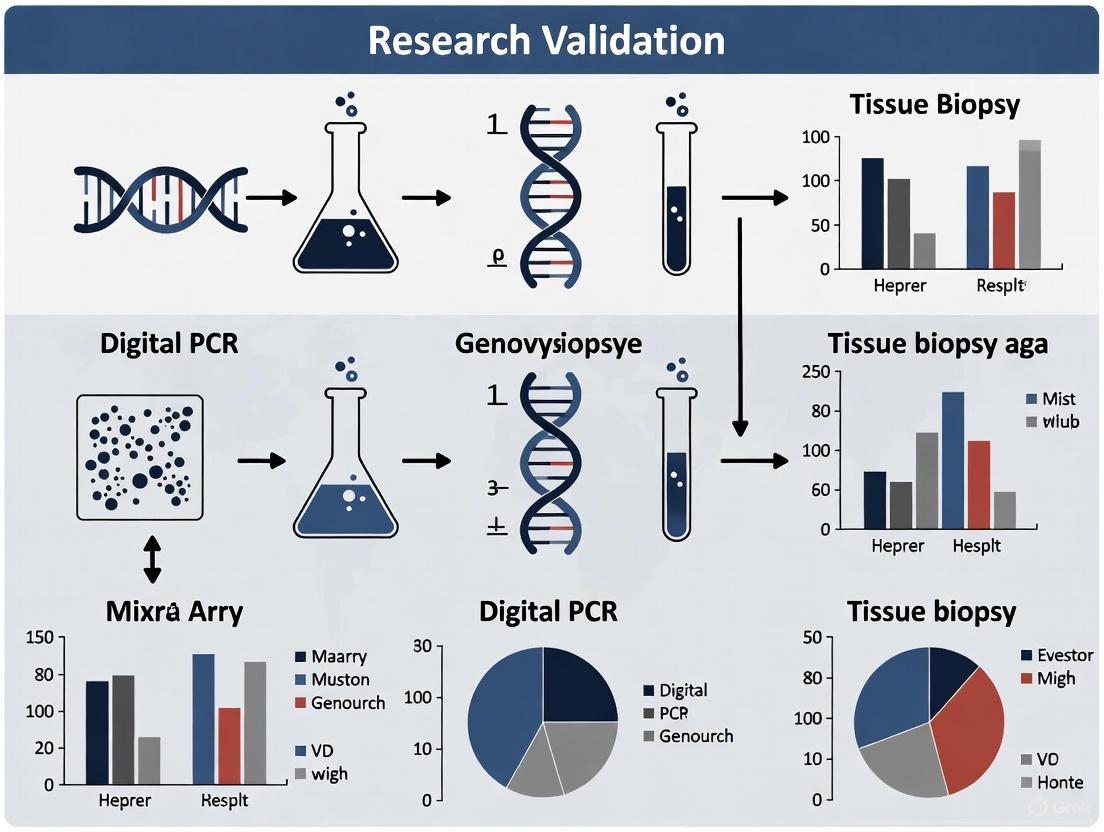
This article provides a systematic review of digital PCR (dPCR) as a robust methodology for genotyping validation against the traditional gold standard of tissue biopsy.
Digital PCR Validation Against Tissue Biopsy Genotyping: A Comprehensive Guide for Precision Oncology
Abstract
This article provides a systematic review of digital PCR (dPCR) as a robust methodology for genotyping validation against the traditional gold standard of tissue biopsy. Aimed at researchers, scientists, and drug development professionals, it explores the foundational principles of dPCR, details methodological workflows for clinical application, addresses key troubleshooting and optimization strategies, and presents a critical analysis of validation studies and performance comparisons across various cancer types. The synthesis of current evidence positions dPCR as a highly sensitive, specific, and cost-effective tool for liquid biopsy, offering significant potential to complement or supplement tissue-based genotyping in clinical trials and precision medicine.
The Rise of Digital PCR: Fundamental Principles and its Niche in Molecular Diagnostics
The advent of Polymerase Chain Reaction (PCR) revolutionized molecular biology by enabling targeted amplification of specific DNA sequences. Quantitative real-time PCR (qPCR) later emerged as a powerful technique that allowed researchers to monitor amplification as it occurred, providing relative quantification of nucleic acid targets through comparison to standard curves. However, the dependence on external calibrators and relative measurements introduced variability that limited precise quantification, particularly for low-abundance targets and subtle genetic alterations. The development of digital PCR (dPCR) represents a fundamental evolution in nucleic acid quantification—a shift from relative to absolute measurement. By combining sample partitioning, end-point amplification, and Poisson statistics, dPCR enables direct quantification of DNA or RNA molecules without standard curves, offering unparalleled precision for applications requiring detection of minute genetic variations [1].
This technological evolution holds particular significance in the context of tissue biopsy genotyping research, where accurate detection of genetic mutations directly impacts diagnostic and therapeutic decisions. As molecular diagnostics increasingly inform clinical practice, especially in oncology, the demand for technologies capable of detecting low-frequency mutations in complex biological samples has accelerated the adoption of dPCR. This guide provides an objective comparison of qPCR and dPCR performance, with supporting experimental data relevant to researchers and drug development professionals validating dPCR against traditional tissue biopsy genotyping.
Fundamental Principles: How qPCR and dPCR Work
Quantitative PCR (qPCR) Methodology
qPCR operates on the principle of monitoring PCR amplification in real-time using fluorescent detection systems. The technique relies on the quantification cycle (Cq), the point at which fluorescence crosses a predetermined threshold, which correlates with the initial amount of target DNA. In qPCR, the entire reaction proceeds as a single bulk mixture, with fluorescence measurements taken at the end of each amplification cycle during the exponential phase. The Cq values of unknown samples are compared to those of a standard curve with known concentrations to determine target quantity [2] [3]. This approach provides either relative quantification (e.g., fold-change differences) or absolute quantification when suitable standards are available. However, this dependence on external calibration curves and amplification efficiency makes the technique susceptible to inhibition and efficiency variations between samples.
Digital PCR (dPCR) Methodology
dPCR represents a fundamental departure from qPCR through its partitioning approach. The technique divides a PCR reaction into thousands to millions of separate nanoliter-sized partitions, each functioning as an individual micro-reactor. These partitions undergo conventional PCR amplification to endpoint. Following amplification, each partition is analyzed to determine if it contains the target sequence (positive) or not (negative). The absolute concentration of the target nucleic acid is then calculated using Poisson statistics based on the ratio of positive to negative partitions, according to the formula: λ = -ln(1-p), where p is the fraction of positive partitions [2] [1]. This approach eliminates the need for standard curves and provides direct absolute quantification. The partitioning also enhances tolerance to PCR inhibitors because their effect is diluted across partitions, and amplification efficiency variations have minimal impact on the binary endpoint measurement [4] [3].
Visualizing the Fundamental Workflows
The core technological differences between qPCR and dPCR are illustrated in the following workflow diagram:
Performance Comparison: Quantitative Data Analysis
Analytical Performance Metrics
Direct comparisons of qPCR and dPCR across multiple studies reveal distinct performance characteristics that inform their appropriate applications. The following table summarizes key analytical parameters derived from experimental studies:
Table 1: Performance comparison between qPCR and dPCR across key analytical parameters
| Performance Parameter | qPCR | dPCR | Experimental Context |
|---|---|---|---|
| Dynamic Range | 8 logs [5] | 6 logs [5] | gBlocks dilution series |
| Sensitivity (Limit of Detection) | 0.41% mutation frequency [6] | 0.06%-0.2% mutation frequency [6] | KRAS mutations in pancreatic cancer |
| Precision (Coefficient of Variation) | Up to 20% variation in copy number ratio [5] | <5% CV intra-assay variability [7] | CAR-T manufacturing & periodontal pathobionts |
| Tolerance to Inhibitors | Highly susceptible to RT mix contaminants [4] | Maintains quantification with inconsistent contamination [4] | Synthetic DNA with variable RT mix |
| Quantification Approach | Relative (requires standard curve) [2] [3] | Absolute (Poisson statistics) [2] [1] | Fundamental methodology |
| Multiplexing Capability | Limited by fluorescence channels | Enhanced through melting curve analysis [6] | KRAS genotyping with 7 mutations |
Application-Specific Performance
Detection of Low-Abundance Targets
dPCR demonstrates superior performance in detecting low-abundance targets, which is particularly relevant for liquid biopsy applications. In a 2023 study on KRAS genotyping for pancreatic cancer, researchers optimized dPCR with melting curve analysis to detect seven different KRAS mutations (G12D, G12R, G12V, G13D, G12A, G12C, and G12S) in circulating tumor DNA. The improved assay achieved a detection limit of <0.2% for all target mutations, a significant enhancement over the previous 0.41% limit [6]. This sensitivity is crucial for detecting minimal residual disease and early treatment response monitoring, where mutant allele frequencies often fall below 1%.
Performance in Complex Samples
The partitioned nature of dPCR confers greater resistance to PCR inhibitors commonly found in complex biological samples. In a 2017 systematic comparison, researchers evaluated both technologies using synthetic DNA samples with variable amounts of reverse transcription (RT) mix contaminants. While qPCR showed significant Cq value shifts (approximately 2 cycles) and reduced reaction efficiency (from 89.6% to 67.1%) with increasing RT mix, dPCR maintained consistent quantification across contamination levels despite some increase in intermediate droplets [4]. This robustness is particularly valuable for clinical samples that may contain variable inhibitor levels.
Precision in Absolute Quantification
dPCR provides superior precision, especially at low target concentrations. A 2025 study comparing both technologies for periodontal pathobiont detection found dPCR had significantly lower intra-assay variability (median CV: 4.5%) compared to qPCR [7]. Similarly, in CAR-T manufacturing validation, dPCR demonstrated higher correlation between genes linked in one construct (R² = 0.99 vs. R² = 0.78 for qPCR) and lower data variation [5]. This precision advantage makes dPCR particularly suitable for applications requiring exact quantification, such as vector copy number determination in gene therapy.
Experimental Protocols: Key Methodologies for Technology Comparison
Protocol 1: Direct Comparison Using Reference Materials
This protocol, adapted from multiple studies, allows for systematic comparison of qPCR and dPCR performance using controlled reference materials [4] [5]:
Reference Material Preparation: Prepare serial dilutions (at least 5 orders of magnitude) of validated reference standards such as gBlocks, synthetic oligonucleotides, or linearized plasmids in background DNA.
Reaction Mixture Formulation: Create a single master mix containing all reaction components (polymerase, dNTPs, buffers, primers, probes) and the target DNA. Split this identical mixture for both qPCR and dPCR analysis to eliminate formulation variables.
qPCR Analysis:
- Perform amplification using standard cycling conditions: initial denaturation (95°C for 2 min), followed by 40-45 cycles of denaturation (95°C for 15 s) and annealing/extension (60°C for 1 min).
- Generate standard curves from serial dilutions and calculate efficiency (90-110% acceptable) and correlation coefficient (R² > 0.98).
- Analyze Cq values and quantification outputs.
dPCR Analysis:
- For droplet-based systems: Generate droplets according to manufacturer protocols (typically 10,000-20,000 droplets per reaction).
- For nanoplate-based systems: Load samples into partitions (typically 26,000 partitions per well).
- Perform endpoint PCR amplification with similar cycling conditions to qPCR but with increased cycles (45 cycles).
- Read partitions and apply Poisson correction for absolute quantification.
Data Analysis: Compare linearity, dynamic range, sensitivity, and precision across both platforms using the same statistical framework.
Protocol 2: Mutation Detection in Complex Backgrounds
This protocol, optimized for KRAS genotyping, highlights dPCR's advantage in detecting rare mutations [6]:
Sample Preparation: Extract DNA from clinical samples (tissue, plasma, or cell-free DNA). For ctDNA, use specialized extraction kits optimized for short fragments.
Primer and Probe Design:
- Design primers to produce short amplicons (∼66 bp) compatible with fragmented DNA.
- Include mismatched bases near the 3' end to suppress pseudogene amplification.
- Use molecular beacon probes with stem-loop structures for melting curve analysis.
Multiplex dPCR with Melting Curve Analysis:
- Prepare reaction mixture with target DNA, enzymes, primers, and molecular beacons.
- Partition reactions using microfluidic chips (∼20,000 wells).
- Perform asymmetric PCR to generate single-stranded amplicons.
- Conduct melting curve analysis by capturing fluorescence images while controlling temperature (50-80°C range).
- Determine genotype based on fluorescence intensity, probe color, and melting temperature (Tm).
Data Analysis:
- Apply mutation type determination algorithms to distinguish false positives.
- Calculate mutation frequencies using Poisson statistics.
- Compare with conventional dPCR or qPCR results for validation.
Visualizing the KRAS Genotyping Workflow
The following diagram illustrates the sophisticated dPCR workflow with melting curve analysis used for KRAS genotyping:
The Scientist's Toolkit: Essential Research Reagents and Materials
Successful implementation of dPCR requires specific reagents and consumables optimized for partitioning and endpoint detection. The following table details essential components for dPCR experiments, particularly in the context of genotyping validation studies:
Table 2: Essential research reagents and materials for dPCR experiments
| Item | Function | Application Notes |
|---|---|---|
| Nanoplate dPCR Plates | Microfluidic chip with fixed partitions (∼26,000/well) | Provides consistent partitioning without oil emulsion; compatible with automated systems [7] |
| Droplet Generation Oil | Creates water-in-oil emulsion for droplet-based systems | Requires specific surfactants for droplet stability during thermal cycling [1] |
| Restriction Enzymes | Digests long DNA fragments for better partitioning | Enhances detection efficiency of genomic targets; PvuII used in periodontal study [7] |
| Molecular Beacon Probes | Stem-loop probes for melting curve analysis | Enables multiplexing beyond fluorescent channels; critical for KRAS genotyping [6] |
| Hydrolysis Probes (TaqMan) | Sequence-specific fluorescence detection | Standard for target discrimination; FAM/BHQ1 combination common [2] |
| dPCR Master Mix | Optimized polymerase, dNTPs, buffers | Formulated for endpoint detection and partition integrity |
| Reference Standard Materials | gBlocks, linearized plasmids, synthetic DNA | Essential for assay validation and limit of detection studies [5] |
| Magnetic Beads (BEAMing) | Primer-coated beads for target capture | Used in BEAMing dPCR for rare mutation detection [1] |
Applications in Genotyping Validation and Biopsy Correlation
Liquid Biopsy and Minimal Residual Disease Monitoring
dPCR has found particularly valuable application in liquid biopsy analysis, where it detects and quantifies circulating tumor DNA (ctDNA) with sensitivity required for clinical utility. In the KRAS genotyping study, researchers detected mutations in 82.3% of pancreatic cancer patients with liver or lung metastases using dPCR, demonstrating high clinical sensitivity consistent with tissue biopsy findings [6]. The ability to detect mutant allele frequencies below 0.2% enables monitoring of minimal residual disease and treatment response, providing a non-invasive alternative to repeated tissue biopsies.
Infectious Disease Quantification and Antimicrobial Resistance
The precision of dPCR has proven valuable in microbial quantification, particularly for low-abundance targets in complex backgrounds. A 2025 study on periodontal pathobionts demonstrated dPCR's superior sensitivity for detecting Porphyromonas gingivalis and Aggregatibacter actinomycetemcomitans, resulting in a 5-fold higher prevalence detection compared to qPCR [7]. This enhanced detection capability is crucial for understanding microbial dynamics in infection and antimicrobial resistance surveillance.
Cell and Gene Therapy Manufacturing
In advanced therapeutic manufacturing, dPCR provides the precision required for critical quality assessments. A 2025 study on CAR-T manufacturing found dPCR offered less variable results and a more compact array of regulatory tests compared to qPCR, improving both data robustness and documentation processes [5]. The technology's absolute quantification capability ensures accurate vector copy number determination and safety testing.
The evolution from qPCR to dPCR represents a significant advancement in nucleic acid quantification, particularly for applications requiring absolute quantification, high precision, and detection of rare variants. While qPCR remains suitable for applications with abundant targets and broad dynamic range requirements, dPCR excels in detecting low-frequency mutations, quantifying targets in inhibitor-rich environments, and providing standardized absolute measurements across laboratories.
For researchers validating dPCR against tissue biopsy genotyping, the technology offers sufficient sensitivity and precision to correlate liquid biopsy findings with traditional tissue analysis. The experimental protocols and performance data presented in this guide provide a framework for implementing dPCR in genotyping validation studies. As the technology continues to evolve with improved multiplexing, automation, and standardization, dPCR is poised to become an indispensable tool for molecular diagnostics and therapeutic monitoring, ultimately enhancing our ability to make clinical decisions based on precise genetic measurements.
Digital PCR (dPCR) represents a significant advancement in nucleic acid quantification by enabling absolute, calibration-free measurement of target DNA or RNA molecules. This guide explores its core principles and evaluates its performance against alternative methods like next-generation sequencing (NGS) within the context of validation against tissue biopsy genotyping in clinical cancer research.
Core Principles and Workflow of Digital PCR
dPCR operates on three fundamental principles: sample partitioning, end-point fluorescence analysis, and application of Poisson statistics. The technique involves dividing a PCR reaction mixture into thousands to millions of discrete partitions, so that each contains zero, one, or a few nucleic acid targets [1]. Following PCR amplification to the endpoint, each partition is analyzed as positive (fluorescent) or negative (non-fluorescent) based on the presence of the target sequence [8]. The ratio of positive to negative partitions is then used with Poisson statistics to calculate the absolute concentration of the target molecule in the original sample, without requiring a standard curve [9].
The Principle of Partitioning and Poisson Statistics
Partitioning is the foundational step that differentiates dPCR from other PCR technologies. By randomly distributing target molecules across many nanoliter-sized reactions, the method dramatically increases the signal-to-noise ratio for detecting rare mutations and enables precise quantification [1]. The random distribution of molecules means Poisson statistics must be applied to account for partitions that may contain more than one target molecule. The Poisson model determines the probability of a partition receiving multiple copies based on the formula:
P(k) = (λ^k * e^-λ) / k!
Where λ (lambda) represents the average number of targets per partition, and P(k) is the probability that a partition contains k target molecules [9]. This statistical approach allows for the calculation of the absolute target concentration from the fraction of positive partitions.
dPCR Workflow: From sample partitioning to absolute quantification.
Performance Comparison: dPCR versus Next-Generation Sequencing
Multiple studies have directly compared the performance characteristics of dPCR and NGS, particularly in clinical applications such as circulating tumor DNA (ctDNA) detection for cancer monitoring.
Detection Sensitivity and Analytical Performance
Table 1: Comparative Performance of ddPCR vs. NGS in ctDNA Detection for Rectal Cancer
| Parameter | ddPCR Performance | NGS Performance | Study Details |
|---|---|---|---|
| Detection Rate (Baseline Plasma) | 58.5% (24/41 patients) | 36.6% (15/41 patients) | Development group (n=41), p=0.00075 [10] |
| Detection Rate (Validation Group) | 80.8% (21/26 patients) | Not reported | Pre-therapy plasma samples [10] |
| Variant Allele Frequency (VAF) Sensitivity | ~0.01% [10] | >0.01% with optimized calling [10] | Tumor-informed approach |
| Association with Clinical Staging | Positive ctDNA associated with higher tumor stage and lymph node positivity [10] | Similar association observed [10] | Assessed via MRI |
| Postoperative Monitoring | Limited detection before recurrence [10] | Not specifically reported [10] | 1-year follow-up |
Operational and Economic Considerations
Table 2: Operational Characteristics Comparison
| Characteristic | ddPCR | NGS Panel Sequencing |
|---|---|---|
| Cost Factor | 5-8.5-fold lower operational costs [10] | Higher cost due to sequencing and bioinformatics |
| Assay Design | Mutation-specific probes required [10] | Broad panel coverage in single assay [10] |
| Throughput | Lower multiplexing capability | High multiplexing capacity |
| Technical Expertise | Standard molecular biology skills | Requires bioinformatics expertise |
| Turnaround Time | Potentially faster (no library prep) [1] | Longer due to library prep and sequencing |
Experimental Protocols for ctDNA Detection Validation
Tumor-Informed ctDNA Detection Using ddPCR
The following protocol is adapted from studies comparing dPCR with tissue biopsy genotyping [10]:
Sample Collection and Processing:
- Collect 3 × 9 mL of patient blood into Streck Cell Free DNA BCT vacuum tubes
- Process plasma samples through double centrifugation (800 × g for 10 minutes, then 14,000 × g for 10 minutes)
- Isolate cfDNA from 2-4 mL plasma using commercial extraction kits
- Extract and sequence tumor DNA from formalin-fixed paraffin-embedded (FFPE) tissue using NGS cancer hotspot panels
Mutation Selection and Assay Design:
- Identify somatic mutations in tumor tissue using NGS panel sequencing (e.g., Ion AmpliSeq Cancer Hotspot Panel v2)
- Select 1-2 mutations with highest variant allele frequencies for ddPCR assay design
- Design specific primers and probes (FAM/HEX) for selected mutations
ddPCR Reaction Setup:
- Prepare 20-22 μL reaction mixtures containing:
- 11 μL ddPCR Supermix for Probes
- 2-4 μL template cfDNA
- 900 nM primers
- 250 nM probes
- Generate droplets using automated droplet generators (target: 20,000 droplets per sample)
- Transfer droplets to 96-well PCR plates and seal
PCR Amplification:
- Perform thermal cycling with the following conditions:
- Enzyme activation: 95°C for 10 minutes
- 40-45 cycles of:
- Denaturation: 94°C for 30 seconds
- Annealing/Extension: 55-60°C for 60 seconds
- Enzyme deactivation: 98°C for 10 minutes
- 4°C hold
Droplet Reading and Analysis:
- Load amplified samples into droplet readers
- Count positive and negative droplets for each fluorescence channel
- Apply Poisson statistics to calculate absolute target concentration
- Report results as copies per μL or total target molecules in reaction
HPV ctDNA Detection Protocol
For applications such as HPV-associated oropharyngeal cancer detection, the following ddPCR approach has been validated [11]:
Sample Preparation:
- Collect platelet-poor plasma (PPP) samples
- Extract cfDNA using optimized protocols for viral DNA recovery
Multiplex Assay Design:
- Design primers and probes targeting 5 high-risk HPV genotypes
- Include internal control genes for sample quality assessment
ddPCR Analysis:
- Set up multiplex reactions with genotype-specific probes
- Partition samples and amplify with optimized cycling conditions
- Analyze using two-color detection systems
- Determine analytical sensitivity (7.71-19.45 HPV ctDNA fragments/mL PPP across genotypes)
Core Principles: The three foundational elements of digital PCR.
Research Reagent Solutions for dPCR Experiments
Table 3: Essential Materials and Reagents for dPCR Validation Studies
| Reagent/Equipment | Function | Example Specifications |
|---|---|---|
| ddPCR Supermix | Provides optimized buffer, enzymes, and dNTPs for droplet-based reactions | Contains DNA polymerase, dNTPs, optimized buffer; compatible with probe-based detection [8] |
| Primers and Probes | Sequence-specific amplification and detection | 900 nM primers, 250 nM hydrolysis probes (FAM/HEX labeled) [10] |
| Droplet Generator | Creates uniform water-in-oil emulsion | Generates ~20,000 droplets per sample [8] |
| Droplet Reader | Analyzes fluorescence in individual droplets | Two-color detection system; processes droplets in sequence [8] |
| cfDNA Extraction Kits | Isolves cell-free DNA from plasma | Optimized for 2-4 mL plasma input; includes carrier RNA [10] |
| NGS Hotspot Panels | Identifies tumor mutations for informed assay design | Covers 50+ oncogenes; >2800 COSMIC variants (e.g., Ion AmpliSeq Cancer Hotspot Panel v2) [10] |
| Microfluidic Cartridges | Sample partitioning platform | Compatible with 20 μL reaction volumes [1] |
| Thermal Sealers | Secures PCR plates during amplification | Prevents evaporation and cross-contamination during thermal cycling |
The validation of dPCR against traditional tissue biopsy genotyping demonstrates its robust performance in clinical oncology applications. Studies show that dPCR provides superior detection sensitivity for ctDNA compared to NGS in localized cancers, with detection rates of 58.5% versus 36.6% in baseline plasma samples [10]. The technology's ability to detect variant allele frequencies as low as 0.01% makes it particularly valuable for minimal residual disease monitoring and treatment response assessment.
While NGS offers broader genomic coverage and discovery potential, dPCR excels in scenarios requiring precise quantification of known mutations, especially when analyzing limited sample material or detecting rare variants against a high wild-type background [1]. The 5-8.5-fold lower operational costs of dPCR further enhance its practicality for routine clinical monitoring [10]. As evidenced by HPV ctDNA detection studies achieving 90.63% overall agreement with tissue biopsy results [11], dPCR represents a validated, cost-effective approach for liquid biopsy applications that complements both tissue genotyping and NGS-based approaches in cancer research and drug development.
Digital PCR (dPCR) represents a significant advancement in nucleic acid quantification by enabling absolute target measurement without the need for standard curves. This technology operates by distributing a sample across thousands to millions of individual partitions, performing PCR amplification on each partition, and using Poisson statistics to calculate the absolute concentration of the target sequence based on the ratio of positive to negative partitions [1]. The two predominant dPCR platforms available today are Droplet Digital PCR (ddPCR) and microchamber-based dPCR systems, which differ fundamentally in their partitioning mechanisms and operational workflows [12].
ddPCR utilizes microfluidic technology to emulsify the PCR reaction mixture into thousands to millions of nanoliter-sized water-in-oil droplets, effectively creating independent reaction chambers [1]. In contrast, microchamber-based systems (also referred to as chip-based or nanoplate-based dPCR) employ solid chips containing fixed arrays of microscopic wells, with partition counts typically ranging from thousands to tens of thousands depending on the specific platform [13] [12]. This fundamental difference in partitioning strategy creates distinct performance characteristics, operational considerations, and application suitability that researchers must evaluate when selecting the optimal platform for tissue biopsy genotyping validation studies.
Technical Comparison of Partitioning Mechanisms
Droplet Digital PCR (ddPCR) Partitioning
The ddPCR workflow involves creating a stable water-in-oil emulsion through microfluidic control, generating thousands to millions of monodisperse droplets [1]. This process requires specialized droplet generation equipment that precisely controls aqueous and oil phase mixing to produce droplets of consistent size (typically picoliter to nanoliter volumes). The uniformity of droplet size is critical for quantification accuracy, as volume variations can introduce measurement errors [12]. Following partitioning, the droplets undergo end-point PCR amplification in a thermal cycler, after which they are transferred to a droplet reader that measures fluorescence from each droplet individually [12]. This multi-step process, while potentially more labor-intensive, provides exceptional partition uniformity and scalability.
Microchamber-Based dPCR Partitioning
Microchamber-based systems utilize chips with predefined nanoscale wells fabricated into the substrate [1]. Platforms such as the Absolute Q system and QIAcuity employ microfluidic chamber arrays where partitioning occurs through capillary action or controlled loading mechanisms [13]. These systems typically integrate partitioning, thermal cycling, and imaging within a single instrument, reducing hands-on time and potential contamination risks [13]. The fixed architecture of these chips ensures consistent partition volumes but offers less flexibility in total partition count compared to droplet-based systems. The entire process from sample loading to results is often fully automated, streamlining workflow efficiency [13].
Comparative Partitioning Workflow
The diagram below illustrates the key procedural differences between ddPCR and microchamber-based dPCR workflows:
Performance Metrics and Experimental Data Comparison
Quantitative Performance Characteristics
Direct comparative studies provide valuable insights into the performance differences between ddPCR and microchamber-based dPCR platforms. Research comparing the QX200 ddPCR system (Bio-Rad) with the QIAcuity One nanoplate-based system (QIAGEN) demonstrated both platforms can deliver highly precise results, though with some variation depending on experimental conditions [14].
Table 1: Comparative Performance Metrics of ddPCR vs. Microchamber-Based dPCR
| Performance Parameter | Droplet Digital PCR (ddPCR) | Microchamber-Based dPCR |
|---|---|---|
| Typical Partition Count | 20,000 droplets/reaction (QX200) [15] | 26,000 chambers/chip (QIAcuity) [16] |
| Partition Volume | Nanoliter-sized droplets [12] | Fixed nanoliter chambers [13] |
| Limit of Detection (LOD) | 0.17 copies/µL input (QX200) [14] | 0.39 copies/µL input (QIAcuity) [14] |
| Limit of Quantification (LOQ) | 4.26 copies/µL input (QX200) [14] | 1.35 copies/µL input (QIAcuity) [14] |
| Precision (Coefficient of Variation) | 6-13% CV (varies with concentration) [14] | 7-11% CV (varies with concentration) [14] |
| Restriction Enzyme Impact | Higher precision with HaeIII vs. EcoRI (CV <5% with HaeIII) [14] | Minimal impact from enzyme choice (CV 1.6-14.6%) [14] |
| Multiplexing Capability | Supports multiplexed assays [12] | Demonstrated duplex assays [13] |
Precision and Reproducibility Data
Studies directly comparing platform precision have revealed condition-dependent performance characteristics. In one comprehensive evaluation using synthetic oligonucleotides and Paramecium tetraurelia DNA, ddPCR demonstrated slightly better accuracy in mid-concentration ranges, while microchamber-based dPCR showed more consistent precision across different concentrations [14]. The coefficient of variation (CV) for ddPCR ranged from 6% to 13%, compared to 7% to 11% for the nanoplate-based system across dilution series above the LOQ [14].
Notably, restriction enzyme selection significantly impacted ddPCR precision, with HaeIII digestion dramatically improving CV values compared to EcoRI (from >60% to <5% CV for some samples) [14]. Microchamber-based systems showed less sensitivity to enzyme selection, maintaining CV values between 1.6% and 14.6% regardless of enzyme choice [14]. This suggests that microchamber-based systems may offer more robust performance with suboptimal sample preparation, an important consideration for clinical samples where DNA quality may vary.
Experimental Protocols for Genotyping Validation
Duplex dPCR Assay for HIV DNA Quantification (Microchamber-Based System)
A recently published protocol utilizing the Absolute Q microchamber-based dPCR system demonstrates the application of this technology for precise nucleic acid quantification in clinical samples [13]:
Sample Preparation:
- Extract genomic DNA from peripheral blood mononuclear cells (PBMCs) or CD4+ T cells using standard silica-membrane or magnetic bead-based methods
- Quantify DNA concentration using fluorometric methods and dilute to working concentration in TE buffer or nuclease-free water
- For the duplex assay, prepare reaction mixture containing: 900 nM LTR-RU5 HIV and RPP30 primers, 250 nM LTR-RU5 HIV and RPP30 probes, 1× Absolute Q Digital PCR Master Mix, and 10-100 ng template DNA
dPCR Run Conditions:
- Load samples into microfluidic chamber array plates according to manufacturer specifications
- Perform PCR amplification with the following thermal profile: Initial denaturation at 96°C for 10 minutes; 40 cycles of denaturation at 96°C for 10 seconds, combined annealing/extension at 60°C for 50 seconds; final hold at 98°C for 10 minutes
- Fluorescence imaging and analysis using integrated instrument software
Data Analysis:
- Automatic partition identification and fluorescence thresholding using instrument software
- Absolute quantification of HIV DNA copies/10⁶ cells using Poisson statistics
- Normalize results to the reference gene (RPP30) copy number to account for cell number variations
This protocol demonstrated excellent linearity (R² = 0.977, p < 0.0001) with a lower limit of detection of 79.7 HIV DNA copies/10⁶ cells and acceptable precision (CV = 8.7-10.9% for higher concentration samples) [13].
Multiplex ddPCR for Invasive Fungal Detection
For comparison, a validated ddPCR protocol for detecting pulmonary fungal pathogens illustrates the droplet-based approach [15]:
Sample Processing:
- Collect bronchoalveolar lavage fluid (BALF) samples and centrifuge at 2,000 × g for 10 minutes
- Extract DNA using commercial extraction kits, eluting in 50 μL nuclease-free water
- For the multiplex assay, prepare reaction mixture containing: 5 μL DNA template, 10 μL ddPCR premix, detection primers, and probes for Pneumocystis, Aspergillus, and Cryptococcus targets
Droplet Generation and Amplification:
- Transfer reaction mixture to a disposable plastic chip for droplet generation
- Generate approximately 20,000 water-in-oil emulsion droplets using a microfluidic droplet generator
- Perform PCR amplification with the following protocol: 95°C for 5 minutes; 40 cycles of 95°C for 15 seconds and 60°C for 30 seconds; final hold at 4°C
Fluorescence Reading and Analysis:
- Load amplified chip into droplet reader for fluorescence signal detection
- Analyze fluorescence data using manufacturer software with automatic thresholding
- Calculate absolute copy numbers for each target using Poisson statistics
This multiplex ddPCR assay demonstrated superior sensitivity compared to qPCR, detecting Aspergillus in 11.76% of samples versus 9.41% with qPCR, and Pneumocystis in 4.71% versus 3.53% with qPCR [15].
Research Reagent Solutions for dPCR Experiments
Table 2: Essential Reagents and Materials for dPCR Experiments
| Reagent/Material | Function | Application Notes |
|---|---|---|
| Digital PCR Master Mix | Provides DNA polymerase, dNTPs, buffer, and stabilizers optimized for partition-based amplification | Platform-specific formulations recommended by manufacturers |
| Hydrolysis Probes (TaqMan) | Sequence-specific detection with fluorophore-quencher pairs | FAM, HEX/VIC, CY5 common for multiplexing; concentration typically 250-500 nM |
| Primer Sets | Target-specific amplification | Typical working concentration 500-900 nM; requires rigorous validation for specificity |
| Restriction Enzymes | Fragment genomic DNA to improve target accessibility | HaeIII may provide better precision than EcoRI in ddPCR [14] |
| DNA Extraction Kits | Nucleic acid purification from various sample types | Silica-membrane or magnetic bead-based methods; consider yield and inhibitor removal |
| Microfluidic Chips/Cartridges | Partitioning substrate | Platform-specific consumables (droplet generator chips or microchamber arrays) |
| Surfactants/Stabilizers | Maintain partition integrity during thermal cycling | Critical for droplet-based systems to prevent coalescence [1] |
| Quantification Standards | Assay validation and quality control | Synthetic oligonucleotides or reference genomic DNA with known target copy numbers |
Application in Tissue Biopsy Genotyping Validation
The selection between ddPCR and microchamber-based dPCR systems for tissue biopsy genotyping validation depends on specific research requirements. ddPCR's higher partition count provides theoretical advantages for detecting rare variants in heterogeneous samples, while microchamber-based systems offer streamlined workflows with reduced hands-on time [13] [12].
For validation studies comparing dPCR to tissue biopsy genotyping, consider the following applications:
- Liquid biopsy validation: Both platforms can detect tumor-derived DNA in circulation, with ddPCR potentially offering advantages for very rare targets (<0.1% variant allele frequency) [17]
- Minimal residual disease monitoring: The precision of microchamber-based systems at moderate copy numbers may benefit longitudinal monitoring studies [13]
- Mutation confirmation: Both platforms provide orthogonal validation for next-generation sequencing findings from tissue biopsies, with absolute quantification capabilities
Recent advancements in both technologies continue to narrow performance gaps, with improvements in partition density, multiplexing capability, and workflow efficiency enhancing their utility for comprehensive genotyping validation frameworks.
In precision oncology, accurate molecular profiling of tumors is paramount for effective treatment selection. However, two significant clinical challenges complicate this process: tumor heterogeneity and anatomically inaccessible tumor sites. Tumor heterogeneity refers to the genetic diversity observed between different regions of the same tumor (spatial heterogeneity) or within the same tumor over time (temporal heterogeneity), which can lead to incomplete molecular characterization through single-site biopsies [18]. Simultaneously, some tumors reside in locations that make tissue sampling through conventional biopsies medically risky or technically infeasible, creating diagnostic blind spots for clinicians.
Traditional tissue biopsies, while remaining the gold standard for cancer diagnosis, struggle to address these challenges comprehensively. A single biopsy may not capture the complete genomic landscape of a heterogeneous tumor and cannot be easily repeated for monitoring evolving mutations under therapeutic pressure [18]. Liquid biopsy, which involves the analysis of circulating tumor DNA (ctDNA) shed into the bloodstream, has emerged as a powerful complementary approach that can overcome these limitations by providing a more comprehensive representation of the tumor's genetic makeup [18].
Among the technologies enabling liquid biopsy, digital PCR (dPCR) has established itself as a highly sensitive and accessible method for detecting specific genetic alterations. This guide provides an objective comparison of dPCR's performance against alternative technologies, with supporting experimental data framed within the broader context of validating dPCR against tissue biopsy genotyping research.
Technology Performance Comparison
Detection Sensitivity and Limit of Detection (LoD)
The ability to detect rare mutant alleles against a background of wild-type DNA is crucial for liquid biopsy applications, especially in early-stage cancer or minimal residual disease (MRD) monitoring.
Table 1: Comparison of Detection Sensitivity and Limits of Detection
| Technology | Theoretical Limit of Detection | Typical Practical LoD | Optimal Use Case for Sensitivity |
|---|---|---|---|
| Digital PCR (dPCR) | <0.01% Variant Allele Frequency (VAF) [10] | 0.01% - 0.1% VAF [10] [19] | Targeted mutation detection with maximal sensitivity |
| Next-Generation Sequencing (NGS) | ~0.1% VAF [18] | 0.1% - 0.5% VAF (therapy selection panels) [18] | Broad, untargeted mutation discovery |
| Quantitative PCR (qPCR) | ~1% VAF | 1% - 5% VAF | High VAF mutation detection |
Supporting Experimental Data: A direct comparative study in rectal cancer demonstrated this sensitivity difference in a clinical setting. Using patient plasma samples, droplet digital PCR (ddPCR) detected ctDNA in 58.5% (24/41) of baseline plasma samples, significantly outperforming an NGS panel which detected ctDNA in only 36.6% (15/41) of the same samples (p=0.00075) [10]. This highlights dPCR's superior analytical sensitivity for detecting low-abundance ctDNA.
Quantitative Accuracy and Dynamic Range
dPCR provides absolute quantification of target DNA molecules without requiring a standard curve, a key advantage for precise measurement of ctDNA levels, which is vital for therapy monitoring.
Table 2: Comparison of Quantitative Performance and Workflow Characteristics
| Parameter | Digital PCR (dPCR) | Next-Generation Sequencing (NGS) |
|---|---|---|
| Quantification Method | Absolute quantification via Poisson statistics [1] | Relative quantification; requires calibration [18] |
| Multiplexing Capacity | Limited (typically 2-6 plex per reaction) [20] | High (dozens to hundreds of targets) [18] |
| Turnaround Time | 3 hours (MET amplification assay) [21] | 2+ days (MET amplification via FISH) [21] |
| Cost per Sample | Low for targeted detection [10] | 5–8.5-fold higher than ddPCR [10] |
| Input DNA Requirements | Can work with low input (≥60 ng for 20,000x coverage) [18] | Requires sufficient input for library prep |
Supporting Experimental Data: A study developing a dPCR assay for MET amplification in Non-Small Cell Lung Cancer (NSCLC) demonstrated exceptional quantitative performance. The assay showed a strong linear correlation (R² = 1.00) in quantifying MET copy number across a wide dynamic range, surpassing the performance of NGS for this specific application [21]. This precision is critical for distinguishing between focal MET amplification (a key resistance mechanism) and MET polysomy, a distinction that directly impacts therapy selection.
Concordance with Tissue Biopsy and Clinical Validation
The ultimate validation of any liquid biopsy method is its agreement with standard tissue genotyping.
Supporting Experimental Data:
- MET Amplification in NSCLC: A dPCR assay demonstrated 96.0% sensitivity and 96.7% specificity compared to tissue-based FISH and NGS, achieving 100% concordance with FISH in differentiating focal MET amplification from polysomy [21].
- Lung Cancer Methylation Markers: A methylation-specific ddPCR multiplex assay was validated in patient plasma, showing ctDNA-positive rates of 38.7% - 46.8% in non-metastatic disease and 70.2% - 83.0% in metastatic disease, confirming the method's ability to detect cancer-derived DNA across stages [19].
Experimental Protocols for dPCR-Based ctDNA Detection
Protocol 1: Tumor-Informed ctDNA Detection using ddPCR
This protocol, adapted from a rectal cancer study [10], uses a tumor-informed approach where mutations identified in tumor tissue are specifically targeted in plasma.
Detailed Methodology:
- Tumor DNA Sequencing: Isolate DNA from formalin-fixed paraffin-embedded (FFPE) tumor tissue. Perform targeted sequencing using a panel (e.g., Ion AmpliSeq Cancer Hotspot Panel v2) to identify somatic mutations.
- Plasma Collection and cfDNA Isolation: Collect patient blood in Streck Cell-Free DNA BCT tubes. Centrifuge to separate plasma, then extract cell-free DNA (cfDNA) using a commercial kit (e.g., QIAsymphony DSP Circulating DNA Kit).
- Assay Design: Design custom ddPCR assays (primers and TaqMan probes) for the 1-2 somatic mutations identified in the tumor tissue with the highest variant allele frequencies (VAF).
- Droplet Digital PCR:
- Prepare the PCR reaction mix containing the ddPCR supermix, cfDNA sample, and mutation-specific assays.
- Generate droplets using a droplet generator (e.g., Bio-Rad QX200 Droplet Generator), partitioning each sample into ~20,000 nanoliter-sized droplets.
- Perform PCR amplification on a thermal cycler.
- Read the droplets using a droplet reader (e.g., Bio-Rad QX200 Droplet Reader) to count the fluorescent-positive (mutant) and negative (wild-type) droplets.
- Data Analysis: Use Poisson statistics to calculate the absolute concentration of mutant and wild-type DNA fragments and determine the VAF of the mutation in the plasma.
Protocol 2: Methylation-Specific Multiplex ddPCR for Cancer Detection
This protocol, adapted from a lung cancer study [19], detects tumor-specific DNA methylation patterns, offering a universal approach not reliant on specific mutations.
Detailed Methodology:
- Marker Identification: Identify tumor-specific differentially methylated CpG sites through in-silico analysis of public methylation array data (e.g., from The Cancer Genome Atlas).
- Plasma Processing and cfDNA Extraction: Collect blood in EDTA tubes. Centrifuge within 4 hours to separate plasma. Extract cfDNA from 4 mL of plasma using a system (e.g., QIAsymphony SP with DSP Circulating DNA Kit).
- DNA Conversion: Concentrate the extracted cfDNA using a centrifugal filter unit. Perform bisulfite conversion on the DNA using a commercial kit (e.g., EZ DNA Methylation-Lightning Kit), which converts unmethylated cytosines to uracils, while methylated cytosines remain unchanged.
- Multiplex ddPCR Assay:
- Design ddPCR assays specific to the methylated sequences of the 5 target genes.
- Set up a multiplex ddPCR reaction with the bisulfite-converted DNA.
- Generate droplets, amplify with PCR, and read the droplets as in Protocol 1.
- Quality Control and Analysis:
- Include a spike-in DNA control to assess extraction efficiency.
- Use an immunoglobulin gene-specific ddPCR assay to rule out genomic DNA contamination from lymphocytes.
- Determine ctDNA positivity based on validated cut-off values for the methylation signals.
Workflow and Pathway Diagrams
dPCR Liquid Biopsy Workflow for Tumor Heterogeneity
This diagram illustrates the complete process of using dPCR to profile tumor heterogeneity non-invasively via a blood draw, from sample collection to clinical decision-making.
Addressing Tumor Heterogeneity with Liquid Biopsy
This diagram contrasts how traditional tissue biopsies and liquid biopsies capture the genomic landscape of heterogeneous tumors.
The Scientist's Toolkit: Essential Research Reagent Solutions
Successful implementation of dPCR for ctDNA analysis requires specific reagents and tools. The following table details key solutions for setting up a robust laboratory workflow.
Table 3: Essential Research Reagent Solutions for dPCR-based ctDNA Analysis
| Reagent/Material | Function | Example Products & Notes |
|---|---|---|
| Cell-Free DNA Blood Collection Tubes | Preserves blood sample integrity and prevents genomic DNA contamination from white blood cell lysis during transport and storage. | Streck Cell-Free DNA BCT tubes [10] |
| cfDNA Extraction Kits | Isolate high-quality, short-fragment cfDNA from plasma samples with high efficiency and reproducibility. | QIAsymphony DSP Circulating DNA Kit [10] [19] |
| dPCR Supermix & Assays | Provides optimized buffer, enzymes, and fluorescence chemistry for amplification in partitioned reactions. Includes primers and probes for specific targets. | Bio-Ral ddPCR Supermix; Thermo Fisher dPCR Assays; Custom TaqMan Assays [10] [19] |
| Bisulfite Conversion Kits | (For methylation analysis) Chemically converts unmethylated cytosine to uracil, allowing for the differentiation of methylated and unmethylated DNA sequences. | EZ DNA Methylation-Lightning Kit [19] |
| Droplet Generation Oil & Surfactants | Creates stable, monodisperse water-in-oil emulsions essential for ddPCR; prevents droplet coalescence during thermal cycling. | Bio-Rad Droplet Generation Oil; Stilla Technologies Naica Crystal Oil [1] |
| Quantitative Standards & Controls | Validates assay performance, determines limit of detection (LoD), and ensures inter-run reproducibility. | Seraseq Lung & Brain CNV Mix [21]; synthetic mutant DNA fragments |
Digital PCR presents a compelling solution to the persistent clinical challenges of tumor heterogeneity and inaccessible tumor sites. The experimental data and comparative analysis outlined in this guide demonstrate that dPCR offers a unique combination of high sensitivity, absolute quantification, rapid turnaround time, and cost-effectiveness for targeted mutation detection in liquid biopsies.
While NGS remains indispensable for broad genomic discovery, dPCR's validated performance in detecting specific resistance mechanisms like MET amplification [21] and its superior sensitivity in ctDNA detection compared to NGS in some clinical scenarios [10] solidifies its role in the molecular diagnostics toolkit. For researchers and drug development professionals, dPCR provides a highly precise and accessible platform for validating genomic biomarkers, monitoring treatment response, and ultimately advancing personalized cancer care. Its integration into clinical workflows enables more dynamic and comprehensive tumor genotyping, directly addressing the limitations imposed by spatial heterogeneity and difficult-to-biopsy tumor locations.
Circulating Tumor DNA (ctDNA) as a Minimally Invasive Biomarker
Circulating tumor DNA (ctDNA) analysis, often referred to as liquid biopsy, represents a transformative approach in oncology that enables the detection of tumor-derived genetic material from a simple blood draw. This minimally invasive technique provides real-time genomic snapshots of heterogeneous tumors, capturing information from both primary and metastatic lesions [18]. ctDNA consists of fragmented DNA shed into the bloodstream through apoptosis or necrosis of tumor cells, typically comprising 0.01% to <10% of total cell-free DNA (cfDNA) in cancer patients [10] [22]. The half-life of ctDNA is approximately 2 hours, allowing it to dynamically reflect real-time tumor burden and treatment response [23]. As tumors are sometimes hard to detect early, and tissue biopsies are difficult to collect and invasive, liquid biopsies provide a promising role in early screening and continuous monitoring of tumor progression [22].
The clinical implementation of ctDNA analysis has demonstrated significant utility across multiple malignancies, including non-small cell lung cancer (NSCLC), colorectal cancer, breast cancer, and lymphomas [18] [24]. In NSCLC, ctDNA-based mutation detection has achieved guideline inclusion as a standard diagnostic modality for identifying actionable alterations in genes such as EGFR, KRAS, and MET, facilitating timely therapeutic intervention while circumventing the morbidity and temporal constraints associated with invasive tissue sampling [18]. The field has evolved through several technological generations, with current methods focusing on improving sensitivity, specificity, and the range of detectable alterations to better inform clinical decision-making in precision oncology.
Technology Performance Comparison
The analytical and clinical performance of ctDNA detection technologies varies significantly across platforms, with key trade-offs between sensitivity, multiplexing capability, and practical implementation factors. The following comparison examines the major technological approaches currently employed in clinical and research settings.
Table 1: Comparison of Major ctDNA Detection Technologies
| Technology | Detection Sensitivity | Variant Types Detected | Multiplexing Capacity | Turnaround Time | Key Applications |
|---|---|---|---|---|---|
| ddPCR | 0.01% VAF [10] | Known SNVs | Low (1-5 mutations) | 1-2 days | Treatment monitoring, MRD detection [10] |
| NGS Panels | 0.1-0.5% VAF [18] [25] | SNVs, Indels, CNVs, Fusions, MSI | High (dozens to hundreds of genes) | 7-21 days [26] [27] | Comprehensive genomic profiling, therapy selection |
| Combined ctDNA/ctRNA | 0.15% VAF (SNVs) [25] | SNVs, Indels, CNVs, Fusions (via RNA) | High (DNA + RNA targets) | 9.7 days (mean) [26] | Gene rearrangement detection, expanded biomarker access |
Table 2: Clinical Detection Performance Across Technologies in Recent Studies
| Study Context | Technology | Detection Rate | Comparison Benchmark | Key Findings |
|---|---|---|---|---|
| Metastatic NSCLC [26] | LHM ctDNA (NGS) | 48.2% | Tissue NGS (59.6%) | 11.4% fewer biomarker-positive patients vs tissue |
| Metastatic NSCLC [26] | Guardant360 CDx | Similar to LHM ctDNA | Tissue NGS | Non-inferiority established between liquid biopsies |
| Localized Rectal Cancer [10] [28] | ddPCR | 58.5% (24/41) | Tumor tissue mutations | Significantly higher detection vs NGS (p=0.00075) |
| Localized Rectal Cancer [10] [28] | NGS Panel | 36.6% (15/41) | Tumor tissue mutations | Lower detection rate vs ddPCR |
| Advanced Cancers [27] | 33-gene ctDNA Panel | 65.0% (Tier I/II variants) | Matched tissue | 76% sensitivity for Tier I variants; 21-day faster TAT |
Digital droplet PCR (ddPCR) demonstrates superior sensitivity for detecting specific known mutations at very low variant allele frequencies (0.01%), making it particularly valuable for monitoring minimal residual disease (MRD) and tracking known mutations during treatment [10]. However, its limited multiplexing capacity restricts its utility in comprehensive genomic profiling. Next-generation sequencing (NGS) panels offer broader genomic coverage, capable of detecting various alteration types across dozens to hundreds of genes simultaneously, albeit with generally lower sensitivity (typically 0.1-0.5% VAF) [18] [25]. The operational costs of ctDNA detection with ddPCR are reported to be 5-8.5-fold lower than NGS, though custom probes for rare mutations may not be practical due to high costs [10].
Emerging approaches that combine ctDNA with circulating tumor RNA (ctRNA) analysis show promise for improving detection of gene rearrangements. The LiquidHALLMARK assay demonstrated that the addition of ctRNA increased the diagnostic yield of tissue NGS-confirmed gene rearrangements by 28.6% relative to ctDNA alone and all actionable biomarkers by 15.6% relative to Guardant360 CDx [26]. Recent advancements in NGS assay sensitivity are also addressing historical limitations, with newer assays like Northstar Select demonstrating a 95% limit of detection of 0.15% VAF for SNVs/indels, identifying 51% more pathogenic SNVs/indels and 109% more CNVs compared to on-market CGP assays [25].
Experimental Protocols and Methodologies
Sample Collection and Processing
Proper sample collection and processing are critical for reliable ctDNA analysis. For most clinical applications, blood samples are collected in specialized tubes designed to stabilize cell-free DNA, such as Streck Cell Free DNA BCT tubes [10]. Typically, 3 × 9 mL of blood is collected per patient, from which plasma is separated through centrifugation protocols within specified timeframes to prevent genomic DNA contamination from white blood cell lysis [10]. Cell-free DNA is then extracted from plasma using commercial kits optimized for short DNA fragments, with quality control measures including fluorometric quantification and fragment analysis to ensure DNA integrity and sufficient yield for downstream applications [18] [10].
The quantity of input DNA represents a critical limiting factor for ctDNA assay sensitivity. The absolute number of mutant DNA fragments in a sample constrains detection capability; for example, a 10 mL blood draw from a lung cancer patient might yield only ~8000 haploid genome equivalents (GEs), and with a ctDNA fraction of 0.1%, this provides a mere eight mutant GEs for the entire analysis, making detection statistically improbable [18]. This fundamental limitation underscores the importance of adequate blood volume collection and efficient extraction protocols, particularly for low-shedding tumors.
ddPCR Workflow for Mutation Detection
Droplet digital PCR represents a highly sensitive approach for detecting specific known mutations in ctDNA. The workflow typically involves several key steps:
Assay Design: Predesigned or custom probes are developed based on known mutations identified through prior tumor tissue testing or common hotspot mutations in the cancer type.
Sample Partitioning: Each reaction divides 2-9 μL of extracted cfDNA into approximately 20,000 nanodroplets, creating individual reaction chambers.
Endpoint PCR Amplification: PCR amplification occurs within each droplet, with fluorescence signals indicating the presence of mutant or wild-type sequences.
Droplet Reading and Quantification: A droplet reader counts the positive and negative droplets, enabling absolute quantification of the mutant allele fraction based on Poisson statistics [10].
The ddPCR approach allows for detection of somatic alterations at very low frequencies (VAF 0.01%) by effectively concentrating rare mutant molecules and separately amplifying them in thousands of individual partitions, thereby overcoming the limitations of background wild-type DNA [10]. This method is particularly valuable for tracking known mutations during treatment and for MRD assessment where high sensitivity for specific alterations is prioritized over comprehensive genomic profiling.
NGS-Based Comprehensive Genomic Profiling
Next-generation sequencing approaches for ctDNA analysis enable broader genomic assessment across multiple genes and alteration types. The general workflow includes:
Library Preparation: Cell-free DNA undergoes end-repair, adapter ligation, and amplification using kits optimized for low-input and fragmented DNA. Unique molecular identifiers (UMIs) are incorporated during this stage to tag original DNA molecules, facilitating bioinformatic error correction.
Target Enrichment: Either hybrid capture-based or amplicon-based approaches are used to enrich for genomic regions of interest. Panel sizes vary from focused gene hotspots to comprehensive几百gene panels.
Sequencing: High-throughput sequencing is performed at sufficient depth to detect low-frequency variants, with typical coverages ranging from 2,000× to 20,000× after deduplication.
Bioinformatic Analysis: Sequencing data undergoes alignment, UMI-based deduplication, variant calling, and annotation using specialized pipelines designed to distinguish true somatic variants from sequencing artifacts and background noise [18].
The analytical sensitivity of NGS-based ctDNA detection is fundamentally linked to sequencing depth and input DNA quantity. For a variant to be reliably detected, it must be supported by multiple unique reads (typically ≥3 for ctDNA analysis versus ≥5 for tissue samples) [18]. The relationship between sequencing depth and detection probability follows binomial distribution principles, with deeper coverage required for lower VAFs—approximately 10,000× coverage is needed for 99% detection probability at 0.1% VAF [18]. This requirement for ultra-deep sequencing presents economic and technical challenges for widespread clinical implementation.
Diagram 1: Experimental Workflow Comparison between ddPCR and NGS ctDNA Analysis. The workflow begins with blood collection and plasma separation, followed by cfDNA extraction, then diverges into technology-specific pathways for either targeted mutation detection (ddPCR) or comprehensive genomic profiling (NGS).
Clinical Validation Against Tissue Biopsy
Tissue biopsy remains the gold standard for molecular analysis in oncology, making validation against tissue-based genotyping essential for establishing clinical utility of ctDNA assays [18] [22]. Recent prospective studies have provided robust evidence regarding the performance characteristics of various ctDNA technologies compared to tissue testing.
Table 3: Validation Metrics of ctDNA Assays Versus Tissue Biopsy
| Validation Parameter | LHM ctDNA [26] | 33-gene ctDNA Panel [27] | Combined ctDNA/ctRNA [26] |
|---|---|---|---|
| Sensitivity for Biomarkers | 48.2% detection rate vs 59.6% for tissue | 76% for Tier I variants | 51/68 (75%) vs 45/68 (66.2%) for G360 ctDNA |
| Concordance Rate | 72.1% with tissue NGS | Not specified | Superior to ctDNA-only (p=0.001) |
| Turnaround Time | 9.7 days (mean) | 21 days faster than tissue | Similar to ctDNA component |
| Additional Biomarkers | N/A | 19% patients had unique actionable variants in ctDNA | 28.6% increase in gene rearrangements vs ctDNA alone |
The LIQUIK prospective multicenter study demonstrated that LHM ctDNA detected 11.4% fewer biomarker-positive patients than tissue NGS (48.2% vs 59.6%) and did not meet noninferiority criteria compared to tissue, though it did establish noninferiority to another liquid biopsy (Guardant360 CDx) [26]. This highlights a persistent sensitivity gap between liquid and tissue biopsies that technological improvements are gradually addressing. Importantly, treatment outcomes based on liquid biopsy were comparable to those based on tissue NGS, with similar overall response rates and progression-free survival in patients receiving targeted therapy guided by either approach [26].
The integration of circulating tumor RNA (ctRNA) with ctDNA analysis shows promise for closing the sensitivity gap for certain alteration types. In the LIQUIK study, the addition of ctRNA increased the diagnostic yield of tissue NGS-confirmed gene rearrangements by 28.6% relative to ctDNA alone and all actionable biomarkers by 15.6% relative to Guardant360 CDx [26]. The combined ctDNA/ctRNA approach detected 8.8% more biomarker-positive patients than ctDNA-only liquid biopsy (51/68 vs 45/68), demonstrating statistical superiority (p=0.001) [26].
Turnaround time represents a significant practical advantage for liquid biopsy, with multiple studies reporting substantially faster results compared to tissue testing. The mean turnaround time for LHM ctDNA was 9.7 days versus 21.7 days for tissue NGS (p<0.001) [26], while another study reported ctDNA results preceding tissue results by an average of 21 days [27]. This time-saving capacity is particularly valuable for aggressive cancers where rapid identification of actionable mutations may enable prompt initiation of targeted therapies, potentially improving survival outcomes [18].
Research Reagent Solutions
Successful ctDNA analysis requires specialized reagents and materials optimized for the unique challenges of working with low-abundance, fragmented tumor DNA in blood. The following table outlines essential research reagents and their applications in ctDNA workflows.
Table 4: Essential Research Reagents for ctDNA Analysis
| Reagent Category | Specific Examples | Function & Importance | Technical Considerations |
|---|---|---|---|
| Blood Collection Tubes | Streck Cell-Free DNA BCT Tubes [10] | Preserves cfDNA integrity, prevents white blood cell lysis | Critical for sample stability during transport; requires proper filling and mixing |
| DNA Extraction Kits | QIAamp Circulating Nucleic Acid Kit, other cfDNA-specific kits | Isolation of short-fragment cfDNA from plasma | Yield and purity affect downstream sensitivity; optimized for <200bp fragments |
| Unique Molecular Identifiers | Custom UMI sequences [18] | Tags original DNA molecules to enable bioinformatic error correction | Essential for distinguishing true variants from PCR/sequencing errors |
| ddPCR Mutation Assays | Bio-Rad ddPCR Mutation Assays [10] | Target-specific probes for known mutations | Require prior knowledge of mutations; optimal for tracking specific variants |
| NGS Library Prep Kits | Ion AmpliSeq panels, hybrid capture kits [10] [25] | Prepare cfDNA for sequencing with minimal bias | Input requirements, capture efficiency, and complexity affect sensitivity |
| Target Enrichment Panels | Cancer Hotspot Panels, Comprehensive Gene Panels [10] [25] | Enrich disease-relevant genomic regions | Design impacts clinical utility; should include guideline-recommended biomarkers |
The selection of appropriate blood collection tubes represents a critical first step in the preanalytical phase, as these specialized tubes prevent the release of genomic DNA from white blood cells that would dilute the already scarce ctDNA fraction [10]. For DNA extraction, methods optimized for the short fragment length of cfDNA (typically 160-180 bp) are essential for maximizing yield, as conventional extraction protocols developed for high-molecular-weight genomic DNA may recover cfDNA inefficiently [18].
Unique molecular identifiers (UMIs) have become increasingly important for ctDNA NGS applications, as these short random sequences added to each original DNA molecule during library preparation enable bioinformatic discrimination of true somatic mutations from PCR amplification errors and sequencing artifacts [18]. The implementation of UMI-based error correction has been shown to significantly improve the signal-to-noise ratio in ctDNA detection, particularly for variants at very low allele frequencies [18]. However, UMI-based deduplication is technically challenging with no universally accepted methodology and typically requires skilled bioinformaticians for optimal implementation [18].
For NGS-based approaches, the choice of target enrichment strategy (amplicon-based vs. hybrid capture) and panel design significantly impacts performance characteristics. Amplicon-based approaches generally require less input DNA and sequencing depth but may struggle with uniformity and artifact formation, while hybrid capture methods offer more flexible panel design and better performance for copy number alterations and fusions but typically require higher input amounts and deeper sequencing [26] [25].
Diagram 2: Logical Workflow of ctDNA Analysis from Sample to Result. The process flows through three major phases: pre-analytical (sample collection and processing), analytical (laboratory testing), and post-analytical (data analysis and reporting), with multiple critical steps at each stage that influence final data quality.
The evolving landscape of ctDNA analysis technologies presents researchers and clinicians with multiple options, each with distinct advantages and limitations for specific applications. Digital PCR offers exceptional sensitivity for tracking known mutations but lacks the multiplexing capability needed for comprehensive genomic profiling. Next-generation sequencing panels provide broad genomic coverage with gradually improving sensitivity, while emerging approaches that combine ctDNA with ctRNA show promise for enhanced detection of gene rearrangements.
Validation studies consistently demonstrate that while ctDNA assays have not yet reached parity with tissue biopsy for overall biomarker detection rates, they provide clinically actionable information with significantly faster turnaround times. The complementary use of both tissue and liquid biopsies can maximize the detection of actionable alterations, with studies showing that concurrent ctDNA and tissue testing increases the identification of actionable variants by 14.3-15.6% compared to tissue testing alone [26] [27].
As technological advancements continue to address current limitations in sensitivity, standardization, and cost, ctDNA analysis is poised to play an increasingly important role in precision oncology, from initial diagnosis through treatment monitoring and recurrence detection. The ongoing refinement of these minimally invasive biomarkers represents a significant advancement in our ability to understand and combat cancer through real-time molecular assessment.
Implementing dPCR Assays: From Workflow Design to Clinical Application
Digital PCR (dPCR) represents a transformative advancement in nucleic acid quantification, enabling absolute target measurement without the need for standard curves. This technology operates by partitioning a PCR reaction into thousands to millions of individual reactions, allowing for the precise quantification of target sequences based on Poisson statistics applied to the count of positive and negative partitions [1]. The exceptional sensitivity and precision of dPCR make it particularly valuable for applications requiring the detection of rare genetic events, including somatic mutations in cancer, aberrant methylation patterns, and copy number variations (CNVs) in complex genomic regions [29] [30]. As molecular diagnostics increasingly inform clinical decision-making, particularly in oncology, the validation of dPCR against the historical gold standard of tissue biopsy has become a critical research focus. This guide provides a comprehensive performance comparison of dPCR across three key application areas—mutation detection, methylation analysis, and CNV determination—synthesizing experimental data and methodologies to inform researchers, scientists, and drug development professionals.
Performance Comparison of dPCR Platforms and Competing Technologies
Mutation Detection: dPCR vs. Next-Generation Sequencing
The detection of low-frequency mutations, such as those found in circulating tumor DNA (ctDNA), demands exceptionally high sensitivity. In a direct comparison for detecting ctDNA in localized rectal cancer, droplet digital PCR (ddPCR) demonstrated significantly higher detection rates than a next-generation sequencing (NGS) panel. In a development cohort, ddPCR detected ctDNA in 58.5% (24/41) of baseline plasma samples, compared to only 36.6% (15/41) detected by the NGS panel (p = 0.00075) [10] [28]. This performance advantage is attributed to dPCR's ability to detect mutant alleles with a variant allele frequency (VAF) as low as 0.01%, a threshold that challenges many NGS methods without extensive sequencing depth [10].
Table 1: Comparison of ddPCR and NGS for ctDNA Detection in Rectal Cancer
| Metric | ddPCR | NGS Panel | Significance |
|---|---|---|---|
| Detection Rate (Development Group) | 58.5% (24/41) | 36.6% (15/41) | p = 0.00075 |
| Detection Rate (Validation Group) | 80.8% (21/26) | Not Reported | - |
| Typical Limit of Detection (VAF) | ~0.01% | Varies; generally higher than ddPCR | - |
| Cost Consideration | 5–8.5-fold lower than NGS [10] | Higher | - |
Beyond plasma, dPCR has proven effective in detecting mutations from minimal tissue samples. A "water-burst" method, which uses osmotic shock to release DNA from fine-needle aspirates without purification, enabled direct dPCR detection of KRAS mutations in pancreatic ductal carcinomas. This protocol achieved a positive mutation call in 9 of 10 oncogenic KRAS pancreatic tumor samples, detecting mutant allele frequencies as low as 0.8% with a total turnaround time of approximately 2.5 hours [31].
Methylation Analysis: Nanoplate-based vs. Droplet-based dPCR
DNA methylation is a key epigenetic marker, and its accurate quantification is crucial for cancer diagnostics. A recent comparative study of two major dPCR platforms for analyzing CDH13 gene methylation in 141 breast cancer FFPE samples revealed that both technologies perform with high accuracy and strong correlation.
Table 2: Platform Comparison for CDH13 Methylation Analysis in FFPE Samples
| Performance Metric | QIAcuity (Nanoplate-based) | QX-200 (Droplet-based) |
|---|---|---|
| Specificity | 99.62% | 100% |
| Sensitivity | 99.08% | 98.03% |
| Correlation between Platforms | r = 0.954 | r = 0.954 |
| Number of Partitions Analyzed | ~8,500 per well | ~20,000 per sample |
The study concluded that the primary differentiators for selecting a platform are not sensitivity or specificity, but practical factors such as workflow time and complexity, instrument requirements, and the possibility for temperature gradient or reanalysis [29]. Both systems successfully overcame the challenges of analyzing fragmented DNA from FFPE tissues, establishing dPCR as a robust tool for methylation-based biomarker studies.
CNV Determination: dPCR vs. Quantitative PCR (qPCR)
In pharmacogenomics, accurately determining gene copy number is essential for predicting drug response. dPCR offers several distinct advantages over the more traditional qPCR for CNV analysis of complex loci like CYP2D6 [30]:
- Absolute Quantification: dPCR provides copy number values without requiring standard curves, reducing inter-run variability.
- Precision and Robustness: Partitioning the reaction minimizes the impact of PCR inhibitors and increases resistance to variations in amplification efficiency.
- Resolution of High Copy Numbers: qPCR often reports higher copies as "≥3," whereas dPCR can reliably distinguish up to 6 gene copies [30].
- Multiplexing Capability: dPCR allows for optical multiplexing of multiple target regions in a single reaction, which is crucial for identifying complex structural variants like CYP2D6 hybrid genes [30].
A validation study for CYP2D6 CNV testing on the Absolute Q dPCR platform demonstrated consistent results across different DNA sample types (blood, saliva, liver tissue) and a range of copy numbers (0–6), confirming its reliability for clinical pharmacogenetic testing [30].
Experimental Protocols for Key Applications
- Sample Collection: Collect 3 × 9 mL of patient blood into Streck Cell Free DNA BCT tubes before initiation of neoadjuvant therapy.
- cfDNA Extraction: Isolate cell-free DNA from plasma using a validated kit (e.g., QIAamp circulating nucleic acid kit).
- Assay Design: Design custom ddPCR assays based on the top 1-2 somatic mutations (e.g., in KRAS, BRAF, APC) identified in the patient's tumor tissue via prior NGS profiling.
- Droplet Generation & PCR: Incorporate the extracted cfDNA into a ddPCR reaction mixture and generate approximately 20,000 droplets using a droplet generator (e.g., Bio-Rad QX200).
- Endpoint PCR Amplification: Perform PCR amplification on the droplet emulsion.
- Droplet Reading & Analysis: Read the droplets on a droplet reader to quantify the absolute number of mutant and wild-type DNA molecules. Apply Poisson statistics to determine the original concentration of ctDNA in the sample. A sample is considered ctDNA-positive if any oncogenic mutation is detected above the platform's limit of detection (0.01% VAF).
- DNA Isolation & Modification: Isolate genomic DNA from FFPE tissue sections using a kit (e.g., DNeasy Blood and Tissue Kit). Subject 1 µg of DNA to bisulfite conversion using a commercial kit (e.g., EpiTect Bisulfite Kit).
- Assay Design: Design a methylation-specific assay with two fluorescent probes: one specific for the methylated allele (FAM-labeled) and one for the unmethylated allele (HEX-labeled), paired with a single set of primers.
- dPCR Setup:
- For nanoplate-based systems (QIAcuity): Prepare a 12 µL reaction containing 3 µL of 4x Probe PCR Master Mix, primers, probes, and 2.5 µL of bisulfite-converted DNA. Load into a 24-well nanoplate.
- For droplet-based systems (QX200): Prepare a 20 µL reaction containing 10 µL of Supermix for Probes, primers, probes, and 2.5 µL of DNA. Generate droplets.
- PCR Amplification: Run the following thermocycling protocol: initial activation at 95°C for 2 min; 40 cycles of denaturation at 95°C for 15 s and a combined annealing/extension at 57°C for 1 min.
- Data Analysis: The methylation level is calculated as the ratio of FAM-positive partitions to the total number of positive (FAM + HEX) partitions.
- Assay Design: Design and multiplex TaqMan copy number assays targeting multiple regions of the CYP2D6 gene (e.g., 5'UTR, intron 6, exon 9) and a reference gene (e.g., TERT or RNaseP) using different fluorescent channels.
- Sample Digestion ("One-pot" Method): Directly incorporate a restriction enzyme into the dPCR reaction mixture alongside the master mix and assays to streamline the workflow, bypassing a separate pre-digestion step.
- dPCR Run: Load the reaction mixture onto the dPCR platform (e.g., Absolute Q MAP16 plate or QX200 droplet generator) and perform amplification.
- Copy Number Calculation: The platform's software automatically calculates the copy number by comparing the concentration (copies/µL) of the CYP2D6 target to the concentration of the reference gene, then multiplying this ratio by 2 (the expected copy number of the reference gene).
Visualizing Experimental Workflows
The following diagrams illustrate the core workflows for the key dPCR applications discussed in this guide.
dPCR Workflow for Mutation Detection
dPCR Methylation Analysis Process
The Scientist's Toolkit: Essential Research Reagents
Table 3: Key Reagents and Materials for dPCR Assay Development
| Item | Function/Description | Example Use Case |
|---|---|---|
| Cell-Free DNA BCT Tubes (e.g., Streck) | Preserves blood samples and prevents white blood cell lysis, stabilizing nucleated blood cells. | Collection of blood for ctDNA analysis [10]. |
| Nucleic Acid Extraction Kits (e.g., QIAamp Circulating Nucleic Acid Kit) | Isolation of high-quality, inhibitor-free cfDNA or genomic DNA from various sample types. | Extraction of ctDNA from plasma or gDNA from FFPE tissues [32] [29]. |
| Bisulfite Conversion Kits (e.g., EpiTect Bisulfite Kit) | Chemically converts unmethylated cytosines to uracils, allowing for discrimination from methylated cytosines. | Preparation of DNA for methylation-specific dPCR assays [29]. |
| TaqMan Assay Chemistry | Fluorogenic probes and primers for specific target detection. Hydrolysis probes release a fluorescent signal upon amplification. | Custom assay design for mutation, methylation, or CNV detection [29] [30]. |
| dPCR Supermix/Master Mix | Optimized buffer containing DNA polymerase, dNTPs, and stabilizers for efficient amplification in partitioned reactions. | Core component of all dPCR reaction mixtures [29] [30]. |
| Restriction Enzymes | Enzymes that cleave DNA at specific recognition sites to fragment large genomic DNA for better partitioning. | Used in CNV analysis (e.g., CYP2D6) to improve assay efficiency [30]. |
Digital PCR has firmly established itself as a powerful and versatile technology for precise molecular diagnostics, demonstrating validated performance against tissue biopsy genotyping across multiple application domains. The experimental data confirms that dPCR, particularly in its droplet-based format, offers superior sensitivity for ctDNA mutation detection compared to NGS, making it a cost-effective tool for liquid biopsy applications [10] [28]. For methylation analysis, both nanoplate and droplet dPCR platforms deliver highly correlated and reliable results, with the choice between them hinging on laboratory workflow preferences rather than performance concerns [29]. In the realm of CNV analysis, dPCR outperforms qPCR in accuracy, precision, and the ability to resolve complex genetic structures, solidifying its role in advanced pharmacogenomic testing [30]. As the field progresses, the integration of dPCR into clinical trial frameworks and routine diagnostic pathways promises to enhance our ability to non-invasively monitor disease progression and tailor therapies with unprecedented precision.
The analysis of circulating cell-free DNA (cfDNA) has emerged as a cornerstone of liquid biopsy applications in oncology, offering a minimally invasive method for cancer detection, monitoring, and treatment selection [33]. The reliability of any downstream molecular analysis, including digital PCR (dPCR) validation against tissue genotyping, is fundamentally dependent on the pre-analytical phase of sample processing. This phase encompasses plasma collection, cfDNA extraction, and bisulfite conversion, each of which can significantly impact DNA yield, quality, and subsequent analytical sensitivity [33] [34].
Optimizing these initial steps is particularly critical for detecting circulating tumor DNA (ctDNA), which often represents only a small fraction of total cfDNA in patients with early-stage disease or low tumor burden [33]. This guide provides a comprehensive, data-driven comparison of commercial methodologies for each step of the sample processing workflow, equipping researchers with the evidence needed to select optimal protocols for robust dPCR-based liquid biopsy analyses.
Plasma Collection and cfDNA Isolation
The initial blood draw and plasma processing steps set the foundation for all subsequent analyses. Proper collection and timely processing are essential to prevent genomic DNA contamination from leukocyte lysis and to preserve the integrity of the fragile cfDNA molecules.
Comparative Performance of cfDNA Isolation Kits
The selection of an appropriate cfDNA isolation kit is a critical determinant of the yield and quality of the extracted nucleic acids. Table 1 summarizes the performance characteristics of three commercially available cfDNA isolation kits based on a systematic evaluation [33].
Table 1: Performance Comparison of cfDNA Isolation Kits
| Kit Name | Average cfDNA Yield (from 1 mL plasma) | Fragment Size Profile (Average Peak) | Key Performance Notes |
|---|---|---|---|
| QIAamp Circulating Nucleic Acid Kit (CNA) | 13.9 ng (plasma only) to 17.6 ng (with spike-in) | 165-170 bp | Highest yield; considered a "gold standard" in multiple studies. |
| QIAamp MinElute ccfDNA Mini Kit | 5.0 ng to 9.8 ng | 174-177 bp | Lower yield than CNA kit. |
| Maxwell RSC ccfDNA Plasma Kit | 5.2 ng to 7.8 ng | 174-177 bp | Lower yield than CNA kit; automated platform. |
The data demonstrate that the QIAamp Circulating Nucleic Acid Kit (CNA) yielded approximately twice the amount of cfDNA compared to the other two kits tested, although the extracted cfDNA had a slightly smaller average fragment size [33]. This higher yield is a significant advantage when working with limited sample volumes or low-concentration samples.
Bisulfite Conversion for Methylation Analysis
For detection of DNA methylation biomarkers—a promising approach in cancer diagnostics—cfDNA must undergo a pre-treatment step to distinguish methylated from unmethylated cytosines. Bisulfite conversion is the current gold-standard method, but it is known to cause DNA fragmentation and loss, which is particularly challenging for scarce cfDNA samples [33] [34].
Comparison of Bisulfite Conversion Kits
Five commercial bisulfite conversion kits were systematically evaluated based on DNA yield and recovery after conversion. Table 2 summarizes the key findings [33].
Table 2: Performance Comparison of Bisulfite Conversion Kits
| Bisulfite Conversion Kit | Relative DNA Yield | Average DNA Recovery | Performance Summary |
|---|---|---|---|
| EpiTect Plus DNA Bisulfite Kit | Highest | 10-20% (for inputs ≥ 2 ng) | Best overall performance in terms of yield and recovery. |
| Premium Bisulfite Kit | High | 10-20% (for inputs ≥ 2 ng) | Good performance, closely following the EpiTect kit. |
| EZ DNA Methylation-Direct Kit | Moderate | Not Specified | Performance was slightly better at higher input amounts. |
| EpiJET Bisulfite Conversion Kit | Low | Not Specified | Lower performance across tested input amounts. |
| Imprint DNA Modification Kit | Lowest | < 10% | Lowest yield and recovery. |
The EpiTect Plus DNA Bisulfite Kit consistently demonstrated the highest DNA yield and recovery across a range of input amounts, making it a robust choice for converting low-input cfDNA samples [33].
Bisulfite vs. Enzymatic Conversion
Enzymatic conversion represents a newer, gentler alternative to traditional bisulfite treatment. A comparative study evaluated the performance of enzymatic conversion (using the NEBNext Enzymatic Methyl-seq Kit) against the leading bisulfite method (EpiTect Plus DNA Bisulfite Kit) [34].
Table 3: Bisulfite vs. Enzymatic Conversion for cfDNA
| Conversion Method | Conversion Efficiency | DNA Recovery | Fragment Length | Best Suited For |
|---|---|---|---|---|
| Bisulfite (EpiTect Plus) | ~100% | 61-81% | Shorter fragments post-conversion | ddPCR applications, due to higher recovery. |
| Enzymatic (NEBNext) | 97.1% - 99.9% | 5-47% | Longer DNA fragments | Sequencing applications, where longer fragments are beneficial. |
While both methods achieved high conversion efficiencies, bisulfite conversion provided significantly higher DNA recovery. This resulted in a greater number of positive droplets in subsequent ddPCR assays, underscoring its advantage for sensitive detection of DNA methylation biomarkers in cfDNA using digital PCR [34].
Integrated Workflow and Experimental Protocols
Optimal Combined Workflow for Methylation-specific ddPCR
Based on the comparative data, an optimal end-to-end workflow can be constructed for processing plasma samples for methylation-based ctDNA detection using ddPCR. The recommended combination is the QIAamp Circulating Nucleic Acid Kit for isolation followed by the EpiTect Plus DNA Bisulfite Kit for conversion [33]. This combination was empirically shown to produce the highest yield of bisulfite-converted cfDNA from plasma.
Diagram 1: Optimal sample processing workflow for methylation analysis.
Detailed Experimental Protocol: Isolation and Conversion
Protocol 1: cfDNA Extraction using QIAamp Circulating Nucleic Acid Kit [33]
- Plasma Preparation: Centrifuge whole blood collected in Streck Cell-Free DNA BCT tubes at 2,000 × g for 10 minutes to separate plasma.
- Sample Input: Use 1-4 mL of plasma as starting material.
- Lysis: Mix plasma with proprietary lysis buffer and Proteinase K. Incubate to digest proteins.
- Binding: Bind cfDNA to the kit's silica membrane in a column format under specific buffer conditions.
- Washing: Perform multiple wash steps using provided wash buffers to remove contaminants.
- Elution: Elute pure cfDNA in a small volume of low-salt buffer or nuclease-free water (e.g., 60 μL).
Protocol 2: Bisulfite Conversion using EpiTect Plus DNA Bisulfite Kit [33] [19]
- DNA Input: Use up to 2 μg of extracted cfDNA (typically 10-50 ng from plasma).
- Denaturation: Incubate DNA in a denaturation buffer to obtain single-stranded DNA.
- Conversion: Mix denatured DNA with bisulfite solution and incubate in a thermal cycler using a programmed degradation-protection regime (typically 5-20 cycles of elevated temperature).
- Desulphonation: Bind converted DNA to a membrane and treat with a desulphonation buffer to complete the conversion reaction.
- Washing and Elution: Perform wash steps and elute the bisulfite-converted DNA in a small volume (e.g., 15-20 μL) of elution buffer for immediate use or storage at -80°C.
The Scientist's Toolkit: Essential Research Reagents
Table 4: Key Reagent Solutions for cfDNA Processing and Analysis
| Product Name | Manufacturer | Primary Function in Workflow |
|---|---|---|
| Streck Cell-Free DNA BCT Tubes | Streck | Stabilizes blood cells and preserves cfDNA profile during transport and storage. |
| QIAamp Circulating Nucleic Acid Kit | Qiagen | Isolation of high-purity, high-yield cfDNA from plasma. |
| EpiTect Plus DNA Bisulfite Kit | Qiagen | Efficient bisulfite conversion of cfDNA with high recovery rates. |
| QX200 Droplet Digital PCR System | Bio-Rad | Absolute quantification of target molecules (e.g., mutated or methylated DNA). |
| DSP Circulating DNA Kit | Qiagen | Automated extraction of cfDNA on QIAsymphony platforms. |
The pre-analytical phase of liquid biopsy testing is a critical determinant of success in dPCR-based ctDNA studies. Systematic comparisons of commercial kits reveal clear performance differences that can significantly impact assay sensitivity. The evidence indicates that the combination of the QIAamp Circulating Nucleic Acid Kit for cfDNA isolation and the EpiTect Plus DNA Bisulfite Kit for conversion provides an optimal balance of high DNA yield and recovery, making it particularly suitable for methylation-based ddPCR assays where input material is limited. Furthermore, while enzymatic conversion offers a gentler alternative for sequencing applications, bisulfite conversion remains the superior method for ddPCR due to its significantly higher DNA recovery. By adopting these optimized and validated sample processing protocols, researchers can enhance the reliability and sensitivity of their liquid biopsy analyses for robust validation against tissue genotyping.
The shift towards liquid biopsies for cancer genotyping presents a significant challenge: achieving the sensitivity required to detect low-frequency genetic variants against a high background of wild-type circulating cell-free DNA (cfDNA). Digital PCR (dPCR), with its capacity for absolute quantification and high precision, has emerged as a powerful tool in this field. Multiplexing, the simultaneous detection of multiple nucleic acid targets in a single reaction, is a key strategy enhancing the utility of dPCR by maximizing the information obtained from minute sample volumes [35]. This approach is particularly valuable in the context of validating dPCR against tissue biopsy, the current gold standard, as it allows for a more comprehensive genomic interroagation that can better account for tumor heterogeneity. This guide objectively compares the performance of multiplex dPCR strategies with alternative methods, providing a detailed analysis of experimental data and protocols to inform researchers and drug development professionals.
Performance Comparison of dPCR Multiplexing vs. Alternative Platforms
The diagnostic performance of any liquid biopsy platform is measured by its sensitivity and specificity when compared to a reference method, typically tissue biopsy. The table below summarizes a meta-analysis and selected studies comparing Quantitative PCR (qPCR), Droplet Digital PCR (ddPCR), and Next-Generation Sequencing (NGS) for detecting tumor-derived DNA in blood.
Table 1: Comparative Diagnostic Performance of Liquid Biopsy Platforms
| Platform | Typical Sensitivity | Typical Specificity | Key Advantages | Key Limitations |
|---|---|---|---|---|
| Digital PCR (Multiplex) | 70.2% - 84.9% [36] [19] | 84.4% - 92.5% [36] [37] | High sensitivity/specificity; absolute quantification; cost-effective; rapid turnaround [19] [38] | Limited multiplexing scale; targeted detection only |
| Next-Generation Sequencing (NGS) | Highest sensitivity in meta-analysis [38] | Similar high specificity [38] | Untargeted, genome-wide discovery; highest multiplexing capacity [38] | Higher cost; complex data analysis; longer turnaround time [38] |
| Quantitative PCR (qPCR) | Lower than ddPCR/NGS [38] | Similar high specificity [38] | Widely accessible; low cost; fast | Relies on standard curves; lower sensitivity for rare variants [38] |
A 2022 meta-analysis of liquid biopsies for HPV-associated cancers provides a direct platform comparison, finding that sensitivity was greatest with NGS, followed by ddPCR and then qPCR, while specificity was similarly high across all methods [38]. This demonstrates ddPCR's strong position, offering a favorable balance of performance, practicality, and cost.
Multiplex dPCR shines in specific clinical validation contexts. A study of 224 breast cancer patients comparing dPCR (liquid biopsy) to tissue IHC/FISH (for HER2 status) reported an overall concordance of 66.96%, with a sensitivity of 43.75% and specificity of 84.38% [37]. Performance improved with tumor burden: sensitivity rose from 37.93% in stage III cancer to 51.61% in recurrent cancer, illustrating the method's heightened utility in advanced disease [37]. Similarly, a multiplex ddPCR for bloodstream infections showed a sensitivity of 72.5% and specificity of 63.1% against blood culture, but when compared to a composite clinical diagnosis, its performance increased to 84.9% sensitivity and 92.5% specificity, underscoring that dPCR can detect pathogens missed by culture [36].
Detailed Experimental Protocols for Key dPCR Studies
Protocol: Methylation-Specific Multiplex ddPCR for Lung Cancer Detection
A 2025 study developed a robust, cost-effective multiplex ddPCR assay for lung cancer detection using five tumor-specific methylation markers [19].
- Sample Collection and Processing: Whole blood was collected in EDTA tubes and centrifuged within 4 hours to isolate plasma. Cell-free DNA (cfDNA) was extracted from 4 mL of plasma using the QIAsymphony SP system (DSP Circulating DNA Kit, Qiagen). An exogenous spike-in DNA (CPP1) was added pre-extraction to monitor extraction efficiency [19].
- Bisulfite Conversion: The extracted DNA was concentrated and bisulfite converted using the EZ DNA Methylation-Lightning Kit (Zymo Research) to deaminate unmethylated cytosines to uracils, enabling methylation discrimination [19].
- ddPCR Setup and Workflow: The bisulfite-converted DNA was analyzed using a multiplexed methylation-specific ddPCR assay. The reaction mixture was partitioned into thousands of nanodroplets using a droplet generator. The droplets underwent endpoint PCR amplification on a thermal cycler [19].
- Data Analysis: After amplification, droplets were read on a droplet reader. The fraction of positive droplets for each methylation marker was quantified using Poisson statistics. Two different cut-off methods were applied to determine ctDNA status, which yielded sensitivities of 38.7-46.8% in non-metastatic disease and 70.2-83.0% in metastatic disease, with higher sensitivities for specific cancer subtypes [19].
Figure 1: Workflow for methylation-specific multiplex ddPCR assay for lung cancer detection.
Protocol: Multiplex ddPCR for Bloodstream Infection Pathogens and AMR Genes
A 2022 prospective study validated a multiplex ddPCR panel for rapid diagnosis of bloodstream infections (BSIs) in critically ill patients [36].
- Sample Collection: Upon clinical suspicion of BSI, paired blood culture samples (aerobic and anaerobic bottles) and whole blood (in EDTA tubes) for ddPCR were drawn synchronously [36].
- Plasma DNA Extraction: Plasma was processed from whole blood by centrifugation (1,600 r.c.f. for 15 min). Total nucleic acids were then extracted from the plasma [36].
- Multiplex ddPCR Assay: The multiplex ddPCR testing, a five-channel platform, was used to detect 8 bacterial species, 4 fungal species, and 3 antimicrobial resistance (AMR) genes (blaKPC, blaNDM, mecA) directly from extracted nucleic acids. The reaction mixture was partitioned into tens of thousands of water-in-oil emulsion droplets using a droplet generator (DG32) [36].
- Amplification and Analysis: Droplets underwent PCR amplification in a thermal cycler for 60 minutes. Fluorescence in each droplet was then read by a chip scanner (CS5), and data were analyzed using dedicated software (GenePMS) to provide absolute quantification of each target. The entire process, from sample to result, was completed in approximately 2.5 hours [36].
Essential Research Reagent Solutions for dPCR Multiplexing
Successful implementation of a multiplex dPCR assay requires a suite of specialized reagents and instruments. The following toolkit details the essential components.
Table 2: Key Research Reagent Solutions for dPCR Multiplexing
| Item Category | Specific Examples | Critical Function |
|---|---|---|
| Nucleic Acid Extraction | QIAsymphony DSP Circulating DNA Kit (Qiagen), QIAamp Circulating Nucleic Acid Kit [37] [19] | Isolation of high-quality cfDNA from plasma; kits optimized for low-concentration targets are essential. |
| Bisulfite Conversion | EZ DNA Methylation-Lightning Kit (Zymo Research) [19] | Critical for methylation-based assays; deaminates unmethylated cytosine to enable sequence discrimination. |
| dPCR Master Mix | ddPCR Master Mix (Bio-Rad) | Optimized buffer for partitioned amplification; often contains a high concentration of DNA polymerase for efficient endpoint PCR. |
| Fluorogenic Probes | Hydrolysis Probes (e.g., TaqMan), Molecular Beacons [35] | Sequence-specific detection; different fluorophores (FAM, HEX/VIC, Cy5, etc.) enable target multiplexing in limited optical channels. |
| Droplet/Oil Generators | Droplet Generator DG32 (PilotGene) [36] | Creates the water-in-oil emulsion partitions that are the foundation of ddPCR quantification. |
| Thermal Cyclers | ProFlex 2X Flat PCR System (Thermo Fisher) [37] | Performs precise PCR amplification on the partitioned samples. |
| Droplet Readers/Scanners | Chip Scanner CS5 (PilotGene) [36] | Reads the fluorescence endpoint signal from each partition post-amplification. |
dPCR Multiplexing Configurations and Data Analysis Fundamentals
Multiplexing in dPCR is not merely running multiple assays together; it requires careful configuration of primers and probes. The core formats include:
- Non-Competing Duplex Reactions: This configuration uses two primer pairs to amplify two distinct genomic regions, with a specific probe for each target. In a 2D scatter plot, this typically yields four clear clusters: double-negative, two single-positive, and one double-positive cluster, allowing independent quantification of both targets [35]. This is widely used for copy number variation analysis.
- Competing Duplex Reactions: This format uses a single primer pair with two probes that bind the same genomic region. The probes are designed to discriminate between variants, such as a single nucleotide polymorphism (SNP) or wild-type vs. mutant sequence. The specificity resides in the probe binding, making it ideal for detecting rare mutations in a background of wild-type DNA [35].
The fundamental principle of dPCR quantification is based on Poisson statistics. After partitioning and amplification, the concentration of the target (λ, average copies per partition) is calculated based on the proportion of negative partitions (w) out of the total partitions (n), as λ = -ln(w/n) [35]. In multiplexing, this calculation is performed for each target individually, considering the partitions negative for that specific target. Proper threshold setting between positive and negative clusters is critical for accurate quantification [35].
Figure 2: Core workflow and data analysis logic for a multiplex dPCR experiment.
The shift toward precision oncology necessitates highly sensitive and specific methods for biomarker detection. While tissue biopsy has been the gold standard for tumor genotyping, its limitations—including invasiveness, sampling bias, and inability to monitor disease dynamically—have driven the search for robust alternatives. Liquid biopsy, which analyzes circulating tumor DNA (ctDNA) in blood, offers a minimally invasive solution for real-time tumor monitoring. Among the technologies for ctDNA analysis, digital PCR (dPCR) has emerged as a highly precise and accessible platform. This guide objectively compares the performance of dPCR with next-generation sequencing (NGS) and tissue biopsy in lung, breast, and colorectal cancer, providing supporting experimental data from recent studies to frame its validation within modern oncology research.
Performance Comparison of Detection Technologies
The following tables summarize key performance metrics of dPCR against other common technologies like NGS and tissue-based fluorescence in situ hybridization (FISH) across various cancer types and applications.
Table 1: Comparative Performance of dPCR vs. NGS in ctDNA Detection
| Cancer Type | Application | Technology | Sensitivity | Specificity | Key Performance Findings | Source (Study) |
|---|---|---|---|---|---|---|
| Rectal Cancer | Pre-therapy ctDNA detection | ddPCR | 58.5% (24/41) | N/A | Significantly higher detection rate than NGS (p=0.00075) | [10] |
| Pre-therapy ctDNA detection | NGS Panel | 36.6% (15/41) | N/A | [10] | ||
| HPV+ Cancers (OPSCC, Cervical, SCCA) | Pretreatment ctHPV DNA detection | NGS | Greatest | Similar | Sensitivity: NGS > ddPCR > qPCR (P < 0.001) | [38] |
| Pretreatment ctHPV DNA detection | ddPCR | Intermediate | Similar | [38] | ||
| Pretreatment ctHPV DNA detection | qPCR | Lowest | Similar | [38] |
Table 2: dPCR Performance in Specific Detection and Monitoring Applications
| Cancer Type | Application | Technology | Sensitivity | Specificity | Key Performance Findings | Source (Study) |
|---|---|---|---|---|---|---|
| NSCLC | MET amplification detection | dPCR | 96.0% | 96.7% | 100% concordance with FISH in differentiating focal amplification; quantitative CN (R²=1.00) | [21] |
| Triple-Negative Breast Cancer (TNBC) | Post-NAC MRD detection (pre-op) | ddPCR | N/A | N/A | 95% distant-disease relapse-free survival if ctDNA not detected | [39] |
| Melanoma (Stage III) | MRD detection post-resection | ddPCR | N/A | N/A | Baseline ctDNA detection associated with worse RFS (HR ~2.95) and OS (HR ~3.81) | [40] |
| Breast Cancer | Diagnosis via cfDNA methylation | mddPCR | N/A | N/A | AUC of 0.856 vs. healthy controls; 0.742 vs. benign tumors | [41] |
Table 3: Operational and Economic Comparison of dPCR and NGS
| Parameter | Digital PCR (dPCR) | Next-Generation Sequencing (NGS) |
|---|---|---|
| Absolute Quantification | Yes, without standard curves | No, requires reference standards or controls |
| Sensitivity (VAF) | Can detect down to 0.01% [10] | Generally less sensitive than dPCR [10] |
| Cost per Assay | 5–8.5 fold lower than NGS [10] | Higher due to complex instrumentation and bioinformatics |
| Turnaround Time | Faster (e.g., 3 hours for MET assay [21]) | Slower (e.g., days for library prep and sequencing) |
| Multiplexing Capacity | Lower (multiplexed ddPCR assays exist [41]) | High, can interrogate hundreds of genes simultaneously |
| Ease of Use & Accessibility | Suitable for clinical labs with limited molecular expertise [21] | Requires specialized expertise in sequencing and bioinformatics |
Case Study 1: Lung Cancer — MET Amplification Detection
Experimental Protocol and Workflow
A 2025 study developed a novel dPCR assay to detect and differentiate focal from non-focal MET amplification in NSCLC, comparing it to FISH and targeted NGS [21].
- Sample Type: Formalin-fixed paraffin-embedded (FFPE) tissue samples from 55 NSCLC patients (26 MET-positive, 29 MET-negative) [21].
- DNA Extraction: DNA was isolated using the EZ2 AllPrep DNA/RNA FFPE Kit (Qiagen) on the EZ2 Connect instrument, followed by quantification with Qubit dsDNA HS Assay Kit [21].
- dPCR Assay: The in-house dPCR assay was designed to target the MET gene and a reference gene on a different chromosome. The reaction used 10 µL of ddPCR Supermix for Probes, target-specific primers and probes, and 5–6 µL of DNA template. Droplets were generated on a Bio-Rad QX200 Droplet Generator, amplified by PCR, and read on a QX200 Droplet Reader. Data was analyzed with QuantaSoft Analysis Pro software to calculate MET copy number variants [21].
- Comparator Methods: All samples were also analyzed by FISH using a MET/CEP7 Dual Color FISH Probe and by a targeted NGS panel [21].
Key Experimental Findings and Data
The dPCR assay demonstrated 96.0% sensitivity and 96.7% specificity for detecting MET amplification compared to established methods [21]. It achieved 100% concordance with FISH in differentiating the clinically critical focal MET amplification from MET polysomy. Furthermore, the dPCR assay showed excellent linearity (R² = 1.00) in MET copy number quantification, outperforming NGS for this specific application. The dPCR workflow was significantly faster, with a turnaround time of approximately 3 hours compared to 2 days for FISH [21].
Case Study 2: Breast Cancer — Monitoring and Methylation Analysis
Experimental Protocol: ctDNA for Risk Stratification in TNBC
The TRICIA trial evaluated a tumor-informed ddPCR assay for ctDNA detection in Triple-Negative Breast Cancer (TNBC) patients with residual disease after neoadjuvant chemotherapy (NAC) [39].
- Sample Collection: Plasma was collected at multiple timepoints: T1 (post-NAC, pre-surgery), T2 (post-surgery), T3 (during adjuvant capecitabine), and T4 (after completing adjuvant treatment) [39].
- ctDNA Detection: Tumor-informed, mutation-specific ddPCR assays were used to detect ctDNA in plasma cfDNA. This personalized approach involves first sequencing the tumor to identify patient-specific mutations, then designing custom ddPCR assays to track those mutations in the blood [39].
- Outcome Measurement: The primary goal was to correlate ctDNA status with distant-disease relapse-free survival over a median follow-up of 38 months [39].
Experimental Protocol: mddPCR for cfDNA Methylation
A 2025 study developed multiplex ddPCR (mddPCR) assays to detect breast cancer-specific DNA methylation patterns in plasma cfDNA [41].
- Marker Discovery: BC-specific methylated CpG sites were identified by combining in-house 850K methylation array data with large public datasets (TCGA, GEO). This process filtered out markers also present in white blood cells or other cancers [41].
- Assay Development: Three mddPCR assays were developed to target eight methylated markers. The reaction mixture included ddPCR Supermix for Probes, primers, and MGB TaqMan probes (FAM/VIC dyes) for multiple targets, and bisulfite-converted cfDNA. Droplets were generated and read on a Bio-Rad QX200 system [41].
- Validation Cohort: The assays were tested on plasma from 201 BC patients, 83 healthy donors, and 71 individuals with benign tumors [41].
Key Experimental Findings and Data
In the TRICIA trial, the absence of ctDNA at the post-NAC, pre-operative timepoint (T1) was a powerful prognostic indicator, associated with 95% distant-disease relapse-free survival [39]. Furthermore, capecitabine treatment cleared ctDNA in 41% of previously positive cases, and this clearance was associated with a good prognosis [39].
The mddPCR methylation assay achieved an AUC of 0.856 for distinguishing breast cancer from healthy controls and an AUC of 0.742 for differentiating breast cancer from benign tumors. When combined with traditional mammography and ultrasound, the diagnostic performance improved significantly to an AUC of 0.898 for differentiating cancer from benign tumors [41].
Case Study 3: Colorectal Cancer — ddPCR vs. NGS in Rectal Cancer
Experimental Protocol and Workflow
A 2025 study directly compared the performance of ddPCR and an NGS panel for detecting ctDNA in localized rectal cancer [10].
- Patient Cohorts: The study included a development group (n=41) and a validation group (n=26) with non-metastatic rectal cancer [10].
- Tumor Tissue Analysis: Somatic mutations in primary tumor tissues were first identified using the Ion AmpliSeq Cancer Hotspot Panel v2 (HS1) NGS [10].
- ctDNA Analysis in Plasma: For the development group, baseline plasma was tested with two methods:
- ddPCR: Custom ddPCR assays were designed to target the top 1-2 mutations (by VAF) found in the patient's matched tumor NGS.
- NGS: The same HS1 panel used for tumor tissue was used on plasma, but the variant calling threshold was lowered to 0.01% VAF to optimize for ctDNA detection [10].
Key Experimental Findings and Data
In the development cohort, ddPCR demonstrated a significantly higher ctDNA detection rate in baseline plasma compared to NGS: 58.5% (24/41) for ddPCR vs. 36.6% (15/41) for NGS (p=0.00075) [10]. This highlights ddPCR's superior sensitivity for detecting low-frequency variants in a limited marker set. The study also reported that pre-therapy ctDNA detection was associated with higher clinical tumor stage and lymph node positivity on MRI [10]. Furthermore, the operational cost of ctDNA detection with ddPCR was noted to be 5–8.5-fold lower than with NGS [10].
The Scientist's Toolkit: Essential Research Reagent Solutions
Table 4: Key Reagents and Materials for dPCR-based ctDNA Analysis
| Reagent/Material | Function/Application | Example Product/Catalog |
|---|---|---|
| cfDNA Blood Collection Tubes | Stabilizes nucleated blood cells to prevent genomic DNA contamination and preserve cfDNA profile. | Streck Cell-Free DNA BCT Tubes [10] [22] |
| Nucleic Acid Extraction Kits | Isolate high-purity cfDNA from plasma or DNA/RNA from FFPE tissues. | Qiagen EZ2 AllPrep DNA/RNA FFPE Kit [21] |
| dPCR Supermix | Optimized reaction buffer, polymerase, and dNTPs for partition-based PCR. | Bio-Rad ddPCR Supermix for Probes (No dUTP) [41] |
| dPCR Systems & Readers | Instrumentation for droplet generation, thermal cycling, and fluorescence reading. | Bio-Rad QX200 Droplet Generator & Reader [41] |
| Target-Specific Assays | Pre-designed or custom primers and fluorescent probes for mutant allele detection. | Custom ddPCR Mutation Assays [10] [40] |
| Methylation-Specific Probes | TaqMan probes (e.g., MGB) designed to specifically bind bisulfite-converted, methylated DNA sequences. | Minor Groove Binder (MGB) TaqMan Probes [41] |
| Automated Liquid Handlers | For high-throughput, reproducible setup of dPCR reactions. | (Various platform-specific systems) |
The collective evidence from recent lung, breast, and colorectal cancer studies solidifies the role of digital PCR as a robust and clinically valid technology for oncology applications. dPCR consistently demonstrates high sensitivity and specificity, rivaling or exceeding NGS for detecting low-frequency variants and specific alterations like MET amplification, while offering advantages in cost, speed, and accessibility. Its proven utility in detecting minimal residual disease, monitoring treatment response, and risk stratification across cancer types confirms its value as a precise and practical tool for both clinical research and routine molecular diagnostics, effectively complementing and sometimes surpassing the capabilities of traditional tissue genotyping.
In the evolving landscape of cancer management, the limitations of single-timepoint tissue biopsies have become increasingly apparent. These "snapshots" provide limited information, fail to capture tumor heterogeneity, and cannot be repeated frequently to monitor dynamic disease changes. Digital PCR (dPCR) emerges as a transformative technology enabling longitudinal monitoring of treatment response and minimal residual disease (MRD) through liquid biopsies. This approach detects circulating tumor DNA (ctDNA) shed by tumors into the bloodstream, offering a real-time, comprehensive view of tumor dynamics [42] [43]. The clinical significance of MRD detection is profound, as it represents the persistence of tumor cells after treatment that may lead to disease recurrence [43]. This guide objectively compares dPCR's performance against alternative technologies within the context of validating dPCR against traditional tissue biopsy genotyping, providing researchers with experimental data and methodologies to inform their study designs.
Technology Comparison: dPCR Versus Alternative Detection Methods
Fundamental Principles and Performance Characteristics
Digital PCR operates on a fundamentally different principle than quantitative PCR (qPCR) and next-generation sequencing (NGS). It partitions samples into thousands of nanoliter-sized reactions, allowing absolute quantification of nucleic acids without standard curves through Poisson statistics [44] [45]. This section provides a detailed comparison of nucleic acid detection technologies.
Table 1: Technical Comparison of Nucleic Acid Detection Methods
| Characteristic | Digital PCR (dPCR) | Quantitative PCR (qPCR) | Next-Generation Sequencing (NGS) |
|---|---|---|---|
| Quantification Method | Absolute via Poisson statistics | Relative via standard curves | Relative via sequencing depth |
| Precision | High (+++) | Moderate (++) | Variable |
| Sensitivity | 0.001%-0.1% [43] [45] | 1-5% | 0.1%-5% |
| Dynamic Range | Limited by partition count | Wide | Very wide |
| Throughput | Moderate (++) | High (+++) | High (+++) |
| Cost per Sample | Moderate | Low | High |
| Multiplexing Capability | Moderate | Limited | Extensive |
| Tolerance to Inhibitors | High | Moderate | Low |
| Application in MRD | Excellent for known targets | Moderate for known targets | Excellent for unknown targets |
Experimental Evidence: Head-to-Head Performance Comparisons
Recent studies provide direct comparisons between these technologies in clinical scenarios. In acute lymphoblastic leukemia (ALL), ddPCR significantly outperformed qPCR with a sixfold reduction in critical MRD estimates below the quantitative limit in a retrospective cohort and a threefold reduction in a prospective study [46]. The concordance between ddPCR and flow cytometry was higher than between ddPCR and qPCR, likely because both ddPCR and flow cytometry are absolute quantification methods independent of diagnostic samples [46].
In solid tumors, a methylation-specific ddPCR multiplex assay for lung cancer demonstrated ctDNA-positive rates of 38.7-46.8% in non-metastatic disease and 70.2-83.0% in metastatic cases, with higher sensitivities for small cell lung cancer and squamous cell carcinoma [19]. For HER2 amplification detection in advanced breast cancer, dPCR of plasma samples showed 84.38% specificity compared to tissue IHC/FISH, with sensitivity increasing from 37.93% in stage III to 51.61% in recurrent disease, reflecting dPCR's capacity to detect heterogeneity missed by single-site tissue biopsies [37].
Table 2: Clinical Performance Comparison Across Cancer Types
| Cancer Type | Technology | Sensitivity | Specificity | Clinical Context |
|---|---|---|---|---|
| Acute Lymphoblastic Leukemia [46] | ddPCR vs qPCR | Significantly better quantitative limit | High concordance | MRD monitoring |
| Lung Cancer [19] | Methylation-specific ddPCR | 38.7%-83.0% (varies by stage) | Not specified | Cancer detection across stages |
| Breast Cancer [37] | dPCR (liquid biopsy) | 43.75% overall (increases with stage) | 84.38% | HER2 amplification vs tissue biopsy |
| Various Hematologic Malignancies [45] | dPCR | 0.01%-0.1% | High | MRD monitoring |
Experimental Protocols for dPCR-Based MRD Detection
Sample Processing and cfDNA Extraction
Proper sample processing is critical for reliable dPCR results. For plasma preparation, collect peripheral blood in EDTA tubes or specialized cfDNA collection tubes (e.g., PAXgene Blood ccfDNA Tubes). Centrifuge whole blood at 2,000 ×g for 10 minutes within 4 hours of venipuncture, followed by a second centrifugation of the supernatant at the same parameters to obtain platelet-free plasma [19] [37]. Aliquot and store plasma at -80°C until extraction.
For cfDNA extraction, use commercial kits (e.g., QIAamp Circulating Nucleic Acid Kit or DSP Circulating DNA Kit) according to manufacturer instructions. Extract cfDNA from 4 mL plasma using the QIAsymphony SP system, eluting in 60 μL elution buffer [19] [37]. Add an exogenous spike-in DNA fragment (approximately 9000 copies/mL) before extraction to monitor extraction efficiency [19]. Quality control should include assessment of genomic DNA contamination using an immunoglobulin gene-specific ddPCR assay and total cfDNA concentration measurement with assays targeting different fragment sizes (e.g., 65 bp and 250 bp regions of the EMC7 gene) [19].
dPCR Assay Setup and Thermal Cycling
The dPCR reaction mixture typically contains 5.8 μL cfDNA sample (approximately 5 ng input), master mix, and primer-probe sets. For droplet-based systems, generate droplets according to manufacturer protocols. For mutation detection, bisulfite conversion may be required prior to dPCR when analyzing methylation patterns [19].
Thermal cycling conditions must be optimized for each assay. A common approach includes:
- Enzyme activation: 95°C for 10 minutes
- 5 cycles of denaturation (95°C for 30 seconds) and annealing/extension (60°C for 1-2 minutes)
- 35-40 cycles of denaturation (94°C for 30 seconds) and annealing/extension (64°C for 1-2 minutes)
- Enzyme deactivation and droplet stabilization: 98°C for 10 minutes, then 4°C hold [47]
For methylation-specific assays, after bisulfite conversion using kits such as the EZ DNA Methylation-Lightning Kit, concentrate DNA to 20 μL with centrifugal filter units before conversion [19].
Data Analysis and Interpretation
Following thermal cycling, read partitions and analyze using manufacturer software. Apply Poisson statistics to calculate absolute target concentration. Determine MRD status using predefined cut-off methods, which significantly impact sensitivity and specificity [19]. For example, in the lung cancer ddPCR multiplex, two different cut-off methods produced ctDNA-positive rates of 38.7% and 46.8% in non-metastatic disease, highlighting the importance of validated thresholds [19].
Figure 1: Digital PCR workflow for minimal residual disease detection, highlighting key steps from blood collection to MRD quantification.
The Scientist's Toolkit: Essential Research Reagents and Materials
Successful implementation of dPCR for longitudinal monitoring requires specific reagents and tools. This section details essential research solutions for dPCR-based MRD studies.
Table 3: Essential Research Reagent Solutions for dPCR-Based MRD Detection
| Reagent/Material | Function | Example Products/References |
|---|---|---|
| cfDNA Extraction Kits | Isolation of high-quality cell-free DNA from plasma | QIAamp Circulating Nucleic Acid Kit [37], DSP Circulating DNA Kit [19] |
| Blood Collection Tubes | Stabilization of cell-free DNA in blood samples | PAXgene Blood ccfDNA Tubes [37], EDTA tubes [19] |
| dPCR Master Mixes | Provision of enzymes, nucleotides, and buffer for amplification | ddPCR Supermix for Probes, QIAGEN dPCR Master Mix [44] |
| Target-Specific Assays | Detection of specific mutations or methylation patterns | Custom-designed primers/probes [47], HER2 Amplification Detection Kit [37] |
| Bisulfite Conversion Kits | DNA modification for methylation-specific assays | EZ DNA Methylation-Lightning Kit [19] |
| Droplet Generation Oil | Creation of water-in-oil emulsion for partitioning | Droplet Generation Oil for Probes [45] |
| Quality Control Assays | Monitoring extraction efficiency and contamination | Exogenous spike-in DNA (CPP1) [19], PBC assay [19] |
Applications in Cancer Monitoring and Treatment Guidance
Longitudinal Monitoring of Treatment Response
dPCR enables real-time assessment of therapy effectiveness through serial blood draws. In a study of NSCLC patients receiving immunotherapy, longitudinal samples collected before the first, second, and fourth treatment cycles demonstrated ddPCR's capability to monitor marker dynamics and predict treatment response [19]. The short half-life of ctDNA (approximately 2 hours) enables rapid detection of molecular response to therapy, often weeks before radiographic changes become apparent [43].
Detection of Minimal Residual Disease
MRD detection represents one of the most promising applications of dPCR technology. In hematologic malignancies, ddPCR assays have been developed for various fusion transcripts and mutations, including atypical BCR::ABL1 variants, CBFB::MYH11, and PCM1::JAK2, with sensitivities sufficient to guide clinical decision-making [47]. In solid tumors, dPCR-based ctDNA detection can identify MRD after curative-intent surgery, predicting recurrence months before clinical manifestation [42] [43].
Figure 2: Longitudinal monitoring paradigm for cancer management using dPCR, showing key decision points based on molecular response assessment.
Overcoming Tumor Heterogeneity
The limitations of tissue biopsies due to spatial heterogeneity are well-documented. In breast cancer, many patients determined to be HER2-negative by tissue biopsy showed HER2 amplification in liquid biopsy, potentially due to heterogeneity or emerging clones during disease progression [37]. dPCR-based liquid biopsy provides a more comprehensive representation of the tumor genome, capturing contributions from multiple tumor sites and evolving clones.
Digital PCR represents a significant advancement in molecular diagnostics, offering precise, absolute quantification of nucleic acids for longitudinal monitoring of treatment response and MRD. While NGS provides broader mutation screening capability for discovery applications, dPCR offers superior sensitivity and precision for tracking specific known mutations over time. The technology's tolerance to PCR inhibitors and lack of requirement for standard curves make it particularly suitable for clinical implementation [44] [45] [48].
As cancer treatment evolves toward more personalized approaches, dPCR enables real-time assessment of therapeutic efficacy and early detection of treatment resistance. By providing a "molecular stethoscope" to listen to the evolving tumor genome, dPCR moves cancer management beyond static snapshots to dynamic monitoring, offering new opportunities for intervention before clinical recurrence becomes evident. Future directions include standardization of assays, validation in larger clinical cohorts, and integration of multi-analyte liquid biopsy approaches to further enhance the sensitivity and specificity of MRD detection.
Optimizing Performance: Critical Parameters and Troubleshooting Common Challenges
In the field of molecular diagnostics, particularly for cancer genotyping and liquid biopsy applications, establishing robust analytical performance metrics is paramount for clinical validity. Limit of Blank (LOB), Limit of Detection (LOD), and Limit of Quantification (LOQ) are three fundamental parameters that define the lowest concentrations of an analyte that can be reliably detected and measured by an analytical procedure [49] [50]. These metrics are especially critical for digital PCR (dPCR) platforms, which have emerged as powerful tools for detecting rare genetic mutations in circulating tumor DNA (ctDNA) against a background of wild-type DNA [51] [1]. The exceptional sensitivity of dPCR enables the detection of mutant alleles at frequencies as low as 0.01% (1 in 10,000), making it particularly valuable for monitoring tumor dynamics, minimal residual disease, and treatment response in cancer patients [52] [1]. This guide provides a comprehensive comparison of how these metrics are established and validated for dPCR assays in cancer genotyping research, with supporting experimental data and protocols.
Fundamental Definitions and Statistical Foundations
Core Definitions and Relationships
Limit of Blank (LOB) represents the highest apparent analyte concentration expected to be found when replicates of a blank sample containing no analyte are tested [49] [53]. It essentially measures the background noise or signal of the assay system when no target is present. Statistically, LOB is defined as the mean blank value plus 1.645 times its standard deviation (assuming a one-sided 95% confidence interval for a Gaussian distribution) [49] [50].
Limit of Detection (LOD) is the lowest analyte concentration likely to be reliably distinguished from the LOB and at which detection is feasible [49] [54]. The LOD is determined by utilizing both the measured LOB and test replicates of a sample known to contain a low concentration of analyte [49]. According to CLSI EP17 guidelines, LOD is calculated as LOB + 1.645 × SD (standard deviation of a low concentration sample) [49] [54].
Limit of Quantification (LOQ) is the lowest concentration at which the analyte can not only be reliably detected but at which some predefined goals for bias and imprecision are met [49] [50]. The LOQ may be equivalent to the LOD or at a much higher concentration, but it cannot be lower than the LOD [49]. LOQ is often defined as the concentration that results in a specific coefficient of variation (CV), such as 20% [49] [53].
The conceptual relationship between these three parameters is hierarchical, with LOB < LOD ≤ LOQ, representing increasing levels of analytical capability [49] [50].
Statistical Formulas for Calculation
Table 1: Statistical Formulas for LOB, LOD, and LOQ Calculation
| Parameter | Sample Type | Formula | Interpretation |
|---|---|---|---|
| LOB | Sample containing no analyte | LOB = meanblank + 1.645(SDblank) [49] | Highest measurement expected from a blank sample (95% confidence) |
| LOD | Sample with low analyte concentration | LOD = LOB + 1.645(SDlow concentration sample) [49] | Lowest concentration reliably distinguished from LOB (95% confidence) |
| LOQ | Sample with low analyte concentration | LOQ ≥ LOD [49] | Lowest concentration measurable with defined precision and accuracy |
The following diagram illustrates the statistical and conceptual relationships between LOB, LOD, and LOQ:
Experimental Protocols for Determining LOB, LOD, and LOQ
General Experimental Design
Establishing LOB, LOD, and LOQ requires a systematic experimental approach with appropriate sample types and replication. According to CLSI guidelines, for manufacturer establishment of these parameters, 60 replicates are recommended, while for laboratory verification, 20 replicates are typically sufficient [49]. The experimental design should include two sample subsets: one composed of wild-type or blank samples to assess the false-positive rate (for LOB), and a second containing a mutation titration series to verify linearity and sensitivity (for LOD and LOQ) [51].
For dPCR assays in cancer genotyping, blank samples typically consist of wild-type genomic DNA, while low-concentration samples are created by spiking synthetic mutant DNA or characterized reference materials into wild-type DNA at known ratios [51] [52]. The number of replicates should account for expected variability, with more replicates providing greater statistical confidence.
Digital PCR-Specific Methodologies
Digital PCR presents unique considerations for determining detection limits compared to other molecular detection methods. The fundamental principle of dPCR involves partitioning a PCR reaction into thousands to millions of individual reactions, with each partition containing either 0, 1, or a few target molecules according to Poisson distribution [1]. This partitioning enables absolute quantification without calibration curves and provides exceptional sensitivity for rare variant detection [1].
For LOB determination in dPCR, multiple replicates of wild-type DNA samples are analyzed to establish the false-positive rate of the assay. The number of false-positive droplets (those indicating mutation presence in wild-type samples) is counted and used to calculate the average false-positive rate (ΛFP or RFP) [51]. This experimentally determined false-positive rate is critical for establishing the practical sensitivity limits of the assay.
For LOD determination, a titration series with known mutant-to-wild-type ratios is analyzed. The experimental LOD can be defined as the lowest concentration where the mutant population is clearly distinguishable from the wild-type background with 95% confidence [51] [52]. The theoretical LOD can be extrapolated based on the total number of genome equivalents analyzed and the measured false-positive rate [51].
The following workflow diagram illustrates the experimental process for determining these metrics in dPCR assays:
Comparative Performance of Digital PCR in Cancer Genotyping
LOD, LOB, and LOQ Across Cancer Targets
Digital PCR demonstrates exceptional sensitivity for mutation detection across various cancer-related genes. The table below summarizes reported performance metrics for different dPCR assays targeting common cancer mutations:
Table 2: Comparison of LOB, LOD, and LOQ Values for Digital PCR Assays Targeting Cancer Mutations
| Assay Target | LOB | LOD | LOQ | Sample Type | Reference |
|---|---|---|---|---|---|
| BRAF V600E | 0.01% | 0.02% | 0.1% | Cell-free DNA reference material | [52] |
| KRAS codon 12/13 | 0.13 copies/µL | 0.57 copies/µL | Not specified | Cell-free DNA | [55] |
| EGFR L858R | 1 in 14 million (theoretical) | 1:180,000 (3.3 μg DNA) 1:4 million (70M DNA copies) | Not specified | Genomic DNA with spiked mutations | [51] |
| EGFR T790M | Not specified | 1:13,000 (3.3 μg DNA) Approaches 1:22,000 | Not specified | Genomic DNA with spiked mutations | [51] |
| HPV ctDNA | Not specified | 7.71-19.45 fragments/mL PPP | Not specified | Platelet-poor plasma | [11] |
Comparison with Alternative Technologies
When compared to other molecular detection methods, dPCR demonstrates superior sensitivity for low-abundance mutation detection:
Quantitative PCR (qPCR): Traditional qPCR typically achieves detection limits in the range of 1-5% mutant allele frequency, significantly less sensitive than dPCR for rare variant detection [1] [54]. The logarithmic response of qPCR (Cq values) complicates determination of detection limits at low concentrations [54].
Next-Generation Sequencing (NGS): While NGS provides comprehensive mutational profiling, its sensitivity for rare variants typically ranges from 1-5% without error-suppression techniques, which can reduce but not eliminate the sensitivity gap with dPCR [52].
BEAMing (Beads, Emulsion, Amplification, and Magnetics): As a precursor to modern dPCR, BEAMing technology demonstrated early capabilities for rare mutation detection but with more complex workstreams compared to current dPCR systems [1].
The exceptional sensitivity of dPCR is particularly valuable for liquid biopsy applications, where ctDNA often represents a very small fraction (<<1%) of total cell-free DNA, especially in early-stage cancer or minimal residual disease monitoring [52] [55].
Essential Research Reagent Solutions
Successful implementation of robust dPCR assays requires specific reagent systems and reference materials. The following table outlines key solutions and their functions:
Table 3: Essential Research Reagent Solutions for dPCR Assay Validation
| Reagent Category | Specific Examples | Function in Assay Validation |
|---|---|---|
| Reference Materials | SI-traceable "ctDNA" reference materials [52], Synthetic plasmid templates [51] | Provide known mutation fractions for LOD/LOQ determination and interlaboratory standardization |
| Wild-type DNA | Human genomic DNA (e.g., Promega G3041) [51] | Serves as blank and background matrix for LOB determination and dilution series |
| Probe Systems | Hydrolysis probes (TaqMan) [51], LNA-ZEN probes [51], LNA-based drop-off probes [55] | Enable specific mutation detection with enhanced allele discrimination |
| Partitioning Reagents | Droplet stabilizers [51], Surfactants [1] | Ensure stable compartmentalization during thermal cycling |
| DNA Processing Kits | Bisulfite conversion kits (for methylation assays) [19], cfDNA extraction kits [55] [19] | Prepare DNA targets for specific assay types and ensure compatibility with dPCR |
| Master Mixes | TaqMan Genotyping Master Mix [51] | Provide optimized reaction components for efficient amplification |
The establishment of robust LOB, LOD, and LOQ metrics for dPCR assays has profound implications for cancer genotyping research and therapeutic development. These well-characterized analytical parameters provide the foundation for reliable detection of low-frequency mutations in heterogeneous tumor samples and liquid biopsies, enabling applications that were previously technically challenging [51] [1]. The exceptional sensitivity of dPCR, with demonstrated capabilities to detect mutant alleles at frequencies of 0.01% and below, positions this technology as a cornerstone for minimal residual disease monitoring and early treatment response assessment [52] [55].
For drug development professionals, the rigorous validation of dPCR assays using established LOB, LOD, and LOQ protocols provides confidence in pharmacodynamic biomarker data and patient stratification accuracy in clinical trials [11]. The growing availability of SI-traceable reference materials further enhances interlaboratory reproducibility and supports regulatory submissions [52]. As dPCR technology continues to evolve with improved multiplexing capabilities and streamlined workflows, its application in cancer research and clinical trials will expand, driven fundamentally by these well-established metrics of analytical performance.
In the evolving landscape of precision oncology, circulating cell-free DNA (cfDNA) has emerged as a transformative analyte for liquid biopsies, enabling non-invasive disease monitoring and treatment selection [56] [10]. The analytical validity of cfDNA-based assays, particularly digital PCR (dPCR) platforms, is fundamentally dependent on pre-analytical factors governing cfDNA concentration and purity. These parameters directly influence the detection sensitivity for rare mutant alleles in a background of wild-type DNA, a critical requirement for meaningful clinical application [57]. Variations in extraction efficiency, sample collection, and processing protocols introduce substantial variability in cfDNA yield and quality, potentially compromising the reliability of subsequent genotyping analyses [58] [59]. This guide systematically compares methodologies for optimizing cfDNA input material, providing researchers with evidence-based strategies to enhance the performance of dPCR validation studies against tissue biopsy genotyping.
Pre-Analytical Phase: Sample Collection and Processing
The integrity of cfDNA analysis is established during the initial sample handling phases before extraction. Standardized protocols are essential to minimize contamination from genomic DNA released by lysed blood cells and to preserve the true profile of circulating nucleic acids.
- Blood Collection Tubes: The use of specialized blood collection tubes containing DNA stabilizers (e.g., Streck Cell-Free DNA BCT) is recommended to prevent cell lysis and preserve cfDNA integrity during transport and storage [10].
- Centrifugation Protocols: A two-step centrifugation protocol is critical for obtaining platelet-poor plasma. An initial centrifugation at lower speed (e.g., 600-1,700 × g for 10 minutes) removes blood cells, followed by a higher-speed centrifugation (e.g., 2,500 × g for 15 minutes) of the supernatant to remove residual platelets and debris [56] [58]. Studies have demonstrated that centrifugation speed and temperature do not significantly alter cfDNA concentrations when standardized protocols are followed [58].
- Sample Storage: Plasma should be aliquoted and snap-frozen in liquid nitrogen before storage at −80°C to prevent nucleic acid degradation and avoid freeze-thaw cycles [56].
The following workflow diagram summarizes the optimal journey of a sample from collection to analysis:
cfDNA Extraction and Co-Purification Strategies
The selection of nucleic acid extraction methodology significantly impacts both the quantity and quality of recovered cfDNA. Recent advances have demonstrated the value of co-purification approaches for comprehensive liquid biopsy analysis.
Performance Comparison of Extraction and Co-Purification Kits
Digital PCR-based evaluations provide quantitative data for comparing the performance of various commercial kits. The following table summarizes key findings from a systematic assessment of different purification methods [57] [59].
Table 1: Performance Comparison of cfDNA and cfDNA/cfRNA Co-Purification Kits
| Kit Name | Type | Input Volume Range | Performance Highlights | Key Applications |
|---|---|---|---|---|
| iCatcher Circulating cfDNA/cfRNA 4000 (CAT) | Co-purification | 0.06-4 mL | Highest cfDNA/cfRNA concentrations and yields [59] | Maximizing yield from limited samples |
| QIAamp ccfDNA/RNA (CCF) | Co-purification | 0.06-4 mL | High cfDNA/cfRNA yields, reproducible eluate volumes [59] | Routine clinical applications |
| MagNA Pure 24 (MAP) | Co-purification | 0.06-4 mL | Good cfDNA concentration, automated processing [59] | High-throughput laboratories |
| miRNeasy Serum/Plasma Advanced (MIRA) | Co-purification | 0.06-4 mL | Reliable performance across input volumes [59] | Standardized research protocols |
| Maxwell ccfDNA LV Plasma (MAX) | cfDNA only | Not specified | Optimized for cfDNA purification [59] | DNA-specific applications |
Direct Quantification Without Extraction
For specific applications, direct quantification of cfDNA without prior extraction has been validated as a cost-effective alternative. This approach eliminates extraction-related DNA losses, with validated qPCR assays demonstrating an ultra-low limit of quantification (LOQ) of 0.47-0.69 ng/ml, repeatability ≤ 11.6%, and intermediate precision ≤ 12.1% [58]. Combining assays targeting different fragment lengths (e.g., 90 bp and 222 bp) enables simultaneous quantification and integrity assessment [58].
Quantification and Quality Control of cfDNA
Rigorous quality assessment is imperative to ensure cfDNA purity and compatibility with downstream dPCR applications.
- Fragment Size Analysis: Microfluidic electrophoresis (e.g., TapeStation) confirms the presence of classic cfDNA fragmentation patterns (~170 bp) and assesses contamination from high molecular weight genomic DNA (>700 bp). High-quality cfDNA preparations typically show 64-94% pure cfDNA with low HMW DNA fractions [59].
- Concentration Measurement: Fluorometric methods (e.g., Qubit, PicoGreen) provide accurate concentration measurements without being influenced by contaminants that can affect spectrophotometric approaches [58].
- Purity Assessment: UV spectrophotometry (e.g., NanoDrop) can detect potential contaminants including proteins or solvents, though it should not be used as the sole quantification method for cfDNA [60].
Table 2: Analytical Performance of Digital PCR for cfDNA Detection Across Applications
| Application Context | Detection Method | Sensitivity/LOD | Key Performance Findings | Reference |
|---|---|---|---|---|
| HPV-Associated Cancers | ddPCR | VAF 0.01% [10] | Pooled sensitivity: 0.81 (95% CI, 0.73–0.87) [61] | [61] |
| HPV-Associated Cancers | NGS | VAF 0.01% [10] | Pooled sensitivity: 0.94 (95% CI, 0.88–0.97) [61] | [61] |
| HPV-Associated Cancers | qPCR | Not specified | Pooled sensitivity: 0.51 (95% CI, 0.37–0.64) [61] | [61] |
| Plant Pathogen Detection | ddPCR | Determined by probit regression [60] | Positive rate: 96.4% vs 83.9% for qPCR; better tolerance to PCR inhibitors [60] | [60] |
| CNS Metastases | DigPCR | 0.15 copies/μL [62] | More sensitive than conventional cytology; reflected treatment response [62] | [62] |
Digital PCR: Detection Technologies and Workflow Optimization
Digital PCR platforms provide absolute quantification of nucleic acid targets by partitioning samples into thousands of individual reactions, offering superior sensitivity for detecting rare variants compared to traditional qPCR.
Comparative Sensitivity of Detection Methods
A comprehensive meta-analysis of circulating tumor HPV DNA (ctHPVDNA) detection across 36 studies revealed significant differences in sensitivity between platforms. Next-generation sequencing (NGS) demonstrated the highest pooled sensitivity (0.94; 95% CI, 0.88–0.97), followed by ddPCR (0.81; 95% CI, 0.73–0.87), and qPCR (0.51; 95% CI, 0.37–0.64) [61]. In rectal cancer, ddPCR detected ctDNA in 58.5% of baseline plasma samples compared to 36.6% with NGS (p = 0.00075) in a development cohort, and in 80.8% in a validation cohort [10].
Enhancing dPCR Detection Sensitivity
Several strategies can optimize dPCR performance for cfDNA analysis:
- Increasing Template Volume: Raising the cfDNA eluate input volume to up to 40% of the total reaction volume (8μL in a 20μL reaction) can enhance detection sensitivity without inhibition, provided assays are validated for such modifications [59].
- Assay Design: Designing primers and probes within highly abundant exons enables precise quantification of both cfDNA and cfRNA using the same assays [59].
- Input Volume Considerations: Higher plasma input volumes (up to 4 mL) during extraction generally yield higher nucleic acid concentrations in the eluate, directly improving detection capability for low-abundance targets [59].
The Scientist's Toolkit: Essential Reagents and Materials
Table 3: Key Research Reagent Solutions for cfDNA Analysis
| Item | Function/Application | Examples/Specifications |
|---|---|---|
| Stabilized Blood Collection Tubes | Preserves cfDNA in vivo state during transport | Streck Cell-Free DNA BCT [10] |
| Nucleic Acid Co-purification Kits | Simultaneous extraction of cfDNA and cfRNA | iCatcher, QIAamp ccfDNA/RNA Kit [59] |
| Digital PCR Master Mix | Partitioning and amplification for dPCR | ddPCR Supermix for Probes (Bio-Rad) [60] |
| Microfluidic Electrophoresis | cfDNA size distribution and quality control | TapeStation System [59] |
| Fragment Analysis Standards | Size reference for cfDNA quantification | DNA size markers (100-1000 bp range) |
| DNase Treatment Reagents | RNA purification from co-extracted samples | Removal of genomic DNA contamination [59] |
Optimizing cfDNA concentration and purity is a critical prerequisite for robust dPCR validation against tissue biopsy genotyping. The integrated approach encompassing standardized pre-analytical processing, efficient extraction methodology, and rigorous quality control ensures the reliability of liquid biopsy analyses. The experimental data presented demonstrates that digital PCR platforms, particularly ddPCR, offer enhanced detection sensitivity for rare variants compared to qPCR, though NGS may provide superior sensitivity in certain applications. By implementing the optimized protocols and comparative performance data outlined in this guide, researchers can significantly improve the accuracy and reproducibility of cfDNA-based biomarker studies, advancing the translation of liquid biopsies into clinical practice.
In molecular diagnostics, the accuracy of polymerase chain reaction (PCR) is paramount, yet it is frequently compromised by inhibitory substances present in complex sample matrices. These inhibitors, which can originate from clinical samples like blood, tissue, or wastewater, directly undermine the reliability of diagnostic results, leading to potential false negatives and an underestimation of target concentrations [63]. The challenge is particularly acute in digital PCR (dPCR) applications, such as liquid biopsy for cancer detection, where the precise quantification of rare targets like circulating tumor DNA (ctDNA) is essential [19] [32]. The presence of inhibitors can skew the partitioning and amplification efficiency fundamental to dPCR, thereby jeopardizing its renowned sensitivity and absolute quantification capabilities [1]. Overcoming this challenge is not merely a technical exercise but a critical prerequisite for validating dPCR against the gold standard of tissue biopsy genotyping, ensuring that liquid biopsy can fulfill its promise as a robust, non-invasive diagnostic tool [19] [64]. This guide objectively compares the performance of various strategies to enhance PCR robustness, providing researchers with the data and protocols needed to secure reliable results in the most challenging sample types.
Mechanisms and Impact of PCR Inhibition
PCR inhibition manifests through two primary mechanisms: disruption of DNA polymerization and interference with fluorescence detection. Inhibitory substances such as hemoglobin, heparin, humic acids (common in environmental samples), and various components of cellular debris can co-purify with nucleic acids [63]. These inhibitors operate by directly binding to and inactivating DNA polymerase, chelating magnesium ions (a crucial cofactor for polymerase activity), or binding to the nucleic acids themselves, thus preventing efficient primer annealing and extension [63] [65].
The impact on PCR efficiency is profound. Inhibitors can reduce amplification efficiency, leading to a significant underestimation of the target concentration or, in severe cases, complete amplification failure and false-negative results [63]. This is especially critical in droplet digital PCR (ddPCR), where the reaction is partitioned into thousands of nanoliter-sized droplets. Inhibitors may not be uniformly distributed across the droplet population, leading to a fraction of droplets failing to amplify even when they contain a target molecule. This results in an inaccurate count of positive droplets and a miscalculation of the target concentration based on Poisson statistics [1]. The problem is compounded in applications with inherently low target concentrations, such as detecting circulating tumor DNA (ctDNA) in early-stage cancer or viral pathogens in wastewater, where the loss of even a few copies can drastically impact clinical or public health decisions [19] [65].
Comparative Analysis of Inhibition-Management Strategies
Researchers have developed a multi-faceted arsenal to combat PCR inhibition. The effectiveness of a strategy depends on the sample type, the nature of the inhibitor, and the specific PCR technology employed. The following table summarizes the core approaches, their mechanisms of action, and their key advantages and limitations.
Table 1: Comparison of Strategies for Overcoming PCR Inhibition
| Strategy | Mechanism of Action | Key Advantages | Major Limitations |
|---|---|---|---|
| Sample Dilution [65] | Reduces inhibitor concentration below a critical threshold. | Simple, low-cost, requires no specialized reagents. | Also dilutes the target DNA, reducing sensitivity; may not be feasible for low-abundance targets. |
| Inhibitor Removal Kits [65] | Uses specialized silica columns or magnetic beads to selectively bind inhibitors or DNA. | Effective for a broad range of inhibitors; standardized protocol. | Added cost and processing time; potential for incomplete removal or DNA loss. |
| Polymerase & Buffer Optimization [63] | Employs inhibitor-resistant polymerases and optimized buffer compositions (e.g., with BSA, trehalose). | Can be highly effective for specific inhibitors; directly integrated into the PCR mix. | May require extensive empirical testing; does not address all inhibitor types. |
| PCR Enhancers (e.g., gp32, BSA) [65] | Additives that stabilize polymerase, bind inhibitors, or prevent nonspecific interactions. | Can significantly boost robustness; simple addition to existing protocols. | Requires optimization of concentration; cost addition; mechanism not always fully characterized. |
| Digital PCR (dPCR) [1] [64] | Partitions the reaction, diluting inhibitors and allowing for Poisson correction of failed reactions. | Absolute quantification; higher inherent tolerance to some inhibitors; reveals partitioning issues. | Higher cost per reaction; inhibitors can still cause droplet instability or fluorescence quenching. |
The selection of an appropriate strategy is highly context-dependent. For instance, in a study on wastewater-based epidemiology, a 10-fold dilution, the addition of T4 gene 32 protein (gp32), the addition of Bovine Serum Albumin (BSA), and the use of an inhibitor removal kit were all effective at eliminating false negative results. Among these, the addition of gp32 at a final concentration of 0.2 μg/μl was noted as the most significant for removing inhibition [65]. Conversely, for clinical plasma samples, optimizing the DNA polymerase and buffer system is often the first line of defense, as it integrates seamlessly into automated extraction and amplification workflows [19] [63].
Experimental Data on Strategy Performance
Objective comparison requires quantitative data on how these strategies perform under controlled conditions. The following table synthesizes experimental findings from recent studies, providing a basis for informed decision-making.
Table 2: Quantitative Performance of Inhibition-Mitigation Strategies in Recent Studies
| Sample Matrix | PCR Method | Strategy Tested | Key Performance Metric | Result | Source |
|---|---|---|---|---|---|
| Wastewater | RT-qPCR | 10-fold Dilution | Elimination of false negatives | Effective | [65] |
| Wastewater | RT-qPCR | T4 gp32 (0.2 μg/μl) | Elimination of false negatives | Most Effective | [65] |
| Wastewater | RT-qPCR | BSA Addition | Elimination of false negatives | Effective | [65] |
| Wastewater | RT-qPCR | Inhibitor Removal Kit | Elimination of false negatives | Effective | [65] |
| Wastewater | RT-ddPCR vs. RT-qPCR | Optimized RT-qPCR (with gp32) vs. standard RT-ddPCR | Detection Frequency / Correlation | 100% detection by both; Good correlation (ICC: 0.713) | [65] |
| Plasma (Lung Cancer) | Methylation-specific ddPCR | Multiplex Assay & QC | Sensitivity in Metastatic vs. Non-Metastatic Cancer | 70.2-83.0% (Metastatic); 38.7-46.8% (Non-Metastatic) | [19] |
| Plasma (Pediatric Glioma) | ddPCR | Comparison of Biofluid Types | ctDNA Detection Rate | Significantly higher in CSF than plasma | [32] |
| Cancer Liquid Biopsy | Endpoint dPCR vs. Real-time dPCR | Real-time Amplification Curve Analysis | Baseline for Wild-type Samples / Limit of Detection | Lower baseline; Improved LoD for real-time dPCR | [64] |
The data underscores that there is no universal solution. The performance of a strategy is intimately tied to the sample matrix and the detection technology. For example, while dilution is a valid and simple strategy, dPCR technologies offer a fundamental advantage in managing inhibition. The partitioning process inherently dilutes inhibitors into individual reaction chambers or droplets. Moreover, because dPCR provides an absolute count of positive partitions, the Poisson distribution algorithm can partially account for the "missing" positives in partitions where amplification failed due to inhibition, leading to a more accurate final concentration than quantitative PCR (qPCR), which relies on a standard curve that is equally susceptible to inhibition [1] [64]. A recent advancement, real-time dPCR, further improves upon endpoint dPCR by using real-time amplification curves to identify and remove false-positive partitions, thereby allowing the threshold for a positive call to be lowered, which enhances sensitivity in inhibited samples [64].
Detailed Experimental Protocol for Assessing Inhibition
To systematically address inhibition, researchers must first be able to detect and quantify its presence. The following protocol, adapted from common practices in the field, provides a robust methodology for this critical first step.
Objective: To assess the degree of PCR inhibition in a nucleic acid extract and evaluate the efficacy of mitigation strategies.
Materials:
- Extracted DNA/cDNA from the complex matrix of interest.
- A validated PCR assay for a high-abundance target (e.g., a reference gene).
- PCR reagents: master mix, primers, probes.
- Internal Amplification Control (IAC) DNA (e.g., synthetic oligonucleotide or plasmid).
- Equipment: dPCR or qPCR thermocycler.
Method A: Using an Internal Amplification Control (IAC)
- Spike the IAC: Add a known, low copy number of the IAC to all test sample reactions.
- Run Amplification: Perform dPCR or qPCR according to standard protocols.
- Analyze IAC Recovery:
- In dPCR, calculate the recovered concentration of the IAC and compare it to the expected concentration from a non-inhibited control (e.g., pure water). A significant drop in recovered IAC indicates inhibition [63].
- In qPCR, a significant delay (increase) in the quantification cycle (Cq) value for the IAC in the test sample compared to the non-inhibited control indicates inhibition.
Method B: Standard Dilution Series
- Prepare Dilutions: Create a series of dilutions (e.g., 1:2, 1:5, 1:10) of the extracted DNA in a non-inhibitory buffer or nuclease-free water.
- Run Amplification: Amplify each dilution using the target assay.
- Analyze Curve Shape and Efficiency: In qPCR, plot the Cq values against the log of the dilution factor. A non-linear relationship or a significant deviation in amplification efficiency from the ideal (90-110%) suggests inhibition. In dPCR, a non-linear decrease in calculated concentration with dilution suggests inhibition is being relieved.
Interpretation and Mitigation:
- A sample showing significant inhibition via either method should be subjected to mitigation strategies.
- Re-test the sample after applying a strategy (e.g., dilution, re-purification with an inhibitor removal kit). Successful mitigation is indicated by the normalization of IAC recovery or a linear response in the dilution series.
The Scientist's Toolkit: Essential Research Reagents
Successfully navigating PCR inhibition requires a suite of reliable reagents and tools. The following table details key components for building robust, inhibition-resistant assays.
Table 3: Essential Reagents for Combating PCR Inhibition
| Reagent / Tool | Function | Example Application Context |
|---|---|---|
| Inhibitor-Tolerant DNA Polymerase | Enzyme engineered for resilience to common inhibitors (e.g., humic acid, hemoglobin). | Critical for direct amplification from crude samples or samples with incomplete purification [63]. |
| PCR Enhancers (BSA, gp32) | Protein additives that bind inhibitors, stabilize enzymes, and prevent nonspecific adsorption. | T4 gp32 was identified as highly effective for wastewater analysis; BSA is a common additive for blood-derived samples [65]. |
| Internal Amplification Control (IAC) | Non-target nucleic acid sequence co-amplified with the sample to distinguish true target negatives from amplification failure. | A cornerstone of quality control in diagnostic assays to monitor for inhibition in every single reaction [63]. |
| Inhibitor Removal Kits | Silica-based columns or magnetic beads with chemistry designed to separate inhibitors from nucleic acids during extraction. | Standard for challenging matrices like stool, soil, and formalin-fixed paraffin-embedded (FFPE) tissue [19] [65]. |
| Digital PCR Platform | Instrumentation for partitioning reactions to provide absolute quantification and inherent tolerance to inhibitors. | Used for liquid biopsy (e.g., ctDNA detection) and environmental monitoring where precision and sensitivity are critical [19] [1] [64]. |
| cfDNA Extraction Kit | Optimized chemistry for isolating low-concentration, fragmented cell-free DNA from plasma while removing contaminants. | Essential for liquid biopsy workflows to ensure high-quality input material for ddPCR [19] [32]. |
Integrated Workflow for Robust PCR Analysis
Implementing a single strategy may not be sufficient for the most challenging samples. An integrated workflow that combines pre-PCR, peri-PCR, and post-PCR data analysis strategies offers the most robust approach to ensuring data integrity. The following diagram outlines a comprehensive, multi-layered strategy for achieving reliable results in the presence of PCR inhibitors.
This integrated workflow highlights the synergy between different strategies. For instance, combining an inhibitor-removal extraction kit with an inhibitor-tolerant master mix in a dPCR platform creates multiple layers of defense. The final step of using real-time amplification curves to analyze dPCR data represents a cutting-edge approach to further refine data quality by eliminating false positives, thereby pushing the effective sensitivity and reliability of the assay even higher [64]. By systematically applying this workflow, researchers can confidently generate data that stands up to validation against tissue biopsy and other gold-standard methods.
Circulating tumor DNA (ctDNA) refers to the fragmented DNA derived from tumor cells that is present in bodily fluids such as blood plasma. As a component of cell-free DNA (cfDNA), ctDNA carries tumor-specific genetic alterations and has emerged as a transformative biomarker in oncology [66]. The quantitative and qualitative analysis of ctDNA, often called liquid biopsy, provides essential molecular information for cancer diagnosis, prognosis, and monitoring treatment response without the need for invasive tissue biopsies [66]. The detection of ctDNA is particularly valuable for assessing minimal residual disease (MRD)—the presence of hidden, latent tumor cells after curative-intent treatment that can lead to recurrence—enabling earlier intervention than traditional imaging methods [67].
The analytical performance of ctDNA tests, specifically their sensitivity and specificity, is fundamentally governed by the established cut-off values that distinguish positive from negative results. These pre-defined thresholds determine the variant allele frequency (VAF)—the percentage of mutant alleles in the total DNA at a specific genomic position—required to report a mutation as detected [68]. Setting optimal cut-offs involves navigating a critical trade-off: excessively stringent thresholds may miss true positive signals (reducing clinical sensitivity), while overly lenient thresholds increase false positives (reducing specificity) [69]. This balance is complicated by biological factors such as tumor shedding (the amount of ctDNA released into circulation), which varies significantly between patients and cancer types, and technical limitations of detection platforms [25]. This guide objectively compares how different technologies and ctDNA-positive definitions impact test performance within the context of validating digital PCR against the recognized standard of tissue biopsy genotyping.
Defining ctDNA Positivity: Molecular Response Cut-offs and Applications
The definition of a "ctDNA-positive" result is context-dependent, varying based on the clinical application, whether for initial genotyping or monitoring molecular response to therapy.
Cut-offs for Molecular Response in Treatment Monitoring
In the context of monitoring treatment response, "ctDNA-positive" is dynamically defined by a specific reduction in ctDNA levels from a pre-treatment baseline. The ctMoniTR project, which aggregated patient-level data from multiple randomized clinical trials, standardized the assessment of Molecular Response (MR) using three predefined percentage-change thresholds [68].
Table 1: Standardized Molecular Response Cut-offs from the ctMoniTR Project
| Molecular Response Cut-off | Definition | Clinical Utility and Associations |
|---|---|---|
| MR50 | ≥50% decrease in ctDNA levels from baseline | Associated with improved Overall Survival (OS); a more lenient threshold for early signal of response [68]. |
| MR90 | ≥90% decrease in ctDNA levels from baseline | Associated with improved OS; a more stringent threshold indicating a deep molecular response [68]. |
| MR100 (Clearance) | 100% decrease (clearance) of ctDNA from baseline | Associated with improved OS; represents complete eradication of detectable ctDNA signal [68]. |
The association between these molecular response definitions and clinical outcomes like Overall Survival (OS) can vary based on treatment modality. For patients on anti-PD(L)1 immunotherapy, ctDNA reductions at both early (up to 7 weeks) and later (7-13 weeks) timepoints were significantly associated with improved OS across all three MR thresholds. In contrast, for chemotherapy-treated patients, the associations were weaker at the early timepoint but became more pronounced at the later timepoint [68].
Baseline Positivity and MRD Detection
For initial genotyping or MRD detection post-surgery, a "ctDNA-positive" result is typically determined by a VAF threshold above a validated limit of detection (LOD). The LOD is the lowest VAF at which a test can reliably detect a mutation with high confidence (e.g., ≥95%). For example, the Northstar Select liquid biopsy assay has an LOD of 0.15% VAF for single nucleotide variants and indels, meaning variants at or above this frequency can be confidently called positive [25]. In MRD studies, the detection of any tumor-derived somatic mutation in plasma post-treatment is considered positive, as the mere presence of ctDNA is highly predictive of future recurrence [67].
Impact of Cut-offs on Sensitivity and Specificity: Comparative Data
The selection of a VAF threshold or molecular response definition directly dictates the operational sensitivity and specificity of a ctDNA assay. The following table synthesizes performance data from various studies and technologies, illustrating this critical relationship.
Table 2: Impact of Cut-off Definitions and Technologies on Test Performance
| Study / Assay Context | Defined Cut-off / Technology | Reported Sensitivity | Reported Specificity | Key Finding Related to Cut-off |
|---|---|---|---|---|
| ddPCR on Bronchial Washings (NSCLC) [70] [71] | Detection of common EGFR mutations vs. tissue. | 100% | 98.0% | Used a stringent droplet-based readout (>3 positive droplets out of >9,000). High concordance with tissue was achieved by analyzing bronchial washings, a source with higher tumor DNA yield than plasma. |
| MAPs NGS in Lung Cancer [72] | Sequencing with Molecular Amplification Pools (LOD down to 0.1% VAF). | 98.5% | 98.9% | The MAPs error-reduction method allowed for high accuracy down to a very low VAF (0.1%), minimizing false positives in this challenging range and thus maintaining high specificity despite high sensitivity. |
| dPCR for HER2 in Breast Cancer [37] | Plasma HER2 amplification vs. tissue IHC/FISH (all-comers). | 43.75% | 84.38% | Sensitivity was highly stage-dependent: 37.93% for Stage III vs. 51.61% for recurrent cancer. This shows that tumor burden impacts VAF and thus sensitivity when a fixed cut-off is used. |
| Meta-analysis of HPV-associated Cancers [38] | Comparison of ddPCR vs. NGS platforms. | NGS > ddPCR > qPCR (P < 0.001) | Similar across platforms | NGS, often with lower effective VAF cut-offs due to broader sequencing, demonstrated the highest sensitivity, while specificity was maintained. |
| Northstar Select CGP Assay [25] | Tumor-naive NGS with LOD of 0.15% VAF for SNVs/Indels. | (Identified 51% more pathogenic SNV/indels than on-market assays) | (Implied maintained specificity) | The lower LOD (0.15% vs. ~0.3-0.5% for some older assays) allowed detection of more actionable variants, primarily below 0.5% VAF, reducing null reports by 45%. |
The data consistently demonstrates a fundamental trade-off. Technologies and methods that enable reliable detection at lower VAFs (like ddPCR and advanced NGS) achieve higher sensitivity, particularly in low-shedding tumors [25]. However, maintaining high specificity at these low VAFs requires sophisticated error-reduction techniques (like MAPs or unique molecular identifiers) to distinguish true mutant molecules from technical artifacts introduced during amplification and sequencing [72]. Furthermore, clinical context is paramount; the same plasma-based test will show higher sensitivity in advanced, metastatic disease (high tumor burden) compared to early-stage or MRD settings (low tumor burden) [37] [67].
Experimental Protocols for Cut-off Validation and ddPCR Benchmarking
Validating ctDNA-positive cut-offs requires rigorous experimental protocols to establish analytical and clinical performance. The following workflow details a standard approach for validating a ddPCR assay against tissue genotyping.
Detailed Experimental Protocol: ddPCR Validation vs. Tissue
The protocol below is synthesized from a prospective multicenter study that evaluated ddPCR analysis of bronchial washings for NSCLC driver mutations [70] [71].
1. Patient Cohort and Sample Collection:
- Cohort: Prospectively enroll treatment-naïve patients with histologically confirmed NSCLC. A typical study size is ~70 patients [70] [71].
- Informed Consent: Obtain written informed consent approved by the Institutional Review Board [71].
- Sample Collection:
- Tissue Biopsy: Collect during bronchoscopy for standard-of-care pathological diagnosis and genotyping.
- Bronchial Washing (BW): After biopsy, instill 10 mL of saline into the airway and aspirate fluid. Store BW samples at -80°C until processing [71].
- Blood: Draw blood before treatment. Centrifuge to isolate serum or plasma and store at -80°C [70].
2. Sample Processing and DNA Extraction:
- BW Processing: Thaw and centrifuge BW (e.g., 20,000 g for 5 min). Extract DNA from the precipitate using a commercial kit (e.g., DNeasy Blood & Tissue Kit, Qiagen) [71].
- Serum/Plasma cfDNA Extraction: Use a specialized circulating nucleic acid kit (e.g., Qiagen Circulating Nucleic Acids kit) to extract cfDNA from 600 µL of serum/plasma [70].
- Tissue DNA Extraction: Extract DNA from formalin-fixed paraffin-embedded (FFPE) tissue sections using standard methods.
3. Droplet Digital PCR (ddPCR) Analysis:
- Assay Setup: Use the QX200 Droplet Digital PCR System (Bio-Rad). Prepare reaction mixtures with probes for target mutations (e.g., EGFR L858R, EGFR exon 19 deletions) and a reference gene [71].
- Droplet Generation: Generate thousands of nanoliter-sized droplets from each sample, effectively partitioning the PCR reaction.
- PCR Amplification: Perform endpoint PCR on the droplets.
- Droplet Reading and Analysis: Read each droplet in a droplet reader and analyze using QuantaSoft software (Bio-Rad). droplets are classified as positive (mutant), positive (reference), or negative [71].
4. Data Analysis and Cut-off Definition:
- Thresholding: A result is considered valid if the total number of droplets exceeds a quality threshold (e.g., >9,000) [71].
- Positivity Cut-off: Define a sample as positive for a mutation if the number of mutant-positive droplets is above a pre-specified limit. For example, >3 positive droplets was used as the cut-off in the referenced study [71]. The VAF is calculated as [Mutant Copies / (Mutant Copies + Reference Copies)].
- Comparison to Tissue Genotyping: Compare ddPCR results from BW and serum to the results from standard tissue genotyping methods (e.g., AmoyDx, Oncomine DxTT). Calculate concordance rate, sensitivity, and specificity.
5. Statistical Analysis:
- Calculate sensitivity, specificity, positive predictive value (PPV), and negative predictive value (NPV) with 95% confidence intervals.
- Compare turnaround times (TAT) between ddPCR and tissue genotyping using paired t-tests or Wilcoxon signed-rank tests [70] [71].
Diagram 1: Experimental workflow for validating ddPCR ctDNA cut-offs against tissue biopsy.
Key Signaling Pathways and Biological Logic
Understanding the biology of ctDNA release and detection helps rationalize cut-off selection. The following diagram illustrates the logical pathway from tumor biology to clinical interpretation, highlighting where cut-offs exert their influence.
Diagram 2: Logical pathway of ctDNA analysis and the pivotal role of cut-off definition.
The Scientist's Toolkit: Essential Reagents and Materials
Successful execution of ctDNA analysis requires specific reagents and tools. The following table details key solutions used in the featured experiments and the broader field.
Table 3: Essential Research Reagent Solutions for ctDNA Analysis
| Research Reagent / Tool | Function / Application | Example Product / Note |
|---|---|---|
| Specialized Blood Collection Tubes | Stabilizes nucleated blood cells and prevents contamination of plasma with genomic DNA, preserving the integrity of cfDNA. | PAXgene Blood ccfDNA Tubes (Qiagen) [37]. |
| cfDNA Extraction Kits | Isolate and purify short-fragment, low-concentration cfDNA from plasma/serum or other bodily fluids. | Qiagen QIAamp Circulating Nucleic Acid Kit [37] [71]. |
| ddPCR Systems | Partition samples into droplets for absolute quantification of target DNA sequences with high sensitivity and precision. | Bio-Rad QX200 Droplet Digital PCR System [70] [71]. |
| Mutation-Specific Assays | Fluorescent probe-based assays designed to detect and quantify specific point mutations, indels, or fusions. | EGFR L858R, EGFR exon 19 del screen assays (e.g., from Riken Genesis) [71]. |
| Next-Generation Sequencing Kits | Enable comprehensive genomic profiling across a wide panel of genes from low-input cfDNA; often include error-correction. | Pan-cancer targeted panels (e.g., 56-gene panel); MAPs-based or UMI-based kits [72] [25]. |
| Tissue DNA Extraction Kits | Extract DNA from FFPE tissue biopsies for orthogonal validation of liquid biopsy results. | DNeasy Blood & Tissue Kit (Qiagen) [71]. |
The process of setting ctDNA-positive cut-offs is a fundamental and nuanced component of liquid biopsy development that directly dictates clinical utility. As evidenced by the comparative data, technologies like ddPCR and advanced NGS achieve high sensitivity and specificity through stringent, technically-defined thresholds that mitigate false positives. The choice of cut-off must be context-aware, considering the clinical application (e.g., MRD vs. therapy monitoring), tumor type, and technological capabilities. The ongoing trend is toward lowering the effective LOD through sophisticated error-correction methods, thereby enhancing sensitivity for low-VAF variants without sacrificing specificity [72] [25]. This evolution is critical for expanding the use of ctDNA analysis into earlier disease stages and MRD detection, ultimately fulfilling the promise of liquid biopsy to guide personalized cancer therapy with greater precision and timeliness.
In molecular diagnostics, the reliability of results is heavily dependent on sample quality, which is determined long before analysis begins. The selection of appropriate blood collection tubes and adherence to strict sample handling protocols are critical pre-analytical steps that directly influence the integrity of nucleic acids. This is especially true for sensitive downstream applications like digital PCR (dPCR), a third-generation PCR technology known for its absolute quantification, high sensitivity, and ability to detect rare genetic mutations [1]. The validation of dPCR against tissue biopsy genotyping in research and drug development hinges on the quality of the starting material. Variations in sample collection and processing can introduce artifacts, skew quantification, and compromise the validity of comparative data. This guide objectively compares common blood collection tubes, presents experimental data on their performance, and provides detailed methodologies to standardize pre-analytical workflows, ensuring that dPCR results are both accurate and reproducible.
Comparative Analysis of Blood Collection Tubes
The choice of blood collection tube affects the sample matrix (serum or plasma), analyte stability, and processing time, each with distinct implications for nucleic acid analysis.
Tube Types, Characteristics, and Clinical Applications
Table 1: Comparison of Common Blood Collection Tubes [73]
| Tube Type | Additive | Sample Type | Clotting Time | Key Advantages | Key Limitations |
|---|---|---|---|---|---|
| Serum Separator Tube (SST) | Clot Activator, Gel Separator | Serum | ~30 minutes | - Broad assay compatibility.- Better stability for some analytes (e.g., glucose) [73]. | - Risk of incomplete clot formation causing fibrin interference.- Longer turnaround time. |
| Lithium Heparin Plasma Separator Tube (PST) | Lithium Heparin, Gel Separator | Plasma | Immediate (no clotting) | - Faster turnaround; ideal for STAT analysis.- ~15-20% higher yield than serum.- Reduces iatrogenic anemia with low-volume tubes [73]. | - Potential for leucocytosis-induced hyperkalemia.- Heparin can inhibit PCR. |
| Rapid Serum Tube (RST) | Thrombin-based Clot Activator | Serum | 5-10 minutes | - Significantly reduced hemolysis vs. PST and SST.- Shorter processing time than SST.- Lower false-positive rate for hs-cTnT in hemolyzed samples [73]. | - Similar to SST, requires clotting time, albeit shorter. |
Experimental Data on Tube Performance
Recent studies have quantified the impact of tube selection on analytical results:
- Hemolysis and Troponin T Accuracy: A study at Yale New Haven Hospital demonstrated that RST significantly reduced hemolysis compared to PST. Proper tube filling further decreased hemolysis rates. Consequently, RST also showed a lower false positive rate for high-sensitivity cardiac troponin T (hs-cTnT) at levels <50 ng/L in hemolyzed samples, highlighting how tube choice can directly affect diagnostic accuracy [73].
- Stability of Glucose: Studies have shown that the stability of glucose is greater in serum (collected in SST or RST) than in plasma from PST samples stored at room temperature. This is due to a lower degree of ongoing cellular metabolism in the cell-free serum [73].
Blood Collection Tubes in the Context of Digital PCR Validation
Digital PCR's exceptional sensitivity for detecting rare mutations and its application in liquid biopsy for monitoring treatment response [1] makes the control of pre-analytical variables paramount. The choice of blood collection tube can directly influence the success of these applications.
- Inhibition Risks: Tubes containing heparin (like PST) are not suitable for PCR-based methods because heparin is a potent inhibitor of the DNA polymerase enzyme, which can lead to false-negative results [73].
- Analyte Stability for dPCR: For dPCR assays targeting cell-free DNA (cfDNA) or circulating tumor DNA (ctDNA), the rapid processing enabled by tubes like PST and RST is beneficial. However, the risk of heparin inhibition makes PST a poor choice. The demonstrated reduction of hemolysis with RST is critical, as hemolysis can release genomic DNA from blood cells, diluting the rare mutant alleles that dPCR is designed to detect, thereby reducing the effective sensitivity of the assay [73].
- Evidence from Pathogen Detection Studies: The critical importance of sample handling is underscored by a 2025 retrospective study comparing dPCR with blood culture for pathogen detection. The dPCR assay demonstrated a significantly higher sensitivity, detecting pathogens in 42 out of 149 patients compared to only 6 detections by blood culture. Furthermore, the average detection time for dPCR was 4.8 hours, compared to 94.7 hours for blood culture [74]. This highlights that both the analytical method and the pre-analytical phase are crucial for sensitive detection.
Experimental Protocols for Tube and Sample Stability Assessment
To ensure sample integrity for dPCR validation studies, the following protocols, derived from recent literature, should be implemented.
Protocol: Comparison of Tube Types for Molecular Analysis
Objective: To validate the impact of different blood collection tubes on the yield and quality of cell-free DNA for downstream dPCR analysis.
Materials: SST, PST, and RST blood collection tubes; venous blood samples from consented donors; centrifuge; cfDNA extraction kit (e.g., DSP Circulating DNA Kit, Qiagen); droplet digital PCR system (e.g., Bio-Rad QX200 or QIAcuity One) [74] [19].
Methodology:
- Sample Collection: Collect venous blood from each donor into each type of tube.
- Sample Processing:
- SST/RST: Allow samples to clot for the manufacturer-specified time (30 min for SST, 5-10 min for RST) before centrifugation [73].
- PST: Centrifuge immediately after collection.
- Centrifuge all tubes at 2,000 × g for 10 minutes to separate plasma/serum.
- cfDNA Extraction: Extract cfDNA from the plasma/serum using a commercial kit, following the manufacturer's instructions. Elute in a consistent volume [74] [19].
- dPCR Analysis:
- Quantify total cfDNA concentration using a reference assay (e.g., a 65 bp region of the EMC7 gene) [19].
- Spike a known quantity of an exogenous control (e.g., CPP1) into a separate aliquot of plasma before extraction to calculate extraction efficiency [19].
- Perform a target dPCR assay relevant to the genotyping research (e.g., for a specific mutation or methylation marker).
- Data Analysis: Compare the measured total cfDNA concentration, extraction efficiency, and target copy number concentration across the different tube types.
Protocol: Assessing Sample Stability Under Various Storage Conditions
Objective: To determine the stability of cfDNA in plasma samples stored under different temporal and thermal conditions.
Materials: EDTA blood collection tubes (standard for cfDNA studies); centrifuge; cryovials; freezers (-20°C, -80°C); dPCR system [74].
Methodology:
- Sample Collection and Processing: Collect blood in EDTA tubes and centrifuge at 2,000 × g for 10 min to obtain plasma within 4 hours of venepuncture [19].
- Aliquoting and Storage: Aliquot the plasma into multiple cryovials.
- Stability Conditions:
- Time Course: Process and extract cfDNA from aliquots at 0, 2, 4, 8, 12, and 24 hours post-collection, holding them at room temperature.
- Temperature Course: Store aliquots at room temperature, 4°C, -20°C, and -80°C. Extract cfDNA from all after a fixed period (e.g., 1 week and 1 month).
- dPCR Analysis: Quantify total cfDNA and a specific target using dPCR for all samples.
- Data Analysis: Plot the measured concentrations against time/temperature to establish degradation kinetics and determine optimal storage conditions.
Workflow Visualization for Reliable dPCR Analysis
The following diagram illustrates the logical decision-making process for selecting blood collection tubes and handling samples to ensure stability for dPCR analysis.
Decision Workflow for Blood Collection
The Scientist's Toolkit: Essential Research Reagents and Materials
Table 2: Key Materials for Blood Collection and cfDNA Analysis for dPCR
| Item | Function/Description |
|---|---|
| EDTA Blood Collection Tubes | Prevents coagulation by chelating calcium; preferred for cfDNA studies as it preserves cell-free nucleic acids and lacks PCR inhibitors like heparin [74] [19]. |
| Nucleic Acid Extraction Kit (e.g., DSP Circulating DNA Kit) | Automated or manual systems for isolating high-purity cfDNA from plasma, crucial for sensitive dPCR applications [19]. |
| Droplet Digital PCR System (e.g., Bio-Rad QX200, QIAcuity One) | Platform for absolute quantification of nucleic acids; partitions samples into thousands of droplets or nanowell for single-molecule amplification [29] [14] [19]. |
| Bisulfite Conversion Kit (e.g., EZ DNA Methylation-Lightning Kit) | Chemical treatment that converts unmethylated cytosine to uracil, allowing for methylation-specific dPCR assays used in cancer biomarker detection [19]. |
| Exogenous Spike-in DNA (e.g., CPP1) | A known quantity of non-human DNA added to the sample to monitor and calculate the efficiency of the cfDNA extraction process [19]. |
| Reference Gene Assays (e.g., EMC7 65bp/250bp) | dPCR assays targeting stable reference genes to quantify total cfDNA concentration and assess the degree of DNA fragmentation/degradation [19]. |
The path to robust dPCR validation against tissue biopsy begins with meticulous pre-analytical planning. As demonstrated, the choice between serum and plasma tubes involves a direct trade-off between processing time, analyte yield, and compatibility with PCR. EDTA tubes remain the gold standard for cfDNA analysis due to the absence of PCR inhibitors. Furthermore, the move towards rapid serum tubes (RST) offers a compelling alternative for serum-based tests, reducing hemolysis and associated false positives. By adopting the standardized protocols and decision frameworks outlined in this guide, researchers and drug developers can significantly enhance the reliability of their sample material, ensuring that the superior sensitivity and precision of digital PCR are not undermined by pre-analytical variables.
Benchmarking dPCR: Concordance Studies and Comparative Analysis with Tissue Biopsy
Digital PCR (dPCR) represents a transformative advancement in nucleic acid quantification, enabling absolute quantification of target sequences without requiring standard curves. This technology partitions a PCR reaction into thousands of nanoscale reactions, allowing individual amplification events to be counted digitally after endpoint PCR. The fundamental principle relies on Poisson statistics applied to the ratio of positive to negative partitions to calculate absolute target concentration [1]. This approach provides dPCR with significant advantages over quantitative PCR (qPCR), including higher sensitivity, superior tolerance to inhibitors, and the ability to detect rare genetic variants in complex backgrounds [14] [10].
In clinical oncology, the analytical validation of dPCR platforms has become particularly crucial for liquid biopsy applications, where detecting minute quantities of circulating tumor DNA (ctDNA) enables non-invasive cancer monitoring and treatment response assessment [22]. As dPCR increasingly supports critical clinical decisions, rigorous evaluation of its analytical performance—including sensitivity, specificity, and reproducibility—against the gold standard of tissue biopsy genotyping is essential for establishing its clinical utility [75] [10].
Experimental Design for dPCR Validation
Sample Collection and Processing Protocols
Robust analytical validation begins with standardized sample collection and processing. For liquid biopsy applications, blood samples should be collected in specialized tubes designed to stabilize cell-free DNA, such as Streck Cell-Free DNA BCT tubes [10]. Following collection, plasma separation should occur through a two-step centrifugation protocol: initial lower-speed centrifugation to separate cellular components, followed by higher-speed centrifugation to generate platelet-poor plasma [17].
The cell-free DNA (cfDNA) extraction process typically utilizes silica membrane-based kits optimized for recovering short DNA fragments. The QIAamp Circulating Nucleic Acid Kit has been widely adopted in validation studies, with elution volumes optimized to maximize cfDNA concentration [17]. For direct detection methods without nucleic acid purification, samples can undergo heat treatment followed by centrifugation to remove debris before dPCR analysis [17].
dPCR Assay Design and Optimization
Effective dPCR validation requires meticulous assay design. Primers and probes should target conserved regions of interest with rigorous in silico specificity verification. For mutation detection, probes must discriminate between wild-type and mutant sequences with high specificity. Annealing temperature optimization is critical, typically determined through gradient PCR experiments comparing fluorescence signal differentiation between positive and negative controls [17].
Assay performance must be validated using well-characterized reference materials, including:
- Synthetic oligonucleotides with known target sequences
- Commercial reference standards (e.g., AcroMetrix HBV Panel for viral detection)
- Cell line DNA with characterized mutation status
- Clinical samples with matched tissue biopsy confirmation [14] [10] [76]
Platform-Specific Protocol Considerations
Different dPCR platforms require specific protocol adaptations:
Droplet Digital PCR (ddPCR), exemplified by the Bio-Rad QX200 system, partitions samples into ~20,000 nanodroplets. Reaction setup typically uses 20μL volumes with specialized ddPCR supermix [17] [14]. Post-amplification, droplets are analyzed serially through a microfluidic channel with fluorescence detection.
Nanoplate-based dPCR systems, such as the QIAcuity from Qiagen, partition samples into fixed nanowell arrays with reaction volumes up to 40μL [14]. These systems integrate partitioning, thermal cycling, and imaging in an automated workflow, potentially reducing technical variability.
Comparative Performance Metrics Across dPCR Platforms
Sensitivity and Limit of Detection
Sensitivity represents a critical performance parameter, particularly for liquid biopsy applications where target abundance is low. Multiple studies have directly compared the limit of detection (LOD) across dPCR platforms:
Table 1: Sensitivity Comparison Across dPCR Platforms
| Platform | Partitioning Method | Lower LOD | Upper Linear Range | Key Applications |
|---|---|---|---|---|
| QX200 ddPCR (Bio-Rad) | Droplet-based | 0.17 copies/μL [14] | >3,000 copies/μL [14] | ctDNA detection, viral load quantification |
| QIAcuity One (Qiagen) | Nanoplate-based | 0.39 copies/μL [14] | >3,000 copies/μL [14] | Gene expression analysis, copy number variation |
| Custom HBV ddPCR Assay | Droplet-based | 1.6 IU/mL [76] | Not specified | Hepatitis B virus monitoring |
In clinical validation studies, dPCR has demonstrated superior sensitivity for circulating tumor DNA detection compared to next-generation sequencing (NGS). In rectal cancer patients, ddPCR detected ctDNA in 58.5% of pre-therapy plasma samples versus only 36.6% with NGS (p = 0.00075) [10]. This enhanced sensitivity is particularly valuable for detecting minimal residual disease and early treatment response assessment.
Precision and Reproducibility
Precision, measured through intra-run and inter-run variability, is essential for reliable serial monitoring. Coefficient of variation (CV) serves as the primary metric for precision assessment:
Table 2: Precision Metrics Across dPCR Applications
| Application | Platform | Intra-run CV | Inter-run CV | Key Findings |
|---|---|---|---|---|
| HBV DNA Detection | QX200 ddPCR | 0.69% [76] | 4.54% [76] | Excellent precision across quantification range |
| Synthetic Oligos (Mid-range) | QX200 ddPCR | 6-13% [14] | Not specified | Precision concentration-dependent |
| Synthetic Oligos (Mid-range) | QIAcuity One | 7-11% [14] | Not specified | Comparable precision to droplet systems |
| Biodistribution Studies | Multiple ddPCR | <50% [77] | <50% [77] | Acceptable for complex biological samples |
Platform comparison studies reveal that both droplet-based and nanoplate-based systems demonstrate high precision across most analyses, with CV values generally below 15% for controlled samples [14]. However, precision can be influenced by sample-specific factors, with ddPCR showing improved precision when using the HaeIII restriction enzyme compared to EcoRI in complex biological samples [14].
Concordance with Tissue Biopsy Genotyping
Tissue biopsy remains the gold standard for tumor genotyping, making concordance between liquid biopsy dPCR results and tissue findings a crucial validation metric:
Table 3: Concordance with Tissue Biopsy Standards
| Cancer Type | dPCR Platform | Mutation Target | Concordance with Tissue | Key Study Findings |
|---|---|---|---|---|
| Non-Small Cell Lung Cancer | QIAcuity dPCR | EGFR | 100% [75] | Superior to ddPCR (58.8%) for EGFR detection |
| Non-Small Cell Lung Cancer | QX200 ddPCR | EGFR | 58.8% [75] | Moderate agreement (κ = 0.54) with tissue |
| Colorectal Cancer | QIAcuity dPCR | RAS | 86.4% [75] | Higher than ddPCR (72.7%) for RAS mutations |
| Colorectal Cancer | QX200 ddPCR | RAS | 72.7% [75] | Moderate agreement (κ = 0.34) with tissue |
| Head and Neck Cancer | QX200 ddPCR | HPV16 | 55.6-95.8% [17] | Variation by sample type (plasma, serum, SDF) |
These concordance rates demonstrate that while dPCR shows promise for liquid biopsy applications, performance varies significantly by platform, mutation target, and sample type. The QIAcuity system demonstrated higher sensitivity for detecting EGFR and RAS mutations compared to ddPCR in direct platform comparisons [75]. Sampling effects and threshold settings may contribute to observed differences between platforms.
Standardized Workflow for dPCR Analytical Validation
Pre-Analytical Considerations
The pre-analytical phase introduces significant variability in dPCR performance. Sample collection methodology profoundly impacts cfDNA yield and quality, with different anticoagulants (EDTA vs. Streck Cell-Free DNA BCT) demonstrating variable cfDNA preservation characteristics [17] [10]. Processing timelines between blood draw and plasma separation also critically influence cfDNA stability, with delays leading to genomic DNA contamination from leukocyte lysis [10].
For cfDNA extraction, elution volume optimization significantly affects detection sensitivity. Studies demonstrate that reducing elution volumes by five-fold increases effective cfDNA concentration by 8.5-fold, while dissolving cfDNA directly in PCR reaction solution increases sample volume loading by 22-fold [17]. These optimizations substantially enhance the detection of rare targets in limited clinical samples.
Analytical Phase Optimization
The analytical phase requires rigorous optimization of dPCR conditions. Partitioning efficiency must be verified through droplet/well counts, with poor partitioning leading to inaccurate quantification [1]. Thermal cycling conditions, particularly annealing temperature, require empirical optimization to maximize signal-to-noise ratio while maintaining amplification efficiency [17].
Threshold setting between positive and negative partitions represents a critical analytical decision point. Both platform-automated and manual threshold approaches should be compared against known negative controls to establish optimal discrimination [14]. For multiplex assays, fluorescence crosstalk between channels must be quantified and minimized through careful probe design and concentration optimization.
Post-Analytical Validation
The post-analytical phase focuses on data quality assessment and interpretation. Poisson confidence intervals should be calculated and reported for all quantitative results, reflecting the statistical uncertainty inherent in digital counting [1]. Sample-specific factors affecting quantification accuracy, such as the presence of background wild-type DNA in mutation detection assays, must be considered during interpretation.
Adherence to established reporting guidelines, particularly the dMIQE (Minimum Information for Publication of Quantitative Digital PCR Experiments) guidelines, ensures comprehensive methodological reporting [78]. These guidelines facilitate proper interpretation and experimental reproducibility across laboratories.
Essential Research Reagent Solutions
Table 4: Key Reagents for dPCR Validation Studies
| Reagent Category | Specific Examples | Function & Importance | Performance Considerations |
|---|---|---|---|
| Nucleic Acid Extraction Kits | QIAamp Circulating Nucleic Acid Kit [17] | cfDNA purification from plasma/serum | Yield, fragment size preservation, inhibitor removal |
| dPCR Master Mixes | ddPCR Supermix for Probes (Bio-Rad) [17] | Provides reaction components for amplification | Compatibility with probe chemistry, inhibitor resistance |
| Reference Standards | AcroMetrix HBV Panel [76] | Assay calibration and quality control | Commutability with clinical samples, accurate quantification |
| Restriction Enzymes | HaeIII, EcoRI [14] | Improve access to target sequences by cutting DNA | Impact on precision, optimal enzyme selection critical |
| Primers and Probes | HPV16 E6-targeted [17], HBV X gene-targeted [76] | Target-specific amplification and detection | Specificity, amplification efficiency, optimal concentrations |
Comprehensive analytical validation establishes the foundation for reliable dPCR implementation in clinical research settings. The evidence demonstrates that both droplet-based and nanoplate-based dPCR platforms offer robust performance for liquid biopsy applications, with sensitivity sufficient for detecting rare mutations in background wild-type DNA [75] [10]. However, platform-specific performance characteristics necessitate thorough validation for each intended application.
Successful implementation requires strict adherence to standardized protocols throughout the pre-analytical, analytical, and post-analytical phases [17] [10]. The MIQE and dMIQE guidelines provide essential frameworks for ensuring methodological rigor and reporting completeness [78]. As dPCR technology continues to evolve, ongoing validation against tissue biopsy standards remains imperative for establishing its definitive role in clinical decision-making for precision oncology.
Liquid biopsy, the analysis of circulating tumor DNA (ctDNA) in blood, has emerged as a transformative, non-invasive tool in oncology. Its clinical application relies on technologies capable of detecting rare mutant DNA molecules within a vast background of wild-type cell-free DNA. Droplet digital PCR (dPCR) and next-generation sequencing (NGS) are two cornerstone technologies in this field. This guide provides an objective, data-driven comparison of their performance, framing the evaluation within the broader thesis of validating dPCR against the historical standard of tissue biopsy genotyping. For researchers and drug development professionals, understanding the complementary strengths and limitations of these platforms is crucial for assay selection, data interpretation, and the development of robust clinical diagnostics.
Digital PCR (dPCR)
dPCR is the third generation of PCR technology, achieving absolute quantification of nucleic acids without the need for a standard curve. Its core principle involves partitioning a PCR reaction into thousands to millions of nanoscale reactions so that each partition contains either 0, 1, or a few target molecules. Following end-point PCR amplification, the fraction of positive partitions is counted, and the absolute concentration of the target is calculated using Poisson statistics [1]. This partitioning enables single-molecule detection, granting dPCR its hallmark high sensitivity, precision, and tolerance to PCR inhibitors. Modern dPCR systems primarily use two partitioning methods: water-in-oil droplet emulsification (droplet digital PCR, or ddPCR) and fixed microchambers on a chip (solid dPCR, or sdPCR) [1].
Next-Generation Sequencing (NGS)
NGS refers to a suite of high-throughput sequencing technologies that can simultaneously determine the nucleotide sequence of millions of DNA fragments. In liquid biopsy, targeted NGS panels are commonly used to sequence specific genomic regions of interest. This approach allows for the comprehensive profiling of multiple genes, mutation types, and genomic regions from a single, often limited, sample of ctDNA. Unlike dPCR, which is targeted at known specific mutations, NGS can discover novel and unexpected mutations, making it a powerful hypothesis-free tool [10] [79].
Table 1: Core Technological Principles of dPCR and NGS
| Feature | Digital PCR (dPCR) | Next-Generation Sequencing (NGS) |
|---|---|---|
| Principle | Absolute quantification via partitioning & Poisson statistics | Massively parallel sequencing of DNA fragments |
| Targeting | Mutation-specific; requires prior knowledge of alteration | Multi-gene panels; can interrogate known and novel variants |
| Workflow | Relatively simple and fast | Complex, requiring library preparation and bioinformatics |
| Data Output | Absolute count of target molecules | Sequence reads for variant calling |
| Primary Application | Ultrasensitive detection and monitoring of known mutations | Comprehensive genomic profiling and discovery |
The following diagram illustrates the fundamental workflows for both technologies, highlighting the key steps from sample to result.
Direct Performance Comparison: Sensitivity, Specificity, and Utility
Analytical Sensitivity and Detection Rates
Direct, head-to-head comparisons in clinical studies reveal a critical trade-off: dPCR generally offers higher sensitivity for detecting a specific known mutation, while NGS provides a broader genomic view but may miss low-abundance variants.
A 2025 study on localized rectal cancer provided a clear example. In the development cohort, ddPCR detected ctDNA in 24/41 (58.5%) of baseline plasma samples, significantly outperforming the NGS panel, which detected ctDNA in only 15/41 (36.6%) (p = 0.00075) [10]. This demonstrates dPCR's advantage in low-shedding tumor scenarios. Similarly, a study on lung and colorectal cancer focusing on EGFR and KRAS mutations found a 58.8% detection rate for ddPCR versus 100% for solid dPCR (QIAcuity) when compared to tissue results, though the authors noted only moderate agreement between the digital PCR platforms (κ = 0.54) [75].
The superior sensitivity of dPCR is attributable to its ability to reliably detect variants at very low variant allele frequencies (VAF). While standard NGS assays have limits of detection (LOD) around 0.2% to 0.5% VAF, dPCR can consistently detect VAFs as low as 0.01% [10] [80]. However, newer, more sensitive NGS assays are closing this gap. The Northstar Select CGP assay, for instance, has demonstrated a 95% LOD of 0.15% VAF for SNVs/Indels, which was orthogonally confirmed by ddPCR [81].
Concordance with Tissue Biopsy and Tumor Fraction
The performance of both techniques is heavily influenced by the ctDNA tumor fraction (TF). A 2025 study on advanced NSCLC found that the positive percent agreement (PPA) between blood-based and tissue-based NGS was 100% when the ctDNA TF was high (>1%), but plummeted to 47.5% when the TF was low [82]. This underscores that regardless of the platform, low ctDNA shed remains a fundamental challenge.
In stage-specific analyses, NGS performance varies considerably. In stage III NSCLC, the PPA with tissue was notably low at 28.57% (2/7), while it reached 99.20% (124/125) in stage IV disease, where tumor burden and ctDNA shed are typically higher [83].
Practical Considerations: Cost, Turnaround Time, and Throughput
Beyond pure sensitivity, practical aspects are critical for laboratory implementation.
- Cost: dPCR operational costs are reported to be 5–8.5-fold lower than NGS for ctDNA detection [10]. This makes dPCR exceptionally cost-effective for high-volume, repetitive testing of a limited set of known mutations (e.g., monitoring MRD or a specific resistance mutation).
- Turnaround Time (TAT): dPCR has a significant speed advantage. Standard ddPCR protocols can be completed in a few hours. Recent innovations have pushed this even further, with an Ultra-Rapid ddPCR (UR-ddPCR) method achieving a tissue-to-result time of just 15 minutes, enabling intraoperative molecular guidance [84]. NGS workflows, involving library prep and multi-day sequencing runs, have a much longer TAT, often several days.
- Throughput and Multiplexing: This is the primary strength of NGS. While dPCR is typically limited to multiplexing a handful of targets (e.g., 2-6 colors), a single NGS run can comprehensively profile dozens to hundreds of genes simultaneously, identifying SNVs, indels, CNVs, fusions, and MSI status [81] [79].
Table 2: Head-to-Head Performance Summary of dPCR vs. NGS in Liquid Biopsy
| Performance Metric | Digital PCR (dPCR) | Next-Generation Sequencing (NGS) | Supporting Data |
|---|---|---|---|
| Sensitivity (LOD) | Very High (0.01% VAF) | Moderate to High (0.15% - 0.5% VAF) | [10] [81] |
| Detection Rate (Clinical) | Higher for known targets | Lower for low-frequency variants | 58.5% vs. 36.6% in rectal cancer [10] |
| Multiplexing Capacity | Low (2-6 plex typical) | Very High (50-500+ genes) | [81] [79] |
| Tissue Concordance (PPA) | Dependent on ctDNA fraction | High when TF >1%, Low when TF low | 100% vs. 47.5% PPA [82] |
| Operational Cost | Low (5-8.5x lower than NGS) | High | [10] |
| Turnaround Time | Fast (Hours); Ultra-rapid (15 min) | Slow (Several days) | [84] |
| Variant Discovery | Not possible | Yes (SNVs, CNVs, Fusions, MSI) | [81] [79] |
Experimental Protocols for Method Validation
Protocol 1: Tumor-Informed ctDNA Detection with ddPCR
This protocol, derived from a rectal cancer study [10], is a common "tumor-informed" approach where the tumor is sequenced first to identify patient-specific mutations for tracking.
- Tissue and Blood Collection:
- Collect primary tumor tissue (FFPE or fresh-frozen) and matched peripheral blood (e.g., 3 x 9 mL in Streck Cell-Free DNA BCT tubes).
- Tumor DNA Sequencing:
- Extract tumor DNA and perform targeted NGS using a panel like the Ion AmpliSeq Cancer Hotspot Panel v2 to identify somatic mutations.
- Select 1-2 mutations with the highest variant allele frequency (VAF) for ddPCR assay design.
- cfDNA Extraction:
- Process plasma within a predefined window (e.g., < 6 hours for EDTA tubes, up to 7 days for Streck tubes). Isolate cfDNA from 4 mL plasma using a commercial kit (e.g., DSP Circulating DNA Kit on QIAsymphony SP).
- Droplet Digital PCR:
- Design and validate ddPCR assays (FAM/HEX probes) for the selected mutations.
- Partition the PCR reaction mix containing the cfDNA sample into ~20,000 nanoliter-sized droplets.
- Perform endpoint PCR amplification on a thermal cycler.
- Read droplets on a droplet reader (e.g., Bio-Rad QX200) to count fluorescent-positive and negative partitions.
- Data Analysis:
- Use Poisson statistics to calculate the absolute concentration of mutant and wild-type DNA molecules.
- Report ctDNA as positive if any mutant molecules are detected above a pre-set threshold (e.g., ≥ 1 mutant droplet in a background of ~10,000-20,000 wild-type genomes).
Protocol 2: Tumor-Naïve Comprehensive Profiling with NGS
This protocol, based on NSCLC studies [83] [82], uses NGS for broad, "tumor-naïve" genomic profiling without prior knowledge of the tumor's mutational status.
- Blood Collection and Plasma Processing:
- Collect 10-20 mL of peripheral blood in cell-free DNA BCT tubes.
- Centrifuge twice (e.g., 2,000 g for 10 min) to separate plasma from cellular components.
- cfDNA Extraction and QC:
- Extract cfDNA from 4 mL plasma (e.g., using the Nucleic Acid Extraction Kit).
- Quantify cfDNA using a fluorescence-based assay (e.g., Qubit dsDNA HS Assay).
- NGS Library Preparation and Sequencing:
- Use a minimum of 20 ng cfDNA for library construction with a targeted NGS panel (e.g., a 21-gene lung cancer panel or an 84-gene CGP panel).
- The process includes end-repair, adapter ligation, and PCR amplification.
- Enrich for target regions via hybridization capture.
- Sequence on an appropriate platform (e.g., Illumina, USCISEQ-200) to achieve a high mean effective depth (>1400x).
- Bioinformatic Analysis and Variant Calling:
- Align sequence reads to a reference genome (e.g., GRCh37/hg19).
- Mark duplicate reads and perform base quality score recalibration.
- Call variants (SNVs, Indels) using specialized algorithms (e.g., GATK, VarScan).
- Apply stringent filters, including a VAF cutoff (e.g., 0.2% or 0.5%), minimum depth, and removal of common polymorphisms found in population databases (e.g., dbSNP, ExAC).
The following diagram maps the logical decision process for selecting the appropriate technology based on clinical or research objectives.
Essential Research Reagent Solutions
The reliability of liquid biopsy data is fundamentally linked to the quality of reagents and materials used throughout the workflow. The following table details key solutions for generating robust results.
Table 3: Essential Research Reagents and Materials for Liquid Biopsy
| Reagent/Material | Function | Example Products & Notes |
|---|---|---|
| Cell-Free DNA BCT Tubes | Preserves blood sample integrity by preventing white blood cell lysis and release of wild-type genomic DNA during transport. | Streck Cell-Free DNA BCT; PAXgene Blood ccfDNA Tubes (Qiagen). Enable room temp storage for up to 7 days [10] [80]. |
| cfDNA Extraction Kits | Isolate high-purity, short-fragment cfDNA from plasma. Critical for yield and subsequent assay performance. | DSP Circulating DNA Kit (Qiagen); Nucleic Acid Extraction Kit (Beijing USCI) [10] [83]. |
| dPCR Supermix & Assays | Optimized master mix and probe-based assays for efficient amplification and partition stability in dPCR. | ddPCR Supermix for Probes (Bio-Rad); Custom TaqMan Assays [83] [84]. |
| NGS Library Prep Kits | Prepare cfDNA for sequencing by adding adapters and amplifying libraries. | USCI UgenDX Lung Cancer kit; Kits compatible with low input DNA [83]. |
| Targeted Sequencing Panels | Hybridization-based panels to enrich for genes of interest prior to sequencing. | Ion AmpliSeq Cancer Hotspot Panel v2; Custom 21-84 gene panels [10] [81] [83]. |
| Reference Standards | Orthogonal validation and assay calibration using samples with known mutation status. | Horizon Discovery Reference Standards (e.g., IDH1 R132H, BRAF V600E) [84]. |
The choice between dPCR and NGS for liquid biopsy profiling is not a matter of declaring one technology superior, but rather of selecting the right tool for the specific biological question and clinical context. dPCR excels in scenarios demanding utmost sensitivity and quantitative precision for tracking a limited number of predefined mutations, such as minimal residual disease (MRD) monitoring and rapid assessment of resistance mutations. Its low cost and speed make it ideal for repetitive, routine testing. NGS is indispensable for comprehensive genomic profiling, enabling the discovery of novel alterations, capturing tumor heterogeneity, and identifying all classes of genomic variants in a single assay, which is crucial for initial treatment selection in cancers like NSCLC.
Future developments will likely see further integration of both technologies. Tumor-informed NGS can identify patient-specific mutations which are then tracked with ultrasensitive, bespoke dPCR assays for monitoring. Meanwhile, advances in NGS chemistry and bioinformatics continue to lower its detection limit, narrowing the sensitivity gap. Innovations like ultra-rapid ddPCR for intraoperative use [84] and methylation-based dPCR assays [19] are expanding the application horizons of dPCR. For researchers and drug developers, a hybrid, context-driven approach that leverages the unique strengths of both dPCR and NGS will be the most powerful strategy for validating biomarkers and advancing precision oncology.
In the era of targeted cancer therapies, accurate determination of biomarker status has become a critical component of clinical diagnostics and treatment selection. Human Epidermal Growth Factor Receptor 2 (HER2) status in breast cancer represents a paradigmatic example, where treatment decisions hinge on precise classification. The established gold standards for HER2 assessment—immunohistochemistry (IHC) and fluorescence in situ hybridization (FISH)—while foundational, present significant limitations including interobserver variability, spatial sampling constraints, and inability to capture tumor heterogeneity comprehensively [85] [86]. The emergence of novel antibody-drug conjugates (ADCs) like trastuzumab deruxtecan, which demonstrate efficacy in tumors with low HER2 expression, has further intensified the need for precise biomarker measurement [85] [86]. Against this backdrop, digital PCR (dPCR) has emerged as a promising technology for liquid biopsy-based detection of HER2 amplification, offering a complementary approach to traditional tissue-based methods. This guide provides an objective comparison of dPCR performance against tissue IHC/FISH, framed within the broader thesis of validating dPCR against tissue biopsy genotyping research.
Technical Foundations: dPCR and Tissue-Based Methodologies
Digital PCR Technology Principle
Digital PCR represents the third generation of PCR technology, enabling absolute quantification of nucleic acids without requiring calibration curves. The fundamental principle involves partitioning a PCR reaction mixture into thousands of individual nanoliter-scale reactions, so that each partition contains either zero, one, or a few target molecules according to Poisson distribution. Following end-point PCR amplification, the fraction of positive partitions is counted, allowing absolute quantification of the target concentration using Poisson statistics [1]. This partitioning enables dPCR to detect small copy number variations with high sensitivity and precision, making it particularly suitable for detecting HER2 amplification in circulating tumor DNA (ctDNA) [87].
Established Tissue-Based HER2 Testing
Current HER2 testing protocols rely primarily on IHC and FISH performed on formalin-fixed paraffin-embedded (FFPE) tissue sections. IHC provides a semi-quantitative assessment of HER2 protein expression, scored on a scale from 0 to 3+, where scores of 0 and 1+ are considered negative, 3+ is positive, and 2+ is equivocal requiring reflex FISH testing [85]. FISH detects HER2 gene amplification, providing a more quantitative measure but at higher cost and with more complex workflow [85]. Approximately 25% of breast cancer tumors express borderline/equivocal levels of HER2 protein, necessitating additional FISH testing and potentially delaying treatment decisions [85].
Table 1: Core Methodologies for HER2 Status Detection
| Method | Principle | Sample Type | Key Output | Turnaround Time |
|---|---|---|---|---|
| IHC | Antibody-based detection of HER2 protein expression | FFPE tissue sections | Semi-quantitative score (0, 1+, 2+, 3+) | 1-2 days |
| FISH | Fluorescent probes detect HER2 gene amplification | FFPE tissue sections | HER2/CEP17 ratio, gene copies per cell | 2-4 days |
| Digital PCR | Absolute quantification via sample partitioning | Plasma (ctDNA) | HER2/reference gene ratio, absolute copy number | 1-2 days |
Experimental Protocols for dPCR HER2 Testing
The typical experimental workflow for dPCR-based HER2 amplification detection involves several critical steps. First, plasma is separated from whole blood collected in EDTA or specialized ctDNA collection tubes, followed by ctDNA extraction using commercial kits optimized for fragmented DNA recovery. The extracted ctDNA is then quantified using fluorometric methods. For the dPCR reaction, assays are designed to target the HER2 gene and a reference gene (typically located on a stable chromosomal region). The reaction mixture—containing template DNA, primers, probes, and dPCR supermix—is partitioned into thousands of nanodroplets using automated droplet generators. After PCR amplification, droplets are analyzed using a droplet reader to determine the fraction of positive droplets for each target. Finally, the HER2 amplification status is determined by calculating the ratio of HER2 to reference gene copies, with a ratio >2.0 typically indicating amplification [87]. This protocol demonstrates a coefficient of variation (CV) for plasma HER2 between 2-3%, with a limit of detection of 2.36 copies per diploid gene [87].
Diagram 1: Digital PCR Workflow for HER2 Amplification Detection. This diagram illustrates the sequential steps in dPCR-based HER2 testing from sample collection to result interpretation.
Clinical Performance Comparison: dPCR Versus Tissue IHC/FISH
A comprehensive clinical study evaluating dPCR for HER2 amplification detection in 224 advanced breast cancer patients with paired tissue and plasma samples revealed insightful performance metrics. The overall sensitivity between dPCR in plasma and IHC/FISH in tissue samples was 43.75% (42/96), specificity was 84.38% (108/128), and overall concordance was 66.96% (150/224) [87]. While the moderate sensitivity reflects the inherent challenges of ctDNA-based detection, the high specificity suggests that positive dPCR results reliably indicate true HER2 amplification. This performance must be interpreted in the context of tumor heterogeneity and the biological differences between tissue-based and liquid biopsy approaches.
Stage-Stratified Performance Analysis
The concordance between dPCR and tissue IHC/FISH varies significantly by disease stage, reflecting differences in tumor burden and spatial heterogeneity. When analyzed separately by cancer stage, the sensitivity of dPCR increased from 37.93% (11/29) for stage III to 41.67% (15/36) for stage IV cancer, while recurrent breast cancer patients demonstrated the highest sensitivity at 51.61% (16/31) [87]. This progressive increase in sensitivity aligns with expected rising ctDNA shedding as tumor burden increases. Conversely, specificity decreased from 92.68% (38/41) for stage III to 86.44% (51/59) for stage IV cancer, with recurrent breast cancer patients showing the lowest specificity at 67.86% (19/28) [87]. This pattern suggests that some patients determined to be HER2-negative by tissue biopsy may harbor HER2-positive tumors at other sites, detectable by liquid biopsy but not by single-site tissue sampling.
Table 2: Stage-Stratified Performance of dPCR vs. Tissue IHC/FISH
| Disease Stage | Sensitivity | Specificity | Key Clinical Implications |
|---|---|---|---|
| Stage III | 37.93% (11/29) | 92.68% (38/41) | Lower sensitivity but high specificity; tissue biopsy remains primary |
| Stage IV | 41.67% (15/36) | 86.44% (51/59) | Moderate performance; complementary role for both methods |
| Recurrent/Metastatic | 51.61% (16/31) | 67.86% (19/28) | Highest sensitivity; liquid biopsy particularly valuable for reassessment |
Limitations of Tissue-Based Testing and dPCR Advantages
The observed discrepancies between dPCR and tissue IHC/FISH results reflect fundamental limitations of both approaches. Tissue biopsy results are influenced by inter- and intra-tumor heterogeneity, potentially leading to false negative results, particularly in patients with advanced cancer who often have larger and multiple tumors [87]. Additionally, HER2 amplification not present in the original biopsy may arise as cancer progresses or in response to treatment pressure, changes that cannot be captured by single-timepoint tissue sampling [87]. Digital PCR addresses these limitations by providing a global assessment of tumor heterogeneity through ctDNA analysis, enabling serial monitoring of HER2 status throughout treatment. The technology also offers practical advantages including an easy-to-set-up process, fast turnaround time, and straightforward data interpretation [87].
Diagram 2: Factors Contributing to Discordant Results Between Tissue and Liquid Biopsy. This diagram illustrates key biological and technical factors that lead to differing HER2 status classifications between methods.
The Scientist's Toolkit: Essential Research Reagents and Materials
Table 3: Key Research Reagent Solutions for dPCR HER2 Testing
| Reagent/Material | Function | Implementation Example |
|---|---|---|
| ctDNA Collection Tubes | Stabilizes cell-free DNA in blood samples during transport and storage | Streck Cell-Free DNA BCT tubes or similar products |
| ctDNA Extraction Kits | Isolation of fragmented ctDNA from plasma | QIAamp Circulating Nucleic Acid Kit, MagMAX Cell-Free DNA Isolation Kit |
| dPCR Supermix | Optimized reaction buffer for partitioned PCR | Bio-Rad ddPCR Supermix for Probes, Thermo Fisher Digital PCR Master Mix |
| HER2/Reference Assays | Target-specific primers and probes for amplification | Custom-designed or commercially available assays for HER2 and reference genes (e.g., RPP30) |
| Droplet Generation Oil | Creates stable water-in-oil emulsion for partitioning | Bio-Rad Droplet Generation Oil for Probes |
| Quantification Standards | Controls for assay validation and quality control | Synthetic DNA standards with known HER2 copy number variations |
The validation of dPCR against tissue IHC/FISH reveals a complex landscape of complementary strengths and limitations. While tissue-based testing remains the foundational standard for initial HER2 assessment, dPCR-based liquid biopsy addresses critical limitations related to tumor heterogeneity and temporal evolution. The stage-dependent performance patterns support a model where dPCR has particular clinical utility in advanced and recurrent disease settings, where tumor burden is higher and spatial heterogeneity more pronounced. The high specificity of dPCR across all stages suggests its potential role in confirming HER2 positivity, while the increasing sensitivity with disease progression indicates its value in reassessing HER2 status when clinical course and tumor dynamics change. Future research directions should focus on therapeutic outcomes for patients identified as HER2-positive by liquid biopsy but negative by tissue testing, and on standardizing integrated testing algorithms that leverage both approaches for optimal patient management.
The accurate detection of tumor-derived molecular markers is fundamentally challenged by the dynamic nature of cancer burden across disease stages. This is particularly true for circulating tumor DNA (ctDNA) analysis, where the minimal residual disease (MRD) state in non-metastatic patients presents a vastly different diagnostic landscape compared to the abundant molecular signatures in metastatic disease [19]. Digital PCR (dPCR) has emerged as a powerful tool for ctDNA detection, yet its performance characteristics are intrinsically linked to disease stage. This guide provides an objective comparison of dPCR performance across non-metastatic and metastatic settings, validating its application against the gold standard of tissue biopsy genotyping. For researchers and drug development professionals, understanding these performance parameters is crucial for appropriate technology selection in clinical trials and biomarker development, particularly as oncology increasingly shifts toward earlier intervention and MRD detection.
Digital PCR operates by partitioning a PCR reaction mixture into thousands of nanoliter-scale reactions, enabling the absolute quantification of nucleic acids at the single-molecule level [1]. This partitioning-based principle provides dPCR with key advantages for ctDNA analysis, including exceptional sensitivity, absolute quantification without standard curves, and high tolerance to PCR inhibitors [7]. The fundamental workflow involves sample partitioning, end-point PCR amplification, and fluorescent readout of positive/negative partitions, with target concentration calculated using Poisson statistics [1].
Two major dPCR platform types are commercially available: droplet digital PCR (ddPCR) systems that utilize water-in-oil emulsion droplets, and plate-based digital PCR (pdPCR) systems employing nanowell arrays [1] [88]. While both share the core partitioning principle, they differ in implementation, partition numbers, and workflow integration, factors that can influence their suitability for specific stage-dependent applications.
Table: Core dPCR Platform Characteristics
| Platform Type | Partitioning Mechanism | Typical Partition Count | Key Advantages |
|---|---|---|---|
| Droplet Digital PCR (ddPCR) | Water-in-oil emulsion | 20,000 droplets | High scalability, lower cost per reaction |
| Plate-based Digital PCR (pdPCR) | Nanowell arrays | 26,000 wells | Higher reproducibility, easier automation |
The following diagram illustrates the generalized workflow for ctDNA analysis using dPCR, from blood collection to data interpretation:
Comparative Performance Analysis: Non-Metastatic vs. Metastatic Disease
Stage-Stratified Sensitivity Data
The performance disparity of dPCR between non-metastatic and metastatic contexts is substantial, primarily driven by the differences in ctDNA abundance. In non-metastatic disease, ctDNA can represent ≤ 0.1% of cell-free DNA, necessitating exceptionally sensitive detection methods [88]. The following table summarizes key performance metrics across cancer types:
Table: dPCR Sensitivity Across Cancer Stages
| Cancer Type | Non-Metastatic Sensitivity | Metastatic Sensitivity | Detection Method | Reference |
|---|---|---|---|---|
| Lung Cancer | 38.7% - 46.8% | 70.2% - 83.0% | Methylation-specific ddPCR multiplex | [19] |
| Rectal Cancer | 58.5% (ddPCR) 36.6% (NGS) | 80.8% (pre-therapy) | Tumor-informed ddPCR | [10] [28] |
| Breast Cancer | >90% concordance (ddPCR vs pdPCR) | Not specified | ERBB2 CN ddPCR assay | [88] [89] |
Biological and Technical Factors Influencing Stage-Dependent Performance
The performance gap between non-metastatic and metastatic disease detection stems from several biological and technical factors. In metastatic cancer, higher tumor burden and increased cellular turnover release substantially more ctDNA into circulation, creating a more favorable target for detection [19]. Additionally, the anatomic distribution of metastatic lesions may increase ctDNA shedding compared to a single localized tumor.
In non-metastatic settings, technical factors become paramount. The limited input material requires optimized pre-analytical protocols, while marker selection strategy must address tumor heterogeneity. Tumor-informed, patient-specific assays demonstrate superior performance in MRD detection compared to tumor-agnostic approaches [10]. The partitioning efficiency of dPCR systems directly impacts sensitivity, as higher partition numbers improve the statistical power to detect rare variants [1] [88].
Experimental Protocols for Stage-Specific Validation
Tumor-Informed ddPCR Protocol for Non-Metastatic Disease
The following protocol, adapted from Szeto et al. (2025), outlines the tumor-informed approach validated for localized rectal cancer [10] [28]:
- Tissue Genotyping: Perform NGS (Ion AmpliSeq Cancer Hotspot Panel v2) on tumor tissue to identify patient-specific somatic mutations.
- Probe Design: Design 1-2 custom ddPCR assays targeting mutations with the highest variant allele frequencies in the primary tumor.
- Plasma Collection: Collect pre-therapy plasma in Streck Cell Free DNA BCT tubes (3 × 9 mL blood).
- cfDNA Extraction: Isolate cfDNA using the QIAsymphony SP system with the DSP Circulating DNA Kit.
- ddPCR Setup: Prepare 20μL reactions with 2-9μL extracted DNA partitioned into 20,000 droplets.
- Mutation Detection: Analyze using the QX200 droplet reader, with threshold set to detect somatic alterations at VAF ≥0.01%.
This tumor-informed approach demonstrated significantly higher detection rates (58.5%) in non-metastatic rectal cancer compared to tumor-uninformed NGS (36.6%) [10].
Methylation-Specific Multiplex Protocol for Lung Cancer Staging
For lung cancer applications across stages, a methylation-specific multiplex ddPCR approach was developed and validated as follows [19]:
- Marker Identification: Identify lung cancer-specific methylation markers through bioinformatics analysis of Illumina 450K methylation arrays.
- Panel Development: Select five tumor-specific methylation markers (including HOXA9) through recursive feature elimination.
- Sample Processing: Extract cfDNA from 4mL plasma using QIAsymphony SP with DSP Circulating DNA Kit.
- Bisulfite Conversion: Treat extracted DNA with EZ DNA Methylation-Lightning Kit.
- Multiplex ddPCR: Co-amplify all five markers in a single reaction using the QX200 system.
- Cut-off Determination: Apply two different statistical cut-off methods to define ctDNA positivity, optimizing sensitivity/specificity balance.
This protocol demonstrated the critical impact of disease stage, with sensitivity nearly doubling between non-metastatic (38.7-46.8%) and metastatic (70.2-83.0%) lung cancer [19].
Research Reagent Solutions for dPCR Applications
Successful implementation of dPCR assays requires carefully selected reagents and platforms. The following table details essential research solutions validated in the cited studies:
Table: Essential Research Reagents for dPCR ctDNA Analysis
| Reagent Category | Specific Product | Function & Application | Validation Study |
|---|---|---|---|
| Blood Collection Tubes | Streck Cell Free DNA BCT | Preserves cfDNA, prevents leukocyte lysis | Rectal cancer ctDNA [10] |
| cfDNA Extraction Kit | QIAsymphony DSP Circulating DNA Kit | Automated cfDNA isolation from plasma | Lung cancer methylation [19] |
| Bisulfite Conversion Kit | EZ DNA Methylation-Lightning Kit | Converts unmethylated cytosines for methylation analysis | Methylation-specific ddPCR [19] |
| ddPCR Supermix | ddPCR Supermix for Probes | Optimized chemistry for droplet-based reactions | Breast cancer CN detection [89] |
| Restriction Enzyme | Anza 52 PvuII | Digests genomic DNA to improve target accessibility | Periodontal pathogen detection [7] |
Signaling Pathways and Molecular Targets
dPCR assays frequently target critical cancer signaling pathways with diagnostic, prognostic, or therapeutic significance. The following diagram illustrates key pathways and mutations detectable by dPCR in liquid biopsy applications:
The ERBB2 pathway is frequently interrogated in breast cancer using dPCR copy number assays, which have identified an "ultrahigh" ERBB2 group with significantly worse survival after trastuzumab treatment (HR: 3.3 for RFS; p = 0.031) [89]. Similarly, the MAPK pathway harbors BRAF mutations that can be tracked in metastatic melanoma patients receiving targeted therapy [90]. Emerging research also utilizes dPCR for monitoring ESR1 mutations in hormone receptor-positive breast cancer, with demonstrated high concordance between dPCR and NGS methods (R² = 0.9786) [91].
The stage-dependent performance of dPCR has profound implications for cancer research and drug development. In non-metastatic disease, dPCR serves as a powerful tool for MRD detection and recurrence risk assessment, albeit with recognized sensitivity limitations that necessitate tumor-informed approaches and optimized workflows. In metastatic settings, dPCR excels at therapy monitoring and resistance mutation tracking, with sensitivity sufficient for most clinical applications.
For researchers designing clinical trials, the technology selection must align with the disease stage under investigation. Non-metastatic studies benefit from dPCR's precision and quantitative capabilities for longitudinal monitoring, while metastatic cancer trials can leverage dPCR for high-throughput mutation tracking. As drug development increasingly targets earlier disease stages, understanding these performance characteristics becomes essential for appropriate biomarker strategy implementation and clinical trial endpoint selection.
In the field of molecular diagnostics, digital PCR (dPCR) has emerged as a powerful technology for precise, absolute quantification of nucleic acids. Within the specific context of validation studies against tissue biopsy genotyping, understanding the economic and operational advantages of dPCR becomes crucial for researchers, scientists, and drug development professionals making platform selection decisions. While traditional quantitative PCR (qPCR) and next-generation sequencing (NGS) offer their own benefits, dPCR presents a compelling value proposition through reduced operational costs, faster turnaround times, and streamlined workflows that are particularly advantageous for targeted genomic analysis.
This guide provides an objective comparison of dPCR's cost-effectiveness and operational efficiency against alternative technologies, supported by experimental data and quantitative metrics relevant to genotyping applications. By examining direct cost comparisons, throughput capabilities, and experimental requirements, this analysis aims to equip researchers with the data necessary to make informed decisions about implementing dPCR in validation workflows.
Cost-Benefit Analysis: dPCR Versus Competing Technologies
Direct Cost Comparisons
Multiple studies have quantified the operational cost advantages of dPCR compared to NGS, particularly for targeted applications. In a 2025 study focusing on circulating tumor DNA (ctDNA) detection in localized rectal cancer, researchers reported that operational costs for ctDNA detection with dPCR were 5–8.5-fold lower than with NGS panel sequencing [10]. This significant cost differential makes dPCR particularly attractive for focused genotyping validation studies where multiple samples need to be screened for a limited set of predefined mutations.
The cost structure of dPCR platforms reflects its economic advantages for routine testing. While initial instrument costs begin at approximately $38,000, the technology benefits from lower per-sample reagent costs compared to NGS, especially for targeted applications [92]. This cost profile positions dPCR favorably for laboratories conducting repetitive genotyping validation studies where the same mutations are tracked across numerous patient samples.
Table 1: Cost and Operational Comparison of Nucleic Acid Detection Technologies
| Parameter | Digital PCR (dPCR) | Quantitative PCR (qPCR) | Next-Generation Sequencing (NGS) |
|---|---|---|---|
| Cost per Sample | Moderate | Low | High |
| Instrument Cost | ~$38,000+ [92] | Lower than dPCR | Substantially higher than dPCR |
| Operational Cost vs. dPCR | Baseline | Variable | 5-8.5x higher [10] |
| Hands-on Time | Moderate | Low | High |
| Expertise Required | Moderate | Low | High |
| Best Suited Application | Rare mutation detection, absolute quantification [93] | High-throughput screening, gene expression [93] | Comprehensive profiling, multiplexed analysis [94] |
Market Growth and Adoption Trends
The growing recognition of dPCR's value proposition is reflected in market trends. The dPCR and qPCR market is projected to grow at a compound annual growth rate (CAGR) of 7.97% from 2025 to 2034, reaching approximately $21.87 billion by 2034 [95]. Within this expansion, the dPCR segment is expected to grow at the fastest rate, indicating increasing adoption despite its higher costs compared to qPCR [95]. This growth is particularly strong in clinical diagnostics, which accounted for 42.64% of the dPCR market in 2024 [92], underscoring its relevance for validation studies with potential clinical translation.
Turnaround Time and Workflow Efficiency
Experimental Workflow Comparisons
dPCR offers significant workflow advantages for genotyping applications through its simplified quantification approach and reduced sample processing requirements. Unlike qPCR, which requires standard curves and reference samples for quantification, dPCR provides absolute quantification without calibration curves, potentially reducing setup time and eliminating the need for reference standard preparation [93]. This feature is particularly beneficial in validation studies where consistent quantification across multiple experiments is essential.
Recent advancements have further improved dPCR workflow efficiency. Researchers have developed optimized ddPCR-based assays that enable detection without the need for cfDNA purification in some applications, significantly reducing processing time [17]. One study demonstrated robust HPV16 detection without restrictive enzyme digestion, streamlining the experimental process [17]. For unpurified cfDNA processed through simple heat treatment and centrifugation, detection concordance rates reached 55.6% for plasma, 66.7% for serum, and 95.8% for surgical drain fluid compared to purified cfDNA [17], offering potential time savings in sample preparation.
Table 2: Analytical Performance Comparison Across Detection Platforms
| Performance Metric | Digital PCR | Quantitative PCR | Next-Generation Sequencing |
|---|---|---|---|
| Sensitivity | Highest for rare targets [38] [93] | Moderate | High with sufficient coverage |
| Absolute Quantification | Yes, without standards [93] | Requires standard curve [93] | Relative quantification |
| Detection Limit | Can detect mutant alleles at <0.001% frequency [17] | Varies by application | Dependent on sequencing depth |
| Precision | High | Moderate | High |
| Multiplexing Capacity | Limited | Moderate | Extensive |
Throughput Considerations
While dPCR offers advantages in sensitivity and turnaround time for individual samples, its throughput limitations relative to other technologies represent an important consideration for large-scale studies. Current droplet dPCR systems plateau at approximately 480 samples per day [92], which may be insufficient for population-scale screening applications. This throughput constraint positions dPCR ideally for small to medium-scale genotyping validation studies rather than mass screening applications.
The physical partition-count ceilings of dPCR systems present scalability challenges compared to the high multiplexing capacity of NGS [92]. However, for research applications focused on validating a limited set of genetic variants across numerous samples, dPCR's throughput is generally sufficient, especially when considering its superior sensitivity for rare variant detection.
Experimental Protocols and Methodologies
Representative dPCR Protocol for ctDNA Detection
The following protocol for circulating tumor HPV DNA (ctHPVDNA) detection exemplifies a standardized dPCR approach applicable to genotyping validation studies [17]:
Sample Preparation:
- Collect liquid biopsies (plasma, serum, or surgical drain fluid) in appropriate collection tubes.
- Isolate cell-free DNA using the QIAamp Circulating Nucleic Acid Kit or similar.
- Elute cfDNA in a reduced volume (e.g., 1:50 ratio of eluent to original sample volume) to increase concentration.
dPCR Setup:
- Prepare ddPCR reaction mixture using ddPCR Supermix for Probes.
- Add target-specific primers and probes (e.g., for HPV16 E6 region: forward primer 5'-TGTTTCAGGACCCACAGGAG-3', reverse primer 5'-TGTTGCTTGCAGTACACACA-3', and FAM-labeled probe).
- Partition the reaction mixture into approximately 20,000 droplets using a droplet generator.
Amplification and Analysis:
- Perform PCR amplification with optimized thermal cycling conditions (annealing at 56.5°C for HPV16).
- Read droplets using a droplet reader to quantify positive and negative partitions.
- Apply Poisson statistics to calculate absolute target concentration from the fraction of positive droplets.
This protocol highlights how dPCR's streamlined workflow facilitates efficient target detection without the need for standard curves, contributing to its operational advantages.
Direct Detection Protocol Without DNA Purification
For applications prioritizing speed, researchers have developed direct dPCR protocols that bypass DNA extraction [17]:
- Process liquid biopsies (plasma, serum, or surgical drain fluid) with simple heat treatment and centrifugation.
- Use the supernatant directly in ddPCR reactions with increased sample volume loading (up to 22-fold higher).
- Amplify and analyze as in standard dPCR protocols.
This approach demonstrates 55.6-95.8% concordance with purified cfDNA results depending on sample type [17], offering a valuable option when rapid turnaround time is prioritized over maximum sensitivity.
Technical Considerations for Research Implementation
Key Research Reagent Solutions
Successful implementation of dPCR in genotyping validation studies requires careful selection of reagents and materials. The following table outlines essential components and their functions:
Table 3: Essential Research Reagents for dPCR Genotyping Studies
| Reagent/Material | Function | Representative Examples |
|---|---|---|
| Droplet Generator Oil | Creates immiscible phase for droplet formation | Bio-Rad Droplet Generation Oil |
| dPCR Supermix | Optimized buffer for amplification in partitions | ddPCR Supermix for Probes |
| Target-Specific Assays | Target detection with high specificity | TaqMan assays, custom primers/probes |
| DNA Extraction Kits | Nucleic acid purification | QIAamp Circulating Nucleic Acid Kit |
| Quantification Standards | Assay validation and quality control | Synthetic DNA standards |
Workflow Integration and Data Analysis
dPCR technology integrates into genotyping validation workflows through both droplet-based and chip-based systems. The following diagram illustrates the comparative workflow and decision process for selecting appropriate nucleic acid detection technologies:
dPCR presents compelling economic and operational advantages for genotyping validation studies against tissue biopsy benchmarks. The technology's 5–8.5-fold lower operational costs compared to NGS, combined with its capabilities for absolute quantification without standard curves and detection of rare mutations at frequencies below 0.001%, position it as an optimal solution for focused genotyping applications [10] [17]. While throughput limitations may constrain its utility for population-scale studies, dPCR offers an unmatched combination of sensitivity, precision, and cost-effectiveness for targeted validation workflows.
For researchers and drug development professionals designing genotyping validation studies, dPCR represents a strategically advantageous technology when study requirements include precise quantification of low-frequency mutations, minimal sample material, or streamlined workflows with rapid turnaround times. As dPCR technology continues to evolve with improvements in multiplexing capacity and workflow automation, its value proposition for validation research is likely to strengthen further, solidifying its role in the molecular researcher's toolkit.
Conclusion
The collective evidence firmly establishes digital PCR as a validated, highly sensitive, and practical technology for genotyping, effectively complementing traditional tissue biopsy. Its ability to provide absolute quantification, tolerate inhibitors, and detect rare variants in liquid biopsies addresses critical limitations of tissue-based approaches, particularly tumor heterogeneity and invasiveness. Key validation studies across multiple cancers demonstrate strong concordance with tissue standards, with performance increasing with tumor burden. For the future, the integration of dPCR into clinical trials and routine practice holds immense promise for advancing precision oncology. Future directions should focus on standardizing protocols across platforms, validating multi-marker panels in large, prospective clinical cohorts, and further exploring its utility in guiding therapy and detecting minimal residual disease (MRD) to improve patient outcomes.
References
- 1. Digital PCR: from early developments to its future ... [https://pubs.rsc.org/en/content/articlehtml/2025/lc/d5lc00055f]
- 2. Comparison of Droplet Digital PCR and Quantitative PCR Assays for Quantitative Detection of Xanthomonas citri Subsp. citri - PMC [https://www.ncbi.nlm.nih.gov/pmc/articles/PMC4948846/]
- 3. dPCR vs. qPCR – QIAGEN [https://www.qiagen.com/us/applications/digital-pcr/beginners/dpcr-vs-qpcr]
- 4. Droplet Digital PCR versus qPCR for gene expression analysis with low abundant targets: from variable nonsense to publication quality data | Scientific Reports [https://www.nature.com/articles/s41598-017-02217-x]
- 5. Enhanced Precision and Robustness in CAR-T Manufacturing: A Comparative Study of qPCR and dPCR - ScienceDirect [https://www.sciencedirect.com/science/article/abs/pii/S1465324925004992]
- 6. Efficient and accurate KRAS genotyping using digital PCR ... [https://www.nature.com/articles/s41598-023-30131-y]
- 7. Digital PCR outperforms quantitative real-time PCR for the ... [https://pmc.ncbi.nlm.nih.gov/articles/PMC12288185/]
- 8. How does ddPCR work? [https://mogene.com/how-does-ddpcr-work/]
- 9. Fundamentals of digital PCR [https://www.qiagen.com/us/knowledge-and-support/knowledge-hub/bench-guide/pcr/digital-pcr/what-is-digital-pcr]
- 10. Performance Comparison of Droplet Digital PCR and Next ... [https://pmc.ncbi.nlm.nih.gov/articles/PMC12062871/]
- 11. Detection, quantitation, and genotyping of human ... [https://pubmed.ncbi.nlm.nih.gov/40827899/]
- 12. ddPCR vs dPCR: In-Depth Comparison and Accuracy Insights - Biology Insights [https://biologyinsights.com/ddpcr-vs-dpcr-in-depth-comparison-and-accuracy-insights/]
- 13. Duplex digital PCR assay on microfluidic chamber arrays for total HIV DNA reservoir quantification in persons with HIV | Scientific Reports [https://www.nature.com/articles/s41598-025-17392-5]
- 14. Comparing the precision of two digital PCR applications for ... [https://www.nature.com/articles/s41598-025-13143-8]
- 15. Analytical and clinical validation of multiplex droplet digital ... [https://pmc.ncbi.nlm.nih.gov/articles/PMC10976995/]
- 16. Comparative Performance of Digital PCR and Real-Time RT ... [https://pmc.ncbi.nlm.nih.gov/articles/PMC12474457/]
- 17. Rapid and Sensitive Digital Droplet PCR Assays for ... [https://pmc.ncbi.nlm.nih.gov/articles/PMC11683180/]
- 18. Real-World Technical Hurdles of ctDNA NGS Analysis [https://pmc.ncbi.nlm.nih.gov/articles/PMC12564474/]
- 19. Development and validation of a methylation-specific ... [https://www.nature.com/articles/s41598-025-15228-w]
- 20. Digital PCR Market Opportunities Growing for Legacy ... [https://www.genomeweb.com/pcr/digital-pcr-market-opportunities-growing-legacy-developers-amid-emerging-competition-asia]
- 21. A Novel Digital PCR Assay for Accurate Detection and ... [https://www.mdpi.com/2072-6694/17/5/811]
- 22. Liquid biopsy in cancer: current status, challenges and ... [https://www.nature.com/articles/s41392-024-02021-w]
- 23. Circulating tumor DNA predicts prognosis at different time ... [https://pmc.ncbi.nlm.nih.gov/articles/PMC12507613/]
- 24. The prognostic and clinical utility of circulating tumor DNA ... [https://www.nature.com/articles/s41698-025-01174-3]
- 25. Validation of a liquid biopsy assay with increased ... [https://www.sciencedirect.com/science/article/pii/S2950195425000384]
- 26. Prospective Multicenter Study Evaluating a Combined ... [https://pmc.ncbi.nlm.nih.gov/articles/PMC12203978/]
- 27. Validation and Clinical Utility of a Pan-Cancer Circulating ... [https://www.sciencedirect.com/science/article/pii/S1525157825002211]
- 28. Performance Comparison of Droplet Digital PCR and Next- ... [https://pubmed.ncbi.nlm.nih.gov/40346007/]
- 29. Comparative Analysis of Two Digital PCR Platforms for ... [https://pmc.ncbi.nlm.nih.gov/articles/PMC12361875/]
- 30. CYP2D6 copy number determination using digital PCR [https://www.frontiersin.org/journals/pharmacology/articles/10.3389/fphar.2024.1429286/full]
- 31. Time-saving method for directly amplifying and capturing a ... [https://www.nature.com/articles/s41598-020-69221-6]
- 32. Droplet digital PCR-based detection of circulating tumor DNA ... [https://pmc.ncbi.nlm.nih.gov/articles/PMC8218704/]
- 33. Evaluation of commercial kits for isolation and bisulfite ... [https://clinicalepigeneticsjournal.biomedcentral.com/articles/10.1186/s13148-023-01563-0]
- 34. Comparison of enzymatic and bisulfite conversion ... [https://pmc.ncbi.nlm.nih.gov/articles/PMC12135323/]
- 35. Fundamentals of multiplexing with digital PCR - PMC [https://pmc.ncbi.nlm.nih.gov/articles/PMC5154634/]
- 36. Clinical validation of a multiplex droplet digital PCR for ... [https://pmc.ncbi.nlm.nih.gov/articles/PMC9358819/]
- 37. Liquid Biopsy and Tissue Biopsy Comparison with Digital ... [https://pmc.ncbi.nlm.nih.gov/articles/PMC8824896/]
- 38. Comparing the Diagnostic Performance of Quantitative ... [https://www.sciencedirect.com/science/article/pii/S1525157823002921]
- 39. Clinical Validation of Digital PCR-based ctDNA detection ... [https://www.medrxiv.org/content/10.1101/2025.07.02.25330747v1]
- 40. Articles Clinical validation of droplet digital PCR assays ... [https://www.sciencedirect.com/science/article/abs/pii/S1470204525001391]
- 41. Discovery and validation of cell-free DNA methylation ... [https://pmc.ncbi.nlm.nih.gov/articles/PMC12172351/]
- 42. Digital PCR's role in ctDNA-based MRD detection [https://www.qiagen.com/us/customer-stories/digital-pcrs-role-in-ctdna-based-mrd-detection]
- 43. Minimal residual disease (MRD) detection in solid tumors ... [https://pmc.ncbi.nlm.nih.gov/articles/PMC10448395/]
- 44. dPCR vs qPCR vs end-point PCR [https://www.qiagen.com/us/knowledge-and-support/knowledge-hub/bench-guide/pcr/digital-pcr/digital-pcr-vs-quantitative-pcr-vs-end-point-pcr]
- 45. Digital PCR: A Reliable Tool for Analyzing and Monitoring ... [https://pmc.ncbi.nlm.nih.gov/articles/PMC7247671/]
- 46. A New View on Minimal Residual Disease Quantification in ... [https://www.sciencedirect.com/science/article/pii/S1525157822001453]
- 47. Application of droplet digital PCR in minimal residual ... [https://www.nature.com/articles/s41598-024-57016-y]
- 48. Real-Time vs Digital vs Traditional PCR [https://www.thermofisher.com/us/en/home/life-science/pcr/real-time-pcr/real-time-pcr-learning-center/real-time-pcr-basics/real-time-vs-digital-vs-traditional-pcr.html]
- 49. Limit of Blank, Limit of Detection and Limit of Quantitation [https://pmc.ncbi.nlm.nih.gov/articles/PMC2556583/]
- 50. Method Validation Essentials, Limit of Blank ... [https://www.biopharminternational.com/view/method-validation-essentials-limit-blank-limit-detection-and-limit-quantitation]
- 51. Determining lower limits of detection of digital PCR assays ... [https://pmc.ncbi.nlm.nih.gov/articles/PMC5129438/]
- 52. Interlaboratory assessment of droplet digital PCR for ... [https://www.sciencedirect.com/science/article/abs/pii/S0039914019309269]
- 53. Approaches to Assay Characterization and Validation: Part 1 [https://www.quanterix.com/approaches-to-assay-characterization-and-validation-part-1-limit-of-detection-and-lower-limit-of-quantitation/]
- 54. Methods to determine limit of detection and ... [https://pmc.ncbi.nlm.nih.gov/articles/PMC5496743/]
- 55. A novel KRAS exon 2 drop-off digital PCR assay for mutation ... [https://diagnosticpathology.biomedcentral.com/articles/10.1186/s13000-025-01637-y]
- 56. Assessing nuclear versus mitochondrial cell-free DNA ( cfDNA ) by... [https://pmc.ncbi.nlm.nih.gov/articles/PMC9889441/]
- 57. Digital PCR-based evaluation of nucleic acid extraction kit ... [https://pmc.ncbi.nlm.nih.gov/articles/PMC9805675/]
- 58. quantitative Validating assays for PCR detection without DNA... cfDNA [https://www.nature.com/articles/s41598-021-92826-4?error=cookies_not_supported&code=b4af7e8d-a8a5-46f5-8ce4-bc0cce7e22e7]
- 59. -based evaluation of nucleic acid extraction kit... Digital PCR [https://humgenomics.biomedcentral.com/articles/10.1186/s40246-022-00446-4]
- 60. Development and validation of a droplet digital PCR assay ... [https://www.frontiersin.org/journals/plant-science/articles/10.3389/fpls.2025.1573949/full]
- 61. Comparing the Diagnostic Performance of Quantitative ... [https://pmc.ncbi.nlm.nih.gov/articles/PMC10918646/]
- 62. Quantification of tumor-derived cell free DNA(cfDNA) by digital ... [https://pmc.ncbi.nlm.nih.gov/articles/PMC5356746/]
- 63. Strategies for Overcoming PCR Inhibition in Diagnostic ... [https://www.amerigoscientific.com/resource-strategies-for-overcoming-pcr-inhibition-in-diagnostic-analysis.html?srsltid=AfmBOorqqXA4X6FpykreFGMCe78LTJkbZtb5BNp5usGbPUvrjjZ74Wy6]
- 64. Real-time digital polymerase chain reaction (PCR) as a novel ... [https://pmc.ncbi.nlm.nih.gov/articles/PMC8743530/]
- 65. Evaluation of PCR-enhancing approaches to reduce ... [https://pubmed.ncbi.nlm.nih.gov/39393702/]
- 66. The Role of ctDNA and Liquid Biopsy in the Diagnosis ... [https://pmc.ncbi.nlm.nih.gov/articles/PMC11430155/]
- 67. Clinical application of minimal residual disease detection by ... [https://tlcr.amegroups.org/article/view/98188/html]
- 68. Molecular response cutoffs and ctDNA collection ... [https://pmc.ncbi.nlm.nih.gov/articles/PMC12458711/]
- 69. Circulating tumour DNA (ctDNA) as a predictor of ... [https://www.sciencedirect.com/science/article/pii/S2950195425001572]
- 70. Rapid detection of non-small cell lung cancer driver ... [https://pubmed.ncbi.nlm.nih.gov/40114932/]
- 71. Rapid detection of non-small cell lung cancer driver mutations ... [https://tlcr.amegroups.org/article/view/96755/html]
- 72. Sensitivity, specificity, and accuracy of a liquid biopsy ... [https://www.nature.com/articles/s41598-021-89592-8]
- 73. Not All Blood Collection Tubes are Created Equal [https://myadlm.org/cln/cln-industry-insights/2025/not-all-blood-collection-tubes-are-created-equal-choosing-the-right-tube-for-the-right-test]
- 74. Comparative analysis between digital PCR and blood ... [https://pmc.ncbi.nlm.nih.gov/articles/PMC12515817/]
- 75. Comparison of digital PCR systems for the analysis ... [https://www.sciencedirect.com/science/article/pii/S0009898123000414]
- 76. Development and Validation of a High-Sensitivity Droplet ... [https://pubmed.ncbi.nlm.nih.gov/40087905/]
- 77. Using qPCR and ddPCR to study biodistribution of cell ... [https://www.sciencedirect.com/science/article/pii/S1465324924008648]
- 78. MIQE 2.0: Revision of the Minimum Information for ... [https://pubmed.ncbi.nlm.nih.gov/40272429/]
- 79. Next-Generation Sequencing in NSCLC: Liquid Biopsy ... [https://esmed.org/next-generation-sequencing-in-nsclc-liquid-biopsy-insights/]
- 80. Improvement of the sensitivity of circulating tumor DNA- ... [https://www.explorationpub.com/Journals/etat/Article/1002333]
- 81. Validation of a liquid biopsy assay with increased sensitivity ... [https://pmc.ncbi.nlm.nih.gov/articles/PMC12447423/]
- 82. The diagnostic accuracy of next-generation sequencing in ... [https://www.sciencedirect.com/science/article/pii/S2950195425000414]
- 83. Implementing liquid biopsy NGS in stage III/IV NSCLC [https://bmccancer.biomedcentral.com/articles/10.1186/s12885-025-15227-0]
- 84. Ultra-rapid droplet digital PCR enables intraoperative ... [https://www.sciencedirect.com/science/article/abs/pii/S2666634025000315]
- 85. Enhancing HER2 testing in breast cancer - PubMed Central [https://pmc.ncbi.nlm.nih.gov/articles/PMC11884934/]
- 86. Systematic review and meta-analysis of artificial ... [https://www.nature.com/articles/s41746-025-01483-8]
- 87. Liquid Biopsy and Tissue Biopsy Comparison with Digital ... [https://www.jcancer.org/v13p0744.htm]
- 88. Comparative study of droplet-digital PCR and absolute Q ... [https://www.sciencedirect.com/science/article/pii/S0009898123004758]
- 89. Digital PCR quantification of ultrahigh ERBB2 copy number ... [https://www.nature.com/articles/s41523-024-00621-x]
- 90. Development of an innovative duplex digital PCR assay for ... [https://translational-medicine.biomedcentral.com/articles/10.1186/s12967-025-06941-1]
- 91. Comparative performance of a targeted next-generation ... [https://www.sciencedirect.com/science/article/abs/pii/S1525157825002375]
- 92. Digital PCR Market Size, Forecast Report [https://www.mordorintelligence.com/industry-reports/digital-pcr-market]
- 93. Digital PCR (dPCR) vs Real-Time PCR (qPCR) [https://firalismolecularprecision.com/2025/04/09/dpcr-qpcr-differences/]
- 94. Comparison of Next-Generation Sequencing, Real-Time ... [https://www.mdpi.com/2076-2607/13/10/2344]
- 95. Digital PCR (dPCR) and Real-time PCR (qPCR) Market to ... [https://www.towardshealthcare.com/insights/digital-pcr-dcpr-and-real-time-pcr-qpcr-market-sizing]