Data Preprocessing and Augmentation for Medical Imaging: A 2025 Guide for AI-Driven Drug Development
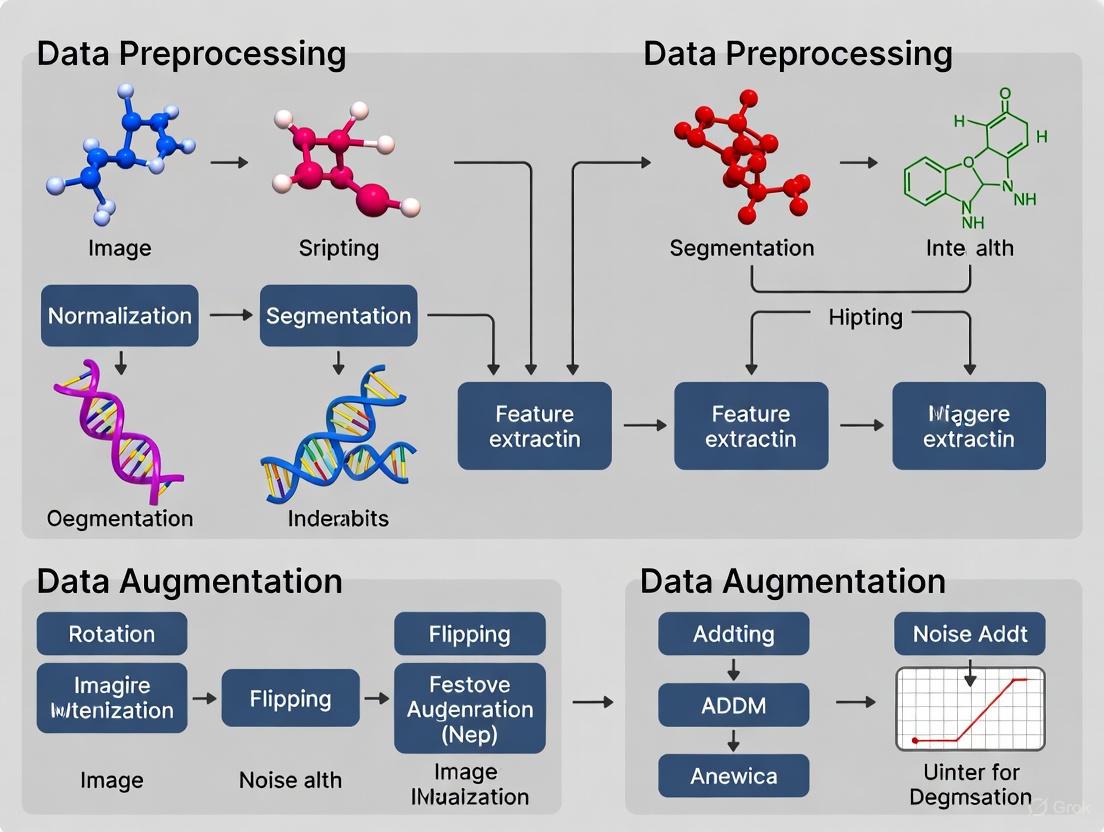
This article provides a comprehensive guide for researchers and drug development professionals on leveraging data preprocessing and augmentation to overcome the critical challenge of limited and imbalanced medical imaging data.
Data Preprocessing and Augmentation for Medical Imaging: A 2025 Guide for AI-Driven Drug Development
Abstract
This article provides a comprehensive guide for researchers and drug development professionals on leveraging data preprocessing and augmentation to overcome the critical challenge of limited and imbalanced medical imaging data. Covering foundational concepts, advanced methodological applications, troubleshooting for real-world optimization, and rigorous validation frameworks, it synthesizes current best practices and emerging trends. Readers will gain actionable insights into building more robust, generalizable, and clinically impactful AI models for diagnostic and therapeutic innovation, with a specific focus on applications in the pharmaceutical pipeline.
Why Data Preprocessing and Augmentation is Fundamental to Medical AI
The advancement of artificial intelligence (AI) in medical imaging is fundamentally constrained by the quality, quantity, and diversity of the underlying datasets. Data scarcity, particularly for rare diseases or specific patient populations, limits the ability to train robust models. Data imbalance, where certain classes or demographic groups are underrepresented, leads to models that fail to generalize. Data bias, stemming from unrepresentative data collection or processing, can cause AI systems to perform poorly for underrepresented patient groups, potentially exacerbating existing healthcare disparities [1] [2]. One stark example is in pediatric care; while AI is transforming healthcare, only 17% of FDA-approved medical AI devices are labeled for pediatric use, which a recent preprint links to a fundamental data gap, finding that children represent less than 1% of the data in public medical imaging datasets [3]. This article details the scope of these challenges and provides actionable protocols and solutions for researchers to build more reliable and equitable medical imaging AI.
Quantifying the Data Challenge
The scale of scarcity, imbalance, and bias in medical imaging can be characterized through recent empirical findings. The following tables summarize key quantitative evidence of these challenges.
Table 1: Evidence of Data Scarcity and Imbalance in Medical Imaging AI
| Evidence Type | Domain | Finding | Source/Reference |
|---|---|---|---|
| Pediatric Data Gap | Public Medical Imaging Datasets | Children represent <1% of available data. | Erdman et al. [3] |
| FDA Approval Disparity | Medical AI Devices | Only 17% of FDA-approved AI devices are labeled for pediatric use. | Erdman et al. [3] |
| Demographic Reporting | Public Chest Radiograph Datasets | Only 17% of 23 public datasets reported race or ethnicity. | Yi et al. [4] |
| Risk of Bias (ROB) | Healthcare AI Models | 50% of sampled AI studies demonstrated a high risk of bias. | Kumar et al. [1] |
Table 2: Impact of Data Preprocessing and Augmentation on Model Performance
| Technique | Task | Impact on Performance | Notes |
|---|---|---|---|
| Hybrid Data Augmentation | Corneal Topographic Map Classification | Achieved 99.54% accuracy, significantly outperforming individual techniques. | Combines traditional transformations and Generative Adversarial Networks (GANs) [5]. |
| Data Augmentation (General) | Medical Image Analysis (across organs/modalities) | Found to be beneficial across all organs, modalities, and tasks. | Highest performance increase associated with heart, lung, and breast applications [6]. |
| Histogram Equalization (HE) | Chest X-ray Preprocessing | Can lead to poorer generalizability on external validation sets. | Suggests potential overfitting and information loss; model performance is highly dependent on preprocessing [7]. |
| DICOM VOI LUT Preprocessing | Chest X-ray (Pneumothorax) | Improves model robustness by using pixel values closer to clinical standards. | Mimics the standard clinical workflow for radiologists [7]. |
Experimental Protocols for Bias Mitigation and Data Enhancement
Protocol 1: Systematic Evaluation of Dataset Demographics
Objective: To identify and quantify potential age, sex, race, and ethnicity biases in a medical imaging dataset before model development.
Materials: The dataset (in DICOM, .nii, or other format), computing environment with Python, and relevant libraries (e.g., Pandas, SimpleITK, pydicom).
Methodology:
- Data Extraction: For each subject, extract available demographic metadata. For DICOM files, this includes tags for Patient Age (0010, 1010), Patient Sex (0010, 0040), and other relevant fields. If demographics are stored in a separate spreadsheet, ensure it is properly linked.
- Data Summary: Calculate summary statistics (counts, percentages) for each demographic variable.
- Gap Analysis: Identify which demographic variables are missing or incomplete. Report the percentage of records with missing data for each variable.
- Representation Analysis: Compare the demographic distribution of your dataset to the target population or broader census data to identify underrepresentation.
Deliverable: A demographic summary report and a table similar to Table 1, specific to your dataset.
Protocol 2: Implementing a Hybrid Data Augmentation Pipeline
Objective: To increase the effective size and diversity of a training dataset, thereby improving model robustness and mitigating overfitting.
Materials: Training dataset, deep learning framework (e.g., PyTorch, TensorFlow).
Methodology:
- Apply Affine Transformations: Use a combination of random rotations (e.g., ±10°), translations, scaling, and flipping. These are simple but effective and often achieve the best trade-off between performance and complexity [6].
- Apply Pixel-Level Transformations: Introduce variations in image appearance using techniques like adjusting brightness, contrast, and adding Gaussian noise.
- Integrate Generative Models (for severe scarcity): For selected organs or conditions with extreme data scarcity, employ Generative Adversarial Networks (GANs) or other generative models to create synthetic, realistic images [6] [5]. The hybrid of traditional and generative methods has been shown to achieve top performance [5].
- Validation: Always reserve a completely separate, non-augmented validation set to monitor performance and ensure the augmentation is not introducing unrealistic artifacts.
Protocol 3: Clinical-Standard DICOM Preprocessing for Chest X-Rays
Objective: To preprocess DICOM images in a way that retains diagnostically relevant information and improves model generalizability across datasets.
Materials: Raw DICOM files from chest X-rays, DICOM processing library.
Methodology:
- Extract Raw Pixels: Access the original pixel array from the DICOM tag (7fe0, 0010) [7].
- Apply VOI LUT Transformation: Transform the raw pixels using the DICOM Values-of-Interest Look-Up Table (VOI LUT) function (tag 0028, 1056). This can be a linear or non-linear (sigmoid) transformation specified by the manufacturer to produce P-values for clinical presentation [7].
- Avoid Non-Standard Enhancements: Refrain from applying aggressive image enhancements like Histogram Equalization (HE) as a default, as they can lead to information loss and poor performance on external datasets [7].
- Normalization: Finally, normalize the processed pixel values to a standard range (e.g., 0 to 1) for model consumption.
Deliverable: A dataset of preprocessed images that closely resemble the images used by radiologists in clinical practice.
The Scientist's Toolkit: Research Reagent Solutions
Table 3: Essential Tools for Medical Imaging Data Preprocessing and Augmentation
| Tool / Reagent | Function | Application Note |
|---|---|---|
| SimpleITK / pydicom | Python libraries for reading medical image formats (DICOM, .nii, .mha). | Essential for accessing raw pixel data and metadata. Prefer DICOM over preprocessed .jpg to retain control [7] [8]. |
| ITK-SNAP | Free software for 3D medical image visualization and segmentation. | Used for exploring image structure, creating annotations, and verifying segmentation results [8]. |
| DICOM VOI LUT | A transformation that converts raw pixel values to clinically meaningful "P-values". | Critical for standardizing image presentation. Using this mimics the radiologist's workflow and improves model robustness [7]. |
| TorchIO | A Python library for efficient preprocessing, augmentation, and patch-based sampling of 3D medical images. | Simplifies the implementation of complex spatial and intensity transformations in a deep learning pipeline [6]. |
| Generative Adversarial Networks (GANs) | A class of AI models that generate new, synthetic data instances that resemble the training data. | Used in hybrid augmentation strategies to address severe data scarcity for specific conditions or populations [6] [5]. |
| Fairness Metrics (e.g., Demographic Parity, Equalized Odds) | Statistical tools to measure performance differences between demographic groups. | No single metric is universal; must be selected based on clinical context to evaluate and prove algorithmic fairness [4] [1]. |
Addressing the core challenges of scarcity, imbalance, and bias is not optional but a prerequisite for developing trustworthy AI in medical imaging. As summarized in the workflows and protocols, solutions require a multi-faceted approach: a rigorous, standardized preprocessing methodology that respects clinical standards [7]; strategic data augmentation to expand and balance training data [6] [5]; and a committed, ongoing effort to audit datasets and models for demographic representation and fairness [3] [4] [1]. By integrating these practices throughout the AI lifecycle, from data curation to deployment, researchers can mitigate the risks of biased algorithms and pave the way for equitable, reliable, and generalizable medical imaging AI.
In medical imaging research, the scarcity of large, well-annotated datasets remains a significant bottleneck for developing robust deep-learning models [9]. Two fundamental techniques to address this challenge are data preprocessing and data augmentation. While these terms are sometimes used interchangeably, they represent distinct phases in the model development pipeline with different objectives.
This application note provides a clear, operational distinction between preprocessing and augmentation. We define data preprocessing as a set of deterministic, mandatory operations applied to all images to standardize data and correct acquisition artifacts, ensuring data quality and consistency. In contrast, we define data augmentation as a set of randomized, optional transformations applied during model training to artificially expand the dataset and improve model generalization [10]. We structure quantitative performance comparisons, detailed experimental protocols, and visual workflows to equip researchers with practical guidelines for implementing these techniques effectively.
Conceptual Distinctions and Definitions
Core Objectives and Methodologies
Data Preprocessing involves operations that prepare raw medical data for analysis. The goal is to format data and reduce acquisition artifacts to create a standardized input for deep learning models. Preprocessing is typically applied consistently to all images in the dataset (both training and validation) and is often necessary to ensure the data is in a clinically meaningful state for interpretation [7] [8]. Key characteristics include:
- Deterministic Application: The same operations and parameters are applied to every image.
- Data Quality Focus: Aims to enhance signal quality, standardize pixel values, and format data correctly.
- Mandatory Nature: Considered an essential, non-negotiable step for model input.
Data Augmentation involves artificially expanding a training dataset by creating modified versions of existing images. The goal is to increase the amount and variability of training data to prevent overfitting and improve model robustness [6] [11] [9]. It is applied randomly and only during the model training phase. Key characteristics include:
- Randomized Application: Transformations are applied with random parameters during training.
- Data Quantity & Variety Focus: Aims to expose the model to a wider range of anatomical and pathological variations.
- Optional, Strategic Nature: A tactical choice to improve model performance and generalization.
Operational Workflow
The following diagram illustrates the distinct roles and sequential relationship of preprocessing and augmentation in a typical medical image analysis pipeline.
Quantitative Performance Comparison
Empirical evidence consistently shows that the choice and combination of preprocessing and augmentation techniques significantly impact model performance. The tables below summarize key findings from recent systematic evaluations.
Table 1: Impact of Preprocessing Techniques on Diagnostic Accuracy (Adapted from [12])
| Preprocessing Method | Reported Effectiveness | Key Strengths / Impact on Performance |
|---|---|---|
| Median-Mean Hybrid Filter | 87.5% Efficiency Rate | Effective noise reduction while preserving edges; improves generalizability. |
| Unsharp Masking + Bilateral Filter | 87.5% Efficiency Rate | Enhances edge clarity and detail; combines sharpening with noise reduction. |
| CLAHE + Median Filter | Evaluated | Contrast enhancement coupled with noise suppression. |
| DICOM VOI LUT Transformation | Clinically Standardized [7] | Retains diagnostically significant features; aligns data with clinical workflow. |
Table 2: Performance of Deep Learning Models with Various Preprocessing Techniques (Sourced from [12])
| Deep Learning Model | Efficiency Ratio | Computational Efficiency | Recommended Preprocessing Pairing |
|---|---|---|---|
| EfficiencyNet-B4 | 75% | High | Median-Mean Hybrid Filter |
| MobileNetV2 | 75% | 34% shorter runtime | Unsharp Masking + Bilateral Filter |
| DenseNet-169 | Evaluated | Standard | CLAHE + Butterworth |
| ResNet-50 | Evaluated | Standard | Multiple |
Table 3: Effectiveness of Augmentation Techniques Across Medical Image Modalities (Sourced from [9])
| Augmentation Technique | Brain MR | Lung CT | Breast Mammography | Eye Fundus |
|---|---|---|---|---|
| Geometric (Rotation, Flip) | High | High | Medium | High |
| Intensity Adjustment | Medium | Medium | High | Low |
| Advanced (MixUp, CutMix) | High [13] | High | Evaluated | Evaluated |
| GAN-based Synthesis | Evaluated | Evaluated | High | Medium |
Detailed Experimental Protocols
Protocol 1: Standardized DICOM Preprocessing for Chest X-rays
This protocol is essential for creating a consistent dataset from raw DICOM files, which is critical for model generalizability [7].
Research Reagent Solutions
| Item / Tool | Function / Explanation |
|---|---|
| PyDICOM / SimpleITK | Python libraries for reading and processing DICOM files and metadata. |
| DICOM VOI LUT Function | Applies manufacturer-specific transformation to convert raw pixels to P-values for clinical presentation. |
| HU Value Scaling (for CT) | Converts raw pixel data to standardized Hounsfield Units using rescale slope and intercept. |
| NumPy | For efficient array operations and conversion of image data. |
Methodology
- Data Reading: Use SimpleITK or PyDICOM to load the DICOM file and extract the pixel array and metadata tags [8].
- VOI LUT Application: Apply the Values-of-Interest Look-Up Table (VOI LUT) transformation specified in the DICOM tags (0028,1050) Window Center and (0028,1051) Window Width. This transformation, which can be linear or non-linear (sigmoid), maps the raw pixel values to a range optimized for clinical display [7].
- Normalization: Scale the resulting pixel intensities to a fixed range, typically [0, 1], to ensure stable model training.
Validation Scheme
- Assess preprocessing consistency by comparing pixel value distributions across multiple datasets and manufacturers.
- Evaluate the impact on model performance by training pneumothorax classification models on datasets preprocessed with VOI LUT versus aggressive histogram equalization. Models using VOI LUT show better generalizability to external validation sets [7].
Protocol 2: Augmentation for Medical Image Segmentation
This protocol details the HSMix method, a local image-editing augmentation technique designed for segmentation tasks where contour preservation is crucial [13].
Research Reagent Solutions
| Item / Tool | Function / Explanation |
|---|---|
| Superpixel Algorithm (e.g., SLIC) | Decomposes images into homogeneous regions, providing the structural basis for contour-aware mixing. |
| Saliency Map Generator | Calculates pixel-wise importance coefficients used for soft brightness mixing. |
| U-Net (or variant) | A standard deep learning architecture used for semantic segmentation of medical images. |
Methodology
- Hard Mixing:
- Select two training images and their corresponding segmentation masks (Image A, Mask A; Image B, Mask B).
- Generate superpixels for both Image A and Image B.
- Randomly select a set of superpixels from Image B and paste them into the corresponding location in Image A.
- Perform the identical cut-and-paste operation on Mask B and Mask A to create the augmented segmentation mask.
- Soft Mixing:
- Using the same superpixel regions defined in the hard mixing step, perform a pixel-wise blending between Image A and Image B.
- The blending coefficient for each pixel is determined by its saliency value within the superpixel, rather than using a fixed ratio for the entire image.
- Apply the same soft mixing operation to the pair of segmentation masks.
- Training: The augmented images and masks from both hard and soft mixing are used to train the segmentation model.
Validation Scheme
- Performance is measured using segmentation metrics like Dice Similarity Coefficient (DSC) and Hausdorff Distance on held-out test sets.
- Compare HSMix against baseline augmentation methods (e.g., CutOut, CutMix, MixUp). HSMix has demonstrated superior performance by preserving contour information and creating a more diverse augmentation space [13].
The strategic integration of preprocessing and augmentation is paramount. A recommended workflow is to first establish a robust, standardized preprocessing pipeline based on clinical standards (like DICOM VOI LUT), and then strategically select augmentation techniques that address specific data limitations and task requirements [7] [9].
The following diagram synthesizes the decision-making process for building an effective data preparation pipeline, connecting the foundational choices of preprocessing with the tactical selection of augmentation.
In conclusion, preprocessing and augmentation are complementary but distinct tools. Preprocessing ensures data quality and clinical relevance, forming a reliable foundation for any model. Augmentation strategically enhances model robustness and generalizability by simulating data variation. The most successful medical imaging AI projects will be those that rigorously apply both, with a clear understanding of their unique roles in the research pipeline.
Deep learning has revolutionized medical image analysis, but its success depends on large, diverse datasets that are often unavailable in clinical settings due to privacy concerns, annotation costs, and inherent data limitations [6]. Most manually annotated medical datasets suffer from severe class imbalance, with specific conditions or patient demographics significantly underrepresented [6] [14]. These limitations lead to three fundamental challenges: model overfitting on limited training examples, poor generalization to unseen data or diverse populations, and prohibitive data collection costs [15] [16]. Data preprocessing and augmentation strategies have emerged as crucial solutions to these challenges, enabling more robust and clinically viable AI systems without requiring extensive new data collection [6].
The unique characteristics of medical images—including subtle pathological features, low inter-class variance, high intra-class variability, and diverse imaging modalities—necessitate specialized augmentation approaches tailored to the medical domain [17] [18]. This document presents comprehensive application notes and experimental protocols for implementing effective data augmentation strategies that enhance model robustness, prevent overfitting, and reduce dependency on large-scale data collection in medical imaging research.
Data Augmentation Techniques: Comparative Analysis
Taxonomy of Augmentation Methods
Data augmentation techniques for medical imaging can be broadly categorized into transformation-based methods (applying image manipulations to existing data) and synthetic data generation (creating new samples through generative models) [6]. Transformation-based methods include affine transformations (rotation, scaling, translation), elastic deformations, and intensity modifications, while synthetic generation encompasses Generative Adversarial Networks (GANs), variational autoencoders, and more recent diffusion models [6] [16].
Advanced mix-based augmentation strategies have shown particular promise for medical imaging applications. These methods semantically combine multiple images and their corresponding labels to generate novel training examples [18]. The table below summarizes the performance of prominent mix-based techniques across different medical imaging tasks and model architectures:
Table 1: Performance Comparison of Mix-Based Augmentation Techniques on Medical Imaging Tasks
| Augmentation Method | Dataset | Backbone Architecture | Accuracy (%) | Key Advantages |
|---|---|---|---|---|
| MixUp | Brain Tumor MRI | ResNet-50 | 79.19 | Smooths decision boundaries, effective for data scarcity |
| SnapMix | Brain Tumor MRI | ViT-B | 99.44 | Preserves critical spatial features using activation maps |
| YOCO | Eye Disease Fundus | ResNet-50 | 91.60 | Enhances local and global diversity through subregion augmentation |
| CutMix | Eye Disease Fundus | ViT-B | 97.94 | Maintains spatial context while expanding sample variety |
| KeepMask | Multi-organ Segmentation | U-Net | +3.2% IoU vs baseline | Preserves foreground integrity, transplantable across models |
| KeepMix | Multi-class Segmentation | DeepLabV3 | +2.7% mIoU vs baseline | Perturbs background without affecting target organs |
Domain-Specific Considerations
The effectiveness of augmentation strategies varies significantly across medical specialties, organs, and imaging modalities [6]. Research indicates that the highest performance increases associated with data augmentation are observed for cardiac, pulmonary, and breast imaging applications [6]. This variability necessitates careful selection of augmentation techniques based on the specific clinical context and imaging characteristics.
For segmentation tasks, techniques like KeepMask and KeepMix have demonstrated particular value by ensuring the reliability of foreground structures (organs or lesions) while perturbing less clinically relevant background areas [19]. These approaches can be seamlessly transplanted across various model architectures and adapted for both binary and multi-class segmentation problems, making them particularly valuable for resource-constrained research environments [19].
Experimental Protocols for Augmentation Implementation
Protocol 1: Evaluation Framework for Augmentation Techniques
Objective: Systematically compare and evaluate data augmentation strategies for medical image classification.
Materials:
- Medical image dataset (e.g., DermaMNIST, BloodMNIST, OCTMNIST)
- Deep learning framework (PyTorch or TensorFlow)
- Computational resources (GPU recommended)
Methodology:
- Data Preparation:
- Split dataset into training (70%), validation (15%), and test (15%) sets
- Apply baseline normalization specific to imaging modality
- Establish un-augmented baseline performance metrics
Augmentation Implementation:
- Implement multiple augmentation strategies in parallel:
- Basic transformations: Rotation (±15°), flipping (horizontal/vertical), scaling (0.8-1.2x)
- Mix-based methods: Implement MixUp (α=0.2), CutMix (α=1.0), and SnapMix
- Advanced techniques: Implement KeepMask for segmentation tasks
- For each technique, generate augmented training sets (3-5x original size)
- Implement multiple augmentation strategies in parallel:
Model Training & Evaluation:
- Train identical model architectures on each augmented dataset
- Use consistent optimization parameters (learning rate: 0.001, batch size: 32)
- Validate on unaugmented validation set after each epoch
- Evaluate final models on held-out test set
- Perform statistical analysis of performance differences (p<0.05)
Robustness Assessment:
- Test model performance on corrupted data (MedMNIST-C benchmark)
- Evaluate cross-domain generalization where possible
- Assess fairness across patient subgroups (age, sex, ethnicity)
Deliverables: Comparative performance metrics, robustness analysis, computational efficiency assessment.
Protocol 2: KeepMask Augmentation for Medical Segmentation
Objective: Implement and validate the KeepMask augmentation technique to improve segmentation accuracy while preserving critical anatomical structures.
Materials:
- Medical image segmentation dataset with corresponding masks
- Segmentation model (U-Net, DeepLab, or similar)
- KeepMask implementation ( [19])
Methodology:
- Background-Foreground Separation:
- Use provided ground truth masks to identify foreground (target) regions
- Apply morphological operations to ensure mask continuity
- Generate inverse masks for background regions
KeepMask Application:
- Select two training samples (Image A, Mask A; Image B, Mask B)
- Extract foreground from Image A using Mask A
- Extract background from Image B using inverse of Mask B
- Combine foreground from A with background from B
- Apply analogous operation to corresponding segmentation masks
KeepMix Variant:
- For multi-class segmentation, extend KeepMask to preserve multiple foreground classes
- Implement class-specific preservation parameters based on clinical importance
- Ensure anatomical plausibility in combined images
Model Training:
- Incorporate KeepMask-augmented samples into training pipeline (25-50% of batch)
- Use compound loss function (Dice + Cross-Entropy)
- Implement progressive augmentation scheduling (increasing intensity over epochs)
Validation:
- Quantitative evaluation using Dice coefficient, IoU, and Hausdorff distance
- Qualitative assessment by clinical experts for anatomical plausibility
- Comparison with conventional augmentation baselines
Deliverables: Segmentation performance metrics, qualitative results, clinical validation report.
Implementation Workflows
Medical Image Augmentation Workflow: This diagram illustrates the comprehensive pipeline for implementing data augmentation in medical imaging applications, progressing through four critical phases from raw data to deployable model.
Augmentation Technique Pathways: This diagram outlines three distinct augmentation methodologies suitable for medical imaging applications, each addressing different aspects of model robustness and data scarcity.
The Scientist's Toolkit: Essential Research Reagents
Table 2: Essential Tools and Resources for Medical Imaging Augmentation Research
| Tool/Resource | Type | Function | Example Implementations |
|---|---|---|---|
| MedMNIST+ Dataset Collection | Benchmark Datasets | Standardized evaluation across multiple imaging modalities and tasks | DermaMNIST, BloodMNIST, OCTMNIST, PneumoniaMNIST [17] |
| KeepMask/KeepMix | Augmentation Algorithm | Preserves foreground integrity while augmenting background context | Custom implementation per [19] |
| MixUp/CutMix/SnapMix | Mix-based Augmentation | Generates novel samples by semantically combining images and labels | TorchIO, Albumentations, Custom PyTorch/TensorFlow [18] |
| Generative Models (GANs/VAEs) | Synthetic Data Generation | Creates entirely new training samples from data distribution | StyleGAN, DCGAN, VAE implementations [6] |
| Robustness Evaluation Benchmarks | Evaluation Framework | Assesses model performance under corruption and distribution shifts | MedMNIST-C, Corruption robustness metrics [17] [15] |
| Fairness Assessment Tools | Bias Evaluation | Measures performance disparities across patient subgroups | Group fairness metrics (demographic parity, equality of opportunity) [14] |
Data preprocessing and augmentation represent foundational components of robust medical imaging AI systems. The protocols and application notes presented herein demonstrate that strategic data augmentation can simultaneously address the interconnected challenges of model overfitting, data scarcity, and collection costs while enhancing generalization capabilities [6] [20]. The systematic implementation of these techniques enables researchers to extract maximum value from limited medical datasets while building more reliable and equitable diagnostic systems.
Future research directions should focus on developing organ-specific and modality-specific augmentation policies, advancing learnable augmentation techniques that adapt to dataset characteristics, and creating more sophisticated fairness-aware augmentation strategies that proactively address performance disparities across patient demographics [6] [14]. Additionally, the integration of generative AI for synthetic data generation presents promising avenues for creating diverse training examples while maintaining privacy through synthetic data generation [21]. As medical AI continues to evolve, systematic data augmentation methodologies will remain essential for building trustworthy, robust, and clinically applicable diagnostic systems.
Application Note
This document details standard protocols and application notes for the critical stages of modern drug development, with a specific focus on the role of data preprocessing and augmentation in medical imaging research. The methodologies outlined herein support the broader thesis that robust data handling is fundamental to generating reliable, reproducible results across the drug development pipeline, from initial target discovery to final clinical trial analysis.
Target Identification and Validation
Target identification is the foundational step in drug discovery, involving the pinpointing of biological entities (e.g., proteins, genes) whose modulation is expected to have a therapeutic effect. Target validation then confirms the role of this entity in the disease process and its potential as a druggable target. [22]
Cutting-edge techniques in this phase are increasingly reliant on artificial intelligence (AI) and high-throughput screening. For instance, one novel framework, optSAE + HSAPSO, integrates a stacked autoencoder (SAE) for robust feature extraction with a hierarchically self-adaptive particle swarm optimization (HSAPSO) algorithm for adaptive parameter optimization. This approach has demonstrated a 95.52% accuracy in drug classification and target identification on datasets from DrugBank and Swiss-Prot, while also reducing computational complexity to 0.010 seconds per sample. [23] Other standard laboratory protocols include:
- Design and Preliminary Screen of Antisense Oligonucleotides: Used to inhibit gene expression and validate target function. [22]
- A Robust siRNA Screening Approach: Enables large-scale transfection in multiple human cancer cell lines for functional genomics. [22]
- Click Chemistry for Target Engagement Studies: Confirms direct binding between a drug candidate and its intended target. [22]
- Fragment Screening via ¹⁹F NMR Spectroscopy: A powerful method for assessing target ligandability and identifying initial hit compounds. [22]
AI-Enhanced Druggability Assessment and Candidate Selection
The assessment of a target's "druggability" and the selection of candidate molecules have been transformed by AI. Traditional methods like support vector machines (SVMs) and XGBoost often struggle with the complexity and scale of modern pharmaceutical datasets. Deep learning models address these limitations by automatically learning intricate molecular patterns. [23]
The optSAE + HSAPSO framework is a prime example of this advancement. The stacked autoencoder compresses high-dimensional input data (e.g., molecular descriptors, protein sequences) into a lower-dimensional, informative representation. The HSAPSO algorithm then optimizes the model's hyperparameters, dynamically balancing exploration and exploitation during training. This results in a model with superior performance, faster convergence, and greater resilience to data variability compared to state-of-the-art methods. [23] This AI-driven prioritization significantly accelerates the identification of viable clinical candidates.
Medical Image Preprocessing and Augmentation in Clinical Research
Medical imaging is a critical biomarker in many clinical trials, particularly in neurology and oncology. Standardized image preprocessing is essential for reliable quantification. The Centiloid method, for example, provides a standardized scale for quantifying brain amyloid burden from PET scans, but has a high failure rate in populations with anatomical differences, such as individuals with Down syndrome (DS). [24]
A study developed and evaluated five alternative preprocessing pipelines (PPMs) to improve the success rate of Centiloid processing. These pipelines were constructed from combinations of steps including image origin reset, filtering, MRI bias correction, and MRI skull stripping. This approach successfully improved the processing success rate in a DS cohort from 61.3% to 95.6%, demonstrating the profound impact of tailored preprocessing on data yield and quality. [24]
Data augmentation, the artificial expansion of a dataset using transformations, is equally vital for training robust AI models in healthcare. It reduces data collection requirements, prevents model overfitting, and enhances the model's ability to generalize to real-world, imperfect images. [25] [11]
Table 1: Key Medical Image Preprocessing and Augmentation Techniques
| Technique Category | Specific Method | Primary Function | Common Tools / Libraries |
|---|---|---|---|
| Medical Image Reading | SimpleITK, ITK-SNAP, pydicom | Handles 3D medical formats (.dcm, .nii, .mha) and visualization. [8] | Python, ITK-SNAP |
| Preprocessing | Normalization (e.g., to Hounsfield Units), Standardization, Skull Stripping, Bias Field Correction | Optimizes data for neural networks; standardizes and harmonizes data across sites. [24] [8] | SPM, PMOD, SimpleITK |
| Geometric Augmentation | Flipping, Rotation, Translation, Cropping, Shearing | Teaches models invariance to object orientation and position. [11] | TensorFlow, PyTorch, OpenCV |
| Color & Lighting Augmentation | Brightness/Contrast Adjustment, Color Jittering, Grayscale Conversion | Makes models robust to varying acquisition conditions and camera types. [11] | TensorFlow, PyTorch, OpenCV |
| Advanced & Generative Augmentation | MixUp, CutMix, CutOut, Generative Adversarial Networks (GANs) | Combines multiple images or generates new, realistic synthetic images to improve generalization. [25] [11] | TensorFlow, PyTorch |
Clinical Trial Analysis and Trends in 2025
Analysis of clinical trial initiations in 2025 indicates a strong recovery and growth in the sector. According to data from TA Scan and GlobalData, the first half of 2025 saw 6,071 Phase I-III interventional trials begin globally, a 20% increase from the same period in 2024. This surge is driven by stronger biotech funding, fewer trial cancellations, and more efficient operational processes. [26] [27]
Table 2: Clinical Trial Initiations and Trends in H1 2025
| Metric | H1 2024 | H1 2025 | Change & Key Observations |
|---|---|---|---|
| Total Trial Initiations | 4,972 | 6,071 | +20% Year-over-Year (YoY), returning to 2021/pre-pandemic levels. [27] |
| Phase 1 Trials | 1,187 | 1,560 | +21% YoY, indicating a healthy early-stage pipeline. [27] |
| Phase 2 Trials | 1,711 | 2,278 | Significant jump, now the primary growth engine. [27] |
| Leading Therapeutic Area | Oncology | Oncology | Top 10 therapeutic areas are all oncology; Thoracic cancer saw the fastest growth (25%). [27] |
| Key Regional Hubs | - | - | North America (2,134 trials), Europe (1,488 trials), and East Asia/China (1,268 trials). [27] |
Visual aids are increasingly critical for communicating the results of these trials. As emphasized by regulatory guidelines, tools like visual synopses and graphical abstracts enhance comprehension for a diverse audience, including patients and healthcare professionals, thereby supporting patient-focused drug development. [28]
Protocols
Protocol 1: Preprocessing of Amyloid PET Imaging for Centiloid Standardization
This protocol outlines a procedure to improve the success rate of Centiloid processing for magnetic resonance imaging (MRI) and amyloid positron emission tomography (PET) scans, particularly in cohorts with anatomical variations.
1. Reagents and Materials
- T1-weighted MRI scan and corresponding amyloid PET scan (e.g., [¹¹C]PiB) in DICOM or NIfTI format.
- Function: Source medical images for analysis.
- Computing workstation with SPM8 (or later) software and MATLAB/Python environment.
- Function: Provides the computational platform for image processing.
- In-house white matter and gray matter only template (TPM_MRI.nii).
- Function: A brain-tissue-only registration target to improve warping accuracy.
- Montreal Neurological Institute (MNI) 152 template.
- Function: Standard brain atlas for spatial normalization.
2. Preprocessing Steps
- Step 1: Image Preparation. If using multiframe PET scans, perform frame-to-frame motion correction and average the frames (e.g., 50-70 min post-injection) to create a single-frame image. [24]
- Step 2: Preprocessing Combination (PPM). Apply a combination of the following preprocessing steps to the MRI scan to enhance subsequent coregistration and warping:
- Image origin reset.
- Filtering.
- MRI bias field correction.
- MRI skull stripping. [24]
- Step 3: Rigid Registration to Template. Use the SPM8 "Coregister" function to rigidly align the (preprocessed) subject MRI scan to the MNI152 template. Use the synthetic TPM_MRI.nii (GM + 1.7*WM) as the reference image. [24]
- Step 4: PET to MRI Coregistration. Rigidly register the subject PET image to the aligned subject MRI image using SPM8 "Coregister". [24]
- Step 5: Non-linear Warping. Perform non-linear warping of the MRI image to the MNI152 template using the SPM8 Unified Segmentation method. Apply the resulting deformation parameters to the co-registered PET image. [24]
- Step 6: Quantification. Extract tracer concentrations from the warped PET image using the standard Centiloid cortical region of interest (ROI) and the whole cerebellum ROI. Calculate the cortical-to-cerebellum ratio and convert to Centiloid units via the established linear transformation. [24]
3. Analysis and Quality Assurance Evaluate the success of processing by checking the alignment of the warped images with the MNI template and the plausibility of the extracted ROI values. The implementation of this protocol with five accepted PPMs has been shown to increase processing success rates from 61.3% to 95.6% in a Down syndrome cohort. [24]
Centiloid Preprocessing Workflow
Protocol 2: Deep Learning-Based Data Augmentation for Medical Image Analysis
This protocol describes the application of data augmentation techniques to improve the training of deep learning models for medical imaging tasks such as classification and segmentation.
1. Reagents and Materials
- Curated dataset of medical images (e.g., CT, MRI, X-ray) with corresponding labels.
- Function: The base training data for the model.
- Python programming environment with deep learning libraries (e.g., TensorFlow/Keras, PyTorch, OpenCV).
- Function: Provides the functions and classes to implement augmentation.
- GPU-accelerated computing hardware.
- Function: Speeds up the training process, especially when using real-time augmentation.
2. Procedure
- Step 1: Define Augmentation Strategy. Select a set of transformations suitable for the medical task and imaging modality. A comprehensive strategy often includes:
- Geometric Transformations: Random horizontal/vertical flip, random rotation (e.g., ±15°), random translation (shift), random zoom. [11]
- Photometric Transformations: Random adjustments to brightness, contrast, hue, and saturation. Random application of blur or sharpening filters. [11]
- Advanced Techniques: Consider using CutOut (random erasing) to simulate occlusions, or MixUp/CutMix to blend images and labels. [25] [11]
- Step 2: Implementation. Augmentation can be implemented in two ways:
- Offline/Ahead-of-Time: Apply transformations to the entire dataset and save the expanded set of images to disk. This is simple but storage-intensive.
- Online/Real-Time: Integrate the transformation functions into the data loader, so new random variations are created on-the-fly during each training epoch. This is more efficient and provides nearly infinite variability. [11]
- Step 3: Integration and Training. Feed the augmented images into the deep learning model (e.g., a Convolutional Neural Network) during the training phase. Monitor performance on a separate, non-augmented validation set to ensure the model is generalizing and not overfitting to the augmented artifacts.
3. Analysis and Notes The success of augmentation is evaluated by comparing the model's performance on a held-out test set with and without the use of augmentation. Key metrics include accuracy, sensitivity, specificity, and area under the ROC curve. Effective augmentation should lead to higher performance and better generalization to unseen clinical data. [25]
Data Augmentation Strategy
The Scientist's Toolkit: Research Reagent Solutions
Table 3: Essential Tools and Materials for Featured Protocols
| Item | Function / Application |
|---|---|
| ITK-SNAP / SimpleITK | Software and library for reading, visualizing, and processing 3D medical images (e.g., DICOM, NIfTI). [8] |
| SPM (Statistical Parametric Mapping) | A widely used software package for the analysis of brain imaging data sequences, essential for the Centiloid protocol. [24] |
| TensorFlow / PyTorch | Open-source libraries for building and training deep learning models, including the implementation of data augmentation pipelines. [11] |
| siRNA / Antisense Oligonucleotides | Research reagents used in target validation to selectively silence or inhibit the expression of a candidate gene. [22] |
| Fragment Libraries (for ¹⁹F NMR) | Curated collections of small, simple molecules used in fragment-based drug discovery to identify initial hits against a target. [22] |
| Clinical Trials Database (e.g., GlobalData, TA Scan) | Intelligence platforms used for analyzing clinical trial trends, sponsor activities, and regional growth patterns. [26] [27] |
A Technical Deep Dive: Core and Advanced Augmentation Techniques
Data augmentation is a fundamental strategy in medical imaging research to overcome limitations posed by small, imbalanced datasets and to improve the generalization of deep learning models. By applying label-preserving transformations, researchers can artificially expand the diversity and size of training data. This document details the application notes and experimental protocols for basic geometric and photometric transformations, framed within a broader thesis on data preprocessing and augmentation. These techniques are essential for building robust, clinically viable AI systems for classification, segmentation, and detection tasks [6] [18].
Transformation Definitions and Specifications
Geometric Transformations
Geometric transformations modify the spatial arrangement of pixels in an image. They are crucial for teaching models to be invariant to changes in object orientation and position, which is vital in medical imaging where anatomy can appear in different views [29] [30].
- Rotation: Rotates the image around a specified axis by a defined angle. In 2D, this uses a rotation matrix. For 3D medical volumes (e.g., MRI, CT), rotation can be applied around different planes (axial, coronal, sagittal) [29] [31].
- Flipping/Reflection: Creates a mirrored version of the image. Horizontal flipping reverses the order of pixels in each row, while vertical flipping reverses the order of pixels in each column [29] [31].
- Translation: Shifts all pixels of an image horizontally, vertically, or both, according to specified offset values (
tx,ty). This can simulate variations in the positioning of an organ or lesion within the image frame [29] [31]. - Scaling: Enlarges or reduces the image dimensions. Isometric scaling is often preferred in medical imaging to preserve anatomical proportions [29] [31].
Photometric Transformations
Photometric transformations alter the pixel intensity values to make models robust to changes in image acquisition, such as variations in lighting and scanner settings [32].
- Contrast Adjustment: Modifies the difference between the darkest and lightest areas of an image. In X-ray imaging, this can emulate changes in acquisition parameters like kilovoltage (kV), which directly affect image contrast [32].
- Brightness Adjustment: Adds or subtracts a constant value to all pixel intensities, simulating changes in exposure or the number of photons (mAs) [32].
Table 1: Standard Parameters for Basic Transformations in Medical Imaging
| Transformation Category | Specific Technique | Common Parameter Ranges | Medical Imaging Considerations |
|---|---|---|---|
| Geometric | Rotation | ±5° to 15° (conservative); ±180° (broad) | Small angles often suffice; large rotations may create anatomically implausible images [31]. |
| Flipping (2D) | Horizontal and/or Vertical | Anatomical symmetry determines applicability (e.g., horizontal flip often valid for brain MRI) [29] [31]. | |
| Translation | ±10% to 20% of image dimension | Useful for centering objects; requires padding for empty regions [29] [31]. | |
| Scaling (Zoom) | 0.8x to 1.2x (typical) | Simulates differences in distance to object or field of view [31]. | |
| Photometric | Contrast Adjustment | Factor range: [0.7, 1.3] | Must preserve critical diagnostic features; avoid extreme values that mask lesions [32]. |
| Brightness Adjustment | Offset range: [-0.2, 0.2] (normalized) | Simulates variations in radiation dose (mAs) or scanner gain [32]. |
Experimental Protocols
Protocol 1: Evaluating a Single Transformation
Objective: To assess the individual impact of a specific geometric or photometric transformation on model performance for a defined medical imaging task (e.g., tumor classification).
Materials:
- Medical image dataset (e.g., brain tumor MRI [18])
- Deep learning framework (e.g., PyTorch, TensorFlow)
- Computing hardware with GPU acceleration
Methodology:
- Dataset Partitioning: Split the dataset into training, validation, and test sets, ensuring no data leakage.
- Baseline Model Training: Train a baseline model (e.g., ResNet-50) using only the original training images.
- Augmented Model Training: Train an identical model architecture from scratch, applying the target transformation (e.g., random rotation within ±10°) to the training images in each epoch.
- Performance Comparison: Evaluate both models on the same, untouched test set. Compare key metrics such as accuracy, sensitivity, specificity, and Area Under the Curve (AUC).
Protocol 2: Benchmarking a Transformation Pipeline
Objective: To systematically compare the performance of multiple transformation strategies and their combinations against a baseline.
Materials:
- As in Protocol 1.
Methodology:
- Define Strategies: Establish several training conditions:
- Baseline: No augmentation.
- Geometric-only: A combination of rotation, flipping, and scaling.
- Photometric-only: A combination of contrast and brightness adjustments.
- Combined: All geometric and photometric transformations applied.
- Consistent Training: Train separate models for each strategy, keeping all other hyperparameters (learning rate, number of epochs, etc.) constant.
- Comprehensive Evaluation: Compare final performance on the test set. The systematic review by Sciencedirect suggests that combining affine (geometric) and pixel-level (photometric) transformations often achieves an excellent trade-off between performance and complexity [6].
The following workflow diagrams the benchmarking process for data augmentation strategies.
Performance Benchmarks
Empirical evidence from recent literature demonstrates the significant benefits of data augmentation. A comprehensive systematic review of over 300 articles found data augmentation to be beneficial across all organs, modalities, and tasks, with the highest performance increases noted for heart, lung, and breast applications [6]. Furthermore, advanced mix-based strategies show considerable promise.
Table 2: Performance Impact of Advanced Mix-based Augmentation Strategies (Adapted from MediAug Benchmark [18])
| Backbone Model | Augmentation Strategy | Brain Tumor Classification Accuracy (%) | Eye Disease Classification Accuracy (%) |
|---|---|---|---|
| ResNet-50 | MixUp | 79.19 | - |
| ResNet-50 | YOCO | - | 91.60 |
| ViT-B | SnapMix | 99.44 | - |
| ViT-B | CutMix | - | 97.94 |
The Scientist's Toolkit
Table 3: Essential Research Reagent Solutions for Medical Image Augmentation
| Item | Function/Application | Example/Notes |
|---|---|---|
| PyTorch / TensorFlow | Deep Learning Frameworks | Provide modular APIs for implementing data augmentation pipelines (e.g., torchvision.transforms). |
| OpenCV (cv2) | Computer Vision Library | Used for implementing core transformation functions like cv2.warpAffine for geometric manipulations [29]. |
| Scipy | Scientific Computing | Offers multi-dimensional image processing functions like ndimage.zoom and ndimage.rotate for 3D medical volumes [31]. |
| NiBabel | Medical Image I/O | Python library for reading and writing neuroimaging data formats (e.g., NIfTI) [31]. |
| DICOM Standard | Medical Image Format & Metadata | The universal standard for storing and transmitting medical images and their critical metadata (e.g., kV, mAs) [32] [32]. |
Implementation Workflow
A standard implementation workflow for applying basic transformations in a training pipeline involves both geometric and photometric steps, as visualized below.
Pixel-level image manipulation forms a critical foundation for data preprocessing and augmentation in medical imaging research. These techniques—encompassing noise injection, blurring, and sharpening with kernel filters—directly address key challenges in developing robust deep learning models, including limited dataset sizes, variable image quality, and the need for enhanced feature visibility. Within a comprehensive data augmentation pipeline, these methods serve to artificially expand training datasets, improve model generalization, and ultimately enhance diagnostic accuracy for researchers, scientists, and drug development professionals working with medical imaging data. This document provides detailed application notes and experimental protocols for implementing these advanced pixel-level techniques in medical research contexts, with a focus on quantitative outcomes and reproducible methodologies.
Technique-Specific Quantitative Performance
The efficacy of pixel-level techniques is quantitatively assessed through standardized image quality metrics. The following table summarizes the performance characteristics of noise reduction and edge enhancement techniques as established in recent research.
Table 1: Quantitative Performance of Denoising and Edge Enhancement Techniques
| Technique Category | Specific Method | Performance Metrics | Key Findings |
|---|---|---|---|
| Hybrid Denoising | Adaptive Median Filter (AMF) + Modified Decision-Based Median Filter (MDBMF) | PSNR: Improvement up to 2.34 dBMSE: Up to 15% improvementSSIM: Improvement up to 0.07IEF: Improvement >20%FOM: 0.68, VIF: 0.61 | Significantly outperforms BPDF, AT2FF, and SVMMF; effectively preserves edges and structural similarity [33]. |
| Deep Learning Denoising | Fully Convolutional Neural Network (FCNN) with Wavelet Filter | Segmentation Accuracy: 98.84%BMD Correlation: 0.9928 | Outperforms standalone noise reduction algorithms for femur segmentation in DXA images [34]. |
| Edge Enhancement | Endoscopic Edge Enhancement (Various Levels) | Sharpness Increase: Factor of 3Noise Increase: Factor of 4 | Measured level range: 0 to 1.3; enhances perceived sharpness but amplifies noise [35]. |
Detailed Experimental Protocols
Protocol 1: Hybrid Denoising for High-Density Impulse Noise
This protocol outlines the application of a hybrid Adaptive Median Filter (AMF) and Modified Decision-Based Median Filter (MDBMF) algorithm, designed to remove high-density salt-and-pepper noise (10-90%) while preserving critical edge information in medical images [33].
Materials and Equipment
- Source Images: Nine benchmark images, including standard and medical datasets (e.g., Chest and Liver images) [33].
- Noise Introduction: Algorithm for adding bipolar impulse noise with varying densities (10% to 90%) [33].
- Computing Environment: MATLAB or Python with image processing工具箱.
Step-by-Step Procedure
Noise Detection with AMF:
- For each pixel in the noisy image, select an initial filtering window (e.g., 3x3).
- Within the window, calculate the median, minimum, and maximum intensity values.
- If the median value is not an extreme value (neither min nor max), proceed to the replacement check. If it is, increase the window size and repeat until a maximum window size is reached.
- This adaptive process dynamically identifies pixels corrupted by impulse noise [33].
Noise Removal with MDBMF:
- For a pixel identified as noisy, process it with the MDBMF.
- The filter replaces the corrupted pixel value with the median of its non-noisy neighbors.
- If all pixels in the window are noisy, the mean of the window is used as the replacement value.
- This selective recovery ensures that intact regions of the image remain unaffected [33].
Performance Validation:
- Compare the denoised output against the original, noise-free image.
- Calculate quantitative metrics including PSNR, MSE, SSIM, IEF, FOM, and VIF to validate performance against state-of-the-art methods [33].
Protocol 2: Edge Enhancement and Sharpness Quantification
This protocol provides a method to objectively quantify the level of edge enhancement applied by a video processor and measure its effects on image sharpness and noise, particularly relevant for endoscopic and laryngoscopic imaging [35].
Materials and Equipment
- Test Target: Rez checker target matte (or similar standardized test chart with slanted edges and gray patches) [35].
- Imaging System: Flexible digital endoscope connected to its video processor with adjustable edge enhancement settings [35].
- Image Capture: Frame grabber (e.g., Epiphan DVI2USB3) to record uncompressed images (e.g., 24-bit RGB bitmap) from the processor's output [35].
- Analysis Software: Custom MATLAB script for ISO12233-compliant analysis [35].
Step-by-Step Procedure
Image Acquisition:
- Position the endoscope tip at a representative operational distance (e.g., 30mm) from the test target.
- Adjust illumination to avoid pixel saturation in the brightest gray patch.
- For each level of edge enhancement (from zero to maximum), capture an image of the test target.
- Ensure consistent white balance and avoid ambient light interference [35].
Image Analysis and Linearization:
- Automatically identify Regions of Interest (ROIs) containing slanted edges and gray patches.
- Convert RGB values to luminance (Y) using the formula:
Y = 0.2125*R + 0.7154*G + 0.0721*B. - Estimate the system's gamma value (
γ) by fitting the log of normalized luminance values from the gray patches against their known status-T densities. - Linearize the luminance values in the edge ROIs using:
Y_lin = 255 * (Y/255)^(1/γ)[35].
Quantifying Edge Enhancement Level:
- Measure the Step Response (SR) from the linearized slanted-edge ROI.
- Subtract the SR of the image with no edge enhancement from the SR of the image with enhancement applied.
- The Edge Enhancement Level is calculated as the peak-to-peak difference of the resulting signal, normalized by the step size [35].
Measuring Sharpness and Noise:
- Compute the Modulation Transfer Function (MTF) from the linearized slanted-edge data.
- Characterize sharpness by reporting the spatial frequency at which the MTF decays to 50%.
- Measure noise by calculating the weighted sum of variances from the luminance and chrominance channels on a uniform gray patch [35].
Kernel Filter Operations: A Foundational Workflow
The following diagram illustrates the universal workflow for applying a kernel filter to a medical image, which forms the basis for many blurring and sharpening operations.
Diagram 1: Kernel Filter Application Workflow (64 characters)
Table 2: Common Kernel Filters and Their Medical Imaging Applications
| Kernel Type | Kernel Matrix | Primary Effect | Typical Medical Application |
|---|---|---|---|
| Identity | [0, 0, 0; 0, 1, 0; 0, 0, 0] |
Leaves image unchanged. | Baseline for filter development [36]. |
| Sharpening | [0, -1, 0; -1, 5, -1; 0, -1, 0] |
Emphasizes differences in adjacent pixels, increasing perceived vividness and edge acuity. | Enhancing subtle edges in radiographs or retinal scans prior to analysis [36]. |
| Unsharp Masking (Sample) | [-1/8, -1/8, -1/8; -1/8, 2, -1/8; -1/8, -1/8, -1/8] |
Enhances edges in all directions by subtracting a blurred version from the original [37]. | General edge enhancement for diagnostic clarity [37] [35]. |
| Gaussian Blur (3x3 approx.) | [1/16, 1/8, 1/16; 1/8, 1/4, 1/8; 1/16, 1/8, 1/16] |
De-emphasizes pixel differences, reducing noise and creating a smoothing effect. | Preprocessing for noise reduction prior to segmentation or edge detection [38] [36]. |
| Mean Blur | [1/9, 1/9, 1/9; 1/9, 1/9, 1/9; 1/9, 1/9, 1/9] |
Simplest smoothing filter; replaces each pixel with the average of its neighbors. | Basic noise reduction (can blur edges significantly) [38]. |
| Edge Detection (Horizontal) | [1, 0, -1; 2, 0, -2; 1, 0, -1] (Sobel) |
Highlights horizontal edges and lines. | Isolating specific anatomical structures oriented horizontally [37] [36]. |
| Edge Detection (Vertical) | [1, 2, 1; 0, 0, 0; -1, -2, -1] (Sobel) |
Highlights vertical edges and lines. | Isolating specific anatomical structures oriented vertically [37] [36]. |
The Scientist's Toolkit: Research Reagent Solutions
Table 3: Essential Materials and Tools for Medical Image Filtering Experiments
| Item Name | Function/Application | Example/Specification |
|---|---|---|
| Standardized Test Target | Objective quantification of sharpness (MTF), noise, and edge enhancement levels. | Rez checker target matte (Imatest) with slanted edges and gray patches [35]. |
| Frame Grabber | Capturing uncompressed, high-fidelity images directly from medical video processors for analysis. | Epiphan DVI2USB3.0 [35]. |
| Medical Image Datasets | Benchmarking and validating algorithm performance on clinically relevant data. | DermaMNIST, BloodMNIST, OCTMNIST, Fitzpatrick17k, custom clinical datasets (e.g., DXA femur images) [34] [17]. |
| Computing Environment & Libraries | Implementing, training (for DL methods), and applying filtering algorithms. | Python with Skimage, PyTorch, TorchIO; MATLAB with Image Processing Toolbox [39]. |
| Quantitative Metrics Software | Standardized calculation of image quality metrics to enable fair comparison between techniques. | Custom MATLAB/Python scripts for PSNR, SSIM, MTF, etc., compliant with standards like ISO12233 [35]. |
Integrated Preprocessing and Augmentation Workflow
The most effective application of these pixel-level techniques is often within a sequential pipeline designed to prepare medical images for deep learning models. The following diagram depicts a robust integrated workflow that combines preprocessing and augmentation.
Diagram 2: Integrated Preprocessing and Augmentation Pipeline (67 characters)
Generative Artificial Intelligence (GenAI) has emerged as a transformative force in scientific research, particularly in the field of medical imaging where data scarcity, class imbalance, and privacy concerns are significant obstacles [6] [40]. These models offer a powerful solution for synthetic data creation, enabling researchers to augment limited datasets and accelerate the development of robust, generalizable AI systems [41]. The field has witnessed rapid evolution from early Generative Adversarial Networks (GANs) and Variational Autoencoders (VAEs) to the current dominance of diffusion models, each offering distinct advantages for scientific image synthesis [42] [43]. Within medical imaging research, these technologies are primarily applied to overcome data limitations through realistic data augmentation, to generate rare or critical pathological cases for training, and to create privacy-preserving synthetic datasets for method development and sharing [6] [44]. This article details the core architectures, their specific applications, and provides practical experimental protocols for implementing generative AI within medical imaging research workflows.
Core Generative Architectures: Mechanisms and Comparative Analysis
Architectural Foundations and Workflows
Variational Autoencoders (VAEs) operate on the principle of probabilistic latent variable models. They learn to encode input data into a lower-dimensional latent space characterized by a known probability distribution (typically Gaussian) and then decode samples from this space back to the original data domain [42] [45]. This enforced structure of the latent space facilitates smooth interpolation and data generation. VAEs are trained by maximizing the evidence lower bound (ELBO), which balances reconstruction fidelity with the closeness of the latent distribution to its prior [42].
Generative Adversarial Networks (GANs) employ an adversarial training framework between two neural networks: a generator and a discriminator. The generator creates synthetic images from random noise, while the discriminator learns to distinguish between real and generated images [46] [47]. This competition drives both networks to improve, resulting in the generator producing highly realistic data. Architectures like StyleGAN allow for fine-grained control over image attributes by manipulating the latent space [42] [47].
Diffusion Models generate data through a iterative denoising process. They operate via a forward process that gradually adds noise to data until it becomes pure noise, and a reverse process where a neural network learns to progressively remove this noise to reconstruct the data from random noise [43]. Models like Denoising Diffusion Probabilistic Models (DDPMs) and Latent Diffusion Models (LDMs) have set new standards for image quality and diversity [42] [43]. LDMs, in particular, perform this diffusion in a compressed latent space, significantly improving computational efficiency [43].
The workflows of these three fundamental architectures are visualized below.
Quantitative Performance Comparison
The selection of an appropriate generative model requires careful consideration of performance trade-offs. The following table synthesizes quantitative findings from comparative evaluations across multiple scientific imaging domains, including microCT scans, composite fibers, and plant root images [42].
Table 1: Comparative Performance of Generative Models in Scientific Imaging
| Model Architecture | Perceptual Quality (FID) | Structural Coherence (SSIM) | Training Stability | Computational Cost | Key Strengths |
|---|---|---|---|---|---|
| GANs (e.g., StyleGAN) | High (Low FID) | High | Low | Moderate | High perceptual quality, fine-grained control [42] [46] |
| VAEs | Moderate (Higher FID) | Moderate | High | Low | Stable training, meaningful latent space, fast generation [42] [45] |
| Diffusion Models | Very High (Lowest FID) | High | High | Very High | State-of-the-art image quality, diversity, avoidance of mode collapse [42] [43] |
Evaluation metrics critical for scientific validation include Frechet Inception Distance (FID) for perceptual quality, Structural Similarity Index (SSIM) for structural coherence, and Learned Perceptual Image Patch Similarity (LPIPS) for assessing feature-level diversity [42]. It is crucial to note that quantitative metrics alone are insufficient for scientific applications; domain-expert validation remains essential to verify the scientific relevance and accuracy of generated images [42] [45].
Application Notes: Use Cases in Medical Imaging Research
Data Augmentation for Enhanced Model Robustness
Generative models significantly improve the performance and robustness of deep learning models in medical image analysis, particularly in data-scarce environments. A systematic review of over 300 articles found consistent benefits across all organs, modalities, and tasks, from classification to segmentation [6]. The strategic application of different generative models can mitigate specific challenges.
For instance, a 2025 study on lower limb MRI segmentation demonstrated that data augmentation dramatically improves model resilience to motion artifacts [48]. Models trained with MRI-specific augmentations maintained segmentation quality (Dice score: 0.79±0.14 vs. 0.58±0.22 without augmentation) and measurement precision (Mean Absolute Deviation: 5.7±9.5° vs. 20.6±23.5°) even under severe artifact conditions [48].
The DreamOn framework exemplifies advanced augmentation, using a conditional GAN to generate REM-dream-inspired interpolations between image classes [47]. This approach creates challenging samples near decision boundaries, resulting in substantial improvements in classification accuracy under high-noise conditions compared to standard augmentation strategies [47].
Overcoming Ultra Low-Data Regimes
Generative AI enables complex medical image analysis in ultra low-data regimes where annotated samples are exceptionally scarce. The GenSeg framework addresses this challenge through a generative deep learning approach that produces high-quality image-mask pairs optimized specifically for segmentation performance [44].
Using multi-level optimization, GenSeg generates synthetic data that directly improves segmentation outcomes, demonstrating strong generalization across 11 medical image segmentation tasks and 19 datasets [44]. When training with only 50-100 samples, models augmented with GenSeg achieved performance improvements of 10-20% absolute percentage points compared to baseline models, while matching baseline performance with 8-20 times fewer labeled samples [44].
Domain-Specific Image Synthesis and Evaluation
Clinical evaluation of synthetic medical images requires rigorous validation protocols. The Clinical Evaluation of Medical Image Synthesis (CEMIS) protocol provides a comprehensive framework for assessing synthetic image quality, diversity, realism, and clinical utility [45].
In a case study on wireless capsule endoscopy, the TIDE-II model (a VAE-based architecture) generated high-resolution synthetic images of inflammatory bowel disease that were systematically evaluated by 10 international WCE specialists [45]. The evaluation assessed texture quality, anatomical structure plausibility, and diagnostic relevance, demonstrating that generative models can produce clinically plausible images for rare conditions [45].
Table 2: Research Reagent Solutions for Generative AI in Medical Imaging
| Reagent Category | Specific Examples | Function in Research Pipeline |
|---|---|---|
| Generative Model Architectures | StyleGAN, Stable Diffusion, DDPM, VAE | Core engines for synthetic data generation; choice depends on fidelity needs and computational constraints [42] [43] [46] |
| Evaluation Metrics | FID, SSIM, LPIPS, CLIPScore | Quantitative assessment of image quality, diversity, and semantic alignment [42] |
| Domain-Specific Datasets | BUSI (Breast Ultrasound), Kvasir-Capsule, BraTS (Brain Tumor) | Benchmark datasets for training and validation; often include expert annotations [47] [45] |
| Clinical Validation Protocols | CEMIS, Visual Turing Tests, Expert Consensus Reviews | Essential for verifying clinical relevance and utility of synthetic images [45] |
| Segmentation Frameworks | nnU-Net, DeepLab, UNet | Downstream task models for evaluating utility of synthetic data in applications [48] [44] |
Experimental Protocols
Protocol: Evaluating Augmentation Strategies for AI Robustness
Objective: To systematically evaluate how different data augmentation strategies affect a deep learning model's segmentation performance under variable artifact severity [48].
Materials and Methods:
- Imaging Data: Axial T2-weighted MR images of lower limbs (hips, knees, ankles)
- AI Model: nnU-Net architecture for automatic bone segmentation and torsional angle quantification
- Training Groups: Three models trained with (1) no augmentation, (2) standard nnU-Net augmentations, and (3) standard plus MRI-specific artifact simulations
- Test Set: 600 MR image stacks from 20 healthy participants, each imaged five times under standardized motion conditions
- Artifact Grading: Two radiologists independently grade artifact severity as none, mild, moderate, or severe
Experimental Workflow:
- Acquire baseline MRI scans without induced motion
- Acquire additional scans under breath-synchronized foot motion and gluteal contraction conditions
- Train three separate nnU-Net models with different augmentation strategies
- Evaluate segmentation quality using Dice Similarity Coefficient (DSC)
- Compare torsional angle measurements between manual and automatic methods using Mean Absolute Deviation (MAD) and Intraclass Correlation Coefficient (ICC)
Validation Metrics:
- Segmentation quality: Dice Similarity Coefficient (DSC)
- Measurement accuracy: Mean Absolute Deviation (MAD), Intraclass Correlation Coefficient (ICC), Pearson's correlation coefficient (r)
- Statistical analysis: Linear Mixed-Effects Model to account for repeated measures [48]
Protocol: Clinical Evaluation of Synthetic Image Quality
Objective: To clinically evaluate the quality, diversity, and diagnostic utility of synthetic medical images using a standardized protocol [45].
Materials and Methods:
- Synthetic Data Generation: TIDE-II model (VAE-based) trained on WCE images from KID 2 and Kvasir-Capsule datasets
- Evaluation Framework: Clinical Evaluation of Medical Image Synthesis (CEMIS) protocol
- Experts: 10 WCE specialists with 5-27 years of experience
- Assessment Procedures: Five distinct evaluation modes (A1-A5)
Experimental Workflow:
- Individual Image Assessment (A1): Experts evaluate 50 real and synthetic images for quality, texture, anatomy, and pathology likelihood using Likert scales
- Real vs. Synthetic Discrimination (A2): Experts attempt to distinguish real from synthetic images in paired comparisons
- Similarity Assessment (A3): Experts evaluate similarity between real and corresponding synthetic images
- Group Plausibility Ranking (A4): Experts rank groups of images by plausibility
- Diagnostic Accuracy Assessment (A5): Experts identify pathological findings in synthetic images and rate diagnostic difficulty
Validation Metrics:
- Image Quality Score (IQS): Mean rating across quality, texture, and anatomy
- Realism Score: Percentage of synthetic images mistaken for real
- Plausibility Score: Ranking of image groups by clinical plausibility
- Diagnostic Accuracy: Correct identification of pathological findings in synthetic images [45]
The following diagram illustrates the key decision points and methodological considerations for researchers implementing generative AI solutions for medical imaging challenges.
Generative AI models have fundamentally expanded the possibilities for medical imaging research by addressing critical data limitations. GANs, VAEs, and diffusion models each offer distinct advantages, with the optimal choice depending on specific research requirements regarding image quality, training stability, and computational resources [42]. The implementation of rigorous experimental protocols and comprehensive evaluation frameworks like CEMIS is essential for ensuring the scientific validity and clinical utility of synthetic data [45]. As these technologies continue to mature, future developments will likely focus on improved model interpretability, reduced computational costs, standardized verification protocols, and enhanced capabilities for cross-modality synthesis [42] [40]. By integrating these generative approaches into research workflows, scientists can accelerate innovation in medical image analysis while navigating the challenges of data privacy, scarcity, and imbalance.
In medical imaging, deep learning models face significant challenges due to limited annotated datasets, class imbalance, and the need for robust generalization in clinical practice. Data augmentation has emerged as a crucial strategy to artificially expand training datasets and improve model performance. While traditional augmentation techniques involve basic image manipulations, and generative approaches create entirely new samples, hybrid strategies combine the strengths of both paradigms. These integrated approaches range from simple combinations of transformations to sophisticated learning-based methods that generate challenging interpolations, offering powerful solutions to address dataset limitations and enhance model robustness across various medical imaging modalities and clinical tasks [6] [16].
The unique characteristics of medical images—including their anatomical consistency, diagnostic significance of subtle features, and domain-specific artifacts—necessitate specialized augmentation approaches. Hybrid methods effectively bridge the gap between the computational efficiency of traditional techniques and the data diversity offered by generative models, enabling more effective regularization of deep neural networks without compromising anatomical plausibility [6]. This approach is particularly valuable for enhancing performance on underrepresented classes, improving segmentation accuracy of anatomical structures, and increasing resistance to image degradation commonly encountered in clinical settings [47] [48].
Comparative Analysis of Hybrid Augmentation Techniques
Performance Metrics Across Medical Imaging Tasks
Table 1: Quantitative Performance of Hybrid Augmentation Methods Across Medical Imaging Modalities
| Augmentation Method | Architecture | Dataset | Task | Performance Metrics |
|---|---|---|---|---|
| MixUp [49] | ResNet-50 | Brain MRI | Tumor Classification | Accuracy: 79.19% |
| SnapMix [49] | ViT-B | Brain MRI | Tumor Classification | Accuracy: 99.44% |
| YOCO [49] | ResNet-50 | Eye Fundus | Disease Classification | Accuracy: 91.60% |
| CutMix [49] | ViT-B | Eye Fundus | Disease Classification | Accuracy: 97.94% |
| DreamOn [47] | ResNet-18 | Breast Ultrasound | Classification | Substantial improvement in high-noise robustness |
| RPS [50] | Multiple CNNs/Transformers | Lung CT | Cancer Diagnosis | Accuracy: 97.56%, AUROC: 98.61% |
| MRI-Specific Augmentation [48] | nnU-Net | Lower Limb MRI | Segmentation | DSC: 0.79±0.14 (severe artifacts) |
Methodological Characteristics and Clinical Applications
Table 2: Characteristics and Applications of Hybrid Augmentation Strategies
| Technique | Core Mechanism | Advantages | Clinical Considerations | Optimal Use Cases |
|---|---|---|---|---|
| MixUp [47] [49] | Linear interpolation of image-label pairs | Smooths decision boundaries, prevents overconfidence | May blur fine anatomical details; requires careful parameter tuning | General classification tasks with sufficient inter-class separation |
| CutMix [50] [49] | Replaces image regions with patches from other images | Preserves spatial context, maintains localization information | Patch boundaries may create artificial edges; label proportionality critical | Organ segmentation, lesion detection requiring spatial awareness |
| SnapMix [49] | CAM-based semantic-aware mixing | Respects semantic importance of regions, more biologically plausible | Computationally more intensive; requires class activation maps | Fine-grained classification where specific regions carry diagnostic importance |
| DreamOn [47] | REM-dream-inspired GAN interpolations | Enhances robustness to noise, creates challenging boundary cases | Complex training process; requires separate GAN training | Noisy imaging environments (e.g., ultrasound, motion-prone MRI) |
| Random Pixel Swap (RPS) [50] | Swaps pixels within patient CT scans | Preserves diagnostic information, avoids label distortion | Limited to intra-patient variations; may not capture full pathological spectrum | Data scarcity scenarios where preserving original labels is critical |
| AugMix [49] | Diverse chained augmentations with consistency | Enhances robustness without altering labels | Requires careful composition of transformation chains | Safety-critical applications where label integrity is paramount |
| YOCO [49] | Patch-based diverse local/global transforms | Simulates partial views, encourages feature learning | May occlude critical regions in small anatomical structures | Multi-scale feature learning, partial volume effect simulation |
Experimental Protocols and Implementation Frameworks
Protocol 1: Benchmarking Mixed Sample Data Augmentations
Objective: Systematically evaluate and compare the performance of mix-based data augmentation techniques on medical image classification tasks.
Materials:
- Medical imaging dataset (e.g., brain MRI, retinal fundus images, chest X-rays)
- Computational resources: GPU (Tesla T4 or A100 recommended), 80GB RAM [49]
- Deep learning frameworks: PyTorch or TensorFlow
- Evaluation metrics: Accuracy, Dice Score, AUROC, Precision, Recall, F1-Score
Methodology:
- Data Preparation:
- Curate balanced dataset with appropriate train/validation/test splits (recommended: 80/10/10)
- Apply basic pre-processing: normalization, resizing to 224×224 pixels [49]
- Establish baseline performance without augmentation
Augmentation Implementation:
- Implement mix-based techniques: MixUp, CutMix, SnapMix, YOCO, CropMix, AugMix
- Set hyperparameters: MixUp (α=0.2), CutMix (α=1.0), others as per original papers [49]
- Configure appropriate loss functions for mixed samples (e.g., cross-entropy with soft labels)
Model Training:
- Utilize both CNN (ResNet-50) and Transformer (ViT-B) backbones for comprehensive comparison
- Train with consistent parameters: Adam optimizer, learning rate=0.001, epochs=50 [49]
- Implement cross-validation with fixed random seeds for reproducibility
Evaluation:
- Assess performance on clean and noisy test sets to measure robustness [47]
- Compare computational efficiency and training convergence rates
- Perform statistical significance testing (paired t-tests) across multiple runs
Expected Outcomes: Identification of optimal augmentation strategies for specific medical imaging tasks and architectures, with performance improvements of 3-15% over baseline methods depending on dataset characteristics [49].
Protocol 2: Domain-Specific Augmentation for Robustness
Objective: Develop and validate MRI-specific augmentation techniques to improve model robustness against motion artifacts.
Materials:
- MRI datasets with varying artifact severity levels
- Expert radiologist annotations for artifact grading
- nnU-Net framework for segmentation tasks [48]
Methodology:
- Artifact Simulation:
- Implement motion artifact simulations: ghosting, blurring, ringing artifacts
- Parameterize artifact severity: none, mild, moderate, severe [48]
- Validate simulated artifacts against real clinical images with radiologist assessment
Hybrid Augmentation Pipeline:
- Combine standard nnU-Net augmentations (rotation, scaling, elastic deformations)
- Integrate MRI-specific artifact simulations during training
- Balance augmentation intensity to avoid excessive distortion of anatomical features
Robustness Evaluation:
- Test on prospectively acquired datasets with controlled motion conditions [48]
- Measure segmentation quality (Dice Similarity Coefficient) across artifact severity levels
- Quantify impact on downstream clinical measurements (e.g., torsional angles in lower limbs)
Clinical Validation:
- Compare AI measurements with manual radiologist measurements
- Assess clinical acceptability of measurements under severe artifact conditions
Expected Outcomes: Significant improvement in segmentation performance under artifact conditions (DSC improvement of 0.14-0.21 for severe artifacts) and maintained precision in clinical measurements (MAD reduction from 20.6° to 5.7° for femoral torsion) [48].
Workflow Visualization
Hybrid Augmentation Workflow for Medical Imaging
The Scientist's Toolkit: Research Reagent Solutions
Table 3: Essential Resources for Implementing Hybrid Augmentation in Medical Imaging Research
| Resource Category | Specific Tools/Platforms | Function/Purpose | Implementation Considerations |
|---|---|---|---|
| Computational Frameworks | PyTorch, TensorFlow, MONAI | Model development and training infrastructure | MONAI provides medical imaging-specific transforms and networks |
| Augmentation Libraries | TorchIO, Albumentations, MediAug [49] | Specialized medical image transformations | TorchIO offers extensive medical imaging transforms and augmentation pipelines [6] |
| Model Architectures | ResNet-50, ViT-B, nnU-Net | Backbone networks for evaluation | ViT-B excels with sufficient data; ResNet-50 effective for smaller datasets [49] |
| Generative Models | Conditional GANs, StyleGAN | REM-dream interpolations, synthetic data generation | DreamOn uses conditional GANs for noise-robust interpolations [47] |
| Evaluation Metrics | Dice Score, Hausdorff Distance, AUROC | Performance quantification and model comparison | Dice Score particularly valuable for segmentation tasks [51] [48] |
| Domain-Specific Tools | MRI artifact simulators, Anatomical constraints | Medical image degradation simulation | Essential for creating clinically relevant augmentations [48] |
Future Directions and Clinical Translation
The evolution of hybrid augmentation strategies continues to address emerging challenges in medical AI implementation. Current research indicates several promising directions, including the development of automated augmentation policy learning, dynamic augmentation strategies that adapt to model training progress, and domain-aware techniques that incorporate clinical knowledge directly into the augmentation process [6] [16]. The integration of uncertainty-aware learning with data augmentation shows particular promise for improving model calibration and clinical trustworthiness [52].
For successful clinical translation, future work must prioritize the development of standardized evaluation protocols that assess not only technical performance but also clinical utility, including workflow efficiency gains and diagnostic consistency. The HybridMS framework demonstrates the potential of combining targeted human oversight with automated refinement, reducing annotation time by approximately 82% for standard cases while maintaining segmentation quality [51]. Such human-AI collaborative approaches represent a critical pathway for integrating advanced augmentation strategies into clinical practice, ultimately bridging the gap between technical innovation and healthcare delivery.
Cardiovascular Disease: AI-Driven Cardiac MRI
Application Note
Artificial intelligence is revolutionizing Cardiac Magnetic Resonance (CMR) by addressing long-standing challenges of exam complexity, duration, and accessibility. Philips has introduced a new suite of AI-enabled CMR innovations designed to make cardiac MR faster, easier, and more accessible for clinicians and patients [53]. These solutions simplify workflows, expand access to advanced imaging, and deliver diagnostic precision for a wider range of patients, helping clinicians detect and manage heart disease earlier and with greater confidence [53].
A significant application spotlight comes from the integration of AI throughout the CMR workflow, which reduces scan times, minimizes patient breath-holds by up to 75% with technologies like SmartHeart, and employs simplified free-breathing imaging techniques [53]. This AI-driven automation helps address staffing shortages by reducing the need for expert operators while enhancing departmental productivity through shorter planning times and reduced motion artifacts that traditionally led to repeat scans [53].
Table 1: Quantitative Impact of AI in Cardiac MRI
| Performance Metric | Improvement | Clinical Significance |
|---|---|---|
| Breath-hold reduction | Up to 75% fewer breath-holds [53] | Improved patient comfort and compliance |
| Myocardial damage assessment | Identification in as little as 10 minutes [53] | Supports proactive management of high-risk patients |
| Diagnostic capabilities | Quantitative biomarkers (intramyocardial strain imaging) [53] | Early detection of heart failure and cardio-oncology monitoring |
Experimental Protocol
Methodology for AI-Augmented Cardiac MRI
Objective: To implement and validate an AI-powered CMR workflow that reduces exam duration while maintaining diagnostic precision.
Materials and Equipment:
- MRI scanner (Philips BlueSeal helium-free MR systems recommended for sustainability) [53]
- AI-powered software suite (SmartHeart, CINE Freebreathing, single beat acquisition) [53]
- Dual AI-powered reconstruction technology (Adaptive CS-NET and Precise Net) [53]
Procedure:
- Patient Preparation: Position patient in scanner using standard CMR protocols.
- AI-Guided Planning: Utilize AI-driven planning tools to automate scan plane localization, reducing technologist cognitive load.
- Image Acquisition:
- Implement free-breathing sequences where appropriate to improve patient comfort.
- Use single-beat acquisition techniques to minimize scan time.
- Apply motion correction algorithms in real-time to reduce artifacts.
- Image Reconstruction: Employ dual AI-engine reconstruction (Adaptive CS-NET and Precise Net) to enhance image quality from potentially undersampled data [53].
- Post-Processing: Utilize automated segmentation and analysis tools for quantitative assessment of cardiac function, including myocardial strain analysis.
Validation: Compare exam duration, image quality scores, and diagnostic accuracy against historical controls using standard CMR protocols. Quantitative biomarkers such as intramyocardial strain imaging (SENC, MyoStrain) should be validated against expert reader measurements [53].
Research Reagent Solutions
Table 2: Essential Research Reagents for AI-Cardiac MRI
| Reagent/Software Solution | Function | Application in Protocol |
|---|---|---|
| SmartHeart AI Software | Automates scan planning and acquisition | Reduces operator dependency and exam duration |
| CINE Freebreathing Algorithm | Enables imaging without breath-holds | Improves patient comfort, especially in challenging cases |
| MyoStrain Analysis Package | Quantifies intramyocardial strain | Provides biomarkers for early disease detection |
| Dual AI Reconstruction (Adaptive CS-NET) | Enhances image quality from undersampled data | Enables faster acquisition while maintaining diagnostic quality |
Oncology: Hybrid PET/CT Imaging and Data Augmentation
Application Note
A groundbreaking medical imaging technique developed at UC Davis is significantly improving how doctors detect and understand cancer. This innovation combines PET (Positron Emission Tomography) and dual-energy CT (Computed Tomography) in a novel way that enables tissue composition analysis without additional radiation exposure [54].
The method, called PET-enabled Dual-Energy CT, represents a major step forward by using PET scan data to create a second, high-energy CT image. When combined with regular CT scans, this enables dual-energy imaging that provides a much clearer picture and more detailed information about tissue composition [54]. This approach is particularly valuable for cancer imaging, where it helps distinguish between healthy and cancerous tissues more accurately, and for bone marrow scans, where it improves how doctors measure disease activity [54].
For AI applications in oncology, addressing limited datasets is crucial. The MediAug framework systematically evaluates mix-based augmentation methods like MixUp, YOCO, CropMix, CutMix, AugMix, and SnapMix with both convolutional and transformer backbones [18]. On brain tumor classification, SnapMix with a ViT-B backbone achieved 99.44% accuracy, while MixUp achieved 79.19% accuracy with ResNet-50 [18].
Table 3: Data Augmentation Performance in Neuro-Oncology
| Augmentation Method | Backbone | Accuracy | Dataset |
|---|---|---|---|
| SnapMix | ViT-B | 99.44% | Brain Tumor MRI [18] |
| MixUp | ResNet-50 | 79.19% | Brain Tumor MRI [18] |
| YOCO | ResNet-50 | 91.60% | Eye Disease Fundus [18] |
| CutMix | ViT-B | 97.94% | Eye Disease Fundus [18] |
Experimental Protocol
Methodology for PET-Enabled Dual-Energy CT in Oncology
Objective: To implement and validate PET-enabled Dual-Energy CT for improved tissue characterization in oncology applications.
Materials and Equipment:
- PET/CT scanner (EXPLORER total-body PET scanner used in validation) [54]
- Reconstruction software capable of processing PET data for dual-energy CT synthesis
- Phantom validation tools for quantitative accuracy assessment
Procedure:
- Patient Preparation: Administer standard PET radiotracer according to institutional protocol.
- Image Acquisition:
- Acquire standard CT transmission data at single energy level.
- Acquire PET emission data according to standard protocol.
- Dual-Energy Synthesis:
- Utilize PET emission data to generate synthetic high-energy CT information.
- Combine synthetic high-energy data with acquired low-energy CT data.
- Apply material decomposition algorithms to differentiate tissue types.
- Image Analysis:
- Quantify tissue composition parameters in regions of interest.
- Compare lesion characterization between standard PET/CT and dual-energy enhanced images.
- Validation:
- Correlate imaging findings with histopathological results when available.
- Assess inter-observer variability for lesion characterization.
Data Augmentation Protocol for Medical Imaging (MediAug Framework):
Objective: To enhance model robustness for medical image classification under limited data conditions.
Procedure:
- Dataset Preparation: Curate annotated medical image dataset (e.g., brain tumor MRI, fundus images).
- Augmentation Strategy Selection:
- Model Training:
- Validation: Evaluate on separate test set with various artifact conditions.
Research Reagent Solutions
Table 4: Essential Research Reagents for Oncology Imaging AI
| Reagent/Software Solution | Function | Application in Protocol |
|---|---|---|
| EXPLORER PET Scanner | Enables total-body PET imaging | Platform for PET-enabled dual-energy CT validation [54] |
| MediAug Framework | Standardized data augmentation pipeline | Implements mix-based strategies for medical images [18] |
| PixMed-Enhancer | Conditional GAN with ghost module | Generates synthetic medical images with reduced computational cost [55] |
| ViT-AMC (Vision Transformer) | Explainable AI for tumor grading | Provides attention mechanisms for diagnostically significant areas [56] |
Neuroimaging: Motion Artifact Robustness
Application Note
In neuroimaging, motion artifacts present a significant challenge, affecting up to a third of clinical MRI sequences and requiring approximately 20% of MRI studies to be repeated due to motion corruption [48]. This problem is particularly pronounced in neuroimaging where patient movement can severely compromise diagnostic quality.
Research has demonstrated that appropriate data augmentation strategies can significantly improve AI model robustness against motion artifacts. A systematic study evaluated three different augmentation strategies for lower limb segmentation in MR images: (1) no augmentation, (2) standard nnU-Net augmentations, and (3) standard plus MRI-specific augmentations that emulate MR artifacts [48].
The findings revealed that while segmentation quality decreased with increasing artifact severity, this degradation was significantly mitigated by proper data augmentation. For severe artifacts, the Dice Similarity Coefficient (DSC) improved from 0.58±0.22 with no augmentation to 0.79±0.14 with MRI-specific augmentations in proximal femur segmentation [48]. This demonstrates that data augmentation can play a crucial role in maintaining AI performance in real-world clinical settings where motion artifacts are common.
Table 5: Impact of Data Augmentation on Motion Artifact Robustness
| Artifact Severity | Augmentation Strategy | Dice Score (Proximal Femur) | Femoral Torsion MAD |
|---|---|---|---|
| Severe | None | 0.58 ± 0.22 | 20.6° ± 23.5° [48] |
| Severe | Standard nnU-Net | 0.72 ± 0.22 | 7.0° ± 13.0° [48] |
| Severe | MRI-Specific | 0.79 ± 0.14 | 5.7° ± 9.5° [48] |
Experimental Protocol
Methodology for Assessing Data Augmentation Against Motion Artifacts
Objective: To evaluate the effectiveness of different data augmentation strategies in maintaining AI model performance on motion-corrupted MRI data.
Materials and Equipment:
- 3.0-T MRI scanner (Philips Achieva or Elition X)
- nnU-Net architecture for segmentation tasks
- Motion simulation apparatus or protocol
- Expert-annotated segmentation datasets
Procedure:
- Dataset Curation:
- Collect axial T2-weighted MR images of target anatomy (e.g., lower limbs, brain)
- Obtain manual segmentation outlines from clinical radiologists
- Artifact Simulation:
- Acquire images under varying motion conditions:
- Resting position (reference)
- High-frequency synchronized motion
- Low-frequency synchronized motion
- Alternatively, simulate motion artifacts computationally
- Acquire images under varying motion conditions:
- Artifact Grading:
- Have two radiologists independently grade artifact severity as none, mild, moderate, or severe
- Resolve discrepancies through consensus discussion
- Model Training:
- Train three model versions with different augmentation strategies:
- Baseline: No data augmentation
- Default: Standard nnU-Net augmentations
- MRI-Specific: Default plus MR artifact simulations
- Train three model versions with different augmentation strategies:
- Validation:
- Evaluate segmentation quality using Dice Similarity Coefficient (DSC)
- Assess quantitative measurement accuracy (e.g., torsional angles) using Mean Absolute Deviation (MAD)
- Calculate Intraclass Correlation Coefficient (ICC) and Pearson's correlation coefficient (r)
Analysis:
- Compare performance metrics across artifact severity levels
- Statistical analysis using Linear Mixed-Effects Models
- Assess clinical relevance of maintained accuracy
Research Reagent Solutions
Table 6: Essential Research Reagents for Motion Artifact Research
| Reagent/Software Solution | Function | Application in Protocol |
|---|---|---|
| nnU-Net Framework | Automated segmentation architecture | Baseline model for segmentation tasks [48] |
| Motion Simulation Protocol | Standardized artifact induction | Creates controlled motion artifacts for training [48] |
| Dice Similarity Coefficient | Segmentation quality metric | Quantifies segmentation accuracy against manual outlines [48] |
| Linear Mixed-Effects Model | Statistical analysis method | Accounts for repeated measures in artifact severity analysis [48] |
Navigating Pitfalls and Optimizing Augmentation Pipelines
The integration of artificial intelligence (AI) into medical imaging promises a new era of diagnostic accuracy and efficiency. However, the development of robust AI models is fundamentally constrained by the scarcity of diverse, high-quality medical image data, a challenge exacerbated by patient privacy concerns and the high cost of expert annotation [6] [57]. Synthetic data generation and data augmentation have emerged as pivotal strategies to overcome these data bottlenecks, enabling researchers to expand and balance training datasets artificially [58] [59].
While these techniques are powerful, they carry an inherent risk: the introduction of data distortions that can compromise clinical relevance. Such distortions occur when generated images contain anatomically implausible features, unrealistic textures, or artifacts that mislead AI models during training [11] [59]. The consequence is a model that performs well on synthetic data but fails to generalize in real-world clinical settings, potentially leading to diagnostic errors. Therefore, ensuring the synthetic realism and clinical fidelity of augmented data is not merely a technical exercise but a foundational requirement for the safe and effective translation of AI tools into healthcare. This document provides detailed application notes and protocols to help researchers navigate these critical challenges.
Quantifying Realism and Clinical Relevance: A Validation Framework
A rigorous, multi-faceted validation framework is essential to ensure that synthetic medical images are both realistic and clinically useful. This framework must extend beyond simple statistical similarity to include expert clinical review and performance-based evaluation.
Table 1: Key Validation Metrics for Synthetic Medical Image Quality
| Validation Dimension | Metric | Description | Interpretation in Clinical Context |
|---|---|---|---|
| Image Quality & Fidelity | Fréchet Inception Distance (FID) [60] [59] | Measures the statistical distance between feature distributions of real and synthetic images. | A lower FID indicates the synthetic dataset is more statistically similar to the real one. |
| Learned Perceptual Image Patch Similarity (LPIPS) [59] | Assesses perceptual similarity between images based on deep features. | Higher LPIPS values indicate greater perceptual diversity, which is desirable if clinically plausible. | |
| Clinical Task Performance | Classification Accuracy / AUC [61] [18] | Measures a model's ability to correctly classify diseases using synthetic training data. | A model trained on synthetic data should perform comparably to one trained on real data when tested on real-world images. |
| Dice Similarity Coefficient (Dice) [60] | Evaluates the overlap between a model's segmentation and a ground-truth mask. | Improvement in Dice score indicates synthetic data helps the model learn better anatomical boundaries. | |
| Clinical Realism | Expert Turing Test [62] [59] | Clinicians attempt to distinguish synthetic from real images in a blinded setting. | High difficulty in discrimination indicates strong clinical realism of the synthetic images. |
| Privacy Preservation | Membership Inference Attack Resistance [57] [59] | Tests whether a specific real patient's data can be identified as part of the training set for the synthetic data generator. | Successful resistance ensures patient privacy is protected and synthetic data is not a mere memorization of real data. |
Application Note: Interpreting Validation Outcomes
- Trade-off Between FID and Clinical Utility: A low FID score is necessary but not sufficient for clinical relevance. An image can be statistically similar to a training set yet lack the subtle pathological features required for an accurate diagnosis [59]. Therefore, FID must always be complemented with task-based metrics like Dice or AUC.
- The Role of Expert Review: Quantitative metrics can be gamed by advanced generators. A blinded expert review is the ultimate test for identifying subtle, anatomically implausible features or hallucinations that could degrade model performance [62]. For instance, in a recent study on synthetic chest X-rays, clinicians validated that generated pathologies like pneumothorax and support devices were realistic [61].
Experimental Protocols for Generation and Validation
This section provides detailed, actionable protocols for generating high-fidelity synthetic data and for rigorously validating its utility.
Protocol 1: Generating Synthetic Brain Tumor MRIs with MCFDiffusion
This protocol is adapted from a recent study that used a Multi-Channel Fusion Diffusion Model (MCFDiffusion) to convert healthy brain MRIs into images with tumors, effectively addressing class imbalance [60].
Objective: To augment an imbalanced brain tumor MRI dataset by generating high-quality, diverse synthetic tumor images that improve the performance of downstream classification and segmentation models.
Materials and Inputs:
- A public brain tumor MRI dataset (e.g., the BraTS dataset).
- Healthy brain MRI scans (if available).
- Computational resources with high-GPU memory.
Methodology:
- Data Preprocessing: Co-register all MRI modalities (e.g., T1, T1c, T2, FLAIR) to a common anatomical template. Normalize the intensity values of all images to a standard range (e.g., 0-1).
- Model Training:
- Train the MCFDiffusion model on paired healthy and tumorous image slices.
- The model learns a reverse diffusion process that gradually adds realistic tumor features to a healthy image base.
- The multi-channel input ensures the model leverages information from all available MRI sequences for a coherent synthesis.
- Image Generation:
- Input a healthy brain MRI slice into the trained model.
- The model executes the reverse diffusion process, fusing a generated tumor mask with the healthy image to produce a synthetic tumor image.
- The process is repeated with varying random seeds to generate a diverse set of synthetic tumor images.
Validation Steps:
- Calculate the FID score between the generated synthetic images and a held-out test set of real tumor images. Aim for an FID score that is lower than or comparable to other state-of-the-art generative models [60].
- Train a standard segmentation model (e.g., U-Net) on a dataset augmented with the synthetic images. Evaluate its performance on a real-world test set using the Dice coefficient. The study achieved Dice improvements of 1.5%–2.5% [60].
- Submit a sample of synthetic images to expert neuroradiologists for a blinded review to assess anatomical and pathological plausibility.
Protocol 2: Benchmarking Mix-Based Augmentation for Classification
This protocol outlines a systematic evaluation framework, inspired by the MediAug benchmark, to identify the optimal data augmentation strategy for a specific medical imaging task and model architecture [18].
Objective: To evaluate the efficacy of advanced mix-based augmentation techniques on a medical image classification task and determine the best policy for a given dataset and backbone network.
Materials and Inputs:
- A labeled medical image dataset (e.g., brain tumor MRI or eye disease fundus).
- Pre-trained ResNet-50 and Vision Transformer (ViT-B) models.
Methodology:
- Baseline Establishment: Train the models (ResNet-50 and ViT-B) on the original dataset without any advanced augmentation to establish a baseline classification accuracy.
- Augmentation Policy Integration: Implement a suite of mix-based augmentation techniques, including:
- Comparative Training: Retrain each model from scratch using each augmentation policy individually. Maintain consistent hyperparameters and training schedules across all experiments.
Validation and Analysis:
- Record the final classification accuracy on a held-out test set for each model-augmentation combination.
- Analyze the results to identify the best-performing policy. For example, the MediAug study found that for brain tumor classification, MixUp was optimal for ResNet-50 (79.19% accuracy) while SnapMix was best for ViT-B (99.44% accuracy) [18].
The workflow for this systematic benchmarking process is outlined below.
The Scientist's Toolkit: Research Reagents and Solutions
Successful implementation of the aforementioned protocols requires a suite of essential computational tools and frameworks. The following table details these key "research reagents."
Table 2: Essential Research Reagents for Synthetic Medical Imaging
| Tool / Solution | Type | Primary Function | Application Note |
|---|---|---|---|
| Denoising Diffusion Probabilistic Models (DDPM) [61] [60] | Generative Model | Generates high-quality images by iteratively denoising random noise. | Excels at producing diverse, high-fidelity images. Shown to outperform GANs in some medical imaging tasks [60]. |
| Generative Adversarial Networks (GANs) [57] [59] | Generative Model | Generates data by training a generator and a discriminator in an adversarial setup. | Prone to mode collapse and training instability. Variants like StyleGAN are used for high-resolution synthesis. |
| Multi-Channel Fusion Diffusion Model (MCFDiffusion) [60] | Specialized Generative Model | Converts healthy images to pathological ones using multi-channel data. | Specifically designed for complex modalities like MRI. Effective for addressing severe class imbalance. |
| TorchIO [6] | Python Library | Provides efficient medical image preprocessing and augmentation tools. | Essential for standardizing and preparing data before it is fed into generative models. |
| Fréchet Inception Distance (FID) [60] [59] | Evaluation Metric | Quantifies the statistical similarity between real and synthetic image distributions. | A standard metric for generative model performance. Lower scores are better. |
| Large Language Model (e.g., GPT-4) [62] | Text Generator | Generates synthetic, structured radiology reports. | Used to create paired text-image datasets for multi-modal AI training while preserving privacy. |
The path to clinically relevant and robust medical AI models is paved with synthetically augmented data. However, this path must be navigated with rigor and a critical eye. By adopting the validation frameworks, experimental protocols, and tools detailed in this document, researchers can systematically mitigate the risks of data distortion. The ultimate goal is to leverage synthetic data not just as a convenience for expanding datasets, but as a powerful, validated tool to build more equitable, generalizable, and trustworthy AI systems that enhance patient care and advance drug development.
The application of artificial intelligence (AI) in medical imaging represents a transformative advancement for diagnostic accuracy, treatment personalization, and patient outcome predictions [63]. However, these technologies can inadvertently perpetuate and amplify existing healthcare disparities if biases within the training data are not adequately addressed [2] [64]. Data augmentation—the process of artificially expanding training datasets using techniques such as rotation, flipping, or color jittering—is a common strategy to improve model robustness. Yet, without careful implementation, augmentation can fail to correct for underlying demographic imbalances or even introduce new biases, compromising equity across patient subgroups [2]. This document provides application notes and detailed protocols for researchers to detect, characterize, and mitigate demographic disparities in augmented medical imaging data, ensuring the development of more equitable AI models.
Fundamentals of Bias in Medical AI
In the context of medical AI, bias refers to systematic errors that lead to a divergence between model predictions and ground truth, potentially disadvantaging some patient groups [2]. Bias can be categorized into two primary types:
- Performance-Affecting Bias: Occurs when model performance metrics (e.g., accuracy, false negative rate) differ significantly across demographic groups [64]. For instance, a diagnostic classifier for chest radiographs may exhibit a higher false negative rate for Black patients compared to White patients [64].
- Performance-Invariant Bias: Occurs when model performance appears equivalent across groups, but the underlying data distributions or label definitions are not equally representative of all subgroups' healthcare needs [64]. An example is using predicted healthcare costs to allocate resources, which can underestimate the needs of Black patients due to historical underservice, despite seemingly equivalent accuracy [64] [65].
Bias can originate at any stage of the AI lifecycle, including study design, data collection, annotation, modeling, and deployment [2]. Key sources relevant to data augmentation are summarized in Table 1.
Table 1: Key Bias Sources in Medical Imaging AI and Augmentation
| Bias Type | Definition | Potential Impact on Augmentation |
|---|---|---|
| Demographic Imbalance [2] | Training data over-represents specific racial, ethnic, gender, or age groups. | Standard augmentation may increase dataset size without improving representation of underrepresented groups. |
| Annotation Bias [2] | Inconsistencies or subjective interpretations during image labeling by human experts. | Augmented data inherits and potentially amplifies label inaccuracies. |
| Covariate Shift [2] | Distributional differences in image features (e.g., equipment, protocols) between training and real-world deployment settings. | Augmentation may not account for domain shifts across hospitals or geographic regions. |
| Propagation Bias [2] | Bias present in initial algorithms or data is inherited and amplified by subsequent models in the pipeline. | Augmentation strategies applied to a biased base dataset can propagate these biases. |
Detection and Measurement of Disparities
Before mitigation, biases must be detected and quantified using robust fairness metrics. These metrics should be evaluated on a hold-out test set that reflects real-world demographic distributions.
Table 2: Essential Fairness Metrics for Evaluating Model Equity [64] [65]
| Metric | Formula/Definition | Interpretation |
|---|---|---|
| Equal Opportunity Difference (EOD) [65] | False Negative RateGroup A - False Negative RateGroup B | A value of 0 indicates equal false negative rates across groups. |
| Difference in Area Under the Curve (AUC) [64] | AUCGroup A - AUCGroup B | Measures disparity in the overall model discriminative ability. |
| Difference in False Discovery Rate (FDR) [64] | FDRGroup A - FDRGroup B | Highlights disparities in the reliability of positive predictions. |
| AEquity [64] | A data-centric metric using a learning curve approximation to diagnose bias related to dataset or labels. | Guides targeted data collection or relabeling to mitigate bias. |
Experimental Protocol: Bias Audit
Objective: To identify performance disparities across predefined demographic subgroups (e.g., race, ethnicity, sex, insurance type) in a medical imaging model.
- Dataset Partitioning: Split data into training, validation, and test sets, ensuring all subgroups are represented in each split. The test set must be held out and not used in any training or augmentation steps.
- Subgroup Performance Evaluation: Train a baseline model (e.g., a Convolutional Neural Network like ResNet-50) on the training set. Calculate the fairness metrics listed in Table 2 for each demographic subgroup on the test set.
- Statistical Analysis: Report performance differences with confidence intervals. For example, an EOD with a 95% CI that does not cross zero indicates a statistically significant disparity [65].
- Visualization with Disparity Dashboards: Create visualizations such as grouped bar charts or parallel boxplots to compare performance metrics (e.g., AUC, F1-score) across subgroups, facilitating intuitive analysis of disparities [66].
Mitigation Protocols for Augmented Data
Once disparities are identified, data augmentation strategies must be designed to explicitly address them. The following protocols outline targeted mitigation approaches.
Protocol: AEquity-Guided Data Augmentation and Collection
Background: AEquity is a novel, data-centric metric that uses a learning curve approximation to diagnose whether bias stems from the dataset (independent variables) or the labels (dependent variables) [64]. It helps determine if the optimal mitigation strategy is collecting more data for a disadvantaged subgroup or re-evaluating the labeling process.
Procedure:
- AEquity Calculation: For the disadvantaged subgroup identified in the bias audit, compute the AEquity metric. This involves measuring the learnability of the subgroup's data relative to the majority group.
- Strategy Selection:
- If AEquity indicates dataset issues: Prioritize the collection of additional original imaging data from the underrepresented demographic. Then, apply semantic-preserving augmentation techniques (e.g., geometric transformations, elastic deformations) exclusively to this newly collected data to further expand its representation.
- If AEquity indicates label issues: Audit the labeling process and reference standards for the subgroup. Consider re-annotation by a diverse panel of experts to mitigate annotation and reference standard bias [2].
- Model Retraining and Validation: Retrain the model on the augmented, AEquity-informed dataset. Re-evaluate fairness metrics on the same held-out test set to quantify bias reduction.
Protocol: Post-Processing with Threshold Adjustment
Background: This method operates on the model's output scores after training and is highly scalable for healthcare systems with limited resources [65]. It involves setting different decision thresholds for different demographic subgroups to equalize a key performance metric like false negative rate.
Procedure:
- Identify Optimal Subgroup Thresholds: Using the validation set, determine the classification threshold that equalizes the false negative rates (or another critical metric) across subgroups. This is the threshold that minimizes the Equal Opportunity Difference [65].
- Apply Subgroup-Specific Thresholds: During inference on the test set, apply the unique threshold optimized for each patient's demographic subgroup when making final classification decisions.
- Success Criteria Validation: A successful mitigation using this technique should meet the following criteria [65]:
- Absolute subgroup EOD < 5 percentage points.
- Overall model accuracy reduction < 10%.
- Change in overall alert rate (e.g., positive prediction rate) < 20%.
The following workflow diagram illustrates the logical relationship between bias detection, analysis, and the selection of an appropriate mitigation protocol.
The Scientist's Toolkit
The following table details key computational and data resources essential for implementing the described protocols.
Table 3: Research Reagent Solutions for Equitable AI Development
| Item/Tool | Function/Description | Application in Protocol |
|---|---|---|
| AEquity Metric [64] | A data-centric metric to diagnose bias origin (data vs. labels) and guide mitigation. | Core to Protocol 4.1 for determining the optimal strategy between data collection and label revision. |
| Post-Processing Algorithms (e.g., Threshold Adjustment) [65] | Algorithmic adjustments post-training to improve fairness, such as setting subgroup-specific classification thresholds. | Core to Protocol 4.2; a scalable method to achieve equal opportunity across groups. |
| Convolutional Neural Networks (e.g., ResNet-50) [64] | A standard deep learning architecture for image-based tasks, used as a testbed for evaluating fairness. | Used in Protocol 3.1 to establish a baseline model and measure performance disparities. |
| Vision Transformers (ViT) [64] | A transformer-based architecture adapted for image classification, demonstrating the applicability of fairness methods to modern architectures. | Validates that mitigation strategies like AEquity work on large, state-of-the-art models. |
| Fairness Metrics (EOD, AUC Difference) [64] [65] | Quantitative measures to audit and quantify model bias across demographic subgroups. | Essential for the Bias Audit (Protocol 3.1) and for validating the success of all mitigation protocols. |
Integrating equity-aware practices into the data augmentation pipeline is not an optional step but a scientific necessity for developing trustworthy medical AI. The protocols outlined—centered on rigorous bias auditing, data-centric analysis with AEquity, and targeted mitigation via guided augmentation or post-processing—provide a concrete roadmap for researchers. By adopting these application notes, scientists and drug development professionals can proactively address demographic disparities, thereby building models that are not only high-performing but also equitable and just for all patient populations.
The application of deep learning in medical image analysis is fundamentally constrained by the challenge of developing robust models with limited computational resources and datasets. Data preprocessing and augmentation are not merely preliminary steps but form the core strategic foundation for building efficient, generalizable, and clinically viable pipelines. In medical imaging, where data is often scarce, imbalanced, and complex, the choice of augmentation strategy and computational framework directly impacts diagnostic accuracy, model training efficiency, and real-world deployment feasibility [6]. This document outlines application notes and experimental protocols for constructing such efficient pipelines, providing a structured guide for researchers and scientists in academia and drug development.
Quantitative Analysis of Data Augmentation Techniques
Data augmentation expands training datasets by generating synthetic but plausible variations of existing data. A systematic review of over 300 articles published between 2018 and 2022 confirms its consistent benefits across all organs, modalities, and tasks in medical imaging [6]. The techniques can be broadly categorized, each with distinct computational trade-offs.
Table 1: Characteristics and Computational Trade-offs of Major Data Augmentation Families
| Augmentation Family | Key Examples | Typical Performance Improvement | Computational Cost | Primary Use Case |
|---|---|---|---|---|
| Basic Transformations | Affine (rotation, scaling), flipping, pixel-level (contrast, noise) | Foundational improvements; achieves best trade-off between performance and complexity [6] | Very Low | All tasks; ideal for initial benchmarking and resource-starved environments. |
| Mix-based Strategies | MixUp, CutMix, SnapMix, AugMix [18] | High; e.g., +79.19% accuracy with MixUp on ResNet-50 for brain tumors; +99.44% with SnapMix on ViT-B [18] | Medium | Classification tasks; improves regularization and model generalization. |
| Generative Models | Generative Adversarial Networks (GANs), Variational Autoencoders (VAEs) [6] [67] | High for data synthesis and class imbalance correction; can preserve diagnostic integrity in compression [6] [67] | Very High | Addressing severe class imbalance; generating synthetic training cohorts; image compression. |
| Attention Mechanisms | Convolutional Block Attention Module (CBAM) [17] | Enhances feature focus; e.g., enables lightweight models like MedNet to match larger baselines [17] | Low to Medium (when integrated into efficient models) | All tasks; improves model interpretability and efficiency, especially with subtle features. |
Selection of an augmentation strategy must balance potential performance gains against computational overhead. For most pipelines, starting with a combination of basic and mix-based transformations offers a favorable cost-benefit ratio [6] [18]. Generative models, while powerful, should be reserved for specific problems like extreme class imbalance due to their significant resource demands.
Application Notes: Strategic Pipeline Design
Embracing Lightweight and Hybrid Model Architectures
Architecture choice is paramount for efficiency. Lightweight convolutional networks that incorporate mechanisms like depthwise separable convolutions and attention modules can significantly reduce parameters and computational cost while maintaining, or even exceeding, the performance of larger models [17]. For instance, the MedNet architecture, which combines depthwise separable convolutions with the CBAM attention mechanism, demonstrates that a compact model can achieve state-of-the-art accuracy across diverse datasets like DermaMNIST and BloodMNIST [17]. Similarly, hybrid frameworks that merge traditional signal processing with deep learning, such as using Discrete Wavelet Transform (DWT) before a deep learning encoder, can enhance efficiency for tasks like image compression [67].
Leveraging AI for Low-Dose Imaging and Workflow Efficiency
Beyond model training, computational efficiency extends to the imaging process itself. AI-driven techniques are now capable of reconstructing high-quality diagnostic images from low-dose computed tomography (LDCT) and X-ray scans [68]. Integrating these protocols into the data acquisition pipeline reduces radiation exposure for patients and simultaneously decreases the computational burden of processing and storing high-dose, ultra-high-resolution images that may be diagnostically redundant. AI can also optimize radiology workflows by automating tasks like segmentation and report generation, freeing up human resources for more complex analysis [69] [70].
Implementing Tiered Storage and Compression
Efficient data management is a critical, often overlooked, component of the pipeline. The massive volume of imaging data necessitates a tiered storage architecture, typically implemented in Picture Archiving and Communication Systems (PACS) [71]. Frequently accessed recent images are kept on fast, online storage (e.g., SAN/NAS), while older images are migrated to more cost-effective nearline or cloud archives [71]. Furthermore, advanced compression frameworks are vital. The hybrid DWT and Cross-Attention Learning (CAL) method demonstrates that deep learning-based compression can achieve superior compression ratios while preserving critical diagnostic details, which is essential for telemedicine and long-term storage [67].
Experimental Protocols
Protocol 1: Benchmarking Data Augmentation Strategies for Image Classification
This protocol provides a methodology for evaluating the efficacy of different data augmentation techniques on a medical image classification task, using the MediAug framework as a guide [18].
1. Research Question: Which data augmentation strategy (MixUp, CutMix, SnapMix, AugMix, YOCO, CropMix) most effectively improves the classification accuracy of a lightweight CNN on a given medical image dataset?
2. Experimental Workflow:
The following diagram outlines the key stages of the benchmarking protocol.
3. Detailed Methodology:
- Dataset Preparation: Select a relevant benchmark dataset (e.g., a subset from MedMNIST like DermaMNIST or BloodMNIST [17]). Preprocess all images by resizing to a uniform size (e.g., 224x224 pixels) and normalizing pixel values.
- Data Splitting: Partition the data into training (70%), validation (15%), and a held-out test set (15%), ensuring stratification to maintain class distribution.
- Augmentation Strategies: Implement the six mix-based augmentation methods. For each method, apply it exclusively to the training set. The validation and test sets should only receive standard preprocessing (resize, normalize) without augmentation.
- Model Training: Train a lightweight model (e.g., MedNet [17] or ResNet-50 [18]) from scratch or using transfer learning for a fixed number of epochs (e.g., 100) for each augmentation condition.
- Hyperparameter Tuning: Use the validation set to tune key hyperparameters, notably the learning rate and the mixing parameter (α) for techniques like MixUp.
- Evaluation: Finally, evaluate each trained model on the held-out test set. Compare the primary metric of Top-1 Accuracy, along with secondary metrics like AUC and F1-Score.
4. Key Research Reagent Solutions:
Table 2: Essential Materials for Augmentation Benchmarking
| Item | Function/Description | Example / Note |
|---|---|---|
| Medical Image Dataset | Provides standardized benchmark for fair comparison. | MedMNIST collections (e.g., DermaMNIST, BloodMNIST) [17]. |
| Lightweight CNN Model | Base architecture for evaluating augmentation efficacy. | MedNet [17], ResNet-50 [18]. |
| Mix-based Augmentation Algorithms | Generates synthetic training samples to improve generalization. | MixUp, CutMix, SnapMix, etc. [18]. |
| Deep Learning Framework | Provides environment for implementing and training models. | PyTorch or TensorFlow. |
| Hardware with GPU Acceleration | Accelerates the model training process. | NVIDIA GPU with CUDA support. |
Protocol 2: Evaluating a Hybrid Compression Model
This protocol details the steps for assessing a novel deep learning-based image compression framework, ensuring it preserves diagnostically critical information.
1. Research Question: Does the proposed hybrid DWT-CAL-VAE compression framework outperform traditional codecs (JPEG2000, BPG) in terms of rate-distortion performance on chest CT scans?
2. Experimental Workflow:
The workflow for the compression model evaluation is illustrated below.
3. Detailed Methodology:
- Dataset: Use a public benchmark dataset of chest CT scans, such as the LIDC-IDRI or LUNA16 [67].
- Preprocessing: Convert images to a standard format and extract 2D slices if necessary.
- Implementation:
- Proposed Method: Implement the hybrid compression pipeline. First, decompose the input image into frequency sub-bands using DWT. Then, process these sub-bands through an encoder equipped with a Cross-Attention Learning (CAL) module to dynamically weight diagnostically important regions. Finally, use a lightweight Variational Autoencoder (VAE) to create a compressed latent representation, which is then entropy coded [67].
- Baseline Methods: Compress the same test images using standard codecs like JPEG2000 and BPG at various quality/bitrate levels.
- Evaluation:
- Quantitative: Calculate Peak Signal-to-Noise Ratio (PSNR), Structural Similarity Index (SSIM), and Mean Squared Error (MSE) between the original and reconstructed images across a range of compression ratios.
- Qualitative: Conduct a reader study where expert radiologists blindly assess the reconstructed images for diagnostic quality, focusing on the clarity of critical structures (e.g., lung nodules, vessels).
The Scientist's Toolkit
Table 3: Key Research Reagent Solutions for Efficient Medical Imaging Pipelines
| Category | Item | Function/Description |
|---|---|---|
| Software & Libraries | TorchIO [6] | A Python library specifically designed for efficient loading, preprocessing, augmentation, and patch-based sampling of medical images in deep learning projects. |
| MedMNIST+ [17] | A comprehensive benchmark dataset collection of 2D and 3D pre-processed medical images, standardizing evaluation for various classification tasks. | |
| Model Architectures | MedNet [17] | A lightweight CNN that combines depthwise separable convolutions with the CBAM attention mechanism for efficient and accurate classification. |
| U-Net Variants [69] [67] | A foundational architecture for image segmentation, often used as a backbone in models for tasks like organ segmentation and image compression. | |
| Data Management | Vendor Neutral Archive (VNA) [71] | A storage architecture that decouples the image archive from specific PACS applications, offering greater long-term flexibility and data interoperability. |
| Cloud-based PACS [71] | A Picture Archiving and Communication System hosted in the cloud, offering scalability, remote access, and reduced internal IT overhead. |
The application of artificial intelligence (AI) in medical imaging represents a frontier of modern healthcare innovation, enabling more accurate diagnostics and personalized treatment strategies. However, this progress is tightly constrained by a complex web of data protection regulations designed to safeguard patient privacy. The General Data Protection Regulation (GDPR) in the European Union, the Health Insurance Portability and Accountability Act (HIPAA) in the United States, and the pioneering EU AI Act collectively establish rigorous requirements for handling sensitive health information. Non-compliance carries significant consequences, as evidenced by enforcement actions such as the UK ICO's £14 million fine issued to Capita for failing to secure personal data [72].
Within this regulated environment, synthetic data—artificially generated datasets that mimic the statistical properties of real patient data without containing identifiable information—has emerged as a transformative technology. For medical imaging researchers and drug development professionals, synthetic data offers a pathway to accelerate innovation while maintaining compliance. This document provides detailed application notes and experimental protocols for implementing synthetic data within medical imaging research, with specific reference to GDPR, HIPAA, and EU AI Act compliance requirements.
Understanding the Regulatory Framework
Core Regulatory Principles
GDPR establishes strict guidelines for processing personal data of EU citizens, with special protections for health information. A fundamental challenge for medical imaging AI under GDPR is the inherent tension between blockchain's immutability and the "right to be forgotten" (Article 17), which creates significant compliance hurdles for distributed ledger technologies [72]. GDPR requires implementing Privacy by Design and by Default (Article 25), conducting Data Protection Impact Assessments (DPIAs) for high-risk processing, and ensuring robust security measures to protect personal data.
HIPAA regulates the use and disclosure of Protected Health Information (PHI) in the United States. The Privacy Rule establishes standards for protecting individually identifiable health information, while the Security Rule sets national standards for securing electronic PHI. HIPAA provides two primary methods for de-identification: the Expert Determination Method (requiring formal certification that re-identification risk is very small) and the Safe Harbor Method (removing 18 specific identifiers) [73].
The EU AI Act introduces a risk-based regulatory framework for artificial intelligence systems. Medical imaging AI applications typically qualify as high-risk AI systems due to their impact on health and fundamental rights [74]. These systems face rigorous requirements including robust data governance, technical documentation, transparency provisions, and human oversight mechanisms. The AI Act also introduces Fundamental Rights Impact Assessments (FRIAs) that often overlap with GDPR's Data Protection Impact Assessments, creating potential duplication [72].
Regulatory Alignment for Synthetic Data
Synthetic data generation, when properly implemented, can simultaneously address requirements across all three regulatory frameworks by creating datasets that preserve statistical utility while eliminating identifiable patient information. Under HIPAA, synthetic data generated through Expert Determination provides a "safe harbor" by formally certifying that re-identification risk has been reduced to very small levels [73]. For GDPR compliance, synthetic data can support purpose limitation and data minimization by generating only the specific data attributes needed for research. Within the EU AI Act, synthetic data facilitates the data governance requirements for high-risk AI systems by ensuring training datasets meet quality standards and minimize biases [74].
Table 1: Regulatory Alignment of Synthetic Data Applications
| Regulation | Core Requirement | Synthetic Data Solution | Compliance Benefit |
|---|---|---|---|
| GDPR | Right to Erasure (Article 17) | Synthetic data contains no real patient information, eliminating deletion requirements | Eliminates conflict with immutable systems like blockchain |
| GDPR | Data Protection Impact Assessment | Synthetic data reduces privacy risks documented in DPIAs | Streamlines DPIA process for high-risk processing |
| HIPAA | De-identification (Safe Harbor) | Expert Determination provides mathematical privacy guarantees | Creates legal safe harbor from PHI disclosure requirements |
| EU AI Act | Data Governance for High-Risk AI | Enables creation of diverse training sets while protecting privacy | Facilitates compliance with training data quality requirements |
| EU AI Act & GDPR | Transparency & Explainability | Synthetic data can be generated with known ground truth for validation | Supports model interpretability requirements across both frameworks |
Synthetic Data Applications in Medical Imaging Research
Technical Foundations and Performance Evidence
Synthetic data generation for medical imaging has evolved from simple affine transformations to sophisticated generative AI models. Research demonstrates that Denoising Diffusion Probabilistic Models (DDPMs) can create highly realistic synthetic medical images that preserve pathological characteristics while eliminating patient identifiers [75]. A 2024 systematic review of data augmentation in medical imaging confirmed consistent benefits across all organs, modalities, and tasks, with the highest performance increases observed for heart, lung, and breast applications [6].
Recent evidence indicates that supplementing real datasets with synthetic medical images significantly improves model performance and generalizability. A 2024 study on chest X-rays (CXR) found that adding synthetic data to real datasets resulted in notable increases in AUROC values (area under the receiver operating characteristic curve), with improvements of up to 0.02 in internal and external test sets with 1000% supplementation [75]. Perhaps more impressively, classifiers trained exclusively on synthetic data achieved performance levels comparable to those trained on real data with 200-300% data supplementation [75].
Table 2: Quantitative Performance Metrics of Synthetic Data in Medical Imaging
| Application Domain | Synthetic Data Approach | Performance Metric | Result | Citation |
|---|---|---|---|---|
| Chest X-ray Pathology Classification | DDPM-generated synthetic CXRs | AUROC Improvement | +0.02 increase with synthetic data supplementation | [75] |
| Multi-modal Medical Imaging | Affine and pixel-level transformations | Diagnostic Accuracy | 87.5% efficiency rate for hybrid filtering preprocessing | [12] |
| Model Generalization | Mixing synthetic with external data sources | AUROC on Internal Test Set | Increased from 0.76 to 0.80 (p-value <0.01) | [75] |
| Privacy Protection | Differential Privacy with Synthetic Data | Re-identification Risk | Risk reduced to <0.04% threshold | [73] |
| Data Utility Preservation | Synthetic Data Generation | Statistical Fidelity (Hellinger Distance) | Maintained at <0.1 threshold | [73] |
Regulatory-Compliant Workflow Implementation
The following diagram illustrates a comprehensive workflow for generating and validating synthetic medical imaging data within the regulatory requirements of GDPR, HIPAA, and the EU AI Act:
Synthetic Data Regulatory Workflow
Experimental Protocol: Synthetic Data Generation and Validation
This protocol provides a detailed methodology for generating and validating synthetic medical imaging data in compliance with GDPR, HIPAA, and EU AI Act requirements.
Phase 1: Regulatory Assessment and Documentation
Objective: Establish legal basis for processing and conduct required privacy impact assessments.
Materials:
- Data Inventory Template: Document all data elements, sources, and processing activities
- DPIA Template: Specifically for blockchain-based processing where applicable [72]
- Legal Basis Checklist: Map processing activities to GDPR Article 6 and 9 conditions
Procedure:
- Data Mapping: Create comprehensive inventory of all medical imaging data elements, including metadata containing potentially identifiable information
- Legal Basis Determination: Document the specific legal basis for processing special category (health) data under GDPR Article 9
- DPIA Execution: Conduct Data Protection Impact Assessment using approved templates, with particular attention to:
- Necessity and proportionality assessment
- Risks to rights and freedoms of data subjects
- envisaged measures to address risks
- safeguards, security measures, and mechanisms to ensure personal data protection
- Expert Determination Preparation: For HIPAA compliance, engage qualified statisticians to design re-identification risk assessment protocol
Documentation: Maintain complete records of all assessments, legal basis determinations, and risk mitigation strategies for regulatory inspection readiness [73].
Phase 2: Synthetic Data Generation with Privacy Protection
Objective: Generate statistically representative synthetic medical images while implementing mathematical privacy guarantees.
Materials:
- Source Dataset: CheXpert (CXR), MIMIC-CXR, or domain-specific medical imaging dataset
- Generative Models: Denoising Diffusion Probabilistic Models (DDPMs), Generative Adversarial Networks (GANs), or Variational Autoencoders (VAEs)
- Privacy Technologies: Differential privacy frameworks, federated learning infrastructure
- Computational Resources: 4× A100 GPUs or equivalent for training diffusion models [75]
Procedure:
- Data Preprocessing:
- Resize images to 256×256 pixels while preserving aspect ratio by padding
- Apply histogram equalization to 256 bins for intensity normalization
- Exclude images with uncertain labels from training set
- Split data at patient level to prevent data leakage
Generative Model Training:
- Implement conditional DDPM architecture conditioned on demographic and pathological characteristics
- Train for 500,000 iterations with batch size of 8 using Adam optimizer
- Apply gradient clipping with threshold of 1.0 to stabilize training
- Monitor Fréchet Inception Distance (FID) to assess synthetic image quality
Privacy Protection Integration:
- Implement differential privacy with epsilon (ε) = 1.0 for strict privacy guarantees
- Apply noise calibrated to sensitivity of imaging features
- Maintain privacy budget accounting throughout training process
- For federated approaches: implement secure multi-party computation for model aggregation
Synthetic Dataset Generation:
- Generate synthetic replica datasets at 100% to 1000% of original dataset size
- Preserve same demographic and pathologic characteristics as original dataset
- Export synthetic images in DICOM format with appropriate metadata
Validation Checkpoints:
- Monitor training stability through loss convergence
- Assess synthetic image quality through radiologist evaluation
- Verify absence of memorization through data leakage tests
Phase 3: Compliance Validation and Performance Testing
Objective: Validate regulatory compliance and research utility of synthetic medical imaging data.
Materials:
- Statistical Testing Framework: Hellinger distance, Kolmogorov-Smirnov tests, chi-square goodness-of-fit
- ML Parity Testing Infrastructure: Train-on-synthetic-test-on-real (TSTR) evaluation pipeline
- Re-identification Risk Assessment: Prosecutor risk model, record linkage simulation
- Clinical Validation Cohort: Independent test set with expert annotations
Procedure:
- Statistical Fidelity Assessment:
- Calculate Hellinger distance between distributions of real and synthetic data (target: <0.1)
- Perform Kolmogorov-Smirnov tests for continuous variables (target: p > 0.05)
- Assess joint distribution preservation using copula analysis
- Validate pathological characteristic prevalence alignment
ML Parity Testing:
- Implement Train-on-Synthetic-Test-on-Real (TSTR) methodology
- Train pathology classifiers exclusively on synthetic data
- Evaluate performance on real clinical test sets
- Compare AUROC, sensitivity, specificity with real-data trained models
- Target performance parity: TSTR > 0.95 of real-data performance [73]
Privacy Certification:
- Conduct re-identification risk assessment using prosecutor risk model
- Perform record linkage attacks with auxiliary datasets
- Apply k-map analysis (target: k ≥ 5)
- Validate attribute disclosure risk (target: l-diversity ≥ 3)
- Formalize Expert Determination report for HIPAA compliance
Clinical Validation:
- Engage board-certified radiologists for blinded evaluation
- Assess diagnostic utility through reader studies
- Validate preservation of rare pathology manifestations
- Test generalizability across multiple external datasets
Acceptance Criteria:
- Re-identification risk < 0.04% threshold [73]
- Hellinger distance < 0.1 for distribution preservation
- TSTR performance > 0.95 of real-data baseline
- Clinical validation score > 4.5/5 by expert radiologists
The Scientist's Toolkit: Research Reagent Solutions
Table 3: Essential Research Reagents for Compliant Synthetic Data Generation
| Reagent Category | Specific Solutions | Function | Regulatory Application |
|---|---|---|---|
| Generative Models | Denoising Diffusion Probabilistic Models (DDPMs) | Generate high-fidelity synthetic medical images | Creates training data for AI Act-compliant model development |
| Privacy Technologies | Differential Privacy (DP) Frameworks | Provide mathematical privacy guarantees | HIPAA Expert Determination and GDPR compliance |
| Validation Tools | Train-on-Synthetic-Test-on-Real (TSTR) Pipeline | Validate model performance parity | Demonstrates utility preservation for regulatory submissions |
| Statistical Testing | Hellinger Distance, KS Tests, Chi-square | Assess statistical fidelity of synthetic data | Quantitative validation for privacy certifications |
| Risk Assessment | Prosecutor Risk Model, k-map Analysis | Measure re-identification risk | HIPAA Expert Determination requirement |
| Documentation Frameworks | DPIA Templates, Audit Trail Systems | Maintain regulatory documentation | GDPR and AI Act compliance evidence |
| Federated Infrastructure | Secure Multi-Party Computation | Enable collaborative training without data sharing | Cross-border research under GDPR and EHDS |
Compliance Documentation and Audit Preparedness
Essential Documentation Framework
Regulatory compliance requires comprehensive documentation demonstrating adherence to all requirements. Maintain the following evidence for inspections and audits:
- Expert Determination Report: Formal certification by qualified statisticians documenting re-identification risk assessment methodology and results, confirming risk reduced to very small levels (<0.04%) per HIPAA 45 CFR §164.514 [73]
- Data Protection Impact Assessment: Completed DPIA documenting processing operations, necessity assessment, risk identification, and safeguards implementation, with specific attention to blockchain applications where appropriate [72]
- Technical Documentation: AI Act-required documentation for high-risk AI systems including system description, training methodologies, data governance measures, and validation results [74]
- Audit Trail: Comprehensive logging of all synthetic data generation processes, parameter settings, privacy budget utilization, and validation results
- Legal Basis Analysis: Documented assessment of lawful bases for processing under GDPR Article 6 and 9, with particular attention to special category data
Ongoing Compliance Monitoring
Regulatory compliance requires continuous monitoring and maintenance:
- Real-time Risk Monitoring: Implement utility/fidelity dashboards to ensure synthetic data maintains research value while preserving privacy guarantees
- ML Parity Surveillance: Continuously validate that AI models perform equivalently on synthetic versus real data throughout model lifecycle
- Re-identification Risk Checks: Conduct ongoing assessment of disclosure risks as new re-identification techniques emerge
- Regulatory Change Management: Maintain processes to adapt to evolving regulations including EU AI Act phase-in (full compliance by August 2027) and emerging state privacy laws [73]
Synthetic data represents a transformative approach to navigating the complex regulatory landscape governing medical imaging research. By implementing the application notes and experimental protocols outlined in this document, researchers and drug development professionals can harness the power of AI-driven medical imaging while maintaining rigorous compliance with GDPR, HIPAA, and the EU AI Act. The technical workflows, validation methodologies, and documentation frameworks presented here provide a actionable pathway to balance innovation with responsibility, transforming privacy compliance from a regulatory burden into a competitive advantage.
When properly implemented with mathematical privacy guarantees, comprehensive validation, and robust documentation, synthetic data enables accelerated medical imaging research while building the trust necessary for sustainable innovation in healthcare AI. As regulatory frameworks continue to evolve, this foundation provides the flexibility to adapt while maintaining unwavering commitment to patient privacy and scientific excellence.
Combating Alert Fatigue and Model Opacity in Clinical Workflows
Clinical workflows are increasingly supported by sophisticated digital systems, yet two significant challenges threaten their efficacy and safety: alert fatigue and model opacity. Alert fatigue describes the desensitization of healthcare providers to clinical decision support system (CDSS) alerts due to a high volume of often irrelevant notifications, leading to missed critical information [76] [77]. Model opacity refers to the "black box" nature of many advanced artificial intelligence (AI) models, particularly in deep learning, where the reasoning behind a diagnostic output is not transparent to the clinician [78]. Framed within the context of medical imaging research, this document provides detailed application notes and protocols to address these challenges through strategic data preprocessing and augmentation, thereby enhancing both the usability of clinical alerts and the interpretability of AI models.
Understanding and Mitigating Alert Fatigue in Clinical Decision Support
The Problem and Its Root Causes
Alert fatigue is a well-documented phenomenon in primary care and other clinical settings. General Practitioners (GPs) are inundated with various clinical reminders (CRs), including alerts about potential diagnoses, drug interactions, and prompts for preventative care tasks [76]. When these alerts are too frequent, poorly designed, or lack contextual relevance, they are often justifiably disregarded. This chronic issue has significant implications for patient safety, quality of care, and physician burnout [76] [77].
Key factors contributing to alert fatigue include:
- High Volume and Low Specificity: CDSS often generate alerts based on simple thresholds, resulting in a flood of notifications with little distinction in clinical urgency [79].
- Lack of Contextual Nuance: Alerts frequently fail to account for the patient's full clinical context or the GP's experiential knowledge, leading to perceptions of inaccuracy and irrelevance [76].
- Workflow Disruption: Poorly integrated alerts interrupt clinical workflows without providing proportional clinical value [77].
Quantitative Evidence of Contributing Factors
Research using the Technology Acceptance Model (TAM) has quantified how specific factors influence physicians' acceptance of CDSS alerts. The table below summarizes key findings from a study involving 72 physicians in an outpatient academic medical center [77].
Table 1: Physician Factors Influencing CDSS Alert Acceptance (TAM Framework)
| Physician Characteristic | Impact on Perceived Usefulness (PU) | Impact on Perceived Ease of Use (PEOU) | Clinical Workflow Implication |
|---|---|---|---|
| High Patient Volume | Negative (β= -2.64, p<0.01) | Negative | Increases cognitive load, making any alert disruption more burdensome. |
| Older Age | Negative (β= -2.38, p<0.05) | Negative | May indicate less comfort with disruptive technology or specific UI designs. |
| Clinical Experience | Positive | Positive (β= 2.11, p<0.05) | Experienced clinicians may better discern an alert's potential value. |
| PEOU → PU | Positive (β= 0.67, p<0.001) | - | Improving ease of use directly enhances perceptions of usefulness. |
Application Note: Protocol for AI-Driven Alert Triage
To combat alert fatigue, a shift from static, threshold-based alerts to dynamic, AI-driven triage is required. The following protocol outlines the development and implementation of an intelligent escalation system for remote patient monitoring (RPM), a common source of alert overload [79].
Protocol 1: Development of an AI-Driven Smart Triage System
- Objective: To reduce non-actionable alerts and prioritize clinician attention on patients with the highest clinical need by analyzing trends and contextual data.
- Materials and Input Data:
- Streaming Biometric Data: Blood pressure, heart rate, blood glucose, SpO₂, etc.
- Electronic Health Record (EHR) Data: Patient history, diagnoses, medications.
- Patient-Reported Outcomes: Symptom surveys, medication adherence logs.
- Methodology:
- Data Integration and Baselining:
- Ingest real-time and historical patient data from RPM devices and the EHR.
- Establish an individualized baseline for each biometric parameter for each patient over a defined learning period (e.g., 14-30 days).
- Trend Analysis and Pattern Recognition:
- Employ machine learning models (e.g., Long Short-Term Memory networks) to analyze data streams for meaningful trends rather than isolated threshold breaches.
- Model inputs should include:
- Deviations from personal baseline.
- Co-variance of multiple biometrics (e.g., a rising heart rate coupled with a dropping SpO₂).
- Trajectory and rate of change of values.
- Risk Stratification and Alert Prioritization:
- Calculate a composite risk score based on the analyzed trends.
- Categorize alerts into priority levels (e.g., Low, Medium, High, Critical) based on the risk score.
- Intelligent Escalation:
- High/Critical Alerts: Immediate push notification to the designated care team member with a summary of the triggering pattern.
- Medium Alerts: Queued for review during next scheduled session.
- Low Alerts: Logged for future trend analysis without active notification.
- Data Integration and Baselining:
- Validation:
- Conduct a prospective study comparing the AI-triage system against the legacy threshold-based system.
- Key Metrics: Volume of alerts per patient per day, rate of missed critical events, time to intervention for critical events, and clinician satisfaction scores.
Illuminating Model Opacity through Data Preprocessing and Explainable AI
The Challenge of Black-Box Models in Medical Imaging
Deep learning models have demonstrated significant potential in classifying diseases from X-rays, MRIs, and CT scans [12] [78]. However, their complex, multi-layered architectures often make it difficult for researchers and clinicians to understand why a model arrived at a particular classification. This opacity is a major barrier to clinical adoption, as trust requires understanding the model's reasoning and potential failure modes [78].
The Foundational Role of Preprocessing and Augmentation
Data preprocessing and augmentation are not merely steps to improve model accuracy; they are critical for enhancing model robustness, generalizability, and, indirectly, interpretability. High-quality, well-prepared data is the foundation upon which reliable models are built.
Table 2: Key Medical Image Preprocessing and Augmentation Techniques
| Technique Category | Example Methods | Primary Function | Impact on Model Performance & Interpretability |
|---|---|---|---|
| Preprocessing | Image Normalization, Resizing, Denoising (e.g., Median-Mean Hybrid Filter), Skull Stripping (MRI) [12] [78] [24] | Standardizes image data, removes noise and artifacts, and prepares it for model input. | Reduces model confusion from irrelevant variations (e.g., scanner differences), allowing it to focus on clinically significant features. Enhances reliability. |
| Geometric Augmentation | Rotation, Flipping, Translation, Zooming [25] [78] [11] | Artificially increases dataset size and diversity by applying spatial transformations. | Improves model invariance to object orientation and position, preventing overfitting and leading to more generalizable feature detection. |
| Advanced & Generative Augmentation | MixUp, CutMix, Generative Adversarial Networks (GANs) [25] [11] | Creates complex new training samples by blending images or generating synthetic data. | Exposes the model to a wider range of pathological presentations and anatomical variations, strengthening feature learning and reducing bias from rare conditions. |
Application Note: Protocol for an Explainable AI (XAI) Workflow in Medical Image Classification
This protocol integrates robust data preparation with post-hoc explainability techniques to create a transparent and trustworthy diagnostic model.
Protocol 2: Building an Interpretable Medical Image Classification Pipeline
- Objective: To develop a deep learning model for disease classification from medical images that provides human-interpretable justifications for its predictions.
- Materials:
- Methodology:
- Data Preprocessing:
- Resizing: Standardize all images to a uniform size (e.g., 224x224 pixels).
- Normalization: Scale pixel intensities to a [0, 1] or [-1, 1] range.
- Denoising: Apply a Median-Mean Hybrid Filter or Unsharp Masking + Bilateral Filter, which have been shown to be highly effective [12].
- (For MRI) Skull Stripping: Use a validated pipeline to remove non-brain tissue, which is critical for accurate analysis and has been shown to improve processing success rates [24].
- Data Augmentation:
- Model Development and Training:
- Architecture Selection: Use a pre-trained model like EfficientNet-B4 or MobileNetV2, which offer a good balance of accuracy and computational efficiency [12].
- Transfer Learning: Fine-tune the pre-trained model on the preprocessed and augmented medical imaging dataset.
- Training Configuration:
- Explainability Analysis using XAI:
- Technique: Apply Gradient-weighted Class Activation Mapping (Grad-CAM).
- Process: Use the gradients of the target concept (e.g., "COVID-19") flowing into the final convolutional layer to produce a coarse localization map highlighting the important regions in the image for the prediction.
- Output: A heatmap superimposed on the original image, showing which areas most influenced the model's decision.
- Data Preprocessing:
- Validation:
- Diagnostic Accuracy: Standard metrics (Accuracy, AUC-ROC, F1-Score).
- Explainability Validation: Conduct a qualitative review with board-certified radiologists to assess whether the regions highlighted by Grad-CAM align with known radiological features of the disease.
The Scientist's Toolkit: Essential Research Reagents and Materials
Table 3: Key Reagents and Computational Tools for Medical Imaging Research
| Item Name | Type/Category | Brief Function and Rationale |
|---|---|---|
| EfficientNet-B4 Model | Deep Learning Architecture | A pre-trained convolutional neural network that provides high classification accuracy with relatively efficient computational resource use [12]. |
| Median-Mean Hybrid Filter | Preprocessing Technique | An effective image denoising method that preserves edges while removing noise, improving input data quality [12]. |
| Generative Adversarial Network (GAN) | Data Augmentation Tool | Generates high-quality, synthetic medical images to balance datasets and augment training data for rare conditions [25] [11]. |
| Grad-CAM | Explainable AI (XAI) Library | Produces visual explanations for decisions from a large class of CNN-based models, making their reasoning transparent [78]. |
| TensorFlow with Keras API | Deep Learning Framework | A widely used, open-source platform for building and training deep learning models, offering flexibility and a large community [78]. |
Measuring Success: Validation Frameworks and Performance Benchmarking
In medical imaging research, quantitative evaluation is the cornerstone of validating novel algorithms for classification, segmentation, and detection. Key Performance Indicators (KPIs) such as Accuracy, Dice Score, Sensitivity, and Specificity provide objective metrics to assess how well a model's predictions align with ground truth annotations, which are typically established by clinical experts. The selection and interpretation of these KPIs are critically influenced by upstream processes, particularly data preprocessing and augmentation. These preparatory steps directly impact data quality and variability, which in turn affect model generalization and the reliability of performance metrics [6] [39]. A thorough understanding of these KPIs is indispensable for researchers and drug development professionals to correctly evaluate and compare the efficacy of artificial intelligence (AI) models in biomedical applications.
The following table summarizes the core definitions, mathematical formulas, and primary clinical significance of each KPI.
Table 1: Definition and Formulae of Key Performance Indicators (KPIs)
| KPI | Definition | Formula | Clinical Interpretation |
|---|---|---|---|
| Accuracy | The overall ability to correctly differentiate both diseased and healthy cases [80]. | (TP + TN) / (TP + TN + FP + FN) | General diagnostic reliability of the test. |
| Sensitivity (True Positive Rate) | The probability of a positive test result, conditioned on the individual truly being positive [81]. | TP / (TP + FN) | Ability to correctly identify patients who have the disease. Crucial for screening and ruling out disease when high [82] [81]. |
| Specificity (True Negative Rate) | The probability of a negative test result, conditioned on the individual truly being negative [81]. | TN / (TN + FP) | Ability to correctly identify patients who do not have the disease. Crucial for confirming (ruling in) a disease when high [82] [81]. |
| Dice Score (F1-Score) | A measure of spatial overlap between the predicted segmentation and the ground truth. | (2 * TP) / (2 * TP + FP + FN) | Similarity between the automated segmentation and the manual annotation. Ranges from 0 (no overlap) to 1 (perfect overlap). |
Abbreviations: TP = True Positive, TN = True Negative, FP = False Positive, FN = False Negative.
Interdependent Relationships and Trade-offs
These KPIs do not operate in isolation; they exhibit strong interdependencies. Sensitivity and specificity often have an inverse relationship; as sensitivity increases, specificity tends to decrease, and vice-versa [82] [83]. This trade-off is managed by adjusting the model's classification threshold. Furthermore, Accuracy can be a misleading metric when dealing with imbalanced datasets, which are common in medical imaging (e.g., a low disease prevalence) [6] [84]. In such cases, a high accuracy might be achieved by simply always predicting the majority class, while failing to identify critical, rare pathologies. Therefore, sensitivity and specificity should always be considered together to provide a holistic picture of a diagnostic test's performance [82].
The Impact of Preprocessing and Augmentation on KPIs
Data preprocessing and augmentation are not merely preliminary steps but are integral to achieving robust and generalizable model performance, which is reflected in the KPIs.
Preprocessing for KPI Stability: Preprocessing techniques like denoising, intensity normalization, and resampling standardize images across a dataset [39]. This reduces unwanted variance, leading to more stable and reliable estimates of model sensitivity and specificity by ensuring the model focuses on biologically relevant features rather than acquisition artifacts.
Augmentation for Generalizable Performance: Data augmentation artificially expands the training set, which is crucial for preventing overfitting—a phenomenon where a model performs well on training data but poorly on unseen data, leading to inflated accuracy during training that does not hold in validation [6] [16]. Techniques range from simple geometric transformations (e.g., flipping, rotation) to complex generative models like Generative Adversarial Networks (GANs) [6] [55]. By exposing the model to a wider array of anatomical variations and potential artifacts, augmentation improves the model's ability to generalize, thereby producing more trustworthy and clinically applicable sensitivity and specificity metrics [6].
Experimental Protocols for KPI Evaluation
This section outlines a standardized protocol for evaluating the performance of a deep learning model on a medical image classification task, using the MedMNIST benchmark dataset as an example.
Example Workflow: Image Classification on MedMNIST
The following diagram illustrates the high-level workflow for this experiment, connecting data preparation, model training, and KPI calculation.
Protocol Steps
Data Preparation:
- Dataset: Use a publicly available subset from the MedMNIST collection (e.g., BloodMNIST or DermaMNIST) [17].
- Preprocessing: Rescale image intensities to a [0, 1] range using per-image minimum and maximum values. Resample all images to a uniform 28x28 pixel resolution if not already provided in this format.
- Data Splitting: Divide the dataset into training (70%), validation (15%), and hold-out test (15%) sets, ensuring stratification by class labels to maintain distribution.
Data Augmentation:
Model Training & Evaluation:
- Model Selection: Implement a lightweight Convolutional Neural Network (CNN), such as the MedNet architecture which uses depthwise separable convolutions and attention mechanisms [17].
- Training: Train the model using the Adam optimizer and Categorical Cross-Entropy loss. Use the validation set for hyperparameter tuning and to determine the early stopping point.
- Prediction: Run the final trained model on the held-out test set to obtain prediction probabilities for each image.
KPI Calculation:
- Convert prediction probabilities into class labels by selecting the class with the highest probability.
- Compare these predictions to the ground truth labels to build a confusion matrix, tabulating TP, TN, FP, and FN counts for each class.
- Compute per-class and macro-averaged Accuracy, Sensitivity, and Specificity using the formulae in Table 1.
The Scientist's Toolkit: Research Reagents & Materials
Table 2: Essential Research Reagents and Computational Tools
| Item / Resource | Function / Description | Application in Protocol |
|---|---|---|
| MedMNIST Datasets [17] | A collection of standardized 2D and 3D biomedical image datasets pre-processed into a consistent format. | Provides a benchmark dataset for training and evaluation, ensuring comparability with state-of-the-art models. |
| TorchIO Library [6] [39] | A Python library for efficient loading, preprocessing, and augmentation of 3D medical images. | Used for implementing complex preprocessing pipelines and data augmentation strategies. |
| scikit-image (skimage) | A collection of algorithms for image processing in Python. | Used for fundamental 2D image preprocessing tasks such as intensity normalization and resampling. |
| Lightweight CNN Models (e.g., MedNet [17]) | Efficient neural network architectures designed for high performance with lower computational cost. | Serves as the core classification model, ideal for resource-constrained environments or rapid prototyping. |
| Generative Adversarial Network (GAN) [55] | A deep learning model that generates synthetic data to augment training sets. | Used for advanced data augmentation to address class imbalance or limited dataset size (e.g., PixMed-Enhancer [55]). |
Advanced Considerations: Predictive Values and Relative Accuracy
Beyond the core KPIs, other metrics provide critical context, especially in clinical deployment.
Positive and Negative Predictive Values (PPV & NPV): Unlike sensitivity and specificity, PPV and NPV are highly dependent on disease prevalence in the target population [82] [84].
- PPV is the probability that a patient with a positive test result actually has the disease. A low PPV can lead to "alert fatigue" due to numerous false positives [84].
- NPV is the probability that a patient with a negative test result is truly healthy. For reliable AI systems, an NPV of 95% or higher is typically expected [84].
Relative Accuracy in Paired Studies: In studies comparing two imaging tests where the gold standard (e.g., biopsy) is only performed on patients with at least one positive test, standard sensitivity and specificity cannot be calculated without bias. The concept of relative accuracy, specifically the relative True Positive Rate (rTPR), provides an unbiased alternative for comparison in such scenarios [83].
Data augmentation is an indispensable technique in medical imaging, designed to artificially expand limited training datasets and enhance the generalization capabilities of deep learning models. This application note provides a comparative analysis of data augmentation strategies tailored for Computed Tomography (CT), Magnetic Resonance Imaging (MRI), and X-ray modalities. We summarize the performance of various augmentation techniques, detail experimental protocols for their evaluation, and present standardized workflows to guide researchers in selecting and implementing the most effective strategies for specific imaging tasks and modalities.
The application of deep learning in medical image analysis is often constrained by the limited availability of annotated data, a consequence of patient privacy concerns, the rarity of certain diseases, and the high cost of expert annotation [9] [85]. Data augmentation addresses this challenge by artificially increasing the size and diversity of training datasets through controlled modifications to existing images [25]. This process is critical for improving model robustness, reducing overfitting, and enhancing performance on unseen data [16]. However, the efficacy of augmentation strategies is highly dependent on the imaging modality and the specific clinical task, as the biological plausibility of generated variations must be preserved [86] [87]. This document provides a structured, comparative evaluation of augmentation methodologies across the primary medical imaging modalities: CT, MRI, and X-ray.
Quantitative Comparison of Augmentation Strategies
The performance of an augmentation technique is typically measured by the improvement it confers to a downstream task, such as classification or segmentation. The table below summarizes the effectiveness of various techniques across different modalities and organs, as reported in the literature.
Table 1: Efficacy of Data Augmentation Techniques in Medical Imaging
| Modality | Target Organ/Task | Augmentation Technique | Reported Impact on Performance | Key Findings |
|---|---|---|---|---|
| MRI | Brain (Tumor Segmentation & Classification) | Random Rotation, Noise Addition, Zooming, Sharpening [9] | Accuracy: 94.06% [9] | Assisted in distinguishing malignant and benign tumors with high sensitivity and specificity [9]. |
| MRI | Brain (Age Prediction, Schizophrenia Diagnosis) | Translation, Rotation, Cropping, Blurring, Noise Addition [9] | MAE for Age Prediction: 6.02; AUC for Schizophrenia: 0.79 [9] | Data augmentation was found to be task and dataset-specific [9]. |
| MRI | Brain (Tumor Segmentation - HGG/LGG) | Random Scaling, Rotation, Elastic Deformation [9] | Evaluated with Dice Score & Hausdorff Distance [9] | Commonly used to increase segmentation accuracy for high-grade and low-grade gliomas [9]. |
| CT | Lung (Nodule Detection/Classification) | Generative Adversarial Networks (GANs) [88] | Varies by model and task | Used to generate realistic synthetic images to expand limited datasets [88]. |
| X-ray | General (Classification, Segmentation) | Rotation, Flipping, Translation, Intensity Shifts [85] [87] | Improved model robustness and accuracy | Simple geometric transformations help models become invariant to irrelevant variations like positioning [87]. |
| Multi-modal | Brain Age Prediction | Synthetic Data (Diffusion Models), Real-data Augmentation [86] | Improved predictive accuracy, especially for underrepresented age groups [86] | Synthetic augmentation boosted accuracy, while real-data augmentation provided more stable feature attributions in XAI [86]. |
The selection of an appropriate technique must also consider its computational demand. The following table compares advanced, deep learning-based augmentation methods.
Table 2: Comparison of Deep Generative Models for Data Augmentation
| Model Type | Key Principle | Strengths | Limitations | Suitability for Medical Imaging |
|---|---|---|---|---|
| Generative Adversarial Networks (GANs) | Adversarial training between Generator and Discriminator [88] | Can generate highly realistic and sharp images [88] | Training instability, mode collapse (limited diversity) [88] [86] | Effective for augmenting MRI, CT, X-ray datasets; widely used [88] [86] |
| Variational Autoencoders (VAEs) | Probabilistic latent space and reconstruction [88] [86] | Stable training, high output diversity, free from mode collapse [88] | Often produces blurry, less sharp output images [88] | Less common for direct augmentation due to output quality [88] |
| Diffusion Models | Iterative denoising process [88] [86] | High-quality and diverse output generation [88] [86] | High computational cost, slow sampling/synthesis time [88] | Emerging promise for neuroimaging; addresses data imbalance [86] |
Experimental Protocols for Augmentation Evaluation
To ensure reproducible and clinically relevant results, the following protocols outline a standardized workflow for evaluating augmentation strategies.
Protocol 1: Benchmarking Augmentation Techniques for a Classification Task
This protocol is designed to quantitatively compare the efficacy of different augmentation strategies.
- Dataset Curation: Acquire a baseline dataset (e.g., brain MRIs from a public repository like OASIS-3). Split the data into training, validation, and test sets, ensuring no patient overlap [86].
- Baseline Model Training: Train a standard deep learning classifier (e.g., a Convolutional Neural Network - CNN) on the non-augmented training set. Evaluate its performance on the test set to establish a baseline.
- Augmentation Strategy Application: Create multiple augmented training sets. Each set should apply a distinct strategy:
- Strategy A (Geometric): Apply random rotations (±15°), horizontal flips, and minor translations [9] [87].
- Strategy B (Intensity-based): Modify pixel intensities through brightness, contrast, and Gaussian noise adjustments [85].
- Strategy C (Synthetic): Use a generative model (e.g., GAN or Diffusion Model) to synthesize new, labeled training samples for the minority class or to increase overall diversity [88] [86].
- Model Re-training and Evaluation: Retrain the CNN model from scratch on each augmented training set. Use the same validation set for hyperparameter tuning and early stopping.
- Performance Metrics and Analysis: Evaluate all models on the same held-out test set. Compare key metrics such as Accuracy, Sensitivity, Specificity, and Area Under the Curve (AUC). Perform statistical significance testing to determine if performance differences are meaningful.
Protocol 2: Assessing the Impact of Augmentation on Model Interpretability
For clinical trust, it is crucial to ensure that augmentation does not lead to unstable or misleading model explanations [86].
- Model Training with Different Strategies: Train models using the baseline method and the most effective augmentation strategies identified in Protocol 1.
- Explanation Generation: Apply Explainable AI (XAI) methods like DeepSHAP, Grad-CAM, or Occlusion to generate feature attribution maps for a set of test images [86].
- Stability Assessment: For each model, generate explanations for multiple augmented versions of the same base image (e.g., slightly rotated, noisy). Quantify the similarity between these explanations using metrics like Structural Similarity Index (SSIM).
- Clinical Plausibility Evaluation: Partner with a clinical expert to qualitatively assess whether the highlighted regions in the explanations align with known anatomical or pathological features.
Workflow Visualization
The following diagram illustrates the logical workflow for the comparative evaluation of augmentation strategies as outlined in the experimental protocols.
Diagram 1: Augmentation Strategy Evaluation Workflow
The Scientist's Toolkit: Research Reagent Solutions
This section details the essential software and data components required to implement the described protocols.
Table 3: Essential Tools for Medical Imaging Augmentation Research
| Tool Category | Example Solutions | Function & Application |
|---|---|---|
| Deep Learning Frameworks | PyTorch [88], TensorFlow [85] | Provide built-in functions for on-the-fly data augmentation (rotations, flips) and the foundation for building custom models. |
| Medical Imaging Libraries | TorchIO [87] | Offer specialized, domain-specific augmentation transforms for both 2D and 3D medical images (e.g., simulating different slice thicknesses). |
| Generative Model Architectures | GANs (e.g., StyleGAN2), Diffusion Models (e.g., DDPM), VAEs [88] [86] | Used for generating high-fidelity synthetic medical images to augment datasets, particularly for rare conditions or class imbalance. |
| Explainable AI (XAI) Tools | DeepSHAP, Grad-CAM, Occlusion [86] | Provide post-hoc interpretations of model predictions, crucial for validating the clinical plausibility of models trained on augmented data. |
| Public Datasets | OASIS (MRI) [86], IU X-ray [89] | Serve as standardized benchmarks for developing, training, and fairly comparing the performance of different augmentation methodologies. |
Data augmentation is a critical strategy for combating overfitting and improving the generalization of deep learning models in medical imaging, where large, annotated datasets are notoriously difficult to acquire [6] [9]. This case study operates within the broader thesis that sophisticated data preprocessing and augmentation are foundational to robust medical imaging research. We present a structured benchmark evaluating three augmentation paradigms—Traditional, Generative, and Hybrid—on the MedSegBench public dataset [90]. The objective is to provide researchers, scientists, and drug development professionals with clear, quantitative comparisons and detailed, reproducible protocols to inform their experimental design.
Background and Definitions
- Traditional Augmentation encompasses a set of hand-crafted, rule-based image transformations. These include affine transformations (e.g., rotation, scaling, flipping) and pixel-level intensity manipulations (e.g., adding noise, altering contrast). These techniques are computationally efficient and provide a basic form of invariance but may lack the diversity to capture complex anatomical variations [6] [88].
- Generative Augmentation employs deep generative models to synthesize entirely new, realistic image-mask pairs from a learned data distribution. Prominent models include Generative Adversarial Networks (GANs), Variational Autoencoders (VAEs), and Diffusion Models (DMs) [88] [40]. Frameworks like GenSeg use multi-level optimization to guide data generation based on downstream segmentation performance, demonstrating significant improvements in ultra low-data regimes [44].
- Hybrid Augmentation seeks to leverage the strengths of both aforementioned approaches. This can involve applying traditional transformations to images generated by a generative model or using mix-based strategies (e.g., MixUp, CutMix) that combine multiple training images and their labels semantically [18]. Techniques like SnapMix use class activation maps to guide the mixing process, preserving critical semantic features [18].
Experimental Setup and Benchmarking Data
The MedSegBench Dataset
To ensure a fair and comprehensive evaluation, this case study utilizes the MedSegBench dataset [90]. Its selection is predicated on several key advantages for benchmarking studies:
- Comprehensiveness: It is one of the most extensive public benchmarks, comprising over 60,000 images from 35 distinct datasets.
- Diversity of Modalities: It covers a wide array of imaging modalities, including Ultrasound, MRI, X-ray, Dermoscopy, Endoscopy, and Optical Coherence Tomography (OCT) [90].
- Standardization: All datasets are resized to standard resolutions (128x128, 256x256, 512x512) and come with predefined train/validation/test splits, which is crucial for reproducible and comparable results [90].
- Task Variety: It supports both binary and multi-class segmentation tasks, with some datasets featuring up to 19 distinct classes, allowing for the evaluation of augmentation strategies on problems of varying complexity.
For the purpose of this protocol, we focus on a subset of tasks to illustrate the findings, including the segmentation of skin lesions from dermoscopy images, placental vessels from fetoscopic images, and breast cancer from ultrasound images [44].
Evaluation Metrics
Model performance is evaluated using standard segmentation metrics calculated on a held-out test set:
- Dice Similarity Coefficient (DSC): Measures the spatial overlap between the predicted segmentation and the ground truth mask.
- Hausdorff Distance (HD): Assesses the boundary quality of the segmentation by measuring the maximum distance between the predicted and ground truth boundaries.
Quantitative Results and Comparative Analysis
The following tables summarize the performance of different augmentation strategies across various data regimes and tasks, as synthesized from the benchmark literature [44] [18].
Table 1: Performance Comparison in Ultra Low-Data Regimes (e.g., 50 training samples)
| Segmentation Task | Backbone Model | No Augmentation | Traditional Augmentation | Generative Augmentation (e.g., GenSeg) | Hybrid Augmentation (e.g., MixUp) |
|---|---|---|---|---|---|
| Placental Vessels | DeepLab | 0.31 | 0.41 | 0.516 (20.6% gain) | 0.48 |
| Skin Lesions | DeepLab | 0.45 | 0.53 | 0.595 (14.5% gain) | 0.57 |
| Polyps | UNet | 0.50 | 0.58 | 0.690 (19.0% gain) | 0.65 |
| Breast Cancer | UNet | 0.48 | 0.55 | 0.606 (12.6% gain) | 0.59 |
| Brain Tumor Classification* (Accuracy) | ResNet-50 | - | 75.10% | 77.50% | 79.19% |
Note: Results are representative Dice scores (or accuracy for classification) from published studies [44] [18]. Generative augmentation shows particularly strong gains when data is severely limited.
Table 2: Data Efficiency and Out-of-Domain (OOD) Generalization
| Augmentation Strategy | Data Efficiency (Performance vs. Data) | OOD Robustness | Computational Cost | Key Strengths |
|---|---|---|---|---|
| Traditional | Low | Low | Low | Computational efficiency, simplicity |
| Generative | High (8-20x less data required) [44] | High (10-20% absolute OOD gain) [44] | High | Data diversity, realism, tailored generation |
| Hybrid | Medium-High | Medium-High | Medium | Balances diversity and cost, improves classifier robustness [18] |
Detailed Experimental Protocols
Protocol 1: Implementing Traditional Augmentation
This protocol outlines the implementation of a standard traditional augmentation pipeline suitable for on-the-fly execution during model training.
- Objective: To increase dataset size and variability using simple geometric and photometric transformations.
- Materials: Raw training images and corresponding segmentation masks.
- Software: Python with libraries such as PyTorch/TorchIO, TensorFlow, or Albumentations.
- Procedure:
- Geometric Transformations: Apply the following transformations randomly to the image and its corresponding mask simultaneously to preserve alignment:
- Rotation: Random rotation between -15° and +15°.
- Scaling: Random scaling between 0.85x and 1.15x.
- Flipping: Random horizontal and vertical flipping with a 50% probability.
- Translation: Random translation by up to ±10% of the image dimensions.
- Photometric Transformations: Apply the following transformations to the image only (masks remain unchanged):
- Brightness/Contrast: Random adjustments within a ±20% range.
- Gaussian Noise: Additive zero-mean Gaussian noise with a standard deviation of 0.01 to 0.05.
- Gamma Correction: Random gamma adjustment with a gamma value between 0.8 and 1.2.
- Integration: This pipeline is integrated directly into the data loader, generating a new random augmented batch for each training epoch.
- Geometric Transformations: Apply the following transformations randomly to the image and its corresponding mask simultaneously to preserve alignment:
Protocol 2: Implementing Generative Augmentation with a GAN Framework
This protocol details the use of a Generative Adversarial Network (GAN) for generating synthetic image-mask pairs, inspired by frameworks like GenSeg [44].
- Objective: To generate high-fidelity, synthetic medical images and their corresponding segmentation masks to expand the training set.
- Materials: A small set of expert-annotated real image-mask pairs.
- Software: PyTorch or TensorFlow with dedicated GAN libraries.
- Procedure:
- Model Selection and Setup: Choose a GAN architecture suitable for paired image generation, such as a Pix2Pix or a custom U-Net-based generator.
- Pre-processing: Normalize all input images and masks to a common intensity range (e.g., [0, 1]).
- Training Loop: Train the GAN in two alternating steps:
- Discriminator Step: Train the discriminator to distinguish between real (image, mask) pairs and fake pairs produced by the generator.
- Generator Step: Train the generator to produce synthetic (image, mask) pairs that are realistic enough to "fool" the discriminator.
- Synthetic Data Generation: After training, use the generator to produce a large number of synthetic image-mask pairs.
- Downstream Training: Combine the original real training data with the generated synthetic data to train the final segmentation model (e.g., U-Net or DeepLab).
Protocol 3: Implementing Hybrid Augmentation with MixUp
This protocol describes the implementation of the MixUp strategy, a simple yet effective hybrid technique that improves model calibration and generalization [18].
- Objective: To create virtual training examples by linearly combining pairs of images and their labels, encouraging smoother decision boundaries.
- Materials: Raw training images and one-hot encoded labels (for classification) or soft masks (for segmentation).
- Software: Standard deep learning frameworks (PyTorch/TensorFlow).
- Procedure:
- Data Preparation: Ensure your data is batched and ready for training.
- Mixing Coefficient: For each batch, sample a mixing coefficient
λfrom a Beta distribution:λ ~ Beta(α, α), whereαis a hyperparameter (typically set between 0.2 and 0.4). - Image Mixing: Randomly select two images and their labels from the batch,
(I_a, y_a)and(I_b, y_b). Create a mixed imageI_mixedusing:I_mixed = λ * I_a + (1 - λ) * I_b. - Label Mixing: Create a mixed label
y_mixedusing the same coefficient:y_mixed = λ * y_a + (1 - λ) * y_b. - Model Training: Train the model using the mixed images and labels by computing the loss as
Loss = CrossEntropyLoss(Model(I_mixed), y_mixed).
Workflow and Pathway Visualizations
Diagram 1: Benchmarking experimental workflow.
Diagram 2: GenSeg generative framework with multi-level optimization.
The Scientist's Toolkit: Research Reagent Solutions
Table 3: Essential Tools and Materials for Medical Imaging Augmentation Research
| Item Name | Type / Category | Function / Application | Key Considerations |
|---|---|---|---|
| MedSegBench [90] | Public Dataset | A comprehensive benchmark for evaluating segmentation models across 35 datasets and 6 modalities. | Provides standardized splits and pre-processing; essential for fair comparison. |
| U-Net [44] [90] | Segmentation Model | A foundational convolutional network architecture for biomedical image segmentation. | Often used as a baseline model; available in many deep learning libraries. |
| DeepLab [44] | Segmentation Model | A segmentation model using atrous convolution to capture multi-scale contextual information. | Known for good performance on complex boundaries. |
| Generative Adversarial Network (GAN) [44] [88] | Generative Model | Framework for generating realistic synthetic data by training a generator and a discriminator adversarially. | Can be unstable to train; requires careful hyperparameter tuning. |
| PyTorch / TensorFlow | Software Library | Open-source deep learning frameworks used for building and training custom augmentation pipelines and models. | PyTorch is often preferred for research prototyping due to its dynamic graph. |
| TorchIO [6] | Software Library | A Python library dedicated to loading, preprocessing, and augmenting 3D medical images. | Simplifies the implementation of complex, spatially-aware augmentations. |
| Diffusion Models [88] [40] | Generative Model | A class of generative models that produce data by progressively denoising a random variable. | State-of-the-art image quality but computationally intensive for training and sampling. |
| MixUp / CutMix [18] | Hybrid Augmentation Technique | Creates virtual training examples by linearly combining images and labels, or cutting and pasting patches. | Effective for improving model robustness and calibration, especially in classification. |
The Importance of External Validation and Generalization Testing
The integration of Artificial Intelligence (AI) into medical imaging has revolutionized diagnostic processes, yet the transition from experimental settings to reliable clinical deployment hinges on rigorous validation. External validation and generalization testing are critical processes that assess how an AI model performs on data completely separate from its training set, particularly data from different institutions, scanner types, or patient populations [91] [92]. Without these tests, models may suffer from performance degradation in real-world scenarios due to domain shift, a phenomenon where differences in data distribution between training and deployment environments render AI predictions unreliable [93]. The growing emphasis on these validations reflects a paradigm shift in medical AI, moving beyond mere technical accuracy to ensuring robust, equitable, and clinically effective models that maintain performance across diverse, real-world settings [92] [94] [95].
Framing this within the context of data preprocessing and augmentation, these preparatory steps are not merely technical preliminaries but are foundational to a model's capacity to generalize. Consistent and standardized preprocessing mitigates domain shift by normalizing technical variabilities, while strategic augmentation exposes models to a wider spectrum of potential clinical scenarios during training. Ultimately, the goal of rigorous external validation is to deliver AI tools that are not only statistically proficient but also clinically trustworthy and capable of enhancing patient care across diverse healthcare ecosystems [91] [96].
Core Principles and Challenges
Key Definitions and Concepts
- External Validation: The process of evaluating a trained AI model on data acquired from a completely separate source (e.g., a different hospital, geographic location, or scanner manufacturer) not used in any phase of model development [92] [94]. This provides a realistic estimate of model performance in clinical practice.
- Generalization: The ability of an AI model to maintain accurate performance on new, previously unseen data that may differ from its training data in aspects such as imaging protocols, patient demographics, or disease prevalence [93].
- Domain Shift: A change in the underlying data distribution between the training environment (source domain) and the deployment environment (target domain). Domain shift can be caused by covariate shift (P(X)), where the input image characteristics change, or label shift (P(Y)), where the prevalence of diseases differs [93].
- Fairness Gaps: Disparities in model performance (e.g., sensitivity, specificity) across different demographic subgroups, such as those defined by race, sex, or age [93]. External validation is essential for uncovering such biases.
Major Challenges in Generalization
The path to robust generalization is fraught with challenges that can compromise AI reliability if unaddressed.
- Data Heterogeneity: Medical images vary significantly due to differences in scanner vendors, imaging protocols, reconstruction kernels, and acquisition parameters [91] [96]. For instance, a model trained on CT images from a Siemens scanner may fail on images from a GE scanner if preprocessing does not standardize Hounsfield Units [96].
- Limited and Biased Training Data: Models often rely on small, single-institution datasets or homogeneous patient populations, leading to overfitting where models learn dataset-specific noise rather than clinically relevant features [91]. This limits their applicability to broader populations.
- Demographic Shortcuts: AI models can leverage protected demographic attributes like race as shortcuts for disease classification, leading to unfair predictions across subpopulations [93]. While algorithmic corrections can create "locally optimal" models, this optimality often fails in new test settings.
- Black-Box Nature: The lack of interpretability in complex AI models, particularly deep learning, creates skepticism among clinicians and complicates the identification of failure modes when models are applied in new contexts [91].
Table 1: Quantifying Performance Gaps and Fairness Issues in Medical Imaging AI
| Imaging Modality / Task | Performance on Training/Internal Data | Performance on External/Unseen Data | Noted Fairness Gaps / Challenges |
|---|---|---|---|
| Chest X-ray Disease Classification [93] | High AUROC reported on internal test sets | Fairness gaps (FPR/FNR) of up to 30% observed for age subgroups in external tests | Strong correlation (R=0.82) between demographic encoding and model unfairness |
| nAMD Activity Detection (OCT) [92] | Real-world care NPV: 81.6% | AI system NPV: 95.3% (rNPV: 1.17) on external data | AI improved consistency, reducing undertreatment across two NHS centers |
| Prostate Cancer Detection (MRI) [94] | AI performance comparable to radiologists in development cohort | External validation on 144 patients: sensitivity for csPCa 88.4% (vs. radiologists 89.5%) | AI combined with radiologist interpretation improved sensitivity for indeterminate lesions |
| Chest X-ray Triage (CXR) [95] | Trained on 275,399 images from multiple sources | External validation on 1,045 images: AUROC 0.927 for abnormality detection | False negatives were mainly subtle or equivocal cases |
Experimental Protocols for Robust Validation
Protocol 1: External Validation and Domain Generalization Study
Objective: To evaluate the diagnostic performance and robustness of a medical imaging AI model when applied to data from external institutions with different acquisition parameters and patient demographics.
Table 2: Key Research Reagents and Solutions for External Validation
| Item / Solution | Function / Description | Critical Specifications |
|---|---|---|
| DICOM Anonymizer Software | Removes protected health information (PHI) from image headers and pixels (e.g., via defacing) [97]. | Compliance with HIPAA/GDPR; ability to retain non-critical metadata (e.g., scanner model) for analysis. |
| Hounsfield Unit (HU) Calibration Tool | Applies Rescale Slope (0028,1053) and Intercept (0028,1052) to convert raw CT pixel values to standardized HU [96]. | Essential for mitigating covariate shift in CT imaging across different scanners. |
| Photometric Interpretation Corrector | Inverts MONOCHROME1 DICOM images to MONOCHROME2 standard to ensure consistent intensity interpretation [96]. |
Prevents models from learning reversed intensity features, a common source of failure. |
| Centralized Imaging Repository | A secure database for aggregating and managing diverse, multi-institutional datasets for training and testing. | Supports standardized data formats (e.g., DICOM, NIfTI) and federated learning approaches [91]. |
| Segmentatio\&Annotation Platform | Proprietary or open-source software for radiologists to review images and apply verified annotations [95]. | Creates high-quality ground truth labels; crucial for model training and reference standard establishment. |
Methodology:
- Dataset Curation: Assemble external validation sets from at least two independent clinical centers not involved in model training. The sample size must be sufficient for statistical power, as defined by a pre-specified power calculation [92] [94]. Apply strict inclusion/exclusion criteria based on clinical relevance and image quality.
- Reference Standard Establishment: For each case in the external set, establish a robust ground truth. This may involve:
- Blinded Expert Review: Cases are reviewed by an independent panel of specialists (e.g., an ophthalmic reading center for retinal diseases [92]) using a predefined grading protocol.
- Clinical Outcome Correlation: In oncology, correlate AI predictions with histopathology results from biopsy [94].
- Verification with Large Language Models (LLMs): In high-volume settings (e.g., CXR triage), use an LLM to extract findings from original radiology reports, with its accuracy confirmed by a radiologist on a subset [95].
- Preprocessing Pipeline: Implement a consistent preprocessing protocol for all external data:
- HU Calibration: For CT images, apply the Rescale Slope and Intercept from DICOM headers to ensure all voxel values represent accurate physical tissue densities [96].
- Photometric Interpretation: Detect and invert
MONOCHROME1images to a consistentMONOCHROME2standard. - Anatomical Orientation: Normalize all images to a canonical coordinate system (e.g., RAS/LPS) to prevent misalignment errors [96].
- Intensity Normalization: Standardize the intensity range (e.g., 0-1) across all images.
- Performance Benchmarking: Compare the model's performance on the external dataset against both the internal validation set and, if available, the performance of clinical experts in the real world. Key metrics include AUC, sensitivity, specificity, NPV, and PPV, reported with 95% confidence intervals [92] [94] [95].
- Bias and Fairness Analysis: Conduct a subgroup analysis to evaluate performance disparities across demographic attributes such as race, sex, and age, measuring differences in false-positive and false-negative rates [93].
Protocol 2: Data Partitioning and Ablation Analysis for Generalization
Objective: To assess the specific contribution of data preprocessing and augmentation techniques to model generalization by using rigorous data partitioning and ablation studies.
Methodology:
- Data Partitioning Strategy: Partition the available dataset at the study or patient level, never at the image level, to prevent data leakage. A recommended scheme includes:
- Training Set (70%): For model parameter estimation. May be enriched with data from a primary institution.
- Internal Validation Set (15%): For hyperparameter tuning and model selection. Should be from the same source as the training data but with held-out patients.
- External Test Set (15%): For the final, unbiased performance assessment. Must comprise data from entirely separate institutions, equipment, and, if possible, geographies [97].
- Ablation Study on Preprocessing: Systematically remove or alter individual preprocessing steps during inference on the external test set to quantify their impact on performance. Key components to ablate include:
- HU Calibration: Run inference with and without proper HU calibration.
- Photometric Interpretation Correction: Compare performance on
MONOCHROME1images with and without inversion. - Data Augmentation: During training, ablate specific augmentation techniques (e.g., geometric transformations, noise addition) to measure their effect on robustness to domain shift [95].
- Analysis of Failure Modes: Conduct a qualitative error analysis on cases where the model failed on the external data but succeeded internally (and vice versa). An expert clinician should review these cases to identify potential causes, such as unique imaging artifacts or rare disease manifestations not present in the training set [92].
External validation and generalization testing are the cornerstones of translating medical imaging AI from a research novelty into a trusted clinical tool. These protocols demonstrate that achieving robustness requires more than just sophisticated algorithms; it demands meticulous attention to data preprocessing, rigorous study design that accounts for real-world heterogeneity, and comprehensive evaluation for fairness and bias. By adopting these standardized application notes and protocols, researchers and drug development professionals can systematically build and validate AI models that not only excel in controlled experiments but also deliver consistent, equitable, and impactful performance across the diverse landscape of global healthcare, ultimately fulfilling the promise of AI in precision medicine.
This document outlines application notes and protocols for data preprocessing and augmentation in medical imaging research, synthesizing recent state-of-the-art study metrics. It provides a structured framework to enhance model robustness, diagnostic accuracy, and clinical applicability, serving researchers, scientists, and drug development professionals engaged in developing AI-based medical imaging solutions. The protocols emphasize reproducibility and are contextualized within a broader thesis on optimizing data pipelines for medical AI.
Market and Clinical Application Benchmarks
Quantitative data on the adoption and growth of AI in medical imaging provides essential context for benchmarking research scope and clinical impact.
Table 1: AI in Medical Imaging Market by Clinical Area (2022-2024) [98]
| Clinical Area | 2022 (USD Million) | 2023 (USD Million) | 2024 (USD Million) | 2024 Market Share (%) |
|---|---|---|---|---|
| Lung / Pulmonology | 210.19 | 267.64 | 341.59 | 22% |
| Brain / Neurology | 190.54 | 241.42 | 306.61 | - |
| Heart / Cardiology | 130.67 | 166.44 | 212.49 | - |
| Oncology (Other) | 116.13 | 149.36 | 192.50 | - |
| Musculoskeletal | 90.66 | 115.79 | 148.24 | - |
| Gastroenterology / Hepatology | 72.29 | 91.57 | 116.27 | - |
| Ophthalmology | 59.72 | 75.81 | 96.46 | - |
| Other Specialties | 107.71 | 131.97 | 161.88 | - |
Table 2: AI Technology and Modality Adoption (2024) [98]
| Category | Leading Segment (2024 Share) | Fastest-Growing Segment (Projected CAGR) |
|---|---|---|
| Technology Type | Deep Learning (DL) - 48% | Explainable AI (XAI) - 30.0% |
| Imaging Modality | CT - 37% | MRI - 30.0% |
| Deployment Type | On-Premise - 58% | Edge/Embedded - 30.8% |
| Functionality | Image Analysis - 51% | Image Acquisition & Reconstruction - 29.6% |
Performance Benchmarks from State-of-the-Art Studies
Recent studies demonstrate performance gains achieved through advanced data augmentation and robust training techniques.
Table 3: Performance Benchmarks from Recent Studies
| Study Focus / Technique | Key Metric | Reported Performance | Benchmark Context / Dataset |
|---|---|---|---|
| Hybrid Data Augmentation for Corneal Map Classification [5] | Accuracy | 99.54% | Custom CNN; Corneal Topographic Maps |
| Robust Training with Data Augmentation (RTDA) [20] | Robustness & Accuracy | Superior robustness against adversarial attacks & distribution shift, while maintaining high clean accuracy | Mammograms, X-rays, Ultrasound |
| Data Augmentation (General Review) [6] | Performance Increase | Consistent benefits across all organs, modalities, and tasks | Systematic Review of >300 articles (2018-2022) |
| Affine & Pixel-level Transformations [6] | Performance vs. Complexity | Best trade-off between performance and complexity | Systematic Review of >300 articles (2018-2022) |
| Deep Feature Distance (DFD) IQ Metrics [99] | Correlation with Radiologist IQ | Correlation comparable to radiologist inter-reader variability | MRI Reconstructions; Expert Radiologist Scores |
Detailed Experimental Protocols
Protocol 1: Hybrid Data Augmentation for Classification
This protocol details the methodology for implementing a hybrid data augmentation strategy, proven to achieve high accuracy in medical image classification tasks with limited data [5].
- Objective: To significantly improve model accuracy and mitigate overfitting in medical image classification by leveraging a hybrid of traditional and generative data augmentation.
- Materials:
- A curated dataset of medical images (e.g., corneal topographic maps, fundus images) with expert annotations.
- Computational resources with GPU acceleration.
- Python frameworks: PyTorch or TensorFlow for CNN development; TorchIO for medical image transformations; and libraries for GANs (e.g., PyTorch-GAN).
- Procedure:
- Baseline Model Training:
- Implement a customized Convolutional Neural Network (CNN) architecture suitable for the image type and classification task.
- Train the model on the original, non-augmented training dataset to establish a baseline performance metric (e.g., accuracy, F1-score).
- Traditional Transformation Augmentation:
- Apply a suite of affine (e.g., rotation, scaling, translation, shearing) and pixel-level (e.g., adjusting brightness, contrast, adding Gaussian noise) transformations.
- Use a library like TorchIO to ensure these transformations are applicable to medical imaging formats and maintain biological plausibility.
- Generate a transformed dataset, typically increasing the dataset size by 5-10x.
- Retrain the CNN model on this augmented dataset and evaluate performance.
- Generative Model Augmentation:
- Train a Generative Adversarial Network (GAN) or a specific generative model on the original training dataset.
- After training, use the generator to create synthetic, but realistic, medical images.
- Incorporate these synthetic images into the training set.
- Retrain the CNN model on this augmented dataset and evaluate performance.
- Hybrid Augmentation Implementation:
- Combine the datasets from the traditional transformation and generative model steps to create a comprehensive hybrid training set.
- Perform a final training round of the CNN model on this hybrid dataset.
- Validation and Analysis:
- Evaluate all trained models (baseline, traditional, generative, hybrid) on a held-out, pristine test set.
- Compare accuracy and loss metrics to quantify the improvement from each augmentation strategy. The hybrid approach is expected to achieve the highest accuracy (e.g., 99.54% as reported) [5].
- Baseline Model Training:
- Troubleshooting:
- Mode Collapse in GANs: If the generative model produces low-variety images, adjust the GAN's architecture or training parameters, or consider using a Variational Autoencoder (VAE) as an alternative.
- Over-regularization: If performance decreases with augmentation, reduce the intensity or probability of the applied transformations.
Protocol 2: Robust Training with Data Augmentation (RTDA)
This protocol describes a robust training algorithm designed to defend against adversarial attacks and natural distribution shifts, a critical requirement for reliable clinical deployment [20].
- Objective: To train a medical image classification model that maintains high accuracy on clean data while demonstrating superior robustness against adversarial perturbations and natural variations.
- Materials:
- Datasets from multiple imaging technologies (e.g., mammograms, X-rays, ultrasound) to ensure generalizability.
- Adversarial attack libraries (e.g., ART - Adversarial Robustness Toolbox, Foolbox).
- Standard deep learning infrastructure (PyTorch/TensorFlow, GPUs).
- Procedure:
- Data Preprocessing and Augmentation:
- Apply standard medical image preprocessing: intensity normalization, resampling to a uniform resolution, and background removal (e.g., skull-stripping for brain MRI) [39].
- Implement a strong, continuous data augmentation pipeline during training. This includes both adversarial and natural variations.
- Adversarial Example Generation:
- During training, for each mini-batch, generate adversarial examples using a chosen attack method (e.g., Projected Gradient Descent - PGD).
- These adversarial examples are created by applying small, worst-case perturbations to the original training images designed to fool the current state of the model.
- Robust Optimization Loop:
- The core of RTDA is to modify the training objective to explicitly penalize sensitivity to these adversarial examples.
- The loss function is calculated using both the original images and the adversarially perturbed images.
- The model's parameters are updated to minimize the combined loss, which encourages the model to learn features that are stable under perturbation.
- Benchmarking and Evaluation:
- Compare the RTDA-trained model against baselines, including standard data augmentation and adversarial training in isolation.
- Evaluate on:
- Clean Accuracy: Standard test set performance.
- Adversarial Robustness: Performance on a test set under various adversarial attacks.
- Generalization to Distribution Shifts: Performance on test data from different hospitals, scanner manufacturers, or patient demographics.
- Data Preprocessing and Augmentation:
- Troubleshooting:
- Drop in Clean Accuracy: If robust training leads to a significant decrease in standard accuracy, tune the weight given to the adversarial loss term in the combined objective function.
- Computational Overhead: Adversarial example generation is computationally expensive. Use a single-step attack like FGSM (Fast Gradient Sign Method) as a faster, though slightly less robust, alternative to multi-step attacks like PGD during training.
Workflow and Signaling Diagrams
Medical Image Preprocessing Pipeline
The following diagram illustrates a standardized preprocessing workflow essential for preparing raw medical images for analysis and model training [39].
Hybrid Data Augmentation Strategy
This diagram outlines the logical workflow for combining multiple data augmentation strategies to maximize model performance [6] [5].
The Scientist's Toolkit: Research Reagent Solutions
Table 4: Essential Tools for Medical Imaging Research [6] [39]
| Tool / Solution | Category | Primary Function |
|---|---|---|
| TorchIO | Software Library | Efficient loading, preprocessing, and augmentation of 3D medical images in PyTorch. [39] |
| SimpleITK | Software Library | Open-source interface for image segmentation and registration. [39] |
| Generative Adversarial Networks (GANs) | Algorithm | Generating synthetic medical images to augment training data and address class imbalance. [6] [5] |
| Affine & Pixel-level Transformations | Augmentation Technique | Applying geometric and intensity variations to data for model regularization; offers a strong performance-complexity trade-off. [6] |
| Deep Feature Distance (DFD) | Evaluation Metric | Quantifying the perceptual quality of image reconstructions by measuring distances in a deep learning feature space, correlating well with expert radiologist scores. [99] |
Conclusion
Data preprocessing and augmentation are no longer optional but essential components for developing robust and effective AI models in medical imaging and drug development. As synthesized from the four intents, a successful strategy requires a solid foundational understanding, the skillful application of both basic and advanced generative methods, careful attention to troubleshooting pitfalls like bias and overfitting, and rigorous validation against clinical benchmarks. The future points toward more sophisticated hybrid and generative AI techniques, increased automation, and a stronger regulatory framework focused on synthetic data. For researchers and pharmaceutical professionals, mastering this domain is pivotal to accelerating drug discovery, optimizing clinical trials, and ultimately delivering more personalized and effective patient therapies.
References
- 1. Bias recognition and mitigation strategies in artificial ... [https://www.nature.com/articles/s41746-025-01503-7]
- 2. Bias in artificial intelligence for medical imaging [https://dirjournal.org/articles/bias-in-artificial-intelligence-for-medical-imaging-fundamentals-detection-avoidance-mitigation-challenges-ethics-and-prospects/dir.2024.242854]
- 3. Lack of children in public medical imaging data points to ... [https://pubmed.ncbi.nlm.nih.gov/41255988/]
- 4. Radiologists Share Tips to Prevent AI Bias [https://www.rsna.org/news/2025/may/tips-to-prevent-ai-bias]
- 5. Hybrid data augmentation strategies for robust deep ... [https://pubmed.ncbi.nlm.nih.gov/39832385/]
- 6. Data augmentation for medical imaging: A systematic ... [https://www.sciencedirect.com/science/article/abs/pii/S001048252201099X]
- 7. DICOM LUT is a Key Step in Medical Image Preprocessing ... [https://pmc.ncbi.nlm.nih.gov/articles/PMC12572459/]
- 8. Medical Image Reading and Preprocessing Methods [https://www.allpcb.com/allelectrohub/medical-image-reading-and-preprocessing-methods]
- 9. Medical image data augmentation: techniques ... [https://pmc.ncbi.nlm.nih.gov/articles/PMC10027281/]
- 10. Preprocessing and Augmentation - MATLAB & Simulink [https://www.mathworks.com/help/medical-imaging/medical-image-preprocessing-and-augmentation.html]
- 11. Data Augmentation: The Ultimate Guide for 2025 [https://www.ultralytics.com/blog/the-ultimate-guide-to-data-augmentation-in-2025]
- 12. Evaluating pre-processing and deep learning methods in ... [https://www.sciencedirect.com/science/article/pii/S1110016825001176]
- 13. Hard and Soft Mixing Data Augmentation for Medical ... [https://arxiv.org/html/2511.17614v1]
- 14. Addressing fairness issues in deep learning-based ... [https://www.nature.com/articles/s41746-024-01276-5]
- 15. Robustness in deep learning models for medical diagnostics [https://link.springer.com/article/10.1007/s10462-024-11005-9]
- 16. Developments in Deep Learning Artificial Neural Network ... [https://pmc.ncbi.nlm.nih.gov/articles/PMC12071792/]
- 17. MedNet: a lightweight attention-augmented CNN for ... [https://www.nature.com/articles/s41598-025-25857-w]
- 18. MediAug: Exploring Visual Augmentation in Medical Imaging [https://arxiv.org/html/2504.18983v1]
- 19. A data augmentation approach that ensures the reliability ... [https://www.sciencedirect.com/science/article/pii/S0262885624001604]
- 20. Robust Training with Data Augmentation for Medical ... [https://arxiv.org/abs/2506.17133]
- 21. Medical imaging trends to watch in 2025 [https://radiologybusiness.com/topics/healthcare-management/business-intelligence/medical-imaging-trends-watch-2025]
- 22. Target Identification and Validation in Drug Discovery [https://link.springer.com/book/10.1007/978-1-0716-4418-8]
- 23. Automated drug design for druggable target identification ... [https://www.nature.com/articles/s41598-025-18091-x]
- 24. Development and evaluation of image preprocessing ... [https://pmc.ncbi.nlm.nih.gov/articles/PMC12514937/]
- 25. A systematic review of deep learning data augmentation in ... [https://www.sciencedirect.com/science/article/pii/S277244252400042X]
- 26. Clinical trial initiations surge in 2025 [https://www.clinicaltrialsarena.com/analyst-comment/clinical-trial-initiations-surge-2025/]
- 27. Mid-Year 2025 Clinical Trial Wrap – TA Scan Edition [https://www.anjusoftware.com/insights/data-science/mid-2025-clinical-trial-trends/]
- 28. Visual aids in patient-focused drug development and ... [https://trilogywriting.com/document/visual-aids-in-patient-focused-drug-development/]
- 29. Geometric Transformations in Image Processing [https://medium.com/@henriquevedoveli/geometric-transformations-in-image-processing-150b0de27c7a]
- 30. What is geometric data augmentation? [https://milvus.io/ai-quick-reference/what-is-geometric-data-augmentation]
- 31. Introduction to 3D medical imaging for machine learning [https://theaisummer.com/medical-image-processing/]
- 32. Photometric data augmentation in projection radiography [https://medium.com/lunit/photometric-data-augmentation-in-projection-radiography-bed3ae9f55c3]
- 33. A new hybrid image denoising algorithm using adaptive ... [https://pmc.ncbi.nlm.nih.gov/articles/PMC11910666/]
- 34. Exploring the Impact of Noise and Image Quality on Deep ... [https://pmc.ncbi.nlm.nih.gov/articles/PMC11240833/]
- 35. Influence of edge enhancement applied in endoscopic ... [https://pmc.ncbi.nlm.nih.gov/articles/PMC9535298/]
- 36. Image Kernels explained visually [https://setosa.io/ev/image-kernels/]
- 37. Edge Enhancement - an overview [https://www.sciencedirect.com/topics/engineering/edge-enhancement]
- 38. Smoothing Filters [http://www.theobjects.com/dragonfly/dfhelp/2024-1/Content/Image%20Filtering/Smoothing%20Filters.htm]
- 39. Medical Image Preprocessing: Key Techniques & Best Practices [https://collectiveminds.health/articles/the-ultimate-guide-to-preprocessing-medical-images-techniques-tools-and-best-practices-for-enhanced-diagnosis]
- 40. Generative AI for synthetic data across multiple medical ... [https://www.sciencedirect.com/science/article/pii/S0010482525001842]
- 41. Generative AI in clinical (2020–2025): a mini-review of ... - PMC [https://pmc.ncbi.nlm.nih.gov/articles/PMC12620437/]
- 42. Synthetic Scientific Image Generation with VAE, GAN, and ... [https://pmc.ncbi.nlm.nih.gov/articles/PMC12387873/]
- 43. Review of diffusion models and its applications in biomedical ... [https://bmcmedinformdecismak.biomedcentral.com/articles/10.1186/s12911-025-03210-5]
- 44. Generative AI enables medical image segmentation in ultra ... [https://www.nature.com/articles/s41467-025-61754-6]
- 45. Clinical evaluation of medical image synthesis: a case ... [https://www.nature.com/articles/s41598-025-14359-4]
- 46. A Review on the Applications of GANs for 3D Medical ... [https://www.mdpi.com/2076-3417/15/20/11219]
- 47. DreamOn: a data augmentation strategy to narrow the ... [https://www.frontiersin.org/journals/radiology/articles/10.3389/fradi.2024.1420545/full]
- 48. AI in motion: the impact of data augmentation strategies on ... [https://pmc.ncbi.nlm.nih.gov/articles/PMC12559149/]
- 49. GitHub - AIGeeksGroup/MediAug: [MIUA ] MediAug: Exploring... [https://github.com/AIGeeksGroup/MediAug]
- 50. JMIR Bioinformatics and Biotechnology - Lung Cancer Diagnosis From... [https://bioinform.jmir.org/2025/1/e68848]
- 51. Hybrid intelligence in medical image segmentation [https://www.nature.com/articles/s41598-025-24990-w]
- 52. Deep learning-based image classification for AI-assisted ... [https://www.frontiersin.org/journals/medicine/articles/10.3389/fmed.2025.1574514/full]
- 53. Advancing Cardiac MRI with AI at RSNA 2025 [https://www.philips.com/a-w/about/news/archive/standard/news/articles/2025/philips-advances-cardiac-mr-with-a-new-suite-of-innovations-powered-by-ai-to-expand-patient-access-and-improve-diagnostic-precision.html]
- 54. New hybrid imaging breakthrough could transform ... [https://health.ucdavis.edu/news/headlines/new-hybrid-imaging-breakthrough-could-transform-detection-of-cancer-and-other-diseases/2025/08]
- 55. PixMed-Enhancer: An Efficient Approach for Medical Image ... [https://www.mdpi.com/2306-5354/12/3/235]
- 56. Toward Artificial Intelligence in Oncology and Cardiology [https://www.mdpi.com/2077-0383/14/21/7555]
- 57. Synthetic data in medical imaging within the EHDS [https://pmc.ncbi.nlm.nih.gov/articles/PMC12540451/]
- 58. Synthetic medical imaging: safer, smarter AI [https://www.philips.com/a-w/about/news/archive/standard/news/articles/2025/synthetic-medical-imaging-accelerating-ai-in-healthcare-while-protecting-privacy.html]
- 59. Creating synthetic training data for healthcare AI - Momentum [https://www.themomentum.ai/blog/creating-synthetic-training-data-for-healthcare-ai]
- 60. Multi channel fusion diffusion models for brain tumor MRI ... [https://www.nature.com/articles/s41598-025-06529-1]
- 61. Addressing Bias in Imaging AI to Improve Patient Equity [https://www.rsna.org/news/2025/september/synthetic-data-boosts-ai-fairness]
- 62. Synthetic Data Powers Breakthrough in Radiology AI at ... [https://news.cuanschutz.edu/dbmi/synthetic-data-radiology]
- 63. AI-driven healthcare: A review on ensuring fairness and ... [https://journals.plos.org/digitalhealth/article?id=10.1371/journal.pdig.0000864]
- 64. Algorithm Development and Validation Study [https://www.jmir.org/2025/1/e71757]
- 65. Identifying and mitigating algorithmic bias in the safety net [https://pmc.ncbi.nlm.nih.gov/articles/PMC12141433/]
- 66. 14 Comparing quantitative data between individuals [https://bookdown.org/pkaldunn/SRM-Textbook/BetweenQuantData.html]
- 67. Deep learning based medical image compression using ... [https://www.nature.com/articles/s41598-025-23582-y]
- 68. AI-Driven Advances in Low-Dose Imaging and Enhancement ... [https://pmc.ncbi.nlm.nih.gov/articles/PMC11941271/]
- 69. Revolutionizing Medical Imaging: The Transformative Role of ... [https://pmc.ncbi.nlm.nih.gov/articles/PMC12191749/]
- 70. Medical Imaging in 2025: Precision Medicine [https://openmedscience.com/vision-2025-transforming-healthcare-through-the-future-of-medical-imaging/]
- 71. RIS vs PACS: The Complete 2025 Guide to Radiology ... [https://curogram.com/blog/ris-vs-pacs-radiology-systems-guide]
- 72. Data protection digest 19 Oct - 2 Nov 2025: New AI Act and ... [https://techgdpr.com/blog/data-protection-digest-03112025-new-ai-act-and-gdpr-study-personal-data-stored-on-blockchain/]
- 73. Privacy-by-Design Synthetic Data with Auditable Safeguards [https://synthetic-ehr.com/privacy-compliance]
- 74. What the EU AI Act Means for Your Data Strategy in 2025 [https://www.alation.com/blog/eu-ai-act-2025-data-strategy/]
- 75. unveiling synthetic data's potential in medical imaging ... [https://pmc.ncbi.nlm.nih.gov/articles/PMC11177083/]
- 76. Understanding “Alert Fatigue” in Primary Care: Qualitative ... [https://pmc.ncbi.nlm.nih.gov/articles/PMC11845892/]
- 77. Using technology acceptance model to explore physicians ... [https://pmc.ncbi.nlm.nih.gov/articles/PMC12207143/]
- 78. Deep learning approaches for classification tasks in medical X ... [https://bmcmedimaging.biomedcentral.com/articles/10.1186/s12880-025-01701-5]
- 79. From Alert Fatigue to Smart Triage: AI-Driven Escalation ... [https://blog.prevounce.com/ai-powered-rpm-smart-triage]
- 80. Simple Definition and Calculation of Accuracy, Sensitivity ... [https://pmc.ncbi.nlm.nih.gov/articles/PMC4614595/]
- 81. Sensitivity and specificity [https://en.wikipedia.org/wiki/Sensitivity_and_specificity]
- 82. Diagnostic Testing Accuracy: Sensitivity, Specificity, Predictive ... [https://www.ncbi.nlm.nih.gov/books/NBK557491/]
- 83. Comparing sensitivity and specificity of medical imaging ... [https://www.sciencedirect.com/science/article/abs/pii/S0720048X17304175]
- 84. How to Evaluate AI Accuracy in Radiology [https://www.aidoc.com/learn/blog/how-to-evaluate-ai-accuracy-in-radiology/]
- 85. Role of Data Augmentation in Medical Image Analysis [https://medium.com/@mohsincsv/role-of-data-augmentation-in-medical-image-analysis-aa4cbc1e2426]
- 86. Comparing XAI Explanations and Synthetic Data ... [https://link.springer.com/chapter/10.1007/978-3-032-08330-2_1]
- 87. How is data augmentation used in medical imaging? [https://milvus.io/ai-quick-reference/how-is-data-augmentation-used-in-medical-imaging]
- 88. Deep Learning Approaches for Data Augmentation in ... [https://www.mdpi.com/2313-433X/9/4/81]
- 89. Advancements in Radiology Report Generation [https://pmc.ncbi.nlm.nih.gov/articles/PMC12292164/]
- 90. MedSegBench: A comprehensive benchmark for medical ... [https://www.nature.com/articles/s41597-024-04159-2]
- 91. Addressing the current challenges in the clinical application of ... [https://pmc.ncbi.nlm.nih.gov/articles/PMC12515897/]
- 92. Dual site external validation of artificial intelligence ... [https://www.nature.com/articles/s41433-025-04025-4]
- 93. The limits of fair medical imaging AI in real-world ... [https://www.nature.com/articles/s41591-024-03113-4]
- 94. External Validation of an Artificial Intelligence Algorithm ... [https://www.sciencedirect.com/science/article/abs/pii/S1076633225002806]
- 95. External Validation of an Artificial Intelligence Triaging ... [https://www.mdpi.com/2075-4418/15/22/2899]
- 96. Medical Imaging AI/ML Engineering Guide: Best Practices ... [https://innolitics.com/articles/medical-imaging-best-practices/]
- 97. Best Practices and Checklist for Reviewing Artificial ... [https://link.springer.com/article/10.1007/s10278-025-01548-w]
- 98. AI in Medical Imaging Market Size to Reach USD ... [https://www.globenewswire.com/news-release/2025/09/16/3150995/0/en/AI-in-Medical-Imaging-Market-Size-to-Reach-USD-21-780-Mn-by-2034-Supported-by-MRI-Advancements-and-Explainable-AI-Growth.html]
- 99. Using deep feature distances for evaluating the perceptual ... [https://pubmed.ncbi.nlm.nih.gov/39921580/]