Circulating Tumor DNA and Digital PCR: A Comprehensive Guide for Cancer Researchers and Drug Developers
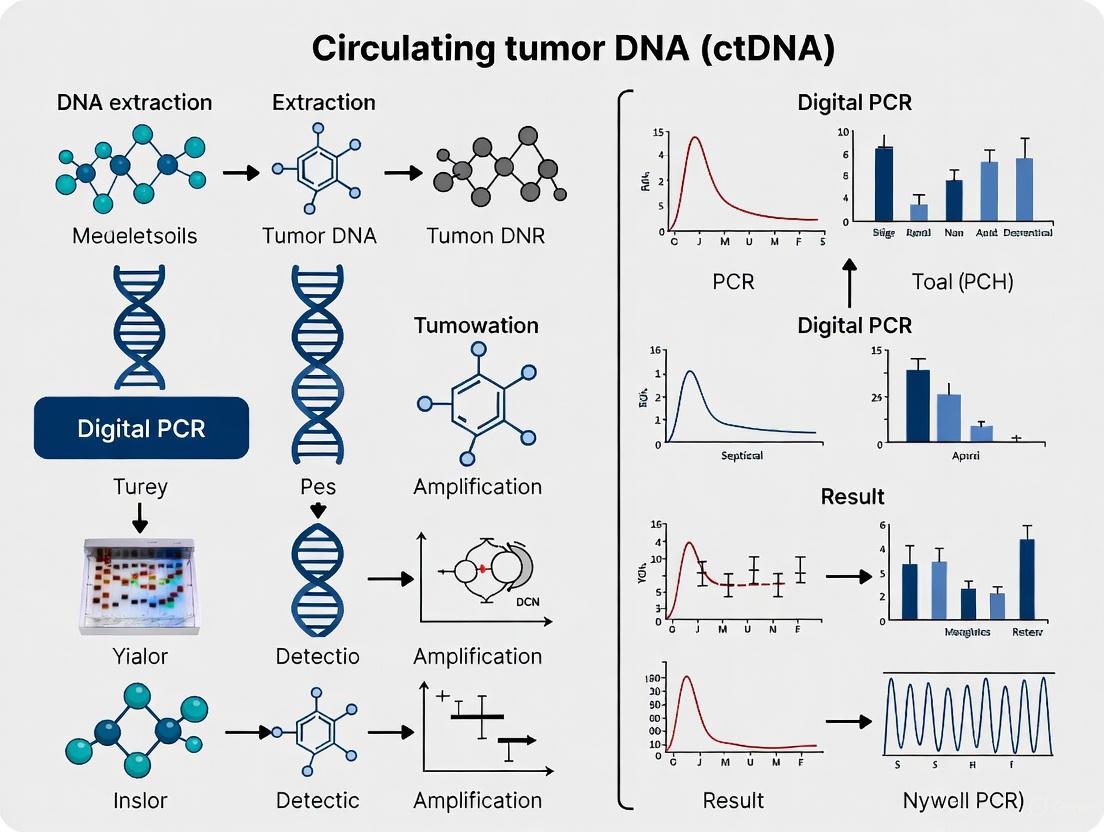
This article provides a comprehensive overview of circulating tumor DNA (ctDNA) and digital PCR (dPCR) for researchers, scientists, and drug development professionals.
Circulating Tumor DNA and Digital PCR: A Comprehensive Guide for Cancer Researchers and Drug Developers
Abstract
This article provides a comprehensive overview of circulating tumor DNA (ctDNA) and digital PCR (dPCR) for researchers, scientists, and drug development professionals. It covers the biological foundations of ctDNA, including its origin, characteristics, and significance as a real-time biomarker. The methodological section details dPCR workflows, its application in minimal residual disease (MRD) detection, and therapy monitoring. The guide also addresses key technical challenges and optimization strategies, and offers a comparative analysis with next-generation sequencing (NGS). By synthesizing the latest research and clinical evidence, this resource aims to support the development and implementation of precision oncology tools.
The Biology of Circulating Tumor DNA: From Origin to Clinical Significance
Circulating tumor DNA (ctDNA) refers to small fragments of DNA that are shed from tumor cells into the bloodstream and other biofluids [1] [2]. These fragments carry tumor-specific genetic characteristics, making them a valuable biomarker in oncology. ctDNA is a subset of cell-free DNA (cfDNA), which encompasses all DNA fragments circulating in bodily fluids, predominantly originating from the physiological apoptosis of hematopoietic and other normal cells [1] [2]. The key distinction lies in its origin and molecular features: ctDNA is derived specifically from malignant cells or cells within the tumor microenvironment and harbors somatic mutations, methylation changes, or other genomic alterations that distinguish it from non-tumor cfDNA [1] [2].
The half-life of ctDNA in circulation is remarkably short, estimated to be between 16 minutes and several hours [1]. This transient nature enables real-time monitoring of tumor dynamics, reflecting current tumor burden and offering a dynamic window into cancer progression and treatment response [1].
Table 1: Fundamental Characteristics of ctDNA and Its Relationship to cfDNA
| Characteristic | Cell-Free DNA (cfDNA) | Circulating Tumor DNA (ctDNA) |
|---|---|---|
| Definition | All DNA fragments in circulation | DNA fragments originating from tumor cells |
| Primary Sources | Apoptosis of normal cells (e.g., hematopoietic) | Apoptosis, necrosis, or active release from tumor cells [1] [2] |
| Presence | Healthy individuals and patients | Predominantly cancer patients [2] |
| Key Features | Non-specific | Carries tumor-specific alterations (e.g., mutations, methylation) [2] |
| Typical Fragment Size | ~166 bp (mono-nosomal pattern) | Highly fragmented, often <100 bp [2] |
| Proportion of Total cfDNA | 100% | Typically <1% to 10% (can be higher in advanced disease) [1] [2] |
| Half-Life | Several hours [1] | 16 minutes to several hours [1] |
Biological Origins and Molecular Features
Mechanisms of Release and Processing
ctDNA is released into the circulation through passive and active mechanisms. Passive release occurs after cellular breakdown, primarily from tumor cells undergoing apoptosis, necrosis, pyroptosis, or autophagy [2]. Active release involves the deliberate secretion of DNA by cells, potentially via extracellular vesicles or other structures [2]. Once in the bloodstream, the highly fragmented nature of ctDNA is thought to reflect the underlying chromatin structure of its cell of origin, with cleavage occurring between nucleosomes [1] [2].
distinguishing ctDNA from Background cfDNA
The reliable detection of ctDNA is analytically challenging because it often constitutes a very small fraction (sometimes less than 0.01%) of the total cfDNA in plasma [3]. Researchers leverage specific tumor-derived features to distinguish ctDNA from the background of normal cfDNA:
- Somatic Mutations: The presence of single nucleotide variants (SNVs), insertions, deletions, or copy number alterations (CNAs) not found in the patient's germline DNA is a primary marker for ctDNA [1].
- Methylation Profiles: Cancer cells exhibit distinct DNA methylation patterns, and these epigenetic signatures can be used to identify ctDNA with high specificity [1] [2].
- Fragmentation Patterns: The fragmentation of ctDNA is non-random. Research has shown that the size distribution of ctDNA fragments and the sequences at their endpoints (end motifs) differ from those of normal cfDNA, providing another layer of discrimination [1].
- Viral DNA Sequences: In virus-associated cancers (e.g., certain lymphomas, nasopharyngeal carcinoma), the detection of viral DNA sequences in plasma serves as a proxy for ctDNA [1].
Detection Technologies and Methodologies
The detection and analysis of ctDNA require highly sensitive and specific molecular techniques capable of identifying rare mutant molecules amid a vast excess of wild-type DNA.
Digital PCR (dPCR)
Digital PCR represents a third-generation PCR technology that enables absolute quantification of nucleic acids without the need for a standard curve [4] [2]. The core principle involves partitioning a PCR reaction mixture into thousands to millions of individual reactions so that each partition contains either zero, one, or a few target molecules [4]. Following end-point PCR amplification, the partitions are analyzed for fluorescence, and the fraction of positive partitions is used to compute the absolute concentration of the target sequence based on Poisson statistics [4].
Key dPCR Methodologies:
- Droplet Digital PCR (ddPCR): The sample is dispersed into nanoliter-sized water-in-oil droplets using a microfluidic chip [4] [2].
- Chip-Based Digital PCR (cdPCR): The PCR mixture is loaded into a microfabricated chip containing tens of thousands of microchambers [4].
Experimental Protocol for ddPCR-based ctDNA Detection:
- Sample Preparation: Extract cfDNA from patient plasma using a commercial kit. The quantity and quality of cfDNA are assessed using a spectrophotometer or fluorometer.
- Assay Design: Design and validate primer-probe sets (e.g., TaqMan) specific to the mutation of interest (e.g., a KRAS G12D mutation) and a reference wild-type sequence.
- Partitioning and PCR:
- Prepare the PCR reaction mix containing the extracted cfDNA, primers, probes, and dPCR supermix.
- Load the mixture into a droplet generator to create thousands of individual droplets.
- Transfer the droplets to a PCR plate and run a standard thermal cycling protocol.
- Endpoint Fluorescence Reading: After amplification, load the droplet plate into a droplet reader. This instrument flows the droplets single-file past a fluorescence detector, classifying each droplet as positive (mutant), positive (wild-type), or negative (no target).
- Data Analysis and Quantification: The instrument's software uses Poisson statistics to calculate the absolute concentration of mutant and wild-type DNA fragments (in copies/μL) and the variant allele frequency (VAE).
Next-Generation Sequencing (NGS)
NGS technologies allow for the parallel sequencing of millions of DNA molecules, providing a comprehensive and untargeted approach to ctDNA analysis [1] [2]. This is particularly valuable for discovering novel mutations, assessing tumor mutational burden, and analyzing complex genomic regions.
Common NGS-based Approaches for ctDNA:
- Targeted Error-Correction Sequencing (TEC-Seq): An ultrasensitive method for detecting low-frequency mutations across a targeted gene panel [1].
- CAncer Personalized Profiling by Deep Sequencing (CAPP-Seq): A method that uses a selector of recurrently mutated regions in a cancer type to achieve sensitive ctDNA detection [1].
- Whole-Genome Sequencing (WGS) / Whole-Exome Sequencing (WES): These broader approaches are less commonly used for low-frequency ctDNA detection due to cost and depth constraints but can be used for tumor-informed assay design [1] [5].
Experimental Protocol for Tumor-Informed NGS-based MRD Detection (e.g., Signatera Assay):
- Tissue and Blood Sampling:
- Collect a primary tumor tissue sample (e.g., from surgery) and a matched normal sample (e.g., blood or saliva) from the patient.
- Collect a blood sample for plasma isolation (the "baseline" liquid biopsy).
- Tumor Whole Exome/Genome Sequencing: Perform WES or WGS on the tumor and normal DNA to identify patient-specific somatic mutations (typically 16-50 variants).
- Personalized Assay Design: A custom NGS panel is computationally designed to target the unique set of somatic mutations identified in the patient's tumor.
- Longitudinal ctDNA Monitoring: For subsequent monitoring, only a blood draw is needed. cfDNA is extracted from plasma and sequenced using the patient's personalized NGS panel.
- Bioinformatic Analysis: The sequencing data are analyzed to detect the presence or absence of the tumor-derived mutations, providing a highly sensitive and specific readout of MRD [5].
Table 2: Comparison of Key ctDNA Detection Technologies
| Parameter | Digital PCR (dPCR) | Next-Generation Sequencing (NGS) |
|---|---|---|
| Principle | Absolute quantification via partitioning and Poisson statistics | Massively parallel sequencing of DNA fragments |
| Throughput | Low-plex (1 to a few targets per reaction) | High-plex (dozens to thousands of targets) |
| Sensitivity | Very high (can detect VAF < 0.1% [6] to 0.001% [2]) | High (dependent on sequencing depth; ~0.01% for some error-corrected methods [1]) |
| Quantification | Absolute, calibration-free | Relative, requires bioinformatic analysis |
| Primary Application | Tracking known, specific mutations; MRD monitoring | Comprehensive genomic profiling; discovery of novel alterations; tumor-informed MRD |
| Turnaround Time | Rapid (hours to a day) | Longer (days to weeks) |
| Cost | Lower per sample for a few targets | Higher, especially for high-depth sequencing |
The Scientist's Toolkit: Essential Reagents and Materials
Successful ctDNA analysis relies on a suite of specialized reagents and tools. The following table details key components for a typical dPCR-based detection experiment.
Table 3: Essential Research Reagent Solutions for ctDNA Analysis (dPCR Focus)
| Item | Function | Key Considerations |
|---|---|---|
| cfDNA Extraction Kit | Isolation of high-quality, short-fragment DNA from plasma. | Select kits optimized for low-abundance, fragmented DNA to maximize yield and purity. |
| Droplet Generator Oil & Surfactant | Creates a stable water-in-oil emulsion for ddPCR. | Prevents droplet coalescence during thermal cycling; critical for partition integrity [4]. |
| dPCR Supermix | A master mix containing DNA polymerase, dNTPs, and buffer optimized for digital PCR. | Should have high efficiency and robustness for amplification within partitions. |
| Fluorescent Probe-Based Assays (e.g., TaqMan) | Sequence-specific detection of wild-type and mutant alleles. | Probes for mutant and wild-type targets are labeled with different fluorophores (e.g., FAM, HEX/VIC) for multiplexing. |
| Microfluidic Cartridges/Chips | Physical substrates for creating nanoliter-scale reaction chambers. | Specific to the commercial dPCR platform used (e.g., Bio-Rad QX200, Thermo Fisher QuantStudio) [4]. |
| Unique Molecular Identifiers (UMIs) | Short DNA barcodes ligated to individual DNA fragments before amplification. | Allows bioinformatic correction of PCR amplification errors and biases, improving quantification accuracy for NGS and advanced dPCR [1]. |
Clinical and Research Applications in Context
The unique properties of ctDNA have paved the way for numerous applications that are transforming both clinical practice and oncology research, particularly within the framework of precision medicine.
Treatment Response Monitoring and Minimal Residual Disease (MRD): ctDNA levels are dynamically correlated with tumor burden. A decline in ctDNA concentration during therapy indicates a positive response, while the persistence or reappearance of ctDNA after curative-intent surgery (MRD) is a powerful predictor of future clinical relapse, often months before radiographic evidence [1] [7] [5]. The high sensitivity of dPCR makes it exceptionally suited for this application [6].
Treatment Selection and Genomic Profiling: Liquid biopsy can identify actionable mutations (e.g., in EGFR, KRAS, BRAF, ESR1) to guide the use of targeted therapies, especially when tissue is unavailable [1] [7] [8]. NGS-based ctDNA tests provide a broad view of the genomic landscape, capturing spatial heterogeneity.
Early Cancer Detection: Research is actively exploring the use of ctDNA, often in combination with methylation profiling, for multi-cancer early detection (MCED) in asymptomatic populations [8].
The global ctDNA market, valued at USD 7.96 billion in 2025, reflects the growing adoption of this technology, driven largely by applications in cancer diagnosis and MRD monitoring [9]. As detection technologies continue to evolve, the integration of dPCR for ultra-sensitive tracking of known mutations and NGS for comprehensive profiling will remain a cornerstone of advanced cancer research and personalized patient management.
Circulating tumor DNA (ctDNA) has emerged as a transformative biomarker in oncology, enabling non-invasive liquid biopsies for cancer diagnosis, prognosis, and monitoring. The clinical utility of ctDNA hinges on understanding its biological origins—the fundamental cellular processes that govern its release into circulation. CtDNA consists of fragmented DNA derived from tumor cells that enters the bloodstream and other bodily fluids through specific release mechanisms. The composition and characteristics of ctDNA are directly influenced by its mode of release, which includes passive pathways like apoptosis and necrosis, as well as active secretion from viable tumor cells. This article examines these core release mechanisms within the context of digital PCR (dPCR) research, a leading technology for ctDNA detection and quantification. A comprehensive understanding of these origins is essential for optimizing ctDNA-based liquid biopsy applications in research and clinical settings.
Apoptosis: The Programmed Pathway
Apoptosis, a form of programmed cell death (Type I cell death), is considered a major source of ctDNA in the bloodstream [10] [11]. This highly regulated process of cellular suicide is triggered by specific internal or external signals and plays crucial roles in development, homeostasis, and the elimination of damaged cells [10].
Molecular Mechanisms and Signaling Pathways
The execution of apoptosis occurs through two principal pathways:
- Extrinsic Pathway (Death Receptor Pathway): Initiated when external ligands (e.g., TNF-α or FasL) bind to death receptors on the cell surface, leading to the formation of the death-inducing signaling complex (DISC). This complex activates initiator caspases (caspase-8 and -10), which in turn activate effector caspases (caspases-3, -6, and -7), resulting in cellular breakdown [10].
- Intrinsic Pathway (Mitochondrial Pathway): Activated by internal cellular disturbances such as oxidative stress, DNA damage, or mitochondrial damage. These stressors trigger an imbalance between pro-apoptotic (e.g., Bax, Bak, Bok) and anti-apoptotic proteins (e.g., Bcl-2, Bcl-xL), leading to increased mitochondrial membrane permeability. This allows cytochrome c to escape into the cytosol, where it binds with Apoptotic Protease Activating Factor-1 (APAF1) to form the apoptosome, ultimately activating caspase-9 and the execution phase of apoptosis [10].
The following diagram illustrates the key molecular events in apoptotic ctDNA release:
Characteristics of Apoptosis-Derived ctDNA
The controlled enzymatic degradation of cellular components during apoptosis imparts specific characteristics to the resulting ctDNA:
- Fragment Size Profile: Apoptosis-derived ctDNA exhibits a distinctive ladder-like pattern, with a dominant peak at approximately 167 base pairs [11]. This size corresponds to the length of DNA wrapped around a single nucleosome (147 bp) plus linker DNA (20 bp) [11].
- Internucleosomal Cleavage: Activation of caspases during apoptosis triggers specific nucleases, including Caspase-Activated DNase (CAD), which cleaves DNA at internucleosomal regions [11].
- Protection from Degradation: DNA is fragmented and packaged into apoptotic bodies, which protects it from immediate degradation by circulating nucleases until it is processed by phagocytic cells [11].
Table 1: Key Features of Apoptosis-Derived ctDNA
| Characteristic | Description | Biological Significance |
|---|---|---|
| Primary Fragment Size | ~167 bp peak | Corresponds to mononucleosomal DNA protection |
| Fragmentation Pattern | Ladder-like pattern on gel electrophoresis | Result of internucleosomal cleavage by specific nucleases |
| Release Mechanism | Packaged in apoptotic bodies | Protects DNA from immediate degradation |
| End Processing | Phagocytosis by macrophages | Final enzymatic digestion and release as soluble ctDNA |
| Typical VAF Range | 0.01% - 2.5% of total cfDNA [12] | Lower background from hematopoietic cells preferred |
Necrosis: The Inflammatory Pathway
Necrosis represents a distinct mechanism of cell death that contributes significantly to the ctDNA pool, particularly in advanced tumors or under conditions of severe cellular stress [11] [13]. Unlike apoptosis, necrosis has traditionally been characterized as an uncontrolled, accidental form of cell death (Type III cell death) resulting from extreme physical, chemical, or mechanical insults [10] [14].
Molecular Mechanisms and Signaling Pathways
Necrosis occurs through several distinct pathways:
- Accidental Necrosis: Triggered by extreme stressors that cause ATP depletion, ionic imbalance, mitochondrial dysfunction, and eventual osmotic lysis of the plasma membrane [13].
- Regulated Necrosis: Includes specific subtypes such as:
- Necroptosis: Activated by death receptors under caspase-deficient conditions, involving RIPK1, RIPK3, and MLKL phosphorylation, leading to membrane permeabilization [14] [13].
- Pyroptosis: Inflammasome-mediated cell death executed by gasdermin proteins, which form plasma membrane pores [14] [13].
- Ferroptosis: Iron-dependent cell death characterized by glutathione depletion and phospholipid peroxidation [14].
The following diagram illustrates necrotic cell death pathways and their contribution to ctDNA release:
Characteristics of Necrosis-Derived ctDNA
The unregulated nature of necrotic cell death imparts distinct characteristics to the resulting ctDNA:
- Fragment Size Profile: Necrosis produces longer, more heterogeneous DNA fragments ranging from thousands of base pairs to high molecular weight DNA [11]. This results from nonspecific, random DNA degradation.
- Inflammatory Potential: Necrotic cells release damage-associated molecular patterns (DAMPs), including HMGB1, histones, and formylated peptides, which trigger robust inflammatory responses through pattern recognition receptors (PRRs) such as Toll-like receptors (TLRs) [13].
- Clearance Mechanisms: Systemic clearance involves extracellular DNases, the actin-scavenger system, fibrinolytic systems, and reticuloendothelial cells (Kupffer cells, LSECs) [13].
Table 2: Comparative Features of Apoptosis and Necrosis-Derived ctDNA
| Characteristic | Apoptosis-Derived ctDNA | Necrosis-Derived ctDNA |
|---|---|---|
| Primary Fragment Size | ~167 bp (mononucleosomal) | Longer, heterogeneous fragments (up to kb range) |
| Fragmentation Pattern | Ladder-like, organized | Random, disorganized |
| Inflammatory Response | Minimal to absent | Significant, pro-inflammatory |
| DNA Quality | Uniform, protected in bodies | Heterogeneous, exposed to nucleases |
| Key Molecular Triggers | Caspase activation, cytochrome c | ATP depletion, membrane damage, RIPK3/MLKL |
| Cellular Morphology | Cell shrinkage, membrane blebbing | Cellular swelling, membrane rupture |
| DAMP Release | Limited, controlled | Extensive, uncontrolled |
Active Secretion: The Regulated Pathway
Beyond passive release through cell death, emerging evidence indicates that viable tumor cells can actively release DNA through regulated mechanisms. This pathway may contribute significantly to ctDNA pools, particularly in contexts where tumor cell death is limited.
Mechanisms of Active ctDNA Secretion
Active secretion occurs through several documented pathways:
- Extracellular Vesicles (EVs): Tumor cells actively release DNA enclosed within extracellular vesicles, including exosomes and microvesicles. This DNA is protected from degradation and can reflect the tumor's genetic makeup [11].
- Direct Release from Live Cells: Viable tumor cells may release DNA through unknown active mechanisms independent of classical cell death pathways, potentially in response to specific cellular stimuli [11].
- Circadian Dynamics: Studies have reported fluctuations in ctDNA levels according to circadian rhythms, with increased concentrations observed at night, suggesting regulated release mechanisms [12].
Detection Methodologies: Digital PCR Applications
Digital PCR (dPCR) represents a third-generation PCR technology that enables absolute quantification of nucleic acids without need for standard curves. This technology is particularly suited for detecting rare mutations in ctDNA against a background of wild-type DNA [4] [15] [16].
dPCR Workflow and Principles
The fundamental dPCR process involves four key steps:
- Partitioning: A PCR mixture containing the sample is divided into thousands to millions of separate partitions (droplets or microchambers) so that each contains zero, one, or a few target molecules [4].
- Amplification: PCR amplification occurs independently within each partition [4].
- Endpoint Detection: Following amplification, each partition is analyzed for fluorescence to determine if it contains the target sequence [4].
- Absolute Quantification: The fraction of positive partitions is used to calculate the absolute concentration of the target molecule based on Poisson statistics [4].
Experimental Protocol for ctDNA Detection Using dPCR
Sample Collection and Processing [12]:
- Collect 2 × 10 mL of blood using butterfly needles, avoiding excessively thin needles and prolonged tourniquet use.
- Use blood collection tubes (BCTs) with cell-stabilizing preservatives (e.g., Streck cfDNA tubes, PAXgene Blood ccfDNA tubes) to maintain sample integrity for up to 7 days at room temperature.
- Process EDTA tubes within 2-6 hours at 4°C if stabilizer tubes are unavailable.
- Perform two-step centrifugation: first at 1,600-2,000 × g for 10 minutes at 4°C to separate plasma, then at 16,000 × g for 10 minutes to remove residual cells.
- Store plasma at -80°C until DNA extraction.
ctDNA Extraction and dPCR Analysis [15] [16]:
- Extract ctDNA from plasma using commercially available circulating nucleic acid kits.
- Quantify total cell-free DNA concentration using fluorometric methods.
- Prepare dPCR reactions using mutation-specific assays (e.g., TaqMan probes) and partition according to platform specifications.
- For rare mutation detection, ensure sufficient partitions are generated to achieve desired sensitivity (typically 20,000+ droplets for ddPCR).
- Analyze fluorescence data to determine variant allele frequency (VAF) using platform-specific software.
Table 3: Research Reagent Solutions for ctDNA Analysis
| Reagent/Category | Specific Examples | Function/Application |
|---|---|---|
| Blood Collection Tubes | Streck cfDNA BCT, PAXgene Blood ccfDNA tubes (Qiagen), Roche cfDNA tubes | Preserve blood sample integrity, prevent white blood cell lysis |
| Nucleic Acid Extraction Kits | Circulating nucleic acid kits (various manufacturers) | Isolate and purify ctDNA from plasma/serum |
| dPCR Master Mixes | QuantStudio Absolute Q dPCR Master Mix, ddPCR Supermix | Provide optimized reagents for partition-based amplification |
| Mutation Detection Assays | TaqMan dPCR assays, Absolute Q Liquid Biopsy dPCR assays | Enable specific detection of oncogenic mutations (e.g., KRAS) |
| Partitioning Reagents | Droplet generation oil (Bio-Rad), microfluidic array plates | Create nanoliter-scale reaction chambers for single-molecule PCR |
Enhancing ctDNA Detection Sensitivity
Several approaches can improve the sensitivity of ctDNA detection:
- Induction of Transient ctDNA Release: Local tumor irradiation can induce a transient increase in ctDNA concentration 6-24 hours post-procedure, potentially enhancing detection rates [12].
- Ultra-Deep Sequencing Methods: Modified next-generation sequencing (NGS) protocols can discriminate between true low-copy mutations and sequencing artifacts [12].
- Slowing ctDNA Clearance: Experimental approaches targeting liver macrophages and circulating nucleases may slow physiological ctDNA decay, though these remain primarily in animal testing stages [12].
The origin and release mechanisms of ctDNA—through apoptosis, necrosis, and active secretion—fundamentally shape its characteristics and clinical utility as a liquid biopsy biomarker. Apoptosis provides the regular, nucleosome-protected fragments that form the baseline of ctDNA detection, while necrosis contributes more variable, inflammatory-associated DNA. Active secretion mechanisms may further supplement the ctDNA pool, particularly in treatment-resistant contexts. Digital PCR technology has emerged as a powerful tool for detecting these tumor-derived fragments, with partitioning strategies enabling rare mutation detection at variant allele frequencies as low as 0.1% [16]. As our understanding of ctDNA biology deepens and detection technologies continue to evolve, the integration of mechanism-aware analytical approaches will undoubtedly enhance the sensitivity and specificity of liquid biopsy applications in cancer research and clinical management.
Circulating tumor DNA (ctDNA) represents a fraction of cell-free DNA (cfDNA) that is shed by tumor cells into the bloodstream and other bodily fluids, carrying the genetic signatures of both primary and metastatic tumors [17] [18]. As a critical component of liquid biopsy, ctDNA analysis provides a non-invasive method for cancer detection, genotyping, treatment monitoring, and assessment of minimal residual disease [17] [19]. The clinical utility of ctDNA stems from its ability to offer a real-time snapshot of tumor burden and heterogeneity, overcoming limitations associated with traditional tissue biopsies [17] [20].
Understanding the fundamental characteristics of ctDNA—particularly its short half-life, low concentration, and rapid clearance—is essential for developing robust detection assays and interpreting clinical results accurately [17] [18]. These characteristics present both challenges and opportunities for clinical applications. While the short half-life enables real-time monitoring of treatment response, the low concentration demands highly sensitive detection technologies [4] [21]. This technical guide explores these core characteristics within the broader context of ctDNA biology and digital PCR research, providing researchers and drug development professionals with a comprehensive framework for leveraging ctDNA in oncology research and clinical development.
Biological Foundations of ctDNA
Origins and Release Mechanisms
ctDNA enters the circulation through multiple biological processes, with current evidence suggesting three primary mechanisms of release [17] [18]:
Apoptosis (Programmed Cell Death): This is considered a major source of ctDNA, where tumor cells undergoing apoptosis package DNA into nucleosomal fragments that are subsequently released into circulation [17] [18]. ctDNA derived from apoptosis typically exhibits a ladder-like pattern with a predominant fragment size of approximately 167 base pairs, corresponding to DNA wrapped around a single nucleosome plus linker DNA [18]. This fragmentation pattern provides protection against nuclease digestion and represents a characteristic feature of apoptosis-derived ctDNA.
Necrosis: Rapid tumor cell death due to hypoxia or metabolic stress leads to necrosis, resulting in the release of larger, more random DNA fragments that can range up to several kilobases in length [17] [18]. Unlike the controlled fragmentation in apoptosis, necrotic cells exhibit organelle dysfunction and plasma membrane aberrations, leading to the random release of cellular components including DNA [18].
Active Secretion from Viable Cells: Emerging evidence suggests that viable tumor cells can actively release DNA through extracellular vesicles (EVs) or other secretory mechanisms, although this pathway is less characterized than apoptotic or necrotic release [18]. This active secretion may contribute to the presence of ctDNA in early-stage cancer patients where substantial cell death may not yet have occurred [17].
The following diagram illustrates the primary release mechanisms and subsequent clearance of ctDNA:
Figure 1: ctDNA Release Mechanisms and Clearance Pathways
Fragment Size and Molecular Characteristics
ctDNA exhibits distinct molecular characteristics that differentiate it from non-tumor cfDNA. While early studies debated whether ctDNA fragments were longer or shorter than non-tumor cfDNA, recent evidence suggests that ctDNA tends to be shorter than non-cancer cell-free DNA [17]. Studies in liver and breast cancer patients have revealed that plasma contains both extremely long and short DNA molecules, with the short fragments more likely to harbor tumor-specific copy number aberrations [17].
ctDNA carries various cancer-associated molecular alterations, including:
- Single-nucleotide variants (SNVs) [17]
- Copy number variations (CNVs) [17] [20]
- Methylation changes [17]
- Cancer-derived viral sequences (in virus-associated cancers) [17]
These tumor-specific alterations enable the discrimination of ctDNA from normal cfDNA, providing the foundation for highly specific cancer detection and monitoring assays.
Core Characteristics of ctDNA
Short Half-Life and Clearance Dynamics
The half-life of ctDNA is remarkably short, estimated to range from 16 minutes to 2.5 hours depending on the clinical context [18]. This rapid clearance occurs through multiple pathways:
- Enzymatic Degradation: Circulating nucleases, particularly DNase I, systematically cleave ctDNA fragments in the bloodstream [18].
- Hepatic Clearance: The liver and reticuloendothelial system actively remove ctDNA from circulation [18].
- Renal Filtration: Smaller DNA fragments are filtered through the kidneys and excreted in urine [18].
This brief window of detectability makes ctDNA an excellent biomarker for monitoring dynamic changes in tumor burden, especially during active treatment. The rapid clearance enables almost real-time assessment of treatment response, as changes in ctDNA levels can be detected within hours to days after intervention, far preceding radiographic changes [19] [22].
Low Concentration and Detection Challenges
The concentration of ctDNA in blood presents a significant challenge for detection, particularly in early-stage cancers or minimal residual disease. Key aspects include:
- Variant Allele Frequency (VAF): ctDNA typically represents only a small fraction (0.01% to 10%) of total cfDNA, with VAF decreasing dramatically in early-stage disease or following effective treatment [17] [20].
- Tumor Burden Correlation: ctDNA levels generally correlate with tumor volume, though this relationship varies by cancer type and genotype [20]. Advanced cancers typically yield higher ctDNA concentrations, while early-stage tumors may have ctDNA concentrations below 0.1% VAF [17] [20].
- Genotype Dependence: Different tumor genotypes exhibit varying propensities for ctDNA shedding. For instance, KRAS-mutant and TP53-mutant non-small cell lung cancers (NSCLC) show stronger correlation between ctDNA VAF and tumor volume than EGFR-mutant tumors [20].
Table 1: Quantitative Characteristics of ctDNA in Different Clinical Scenarios
| Clinical Scenario | Typical VAF Range | Approximate ctDNA Concentration | Key Influencing Factors |
|---|---|---|---|
| Early-stage Cancer | 0.01% - 0.1% | Very low (<10 copies/mL) | Tumor size, vascularity, location |
| Advanced Cancer | 0.1% - 10% | Moderate to high | Tumor burden, metastasis, genotype |
| Post-treatment Nadir | <0.01% - 0.05% | Very low to undetectable | Treatment efficacy, resistance |
| Progressive Disease | Increasing VAF | Rising concentration | Tumor proliferation, resistance emergence |
Biological and Clinical Implications
The unique characteristics of ctDNA have profound implications for both biology and clinical applications:
- Real-time Monitoring Capability: The short half-life enables dynamic tracking of tumor burden, allowing for early assessment of treatment response [19] [22].
- Technical Detection Challenges: The low concentration demands highly sensitive technologies capable of detecting rare mutations in a background of wild-type DNA [17] [4].
- Preanalytical Considerations: Blood collection, processing, and storage conditions critically impact ctDNA stability and recovery, requiring standardized protocols [18].
- Biological Significance: Beyond being a passive biomarker, some studies suggest ctDNA may actively participate in cancer progression through horizontal gene transfer and oncogenic transformation of susceptible cells, though this "genometastasis" hypothesis requires further validation [17].
Digital PCR Technologies for ctDNA Analysis
Fundamental Principles of dPCR
Digital PCR (dPCR) represents the third generation of PCR technology, enabling absolute quantification of nucleic acids without the need for standard curves [4] [21]. The core principle involves partitioning a PCR reaction into thousands to millions of individual reactions so that each partition contains either 0, 1, or a few target molecules [4]. Following amplification, the fraction of positive partitions is counted, and the original target concentration is calculated using Poisson statistics [4] [21].
The dPCR workflow consists of four key steps:
- Partitioning: The PCR mixture containing the sample is divided into numerous individual compartments [4] [21].
- Amplification: Each partition undergoes endpoint PCR amplification [4].
- Fluorescence Detection: Partitions are analyzed for fluorescence signals indicating target amplification [4] [21].
- Quantitative Analysis: Target concentration is calculated based on the proportion of positive partitions using Poisson distribution statistics [4] [21].
dPCR Platform Technologies
Two major partitioning methods have emerged for dPCR implementation:
Droplet Digital PCR (ddPCR): Utilizes water-in-oil emulsion technology to create nanoliter-sized droplets, typically generating 20,000 droplets per sample with commercial systems [4] [21]. Recent advances have led to integrated systems that combine droplet generation, amplification, and detection on single microfluidic devices [21].
Chip-based Digital PCR (cdPCR): Employs microfabricated chips with fixed arrays of microchambers, offering higher reproducibility but typically lower partition counts compared to ddPCR [4] [21].
The following workflow illustrates a typical ddPCR process for ctDNA detection:
Figure 2: Digital PCR Workflow for ctDNA Analysis
Comparative Advantages for ctDNA Analysis
dPCR offers several critical advantages for ctDNA analysis compared to other detection methods:
- Enhanced Sensitivity: Capable of detecting rare mutations down to 0.001%-0.01% VAF, essential for early cancer detection and MRD monitoring [4] [21].
- Absolute Quantification: Eliminates the need for standard curves, providing direct measurement of target concentration [4] [21].
- Superior Precision: Offers high reproducibility and accuracy, particularly at low target concentrations [4].
- Tolerance to PCR Inhibitors: The partitioning process dilutes inhibitors present in blood samples, improving robustness [21].
Table 2: Comparison of PCR Technologies for ctDNA Detection
| Parameter | Digital PCR (dPCR) | Quantitative PCR (qPCR) | Next-Generation Sequencing (NGS) |
|---|---|---|---|
| Detection Limit | 0.001% - 0.01% VAF | 1% - 5% VAF | 0.1% - 1% VAF (varies by approach) |
| Quantification | Absolute | Relative | Relative or semi-quantitative |
| Multiplexing Capacity | Moderate (2-5 plex) | Low (1-2 plex) | High (dozens to hundreds) |
| Throughput | Medium | High | Medium to High |
| Cost per Sample | Medium | Low | High |
| Best Applications | Low VAF detection, MRD monitoring | High VAF detection, screening | Comprehensive profiling, novel mutation discovery |
Experimental Protocols for ctDNA Characterization
Blood Collection and Plasma Processing
Proper preanalytical procedures are critical for reliable ctDNA analysis:
Blood Collection: Draw 10-20 mL of whole blood into cell-stabilizing tubes (e.g., Streck Cell-Free DNA BCT or PAXgene Blood ccfDNA tubes) to prevent leukocyte lysis and preserve ctDNA integrity [18].
Processing Timeline: Process samples within 2-6 hours of collection when using standard EDTA tubes, or within up to 7 days when using specialized cell-stabilizing tubes [18].
Plasma Separation: Centrifuge at 1600-2000 × g for 10-20 minutes at 4°C to separate plasma from blood cells. Transfer the supernatant to a fresh tube and perform a second centrifugation at 16,000 × g for 10 minutes to remove remaining cellular debris [18].
Storage: Store plasma at -80°C if not proceeding immediately to DNA extraction. Avoid repeated freeze-thaw cycles [18].
ctDNA Extraction and Quality Control
Multiple commercial kits are available for ctDNA extraction, with selection depending on required yield, fragment size retention, and downstream applications:
Extraction Methods: Use silica membrane-based columns or magnetic bead systems optimized for recovery of short DNA fragments [18].
Quality Assessment: Quantify cfDNA using fluorescence-based methods (e.g., Qubit dsDNA HS Assay) rather than UV absorbance, and assess fragment size distribution using microfluidic capillary electrophoresis (e.g., Bioanalyzer, TapeStation) [18].
Yield Expectations: Typical yields range from 1-50 ng cfDNA per mL of plasma, with higher yields generally associated with advanced cancer stages [18].
dPCR Assay Design and Optimization
For optimal dPCR performance in ctDNA detection:
Assay Design: Design primers and probes to amplify short targets (60-100 bp) to accommodate fragmented ctDNA. Place probes over mutation sites with the variant nucleotide in the middle of the probe sequence [4] [21].
Partitioning Optimization: Ensure proper partition formation by verifying droplet generation or chip loading efficiency. Aim for 10,000-20,000 partitions per reaction for optimal Poisson statistics [4] [21].
Thermal Cycling Conditions: Use touchdown PCR protocols or optimized annealing temperatures to ensure specific amplification. Include no-template controls and wild-type controls in each run [4].
Threshold Setting: Establish fluorescence amplitude thresholds using control samples to accurately distinguish positive and negative partitions [4] [21].
Data Analysis and Interpretation
Concentration Calculation: Apply Poisson correction to account for multiple targets per partition: Concentration = -ln(1 - p) / V where p is the fraction of positive partitions and V is the partition volume [4] [21].
Limit of Blank (LOB) Determination: Analyze multiple negative controls to establish background signal levels and set detection thresholds that minimize false positives [4].
Confidence Interval Calculation: Compute 95% confidence intervals for concentration measurements based on binomial statistics of partition counts [4].
Mutation Calling: For variant detection, establish a threshold based on the expected number of false positive partitions in wild-type controls, typically requiring ≥3 positive partitions for a positive call [4] [21].
The Scientist's Toolkit: Essential Research Reagents and Materials
Table 3: Key Research Reagents and Materials for ctDNA Analysis
| Category | Specific Products/Tools | Function and Application |
|---|---|---|
| Blood Collection Tubes | Streck Cell-Free DNA BCT, PAXgene Blood ccfDNA tubes | Preserve blood samples and prevent white blood cell lysis during storage and transport |
| Nucleic Acid Extraction | QIAamp Circulating Nucleic Acid Kit, MagMAX Cell-Free DNA Isolation Kit | Isolate ctDNA from plasma with high recovery of short fragments |
| dPCR Master Mixes | Bio-Rad ddPCR Supermix, TaqMan Genotyping Master Mix | Provide optimized reagents for amplification in partitioned reactions |
| Assay Design Tools | Primer-BLAST, UCSC In-Silico PCR, Custom TaqMan Assay Design Tool | Design specific primers and probes for target mutations |
| Reference Materials | Seraseq ctDNA Reference Materials, Horizon Multiplex I cfDNA Reference | Validate assay performance and establish detection limits |
| Quality Control Instruments | Agilent Bioanalyzer, Fragment Analyzer, Qubit Fluorometer | Assess DNA quantity, quality, and fragment size distribution |
| dPCR Instruments | Bio-Rad QX200, QIAcuity, QuantStudio Absolute Q | Perform partitioning, amplification, and detection of ctDNA targets |
The core characteristics of ctDNA—short half-life, low concentration, and rapid clearance—present both significant challenges and unique opportunities in cancer research and clinical diagnostics. While these properties demand highly sensitive detection methods and careful preanalytical procedures, they also enable real-time monitoring of tumor dynamics that cannot be achieved through traditional imaging or tissue biopsy approaches.
Digital PCR technologies have emerged as powerful tools for addressing the analytical challenges posed by ctDNA biology, offering the sensitivity, precision, and absolute quantification required for meaningful clinical and research applications. As these technologies continue to evolve toward greater automation, miniaturization, and integration, they promise to further expand the utility of ctDNA analysis in precision oncology.
Ongoing research into the biological mechanisms of ctDNA release, clearance, and potential functional roles will continue to refine our understanding of these fascinating molecules and optimize their application in cancer detection, monitoring, and therapeutic decision-making. For researchers and drug development professionals, mastering the technical aspects of ctDNA analysis remains essential for leveraging the full potential of this transformative biomarker in oncology.
Circulating tumor DNA (ctDNA) has emerged as a transformative biomarker in oncology, offering a non-invasive window into tumor genomics. This technical guide details how ctDNA analysis effectively captures tumor heterogeneity—a significant limitation of traditional tissue biopsies. We explore the synergy between ctDNA and advanced detection technologies, notably digital PCR (dPCR), providing a comprehensive resource for researchers and drug development professionals. The document covers the molecular basis of ctDNA, state-of-the-art detection methodologies, detailed experimental protocols, and the reagent toolkit essential for advancing research in this field.
Tumor heterogeneity encompasses the genetic, epigenetic, and phenotypic diversity exhibited by malignant cell populations. This heterogeneity manifests spatially, as differences between metastatic sites (inter-lesional) and within a single lesion (intra-lesional), and temporally, as tumors evolve under selective pressures from therapy and the microenvironment—a process termed clonal evolution [23]. This diversity has profound clinical implications, often leading to mixed treatment responses and the emergence of drug-resistant subclones [23].
Conventional tissue biopsies, while the historical gold standard for tumor genotyping, struggle to capture this dynamic complexity. They provide only a limited snapshot of a single anatomical site, are invasive, and are not suitable for repeated sampling to monitor evolution [24] [23]. Liquid biopsy, particularly through the analysis of ctDNA, presents a paradigm shift. ctDNA consists of short, double-stranded DNA fragments released into the bloodstream by tumor cells through apoptosis, necrosis, and active secretion [24] [1]. As a minimally invasive biomarker, ctDNA offers a real-time, comprehensive reflection of the total tumor burden, including subclones from different metastatic sites, thereby effectively overcoming the challenge of tumor heterogeneity [23] [25].
ctDNA Biology and Its Role in Capturing Heterogeneity
Origin and Properties
ctDNA is a component of the broader pool of cell-free DNA (cfDNA) found in circulation. While cfDNA is primarily derived from the apoptosis of hematopoietic cells, ctDNA carries tumor-specific genetic alterations. It is highly fragmented, with a typical size of 160-200 base pairs, reflecting its nucleosomal origin [24] [26]. The half-life of ctDNA is short, estimated between 16 minutes and 2.5 hours, which allows it to serve as a real-time indicator of tumor dynamics [27] [1] [26]. The concentration of ctDNA, or the tumor fraction (TF), can vary dramatically, from below 0.01% of total cfDNA in early-stage cancers or low-shedding tumors to over 90% in advanced metastatic disease [1] [26].
A Composite Biomarker for Systemic Disease
The fundamental advantage of ctDNA in addressing heterogeneity lies in its origin. As tumor cells from various locations—primary and metastatic—undergo turnover, they release their DNA into the bloodstream. This process creates a pooled sample in the plasma that contains genetic material from all contributing tumor subpopulations [1]. Consequently, a single blood draw can, in principle, capture the clonal mutations common to all tumor cells as well as the subclonal mutations unique to specific lesions, providing a more complete molecular portrait than a single tissue biopsy [23].
Figure 1: ctDNA as a Composite Biomarker. ctDNA fragments released from the primary tumor and distinct metastatic lesions mix in the bloodstream. A single liquid biopsy captures this composite, enabling a systemic genetic profile that overcomes spatial heterogeneity.
Advanced Detection Technologies
The low abundance of ctDNA in a high background of wild-type cfDNA demands highly sensitive detection technologies. The two primary pillars of ctDNA analysis are next-generation sequencing (NGS) and digital PCR (dPCR).
Next-Generation Sequencing (NGS)
NGS offers a hypothesis-free approach for comprehensive genomic profiling. It can interrogate hundreds of genes simultaneously, identifying single-nucleotide variants (SNVs), insertions/deletions (indels), copy number alterations (CNAs), and fusions. This breadth is ideal for discovering novel mutations and assessing heterogeneity without prior knowledge of the tumor's genetics [1] [25]. To achieve the required sensitivity for ctDNA, specialized NGS methods employ unique molecular identifiers (UMIs) and error-correction algorithms (e.g., Safe-SeqS, CAPP-Seq, TEC-Seq) to distinguish true low-frequency variants from PCR and sequencing errors [1].
Digital PCR (dPCR)
dPCR represents the third generation of PCR technology, enabling absolute quantification of nucleic acids without a standard curve. The method partitions a PCR reaction into thousands of individual nanoliter-volume reactions (water-in-oil droplets or microchambers). After end-point amplification, each partition is analyzed for fluorescence. The fraction of positive partitions is used to compute the absolute concentration of the target molecule using Poisson statistics [28].
Key Advantages for ctDNA Analysis:
- High Sensitivity: Capable of detecting rare mutations down to 0.1% variant allele frequency (VAF) or lower, which is crucial for MRD detection and early relapse monitoring [6] [1].
- Absolute Quantification: Provides a precise count of mutant DNA molecules per unit volume, enabling accurate longitudinal tracking of tumor burden [28] [6].
- Robustness: Less susceptible to PCR efficiency variations, making it highly reproducible and ideal for analyzing compromised samples like fragmented cfDNA [28].
While dPCR is exceptionally sensitive, it is typically limited to interrogating a small number of known mutations per assay, making it a targeted, tumor-informed approach [1].
Figure 2: Digital PCR Workflow. The sample is partitioned into thousands of reactions, amplified, and read. The binary (positive/negative) result from each partition allows for absolute quantification of the target.
Quantitative Data: ctDNA in Clinical Research
The following tables summarize key quantitative findings from recent research on ctDNA's ability to capture tumor heterogeneity and its clinical utility.
Table 1: Comparison of Mutational Profiles in Tissue vs. Liquid Biopsy [23]
| Patient | Mutations in Tissue (TBx) | Mutations in Liquid Biopsy (LBx) | Overlapping Mutations | TBx-exclusive Mutations | LBx-exclusive Mutations |
|---|---|---|---|---|---|
| Patient 1 | 8 | 7 | 5 | 3 | 2 |
| Patient 2 | 6 | 9 | 5 | 1 | 4 |
| Patient 3 | 5 | 6 | 4 | 1 | 2 |
| Patient 4 | 12 | 17 | 11 | 1 | 6 |
| Patient 5 | 10 | 8 | 4 | 6 | 4 |
| Patient 6 | 4 | 4 | 3 | 1 | 0 |
| Patient 7 | 7 | 6 | 5 | 2 | 1 |
| Total | 52 | 57 | 37 | 15 | 19 |
Table 2: Performance of dPCR in Detecting Rare Mutations [6] [1]
| Application | Cancer Type | Target | Reported Limit of Detection | Key Finding |
|---|---|---|---|---|
| MRD / Relapse | Breast Cancer | ESR1 mutations | <0.1% VAF | Longitudinal dPCR monitoring detected molecular recurrence months before clinical relapse. |
| MRD / Relapse | Chronic Myeloid Leukemia | BCR-ABL1 transcript | Below qPCR thresholds | Enabled assessment of deep molecular response, informing treatment-free remission decisions. |
| Mutation Detection | Pancreatic Cancer | KRAS mutations | <0.2% VAF | dPCR with melting-curve analysis detected KRAS mutations in 82.3% of patients with metastases. |
Experimental Protocols for ctDNA Analysis
This section provides a detailed methodology for a standard workflow utilizing dPCR for the detection of specific mutations in ctDNA, a common approach for monitoring tumor burden and heterogeneity in a research setting.
Protocol: Targeted ctDNA Mutation Detection via Droplet Digital PCR (ddPCR)
I. Sample Collection and Plasma Preparation
- Blood Collection: Collect whole blood into cell-stabilizing tubes (e.g., Streck Cell-Free DNA BCT or EDTA tubes). Stabilize samples as per manufacturer's instructions.
- Plasma Separation: Process blood within 4-6 hours of draw. Centrifuge at 800-1600 RCF for 10-20 minutes at room temperature to separate plasma from cellular components.
- Plasma Clarification: Transfer the supernatant (plasma) to a new tube without disturbing the buffy coat. Perform a second, high-speed centrifugation (16,000 RCF for 10 minutes) to remove any remaining cells and debris.
- Storage: Aliquot clarified plasma and store at -80°C until DNA extraction.
II. Cell-free DNA Extraction
- Extraction Method: Use a magnetic bead-based or silica membrane-based cfDNA extraction kit, as these methods demonstrate high recovery of short DNA fragments [24].
- Quantification: Quantify extracted cfDNA using a fluorescence-based assay (e.g., Qubit dsDNA HS Assay) rather than UV absorbance, as it is more accurate for low-concentration, fragmented DNA.
- Quality Control: Analyze a subset of samples on a Bioanalyzer or TapeStation to confirm the expected fragment size distribution (~160-170 bp peak).
III. Droplet Digital PCR Assay
- Assay Design: Design and validate TaqMan hydrolysis probes (FAM-labeled for mutant allele, HEX/VIC-labeled for wild-type allele).
- Reaction Setup:
- Combine 5.5 μL of 2x ddPCR Supermix for Probes (no dUTP), 0.5 μL of 20x mutant assay, 0.5 μL of 20x reference assay, and up to 4.5 μL of cfDNA template (typically 1-10 ng).
- Include a no-template control (NTC) and positive controls for both wild-type and mutant alleles.
- Droplet Generation: Transfer 20 μL of the reaction mix to a DG8 cartridge. Add 70 μL of droplet generation oil. Generate droplets using a droplet generator.
- PCR Amplification: Carefully transfer the emulsified samples to a 96-well PCR plate. Seal the plate and run the PCR with the following optimized cycling conditions:
- Enzyme activation: 95°C for 10 minutes.
- 40-45 cycles of:
- Denaturation: 94°C for 30 seconds.
- Annealing/Extension: 55-60°C for 60 seconds.
- Enzyme deactivation: 98°C for 10 minutes.
- Note: Use a ramp rate of 2°C/second and a heated lid (105°C).
- Droplet Reading: After PCR, place the plate in a droplet reader. The reader will flow droplets one-by-one past a two-color optical detection system.
- Data Analysis:
- Use the instrument's software to plot fluorescence amplitude (FAM vs. HEX/VIC) for each droplet.
- Set manual or automatic thresholds to distinguish four droplet populations: mutant-positive, wild-type-positive, double-positive, and negative.
- The software will apply Poisson statistics to calculate the concentration (copies/μL) of mutant and wild-type DNA in the original reaction.
- Calculate the Variant Allele Frequency (VAF) as: [Mutant concentration / (Mutant concentration + Wild-type concentration)] * 100.
The Scientist's Toolkit: Essential Research Reagents and Materials
Table 3: Key Reagents and Materials for ctDNA Research
| Item | Function/Description | Example Products/Brands |
|---|---|---|
| Cell-Stabilizing Blood Tubes | Preserves blood sample integrity by preventing leukocyte lysis and release of wild-type genomic DNA, which dilutes ctDNA. | Streck Cell-Free DNA BCT, PAXgene Blood cDNA Tube |
| cfDNA Extraction Kits | Isolation of short-fragment cfDNA from plasma with high efficiency and purity. | QIAamp Circulating Nucleic Acid Kit, MagMAX Cell-Free DNA Isolation Kit, Circulating DNA Extraction Kit (Magnetic Beads) |
| Fluorometric DNA Quantitation Kits | Accurate quantification of low-concentration, fragmented cfDNA. | Qubit dsDNA HS Assay, Picogreen Assay |
| dPCR Supermix | Optimized buffer, enzymes, and dNTPs for robust amplification in partitioned reactions. | ddPCR Supermix for Probes (Bio-Rad), Absolute Q PCR Mix (Thermo Fisher) |
| TaqMan Probe Assays | Sequence-specific fluorescent probes for allelic discrimination (e.g., mutant vs. wild-type). | Custom or predesigned TaqMan SNP Genotyping Assays |
| Droplet Generation Oil/Evaporative Seal | Creates stable water-in-oil emulsion for ddPCR; prevents cross-contamination and evaporation during cycling. | DG8 Cartridges and Droplet Generation Oil (Bio-Rad), Microseal 'B' Adhesive Seal |
| Reference Genomic DNA | Wild-type control for assay optimization and validation. | Commercial human genomic DNA (e.g., from NA12878 cell line) |
| Synthetic Mutation Controls | Pre-designed DNA fragments containing the target mutation, used as positive controls and for determining assay sensitivity. | gBlocks Gene Fragments, Twist Synthetic Mutant Controls |
The analysis of circulating tumor DNA (ctDNA) has emerged as a cornerstone of precision oncology, enabling non-invasive assessment of tumor genetics, monitoring of treatment response, and detection of minimal residual disease [29] [1]. ctDNA refers to the fraction of cell-free DNA (cfDNA) in the bloodstream that originates from tumor cells, released through apoptosis, necrosis, or active secretion [30]. However, a significant confounding factor in ctDNA analysis is the presence of variants originating from clonal hematopoiesis of indeterminate potential (CHIP) [30]. CHIP represents the age-related expansion of hematopoietic stem cells with somatic mutations in leukemia-associated genes, occurring in >10% of people over age 65 [30]. These CHIP variants are detectable in blood plasma and can be misinterpreted as tumor-derived mutations, potentially leading to false-positive results and incorrect clinical conclusions [30]. This technical challenge represents a critical limitation for liquid biopsy applications, particularly in scenarios requiring high sensitivity such as molecular residual disease detection or early cancer screening.
Fundamental Differences: ctDNA vs. CHIP Variants
Understanding the biological origins and characteristics of ctDNA and CHIP variants is essential for developing effective discrimination strategies.
Table 1: Fundamental Characteristics of ctDNA and CHIP Variants
| Characteristic | Circulating Tumor DNA (ctDNA) | Clonal Hematopoiesis (CHIP) Variants |
|---|---|---|
| Cellular Origin | Tumor cells (epithelial origin) [30] | Hematopoietic stem cells [30] |
| Primary Release Mechanism | Apoptosis, necrosis, active release [30] | Apoptosis of blood cells [27] |
| Representative Genes | KRAS, EGFR, APC, PIK3CA, BRAF [31] [27] | DNMT3A, TET2, ASXL1, TP53, JAK2 [30] |
| Variant Allele Frequency (VAF) | Typically <1% in early-stage cancer [27] | Variable, can be >10% [30] |
| Fragmentomic Profile | Shorter fragments (~90-150 bp) [32] | Longer fragments (similar to wild-type cfDNA) [32] |
| Clearance Half-life | 16 minutes to 2.5 hours [30] | Not well characterized |
Figure 1: Origins and Characteristics of ctDNA vs. CHIP Variants
Methodological Approaches for Discrimination
Wet-Lab Experimental Protocols
Paired Analysis of Plasma and Cellular Fractions
Objective: To distinguish true tumor-derived variants from CHIP-derived variants through parallel sequencing of plasma cfDNA and matched peripheral blood mononuclear cells (PBMCs) or white blood cells (WBCs).
Detailed Protocol:
- Sample Collection: Collect 10-20 mL of peripheral blood in Cell-Free DNA BCT tubes (Streck) or similar preservative tubes [31].
- Processing: Centrifuge blood within 48 hours of collection at 800-1600 × g for 10-20 minutes at 4°C to separate plasma. Transfer supernatant to microcentrifuge tubes and perform a second centrifugation at 16,000 × g for 10 minutes to remove residual cells [31] [15].
- cfDNA Extraction: Extract cfDNA from 4-5 mL plasma using commercial kits (QIAamp Circulating Nucleic Acid Kit, Qiagen). Elute in 20-50 μL elution buffer [31] [15].
- PBMC Isolation: Isolate PBMCs from the cellular fraction by density gradient centrifugation (Ficoll-Paque PLUS, Cytiva). Extract genomic DNA using DNeasy Blood & Tissue Kit (Qiagen) [30].
- Library Preparation: For targeted sequencing, use hybrid capture-based panels (i.e., Ion AmpliSeq Cancer Hotspot Panel v2) or amplicon-based approaches. Incorporate unique molecular identifiers (UMIs) during library preparation to enable error correction [31] [30].
- Sequencing: Sequence to high depth (>10,000× for cfDNA, >500× for PBMC DNA) on appropriate NGS platforms (Illumina, Ion Torrent) [30].
- Variant Calling: Identify somatic variants in plasma cfDNA using callers with UMI support. Filter out any variants also present in PBMC DNA at VAF >0.5% as potential CHIP variants [30].
Fragment Length Analysis
Objective: Leverage differences in DNA fragment size between ctDNA and non-tumor cfDNA to improve specificity.
Detailed Protocol:
- Size Selection: Perform double-sided size selection using magnetic beads (AMPure XP, Beckman Coulter) with optimized ratios to enrich for shorter fragments (90-150 bp) characteristic of ctDNA [32].
- Library Preparation: Use fragment-enriched library preparation methods that preserve native fragment length information. Incorporate UMIs for error correction [32].
- Bioinformatic Analysis: Calculate fragment length distribution for mutant and wild-type alleles separately. True tumor-derived variants typically show enrichment in shorter fragment lengths compared to background cfDNA [32].
Bioinformatic Discrimination Methods
Table 2: Methodological Comparison for CHIP Discrimination
| Method | Principle | Advantages | Limitations | Reported Accuracy |
|---|---|---|---|---|
| Paired PBMC Sequencing [30] | Direct identification of CHIP variants in cellular DNA | Gold standard, comprehensive | Requires additional sample, increased cost | >99% specificity |
| Fragmentomics [32] | ctDNA fragments are shorter than non-tumor cfDNA | Can be applied retrospectively to existing data | Requires high sequencing depth, computational expertise | 85-95% accuracy |
| Methylation Patterns [32] | Tumor-specific methylation signatures | High specificity, multi-cancer applications | Technically challenging, requires specialized protocols | 90-98% accuracy |
| Variant Signature Analysis [30] | CHIP mutations occur in specific genes with characteristic patterns | No additional wet-lab work required | Limited to known CHIP genes, may miss atypical cases | 80-90% accuracy |
Figure 2: Integrated Workflow for Discriminating ctDNA from CHIP Variants
The Scientist's Toolkit: Essential Research Reagents
Table 3: Key Research Reagents for ctDNA/CHIP Discrimination Studies
| Reagent/Category | Specific Examples | Function/Application | Technical Notes |
|---|---|---|---|
| Blood Collection Tubes | Cell-Free DNA BCT (Streck), PAXgene Blood ccfDNA Tubes | Preserve cfDNA profile, prevent white blood cell lysis | Enable sample stability for up to 7 days at room temperature [31] |
| Nucleic Acid Extraction | QIAamp Circulating Nucleic Acid Kit (Qiagen), MagMAX Cell-Free DNA Isolation Kit | Isolation of high-quality cfDNA from plasma | Optimized for recovery of short DNA fragments [15] |
| Library Preparation | Ion AmpliSeq HD Technology, QIAseq Ultra Panels | Incorporation of UMIs, target enrichment | UMI incorporation reduces sequencing errors by >1000-fold [30] |
| Targeted Panels | Ion AmpliSeq Cancer Hotspot Panel v2, CAPP-Seq panels | Simultaneous assessment of multiple genomic regions | Cover 50+ oncogenes and tumor suppressor genes [31] |
| Sequencing Platforms | Illumina NovaSeq, Ion Torrent Genexus | High-depth sequencing for rare variant detection | Enable detection at variant allele frequencies <0.1% [31] [32] |
| Digital PCR Systems | Bio-Rad QX200 Droplet Digital PCR, QuantStudio Absolute Q Digital PCR | Absolute quantification of specific mutations | Sensitivity to 0.01% VAF, useful for validation [6] [15] |
Advanced Integrated Approaches
Multi-Modal Discrimination Framework
Leading-edge research employs integrated approaches that combine multiple discrimination strategies:
- Initial Triage by Gene Context: Variants in known CHIP genes (DNMT3A, TET2, ASXL1) flagged for additional scrutiny [30].
- Paired PBMC Sequencing: Direct experimental confirmation of CHIP origin for flagged variants [30].
- Fragmentomic Confirmation: Validation that putative tumor-derived variants show characteristic shortening compared to wild-type fragments [32].
- Digital PCR Validation: Orthogonal confirmation of true tumor-derived variants using highly specific assays [6] [15].
This multi-modal approach significantly improves the positive predictive value of ctDNA detection, particularly in minimal residual disease settings where false positives carry significant clinical consequences.
Emerging Technologies
Novel approaches under development include:
- Phased Variant Sequencing: Methods like PhasED-seq improve sensitivity by requiring multiple mutations on the same DNA fragment [32].
- Epigenetic Profiling: Simultaneous assessment of mutation and methylation status provides orthogonal confirmation [32].
- Machine Learning Integration: Algorithms that combine fragmentomic patterns, genomic context, and clinical features to improve classification [32].
The discrimination between ctDNA and CHIP variants remains a fundamental challenge in liquid biopsy research, particularly as applications expand to earlier disease stages and lower variant allele frequencies. Successful navigation of this challenge requires integrated experimental designs that combine paired sample analysis, fragmentomic profiling, and sophisticated bioinformatic approaches. The methodologies and frameworks outlined in this technical guide provide researchers with the tools necessary to enhance the specificity and clinical utility of ctDNA analysis, ultimately advancing precision oncology through more reliable liquid biopsy applications.
Digital PCR in Action: Workflows and Applications in Oncology
Digital PCR (dPCR) represents a transformative approach in molecular biology, enabling absolute quantification of nucleic acids without the need for standard curves. This whitepaper details the fundamental principles of dPCR technology, focusing on its core mechanism of sample partitioning and statistical analysis based on Poisson distribution. Within the context of circulating tumor DNA (ctDNA) research, we examine how dPCR achieves exceptional sensitivity and precision in detecting rare mutations and copy number variations. This technical guide provides researchers and drug development professionals with comprehensive methodologies, performance metrics, and practical protocols for implementing dPCR in cancer genomics and liquid biopsy applications.
Digital PCR (dPCR) has emerged as a third-generation PCR technology that provides direct, absolute, and precise measurement of target nucleic acid sequences [33]. Unlike its predecessor, quantitative real-time PCR (qPCR), which relies on relative quantification against standard curves, dPCR enables absolute quantification by partitioning samples into thousands of individual reactions [34]. This partitioning approach fundamentally changes the nature of nucleic acid quantification, converting continuous analog signals into discrete digital measurements that can be statistically analyzed [35].
The history of dPCR began in the 1990s with early attempts to amplify single PCR molecules using limiting dilution conditions [33]. A significant milestone occurred in 1992 when Sykes et al. first explored the combination of limiting dilution, PCR, and Poisson statistics to quantitate rearranged immunoglobulin heavy chain genes from leukemic clones [33]. The technology, named by Vogelstein et al., who first applied dPCR platforms in oncology, has since evolved through various implementations including chamber-based systems (cdPCR) and droplet-based systems (ddPCR) [33]. Today, dPCR has proven particularly valuable in cancer research, where its ability to detect rare mutations and provide precise quantification has advanced capabilities in cancer diagnosis, recurrence prediction, and minimal residual disease monitoring [33].
In the specific context of circulating tumor DNA (ctDNA) research, dPCR offers critical advantages for detecting and quantifying tumor-derived DNA fragments in blood circulation. ctDNA analysis represents a promising approach for liquid biopsies, enabling non-invasive cancer detection, treatment monitoring, and assessment of residual disease [36]. The high sensitivity and absolute quantification capabilities of dPCR make it ideally suited for detecting the typically low-abundance ctDNA in patient blood samples, often present at variant allele frequencies below 0.1% [37] [33].
Fundamental Principles of dPCR
Core Mechanism: Sample Partitioning
The foundational principle of dPCR involves partitioning a nucleic acid sample into many independent PCR sub-reactions such that each partition contains either zero, one, or a few target molecules [34] [33]. This partitioning process is typically achieved through microfluidic technologies that create either physically isolated chambers (cdPCR) or droplet emulsions (ddPCR) [35]. Modern dPCR systems can partition samples into thousands to millions of these nanoliter-sized reactions, with each partition acting as an individual PCR microreactor [34] [33].
Following partitioning, conventional PCR amplification occurs within each partition, with fluorescent probes or dyes indicating successful amplification of target sequences. Partitions containing amplified target sequences are detected by fluorescence, and the proportion of PCR-positive partitions is used to determine the concentration of the target sequence in the original sample [34]. This binary detection system (positive or negative) effectively converts the continuous nature of nucleic acid quantification into a digital readout, hence the name "digital" PCR [34]. The compartmentalization of target sequences provides several advantages, including reduced template competition, higher tolerance to PCR inhibitors, and enhanced ability to detect rare mutations in a background of wild-type sequences [34] [33].
Statistical Foundation: Poisson Distribution
The absolute quantification capability of dPCR hinges on the application of Poisson statistics to model the random distribution of target molecules across partitions [34]. According to Poisson distribution, the probability of a partition containing k target molecules is given by:
P(k) = (λ^k × e^(-λ)) / k!
Where λ represents the average number of target molecules per partition [34]. In practice, dPCR typically only detects whether partitions contain at least one target molecule (positive) or none (negative), not the exact number of molecules per positive partition. The ratio of positive partitions (k) to the total number of partitions (n) provides the data needed to calculate the initial target concentration using the equation:
λ = -ln(1 - k/n)
This mathematical foundation allows dPCR to determine target concentration without external calibration, providing absolute quantification [34]. The precision of this quantification depends on both the number of partitions and the value of λ, with optimal precision achieved when approximately 20% of partitions are positive (λ ≈ 1.6) [34]. As the number of partitions increases, the precision of the concentration estimate improves, scaling as the inverse square root of the partition count [34].
Table 1: Key Statistical Parameters in dPCR Quantification
| Parameter | Symbol | Description | Optimal Value |
|---|---|---|---|
| Average number of target molecules per partition | λ | Determined from the fraction of positive partitions | ~1.6 for optimal precision |
| Total number of partitions | n | Affects the precision of quantification | Higher values increase precision |
| Fraction of positive partitions | k/n | Used to calculate λ using Poisson statistics | ~20% for optimal precision |
| Confidence Interval | CI | Statistical confidence in concentration estimate | Calculated using Wilson or Clopper-Pearson methods |
Fundamental Differences Between dPCR and qPCR
While both dPCR and qPCR can detect and quantify nucleic acids, their underlying principles and quantification strategies differ significantly [34] [37]. qPCR monitors PCR amplification in real-time throughout the exponential phase, requiring calibration curves from samples of known concentration for relative quantification [34]. In contrast, dPCR utilizes end-point measurement after amplification, counting positive and negative partitions to achieve absolute quantification without standard curves [34].
This fundamental difference in approach leads to distinct performance characteristics. dPCR typically demonstrates higher precision and sensitivity, particularly for low-abundance targets, while qPCR offers a broader dynamic range and higher throughput for some applications [37]. dPCR also shows greater tolerance to PCR inhibitors and is less affected by variations in amplification efficiency due to the binary nature of its detection system [34] [37].
Table 2: Comparison of dPCR and qPCR Characteristics
| Characteristic | Digital PCR (dPCR) | Quantitative PCR (qPCR) |
|---|---|---|
| Quantification Method | Absolute, without standard curves | Relative, requires standard curves |
| Detection Principle | End-point measurement of partitioned reactions | Real-time monitoring during exponential phase |
| Statistical Basis | Poisson distribution | Comparative Ct method |
| Precision | High precision, especially for low-abundance targets | Good precision for moderate to high abundance targets |
| Sensitivity | Can detect rare mutations at ≤0.1% frequency [37] | Typically detects mutations at >1% frequency [37] |
| Dynamic Range | Limited by number of partitions | Broad dynamic range |
| Tolerance to Inhibitors | High | Moderate |
| Effect of Amplification Efficiency | Minimal impact on quantification | Significant impact on quantification accuracy |
dPCR Workflow and Experimental Design
Partitioning Technologies and Platforms
dPCR platforms primarily utilize two approaches for sample partitioning: microfluidic chamber-based systems (cdPCR) and droplet-based systems (ddPCR) [35]. Chamber-based systems physically isolate reactions in nanoscale wells or chambers, while droplet-based systems create water-in-oil emulsions where each droplet functions as an individual reaction vessel [33]. Each platform varies in partition numbers, with commercial systems typically generating between thousands to millions of partitions per reaction [33] [35].
The choice between partitioning technologies depends on application requirements. ddPCR systems generally create higher partition numbers, potentially offering better precision for low-abundance targets, while cdPCR systems may provide more consistent partition volumes and simpler workflows [38]. Recent advancements include nanoplate-based dPCR systems that integrate partitioning, thermocycling, and imaging into a single automated instrument, reducing hands-on time and improving workflow efficiency [37].
Experimental Workflow
The following diagram illustrates the complete dPCR workflow from sample preparation to data analysis:
Step 1: Sample Preparation - DNA is extracted and purified from patient samples. For ctDNA analysis, this typically involves plasma separation from blood samples followed by cell-free DNA extraction [36] [33].
Step 2: Reaction Mix Preparation - The DNA sample is combined with PCR master mix, fluorescent probes, and primers in a total volume optimized for the specific dPCR platform [37]. Proper assay design is critical, with TaqMan assays commonly used for their specificity [38].
Step 3: Sample Partitioning - The reaction mix is partitioned into thousands of individual reactions using either microfluidic chambers or droplet generators [33] [35]. Partitioning efficiency is crucial for accurate quantification.
Step 4: PCR Amplification - Conventional PCR cycling is performed with endpoint fluorescence detection. Unlike qPCR, real-time monitoring is not required [34].
Step 5: Fluorescence Reading - Each partition is analyzed for fluorescence signal following amplification. Partitions are scored as positive or negative based on predetermined threshold values [34] [33].
Step 6: Data Analysis - The ratio of positive to total partitions is used to calculate the absolute concentration of the target sequence using Poisson statistics [34]. Analysis software typically provides concentration values in copies per microliter.
Essential Research Reagents and Materials
Table 3: Essential Research Reagent Solutions for dPCR Experiments
| Reagent/Material | Function | Application Notes |
|---|---|---|
| TaqMan Assays | Sequence-specific detection using FAM/VIC-labeled probes | Provide high specificity for mutant and wild-type alleles [38] |
| dPCR Master Mix | Contains DNA polymerase, dNTPs, and optimized buffers | Must be compatible with partitioning technology [37] |
| Partitioning Oil | Creates water-in-oil emulsions for ddPCR | Specific to platform manufacturer [33] |
| Microfluidic Chips/Cartridges | Provides physical partitions for cdPCR | Platform-specific designs [38] [35] |
| Reference DNA | Quality control and assay validation | Human genomic DNA of known concentration |
| Negative Controls | Monitor contamination and false positives | No-template controls and wild-type only samples |
Application in Circulating Tumor DNA Research
Detection of Somatic Mutations
dPCR has demonstrated exceptional capability in detecting somatic mutations in ctDNA, which is critical for cancer diagnosis, monitoring, and treatment selection. In studies on Philadelphia-negative chronic Myeloproliferative Neoplasms, dPCR showed superior sensitivity compared to qPCR for detecting JAK2V617F mutations, with sensitivity reaching 0.01% [33]. Similarly, for CALR mutations in essential thrombocythemia and myelofibrosis, dPCR assays achieved sensitivity of 0.01-0.02%, enabling minimal residual disease monitoring [33].
The high sensitivity of dPCR makes it particularly valuable for detecting residual disease in Acute Myeloid Leukemia (AML) patients in complete remission. Parkin et al. employed dPCR to evaluate variant allele fractions of frequently mutated genes, detecting persistent mutated clones at levels as low as 0.002% [33]. These residual cells, often present at frequencies of 1 in 15,000, have been identified as the source of AML relapse, highlighting the clinical significance of dPCR's detection capabilities.
Performance Comparison with Other Technologies
Recent studies have directly compared dPCR with next-generation sequencing (NGS) for ctDNA detection in cancer patients. In a 2025 study on non-metastatic rectal cancer, ddPCR detected ctDNA in 58.5% of baseline plasma samples compared to 36.6% detected by an NGS panel (p = 0.00075) [36]. This demonstrates dPCR's superior sensitivity for ctDNA detection in localized cancers, where ctDNA concentrations are typically low.
dPCR also shows advantages over other technologies for copy number variation (CNV) analysis. While methods like fluorescent in situ hybridization (FISH), comparative genomic hybridization (CGH), and array CGH exist for CNV detection, dPCR enables high-resolution determination of CNV through accurate detection and quantification of low percent copy number differences [39]. This precision allows detection of small fold changes in copy number, such as from five to six copies, which is particularly valuable in oncology research where oncogene amplification can drive aggressive cancers [39].
Table 4: dPCR Performance Metrics in ctDNA Analysis
| Performance Metric | Typical Value | Application Context |
|---|---|---|
| Limit of Detection (LoD) | 0.01% for JAK2V617F mutation [33] | Myeloproliferative Neoplasms |
| Limit of Quantification (LoQ) | 0.1% for CALR mutations [33] | Essential Thrombocythemia and Myelofibrosis |
| Sensitivity for Rare Mutations | 0.001% allele frequency [33] | Minimal Residual Disease monitoring |
| Detection Rate in Localized Cancer | 58.5% in rectal cancer [36] | Pre-therapy plasma ctDNA detection |
| Mutation Detection Frequency | 0.1% or lower [37] | Rare mutation detection in background of wild-type |
Experimental Protocol for ctDNA Mutation Detection
Sample Collection and Processing
- Collect peripheral blood in cell-stabilizing tubes (e.g., Streck Cell-Free DNA BCT)
- Process within 6 hours of collection: centrifuge at 1600 × g for 10 min at 4°C to separate plasma
- Transfer plasma to microcentrifuge tubes and centrifuge at 16,000 × g for 10 min to remove residual cells
- Store plasma at -80°C or proceed directly to DNA extraction
Cell-Free DNA Extraction
- Extract cell-free DNA from 1-5 mL plasma using commercial cfDNA extraction kits
- Elute DNA in 20-50 μL TE buffer or nuclease-free water
- Quantify extracted DNA using fluorometric methods; typical yields range from 5-30 ng/mL plasma
dPCR Reaction Setup
- Prepare reaction mix containing:
- 5-10 μL template DNA (up to 20 ng total)
- 1× dPCR master mix
- 1× TaqMan assay for mutant allele (FAM-labeled)
- 1× TaqMan assay for reference/wild-type allele (VIC-labeled)
- Nuclease-free water to final volume (varies by platform)
- Partition samples according to manufacturer's protocol
- Perform PCR amplification with the following cycling conditions:
- Initial denaturation: 95°C for 10 min
- 40 cycles of: 95°C for 15 sec, 60°C for 60 sec
- Endpoint fluorescence reading
Data Analysis
- Analyze raw fluorescence data using manufacturer's software
- Set threshold to distinguish positive and negative partitions
- Calculate mutant allele concentration using Poisson statistics:
- λ_mutant = -ln(1 - (positive mutant partitions/total partitions))
- Adjust for partition volume to obtain copies/μL
- Calculate variant allele frequency (VAF) as:
- VAF = (mutant concentration)/(wild-type concentration) × 100%
Digital PCR represents a significant advancement in nucleic acid quantification technology, with particular relevance to circulating tumor DNA research. Through its core principle of sample partitioning and application of Poisson statistics, dPCR enables absolute quantification of target sequences without calibration curves, overcoming several limitations of qPCR. The technology's exceptional sensitivity, precision, and tolerance to inhibitors make it ideally suited for detecting rare mutations, monitoring minimal residual disease, and analyzing copy number variations in cancer research.
As ctDNA continues to emerge as a valuable biomarker for liquid biopsies, dPCR offers researchers and drug development professionals a powerful tool for non-invasive cancer detection and monitoring. The direct comparison between dPCR and other technologies like NGS demonstrates dPCR's superior sensitivity for detecting low-frequency mutations in limited sample volumes. With ongoing advancements in partitioning technologies, workflow automation, and multiplexing capabilities, dPCR is poised to remain an essential technology in cancer genomics and personalized medicine approaches.
Liquid biopsy, the analysis of tumor-derived components in bodily fluids, has emerged as a transformative approach in clinical oncology. Among its most promising analytes is circulating tumor DNA (ctDNA), which comprises fragmented DNA released into the bloodstream through tumor cell apoptosis or necrosis [40]. ctDNA carries the specific genetic and epigenetic alterations of the tumor from which it originates, providing a non-invasive window into the tumor's molecular landscape. The detection and quantification of ctDNA enables real-time monitoring of tumor dynamics, assessment of minimal residual disease, and early detection of treatment resistance [41].
Digital PCR (dPCR) represents a revolutionary nucleic acid quantification technology that provides absolute quantification without requiring standard curves. By partitioning a PCR reaction into thousands of nanoliter-sized reactions, dPCR allows for the detection of single DNA molecules, significantly enhancing sensitivity and precision for rare allele detection [4]. This partitioning step, followed by end-point fluorescence detection and Poisson statistical analysis, enables dPCR to detect mutant alleles present at fractions as low as 0.1% amidst a background of wild-type DNA [42]. The technology's precision, sensitivity, and reproducibility make it particularly suited for ctDNA analysis, where targets are often scarce and require quantitative tracking over time [43].
The "tumor-informed" approach represents a paradigm shift in ctDNA analysis. Unlike "tumor-agnostic" methods that screen for common mutations in plasma, tumor-informed assays first sequence the tumor tissue to identify patient-specific somatic alterations, then design personalized assays to track these specific markers in plasma [41]. This strategy significantly enhances detection specificity and sensitivity by focusing on mutations confirmed to exist in the patient's tumor, making it particularly valuable for monitoring minimal residual disease and early recurrence [40].
Tumor-Informed dPCR Assay Workflow
The development and implementation of a tumor-informed dPCR assay follows a systematic, multi-stage process that integrates tissue analysis, assay design, and plasma tracking. The complete workflow, from sample collection to clinical interpretation, ensures that the resulting assay is both highly specific and sensitive for tracking tumor-specific mutations in circulation.
Figure 1: Complete workflow for tumor-informed dPCR assay development and implementation, showing the integration between tissue analysis, assay design, and plasma tracking phases.
Tissue Analysis and Mutation Selection
The initial phase involves comprehensive molecular characterization of the tumor tissue to identify appropriate mutations for tracking.
Tissue Collection and DNA Extraction: The process begins with obtaining high-quality tumor tissue, typically from formalin-fixed paraffin-embedded (FFPE) biopsy or surgical resection specimens. The tumor content should be precisely assessed through histopathological review, with macrodissection or microdissection performed if necessary to ensure tumor cell content exceeds 20% [41]. Genomic DNA is then extracted using specialized kits designed for FFPE tissue, such as the NEXprep FFPE Tissue Kit, which effectively reverses formaldehyde-induced cross-links and repairs DNA fragmentation [41].
Sequencing and Variant Identification: Targeted next-generation sequencing (NGS) using comprehensive cancer gene panels is preferred for mutation identification. These panels typically cover hundreds of cancer-related genes with demonstrated clinical significance. The OncoPanel AMC version 3, for instance, captures 383 cancer-related genes [41]. Sequencing should achieve sufficient depth (typically >500x) to confidently identify somatic variants. Bioinformatic analysis follows, involving alignment to reference genomes, variant calling using tools like MuTect, and annotation of functional consequences. Identified variants are typically classified according to established frameworks such as OncoKB, which categorizes mutations based on their clinical and functional significance [41].
Mutation Selection Criteria: The selection of appropriate mutations for tracking is critical for assay success. Ideal mutations should have several key characteristics: (1) they should be clonal (present in all tumor cells) rather than subclonal to ensure consistent tracking even as tumor heterogeneity evolves; (2) they should have high variant allele frequency (VAF) in the tumor tissue to confirm they are genuine somatic events rather than sequencing artifacts; (3) they should be functionally significant or located in genomic regions amenable to PCR assay design; and (4) they should ideally include multiple independent mutations (2-4) per patient to enhance detection sensitivity and provide redundancy [41]. Common genes frequently selected include TP53, PIK3CA, KRAS, NRAS, BRAF, PTEN, and ESR1 (in hormone receptor-positive breast cancer) [41] [44].
dPCR Assay Design and Optimization
Once target mutations are identified, the process moves to designing and validating the specific dPCR assays.
Assay Design Principles: For each selected mutation, custom TaqMan assays are designed with fluorescent probes specifically targeting the mutant and wild-type sequences. These typically use a dual-probe system with FAM-labeled probes for mutant alleles and VIC/HEX-labeled probes for wild-type alleles [41]. The assays should be meticulously designed to ensure specific hybridization, with particular attention to the placement of the variant within the probe sequence. For difficult sequences, incorporation of locked nucleic acid (LNA) modifications can enhance specificity by increasing the melting temperature (Tm) difference between matched and mismatched probes [44].
Experimental Optimization: Before clinical application, each primer-probe set requires rigorous optimization and validation. This process involves testing different annealing temperatures, primer concentrations, and probe concentrations to achieve optimal amplification efficiency and specificity [43]. The performance is typically validated using synthetic oligonucleotides containing the exact mutation, mixed with wild-type genomic DNA at defined ratios (e.g., 1%, 0.1%, 0.01%) to establish the limits of detection and quantification [41]. Specificity must be confirmed against panels of wild-type samples to ensure no false-positive signals.
Multiplexing Considerations: For tracking multiple mutations simultaneously, multiplex dPCR assays can be developed. However, this requires careful optimization to ensure no cross-reactivity between assays and minimal spectral overlap between different fluorescent dyes. In some cases, a methylation-specific ddPCR (MS-ddPCR) approach may be employed, particularly for cancers with characteristic epigenetic alterations. This method has demonstrated high specificity (96.7%) and sensitivity (64.4-89.2% depending on cancer stage) in colorectal cancer [40].
Plasma Processing and dPCR Analysis
The plasma analysis phase focuses on sample collection, processing, and mutation quantification.
Blood Collection and Plasma Separation: Proper blood collection and processing are critical for accurate ctDNA analysis. Blood should be collected in specialized tubes containing EDTA or specific preservatives to prevent white blood cell lysis and genomic DNA contamination. Processing within 1-2 hours of collection is recommended, involving an initial centrifugation at 1300×g for 15 minutes to separate plasma from cellular components, followed by a second centrifugation at 16,000×g for 10 minutes to remove remaining platelets and debris [41]. The resulting plasma is aliquoted and stored at -80°C until DNA extraction.
Cell-free DNA Extraction: Cell-free DNA (cfDNA) is extracted from plasma using specialized kits designed for low-concentration, fragmented DNA, such as the QIAamp Circulating Nucleic Acid Kit [41]. The extraction process typically yields 3-20 ng of cfDNA per mL of plasma, with fragment sizes peaking at approximately 166 base pairs – characteristic of apoptotic DNA fragmentation. The concentration and quality of extracted cfDNA should be quantified using fluorometric methods (e.g., Qubit dsDNA HS Assay) rather than spectrophotometry, as the latter is less accurate for low-concentration samples [41].
dPCR Setup and Analysis: The dPCR reaction is assembled using master mixes specifically formulated for digital PCR applications. For droplet-based systems (ddPCR), the reaction mixture is partitioned into approximately 20,000 nanodroplets using microfluidic technology [41]. Thermal cycling follows optimized protocols with an initial denaturation at 95°C for 10 minutes, followed by 40-45 cycles of denaturation (94°C for 15-30 seconds) and annealing/extension (58-60°C for 60 seconds) [41] [42]. Following amplification, droplets are analyzed using a droplet reader that measures fluorescence in each partition. Data analysis involves applying thresholding to distinguish positive (mutant-containing) from negative (wild-type-only) partitions, followed by Poisson statistical analysis to calculate the absolute concentration of mutant and wild-type molecules in the original sample [4].
Essential Reagents and Research Tools
Successful implementation of tumor-informed dPCR assays requires specific reagents and instruments optimized for sensitive nucleic acid detection. The following table summarizes the key components of the "research toolkit" for these assays.
Table 1: Essential Research Reagent Solutions for Tumor-Informed dPCR Assays
| Category | Specific Product/Kit | Key Function | Technical Notes |
|---|---|---|---|
| Tissue DNA Extraction | NEXprep FFPE Tissue Kit [41] | DNA extraction from FFPE tissue | Effective reversal of formaldehyde cross-links |
| cfDNA Extraction | QIAamp Circulating Nucleic Acid Kit [41] | Isolation of cell-free DNA from plasma | Optimized for low-concentration, fragmented DNA |
| Targeted Sequencing | OncoPanel AMC v3 (383 genes) [41] | Identification of tumor-specific mutations | Covers cancer-related genes; enables mutation selection |
| dPCR Master Mix | ddPCR Supermix for Probes (no dUTP) [43] | PCR reaction mixture for partitioning | Critical for accurate quantification; inhibitor-tolerant |
| dPCR System | Bio-Rad QX200/QX600 [41] [4] | Droplet generation and analysis | 20,000 droplets/sample; multiple fluorescence channels |
| Assay Design | Custom TaqMan SNP Genotyping Assays [41] | Mutation-specific detection | FAM-labeled mutant probes; VIC-labeled wild-type probes |
| NGS Library Prep | SureSelectXT Reagent Kit [41] | Target enrichment for sequencing | Hybrid capture-based; compatible with Illumina platforms |
| RNA Detection | TaqMan Advanced miRNA cDNA Synthesis Kit [45] | Reverse transcription for miRNA | Includes preamplification for low-abundance targets |
In addition to these core reagents, several specialized tools enhance assay performance. Restriction enzymes (e.g., Anza 52 PvuII) can be incorporated to digest wild-type sequences and improve mutation detection sensitivity in certain applications [42]. For miRNA analysis using dPCR, the TaqMan Advanced miRNA platform provides the necessary sensitivity for quantifying low-abundance circulating miRNAs [45]. The selection of appropriate master mixes is particularly critical, as studies have demonstrated that the accuracy of ddPCR systems can depend significantly on the specific master mix formulation used [43].
Analytical Validation and Performance Assessment
Before clinical implementation, tumor-informed dPCR assays require comprehensive analytical validation to establish performance characteristics. This process evaluates sensitivity, specificity, precision, and reproducibility under defined operating conditions.
Table 2: Analytical Performance Characteristics of Tumor-Informed dPCR Assays Across Applications
| Cancer Type | Sensitivity | Specificity | Detection Limit | Key Mutations Tracked |
|---|---|---|---|---|
| Colorectal Cancer [40] | 64.4% (localized)89.2% (metastatic) | 96.7% | Not specified | Methylation-based markers |
| Epithelial Ovarian Cancer [41] | Variable by mutation | Established via LOB | Successfully detected 8/10 mutations | TP53, PIK3CA, PTEN, KRAS, RB1 |
| ER+ Metastatic Breast Cancer [44] | 79% (dPCR-SEQ) | 100% | 1.6% MAF threshold | ESR1, PIK3CA, TP53 |
| Metastatic Melanoma [45] | Superior to qRT-PCR | Strong concordance | Detected low-abundance miR-4488 | miR-4488, miR-579-3p (miRatio) |
Establishing Limits of Blank and Detection: A critical step in validation is determining the limit of blank (LOB) – the highest apparent mutant concentration expected to be found in replicates of a known wild-type sample. This is typically calculated as the median plus two standard deviations of the fractional abundance values derived from wild-type plasma cfDNA [41]. The limit of detection (LOD) is then established as the lowest mutant allele fraction that can be reliably distinguished from the LOB with 95% confidence. This involves testing dilution series of mutant DNA in wild-type background and determining the concentration at which ≥95% of replicates test positive [43].
Precision and Reproducibility: Intra-assay and inter-assay precision should be evaluated by testing multiple replicates across different days, operators, and instrument systems. dPCR typically demonstrates lower intra-assay variability (median CV% of 4.5%) compared to qPCR [42]. This high precision is particularly valuable for tracking minimal residual disease, where small changes in ctDNA concentration can have significant clinical implications.
Accuracy and Linearity: Accuracy is assessed by comparing dPCR results with known reference standards or orthogonal methods. The linearity of the assay across the dynamic range should be established using serial dilutions of reference materials. dPCR demonstrates high linearity (R² > 0.99) across a wide dynamic range [42]. For multiplex assays, validation should ensure that there is no cross-talk between different detection channels and that each target is quantified independently and accurately.
Clinical Applications and Interpretation
Tumor-informed dPCR assays have demonstrated significant utility across multiple clinical applications in oncology, particularly for treatment response monitoring and recurrence detection.
Treatment Response Monitoring
The quantitative nature of dPCR makes it ideal for tracking dynamic changes in ctDNA levels during therapy. In metastatic colorectal cancer, ctDNA dynamics from baseline to after the first treatment cycle have shown significant association with both progression-free survival (PFS) and overall survival (OS) [40]. When patients were classified based on ctDNA changes using RECIST-like criteria, pronounced differences in outcomes were observed. Good responders demonstrated median PFS and OS of 11.4 and 35.3 months, respectively, compared to 7.6 and 18.4 months for poor responders, and just 5.1 and 6.85 months for patients with progressive disease [40].
In epithelial ovarian cancer, ctDNA levels generally show trends consistent with the established protein biomarker CA-125, reflecting treatment response. However, cases have been documented where mutated ctDNA was detected during recurrence while CA-125 levels remained within the normal range, suggesting potentially superior sensitivity of ctDNA for early recurrence detection [41].
Resistance Mutation Monitoring
In estrogen receptor-positive metastatic breast cancer, dPCR assays have been developed to monitor mutations in the ESR1 gene, which are associated with resistance to endocrine therapy. The dPCR-SEQ approach, which combines dPCR-based target enrichment with next-generation sequencing, has enabled monitoring of mutation dynamics in ESR1, PIK3CA, and TP53 [44]. This approach revealed that these mutations frequently exhibit discordant dynamics during therapy, highlighting the complex clonal evolution that occurs under therapeutic pressure.
miRNA Ratio Quantification
Beyond DNA mutations, dPCR assays can also be applied to circulating miRNA quantification. In metastatic melanoma, a duplex dPCR assay was developed to simultaneously quantify miR-4488 and miR-579-3p, calculating a "miRatio" that predicts treatment response to MAPK inhibitors [45]. This approach demonstrated superior sensitivity compared to qRT-PCR, particularly for detecting low-abundance miRNAs, and provided a technically advanced platform for real-time monitoring in metastatic melanoma.
Technical Considerations and Methodological refinements
Several technical considerations can significantly impact the performance and reliability of tumor-informed dPCR assays.
Sample Quality and Preanalytical Variables: The quality of ctDNA analysis is highly dependent on preanalytical conditions. Blood collection tube types, processing delays, centrifugation protocols, and storage conditions can all influence cfDNA yield and quality. Standardization of these preanalytical variables is essential for reproducible results. Additionally, the volume of blood collected significantly impacts assay sensitivity; increasing collection volumes from 6-8 mL to 10-20 mL can substantially increase the proportion of analyzable samples [44].
Partitioning Quality and Statistical Power: The accuracy of dPCR quantification depends on the number and quality of partitions generated. Techniques that increase the number of stabilized droplets, such as overnight cooling, can increase statistical power for analysis [43]. Additionally, applying volume precision factors in concentration calculations can improve accuracy by accounting for variations in partition volumes [42].
Multiplexing and Efficiency: While multiplexing increases efficiency, it requires careful optimization to maintain analytical performance. Studies have demonstrated that duplex dPCR assays can maintain performance comparable to singleplex reactions while reducing sample and reagent consumption [45]. However, each additional target increases the complexity of assay design and validation.
Integrated Analysis Approaches: For comprehensive mutation profiling, some approaches combine dPCR with next-generation sequencing. The dPCR-SEQ method utilizes dPCR for target enrichment followed by NGS, providing both sensitive detection and broader mutation profiling capabilities [44]. This hybrid approach maintains the quantitative accuracy of dPCR while expanding the genomic coverage beyond a limited number of hotspot mutations.
Tumor-informed dPCR assays represent a powerful methodology for liquid biopsy applications in clinical oncology. By leveraging patient-specific mutations identified through tumor tissue sequencing, these assays achieve exceptional specificity and sensitivity for detecting and quantifying ctDNA in plasma. The technical workflow – encompassing tissue analysis, assay design, and plasma tracking – provides a robust framework for monitoring tumor dynamics, treatment response, and emerging resistance.
The absolute quantification capability of dPCR, combined with its high precision and sensitivity for rare allele detection, makes it particularly suited for minimal residual disease assessment and early recurrence detection. As standardization improves and technical refinements continue, tumor-informed dPCR assays are poised to play an increasingly important role in personalized oncology, enabling real-time monitoring of tumor dynamics and informing therapeutic decisions throughout the cancer care continuum.
The management of cancer is undergoing a paradigm shift, moving from reliance on radiographic imaging and clinical symptoms to the detection of molecular disease. Central to this transformation is the analysis of circulating tumor DNA (ctDNA), a tumor-derived subset of cell-free DNA, for Minimal Residual Disease (MRD) monitoring. MRD refers to the small number of cancer cells that persist in a patient after treatment, who may otherwise be in complete clinical and radiological remission [46] [47]. These residual cells are a latent reservoir of disease and the primary origin of subsequent relapse. The detection of MRD provides a critical window into tumor activity at the molecular level, long before clinical recurrence becomes evident [47].
In the context of a broader thesis on ctDNA, MRD represents one of its most clinically impactful applications. The challenge, and the focus of advanced research, lies in the fact that in early-stage cancers or post-treatment, ctDNA can be present at vanishingly low concentrations, sometimes less than 0.01% of the total cell-free DNA [32] [47]. This creates a significant technological hurdle, demanding assays with ultra-high sensitivity and specificity. Digital PCR (dPCR) is a cornerstone technology in this field, providing the requisite sensitivity for absolute quantification of rare mutant molecules, thus enabling the precise monitoring of MRD for early relapse prediction [47]. This whitepaper delves into the technical principles, methodologies, and applications of ctDNA-based MRD detection, with a specific focus on the role of dPCR.
Technical Foundations: ctDNA Biology and dPCR Principles
Circulating Tumor DNA (ctDNA) as a Biomarker
Circulating tumor DNA consists of short, fragmented DNA molecules (typically 90-150 base pairs) that are shed into the bloodstream through processes such as apoptosis, necrosis, and secretion from tumor cells [32]. As a biomarker, ctDNA carries the same genetic alterations found in the primary tumor, including single nucleotide variants (SNVs), insertions/deletions (indels), copy number alterations, and chromosomal rearrangements [32] [47]. A key advantage of ctDNA analysis is its ability to capture the spatial and temporal heterogeneity of the tumor non-invasively, providing a real-time snapshot of the evolving disease landscape that may be missed by a single tissue biopsy [32].
Digital PCR (dPCR) for Ultrasensitive Detection
Digital PCR is a refined PCR technology that enables the absolute quantification of nucleic acid targets without the need for a standard curve. Its power in MRD detection stems from its revolutionary workflow:
- Partitioning: A PCR reaction mixture containing the DNA sample, primers, probes, and reagents is partitioned into thousands or millions of individual nanoliter-sized reactions.
- Amplification: Each partition undergoes end-point PCR amplification.
- Counting: Partitions are analyzed for fluorescence. Those containing the target sequence (positive) fluoresce, while those without it (negative) do not. The absolute quantity of the target molecule in the original sample is then calculated using Poisson statistics based on the ratio of positive to negative partitions.
This partitioning step is the key to dPCR's high sensitivity. By diluting the sample across many partitions, it enriches the mutant allele in a background of wild-type DNA, allowing for the detection of mutant allele frequencies as low as 0.001% [47]. This sensitivity is crucial for detecting the trace amounts of ctDNA present in MRD-positive states.
Methodologies and Experimental Workflows for MRD Detection
Strategic Approaches: Tumor-Informed vs. Tumor-Naïve Assays
There are two primary strategic approaches for ctDNA-based MRD testing, each with distinct protocols and applications. The choice between them depends on the required sensitivity, tumor tissue availability, and cost considerations [47].
Detailed Experimental Protocol: Tumor-Informed dPCR for MRD
The following protocol details a targeted approach using a tumor-informed dPCR assay, ideal for tracking a known mutation with ultra-high sensitivity.
Phase 1: Assay Development and Validation
- Step 1: Tumor Genomic Profiling. Isolate DNA from formalin-fixed, paraffin-embedded (FFPE) tumor tissue or a fresh biopsy. Perform whole-exome sequencing (WES) or a large panel next-generation sequencing (NGS) to identify patient-specific somatic mutations (e.g., SNVs, indels).
- Step 2: Mutation Selection and Assay Design. Select 1-16 high-confidence, clonal mutations. Design and validate allele-specific primers and TaqMan probes for dPCR. A validated assay must demonstrate a limit of detection (LOD) of 0.01% mutant allele frequency or lower and a limit of blank (LOB) of 0% in healthy donor plasma [47].
- Step 3: Plasma Collection and cfDNA Extraction. Collect patient blood in cell-stabilizing tubes (e.g., Streck cfDNA BCT). Process within 6 hours to isolate plasma via double centrifugation. Extract cell-free DNA (cfDNA) using a silica-membrane or magnetic bead-based kit. Quantify cfDNA using a fluorescence-based method (e.g., Qubit).
Phase 2: Sample Processing and Data Analysis
- Step 4: Digital PCR Setup. Prepare the dPCR reaction mix containing the extracted cfDNA, assay-specific primers/probes, and dPCR supermix. Load the mixture into a dPCR platform (e.g., Bio-Rad QX200 Droplet Digital PCR, Thermo Fisher QuantStudio Absolute Q Digital PCR) for partition generation.
- Step 5: PCR Amplification and Reading. Run the PCR protocol with optimized thermal cycling conditions. After amplification, read the fluorescence signal in each partition to classify it as positive (mutant), positive (wild-type), or negative.
- Step 6: Data Analysis and MRD Calling. Use the manufacturer's software to analyze the data. The concentration (copies/μL) of mutant and wild-type DNA is calculated. The mutant allele frequency (MAF) is derived as [mutant concentration / (mutant + wild-type concentration)]. A sample is called MRD-positive if the mutant concentration is statistically significantly above the established LOB.
Comparative Analysis of MRD Detection Technologies
While dPCR is a powerful tool, it is one of several technologies used for MRD detection. The choice of technology involves trade-offs between sensitivity, throughput, and the breadth of genomic information.
Technology Performance and Clinical Utility
Table 1: Comparison of Key MRD Detection Technologies [46] [47] [48]
| Technology | Sensitivity | Key Strengths | Key Limitations | Ideal Use Case |
|---|---|---|---|---|
| Digital PCR (dPCR) | 0.001% - 0.1% MAF [47] | Absolute quantification; high sensitivity for known targets; rapid turnaround. | Limited to a small number of pre-defined mutations; cannot discover novel variants. | Tracking known mutations in a tumor-informed approach; therapy response monitoring. |
| Next-Generation Sequencing (NGS) | 0.01% - 0.1% MAF (standard)Up to 0.0001% (ultrasensitive) [46] [47] | Comprehensive; can detect known/novel variants & track clonal evolution; high multiplexing capability. | Higher cost; complex data analysis; longer turnaround time. | Tumor-informed MRD monitoring (e.g., Signatera, RaDaR); discovering resistance mechanisms. |
| Multiparameter Flow Cytometry (MFC) | 0.01% - 0.001% (10⁻⁴ to 10⁻⁵) [46] [48] | Wide applicability; fast results; does not require prior genetic information. | Requires fresh samples; subjective analysis; immunophenotype can shift. | Rapid assessment in hematologic malignancies where genetic targets are unknown. |
Clinical Validation and Prognostic Power
The clinical validity of MRD monitoring is robustly demonstrated by its powerful correlation with patient outcomes across multiple cancer types.
Table 2: Clinical Outcomes Based on MRD Status in Leukemia [48]
| Clinical Metric | MRD-Negative Patients | MRD-Positive Patients |
|---|---|---|
| 5-Year Disease-Free Survival | ~64% | ~25% |
| 5-Year Overall Survival | ~68% | ~34% |
| 2-Year Relapse-Free Survival (High-Risk ALL, early clearance) | 100% (if cleared within 1.5 months) | 38% (if positive after 1.5 months) |
| 12-Month Relapse Rate Post-Transplant | 7.3% | 33.7% |
In solid tumors, the prognostic value is equally striking. For example, in colorectal cancer, ctDNA-based detection can signal recurrence over 400 days (>1 year) before radiographic evidence [9]. A decline in ctDNA levels has also been shown to predict radiographic response to therapy more accurately than follow-up imaging in non-small cell lung cancer (NSCLC) [32].
The Scientist's Toolkit: Essential Research Reagents and Materials
Successful MRD research requires a suite of highly specialized reagents and tools. The following table details key components of the research toolkit.
Table 3: Essential Research Reagents and Materials for ctDNA-based MRD Studies
| Category / Item | Function / Description | Example Products / Notes |
|---|---|---|
| Blood Collection & Stabilization | Prevents lysis of white blood cells and release of genomic DNA, which dilutes ctDNA. | Streck cfDNA BCT, PAXgene Blood ccfDNA Tubes. Critical for pre-analytical integrity. |
| cfDNA Extraction Kits | Isolation of high-purity, short-fragment cfDNA from plasma. | QIAamp Circulating Nucleic Acid Kit (Qiagen), MagMAX Cell-Free DNA Isolation Kit (Thermo Fisher). |
| dPCR Supermix & Reagents | Optimized master mix for efficient amplification within partitions. | Bio-Rad ddPCR Supermix for Probes, TaqMan Genotyping Master Mix. |
| Assay Design Software | For designing highly specific primers and hydrolysis probes for mutant and wild-type alleles. | Primer3, Thermo Fisher Custom TaqMan Assay Design Tool. |
| Droplet or Chip-Based dPCR Systems | Platforms for partition generation, thermal cycling, and fluorescence reading. | Bio-Rad QX200 Droplet Digital PCR, Thermo Fisher QuantStudio Absolute Q Digital PCR. |
| NGS Library Prep Kits | For building sequencing libraries from low-input cfDNA for tumor-informed or -naïve approaches. | Kits with unique molecular identifiers (UMIs) for error correction, e.g., from Illumina, IDT. |
| Bioinformatics Pipelines | Software for variant calling, clonal tracking, and quantifying tumor fraction from NGS data. | SiMSen-Seq [47], Safe-SeqS [47], and custom pipelines for phased variant detection (PhasED-Seq) [32]. |
The monitoring of Minimal Residual Disease through ctDNA analysis represents a fundamental advance in precision oncology. By providing a highly sensitive, non-invasive, and real-time measure of tumor burden, it enables the prediction of relapse well before clinical or radiographic evidence, creating a critical window for therapeutic intervention. Digital PCR serves as a pivotal technology in this field, offering the ultra-sensitive quantification required to detect MRD, especially in the context of tracking known, patient-specific mutations.
The future of MRD research is directed toward overcoming existing challenges, such as pre-analytical variability and the need for even greater sensitivity, and expanding into new frontiers. Key areas of development include the integration of epigenetic analyses like ctDNA methylation profiling to improve the specificity of tumor-naïve assays [32], the use of AI-based error suppression methods to enhance signal-to-noise ratios [32] [47], and the creation of point-of-care microfluidic devices for rapid, decentralized testing [32]. Furthermore, the most significant impact will be realized through large-scale, prospective clinical trials that formally validate MRD as a predictive biomarker to guide treatment decisions, ultimately cementing its role in the curative management of cancer.
Real-world evidence (RWE) has emerged as a critical component in oncology research, complementing findings from randomized clinical trials (RCTs) by providing insights into drug performance in heterogeneous patient populations encountered in routine clinical practice. While RCTs remain the gold standard for establishing efficacy, they often include highly selected patient populations that may not represent those treated in community settings [49]. RWE helps address this gap by generating data on treatment patterns, safety, and effectiveness across diverse demographic and clinical subgroups, thereby informing clinical decision-making, drug development, and health policy.
The integration of RWE is particularly valuable in molecularly defined cancers such as HER2-positive breast cancer and metastatic colorectal cancer (mCRC), where treatment strategies are increasingly tailored to individual patient and tumor characteristics. This whitepaper explores the generation and application of RWE within the broader context of circulating tumor DNA (ctDNA) and digital PCR research, highlighting how these advanced technologies are transforming our understanding of cancer dynamics and treatment response in real-world settings.
Technological Foundations: ctDNA and Digital PCR
Circulating Tumor DNA as a Biomarker
Circulating tumor DNA (ctDNA) comprises fragmented DNA released into the bloodstream through apoptosis or necrosis of tumor cells [50]. This liquid biopsy biomarker has a short half-life of approximately 2 hours, enabling it to reflect real-time tumor burden and dynamics [50]. ctDNA analysis provides a non-invasive method for detecting tumor-specific genetic alterations, monitoring treatment response, identifying minimal residual disease (MRD), and tracking the emergence of resistance mechanisms.
The clinical utility of ctDNA spans multiple contexts. In advanced disease, ctDNA analysis facilitates molecular profiling for treatment selection and enables monitoring of therapy response. In early-stage disease, ctDNA detection after curative-intent therapy (termed molecular residual disease) is strongly prognostic for clinical relapse [51]. Recent studies have also explored ctDNA's potential for early cancer detection, though sensitivity remains limited in early-stage disease [51].
Digital PCR Technology and Workflow
Digital PCR (dPCR) represents the third generation of PCR technology, following conventional PCR and real-time quantitative PCR [52]. This method partitions a PCR reaction mixture into thousands of nanoliter-sized reactions, so that each partition contains zero, one, or a few nucleic acid targets according to a Poisson distribution. Following PCR amplification, the fraction of positive partitions is measured to compute the target concentration absolutely without requiring calibration curves [52].
dPCR offers significant advantages for ctDNA analysis, including exceptional sensitivity for detecting rare mutations, absolute quantification without standards, high precision, and robustness against PCR inhibitors. These characteristics make it particularly suitable for liquid biopsy applications, including detection of MRD, monitoring treatment response, and analyzing tumor heterogeneity [52].
Diagram: Digital PCR Workflow for ctDNA Analysis
Breast Cancer Case Studies
Long-Term Responders in HER2-Positive Metastatic Breast Cancer
A retrospective, multicenter study investigated characteristics of patients with HER2-positive metastatic breast cancer (MBC) who maintained disease control for at least three years following first-line therapy with trastuzumab and/or pertuzumab combined with chemotherapy [53]. Among 280 eligible patients, 48 (17.5%) were classified as long-term responders, with most presenting with de novo metastatic disease (approximately 70%) [53].
Key Findings: The study reported an objective response rate of nearly 90% among long-term responders, with a median duration of response of 5.8 years and remarkable median progression-free survival (PFS) of 11.0 years [53]. Overall survival was not reached, indicating exceptional outcomes in this subgroup. Approximately 15% of these patients were able to discontinue systemic therapy without immediate disease progression, raising important questions about treatment de-escalation strategies in selected patients [53].
Table 1: Characteristics and Outcomes of HER2-Positive MBC Long-Term Responders
| Parameter | Result | Context |
|---|---|---|
| Long-term responder rate | 17.5% (48/280) [95% CI: 12.8–21.6] | Patients maintaining disease control ≥3 years |
| Median age at diagnosis | 56.7 years | - |
| De novo metastatic presentation | ~70% | - |
| Objective response rate | ~90% | - |
| Median duration of response | 5.8 years | - |
| Median progression-free survival | 11.0 years [95% CI: 6.6—not reached] | - |
| Treatment discontinuation without progression | ~15% | - |
Trastuzumab Deruxtecan in HR-Negative, HER2-Low Metastatic Breast Cancer
A real-world, multicenter study evaluated trastuzumab deruxtecan (T-DXd) in 64 patients with HR-negative, HER2-low metastatic breast cancer between May 2022 and May 2025 [54]. This study addressed an important evidence gap, as the pivotal DESTINY-Breast04 trial included only 58 HR-negative patients, with just 40 receiving T-DXd [54].
Key Findings: The objective response rate was 35.9%, with a disease control rate of 75%. Median real-world PFS was 5.0 months, and overall survival was 14.9 months [54]. Multivariate analysis identified brain metastases and prior Trop-2 antibody-drug conjugate treatment as independent predictors of shorter PFS. Patients with HER2 IHC 2+ had significantly longer median PFS than those with HER2 1+ (6.0 vs. 3.9 months; HR: 0.54, 95% CI: 0.31–0.96, P = 0.020) [54].
Table 2: Efficacy of T-DXd in HR-Negative, HER2-Low Metastatic Breast Cancer
| Parameter | Overall Population | HER2 IHC 2+ | HER2 IHC 1+ | With Brain Metastases | Prior Trop-2 ADC |
|---|---|---|---|---|---|
| Sample Size | 64 | 32 | 32 | 11 | 10 |
| Objective Response Rate | 35.9% | 40.6% | 31.2% | 18.2% | 0% |
| Disease Control Rate | 75% | 84.4% | 65.6% | 63.6% | 50% |
| Median rwPFS (months) | 5.0 | 6.0 | 3.9 | 3.6 | 3.1 |
| Median OS (months) | 14.9 | 18.1 | 14.0 | 8.6 | 11.1 |
Experimental Protocol: ctDNA Analysis in Advanced Breast Cancer
Methodology from Real-World Studies:
- Sample Collection: Blood samples collected in cell-stabilization tubes at baseline and serially during treatment (every 2-3 cycles) [51].
- Plasma Processing: Double centrifugation within 2-4 hours of collection (1,600-3,000 × g for 10-20 minutes, then 10,000-16,000 × g for 10-20 minutes) to obtain platelet-poor plasma [51].
- ctDNA Extraction: Cell-free DNA extraction from 4-10 mL plasma using commercially available kits (e.g., QIAamp Circulating Nucleic Acid Kit) with elution volumes of 20-50 μL [51].
- Analysis Methods: Next-generation sequencing (NGS) using tumor-informed (Signatera) or tumor-agnostic panels targeting cancer-related genes including ESR1; alternatively, digital PCR for specific mutation detection [51].
- ctDNA Monitoring: Serial assessment of variant allele frequency (VAF) and mutant molecule concentration to track dynamics; ctDNA clearance defined as conversion from detectable to undetectable levels [51].
Colorectal Cancer Case Studies
Long-Term Responders to Regorafenib in Metastatic Colorectal Cancer
A large-scale retrospective cohort study using a nationwide electronic health record-derived database characterized patients with metastatic colorectal cancer (mCRC) who experienced long-term benefit from regorafenib treatment [55]. The study analyzed 2,444 patients who initiated regorafenib monotherapy between July 2013 and June 2023.
Key Findings: Of the patients analyzed, 544 (22%) had duration of treatment (DoT) ≥4 months (LTR4), 367 (15%) had DoT ≥5 months (LTR5), and 250 (10%) had DoT ≥6 months (LTR6) [55]. Most long-term responders had left-sided tumors (65-70%), Eastern Cooperative Oncology Group performance status of 0/1 (67-68%), and liver metastases (55-61%). The majority (60-67%) had received prior bevacizumab treatment [55].
Table 3: Characteristics of Long-Term Responders to Regorafenib in mCRC
| Parameter | LTR4 (n=544) | LTR5 (n=367) | LTR6 (n=250) |
|---|---|---|---|
| Median Age (years) | 66 | 66 | 66 |
| Left-Sided Tumors | 65-70% | 65-70% | 65-70% |
| ECOG PS 0/1 | 67-68% | 67-68% | 67-68% |
| Liver Metastases | 55-61% | 55-61% | 55-61% |
| Prior Bevacizumab | 60-67% | 60-67% | 60-67% |
| Third-Line Treatment | 31-33% | 31-33% | 31-33% |
| Median Time to Discontinuation | 6.0-9.3 months | 6.0-9.3 months | 6.0-9.3 months |
Real-World Evidence Complements Clinical Trial Insights
Real-world evidence plays a crucial role in contextualizing findings from randomized clinical trials in colorectal cancer. As noted by Dr. Tanios Bekaii-Saab, "Randomized clinical trials are the gold standard of how we inform our practice. However, it is not possible to answer every question through a randomized clinical trial" [49]. This is particularly relevant for treatments like regorafenib, fruquintinib, and TAS-102, which have not been compared head-to-head in randomized trials but are considered equivalent in treatment decision-making [49].
Real-world analyses have helped clarify sequencing strategies and identify factors that influence treatment selection in clinical practice, including tumor characteristics, patient comorbidities, toxicity profiles, and patient preferences regarding route of administration [49]. Real-world studies also provide insights into treatment patterns and outcomes in patient populations typically underrepresented in clinical trials, including older patients, those with multiple comorbidities, and those from diverse racial and ethnic backgrounds [49].
ctDNA Clinical Applications and Signaling Pathways
Prognostic Value Across Cancer Types
A meta-analysis of 22 studies involving 1,519 esophageal cancer patients demonstrated the strong prognostic value of ctDNA at different treatment timepoints [50]. ctDNA detection was associated with poorer PFS at baseline (HR=1.64), after neoadjuvant therapy (HR=3.97), and during follow-up (HR=5.42) [50]. Similarly, ctDNA detection at all timepoints was associated with poorer overall survival, with hazard ratios increasing from baseline through follow-up, indicating strengthening prognostic value over the treatment course [50].
In lung cancer, a study presented at the 2025 World Conference on Lung Cancer demonstrated that ctDNA monitoring could personalize immunotherapy in limited-stage small cell lung cancer [56]. The study found that consolidation immune checkpoint inhibitors improved overall survival compared to chemoradiotherapy alone (HR: 0.41; p=0.031), with benefit concentrated in patients who were ctDNA-positive after induction chemotherapy [56]. ctDNA-negative patients did not show added benefit from immunotherapy, suggesting potential for ctDNA-guided treatment stratification [56].
Diagram: ctDNA Clinical Application Pathways
ctDNA-Informed Treatment Strategies
The SERENA-6 trial represents a landmark in ctDNA-informed treatment, demonstrating that switching therapies based on molecular progression detected by ctDNA improves outcomes [51]. This prospective randomized double-blind study enrolled patients with advanced HR-positive, HER2-negative breast cancer following 6+ months of first-line CDK4/6 inhibitor and aromatase inhibition. Patients with detectable ESR1 mutations in ctDNA without radiographic progression were randomized to switch to camizestrant (an oral SERD) or continue aromatase inhibitor, with both arms maintaining CDK4/6 inhibitor [51].
The trial demonstrated significant improvement in progression-free survival and quality of life for patients switching upon molecular progression, establishing the clinical utility of ctDNA-guided treatment adaptation in advanced breast cancer [51]. This approach represents a paradigm shift toward molecular-response-adapted therapy, potentially allowing treatment modification before radiographic progression occurs.
The Scientist's Toolkit: Essential Research Reagents and Materials
Table 4: Essential Research Reagents for ctDNA and Digital PCR Analysis
| Reagent/Material | Function | Examples/Specifications |
|---|---|---|
| Cell-Stabilization Blood Collection Tubes | Preserves blood cells to prevent genomic DNA contamination and ctDNA degradation during storage/transport | Streck Cell-Free DNA BCT, PAXgene Blood cDNA Tube |
| Nucleic Acid Extraction Kits | Isolation of cell-free DNA from plasma | QIAamp Circulating Nucleic Acid Kit, Maxwell RSC ccfDNA Plasma Kit, MagMAX Cell-Free DNA Isolation Kit |
| dPCR Master Mixes | Optimized reagents for digital PCR amplification | ddPCR Supermix for Probes, QuantStudio Digital PCR MasterMix |
| Mutation Detection Assays | Specific detection of tumor-derived mutations | TaqMan Mutation Detection Assays, Custom dPCR Assays |
| NGS Library Preparation Kits | Preparation of ctDNA libraries for sequencing | AVENIO ctDNA Library Prep Kits, QIAseq Targeted DNA Panels |
| ctDNA Reference Standards | Quality control and assay validation | Seraseq ctDNA Mutation Mix, Horizon Multiplex I cfDNA Reference Standard |
| dPCR Chips/Cartridges | Partitioning of PCR reactions for digital analysis | Bio-Rad ddPCR Chips, QuantStudio Digital PCR Chips |
Real-world evidence provides invaluable insights into cancer treatment patterns, effectiveness, and safety in diverse patient populations encountered in routine practice. When integrated with advanced biomarker technologies such as ctDNA analysis and digital PCR, RWE enables a more comprehensive understanding of treatment responses and resistance mechanisms across breast and colorectal cancer subtypes.
The case studies presented demonstrate how RWE bridges critical gaps left by traditional clinical trials, particularly for underrepresented populations and in contexts where head-to-head trials are lacking. Furthermore, the integration of ctDNA monitoring into clinical research enables dynamic assessment of treatment response and early detection of resistance, potentially guiding more personalized treatment approaches.
As oncology continues to evolve toward precision medicine, the synergy between real-world evidence, liquid biopsy technologies, and advanced molecular analysis will be essential for optimizing cancer care and accelerating drug development. Future initiatives should focus on expanding collection of genetic and molecular data in real-world settings, standardizing ctDNA analysis methodologies, and enhancing international collaborations to ensure diverse population representation.
Circulating tumor DNA (ctDNA) analysis has emerged as a transformative tool in precision oncology, offering capabilities that extend far beyond minimal residual disease (MRD) detection. This blood-based liquid biopsy approach enables real-time monitoring of treatment response and the identification of emerging resistance mechanisms through serial sampling. ctDNA consists of short, double-stranded DNA fragments released into the bloodstream by apoptotic or necrotic tumor cells, carrying tumor-specific genetic alterations that provide a window into tumor dynamics and evolution [57] [1]. The half-life of ctDNA in circulation is remarkably short—estimated between 16 minutes and several hours—enabling near real-time monitoring of tumor dynamics and subclonal changes in response to therapy [1].
The paradigm of cancer management is shifting from reactive to adaptive treatment strategies, facilitated by longitudinal ctDNA analysis. While imaging techniques like RECIST criteria remain the gold standard for monitoring treatment response, they primarily capture macroscopic anatomical changes and lack sensitivity for detecting microscopic disease or early molecular responses [1]. ctDNA analysis addresses these limitations by providing a highly specific biomarker that can reflect treatment response weeks to months before radiographic evidence, enabling earlier intervention and therapy modification [58] [59]. Furthermore, ctDNA captures tumor heterogeneity more comprehensively than single-site tissue biopsies, representing both primary tumors and metastatic deposits [1].
Technical Foundations of ctDNA Analysis for Treatment Monitoring
Detection Methodologies and Platforms
Multiple technological platforms have been developed for ctDNA analysis, each with distinct strengths and applications in treatment response monitoring:
PCR-based methods including digital PCR (dPCR) and droplet digital PCR (ddPCR) offer high sensitivity for detecting specific mutations with rapid turnaround times. These targeted approaches are ideal for monitoring known mutations during treatment, especially when tumor tissue sequencing has identified specific alterations to track [1]. The recently developed CHAMP-16 assay exemplifies ddPCR innovation, utilizing multiple probes targeting nine regions of the HPV16 genome to achieve a limit of detection of <1 genome equivalent of HPV16 DNA, enabling recurrence detection 20 months earlier than conventional assays in HPV-associated oropharyngeal cancer [60].
Next-generation sequencing (NGS) approaches provide broader genomic coverage, enabling simultaneous assessment of multiple mutations and identification of unexpected resistance mechanisms. Hybrid-capture-based NGS methods like CAPP-Seq, TAm-Seq, and SafeSeqS allow for comprehensive profiling of numerous genomic alterations [57] [1]. Foundation Medicine's tissue-informed whole genome sequencing MRD test represents a cutting-edge NGS application, monitoring hundreds to thousands of tumor-specific variants to detect ctDNA down to 1 part per 100,000 (0.001%) [61].
Emerging approaches including fragmentomics and methylation analysis provide additional dimensions of information. Fragmentomics analyzes the size patterns of cell-free DNA, while methylation profiling identifies cancer-specific epigenetic patterns that can distinguish ctDNA from normal cell-free DNA [58] [57] [59]. These methods can function as tumor-agnostic approaches for treatment monitoring, though they currently demonstrate lower sensitivity compared to tumor-informed mutation analysis [57].
Key Performance Parameters for Treatment Monitoring
Table 1: Key Analytical Performance Characteristics of ctDNA Detection Methods
| Methodology | Limit of Detection | Multiplexing Capacity | Turnaround Time | Primary Applications in Treatment Monitoring |
|---|---|---|---|---|
| ddPCR | 0.001%-0.1% VAF | Low (1-4 targets) | 1-2 days | Tracking known mutations; rapid assessment of response |
| NGS (Targeted) | 0.01%-0.1% VAF | Medium (10-500 genes) | 1-2 weeks | Comprehensive resistance mutation profiling |
| Whole Genome Sequencing | 0.001% VAF | High (genome-wide) | 2-4 weeks | MRD detection; novel alteration discovery |
| Methylation Analysis | 0.1% VAF | High (epigenome-wide) | 2-3 weeks | Tumor-agnostic monitoring |
Table 2: Comparison of Tumor-Informed vs. Tumor-Agnostic Approaches
| Parameter | Tumor-Informed | Tumor-Agnostic |
|---|---|---|
| Sensitivity | High (0.001% VAF) | Moderate (0.1% VAF) |
| Specificity | Very High | High |
| Development Time | Longer (2-4 weeks) | Minimal |
| Coverage of Heterogeneity | Limited to known profile | Potentially broader |
| Monitoring Novel Alterations | Limited | Possible |
ctDNA Dynamics as Biomarkers of Treatment Response
Quantitative ctDNA Metrics for Response Assessment
Longitudinal ctDNA monitoring provides multiple quantitative metrics for assessing treatment response:
Variant allele frequency (VAF) reduction: Early decreases in ctDNA VAF following treatment initiation strongly correlate with improved clinical outcomes. In NSCLC patients treated with pembrolizumab, a ≥50% decrease in ctDNA VAF within the first two treatment cycles was associated with significantly prolonged progression-free survival (PFS) and overall survival (OS) [62].
ctDNA clearance: Undetectable levels of tumor-specific mutations in plasma, often termed "molecular remission," represents the most profound response metric. In the IMpower150 trial evaluating atezolizumab combinations in NSCLC, patients achieving ctDNA clearance had median OS of 25.5 months compared to 13.4 months in those without clearance [62].
cfDNA quantity-normalized metrics: Approaches like mean tumor molecules per mL (MTM/mL) account for variations in total cell-free DNA, potentially improving accuracy in tumor burden quantification [59].
Methylation-based biomarkers: Malignancy density ratios derived from bisulfite sequencing and machine learning provide orthogonal confirmation of treatment response [59].
The following diagram illustrates the fundamental workflow for ctDNA-based treatment monitoring, from sample collection to clinical interpretation:
Case Studies in Targeted Therapy Monitoring
RET Fusion-Positive NSCLC
A prospective study of pralsetinib in RET fusion-positive NSCLC demonstrated the power of multi-metric ctDNA monitoring. Three distinct ctDNA dynamic patterns emerged among patients with progressive disease: (1) Clearance-rebound—ctDNA cleared at week 8 but re-emerged at progression; (2) Reduction-rebound—ctDNA decreased but remained detectable at week 8 and increased at progression; and (3) Sustained clearance—ctDNA cleared at week 8 and remained undetectable despite radiographic progression [59]. Molecular progression detected by ctDNA analysis preceded radiographic progression by a mean lead time of 2.2 months, providing a critical window for therapeutic intervention [59].
BRAF-Mutant Metastatic Colorectal Cancer
In a detailed case study of BRAF V600E mutant metastatic colorectal cancer, researchers performed comprehensive ctDNA monitoring using ddPCR, NGS, and fragmentomics during treatment with encorafenib ± binimetinib. The ctDNA and fragmentomics biomarkers demonstrated concordance with traditional serological and radiological biomarkers while preceding them in predicting disease progression. Molecular analyses revealed mutations potentially accounting for therapeutic resistance, subsequently guiding treatment regimen adjustments [58].
EGFR-Mutant NSCLC
The FLAURA and AURA3 trials established the utility of ctDNA monitoring in EGFR-mutant NSCLC treated with osimertinib. Complete clearance of EGFR mutations by week 8 of treatment was significantly associated with longer PFS and OS, while persistence of ctDNA correlated with poorer outcomes [62]. Baseline ctDNA status also provided prognostic information, with ctDNA-negative patients experiencing longer PFS regardless of treatment arm [62].
Tracking Resistance Mutations
Mechanisms of Resistance Identifiable via ctDNA
ctDNA analysis enables comprehensive profiling of resistance mechanisms across multiple therapy types:
On-target mutations: Secondary mutations in the drug target that impair drug binding while maintaining oncogenic function (e.g., EGFR T790M in NSCLC following first-generation EGFR inhibitor therapy) [62].
Bypass pathway activation: Genomic alterations in parallel signaling pathways that circumvent targeted inhibition (e.g., PIK3CA co-mutations in RET fusion-positive NSCLC associated with inferior PFS on pralsetinib: 3.0 vs. 12.4 months) [59].
Histologic transformation: Though not observed in the RET fusion-positive NSCLC cohort [59], transformation from NSCLC to small cell lung cancer has been documented in EGFR-mutant cases following TKI therapy.
Non-genomic resistance: In immunotherapy settings, ctDNA can help distinguish pseudo-progression from true progression, with decreasing ctDNA levels despite radiographic findings suggesting inflammatory responses rather than disease progression [62].
The dynamic interplay between treatment selection pressure and tumor evolution can be visualized through the following resistance development pathway:
Analytical Considerations for Resistance Mutation Detection
Successful detection of resistance mutations requires specialized methodological approaches:
Unique molecular identifiers (UMIs) are essential for distinguishing low-frequency resistance mutations from sequencing artifacts. Advanced methods like Duplex Sequencing, SaferSeqS, and CODEC (Concatenating Original Duplex for Error Correction) significantly improve error correction, with CODEC achieving 1000-fold higher accuracy than conventional NGS while using 100-fold fewer reads than duplex sequencing [1].
Tumor-informed vs. tumor-agnostic approaches: Tumor-informed assays, which sequence tumor tissue first to identify patient-specific mutations, generally provide higher sensitivity for MRD detection but may miss newly evolved resistance mutations not present in the original tumor. Tumor-agnostic approaches monitoring common resistance hotspots offer broader coverage of potential resistance mechanisms [57].
Multi-parametric analysis: Combining mutation detection with fragmentomics and methylation analysis improves the sensitivity and specificity of resistance monitoring. In RET fusion-positive NSCLC, integrating allele frequency-based, cfDNA quantity-normalized, and methylation-based metrics provided complementary information for predicting benefit from pralsetinib therapy [59].
Experimental Protocols for Comprehensive Treatment Monitoring
Longitudinal ctDNA Monitoring Protocol
A robust protocol for ctDNA-based treatment monitoring should include the following key elements:
Baseline Assessment:
- Collect paired tumor tissue (if available) and pre-treatment plasma
- Perform comprehensive genomic profiling to identify tracking mutations
- Establish baseline ctDNA level and mutation profile
- Document co-mutations that may impact prognosis (e.g., PIK3CA in RET+ NSCLC) [59]
Early On-Treatment Monitoring:
- Collect plasma at first radiological assessment (typically 6-8 weeks)
- Quantify ctDNA dynamics using multiple metrics (VAF, MTM/mL, methylation ratio)
- Classify patients as having ctDNA clearance, reduction, or persistence
- Note: Early ctDNA clearance strongly predicts prolonged PFS [59]
Serial Monitoring During Treatment:
- Collect plasma at regular intervals (every 8-12 weeks) aligned with imaging
- Monitor for emerging resistance mutations through NGS profiling
- Document ctDNA dynamics in relation to clinical and radiographic findings
Progression Assessment:
- Collect plasma at time of suspected progression
- Perform comprehensive resistance profiling
- Compare to baseline and prior timepoints to identify acquired alterations
Sample Processing and Analytical Considerations
Blood collection: Use specialized blood collection tubes (e.g., Streck, PAXgene) containing cell-stabilizing preservatives to prevent leukocyte lysis and background DNA release. Process samples within 2-6 hours if using EDTA tubes, or within 7 days at room temperature with specialized tubes [12].
Plasma separation: Employ two sequential centrifugation steps (1,600-3,000 × g followed by 10,000-16,000 × g) to carefully separate plasma from blood cells and cellular debris [12].
cfDNA extraction: Use optimized commercial kits (e.g., QIAamp Circulating Nucleic Acid kit) specifically designed for low-concentration cfDNA samples [59].
Analysis platform selection: Choose appropriate detection method based on clinical context:
- Use ddPCR for high-sensitivity tracking of known mutations
- Employ NGS for comprehensive resistance profiling
- Consider multi-probe approaches for viral DNA targets (e.g., HPV) [60]
Table 3: Research Reagent Solutions for ctDNA-Based Treatment Monitoring
| Reagent Category | Specific Examples | Function in Experimental Workflow |
|---|---|---|
| Blood Collection Tubes | Streck cfDNA BCT, PAXgene Blood ccfDNA | Preserve sample integrity during storage/transport |
| cfDNA Extraction Kits | QIAamp Circulating Nucleic Acid Kit | Isolate high-quality cfDNA from plasma |
| Library Preparation | TaqMan Advanced miRNA cDNA Synthesis Kit, Hybrid-capture NGS kits | Prepare nucleic acids for downstream analysis |
| Detection Reagents | TaqMan ddPCR assays, Hybrid-capture probes | Enable specific target detection and quantification |
| Quality Control Tools | Qubit fluorometer, Bioanalyzer | Assess nucleic acid quantity and quality |
Integration with Clinical Trials and Drug Development
The application of ctDNA analysis in clinical drug development is rapidly expanding, with several emerging paradigms:
MRD-guided adjuvant therapy: Trials are evaluating treatment escalation or de-escalation based on post-operative ctDNA status, potentially sparing patients from unnecessary toxicity while intensifying therapy for those at highest recurrence risk [7].
Liquid biopsy RECIST (LB-RECIST): An emerging concept that complements traditional radiographic assessment with ctDNA dynamics, though still requiring validation in larger trials [62].
Dynamic endpoint assessment: Using ctDNA clearance as an early efficacy endpoint in phase I/II trials to accelerate drug development decisions [1] [59].
Resistance mechanism elucidation: Prospective ctDNA monitoring in clinical trial populations provides unprecedented insights into the timing and diversity of resistance mechanisms, informing combination therapy strategies and next-generation drug development [59].
ctDNA analysis has fundamentally expanded beyond MRD detection to become an essential tool for comprehensive treatment response assessment and resistance mutation tracking. The technical advances in detection sensitivity, combined with multi-parametric analytical approaches, now enable real-time monitoring of tumor dynamics during targeted therapy, immunotherapy, and chemotherapy. The integration of longitudinal ctDNA profiling into clinical practice and drug development holds tremendous promise for personalizing cancer therapy, enabling earlier intervention at emerging resistance, and ultimately improving patient outcomes. As standardization improves and clinical validation expands, ctDNA-based monitoring is poised to become an integral component of precision oncology, transforming cancer into a more dynamically managed disease.
Navigating Technical Challenges and Optimizing ctDNA Detection with dPCR
Circulating tumor DNA (ctDNA) refers to the small fragments of DNA that are released into the bloodstream by cancerous cells and tumors through processes such as apoptosis, necrosis, and active release mechanisms [63] [64]. As a subset of total cell-free DNA (cfDNA), ctDNA carries tumor-specific genetic alterations that enable non-invasive access to tumor genomics. However, a significant analytical challenge persists: the low abundance of ctDNA against a substantial background of wild-type cfDNA derived from normal cell turnover [32] [65]. This ctDNA fraction (the proportion of total cfDNA that is tumor-derived) can be below 0.1% in early-stage cancers and minimal residual disease (MRD) contexts, creating substantial hurdles for reliable detection [66] [32].
The accurate measurement of low ctDNA fractions is paramount for clinical applications, including early cancer detection, monitoring treatment response, and detecting MRD [63] [1]. When the ctDNA fraction falls below an assay's limit of detection (LOD), false-negative results occur, potentially leading to incorrect clinical decisions [66]. Studies have demonstrated that in lung cancer patients with negative liquid biopsy results, those with ctDNA tumor fraction (TF) ≥1% represented true negatives, whereas those with TF <1% frequently had actionable drivers identified through subsequent tissue testing [66]. This underscores that understanding and optimizing pre-analytical variables is not merely a technical concern but a fundamental prerequisite for clinical utility in precision oncology.
Pre-Analytical Variables: A Systematic Workflow Approach
The journey from blood draw to ctDNA analysis involves numerous steps, each introducing potential variables that can significantly impact the integrity and quantity of recovered ctDNA [64]. The pre-analytical phase encompasses everything prior to DNA analysis, including sample collection, processing, and storage. Standardization of these procedures is essential for obtaining reliable, reproducible results, particularly when dealing with low ctDNA fractions [64] [67].
Biological and Physiological Considerations
Before sample collection even begins, numerous biological and physiological factors influence the baseline characteristics and levels of cfDNA and ctDNA [64]. Understanding these variables is crucial for interpreting results and designing appropriate sampling protocols.
Table 1: Biological and Physiological Factors Affecting cfDNA/ctDNA Levels
| Factor | Impact on cfDNA/ctDNA | References |
|---|---|---|
| Age | Significantly higher cfDNA levels in elderly individuals (over 60) compared to younger people | [64] |
| Gender | Women exhibit higher yields of cfDNA than men | [64] |
| Exercise | Increases in cfDNA associated with exercise-induced tissue injury | [64] |
| Obesity | Higher cfDNA concentration induced by inflammation | [64] |
| Pregnancy | cfDNA levels increase as gestation progresses, peaking before labor | [64] |
| Cancer Type & Stage | ctDNA fraction correlates with tumor type, size, growth rate, and stage; can range from <0.1% to >90% | [63] [1] |
| Therapy & Surgery | Tissue injury from surgery or chemotherapy can increase total cfDNA, diluting ctDNA fraction; levels change with treatment response | [64] [67] |
These factors introduce significant intra- and inter-individual variability. For consistent monitoring, establishing a patient-specific baseline and collecting samples under similar conditions is recommended.
Blood Collection and Handling Protocols
The choice of blood collection tubes and adherence to strict handling protocols are among the most critical factors for preserving ctDNA integrity and preventing dilution by wild-type DNA from leukocyte lysis [67].
Diagram 1: Blood Collection and Plasma Separation Workflow
Optimal Sample Type: Plasma is strongly recommended over serum for ctDNA analysis. During the clotting process to prepare serum, leukocytes degrade and release genomic DNA, substantially increasing the background of wild-type DNA and diluting the ctDNA fraction [67].
Blood Collection Tubes:
- K₂/K₃ EDTA Tubes: These are suitable for ctDNA analysis as EDTA inhibits DNase activity and does not inhibit PCR [67]. However, plasma separation must occur promptly—within 4-6 hours of blood collection—to prevent leukocyte lysis and the consequent release of background DNA [67].
- Cell Preservation Tubes: These specialized tubes (e.g., Streck Cell-Free DNA BCT, PAXgene Blood ccfDNA tubes) contain reagents that stabilize nucleated blood cells, preventing lysis and DNA release [67]. They allow for blood storage at room temperature for 5-7 days before processing, providing flexibility for sample transportation [67].
Blood Volume: The input DNA quantity directly correlates with plasma volume and assay sensitivity [67]. For applications requiring high sensitivity, such as MRD detection, collecting additional blood volume (multiple tubes) is recommended to increase the amount of input ctDNA [67].
Plasma Processing and Quality Control
Proper plasma separation is a two-step centrifugation process designed to remove cells and debris efficiently [67]. The recommended protocol is:
- First Centrifugation: 800-1,600×g for 10 minutes at 4°C to separate plasma from blood cells.
- Second Centrifugation: 14,000-16,000×g for 10 minutes at 4°C to remove any remaining cellular debris.
During supernatant transfer after the first centrifugation, care must be taken to avoid disturbing the buffy coat (the layer containing leukocytes) to prevent contamination with cellular genomic DNA [67].
Plasma Quality Control: Visual inspection of plasma is a simple but crucial QC step [67]:
- Hemolysis: Orange or red plasma suggests red blood cell lysis, which is often accompanied by leukocyte lysis and release of wild-type DNA.
- Icterus/Lipemia: Dark yellowish/greenish (icteric) or opaque (lipemic) plasma may interfere with downstream analysis and result in lower cfDNA concentrations [67].
Plasma Storage: To minimize nuclease activity and ctDNA degradation, plasma should be aliquoted and frozen if DNA extraction cannot be performed immediately [67]. For short-term storage (≤3 hours), 4°C is acceptable. For longer storage, plasma should be kept at -20°C and for long-term archival storage, -80°C is recommended [67].
Sample Preparation Strategies for Enhancing ctDNA Fraction
Once plasma is obtained, several specialized sample preparation techniques can be employed to enhance the relative fraction of tumor-derived DNA, thereby improving the sensitivity of downstream assays.
Fragment Size Selection and Enrichment
A key biological property that distinguishes ctDNA from normal cfDNA is fragment length. Tumor-derived DNA fragments are typically shorter (90-150 base pairs) than non-tumor cfDNA [32]. This size difference can be exploited to enrich for ctDNA.
Size-Selection Methods: Bead-based or enzymatic size selection can specifically target and enrich the shorter DNA fragments characteristic of ctDNA [32]. Studies have demonstrated that this approach can increase the fractional abundance of ctDNA in sequencing libraries by several folds, significantly improving the detection of low-frequency variants [32]. This is particularly valuable for MRD detection, where it can reduce the required sequencing depth, making the process more efficient and cost-effective [32].
Specialized Library Preparation Techniques
Innovative library preparation methods are critical for maximizing the recovery of ctDNA molecules and reducing background noise.
Unique Molecular Identifiers (UMIs): UMIs are short random nucleotide sequences added to each original DNA fragment prior to PCR amplification [65] [1]. This molecular barcoding allows bioinformatics pipelines to identify and group reads originating from the same original molecule, enabling the distinction of true mutations from PCR or sequencing errors [65]. The use of UMIs is particularly crucial for detecting variants at very low allele frequencies.
Error-Correction Sequencing Methods: Advanced sequencing methods leverage UMIs for superior error correction:
- Duplex Sequencing: Considered a gold standard, this method tags and sequences both strands of the DNA duplex independently. True mutations are identified when the same variant appears on both strands [1].
- SaferSeqS and CODEC: These newer methods improve upon the efficiency of duplex sequencing, providing ultra-high accuracy with fewer reads, thereby enhancing the detection of ultra-rare variants [1].
Technological Enablers: Digital PCR and Ultrasensitive NGS
Advanced detection technologies are pushing the boundaries of sensitivity for low ctDNA fractions. Digital PCR (dPCR) and Next-Generation Sequencing (NGS) each offer distinct advantages.
Digital PCR for Absolute Quantification
Digital PCR is a powerful technology for the absolute quantification of nucleic acids without the need for a standard curve. It works by partitioning a single PCR reaction into thousands of individual reactions (either in droplets or microchambers), so that each contains zero, one, or a few target DNA molecules [68]. After endpoint amplification, the fraction of positive partitions is used to calculate the absolute concentration of the target molecule using Poisson statistics [68] [69].
Table 2: Digital PCR Technologies for Low ctDNA Fraction Analysis
| Technology Type | Key Features | Benefits for Low ctDNA | Example Systems |
|---|---|---|---|
| Droplet Digital PCR (ddPCR) | Partitions sample into ~20,000 oil-encapsulated droplets | High sensitivity, well-validated, widely adopted | Bio-Rad QX600, QX200 [68] [69] |
| Chip-Based Digital PCR | Uses microfabricated chips with fixed wells/channels | Reduced risk of cross-contamination, consistent partition size | Stilla Technologies Naica System [68] [69] |
| Crystal Digital PCR | Partitions sample in microfluidic chips | Integrated, automated systems | Snipe Molecision S6 [69] |
The market for dPCR is growing rapidly (CAGR of 23.1%), driven by its precision and sensitivity for liquid biopsy applications [69]. dPCR platforms can detect ctDNA at clinically actionable levels, enabling oncologists to monitor metastatic disease in real-time without invasive tissue sampling [68].
Next-Generation Sequencing Approaches
While dPCR is excellent for detecting known mutations, NGS allows for a broader, hypothesis-free exploration of the tumor genome. To address low ctDNA fractions, several ultrasensitive NGS approaches have been developed:
Tumor-Informed Assays: These patient-specific assays (e.g., Signatera, PhasED-Seq) first identify a set of clonal mutations from a tumor tissue sample. Then, a custom panel is designed to track these mutations in plasma with extremely high sensitivity (down to 0.001%) [32].
Structural Variant (SV) Based Assays: Instead of relying on single nucleotide variants, these assays target tumor-specific chromosomal rearrangements (e.g., translocations, inversions). Since these SVs are essentially unique to the tumor and absent in normal DNA, they can be detected with very high specificity and sensitivity, even at low ctDNA fractions [32].
Hybrid Capture vs. Amplicon-Based NGS: Both approaches can be optimized for low ctDNA fractions. Hybrid capture (used in FoundationOne Liquid CDx) can cover broader genomic regions, while amplicon-based approaches (e.g., Safe-SeqS, CAPP-Seq) can be more efficient and sensitive for targeted regions [1].
The Scientist's Toolkit: Essential Reagents and Materials
Successful analysis of low ctDNA fractions requires a carefully selected suite of reagents and materials. The following table details key components for a robust workflow.
Table 3: Research Reagent Solutions for Low ctDNA Analysis
| Reagent/Material | Function | Key Considerations |
|---|---|---|
| Cell-Free DNA Blood Collection Tubes | Stabilizes blood cells during transport/storage, prevents background DNA release | Enables room temp transport for up to 7 days; follow manufacturer's inversion protocol [67] |
| cfDNA Extraction Kits | Isolves cell-free DNA from plasma | Optimized for recovery of short DNA fragments (∼160 bp); silica-membrane or magnetic bead-based [64] |
| Size Selection Beads | Enriches for short cfDNA fragments | Selects fragments <160 bp to increase relative ctDNA fraction; critical for MRD detection [32] |
| UMI Adapters | Tags individual DNA molecules before amplification | Enables bioinformatic error correction; essential for distinguishing true low-VAF variants from noise [65] [1] |
| dPCR Reagent Kits | Partitioning and amplification of target DNA | Optimized for emulsion stability (ddPCR) or chip-based partitioning; low inhibitor sensitivity [68] [69] |
| Hybrid Capture Probes / PCR Primers | Target enrichment for NGS | Designed for target regions of interest; panels often focus on clinically actionable cancer genes [1] |
The reliable detection of low ctDNA fractions is a cornerstone for advancing liquid biopsy applications in early cancer detection, MRD monitoring, and treatment response assessment. This technical guide has outlined a comprehensive approach to addressing this challenge, emphasizing that success depends on a tightly controlled pre-analytical workflow, informed sample preparation strategies, and the judicious application of sensitive detection technologies. By systematically implementing these protocols—from biological consideration and blood draw to DNA extraction and enrichment—researchers and clinicians can significantly enhance the sensitivity and reliability of ctDNA analysis. This, in turn, will accelerate the integration of liquid biopsies into routine cancer management and precision oncology, ultimately improving patient outcomes through more timely and informed clinical decisions.
Clonal hematopoiesis of indeterminate potential (CHIP) represents a formidable challenge in the accurate genomic analysis of circulating tumor DNA (ctDNA). As the use of liquid biopsies expands in oncology for treatment selection, minimal residual disease (MRD) detection, and therapy monitoring, distinguishing somatic tumor mutations from those originating from age-related hematopoietic clones becomes paramount. This whitepaper delineates the mechanisms of CHIP interference and provides a comprehensive technical guide for implementing robust experimental and bioinformatic strategies to mitigate false-positive results. Within the broader context of ctDNA and digital PCR research, we detail specific methodologies including paired white blood cell (WBC) sequencing, advanced error correction techniques, and analytical frameworks that are essential for ensuring the accuracy and clinical utility of liquid biopsy assays in cancer management.
Circulating tumor DNA (ctDNA) refers to fragmented DNA molecules shed into the bloodstream by tumor cells through apoptosis and necrosis, constituting a small fraction (0.1% - 1.0%) of the total cell-free DNA (cfDNA) in cancer patients [29] [27]. The non-invasive nature of liquid biopsy, which enables serial sampling and real-time monitoring of tumor dynamics, has positioned ctDNA analysis as a transformative tool in precision oncology [29] [27]. However, the analytical sensitivity required to detect these rare mutant alleles amidst a background of wild-type DNA is substantial.
A significant confounding factor in this analysis is clonal hematopoiesis (CHIP), a common age-related condition in which hematopoietic stem cells acquire mutations, leading to clonal expansion without overt hematological malignancy [70] [71]. These mutations are present in the blood cells of individuals, and since the majority of cfDNA is derived from peripheral blood cells (PBCs), CHIP-derived mutations can be released into the plasma alongside true tumor-derived ctDNA [70]. When detected in plasma without proper context, these mutations constitute false positives, misrepresenting the tumor's genomic landscape and potentially leading to erroneous clinical decisions [70] [72].
Mechanisms and Clinical Impact of CHIP Interference
Understanding the Source of False Positives
CHIP arises from somatic mutations in genes associated with hematological malignancies, most frequently in the epigenetic regulators DNMT3A and TET2, as well as in genes like TP53, JAK2, and ASXL1 [70] [71]. The prevalence of CHIP increases dramatically with age; while it is detectable in ~10% of individuals over 70 using standard next-generation sequencing (NGS), more sensitive error-corrected sequencing (ECS) has revealed its presence in 95% of healthy individuals aged 50-70 [71]. These clones are often stable longitudinally and can be detected in both myeloid and lymphoid lineages, indicating an origin in long-lived hematopoietic stem and progenitor cells [71].
The interference occurs because standard ctDNA assays sequence DNA extracted from plasma, which is a mixture of nucleic acids from all nucleated cells undergoing turnover, including both tumor and normal hematopoietic cells. A mutation detected in plasma could therefore originate from either source. Without a method to discriminate, a CHIP-derived mutation may be misattributed to the cancer [70].
Quantifying the Clinical Problem
The clinical consequences of CHIP interference are significant and documented across multiple cancer types:
- In Non-Small Cell Lung Cancer (NSCLC): Studies have identified that most JAK2 mutations, some TP53 mutations, and rare KRAS mutations detected in plasma are derived from CHIP and not the tumor [70].
- In Prostate Cancer: A study found that approximately 10% of men with advanced prostate cancer had CHIP interference in plasma ctDNA affecting DNA repair genes (e.g., ATM, BRCA2, CHEK2), which are used to determine eligibility for PARP inhibitor therapy. This can lead to false-positive results and potential misdirection of treatment [72]. The study showed that on plasma-only analysis, only 65% (15 of 23) of detected variants in DNA repair genes were true positives. This accuracy improved to 100% after using a paired whole-blood control to filter out CHIP variants [72].
- Aging Correlation: The risk of CHIP interference is strongly correlated with patient age, underscoring the need for vigilance in older patient populations [72].
Table 1: Documented Instances of CHIP-Driven False Positives in Plasma Genotyping
| Cancer Type | Genes Affected by CHIP | Potential Clinical Consequence | Reference |
|---|---|---|---|
| Non-Small Cell Lung Cancer (NSCLC) | JAK2, TP53, KRAS | Misdiagnosis of tumor mutational status | [70] |
| Advanced Prostate Cancer | ATM, BRCA2, CHEK2 | Inappropriate eligibility for PARP inhibitor therapy | [72] |
Core Strategies for Mitigating CHIP Interference
Paired White Blood Cell (WBC) Sequencing as a Gold Standard
The most robust and widely recommended method to identify and filter CHIP variants is the simultaneous sequencing of DNA from a paired WBC sample (e.g., from buffy coat) alongside the plasma cfDNA [70] [72].
- Principle: Any somatic mutation present in the hematopoietic system will be detectable in the WBC DNA. If a variant is found in both the plasma cfDNA and the paired WBC DNA, it is classified as originating from CHIP and should be excluded from the report of tumor-derived variants.
- Implementation: This requires collecting an additional blood tube at the time of plasma draw, specifically for WBC DNA extraction. Both the cfDNA and WBC DNA are then subjected to the same sequencing assay (e.g, NGS panel, ddPCR). The bioinformatic pipeline must compare the two samples to flag shared variants.
- Impact: As demonstrated in the prostate cancer study, using a paired WBC control can eliminate false positives, increasing the positive predictive value of the liquid biopsy to 100% for the genes studied [72].
Diagram 1: Paired WBC Sequencing Workflow. This diagram illustrates the core experimental workflow for differentiating CHIP-derived variants from true tumor-derived variants using a paired white blood cell (WBC) control.
Leveraging Advanced Molecular Techniques
For scenarios where a paired WBC sample is unavailable or to enhance detection sensitivity, advanced molecular techniques offer powerful alternatives.
Error-Corrected Sequencing (ECS)
Standard NGS has an error rate that limits its ability to reliably detect variants with a variant allele frequency (VAF) below 1-2%. ECS overcomes this by using unique molecular identifiers (UMIs) to tag individual DNA molecules before amplification [71].
- Principle: Each original DNA molecule is labeled with a unique barcode. After PCR and sequencing, bioinformatic analysis groups sequencing reads derived from the same original molecule into a consensus sequence. This process corrects for PCR and sequencing errors, allowing for the accurate detection of ultra-rare variants with VAFs as low as 0.0003% [71].
- Application in CHIP: ECS can be used to create an ultra-deep catalog of CHIP mutations in a patient's WBCs, which can then be used as a definitive filter for plasma cfDNA analysis, even for very low VAF clones [71].
Digital Droplet PCR (ddPCR)
Droplet Digital PCR is a highly sensitive and quantitative method ideal for validating and tracking specific mutations.
- Principle: A sample is partitioned into thousands of nanoliter-sized droplets, so that each contains zero, one, or a few DNA molecules. PCR is performed within each droplet, and endpoint fluorescence is read to count the number of droplets containing the mutant sequence versus the wild-type sequence. This allows for absolute quantification without the need for a standard curve [73] [74].
- Advantages: ddPCR offers a low limit of detection (0.01%-0.10% VAF), high precision, and rapid turnaround [73] [74]. It is an excellent orthogonal method for confirming the presence of a suspected CHIP mutation in both WBC and plasma DNA.
- Implementation: For example, highly optimized laboratory-developed ddPCR assays have been established for the JAK2 V617F mutation, a common CHIP mutation, achieving a limit of quantification of 0.01% VAF [74]. Single-color ddPCR assays using EvaGreen dye and size-based amplicon separation have also been developed for cancer driver mutations like BRAF V600E and KRAS G12D, demonstrating a sensitivity of 0.10% [73].
Table 2: Key Research Reagent Solutions for CHIP Mitigation
| Reagent / Tool | Function in CHIP Mitigation | Technical Notes |
|---|---|---|
| Paired Buffy Coat DNA | Gold-standard reference for filtering CHIP variants. | Must be extracted from the same blood draw as plasma for cfDNA. |
| Unique Molecular Identifiers (UMIs) | Enables error-corrected sequencing by tagging original DNA molecules. | Critical for reducing NGS errors and detecting low-VAF clones. |
| ddPCR Mutation Assays | Orthogonal validation and absolute quantification of specific CHIP variants. | Assays for common CHIP genes (e.g., DNMT3A, TET2, JAK2) are essential. |
| Targeted NGS Panels | Simultaneous screening of a broad set of genes commonly mutated in CH and cancer. | Panels should include a "CHIP gene" module (DNMT3A, TET2, ASXL1, JAK2, TP53). |
Integrated Experimental Protocols
Comprehensive Protocol for CHIP-Aware ctDNA Analysis
This integrated protocol combines the strategies above into a single workflow for robust ctDNA analysis.
Step 1: Sample Collection and Processing
- Collect whole blood into EDTA or CellSave tubes. Process within 2 hours to prevent lysis of blood cells and release of genomic DNA.
- Centrifuge at 2000 x g for 10 minutes to separate plasma from cellular components.
- Carefully transfer the plasma to a new tube and perform a second centrifugation at 2000 x g for 10 minutes to remove any residual cells.
- Isolate the buffy coat layer for WBC DNA extraction.
- Extract cfDNA from plasma using a circulating nucleic acid kit (e.g., Promega Maxwell RSC ccfDNA Plasma Kit). Extract genomic DNA from the buffy coat using a standard blood DNA extraction kit.
Step 2: Library Preparation and Sequencing for NGS
- For both cfDNA and WBC DNA, construct sequencing libraries. For maximum sensitivity, use an ECS workflow:
- Repair and A-tailing: Repair fragment ends and add an 'A' overhang.
- Adapter Ligation: Ligate adapters containing a unique dual index (UDI) and a unique molecular identifier (UMI) to each DNA fragment.
- Amplification: Perform limited-cycle PCR to amplify the library.
- Use a targeted capture approach focusing on a panel of genes relevant to the cancer type and a known set of CHIP-associated genes (e.g., 54 genes recurrently mutated in AML or a solid tumor panel) [71].
- Sequence on an appropriate NGS platform to achieve high coverage (>10,000x for cfDNA; >500x for WBC DNA is a common starting point).
Step 3: Bioinformatic Analysis and Variant Calling
- Consensus Building: Use the UMIs to group reads and generate error-corrected consensus sequences (ECCS) for each original DNA molecule.
- Variant Calling: Call variants in both the plasma cfDNA and WBC DNA samples. For the WBC DNA, set a VAF threshold (e.g., ≥ 0.002) to define a CHIP clone, acknowledging that highly sensitive ECS will find many very low VAF mutations [71].
- Variant Filtering: Create a CHIP "blacklist" from all variants called in the WBC DNA. Filter the plasma cfDNA variant list against this blacklist. Any variant present in both is annotated as CHIP-derived and excluded from the final tumor variant list.
Step 4: Orthogonal Validation (Optional but Recommended)
- For key mutations of clinical interest (e.g., a potential CHIP variant in a therapeutic gene like ATM), design a ddPCR assay.
- Use assays as described in the literature [73] [74], optimizing primer/probe sequences, concentrations, annealing temperature, and template amount.
- Run the ddPCR on both the original plasma cfDNA and the WBC DNA to confirm the presence and VAF of the variant.
Diagram 2: CHIP Variant Decision Pathway. A logical workflow for classifying a variant detected in plasma cfDNA, incorporating availability of a WBC control, gene context, and variant allele frequency (VAF).
The confounding effects of clonal hematopoiesis are an inescapable reality in modern ctDNA analysis. As assays become more sensitive to detect minimal residual disease or for early cancer screening, the challenge of CHIP interference will only intensify. Ignoring CHIP risks the delivery of inaccurate molecular results, which can directly impact patient care. The strategies outlined in this whitepaper—primarily the mandatory inclusion of a paired WBC control, supplemented by advanced error-corrected sequencing and digital PCR—provide a robust framework for separating tumor-derived signals from hematopoietic "noise." For the field of liquid biopsy to fully deliver on its promise of precise and personalized oncology, the rigorous implementation of these CHIP mitigation protocols is not merely an option, but an essential component of analytical and clinical validity.
The analysis of circulating tumor DNA (ctDNA) has emerged as a transformative approach in oncology, enabling non-invasive monitoring of tumor dynamics and treatment response. This technical guide focuses on the critical principles of assay design and validation specifically for ctDNA detection using digital PCR (dPCR) platforms, with particular emphasis on establishing rigorous sensitivity and specificity thresholds. For researchers and drug development professionals, proper validation is paramount, as these analytical performance characteristics directly determine the clinical utility of ctDNA-based biomarkers in cancer detection, minimal residual disease monitoring, and therapy selection.
Within the broader thesis on ctDNA and dPCR research, this document provides the methodological foundation for developing robust assays that can reliably detect low-frequency mutations in blood samples. The fundamental challenge in ctDNA analysis lies in achieving sufficient analytical sensitivity to identify rare tumor-derived DNA fragments against a background of wild-type DNA, while maintaining high specificity to avoid false-positive signals. This balance requires meticulous assay design, optimization, and validation using appropriate statistical approaches.
Core Concepts: Sensitivity, Specificity, and Predictive Values
Fundamental Definitions and Calculations
Sensitivity and specificity are essential indicators of test accuracy that allow researchers to determine the appropriateness of a diagnostic tool [75]. These metrics are defined and calculated using results categorized in a 2x2 contingency table comparing test results against a reference standard.
Sensitivity represents the proportion of true positives detected by the test out of all subjects who actually have the condition [75]. It is calculated as:
A highly sensitive test minimizes false negatives, making it crucial for ruling out disease when the test result is negative.
Specificity represents the proportion of true negatives detected by the test out of all subjects who do not have the condition [75]. It is calculated as:
A highly specific test minimizes false positives, making it valuable for confirming disease when the test result is positive.
Sensitivity and specificity are typically inversely related; as sensitivity increases, specificity tends to decrease, and vice versa [75]. Highly sensitive tests will correctly identify most subjects with a disease, whereas highly specific tests will correctly identify most subjects without the disease.
Predictive Values and Likelihood Ratios
Beyond sensitivity and specificity, other crucial metrics include predictive values and likelihood ratios, which help contextualize test results in practical research and clinical settings.
Positive Predictive Value (PPV) determines, out of all positive findings, how many are true positives, calculated as:
Negative Predictive Value (NPV) determines, out of all negative findings, how many are true negatives, calculated as:
Unlike sensitivity and specificity, predictive values are influenced by disease prevalence in the population studied [75]. When a disease is highly prevalent, the test is better at 'ruling in' the disease and worse at 'ruling it out'.
Likelihood Ratios (LRs) represent another statistical tool to understand diagnostic tests, allowing researchers to determine how much the utilization of a particular test will alter probability [75]. Unlike predictive values, LRs are not impacted by disease prevalence. The positive likelihood ratio (LR+) represents the probability that a positive test would be expected in a patient with the disease divided by the probability that a positive test would be expected in a patient without the disease.
Table 1: Key Metrics for Diagnostic Test Interpretation
| Metric | Definition | Formula | Interpretation |
|---|---|---|---|
| Sensitivity | Ability to correctly identify true positives | True Positives / (True Positives + False Negatives) | Measures how well the test detects the condition when present |
| Specificity | Ability to correctly identify true negatives | True Negatives / (True Negatives + False Positives) | Measures how well the test excludes the condition when absent |
| Positive Predictive Value (PPV) | Probability that a positive test represents true disease | True Positives / (True Positives + False Positives) | Depends on disease prevalence |
| Negative Predictive Value (NPV) | Probability that a negative test represents no disease | True Negatives / (True Negatives + False Negatives) | Depends on disease prevalence |
| Positive Likelihood Ratio (LR+) | How much the odds of disease increase with a positive test | Sensitivity / (1 - Specificity) | Not affected by prevalence |
Experimental Design for ctDNA Assay Validation
Sample Collection and Processing Protocols
Proper sample collection and processing are critical for reliable ctDNA analysis. The following protocol outlines standardized procedures for pre-analytical handling of blood samples:
Blood Collection: Collect peripheral blood (typically 10-20 mL) in cell-stabilizing tubes (e.g., Streck Cell-Free DNA BCT or PAXgene Blood ccfDNA tubes) to prevent leukocyte lysis and preserve ctDNA quality.
Processing Timeline: Process samples within 2-6 hours of collection when using conventional EDTA tubes, or within up to 72-96 hours when using cell-stabilizing tubes.
Plasma Separation: Centrifuge blood at 1600-2000 × g for 10-20 minutes at 4°C to separate plasma from cellular components. Transfer the supernatant to a fresh tube and perform a second centrifugation at 16,000 × g for 10 minutes to remove remaining cells and debris.
cfDNA Extraction: Extract cell-free DNA from plasma using commercially available kits (e.g., QIAamp Circulating Nucleic Acid Kit, Maxwell RSC ccfDNA Plasma Kit) according to manufacturer's instructions. Elute DNA in low-EDTA TE buffer or nuclease-free water.
DNA Quantification: Quantify cfDNA using fluorometric methods (e.g., Qubit dsDNA HS Assay). Typical yields range from 5-30 ng/mL of plasma, with higher concentrations often observed in patients with advanced disease.
Digital PCR Assay Optimization
Digital PCR enables absolute quantification of mutant DNA molecules by partitioning samples into thousands of individual reactions. The following optimization steps are essential for establishing robust ctDNA detection assays:
Primer and Probe Design: Design primers and hydrolysis probes to target specific mutations (e.g., KRAS G12D, TP53 R175H). Ensure amplicon sizes of 60-120 bp to accommodate fragmented ctDNA. Incorporate locked nucleic acid (LNA) probes to enhance specificity and discrimination between wild-type and mutant sequences.
Thermal Cycling Optimization: Optimize annealing temperatures using gradient PCR. For droplet digital PCR (ddPCR), standard conditions typically include: 95°C for 10 minutes (enzyme activation), followed by 40 cycles of 94°C for 30 seconds (denaturation) and 55-60°C for 60 seconds (annealing/extension), with a final 98°C for 10 minutes (enzyme deactivation).
Droplet Generation and Reading: Generate droplets according to manufacturer's specifications (typically 20,000 droplets per sample). Read droplets using a droplet reader and analyze results with accompanying software.
Threshold Determination: Establish fluorescence amplitude thresholds to distinguish positive and negative droplets based on no-template controls (background) and positive controls.
Establishing Sensitivity and Specificity Thresholds
Analytical Validation Using Reference Materials
Establishing sensitivity and specificity thresholds requires systematic testing with well-characterized reference materials:
Limit of Detection (LOD) Determination: Prepare dilution series of mutant DNA in wild-type DNA background (e.g., 10%, 5%, 1%, 0.1%, 0.01%). Test each dilution with at least 20 replicates to establish the lowest mutant allele frequency (MAF) detectable with 95% confidence. The LOD represents the lowest concentration where ≥95% of replicates test positive.
Linearity and Dynamic Range: Assess assay linearity across a range of mutant allele frequencies (typically 0.1% to 10%) using serial dilutions of reference materials. Calculate regression coefficients (R² > 0.98 indicates acceptable linearity).
Specificity Testing: Evaluate assay specificity using samples with known cross-reactive mutations or similar sequences. Include samples from healthy donors to establish false-positive rates.
Precision Assessment: Determine intra-assay and inter-assay precision by testing replicates of samples with low (near LOD), medium, and high mutant allele frequencies across multiple runs, operators, and days.
Table 2: Example Sensitivity and Specificity Data from ctDNA Studies
| Study | Cancer Type | Detection Method | Analytical Sensitivity (LOD) | Specificity | Clinical Context |
|---|---|---|---|---|---|
| Szeto et al. (2025) [36] | Rectal Cancer | ddPCR | Not specified | Not specified | Baseline ctDNA detection in 58.5% (24/41) of patients |
| Szeto et al. (2025) [36] | Rectal Cancer | NGS Panel | Not specified | Not specified | Baseline ctDNA detection in 36.6% (15/41) of patients |
| Metastatic Pancreatic Cancer (2025) [76] | Pancreatic Cancer | ddPCR (methylated markers) | Tumor volume threshold: 90.1 mL (Se: 57.4%) | Tumor volume threshold: 90.1 mL (Sp: 91.7%) | Correlation between ctDNA and tumor volume |
| Metastatic Pancreatic Cancer (2025) [76] | Pancreatic Cancer | ddPCR (methylated markers) | Liver mets volume: 3.7 mL (Se: 85.1%) | Liver mets volume: 3.7 mL (Sp: 79.2%) | Liver metastasis detection |
Threshold Determination in Clinical Context
The selection of appropriate sensitivity and specificity thresholds depends on the intended clinical or research application. For ctDNA assays used in minimal residual disease detection, high sensitivity (0.01% MAF or lower) is prioritized, even at the potential cost of slightly reduced specificity. Conversely, for treatment selection based on targetable mutations, high specificity is critical to avoid false-positive results that could lead to inappropriate therapy.
Recent studies demonstrate the relationship between ctDNA levels and disease burden. In metastatic pancreatic cancer, a total tumor volume threshold of 90.1 mL provided 57.4% sensitivity and 91.7% specificity for ctDNA detection, while a liver metastases volume threshold of 3.7 mL provided 85.1% sensitivity and 79.2% specificity [76]. These findings highlight how tumor characteristics influence ctDNA detectability and should inform threshold selection.
Comparative Performance of Detection Methods
ddPCR versus NGS for ctDNA Analysis
The choice between ddPCR and next-generation sequencing (NGS) depends on the research question, required sensitivity, and number of targets. A 2025 comparative study in non-metastatic rectal cancer demonstrated that ddPCR detected ctDNA in 24/41 (58.5%) patients at baseline, while NGS panels detected ctDNA in only 15/41 (36.6%) patients (p = 0.00075) [36]. This highlights the superior sensitivity of ddPCR for detecting low-frequency mutations in a defined set of targets.
NGS panels, while generally less sensitive for individual mutations, provide broader genomic coverage and can detect unexpected mutations without prior knowledge of the tumor's mutational profile. The selection between these technologies should be guided by the specific research objectives, with ddPCR preferred for tracking known mutations at low frequencies, and NGS更适合 when comprehensive mutation profiling is required.
Method-Specific Considerations for Threshold Establishment
For ddPCR assays:
- Establish threshold based on Poisson statistics and background signal in negative controls
- Determine the minimum number of mutant droplets required for positive call (typically ≥2-3 mutant droplets)
- Account for input DNA amount when calculating sensitivity thresholds
For NGS assays:
- Establish variant allele frequency thresholds based on error rates and sequencing depth
- Implement unique molecular identifiers (UMIs) to correct for PCR errors and duplicates
- Set minimum read depth requirements (typically >5000X for ctDNA detection)
Visualization of Experimental Workflows
ctDNA Analysis Workflow
Assay Validation Methodology
Research Reagent Solutions for ctDNA Analysis
Table 3: Essential Research Reagents for ctDNA Assay Development
| Reagent Category | Specific Examples | Function | Performance Considerations |
|---|---|---|---|
| Blood Collection Tubes | Streck Cell-Free DNA BCT, PAXgene Blood ccfDNA tubes | Preserves ctDNA quality by preventing leukocyte lysis | Enables extended processing windows (up to 96 hours) |
| cfDNA Extraction Kits | QIAamp Circulating Nucleic Acid Kit, Maxwell RSC ccfDNA Plasma Kit | Isolates cell-free DNA from plasma | Maximizes yield while removing PCR inhibitors |
| Digital PCR Master Mixes | ddPCR Supermix for Probes (Bio-Rad), QuantStudio Digital PCR Master Mix | Provides optimized reagents for partition-based PCR | Ensures efficient amplification in partitioned reactions |
| Mutation-Specific Assays | Custom ddPCR assays, LNA-enhanced probes | Detects specific tumor mutations with high specificity | Enhances allele discrimination for low-frequency variants |
| Reference Standards | Seraseq ctDNA Reference Materials, Horizon HDx standards | Provides quality control and assay validation | Characterized mutant allele frequencies for accuracy assessment |
| Quantification Kits | Qubit dsDNA HS Assay, TapeStation Genomic DNA Analysis | Measures DNA concentration and quality | Ensures accurate input material quantification |
Establishing rigorous sensitivity and specificity thresholds is fundamental to developing clinically relevant ctDNA assays. The validation approach must align with the intended research application, whether for early detection, monitoring treatment response, or guiding therapy selection. Digital PCR platforms offer superior sensitivity for tracking known mutations, while NGS provides broader genomic coverage. By implementing systematic validation protocols, using appropriate reference materials, and establishing statistically sound thresholds, researchers can ensure the reliability and reproducibility of ctDNA assays. As this field advances, standardization of validation approaches across laboratories will be crucial for comparing results across studies and translating ctDNA analysis into routine research and clinical practice.
Integrating with Comprehensive Genomic Profiling (CGP) for Assay Development
Comprehensive Genomic Profiling (CGP) has revolutionized precision oncology by enabling the detection of multiple biomarker classes—including single nucleotide variants (SNVs), insertions/deletions (indels), copy number variations (CNVs), fusions, and genomic signatures like tumor mutational burden (TMB)—from a single assay [77]. Meanwhile, circulating tumor DNA (ctDNA) analysis provides a non-invasive method for tumor genotyping and monitoring. The integration of CGP with tumor-informed ctDNA monitoring creates a powerful framework for assay development, allowing researchers to leverage initial comprehensive tumor profiling to guide subsequent liquid biopsy applications [78] [79]. This approach is particularly valuable given that only a small percentage of patients (approximately 6.4% in one recent study) typically receive matched therapies based on CGP results alone, leaving the majority who could benefit from subsequent monitoring [79].
The clinical rationale for this integration stems from the complementary strengths of each technology. CGP provides a comprehensive blueprint of tumor genomics, while ctDNA monitoring enables dynamic tracking of treatment response, early relapse prediction, and assessment of minimal residual disease (MRD) [78] [80]. For assay developers, this synergy presents opportunities to create linked diagnostic systems that maximize clinical utility across the cancer care continuum.
Technological Foundations
Comprehensive Genomic Profiling Platforms
CGP consolidates biomarker detection into a single multiplex assay, eliminating the need for iterative single-gene testing that can deplete precious tissue samples [77]. Modern CGP panels are designed to detect biomarkers at nucleotide-level resolution across all major genomic variant classes, simultaneously assessing both common and rare alterations to maximize the likelihood of identifying actionable targets [77]. The analytical performance of CGP assays has been extensively validated, with one recent ctDNA-based CGP assay demonstrating 98% analytical sensitivity for small variants at 0.5% variant allele frequency (VAF) with a limit of blank of 0.06% VAF [80].
Advanced CGP systems utilize hybrid capture-based next-generation sequencing (NGS) with unique molecular identifiers (UMIs) to enhance accuracy. For example, the AmoyDx Comprehensive Panel covers small variants in 128 genes and fusions in 12 genes, employing a workflow that includes end-repair, adapter ligation, amplification, and target enrichment via hybrid capture [80]. This comprehensive approach enables the detection of actionable biomarkers in approximately 27.4% of patient samples, providing critical information for therapy selection [80].
Digital PCR Technologies
Digital PCR (dPCR) represents the third generation of PCR technology, enabling absolute quantification of nucleic acids without requiring calibration curves [4]. The core principle involves partitioning a PCR mixture into thousands to millions of discrete reactions so that each compartment contains either zero, one, or a few nucleic acid targets according to Poisson distribution. Following amplification, the fraction of positive partitions is counted via endpoint measurement, allowing precise calculation of target concentration [4].
Two primary partitioning methods have emerged: water-in-oil droplet emulsification (ddPCR) and microchamber-based systems. ddPCR disperses samples into picoliter to nanoliter droplets within an immiscible oil phase, while microchamber systems utilize arrays of microscopic wells embedded in solid chips [4]. The technology provides exceptional sensitivity for detecting rare genetic mutations within a background of wild-type sequences, making it particularly suitable for liquid biopsy applications and monitoring treatment response [4].
Table 1: Performance Characteristics of Advanced Genomic Profiling Assays
| Assay Name | Variant Types Detected | Genes Covered | Sensitivity for SNVs/Indels | Key Applications |
|---|---|---|---|---|
| AmoyDx Comprehensive Assay [80] | SNVs, Indels, Fusions | 128 genes (small variants), 12 genes (fusions) | 98% at 0.5% VAF | Clinical CGP, therapy selection |
| Northstar Select [81] | SNVs, Indels, CNVs, Fusions, MSI | 84 genes | 95% LOD at 0.15% VAF | Liquid biopsy CGP for low-shedding tumors |
| OTS-Assay (dPCR) [78] | Somatic mutations | Tumor-informed | High sensitivity for MRD detection | Treatment monitoring, early relapse prediction |
Integrated Workflow Design
CGP-Informed ctDNA Assay Development
The integration of CGP with ctDNA monitoring begins with utilizing CGP results to inform the design of patient-specific liquid biopsy assays. This tumor-informed approach involves identifying somatic mutations from the CGP report and developing tailored dPCR assays to track these specific alterations in blood samples [78] [79]. The process typically follows a structured workflow:
CGP to ctDNA Monitoring Workflow
Experimental Protocol for Integrated Monitoring
A validated protocol for CGP-initiated ctDNA monitoring involves the following key steps [78] [80] [79]:
CGP Analysis: Perform comprehensive genomic profiling using an approved CGP panel (e.g., TruSight Oncology Comprehensive) on tumor tissue or ctDNA. The CGP testing should cover the complete coding sequence of relevant cancer genes rather than limited hotspots.
Variant Selection: In the molecular tumor board, review the CGP report and select 1-3 high-confidence somatic mutations suitable for monitoring. Priority should be given to clonal mutations with high variant allele frequency.
dPCR Assay Development: Design and validate dPCR assays (TaqMan probes or EvaGreen) for each selected mutation using the OTS-Assay (Off-The-Shelf) system or custom designs. Optimization should include determination of limit of detection (LOD) and limit of blank (LOB).
Baseline Sample Collection: Collect pre-treatment plasma samples (2 × 10 mL blood in cell-free DNA collection tubes) and process within 6 hours. Isolve ctDNA from plasma using silica-membrane or bead-based extraction methods.
Longitudinal Monitoring: Collect serial blood samples at predetermined timepoints (e.g., every 2-3 treatment cycles, post-treatment, and every 3 months during surveillance). Process samples using standardized pre-analytical protocols to minimize variability.
Data Analysis: Apply Poisson statistics to calculate absolute mutant copies per mL of plasma. Normalize results to total ctDNA concentration or use mutant fragment fraction for quantitative tracking.
This approach has demonstrated clinical validity in multiple studies, with one investigation reporting that 90.9% (10/11) of monitored patients obtained valuable information for early relapse prediction, treatment response evaluation, or corroboration of no relapse/regrowth [79].
Analytical Performance Considerations
Sensitivity and Specificity Requirements
The integrated CGP-ctDNA approach demands rigorous validation of analytical performance. For CGP, the AmoyDx Comprehensive Assay demonstrated 98.3% sensitivity for hotspot mutations and 100% for non-hotspot mutations at 0.5% VAF, with sensitivity decreasing to 73.8% and 70%, respectively, at 0.125% VAF [80]. The limit of blank was established at 0.06% VAF, though some variant calls were observed at frequencies up to 0.15% in negative controls [80].
For ctDNA monitoring assays, the Northstar Select liquid biopsy assay achieves a 95% limit of detection at 0.15% VAF for SNVs/indels, with sensitive detection of CNVs down to 2.11 copies for amplifications and 1.80 copies for losses [81]. This enhanced sensitivity is particularly valuable for tumors with low ctDNA shedding, as 91% of additional clinically actionable SNVs/indels were detected below 0.5% VAF [81].
Table 2: Analytical Performance of ctDNA Detection Technologies
| Technology | Sensitivity for SNVs/Indels | CNV Detection Capability | Fusion Detection | Time to Results |
|---|---|---|---|---|
| dPCR [4] [79] | High (single molecule detection) | Limited | Not applicable | 6-8 hours |
| Hybrid Capture NGS (AmoyDx) [80] | 98.3% at 0.5% VAF | Yes | Yes (12 genes) | 5-7 days |
| Northstar Select [81] | 95% LOD at 0.15% VAF | 2.11 copies (amplifications) | 0.30% VAF | 7-10 days |
Pre-analytical and Sample Considerations
Robust integrated profiling requires strict attention to pre-analytical variables. Blood collection for ctDNA analysis should use specialized cell-free DNA collection tubes (e.g., Roche Cell-Free DNA Collection Tubes) to stabilize nucleases and prevent genomic DNA contamination [80]. Plasma separation should employ a double-centrifugation protocol (2000g for 20 minutes followed by 3200g for 30 minutes) to remove cellular debris effectively [80]. For ctDNA extraction, methods combining magnetic bead-based purification with UMI incorporation have demonstrated superior recovery and minimal contamination.
Sample requirements vary by technology: dPCR typically requires 3-10 ng of input ctDNA, while NGS-based CGP assays need 10-50 ng of input material [80] [81]. The minimal sample input requirements make these approaches particularly valuable for patients with limited tissue availability or those who cannot undergo invasive biopsy procedures.
Clinical Validation and Implementation
Demonstrating Clinical Utility
Validating the clinical utility of integrated CGP-ctDNA assays requires establishing clear endpoints across multiple applications. In treatment response evaluation, ctDNA monitoring has demonstrated 90.9% clinical validity, with decreasing mutant allele concentrations correlating with therapeutic efficacy [79]. For early relapse prediction, ctDNA detection preceded radiographic evidence of progression by a median of 2.8 months in 45.5% of monitored cases [79].
In one real-world implementation study, ctDNA findings contributed to a documented change in therapy in 11.7% of patients, either by establishing first-line therapy (6.2%) or informing changes in management based on detected actionable alterations (5.5%) [80]. However, the same study noted that only 15% of results were explicitly acknowledged in molecular tumor board documentation, highlighting implementation challenges that extend beyond analytical performance [80].
Implementation Challenges and Solutions
Successful integration of CGP with ctDNA monitoring faces several practical challenges. Inconsistent clinical documentation, noted in 75% of test requisitions lacking explicit clinical questions, can limit clinical utility [80]. Additionally, the default bioinformatics pipelines for some commercial assays may discard low-frequency variants due to preset thresholds, requiring custom filtering to unlock full analytical sensitivity [80].
To address these challenges, developers should:
- Implement standardized requisition protocols with mandatory clinical data fields
- Establish integrated bioinformatics workflows that connect CGP findings with ctDNA assay design
- Develop automated reporting systems that highlight actionable alterations across both CGP and subsequent ctDNA monitoring results
- Create structured data capture systems to track how results influence therapeutic decisions and patient outcomes
Research Reagent Solutions
Table 3: Essential Research Reagents for Integrated CGP-ctDNA Workflows
| Reagent Category | Specific Products | Function in Workflow | Key Considerations |
|---|---|---|---|
| Blood Collection Tubes | Roche Cell-Free DNA Collection Tubes | Stabilize ctDNA in peripheral blood | Prevent gDNA contamination, enable room temperature transport |
| DNA Extraction Kits | EZ1&2 ccfDNA Kit (Qiagen) | Isolve ctDNA from plasma | Maximize yield from low-volume samples, maintain fragment integrity |
| Library Preparation | AmoyDx Comprehensive Panel | Target enrichment for CGP | Coverage of 128 genes for small variants, 12 fusion genes |
| dPCR Reagents | OTS-Assay (Iwate Medical University) | Tumor-informed ctDNA monitoring | Customizable for patient-specific mutations, high sensitivity |
| Reference Standards | SeraSeq cfDNA Reference Standards | Assay validation and QC | Define sensitivity, specificity, LOD at various VAFs (0.125%-5%) |
| Bioinformatics | Cancer Genome Interpreter | Variant annotation and interpretation | Clinical actionability assessment, therapy matching |
The integration of CGP with ctDNA monitoring represents a significant advancement in precision oncology, creating closed-loop diagnostic systems that inform initial therapy selection and enable dynamic treatment adaptation. Future developments will likely focus on increasing sensitivity for low-shedding tumors, standardizing bioinformatics pipelines across platforms, and demonstrating cost-effectiveness in real-world settings [81].
For assay developers, key opportunities include creating streamlined workflows that connect CGP results directly with ctDNA assay design, developing multiplexed dPCR approaches for tracking multiple mutations simultaneously, and establishing automated reporting systems that integrate both static genomic profiles and dynamic ctDNA trends. Additionally, as national genomic medicine initiatives like France's PFMG2025 continue to expand, standardized approaches to CGP and ctDNA monitoring will become increasingly important for ensuring equitable access and consistent implementation [82].
The promising clinical validity demonstrated in recent studies—with 90.9% of patients obtaining valuable information from CGP-initiated ctDNA monitoring—underscores the transformative potential of this integrated approach for advancing cancer diagnostics and personalized treatment strategies [79].
Circulating tumor DNA (ctDNA) analysis has revolutionized oncology by enabling non-invasive liquid biopsies for cancer detection, monitoring, and management [1] [83]. However, the inherent biological and technical challenges of analyzing ctDNA—particularly its low abundance in early-stage cancer, its dilution within the broader cell-free DNA (cfDNA) population, and tumor heterogeneity—have limited the sensitivity and specificity of single-analyte approaches [84] [85]. To overcome these barriers, the field is increasingly moving toward multi-modal approaches that integrate several orthogonal features of ctDNA, alongside the emerging field of fragmentomics, which analyzes the fragmentation patterns of cfDNA [86].
Multi-modal strategies simultaneously probe multiple molecular features, such as genetic, epigenetic, and fragmentomic signatures, to achieve a more comprehensive and accurate readout of the tumor's presence and characteristics [84] [85]. Fragmentomics, a key component of these advanced assays, is based on the observation that ctDNA fragments exhibit distinct size distributions, genomic positions, and end motifs compared to cfDNA derived from healthy cells [86] [87]. This technical guide explores the principles, methodologies, and applications of these integrated approaches, providing a foundational resource for researchers and drug development professionals working at the forefront of precision oncology.
Core Analytical Dimensions in Multi-modal ctDNA Analysis
Multi-modal assays interrogate ctDNA across several biological layers. The most prominent dimensions include methylomics, fragmentomics, copy number alterations, and point mutation profiling.
Methylomics: This dimension involves analyzing the DNA methylation patterns of cfDNA. Cancer cells exhibit widespread and often tissue-specific alterations in their methylomes. Hypermethylation of promoter regions in tumor suppressor genes and global hypomethylation are hallmarks of cancer [85]. Techniques like bisulfite sequencing are used to identify these differential methylated regions (DMRs), which can serve as highly specific biomarkers for both cancer detection and determining the tumor's tissue of origin (TOO) [84] [87].
Fragmentomics: Fragmentomics investigates the structure and fragmentation patterns of cfDNA. ctDNA fragments have been shown to be shorter, on average, than those of non-tumor-derived cfDNA [85] [86]. Furthermore, the specific genomic locations where DNA fragmentation begins and ends (cleavage sites) and the prevalence of certain nucleotide sequences at the fragment ends (end motifs) are non-random and can be characteristic of cancer [84] [87]. These patterns are thought to reflect the nucleosomal organization and epigenetic state of the cell of origin, as well as the enzymatic processes involved in cell death [86].
Copy Number Alterations (CNAs): CNAs are somatic changes in the number of copies of a genomic segment, such as amplifications or deletions. In a multi-modal context, shallow whole-genome sequencing can be used to detect these gross chromosomal abnormalities in cfDNA. The presence of specific CNAs in plasma can be a powerful indicator of malignancy, as they are rare in healthy cells [84] [87].
Somatic Mutations: The detection of single nucleotide variants (SNVs) and small insertions/deletions (indels) remains a cornerstone of ctDNA analysis. In multi-modal assays, mutation profiling can be used to confirm the presence of tumor-derived DNA and to monitor specific oncogenic drivers or resistance mutations [1] [83]. When combined with other features, it increases the overall confidence in detection.
Table 1: Core Analytical Dimensions in Multi-modal ctDNA Analysis
| Analytical Dimension | Molecular Feature | Measurement Technique | Biological Insight |
|---|---|---|---|
| Methylomics | Cytosine methylation in CpG islands | Bisulfite sequencing, targeted methylation sequencing | Cell-type identity, epigenetic regulation, Tissue of Origin (TOO) |
| Fragmentomics | Fragment size, end motifs, cleavage sites, genomic positioning | Shallow whole-genome sequencing, targeted sequencing | Nucleosomal packing, gene expression, enzyme activity in cell death |
| Copy Number Alterations (CNAs) | Amplifications or deletions of genomic regions | Shallow whole-genome sequencing | Chromosomal instability, oncogene activation, tumor suppressor loss |
| Point Mutations | Single nucleotide variants (SNVs), insertions/deletions (indels) | Targeted sequencing, PCR-based methods (dPCR) | Oncogenic drivers, therapeutic targets, resistance mechanisms |
The Power of Integration: SPOT-MAS as a Case Study
The SPOT-MAS (Screening for the Presence of Tumor by Methylation and Size) assay exemplifies the power of a multi-modal approach. This assay simultaneously profiles methylomics, fragmentomics, copy number alterations, and end motifs in a single workflow using targeted and shallow genome-wide sequencing (~0.55x coverage) [84].
In a validation study involving 738 non-metastatic patients across five cancer types (breast, colorectal, gastric, lung, liver) and 1550 healthy controls, SPOT-MAS demonstrated a high sensitivity of 72.4% at a specificity of 97.0%. Crucially, it maintained strong performance for early-stage cancers, with sensitivities of 73.9% and 62.3% for stages I and II, respectively. The assay also localized the tumor origin with an accuracy of 0.7 [84]. A key achievement of SPOT-MAS is its performance at a low sequencing depth, which makes it more economically feasible for large-scale population screening compared to other assays that require deep, costly sequencing [84].
Table 2: Performance Metrics of the SPOT-MAS Multi-modal Assay [84]
| Cancer Stage | Sensitivity | Specificity | Key Finding |
|---|---|---|---|
| All Stages (I-IIIA) | 72.4% | 97.0% | Validated across 5 major cancer types |
| Stage I | 73.9% | - | High detection for earliest stage cancer |
| Stage II | 62.3% | - | Maintains strong detection capability |
| Stage IIIA | 88.3% | - | Sensitivity increases with advancing stage |
| Tissue of Origin | - | - | 0.7 Accuracy in predicting tumor location |
Fragmentomics has emerged as a powerful standalone and complementary approach for cancer detection. It leverages the fact that the release and cleavage of cfDNA are systematic processes influenced by genomic architecture and cellular state.
Key Fragmentomic Features
Fragment Size: ctDNA fragments are typically shorter than non-malignant cfDNA. Studies have shown a peak for ctDNA around 130–150 base pairs, compared to the dominant ~167 bp peak (mononucleosomal length) of cfDNA from healthy cells [85]. This size difference can be quantified using metrics like the proportion of short fragments to improve cancer detection [86].
End Motifs: These refer to the nucleotide sequences found at the ends of cfDNA fragments. The frequency of specific 4-mer end motifs (e.g., "CCCA") can differ significantly between cancer patients and healthy individuals. These motifs are thought to be signatures of the specific nucleases that cleave the DNA [84] [87]. In breast cancer, for example, 18 differentially enriched end motifs have been identified that can distinguish cancer from both healthy individuals and patients with benign lesions [87].
Nucleosomal Positioning and Cleavage Sites: The pattern of cfDNA fragmentation is not random across the genome. It is influenced by the positioning of nucleosomes, which protect DNA from cleavage. In cancer, the chromatin structure is altered, leading to differences in the accessibility of DNA to nucleases. This results in cancer-specific fragmentation patterns at particular genomic loci, such as transcription start sites of genes involved in oncogenesis [86].
Experimental Protocol for Fragmentomics Analysis
A standard workflow for analyzing fragmentomic features from patient plasma is outlined below.
Step 1: Sample Collection and Plasma Preparation
- Collect peripheral blood into cell-stabilizing blood collection tubes (e.g., Streck, Roche) to prevent leukocyte lysis and preserve the native fragment profile [88].
- Process samples within the tube-specific timeframe (e.g., within 48 hours for Streck tubes).
- Centrifuge using a two-step protocol: initial low-speed centrifugation (800–1,900 ×g for 10 min) to separate plasma from cells, followed by a high-speed centrifugation (14,000–16,000 ×g for 10 min) to remove any remaining cellular debris [88].
- Aliquot and store plasma at -80°C to prevent degradation.
Step 2: cfDNA Extraction
- Extract cfDNA from plasma using methods optimized for recovery of short fragments. Magnetic bead-based kits are often preferred due to their high efficiency for small DNA fragments and potential for automation [88] [85].
- Quantify the extracted cfDNA using a fluorescence-based method (e.g., Qubit) that is sensitive to low concentrations.
Step 3: Library Preparation and Sequencing
- Prepare sequencing libraries from the cfDNA, typically without a size selection step to retain the full fragment size distribution.
- For a multi-modal assay like SPOT-MAS, a combination of shallow whole-genome sequencing (sWGS) and targeted sequencing may be used [84]. sWGS (~0.55x coverage) is sufficient for analyzing fragmentomics and CNAs, while targeted sequencing (e.g., of methylation regions) allows for deeper investigation of specific genomic loci.
Step 4: Bioinformatic Analysis
- Fragment Size/Sizing: Align sequencing reads to the reference genome and calculate the inferred fragment size for each molecule.
- End Motif Analysis: Extract the first and last few nucleotides of each aligned fragment and enumerate the frequency of all possible 4-mer sequences. Compare the enrichment of these motifs between case and control cohorts [87].
- Copy Number Alteration Analysis: Using the sWGS data, bin the genome into 1 Mb regions and normalize the read depth in each bin. Use algorithms to identify regions with significant gains or losses in read depth compared to a reference set of healthy controls [84] [87].
- Machine Learning Integration: Feed the multi-dimensional data (fragment sizes, end motif frequencies, CNA profiles, and methylation data) into a machine learning model (e.g., ensemble methods, deep learning) to build a classifier that differentiates cancer from non-cancer and predicts the tissue of origin [84] [86].
Visualizing Workflows and Relationships
Multi-modal ctDNA Analysis Workflow
The following diagram illustrates the integrated workflow of a multi-modal ctDNA assay, from sample collection to clinical reporting.
The Biological Basis of Fragmentomics
This diagram conceptualizes how nucleosomal organization and enzyme activity in cancer cells give rise to measurable fragmentomic features in ctDNA.
The Scientist's Toolkit: Essential Reagents and Technologies
Successful implementation of multi-modal and fragmentomic analyses requires a suite of specialized reagents and technologies.
Table 3: Essential Research Reagent Solutions for Multi-modal ctDNA Analysis
| Reagent/Technology | Function | Key Considerations & Examples |
|---|---|---|
| Cell-Stabilizing Blood Collection Tubes | Preserves in vivo cfDNA profile by preventing white blood cell lysis during storage/transport. | Streck, Roche, Norgen, PAXgene tubes allow plasma separation up to 48+ hours post-draw [88]. |
| Magnetic Bead-based cfDNA Kits | Isolates cfDNA with high efficiency and recovery of short fragments. | Preferred over spin columns for superior recovery of ctDNA-sized fragments (< 160 bp) [88] [85]. |
| Unique Molecular Identifiers (UMIs) | Tags individual DNA molecules pre-amplification to correct for PCR errors and artifacts. | Critical for accurate detection of low-frequency variants in NGS; reduces background noise [85] [1]. |
| Bisulfite Conversion Reagents | Chemically converts unmethylated cytosines to uracils, allowing methylation status to be read via sequencing. | Key for methylomic analysis; can cause DNA degradation, requiring optimized protocols [85]. |
| Targeted Sequencing Panels | Enables deep sequencing of specific genomic regions (e.g., methylation sites, cancer genes). | Panels can be designed to target differentially methylated regions, SNVs, and fragmentomic hotspots simultaneously [84] [83]. |
| Machine Learning Pipelines | Integrates multi-modal data (methylation, fragmentomics, CNAs) to build a predictive classifier. | Algorithms (e.g., ensemble methods) are trained on known cohorts to distinguish cancer from non-cancer and predict TOO [84] [86]. |
The integration of multi-modal approaches and fragmentomics represents a paradigm shift in ctDNA analysis, moving beyond the limitations of single-feature detection. By concurrently analyzing methylation, fragmentation patterns, copy number, and mutations, these advanced assays achieve significantly higher sensitivity and specificity, particularly for the early-stage cancers that pose the greatest challenge for liquid biopsies [84] [87].
The future of this field will be shaped by several key trends. The application of advanced artificial intelligence and deep learning will allow for the identification of ever more subtle and complex patterns within the multi-dimensional data [86]. Furthermore, efforts to standardize pre-analytical protocols—from blood draw to DNA storage—are critical to ensure the reproducibility and reliability of fragmentomic and other ctDNA measurements across different laboratories and clinical sites [88] [85]. Finally, large-scale clinical validation studies are needed to translate these technologically sophisticated assays from the research bench into routine clinical practice, ultimately fulfilling their potential to transform cancer screening, diagnosis, and monitoring.
dPCR vs. NGS: A Comparative Analysis of ctDNA Detection Platforms
The accurate and early detection of non-metastatic cancer represents a pivotal challenge in modern oncology, directly influencing therapeutic strategies and patient survival outcomes. In the context of colorectal cancer (CRC), which is the second most frequently occurring malignant tumor in China, patients with early-stage disease who undergo radical surgery demonstrate significantly improved long-term survival rates and better prognoses [89]. Conversely, the five-year survival rate for patients with advanced metastatic disease remains low, underscoring critical importance of early diagnosis [89]. This whitepaper examines the evolving landscape of diagnostic technologies, focusing specifically on the comparative performance metrics—sensitivity and specificity—of various detection modalities in non-metastatic cancer settings. The emergence of liquid biopsy, particularly circulating tumor DNA (ctDNA) analysis, has introduced a paradigm shift in cancer detection, offering a non-invasive alternative to traditional tissue biopsy and imaging techniques. When combined with third-generation PCR technology—digital PCR (dPCR)—these approaches enable unprecedented sensitivity in detecting molecular evidence of cancer, often before clinical symptoms manifest or tumors are radiographically apparent [32] [4]. The following sections provide a comprehensive technical analysis of established and emerging technologies, detailed experimental methodologies, and performance comparisons relevant to researchers, scientists, and drug development professionals working in precision oncology.
Technology Landscape: Established and Emerging Modalities
Traditional Imaging Modalities
Contrast-enhanced computed tomography (CT) scanning represents an established reference standard in clinical practice for diagnosing colorectal tumors. A recent meta-analysis of nine studies involving 4,857 patients revealed that enhanced CT imaging achieves a pooled sensitivity of 76% (95% CI: 70%-79%) and a pooled specificity of 87% (95% CI: 84%-89%) for detecting colorectal tumors [89]. The area under the summary receiver operating characteristic (SROC) curve was 0.89 (95% CI: 0.85-0.92), indicating strong discriminatory capability [89]. Subgroup analysis demonstrated no statistically significant differences in diagnostic performance between intravenously administered and orally administered contrast agents, suggesting flexibility in protocol selection based on clinical considerations [89].
Protein-Based Multi-Cancer Early Detection Tests
Innovative blood-based multi-cancer early detection (MCED) tests utilizing alternative approaches have recently emerged. The Carcimun test, which detects conformational changes in plasma proteins through optical extinction measurements, has demonstrated promising performance characteristics [90]. In a prospective study that included healthy volunteers, cancer patients, and individuals with inflammatory conditions, the test achieved a sensitivity of 90.6% and specificity of 98.2% in distinguishing cancer patients from other participants [90]. The mean extinction values were significantly higher in cancer patients (315.1) compared to healthy individuals (23.9) and those with inflammatory conditions (62.7), with a p-value <0.001 [90]. This performance is particularly notable given the inclusion of participants with inflammatory conditions, which historically present a challenge for cancer detection tests by increasing false positive rates.
Circulating Tumor DNA and Digital PCR Technologies
Liquid biopsy with circulating tumor DNA has rapidly emerged as a new paradigm for assessing tumor burden in a real-time, noninvasive manner [32]. ctDNA refers to a subset of cell-free DNA derived from tumor tissue, carrying tumor-specific genetic alterations that can be detected in blood plasma [32]. The fundamental challenge in non-metastatic cancer detection lies in the visually low concentration of ctDNA, which can sometimes represent <0.1% of the total circulating cell-free DNA [32].
Digital PCR represents the third generation of PCR technology, following conventional PCR and real-time quantitative PCR (qPCR) [4]. The core innovation of dPCR involves partitioning a PCR mixture supplemented with the sample into a large number of parallel reactions so that each partition contains either 0, 1, or a few nucleic acid targets according to a Poisson distribution [4]. Following PCR amplification, the fraction of positive partitions is extracted from an end-point measurement, enabling absolute quantification of target concentration without requiring calibration curves [4]. This partitioning approach allows dPCR to achieve single-molecule detection sensitivity, making it particularly suitable for detecting rare ctDNA mutations within a background of wild-type DNA [4].
Table 1: Comparative Performance of Detection Modalities in Non-Metastatic Cancer
| Detection Modality | Target/Analyte | Reported Sensitivity | Reported Specificity | Clinical Context |
|---|---|---|---|---|
| Contrast-enhanced CT [89] | Anatomical abnormalities | 76% (95% CI: 70%-79%) | 87% (95% CI: 84%-89%) | Colorectal tumor detection |
| Protein-based MCED Test [90] | Conformational changes in plasma proteins | 90.6% | 98.2% | Pan-cancer detection (multiple types) |
| Structural Variant-based ctDNA Assay [32] | Tumor-specific structural variants | 96% detection rate at baseline | High (specificity not quantified in study) | Early-stage breast cancer |
| dPCR for ctDNA Detection [4] | Rare mutations in background of wild-type genes | Capable of detecting 2 mutant targets in 160,000 wild-type sequences | High (enabled by single-molecule detection) | Liquid biopsy applications |
Experimental Protocols: Methodologies for Ultrasensitive Detection
Sample Processing and Plasma Isolation
For ctDNA analysis, blood samples should be collected in cell-stabilizing tubes (e.g., Streck Cell-Free DNA BCT) to prevent genomic DNA contamination from white blood cell lysis. Plasma separation via double centrifugation (e.g., 1600 × g for 10 minutes followed by 16,000 × g for 10 minutes) is critical for obtaining platelet-poor plasma [90]. The resulting plasma can be stored at -80°C until DNA extraction. Cell-free DNA extraction is typically performed using commercial kits optimized for recovery of short DNA fragments (QIAamp Circulating Nucleic Acid Kit or similar), with elution in low-EDTA or EDTA-free buffers to prevent interference with downstream enzymatic reactions [90] [32].
Digital PCR Workflow and Protocol
The dPCR process follows four key steps: partitioning, amplification, endpoint fluorescence analysis, and concentration computation using Poisson statistics [4]. The following protocol outlines a standard droplet digital PCR (ddPCR) workflow:
Partitioning: Combine the DNA sample with ddPCR supermix, sequence-specific primers, and fluorescent probes (FAM and HEX/VIC labeled). Generate droplets using a droplet generator (e.g., Bio-Rad QX200), which typically creates ~20,000 uniform nanodroplets (1 nL each) per sample through water-in-oil emulsion [4].
PCR Amplification: Transfer the droplet emulsion to a 96-well PCR plate and seal. Perform thermal cycling with optimized conditions:
- Initial denaturation: 95°C for 10 minutes
- 40 cycles of:
- Denaturation: 94°C for 30 seconds
- Annealing/Extension: 55-60°C (primer-specific) for 60 seconds
- Final enzyme deactivation: 98°C for 10 minutes
- Hold at 4°C [4]
Droplet Reading: Place the plate in a droplet reader (e.g., QX200 Droplet Reader) which sequentially aspirates droplets from each well, passes them through a fluorescence detector, and classifies each droplet as positive or negative for each fluorescent channel [4].
Data Analysis: Use companion software (e.g., QuantaSoft) to apply Poisson statistics to the fraction of positive droplets and calculate the absolute concentration of the target sequence (copies/μL) in the original sample [4].
Table 2: Research Reagent Solutions for ctDNA Detection Using dPCR
| Reagent/Equipment | Function | Key Characteristics |
|---|---|---|
| Cell-free DNA BCT Tubes | Blood collection and stabilization | Prevents white blood cell lysis and preserves ctDNA profile |
| Cell-free DNA Extraction Kits | Isolation of ctDNA from plasma | Optimized for short fragment recovery (90-150 bp) |
| ddPCR Supermix | PCR reaction mixture | Contains DNA polymerase, dNTPs, and optimized buffers for droplet formation |
| Sequence-Specific Primers & Probes | Target amplification and detection | Hydrolysis probes (TaqMan) provide specific signal generation |
| Droplet Generator | Partition creation | Generates ~20,000 uniform nanodroplets per sample |
| Droplet Reader | Fluorescence detection | Measures fluorescence in each droplet for target quantification |
Analytical Considerations for Ultrasensitive Detection
For minimal residual disease (MRD) detection in non-metastatic cancers, several technical advancements have improved sensitivity to attomolar concentrations [32]. Fragment size selection during library preparation can enhance sensitivity, as tumor-derived ctDNA typically fragments to 90-150 base pairs, while non-tumor cell-free DNA tends to be longer [32]. Enrichment of these shorter fragments can increase the fractional abundance of ctDNA in sequencing libraries severalfold [32]. Additionally, structural variant (SV)-based ctDNA assays can achieve parts-per-million sensitivity by identifying tumor-specific rearrangements that are absent in normal cells [32]. Phase-variant approaches (e.g., PhasED-Seq) further enhance sensitivity by targeting multiple single-nucleotide variants on the same DNA fragment [32].
Performance Comparison and Clinical Utility
Sensitivity and Specificity Across Cancer Types
The performance of ctDNA-based detection varies across cancer types and stages, with generally higher sensitivity in advanced cancers compared to non-metastatic disease. In early-stage breast cancer, SV-based ctDNA assays detected ctDNA in 96% (91/95) of participants at baseline with a median variant allele frequency of 0.15% (range: 0.0011%-38.7%) [32]. Notably, 10% (9/91) of positive cases had variant allele frequencies <0.01%, demonstrating exceptional sensitivity [32]. In colorectal cancer, machine learning approaches applied to clinical and lifestyle factors have shown promise for predicting metastasis risk, with LightGBM models achieving 83.14% sensitivity, 93.14% specificity, and an AU-ROC of 0.9 in internal validation [91]. External validation demonstrated maintained performance with 78% sensitivity and 86% specificity, supporting model generalizability [91].
Temporal Dynamics and Monitoring Applications
Longitudinal ctDNA monitoring provides significant advantages over traditional methods for detecting molecular recurrence in non-metastatic cancer. In colorectal cancer, ctDNA monitoring during and after adjuvant chemotherapy has been shown to identify molecular relapse significantly faster than carcinoembryonic antigen (CEA) measurement and imaging assessment [32]. This early warning capability enables potential treatment intensification or intervention before clinical recurrence becomes evident. Similarly, in aggressive B-cell lymphoma, ctDNA-based minimal residual disease (MRD) assays demonstrate higher sensitivity and provide more informative data than standard PET or CT imaging, despite the disease being frequently subclinical and not visible on imaging [32].
Diagram 1: Digital PCR Workflow for ctDNA Analysis. This diagram illustrates the complete process from sample collection to quantitative results, highlighting the partitioning step that enables single-molecule detection sensitivity.
Emerging Technologies and Future Directions
Nanomaterial-Enhanced Detection Platforms
Bioelectronic sensors utilizing nanomaterials are advancing ctDNA detection capabilities by transducing DNA-binding events into recordable electrical signals [32]. Magnetic nanoparticles coated with gold and conjugated with complementary DNA probes can capture and enrich target ctDNA fragments with attomolar limits of detection within 20 minutes [32]. Graphene or molybdenum disulfide (MoS₂) facilitates label-free sensing methods, where ctDNA hybridization is detected through impedance changes or current-voltage characteristics [32]. These platforms are being configured for rapid assays with minimal processing requirements, making them suitable for point-of-care or portable devices [32].
Methylation and Epigenetic Profiling
Beyond genetic mutations, ctDNA methylation patterns provide an orthogonal layer of tumor-specific information [32]. Tumor-agnostic hypermethylated gene promoter panels can detect and quantify tumor development in patients with early-stage gastroesophageal cancer by analyzing cell-free DNA in plasma, achieving greater concordance with tumor tissues [32]. The combination of mutation and methylation analyses in cell-free DNA may form the foundation for future pan-cancer screening initiatives [32].
CRISPR-Cas Integrated Systems and Automated Platforms
Multiplexed CRISPR-based ctDNA assays and microfluidic point-of-care devices represent the next horizon for ctDNA liquid biopsy technology [32]. These systems aim to simplify the analytical process while maintaining high sensitivity and specificity. Additionally, AI-based error suppression methods are being developed to distinguish true low-frequency variants from technical artifacts, further enhancing the reliability of ultrasensitive detection in non-metastatic cancer settings [32].
Diagram 2: ctDNA Detection Pathway for Non-Metastatic Cancer. This diagram outlines the process from tumor DNA release to detection using various analytical platforms, highlighting the biological basis for liquid biopsy applications.
The head-to-head performance comparison of sensitivity and specificity in non-metastatic cancer detection reveals a rapidly evolving technological landscape where traditional imaging modalities, protein-based tests, and nucleic acid detection methods each offer distinct advantages and limitations. While contrast-enhanced CT maintains an important role in clinical practice with moderate sensitivity (76%) and good specificity (87%), emerging liquid biopsy approaches demonstrate superior sensitivity for detecting molecular evidence of cancer [89]. Digital PCR technology, with its ability to partition samples and perform absolute quantification without calibration curves, enables detection of rare ctDNA molecules at variant allele frequencies <0.01% in some cases [32] [4]. As these technologies continue to mature, with enhancements from nanomaterials, CRISPR-based systems, and AI-assisted error correction, the potential for highly sensitive and specific non-metastatic cancer detection continues to improve. For researchers and drug development professionals, understanding these performance characteristics and methodological approaches is essential for advancing cancer diagnostics and developing more effective early interception strategies.
Digital PCR (dPCR) represents a third-generation PCR technology that enables the absolute quantification of nucleic acids with unparalleled precision and sensitivity. This whitepaper delineates the core principles and technical strengths of dPCR, with a specific focus on its application in detecting circulating tumor DNA (ctDNA) for cancer research and therapeutic monitoring. By partitioning samples into thousands of individual reactions, dPCR facilitates the detection of rare genetic mutations at frequencies as low as 0.1%, a critical requirement for liquid biopsy applications and early cancer detection [92]. We provide a comprehensive examination of dPCR methodologies, experimental protocols, and reagent systems that empower researchers to track oncogenic mutations with high specificity, supporting advancements in precision medicine and drug development.
Circulating Tumor DNA: A Non-Invasive Biomarker
Circulating tumor DNA (ctDNA) comprises short fragments of cell-free DNA released into the bloodstream through apoptosis, necrosis, and secretion from tumor cells [15]. These nucleic acids carry tumor-specific genetic and epigenetic alterations, providing a non-invasive window into the molecular landscape of malignancies. In pancreatic cancer, for instance, ctDNA analysis reveals characteristic driver mutations such as those in the KRAS gene, which occurs in up to 90% of cases [15]. The poor anatomic location of the pancreas makes traditional tissue biopsies challenging, positioning liquid biopsy as a critical alternative for obtaining diagnostic and prognostic information.
The clinical utility of ctDNA extends across the cancer care continuum, including early detection, prognosis estimation, treatment selection, tumor dynamics monitoring, minimal residual disease detection, and therapy resistance monitoring [15]. However, ctDNA often represents only a small fraction (sometimes less than 0.01%) of the total cell-free DNA (cfDNA) in peripheral blood, creating a significant technical challenge for detection and quantification [15]. This limitation necessitates analytical methods with exceptional sensitivity and specificity, requirements that digital PCR is uniquely positioned to address.
The Evolution of PCR Technology
Digital PCR emerges as the third generation in PCR technology evolution, building upon conventional PCR (first generation) and real-time quantitative PCR (qPCR, second generation) [4]. While qPCR monitors amplification in real-time and requires standard curves for relative quantification, dPCR takes a different approach by partitioning samples to enable absolute target quantification without calibration curves [37]. The foundational concept of dPCR traces back to 1992 when Morley and Sykes combined limiting dilution PCR with Poisson statistics to isolate, detect, and quantify single nucleic acid molecules [4]. The term "digital PCR" was formally coined in 1999 by Bert Vogelstein and collaborators, who developed a workflow using 96-well plates and fluorescence readout to detect RAS oncogene mutations in colorectal cancer patients [4].
Fundamental Principles and Advantages of dPCR
Core Working Mechanism
Digital PCR operates through a streamlined four-step process that differentiates it from other PCR technologies:
- Partitioning: The PCR mixture containing the sample is randomly distributed into thousands to millions of discrete compartments or partitions [4]. This step effectively dilutes the nucleic acid molecules across the partitions.
- Amplification: Each partition undergoes endpoint PCR amplification independently. Partitions containing at least one target molecule (positive) exhibit fluorescence, while those without (negative) remain dark [4].
- Fluorescence Reading: Following amplification, fluorescence in each partition is measured. For droplet-based systems, this may involve inline detection where droplets flow past a detector, while chip-based systems typically use planar imaging of all partitions simultaneously [4].
- Quantitative Analysis: The proportion of positive partitions is analyzed using Poisson statistics to calculate the absolute concentration of the target sequence in the original sample, expressed as copies per microliter [4].
Comparative Advantages of dPCR
The partitioning strategy underpins dPCR's distinctive technical advantages over qPCR, particularly for challenging applications like rare mutation detection in ctDNA.
Table 1: Key Technical Advantages of dPCR for Mutation Detection
| Advantage | Technical Basis | Application Benefit |
|---|---|---|
| Absolute Quantification | Does not require standard curves; uses Poisson statistics on binary readout [37] | Eliminates reference sample variability; provides direct copy number concentration |
| Superior Sensitivity | Partitions dilute wild-type sequences, effectively enriching rare mutants [92] | Detects mutant allele frequencies as low as 0.1% [92] |
| High Tolerance to Inhibitors | Sample partitioning reduces inhibitor concentration in individual reactions [37] | Maintains performance with challenging samples like blood |
| Precision at Low Concentrations | High number of replicates (partitions) provides robust statistical power [37] | Enables accurate quantification of low-abundance targets like ctDNA |
These advantages make dPCR particularly suitable for liquid biopsy applications, where it enables precise quantification of ctDNA from liquid biopsies, helping researchers detect cancer early, measure therapeutic response, quantify residual tumor burden, and monitor emerging resistance to therapies [92].
dPCR Platform Technologies and Workflows
Partitioning Methodologies
Current dPCR platforms primarily utilize two fundamental partitioning strategies, each with distinct characteristics and implementation approaches:
Droplet Digital PCR (ddPCR): This method disperses the sample into thousands of nanoliter-sized water-in-oil droplets within an immiscible oil phase [4]. Monodisperse droplets are generated at high speed (1-100 kHz) using microfluidic chips that leverage passive or active forces to break the aqueous/oil interface. A critical consideration for ddPCR is droplet stability during thermal cycling, which requires appropriate surfactants to prevent coalescence [4]. ddPCR offers greater scalability and cost-effectiveness but requires precise emulsification control.
Chip-Based/Microchamber dPCR: This approach uses fabricated arrays of microscopic wells or chambers embedded in a solid chip [4]. Systems like the QIAcuity utilize nanoplates with integrated microfluidic channels for partitioning [37]. Chip-based systems provide higher reproducibility and ease of automation but are typically limited by a fixed number of partitions and potentially higher costs [4]. Newer nanoplate-based systems substantially accelerate workflow through simultaneous reading of all partitions, front-end automation, and qPCR-like plate setup [37].
Experimental Workflow for ctDNA Mutation Detection
The following diagram illustrates the complete workflow for detecting rare mutations in ctDNA using digital PCR:
Figure 1: dPCR Workflow for ctDNA Analysis. The process from sample collection to absolute quantification, with partition classification illustrated.
Digital PCR System Comparison
The dPCR landscape includes multiple commercial platforms with varying characteristics and capabilities:
Table 2: Commercial dPCR Platform Characteristics
| Brand | Instrument | Partitioning Technology | Throughput | Key Features |
|---|---|---|---|---|
| Bio-Rad | ddPCR Systems | Droplet-based | High | Droplet generation technology; Vericheck ddPCR kits for AAV vectors [93] |
| Thermo Fisher | QuantStudio Absolute Q | Chip-based (Microfluidic Array Plate) | Medium | Simple workflow; results in 90 minutes; AI-powered software [93] [92] |
| QIAGEN | QIAcuity | Nanoplates | High | Integrated partitioning, thermocycling, imaging; under 2 hours total time [4] [37] |
| Stilla Technologies | Crystal Digital PCR | Droplet-based | Medium | Multiplexing innovation; six-color detection [93] |
The market is characterized by continuous innovation, with recent developments including increased multiplexing capabilities, workflow automation, and AI-powered data analysis [93]. As of 2025, key players including Bio-Rad, Thermo Fisher, and QIAGEN are driving platform advancements focused on improving usability, sensitivity, and application range [93].
Essential Reagents and Research Solutions
Successful dPCR experimentation requires carefully selected reagents and materials optimized for partitioned amplification. The following toolkit outlines essential components for ctDNA mutation detection workflows:
Table 3: Research Reagent Solutions for dPCR Mutation Detection
| Reagent/Material | Function | Application Notes |
|---|---|---|
| TaqMan Probe Assays | Sequence-specific detection with fluorescent reporter/quencher system | Predesigned liquid biopsy assays available for known somatic mutations; can detect 0.1% VAF [92] |
| dPCR Master Mix | Optimized buffer, polymerase, dNTPs for partitioned amplification | Formulated for compartmentalized reactions; high tolerance to inhibitors [37] |
| Partitioning Oil/Stabilizer | Creates stable emulsion (ddPCR) or interface material | Prevents droplet coalescence during thermal cycling; critical for signal integrity [4] |
| Microfluidic Array Plates/Cartridges | Physical framework for creating partitions | Chip-based systems use prefabricated nanoplates with precise well dimensions [37] |
| Positive/Negative Controls | Validation of assay performance and partitioning efficiency | Essential for rare mutation detection to rule out false positives/negatives |
For researchers investigating known mutations, predesigned dPCR assays such as the Absolute Q Liquid Biopsy dPCR assays provide a validated solution with performance guarantees, detecting down to 0.1% variant allele frequency in cancer-relevant genes [92]. For novel targets, custom assay design services and self-service tools are available to adapt existing TaqMan assays for dPCR platforms [92].
Digital PCR establishes a powerful paradigm for nucleic acid quantification, offering distinct advantages for high-sensitivity, targeted mutation tracking in oncological research and liquid biopsy applications. Its capacity for absolute quantification without standard curves, exceptional sensitivity for rare variant detection, and robustness across challenging sample types position dPCR as an indispensable technology in the precision medicine toolkit. As platform technologies continue evolving with enhanced multiplexing, automation, and AI-integration, dPCR's role in clinical research and drug development is poised for significant expansion. For researchers investigating ctDNA dynamics, tumor heterogeneity, and minimal residual disease, dPCR provides the analytical precision necessary to illuminate previously undetectable molecular signatures, ultimately advancing both fundamental cancer biology and therapeutic innovation.
In the era of precision medicine, the analysis of circulating tumor DNA (ctDNA) has emerged as a powerful, non-invasive tool for cancer detection and monitoring. CtDNA refers to the small fragments of tumor-derived DNA found in the bloodstream, carrying genomic alterations identical to the primary tumor [88]. Two primary technological approaches have dominated ctDNA analysis: highly sensitive, targeted Digital PCR (dPCR) and broad, untargeted Next-Generation Sequencing (NGS). While dPCR excels at quantifying known, specific mutations with exceptional sensitivity, NGS provides a comprehensive, hypothesis-free approach to genomic interrogation [94] [95]. This technical guide delineates the defining strengths of NGS for broad genomic exploration, framing its role within a complementary diagnostic workflow alongside dPCR. The ability of NGS to survey the entire genomic landscape without prior knowledge of specific mutations makes it indispensable for discovery research, tumor heterogeneity assessment, and identifying novel therapeutic targets [96] [97].
Core Technological Comparison: NGS vs. dPCR
The fundamental difference between NGS and dPCR lies in their approach to genomic analysis. dPCR is a targeted method that partitions a sample into thousands of individual reactions to detect and absolutely quantify a limited set of known pre-defined mutations [28]. In contrast, NGS is a massively parallel sequencing technology that enables the simultaneous, untargeted analysis of millions to billions of DNA fragments, generating a comprehensive view of genetic alterations across the entire genome, exome, or specific gene panels [96].
Table 1: Core Technical Characteristics of NGS vs. dPCR
| Feature | Next-Generation Sequencing (NGS) | Digital PCR (dPCR) |
|---|---|---|
| Analysis Scope | Broad, untargeted; capable of discovering novel and unknown variants [96] | Narrow, targeted; detects only known, pre-defined mutations [28] |
| Multiplexing Capacity | High; can sequence entire genomes, exomes, or large multi-gene panels simultaneously [97] | Low; typically limited to a few (2-6) targets per reaction [98] [95] |
| Throughput | Very high; suitable for population-scale studies [68] | Low to moderate; constrained by partition count and sample input [68] |
| Quantification | Relative; requires bioinformatic analysis and comparison to references [96] | Absolute; provides direct molecule count without standard curves [28] |
| Sensitivity | Variable (e.g., 38-89%); depends on sequencing depth and panel design [94] | High; consistently capable of detecting rare targets (<0.1% variant allele frequency) [28] |
| Primary Application | Discovery, screening, comprehensive profiling, and biomarker identification [96] [97] | Validation, monitoring, and absolute quantification of known biomarkers [94] [95] |
Table 2: Performance Comparison in Clinical ctDNA Studies
| Study Context | NGS Detection Rate | dPCR Detection Rate | Key Finding |
|---|---|---|---|
| Localized Rectal Cancer (Baseline Plasma) [36] | 15/41 (36.6%) | 24/41 (58.5%) | dPCR demonstrated higher sensitivity for ctDNA detection in a pre-therapy setting. |
| Metastatic Breast Cancer (Mutation Detection) [95] | 95% concordance with dPCR | 95% concordance with NGS | Both methods showed high concordance, with NGS identifying additional novel mutations. |
The Strengths of NGS in Genomic Interrogation
Unbiased Discovery and Hypothesis Generation
The most significant strength of NGS is its ability to interrogate the genome without preconceived hypotheses. While dPCR requires prior knowledge of the exact mutation to design specific probes, NGS can identify single nucleotide variants (SNVs), insertions/deletions (indels), copy number variations (CNVs), gene fusions, and chromosomal rearrangements across all sequenced regions [96]. This makes NGS particularly powerful for discovering novel driver mutations, understanding tumor evolution, and identifying resistance mechanisms during treatment [97]. For instance, in a comparative study of metastatic breast cancer, a targeted NGS assay identified an additional PIK3CA mutation (p.P539R) that was not part of the original dPCR screening panel, demonstrating its value in uncovering unanticipated variants [95].
Comprehensive Multimodal Analysis
NGS platforms are uniquely capable of integrating multiomic analyses from a single sample. Beyond DNA sequencing, NGS can be applied to directly profile RNA for transcriptomics, and through specialized protocols, can investigate epigenetic modifications such as DNA methylation [97]. This multi-modal data integration provides a more holistic view of the biological state than is possible with targeted methods. The trend for 2025 and beyond points toward the routine use of multiomics—the integration of genetic, epigenetic, and transcriptomic data—to bridge the gap between genotype and phenotype, accelerating breakthroughs in complex diseases [97].
Scalability and High-Throughput Profiling
The massively parallel nature of NGS makes it exceptionally suited for large-scale studies. Whereas dPCR faces throughput limitations that make it impractical for population-scale screening, NGS can efficiently process hundreds to thousands of samples in a single run [68]. This scalability is critical for population genomics initiatives like the UK Biobank, which is building extensive genomic and epigenomic datasets from tens of thousands of participants [97]. The ability to generate immense, uniform datasets from large cohorts is a prerequisite for powerful AI and machine learning analyses, which are becoming increasingly central to biomarker discovery and understanding biological complexity [97].
Experimental Protocol: A Targeted NGS Workflow for ctDNA Analysis
The following section details a standard, validated protocol for targeted NGS analysis of ctDNA from liquid biopsies, as used in comparative performance studies [95].
Pre-Analytical Phase: Blood Collection and Plasma Processing
The integrity of ctDNA analysis is critically dependent on pre-analytical conditions [88].
- Blood Collection: Collect peripheral blood (typically 10-20 mL) in cell-stabilizing blood collection tubes (e.g., Streck, Roche) to prevent leukocyte lysis and preserve ctDNA quality. These tubes allow for stable transport and storage at room temperature for up to several days [88].
- Plasma Separation: Centrifuge blood using a two-step protocol within the tube's specified timeframe.
- Initial Low-Speed Spin: 800–1,900 × g for 10 minutes at 4°C to pellet blood cells. Transfer the supernatant (plasma) to a new tube without disturbing the buffy coat [88].
- High-Speed Spin: 14,000–16,000 × g for 10 minutes at 4°C to remove any remaining cellular debris. Carefully collect the clarified plasma [88].
- Storage: Aliquot the plasma to avoid freeze-thaw cycles and store at -80°C until DNA extraction. Samples for mutation detection can be stored at -20°C or -80°C for up to 9 months without significant degradation [88].
ctDNA Extraction
Extract cell-free DNA from plasma using commercial kits optimized for recovery of short-fragment DNA.
- Methodology: Silica membrane-based spin columns or magnetic bead-based methods are preferred for their efficiency in recovering the small DNA fragments (~160-200 bp) characteristic of ctDNA [88].
- Quality Control: Quantify the extracted cfDNA using a fluorescence-based assay (e.g., Qubit) and assess fragment size distribution using a bioanalyzer or tape station.
Library Preparation and Targeted Sequencing
This protocol is adapted from the Plasma-SeqSensei (PSS) BC NGS assay used in a breast cancer study [95].
- Library Preparation: Use a targeted NGS kit designed for liquid biopsies. The process typically involves:
- End Repair & A-Tailing: Convert the fragmented, double-stranded cfDNA into a blunt-ended, 5'-phosphorylated form and add a single 'A' nucleotide to the 3' ends.
- Adapter Ligation: Ligate platform-specific sequencing adapters, which include unique molecular identifiers (UMIs), to the 'A'-tailed fragments. UMIs are short random nucleotide sequences that tag individual DNA molecules before amplification, allowing bioinformatic correction of PCR errors and duplicates, enabling more accurate quantification of rare variants [96].
- Library Amplification: Perform a limited-cycle PCR to amplify the adapter-ligated DNA, enriching for successfully constructed library fragments and adding full sequencing primer binding sites.
- Target Enrichment: Hybridize the library to biotinylated probes designed to capture a specific gene panel (e.g., for breast cancer: ERBB2, ESR1, PIK3CA). Capture the probe-bound library fragments using streptavidin-coated magnetic beads, and wash away non-specific fragments. Perform a second round of PCR to amplify the enriched target libraries.
- Sequencing: Pool the final libraries and sequence on a high-throughput platform (e.g., Illumina NextSeq 500) to achieve a high sequencing depth (>10,000x coverage) to ensure sensitivity for low-abundance ctDNA variants [95].
Data Analysis
- Primary Analysis: Base calling and demultiplexing (assigning sequences to samples) are performed by the instrument's software.
- Secondary Analysis:
- Read Alignment: Map sequencing reads to the human reference genome (e.g., GRCh38).
- UMI Processing: Group reads originating from the same original DNA molecule using their UMI tags and generate a consensus sequence to reduce sequencing error.
- Variant Calling: Use specialized algorithms to identify somatic mutations (SNVs, indels) against the reference genome, filtering out common germline polymorphisms using population databases.
- Tertiary Analysis: Interpret the biological and clinical significance of the detected variants using annotation databases and clinical evidence.
Diagram 1: NGS ctDNA Analysis Workflow. This diagram outlines the key stages from sample collection to clinical reporting, highlighting the integrated wet lab and bioinformatics processes.
The Complementary Roles of NGS and dPCR in Research
While this guide focuses on the strengths of NGS, it is critical to recognize that dPCR retains a vital, complementary role in the ctDNA research and diagnostic ecosystem. The relationship between the two technologies is often synergistic rather than competitive.
Table 3: Synergistic Application of NGS and dPCR
| Research Workflow Stage | Primary Technology | Role and Purpose |
|---|---|---|
| Biomarker Discovery & Panel Building | NGS | Used for hypothesis-free screening of tumor tissues or liquid biopsies to identify novel mutations and define a panel of relevant, recurrent variants for a specific cancer type [97]. |
| Validation of NGS Findings | dPCR | Provides an orthogonal method to validate mutations identified by NGS, especially those at low variant allele frequency or with potential technical artifacts [95]. |
| Longitudinal Disease Monitoring | dPCR | Once a patient-specific mutation is identified (e.g., via NGS tumor profiling), dPCR is ideal for frequent, highly sensitive monitoring of that specific marker during treatment to assess response and emergence of resistance [94] [28]. |
| Quality Control & Assay Validation | dPCR | Serves as a gold standard for absolute quantification in the analytical validation of NGS assays, helping to establish limits of detection and precision [95]. |
Diagram 2: NGS and dPCR Decision Workflow. A logical framework for choosing between NGS and dPCR based on the research objective, highlighting their complementary roles.
The Scientist's Toolkit: Essential Reagents and Materials
Table 4: Key Research Reagent Solutions for Targeted NGS of ctDNA
| Reagent/Material | Function | Critical Considerations |
|---|---|---|
| Cell-Free DNA Blood Collection Tubes (e.g., Streck, Roche) | Stabilizes nucleated blood cells to prevent genomic DNA contamination and preserve ctDNA integrity during transport and storage [88]. | Allows for extended sample stability (up to 48+ hours at room temperature), which is crucial for multi-center trials. |
| cfDNA Extraction Kits (Silica-membrane or magnetic bead-based) | Isolves and purifies short-fragment cfDNA from plasma with high yield and purity [88]. | Optimized for recovery of low-concentration, short-fragment DNA (~160-200 bp). Magnetic bead methods offer advantages in automation and recovery of small fragments [88]. |
| Library Preparation Kit with UMI Adapters | Converts fragmented cfDNA into a sequence-ready library by adding platform-specific adapters. UMIs are incorporated to tag individual molecules [95]. | UMI incorporation is essential for accurate detection of low-frequency variants by error-correcting PCR and sequencing duplicates. |
| Targeted Hybridization Capture Probes (e.g., for a cancer gene panel) | Biotinylated oligonucleotide probes that selectively enrich for genomic regions of interest from the whole-genome library prior to sequencing [95]. | Panel design dictates the scope of genomic interrogation. Balanced probe design is critical for uniform coverage across all targets. |
| Sequencing Flow Cell & Reagents | The consumable surface where bridge amplification and sequencing-by-synthesis occur, along with the necessary enzymes and nucleotides [96]. | The choice of flow cell (e.g., high-output vs. mid-output) determines total sequencing capacity and depth, which directly impacts sensitivity for rare variants. |
Next-Generation Sequencing stands as the unequivocal choice for broad, untargeted genomic interrogation, defining its strength through unparalleled comprehensiveness, discovery power, and scalability. Its ability to provide a genome-wide lens without requiring prior hypothesis makes it indispensable for characterizing tumor heterogeneity, identifying novel biomarkers, and building the foundational knowledge that drives precision medicine forward. While dPCR remains superior for the highly sensitive, routine tracking of known mutations, the synergistic integration of both technologies—using NGS for initial discovery and dPCR for focused validation and monitoring—represents the most powerful paradigm for advanced ctDNA research and clinical application. As NGS technology continues to evolve, with trends pointing toward more accessible integrated multiomics and enhanced AI-powered analytics, its role as the primary engine for genomic discovery will only become more pronounced [97].
The analysis of circulating tumor DNA (ctDNA) has revolutionized the field of oncology, providing clinicians and researchers with a powerful, non-invasive tool for understanding tumor dynamics. As a subset of cell-free DNA (cfDNA) shed by tumor cells into the bloodstream, ctDNA carries tumor-specific genetic and epigenetic alterations that serve as biomarkers for cancer detection and monitoring [47]. The clinical applications of ctDNA analysis have primarily diverged into two complementary approaches: minimal residual disease (MRD) monitoring for detecting microscopic residual disease after curative-intent treatment, and comprehensive genomic profiling for identifying targetable alterations to guide therapy selection in advanced cancers [47] [99]. These applications demand different technological approaches, with digital PCR (dPCR) emerging as a particularly sensitive method for tracking known mutations in MRD settings, while next-generation sequencing (NGS) provides the broad genomic coverage needed for comprehensive profiling [4] [47]. This technical guide examines the clinical utility, methodological considerations, and practical implementation of these approaches within the context of a broader thesis on ctDNA and dPCR research, providing drug development professionals with the framework needed to select appropriate methodologies for specific clinical scenarios.
Technological Foundations: dPCR and NGS
Digital PCR: Principle and Workflow
Digital PCR (dPCR) represents the third generation of PCR technology, enabling absolute quantification of nucleic acids without the need for standard curves [4]. The fundamental principle involves partitioning a PCR reaction into thousands to millions of discrete nanoliter-volume reactions, so that each partition contains either 0, 1, or a few target molecules according to Poisson distribution. Following end-point PCR amplification, the fraction of positive partitions is counted, allowing absolute quantification of the target concentration using Poisson statistics [4].
The dPCR workflow comprises four critical steps: (1) partitioning the PCR mixture containing the sample into thousands of individual compartments; (2) amplifying target sequences within each partition through thermal cycling; (3) end-point fluorescence analysis of each partition; and (4) quantitative calculation of target concentration based on the ratio of positive to negative partitions [4]. This compartmentalization provides dPCR with several advantages over quantitative PCR (qPCR), including superior sensitivity for rare allele detection (as low as 0.001% mutant allele frequency), resistance to PCR inhibitors, and absolute quantification without calibration curves [4] [100].
Two major partitioning methodologies have emerged: water-in-oil droplet digital PCR (ddPCR) and microchamber-based dPCR. ddPCR systems generate monodisperse droplets (pL to nL volumes) at high speeds (1-100 kHz) using microfluidic chips, while microchamber systems utilize fixed arrays of microscopic wells embedded in solid chips [4]. The choice between these platforms depends on required throughput, reproducibility needs, and cost considerations.
Next-Generation Sequencing: Approaches for ctDNA Analysis
Next-generation sequencing provides a powerful alternative for ctDNA analysis, enabling comprehensive assessment of multiple genomic regions simultaneously. For ctDNA applications, two primary NGS approaches have emerged: targeted panels and whole-genome/exome sequencing [47]. Targeted panels focus on specific genes or regions of clinical relevance, providing deeper coverage at lower cost, while broader approaches enable hypothesis-free discovery but with shallower coverage of any specific region.
The enhanced sensitivity required for MRD detection has driven the development of specialized NGS methods, including hybridization capture-based approaches (e.g., CAPP-Seq) and PCR amplicon-based NGS (e.g., Safe-SeqS) [47]. These techniques incorporate unique molecular identifiers (UMIs) to correct for PCR amplification errors and sequencing artifacts, enabling detection of mutant allele frequencies as low as 0.02% [47]. More recently, phased-variant detection methods have pushed sensitivity even further, below 0.0001% tumor fraction, by analyzing patterns of multiple mutations on the same DNA molecule [47].
Technical Comparison of dPCR and NGS Platforms
Table 1: Performance Characteristics of dPCR and NGS for ctDNA Analysis
| Parameter | Digital PCR | Next-Generation Sequencing |
|---|---|---|
| Sensitivity | 0.001% MAF [47] | 0.02-0.1% MAF (standard); 0.0001% (advanced methods) [47] |
| Quantification | Absolute, calibration-free [4] | Relative, requires standardization |
| Multiplexing Capacity | Limited (typically 2-5 targets) [101] | High (dozens to hundreds of targets) [47] |
| Target Discovery | No - requires prior knowledge of targets | Yes - can identify novel variants |
| Turnaround Time | Rapid (hours to 1 day) [100] | Longer (3-10 days for library prep and sequencing) [46] |
| Cost per Sample | Lower for limited target numbers | Higher, especially for comprehensive profiling |
| Applications | MRD monitoring, known variant tracking [100] [101] | Comprehensive profiling, novel biomarker discovery [47] [99] |
MRD Monitoring: Protocols and Applications
Clinical Rationale for MRD Detection
Minimal residual disease (MRD), also termed molecular residual disease, refers to the presence of subclinical cancer cells that persist after treatment with curative intent [46] [47]. These residual cells exist below the detection limit of conventional imaging and morphological assessment but can eventually lead to disease recurrence. In hematological malignancies, MRD has been established as a powerful prognostic biomarker for decades, with MRD-positive status predicting significantly poorer outcomes across multiple leukemia subtypes [46] [48]. More recently, MRD detection has demonstrated similar utility in solid tumors, including non-small cell lung cancer (NSCLC), colorectal cancer, and breast cancer [47] [102].
The clinical impact of MRD status is profound. Across leukemia subtypes, MRD-positive patients after therapy experience 5-year overall survival of approximately 34%, compared to 68% for MRD-negative patients [48]. Similarly, in solid tumors, ctDNA positivity following curative-intent surgery is associated with significantly higher recurrence risk, with lead times of several months before radiographic recurrence [47]. This predictive capability positions MRD assessment as a critical tool for guiding adjuvant therapy decisions, enabling treatment intensification for high-risk patients while potentially sparing low-risk patients unnecessary toxicity.
Experimental Protocol: dPCR-Based MRD Detection
The following protocol details a validated approach for dPCR-based MRD detection, as applied in acute myeloid leukemia (AML) for IDH1/IDH2 mutations [100]:
Sample Requirements and Collection
- Source Material: Bone marrow aspirate or peripheral blood (5-10 mL) collected in EDTA tubes
- Processing: Separate plasma within 4 hours of collection through double centrifugation (2,000 × g for 10 minutes, then 10,000 × g for 10 minutes)
- Storage: Aliquot and store plasma at -80°C until DNA extraction
cfDNA Extraction and Quantification
- Extract cfDNA from 4 mL plasma using the QIAsymphony SP system with DSP Circulating DNA Kit (Qiagen)
- Elute DNA in 60 μL elution buffer
- Quantify cfDNA concentration using fluorescence-based methods (e.g., Qubit dsDNA HS Assay)
- Assess DNA quality via genomic DNA contamination check (amplification of 250 bp vs. 65 bp EMC7 fragments) [101]
dPCR Assay Setup and Validation
- Platform: QuantStudio 3D Digital PCR System or equivalent ddPCR system
- Reaction Setup: Prepare 20 μL reactions containing 1× digital PCR supermix, 900 nM primers, 250 nM probes, and 5-20 ng cfDNA
- Probe Design: Use allele-specific TaqMan probes with distinct fluorophores for wild-type and mutant alleles
- Limit of Blank: Establish using wild-type genomic DNA to determine false-positive rate
- Limit of Detection: Determine through serial dilutions of mutant DNA in wild-type background; typically achieves 0.1% sensitivity for most mutations [100]
Partitioning and Amplification
- Generate 20,000 partitions per reaction using appropriate chip or droplet generator
- Amplify with thermal cycling conditions: 10 min at 96°C, followed by 40 cycles of 30 s at 94°C and 60 s at 60°C, final enzyme deactivation at 98°C for 10 min
Data Analysis and Interpretation
- Analyze partitions using manufacturer's software to count positive and negative events
- Apply Poisson correction to calculate absolute copy number of mutant and wild-type alleles
- Calculate variant allele frequency (VAF) as: [mutant copies / (mutant + wild-type copies)] × 100%
- Report MRD positivity when VAF exceeds the established limit of detection with statistical significance (typically ≥3 positive partitions) [100]
Research Reagent Solutions for MRD Detection
Table 2: Essential Research Reagents for dPCR-Based MRD Detection
| Reagent/Category | Specific Examples | Function/Application |
|---|---|---|
| Nucleic Acid Extraction | DSP Circulating DNA Kit (Qiagen), Maxwell RSC ccfDNA Plasma Kit | Isolation of high-quality cfDNA from plasma samples |
| dPCR Master Mixes | ddPCR Supermix for Probes (Bio-Rad), QuantStudio 3D Digital PCR Master Mix | Provides optimized buffer, enzymes, and dNTPs for amplification |
| Assay Design Tools | Primer3, Custom TaqMan Assay Design Tool | In silico design and optimization of primers and probes |
| Mutation-Specific Assays | Custom TaqMan SNP Genotyping Assays, IDH1 R132H Assays | Allele-specific detection of known tumor mutations |
| Reference Assays | EMC7 Reference Assays, Methylated Reference Controls | Quality control and normalization for sample input |
| Partitioning Supplies | DG8 Cartridges and Gaskets (Bio-Rad), QIAcuity Nanoplate (Qiagen) | Generation of nanoliter-scale reaction partitions |
| Quantification Standards | Synthetic DNA Fragments with Target Mutations | Establishing standard curves and assessing assay sensitivity |
Comprehensive Genomic Profiling: Protocols and Applications
Clinical Rationale for Comprehensive Profiling
Comprehensive genomic profiling (CGP) provides a broad assessment of tumor-related genomic alterations, enabling personalized treatment selection based on the molecular characteristics of an individual's cancer [99]. Unlike MRD monitoring that tracks a limited set of known mutations, CGP aims to identify targetable alterations across hundreds of cancer-associated genes, including single nucleotide variants (SNVs), insertions/deletions (indels), copy number variations (CNVs), and structural variants (SVs) [99]. This approach is particularly valuable in advanced cancers, where identifying actionable biomarkers can guide selection of targeted therapies, immunotherapies, and clinical trial options.
The clinical utility of CGP has been demonstrated across multiple solid tumors. In thoracic malignancies, for example, in-house CGP platforms like Rapid-Neo have identified well-established driver alterations in 66.0% of lung cancer cases, with high concordance (96.8%) with companion diagnostic tests [99]. Importantly, these platforms identified additional actionable drivers in 10.0% of cases that were missed by conventional testing, highlighting the limitations of single-gene assays and the value of comprehensive approaches [99].
Experimental Protocol: NGS-Based Comprehensive Profiling
The following protocol outlines a validated approach for CGP using the Rapid-Neo platform in thoracic malignancies [99]:
Sample Requirements and Quality Control
- Source Material: FFPE tumor tissue sections (minimum 10% tumor cellularity) or 8-10 mL blood in Streck Cell-Free DNA BCT tubes
- DNA Extraction: For FFPE, use Maxwell RSC DNA FFPE Kit (Promega); for plasma, extract cfDNA as described in Section 3.2
- Quality Assessment: Quantify DNA using Qubit Fluorometer; assess fragmentation via TapeStation or Bioanalyzer
Library Preparation and Target Enrichment
- DNA Shearing: Fragment 50-200 ng DNA to 150-200 bp using Covaris ultrasonicator
- Library Construction: Use KAPA HyperPrep Kit with dual-indexing adapters for sample multiplexing
- Hybrid Capture: Perform target enrichment using a custom panel (e.g., 1.5 Mb covering 500+ cancer-associated genes)
- Post-Capture Amplification: Amplify captured libraries with 10-12 PCR cycles
Sequencing and Data Analysis
- Sequencing Platform: Illumina NextSeq 550 or NovaSeq 6000
- Sequencing Parameters: Minimum 500x mean coverage for tissue; 10,000x for ctDNA
- Variant Calling:
- Align reads to reference genome (GRCh38) using BWA-MEM or similar aligner
- Call SNVs and indels using MuTect2, VarScan2, or other validated callers
- Identify CNVs using CONTRA, ADTEx, or similar tools
- Detect gene fusions and SVs using Delly, Lumpy, or Manta
- Variant Annotation: Annotate using Ensembl VEP, dbNSFP, and filter against population databases (gnomAD, 1000 Genomes)
- Actionability Assessment: Compare identified variants to knowledge bases (OncoKB, CIViC) for therapeutic implications
Analytical Validation
- Establish sensitivity (>99% for SNVs at ≥5% VAF), specificity (>99%), and reproducibility
- Validate against reference materials with known mutation profiles
- Participate in proficiency testing programs (CAP, EMQN)
Tumor-Informed vs. Tumor-Naïve Approaches
For both MRD monitoring and comprehensive profiling, two strategic approaches exist: tumor-informed and tumor-naïve (agnostic) methods [47]. Tumor-informed approaches require sequencing of matched tumor tissue to identify patient-specific alterations that are then tracked in plasma. This strategy offers higher sensitivity and specificity by focusing on clonal mutations and avoiding false positives from clonal hematopoiesis [47]. Prominent tumor-informed platforms include Signatera (Natera), RaDaR (Inivata/NeoGenomics), and ArcherDX PCM (Invitae), achieving limits of detection as low as 0.001-0.02% [47].
In contrast, tumor-naïve approaches use predefined panels of recurrent cancer-associated alterations without requiring prior tumor sequencing [47]. These include amplicon-based platforms (InVisionFirst-Lung, SafeSeqS) and hybrid capture-based platforms (Guardant Reveal). While offering faster turnaround and lower costs, tumor-naïve methods may have reduced sensitivity for tumors with uncommon alterations [47].
Integration in Clinical Development and Decision Pathways
Complementary Applications in Drug Development
The selection between MRD monitoring and comprehensive profiling in drug development depends on the specific trial objectives, phase of development, and cancer type. MRD monitoring is particularly valuable in early-phase trials of adjuvant therapies, where molecular response can serve as an early efficacy endpoint, potentially accelerating drug development [47]. Comprehensive profiling, meanwhile, is essential in basket trials and precision oncology programs where identifying patient subgroups with specific genomic alterations is critical for enrollment and biomarker stratification [99].
In practice, these approaches are often integrated throughout the drug development continuum. Comprehensive profiling may identify target populations in early development, while MRD monitoring can assess molecular responses in later-phase trials. This integration is exemplified in recent studies of EGFR-mutant NSCLC, where comprehensive profiling identified targetable alterations, and MRD monitoring then assessed response to EGFR-TKI therapy [47] [99].
Decision Framework for Technology Selection
The choice between dPCR and NGS platforms depends on multiple factors, including clinical context, required sensitivity, number of targets, and tissue availability. The following decision pathway illustrates the optimal technology selection for different scenarios:
Diagram 1: Technology Selection Decision Pathway
Emerging Applications and Future Directions
The field of ctDNA analysis continues to evolve rapidly, with several emerging applications enhancing the clinical utility of both MRD monitoring and comprehensive profiling. Epigenetic analyses, particularly DNA methylation patterning, show promise for improving tumor origin determination and detection sensitivity [76] [101]. In metastatic pancreatic cancer, for example, methylation-based ddPCR assays targeting HOXD8 and POU4F1 markers have demonstrated strong correlation with tumor volume, particularly for liver metastases [76].
Whole genome-based MRD approaches represent another advancing frontier. Platforms like MRDetect (Veracyte), C2i Genomics, and NeXT Personal leverage broader genomic coverage (>1000 targetable variants) and advanced computational methods to achieve exceptional sensitivity (limit of detection as low as 0.0001% tumor fraction) [47] [102]. These approaches may overcome limitations of targeted methods in tumors with low mutation burden or significant heterogeneity.
For drug development professionals, these advances create new opportunities for innovative trial designs, including MRD-directed adaptive trials where treatment intensity is modulated based on molecular response, and integrated profiling strategies that combine mutation-based, methylation-based, and fragmentomic analyses for enhanced sensitivity and specificity.
MRD monitoring and comprehensive genomic profiling represent complementary approaches with distinct clinical utilities, technical requirements, and implementation considerations in oncology research and drug development. dPCR platforms offer superior sensitivity for tracking known mutations in MRD settings, making them ideal for monitoring treatment response and detecting residual disease after curative-intent therapy. In contrast, NGS-based comprehensive profiling provides the breadth needed to identify targetable alterations across multiple genes, supporting personalized therapy selection and biomarker discovery.
The optimal approach depends on the specific clinical or research question, with factors including the need for sensitivity versus breadth, availability of prior tumor tissue, and required turnaround time influencing technology selection. As ctDNA analysis continues to evolve, emerging applications in methylation profiling and whole genome-based MRD detection promise to further enhance our ability to detect and characterize minimal residual disease, ultimately supporting more personalized and effective cancer management strategies. For drug development professionals, understanding these technologies and their appropriate applications is essential for designing robust clinical trials and implementing precision oncology approaches in research and development programs.
Circulating tumor DNA (ctDNA), consisting of small fragments of tumor-derived DNA released into the bloodstream, has emerged as a transformative biomarker in oncology [103] [104]. Its applications span non-invasive tumor profiling, minimal residual disease (MRD) detection, treatment response monitoring, and prognosis prediction [104]. The short half-life of ctDNA (approximately 2 hours) enables it to reflect real-time tumor dynamics, offering a significant advantage over traditional imaging and static tissue biopsies [50]. This meta-analysis synthesizes current evidence on the prognostic value of ctDNA across different detection technologies and cancer types, providing researchers and drug development professionals with a comprehensive technical guide grounded in the latest evidence.
Digital PCR (dPCR) represents a third-generation PCR technology that enables absolute quantification of nucleic acids by partitioning samples into thousands of individual reactions [4]. This technology provides exceptional sensitivity for detecting rare genetic mutations against a background of wild-type sequences, making it particularly valuable for liquid biopsy applications [4] [105]. dPCR's calibration-free quantification, high accuracy, and reproducibility have positioned it as a powerful complement to next-generation sequencing (NGS) in ctDNA analysis [4].
Prognostic Value of ctDNA Across Cancer Types
Esophageal Cancer Evidence
A 2025 systematic review and meta-analysis of 22 studies involving 1,519 esophageal cancer patients demonstrated that ctDNA detection at all treatment timepoints was significantly associated with poorer survival outcomes [50]. The hazard ratios (HRs) for progression-free survival (PFS) and overall survival (OS) increased progressively from baseline through follow-up, indicating strengthening prognostic value as treatment progressed.
Table 1: Prognostic Value of ctDNA in Esophageal Cancer (Meta-Analysis of 22 Studies)
| Time Point | PFS HR (95% CI) | OS HR (95% CI) | Studies (Patients) |
|---|---|---|---|
| Baseline | 1.64 (1.30-2.07) | 2.02 (1.36-2.99) | 22 (1,519) |
| Post-Neoadjuvant Therapy | 3.97 (2.68-5.88) | 3.41 (2.08-5.59) | 22 (1,519) |
| During Follow-up | 5.42 (3.97-7.38) | 4.93 (3.31-7.34) | 22 (1,519) |
This meta-analysis also revealed that ctDNA testing predicted clinical recurrence an average of 4.53 months earlier (range: 0.98-11.6 months) than conventional radiological imaging techniques [50]. The prognostic value was further refined by assay type, with tumor-informed assays (which personalize ctDNA analysis using mutations identified in a patient's own tumor tissue) generally showing higher hazard ratios compared to non-tumor-informed approaches [50].
Pancreatic Cancer Evidence
A 2025 systematic review and meta-analysis of 64 studies involving 5,652 patients with non-resectable pancreatic ductal adenocarcinoma (PDAC) established strong prognostic value for both baseline ctDNA levels and ctDNA kinetics during treatment [106].
Table 2: Prognostic Value of ctDNA in Non-Resectable Pancreatic Cancer (Meta-Analysis of 64 Studies)
| ctDNA Measurement | OS HR (95% CI) | PFS HR (95% CI) | Studies (Patients) |
|---|---|---|---|
| High Baseline Level | 2.3 (1.9-2.8) | 2.1 (1.8-2.4) | 24 (1,883 for OS; 1,196 for PFS) |
| Unfavorable Kinetics | 3.1 (2.3-4.3) | 4.3 (2.6-7.2) | 24 (269 for OS; 244 for PFS) |
The association between unfavorable ctDNA kinetics (indicating increasing ctDNA levels during treatment) and particularly poor outcomes highlights the importance of longitudinal monitoring rather than single timepoint assessment [106]. The authors noted that clinical translation remains limited by methodological heterogeneity, particularly the use of study-specific, non-validated thresholds for defining ctDNA positivity [106].
Pan-Cancer Evidence
A prospective 2025 study of a pan-cancer NGS panel across multiple advanced solid tumors (including gastric, non-small cell lung, head and neck, and esophageal cancers) demonstrated that post-treatment ctDNA positivity was significantly associated with inferior PFS (HR 10.5, 95% CI 1.4-80.0, P=0.024) [107]. The study found that 85.4% of patients exhibited tier 1 or 2 somatic variants in pretreatment ctDNA, with TP53 being the most frequently mutated gene [107].
Notably, newly emerging variants after treatment were strongly associated with poor clinical outcomes, and ctDNA dynamics after treatment provided stronger prognostic information than baseline ctDNA status alone [107]. This reinforces the concept that dynamic monitoring offers superior prognostic value compared to single-timepoint assessment.
Technology Comparison: dPCR versus NGS
Performance Characteristics in Rectal Cancer
A 2025 direct comparison study in localized rectal cancer provides valuable insights into the relative performance of droplet digital PCR (ddPCR) and NGS for ctDNA detection [31]. The study utilized tumor-informed assays for both technologies, with the same patient cohort and sample types.
Table 3: ddPCR versus NGS Performance in Localized Rectal Cancer
| Parameter | ddPCR | NGS | P-value |
|---|---|---|---|
| Detection Rate (Baseline) | 58.5% (24/41) | 36.6% (15/41) | 0.00075 |
| Variant Allele Frequency (VAF) Detection | 0.01% | 0.01% (with adjusted threshold) | - |
| Association with Clinical Features | Positive association with higher clinical tumor stage and lymph node positivity | Similar associations, but limited by lower detection rate | - |
| Operational Costs | 5-8.5 fold lower than NGS | Higher due to complex workflow and infrastructure | - |
The significantly higher detection rate of ddPCR highlights its enhanced sensitivity for ctDNA detection in non-metastatic cancer settings [31]. The authors noted that while NGS provides a broader mutational landscape, ddPCR offers practical advantages for clinical workflow implementation, particularly when tracking known mutations [31].
Complementary Clinical Applications
dPCR and NGS offer complementary strengths that make them suitable for different clinical scenarios in ctDNA analysis:
dPCR advantages include exceptional sensitivity (detection down to 0.01% VAF), absolute quantification without standard curves, rapid turnaround time (typically within a day), lower operational costs, and simpler workflows amenable to decentralized testing [31] [4] [105]. These characteristics make dPCR particularly valuable for MRD monitoring and tracking specific mutations in a tumor-informed approach [105] [6].
NGS advantages encompass the ability to detect a broad range of genetic alterations across multiple genes simultaneously, identification of novel mutations, and comprehensive genomic profiling without prior knowledge of tumor mutations [107] [104]. This makes NGS particularly valuable for initial tumor profiling, identifying actionable targets, and monitoring tumor evolution [107] [108].
The combination of both technologies—using NGS for initial tumor mutation identification and dPCR for longitudinal monitoring—represents an optimal approach for personalized cancer monitoring [105]. This combined protocol leverages the breadth of NGS with the sensitivity, precision, and cost-effectiveness of dPCR for serial monitoring [105].
Experimental Protocols for ctDNA Analysis
Tumor-Informed dPCR MRD Assay Protocol
Principle: This protocol utilizes tumor tissue sequencing to identify patient-specific mutations, which are then translated into personalized dPCR assays for highly sensitive ctDNA monitoring [105].
Sample Collection and Processing:
- Collect 3 × 9 mL of blood into cfDNA-preserving tubes (e.g., Streck Cell Free DNA BCT)
- Process within specified timeframes (typically within 6 hours for standard EDTA tubes, up to 72-96 hours for specialized preservative tubes)
- Separate plasma by sequential centrifugation: first at 800-1,600 × g for 10-20 minutes, then transfer supernatant and centrifuge at 16,000 × g for 10 minutes to remove cellular debris
- Extract cfDNA using specialized kits (e.g., QIAamp Circulating Nucleic Acid Kit) with elution in low-EDTA TE buffer or nuclease-free water
- Quantify cfDNA using fluorescence-based methods (e.g., Qubit dsDNA HS Assay)
Tumor Sequencing and Assay Design:
- Isolve DNA from tumor tissue (formalin-fixed paraffin-embedded or fresh frozen)
- Perform NGS using targeted panels (e.g., Ion AmpliSeq Cancer Hotspot Panel v2) or whole-exome sequencing
- Identify tumor-specific mutations (single nucleotide variants, insertions/deletions) with high variant allele frequency
- Design custom dPCR assays (probes or primers) targeting 2-4 top-ranked mutations
- Validate assay performance using synthetic controls and limit of detection studies
dPCR Analysis:
- Prepare dPCR reaction mix containing DNA template, primers/probes, and dPCR supermix
- Partition samples using appropriate dPCR system:
- Nanoplates systems (e.g., QIAcuity): 8,500-26,000 fixed partitions
- Droplet systems (e.g., Bio-Rad ddPCR): ~20,000 droplets
- Amplify with optimized thermal cycling conditions
- Read partitions using endpoint fluorescence measurement
- Analyze data using Poisson statistics to calculate absolute copy numbers and variant allele frequency
Interpretation Criteria:
- Positive ctDNA detection: ≥1 mutant molecules in replicate measurements
- Quantitative tracking: Monitor absolute mutant copies/mL plasma over time
- Significant change: Sustained increase in mutant concentration above threshold
Pan-Cancer NGS ctDNA Profiling Protocol
Principle: This protocol uses hybrid capture-based NGS panels to comprehensively profile ctDNA across multiple cancer-related genes without requiring prior tumor tissue analysis [107] [108].
Sample Collection and Processing:
- Blood collection and plasma separation as described in Section 4.1
- Extract cfDNA ensuring yield ≥5 ng/mL plasma
- Extract germline DNA from paired peripheral blood mononuclear cells (PBMCs) using DNA extraction kits (e.g., QIAamp DNA Mini Kit)
Library Preparation and Sequencing:
- Quantify cfDNA using fluorometry (e.g., Qubit)
- Prepare libraries from 5-30 ng cfDNA using targeted sequencing kits (e.g., DxSeq ctDNA Pan100 Kit)
- Include unique molecular identifiers (UMIs) to reduce amplification artifacts and enable error correction
- Enrich target regions using hybrid capture with pan-cancer panels (e.g., 33-100 genes)
- Sequence on Illumina platforms (e.g., NovaSeq 6000) with paired-end reads (2 × 151 bp)
- Achieve minimum mean depth ≥30,000× for ctDNA and ≥1,000× for gDNA
Bioinformatic Analysis:
- Align sequencing reads to reference genome (GRCh37/hg19) using BWA or similar aligners
- Process UMIs to generate consensus reads and remove PCR duplicates
- Call variants using specialized algorithms (e.g., PiSeq)
- Filter variants using matched PBMC DNA to exclude germline and clonal hematopoiesis variants
- Annotate variants using established guidelines (ACMG/AMP, AMP/ASCO/CAP tiers)
- Apply quality control thresholds: minimum VAF 0.25%, visual confirmation in IGV
Analytical Validation:
- Establish limit of detection (LOD) using dilution series of reference materials
- Determine sensitivity and specificity using contrived samples
- Validate reproducibility through inter-run and intra-run replicates
Workflow Visualization
The Scientist's Toolkit: Essential Research Reagents
Table 4: Essential Research Reagents for ctDNA Analysis
| Reagent/Category | Specific Examples | Function & Importance |
|---|---|---|
| Blood Collection Tubes | Streck Cell-Free DNA BCT, CellSave Preservative Tubes | Stabilize nucleated cells to prevent genomic DNA contamination, enable sample transport |
| Nucleic Acid Extraction Kits | QIAamp Circulating Nucleic Acid Kit, Dxome cfDNA Maxi Reagent | Isolve high-quality cfDNA with minimal fragmentation, maximize yield from limited samples |
| dPCR Master Mixes | ddPCR Supermix, QIAcuity Probe PCR Kit | Enable precise partitioning and efficient amplification in micro-compartments |
| Targeted Panels | Ion AmpliSeq Cancer Hotspot Panel v2, DxLiquid Pan100 | Capture relevant cancer mutations with high efficiency and coverage |
| Reference Materials | Seraseq ctDNA Reference Materials, Horizon Multiplex I | Validate assay performance, establish limits of detection, quality control |
| Bioinformatic Tools | PiSeq, BWA, IGV, QCI Interpret One | Analyze complex NGS data, distinguish somatic variants, visualize results |
The meta-analysis evidence presented demonstrates the robust prognostic value of ctDNA across multiple cancer types, with hazard ratios for poor outcomes ranging from 1.64-5.42 for PFS and 2.02-4.93 for OS depending on assessment timing and cancer type [50] [106]. The increasing hazard ratios from baseline through follow-up monitoring underscore the importance of dynamic rather than static assessment [50] [107].
The technology comparison reveals complementary roles for dPCR and NGS in ctDNA analysis [31] [105]. dPCR offers superior sensitivity and cost-effectiveness for tracking known mutations in MRD settings, while NGS provides comprehensive profiling for initial assessment and discovery applications [31] [107]. The 58.5% detection rate of ddPCR versus 36.6% for NGS in localized rectal cancer highlights the importance of selecting appropriate technology for specific clinical contexts [31].
For researchers and drug development professionals, these findings support several key applications: using ctDNA as a sensitive endpoint in clinical trials, implementing longitudinal monitoring rather than single-timepoint assessment, and selecting appropriate detection technologies based on study objectives. The documented 4.53-month lead time over radiographic recurrence detection demonstrates ctDNA's potential for early intervention studies [50]. As the field advances, standardization of pre-analytical procedures, validation approaches, and reporting standards will be essential for maximizing the translational impact of ctDNA research across diverse cancer types and clinical scenarios.
Conclusion
The synergy between ctDNA analysis and dPCR technology represents a transformative advancement for precision oncology. dPCR offers a highly sensitive and clinically practical platform for tumor-informed monitoring, demonstrating proven utility in predicting relapse months before radiographic evidence and evaluating treatment response. While challenges such as standardization and low ctDNA concentration in early-stage disease remain, the integration of dPCR with comprehensive genomic profiling creates a powerful framework for personalized patient management. Future directions point toward the widespread clinical adoption of these tools for dynamic risk stratification in clinical trials, guiding MRD-directed therapy, and ultimately improving survival outcomes through earlier intervention. For researchers and drug developers, mastering this technology is key to unlocking the next generation of cancer diagnostics and therapeutics.
References
- 1. Circulating tumor DNA to monitor treatment response in ... [https://www.nature.com/articles/s41698-025-00876-y]
- 2. Revolution of Circulating Tumor DNA [https://pmc.ncbi.nlm.nih.gov/articles/PMC12192262/]
- 3. Research trends and prospects of Circulating tumor DNA ... [https://pmc.ncbi.nlm.nih.gov/articles/PMC12360996/]
- 4. Digital PCR: from early developments to its future application ... [https://pubs.rsc.org/en/content/articlehtml/2025/lc/d5lc00055f]
- 5. Signatera™ Indications - Circulating Tumor DNA Blood Test [https://www.natera.com/oncology/signatera-advanced-cancer-detection/]
- 6. How Digital PCR Enables Early Molecular Relapse Detection [https://www.thermofisher.com/blog/behindthebench/early-molecular-relapse-detection-dpcr/]
- 7. Clinical applications of cell-free DNA-based liquid biopsy ... [https://www.sciencedirect.com/science/article/pii/S1936523325002505]
- 8. What Is ctDNA? [https://blog.dana-farber.org/insight/2023/06/what-is-ctdna-and-do-i-need-mine-tested/]
- 9. Circulating Tumor DNA (ctDNA) Market Size 2025 to 2034 [https://www.precedenceresearch.com/circulating-tumor-dna-market]
- 10. Insights on the crosstalk among different cell death ... [https://www.nature.com/articles/s41420-025-02328-9]
- 11. Circulating tumor nucleic acids: biology, release ... [https://pmc.ncbi.nlm.nih.gov/articles/PMC9862574/]
- 12. Improvement of the sensitivity of circulating tumor DNA- ... [https://www.explorationpub.com/Journals/etat/Article/1002333]
- 13. Systemic mechanisms of necrotic cell debris clearance [https://www.nature.com/articles/s41419-024-06947-5]
- 14. Comprehensive landscape of cell death mechanisms [https://pmc.ncbi.nlm.nih.gov/articles/PMC12308763/]
- 15. Circulating Tumor DNA Detection by Digital-Droplet PCR in ... [https://pmc.ncbi.nlm.nih.gov/articles/PMC7956845/]
- 16. Digital PCR for Rare Mutation Detection [https://www.thermofisher.com/us/en/home/life-science/pcr/digital-pcr/mutation-detection.html]
- 17. Circulating tumor DNA: a promising biomarker in the liquid ... [https://pmc.ncbi.nlm.nih.gov/articles/PMC5217053/]
- 18. Circulating tumor nucleic acids: biology, release mechanisms ... [https://molecular-cancer.biomedcentral.com/articles/10.1186/s12943-022-01710-w]
- 19. Identifying key circulating tumor DNA parameters for ... [https://www.nature.com/articles/s41467-024-51316-7]
- 20. Genotype-specific differences in circulating tumor DNA ... [https://pmc.ncbi.nlm.nih.gov/articles/PMC8012216/]
- 21. Droplet-based digital PCR (ddPCR) and its applications [https://www.sciencedirect.com/science/article/abs/pii/S0165993622003806]
- 22. Quantitative and Dynamic ctDNA as a Biomarker of ... [https://www.sciencedirect.com/science/article/pii/S1556086425007518]
- 23. Dissecting Tumor Heterogeneity by Liquid Biopsy—A ... [https://pmc.ncbi.nlm.nih.gov/articles/PMC12347833/]
- 24. Techniques of using circulating tumor DNA as a liquid ... [https://pmc.ncbi.nlm.nih.gov/articles/PMC6197739/]
- 25. promises and challenges of ctDNA-based liquid biopsies in ... [https://www.sciencedirect.com/science/article/abs/pii/S1931524424001142]
- 26. Advances in CTC and ctDNA detection techniques [https://breast-cancer-research.biomedcentral.com/articles/10.1186/s13058-025-02024-7]
- 27. Liquid biopsy in cancer: current status, challenges and ... [https://www.nature.com/articles/s41392-024-02021-w]
- 28. Digital PCR: from early developments to its future application ... [https://pmc.ncbi.nlm.nih.gov/articles/PMC12278255/]
- 29. Circulating tumor DNA: current challenges for clinical utility [https://pmc.ncbi.nlm.nih.gov/articles/PMC9197509/]
- 30. Clinical Circulating Tumor DNA Testing for Precision Oncology [https://pmc.ncbi.nlm.nih.gov/articles/PMC10101787/]
- 31. Performance Comparison of Droplet Digital PCR and Next ... [https://pmc.ncbi.nlm.nih.gov/articles/PMC12062871/]
- 32. Monitoring and Assessment of Circulating Tumor DNA in ... [https://pmc.ncbi.nlm.nih.gov/articles/PMC12550271/]
- 33. Digital PCR: A Reliable Tool for Analyzing and Monitoring ... [https://pmc.ncbi.nlm.nih.gov/articles/PMC7247671/]
- 34. dPCR: A Technology Review - PMC - PubMed Central [https://pmc.ncbi.nlm.nih.gov/articles/PMC5948698/]
- 35. Digital Assays Part I: Partitioning Statistics and Digital PCR [https://www.sciencedirect.com/science/article/pii/S2472630322013334]
- 36. Performance Comparison of Droplet Digital PCR and Next- ... [https://pubmed.ncbi.nlm.nih.gov/40346007/]
- 37. dPCR vs qPCR [https://www.qiagen.com/us/applications/digital-pcr/beginners/dpcr-vs-qpcr]
- 38. Digital PCR | Thermo Fisher Scientific - US [https://www.thermofisher.com/us/en/home/life-science/pcr/digital-pcr.html]
- 39. Digital PCR Applications: Copy Number Variation [https://www.thermofisher.com/us/en/home/life-science/pcr/digital-pcr/education/basic-research/copy-number-variation.html]
- 40. Detection of circulating tumor DNA in colorectal cancer ... [https://pubmed.ncbi.nlm.nih.gov/41239188/]
- 41. Tumor-informed circulating tumor DNA detection for ... [https://pmc.ncbi.nlm.nih.gov/articles/PMC12454446/]
- 42. Digital PCR outperforms quantitative real-time PCR for the ... [https://pmc.ncbi.nlm.nih.gov/articles/PMC12288185/]
- 43. In-house validation of a droplet digital PCR system using a ... [https://www.sciencedirect.com/science/article/pii/S0003267025005665]
- 44. Tracking plasma DNA mutation dynamics in estrogen ... [https://www.nature.com/articles/s41523-018-0093-3]
- 45. Development of an innovative duplex digital PCR assay for ... [https://translational-medicine.biomedcentral.com/articles/10.1186/s12967-025-06941-1]
- 46. Minimal Residual Disease Detection: Implications for ... [https://pmc.ncbi.nlm.nih.gov/articles/PMC12079024/]
- 47. A comprehensive overview of minimal residual disease in ... [https://www.nature.com/articles/s41698-025-00984-9]
- 48. Breaking Research: MRD Positive Status Predicts ... [https://globalrph.com/2025/10/breaking-research-mrd-positive-status-predicts-leukemia-outcomes/]
- 49. Real-World Evidence Complements and Contextualizes ... [https://www.onclive.com/view/real-world-evidence-complements-and-contextualizes-randomized-clinical-trial-insights-in-colorectal-cancer]
- 50. Circulating tumor DNA predicts prognosis at different time ... [https://pmc.ncbi.nlm.nih.gov/articles/PMC12507613/]
- 51. Circulating tumour DNA assays in focus - Nature [https://www.nature.com/articles/s44276-025-00181-y]
- 52. Digital PCR: from early developments to its future ... [https://pubs.rsc.org/en/content/articlelanding/2025/lc/d5lc00055f]
- 53. Real-World Evidence of Long-Term Disease Control in ... [https://pmc.ncbi.nlm.nih.gov/articles/PMC12606757/]
- 54. Real-world outcomes of trastuzumab deruxtecan in HR- ... [https://www.nature.com/articles/s41523-025-00841-9]
- 55. Real-World Study of Patients with Metastatic Colorectal ... [https://pmc.ncbi.nlm.nih.gov/articles/PMC12523651/]
- 56. Circulating Tumor DNA May Guide Immunotherapy Use in ... [https://www.iaslc.org/iaslc-news/press-release/circulating-tumor-dna-may-guide-immunotherapy-use-limited-stage-sclc-new]
- 57. Circulating Tumor DNA as a Prognostic and Predictive ... [https://pmc.ncbi.nlm.nih.gov/articles/PMC12564818/]
- 58. Noninvasive Therapeutic Monitoring of Circulating Tumor ... [https://pubmed.ncbi.nlm.nih.gov/41245504/]
- 59. Multiple ctDNA- based biomarkers predict benefit from ... [https://pmc.ncbi.nlm.nih.gov/articles/PMC12288196/]
- 60. Development of a high-performance multi-probe droplet ... [https://www.sciencedirect.com/science/article/abs/pii/S136883752300132X]
- 61. Foundation Medicine Launches Molecular Residual ... [https://www.foundationmedicine.com/press-release/mrd-test-ruo]
- 62. Beyond the Tissue: Unlocking NSCLC Treatment Potential ... [https://www.mdpi.com/2073-4425/16/8/954]
- 63. What is circulating tumor DNA and how is it used ... [https://medlineplus.gov/genetics/understanding/testing/circulatingtumordna/]
- 64. The impact of preanalytical variables on the analysis of cell ... [https://pmc.ncbi.nlm.nih.gov/articles/PMC11111958/]
- 65. Real-World Technical Hurdles of ctDNA NGS Analysis [https://pmc.ncbi.nlm.nih.gov/articles/PMC12564474/]
- 66. Measurement of ctDNA Tumor Fraction Identifies ... [https://pmc.ncbi.nlm.nih.gov/articles/PMC11145175/]
- 67. Clinical Practice Guideline for Blood-based Circulating Tumor ... [https://pmc.ncbi.nlm.nih.gov/articles/PMC10813828/]
- 68. Digital PCR Market Size, Forecast Report [https://www.mordorintelligence.com/industry-reports/digital-pcr-market]
- 69. Digital PCR Market Share, Growth Analysis | Forecast [2032] [https://www.fortunebusinessinsights.com/digital-pcr-market-102014]
- 70. - false Plasma Genotyping Due to Positive Clonal Hematopoiesis [https://pubmed.ncbi.nlm.nih.gov/29567812/]
- 71. Clonal haematopoiesis harbouring AML-associated ... [https://pmc.ncbi.nlm.nih.gov/articles/PMC4996934/]
- 72. of Interference in DNA... - The ASCO Post Clonal Hematopoiesis [https://ascopost.com/issues/january-25-2021/interference-of-clonal-hematopoiesis-in-dna-repair-genes-with-prostate-cancer-plasma-cell-free-dna-testing/]
- 73. Single-Color Digital PCR Provides High-Performance ... [https://pmc.ncbi.nlm.nih.gov/articles/PMC6593258/]
- 74. Laboratory-developed Droplet Digital PCR Assay for ... [https://www.sciencedirect.com/science/article/pii/S2699940425000190]
- 75. Diagnostic Testing Accuracy: Sensitivity, Specificity, Predictive ... [https://www.ncbi.nlm.nih.gov/books/NBK557491/]
- 76. Correlation between circulating tumor DNA quantity ... [https://www.nature.com/articles/s41598-025-13160-7]
- 77. Comprehensive Genomic Profiling (CGP) | Cancer genomic profiling benefits [https://emea.illumina.com/areas-of-interest/cancer/ngs-in-oncology/cgp.html]
- 78. Monitoring tumor-informed circulating tumor DNA after CGP | ScienceDaily [https://www.sciencedaily.com/releases/2025/01/250115125507.htm]
- 79. Comprehensive Genome Profiling-Initiated Tumor-Informed Circulating Tumor DNA Monitoring for Patients With Advanced Cancer - PubMed [https://pubmed.ncbi.nlm.nih.gov/39757125/]
- 80. Validation and clinical evaluation of a comprehensive circulating tumor DNA assay for genomic profiling in solid tumors | Research Square [https://www.researchsquare.com/article/rs-7479442/v1]
- 81. Validation of a liquid biopsy assay with increased sensitivity for clinical comprehensive genomic profiling - PubMed [https://pubmed.ncbi.nlm.nih.gov/40980342/]
- 82. PFMG2025–integrating genomic medicine into the national ... [https://www.sciencedirect.com/science/article/pii/S2666776224003521?via%3Dihub]
- 83. Circulating Tumor DNA detection in cancer - PubMed Central [https://pmc.ncbi.nlm.nih.gov/articles/PMC12450317/]
- 84. Multimodal analysis of methylomics and fragmentomics in ... [https://pmc.ncbi.nlm.nih.gov/articles/PMC10567114/]
- 85. Genomics and Epigenomics Approaches for the ... [https://www.mdpi.com/1422-0067/26/22/10982]
- 86. Review Cell-free DNA fragmentomics in cancer [https://www.sciencedirect.com/science/article/pii/S1535610825003988]
- 87. Multimodal analysis of cell-free DNA enhances differentiation ... [https://bmcbiol.biomedcentral.com/articles/10.1186/s12915-025-02371-z]
- 88. Circulating tumor DNA laboratory processes and clinical ... [https://www.frontiersin.org/journals/oncology/articles/10.3389/fonc.2025.1520733/full]
- 89. a meta-analysis and systematic review [https://dirjournal.org/articles/diagnostic-sensitivity-and-specificity-of-enhanced-computed-tomography-in-colorectal-tumors-a-meta-analysis-and-systematic-review/dir.2025.243185]
- 90. Evaluation of an innovative multi-cancer early detection test [https://www.frontiersin.org/journals/oncology/articles/10.3389/fonc.2025.1520869/full]
- 91. Optimizing prediction of metastasis among colorectal ... [https://pmc.ncbi.nlm.nih.gov/articles/PMC12007332/]
- 92. Digital PCR for Rare Mutation Detection [https://www.thermofisher.com/br/en/home/life-science/pcr/digital-pcr/mutation-detection.html]
- 93. Top Companies Shaping the Digital PCR dPCR Industry ... [https://www.intellectualmarketinsights.com/blogs/top-companies-shaping-the-digital-pcr-dpcr-industry-in-2025]
- 94. Integrating Circulating Tumor DNA into Clinical Management ... [https://pmc.ncbi.nlm.nih.gov/articles/PMC12346868/]
- 95. Comparative performance of a targeted next-generation ... [https://www.sciencedirect.com/science/article/abs/pii/S1525157825002375]
- 96. Next-generation sequencing: 2025 Revolution [https://lifebit.ai/blog/next-generation-sequencing/]
- 97. 2025 Trends: NGS [https://www.genengnews.com/topics/genome-editing/2025-trends-ngs/]
- 98. The hidden limits of digital PCR and what comes next [https://countablelabs.com/blog/the-hidden-limits-of-digital-pcr-and-what-comes-next]
- 99. Clinical Application of In-House Comprehensive Genomic ... [https://pubmed.ncbi.nlm.nih.gov/40757605/]
- 100. The Validation of Digital PCR–Based Minimal Residual ... [https://www.sciencedirect.com/science/article/abs/pii/S1525157824002794]
- 101. Development and validation of a methylation-specific ... [https://www.nature.com/articles/s41598-025-15228-w]
- 102. NeoGenomics to Present RaDaR ST Bridging Study at ... [https://ir.neogenomics.com/news-events/press-releases/detail/310/neogenomics-to-present-radar-st-bridging-study-at-islb-2025-demonstrating-reliable-mrd-detection-across-solid-tumors]
- 103. Liquid biopsy – a narrative review with an update on current ... [https://pmc.ncbi.nlm.nih.gov/articles/PMC12333414/]
- 104. ctDNA, genomics, and equity in breast cancer care [https://www.nature.com/articles/s41523-025-00811-1]
- 105. How dPCR is expanding access to precision cancer ... [https://www.nature.com/articles/d42473-025-00029-6]
- 106. Circulating tumour DNA (ctDNA) as a predictor of ... [https://www.sciencedirect.com/science/article/pii/S2950195425001572]
- 107. Evaluating the Prognostic Value of a Pan-Cancer ... [https://pmc.ncbi.nlm.nih.gov/articles/PMC12570969/]
- 108. Validation and Clinical Utility of a Pan-Cancer Circulating ... [https://www.sciencedirect.com/science/article/pii/S1525157825002211]