Optimizing QSAR Training and Test Sets: A Practical Guide for Robust Model Development
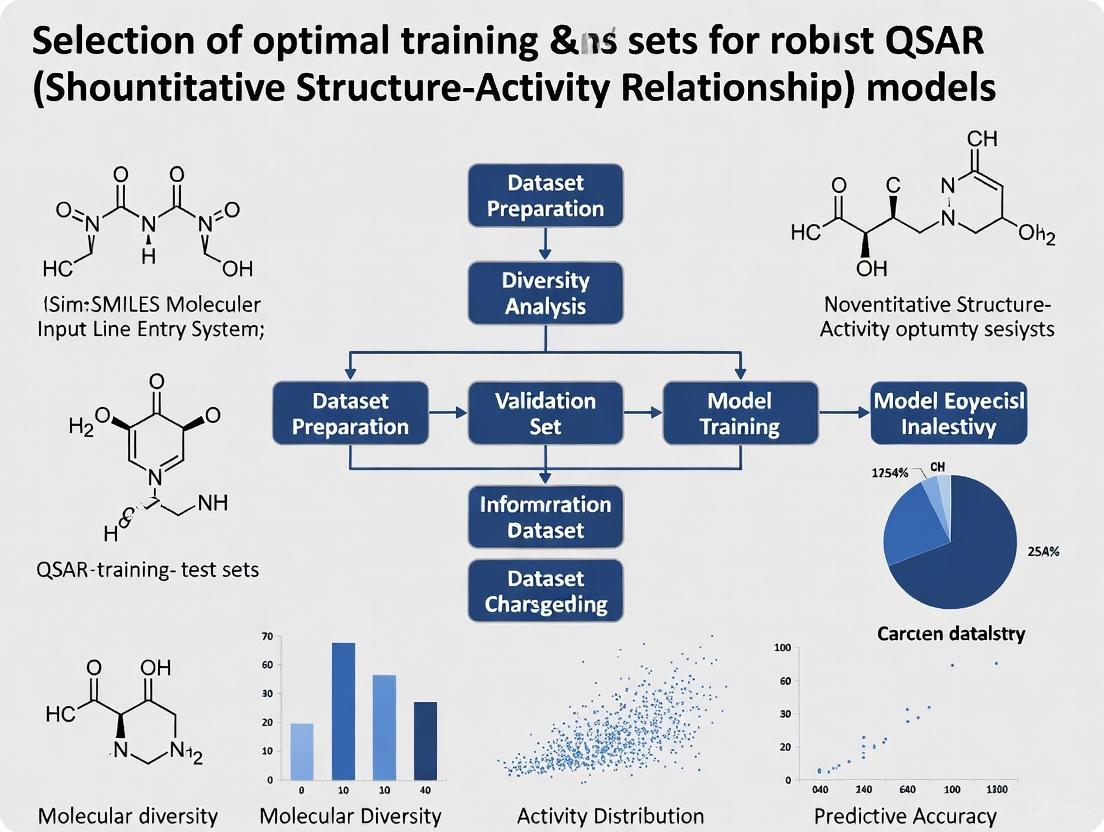
This article provides a comprehensive guide for researchers and drug development professionals on selecting optimal training and test sets to build robust Quantitative Structure-Activity Relationship (QSAR) models.
Optimizing QSAR Training and Test Sets: A Practical Guide for Robust Model Development
Abstract
This article provides a comprehensive guide for researchers and drug development professionals on selecting optimal training and test sets to build robust Quantitative Structure-Activity Relationship (QSAR) models. We explore foundational principles of dataset preparation, including data curation, molecular descriptor calculation, and handling of imbalanced datasets. Methodological sections detail practical splitting strategies, such as the Kennard-Stone algorithm and various cross-validation techniques, while addressing critical challenges like small dataset sizes and class imbalance. The guide further covers advanced troubleshooting and optimization approaches, including feature selection methods and applicability domain determination. Finally, we present a comparative analysis of validation protocols and performance metrics, emphasizing the importance of external validation and metrics tailored to specific research goals, such as positive predictive value for virtual screening. This holistic approach equips scientists with actionable strategies to enhance QSAR model reliability and predictive power in drug discovery applications.
Laying the Groundwork: Essential Principles of QSAR Data Preparation
FAQ: What constitutes the essential components of a reliable QSAR dataset?
A reliable QSAR dataset is built on three fundamental pillars: the chemical structures, the biological activity data, and the calculated molecular descriptors [1] [2]. The quality and management of these components directly determine the predictive power and reliability of the final QSAR model [1].
- Chemical Structures: The dataset must contain a curated set of chemical structures that are representative of the chemical space you intend to model. Structures should be standardized (e.g., removal of salts, normalization of tautomers) to ensure consistency [3].
- Biological Activities: This is the experimental endpoint you aim to predict (e.g., IC₅₀, EC₅₀). The data must be quantitative, of high quality, and ideally obtained from consistent experimental protocols to reduce noise [1] [2].
- Molecular Descriptors: These are numerical representations of the structural, physicochemical, or electronic properties of the molecules [3]. Descriptors should be precise, computationally feasible, and relevant to the biological activity being modeled to avoid the "garbage in, garbage out" situation [1].
FAQ: How should I split my dataset into training and test sets?
A proper split into training and test sets is critical for an unbiased evaluation of your model's predictive power. The test set must be reserved exclusively for the final model assessment and not used during model building or tuning [3]. The optimal ratio for splitting a dataset is not universal and can depend on the specific dataset, the types of descriptors, and the statistical methods used [4]. Below are common methodologies for data splitting.
Table 1: Common Methods for Splitting QSAR Datasets
| Method | Brief Description | Key Consideration |
|---|---|---|
| Random Selection | Compounds are randomly assigned to training and test sets. | Simple but may not ensure representativeness of the chemical space in the training set [4]. |
| Activity Sampling | Data is sorted by activity and split to ensure activity ranges are represented in both sets. | Helps maintain a similar distribution of activity values but may not capture structural diversity [4]. |
| Kennard-Stone | Selects training samples to uniformly cover the descriptor space. | Ensures the training set is structurally representative of the entire dataset [3]. |
| Based on Chemical Similarity | Uses algorithms like Self-Organizing Maps (SOM) or clustering to select diverse training compounds. | A rational approach based on the principle that similar structures have similar activities, helping to define the model's applicability domain [4]. |
The following workflow outlines the key steps in dataset preparation and splitting:
FAQ: What is the impact of training set size on model predictivity?
The size of the training set can significantly impact the predictive ability of a QSAR model, but the effect is not uniform across all projects [4]. A study exploring this issue found that for some datasets, reducing the training set size severely degraded prediction quality, while for others, the impact was less pronounced [4]. Therefore, no general rule exists for an optimal ratio, and the required training set size should be determined for each specific case, considering the complexity of the data and the modeling techniques used [4]. A common rule of thumb is to maintain a minimum ratio of 5:1 between the number of compounds in the training set and the number of descriptors used in the model to avoid overfitting [4].
FAQ: How do I ensure my QSAR model is robust and not the result of chance?
Robustness and the absence of chance correlation are fundamental to a reliable QSAR model. This is established through rigorous validation, which includes several key techniques [5]:
- Internal Validation (Robustness): This is typically done using cross-validation techniques like Leave-One-Out (LOO) or Leave-Many-Out (LMO) cross-validation. The result is often expressed as Q², which estimates the model's ability to predict data it was not directly trained on [4] [6].
- External Validation (Predictivity): This is the most crucial test, performed by predicting the activity of the external test set that was never used in model development. The predictive R² (R²pred) is calculated to quantify this performance [4] [5].
- Y-Scrambling (Chance Correlation): This technique tests for the possibility that a good-looking model arose by chance. The response variable (biological activity) is randomly shuffled, and new models are built. A valid model should perform significantly better than these models built on scrambled data [6] [5].
Table 2: Key Validation Parameters for QSAR Models
| Parameter | Formula | Purpose & Interpretation |
|---|---|---|
| LOO Q² | Q² = 1 - [∑(Yobs - Ypred)² / ∑(Yobs - Ȳtraining)²] | Estimates model robustness via internal cross-validation. A value > 0.5 is generally acceptable [4]. |
| Predictive R² (R²pred) | R²pred = 1 - [∑(Ytest - Ypred)² / ∑(Ytest - Ȳtraining)²] | Measures true external predictivity on a test set. Higher values indicate better predictive power [4]. |
| Root Mean Square Error (RMSE) | RMSE = √[∑(Yobs - Ypred)² / n] | An absolute measure of the model's average prediction error. Lower values are better [6]. |
FAQ: What are common data quality issues and how can I troubleshoot them?
Problem: Poor Model Performance on External Test Set
- Possible Cause 1: The training set is not representative of the chemical space covered by the test set.
- Solution: Re-examine the data splitting method. Use a structure-based method like Kennard-Stone or clustering to ensure the training set covers the entire chemical space of your dataset [4].
- Possible Cause 2: The presence of outliers in the training data is skewing the model.
- Solution: Perform a careful analysis of the training set. Use cluster analysis of variables or quality control charts to identify and, if justified, remove outliers to build a more robust model [7].
Problem: Model Seems Overfitted (High R² for training but low Q²)
- Possible Cause: Too many molecular descriptors relative to the number of training compounds.
- Solution: Apply feature selection techniques (e.g., genetic algorithms, LASSO regression) to identify the most relevant descriptors. Adhere to the rule of thumb that the compound-to-descriptor ratio should be at least 5:1 [4] [3].
The Scientist's Toolkit: Essential Reagents & Software for QSAR
Table 3: Key Resources for Building QSAR Datasets and Models
| Tool / Resource Name | Category | Primary Function |
|---|---|---|
| PaDEL-Descriptor [3] | Descriptor Calculation | Software to calculate molecular descriptors and fingerprints from chemical structures. |
| Dragon [1] | Descriptor Calculation | Professional software for the calculation of a very large number of molecular descriptors. |
| OECD QSAR Toolbox [8] | Data & Profiling | Software designed to fill data gaps for chemical hazard assessment, including profiling and category formation. |
| RDKit [3] | Cheminformatics | An open-source toolkit for cheminformatics used for descriptor calculation, fingerprinting, and more. |
| k-fold Cross-Validation [3] [6] | Statistical Validation | A resampling procedure used to evaluate models on limited data samples, crucial for robustness testing. |
| Y-Randomization (Scrambling) [6] [5] | Statistical Validation | A method to test the validity of a QSAR model by randomizing the response variable to rule out chance correlation. |
For researchers in drug development, robust Quantitative Structure-Activity Relationship (QSAR) models are indispensable tools. The predictive power and reliability of these models hinge on a critical, often painstaking, preliminary step: the curation of the underlying chemical data. Errors or inconsistencies in data related to molecular structures and associated biological activities directly compromise model integrity, leading to unreliable predictions and wasted experimental effort. This guide addresses the most common data curation challenges—handling duplicates, managing missing values, and structural standardization—within the essential context of selecting optimal training and test sets for QSAR research.
Frequently Asked Questions (FAQs)
1. Why is data curation especially critical for QSAR models used in virtual screening?
The primary goal of virtual screening is to identify a small number of promising hit compounds from ultra-large chemical libraries for expensive experimental testing. In this context, a model's Positive Predictive Value (PPV), or precision, becomes the most critical metric [9]. A high PPV ensures that among the top-ranked compounds selected for testing, a large proportion are true actives. Curating data to build models with high PPV, which may involve using imbalanced training sets that reflect the natural imbalance of large screening libraries, can lead to a hit rate at least 30% higher than models built on traditionally balanced datasets [9].
2. How does the size of the training set impact my QSAR model's predictability?
There is no single optimal ratio that applies to all projects. The impact of training set size on predictive quality is highly dependent on the specific dataset, the types of descriptors used, and the statistical methods employed [4]. One study found that for some datasets, reducing the training set size significantly harmed predictive ability, while for others, the effect was minimal [4]. The key is to ensure the training set is large and diverse enough to adequately represent the chemical space of interest. Best practices now often recommend using large datasets (thousands to tens of thousands of compounds) to enhance model robustness [10].
3. What is a fundamental principle for splitting my data into training and test sets?
The most rational approach for splitting data is based on the chemical structure and descriptor space, not random selection or simple activity ranking [4]. The training set should be representative of the entire chemical space covered by the full dataset. This helps ensure that the model can make reliable predictions for new compounds that are structurally similar to those it was trained on. Methods like the leverage approach define a model's "applicability domain," allowing you to assess whether a new compound falls within the structural space covered by the training set [11].
4. My EHR/clinical data has a lot of missing values. What is a robust and practical imputation method?
The optimal method can depend on the mechanism and proportion of missingness. However, for predictive models using data with frequent measurements (like vital signs in EHRs), Last Observation Carried Forward (LOCF) has been shown to be a simple and effective method, often outperforming more complex imputation techniques like random forest multiple imputation in terms of imputation error and predictive performance, all at a minimal computational cost [12]. For patient-reported outcome (PRO) data in clinical trials, Mixed Model for Repeated Measures (MMRM) and Multiple Imputation by Chained Equations (MICE) at the item level generally demonstrate lower bias and higher statistical power [13].
Troubleshooting Guides
Handling Duplicate Compounds
Problem: Duplicate entries for the same compound with conflicting activity data introduce noise and bias, weakening the model's ability to learn true structure-activity relationships.
Solution:
- Standardize Structures: Begin by converting all molecular representations (e.g., SMILES, InChI) into a standardized form. This includes removing salts, neutralizing charges, and generating canonical tautomers [10].
- Identify Duplicates: Use the standardized representations to find identical structures.
- Resolve Conflicts: For duplicates with differing activity values, apply a consistent rule.
- Preferred: Retain the data point from the most reliable source or the one measured with the most consistent protocol.
- Alternative: Calculate the mean or median of the activity values, provided the variance between them is low. If the variance is high, investigate the source of the discrepancy as it may indicate an underlying data quality issue.
- Deduplicate: Remove the redundant entries, keeping a single, canonical entry per unique compound.
Experimental Protocol for Data Deduplication:
- Tools: Utilize cheminformatics toolkits like RDKit or workflows within platforms like QSARtuna to automate structure standardization and duplicate identification [10].
- Data Sources: Assemble chemical-activity pairs from public databases like ChEMBL and PubChem, applying rigorous filters to ensure uniform activity scaling and remove duplicates [10].
- Documentation: Keep a record of the number of duplicates removed and the rules applied for conflict resolution. This ensures the process is transparent and reproducible.
Managing Missing Data
Problem: Missing values in biological activity or molecular descriptor fields can lead to the exclusion of valuable data (complete case analysis) or introduce bias if not handled properly.
Solution: The choice of method depends on the nature of your data and the modeling goal.
- Table 1: Comparison of Methods for Handling Missing Data
| Method | Description | Best For | Considerations |
|---|---|---|---|
| Last Observation Carried Forward (LOCF) | Fills a missing value with the last available measurement from the same subject/compound. | Time-series or longitudinal data with frequent measurements (e.g., EHR data) [12]. | A simple, efficient method that can be reasonable for predictive models, but may introduce bias if the value changes systematically over time. |
| Multiple Imputation (MICE) | Creates several complete datasets by modeling each variable with missing values as a function of other variables. | Complex datasets where data is Missing at Random (MAR). Shown to be effective for patient-reported outcomes (PROs) [13]. | Accounts for uncertainty in the imputed values. More computationally intensive than single imputation. |
| Mixed Model for Repeated Measures (MMRM) | A model-based approach that uses all available data without imputation, modeling the covariance structure of repeated measurements. | Longitudinal clinical trial data, especially for PROs [13]. | Does not require imputation, directly models the longitudinal correlation. Can be complex to implement. |
| Native ML Support | Using machine learning algorithms (e.g., tree-based methods like XGBoost) that can handle missing values internally without pre-imputation. | Large datasets with complex patterns of missingness [12]. | Avoids the potential bias introduced by a separate imputation step. Model performance is the primary metric for success. |
Experimental Protocol for Handling Missing Values in EHR Data for Clinical Prediction Models (Based on [12]):
- Data Preparation: Collapse raw, irregularly measured EHR data into clinically meaningful time windows (e.g., 4-hour blocks) using summary statistics (mean for numeric, mode for categorical variables).
- Method Selection & Implementation: For a pragmatic balance of performance and computational cost, consider implementing the LOCF method.
- Model Training & Evaluation: Train your clinical prediction model (e.g., for extubation success) on the dataset processed with the chosen imputation method. Evaluate its performance using metrics like balanced accuracy or mean squared error.
Structural Standardization and Representation
Problem: Inconsistent molecular representation (e.g., different salt forms, tautomers, or stereochemistry) leads the model to treat the same core structure as multiple different compounds, corrupting the learning process.
Solution:
- Remove Salts and Standardize Tautomers: Strip away counterions and represent molecules in a canonical tautomeric form [10].
- Calculate Diverse Descriptors: Generate a comprehensive set of molecular descriptors that capture relevant physicochemical and structural properties. This can include:
- Define Applicability Domain: Use methods like the leverage approach to establish the chemical space your model is valid for. This helps identify query compounds that are too dissimilar from the training set to be reliably predicted [11].
Experimental Protocol for QSAR Model Development (Based on [11]):
- Data Collection & Curation: Collect a dataset of compounds with experimentally measured activities (e.g., IC50). Apply structural standardization, handle duplicates, and address missing values.
- Descriptor Calculation & Selection: Calculate a pool of molecular descriptors. Use feature selection optimization strategies (e.g., ANOVA) to identify the most statistically significant descriptors for predicting activity [11].
- Data Splitting: Split the curated dataset into training and test sets using a rational method that ensures both sets cover similar chemical space. Avoid simple random splitting.
- Model Building & Validation: Develop models using both linear (e.g., Multiple Linear Regression - MLR) and non-linear (e.g., Artificial Neural Networks - ANN) techniques. Rigorously validate models using both internal (cross-validation) and external (test set) validation [11].
Workflow and Toolkit
Data Curation Workflow for Robust QSAR
The following diagram illustrates the integrated workflow for curating data and developing a QSAR model, highlighting the stages where troubleshooting guides provide specific solutions.
The Scientist's Toolkit: Essential Research Reagents & Solutions
- Table 2: Key Resources for QSAR Data Curation and Modeling
Item Function Example Tools & Databases Chemical Databases Source of chemical structures and associated biological activity data. ChEMBL [10], PubChem [10], eMolecules Explore [9] Cheminformatics Toolkits Software libraries for structure standardization, descriptor calculation, and molecular manipulation. RDKit [10], Mordred [10] Descriptor Calculation Software Generate numerical representations of molecular structures for model development. RDKit, Mordred, Integrated Platforms [10] Automated QSAR Platforms End-to-end workflows that help standardize the data curation and model building process. QSARtuna [10] Advanced Modeling Frameworks For implementing complex models like graph neural networks that can automate feature learning. PyTorch Geometric [10]
Troubleshooting Guides and FAQs for Robust QSAR Research
This technical support center addresses common challenges researchers face when selecting molecular representations and building reliable Quantitative Structure-Activity Relationship (QSAR) models. The guidance is framed within the critical context of constructing optimal training and test sets for predictive and generalizable QSAR research.
Frequently Asked Questions (FAQs)
Q1: What is the fundamental difference between traditional molecular descriptors and modern AI-driven representations?
Traditional molecular descriptors are pre-defined, rule-based numerical values that quantify specific physical, chemical, or topological properties of a molecule. Examples include molecular weight, calculated logP, HOMO/LUMO energies, and atom counts [14] [15]. They are computationally efficient and interpretable.
Modern AI-driven representations, learned by deep learning models like Graph Neural Networks (GNNs) or Transformers, are continuous, high-dimensional feature embeddings. These are derived directly from molecular data (e.g., SMILES strings or molecular graphs) and automatically capture intricate structure-property relationships without pre-defined rules, often leading to superior performance on complex tasks [14] [16].
Q2: My QSAR model performs well on the training data but poorly on the test set. What could be wrong?
This is a classic sign of overfitting and often relates to the data split and the nature of the molecular property landscape. The issue may be that your training and test sets have different distributions of Activity Cliffs (ACs). ACs are pairs of structurally similar molecules with large differences in activity, which violate the core QSAR principle and create a "rough" landscape that is difficult for models to learn [16].
To diagnose this, calculate landscape characterization indices like the Roughness Index (ROGI) or the Structure-Activity Landscape Index (SALI) for your dataset. A high density of ACs in the test set can explain the performance drop [16]. Ensuring your training set adequately represents these discontinuities or using representations that smooth the feature space can mitigate this problem.
Q3: For virtual screening of ultra-large libraries, should I balance my training dataset to have equal numbers of active and inactive compounds?
No. Traditional best practices that recommend dataset balancing for the highest Balanced Accuracy (BA) are not optimal for virtual screening [9]. In this context, the goal is to nominate a very small number of top-ranking compounds for experimental testing. Therefore, the key metric is Positive Predictive Value (PPV), or precision.
Training on imbalanced datasets that reflect the natural imbalance of large libraries (skewed heavily towards inactives) produces models with a higher PPV. This means a higher proportion of your top-scoring predictions will be true actives, leading to a significantly higher experimental hit rate—often 30% or more compared to models trained on balanced data [9].
Troubleshooting Common Experimental Issues
Problem: Inconsistent or Poor Predictive Performance in 3D-QSAR Models
- Symptoms: Low cross-validated ( R^2 ) or ( Q^2 ), high prediction errors for the test set, model instability.
- Potential Causes & Solutions:
| Symptom | Potential Cause | Solution |
|---|---|---|
| Low predictive accuracy | Conformational selection and alignment | Ensure all molecules are in a global minimum energy conformation and use a consistent, biologically relevant alignment rule (e.g., based on the active site pharmacophore) [17] [18]. |
| Model not generalizing | Over-reliance on 2D descriptors in a "3D" model | Use true 3D descriptors (e.g., MoRSE descriptors, 3D-pharmacophores) that capture spatial information about the molecular field, as they can provide information not available in 2D representations [17] [19]. |
| High error for specific analogs | Presence of activity cliffs in the test set | Characterize the dataset using SALI or ROGI indices. Apply scaffold-based splitting to ensure structurally distinct molecules are in the test set, providing a more realistic assessment of generalizability [16]. |
Experimental Protocol: Developing a Robust 3D-QSAR Model using CoMSIA
This protocol outlines the key steps for building a Comparative Molecular Similarity Indices Analysis (CoMSIA) model, as applied in the study of dipeptide-alkylated nitrogen-mustard compounds [18].
Dataset Curation and Preparation:
- Assemble a series of molecules with consistent core structures and known biological activities (e.g., IC50 values).
- Split into Training and Test Sets: Randomly divide the compounds, ensuring the test set is representative of the structural and activity diversity of the entire dataset. A common ratio is 80/20 for training/test.
Molecular Modeling and Conformational Alignment:
- Structure Building: Draw all molecular structures using software like ChemDraw.
- Geometry Optimization: Import structures into a program like HyperChem. Perform initial geometry optimization using a molecular mechanics force field (e.g., MM+), followed by more precise optimization using a semi-empirical quantum mechanical method (e.g., AM1 or PM3) until the root mean square gradient is below 0.01 kcal/(mol·Å) [18].
- Alignment: Superimpose all energetically minimized structures onto a common template molecule, typically the most active compound, based on a presumed pharmacophore or the core scaffold.
Descriptor Calculation and Model Building:
- CoMSIA Field Calculation: In software like Sybyl, calculate steric, electrostatic, hydrophobic, and hydrogen-bond donor/acceptor similarity fields around the aligned molecules.
- Partial Least Squares (PLS) Analysis: Use PLS regression to correlate the CoMSIA fields with the biological activity data for the training set. The model is validated using leave-one-out (LOO) or leave-many-out (LMO) cross-validation to determine the optimal number of components and the cross-validated ( Q^2 ).
Model Validation and Application:
- Predict Test Set: Use the developed model to predict the activity of the external test set compounds that were excluded from model building.
- Contour Map Analysis: Interpret the 3D coefficient contour maps to identify regions in space where specific molecular properties (e.g., steric bulk, electropositive groups) enhance or diminish activity. Use these insights to design new compounds [18].
The workflow for this protocol is summarized in the following diagram:
The Scientist's Toolkit: Essential Research Reagents and Computational Solutions
The following table details key computational tools and descriptors used in modern QSAR workflows, as referenced in the search results.
| Item Name | Function / Description | Application in Experiment |
|---|---|---|
| Extended-Connectivity Fingerprints (ECFP) | A circular fingerprint that encodes molecular substructures as integer identifiers, capturing features in a radius around each atom [16]. | Used for molecular similarity searching, clustering, and as input for machine learning models [14] [16]. |
| Graph Neural Networks (GNNs) | A class of deep learning models that operate directly on the graph structure of a molecule (atoms as nodes, bonds as edges) to learn data-driven representations [14] [16]. | Used for automatic feature learning and molecular property prediction, often outperforming traditional descriptors on complex tasks [14] [20]. |
| CoMSIA (Comparative Molecular Similarity Indices Analysis) | A 3D-QSAR method that evaluates similarity indices in molecular fields (steric, electrostatic, hydrophobic, etc.) around aligned molecules [18]. | Used to build 3D-QSAR models and generate contour maps for visual interpretation and guidance in molecular design [18] [19]. |
| alvaDesc Molecular Descriptors | A software capable of calculating over 5,000 molecular descriptors encoding topological, geometric, and electronic information [14]. | Provides a comprehensive set of features for building QSAR models, as seen in the BoostSweet framework for predicting molecular sweetness [14]. |
| Topological Data Analysis (TDA) | A mathematical approach that studies the "shape" of data. In cheminformatics, it analyzes the topology of molecular feature spaces [16]. | Used to understand and predict which molecular representations will lead to better machine learning performance on a given dataset [16]. |
The decision process for selecting an appropriate molecular representation is guided by the problem context and data characteristics, as illustrated below:
Frequently Asked Questions
FAQ 1: How do dataset size and train/test split ratios influence the performance of my multiclass QSAR model? The size of your dataset and how you split it into training and testing sets are critical factors that significantly impact model performance, especially in multiclass classification.
- Experimental Evidence: A systematic study evaluating these factors with five different machine learning algorithms found clear differences in outcomes based on dataset size and, to a lesser extent, the train/test split ratio. The XGBoost algorithm was noted for its strong performance even in these complex scenarios [21].
- Quantitative Guidance: The study employed specific dataset sizes and split ratios, as summarized in the table below [21]:
| Factor | Values/Categories Investigated |
|---|---|
| Dataset Size (Number of samples) | 100, 500, [Total available data] |
| Train/Test Split Ratio | 50/50, 60/40, 70/30, 80/20 |
- Troubleshooting Tip: Do not assume a single split ratio is optimal for all projects. You should experimentally verify the best ratio for your specific dataset, as its effect can vary [21] [4].
FAQ 2: My dataset is imbalanced, with one activity class dominating the others. Should I always balance it before modeling? Not necessarily. The best approach depends on the primary goal of your QSAR model. The traditional practice of balancing datasets is being re-evaluated, particularly for virtual screening applications.
- For Virtual Screening (Hit Identification): If your goal is to screen ultra-large libraries to find active compounds, models trained on imbalanced datasets can be superior. The key metric here is Positive Predictive Value (PPV), which ensures a high hit rate among the top predictions. Studies show that such models can achieve a hit rate at least 30% higher than models built on balanced datasets when selecting the top compounds for testing [9].
- For Lead Optimization: If your goal is to refine a series of compounds and you need reliable predictions for both active and inactive classes, then striving for a balanced dataset and using metrics like Balanced Accuracy remains a sound strategy [9].
- Methodology: To handle imbalanced data, techniques like Synthetic Minority Over-sampling Technique (SMOTE) or clustering and undersampling the majority class can be employed [21].
FAQ 3: How can I quickly assess if my dataset is even suitable for building a predictive QSAR model? You can calculate the MODelability Index (MODI), a simple metric that estimates the feasibility of obtaining a predictive QSAR model for a binary classification dataset.
- Protocol:
- For every compound in your dataset, identify its first nearest neighbor (the most similar compound based on Euclidean distance in your descriptor space).
- Count how many compounds have their nearest neighbor in the same activity class.
- Calculate MODI using the formula:
MODI = (1 / Number of Classes) * Σ (Number of same-class neighbors for class i / Total compounds in class i)
- Interpretation: A MODI value above approximately 0.65 suggests your dataset is amenable to modeling with an acceptable correct classification rate (e.g., > 0.7). This metric helps identify datasets with too many "activity cliffs"—where very similar structures have different activities—which pose a major challenge for modeling [22].
The Scientist's Toolkit: Essential Reagents for Dataset Analysis
| Research Reagent / Tool | Function in Dataset Analysis |
|---|---|
| MODI (MODelability Index) | A pre-modeling diagnostic tool to quickly assess the feasibility of building a predictive QSAR model on a binary dataset [22]. |
| Gradient Boosting Machines (e.g., XGBoost) | A machine learning algorithm robust to descriptor intercorrelation and effective for modeling complex, non-linear structure-activity relationships [23]. |
| Text Mining (e.g., BioBERT) | A natural language processing tool used to automatically extract and consolidate experimental data from scientific literature (e.g., PubMed) for dataset construction [24]. |
| ToxPrint Chemotypes | A set of standardized chemical substructures used to characterize the chemical diversity of a dataset and identify substructures enriched in active compounds [24]. |
| Correlation Matrix | A diagnostic plot to visualize intercorrelation between molecular descriptors, helping to identify redundant features that could lead to model overfitting [23]. |
Experimental Protocols for Robust Dataset Handling
Protocol 1: Rational Data Curation and Consolidation for Model Development A high-quality, curated dataset is the foundation of any reliable QSAR model.
- 1. Data Collection: Gather data from public databases (e.g., ChEMBL, PubChem) and scientific literature. For literature, use text-mining tools like BioBERT, fine-tuned on annotated abstracts, to efficiently identify relevant studies and results [24].
- 2. Data Curation:
- Standardization: Convert structures to canonical SMILES, neutralize salts, and remove duplicates [24].
- Filtering: Remove mixtures, polymers, and inorganic compounds. Ensure experimental data complies with relevant OECD test guidelines (e.g., OECD 487 for in vitro micronucleus) [24].
- Conflict Resolution: Manually review and resolve conflicting data points for the same compound, retaining the result that best complies with current regulatory criteria [24].
- 3. Chemotype Analysis: Generate ToxPrint chemotypes for your curated dataset. Perform an enrichment analysis to identify substructures that are over-represented in active compounds, which helps understand the chemical space and structural alerts in your data [24].
Protocol 2: A Workflow for Assessing Dataset Modelability and Splitting This workflow helps you evaluate your dataset's potential and create meaningful training/test sets.
Key Experimental Pathways in Dataset Analysis
The following diagram outlines the logical process for handling class distribution, a central challenge in dataset preparation.
In Quantitative Structure-Activity Relationship (QSAR) modeling, the dataset forms the very foundation upon which reliable and predictive models are built. The quality, size, and composition of your dataset directly determine a model's ability to generalize beyond the compounds used in its development. The process of splitting this dataset into training and test sets is not merely a procedural step but a critical strategic decision that balances statistical power with practical constraints. As QSAR has evolved from using simple linear models with few descriptors to employing complex machine learning and deep learning algorithms capable of processing thousands of molecular descriptors, the requirements for adequate dataset sizing have become increasingly important. This technical guide addresses the fundamental challenges researchers face in dataset preparation and provides evidence-based protocols for optimizing this process to build more robust, predictive QSAR models.
Essential Concepts: Key Definitions and Principles
Applicability Domain (AD): The chemical space defined by the compounds in the training set and the model descriptors. Molecules within this domain are expected to have reliable predictions, while those outside it may have uncertain results [11] [25].
Balanced Accuracy (BA): A performance metric that averages the proportion of correct predictions for each class, particularly valuable when dealing with imbalanced datasets where one class significantly outnumbers the other [9].
Positive Predictive Value (PPV): Also known as precision, this metric indicates the proportion of positive predictions that are actually correct. It has become increasingly important for virtual screening applications where the goal is to minimize false positives in the top-ranked compounds [9].
Molecular Descriptors: Numerical representations of chemical structures that encode various properties, from simple atom counts to complex quantum chemical calculations. These serve as the input variables for QSAR models [1] [26].
Troubleshooting Guide: Common Dataset Challenges and Solutions
FAQ 1: How large should my dataset be for a reliable QSAR model?
- Problem Context: Researcher has collected 50 compounds with measured activity and is unsure if this provides sufficient statistical power.
- Evidence-Based Guidance: While no universal minimum exists, dataset requirements vary significantly by model complexity. Traditional statistical methods like Multiple Linear Regression (MLR) may perform adequately with 20+ compounds, while Artificial Neural Networks (ANNs) and other complex machine learning algorithms require substantially larger datasets [11] [1]. A representative bibliometric analysis of QSAR publications from 2014-2023 shows a clear trend toward larger datasets, with studies increasingly utilizing hundreds to thousands of compounds to ensure model robustness [1].
- Risk Assessment: Models built with insufficient data are highly prone to overfitting, where they perform well on training data but fail to predict new compounds accurately. Such models may show excellent internal validation metrics but poor external predictive power.
- Protocol Enhancement: When limited by small datasets, employ stricter validation protocols including leave-one-out cross-validation and y-scrambling to assess model robustness. Consider similarity-based methods like read-across or topological regression that may be more suitable for small datasets [27] [25].
FAQ 2: What is the optimal train/test split ratio for my dataset?
- Problem Context: Team is debating whether to use an 80/20 or 70/30 split for their dataset of 200 compounds.
- Evidence-Based Guidance: The optimal split ratio is highly dependent on total dataset size. Studies examining dataset size and split ratio effects found that with larger datasets (>1000 compounds), performance differences between common ratios (80/20, 70/30) become minimal. However, with smaller datasets (<200 compounds), more conservative splits (e.g., 70/30 or 60/40) that allocate more compounds to training may be beneficial [28].
- Performance Impact: Research comparing split ratios across multiple machine learning algorithms found statistically significant differences in model performance based on both dataset size and split ratios, with the effects being more pronounced for complex algorithms like XGBoost [28].
- Advanced Protocol: For datasets with limited compounds, implement nested cross-validation instead of a single train/test split. This approach maximizes data usage for both model building and validation while providing more robust performance estimates [28] [26].
FAQ 3: Should I balance my dataset if I have many more inactive compounds than actives?
- Problem Context: Virtual screening project has highly imbalanced data with 95% inactive compounds and seeks the best preprocessing approach.
- Paradigm Shift: Traditional best practices often recommended balancing datasets through undersampling of the majority class. However, recent research demonstrates that for virtual screening applications where the goal is identifying active compounds from large libraries, models trained on imbalanced datasets can achieve at least 30% higher hit rates in the top predictions [9].
- Metric Selection: When using imbalanced training sets for virtual screening, prioritize Positive Predictive Value (PPV) over Balanced Accuracy (BA) as your key performance metric. PPV directly measures the model's ability to correctly identify actives among its top predictions, which aligns with the practical objective of virtual screening campaigns [9].
- Implementation Guidance: For virtual screening applications, maintain the natural imbalance in your training data while focusing model optimization on PPV in the top ranking compounds (e.g., top 128 corresponding to a standard screening plate) [9].
FAQ 4: How does dataset size affect different machine learning algorithms?
- Problem Context: Research group needs to select the most appropriate algorithm for their dataset of 150 compounds.
- Algorithm Sensitivity: Studies comparing machine learning algorithms across different dataset sizes found that XGBoost consistently outperformed other algorithms including Random Forests, Support Vector Machines, and k-Nearest Neighbors, particularly for multiclass classification problems [28]. However, the performance advantage varies significantly with dataset size and split ratio.
- Quantum Advantage Emerging Research: Investigations into quantum machine learning for QSAR have found that quantum classifiers can outperform classical counterparts when dealing with limited data availability and reduced feature numbers, suggesting potential for specialized applications where data is scarce [29].
- Selection Framework: Match algorithm complexity to your dataset size. For smaller datasets (<200 compounds), prefer simpler models like Multiple Linear Regression or similarity-based methods. As dataset size increases (>500 compounds), more complex algorithms like ANN, XGBoost, or deep learning architectures become increasingly advantageous [11] [28] [26].
Quantitative Evidence: Dataset Size Impact on Model Performance
Table 1: Performance Metrics Across Dataset Sizes and Split Ratios
| Dataset Size | Split Ratio (Train:Test) | Algorithm | Key Performance Metrics | Observations |
|---|---|---|---|---|
| 121 compounds [11] | 66:34 | Multiple Linear Regression (MLR) | R²: Reported | Direct comparison on NF-κB inhibitors |
| 121 compounds [11] | 66:34 | Artificial Neural Network [8.11.11.1] | R²: Reported | Superior reliability and prediction |
| 2710 compounds [28] | Multiple ratios (50:50 to 90:10) | XGBoost | 25 parameters calculated | Optimal for multiclass classification |
| 3592 compounds [30] | Not specified | Random Forest | RMSE: 0.71, R²: 0.53 | Toxicity prediction with large dataset |
Table 2: Comparative Analysis of Modeling Approaches for Different Dataset Scenarios
| Scenario | Recommended Approach | Advantages | Limitations | Validation Priority |
|---|---|---|---|---|
| Small datasets (<100 compounds) | Topological regression, Read-across [27] [25] | Better interpretation, Less overfitting | Limited complexity | Applicability domain, Y-scrambling |
| Medium datasets (100-500 compounds) | Multiple Linear Regression, Random Forest [11] [26] | Balance of performance and interpretability | May not capture complex patterns | External validation, Cross-validation |
| Large datasets (>500 compounds) | ANN, Deep Learning, XGBoost [28] [26] | Captures complex non-linear relationships | Black box, Computational demands | External test set, Prospective validation |
| Imbalanced datasets (Virtual Screening) | Maintain natural imbalance [9] | Higher hit rates in top predictions | Requires PPV focus | PPV in top rankings, Experimental confirmation |
Experimental Protocols: Methodologies for Optimal Dataset Utilization
Protocol 1: Systematic Approach to Train/Test Splitting
- Stratified Splitting: For classification problems, ensure that both training and test sets maintain similar distributions of activity classes to prevent bias [28] [1].
- Applicability Domain Definition: Use methods such as the leverage approach to define the chemical space of your training set. This helps identify when test compounds fall outside this domain and may have unreliable predictions [11].
- Iterative Splitting: For smaller datasets, implement multiple random splits (e.g., 5 different 80/20 splits) to assess the stability of model performance across different partitions [28].
- External Validation: Whenever possible, reserve a completely external validation set that is not used in any model building or parameter optimization steps [11] [25].
Protocol 2: Workflow for Dataset Size and Split Ratio Optimization
The following workflow provides a systematic approach to determining optimal dataset configuration:
Protocol 3: Handling Imbalanced Data for Virtual Screening
- Objective Alignment: If the primary goal is virtual screening to identify active compounds from large libraries, preserve the natural imbalance in your training data rather than balancing it [9].
- Metric Selection: Focus optimization and model selection on Positive Predictive Value (PPV) calculated for the top N predictions (where N matches your experimental throughput capacity, e.g., 128 compounds for a standard plate) [9].
- Performance Assessment: Compare models based on the number of true positives identified in the top predictions rather than overall balanced accuracy [9].
- Experimental Validation: Always plan for experimental confirmation of top-ranked predictions to validate the virtual screening approach [25].
Research Reagent Solutions: Essential Tools for QSAR Dataset Preparation
Table 3: Key Computational Tools for Dataset Preparation and Modeling
| Tool Name | Type | Primary Function | Application Context |
|---|---|---|---|
| PaDEL [27] [26] | Descriptor Calculator | Extracts molecular descriptors from structures | Standard workflow for feature generation |
| RDKit [27] [29] | Cheminformatics Toolkit | Calculates molecular descriptors and fingerprints | General purpose QSAR modeling |
| QSARINS [26] | Modeling Software | Classical QSAR development with validation | Educational purposes and traditional QSAR |
| Chemprop [27] | Deep Learning Framework | Message-passing neural networks for molecular properties | Complex datasets with non-linear relationships |
| OCHEM [30] | Online Platform | Multiple modeling methods and descriptor packages | Consensus modeling approaches |
| scikit-learn [26] | Machine Learning Library | Standard ML algorithms and validation methods | General purpose machine learning in QSAR |
The critical role of dataset size in QSAR modeling requires careful consideration of statistical power, model complexity, and practical research constraints. Evidence indicates that optimal train/test split ratios are dependent on overall dataset size, with different strategies needed for small, medium, and large datasets. Furthermore, the traditional practice of balancing datasets for virtual screening applications should be reconsidered in favor of maintaining natural imbalances when the goal is identifying active compounds from large chemical libraries. By implementing the systematic approaches and experimental protocols outlined in this guide, researchers can make informed decisions about dataset preparation that maximize model performance and predictive power within their practical constraints. As QSAR continues to evolve with advancements in artificial intelligence and quantum machine learning, these fundamental principles of dataset management will remain essential for building reliable, predictive models that accelerate drug discovery and materials development.
Strategic Data Splitting: Methods for Optimal Training-Test Partitioning
Frequently Asked Questions
1. Why shouldn't I just split my QSAR data randomly? Random splitting is a common starting point, but it can easily lead to over-optimistic performance estimates that do not reflect a model's real-world predictive power [31]. This happens due to "data leakage," where very similar compounds end up in both the training and test sets. A model may then simply memorize structural features from training compounds rather than learning generalizable rules, performing poorly when it encounters truly novel chemical scaffolds [32] [31]. For data with inherent autocorrelation, random splitting is particularly unreliable [31].
2. My dataset is relatively small. What is the best splitting approach?
For smaller datasets, the choice of splitting method is critical. While there is no universal rule for the optimal training/test set ratio, studies suggest that methods based on the chemical descriptor space (X-based) or a combination of descriptors and activity (X- and y-based) generally lead to models with better external predictivity compared to methods based on activity (y-based) alone [33]. If using random splits, it is highly recommended to perform multiple iterations and average the results to ensure stability [34].
3. How can I evaluate my model if the test set is imbalanced? Accuracy can be highly misleading for imbalanced datasets [35]. Instead, use Cohen's Kappa (κ), a metric that accounts for the possibility of agreement by chance [35]. The table below provides a standard interpretation for κ values.
| κ Value | Level of Agreement |
|---|---|
| 0.00 - 0.20 | None |
| 0.21 - 0.39 | Minimal |
| 0.40 - 0.59 | Weak |
| 0.60 - 0.79 | Moderate |
| 0.80 - 0.90 | Strong |
| 0.91 - 1.00 | Almost Perfect to Perfect |
Models with a κ value above 0.60 are generally considered useful [35].
4. In a federated learning environment, can I still use advanced splitting methods? Yes, but with specific constraints. Since chemical structures cannot be shared between partners, methods that require a centralized pool of all structures are not feasible [32]. However, approaches like locality-sensitive hashing (LSH), sphere exclusion clustering, and scaffold-based binning have been successfully applied in such privacy-preserving settings to ensure consistent splitting across partners [32].
Experimental Protocols for Data Splitting
The following protocols outline detailed methodologies for key splitting approaches cited in QSAR literature.
Protocol 1: Stratified Splitting to Counter Autocorrelation This protocol is designed for data where consecutive samples are highly similar, such as in time-series or structural data [31].
- Visualize the Data: Before splitting, plot your feature (
x) against the response (y) to visually check for autocorrelation or clear patterns [31]. - Create Strata: Instead of random points, divide the data into sequential chunks or "bins" along the feature axis. For example, split the data into 5 consecutive chunks [31].
- Assign Folds: Label each data point according to the chunk it belongs to [31].
- Split Data: For each validation round, use 4 chunks for training and the remaining 1 chunk for testing. This ensures the model is tested on a region of chemical or temporal space it has not seen during training [31].
- Validate: Compare the model's performance on this split with its performance on a random split. A significant drop in performance (e.g., R² from 0.97 to -1.15) indicates that the random split was giving an over-optimistic estimate [31].
Protocol 2: Scaffold-Based Splitting for Robust QSAR This method ensures the test set contains structurally distinct compounds by grouping molecules based on their core molecular scaffolds [32].
- Generate Scaffolds: For every compound in the dataset, compute its central molecular scaffold (e.g., using the Bemis-Murcko method) [32].
- Bin by Scaffold: Group all compounds that share an identical core scaffold into the same "bin" [32].
- Assign to Sets: Assign entire bins of compounds to either the training or test set. This guarantees that no compounds in the test set share a core scaffold with any compounds in the training set [32].
- Manage Size: Monitor the resulting split ratios, as assigning whole scaffolds may lead to an uneven distribution of data between the training and test sets [32].
Protocol 3: Comparison of Splitting Algorithms This protocol systematically evaluates the impact of different data splitting methods on model predictivity [33].
- Select Models: Choose several well-documented, reproducible QSAR models from the literature (e.g., from the JRC QMRF Database) [33].
- Define Splitting Methods: Apply multiple splitting algorithms to the same parent dataset. Common methods include [33]:
- Z:1 (
y-based): Sort by activity and select every Z-th compound for the test set. - Kennard-Stone (
X-based): Selects test compounds to be uniformly distributed across the descriptor space. - Duplex (
X-based): Selects test compounds to be both spread out and distant from training compounds.
- Z:1 (
- Rebuild and Validate: For each splitting method, rebuild the model using the new training set and calculate external validation statistics (e.g.,
Q²ₑₓₜandRMSEP) on the corresponding test set [33]. - Compare Results: Compare the validation statistics across all splitting methods. Studies show that
X-based methods (Kennard-Stone, Duplex) typically yield models with superior and more realistic external predictivity [33].
Performance Comparison of Splitting Methods
The table below summarizes key characteristics and performance insights of different data splitting approaches, helping you select the right method for your research.
| Method | Basis | Key Advantage | Key Disadvantage | Impact on External Predictivity |
|---|---|---|---|---|
| Random Split | Chance | Simple, fast | High risk of data leakage and over-optimistic estimates [31] | Unreliable; can be highly exaggerated [31] [33] |
| Stratified Split | Feature/Response | Controls for autocorrelation; ensures representation | Requires careful definition of strata | More realistic than random for autocorrelated data [31] |
| Scaffold-Based | Molecular Structure | Tests ability to predict truly novel chemotypes; highly realistic | Can create imbalanced train/test set sizes [32] | High quality; provides a realistic assessment of generalizability [32] |
| Clustering-Based (e.g., Sphere Exclusion) | Chemical Space | Ensures structural distinctness between train and test sets | Computationally expensive in federated settings [32] | High quality; leads to robust external validation [32] |
| Kennard-Stone / Duplex | Descriptor Space (X) |
Optimizes representativeness and diversity of test set | More complex than random splitting | Better external predictivity compared to y-based methods [33] |
The Scientist's Toolkit: Essential Reagents for Data Splitting
This table lists key computational tools and metrics essential for implementing robust data splitting in QSAR workflows.
| Item | Function / Explanation |
|---|---|
| Cohen's Kappa (κ) | A performance metric that corrects for chance agreement, essential for evaluating models on imbalanced datasets [35]. |
| Concordance Correlation Coefficient (CCC) | A stringent external validation metric proposed as a more stable and prudent measure for a model's predictive ability [36]. |
| Molecular Descriptors (e.g., RDKit, Mordred) | Standardized numerical representations of molecular structures that form the basis for X-based splitting methods [10]. |
| Scaffold Network Algorithm | A method to bin compounds based on their molecular core structure, enabling scaffold-based splits to assess performance on novel chemotypes [32]. |
| Locality-Sensitive Hashing (LSH) | A clustering method suitable for privacy-preserving, federated learning environments where data cannot be centralized [32]. |
| Permutation Tests (Y-Scrambling) | A technique to validate models by randomizing response values; a robust model should fail when trained on scrambled data [4]. |
Data Splitting Selection Workflow
The following diagram illustrates a logical workflow to guide the selection of an appropriate data splitting method based on your dataset characteristics and research goals.
Data Splitting Method Decision Tree
Frequently Asked Questions (FAQs)
Q1: What is the primary advantage of using rational splitting methods like Kennard-Stone or Sphere Exclusion over random selection? Rational splitting methods systematically ensure that your training and test sets provide good coverage of the entire chemical space represented by your dataset. While random selection can lead to over-optimistic performance metrics, methods based on molecular descriptors (X) or a combination of descriptors and the response value (y) consistently lead to models with better external predictivity [33]. This is because they intelligently select a training set that is structurally representative of the whole set, ensuring the model learns a broader range of chemical features [37].
Q2: My dataset contains compounds from several distinct chemical classes. Which splitting method is most appropriate? For datasets with multiple chemical series, scaffold-based binning is a highly effective strategy [32]. This method groups compounds based on their molecular scaffold (core structure) before splitting. Allocating entire scaffolds to either the training or test set prevents information leakage that occurs when very similar structures are present in both sets. This approach avoids the "Kubinyi paradox," where models perform well in validation but fail in prospective forecasting because they were tested on structures too similar to their training set [32].
Q3: In a federated learning context where data cannot be centralized, can I still use these advanced splitting methods? Yes, but with specific considerations. Methods like locality-sensitive hashing (LSH) and scaffold-based binning are applicable in a privacy-preserving, federated setting because they can be run independently at each partner site or without sharing raw chemical structures [32]. However, clustering methods like sphere exclusion that require the computation of a complete, cross-partner similarity matrix are often computationally prohibitive in such environments due to the inability to co-locate sensitive data [32].
Q4: How does the size of my training set impact the model's predictive ability? The impact of training set size is dataset-dependent. For some datasets, reducing the training set size significantly degrades predictive ability, while for others, the effect is less pronounced [4]. There is no universal optimal ratio; the optimum size should be determined based on the specific dataset, the descriptors used, and the modeling algorithm. A general recommendation is to ensure the training set is large and diverse enough to adequately represent the chemical space you intend the model to cover [4].
Q5: Are there validated workflows for applying these algorithms to specific RNA targets? Yes, recent research has established workflows for building predictive QSAR models for RNA targets, such as the HIV-1 TAR element. These workflows involve calculating conformation-dependent 3D molecular descriptors, measuring binding parameters via surface plasmon resonance (SPR), and combining feature selection with multiple linear regression (MLR) to build robust models. This platform has been validated with new molecules and can be extended to different RNA targets [38].
Troubleshooting Guides
Issue 1: Model Performs Well on Cross-Validation but Poorly on External Test Set
Potential Cause: The splitting method failed to ensure the training and test sets are structurally independent, leading to data leakage and over-optimistic internal validation. This is a common flaw of random splitting [32] [33].
| Solution | Description | Best For |
|---|---|---|
| Apply Scaffold Splitting | Group compounds by their Bemis-Murcko scaffolds and assign entire scaffolds to either the training or test set. This ensures structurally distinct sets. | Datasets with multiple, well-defined chemical series [32]. |
| Use Kennard-Stone Algorithm | Selects training set compounds to be uniformly distributed across the chemical space defined by the molecular descriptors. This ensures the training set is representative of the whole. | Creating a representative training set that covers the entire descriptor space [33]. |
| Validate Domain Applicability | Check that your test set compounds fall within the applicability domain of your model, defined by the chemical space of the training set. A large dissimilarity (>0.3 Tanimoto Coefficient) can indicate low prediction confidence [39]. | All models, as a final check before trusting predictions. |
Issue 2: Splitting Algorithm is Computationally Too Expensive for a Large Dataset
Potential Cause: Some algorithms, particularly certain clustering methods, have high computational complexity that does not scale well to very large datasets or federated learning environments [32].
| Solution | Description | Rationale |
|---|---|---|
| Use Directed Sphere Exclusion (DISE) | A modification of the Sphere Exclusion algorithm that generates a more even distribution of selected compounds and is designed to be applicable to very large data sets [40]. | Improves scalability over the standard sphere exclusion approach. |
| Apply Locality-Sensitive Hashing (LSH) | A federated privacy-preserving method that can approximate similarity and assign compounds to folds without a full similarity matrix [32]. | Reduces computational costs in distributed computing settings. |
| Opt for Scaffold Network Binning | A computationally efficient method that operates on molecular scaffolds rather than full fingerprint similarity [32]. | Provides a good balance between structural separation and compute time. |
Issue 3: Test Set is Not Representative of the Broader Chemical Space
Potential Cause: The splitting method was based solely on the response value (y) or failed to account for the overall distribution of molecular descriptors (X) [33].
Solution: Implement a splitting method that explicitly uses the molecular descriptor matrix (X) to select compounds.
- Method Choice: Use the Kennard-Stone algorithm or the duplex algorithm [33].
- Procedure: These algorithms select compounds for the training set that are uniformly distributed across the principal component space of your molecular descriptors. This guarantees that the training set is representative and that the test set compounds are close (in chemical space) to the training set, enabling more reliable predictions.
- Verification: Use Principal Component Analysis (PCA) to project your training and test sets into a 2D or 3D space. A visual inspection will confirm if both sets cover similar areas of the chemical space. The figure below illustrates a rational splitting method that ensures training and test sets are intermixed in chemical space, unlike an activity-only split.
Figure: A workflow for creating representative training and test sets based on chemical space coverage.
Quantitative Data Comparison
Table 1: Comparison of Key Dataset Splitting Algorithms
| Algorithm | Basis for Splitting | Key Advantage | Key Disadvantage | Impact on External Predictivity (Q²ₑₓₜ) |
|---|---|---|---|---|
| Random | Chance | Simple and fast to implement | High risk of non-representative splits and information leakage; over-optimistic validation [37] [33]. | Lower and less reliable compared to rational methods [33]. |
| Activity Sampling (Z:1) | Response value (y) only | Even distribution of activity values in both sets | Does not consider structural similarity; can lead to test compounds outside training chemical space [33]. | Lower than X-based or (X,y)-based methods [33]. |
| Kennard-Stone | Molecular descriptors (X) | Selects a training set uniformly covering the descriptor space [33]. | May not select outliers, which could be informative. | Leads to better external predictivity compared to y-only methods [33]. |
| Sphere Exclusion | Molecular descriptors (X) | Can control dissimilarity within the training set; DISE variant offers even distribution [40]. | Computationally expensive for very large datasets [32]. | High (when computationally feasible) [40]. |
| Scaffold Binning | Molecular scaffold | Creates structurally distinct training and test sets; ideal for multi-series datasets [32]. | Can lead to very uneven split ratios if one scaffold is dominant. | Provides a realistic assessment of model performance on novel scaffolds [32]. |
Table 2: Typical Binding Kinetics for RNA-Ligand Interactions (for Context in Validation)
| RNA-Ligand Set | Median kₒₙ (M⁻¹s⁻¹) | Median kₒff (s⁻¹) | Median Kd (M) |
|---|---|---|---|
| RNA (in vitro-selected) | 8.1 × 10⁴ | 6.3 × 10⁻² | 4.3 × 10⁻⁷ |
| RNA (naturally occurring) | 5.5 × 10⁴ | 1.9 × 10⁻² | 3.0 × 10⁻⁷ |
| HIV-1 TAR–Ligand (as in [38]) | 3.8 × 10⁴ | 7.9 × 10⁻² | 5.0 × 10⁻⁶ |
Experimental Protocols
Protocol 1: Implementing the Kennard-Stone Algorithm for Training Set Selection
This protocol is used to select a training set that is uniformly distributed over the chemical space defined by the molecular descriptors [33].
- Standardization: Standardize all molecular descriptors to have a mean of zero and a standard deviation of one to prevent scaling biases.
- Initial Point Selection: Identify the two compounds that are farthest apart in the descriptor space (i.e., have the maximum Euclidean distance). Add these to the training set.
- Iterative Selection: For each remaining compound in the dataset, calculate its distance to the nearest compound already in the training set.
- Maximize Minimum Distance: Select the compound with the largest of these minimum distances and add it to the training set.
- Repeat: Repeat steps 3 and 4 until the desired number of compounds has been selected for the training set. The remaining compounds form the test set.
Protocol 2: A Workflow for Building Predictive QSAR Models for RNA Targets
This validated workflow outlines the steps for building a predictive QSAR model, such as for the HIV-1 TAR RNA, incorporating advanced splitting and validation [38].
Compound Selection and Preparation:
- Select a diverse set of compounds covering multiple scaffolds (e.g., aminoglycosides, diphenyl furans, diminazenes) [38].
- Calculate a comprehensive set of molecular descriptors (e.g., topological, electrostatic, 3D). Account for possible protonation and tautomerization states by using Boltzmann-weighted averages of low-energy conformations [38].
Experimental Measurement of Binding Parameters:
- Measure binding affinity (Kd) and kinetic rate constants (kon, koff) using a technique like surface plasmon resonance (SPR). Ensure parameters span a wide range (e.g., 2 log units) for reliable modeling [38].
Data Splitting and Model Building:
- Split the dataset into training and test sets using a rational method like Kennard-Stone or Sphere Exclusion to ensure broad chemical space coverage [38] [33].
- Use multiple linear regression (MLR) combined with feature selection on the training set to build a model that correlates descriptors with binding parameters [38].
Model Validation and Application:
- Internal Validation: Validate model robustness using leave-one-out (LOO) cross-validation and y-scrambling to check for chance correlation [6] [4].
- External Validation: Test the model's predictive power on the held-out test set that was generated by the rational split. Use metrics like Q²F2 and RMSEP [6] [33].
- Prospective Prediction: Use the validated model to predict the activities of new, untested compounds [38].
Figure: A comprehensive workflow for building a predictive QSAR model, from data preparation to validation.
The Scientist's Toolkit: Essential Research Reagents & Materials
Table 3: Key Resources for Robust QSAR Modeling
| Item / Resource | Function / Purpose | Example / Notes |
|---|---|---|
| Molecular Descriptor Software | Calculates physicochemical and topological descriptors from chemical structures. | Software like MOE (Molecular Operating Environment) can calculate 400+ descriptors and handle conformation-dependent 3D descriptors [38]. |
| Surface Plasmon Resonance (SPR) | Measures binding affinity (Kd) and kinetic parameters (kₒₙ, kₒff) for biomolecular interactions. | Used to generate high-quality binding data for RNA-targeted small molecules, as demonstrated in HIV-1 TAR studies [38]. |
| Sphere Exclusion Algorithm | Clusters compounds based on molecular similarity to select diverse subsets. | Used to oversample inactive compounds from large databases like ChEMBL and PubChem for target prediction models [39]. The DISE variant offers improved distribution [40]. |
| Scaffold Network Analysis | Groups molecules by their core molecular framework (scaffold). | Essential for creating structurally distinct training and test splits in multi-series datasets and for federated learning [32]. |
| Naïve Bayes Classifier | A machine learning algorithm for target prediction and bioactivity classification. | Effective for large-scale target prediction models trained on millions of bioactivity data points, including inactive ones [39]. |
Frequently Asked Questions (FAQs)
Q1: What is the fundamental reason for splitting my dataset into training, validation, and test sets? Splitting your dataset is crucial to prevent overfitting and to obtain an unbiased evaluation of your model's performance on new, unseen data. Using the same data for training and evaluation gives a false, overly optimistic impression of model accuracy. The training set teaches the model, the validation set is used for model selection and hyperparameter tuning, and the test set provides a final, unbiased assessment of generalization capability [41] [42] [43].
Q2: Is there a single, universally optimal train/validation/test split ratio? No, there is no universally optimal ratio. The best split depends on several factors, including the total size of your dataset, the complexity of your model (e.g., the number of parameters), and the level of noise in the data [44] [41]. However, some common starting points are 80/10/10 or 70/20/10 for large datasets, and 60/20/20 for smaller datasets [43].
Q3: How does the total dataset size influence the split ratio? With very large datasets (e.g., millions of samples), your validation and test sets can be a much smaller percentage (e.g., 1% or 0.5%) while still being statistically significant. For smaller datasets, a larger percentage is required for reliable evaluation, and you may need to use techniques like cross-validation to use the data more efficiently [44] [43]. Research shows that dataset size can significantly affect model outcome and performance parameters [21].
Q4: My dataset has imbalanced classes. How should I split it? For imbalanced datasets, a simple random split is not advisable as it may not preserve the class distribution in each set. You should use stratified splitting, which ensures that the relative proportion of each class is maintained across the training, validation, and test sets. This prevents bias and ensures the model is trained and evaluated on representative data [41] [42] [43].
Q5: What is cross-validation and when should I use it instead of a fixed split? Cross-validation (e.g., k-Fold Cross-Validation) is a technique where the data is repeatedly split into different training and validation sets. It is particularly useful when you have a limited amount of data, as it allows for a more robust estimate of model performance by using all data for both training and validation across multiple rounds. For QSAR regression models under model uncertainty, double cross-validation (nested cross-validation) has been shown to reliably and unbiasedly estimate prediction errors [45].
Troubleshooting Guides
Issue 1: High Variance in Model Performance Metrics
Problem: The reported accuracy or other performance metrics change dramatically when the model is trained or evaluated on different random splits of the data.
Possible Causes and Solutions:
- Cause 1: Test set is too small. A small test set may not be statistically representative of the data distribution, leading to high variance in the performance statistic.
- Cause 2: Inadequate shuffle before splitting. If the data is not randomly shuffled, the splits might contain unintended biases or patterns.
- Solution: Always ensure your data is randomly shuffled before creating splits, unless working with time-series or grouped data [42].
Issue 2: Model is Overfitting
Problem: The model performs exceptionally well on the training data but poorly on the validation and test data.
Possible Causes and Solutions:
- Cause 1: Training set is too small. The model cannot learn the general underlying patterns and instead memorizes the limited training examples.
- Cause 2: Over-tuning on the validation set. Repeatedly using the validation set to guide hyperparameter tuning can cause the model to overfit to the validation set.
Issue 3: Poor Performance on a Rare Class in an Imbalanced Dataset
Problem: The model has high overall accuracy but fails to predict instances of an under-represented class.
Possible Causes and Solutions:
- Cause: Improper splitting method. A random split may have placed a disproportionate number of the rare class into one set (e.g., the test set), leaving the model with too few examples to learn from during training.
Quantitative Data on Split Ratios and Performance
The following table summarizes findings from a systematic study investigating the effects of dataset size and split ratios on multiclass QSAR classification performance [21].
Table 1: Impact of Dataset Size and Split Ratios on Model Performance (Multiclass Classification)
| Factor | Levels / Values Investigated | Impact on Model Performance |
|---|---|---|
| Dataset Size | 100, 500, (and total set size) | Showed a clear and significant effect on model performance and classification outcomes. Larger datasets generally lead to more robust models [21]. |
| Train/Test Split Ratios | Multiple ratios were compared (e.g., 50/50, 60/40, 70/30, 80/20) | Exerted a significant, though lesser, effect on the test validation of models compared to dataset size. The optimal ratio can depend on the specific machine learning algorithm used [21]. |
| Machine Learning Algorithm | XGBoost, Naïve Bayes, SVM, Neural Networks (NN), Probabilistic NN (PNN) | XGBoost was found to outperform other algorithms, even in complex multiclass modeling scenarios. Algorithms were ranked differently based on the performance metric used [21]. |
For regression models with variable selection, double cross-validation has been systematically studied. The parameterization of the inner and outer loops significantly influences model quality.
Table 2: Key Considerations for Double Cross-Validation in QSAR/QSPR Regression [45]
| Cross-Validation Loop | Influenced Aspect | Recommendation |
|---|---|---|
| Inner Loop (Model Building & Selection) | Bias and Variance of the resulting models | The design of the inner loop (e.g., number of folds) must be carefully chosen as it directly affects the fundamental quality (bias and variance) of the models being produced [45]. |
| Outer Loop (Model Assessment) | Variability of the Prediction Error Estimate | The size of the test set in the outer loop primarily affects how much the final estimate of your model's prediction error will vary. A larger test set in the outer loop reduces this variability [45]. |
Experimental Protocols
Protocol 1: Standard Data Splitting for a Typical QSAR Modeling Task
This protocol outlines a standard workflow for splitting data in a QSAR project, incorporating best practices for validation.
Diagram 1: Standard data splitting workflow.
Methodology:
- Data Preparation: Standardize molecular structures, calculate descriptors, and curate the final modeling dataset.
- Assess Class Distribution: Analyze the distribution of your response variable (e.g., active/inactive, or multiclass categories) to determine if the dataset is imbalanced [41].
- Shuffle: Randomly shuffle the entire dataset to remove any underlying ordering that could introduce bias [42].
- Split:
- Secure Test Set: Set the test set aside and do not use it for any further analysis until the final model evaluation.
Protocol 2: Double Cross-Validation for Robust Model Validation
This protocol is adapted from studies on reliable estimation of prediction errors under model uncertainty, common in QSAR with variable selection [45].
Diagram 2: Double cross-validation process.
Methodology:
- Outer Loop (Model Assessment): Split the entire dataset into ( k ) folds. For each iteration ( i ):
- Hold out fold ( i ) as the test set.
- Use the remaining ( k-1 ) folds as the training set for the inner loop.
- Inner Loop (Model Selection): On the training set from the outer loop, perform another cross-validation (e.g., 5-fold or 10-fold).
- This inner loop is used for hyperparameter tuning and variable selection.
- Identify the best model configuration based on the average performance in the inner loop.
- Final Assessment: Train a model on the entire ( k-1 ) training folds using the best configuration from the inner loop. Evaluate this model on the held-out outer test set (fold ( i )) to get an unbiased performance estimate.
- Repeat and Average: Repeat steps 1-3 for all ( k ) folds in the outer loop. The final model performance is the average of the performance across all outer test folds. This process validates the modeling procedure rather than a single final model [45].
The Scientist's Toolkit: Essential Reagents & Materials
Table 3: Key Research Reagent Solutions for Robust QSAR Validation
| Item / Solution | Function in Validation | Brief Explanation |
|---|---|---|
| Stratified Sampling | Ensures representative splits in imbalanced datasets. | A data splitting method that maintains the original class distribution across training, validation, and test sets, preventing biased model evaluation [41] [42]. |
| K-Fold Cross-Validation | Provides a robust performance estimate with limited data. | A resampling technique that divides data into ( k ) subsets. The model is trained on ( k-1 ) folds and validated on the remaining fold, repeated ( k ) times [41] [45]. |
| Double (Nested) Cross-Validation | Prevents model selection bias and gives unbiased error estimates. | A rigorous protocol with an outer loop for model assessment and an inner loop for model selection. It is essential when the modeling process involves tuning and selection [45]. |
| XGBoost Algorithm | A powerful machine learning algorithm for classification tasks. | In comparative studies, this ensemble algorithm has been shown to outperform others, such as SVM and Neural Networks, in multiclass QSAR classification [21]. |
| SMOTE | Addresses class imbalance during model training. | Synthetic Minority Over-sampling Technique creates synthetic examples of the minority class to balance the training set, helping the model learn patterns from all classes [21]. |
FAQs on Cross-Validation for QSAR Research
What is the primary purpose of cross-validation in QSAR modeling?
Cross-validation is a statistical method used to estimate the skill of a machine learning model on unseen data [46]. Its primary purpose is to avoid overfitting by ensuring the model does not perform well only on the training data but generalizes to unseen data [47]. This is particularly crucial in QSAR research where models are used to predict the biological activities of new, untested compounds [6] [45].
My dataset is small (under 100 samples). Which validation method should I use?
For small datasets, Leave-One-Out Cross-Validation (LOOCV) is highly recommended [48] [49]. LOOCV is ideal for small datasets because it uses nearly the entire dataset for training in each iteration (n-1 samples), maximizing the utility of limited data and providing a less biased performance estimate [48] [50]. This is particularly valuable in domains like medical research or early-stage drug discovery where data is expensive and scarce [48].
Why do I get different performance metrics each time I run k-Fold Cross-Validation?
The variation in performance metrics across different k-fold runs typically stems from the random splitting of your data into folds [46]. If your dataset has high variance or the splits are not representative, the performance metrics can fluctuate. To mitigate this:
- Set a
random_stateparameter for reproducible splits [47] [51]. - Increase the value of
k(e.g., 10-fold is standard) for more stable estimates [46]. - Consider using stratified k-fold for classification problems to maintain consistent class distribution in each fold [51].
I've heard external validation is the "gold standard." Is this true for QSAR?
While external validation (hold-out method) is often considered rigorous, research indicates it can be unreliable for high-dimensional, small-sample QSAR data [50] [45]. A comparative study found that external validation metrics exhibit high variation across different random data splits, making them unstable for predictive QSAR models [50]. For such datasets, LOOCV demonstrated superior and more stable performance [50]. Double cross-validation is also recommended as it provides a more realistic picture of model quality than a single test set [45].
How can I reliably estimate prediction errors when my model involves variable selection?
When your modeling process involves variable selection (a form of model uncertainty), standard cross-validation can produce over-optimistic error estimates due to model selection bias [45]. The recommended solution is double cross-validation (nested cross-validation) [45]. This method uses an outer loop for model assessment and an inner loop for model selection, ensuring that the error estimate is not biased by the selection process [45].
Troubleshooting Common Experimental Issues
Problem: Over-optimistic model performance during validation
Diagnosis: This often indicates data leakage or insufficient validation rigor [6] [45]. Solution:
- Ensure all data preprocessing (scaling, normalization) is fit on the training fold only, not the entire dataset [46].
- Use double cross-validation when performing feature selection or hyperparameter tuning to prevent overfitting to your validation sets [45].
- Check for chance correlation using y-scrambling techniques, especially for small datasets [6].
Problem: High variance in model performance across folds
Diagnosis: This suggests your dataset may be too small or have high inherent variability [49] [51]. Solution:
- For small datasets, switch from k-fold to LOOCV to reduce variance in the performance estimate [48] [49].
- Increase the number of folds in k-fold CV (e.g., from 5 to 10) to decrease the variance of the estimate [46].
- Ensure your dataset is shuffled before splitting to make each fold representative [46] [51].
Problem: Computational time is excessive for model validation
Diagnosis: LOOCV and high k-values significantly increase computational load [48] [49]. Solution:
- For large datasets, use k-fold with k=5 or k=10 instead of LOOCV [46] [49].
- Utilize parallel processing capabilities (e.g.,
n_jobs=-1in scikit-learn) to distribute the computation across CPU cores [49]. - For neural networks or SVM with large datasets, consider using a single hold-out set or repeated train-test splits instead [48].
Comparative Analysis of Validation Techniques
Table 1: Comparison of Key Cross-Validation Techniques for QSAR Modeling
| Technique | Optimal Dataset Size | Computational Cost | Bias | Variance | Recommended for QSAR? |
|---|---|---|---|---|---|
| Leave-One-Out (LOOCV) | Small (<100s samples) | High (n models) | Low | High | Yes, especially for small datasets [50] |
| k-Fold (k=5) | Medium to Large | Moderate | Medium | Medium | Yes, good balance [46] |
| k-Fold (k=10) | Medium to Large | High | Low | Low | Yes, recommended standard [46] |
| External Validation (Hold-out) | Very Large | Low | High | Variable | Use with caution for small n, large p data [50] |
| Double Cross-Validation | Any size with model selection | Very High | Low | Low | Yes, when variable selection involved [45] |
Table 2: Validation Techniques Recommendation Guide Based on QSAR Context
| Research Context | Recommended Technique | Rationale | Implementation Considerations |
|---|---|---|---|
| Small dataset (<100 compounds) | LOOCV | Maximizes training data, provides nearly unbiased estimates [48] [50] | Be wary of high computation time for complex models |
| Dataset with variable selection | Double Cross-Validation | Prevents model selection bias, provides reliable error estimates [45] | Ensure outer loop remains completely independent of model building |
| Large dataset (>1000 compounds) | 10-Fold Cross-Validation | Good bias-variance tradeoff, computationally feasible [46] | Can be combined with hold-out set for final validation |
| Imbalanced bioactivity data | Stratified k-Fold | Maintains class distribution in each fold [51] | Particularly important for classification tasks |
| Rapid model prototyping | 5-Fold Cross-Validation | Faster computation with reasonable estimates [46] | Good for initial model screening before rigorous validation |
Experimental Protocols for Robust QSAR Validation
Protocol 1: Standard k-Fold Cross-Validation for QSAR
Protocol 2: Double Cross-Validation for Models with Variable Selection
Workflow Visualization
k-Fold Cross-Validation Process
Leave-One-Out Cross-Validation Process
Double Cross-Validation Process
The Scientist's Toolkit: Essential Research Reagents
Table 3: Essential Computational Tools for QSAR Validation
| Tool/Reagent | Function | Implementation Example |
|---|---|---|
| scikit-learn | Primary library for cross-validation implementation | from sklearn.model_selection import KFold, LeaveOneOut |
| KFold Class | Implements k-fold cross-validation | kf = KFold(n_splits=5, shuffle=True, random_state=42) |
| LeaveOneOut Class | Implements LOOCV procedure | loo = LeaveOneOut() |
| crossvalscore | Automates cross-validation with scoring | scores = cross_val_score(model, X, y, cv=kf) |
| GridSearchCV | Performs hyperparameter tuning with cross-validation | GridSearchCV(estimator, param_grid, cv=inner_cv) |
| StratifiedKFold | Preserves class distribution in folds for classification | StratifiedKFold(n_splits=5, shuffle=True) |
| RandomState | Ensures reproducible splits | random_state=42 (for reproducibility) |
| Performance Metrics | Quantifies model performance | R², RMSE, MAE, Accuracy depending on problem type |
Frequently Asked Questions (FAQs)
FAQ 1: Why is imbalanced data a particularly critical problem in QSAR modeling?
In drug discovery, the data from High-Throughput Screening (HTS) assays is typically highly imbalanced, with a very small number of active compounds contrasting with a very large number of inactive ones [52]. This "natural" distribution poses a significant challenge for most standard machine learning algorithms, as they tend to be biased toward the majority class (inactive compounds) and struggle to learn the characteristics of the minority class (active compounds) [52] [53]. This can lead to models with misleadingly high accuracy that are, in practice, poor at identifying potentially novel active molecules [54].
FAQ 2: My goal is virtual screening for hit identification. Should I still balance my training set?
For the specific task of virtual screening of large chemical libraries, a paradigm shift is now recommended. While traditional best practices emphasized dataset balancing and metrics like Balanced Accuracy (BA), the modern objective is to nominate a small, high-confidence set of compounds for experimental testing [9]. In this context, models trained on imbalanced datasets and evaluated based on their Positive Predictive Value (PPV), or precision, can be more effective [9]. A high PPV ensures that a greater proportion of your top-ranked predictions are true actives, leading to a higher experimental hit rate. Studies have shown that this approach can achieve hit rates at least 30% higher than using models built on balanced datasets [9].
FAQ 3: When should I use oversampling techniques like SMOTE, and what are their limitations?
SMOTE (Synthetic Minority Over-sampling Technique) is a widely used method that generates synthetic samples for the minority class by interpolating between existing instances [54] [53]. It can be beneficial when using "weak" learners like decision trees or support vector machines [55]. However, SMOTE has limitations: it can introduce noisy samples, struggle with highly complex decision boundaries, and requires high computational costs [53] [56]. Newer variants like Borderline-SMOTE, Safe-level-SMOTE, and Cluster-Based Reduced Noise SMOTE (CRN-SMOTE) have been developed to address some of these issues by focusing on samples near the decision boundary or reducing noise [54] [53] [56].
FAQ 4: Is random undersampling a valid approach, or does it cause more problems?
Random undersampling (RUS), which reduces the majority class by randomly removing samples, is a simple and effective technique [52] [55]. It has been shown to perform consistently well in many comparative studies [52]. The primary drawback is the potential loss of potentially useful information from the majority class [55] [56]. To mitigate this, ensemble undersampling methods like EasyEnsemble or Balance Cascade can be used. These methods create multiple balanced subsets of the data by undersampling the majority class in different ways, train a classifier on each subset, and then aggregate the results, thereby preserving more information [52] [55].
FAQ 5: Are there machine learning algorithms that are inherently robust to class imbalance?
Yes, algorithm-level approaches can be a powerful alternative to data resampling. These include:
- Cost-sensitive learning: Modifying algorithms to assign a higher misclassification cost to the minority class, forcing the model to pay more attention to it [52] [54].
- Ensemble methods: Algorithms like Weighted Random Forest [52], Balanced Random Forest [55], and RUSBoost [54] incorporate class weights or internal sampling techniques to handle imbalance directly during model training.
- Strong classifiers: Evidence suggests that modern, "strong" classifiers like XGBoost and CatBoost can be very effective on imbalanced data without resampling, especially when combined with a tuned prediction threshold [55].
Troubleshooting Guides
Issue 1: Poor Performance in Identifying Active Compounds (Low Recall/PPV for Minority Class)
Problem: Your QSAR model has high overall accuracy but fails to identify most of the known active compounds in your test set or virtual screening.
Solution Steps:
- Diagnose with the Right Metrics: Stop relying on accuracy alone. Calculate a confusion matrix and examine metrics specific to the minority class: Sensitivity (Recall), Precision (PPV), and F1-score [54]. For virtual screening, prioritize PPV for the top-ranked predictions [9].
- Apply Resampling Techniques: Use the workflow below to implement data-level methods.
Issue 2: Model Validation is Optimistic or Not Aligned with Project Goals
Problem: Your model shows excellent performance during cross-validation but performs poorly when selecting compounds for experimental testing.
Solution Steps:
- Align Metrics with the Context of Use: Choose your validation metric based on the ultimate goal of your QSAR model. The table below summarizes this critical decision.
| Context of Use (Thesis Objective) | Primary Performance Metric | Recommended Model & Training Strategy |
|---|---|---|
| Virtual Screening (Hit Identification) | Positive Predictive Value (PPV/Precision) at a fixed, small selection size (e.g., top 128 compounds) [9] | Model trained on the imbalanced dataset; prioritize high PPV. |
| Lead Optimization | Balanced Accuracy (BA) or Matthew’s Correlation Coefficient (MCC) [54] | Model trained on a balanced dataset (via sampling) to equally weigh active/inactive prediction. |
| General Purpose / Comparative Studies | Area Under the ROC Curve (AUROC) and F1-Score | Can be used alongside primary metrics; less sensitive to class imbalance than accuracy. |
- Use a Rigorous Train-Validate-Test Split: Always reserve a fully independent test set that is not used in any model training or parameter tuning to get an unbiased estimate of real-world performance [3] [57].
Experimental Protocols
Protocol 1: Implementing a SMOTE-Based Oversampling Workflow for a QSAR Dataset
This protocol provides a step-by-step methodology for applying the SMOTE technique to a chemical dataset to improve the prediction of a minority activity class, as commonly done in materials science and catalyst design [53].
1. Objective: To balance an imbalanced QSAR dataset by generating synthetic samples for the minority class, thereby enhancing model performance in identifying active compounds.
2. Materials and Reagents:
- Software: Python programming environment.
- Libraries:
imbalanced-learn(for SMOTE),scikit-learn(for model building and validation),RDKitorPaDEL-Descriptor(for calculating molecular descriptors) [3]. - Dataset: A QSAR dataset with a confirmed imbalance between active and inactive compounds (e.g., from PubChem BioAssay) [52].
3. Procedure:
1. Data Preparation: Calculate molecular descriptors (e.g., topological, electronic, physicochemical) for all compounds in the dataset and codify the biological activity into binary classes (e.g., active/inactive) [3].
2. Data Splitting: Split the dataset into independent training and test sets. It is critical to apply resampling only to the training set to avoid data leakage and over-optimistic performance estimates [3].
3. Apply SMOTE: Instantiate the SMOTE algorithm from the imbalanced-learn library. Apply the fit_resample method exclusively to the training data to generate a new, balanced training set.
4. Model Training and Validation: Train your chosen classification algorithm (e.g., Random Forest, SVM) on the resampled training data. Validate its performance on the pristine, untouched test set using the metrics discussed in the troubleshooting guides [53].
Protocol 2: Building an Ensemble Classifier with Internal Sampling
This protocol outlines the use of the EasyEnsemble algorithm, which combines multiple undersampling steps with ensemble learning, often outperforming simple resampling [55].
1. Objective: To construct a robust QSAR model for imbalanced data by leveraging ensemble learning, which mitigates the information loss associated with single-round undersampling.
2. Materials and Reagents:
- Software: Python programming environment.
- Libraries:
imbalanced-learn(provides theEasyEnsembleClassifier). - Dataset: A prepared QSAR dataset with molecular descriptors and binary activity labels.
3. Procedure:
1. Data Preparation: Follow the same data preparation and splitting steps as in Protocol 1.
2. Initialize Ensemble Model: Instantiate the EasyEnsembleClassifier from imbalanced-learn. This algorithm will automatically create several balanced subsets of your original training data by undersampling the majority class, train a base estimator (e.g., a Decision Tree) on each subset, and aggregate the results.
3. Model Training and Validation: Fit the ensemble model on the original (imbalanced) training data. The internal resampling is handled by the algorithm itself. Finally, evaluate the final ensemble model on the independent test set [55].
The Scientist's Toolkit: Key Research Reagents & Solutions
The following table details essential computational tools and their functions for handling imbalanced data in QSAR research.
| Tool / Solution Name | Type | Primary Function in Research |
|---|---|---|
| SMOTE & Variants [54] [53] | Data-level / Oversampling | Generates synthetic samples for the minority class to balance dataset distribution, reducing model bias. |
| Random Undersampling [52] [56] | Data-level / Undersampling | Randomly removes samples from the majority class to create a balanced dataset; computationally efficient. |
| imbalanced-learn [55] | Python Library | Provides a comprehensive suite of state-of-the-art resampling techniques (over-, under-, and hybrid-sampling) for easy implementation. |
| Cost-sensitive Learning [52] [54] | Algorithm-level Method | Modifies machine learning algorithms to assign a higher penalty for misclassifying minority class samples during training. |
| EasyEnsemble / Balanced RF [55] [54] | Ensemble Algorithm | Uses multiple undersampled datasets (EasyEnsemble) or class weights (Balanced RF) to build an ensemble model robust to imbalance. |
| XGBoost / CatBoost [55] | Strong Classifier | Modern gradient boosting algorithms that are often inherently more robust to class imbalance, especially with tuned probability thresholds. |
Overcoming Common Pitfalls: Strategies for Challenging Dataset Scenarios
For Quantitative Structure-Activity Relationship (QSAR) modeling, small datasets present significant challenges, including high risk of overfitting, reduced predictive power, and limited ability to capture complex structure-activity relationships [58]. This guide provides troubleshooting advice and methodologies to overcome these limitations and build more robust models.
Troubleshooting Common Small Dataset Challenges
FAQ: My QSAR model performs well on training data but poorly on new compounds. What is happening and how can I fix it?
This is a classic sign of overfitting, where a model learns noise and specific patterns from the limited training data instead of the underlying generalizable relationship [58].
- Solution: Implement robust validation and leverage ensemble methods.
- Use Leave-One-Out Cross-Validation (LOOCV): In LOOCV, a single compound is used as the test set, and the remaining n-1 compounds are used for training. This process is repeated until every compound has been the test set once. It maximizes training data use and provides a more reliable performance estimate for small datasets [59].
- Apply Ensemble Methods: Combine predictions from multiple models to create a single, more accurate and stable prediction. An ensemble model can effectively prevent overfitting and has been shown to achieve high performance (e.g., R² = 0.961) even on small datasets [59].
FAQ: My dataset is highly imbalanced, with very few active compounds. Which performance metrics should I use?
Traditional metrics like overall accuracy can be misleading for imbalanced data. A model might achieve high accuracy by simply predicting all compounds as inactive, missing the crucial active compounds [60].
- Solution: Select metrics that focus on the minority class.
- For Virtual Screening (Hit Identification), prioritize Positive Predictive Value (PPV or Precision). This metric tells you the proportion of predicted active compounds that are truly active, which is critical when you can only test a small number of top-ranking compounds experimentally [9].
- The F-measure (the harmonic mean of precision and recall) is also a robust metric for imbalanced data, as it balances the ability to find all actives (recall) with the accuracy of the active predictions (precision) [60].
FAQ: How can I improve my model when I cannot collect more data?
When experimental data collection is not feasible, you can augment your existing data or use transfer learning to leverage knowledge from larger, related datasets.
- Solution 1: Data Augmentation. Artificially increase the size and diversity of your training set. For molecular data, this can be done by generating new, valid chemical structures that are similar to your existing ones [58]. For image-based molecular representations (e.g., 2D structure diagrams), techniques like rotating or flipping images can create new data points without changing their chemical meaning [61].
- Solution 2: Transfer Learning. This involves first pre-training a model on a large, general chemical dataset (even without the specific activity label). This model learns fundamental chemical rules and representations. You then fine-tune this pre-trained model on your small, specific dataset. The MolPMoFiT approach, for example, pre-trains a model on one million molecules from ChEMBL and then fine-tunes it for specific QSAR tasks, demonstrating strong performance on small datasets [62].
Advanced Experimental Protocols
Protocol 1: Building a Comprehensive Ensemble Model
This protocol is effective for achieving reliable predictions from small datasets [63] [59].
- Data Preparation: Curate your small, target dataset. Standardize structures, remove duplicates, and handle inconsistencies [63].
- Multi-Representation Generation: Calculate different molecular representations for each compound to create input diversity. Common representations include:
- PubChem Fingerprints
- ECFP (Extended Connectivity Fingerprints)
- MACCS Keys
- SMILES strings [63]
- Diversified Model Training: Train multiple individual models using different algorithms and the various representations. For example, combine Random Forest (RF), Support Vector Machines (SVM), and Neural Networks (NN) with each fingerprint type [63].
- Meta-Learning Combination: Use a second-level machine learning model (a "meta-learner") to learn how to best combine the predictions from the diverse individual models. The predictions from the first-level models on a validation set become the input features for the meta-learner [63].
- Validation: Validate the final ensemble model using a rigorous method like LOOCV or a hold-out test set to evaluate its predictive performance [59].
Table: Ensemble Model Performance on Bioassay Datasets
| Model Type | Average AUC | Key Advantage |
|---|---|---|
| Comprehensive Ensemble | 0.814 [63] | Leverages multi-subject diversity for superior performance [63]. |
| Best Individual Model (ECFP-RF) | 0.798 [63] | A strong baseline, but limited to a single representation and algorithm [63]. |
| Worst Individual Model (MACCS-SVM) | 0.736 [63] | Highlights the risk of suboptimal representation-algorithm pairing [63]. |
Protocol 2: Implementing Transfer Learning with MolPMoFiT
This protocol uses self-supervised learning to overcome data scarcity [62].
- Self-Supervised Pre-training:
- Data Collection: Obtain a large corpus of unlabeled molecules (e.g., 1 million molecules from ChEMBL).
- Model Training: Train a Molecular Structure Prediction Model (MSPM). This is a language model that learns to predict the next character or token in a SMILES string, thereby learning fundamental chemical grammar and structure [62].
- Task-Specific Fine-tuning:
- Data Preparation: Use your small, labeled QSAR dataset.
- Model Adaptation: Take the pre-trained MSPM and further train (fine-tune) it on your specific dataset to predict the target activity (e.g., active/inactive, IC50). This allows the model to adapt its general chemical knowledge to your specific task [62].
Table: Essential Computational Tools for Small Dataset QSAR
| Resource Solution | Function | Application Context |
|---|---|---|
| RDKit | Open-source cheminformatics toolkit; calculates molecular descriptors and fingerprints [63]. | Generating diverse molecular representations (e.g., ECFP, MACCS) for ensemble models [63]. |
| PaDEL-Descriptor | Software for calculating molecular descriptors and fingerprints [3]. | Rapidly generating a comprehensive set of chemical features for model building. |
| Pre-trained Models (e.g., MolPMoFiT) | A model pre-trained on a large chemical database, ready for fine-tuning [62]. | Transfer learning to jump-start model development on small, specific datasets [62]. |
| Data Augmentation Techniques | Methods to artificially expand a dataset (e.g., topological projections, SMILES rotation) [58] [61]. | Mitigating overfitting and improving model robustness when experimental data is scarce [58]. |
| Ensemble Learning Algorithms | Machine learning methods that combine multiple models (e.g., Random Forest) [63] [60]. | Stabilizing predictions and improving accuracy from multiple weak learners [59]. |
Frequently Asked Questions (FAQs)
Q1: What is the primary goal of feature selection in QSAR modeling? Feature selection is used to identify the most informative molecular descriptors from a large pool of calculated ones. Its primary goals are to reduce model complexity, decrease the risk of overfitting or overtraining, improve model interpretability, and select descriptors most relevant to the biological activity being studied [64] [65]. By eliminating noisy, irrelevant, or redundant variables, feature selection leads to more robust and generalizable QSAR models [65] [66].
Q2: What are the fundamental differences between filter, wrapper, and embedded methods? The key difference lies in how they evaluate and select features:
- Filter Methods assess the intrinsic properties of features, such as their statistical correlation with the target activity, independently of any machine learning classifier [67]. They are computationally efficient but may select redundant features.
- Wrapper Methods use the performance of a specific predictive model (e.g., SVM, Random Forest) as the objective function to evaluate and select feature subsets [67]. They typically yield high-performing feature sets but are computationally expensive due to repeated model training and validation.
- Embedded Methods integrate the feature selection process directly into the model training algorithm itself [67]. Examples include L1 (LASSO) regularization, which adds a penalty to the cost function to drive less important feature coefficients to zero [67].
Q3: My QSAR dataset is highly imbalanced, with many more inactive compounds than actives. Which feature selection approach is most suitable? For imbalanced QSAR problems, specialized techniques are recommended. One effective strategy is using an embedded feature selection algorithm designed for this context, such as Prediction Risk-based feature selection for EasyEnsemble (PREE) [68]. These methods are tailored to improve the generalization performance of classifiers like EasyEnsemble on imbalanced molecular data, helping to identify meaningful features from the minority class (e.g., active compounds) [68].
Q4: Can I combine different feature selection approaches? Yes, hybridizing feature selection and feature learning approaches can be beneficial. Research has shown that the sets of descriptors identified by different methods can contain complementary information [69]. When feature selection (e.g., using a tool like DELPHOS) and feature learning (e.g., using a tool like CODES-TSAR) provide different descriptor sets, combining them can sometimes yield QSAR models with improved predictive accuracy compared to using either approach alone [69].
Q5: How do I validate my feature selection process to ensure robust QSAR models? Robust validation is critical. Always perform external validation by testing the model on a completely separate set of compounds not used in feature selection or model training [11]. Furthermore, define the applicability domain of your QSAR model (e.g., using the leverage method) to understand for which new compounds the predictions can be considered reliable [11]. The overall model development process should involve rigorous internal and external validation techniques [11].
Troubleshooting Guides
Problem: Model Performance is Poor or Unstable
Potential Causes and Solutions:
Cause: Irrelevant or Noisy Descriptors
Cause: Data Leakage from Inadequate Validation
- Solution: Ensure the feature selection process is performed only on the training set. The selected features are then applied to the validation and test sets. Performing feature selection on the entire dataset before splitting biases the model and leads to optimistically inflated performance metrics on the test set.
Cause: High Computational Cost of Wrapper Methods
- Solution: For large descriptor sets, use a two-phase approach. First, use a fast filter method to reduce the descriptor pool to a manageable size (e.g., a few hundred). Then, apply the more computationally intensive wrapper method (e.g., Genetic Algorithms, Sequential Feature Selection) to this pre-filtered subset [64] [69].
Problem: Selected Descriptors are Chemically Uninterpretable
Potential Causes and Solutions:
Cause: Over-reliance on Complex or Transformed Features
- Solution: If model interpretability is a key goal, prioritize filter methods (which select original descriptors based on clear statistical criteria) or embedded methods like LASSO. Alternatively, using feature learning methods like Principal Component Analysis (PCA) can make interpretation difficult, as the new features are linear combinations of the original descriptors [69].
Cause: Descriptor Redundancy
- Solution: Incorporate redundancy checks. Use a correlation matrix (e.g., Pearson correlation) to identify and remove highly correlated descriptors before or during the feature selection process. This helps in selecting a set of relevant and non-redundant descriptors, making the final model easier to interpret [70].
Problem: Model Fails to Generalize to New Data
Potential Causes and Solutions:
Cause: Overfitting during Feature Selection
Cause: Dataset is Too Small or Non-Diverse
- Solution: The model's generalization capacity is heavily dependent on the data. Use a structurally diverse set of compounds (typically more than 20) with comparable activity values obtained from a standardized protocol [11]. Assess the diversity of your dataset using fingerprint-based similarity indices (e.g., Tanimoto index) and physicochemical properties [66].
Comparison of Feature Selection Methods
The table below summarizes the core characteristics, advantages, and disadvantages of the three main feature selection approaches.
Table 1: Comparison of Filter, Wrapper, and Embedded Feature Selection Methods
| Aspect | Filter Methods | Wrapper Methods | Embedded Methods |
|---|---|---|---|
| Core Principle | Selects features based on intrinsic data properties (e.g., variance, correlation) [67]. | Selects features using the performance of a specific predictive model as the guiding metric [67]. | Integrates feature selection as part of the model training process itself [67]. |
| Computational Cost | Low [67] [71]. | High, due to repeated model training and validation for different feature subsets [67] [71]. | Moderate, as selection happens during a single training process [71]. |
| Risk of Overfitting | Low | High, if not properly validated internally [65]. | Moderate |
| Model Interpretability | High, as it selects original, often chemically meaningful descriptors. | Can be high, depending on the underlying model used. | Can be high (e.g., LASSO coefficients indicate importance). |
| Primary Advantages | Fast, scalable, model-agnostic, good for initial filtering. | Often delivers feature sets with high predictive power for the chosen model. | Balances performance and cost; accounts for feature interactions during learning. |
| Common Algorithms/Examples | Variance Threshold, Chi-square, Information Gain, Fisher Score, Correlation Coefficient [67] [66]. | Genetic Algorithms (GA), Sequential Forward/Backward Selection, Recursive Feature Elimination (RFE) [64] [67]. | L1 (LASSO) regularization, Decision Tree feature importance, Random Forest feature importance [67]. |
Experimental Protocols
Protocol 1: Developing a QSAR Model with Multiple Linear Regression (MLR) and Feature Selection
This protocol is adapted from a case study on NF-κB inhibitors [11].
Data Collection and Curation:
Data Pre-processing and Splitting:
- Apply a filter method to remove constant or near-constant descriptors.
- Use a correlation matrix (e.g., Pearson) to identify and remove highly correlated descriptors to reduce redundancy [70].
- Split the data into training and test sets using a method like random selection with activity stratification to ensure both sets have a similar distribution of activity values [11].
Feature Selection and Model Building:
- On the training set, perform wrapper or embedded feature selection to identify the most significant descriptors.
- Wrapper Example: Use Genetic Algorithms (GA) to search for a subset of descriptors that optimizes the cross-validated performance of an MLR model [64].
- Embedded Example: Use LASSO regression, which will shrink the coefficients of less important descriptors to zero, effectively performing feature selection [67].
- Develop the final MLR model using the selected descriptors on the entire training set.
- On the training set, perform wrapper or embedded feature selection to identify the most significant descriptors.
Model Validation:
- Internal Validation: Assess the model on the training set using cross-validated metrics (e.g., q²) [11].
- External Validation: Predict the activity of the held-out test set compounds and calculate performance metrics (e.g., r² test set) [11].
- Define Applicability Domain: Use methods like the leverage approach to define the chemical space where the model's predictions are reliable [11].
Protocol 2: Implementing a Graph-Based Feature Selection Ensemble
This advanced protocol is used to combine multiple feature selectors for improved robustness [66].
Data Representation:
- Represent each molecule in the dataset using a molecular fingerprint or fragment system (e.g., GSFrag, which can represent 1138 molecular fragments) [66].
Ensemble Generation:
- Repeatedly apply different base feature selection algorithms (e.g., Information Gain, Chi-square, ReliefF) to the training data. This can be done via resampling (e.g., bagging) to create diversity [66].
Graph-Based Combination:
- Instead of simple voting, construct an undirected graph where nodes represent molecular descriptors/features.
- Create links (edges) between features that are frequently selected together in the same subset by the base selectors. The strength of the connection can be based on their co-occurrence frequency [66].
Final Subset Extraction:
- Analyze the graph to identify tightly connected communities or high-weight nodes. This graph-based method considers not only how many times a feature was selected but also its relationships with other features, helping to select a non-redundant and complementary feature set [66].
Model Inference and Evaluation:
- Use the final, consolidated feature subset to train a QSAR model.
- Validate the model rigorously using external test sets as described in Protocol 1.
Workflow Diagram
The diagram below illustrates a recommended hybrid workflow integrating multiple feature selection approaches for robust QSAR model development.
Research Reagent Solutions
Table 2: Essential Software Tools for Feature Selection in QSAR
| Tool / Resource | Function | Reference |
|---|---|---|
| DRAGON | Software for calculating thousands of molecular descriptors (0D-3D) for a given compound set. | [69] |
| RDKit | Open-source cheminformatics toolkit used for descriptor calculation, fingerprint generation, and similarity assessment. | [70] [66] |
| WEKA | A collection of machine learning algorithms that includes implementations of various filter, wrapper, and embedded feature selection methods. | [69] |
| DELPHOS | A feature selection method that splits the task into two phases to manage computational effort while maintaining accuracy. | [69] |
| CODES-TSAR | A feature learning method that generates numerical molecular descriptors directly from chemical structures (SMILES). | [69] |
Within the critical task of selecting optimal training and test sets for robust Quantitative Structure-Activity Relationship (QSAR) research, managing class imbalance stands as a significant challenge. High-Throughput Screening (HTS) datasets, which are foundational for many QSAR models, are typically highly imbalanced, containing a vast number of inactive compounds compared to a small number of active ones [9] [52]. This technical guide addresses the impact of this imbalance on model performance and provides troubleshooting advice and methodologies for developing more predictive and reliable classification QSAR models.
Frequently Asked Questions (FAQs)
1. Why is my QSAR model achieving 99% accuracy but failing to identify any active compounds in validation tests?
This is a classic symptom of the "accuracy paradox" that occurs when working with severely imbalanced datasets. If your dataset consists of, for example, 99% inactive compounds, a model that simply predicts "inactive" for every compound will still achieve 99% accuracy, but its performance is misleading as it has failed to learn the features of the active class [72]. In such cases, accuracy becomes a deceptive metric. You should instead rely on metrics that are more sensitive to class imbalance, such as Balanced Accuracy (BA), Positive Predictive Value (PPV or Precision), or the Matthews Correlation Coefficient (MCC) [9] [73].
2. When building a model for virtual screening, should I balance my training set to get the best hit rate?
Not necessarily. Recent studies suggest a paradigm shift for models intended for virtual screening (hit identification). While balancing training sets (e.g., through undersampling) can increase Balanced Accuracy, it often lowers the Positive Predictive Value (PPV) [9]. For virtual screening, where the goal is to select a small, top-ranked set of compounds for experimental testing (e.g., a 1536-well plate with 128 compounds), a model with the highest PPV is more valuable. Training on imbalanced datasets has been shown to achieve a hit rate at least 30% higher than using balanced datasets in such scenarios because it enriches the top-ranked predictions with more true actives [9].
3. What is the difference between algorithm-level and data-level approaches to handling class imbalance?
The solutions for class imbalance can be categorized into two main groups:
- Data-Level Methods: These techniques adjust the composition of the training dataset itself. This includes random undersampling of the majority class (removing instances) and random oversampling of the minority class (duplicating instances), as well as more advanced methods like SMOTE (Synthetic Minority Oversampling Technique) which creates synthetic minority class samples [52] [72].
- Algorithm-Level Methods: These techniques modify the learning algorithm to account for the imbalance. A common and effective strategy is cost-sensitive learning, which assigns a higher penalty for misclassifying minority class examples during model training [52] [74]. Another is to use a weighted loss function in neural networks, which effectively increases the influence of the minority class on the model's learning process [74].
4. Are there recommended imbalance ratios for QSAR modeling, or is a 1:1 ratio always the target?
Emerging evidence suggests that a perfectly balanced 1:1 ratio is not always optimal. A 2025 study that systematically adjusted the Imbalance Ratio (IR) found that a moderate imbalance, specifically a 1:10 ratio (active to inactive), significantly enhanced model performance across multiple machine learning and deep learning algorithms [73]. This moderate ratio often provides a better balance between retaining informative negative examples and adequately representing the positive class.
Troubleshooting Guides
Problem: Poor Performance on the Minority (Active) Class
Symptoms: High overall accuracy but low recall/sensitivity for the active class. The model is biased towards predicting the majority (inactive) class.
Solutions:
Change Your Evaluation Metric: Immediately stop using accuracy as your primary metric. Adopt a suite of metrics that provide a clearer picture:
- Positive Predictive Value (PPV/Precision): Crucial for virtual screening, as it tells you the proportion of predicted actives that are truly active [9].
- Balanced Accuracy (BA): The average of sensitivity and specificity, giving a better overall view of performance on both classes [9].
- Matthews Correlation Coefficient (MCC): A balanced measure that is particularly useful when the classes are of very different sizes [73].
- F1-Score: The harmonic mean of precision and recall.
Implement Resampling Techniques: Apply data-level methods to adjust your training set.
- Random Undersampling (RUS): Randomly remove examples from the majority class. A study found RUS outperformed oversampling on highly imbalanced HTS datasets [73]. However, it can lead to loss of information.
- Random Oversampling (ROS) or SMOTE: Duplicate or create synthetic examples for the minority class. This can be beneficial but carries a risk of overfitting [72]. A study on antimalarial data found that an oversampling technique gave the best outcome [75].
Apply Algorithm-Level Adjustments: Modify the learning process itself.
- Use Cost-Sensitive Learning: Many algorithms (e.g., SVM, Random Forest) allow you to set a higher class weight or misclassification cost for the minority class [52].
- Employ a Weighted Loss Function: When using deep learning models like Graph Neural Networks (GNNs), use a weighted loss function that assigns more importance to the minority class [74].
Problem: Model is Overfitting on a Resampled Dataset
Symptoms: Excellent performance on the training data but poor performance on the validation or test set, especially after applying oversampling.
Solutions:
- Switch to or Combine with Undersampling: If you are using ROS or SMOTE, try using RUS instead. Alternatively, a hybrid approach can be tested.
- Use Ensemble Methods: Techniques like Balanced Random Forests or Easy Ensemble combine multiple learners trained on strategically undersampled data to reduce variance and improve generalization.
- Tune the Imbalance Ratio: Instead of forcing a 1:1 balance, experiment with moderate ratios. Research indicates that an imbalance ratio of 1:10 can be more effective than a perfect balance for some drug discovery datasets [73].
- Apply Stronger Regularization: Increase dropout rates, L1/L2 regularization, or other techniques to prevent the model from overfitting to the noise that might be introduced by resampling.
Protocol: Benchmarking Resampling Techniques for a HTS Dataset
This protocol provides a step-by-step methodology for comparing different imbalance handling strategies, based on common approaches in the literature [52] [73].
1. Data Curation:
- Obtain a HTS dataset from a public source like PubChem.
- Apply standard curation procedures: remove duplicates, check for errors, standardize structures.
- Define the active/inactive classes based on the reported bioactivity endpoint (e.g., IC50 < 10 μM = active).
2. Baseline Model Development:
- Split the curated data into training and test sets (e.g., 80/20), ensuring the class imbalance is preserved in the split.
- Train a baseline model (e.g., Random Forest) on the imbalanced training set.
- Evaluate the model on the test set using key metrics (BA, PPV, MCC, F1-score). This is your performance baseline.
3. Application of Resampling/Balancing Techniques:
- On the training set only, apply the following techniques to create new training sets:
- Random Undersampling (RUS): Reduce the majority class to achieve a 1:1 ratio.
- K-Ratio Undersampling (K-RUS): Reduce the majority class to achieve moderate ratios like 1:10 and 1:25 [73].
- Random Oversampling (ROS): Increase the minority class to achieve a 1:1 ratio.
- SMOTE: Generate synthetic minority class samples to achieve a 1:1 ratio.
- For algorithm-level methods, train a model on the original, imbalanced training set but use a cost-sensitive version of the algorithm or a weighted loss function.
4. Model Evaluation and Comparison:
- Train the same model architecture on each of the newly created training sets.
- Evaluate all models on the same, original (imbalanced) test set.
- Compare the performance metrics to identify the strategy that yields the best balance of PPV, BA, and MCC for your specific dataset and goal.
Table 1: Comparison of Model Performance on Imbalanced vs. Balanced Training Sets for Virtual Screening [9]
| Training Set Type | Primary Metric | Virtual Screening Performance (Hit Rate in Top Predictions) | Key Advantage |
|---|---|---|---|
| Imbalanced (Natural distribution) | High Positive Predictive Value (PPV) | ~30% higher hit rate in top nominations (e.g., top 128 compounds) | Maximizes the probability that a predicted active is a true active, ideal for selecting compounds for experimental testing. |
| Balanced (via undersampling) | High Balanced Accuracy (BA) | Lower hit rate compared to imbalanced training | Provides a globally good classification across all data, may be better for lead optimization contexts. |
Table 2: Performance of Different Balancing Techniques Across Various Studies [75] [74] [73]
| Technique Category | Specific Method | Reported Efficacy / Key Finding |
|---|---|---|
| Data-Level (Undersampling) | Random Undersampling (RUS) | Outperformed ROS on highly imbalanced HTS datasets (HIV, Malaria) [73]. |
| Data-Level (Undersampling) | K-Ratio Undersampling (1:10) | A moderate 1:10 imbalance ratio significantly enhanced models' performance across multiple algorithms [73]. |
| Data-Level (Oversampling) | Random Oversampling (ROS) | Gave the best outcome for a balanced PfDHODH inhibitors dataset, with MCCtest > 0.65 [75]. |
| Algorithm-Level | Weighted Loss Function (in GNNs) | Improved performance on unbalanced datasets; models had a higher chance of attaining a high MCC score when combined with oversampling [74]. |
Workflow and Relationship Diagrams
Diagram 1: Troubleshooting Workflow for Class Imbalance
Diagram 2: Strategy Selection Based on Research Goal
The Scientist's Toolkit: Key Research Reagents & Solutions
Table 3: Essential Resources for Imbalanced QSAR Modeling
| Item / Resource | Function / Purpose | Example / Note |
|---|---|---|
| PubChem BioAssay | A public repository of HTS data, providing large, typically imbalanced datasets for model training and validation [52]. | AID 485341 (AmpC beta-lactamase inhibitors). |
| ChEMBL Database | A curated database of bioactive molecules with drug-like properties. Datasets can be more balanced but are often biased towards active compounds [52]. | CHEMBL3486 (PfDHODH inhibitors) [75]. |
| imbalanced-learn (Python) | A scikit-learn-contrib library providing a wide range of resampling techniques, including SMOTE, Tomek Links, and various undersampling methods [72]. | Essential for implementing data-level solutions. |
| Cost-Sensitive Algorithms | Built-in or modified algorithms that assign higher penalties for misclassifying the minority class. | Weighted Random Forest [52], SVM with class weights [52]. |
| Graph Neural Networks (GNNs) | Advanced deep learning architectures that operate directly on molecular graphs. Can be combined with weighted loss functions to handle imbalance [74]. | Architectures: GCN, GAT, MPNN [74]. |
| MCC (Matthews Correlation Coefficient) | A single, balanced metric for evaluating model performance on imbalanced datasets that accounts for all four corners of the confusion matrix [73]. | More informative than accuracy or F1 when class sizes vary greatly. |
In Quantitative Structure-Activity Relationship (QSAR) modeling, the applicability domain (AD) defines the boundaries within which a model's predictions are considered reliable. It represents the chemical, structural, and biological space covered by the training data used to build the model [76]. Predictions for compounds within the AD are generally more trustworthy, as the model is primarily valid for interpolation within the training data space rather than extrapolation beyond it [76]. Defining the AD is not merely a best practice; it is a fundamental requirement for the regulatory acceptance of QSAR models, as outlined by the Organisation for Economic Co-operation and Development (OECD) [76]. This guide addresses common challenges and provides troubleshooting advice for effectively defining and applying the applicability domain in your QSAR research, particularly within the critical context of selecting optimal training and test sets.
Troubleshooting Guide: Common AD Challenges and Solutions
FAQ 1: How do I define the Applicability Domain for my QSAR model?
Answer: There is no single, universally accepted algorithm, but several well-established methods can be used to characterize the interpolation space of your model [76]. The choice of method can depend on your specific model and data.
Table: Common Methods for Defining the Applicability Domain
| Method Category | Description | Common Techniques |
|---|---|---|
| Range-Based | Defines the AD based on the range of descriptor values in the training set. | Bounding Box [76] |
| Geometrical | Defines a geometric boundary that encompasses the training data. | Convex Hull [76] |
| Distance-Based | Assesses the distance of a new compound from the training set in descriptor space. | Leverage (using the hat matrix) [11] [76], Euclidean Distance, Mahalanobis Distance [76], Distance to k-Nearest Neighbors [77] |
| Probability-Density Based | Estimates the probability density distribution of the training data to identify sparse regions. | Kernel Density Estimation (KDE) [77] |
Troubleshooting Tip: If you find the concept of convex hulls or leverage complex to implement, Kernel Density Estimation (KDE) is a powerful and flexible alternative. KDE naturally accounts for data sparsity and can handle arbitrarily complex geometries of data and ID regions without the limitation of defining a single, connected shape like a convex hull [77].
FAQ 2: My model has high internal validation accuracy but performs poorly on the external test set. Could the Applicability Domain be the issue?
Answer: Yes, this is a classic symptom of a problem with the model's applicability domain or training set composition. A high leave-one-out cross-validated R² (q²) for the training set does not guarantee predictive accuracy for an external test set [78]. This discrepancy often occurs when the external test compounds fall outside the chemical space defined by the training set.
Solution:
- Rational Data Splitting: Ensure your training and test sets are divided rationally. The test set should be representative of the chemical space you intend to predict but selected to ensure a meaningful evaluation. Techniques such as clustering or sphere exclusion can help create a representative external set [78].
- Analyze AD of Test Set: After model development, check how many of your external test compounds fall inside the defined AD. Poor performance is likely concentrated in those compounds that are outside the AD [77]. The following workflow illustrates the process of using KDE for domain determination:
FAQ 3: Can I use the model to predict a compound that is outside the Applicability Domain?
Answer: It is not recommended. The prediction error of QSAR models generally increases as the distance (e.g., Tanimoto distance on molecular fingerprints) to the nearest training set compound increases [79]. While a model might produce a numerical prediction, the reliability of that prediction is low, and it should be treated with extreme caution. Using such predictions for decision-making can lead to costly experimental failures.
Best Practice: Always report the AD status (in-domain or out-of-domain) alongside the predicted activity value for any new compound. This provides crucial context for your colleagues and stakeholders to assess the risk associated with the prediction [80].
FAQ 4: Does removing outliers from the training set improve the Applicability Domain?
Answer: Not necessarily. While data curation is essential, simply removing compounds with large prediction errors from the training set based on cross-validation, with the goal of improving predictivity for new compounds, can lead to overfitting and does not reliably enhance external predictions [81]. The identified "outliers" might be compounds with potential experimental errors, but their removal does not automatically fix the model's underlying ability to generalize.
Solution: Focus on rigorous data curation at the beginning of the modeling process. This includes checking for and correcting structural errors and verifying the accuracy of biological activity measurements, as the quality of the input data strongly influences the quality and domain of the resulting model [81].
The Scientist's Toolkit: Essential Reagents for QSAR Model Development
Table: Key Components for Robust QSAR Modeling and AD Definition
| Tool or Reagent | Function | Example/Note |
|---|---|---|
| Molecular Descriptors | Quantify chemical structures into numerical values for modeling. | A wide variety exist, from simple physicochemical properties to complex fingerprint-based descriptors. |
| Chemical Curation Tools | Identify and correct errors in chemical structures (e.g., invalid valences, missing stereochemistry). | Essential for ensuring the quality of the input data [81]. |
| Kernel Density Estimation (KDE) | A statistical method to estimate the probability density function of the training data in feature space. | Used to define the AD by identifying regions with sufficient data density [77]. |
| Tanimoto Similarity | A common metric for calculating the similarity between molecular fingerprints (e.g., Morgan/ECFPs). | Often used in distance-based AD methods; the distance to the nearest training set compound is a strong indicator of prediction reliability [79]. |
| Leverage / Hat Matrix | A statistical measure for identifying influential points and defining the AD in regression models. | A compound with a leverage greater than a defined threshold (e.g., 3p/n, where p is model dimension and n is number of compounds) may be outside the AD [11]. |
| Consensus Prediction | Averaging predictions from multiple individual models. | Can improve predictive accuracy and help identify compounds with potential experimental errors [81]. |
This guide provides troubleshooting support for researchers building Quantitative Structure-Activity Relationship (QSAR) models. Selecting the optimal machine learning algorithm is not a one-size-fits-all process; it depends critically on your dataset's characteristics and research objectives. The following FAQs address common experimental challenges, framed within the broader thesis that robust QSAR research requires the strategic selection of training and test sets to ensure model generalizability and predictive power.
Troubleshooting Guides and FAQs
FAQ 1: Which machine learning algorithm should I start with for a typical QSAR regression task?
The optimal algorithm depends on your data size, descriptor type, and desired interpretability. Recent studies provide performance benchmarks on specific QSAR tasks to guide your selection.
- Experimental Evidence: A 2025 study on pyrazole corrosion inhibitors compared four machine learning models using both 2D and 3D molecular descriptors. The performance was quantified as follows [82]:
| Algorithm | Data Type | Training R² | Test R² | Key Strengths |
|---|---|---|---|---|
| XGBoost | 2D Descriptors | 0.96 | 0.75 | Strong predictive ability, handles complex relationships |
| XGBoost | 3D Descriptors | 0.94 | 0.85 | High performance with 3D structural data |
| Support Vector Regression (SVR) | 2D & 3D | Not Specified | Not Specified | Effective for high-dimensional data |
| Categorical Boosting (CatBoost) | 2D & 3D | Not Specified | Not Specified | Handles categorical features well |
| Backpropagation ANN (BPANN) | 2D & 3D | Not Specified | Not Specified | Captures complex non-linear patterns |
- Protocol for Algorithm Comparison:
- Descriptor Calculation: Calculate a standardized set of molecular descriptors (e.g., 2D topological or 3D spatial descriptors) for your compound library [82] [3].
- Feature Selection: Use a feature selection method like Select KBest to reduce dimensionality and avoid overfitting [82].
- Model Training: Train multiple candidate algorithms on the same training set. For a standard workflow, start with XGBoost, Random Forest, Support Vector Machines, and a simple linear model like PLS as a baseline [82] [3] [83].
- Performance Validation: Evaluate models rigorously using an external test set that was not used in training or feature selection. Key metrics include R² (coefficient of determination) and RMSE (Root Mean Square Error) for regression, or Balanced Accuracy and PPV for classification [82] [9] [3].
FAQ 2: My dataset is highly imbalanced. Should I balance it before building a classification model?
Traditional best practices recommend balancing datasets, but a paradigm shift is underway, especially for virtual screening. The choice depends on your model's primary application [9].
- For Virtual Screening (Hit Identification): Use models with high Positive Predictive Value (PPV) trained on imbalanced datasets. A 2025 study demonstrated that models trained on imbalanced datasets achieve a hit rate at least 30% higher than models using balanced datasets when selecting the top scoring compounds (e.g., a batch of 128 molecules for experimental testing). High PPV ensures that a greater proportion of your top predictions are true actives, which is critical when experimental capacity is limited [9].
- For Lead Optimization: If the goal is to equally well predict both active and inactive compounds across the entire chemical space, then balancing the dataset and using metrics like Balanced Accuracy remains a valid approach [9].
- Troubleshooting Protocol for Imbalanced Data:
- Define the Goal: Determine if the model is for early-stage hit discovery (favor PPV) or later-stage lead characterization (favor Balanced Accuracy).
- Skip Balancing for Screening: If the goal is virtual screening, avoid undersampling the majority (inactive) class. Train the model directly on the imbalanced dataset.
- Evaluate by PPV: Assess model performance by examining the PPV within the top N predictions (e.g., top 128), as this simulates a real-world screening scenario [9].
- Use Advanced Techniques: If balancing is necessary, consider advanced techniques like SMOTE (Synthetic Minority Over-sampling Technique) or ensemble methods designed for imbalanced data, rather than simple random undersampling [28].
FAQ 3: How can I improve model performance when my dataset has quality or coverage issues?
Employ Machine Learning not just for modeling, but also for intelligent data filtering to create a more reliable subset for regression [83].
- Evidence from Toxicity Modeling: A 2023 study on predicting chemical acute toxicity (LD50) used a ML-based data filtering strategy. A classifier was used to separate chemicals favorable for regression models (CFRM) from those that were not (CNRM). This approach led to significantly improved regression model performance for the CFRM subset (RMSE: 0.45–0.48 log10 (mg/kg)) [83].
- Protocol for ML-Assisted Data Filtering:
- Train a Classifier: Develop a classification model to distinguish between compounds with reliable and unreliable data. This model is trained on metadata and structural features to predict data quality [83].
- Split the Dataset: Apply the classifier to split your dataset into two groups:
- CFRM (Chemicals Favorable for Regression Models): Use this subset to build your final, robust regression model.
- CNRM (Chemicals Not Favorable for Regression Models): For these compounds, use a classification model to predict a toxicity or activity interval instead of a precise value [83].
- Build Final Models: Develop a regression model on the CFRM subset and a separate classification model for the CNRM subset. This hybrid strategy ensures broader coverage and more reliable predictions [83].
The following workflow illustrates the ML-assisted data filtering and modeling process:
FAQ 4: What is a modern alternative to traditional QSAR for small or complex datasets?
Consider the Read-Across Structure-Activity Relationship (RASAR) approach, which combines the strengths of QSAR and read-across in a single modeling framework [84].
- Evidence from Nephrotoxicity Prediction: A 2025 study developed classification-RASAR (c-RASAR) models to predict the nephrotoxicity potential of drugs. The c-RASAR models demonstrated superior performance compared to conventional QSAR models, with the best model achieving a Matthews Correlation Coefficient (MCC) of 0.431 on the test set [84].
- Protocol for Developing a c-RASAR Model:
- Standard QSAR Modeling: Begin by developing conventional QSAR models using topological descriptors or fingerprints.
- Generate RASAR Descriptors: Using the chemical space defined by the initial descriptors, compute new RASAR descriptors. These are similarity and error-based measures derived from the predictions and properties of a compound's closest neighbors in the training set.
- Build RASAR Models: Use these new RASAR descriptors to build a second set of models. These models often yield better predictivity because the descriptors incorporate information about the local chemical space around each compound, effectively encoding non-linear relationships into a simpler modeling framework [84].
The diagram below outlines the key steps in creating a c-RASAR model:
FAQ 5: How do dataset size and train/test split ratios influence my model's performance?
Both factors significantly impact model performance and validation reliability, especially in multiclass classification scenarios [28].
- Experimental Findings: A 2021 systematic study on multiclass QSAR/QSPR classification found that [28]:
- Dataset Size (Number of Samples): Has a clear and significant effect on classification performance.
- Train/Test Split Ratios: Also exert a significant effect, influencing the stability of test validation results.
- Algorithm Choice: The XGBoost algorithm consistently outperformed other methods, even in complex multiclass modeling.
- Protocol for Data Set Splitting:
- Prioritize Larger Sets: Whenever possible, use larger, well-curated datasets to improve model stability.
- Use Standard Splits: Common practices include an 80/20 or 70/30 split for training and test sets. Use methods like the Kennard-Stone algorithm to ensure the test set is representative of the chemical space covered by the training set [3].
- Reserve an External Test Set: It is critical to hold out a portion of the data exclusively for final model assessment. This external test set must not be used during model training or hyperparameter tuning to obtain an unbiased estimate of performance on new compounds [3].
- Apply Cross-Validation: Use k-fold cross-validation (e.g., 5-fold) on the training set to tune model parameters and assess robustness before final evaluation on the external test set [3] [84].
The Scientist's Toolkit: Essential Research Reagents & Software
The table below lists key tools and software used in the development of modern QSAR models, as cited in recent literature.
| Tool Name | Type | Primary Function | Example Use Case |
|---|---|---|---|
| PaDEL-Descriptor [85] | Software | Calculates molecular descriptors and fingerprints from chemical structures. | Generating 1,875 physicochemical property descriptors for a QSAR model [85]. |
| alvaDesc [84] | Software | Calculates, analyzes, and manages a large number of molecular descriptors. | Pre-treatment and filtering of 2400+ descriptors for nephrotoxicity modeling [84]. |
| XGBoost [82] [28] | Algorithm | A scalable, tree-based gradient boosting machine learning algorithm. | Achieving high predictive accuracy (R² = 0.96 training, 0.75 test) for corrosion inhibition [82]. |
| SHAP Analysis [82] | Interpretability Tool | Explains the output of machine learning models by quantifying feature importance. | Identifying key molecular descriptors influencing inhibition efficiency in a QSAR model [82]. |
| c-RASAR [84] | Modeling Framework | Integrates read-across concepts into a quantitative, machine-learning model. | Enhancing predictivity for a small, curated dataset of nephrotoxic drugs [84]. |
Comprehensive Model Assessment: Validation Protocols and Metric Selection
In Quantitative Structure-Activity Relationship (QSAR) modeling, validation is not merely a final step but a fundamental process that determines a model's reliability and regulatory acceptance. Validation ensures that the mathematical models built to connect chemical structure to biological activity are not just statistically significant within a limited dataset but are genuinely predictive for new, untested compounds. The Organisation for Economic Cooperation and Development (OECD) has established principles that highlight the necessity for "appropriate measures of goodness-of-fit, robustness, and predictivity," which inherently requires both internal and external validation [86]. For researchers in drug development, understanding the distinction, application, and interplay between these two validation types is critical for selecting optimal training and test sets, ultimately leading to models that can confidently guide experimental work. This guide provides a technical foundation for troubleshooting common validation challenges in QSAR research.
Core Concepts: Internal vs. External Validation
Definitions and Objectives
- Internal Validation assesses the stability and robustness of a model using only the training set data. Its primary objective is to verify that the model is not overly dependent on a specific subset of the data it was built upon and to guard against overfitting [86]. It is a necessary check for model reliability but does not prove predictive power for entirely new data.
- External Validation evaluates the predictive ability of a model by applying it to a completely separate test set of compounds that were not used in any part of the model-building process [86] [78]. This is considered the gold standard for establishing a model's real-world utility and generalizability, providing the highest confidence for its use in screening virtual chemical libraries [78] [87].
Key Differences at a Glance
The table below summarizes the fundamental distinctions between internal and external validation.
Table 1: Core Differences Between Internal and External Validation
| Aspect | Internal Validation | External Validation |
|---|---|---|
| Primary Goal | Assess model robustness and stability | Assess model predictability and generalizability |
| Data Used | Only the training set | A separate, unseen test set |
| Typical Methods | Leave-One-Out (LOO), Leave-Many-Out (LMO) cross-validation | Splitting data into training/test sets, true external validation on new data [86] |
| Key Metrics | LOO-Q², LMO-Q², model R² | Predictive R² (R²pred), Q²(ext), validation ratio [88] [89] |
| Answers the Question | "Is the model stable and reliable for the data it was trained on?" | "Will the model accurately predict the activity of new compounds?" |
The QSAR Validation Workflow
A robust QSAR modeling process integrates both internal and external validation to ensure model reliability. The following diagram illustrates the key stages and their relationships.
Diagram Title: QSAR Model Validation Workflow
Troubleshooting Common Validation Issues
Poor External Validation Performance Despite High Internal Metrics
Problem: A model shows a high LOO cross-validated R² (q² > 0.5) but performs poorly on the external test set (low R²pred) [78] [88].
Diagnosis & Solution:
- Cause 1: Over-reliance on q². The q² metric can be misleading and does not always correlate with true external predictive power [78] [87].
- Cause 2: Flawed Data Splitting. A random or activity-based split can lead to training and test sets that are not structurally representative of each other [4].
- Fix: Use rational methods for splitting data, such as methods based on molecular descriptors (e.g., Kennard-Stone, SOM) to ensure the test set is within the model's applicability domain [4].
- Cause 3: Overfitting. The model may be too complex, having learned the noise in the training data rather than the underlying structure-activity relationship.
Inconsistent Model Performance on Different Test Sets
Problem: A model validated on one test set performs poorly on another external set or when the roles of the original training and test sets are exchanged [90].
Diagnosis & Solution:
- Cause 1: Narrow Applicability Domain (AD). The model's predictive space is limited to compounds very similar to its original training set.
- Fix: Explicitly define the AD of the model during development. When predicting new compounds, check if they fall within this domain and report the uncertainty for those that do not [86].
- Cause 2: Inadequate Training Set. The training set may be too small or lack the chemical diversity to generate a broadly applicable model [4].
- Fix: There is no universal optimal ratio, but the training set must be large and diverse enough to capture the essential structural features influencing activity. The required size depends on the specific data set and descriptors used [4].
High Error in Test Set Predictions
Problem: The calculated activity for test set compounds has a high absolute error, even if the trend is correct.
Diagnosis & Solution:
- Cause: Improper Validation Criteria. Relying only on the coefficient of determination (r²) for the test set can be insufficient, as a good r² might mask a consistent bias in predictions [88].
- Fix: Use a suite of external validation parameters. Beyond R²pred, check the consistency of performance through metrics like r₀² and r'₀², ensuring they are close to each other and to the conventional r² [88]. Also, report mean absolute error (MAE) and root mean square error (RMSE) for the test set to understand prediction accuracy [91].
Essential Experimental Protocols
Protocol for Rational Training/Test Set Division
Objective: To split a dataset into representative training and test sets that support the development of a robust and predictive QSAR model.
Methodology (Descriptor-Based Splitting):
- Calculate Descriptors: Compute a set of relevant physicochemical and/or structural descriptors for all compounds in the full dataset.
- Apply Rational Algorithm: Use a rational method like the Kennard-Stone algorithm. This algorithm sequentially selects compounds that are structurally most representative (in the descriptor space) into the training set, ensuring the test set is within the interpolation space of the training set [4].
- Verify Representativeness: Check that the range of the response variable (biological activity) is adequately covered by both the training and test sets. The test set should not contain compounds with activity values far outside the range of the training set.
- Document the Split: Clearly record the compounds assigned to each set and the method used for the split to ensure reproducibility.
Protocol for External Validation Using a Test Set
Objective: To rigorously evaluate the predictive power of a developed QSAR model on an external test set.
Methodology:
- Model Development: Develop the final QSAR model using only the training set data.
- Predict Test Set: Use the finalized model to predict the activity of all compounds in the test set. The test set must be completely excluded from the model building and variable selection process.
- Calculate Validation Metrics: Compute the following key statistical parameters for the test set predictions [88] [4] [91]:
- Predictive R² (R²pred): Calculated as 1 - [Σ(Yobs(test) - Ypred(test))²] / [Σ(Yobs(test) - Ȳtraining)²], where Ȳ_training is the mean observed activity of the training set [4].
- Mean Absolute Error (MAE) and Root Mean Square Error (RMSE): To quantify the average prediction error.
- Concordance Correlation Coefficient (r₀² and r'₀²): To check for systematic bias in predictions [88].
The Scientist's Toolkit: Key Reagents & Software for QSAR Validation
Table 2: Essential Resources for QSAR Model Validation
| Category | Item / Software | Brief Function / Explanation |
|---|---|---|
| Validation Metrics | LOO/LSO Q² | Metric for internal validation and robustness checking [4]. |
| Predictive R² (R²pred) | Key metric for external validation, based on test set predictions [4]. | |
| RMSE / MAE | Measures of average prediction error for both training and test sets [91]. | |
| Data Splitting Methods | Kennard-Stone Algorithm | Rational method for selecting a representative training set in descriptor space [4]. |
| Kohonen's Self-Organizing Map (SOM) | A neural network-based method for mapping and splitting data [4]. | |
| D-Optimal Design | A statistical design approach for selecting an optimal training set [4]. | |
| Critical Concepts | Applicability Domain (AD) | The chemical space region where the model provides reliable predictions (OECD Principle 3) [86]. |
| Y-Scrambling (Randomization) | Technique to rule out chance correlations by scrambling response variables [4] [86]. | |
| OECD Principles | Defined Endpoint & Algorithm | Principles 1 & 2: Ensure model clarity, transparency, and reproducibility [86]. |
Frequently Asked Questions (FAQs)
Q1: Can a model pass internal validation but fail external validation? Yes, this is a common and critical issue. A high q² from internal validation indicates robustness within the training set but does not guarantee predictions for structurally different compounds in an external test set. External validation is the true test of a model's practical utility [78] [88].
Q2: What is the optimal ratio for splitting data into training and test sets? There is no universally optimal ratio. The impact of training set size depends on the specific dataset, the types of descriptors, and the statistical methods used. The key is to ensure the training set is large and diverse enough to be representative. A common practice is to use 70-80% of the data for training, but this should be validated for each specific case [4].
Q3: Why is the "q²" metric alone considered dangerous for QSAR model validation? Extensive research has shown that there is no consistent correlation between a high LOO-q² value and a model's accuracy in predicting a true external test set. A model can have a high q² but poor predictive power, making it an inadequate standalone measure of model quality [78] [87].
Q4: What are the biggest threats to external validity in QSAR? The primary threats are sampling bias (where the training set is not representative of the broader chemical space of interest) and improper definition of the applicability domain, leading to overconfident predictions for compounds that are too dissimilar from the training set [92] [86].
Q5: How do the OECD principles relate to internal and external validation? OECD Principle 4 directly calls for "appropriate measures of goodness-of-fit, robustness, and predictivity." Goodness-of-fit and robustness are addressed through internal validation, while predictivity must be established through external validation [86].
Frequently Asked Questions (FAQs)
Q1: What is the fundamental difference between R² and Q²?
R² (coefficient of determination) measures the goodness-of-fit of a model to its training data, indicating how well the model explains the variance in the data used to create it [93]. In contrast, Q² (or q²), derived from cross-validation (e.g., Leave-One-Out cross-validation), is an estimate of the model's predictive power for new, unseen data [94] [93]. A high R² does not guarantee a high Q²; a model can fit its training data very well but fail to predict new compounds accurately, which is a sign of overfitting.
Q2: My model has a high R² but a low Q². What does this indicate and how can I troubleshoot it?
This discrepancy is a classic symptom of overfitting [93]. The model has likely learned not only the underlying structure-activity relationship but also the noise in the training data. To address this:
- Review Model Complexity: Simplify the model by reducing the number of molecular descriptors. Ensure you have a sufficient number of compounds per descriptor [11].
- Check the Applicability Domain: Ensure the compounds you are trying to predict fall within the chemical space defined by your training set. Predictions for compounds outside this domain are unreliable [11].
- Validate Externally: Always test the final model on a truly external test set that was not used in any model building or selection steps. This provides the most realistic estimate of predictive power [93].
Q3: How should I interpret a negative R² value for my test set predictions?
For a test set, R² is calculated as ( R^2 = 1 - \frac{\Sigma(y-\hat{y})^2}{\Sigma(y-\bar{y}{train})^2} ), where ( \bar{y}{train} ) is the mean observed activity from the training set [93]. A negative R² indicates that the mean of the training set is a better predictor than your model for the test set compounds. This is a clear sign that the model has no predictive ability for that particular test set.
Q4: When building a model for virtual screening, is balanced accuracy the most important metric?
Not necessarily. For virtual screening of large chemical libraries, where the goal is to select a small number of top-ranking compounds for experimental testing, the Positive Predictive Value (PPV), or precision, is often more critical [9]. PPV measures the proportion of predicted active compounds that are truly active. A model trained for high PPV on an imbalanced dataset (reflecting the real-world abundance of inactives) can yield a 30% higher hit rate in the top ranked compounds compared to a model trained on a balanced dataset for high balanced accuracy [9].
Q5: What is considered a "good" value for RMSE?
The acceptability of a Root Mean Squared Error (RMSE) value is context-dependent and must be evaluated relative to the range of your biological activity data. An RMSE of 0.5 log units may be excellent for predicting activities spanning 6 orders of magnitude but poor for a range of 2 orders. It is most useful for comparing the performance of different models on the same dataset.
Troubleshooting Common Problems
| Problem | Potential Cause | Corrective Action |
|---|---|---|
| High R², Low Q² | Overfitting; too many descriptors; training set is not representative [93]. | Reduce descriptors; apply feature selection; check applicability domain; use a larger, more diverse training set [11]. |
| Negative R² on Test Set | Model has no predictive power; test set is outside the model's applicability domain [93]. | Re-evaluate model construction and descriptor selection; check the chemical similarity between training and test sets. |
| High RMSE | Noisy experimental data; model misses key structural features; incorrect model type. | Check data quality for outliers; explore different, more relevant molecular descriptors; try alternative machine learning algorithms [11]. |
| Poor Virtual Screening Hit-Rate | Model optimized for balanced accuracy, not early enrichment [9]. | Refocus model development on maximizing Positive Predictive Value (PPV) for the top-ranked compounds [9]. |
Experimental Protocol: Developing and Validating a Robust QSAR Model
This protocol outlines the key steps for building a QSAR model with a reliable estimate of its predictive performance, directly supporting the selection of optimal training and test sets.
1. Data Curation and Preparation
- Collect a set of compounds with consistent, experimentally measured biological activity (e.g., IC50, pIC50) [11] [95].
- Standardize chemical structures (e.g., neutralize charges, remove duplicates).
- Calculate a diverse set of molecular descriptors using software like Dragon, RDKit, or others.
2. Training and Test Set Division
- Divide the data into training and test sets. A common split is 70-80% for training and 20-30% for testing [94].
- Critical Step: Ensure the test set is put aside and not used in any model building or parameter tuning. It should only be used once to evaluate the final, selected model [93].
- Use methods like Kennard-Stone or random sampling to ensure the test set is representative of the chemical space covered by the training set.
3. Model Construction and Internal Validation
- Use the training set to build models using methods like Multiple Linear Regression (MLR), Partial Least Squares (PLS), or machine learning algorithms (e.g., Random Forest, ANN) [96] [11].
- Perform internal validation using cross-validation (e.g., 5-fold or Leave-One-Out) to calculate Q².
- Use this step for model selection and parameter optimization.
4. External Validation and Final Assessment
- Apply the final, tuned model to the held-out test set.
- Calculate key external validation metrics: R²ext (using the training set mean), RMSEext, and other relevant metrics like PPV for classification tasks [9] [93].
- Define the model's Applicability Domain to identify for which new compounds the predictions can be trusted [11].
QSAR Model Validation Workflow
Research Reagent Solutions: Essential Materials for QSAR Modeling
| Item | Function in QSAR Research |
|---|---|
| Chemical Databases (e.g., ChEMBL, PubChem) | Sources of publicly available chemical structures and associated bioactivity data for model training [95]. |
| Descriptor Calculation Software (e.g., Dragon, RDKit) | Tools to compute numerical representations (descriptors) of molecular structures that serve as model inputs [11]. |
| Machine Learning Libraries (e.g., Scikit-learn, DeepChem) | Software libraries providing algorithms (MLR, PLS, RF, ANN) for constructing QSAR models [11] [95]. |
| Validation Scripts (Custom or Commercial) | Code for calculating key validation metrics (R², Q², RMSE, PPV) and defining the Applicability Domain [93]. |
The development of a robust Quantitative Structure-Activity Relationship (QSAR) model extends beyond its initial construction to rigorous validation, a critical step ensuring reliability for predicting new chemicals. Validation provides essential checks for the model's predictive power and establishes its domain of applicability, directly impacting its utility in drug discovery and regulatory decision-making. While internal validation techniques like cross-validation are necessary, they are insufficient alone to guarantee that a model will perform well on external data. This has led to the development and adoption of advanced external validation criteria, which provide a more stringent assessment of a model's real-world predictive ability. Among these, the Golbraikh-Tropsha criteria, the Concordance Correlation Coefficient (CCC), and the rm² metrics and its variants have become cornerstone methods for the QSAR community. Proper application of these criteria is intrinsically linked to the initial selection of optimal training and test sets, forming the foundation upon which all subsequent validation is built [97] [98].
Detailed Criteria and Metrics
Golbraikh-Tropsha Criteria
The Golbraikh-Tropsha criteria represent a set of statistical conditions proposed to rigorously evaluate the external predictive power of QSAR models, moving beyond the reliance on the cross-validated correlation coefficient (q²) alone, which can be an overly optimistic measure [98].
- Objective: To ensure a model has a strong linear relationship between observed and predicted values for the test set, with a slope close to 1 and an intercept close to 0.
- Key Conditions: A model is considered predictive if it satisfies all of the following conditions for the test set [98]:
- The squared correlation coefficient (r²) between the observed and predicted values exceeds 0.6.
- The slopes
kork'of the regression lines through the origin (observed vs. predicted, or predicted vs. observed) are between 0.85 and 1.15. - The differences
(r² - r₀²)/r²and(r² - r₀'²)/r²are less than 0.1, wherer₀²andr₀'²are the squared correlation coefficients for the regression through the origin.
Troubleshooting FAQ:
- Q: My model meets the q² threshold for internal validation but fails one or more Golbraikh-Tropsha criteria. What does this mean?
- A: This is a common scenario highlighting why external validation is crucial. A high q² indicates good internal consistency but does not guarantee predictive ability for new compounds. Failure of the Golbraikh-Tropsha criteria suggests the model may not generalize well outside its training set. This could be due to overfitting, a training set that is not representative of the test set chemical space, or the presence of outliers or experimental errors in the data [81] [98].
- Q: I am getting negative values for r₀² when calculating the criteria. What is the cause?
- A: This is a known issue related to the calculation method for regression through the origin (RTO) in some statistical software packages, such as Microsoft Excel. The formula for R² in RTO can yield negative values when the model fit is poor and the intercept is large. This inconsistency between software packages (e.g., Excel vs. SPSS) has been a point of criticism, suggesting that criteria reliant on RTO may not be optimal. It is recommended to use established statistical software and to complement the Golbraikh-Tropsha analysis with other metrics like the calculation of absolute errors [98].
Concordance Correlation Coefficient (CCC)
The Concordance Correlation Coefficient (ρc) is a measure of agreement that evaluates how well observed and predicted values fall along the line of perfect concordance (the 45° line). It accounts for both precision (how far the observations deviate from the fitted line) and accuracy (how far the line deviates from the 45° line) [99].
- Objective: To quantify the agreement between two variables (e.g., observed and predicted activity), penalizing for both shifts in location (bias) and scale.
- Calculation: The CCC is calculated as follows [99]:
ρc = (2ρσxσy) / (σx² + σy² + (μx - μy)²)Whereρis the Pearson correlation coefficient (precision),σxandσyare the variances, andμxandμyare the means for the observed and predicted values, respectively. The term(μx - μy)²represents the bias in accuracy. - Interpretation: Values of CCC close to 1 indicate excellent agreement. It has been suggested as a robust single metric for external validation [99] [98].
Troubleshooting FAQ:
- Q: How is the CCC different from the traditional Pearson correlation coefficient (r)?
- A: The Pearson correlation (r) only measures precision, i.e., the strength of a linear relationship. A high
rcan be achieved even if the predictions are systematically biased (e.g., all predictions are twice the observed values). The CCC, in contrast, also penalizes for this bias (inaccuracy), making it a more comprehensive and stringent metric for assessing prediction quality [99].
- A: The Pearson correlation (r) only measures precision, i.e., the strength of a linear relationship. A high
- Q: My model has a high Pearson's r but a low CCC for the test set. What is the likely issue?
- A: A high r but low CCC indicates that while your predictions are linearly related to the observations (precise), they are systematically biased (inaccurate). This could mean your model consistently over- or under-predicts the activity. You should investigate the distribution of residuals to identify this bias [99].
rm² Metrics
The rm² metrics, introduced by Roy and coworkers, are a series of validation parameters designed to be more stringent than traditional R² by directly assessing the closeness of predicted and observed data without primary reliance on the training set mean [100] [101].
- Objective: To ensure close agreement between individual observed and predicted data points for the test set.
- Key Variants:
- rm²(LOO): Used for internal validation based on Leave-One-Out cross-validation.
- rm²(test): Used for external validation of the test set.
- rm²(overall): Assesses the overall model performance on both internal and external sets.
- rm²(rank): A later variant that incorporates the concept of rank-order predictions, addressing a limitation of traditional metrics that ignore the stability of the ranking of molecules by their predicted activity [101].
- Calculation and Interpretation: The core rm² metric is calculated as
rm² = r² × (1 - √(r² - r₀²)). A general threshold for acceptability isrm²(test) > 0.5[101]. Therm²(rank)is derived by incorporating scaled ranks of the observed and predicted responses into the rm² calculation, making it sensitive to the order of predictions [101].
Troubleshooting FAQ:
- Q: When should I prioritize using the rm²(rank) metric?
- A: The
rm²(rank)metric is particularly valuable when the rank-order of compounds based on their predicted activity is of practical importance. For instance, in virtual screening when you want to prioritize the top 100 compounds for synthesis, the correct ranking is more critical than the exact floating-point prediction. It is also highly useful when the test set has a narrow range of response values, where small prediction errors can lead to large changes in ranking [101].
- A: The
- Q: What does it signify if my model has an acceptable R²pred but a low rm² value?
- A: This discrepancy suggests that while the model explains a good proportion of the variance in the test set (good R²pred), there is a lack of close agreement between individual predicted and observed values. The rm² metric is more stringent and can fail even for models with good R²pred if there is a consistent bias in predictions. This reinforces the need to use multiple validation metrics for a comprehensive assessment [100].
The table below provides a consolidated overview of these advanced validation metrics for easy comparison.
Table 1: Summary of Advanced QSAR Validation Metrics
| Metric | Primary Objective | Key Strengths | Common Threshold | Potential Pitfalls |
|---|---|---|---|---|
| Golbraikh-Tropsha | Evaluate linear relationship and absence of bias in test set predictions. | A multi-condition framework, stringent and widely recognized. | All conditions must be met [98]. | Criteria based on Regression Through Origin (RTO) can be sensitive to software-specific calculations [98]. |
| Concordance Correlation Coefficient (CCC) | Measure agreement with the line of perfect concordance. | Combines precision (Pearson's r) and accuracy (bias) in a single metric. | Close to 1.0 [99]. | Less commonly reported than traditional R², requiring clearer explanation. |
| rm² (and variants) | Judge the closeness of predicted and observed values. | Stringent; less dependent on training set mean; rm²(rank) incorporates vital rank-order information [100] [101]. |
> 0.5 [101]. | Multiple variants exist, which can cause confusion; requires understanding of which variant to use for a given context. |
Experimental Protocols and Workflows
General Workflow for External Validation
The following diagram illustrates the standard workflow for developing and rigorously validating a QSAR model, integrating the advanced criteria discussed.
Diagram 1: QSAR Model Validation Workflow
Protocol for Implementing Validation Criteria
Once a model is built and used to predict the held-out test set, follow this step-by-step protocol to apply the advanced validation criteria.
Step 1: Calculate Foundational Statistics Gather the vectors of observed (Yobs) and predicted (Ypred) values for the test set. Calculate the following:
- Means (μobs, μpred)
- Variances (σ²obs, σ²pred)
- Pearson's correlation coefficient (r)
- Regression parameters (slope, intercept) for Yobs vs. Ypred and vice versa, both with and without an intercept.
Step 2: Apply Golbraikh-Tropsha Criteria Check the following conditions [98]:
r² > 0.6- Slopes
k(Yobs vs. Ypred, RTO) andk'(Ypred vs. Yobs, RTO) satisfy0.85 < k, k' < 1.15. (r² - r₀²)/r² < 0.1and(r² - r₀'²)/r² < 0.1
Step 3: Calculate Concordance Correlation Coefficient (CCC)
Use the formula: CCC = (2 * r * σ_obs * σ_pred) / (σ²_obs + σ²_pred + (μ_obs - μ_pred)²) [99]. Interpret the value, aiming for a value close to 1.
Step 4: Calculate rm² Metrics
Calculate the primary metric for external validation [101]:
rm²(test) = r² * (1 - √(r² - r₀²))
Check that rm²(test) > 0.5. If rank-order is important, calculate rm²(rank) using the scaled ranks of the observed and predicted values.
Step 5: Make a Consensus Decision No single metric should be used in isolation. A robust model should satisfy the majority, if not all, of these criteria. Consistent failure of a specific metric (e.g., low CCC) can help diagnose specific model weaknesses (e.g., systematic bias).
This section lists key computational "reagents" and tools required for implementing robust QSAR validation.
Table 2: Essential Toolkit for QSAR Validation
| Category | Item/Concept | Function/Purpose | Example Tools/Notes |
|---|---|---|---|
| Data | Curated Training & Test Sets | The foundational input for model building and validation. | Requires rigorous cleaning, standardization, and representative chemical space coverage [81] [3]. |
| Software | Statistical Analysis Package | Calculates validation metrics and generates plots. | Use reliable software (e.g., R, Python/scikit-stats, SPSS) to avoid calculation inconsistencies seen in tools like Excel [98]. |
| Software | Cheminformatics Platform | Calculates molecular descriptors and handles chemical structures. | PaDEL-Descriptor, RDKit, Dragon [3]. |
| Method | Applicability Domain (AD) | Defines the chemical space where the model's predictions are reliable. | Critical for interpreting validation results and using the model responsibly; not directly covered by the metrics above. |
| Metric | Golbraikh-Tropsha Criteria | A multi-faceted framework to test predictive power. | Apply all conditions to the external test set [98]. |
| Metric | Concordance Correlation Coefficient (CCC) | A single measure of precision and accuracy (agreement). | Preferable to Pearson's r for a holistic view of prediction quality [99]. |
| Metric | rm² & rm²(rank) Metrics | Stringent metrics for point-prediction and rank-order accuracy. | Use rm²(rank) when the order of compound activity is critical [101]. |
Troubleshooting Common Experimental Issues
Problem: Inconsistent metric values across different software.
- Solution: This is a documented issue, particularly for metrics based on Regression Through Origin (RTO) like those in the Golbraikh-Tropsha criteria [98]. Standardize your workflow by using established, open-source scientific computing environments like R or Python with dedicated statistical libraries, which implement algorithms consistently and transparently.
Problem: Model performs well on training data but fails advanced external validation.
- Solution: This is a classic sign of overfitting or non-representative data splitting.
- Revisit Training/Test Set Split: Ensure your training and test sets are chemically diverse and representative of each other. Use rational methods like sphere exclusion or Kennard-Stone algorithm instead of random splitting [97].
- Simplify the Model: Reduce the number of descriptors to minimize overfitting. Use feature selection techniques like Genetic Algorithms or LASSO [3].
- Check Data Quality: Investigate your dataset for experimental errors or outliers. QSAR predictions themselves can sometimes be used to identify compounds with potential experimental errors in the dataset [81].
Problem: Deciding which metric to prioritize when they conflict.
- Solution: Do not rely on a single metric. Understand the story each one tells:
- A model failing Golbraikh-Tropsha or CCC likely has a systematic bias.
- A model failing rm² but passing R²pred may have poor point-prediction accuracy despite explaining variance.
- If the project goal is to rank compounds (e.g., virtual screening), prioritize rm²(rank) and Spearman's correlation. For absolute value prediction, prioritize CCC and Golbraikh-Tropsha. A robust model should perform adequately across multiple metrics.
Troubleshooting Guides
Guide 1: Diagnosing Misleading Model Performance
Problem: Your QSAR model shows high accuracy, but it fails to reliably identify active compounds during virtual screening.
Explanation: In QSAR research, datasets are often imbalanced, containing many more inactive compounds than active ones. In such cases, standard accuracy becomes a misleading metric. A model can achieve a high score simply by always predicting the majority class ("inactive") without learning to identify the true signals of activity [102] [103].
Solution Steps:
- Calculate Balanced Accuracy: Use this metric to get a realistic performance view. It is the arithmetic mean of sensitivity (true positive rate) and specificity (true negative rate) [104] [103]. This ensures both classes contribute equally to the score.
- Examine the Confusion Matrix: Always inspect the full confusion matrix (Counts of True Positives, True Negatives, False Positives, False Negatives) instead of relying on a single metric [104] [105].
- Evaluate Positive Predictive Value (PPV): If the goal is virtual screening, prioritize PPV. A high PPV means that when your model predicts a compound is "active," you can be confident it is truly active, leading to a higher hit rate [106].
Guide 2: Selecting a Metric for a Virtual Screening Campaign
Problem: You need to select the best QSAR model for a virtual screening campaign where the cost of synthesizing and testing false positives is very high.
Explanation: Different metrics optimize for different real-world outcomes. For prioritization tasks where experimental validation is expensive, you need a model that maximizes the confidence of its positive predictions [106].
Solution Steps:
- Define the Objective: For this scenario, the key is to ensure that the compounds selected from the screen are very likely to be active.
- Prioritize PPV (Precision): Select and optimize your model for the highest PPV. A recent study suggests that PPV-oriented models, even when trained on imbalanced datasets, can increase the first-batch hit rate in virtual screening by at least 30% compared to models optimized for other metrics like balanced accuracy [106].
- Use a Combination of Metrics: While PPV is the primary target, also report sensitivity (recall) to ensure you are not missing a large portion of active compounds entirely [102] [107].
Guide 3: Handling Performance Metric Dependence on Prevalence
Problem: You cannot directly compare the performance of two models because they were validated on test sets with different prevalence (different ratios of active to inactive compounds).
Explanation: Many common performance metrics, including Accuracy, PPV, and NPV, are dependent on the class distribution (prevalence) of the test set [104] [108] [105]. A model's PPV will be lower when tested on a dataset with low prevalence of actives, even if its intrinsic ability to identify actives (sensitivity) remains the same [104] [108].
Solution Steps:
- Use Prevalence-Invariant Metrics: For a fair comparison, use metrics that are independent of prevalence, such as Sensitivity (Recall) and Specificity [104] [105].
- Calculate Balanced Metrics: Use Balanced Accuracy, which is inherently independent of prevalence [105] [103]. The concept of "balanced" metrics can also be extended to others. For example, you can calculate what the MCC would have been on a balanced test set to enable a fairer comparison [105].
- Report the Prevalence: Always document the prevalence of your training and test sets. This allows others to understand the context of your reported metrics [105].
Frequently Asked Questions (FAQs)
Q1: When should I use Balanced Accuracy instead of standard Accuracy? A: Use Balanced Accuracy when your dataset is imbalanced, meaning one class (e.g., "inactive compounds") significantly outnumbers the other (e.g., "active compounds") [103]. Standard accuracy can be deceptively high on imbalanced sets, while balanced accuracy provides a more realistic view of model performance by giving equal weight to both classes [102] [104] [103].
Q2: What is the key difference between Positive Predictive Value (PPV) and Recall? A: PPV (Precision) and Recall (Sensitivity) answer different questions from two perspectives [102] [107].
- Recall: "Of all the actually active compounds, how many did my model find?" It focuses on minimizing false negatives.
- PPV: "Of all the compounds my model predicted to be active, how many are truly active?" It focuses on minimizing false positives. In QSAR, a high recall is important if you cannot afford to miss any active compound. A high PPV is critical when the cost of experimentally testing a false positive is high [102] [106].
Q3: Why does my model have a high Accuracy but a very low PPV? A: This is a classic symptom of working with an imbalanced dataset where the model is biased toward the majority class. For example, if 99% of your compounds are inactive, a model that predicts "inactive" for every compound will be 99% accurate. However, its PPV is undefined (or NaN) because it has no true positive predictions [102]. The high accuracy is achieved by correctly identifying the easy, majority class, while the model fails on the class of primary interest, leading to a low PPV [103].
Q4: How do I calculate key metrics from a confusion matrix? A: The table below shows how to calculate the primary metrics from the counts in a confusion matrix.
Table: Calculating Performance Metrics from a Confusion Matrix
| Metric | Formula | Description |
|---|---|---|
| Accuracy | (TP + TN) / (TP + TN + FP + FN) | Overall fraction of correct predictions [102] |
| Recall (Sensitivity) | TP / (TP + FN) | Fraction of actual positives correctly identified [102] [107] |
| Specificity | TN / (TN + FP) | Fraction of actual negatives correctly identified [104] |
| Positive Predictive Value (PPV/Precision) | TP / (TP + FP) | Fraction of positive predictions that are correct [108] [107] |
| Balanced Accuracy | (Sensitivity + Specificity) / 2 | Average of recall and specificity [104] [103] |
Q5: Which metric should I prioritize for my QSAR model? A: The choice of metric should be guided by the goal of your research and the cost of different types of errors. The table below provides a decision framework.
Table: A Guide to Selecting Primary Performance Metrics
| Research Goal / Context | Recommended Primary Metric(s) | Rationale |
|---|---|---|
| General model assessment on a balanced dataset | Accuracy | Provides a good overall measure when class costs are similar [102] |
| Model assessment on an imbalanced dataset | Balanced Accuracy | Prevents the majority class from dominating the performance score [103] |
| Virtual screening, where false positives are costly | Positive Predictive Value (PPV) | Ensures that the compounds selected for testing are very likely to be true actives [106] |
| Safety screening, where missing a positive is critical (e.g., genotoxicity) | Recall (Sensitivity) | Ensures the model captures as many true hazardous compounds as possible [102] [109] |
| Seeking a single balanced score for an imbalanced dataset | F1 Score or Matthews Correlation Coefficient (MCC) | F1 balances PPV and Recall. MCC considers all four cells of the confusion matrix and is generally more robust [102] [104] |
Experimental Protocol: Evaluating a Genotoxicity Prediction Model
This protocol is adapted from a large-scale study that compiled a genotoxicity dataset and evaluated multiple QSAR models and structural alerts [109].
1. Objective: To evaluate and compare the performance of different in silico tools (QSAR models and structural alerts) for predicting genotoxicity potential.
2. Dataset Curation:
- Data Compilation: Assemble a large dataset from public sources like TOXNET, eChemPortal, and the NTP [109].
- Substance Categorization: Categorize each substance as genotoxic if it is positive in at least one Ames or clastogen study. Categorize as non-genotoxic if all available Ames and clastogen studies are negative [109].
- Dataset Size: The referenced study used a categorization dataset of 8,442 chemicals (2,728 genotoxic, 5,585 non-genotoxic) [109].
3. Model Prediction & Evaluation:
- Run Predictions: Use the curated dataset to generate predictions from individual QSAR tools (e.g., TEST, VEGA) and structural alert schemes [109].
- Build a Consensus Model: Develop a Naïve Bayes consensus model using the predictions from the individual QSAR models and structural alerts as inputs [109].
- Calculate Performance Metrics: For each model and the consensus model, compute key metrics against the curated "ground truth" dataset. The primary metrics reported in the study were Balanced Accuracy, Sensitivity, and Specificity [109].
4. Expected Outcome: The consensus model in the referenced study achieved a balanced accuracy of 81.2%, with a sensitivity of 87.24% and a specificity of 75.20%, demonstrating that an ensemble approach can offer a robust strategy for prioritization [109].
Performance Metric Selection Workflow
The following diagram illustrates the logical process for selecting the most appropriate performance metric based on your dataset characteristics and research objectives.
The Scientist's Toolkit: Key Reagents for Robust QSAR Validation
Table: Essential "Reagents" for Performance Evaluation in QSAR Research
| Item / Concept | Function & Explanation |
|---|---|
| Confusion Matrix | The fundamental table of True Positives, False Positives, True Negatives, and False Negatives. It is the raw data from which almost all classification metrics are calculated [104] [103]. |
| Sensitivity & Specificity | Intrinsic metrics of the test. They are independent of prevalence, making them ideal for comparing model performance across datasets with different class distributions [104] [105]. |
| Prevalence | The proportion of positive instances in the dataset. It is a critical factor to report because it directly influences metrics like PPV and NPV [104] [108] [105]. |
| Balanced Accuracy | A prevalence-invariant summary metric. It is the arithmetic mean of sensitivity and specificity, providing a fairer performance estimate on imbalanced data than standard accuracy [104] [103]. |
| External Test Set | An independent dataset, not used in model training or validation, providing an unbiased estimate of how the model will perform on new, similar data [104]. |
| Cross-Validation | A resampling procedure (e.g., 5-fold or 10-fold) used to reliably estimate model performance when data is limited, helping to ensure that the validation is robust [104]. |
Selecting the right performance metrics is not merely a statistical exercise; it is a critical strategic decision that directly impacts the success of quantitative structure-activity relationship (QSAR) modeling in drug discovery. The optimal choice of validation metrics depends fundamentally on the research objective: virtual screening for hit identification versus lead optimization for refining compound properties. Using inappropriate metrics can lead to misleading model evaluations and inefficient resource allocation in experimental follow-up. This guide provides troubleshooting advice and best practices for selecting metrics based on your specific research goals within the broader context of building robust QSAR models through proper training and test set selection.
FAQ: Performance Metrics and Validation
What is the core difference in metric philosophy between virtual screening and lead optimization?
- Virtual Screening Goal: Identify a small number of true active compounds from extremely large libraries. The focus is on early enrichment - ensuring that active compounds appear early in the ranked list of predictions.
- Lead Optimization Goal: Reliably predict activity and properties across a congeneric series of compounds. The focus is on balanced performance across all compounds regardless of their predicted ranking.
Why is balanced accuracy (BA) problematic for virtual screening applications?
Traditional best practices often recommend balanced accuracy as the key metric for QSAR models. However, for virtual screening of modern large chemical libraries, this approach is suboptimal because:
- BA gives equal weight to correct predictions of both active and inactive compounds [9]
- Virtual screening practical constraint: Typically, only a small fraction of top-ranking compounds (e.g., 128 molecules fitting a single 1536-well plate) can be tested experimentally [9]
- High BA doesn't guarantee that active compounds will be enriched in the top predictions [9]
For virtual screening, models trained on imbalanced datasets with high Positive Predictive Value (PPV) achieve hit rates approximately 30% higher than models trained on balanced datasets to maximize BA [9].
What metrics should I prioritize for virtual screening?
For virtual screening campaigns, prioritize these metrics:
| Metric | Calculation | Advantages | Target Value |
|---|---|---|---|
| Positive Predictive Value (PPV/Precision) | True Positives / (True Positives + False Positives) | Directly measures hit rate in experimental testing; easily interpretable | Maximize (>0.8 ideal) |
| Bayes Enrichment Factor (EFB) | (Fraction of actives above score threshold) / (Fraction of random molecules above threshold) | No dependence on active:inactive ratios; better for large libraries [110] | Maximize |
| BEDROC | AUROC adjustment emphasizing early enrichment | Places additional emphasis on top-ranked predictions [9] | Parameter α requires tuning |
For EFB, calculate at the specific cutoff relevant to your experimental testing capacity (e.g., top 128 compounds) [110] [9].
What metrics are most appropriate for lead optimization?
For lead optimization, where the goal is reliable prediction across all compounds:
| Metric | Application Context | Rationale |
|---|---|---|
| Balanced Accuracy (BA) | Binary classification models | Ensures equal performance on active and inactive compounds [9] |
| Q² and R² | Continuous activity predictions (IC₅₀, Ki) | Measures correlation between predicted and actual values [111] |
| RMSE | Continuous activity predictions | Quantifies average prediction error in log units [30] |
How does training set design affect metric performance?
Training set construction directly impacts model performance for your specific goal:
- For Virtual Screening: Use imbalanced training sets that reflect the natural imbalance of chemical libraries (many more inactives than actives) to maximize PPV [9]
- For Lead Optimization: Use balanced training sets or apply sampling techniques to ensure adequate representation of all activity classes to maximize BA [9]
- For Both: Apply rigorous training/test set separation using scaffold-based or temporal splits to avoid data leakage and overoptimistic performance estimates [87]
What are common pitfalls in metric selection and how can I avoid them?
| Pitfall | Impact | Solution |
|---|---|---|
| Using only q² (LOO cross-validation) | Overestimated predictive ability [87] | Always use external validation with separate test set [87] |
| Focusing only on global metrics (e.g., AUROC) | Poor early enrichment in virtual screening [9] | Use early enrichment metrics (PPV, EFB) at practically relevant cutoffs |
| Ignoring applicability domain | Poor predictions for structurally novel compounds | Define and respect model applicability domain [111] |
| Using random splits for structurally similar compounds | Data leakage and overoptimistic results | Use scaffold-based splitting to ensure structural diversity between sets |
Troubleshooting Guide: Common Experimental Scenarios
Problem: High balanced accuracy but low hit rate in virtual screening
Symptoms: Model shows good BA (>0.8) on external test set, but experimental testing of top predictions yields few active compounds.
Diagnosis: The model is optimized for overall classification rather than early enrichment.
Solutions:
- Retrain model using imbalanced training set without down-sampling the majority class [9]
- Select features and parameters to maximize PPV rather than BA
- Use different metrics for model selection: prioritize EFB or PPV at 1% cutoff rather than BA [110] [9]
Problem: Model identifies actives but they cluster in specific chemical series
Symptoms: Good initial hit rate, but limited structural diversity among active compounds.
Diagnosis: The model may be biased toward specific structural features or scaffolds.
Solutions:
- Apply scaffold-based splitting during training/test set creation to ensure diversity [87]
- Incorporate diverse descriptor types including 3D shape-based descriptors [112]
- Use cluster-based sampling when selecting compounds for experimental testing
Problem: Inconsistent performance between cross-validation and external testing
Symptoms: High q² during model development but poor performance on external test set.
Diagnosis: Overfitting or inadequate validation protocol.
Solutions:
- Implement external validation with a rationally selected test set [87]
- Use scaffold-based or time-based splits instead of random splits [87]
- Apply y-randomization to confirm model robustness [111]
- Ensure applicability domain analysis for predictions [111]
Experimental Protocols
Protocol 1: Building a Virtual Screening-Optimized QSAR Model
Objective: Develop a classification QSAR model optimized for identifying active compounds in large chemical libraries.
Materials:
- Chemical structures with validated activity data
- Molecular descriptor calculation software (e.g., Dragon, RDKit)
- Machine learning environment (e.g., Python scikit-learn, R)
Procedure:
- Data Curation: Collect and curate bioactivity data following best practices [111]
- Descriptor Calculation: Generate 1D-3D molecular descriptors [65]
- Training Set Creation: Maintain natural imbalance between active and inactive compounds [9]
- Feature Selection: Use appropriate descriptor selection methods to avoid overfitting [65]
- Model Training: Implement machine learning algorithms (e.g., Random Forest, SVM)
- Model Validation:
- Experimental Validation: Test top-ranked compounds (typically 100-1000) in biological assays
Validation Metrics Table:
| Metric | Target Value | Purpose |
|---|---|---|
| PPV at 1% | >0.3 | Hit rate in top predictions |
| EFBmax | >20 | Maximum enrichment achievable |
| BA | >0.7 | Overall classification performance |
Protocol 2: Evaluating Model Performance for Lead Optimization
Objective: Develop a QSAR model for predicting continuous activity values to guide lead optimization.
Materials:
- Congeneric compound series with measured activities (IC₅₀, Ki, etc.)
- Molecular descriptor software
- Regression machine learning algorithms
Procedure:
- Data Preparation: Curate dataset of structurally similar compounds with reliable activity data
- Training/Test Split: Use rational methods to ensure representative splits [87]
- Model Development: Implement regression algorithms (e.g., PLS, Random Forest regression)
- Model Validation:
- Model Application: Predict activities of proposed analogs to prioritize synthesis
Validation Criteria:
- Q² > 0.6 for internal cross-validation
- R² > 0.65 for external test set [30]
- RMSE < 0.7 log units for external test set [30]
Workflow Visualization
Metric Selection Decision Workflow
Metric Relationships and Trade-offs
Metric Relationships and Applications
Research Reagent Solutions
| Reagent/Tool | Function | Application Context |
|---|---|---|
| Molecular Descriptors | Numerical representation of chemical structures | Feature generation for all QSAR models [65] |
| Shape-Based Fingerprints | 3D molecular shape and pharmacophore representation | Virtual screening; improves scaffold hopping [112] |
| DUD-E/LIT-PCBA | Benchmark datasets with confirmed actives and decoys | Method validation and comparison [110] [113] |
| Random Forest Algorithm | Machine learning for classification and regression | Robust modeling for both screening and optimization [75] [30] |
| Scaffold-Based Splitting | Rational data splitting method | Prevents overoptimistic performance estimates [87] |
| Applicability Domain Tools | Defining reliable prediction boundaries | All QSAR applications to flag unreliable predictions [111] |
| BAYES Enrichment Calculator | Improved enrichment factor calculation | Virtual screening performance assessment [110] |
Selecting appropriate metrics based on research goals is essential for successful QSAR modeling. For virtual screening, prioritize PPV and Bayes enrichment factors to maximize hit rates in experimental testing. For lead optimization, focus on balanced accuracy and regression metrics to ensure reliable predictions across compound series. Always align your metric selection with the ultimate practical application of the model, considering the constraints of experimental testing capacity and the specific decision-making context in your drug discovery pipeline. Proper training and test set selection remains foundational to developing robust models regardless of the specific metrics used.
Conclusion
Selecting optimal training and test sets is a critical determinant of QSAR model success, requiring careful consideration of dataset characteristics, appropriate splitting methodologies, and comprehensive validation strategies. The foundational principles of data curation and molecular representation establish the basis for reliable models, while strategic data splitting methods ensure proper model training and evaluation. Addressing common challenges such as small datasets and class imbalance through targeted optimization techniques enhances model robustness. Finally, rigorous validation using multiple metrics and protocols tailored to specific research objectives—such as prioritizing positive predictive value for virtual screening campaigns—ensures models deliver meaningful predictions. As QSAR modeling continues to evolve with advances in artificial intelligence and larger chemical databases, these core principles of dataset preparation and validation will remain essential for developing predictive models that accelerate drug discovery and advance biomedical research.
References
- 1. A review of quantitative structure-activity relationship [https://www.sciencedirect.com/science/article/abs/pii/S0169743924002181]
- 2. Quantitative structure–activity relationship-based ... [https://pmc.ncbi.nlm.nih.gov/articles/PMC9300454/]
- 3. A Beginner's Guide to QSAR Modeling in Cheminformatics ... [https://neovarsity.org/blogs/cheminformatics-qsar-beginner-guides]
- 4. Exploring the impact of size of training sets for ... [https://www.sciencedirect.com/science/article/abs/pii/S0169743907001529]
- 5. Quantitative structure–activity relationship [https://en.wikipedia.org/wiki/Quantitative_structure%E2%80%93activity_relationship]
- 6. The Relevance of Goodness‐of‐fit, Robustness and ... [https://pmc.ncbi.nlm.nih.gov/articles/PMC9787734/]
- 7. Progressive study and robustness test of QSAR model ... [https://www.sciencedirect.com/science/article/abs/pii/S0045653500005385]
- 8. QSAR Toolbox [https://qsartoolbox.org/support/]
- 9. One size does not fit all: revising traditional paradigms for ... [https://jcheminf.biomedcentral.com/articles/10.1186/s13321-025-00948-y]
- 10. Empowering QSAR Modeling: Optimal Data Practices and ... [https://marcdeller.com/empowering-qsar-modeling-optimal-data-practices-and-cutting-edge-tools/]
- 11. Advancing QSAR models in drug discovery for best ... [https://www.sciencedirect.com/science/article/abs/pii/S0169743925002291]
- 12. Methods for Addressing Missingness in Electronic Health ... [https://medinform.jmir.org/2025/1/e79307]
- 13. Comparison of different approaches in handling missing ... [https://pmc.ncbi.nlm.nih.gov/articles/PMC11972534/]
- 14. Recent advances in molecular representation methods and ... [https://www.nature.com/articles/s44386-025-00017-2]
- 15. Tutorial: Molecular Descriptors in QSAR [https://people.chem.ucsb.edu/kahn/kalju/chem162/public/molecules_qsar.html]
- 16. The topology of molecular representations and its influence on ... [https://jcheminf.biomedcentral.com/articles/10.1186/s13321-025-01045-w]
- 17. Use of three-dimensional descriptors in molecular design ... [https://www.sciencedirect.com/science/article/pii/S2211339819300656]
- 18. 3D- and 2D-QSAR models' study and molecular docking of ... [https://pmc.ncbi.nlm.nih.gov/articles/PMC10090277/]
- 19. Machine learning-based 3D-QSAR models for predicting ... [https://www.sciencedirect.com/science/article/pii/S3050787125000137]
- 20. Learning Molecular Representation in a Cell - PMC [https://pmc.ncbi.nlm.nih.gov/articles/PMC11213146/]
- 21. Effect of Dataset Size and Train/Test Split Ratios in QSAR ... [https://pmc.ncbi.nlm.nih.gov/articles/PMC7922354/]
- 22. Dataset Modelability by QSAR - PMC [https://pmc.ncbi.nlm.nih.gov/articles/PMC3984298/]
- 23. Tackling descriptor intercorrelation in QSAR models | Cresset [https://cresset-group.com/science/science-resources/qsar-models-tackling-descriptor-intercorrelation/]
- 24. Datasets Construction and Development of QSAR Models ... [https://www.mdpi.com/2305-6304/11/9/785]
- 25. The importance of good practices and false hits for QSAR ... [https://www.frontiersin.org/journals/drug-discovery/articles/10.3389/fddsv.2023.1237655/full]
- 26. AI-Integrated QSAR Modeling for Enhanced Drug Discovery [https://pmc.ncbi.nlm.nih.gov/articles/PMC12525248/]
- 27. Topological regression as an interpretable and efficient ... [https://www.nature.com/articles/s41467-024-49372-0]
- 28. Effect of Dataset Size and Train/Test Split Ratios in QSAR/ ... [https://www.mdpi.com/1420-3049/26/4/1111]
- 29. Enhancing Drug Discovery: Quantum Machine Learning for ... [https://arxiv.org/html/2501.13395v1]
- 30. Structure-based QSAR Models to Predict Repeat Dose ... [https://pmc.ncbi.nlm.nih.gov/articles/PMC8128699/]
- 31. Splitting data randomly can ruin your model [https://datascience.stanford.edu/news/splitting-data-randomly-can-ruin-your-model]
- 32. Splitting chemical structure data sets for federated privacy ... [https://pmc.ncbi.nlm.nih.gov/articles/PMC8650276/]
- 33. Investigating the influence of data splitting on the predictive ... [https://link.springer.com/article/10.1007/s11224-011-9757-4]
- 34. Sample selection algorithms to ensure that training & ... [https://stats.stackexchange.com/questions/118693/sample-selection-algorithms-to-ensure-that-training-validation-sets-are-repres]
- 35. How to evaluate the performance of QSAR/QSPR ... [https://optibrium.com/knowledge-base/how-to-evaluate-the-performance-of-qsar-qspr-classification-models/]
- 36. Real external predictivity of QSAR models: how to evaluate ... [https://pubmed.ncbi.nlm.nih.gov/21800825/]
- 37. Does rational selection of training and test sets improve the ... [https://pubmed.ncbi.nlm.nih.gov/23030316/]
- 38. Quantitative Structure–Activity Relationship (QSAR) Study ... [https://pmc.ncbi.nlm.nih.gov/articles/PMC9150105/]
- 39. Target prediction utilising negative bioactivity data covering ... [https://jcheminf.biomedcentral.com/articles/10.1186/s13321-015-0098-y]
- 40. DISE: Directed Sphere Exclusion [https://www.semanticscholar.org/paper/DISE%3A-Directed-Sphere-Exclusion-Gobbi-Lee/b80b906f2a61c7d7e0b377eff6f147680b644179]
- 41. Train Test Validation Split: How To & Best Practices [2024] [https://www.v7labs.com/blog/train-validation-test-set]
- 42. Training, Validation, Test Split for Machine Learning Datasets [https://encord.com/blog/train-val-test-split/]
- 43. Train Test Validation Split: Best Practices & Examples [https://www.lightly.ai/blog/train-test-validation-split]
- 44. Is there a rule-of-thumb for how to divide a dataset into ... [https://stackoverflow.com/questions/13610074/is-there-a-rule-of-thumb-for-how-to-divide-a-dataset-into-training-and-validatio]
- 45. Reliable estimation of prediction errors for QSAR models ... [https://jcheminf.biomedcentral.com/articles/10.1186/s13321-014-0047-1]
- 46. A Gentle Introduction to k-fold Cross-Validation [https://www.machinelearningmastery.com/k-fold-cross-validation/]
- 47. K- Fold Cross Validation in Machine Learning [https://www.geeksforgeeks.org/machine-learning/k-fold-cross-validation-in-machine-learning/]
- 48. Leave-One-Out Cross-Validation Explained [https://medium.com/@pacosun/one-out-all-in-leave-one-out-cross-validation-explained-409df5ff6385]
- 49. LOOCV for Evaluating Machine Learning Algorithms [https://www.machinelearningmastery.com/loocv-for-evaluating-machine-learning-algorithms/]
- 50. Beware of External Validation! - A Comparative Study of ... [https://pubmed.ncbi.nlm.nih.gov/29701159/]
- 51. Cross Validation in Machine Learning [https://www.geeksforgeeks.org/machine-learning/cross-validation-machine-learning/]
- 52. QSAR Modeling of Imbalanced High-Throughput Screening ... [https://pmc.ncbi.nlm.nih.gov/articles/PMC3985743/]
- 53. A review of machine learning methods for imbalanced data ... [https://pubs.rsc.org/en/content/articlehtml/2025/sc/d5sc00270b]
- 54. Addressing imbalanced data classification with Cluster-Based ... [https://journals.plos.org/plosone/article?id=10.1371/journal.pone.0317396]
- 55. Should You Use Imbalanced-Learn in 2025? [https://www.blog.trainindata.com/should-you-use-imbalanced-learn-in-2025/]
- 56. A review of machine learning methods for imbalanced data ... [https://pmc.ncbi.nlm.nih.gov/articles/PMC12013631/]
- 57. Machine Learning 101: How to train your first QSAR model [https://optibrium.com/knowledge-base/machine-learning-101-how-to-train-your-first-qsar-model-blog/]
- 58. Artificial augmented dataset for the enhancement of nano- ... [https://pubmed.ncbi.nlm.nih.gov/37885250/]
- 59. Insight into Machine Learning Models to Predict Toxicity of ... [https://www.sciencedirect.com/science/article/pii/S2405665025001337]
- 60. A Model-Based Ensembling Approach for Developing ... [https://pmc.ncbi.nlm.nih.gov/articles/PMC2760036/]
- 61. Transfer learning, data augmentation and model ... [https://www.sciencedirect.com/science/article/abs/pii/S1385894720341176]
- 62. Inductive transfer learning for molecular activity prediction [https://jcheminf.biomedcentral.com/articles/10.1186/s13321-020-00430-x]
- 63. Comprehensive ensemble in QSAR prediction for drug ... [https://bmcbioinformatics.biomedcentral.com/articles/10.1186/s12859-019-3135-4]
- 64. Feature selection methods in QSAR studies [https://pubmed.ncbi.nlm.nih.gov/22816254/]
- 65. Descriptors and their selection methods in QSAR analysis [https://www.sciencedirect.com/science/article/abs/pii/S1359644616302318]
- 66. Graph-Based Feature Selection Approach for Molecular ... [https://pmc.ncbi.nlm.nih.gov/articles/PMC9006223/]
- 67. What is the difference between filter, wrapper, and ... [https://sebastianraschka.com/faq/docs/feature_sele_categories.html]
- 68. Feature selection for the imbalanced QSAR problems by ... [https://pubmed.ncbi.nlm.nih.gov/20063462/]
- 69. Hybridizing Feature Selection and ... [https://www.nature.com/articles/s41598-017-02114-3]
- 70. Prioritization of new molecule design using QSAR models - 2D [https://cresset-group.com/discovery/specific/prioritization-new-molecule-design-qsar-models/]
- 71. Evaluating Filter, Wrapper, and Embedded Feature ... [https://www.mdpi.com/2079-9292/14/18/3587]
- 72. 10 Techniques to Solve Imbalanced Classes in Machine ... [https://www.analyticsvidhya.com/blog/2020/07/10-techniques-to-deal-with-class-imbalance-in-machine-learning/]
- 73. Adjusted imbalance ratio leads to effective AI-based drug ... [https://www.nature.com/articles/s41598-025-15265-5]
- 74. Overcoming class imbalance in drug discovery problems [https://www.sciencedirect.com/science/article/abs/pii/S1093326323002255]
- 75. Quantitative structure-activity relationship (QSAR) studies ... [https://www.sciencedirect.com/science/article/pii/S3050787125000186]
- 76. Applicability domain [https://en.wikipedia.org/wiki/Applicability_domain]
- 77. A general approach for determining applicability domain of ... [https://www.nature.com/articles/s41524-025-01573-x]
- 78. Rational selection of training and test sets for the ... - PubMed [https://pubmed.ncbi.nlm.nih.gov/13677490/]
- 79. Applicability domains are common in QSAR but irrelevant ... [https://variational.ai/blog/applicability-domains-are-common-in-qsar-but-irrelevant-for-conventional-ml-tasks/]
- 80. Applicability Domain - an overview [https://www.sciencedirect.com/topics/pharmacology-toxicology-and-pharmaceutical-science/applicability-domain]
- 81. Experimental Errors in QSAR Modeling Sets: What We Can ... [https://pmc.ncbi.nlm.nih.gov/articles/PMC5494643/]
- 82. 2D and 3D QSAR-Based Machine Learning Models for ... [https://www.sciencedirect.com/science/article/pii/S2468227625005381]
- 83. Machine learning-assisted data filtering and QSAR models ... [https://www.sciencedirect.com/science/article/abs/pii/S0304389423006271]
- 84. Machine learning assisted classification RASAR modeling ... [https://www.nature.com/articles/s41598-024-85063-y]
- 85. A dataset for machine learning-based QSAR models ... [https://pmc.ncbi.nlm.nih.gov/articles/PMC11877915/]
- 86. Validation of QSAR Models [https://basicmedicalkey.com/validation-of-qsar-models/]
- 87. Rational selection of training and test sets for the ... [https://link.springer.com/article/10.1023/A:1025386326946]
- 88. Comparison of various methods for validity evaluation ... [https://pmc.ncbi.nlm.nih.gov/articles/PMC9396839/]
- 89. Internal and external validation of the long-term QSARs ... [https://pubmed.ncbi.nlm.nih.gov/21732893/]
- 90. Correct split of training and test sets, ranking of models and ... [https://pubmed.ncbi.nlm.nih.gov/26434574/]
- 91. Machine learning-driven QSAR models for predicting the ... [https://www.sciencedirect.com/science/article/pii/S0160412023002982]
- 92. Internal vs. External Validity | Understanding Differences & ... [https://www.scribbr.com/methodology/internal-vs-external-validity/]
- 93. Beware of R2: simple, unambiguous assessment of the ... [https://pmc.ncbi.nlm.nih.gov/articles/PMC4530125/]
- 94. Validation of Quantitative Structure-Activity Relationship ... [https://pmc.ncbi.nlm.nih.gov/articles/PMC3257093/]
- 95. Integrating QSAR modelling with reinforcement learning for ... [https://pmc.ncbi.nlm.nih.gov/articles/PMC11998205/]
- 96. Design, Quantitative Structure–Activity Relationships and ... [https://www.sciencedirect.com/science/article/pii/S2667022425001458]
- 97. Predictive QSAR modeling based on diversity sampling of ... [https://pubmed.ncbi.nlm.nih.gov/12549674/]
- 98. Is regression through origin useful in external validation of ... [https://www.sciencedirect.com/science/article/abs/pii/S0928098714001109]
- 99. Concordance correlation coefficient [https://en.wikipedia.org/wiki/Concordance_correlation_coefficient]
- 100. On the use of the metric rm² as an effective tool for ... [https://pubmed.ncbi.nlm.nih.gov/22587764/]
- 101. Introduction of rm2(rank) metric incorporating rank-order ... [https://www.sciencedirect.com/science/article/pii/S0169743912001402]
- 102. Classification: Accuracy, recall, precision, and related metrics [https://developers.google.com/machine-learning/crash-course/classification/accuracy-precision-recall]
- 103. Balanced Accuracy: When Should You Use It? [https://neptune.ai/blog/balanced-accuracy]
- 104. Evaluating Machine Learning Models and Their Diagnostic ... [https://www.ncbi.nlm.nih.gov/books/NBK597473/]
- 105. Mind your prevalence! | Journal of Cheminformatics | Full Text [https://jcheminf.biomedcentral.com/articles/10.1186/s13321-024-00837-w]
- 106. revising traditional paradigms for QSAR-based virtual ... [https://chemrxiv.org/engage/chemrxiv/article-details/6585ddc19138d23161476eb1]
- 107. Precision and recall [https://en.wikipedia.org/wiki/Precision_and_recall]
- 108. Positive and negative predictive values [https://en.wikipedia.org/wiki/Positive_and_negative_predictive_values]
- 109. Evaluation of Existing QSAR Models and Structural Alerts ... [https://pmc.ncbi.nlm.nih.gov/articles/PMC8422876/]
- 110. An Improved Metric and Benchmark for Assessing the ... [https://pmc.ncbi.nlm.nih.gov/articles/PMC10980085/]
- 111. QSAR-Based Virtual Screening: Advances and ... [https://pmc.ncbi.nlm.nih.gov/articles/PMC6262347/]
- 112. Novel Efficient Multistage Lead Optimization Pipeline ... [https://pmc.ncbi.nlm.nih.gov/articles/PMC9619999/]
- 113. Efficient decoy selection to improve virtual screening using ... [https://jcheminf.biomedcentral.com/articles/10.1186/s13321-025-01107-z]