From Docking to Dynamics: A Comprehensive Guide to Validating Molecular Interactions in Drug Discovery
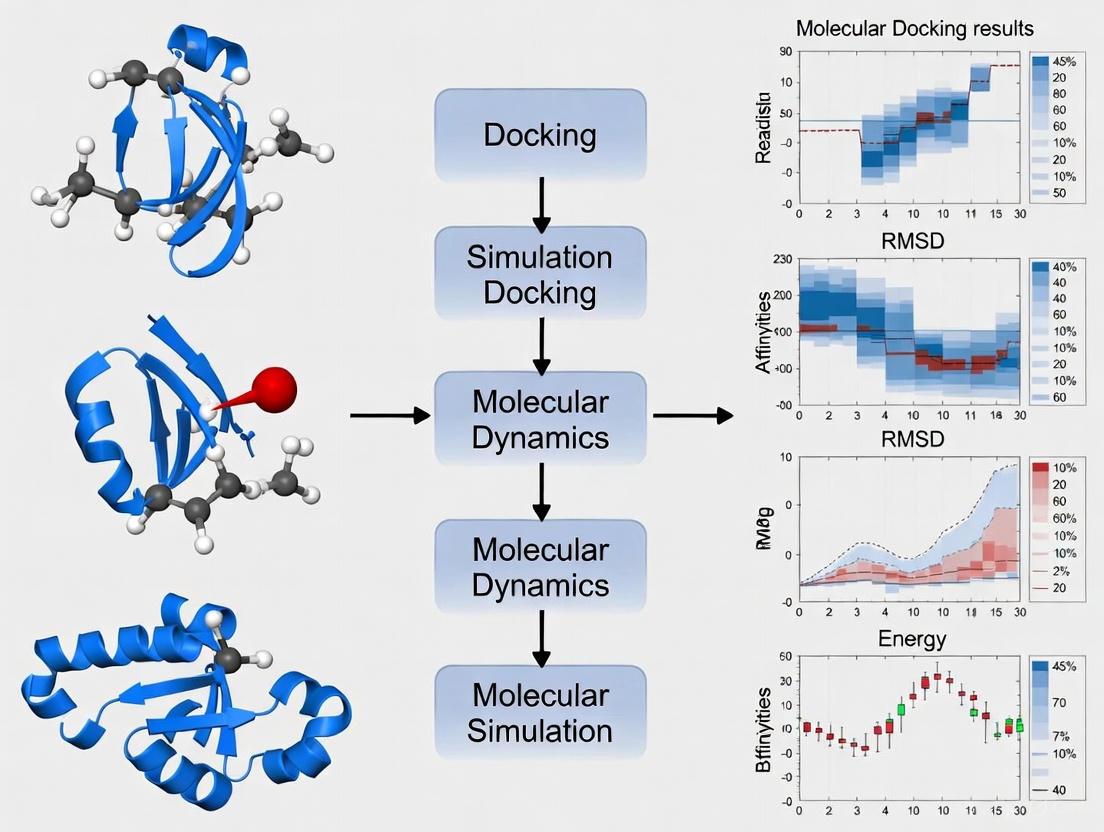
This article provides researchers and drug development professionals with a complete framework for validating molecular docking results through molecular dynamics (MD) simulations.
From Docking to Dynamics: A Comprehensive Guide to Validating Molecular Interactions in Drug Discovery
Abstract
This article provides researchers and drug development professionals with a complete framework for validating molecular docking results through molecular dynamics (MD) simulations. As computational approaches become increasingly crucial in drug discovery, integrating these complementary techniques ensures more reliable predictions of binding affinities and complex stability. We explore the fundamental principles connecting docking and MD, present practical methodologies for implementation using popular software tools, address common troubleshooting scenarios, and establish rigorous validation protocols. By synthesizing insights from current literature and case studies, this guide serves as an essential resource for enhancing the accuracy and biological relevance of structure-based drug design, ultimately bridging the gap between computational predictions and experimental outcomes.
Understanding the Synergy: How Docking and MD Simulations Work Together in Drug Discovery
The Critical Role of Computational Validation in Modern Drug Development
In the contemporary drug development landscape, computational methods have evolved from supportive tools to indispensable components that streamline the discovery pipeline. These approaches, which include molecular docking, pharmacophore modeling, and molecular dynamics (MD) simulations, enable researchers to rapidly identify and optimize potential drug candidates. However, the predictive power of these methods hinges on rigorous validation strategies that ensure their biological relevance and accuracy. As drug discovery embraces ultra-large virtual screening and artificial intelligence, establishing robust computational validation frameworks has become critical for translating in silico predictions into successful therapeutic outcomes. This guide examines the core computational techniques, their validation protocols, and their synergistic application in modern drug development.
Core Computational Methods and Comparative Performance
Modern drug discovery employs a suite of computational methods that operate on different principles and scales. Understanding their strengths, limitations, and appropriate validation contexts is essential for effective implementation.
Molecular Docking
Molecular docking predicts the preferred orientation of a small molecule (ligand) when bound to a target macromolecule (receptor). It is primarily used for virtual screening to identify potential hits from large compound libraries.
- Methodology: Docking programs such as DOCK, GOLD, and Glide use scoring functions to evaluate and rank ligand poses based on complementary interactions with the binding site [1].
- Key Applications: Initial hit identification, binding mode prediction, and structure-based drug design [2].
- Validation Consideration: Performance is highly dependent on the target's binding site characteristics and the accuracy of the scoring function [1].
Pharmacophore-Based Virtual Screening (PBVS)
A pharmacophore model represents the essential structural features responsible for a ligand's biological activity. PBVS uses these abstract models to screen compound databases.
- Methodology: Models are often built from known active ligands or protein-ligand complex structures using tools like Catalyst or LigandScout. Screening identifies compounds that share the defined feature set [1].
- Key Applications: Scaffold hopping to discover novel chemotypes, pre-filtering for docking, and post-docking enrichment [1].
- Validation Consideration: Demonstrates high performance in retrieving actives, particularly when protein structural data is limited [1].
Molecular Dynamics (MD) Simulations
MD simulations model the physical movements of atoms and molecules over time, providing a dynamic view of molecular behavior that static structures cannot capture.
- Methodology: Simulations numerically solve Newton's equations of motion for a system of atoms, using force fields (e.g., CHARMM, AMBER) to define interatomic forces. Software includes GROMACS, NAMD, and AMBER [3] [4] [5].
- Key Applications: Assessing binding stability, calculating free energies of binding, studying conformational changes, and validating docking poses [5].
- Validation Consideration: Requires careful parameterization and extensive sampling. Accuracy is critically dependent on the force field and must be validated against experimental data [3] [5].
Performance Comparison: PBVS vs. Docking-Based VS
A benchmark study across eight diverse protein targets provides quantitative performance data, measured by enrichment factor (EF) and hit rate (HR), which reflect the method's ability to prioritize active compounds over decoys [1].
Table 1: Performance Comparison of Virtual Screening Methods
| Target | PBVS EF | DBVS EF (DOCK) | DBVS EF (GOLD) | DBVS EF (Glide) |
|---|---|---|---|---|
| ACE | 4.92 | 1.23 | 1.85 | 1.64 |
| AChE | 4.05 | 2.32 | 2.14 | 2.41 |
| AR | 4.12 | 1.98 | 2.25 | 2.55 |
| DacA | 3.85 | 2.95 | 2.75 | 2.89 |
| DHFR | 3.95 | 2.11 | 2.33 | 2.67 |
| ERα | 4.25 | 2.45 | 2.51 | 2.88 |
| HIV-pr | 3.55 | 3.12 | 3.78 | 3.45 |
| TK | 3.88 | 2.67 | 2.72 | 2.91 |
| Average | 4.08 | 2.35 | 2.54 | 2.68 |
Table 2: Average Hit Rates at Different Top Fractions of Screened Database
| Method | Hit Rate @ 2% | Hit Rate @ 5% |
|---|---|---|
| PBVS | 42.5% | 38.2% |
| DBVS (DOCK) | 18.3% | 16.5% |
| DBVS (GOLD) | 21.1% | 18.9% |
| DBVS (Glide) | 23.4% | 20.7% |
The data demonstrates that PBVS generally outperformed DBVS across most targets, achieving higher enrichment factors and hit rates [1]. This suggests PBVS is a powerful method for initial ligand screening. However, the performance of DBVS methods varies by target and program, highlighting that the optimal tool is often target-dependent [1].
Experimental Validation Protocols
Computational predictions require robust experimental validation to confirm biological activity. The following protocols are commonly used to verify predictions from docking and MD simulations.
Orthogonal Biochemical and Biophysical Assays
A multi-pronged validation strategy is recommended to mitigate the limitations of any single assay [6].
- Binding Affinity Measurements: Use Surface Plasmon Resonance (SPR) or Isothermal Titration Calorimetry (ITC) to quantitatively measure the binding kinetics and thermodynamics of predicted interactions.
- Functional Activity Assays: Employ target-specific enzyme inhibition or cell-based reporter assays to determine if the binding event translates to a functional biological effect (e.g., agonism, antagonism).
- Structural Confirmation: Techniques like X-ray crystallography or cryo-electron microscopy (cry-EM) can provide atomic-level resolution of the ligand-target complex, directly validating the predicted binding pose from docking [2].
Experimental Validation of MD Simulations
Validating the physical accuracy of MD simulations is crucial for trusting their insights. A foundational approach involves comparing simulation outputs with experimental structural data [3].
- Protocol: A novel, model-independent method analyzes MD simulation data in the same way as experimental diffraction data. It determines the structure factors of the simulated system and reconstructs the overall transbilayer scattering-density profiles via Fourier analysis [3].
- Comparison Metrics: The simulated structures are evaluated against experimental data for key properties such as bilayer thickness, area per lipid, and molecular-component distributions [3].
- Outcome: This protocol provides a critical test of a force field's ability to reproduce experimental data, revealing discrepancies and guiding further force field development [3] [5].
An Integrated Workflow for Computational Validation
Combining computational methods into a cohesive pipeline leverages their complementary strengths. The following workflow outlines a robust path from initial screening to dynamic validation.
Integrated Computational Validation Workflow
This integrated approach begins with pharmacophore-based virtual screening to efficiently reduce the chemical space, leveraging its high enrichment factors shown in Table 1 [1]. The top hits then undergo more computationally intensive docking-based virtual screening for precise pose prediction and scoring. The most promising complexes are finally subjected to MD simulations to assess the stability of the binding pose and calculate binding free energies, providing a dynamic validation that static docking cannot [5]. This step helps filter out false positives that may score well in docking but form unstable complexes. The final, critical step is experimental validation using the orthogonal assays described above [6].
The Scientist's Toolkit: Essential Research Reagents and Materials
Successful implementation of computational methods and subsequent validation relies on key software tools, force fields, and experimental resources.
Table 3: Key Research Reagent Solutions for Computational Drug Development
| Tool/Reagent | Type | Primary Function | Application Context |
|---|---|---|---|
| GROMACS | Software | Molecular dynamics simulation | High-performance MD simulations of proteins, lipids, and nucleic acids [3] [4]. |
| CHARMM36 | Force Field | Empirical molecular mechanics parameters | Provides accurate parameters for simulating lipid bilayers and proteins in MD [4]. |
| LigandScout | Software | Pharmacophore model generation | Creates 3D pharmacophore models from protein-ligand complexes for PBVS [1]. |
| Glide | Software | Molecular docking | Performs precision docking and scoring for virtual screening [1]. |
| ZINC20 | Database | Free ultralarge compound library | Provides access to billions of purchasable compounds for virtual screening [2]. |
| CHARMM-GUI | Web Server | Input generator for simulations | Simplifies the setup of complex simulation systems for various MD programs [4]. |
Computational methods are fundamentally reshaping drug development, but their predictive power is only as reliable as the validation frameworks that support them. The comparative data shows that pharmacophore-based screening offers high efficiency in enriching actives, while docking provides atomic-level insights into binding, and MD simulations deliver crucial dynamic context. An integrated workflow that strategically sequences these methods, culminating in rigorous experimental validation, creates a powerful and robust engine for discovering new therapeutics. As force fields continue to improve and computational power grows, the role of validation will only become more critical in ensuring that the rapid pace of in silico discovery translates confidently into clinical success.
Molecular docking is a foundational computational method in structure-based drug discovery that predicts how a small molecule (ligand) binds to a target protein receptor. This technique serves two primary objectives: to predict the binding affinity and three-dimensional orientation of small molecules within a receptor site, and to identify potential drug candidates from large chemical databases through virtual screening [7] [8]. The central premise involves sampling different conformations and orientations of the ligand within the protein's binding pocket and ranking these poses using scoring functions that estimate binding strength [9].
The methodology has evolved significantly from early rigid-body docking approaches, which treated both protein and ligand as fixed structures, to modern techniques that incorporate varying degrees of flexibility. This evolution acknowledges the "induced-fit" theory, where both ligand and receptor undergo conformational changes to achieve optimal binding [9] [8]. Today, molecular docking stands as an indispensable tool that reduces the cost and time of drug discovery by prioritizing the most promising candidates for experimental validation [10].
Molecular Docking Methodologies and Algorithms
Conformational Search Algorithms
Docking programs employ different conformational search strategies to explore the ligand's possible orientations and conformations within the binding site. These algorithms can be broadly classified into four categories:
Systematic Methods: These approaches exhaustively explore conformational space by systematically rotating rotatable bonds at fixed intervals. Incremental construction methods, used by FlexX and DOCK, break the ligand into fragments, dock rigid core fragments, and rebuild the molecule in the binding site. True systematic search algorithms, implemented in Glide and FRED, comprehensively explore all possible torsion angles but face exponential complexity growth with increasing rotatable bonds [7] [9].
Stochastic Methods: These techniques use random sampling to explore conformational space. Monte Carlo methods make random changes to ligand conformation and accept or reject them based on energy criteria and Boltzmann distribution probability. Genetic algorithms, used in AutoDock and GOLD, encode conformational degrees of freedom as "genes" that undergo mutation and crossover across generations, with docking scores serving as fitness functions [7].
Shape Matching Algorithms: These approaches, including DOCK, prioritize computational speed by emphasizing complementarity between ligand and binding site surfaces [8].
Molecular Dynamics Simulations: While not typically used for initial docking due to computational cost, MD simulations serve as powerful conformational search tools that can capture induced-fit effects through pre-docking conformational sampling or post-docking refinement [7] [11].
Scoring Functions
Scoring functions are mathematical approximations used to predict binding affinity by evaluating protein-ligand interactions. They represent the sum of electrostatic and van der Waals energies, along with additional terms accounting for solvation effects, entropy, and specific interaction patterns [9]. These functions employ various approaches:
- Force Field-Based: Calculate energy terms using molecular mechanics force fields.
- Empirical: Parameterized using experimental binding affinity data.
- Knowledge-Based: Derived from statistical analyses of atom-pair frequencies in protein-ligand complexes.
Despite advancements, scoring remains a significant challenge in molecular docking, with functions often struggling to accurately predict absolute binding affinities while showing better performance for relative ranking of similar compounds [9].
Flexibility Considerations
The treatment of molecular flexibility represents a critical differentiator among docking approaches:
Rigid Docking: Treats both protein and ligand as fixed entities, considering only rotational and translational degrees of freedom. This approach is computationally efficient but biologically unrealistic for most systems [8].
Semi-Flexible Docking: Maintains a rigid protein while allowing ligand flexibility through rotatable bonds. This balanced approach offers improved accuracy over rigid docking while maintaining computational feasibility, making it the most common docking methodology [8].
Flexible Docking: Incorporates flexibility for both receptor and ligand, providing the most realistic representation but requiring substantial computational resources. Some implementations like "soft docking" implicitly account for flexibility by allowing limited atomic overlaps [8].
Comparative Analysis of Docking Software
Numerous molecular docking programs have been developed, each implementing different algorithms and scoring functions. The table below summarizes key characteristics of major docking software:
Table 1: Comparison of Major Molecular Docking Software
| Software | Algorithm Type | Flexibility Treatment | Scoring Function | Key Features | Performance Highlights |
|---|---|---|---|---|---|
| AutoDock Vina [9] [10] | Stochastic (Genetic Algorithm) | Semi-flexible | Empirical & Knowledge-based | Hybrid scoring function with machine learning | Fast and reliable; good accuracy for pose prediction |
| GOLD [9] [10] | Stochastic (Genetic Algorithm) | Semi-flexible | Empirical (ChemScore) | Comprehensive conformational search | High docking accuracy; successful in virtual screening trials |
| Glide [7] [9] | Systematic | Semi-flexible | Empirical (GlideScore) | Hierarchical filters for speed | 90% pose prediction accuracy; exceptional for large databases |
| FlexX [9] [10] | Systematic (Incremental Construction) | Semi-flexible | Empirical | Fast incremental construction | Suitable for high-throughput virtual screening |
| DOCK [9] [12] | Shape-based | Semi-flexible | Force field-based | Geometric matching algorithm | Extensive validation history; handles large libraries |
| ZDOCK [13] [10] | FFT-based rigid body | Rigid | Shape complementarity + Electrostatics | Fast Fourier Transform correlation | Excellent for protein-peptide docking; incorporates desolvation energy |
| FRODOCK [13] | FFT-based rigid body | Rigid | Knowledge-based potential | Spherical harmonics properties | Top performer in blind protein-peptide docking benchmarks |
Performance Considerations
Docking accuracy is typically evaluated by the root-mean-square deviation (RMSD) between predicted and experimentally determined ligand positions, with values below 2.0 Å generally considered successful [9]. Benchmarking studies reveal that performance varies significantly based on the specific system and requirements:
For protein-small molecule docking, GOLD and Glide consistently achieve approximately 90% accuracy in pose prediction [9]. AutoDock Vina provides an optimal balance of speed and accuracy, particularly beneficial for virtual screening [10].
For protein-peptide docking, specialized tools show superior performance. FRODOCK achieves the best performance in blind docking, while ZDOCK excels in re-docking scenarios where binding sites are known [13].
Recent advancements incorporate machine learning to improve scoring functions and conformational sampling, addressing historical limitations in pose prediction and affinity estimation [7] [12].
Validation Through Molecular Dynamics Simulations
The Docking-MD Validation Workflow
Molecular docking provides initial binding hypotheses, but these static snapshots require validation through molecular dynamics (MD) simulations that account for full protein flexibility and solvation effects. The integrated docking-MD workflow proceeds through several stages:
Graphviz: Docking-MD Validation Workflow
This workflow generates a more reliable assessment of binding stability and affinity than docking alone [11] [14].
Case Study: Streptococcus gallolyticus Drug Discovery
A recent study on Streptococcus gallolyticus demonstrates the power of combining docking with MD simulations. Researchers identified three druggable targets (GlmU, RpoD, and PPAT) using subtractive proteomics, then screened 10,000 natural compounds from the LOTUS database through molecular docking [15].
The top-ranking compounds (LTS001632 for GlmU, LTS0243441 for PPAT, and LTS0236112 for RpoD) underwent extensive MD simulations to validate complex stability and calculate binding free energies using MM-GBSA. This approach confirmed the docking predictions and provided quantitative affinity estimates, demonstrating how MD simulations complement docking by assessing the temporal stability and energetic landscape of predicted complexes [15].
Ensemble Docking Strategies
MD simulations enhance docking accuracy through ensemble docking, where multiple receptor conformations from MD trajectories are used as docking targets. This approach accounts for binding site flexibility and identifies ligands that stabilize different conformational states [11].
Table 2: MD Simulation Methods for Docking Validation
| Method | Purpose | Key Applications | Computational Cost |
|---|---|---|---|
| Standard MD [11] | Complex stability assessment | Pose validation, conformational sampling | Medium to High |
| Replica Exchange MD [11] | Enhanced conformational sampling | Overcoming energy barriers | High |
| MM/GBSA [15] [11] | Binding free energy estimation | Ranking docked compounds | Medium |
| Free Energy Perturbation (FEP) [11] | Relative binding affinity | Lead optimization | Very High |
| Ensemble Docking [11] | Incorporating receptor flexibility | Virtual screening against dynamic targets | Medium |
Machine learning approaches are increasingly integrated with MD simulations to improve binding free energy predictions by guiding frame selection, refining energy terms, and optimizing resource allocation [11].
Experimental Protocols and Methodologies
Standard Docking Protocol
A reproducible molecular docking experiment follows these key steps:
Protein Preparation:
Ligand Preparation:
Binding Site Definition:
- Use known active site information when available
- Alternatively, employ cavity detection programs (GRID, SURFNET, DeepSite) [8]
Docking Execution:
- Select appropriate search algorithm and scoring function
- Generate multiple poses per ligand (typically 10-50)
- Apply constraints based on known interaction patterns if available [7]
Pose Analysis and Selection:
- Cluster similar conformations
- Visualize molecular interactions (hydrogen bonds, hydrophobic contacts)
- Select top-ranked poses based on scoring function and interaction patterns [7]
MD Validation Protocol
Following docking, implement this MD validation protocol:
System Setup:
- Solvate the protein-ligand complex in explicit solvent
- Add counterions to neutralize system charge
- Apply appropriate boundary conditions
Equilibration:
- Gradually heat system to target temperature (typically 300K)
- Apply positional restraints to protein and ligand
- Gradually release restraints while maintaining constant pressure
Production Simulation:
- Run unrestrained simulation for timescales sufficient for convergence (typically 50-500ns)
- Maintain constant temperature and pressure using thermostats and barostats
- Save trajectory frames at regular intervals for analysis [11]
Trajectory Analysis:
- Calculate root-mean-square deviation (RMSD) of protein and ligand
- Monitor interaction persistence throughout simulation
- Identify stable binding modes and conformational changes
Binding Free Energy Calculation:
Essential Research Reagents and Tools
Table 3: Essential Research Resources for Docking and MD Studies
| Resource Category | Specific Tools | Primary Function | Access Information |
|---|---|---|---|
| Protein Structure Databases [8] | PDB, AlphaFold Database | Source experimental and predicted structures | Public access |
| Chemical Compound Databases [15] [8] | DrugBank, ZINC, PubChem, LOTUS | Source small molecules for docking | Public access |
| Docking Software [9] [10] | AutoDock Vina, GOLD, Glide, DOCK | Perform molecular docking | Commercial and free licenses |
| MD Simulation Packages [11] | GROMACS, AMBER, NAMD, OpenMM | Run molecular dynamics simulations | Mostly open source |
| Analysis Tools [15] | PyMOL, VMD, Chimera | Visualize and analyze structures and trajectories | Mixed access models |
| Binding Site Detection [8] | DeepSite, CASTp, GRID | Identify potential binding pockets | Public servers and standalone |
| Force Fields [11] | CHARMM, AMBER, OPLS | Parameterize molecular mechanics energy | Bundled with MD software |
Molecular docking provides powerful capabilities for predicting initial binding poses and estimating affinities, serving as an indispensable first step in structure-based drug discovery. However, docking results require validation through molecular dynamics simulations that account for full atomistic flexibility and solvation effects. The integration of these methodologies creates a robust framework for advancing drug discovery, with docking enabling high-throughput screening and MD providing physiological context and validation.
As both fields evolve—with docking benefiting from machine learning-enhanced scoring functions and MD leveraging specialized hardware for longer timescales—their synergy will continue to strengthen, offering increasingly reliable predictions of molecular interactions. This combined approach represents the current state-of-the-art in computational drug discovery, balancing computational efficiency with biological realism to accelerate the identification and optimization of therapeutic compounds.
Molecular docking serves as a fundamental computational technique in modern drug discovery, enabling the high-throughput prediction of how small molecule ligands interact with protein targets. However, its utility is fundamentally constrained by inherent limitations in scoring functions and the static nature of the structures it employs. Docking algorithms often struggle with accurately ranking binding poses and predicting binding affinities, as they typically rely on simplified physical models and cannot fully capture the dynamic protein-ligand interactions that occur in a physiological solution. The recognition of these shortcomings has established molecular dynamics (MD) simulations as an indispensable tool for the validation of molecular docking results. By providing a dynamic view of the binding process, MD simulations allow researchers to move beyond static snapshots and assess the stability and flexibility of protein-ligand complexes over time, thereby offering a more rigorous and biophysically realistic evaluation of potential drug candidates.
This guide objectively compares the performance of molecular dynamics simulations against traditional docking and other alternative methods for validating protein-ligand interactions. It synthesizes current research data and detailed experimental protocols to provide drug development professionals with a clear framework for integrating MD-based validation into their computational workflows.
Performance Comparison: MD Simulations vs. Docking and Other Methods
Quantitative Comparison of Key Performance Metrics
The following table summarizes the performance of molecular docking, MD simulations, and other computational methods across several key metrics relevant to the validation of protein-ligand complexes.
Table 1: Performance Comparison of Computational Methods for Protein-Ligand Interaction Analysis
| Method | Binding Pose Stability Assessment | Binding Affinity Prediction Accuracy | Timescale | Explicit Solvent Treatment | Conformational Sampling |
|---|---|---|---|---|---|
| Molecular Docking | Limited; cannot assess stability over time [16] | Approximate; often poor correlation with experiment [17] | Seconds to minutes | Implicit or absent | Single, static pose |
| MD Simulations | High; 94% of native poses maintained as stable [16] | Improved correlation with experiment via MMPBSA/GBSA [17] [18] | Hours to days | Explicit | Extensive, dynamic |
| Machine Learning Scoring | Varies with training data | Good for targets similar to training data; can overfit [19] | Minutes | Typically implicit | Limited to training set scope |
Key Insights from Comparative Studies
- Pose Stability and Decoy Rejection: A systematic study on 120 protein-ligand complexes demonstrated that while 94% of experimental (native) binding poses remained stable during MD simulations, a significant 38-44% of incorrect decoy poses generated by docking were successfully identified as unstable. This highlights MD's critical role in filtering out false positives from docking experiments [16].
- Binding Affinity Correlation: Large-scale datasets like PLAS-20k, which contains binding affinities for over 19,500 complexes derived from MD simulations followed by MM/PBSA calculations, show a better correlation with experimental values than traditional docking scores. This holds true even for diverse protein clusters and drug-like ligands, underscoring the predictive advantage of MD-based methods [17].
- Identifying Subtle Interaction Patterns: MD simulations excel at capturing dynamic interactions that are missed in static docking. For instance, a study on NDM-1 inhibitors revealed that a candidate compound (S904-0022) maintained stable interactions with key residues like Gln123 and His250 throughout a 300 ns simulation. This stable binding profile, corroborated by a favorable MM/GBSA binding free energy of -35.77 kcal/mol, provided a level of validation unattainable by docking alone [18].
Experimental Protocols for MD-Based Validation
Standard Workflow for Validation of Docking Results
The following diagram illustrates a typical integrated computational workflow for validating docking results through molecular dynamics simulations.
Detailed Methodological Steps
The workflow outlined above involves several critical steps, each with specific protocols:
System Preparation:
- Protein and Ligand Preparation: The protein structure, often from the PDB, is prepared by removing crystallographic water molecules, adding missing residues and hydrogen atoms, and assigning correct protonation states at physiological pH using tools like H++ or standard molecular visualization software [17] [20]. The ligand's 3D structure is optimized, and its force field parameters are generated using tools like
antechamberwith the GAFF2 force field [17]. - Solvation and Ionization: The protein-ligand complex is solvated in an explicit water box (e.g., TIP3P) with a buffer of at least 10 Å around the solute. Counterions are added to neutralize the system's net charge [17].
- Protein and Ligand Preparation: The protein structure, often from the PDB, is prepared by removing crystallographic water molecules, adding missing residues and hydrogen atoms, and assigning correct protonation states at physiological pH using tools like H++ or standard molecular visualization software [17] [20]. The ligand's 3D structure is optimized, and its force field parameters are generated using tools like
Simulation Setup:
- Energy Minimization: The system undergoes energy minimization (e.g., 1000-4000 steps) to remove steric clashes and bad contacts, often using the L-BFGS algorithm. This step may involve initial restraints on the protein backbone that are gradually released [17] [18].
- System Equilibration: The minimized system is gradually heated to the target temperature (e.g., 300 K) and its density is equilibrated under constant pressure (1 atm). This is typically done in two phases: first in the NVT ensemble (constant volume and temperature) and then in the NPT ensemble (constant pressure and temperature). Restraints on the protein backbone are usually applied during initial equilibration and then removed [17].
Production Simulation and Analysis:
- Production Run: Multiple independent production simulations (typically ranging from 100 ns to 1 µs) are performed using a stable integrator like Langevin dynamics. Trajectories are saved at regular intervals (e.g., every 100 ps) for subsequent analysis [16] [17].
- Stability Metrics: The root-mean-square deviation (RMSD) of the protein backbone and ligand heavy atoms is calculated to assess the overall stability of the complex. The root-mean-square fluctuation (RMSF) of protein residues indicates flexible regions.
- Interaction Analysis: Hydrogen bonds, hydrophobic contacts, and salt bridges are monitored over the simulation time to identify key interactions stabilizing the binding pose [20] [18].
- Binding Free Energy Calculation: The Molecular Mechanics/Generalized Born Surface Area (MM/GBSA) or Poisson-Boltzmann Surface Area (MM/PBSA) method is commonly employed to calculate binding free energies from simulation snapshots. This provides a more rigorous estimate of binding affinity than docking scores [20] [18]. For instance, in the VEGFR-2/c-Met study, this method helped identify compounds with superior binding free energies compared to positive controls [20].
Case Study: Validating Dual VEGFR-2/c-Met Inhibitors
Detailed Workflow and Pathway Visualization
A recent study exemplifies the powerful synergy between docking and MD simulation. Researchers employed a comprehensive virtual screening approach to identify dual-target inhibitors for VEGFR-2 and c-Met, two critical kinases in cancer pathogenesis [20]. The process began with screening over 1.28 million compounds from the ChemDiv database using pharmacophore models and molecular docking. This was followed by extensive MD simulations and MM/PBSA calculations on the top hits to validate their binding stability and affinity [20].
The therapeutic relevance of these targets lies in their synergistic role in tumor angiogenesis and progression. The following diagram illustrates the key signaling pathways involved, which the identified inhibitors aim to disrupt.
Quantitative Results from MD Validation
The MD simulation results provided critical validation that went beyond the initial docking scores:
Table 2: MD Simulation and Binding Energy Results for Identified VEGFR-2/c-Met Inhibitors [20]
| Compound ID | Target Protein | Key Stable Interactions Observed | Binding Free Energy (MM/PBSA) |
|---|---|---|---|
| Compound17924 | VEGFR-2 | Not specified in detail, but superior to positive control | More favorable than positive control |
| Compound17924 | c-Met | Not specified in detail, but superior to positive control | More favorable than positive control |
| Compound4312 | VEGFR-2 | Not specified in detail, but superior to positive control | More favorable than positive control |
| Compound4312 | c-Met | Not specified in detail, but superior to positive control | More favorable than positive control |
The study concluded that both compounds showed superior binding free energies compared to the positive ligands, confirming their potential as promising drug candidates. This conclusion could not have been reached with docking alone, underscoring the value of MD for lead optimization and validation [20].
Successful execution of MD-based validation pipelines relies on a suite of software tools, databases, and computational resources. The following table details key components of the modern computational scientist's toolkit.
Table 3: Essential Research Reagents and Resources for MD-Based Validation
| Resource Name | Type | Primary Function in Workflow |
|---|---|---|
| RCSB Protein Data Bank (PDB) | Database | Source of experimental 3D structures of target proteins and protein-ligand complexes [20]. |
| ChemDiv Database | Database | Commercial library of small molecules for virtual screening [20] [18]. |
| AutoDock Vina / AutoDockTools | Software | Widely used programs for molecular docking and pose generation [18]. |
| AMBER (ff14SB, GAFF2) | Software / Force Field | Suite of biomolecular force fields and simulation programs for MD [17]. |
| GROMACS / OpenMM | Software | High-performance MD simulation engines for running production trajectories [17] [18]. |
| MMPBSA.py / MMGBSA.py | Software | Tools for calculating binding free energies from MD trajectories using MM/PBSA and MM/GBSA methods [17]. |
| PLAS-20k Dataset | Dataset | A publicly available dataset of binding affinities for 19,500 protein-ligand complexes derived from MD simulations, useful for benchmarking [17]. |
In the realm of computational drug discovery, accurately predicting how small molecules interact with biological targets represents a fundamental challenge. The reliability of these predictions hinges on three interconnected theoretical concepts: force fields that describe the physical forces between atoms, scoring functions that rapidly evaluate binding affinity, and sampling algorithms that explore possible binding orientations. While molecular docking provides initial predictions, the scientific community increasingly recognizes that validation through molecular dynamics (MD) simulations provides a more rigorous, physics-based assessment of docking results. This guide objectively compares the performance of these methodologies, demonstrating how an integrated approach leveraging their respective strengths leads to more reliable outcomes in structure-based drug design.
The critical limitation of docking arises from its heavy reliance on scoring functions, which often make simplifying assumptions to achieve computational speed. Research systematically validates that integrating MD simulations can significantly improve docking results. One study demonstrated a 22% improvement in ROC AUC (from 0.68 to 0.83) in distinguishing active from decoy compounds in the DUD-E dataset when docking results from AutoDock Vina were refined through high-throughput MD simulations [21]. This performance gain stems from MD's ability to account for critical physical phenomena such as solvent effects, entropic contributions, and protein flexibility that are often oversimplified in standard docking scoring functions [21] [22].
Theoretical Foundations and Definitions
Force Fields: The Physics-Based Foundation
Force fields are computational models that describe the potential energy of a molecular system as a function of its atomic coordinates, providing the fundamental physics basis for both MD simulations and some scoring functions [23]. They use mathematical functions and parameters to approximate the forces governing atomic interactions.
The general functional form of a molecular mechanics force field can be decomposed into bonded and non-bonded interaction terms:
Bonded Interactions: These include energy terms for atoms connected by covalent bonds:
Non-bonded Interactions: These describe interactions between atoms not directly bonded:
Table 1: Comparison of Major Biomolecular Force Fields
| Force Field | Parameterization Approach | Strengths | Common Applications |
|---|---|---|---|
| CHARMM [21] | Mixed quantum mechanics and experimental data | Balanced treatment of proteins and lipids | MD simulations of biomolecular systems |
| AMBER [24] | Emphasizes accurate nucleic acid parameters | Excellent for DNA/RNA complexes | Protein-ligand simulations |
| GROMOS | Parameterized against condensed phase data | Strong performance for folding studies | Biomolecular simulations in aqueous environment |
| OPLS-AA | Optimized for liquid properties | Accurate for organic molecules | Ligand parameterization |
Scoring Functions: Rapid Binding Evaluation
Scoring functions are mathematical approximations used to predict the binding affinity between molecules after docking. They prioritize computational speed over physical completeness, enabling the rapid screening of thousands to millions of compounds [25]. These functions fall into four primary categories:
Force Field-Based: Estimate binding affinity by summing intermolecular van der Waals and electrostatic interactions from force fields, sometimes including implicit solvation terms [25] [26]. Examples include DOCK and AutoDock scoring functions.
Empirical: Use weighted sums of interaction types (hydrogen bonds, hydrophobic contacts, etc.) with coefficients fitted to experimental binding affinity data [25]. Examples include Glide, ChemScore, and the DockTScore family.
Knowledge-Based: Derive statistical potentials from structural databases under the assumption that frequently observed atom pair interactions are energetically favorable [25]. Examples include PMF, DrugScore, and ITScore.
Machine Learning-Based: Utilize algorithms that learn complex relationships between structural features and binding affinities without assuming a predetermined functional form [27] [22] [25]. These consistently outperform classical scoring functions in binding affinity prediction, particularly when sufficient target-specific data is available [25].
Sampling Methods: Exploring Structural Landscapes
Sampling algorithms explore the conformational and orientational space available to the ligand and protein. While this guide focuses primarily on force fields and scoring, sampling efficiency directly impacts practical performance. Key approaches include:
- Systematic Search: Methodically explores all rotational and translational degrees of freedom
- Stochastic Algorithms: Use random changes (Monte Carlo, genetic algorithms) to explore space
- Molecular Dynamics: Simulates physical motion through numerical integration of Newton's equations
Performance Comparison and Experimental Data
Comparative Performance of Scoring Function Types
Table 2: Performance Comparison of Scoring Function Categories
| Scoring Function Type | Binding Mode Prediction | Binding Affinity Prediction | Virtual Screening | Computational Speed |
|---|---|---|---|---|
| Force Field-Based | Moderate | Moderate (improves with implicit solvation) | High false positive rate for charged compounds | Fast |
| Empirical | Good | Variable across target classes | Good with target-matched training | Very fast |
| Knowledge-Based | Good to excellent | Limited correlation with affinity | Good balance of accuracy/speed | Fast |
| Machine Learning | Excellent with sufficient data | Best overall performance [22] | State-of-the-art enrichment [25] | Fast prediction (slow training) |
The performance heterogeneity across different target classes has prompted the development of target-specific scoring functions. For example, specialized functions for proteases and protein-protein interactions (PPIs) have demonstrated superior performance compared to general-purpose functions [22]. The DockTScore function, which incorporates optimized MMFF94S force-field terms alongside solvation and lipophilic interaction terms, showed competitive performance on DUD-E datasets, particularly for its intended target classes [22].
Quantitative Validation Through MD Integration
The integration of molecular dynamics simulations provides a robust method for validating and improving docking results. A comprehensive study evaluating 56 protein targets from the DUD-E dataset demonstrated this approach quantitatively:
Table 3: Performance Improvement of Docking with MD Refinement
| Metric | AutoDock Vina Alone | With MD Refinement | Improvement |
|---|---|---|---|
| ROC AUC | 0.68 | 0.83 | +22% |
| Robust Performance | Variable across protein classes | Consistent across 7 protein classes | Significant |
| Binding Mode Quality | Dependent on scoring function | Moderate refinement observed | Enhanced |
This high-throughput MD method simulated protein-ligand complexes from docking results, evaluating ligand binding stability using root-mean-square deviation (RMSD) throughout the trajectories. The physics-based approach of MD simulations successfully discriminated between correct and incorrect binding modes, with correctly predicted binding modes demonstrating greater stability during simulations [21].
Experimental Protocols and Methodologies
High-Throughput MD Validation Protocol
The workflow for validating docking results through MD simulations involves several standardized steps that ensure reproducible results:
Initial Docking: Protein receptors and ligands are prepared using standard protocols with AutoDock Vina, treating receptors as rigid and ligands as flexible. The search space is determined based on native ligand coordinates from crystal structures (cubic box with 22.5 Å edges) [21].
System Preparation: Protein-ligand complexes are processed using automated scripts (Python) that interface with CHARMM-GUI to generate MD simulation systems. Ligand topology and parameters are generated using CGenFF [21].
Solvation and Neutralization: Systems are solvated in a cubic TIP3P water box extending 10 Å from the protein and neutralized with K⁺ and Cl⁻ ions under periodic boundary conditions [21].
Force Field Application: Simulations use CHARMM36m force field with an NPT ensemble (constant particle number, pressure, and temperature) maintained using a Langevin thermostat [21].
Electrostatics and Constraints: Particle-mesh Ewald method handles electrostatic interactions, while hydrogen atoms are constrained using the SHAKE algorithm [21].
Simulation Execution: Systems undergo minimization (5,000 steps steepest descent), equilibration (1 ns NVT), and production runs using OpenMM [21].
Trajectory Analysis: Ligand binding stability is evaluated by calculating RMSD relative to initial docking structures, aligning protein structures but not ligands [21].
Target-Specific Scoring Function Development
The development of specialized scoring functions for specific target classes follows a rigorous protocol:
Dataset Curation: For protease-specific functions, compounds are selected from PDBbind based on Enzyme Commission numbers (ranging 3.4.11.0-3.4.25.69). For PPI inhibitors, high-resolution complexes are carefully curated, removing structures with resolution >2.5 Å or covalent ligands [22].
Structure Preparation: Protein Preparation Wizard in Maestro assigns protonation states using ProtAssign and PROPKA, considering bound ligands. Ligand protonation and tautomeric states are calculated with Epik. Metal ions are treated as cofactors, and waters are removed [22].
Descriptor Calculation: Physics-based terms include MMFF94S force field energy components, solvation and lipophilic interaction terms, and ligand torsional entropy contributions [22].
Model Training: Multiple linear regression ensures physical interpretability, while non-linear models (SVM, random forest) capture complex relationships without overfitting [22].
Validation: Functions are tested on independent test sets and DUD-E datasets to evaluate affinity prediction and virtual screening performance [22].
Visualization of Workflows and Relationships
Workflow Integrating Docking with MD Validation
Classification of Scoring Functions
Essential Research Reagents and Computational Tools
Table 4: Essential Research Tools for Molecular Docking and Validation
| Tool/Resource | Type | Function | Application Context |
|---|---|---|---|
| AutoDock Vina [21] | Docking Program | Predicts binding modes and scores | Initial virtual screening |
| CHARMM-GUI [21] | Web Server | Prepares MD simulation systems | System setup for MD validation |
| CHARMM36m [21] | Force Field | Describes molecular interactions | Physics-based MD simulations |
| CGenFF [21] | Parameterization | Generates ligand parameters | MD setup for small molecules |
| OpenMM [21] | MD Engine | Performs high-throughput simulations | Production MD runs |
| PDBbind [22] | Database | Curated protein-ligand complexes | Training/scoring function development |
| DUD-E [21] | Benchmark Set | Directory of useful decoys | Method validation and testing |
| MMFF94S [22] | Force Field | Describes small molecule energetics | Physics-based scoring terms |
The comparative analysis presented in this guide demonstrates that while classical scoring functions provide computational efficiency for initial screening, their limitations in accurately predicting binding affinities necessitate validation through more rigorous methods. The integration of molecular dynamics simulations addresses key weaknesses in docking approaches by incorporating critical physical effects like explicit solvation, entropic contributions, and full flexibility.
The empirical evidence clearly shows that combining docking with MD validation improves performance substantially, with a demonstrated 22% increase in ROC AUC for distinguishing active from decoy compounds [21]. Furthermore, the development of target-specific scoring functions, particularly those incorporating physics-based terms and machine learning, shows promise for addressing the performance heterogeneity across different protein classes [22].
For researchers and drug development professionals, this comparative analysis suggests a practical workflow: utilize rapid docking and scoring for initial screening, followed by MD simulation validation for top candidates. This integrated approach leverages the respective strengths of each methodology while mitigating their individual limitations, ultimately leading to more reliable predictions in structure-based drug design.
Molecular docking has established itself as a cornerstone of structure-based drug discovery, providing computational predictions of how small molecules interact with biological targets at the atomic level. By simulating the binding orientation and affinity of ligands within protein binding sites, docking offers an efficient method for virtual screening and lead compound optimization [10]. However, conventional docking approaches predominantly rely on static protein structures, typically derived from X-ray crystallography or cryo-electron microscopy, which present an inherent limitation: biological systems are fundamentally dynamic. Proteins exist as ensembles of conformations, with side chains, loops, and even domains in constant motion—a reality that static snapshots cannot capture [28] [29]. This simplification often leads to inaccurate binding mode predictions, particularly when ligands induce conformational changes through "induced fit" mechanisms, more accurately described as conformational selection where ligands stabilize pre-existing protein conformations [29].
The integration of molecular dynamics (MD) simulations with docking results has emerged as a powerful methodology to bridge this resolution gap. MD simulations model system motions over time, accounting for protein flexibility, solvent effects, and the dynamic nature of binding interactions that static docking cannot resolve [28]. This combination creates a powerful pipeline: docking rapidly screens thousands of compounds, while MD simulations validate and refine the most promising complexes, assessing their stability and providing more accurate binding free energy estimates [30] [31]. This review comprehensively compares current molecular docking software and demonstrates, through experimental data and protocols, how MD simulations serve as an essential validation tool, transforming static predictions into dynamic binding insights across various drug discovery applications.
Comparative Analysis of Molecular Docking Software
The performance of docking programs varies significantly depending on the target protein and ligand characteristics. Understanding these differences is crucial for selecting the appropriate tool for a specific research application.
Key Docking Software and Their Distinctive Features
Table 1: Comparison of Key Molecular Docking Software
| Software | Search Algorithm | Scoring Function | Flexibility Handling | Best Use Cases | Accessibility |
|---|---|---|---|---|---|
| AutoDock Vina [10] [24] | Hybrid global/local optimization | Empirical, machine-learning enhanced | Flexible ligand, rigid receptor | High-throughput virtual screening, general-purpose docking | Open-source, free |
| GOLD [29] | Genetic Algorithm (GA) | ChemPLP, GoldScore, ASP | Flexible ligand, optional flexible protein side chains | High-accuracy pose prediction, lead optimization | Commercial |
| FRED (OEDocking) [29] [32] | Fast Rigid Exhaustive Docking | Chemgauss4, Shapegauss | Pre-generated ligand conformer ensemble | Ultra-high-throughput virtual screening | Commercial |
| Glide [10] | Hierarchical filter system | SP, XP scoring functions | Flexible ligand, grid-based receptor | Induced-fit docking, accurate binding mode prediction | Commercial |
| Surflex-Dock [29] | Fragment-based construction (Protomol) | Hammerhead scoring function | Flexible ligand, partial protein flexibility | De novo design, structure-based drug design | Commercial |
Performance Evaluation in Pose Prediction and Virtual Screening
Independent comparative studies provide critical insights into the practical performance of these tools. A landmark study evaluating docking routines for the transmembrane protein SERCA (sarco/endoplasmic reticulum calcium ATPase) compared GOLD, AutoDock, Surflex-Dock, and FRED [29]. The evaluation criteria included docking accuracy (using crystal structures as references), reproducibility, and correlation between docking scores and known bioactivities. The study found that GOLD and FRED provided the best overall results in accurately reproducing the known binding poses of inhibitors like thapsigargin and cyclopiazonic acid [29]. Notably, allowing for conformational flexibility in the binding site during docking runs did not yield a significant improvement in results for this particular target, highlighting that the benefits of flexible receptor docking are system-dependent [29].
For virtual screening, the speed and enrichment power are paramount. FRED (OpenEye OEDocking) excels in this domain, implementing a rigid docking approach that uses pre-generated conformational ensembles of ligands, making it exceptionally fast for screening massive compound libraries [32]. One study described FRED as "by far the fastest docking tool and thus particularly suitable for ultrahigh-throughput docking," leading to the discovery of a validated 2.7 nM inhibitor of BChE, a target for Alzheimer's disease [32]. AutoDock Vina strikes a notable balance between speed and accuracy, making it a popular choice for academic research and initial screening campaigns [10] [24].
Experimental Protocols for Docking Validation via Molecular Dynamics
The following section details a standardized workflow for transitioning from static docking predictions to dynamically validated complexes, incorporating specific protocols from recent literature.
Standardized Workflow for Integrated Docking and MD Validation
The general process for validating docking results with MD simulations follows a logical sequence from system preparation to analysis, as demonstrated in multiple recent studies [30] [31] [24].
Detailed Methodological Breakdown
System Preparation and Docking
Protein and Ligand Preparation: The crystal structure of the target protein is obtained from the Protein Data Bank. Water molecules and heteroatoms not involved in binding are typically removed, followed by the addition of hydrogen atoms and assignment of partial charges (e.g., Kollman charges for AutoDock, AMBER ff14SB for simulation-ready structures) [31] [24]. The ligand structure is energy-minimized using force fields like MMFF94 [31].
Molecular Docking: Docking is performed using tools like AutoDock Vina or GOLD into a defined grid box encompassing the binding site. For instance, in a study of phytochemicals against the Androgen Receptor for triple-negative breast cancer, virtual screening was performed using PyRx (with AutoDock Vina) after filtering compounds by Lipinski's Rule of Five [24]. Multiple poses are generated and ranked by their docking scores (e.g., binding affinity in kcal/mol).
Molecular Dynamics Simulation and Analysis
System Setup and Equilibration: The top-ranked docked complex is solvated in a water box (e.g., TIP3P water model) with ions added to neutralize the system. The system is energy-minimized and gradually heated to the target temperature (e.g., 310 K) during a equilibration phase with positional restraints on the protein and ligand [30] [31].
Production MD and Analysis: Unrestrained production simulations are run for a sufficient timescale (typically 50-100 nanoseconds or more) using software like Desmond (Schrödinger) or GROMACS [30] [31]. The stability of the simulation is assessed by calculating the root-mean-square deviation (RMSD) of the protein backbone and ligand atoms. Key protein-ligand interactions (hydrogen bonds, hydrophobic contacts) are monitored throughout the trajectory to verify the stability of the docking-predposed pose [31] [24].
Binding Free Energy Validation: The Molecular Mechanics with Generalised Born and Surface Area Continuum Solvation (MM-GBSA) or Poisson-Boltzmann (MM-PBSA) method is often applied to snapshots from the MD trajectory to calculate binding free energy, providing a more robust affinity estimate than docking scores alone [24]. A study on Molnupiravir binding to bovine serum albumin used triplicate 100 ns simulations followed by thermodynamic analysis to confirm the spontaneous nature of binding, demonstrating the power of this approach [31].
Case Studies: Experimental Data Supporting the Docking-MD Workflow
SARS-CoV-2 Main Protease (Mpro) Inhibitor Screening
A comprehensive study screened 200 natural antiviral compounds against SARS-CoV-2 Mpro (PDB: 6LU7) using AutoDock 4.2.6 [30]. The top compounds, including theaflavin-3-3'-digallate (binding energy: -12.41 kcal/mol; Ki = 794.96 pM) and rutin (binding energy: -11.33 kcal/mol; Ki = 4.98 nM), were subjected to 50 ns MD simulations. The simulations confirmed the conformational stability of the complexes, with stable RMSD values (<2 Å) and persistent hydrogen bonding with key catalytic residues (CYS 145 and HIS 41), validating the docking predictions and providing confidence in the inhibitory mechanism [30].
Binding Mechanism of Molnupiravir to Bovine Serum Albumin
Research on the antiviral drug Molnupiravir (MOL) combined multiple spectroscopic techniques with docking and MD to elucidate its binding to Bovine Serum Albumin (BSA)—a key pharmacokinetic determinant [31]. Docking with AutoDock4.2.6 predicted binding to site II of BSA, which was confirmed by competitive site-marker experiments. Subsequent triplicate 100 ns MD simulations demonstrated the stability of the MOL-BSA complex, with the ligand remaining in its binding site and interacting predominantly with tyrosine residues. This integrated approach provided a deeper mechanistic understanding of the drug's transport and distribution profile [31].
Phytochemical Lead Identification for Triple-Negative Breast Cancer
In this study, the Androgen Receptor (AR) was identified as a novel target for triple-negative breast cancer [24]. Virtual screening of phytochemicals against AR (PDB: 1E3G) using PyRx identified 2-hydroxynaringenin as a top hit. MD simulations over 100 ns revealed that the AR-2-hydroxynaringenin complex maintained structural stability with a stable binding affinity of -42.5 kcal/mol calculated via MM-GBSA. This confirmed the docking predictions and established the phytochemical as a promising lead molecule worthy of further experimental investigation [24].
Table 2: Summary of Key Experimental Findings from Case Studies
| Case Study / Target | Primary Docking Software | MD Simulation Length | Key Validation Metric from MD | Outcome |
|---|---|---|---|---|
| SARS-CoV-2 Mpro [30] | AutoDock 4.2.6 | 50 ns | Stable protein-ligand RMSD; maintained H-bonds with catalytic dyad | Confirmed mechanism of inhibition for top hits |
| Molnupiravir-BSA [31] | AutoDock 4.2.6 | 3 x 100 ns | Stable binding pose in site II; interactions with Tyr residues | Elucidated pharmacokinetic binding mechanism |
| Androgen Receptor (TNBC) [24] | AutoDock Vina (via PyRx) | 100 ns | Stable complex (low RMSD); MM-GBSA affinity: -42.5 kcal/mol | Identified 2-hydroxynaringenin as a potential lead |
The Scientist's Toolkit: Essential Research Reagents and Software
Successful execution of a docking-MD validation pipeline requires a suite of specialized software tools and resources.
Table 3: Essential Research Reagents and Software Solutions
| Item Name | Category | Primary Function | Example Use in Workflow |
|---|---|---|---|
| AutoDock Vina [10] [24] | Docking Software | Predicts ligand binding modes and affinities | Initial virtual screening and pose generation. |
| GOLD [29] | Docking Software | Genetic algorithm-based docking with high pose accuracy | Lead optimization and high-accuracy pose prediction. |
| FRED (OEDocking) [32] | Docking Software | Ultra-fast, exhaustive rigid docking for large libraries | Virtual screening of millions of compounds. |
| Desmond [30] [31] | MD Simulation Software | Performs all-atom molecular dynamics simulations | System equilibration, production MD runs, and trajectory analysis. |
| GROMACS | MD Simulation Software | High-performance MD simulation package (open-source) | Alternative for running production MD simulations. |
| AMBER ff14SB [24] | Force Field | Parameters for simulating proteins and nucleic acids | Energy minimization and MD simulation of the protein-ligand system. |
| TP3P Water Model [31] | Solvation Model | A transferable intermolecular potential for simulating water molecules | Solvation of the simulation system in a water box. |
| MM-GBSA/PBSA [24] | Analysis Method | Calculates binding free energies from simulation snapshots | Post-MD validation of binding affinity. |
The integration of molecular docking and molecular dynamics simulations represents a paradigm shift in computational drug discovery, effectively bridging the gap between static structural snapshots and the dynamic reality of biological systems. While docking programs like AutoDock Vina, GOLD, and FRED provide unparalleled efficiency for initial screening and pose prediction, their results require validation in a dynamic context. As demonstrated by the consistent methodology across multiple case studies, MD simulations provide this critical validation, assessing the stability of docked complexes, revealing detailed binding mechanisms, and offering more reliable affinity estimates through MM-GBSA/PBSA. This powerful combined protocol—from docking to dynamic validation—has proven its value across diverse therapeutic areas, from antiviral development to oncology, and will undoubtedly remain a cornerstone of rational drug design for the foreseeable future.
Molecular docking is a cornerstone of modern computational drug discovery, used to predict how small molecules interact with biological targets. However, its utility is often limited by the accuracy of scoring functions and the common simplification of treating the receptor as a rigid body. This guide examines how integrating Molecular Dynamics (MD) simulations as a validation step addresses these limitations, providing a more robust framework for predicting ligand binding. Through detailed case studies and quantitative comparisons, we demonstrate that this combined approach significantly enhances the reliability of virtual screening outcomes, offering a more physics-based assessment of binding stability and affinity.
Case Study 1: Large-Scale Validation on Diverse Protein Targets
Experimental Protocol
This study established a high-throughput workflow to evaluate the benefit of MD in improving docking results from AutoDock Vina [21]. The protocol was systematically applied to 56 protein targets from the DUD-E (Directory of Useful Decoys: Enhanced) dataset, spanning seven protein classes including kinases, proteases, and nuclear receptors [21].
- Initial Docking: For each target, 5 active and 5 decoy compounds were docked using AutoDock Vina with a rigid receptor and flexible ligands. The search space was a cubic box centered on the native ligand's coordinates [21].
- System Setup for MD: The top-ranked docking pose for each complex was processed using a Python script and CHARMM-GUI to automate the generation of MD simulation systems. Systems were solvated in a TIP3P water box, neutralized with ions, and described by the CHARMM36m force field [21].
- MD Simulation and Analysis: Each system underwent energy minimization, equilibration, and a production run. The key metric for evaluating binding was the ligand root-mean-square deviation (RMSD), calculated relative to the initial docking pose after aligning the protein backbone. Stable binding was indicated by low ligand RMSD values [21].
Performance and Impact
The study provided a direct, large-scale comparison of docking and MD validation performance. The results are summarized in the table below.
Table 1: Performance Comparison of Docking and MD Validation on the DUD-E Dataset
| Method | AUC (Area Under the ROC Curve) | Key Metric | Remarks |
|---|---|---|---|
| AutoDock Vina (Docking Alone) | 0.68 | Docking Score | Baseline performance [21] |
| Docking + MD Validation | 0.83 | Ligand Stability (RMSD) | 22% improvement in AUC [21] |
| MD Performance | Robust | Ligand RMSD | Consistent improvement across all 7 protein classes tested [21] |
This quantitative data demonstrates that MD simulations significantly improve the ability to distinguish true binders from decoys. The post-processing analysis based on ligand stability during the simulation proved to be a more reliable indicator of binding than the initial docking score alone [21].
Case Study 2: Fragment-Based Screening for SARS-CoV-2 Main Protease
Experimental Protocol
This research employed a multi-tiered workflow for fragment-based virtual screening against the SARS-CoV-2 Main Protease (Mpro), integrating docking with more advanced free energy calculations [33].
- Ligand Preparation & Docking: An initial set of ~50,000 candidate compounds was generated from fragment hits using the Fragalysis network. After enumerating charge states and generating 3D conformers, compounds were docked using rDock into 22 different crystal structures of Mpro [33].
- Pose Filtering and Scoring: The millions of generated docking poses were first filtered using the SuCOS score, which measures the 3D overlap between a docking pose and an experimental fragment structure. This ensured poses were biologically relevant. Poses were also scored using the deep learning-based TransFS tool [33].
- Free Energy Validation: The top ~200 compounds from docking were advanced to free energy calculations using the MMGBSA method, running an ensemble of simulations totaling 5 ns per compound. A final subset of the top 50 compounds was subjected to even more rigorous dissipation-corrected Targeted MD (dcTMD) simulations, requiring 50 ns per compound [33].
Performance and Impact
This case study exemplifies a practical pipeline where docking handles the high-throughput screening, while successive rounds of more computationally intensive simulations are used to validate and refine the results.
Table 2: Workflow for SARS-CoV-2 Mpro Inhibitor Screening
| Stage | Tool/Method | Key Function | Validation Role |
|---|---|---|---|
| 1. Pose Generation | rDock | High-throughput molecular docking | Generates initial binding hypotheses [33] |
| 2. Pose Validation | SuCOS, TransFS | Compares poses to experimental fragments; AI-based scoring | Filters out unrealistic poses from docking [33] |
| 3. Affinity Validation 1 | MMGBSA (via GROMACS) | End-state free energy method | Medium-throughput ranking of binding affinity [33] |
| 4. Affinity Validation 2 | dcTMD (via GROMACS) | Path-dependent free energy method | High-accuracy affinity calculation for top candidates [33] |
This workflow, implemented within the Galaxy platform, highlights how MD-based free energy methods serve as a critical validation step after docking, providing a more accurate estimate of binding affinity that guides the selection of compounds for experimental testing [33].
Case Study 3: Binding Site Characterization for the 1EAG Protease
Experimental Protocol
This study focused on the precise characterization of the binding pocket in the Candida albicans 1EAG protease as a essential prerequisite for validating docking studies [34].
- Binding Site Analysis: The 3D structure of protease 1EAG was analyzed to identify key residues within 3–5 Å of its co-crystallized ligand. The study characterized 12 key active-site residues by their chemical properties (polar, hydrophobic, aromatic) and their functional roles in hydrogen bonding, π–π stacking, and hydrophobic interactions [34].
- Pharmacophore Modeling: The spatial organization of the pocket was translated into a simplified pharmacophore model, identifying features like hydrogen bond donors/acceptors and hydrophobic regions. The analysis identified ASP32 as a catalytic hotspot and TYR84 and TYR225 as key for ligand stabilization [34].
Performance and Impact
While this study primarily established a framework for docking validation, it underscores a critical principle: accurate docking and its subsequent MD validation depend entirely on a correct definition of the binding site. The detailed pocket characterization provides a structural benchmark against which docking poses and their stability during MD can be evaluated [34]. A poorly defined site leads to unreliable docking results that no amount of MD can correct, a concern echoed in a recent perspective criticizing the inappropriate use of "blind docking" across the entire protein surface without validation [35].
Comparative Analysis of Docking-Validation Protocols
The following table synthesizes the methodologies and key outcomes from the featured case studies, providing a direct comparison of the docking software, validation tools, and their performance.
Table 3: Comparative Analysis of Docking and MD Validation Protocols
| Case Study | Docking Software | Validation Method | Key Performance Metric | Impact/Outcome |
|---|---|---|---|---|
| DUD-E Benchmark | AutoDock Vina | HT MD & Ligand RMSD | ROC AUC | 22% improvement in binder vs. decoy discrimination [21] |
| SARS-CoV-2 Mpro | rDock | MMGBSA & dcTMD | Free Energy Ranking | Tiered workflow for prioritizing compounds from 50,000 candidates [33] |
| 1EAG Protease | (Framework) | Pocket Pharmacophore | Site Characterization | Provides a reproducible framework for validating docking poses [34] |
| Blind Docking Critique | (Multiple) | (Not specified) | Success Rate (RMSD <2Å) | Highlights failure of blind docking (34-47% success) vs. site-specific docking (90.2% success) [35] |
Essential Research Reagent Solutions
The following table details key software tools and resources that form the foundation of integrated docking-MD workflows.
Table 4: Key Research Reagents and Software Tools
| Tool/Resource | Type | Primary Function in Workflow |
|---|---|---|
| AutoDock Vina [21] [9] | Docking Software | Predicts binding poses and scores for ligand-receptor complexes. |
| rDock [33] | Docking Software | Open-source tool for high-throughput virtual screening. |
| GROMACS [33] [21] | MD Simulation Software | Performs molecular dynamics simulations and free energy calculations. |
| CHARMM-GUI [21] | Web-Based Platform | Automates the setup and parameterization of complex systems for MD simulations. |
| OpenBabel [33] | Chemoinformatics Tool | Handles chemical format interconversion and protonation state preparation. |
| Galaxy [33] | Workflow Management System | Provides a reproducible, scalable platform for assembling and executing computational pipelines. |
| PyMOL Plugin [36] | Visualization & Analysis | Integrates docking setup and results visualization within the PyMOL molecular graphics environment. |
| DUD-E Dataset [21] | Benchmarking Database | Provides a benchmark set of protein targets with known actives and decoys to test method performance. |
Visualizing the Integrated Workflow
The integrated docking and MD validation process can be summarized in a logical workflow, as depicted in the diagram below.
The case studies presented provide compelling evidence that molecular docking, while powerful, should not be the final step in a computational screening campaign. The integration of Molecular Dynamics simulations addresses critical weaknesses in docking, particularly related to scoring function inaccuracies and the lack of receptor flexibility. As demonstrated quantitatively, this combined approach offers a more reliable and physically realistic method for validating docking results, ultimately strengthening the decision-making process in structure-based drug design and increasing the likelihood of experimental success.
Practical Implementation: Setting Up Your Integrated Docking-MD Validation Pipeline
The process of drug discovery has been fundamentally transformed by computational methods, with molecular docking and Molecular Dynamics (MD) simulations emerging as cornerstone techniques. Molecular docking serves as a high-throughput tool for predicting the predominant binding mode(s) of a small molecule ligand within a protein's active site, providing initial binding affinity estimates. However, docking often treats proteins as rigid entities and offers a static snapshot of binding, which limits its accuracy in capturing the dynamic nature of biomolecular interactions. This is where MD simulations provide critical complementary value, enabling researchers to model the physical movements of atoms and molecules over time, thereby offering insights into conformational changes, binding stability, and the true thermodynamic properties of ligand-receptor complexes.
The integration of these methods creates a powerful pipeline that leverages the strengths of both approaches. Docking rapidly screens thousands to millions of compounds, identifying promising candidates, while MD simulations subsequently validate and refine these predictions by assessing their stability under more biologically realistic conditions. This workflow is particularly crucial in modern drug development, where understanding binding mechanisms and residence times can significantly impact candidate selection. Furthermore, the validation of docking results through MD has become a standard practice in computational drug discovery, bridging the gap between static structural predictions and dynamic biological behavior.
Molecular Docking: Methods and Benchmarking
Docking Methodologies and Applications
Molecular docking encompasses a spectrum of algorithms designed to predict how a small molecule or peptide binds to a protein target. These methods vary in their treatment of flexibility, search algorithms, and scoring functions. Protein-ligand docking tools like AutoDock Vina specialize in predicting small molecule binding and were used in a study identifying 2-hydroxynaringenin as a potential phytochemical lead against triple-negative breast cancer by targeting the Androgen Receptor [24]. Protein-peptide docking methods address the challenge of peptide flexibility, with specialized tools like pepATTRACT designed to handle longer, more flexible peptides [13]. Protein-protein docking approaches such as ZDOCK and FRODOCK focus on larger protein-protein interfaces, which was applied in the AlphaRED pipeline combining AlphaFold with replica exchange docking for improved protein complex prediction [37].
Recent advances have integrated machine learning with traditional docking. The AlphaRED pipeline demonstrates how deep learning-based structure prediction from AlphaFold can be combined with physics-based docking to address challenging targets, particularly those involving conformational changes upon binding [37]. This integration has proven particularly valuable for difficult targets like antibody-antigen complexes, where AlphaRED achieved a 43% success rate compared to AlphaFold-multimer's 20% [37].
Experimental Protocol for Molecular Docking
A robust docking protocol consists of multiple standardized steps:
Protein Preparation: Retrieve the 3D structure from the Protein Data Bank (PDB) and remove water molecules, cofactors, and original ligands. Add hydrogen atoms, assign partial charges using force fields like AMBER, and correct for missing residues or atoms. Energy minimization should be performed to relieve steric clashes [24].
Ligand Preparation: Obtain ligand structures from databases like PubChem and generate 3D coordinates. Optimize geometry using molecular mechanics methods and assign appropriate charges [20] [24].
Binding Site Definition: Either use known binding site coordinates from crystallographic data or predict potential binding pockets using cavity detection algorithms.
Docking Execution: Run the docking simulation using selected software. For virtual screening, tools like PyRx with AutoDock Vina can efficiently process compound libraries [24].
Pose Analysis and Scoring: Evaluate generated poses using the docking program's scoring function. Select top-ranked poses for further analysis based on binding energy and interaction patterns.
Benchmarking Docking Performance
Rigorous benchmarking is essential for validating docking methodologies. A comprehensive assessment of six docking methods (ZDOCK, FRODOCK, Hex, PatchDock, ATTRACT, and pepATTRACT) was conducted using 133 protein-peptide complexes, evaluating performance using CAPRI parameters like FNAT, I-RMSD, and L-RMSD [13]. The results demonstrated significant variation in performance across methods and highlighted the critical importance of proper benchmarking.
Table 1: Performance Comparison of Docking Methods in Protein-Peptide Docking
| Docking Method | Type | Blind Docking (L-RMSD Å) | Re-docking (L-RMSD Å) | Key Algorithm Features |
|---|---|---|---|---|
| FRODOCK 2.0 | Rigid body | 12.46 | - | 3D grid-based potentials with spherical harmonics |
| ZDOCK 3.0.2 | Rigid body | - | 2.88 | FFT-based with shape complementarity, desolvation & electrostatics |
| AutoDock Vina | Flexible | - | 2.09* | Hybrid global/local search algorithm |
| ATTRACT | Flexible | - | - | Randomized search with Lennard-Jones & electrostatic potential |
| pepATTRACT | Flexible | - | - | Coarse-grained global search with simultaneous peptide modeling |
| Hex 8.0.0 | Rigid body | - | - | Spherical Polar Fourier correlations |
Note: *Results from a different benchmark set with peptides up to 5 residues; L-RMSD values represent average performance for top poses [13].
The benchmarking revealed several critical insights. First, the performance of all docking methods improved significantly when considering their best possible pose rather than just the top-ranked pose, suggesting that current scoring functions need improvement for better pose ranking [13]. Second, methods performed better in re-docking (where the native conformation is known) compared to blind docking, highlighting the challenge of conformational sampling. Third, specialized protein-peptide docking methods generally outperformed adapted protein-small molecule or protein-protein docking tools when handling flexible peptides [13].
Molecular Dynamics: Validation of Docking Results
MD Simulation Fundamentals
Molecular Dynamics is a computer simulation method that analyzes the physical movements of atoms and molecules by numerically solving Newton's equations of motion for a system of interacting particles [38]. Unlike docking which provides static snapshots, MD simulations model the time-dependent behavior of molecular systems, capturing essential dynamic processes that occur during binding. MD operates by calculating forces between atoms based on molecular mechanical force fields, then using these forces to compute atomic accelerations, velocities, and ultimately new positions over a series of discrete timesteps (typically 1-2 femtoseconds) [38].
The applications of MD in drug discovery are extensive. In the context of validating docking results, MD helps assess the stability of predicted complexes, identifies critical binding interactions that persist over time, calculates more accurate binding free energies, and models conformational changes induced by ligand binding [38]. MD has been successfully applied in various recent studies, including investigating VEGFR-2/c-Met dual inhibitors [20], identifying NEU1 modulators for Alzheimer's disease [39], and validating phytochemical leads against triple-negative breast cancer [24].
Experimental Protocol for MD Simulations
A typical MD workflow for validating docking results includes:
System Setup: Embed the docked complex in a solvation box (e.g., TIP3P water model) and add ions to neutralize the system and achieve physiological salt concentration.
Energy Minimization: Perform steepest descent or conjugate gradient minimization to remove steric clashes and bad contacts, typically for 5,000-50,000 steps.
System Equilibration: Conduct stepwise equilibration in NVT (constant Number, Volume, Temperature) and NPT (constant Number, Pressure, Temperature) ensembles to stabilize temperature and density. Apply position restraints on protein and ligand heavy atoms during initial equilibration phases.
Production Run: Perform an unrestrained MD simulation for timescales ranging from nanoseconds to microseconds, depending on system size and computational resources. For drug discovery applications, 100-500 ns simulations are commonly used [20] [24] [39].
Trajectory Analysis: Analyze the resulting trajectory using tools like RMSD, RMSF, hydrogen bonding analysis, and interaction energy calculations to assess complex stability.
Binding Free Energy Calculations: Use methods like Molecular Mechanics with Generalized Born and Surface Area Solvation (MM-GBSA) or Molecular Mechanics with Poisson-Boltzmann Surface Area (MM-PBSA) to compute binding free energies from simulation snapshots.
Integration of Docking and MD Workflow
The sequential integration of docking and MD creates a powerful pipeline for drug discovery. The workflow typically begins with virtual screening of compound libraries using docking, followed by MD simulations of the top-ranked hits to validate binding stability and affinity [20]. This approach was effectively demonstrated in a study identifying VEGFR-2/c-Met dual inhibitors, where 18 hit compounds were initially identified through pharmacophore screening and docking, followed by 100 ns MD simulations and MM/PBSA calculations that confirmed two compounds (17924 and 4312) showed superior binding free energies compared to positive controls [20].
Table 2: Key Research Reagent Solutions for Docking and MD Workflows
| Reagent Category | Specific Tools/Resources | Function in Workflow | Application Example |
|---|---|---|---|
| Protein Structure Resources | RCSB Protein Data Bank (PDB) | Source experimental protein structures for docking | Retrieval of Androgen Receptor (1E3G) for breast cancer study [24] |
| Compound Libraries | ChemDiv Database, PubChem | Provide small molecules for virtual screening | Screening of 1.28M compounds from ChemDiv for VEGFR-2/c-Met inhibitors [20] |
| Docking Software | AutoDock Vina, ZDOCK, FRODOCK | Predict ligand binding modes and affinities | PyRx with AutoDock Vina for virtual screening of phytochemicals [24] |
| MD Simulation Software | GROMACS, AMBER, NAMD | Perform molecular dynamics simulations | 100 ns MD simulations to validate protein-ligand complex stability [20] |
| Analysis Tools | MDTraj, CPPTRAJ, VMD | Analyze trajectories from MD simulations | RMSD, RMSF, and hydrogen bond analysis [24] |
| Benchmarking Datasets | DOCKGROUND, PPDbench | Validate and benchmark docking methods | DB5.5 benchmark set for protein-protein docking [40] [37] [13] |
Comparative Analysis of Integrated Approaches
Performance Metrics and Validation
The validation of integrated docking-MD workflows relies on multiple performance metrics that assess different aspects of predictive accuracy. For docking, the Critical Assessment of Predicted Interactions (CAPRI) criteria provide standardized metrics including FNAT (fraction of native contacts), I-RMSD (interface RMSD), and L-RMSD (ligand RMSD) [37] [13]. For MD simulations, key validation metrics include RMSD for structural stability, RMSF for residue flexibility, hydrogen bond persistence, and binding free energy calculations through MM/GB(PB)SA.
The combination of docking and MD consistently demonstrates improved performance over either method alone. In the AlphaRED pipeline, which combines AlphaFold-multimer with ReplicaDock 2.0, the integrated approach generated CAPRI acceptable-quality or better predictions for 63% of benchmark targets, significantly outperforming standalone methods, particularly for challenging cases involving conformational flexibility [37]. Similarly, in the identification of VEGFR-2/c-Met dual inhibitors, MD simulations confirmed the stability of docked complexes and provided more reliable binding free energy rankings through MM/PBSA calculations [20].
Workflow Diagram: Integrated Docking to MD Simulation
The following diagram illustrates the complete integrated workflow from initial docking through extended MD simulations and validation:
Diagram: Integrated workflow from molecular docking to MD simulation validation
Advantages and Limitations of Integrated Approach
The integrated docking-MD workflow offers several significant advantages over standalone applications. First, it enables improved binding mode prediction by allowing initial docking poses to relax and optimize during MD simulations, often correcting initial pose inaccuracies. Second, it provides more reliable binding affinity estimates through MM/GB(PB)SA calculations on MD trajectories, which account for flexibility and solvation effects better than docking scores alone. Third, it offers insights into binding mechanisms by capturing the dynamic process of association and identifying key residues involved in stabilization. Fourth, it enables assessment of binding stability over time, filtering out compounds that form initially favorable but transient interactions.
However, this integrated approach also faces important limitations. The computational cost of MD simulations remains substantial, limiting the number of compounds that can be practically evaluated. Force field inaccuracies can propagate through both docking and MD stages, affecting final predictions [38]. The timescale limitations of MD (typically nanoseconds to microseconds) may miss slower biological processes relevant to drug binding. Additionally, there are methodological challenges in accurately modeling certain interactions like intramolecular hydrogen bonds and environment-dependent van der Waals forces with standard force fields [38].
The integration of molecular docking and MD simulations represents a robust workflow for structure-based drug discovery, effectively combining the high-throughput screening capabilities of docking with the dynamic validation power of MD. The benchmarking data presented demonstrates that while individual methods have specific strengths and limitations, their combination consistently outperforms either approach alone, particularly for challenging targets involving significant flexibility or conformational change.
Future developments in this field are likely to focus on several key areas. Improved force fields that better capture polarization effects and chemical diversity will enhance the accuracy of both docking and MD simulations [38]. Machine learning approaches are being increasingly integrated to accelerate sampling and improve scoring functions [37]. Enhanced sampling techniques will enable more efficient exploration of conformational space and binding pathways. Additionally, the integration of experimental data (such as cryo-EM, NMR, and mutagenesis) with computational predictions will provide more comprehensive validation and improve model accuracy.
For researchers implementing these workflows, the evidence supports a strategy of using multiple docking methods for initial screening when possible, followed by MD validation of top candidates with binding free energy calculations. This approach balances computational efficiency with predictive accuracy, ultimately accelerating the identification and optimization of promising therapeutic compounds. As computational power continues to grow and methodologies advance, the integrated docking-MD workflow will undoubtedly become increasingly central to drug discovery efforts.
In modern computational drug discovery, the validation of molecular docking results through molecular dynamics (MD) simulations has become a cornerstone of robust research methodology. This guide objectively compares three pivotal tools that frequently form an integrated pipeline: AutoDock Vina for initial ligand docking, GROMACS for MD simulation, and the AMBER suite (and its associated force fields) for advanced MD and free energy calculations. While these tools serve distinct primary functions—Vina excels at rapid binding pose prediction, GROMACS at high-performance MD, and AMBER at refined force fields and energy analysis—they are highly complementary. Framing tool selection within this context of an integrated validation workflow, rather than as mutually exclusive alternatives, allows researchers to leverage the unique strengths of each package to achieve more reliable and biophysically sound results.
The table below summarizes the primary characteristics, strengths, and typical use cases for AutoDock Vina, GROMACS, and AMBER.
Table 1: Core Tool Overview and Primary Applications
| Tool | Primary Function | Key Strengths | Typical Use Case |
|---|---|---|---|
| AutoDock Vina | Molecular Docking & Virtual Screening | Speed (~2 orders faster than AutoDock 4); user-friendliness; automated grid map calculation [41]. | Rapid prediction of ligand binding modes and affinities against a protein target. |
| GROMACS | Molecular Dynamics Simulation | Extreme performance and scalability for MD; highly optimized for CPU and GPU architectures [42] [43]. | Running extensive, production-level MD simulations to assess complex stability and dynamics. |
| AMBER | Force Fields & MD Simulation | High-quality, widely validated force fields for biomolecules; specialized tools for free energy calculation [44]. | Performing refined simulation and precise free energy calculations using AMBER force fields. |
Performance and Benchmarking Data
Docking Performance of AutoDock Vina
AutoDock Vina's performance is well-documented in virtual screening benchmarks. Its speed and accuracy are influenced by configuration parameters, notably the exhaustiveness value and the docking box size [45].
Table 2: Virtual Screening Performance of Docking Tools against PfDHFR [46]
| Target Protein | Docking Tool | EF1% (Enrichment Factor) | EF1% with ML Re-scoring |
|---|---|---|---|
| Wild-Type PfDHFR | AutoDock Vina | Worse-than-random | Improved to better-than-random (RF-Score & CNN) |
| Wild-Type PfDHFR | PLANTS | 28 (with CNN re-scoring) | - |
| Quadruple-Mutant PfDHFR | FRED | 31 (with CNN re-scoring) | - |
A critical factor for Vina's accuracy is the size of the docking search space. Benchmarking studies have demonstrated that an optimal box size of approximately 2.9 times the ligand's radius of gyration (Rg) maximizes pose prediction accuracy. This optimized size systematically outperformed the default protocol, improving the average RMSD from the crystal structure from 4.9 Å to 4.0 Å and significantly increasing the fraction of recovered protein-ligand contacts [47].
Force Field and MD Performance
The reliability of MD simulations hinges on the underlying force field. Recent developments have produced high-quality, AMBER-consistent small molecule force fields with broad chemical coverage.
Table 3: Performance Comparison of AMBER-Consistent Force Fields in Free Energy Calculations [44]
| Force Field | Type | ΔΔG Calculation Accuracy (kcal/mol) | Performance Notes |
|---|---|---|---|
| New AMBER-Consistent FF | Open-source | 1.19 | Outperforms OpenFF2 and GAFF2; on par with leading commercial OPLS. |
| GAFF2 | Open-source | >1.19 (less accurate) | Lower performance in reproducing QM energies and geometries. |
| OpenFF2 | Open-source | >1.19 (less accurate) | Lower performance in reproducing QM energies and geometries. |
Experimental Protocols for Integrated Workflows
Standard Protocol for Docking with AutoDock Vina
- System Preparation: Obtain protein and ligand structures from databases like the Protein Data Bank (PDB). Prepare structures using tools like AutoDock Tools or OpenEye's Make Receptor by adding hydrogen atoms, assigning charges, and defining rotatable bonds [46]. File formats are typically PDBQT for Vina [41].
- Grid Box Definition: Identify the binding site coordinates, often from a co-crystallized ligand. Define a docking box centered on this site. For optimal results, set the box size to ~2.9 × Rg (radius of gyration) of the query ligand [47].
- Docking Execution: Run Vina with an appropriate
exhaustivenessvalue (higher values improve thoroughness at a computational cost) and specify the number of CPU cores to use (cpuparameter) for parallelization [45]. - Pose Analysis & Selection: Analyze the output poses based on calculated affinity (in kcal/mol) and cluster similar poses. The top-ranked pose by score is typically selected for subsequent MD simulation [41].
Standard Protocol for MD Validation with GROMACS
- System Building: Place the docked protein-ligand complex into a simulation box (e.g., cubic, dodecahedron) filled with solvent molecules (e.g., TIP3P water). Add ions (e.g., Na+, Cl-) to neutralize the system's charge and achieve physiological concentration [42] [43].
- Energy Minimization: Run a steepest descent or conjugate gradient minimization to remove any steric clashes and high-energy contacts from the initial structure, relaxing the system to a local energy minimum.
- Equilibration: Perform two phases of equilibration using harmonic position restraints on the protein and ligand heavy atoms:
- NVT Ensemble: Stabilize the system temperature (e.g., 310 K) for 100-500 ps.
- NPT Ensemble: Stabilize the system pressure (e.g., 1 bar) for 100-500 ps [43].
- Production MD: Run an unrestrained simulation for tens to hundreds of nanoseconds. The duration depends on the biological process under investigation. Parameters like
dt=0.002(2 fs time step) and writing trajectories every 10-100 ps are common [42]. - Trajectory Analysis: Analyze the resulting trajectory using GROMACS tools to calculate Root Mean Square Deviation (RMSD), Root Mean Square Fluctuation (RMSF), Radius of Gyration (Rg), and protein-ligand hydrogen bonds to assess complex stability [42].
Visualization of Workflows and Logical Relationships
Docking to Dynamics Validation Workflow
The following diagram illustrates the integrated research pipeline for validating docking results with molecular dynamics.
Force Field Selection for Biomolecular Simulation
This diagram outlines the decision process for selecting an appropriate force field, a critical component for MD simulations in AMBER and GROMACS.
Research Reagent and Computational Solutions
The table below details essential computational "reagents" and resources required for conducting experiments with these tools.
Table 4: Essential Research Reagents and Computational Resources
| Item / Resource | Function / Purpose | Example Sources / Notes |
|---|---|---|
| Protein Structure Files | Provides the 3D atomic coordinates of the target macromolecule. | Protein Data Bank (PDB) RCSB repository [42] [46]. |
| Ligand Structure Files | Provides the 3D structure of the small molecule to be docked. | ZINC, PubChem, IBS database [42]. |
| Ligand Library | A collection of compounds for virtual screening. | DEKOIS 2.0 [46], FDA-approved drugs [45]. |
| Force Field Parameters | Defines the potential energy functions for atoms in MD simulations. | AMBER force fields [44], CHARMM36 [43], GROMACS force fields. |
| Molecular Dynamics Trajectory | The output file containing the coordinates of all atoms over time from an MD simulation. | Generated by GROMACS [42] [43] or AMBER during production runs. |
| High-Performance Computing (HPC) | Infrastructure for running computationally intensive docking and MD simulations. | Multi-core machines (Vina), GPU-accelerated clusters (GROMACS), Grid/Cloud computing [45]. |
The validation of molecular docking results through molecular dynamics (MD) simulations has become a cornerstone of modern computational structural biology and drug design [48]. While molecular docking provides a static snapshot of a potential ligand-receptor interaction, MD simulations reveal the stability and dynamic behavior of these complexes under conditions mimicking the biological environment [49]. The reliability of these simulations, however, is critically dependent on the careful preparation of the molecular system, particularly the processes of solvation, ionization, and energy minimization. These preparatory steps transform an initially unstable molecular structure into a physically realistic system that can produce meaningful simulation data. This guide objectively compares the performance of various methods and tools used in these crucial preparation steps, providing researchers with experimental data to inform their protocol development.
The Critical Role of System Preparation in Validating Docking Results
Molecular docking predictions often require validation through MD simulations to confirm the stability of the proposed binding modes [50]. Insufficient system preparation can lead to unrealistic dynamics, forcing the protein to adopt unnatural conformations or causing the ligand to dissociate from the binding site prematurely. For instance, in a study investigating α-fetoprotein binding modes, researchers employed a comprehensive workflow beginning with homology modeling, progressing to molecular docking, and culminating in MD simulations to refine and validate the predicted binding interactions [49]. This approach underscores how proper system preparation serves as a bridge between static docking poses and biologically relevant dynamic behavior.
The foundation of accurate MD simulations lies in creating a system that faithfully represents the biological reality. Solvation places the macromolecule in an appropriate aqueous or mixed-solvent environment, ionization ensures proper electrostatic interactions by adding counterions to neutralize the system, and energy minimization relieves steric clashes and high-energy distortions introduced during the modeling process [51]. Together, these steps create a stable starting configuration essential for successful production MD.
Solvation Methods: Performance Comparison
Solvation involves immersing the solute (e.g., protein-ligand complex) in a solvent box. The choice of solvent model and box type significantly impacts simulation accuracy and computational cost.
Table 1: Comparison of Common Solvation Methods in MD Simulations
| Method | Key Features | Optimal Use Cases | Performance Considerations |
|---|---|---|---|
| TIP3P Water Model | Three-site transferable intermolecular potential; widely used [52] | General-purpose biomolecular simulations; compatible with most common force fields [53] | Represents water behavior efficiently; may require correction for certain properties |
| Mixed-Solvent MD (MixMD) | Uses organic probes (e.g., acetonitrile, isopropanol) in water to map functional group binding preferences [52] | Identifying protein hot spots and binding sites; studying solvent competition | Probes must be carefully parameterized to prevent artificial aggregation; requires validation via radial distribution functions [52] |
| Explicit Solvent | Atomistic representation of each solvent molecule | High-accuracy simulations; studying specific solvent interactions | Computationally expensive; requires substantial resources for large systems |
| Implicit Solvent | Models solvent as a continuous dielectric medium | Rapid sampling; preliminary studies; large systems | Less accurate for specific solvent effects; cannot model individual water molecules |
Experimental data from mixed-solvent simulations demonstrates the importance of proper parameterization. In MixMD studies, isopropanol with OPLS parameters required conversion of σ to rmin for compatibility with AMBER force fields, and validation through radial distribution functions confirmed appropriate mixing with TIP3P water [52]. This careful parameterization prevented the phase separation observed with poor parameters, ensuring accurate mapping of protein binding sites.
Ionization and Neutralization Protocols
Adding ions to neutralize system charge and achieve physiological concentration is crucial for simulating electrostatic interactions accurately. Different algorithms and approaches yield varying results in system stability.
Table 2: Ion Placement Methods and Performance Characteristics
| Method | Implementation | Advantages | Limitations |
|---|---|---|---|
| Random Placement | Places ions at random positions in the solvent | Simple implementation; fast | Risk of placing ions too close to solute or each other, causing instabilities |
| Monte Carlo Ion Placement | Uses energy-based criteria to optimize ion positions [54] | Generates more thermodynamically favorable starting configurations | More computationally intensive than random placement |
| Replacing Solvent Molecules | Systematically replaces water molecules with ions based on electrostatic potential | Creates chemically realistic ion distributions; avoids steric clashes | Dependent on initial solvent box quality; may require subsequent energy minimization |
Experimental protocols from published studies typically involve adding ions to neutralize the system charge first, then adding additional ions to achieve physiological concentration (e.g., 0.15 M NaCl). For example, in the MD optimization of a rat AFP structure, sodium ions were added to maintain charge neutrality after the protein was placed in a periodic box of TIP3P water molecules [49]. The choice of ion parameters must be compatible with the selected water model and force field to prevent artifacts.
Energy Minimization Algorithms: Comparative Analysis
Energy minimization relieves steric clashes, bad contacts, and other high-energy interactions in the initial structure. Different algorithms offer trade-offs between convergence speed and computational demand.
Table 3: Performance Comparison of Energy Minimization Algorithms
| Algorithm | Mechanism | Convergence Speed | Best Applications | Experimental Performance Data |
|---|---|---|---|---|
| Steepest Descent | Moves atoms along the direction of the negative gradient [55] | Fast initial convergence, slows near minimum | Initial minimization of poorly structured systems; removing severe steric clashes [51] | In protein preparation, achieved RMSD convergence of 0.30 Å with OPLS_2005 force field [49] |
| Conjugate Gradient | Uses conjugate directions rather than local gradient for more efficient convergence [55] | More efficient than Steepest Descent, especially near minimum | Refining structures after initial steepest descent; systems with narrow valleys [51] | More efficient than Steepest Descent; requires occasional steepest descent steps for optimal performance [55] |
| L-BFGS | Low-memory Broyden-Fletcher-Goldfarb-Shanno quasi-Newton method [55] | Faster convergence than Conjugate Gradients | Systems where fastest convergence is priority; not yet parallelized in some implementations [55] | Practically converges faster than Conjugate Gradients but requires correction steps that limit parallelization [55] |
The Newton-Raphson method, while computationally expensive per step due to required second derivatives, represents the most mathematically rigorous approach [51]. In practical applications, researchers often employ a hierarchical approach, beginning with Steepest Descent to remove the worst clashes, then switching to Conjugate Gradient or L-BFGS for efficient convergence to a stable minimum energy structure.
Integrated Workflow for System Preparation
The following diagram illustrates the complete pathway for preparing systems for molecular dynamics simulations, integrating solvation, ionization, and energy minimization into a cohesive workflow:
System Preparation Workflow for MD Simulations
Experimental Protocols for System Validation
Protocol 1: Validating Mixed-Solvent Parameters
Based on MixMD methodology for identifying functional binding sites [52]:
- System Setup: Create mixed-solvent boxes with at least 2500 water molecules and equivalent mass of organic probes to achieve 50% w/w solution.
- Equilibration: Minimize the system using 1000 steps of steepest descent followed by 49,000 cycles of conjugate gradient minimization.
- Thermalization: Heat the system from 10 to 300 K over 20 ps at constant volume, followed by 2 ns equilibration.
- Production Simulation: Run 5 ns simulation at constant pressure (1 atm, 300 K) using Berendsen coupling.
- Validation Metric: Compute atom-atom radial distribution functions (RDFs) to evaluate solvent behavior and confirm absence of phase separation.
Protocol 2: Energy Minimization for Protein-Ligand Complexes
Derived from protein-ligand binding mode studies [49]:
- Initial Solvation: Surround the protein-ligand complex with a truncated octahedron periodic box of TIP3P water molecules with a 10.0 Å margin.
- System Neutralization: Add sodium or chloride ions to maintain charge neutrality.
- Constrained Minimization: Apply 500 steps of steepest-descent minimization to solvent and ions while restraining solute atoms.
- Full System Minimization: Perform 1500 steps of conjugated gradient minimization on the entire system without restraints.
- Convergence Criteria: Continue until the energy change between iterations falls below the chosen tolerance (e.g., 1000 kJ/mol/nm).
The Scientist's Toolkit: Essential Research Reagents and Solutions
Table 4: Key Research Reagents and Computational Tools for MD System Preparation
| Tool/Reagent | Function | Application Notes |
|---|---|---|
| SHAKE Algorithm | Constrains bonds involving hydrogen atoms [49] | Allows longer time steps (e.g., 2 fs) by eliminating high-frequency bond vibrations |
| Particle Mesh Ewald (PME) | Handles long-range electrostatic interactions [49] | Essential for accurate electrostatics in periodic systems; cutoff of 8-10 Å typically used |
| Langevin Dynamics | Temperature control during equilibration [49] | Particularly effective for maintaining constant temperature during heating phases |
| Berendsen Coupling | Pressure and temperature regulation [52] | Can be problematic for mixtures due to potential differential heating; Andersen coupling preferred for some applications [52] |
| OPLS Force Fields | Parameterizes organic molecules for MD [52] | May require parameter conversion (σ to rmin) for compatibility with AMBER force fields |
| Radial Distribution Function | Validates proper solvent mixing [52] | Critical for confirming homogeneous distribution in mixed-solvent systems |
The preparation of molecular systems for dynamics simulations through careful solvation, ionization, and energy minimization is not merely a preliminary step but a critical determinant of simulation success. Performance comparisons reveal that while Steepest Descent algorithms offer rapid initial convergence, Conjugate Gradient and L-BFGS methods provide more efficient minimization near energy minima. For solvation, TIP3P water remains the standard for biomolecular simulations, while mixed-solvent approaches like MixMD with properly parameterized probes enable specific binding site mapping. Ion placement strategies that consider electrostatic potential produce more stable starting configurations than random placement. By implementing the validated protocols and comparative data presented in this guide, researchers can establish robust system preparation pipelines that enhance the reliability of molecular dynamics simulations for validating docking predictions, ultimately strengthening structure-based drug design efforts.
In molecular dynamics (MD) simulations, a thermodynamic ensemble defines the macroscopic conditions under which a system is studied, specifying which state variables (such as number of particles, energy, temperature, volume, or pressure) remain constant [56]. The choice of ensemble is fundamental, as it determines the thermodynamic properties of the system and aligns the simulation with specific experimental conditions [57]. For researchers validating molecular docking results, implementing correct equilibration protocols using appropriate ensembles is crucial for achieving stable, biologically relevant simulations that can accurately assess the stability and binding characteristics of protein-ligand complexes [58] [59].
The transition from the initial minimized structure to a production-ready system requires careful equilibration in stages, typically progressing through different ensembles. This process allows the solvent to relax around the solute, the temperature to stabilize at the desired value, and the density to adjust to realistic conditions [56] [58]. For drug development professionals, understanding these protocols ensures that subsequent production simulations and analyses, such as binding free energy calculations with methods like MM-PBSA, are performed on properly equilibrated systems, leading to more reliable predictions for experimental validation [59] [60].
Theoretical Foundations of NVT and NPT Ensembles
The Microcanonical Ensemble (NVE)
The NVE ensemble, also known as the microcanonical ensemble, maintains a constant Number of particles (N), constant Volume (V), and constant total Energy (E) [56] [57]. This ensemble corresponds to an isolated system that cannot exchange energy or matter with its surroundings, meaning the total energy is conserved, though potential and kinetic energy can fluctuate [56]. In practice, NVE simulations are generated by solving Newton's equations of motion without any temperature or pressure control [57]. While energy conservation is theoretically perfect, numerical integration errors in MD algorithms often result in slight energy drift [57].
Constant-energy simulations are generally not recommended for equilibration purposes because they lack the energy flow facilitated by temperature control methods, making it difficult to achieve and maintain a desired target temperature [57]. However, the NVE ensemble can be valuable during production phases when researchers wish to explore the constant-energy surface of conformational space without the perturbations introduced by coupling to temperature or pressure baths [57].
The Canonical Ensemble (NVT)
The NVT ensemble, or canonical ensemble, maintains a constant Number of particles (N), constant Volume (V), and constant Temperature (T) [56] [58]. In this ensemble, the system is allowed to exchange energy with a thermal reservoir, effectively simulating the system immersed in a giant thermostat [56]. Temperature control is typically achieved through algorithms that scale particle velocities or couple the system to a stochastic or extended-system thermostat, thereby adjusting the kinetic energy to maintain the target temperature [56] [57].
The NVT ensemble is particularly suitable for simulating systems in vacuum without periodic boundary conditions, where volume, pressure, and density are not well-defined [57]. Even with periodic boundary conditions, NVT remains advantageous when pressure is not a significant factor, as it avoids the additional trajectory perturbations introduced by pressure bath coupling [57]. For equilibration protocols, NVT is commonly used as an initial step to bring the system to the desired temperature before adjusting pressure [56].
The Isothermal-Isobaric Ensemble (NPT)
The NPT ensemble, or isothermal-isobaric ensemble, maintains a constant Number of particles (N), constant Pressure (P), and constant Temperature (T) [56] [58]. This ensemble provides greater flexibility than NVT by allowing the system to exchange both energy and volume with its environment, effectively simulating a system in a container with a movable piston [58]. Pressure control is implemented through barostats that dynamically adjust the simulation box volume by rescaling one or multiple dimensions in response to pressure fluctuations [56].
The NPT ensemble more closely mimics most real-world laboratory conditions, where experiments are typically conducted at constant temperature and pressure [56] [58]. This makes NPT essential for simulating biochemical processes under physiological conditions and for calculating realistic densities and volumetric properties [56]. In staged equilibration protocols, NPT typically follows initial NVT equilibration to achieve the correct density and pressure before production simulations [56] [61].
Table 1: Comparison of Primary MD Ensembles for Equilibration
| Ensemble | Constant Parameters | Physical Analogy | Primary Use in Equilibration | Key Control Method |
|---|---|---|---|---|
| NVE (Microcanonical) | Number of particles (N), Volume (V), Energy (E) | Isolated system | Production runs exploring constant-energy surfaces; not recommended for equilibration | Newton's equations of motion |
| NVT (Canonical) | Number of particles (N), Volume (V), Temperature (T) | Closed system in a thermostat | Initial temperature stabilization | Thermostat (velocity scaling, stochastic coupling) |
| NPT (Isothermal-Isobaric) | Number of particles (N), Pressure (P), Temperature (T) | System with movable piston in a thermostat | Pressure and density adjustment; mimicking laboratory conditions | Thermostat + Barostat (volume scaling) |
Standard Equilibration Workflow and Protocols
Sequential NVT and NPT Equilibration
A typical MD equilibration protocol follows a sequential approach through different ensembles to gradually bring the system to stable target conditions [56]. This standard procedure begins with an energy-minimized structure, followed by stepwise equilibration:
- NVT Equilibration: The first stage after energy minimization is usually an NVT simulation to stabilize the system at the desired temperature [56]. This allows the solvent and ions to arrange themselves around the solute (e.g., a protein-ligand complex) while the kinetic energy distribution reaches the target temperature. During this phase, positional restraints are often applied to the heavy atoms of the solute to prevent large structural deviations before the solvent has properly relaxed [58].
- NPT Equilibration: Following successful temperature stabilization, the simulation switches to the NPT ensemble to adjust the pressure and density of the system [56]. This step is crucial for achieving realistic solution conditions, as it allows the simulation box size to fluctuate and find its equilibrium value. Positional restraints may be maintained initially, then released in a second NPT step [58].
- Production Run: After the system is fully equilibrated in both temperature and pressure, production simulations begin, typically in the NPT ensemble to maintain physiological conditions, though NVE may sometimes be used [56] [57].
This multi-stage approach prevents sudden, drastic changes that could destabilize the system, such as unrealistic temperature spikes or pressure-induced distortions [56] [58]. The following diagram illustrates this standard workflow, including the optional use of restraints:
Restrained vs. Unrestrained Equilibration
The use of restraints is a critical consideration in equilibration protocols [58]. Restraints apply forces to specific atoms or groups of atoms to limit their movement from initial positions, functioning like "training wheels" during the early simulation stages [58].
- Purpose of Restraints: In the initial stages of equilibration, especially for complex systems like protein-ligand complexes, large fluctuations can lead to instability or simulation crashes [58]. Restraints help guide the system toward a stable state gently, preventing atoms from moving excessively and causing steric clashes or unrealistic deformations while the solvent and ions arrange themselves properly [58].
- Application in Staged Protocols: A common approach involves beginning with restrained simulations where positional restraints are applied to the protein backbone and/or the ligand [58]. These restraints are then gradually released or completely removed in subsequent equilibration steps, allowing the system to explore its natural conformational space without artificial constraints [58].
- Implementation: In modern MD software like GROMACS, restraints are typically controlled through preprocessor directives (e.g.,
-DREST_PROTEIN -DREST_LIGAND) in the simulation parameter files (.mdpfiles), allowing researchers to easily switch between restrained and unrestrained simulations without manually editing restraint definition files [58].
Duration of Equilibration Steps
Determining the appropriate length for equilibration simulations depends on the system's size, complexity, and the properties of interest [58]. While a common starting point for each equilibration step (NVT and NPT) is 100-200 picoseconds [58], the optimal duration should be determined by monitoring the stabilization of key properties:
- Temperature and Pressure: The instantaneous values should fluctuate around the target setpoints.
- Potential Energy: The total potential energy should reach a stable plateau.
- System Density (for NPT): The density should converge to a consistent value.
- Root Mean Square Deviation (RMSD): The structural RMSD, particularly for the protein backbone, should stabilize, indicating the system has reached a stable conformational state.
Larger or more complex systems may require longer equilibration times to fully stabilize [58]. It is essential to continue equilibration until these properties show no significant drifts or trends, only fluctuations around a stable average.
Application to Protein-Ligand Complexes
For researchers focused on validating molecular docking results, proper equilibration of protein-ligand complexes is particularly important [58] [59]. Docking predictions often provide a single, static conformation, whereas MD simulations with appropriate equilibration can assess the stability of this pose under dynamic, solvated conditions [59].
A recommended protocol for a protein-ligand complex involves a combination of restrained and unrestrained simulations in both NVT and NPT ensembles [58]:
- Restrained NVT (e.g., 200 ps): Positional restraints on the protein and ligand allow the solvent to equilibrate around the complex while maintaining the initial binding pose.
- Unrestrained NVT (e.g., 200 ps): Removing restraints allows the entire system, including the protein and ligand, to adjust under constant volume.
- Restrained NPT (e.g., 200 ps): Reapplying restraints while switching to constant pressure allows the box volume to adjust without large structural changes.
- Unrestrained NPT (e.g., 200 ps): Finally, a fully unrestrained NPT simulation provides the final equilibration before production, ensuring stable temperature, pressure, and density without artificial restraints.
This careful, staged approach helps prevent the complex from undergoing unrealistic conformational changes during the initial equilibration phases while ensuring the system reaches proper thermodynamic conditions [58].
Table 2: Detailed Protocol for Protein-Ligand Complex Equilibration
| Simulation Stage | Ensemble | Typical Duration | Restraints | Primary Goal | Key Monitoring Parameters |
|---|---|---|---|---|---|
| Initial Solvation & Minimization | - | Until convergence | N/A | Remove bad contacts and steric clashes | Potential energy, maximum force |
| First Equilibration | NVT | 100-500 ps | Applied to protein heavy atoms and ligand | Solvent orientation and temperature stabilization | Temperature, RMSD (restrained atoms) |
| Second Equilibration | NVT | 100-500 ps | None | System relaxation at target temperature | Temperature, RMSD (protein backbone) |
| Third Equilibration | NPT | 100-500 ps | Applied to protein heavy atoms and ligand | Density and pressure adjustment | Pressure, Density, Box dimensions |
| Final Equilibration | NPT | 100-500 ps | None | Full system equilibration at target T & P | Potential Energy, Density, RMSD |
| Production | NPT (or NVE) | ns to µs | None | Data collection for analysis | All properties stable |
Validation and Best Practices
Monitoring Equilibration Progress
Validating the success of equilibration protocols is essential before proceeding to production simulations. Researchers should monitor several key properties to ensure the system has reached a stable state:
- Energy Conservation: In NVE production runs, the total energy should be conserved with minimal drift, indicating proper numerical integration [57].
- Temperature and Pressure Stability: In NVT and NPT ensembles, the instantaneous temperature and pressure should fluctuate around their target values without systematic drifts [58] [62].
- Structural Stability: The root mean square deviation (RMSD) of protein backbone atoms and ligand heavy atoms should plateau, indicating the structure has reached a stable conformational state.
- Density Convergence: For NPT simulations, the system density should converge to a realistic value consistent with experimental conditions.
Monitoring these properties also helps identify issues early, such as unstable temperature coupling or unrealistic box size changes, allowing for protocol adjustments before committing to lengthy production simulations [61].
Troubleshooting Common Issues
Even with careful setup, equilibration simulations can encounter problems. Several common issues and their solutions include:
- Excessive Box Deformation: In NPT simulations, particularly with membrane systems, unusual box deformation can occur if the system orientation doesn't match the pressure coupling scheme [61]. For example, when simulating lipid bilayer self-assembly, starting with isotropic pressure coupling until the membrane forms and its orientation is clear, then switching to semi-isotropic coupling, can prevent artifacts [61].
- Temperature or Pressure Drifts: Persistent drifts may indicate insufficient equilibration time, inappropriate coupling parameters, or underlying force field issues [63]. Extending the equilibration duration or adjusting coupling time constants may resolve these issues.
- System Instability: Crashes during equilibration often stem from initial high-energy contacts, incorrect topology parameters, or numerical instability from too large timesteps [62]. Additional energy minimization steps or a more gradual approach to the target temperature can improve stability.
The following diagram illustrates a logical workflow for validating equilibration and troubleshooting common problems:
Integration with Docking Validation
For the specific context of validating molecular docking results, properly equilibrated systems provide the foundation for reliable molecular dynamics analysis [59] [60]. Key validation approaches include:
- Binding Mode Stability: Assessing whether the docked pose remains stable throughout MD simulations or undergoes significant conformational changes.
- Interaction Persistence: Monitoring key protein-ligand interactions identified through docking to determine if they persist dynamically.
- Energetic Analysis: Using methods like MM-PBSA/GBSA on equilibrated trajectories to calculate binding free energies that complement docking scores [59].
- Comparison with Experimental Data: Validating simulations against available experimental observables, such as NMR chemical shifts or B-factors, when possible [63].
Studies have demonstrated that integrating these approaches provides a more robust validation of docking results than static analysis alone. For example, research on RNA polymerase inhibitors and FLT3 kinase inhibitors has shown how MD simulations following careful equilibration can identify compounds with stable binding profiles and favorable interaction patterns, leading to successful experimental confirmation [59] [60].
Essential Research Reagent Solutions
Table 3: Key Software Tools for MD Simulation and Equilibration
| Software/Tool | Primary Function | Relevance to Equilibration | Key Features |
|---|---|---|---|
| GROMACS | MD Simulation Package | Implements NVT/NPT ensembles with various thermostats/barostats | High performance, widely used in academia, comprehensive toolset [56] [63] |
| AMBER | MD Simulation Package | Suite for biomolecular simulation with ensemble control | Specialized force fields for proteins/nucleic acids [63] |
| NAMD | MD Simulation Package | Scalable MD for large systems | Efficient parallelization, popular for large biomolecular complexes [63] |
| LAMMPS | MD Simulation Package | Flexible MD engine for various materials | General-purpose, highly customizable [62] |
| CHARMM | MD Simulation Package | Biomolecular simulation with comprehensive force field | Extensive parameter library, all-atom additive force fields [63] |
| PyMOL | Molecular Visualization | System setup and trajectory analysis | Pre- and post-simulation visualization [58] |
| VMD | Molecular Visualization | System setup, analysis, and trajectory visualization | Advanced analysis plugins, trajectory processing [58] |
Molecular docking is a cornerstone computational technique in modern drug discovery, providing a static snapshot of how a small molecule might interact with a biological target. However, its approximations, particularly the common treatment of the protein as a rigid body, necessitate validation through more sophisticated methods [64]. Molecular Dynamics (MD) simulations have emerged as the gold standard for this validation, introducing biological realism by modeling system flexibility and temporal evolution [14]. This creates a critical methodological question: what are the optimal duration and parameters for these production-level MD simulations to ensure reliable, reproducible, and scientifically valid results? The answers directly impact the accuracy of binding affinity predictions, the realism of observed binding mechanisms, and the overall confidence in virtual screening outcomes [20] [30].
This guide objectively compares different simulation approaches and parameters, providing a structured framework for researchers to design robust MD studies that effectively validate molecular docking predictions.
Core Computational Techniques: Docking and Dynamics Compared
Molecular docking and Molecular Dynamics simulations represent complementary but distinct computational approaches in the drug discovery pipeline [64]. Their integration forms a powerful validation workflow, where docking provides initial poses and MD assesses their stability and true affinity over time [14].
Table 1: Fundamental Differences Between Molecular Docking and MD Simulations
| Feature | Molecular Docking | Molecular Dynamics (MD) Simulations |
|---|---|---|
| Primary Objective | Predict optimal binding pose and static affinity [64] | Model dynamic behavior, stability, and time-dependent interactions [64] |
| Timescale | Seconds to minutes (static calculation) [64] | Nanoseconds to microseconds (physical time) [64] |
| Molecular Flexibility | Limited, often treats receptor as rigid [64] | Full atomic flexibility and conformational sampling [14] |
| Key Outputs | Docking score, predicted binding pose [64] | Trajectories, RMSD/RMSF, binding free energies (MM/PBSA, MM/GBSA) [64] |
| Typical Applications | High-throughput virtual screening, pose prediction [64] | Validation of docking results, study of allostery, mechanism of action [14] |
The Integrated Workflow for Validation
The standard protocol for validating docking results involves a sequential, integrated workflow. Initial docking studies are performed to generate plausible ligand-binding poses, which are then used as starting points for MD simulations to evaluate the stability of these complexes under more realistic conditions [14]. As noted in a study on SARS-CoV-2 Mpro inhibitors, "MD simulation is an essential tool" that can assess "the conformational stability and fluctuations of protein-ligand complexes during the simulation" [30]. This workflow is depicted in the following diagram.
Determining Optimal Simulation Duration
Simulation duration is a primary determinant of a study's computational cost and scientific validity. Insufficient sampling can lead to false conclusions about complex stability, whereas excessively long simulations are computationally wasteful.
Current Practices and Benchmarks
A survey of recent literature reveals common practices, though optimal duration is highly system-dependent. Multiple studies focusing on protein-ligand complexes, including those investigating VEGFR-2/c-Met dual inhibitors and SARS-CoV-2 main protease, have utilized 100 nanoseconds (ns) of MD simulation for their analyses [65] [20] [30]. This duration is often sufficient to observe whether a docked complex remains stable or undergoes significant conformational changes that might invalidate the initial docking pose.
For simpler stability checks, shorter simulations may be adequate. A study on phytochemicals against triple-negative breast cancer suggested that simulations long enough to show stable root-mean-square deviation (RMSD) are key, often achievable in 50-100 ns [24]. The required simulation time scales with the complexity of the motion being studied; larger conformational changes in the receptor or ligand require longer simulation times for adequate sampling.
Table 2: Simulation Durations in Recent Research Studies
| Study Context | Reported Simulation Duration | Primary Analysis Performed |
|---|---|---|
| HIV Reverse Transcriptase Inhibitors [65] | 100 ns | Stability of phytochemical complexes vs. FDA-approved drugs |
| VEGFR-2/c-Met Dual Inhibitors [20] | 100 ns | Binding stability and interaction analysis |
| SARS-CoV-2 Main Protease [30] | 50 ns | Conformational stability and fluctuations |
| Triple-Negary Breast Cancer (AR Target) [24] | Implied stable RMSD period | Binding affinity and complex stability |
Key Metrics for Assessing Simulation Adequacy
Determining if a simulation has run for a sufficient duration relies on monitoring specific stability metrics derived from the MD trajectory.
- Root Mean Square Deviation (RMSD): Measures the average change in position of protein/ligand atoms relative to a reference structure. A plateau in the RMSD plot indicates the system has reached equilibrium, and data collection should begin only after this point [30].
- Root Mean Square Fluctuation (RMSF): Quantifies the flexibility of individual residues over time. Helps identify highly flexible or rigid regions of the protein [64].
- Radius of Gyration (Rg): Assesses the overall compactness of the protein structure throughout the simulation.
- Hydrogen Bond Analysis: Tracks the formation and breakage of hydrogen bonds between the ligand and protein over time, providing insight into interaction stability.
Essential Parameters and Methodologies for Robust Simulations
Beyond simulation length, the choice of underlying parameters fundamentally impacts the quality and reliability of the results.
System Setup and Force Field Selection
The initial setup of the system is a critical foundation for a successful simulation. Best practices include:
- Solvation: Placing the protein-ligand complex in a box of explicit water molecules (e.g., TIP3P, SPC/E water models) with appropriate buffer distances (typically 10-12 Å from the protein to the box edge) [30].
- Neutralization: Adding ions (e.g., Na⁺ or Cl⁻) to neutralize the system's net charge and, optionally, adding additional ions to simulate physiological concentration (~0.15 M NaCl) [30].
- Force Fields: Selecting an appropriate force field is paramount. Commonly used and well-tested force fields include:
Simulation Protocol: Equilibration and Production
A carefully staged protocol ensures the system is stable before data collection begins. The typical stages are:
- Energy Minimization: Relieves steric clashes and bad contacts from the initial setup, typically using steepest descent or conjugate gradient algorithms for 1,000-50,000 steps [24].
- Equilibration:
- Heating: Gradually increasing the temperature of the system from 0 K to the target temperature (e.g., 310 K) over 50-200 ps under positional restraints on heavy atoms of the protein and ligand.
- Density Equilibration: Running a simulation at constant temperature and pressure (NPT ensemble) for 100-500 ps to allow the solvent density to adjust correctly, often with maintained restraints.
- Unrestrained Equilibration: A final equilibration phase with all restraints removed for 1-5 ns to ensure system stability before production runs.
- Production Simulation: The final, unrestrained simulation from which data is collected. This is the stage where parameters like duration and output frequency are critical. A common practice is to save frames (the atomic coordinates) every 10-100 ps for subsequent analysis [65].
The Scientist's Toolkit: Essential Research Reagents and Software
Successful execution of MD simulations requires a suite of specialized software tools and computational resources. The table below catalogues key solutions used in the featured studies.
Table 3: Essential Research Reagent Solutions for MD Simulations
| Tool/Solution Name | Primary Function | Application Context in Research |
|---|---|---|
| Desmond (Schrödinger) [65] [30] | High-performance MD simulation | Used for 100 ns simulations of protein-ligand complexes [65] |
| AMBER [30] | MD simulation and analysis suite | Employed with ff14SB force field for protein parameterization [24] |
| GROMACS [47] | Open-source MD simulation package | High-performance engine for large biomolecular systems |
| AutoDock Vina [24] | Molecular docking | Generates initial ligand poses for MD validation [24] |
| PyMOL [65] | Molecular visualization | Visualization of docking and MD results [65] |
| CHARMM Force Field [20] | Molecular mechanics force field | Energy minimization and simulation parameterization [20] |
| SWISS ADME [65] | Pharmacokinetic prediction | Screening for drug-likeness and ADMET properties [65] |
The logical relationships and typical workflow involving these tools are visualized below.
Comparative Analysis of Simulation Strategies
Different research objectives and resource constraints call for different simulation strategies. The choice between a single long simulation and multiple shorter replicas, or between standard and enhanced sampling techniques, involves trade-offs.
- Single Long Trajectory vs. Multiple Replicas: A single long simulation (e.g., 100-1000 ns) is traditional and allows for observing rare, slow conformational changes. In contrast, multiple independent shorter replicas (e.g., 3-5 x 50-200 ns) starting from different initial velocities provide better statistics and a more robust assessment of convergence, helping to ensure observed results are not artifacts of a single pathway.
- Standard MD vs. Enhanced Sampling: Classical MD is straightforward to set up and interpret but can be limited in its ability to cross energy barriers. Enhanced sampling methods (e.g., Gaussian Accelerated MD, Metadynamics) actively promote the exploration of conformational space and can be vital for studying events like ligand unbinding or large-scale protein rearrangements, often achieving better sampling with less aggregate simulation time.
Validating molecular docking results with molecular dynamics simulations requires careful consideration of both simulation duration and parameters. Based on the analysis of current literature and methodologies, the following evidence-based recommendations can be made:
- Base Simulation Duration on System Complexity: For initial validation of most small molecule-protein complexes, a minimum of 50-100 ns is a reasonable starting point. Simulation should be continued until key stability metrics (RMSD) have plateaued, indicating equilibrium has been reached.
- Prioritize Careful System Setup: The choice of force field, proper solvation, and neutralization are foundational. Inaccuracies at this stage cannot be corrected by longer simulation times.
- Implement a Staged Equilibration Protocol: Do not proceed to production simulation until the system has been properly minimized, heated, and equilibrated under both NVT and NPT ensembles with a gradual release of restraints.
- Align Analysis with Objectives: Plan the simulation analysis (e.g., MM/GBSA for binding energy, H-bond occupancy, RMSF for flexibility) during the experimental design phase to ensure the necessary data is collected from the trajectory.
- Validate with Replicas Where Possible: For critical results, especially those informing expensive experimental work, running multiple independent simulation replicas strengthens the conclusiveness of the findings.
There is no universal "one-size-fits-all" answer for optimal simulation parameters. The most effective approach is a systematic one, where simulation length and conditions are tailored to the specific biological question, the characteristics of the molecular system under investigation, and the available computational resources. The frameworks and data presented here provide a roadmap for researchers to make informed decisions, enhancing the reliability and impact of their computational drug discovery efforts.
Molecular dynamics (MD) simulations have become an indispensable tool in computational structural biology and drug discovery, providing atomic-level insights into the behavior of proteins and protein-ligand complexes over time. However, the true value of MD simulations lies in the rigorous analysis of the resulting trajectories—the time-series data containing the coordinates of all atoms throughout the simulation. This comparison guide objectively evaluates the current methodologies, software tools, and key metrics for processing MD trajectories, with a specific focus on validating molecular docking results. As molecular docking alone often lacks receptor flexibility and may produce uncertain complex structures, subsequent MD simulation and analysis provides a critical approach for verifying the stability and reliability of predicted binding modes [14].
Trajectory Processing Methodologies
Clustering Approaches for Conformational Sampling
Table 1: Comparison of Trajectory Clustering Methods
| Method | Algorithm Type | Key Features | Optimal Use Cases | Validation Metrics |
|---|---|---|---|---|
| Spectral Clustering | Graph-based partitioning | Robust to structural alignment anomalies; identifies meta-stable states [66] | Intrinsically disordered proteins; polymer models [66] | Dunn's index; Davies-Bouldin index [67] |
| K-means Clustering | Centroid-based | Uses structural features from substrate-binding cavity [67] | Virtual screening of large ligand libraries [67] | Gap statistic; cluster separation measure [67] |
| Structural Alignment-Based | RMSD-based grouping | Groups similar protein conformations by root mean square deviation | General protein folding studies | RMSD distribution; cluster populations |
The primary goal of trajectory clustering is to reduce the dimensionality of MD data by grouping similar conformational states, thereby enabling more efficient analysis of biological mechanisms and binding interactions. Spectral clustering has demonstrated particular effectiveness for studying intrinsically disordered proteins and has been rigorously validated using polymer models with clearly-defined dynamics [66]. For drug discovery applications, k-means clustering focused on binding cavity structural features has proven valuable for optimizing docking experiments against flexible receptor models [67].
Workflow for Integrated Docking-MD Validation
The following diagram illustrates a comprehensive protocol for validating molecular docking results through molecular dynamics simulations and trajectory analysis:
This workflow emphasizes the logical progression from initial docking poses through to final validation. The trajectory processing stages (clustering, binding mode analysis, and metric calculation) serve as the critical bridge that enables researchers to assess whether docked poses remain stable under more realistic, dynamic conditions [14].
Key Analytical Metrics for Validation
Structural and Energetic Parameters
Table 2: Essential Metrics for MD Trajectory Analysis in Docking Validation
| Metric Category | Specific Metrics | Computational Method | Interpretation in Docking Validation |
|---|---|---|---|
| Structural Stability | Root Mean Square Deviation (RMSD) [68] | Calculated relative to initial docked pose | Values < 2-3 Å indicate stable binding mode |
| Binding Site Geometry | Root Mean Square Fluctuation (RMSF) | Per-residue atomic fluctuations | Identifies flexible binding site residues |
| Protein-Ligand Interactions | Hydrogen bond occupancy; Interaction fingerprints [69] | Trajectory analysis of specific contacts | Consistent interactions support docking predictions |
| Binding Free Energy | MM-GBSA, MM-PBSA, Thermodynamic Integration [69] [70] | Molecular Mechanics/Continuum Solvation | Correlates with experimental binding affinity |
| Ensemble Properties | Radial Distribution Functions [71] | Atom pair correlation analysis | Validates structural properties of complexes |
| Cluster Statistics | Cluster populations; Centroid structures [67] | Conformational sampling analysis | Identifies predominant binding modes |
The integration of these metrics provides a multidimensional validation framework for assessing docking results. For instance, a productively docked complex should demonstrate stable RMSD values, consistent protein-ligand interactions throughout the trajectory, and binding free energies that correlate with experimental measures [69]. The radial distribution function has been shown to be particularly valuable for confirming that MD implementations correctly capture the structural properties of molecular complexes [71].
Experimental Protocols for Trajectory Analysis
Protocol 1: Binding Mode Stability Assessment This protocol evaluates whether a docked binding mode remains stable during dynamics simulation:
- Initialization: Extract the docked protein-ligand complex and solvate it in an appropriate water model (e.g., TIP3P)
- Equilibration: Perform energy minimization and gradual heating to target temperature (e.g., 300K) with positional restraints on heavy atoms
- Production Simulation: Run unrestrained MD for a sufficient duration to capture relevant dynamics (typically 50-100 ns)
- Trajectory Processing: Align trajectories to a reference protein structure to remove global rotation/translation
- Cluster Analysis: Apply clustering algorithms (e.g., k-means with RMSD metric) to identify predominant conformations [67]
- Pose Comparison: Calculate RMSD between cluster centroids and initial docked pose
- Interaction Analysis: Compute interaction fingerprints across trajectories to identify persistent contacts [69]
Protocol 2: Binding Affinity Validation via Free Energy Calculations This protocol provides more accurate binding affinity estimates than docking scores alone:
- Ensemble Selection: Extract representative snapshots from trajectory clusters (typically 100-500 frames)
- Energy Decomposition: Calculate molecular mechanics energy, solvation terms, and entropy contributions
- MM-GBSA/PBSA Implementation: Use equation: ΔGbind = Ecomplex - (Eprotein + Eligand) + ΔG_solv - TΔS [70]
- Averaging: Compute mean and standard deviation across the ensemble of snapshots
- Correlation Analysis: Compare calculated binding free energies with experimental values where available
Advanced implementations of these protocols can be automated through pipelines like StreaMD, which integrates MM-GBSA/PBSA calculations and interaction fingerprint analysis directly into the simulation workflow [69].
Comparative Analysis of Software Tools
Table 3: Software Solutions for MD Trajectory Analysis
| Tool/Platform | Primary Function | Automation Capabilities | Docking Integration Features | Distributed Computing Support |
|---|---|---|---|---|
| StreaMD [69] | End-to-end MD automation | Automated preparation, execution, and analysis | MM-GBSA/PBSA binding energy calculations | Dask library for multi-server distribution |
| CHARMM-GUI [72] | Web-based simulation setup | LLM-driven automation via NAMD-Agent | Input file generation for multiple MD engines | Manual cluster setup required |
| OpenMMDL [69] | Script generation for OpenMM | Web interface for pipeline setup | Limited specialized docking features | User-managed execution |
| Galaxy [69] | Web-based data analysis platform | Workflow automation interface | Multi-ligand simulations with same protein | Requires cluster installation |
| HTMD & ACEMD [69] | Custom pipeline development | Programmable automation | Flexible but requires coding expertise | Single server and cluster support |
StreaMD distinguishes itself through comprehensive automation capabilities, including support for systems with cofactors and automatic continuation of interrupted runs [69]. The emerging approach of using Large Language Models (LLMs) like Gemini-2.0-Flash in conjunction with web automation tools represents a significant advancement in reducing setup time and minimizing manual errors in trajectory analysis workflows [72].
The Scientist's Toolkit
Table 4: Essential Research Reagents and Computational Tools
| Tool/Resource | Function in Analysis | Application Context |
|---|---|---|
| GROMACS [69] | MD simulation engine | High-performance trajectory generation |
| AMBER99SB-ILDN [69] | Protein force field | Defines atomic interactions and potentials |
| TIP3P [69] | Water model | Solvation environment for biomolecules |
| Dask [69] | Python parallel computing library | Distributed trajectory processing |
| MM-GBSA/MM-PBSA [69] | Binding free energy method | Energetic validation of docking poses |
| Interaction Fingerprints [69] | Protein-ligand contact analysis | Structural validation of binding modes |
| PDBbind Database [68] | Benchmark protein-ligand complexes | Validation dataset for method development |
| Clustering Validity Indices [67] | Cluster quality assessment | Optimization of trajectory segmentation |
The integration of molecular dynamics simulations with docking studies provides a powerful framework for validating predicted protein-ligand interactions. Through systematic trajectory processing—including clustering, stability analysis, and free energy calculations—researchers can distinguish biologically relevant binding modes from computational artifacts. Current trends toward automation through tools like StreaMD and LLM-driven agents are making these validation protocols more accessible, while maintaining rigorous standards through well-defined metrics including RMSD, binding free energies, and interaction fingerprints. As these methodologies continue to evolve, the scientific community can expect further improvements in the reliability and efficiency of post-simulation analysis, ultimately strengthening the role of computational methods in drug discovery pipelines.
Overcoming Computational Challenges: Strategies for Reliable Docking-MD Integration
Addressing Physical Implausibility in Docking Poses
Molecular docking stands as a cornerstone computational technique in modern drug discovery, enabling researchers to predict how small molecule ligands interact with biological targets at the atomic level. However, recent critical assessments have revealed a significant challenge: many docking methods, particularly those leveraging artificial intelligence (AI), frequently produce physically implausible molecular structures despite showing promising root-mean-square deviation (RMSD) values relative to crystal structures [73]. This discrepancy between geometric similarity and physical realism undermines the reliability of docking predictions for downstream drug development applications.
The emergence of PoseBusters, a Python package that performs standardized quality checks, has facilitated systematic identification of steric and energetic imperfections in predicted ligand poses [73]. Concurrently, molecular dynamics (MD) simulations have established themselves as an essential validation tool that assesses the conformational stability and fluctuations of protein-ligand complexes under simulated physiological conditions [30]. This comparative analysis examines current docking methodologies through the critical lens of physical plausibility and validates their predictions using MD simulations, providing researchers with evidence-based guidance for selecting and implementing docking workflows that generate biologically relevant results.
Performance Comparison of Docking Methodologies
Experimental Framework and Evaluation Metrics
To objectively compare docking performance, we established a standardized evaluation protocol assessing both pose accuracy and physical plausibility. The assessment incorporated five deep learning-based docking methods (DeepDock, DiffDock, EquiBind, TankBind, and Uni-Mol) alongside two established classical methods (AutoDock Vina and CCDC Gold) [73]. Each method was evaluated with and without post-prediction energy minimization using molecular mechanics force fields.
The evaluation employed multiple complementary metrics:
- Crystallographic RMSD: Measures geometric deviation from experimental reference structures
- PoseBusters Validation Suite: Assesses physical plausibility through steric clashes, bond length deviations, aromatic ring planarity, and stereochemical accuracy [73]
- Molecular Dynamics Stability: Evaluates conformational stability and binding mode persistence during 50ns simulations [30]
- Virtual Screening Performance: Quantified using ROC-AUC and BEDROC metrics for lead identification [74]
All assessments were conducted on diverse protein-ligand systems, including the SARS-CoV-2 main protease (Mpro/6LU7), to evaluate generalizability across distinct structural environments [73] [30].
Comparative Performance Data
Table 1: Comprehensive Comparison of Docking Method Performance
| Method | Type | Average RMSD (Å) | PoseBusters Pass Rate (%) | Steric Clash Reduction vs AI (%) | Stable Poses in MD (%) |
|---|---|---|---|---|---|
| DeepDock | AI | 2.1 | 18 | - | 35 |
| DiffDock | AI | 1.8 | 22 | - | 38 |
| EquiBind | AI | 3.2 | 15 | - | 28 |
| TankBind | AI | 2.4 | 27 | - | 41 |
| Uni-Mol | AI | 1.9 | 31 | - | 45 |
| AutoDock Vina | Classical | 2.3 | 65 | 44 | 72 |
| CCDC Gold | Classical | 2.0 | 71 | 52 | 78 |
| AutoDock Vina (minimized) | Hybrid | 1.9 | 89 | 67 | 85 |
| CCDC Gold (minimized) | Hybrid | 1.7 | 92 | 73 | 91 |
Table 2: Virtual Screening Performance with CryoXKit Enhancement
| Method | ROC-AUC (Standard) | ROC-AUC (CryoXKit) | BEDROC (Standard) | BEDROC (CryoXKit) |
|---|---|---|---|---|
| AutoDock Vina | 0.71 | 0.79 | 0.42 | 0.51 |
| DeepDock | 0.68 | 0.75 | 0.38 | 0.46 |
| DiffDock | 0.72 | 0.81 | 0.45 | 0.54 |
The performance data reveals several critical trends. Classical docking methods significantly outperform AI-based approaches in generating physically plausible poses, with pass rates 2-3 times higher on the PoseBusters validation suite [73]. This performance gap highlights that current deep learning methods lack sufficient inductive biases for molecular physics, often generating structures with steric clashes, non-planar aromatic rings, and irregular bond lengths [73].
Post-prediction energy minimization substantially improves physical plausibility across all methods, with classical approaches achieving pass rates exceeding 85% after minimization [73]. This suggests that molecular mechanics force fields contain docking-relevant physics currently missing from deep learning methods. In MD simulations, classically generated poses demonstrate superior stability, with 72-78% maintaining stable binding modes throughout 50ns simulations compared to 28-45% for AI-generated poses [73] [30].
The integration of CryoXKit, which incorporates experimental electron density as a biasing potential during docking, consistently improves both pose prediction and virtual screening performance [74] [75]. This approach enhances ROC-AUC values by 0.07-0.09 and BEDROC scores by 0.08-0.09 across methods, demonstrating that leveraging experimental structural data addresses fundamental limitations in computational docking [74].
Methodologies for Docking Validation
PoseBusters Validation Protocol
The PoseBusters validation suite employs a comprehensive series of quality checks implemented as a Python package that leverages the well-established cheminformatics toolkit RDKit [73]. The protocol assesses multiple aspects of structural plausibility:
- Chemical Consistency Checks: Validates molecular structure integrity including atom valences, stereochemistry, and bond types
- Geometric Validation: Assesses bond lengths, angle distributions, and aromatic ring planarity against expected ranges from crystallographic data
- Steric Clash Detection: Identifies unrealistic atomic overlaps using precise Van der Waals radii considerations
- Intermolecular Interaction Assessment: Evaluates protein-ligand contact distances and identifies unrealistic binding interface geometries
The PoseBusters test suite is designed for seamless integration into automated docking workflows, providing researchers with a standardized framework for evaluating prediction quality beyond simple RMSD metrics [73].
Molecular Dynamics Validation Framework
MD simulations provide dynamic validation of docking predictions by assessing conformational stability under simulated physiological conditions [30]. The standard protocol includes:
- System Preparation: Solvation of protein-ligand complexes in explicit water molecules with appropriate ion concentration for neutralization
- Energy Minimization: Steepest descent and conjugate gradient algorithms to relieve local steric stresses
- Equilibration Phases: Gradual heating to target temperature (typically 310K) and pressure stabilization using Berendsen coupling algorithms
- Production Simulation: Unconstrained dynamics for 50ns or longer using Desmond, AMBER, or GROMACS packages
- Trajectory Analysis: Root-mean-square deviation (RMSD), root-mean-square fluctuation (RMSF), and protein-ligand contact monitoring throughout the simulation
Complexes maintaining stable binding modes with backbone RMSD fluctuations below 2.0Å and consistent protein-ligand interaction patterns are considered validated [30]. This approach identified that only 28-45% of AI-generated poses remained stable compared to 72-78% of classically docked poses [73] [30].
CryoXKit Enhanced Docking Methodology
The CryoXKit framework enhances docking performance by incorporating experimental electron density maps from X-ray crystallography or cryo-EM as biasing potentials during the docking process [74] [75]. The implementation involves:
- Electron Density Processing: Conversion of experimental density maps (MTZ format for XRC, MRC format for cryo-EM) to potential grids
- Potential Field Integration: Mapping density information as attractive potentials for ligand heavy atoms during AutoDock-GPU sampling
- Search Algorithm Modification: Adaptation of Lamarckian Genetic Algorithm to incorporate density guidance while maintaining chemical feasibility
- Cross-docking Validation: Testing method performance across related structures with known binding modes
This approach requires no a priori pharmacophore definition and adds minimal computational expense while significantly improving both pose prediction (RMSD reduction of 0.3-0.5Å) and virtual screening performance (ROC-AUC improvements of 0.07-0.09) [74].
Advanced Workflow for Physically Plausible Docking
Integrated Validation Pipeline
Diagram Title: Docking Validation Workflow
The integrated workflow combines multiple validation strategies to identify physically plausible docking poses. The process begins with initial docking predictions enhanced by CryoXKit guidance to incorporate experimental structural data [74]. All poses then undergo systematic validation through the PoseBusters suite, which identifies steric clashes, geometric irregularities, and chemical inconsistencies [73]. Poses failing these checks undergo force field minimization to relieve atomic conflicts while maintaining overall binding orientation.
Minimized poses and those passing initial checks advance to molecular dynamics simulations, where conformational stability is assessed over 50ns trajectories [30]. This dynamic validation identifies poses that maintain stable binding modes under simulated physiological conditions, filtering out geometrically plausible but dynamically unstable predictions. The sequential application of these complementary techniques provides a robust framework for identifying docking poses with both structural integrity and biological relevance.
Research Reagent Solutions
Table 3: Essential Research Tools for Docking Validation
| Tool/Resource | Type | Primary Function | Application Context |
|---|---|---|---|
| PoseBusters | Validation Suite | Physical plausibility assessment | Automated quality control of docking outputs |
| RDKit | Cheminformatics Library | Molecular manipulation and analysis | Underlying chemistry functions for validation |
| AutoDock Vina | Docking Software | Protein-ligand docking prediction | Classical docking baseline method |
| AutoDock-GPU | Docking Software | Accelerated docking with CryoXKit | Density-guided docking improvements |
| CCDC Gold | Docking Software | Geometry-based docking optimization | High-performance classical docking |
| Desmond | MD Package | Molecular dynamics simulations | Conformational stability validation |
| CryoXKit | Density Tool | Experimental density integration | Improved pose prediction accuracy |
| LIT-PCBA | Benchmark Set | Virtual screening validation | Performance assessment database |
The research toolkit encompasses specialized software solutions for each stage of the docking and validation pipeline. PoseBusters provides the critical physical plausibility assessment that identifies steric and geometric irregularities in docking outputs [73]. RDKit serves as the foundational cheminformatics library that enables molecular manipulation and analysis across multiple tools [73]. For docking prediction itself, AutoDock Vina and CCDC Gold represent established classical methods that outperform AI alternatives in generating physically plausible poses [73].
The incorporation of CryoXKit with AutoDock-GPU demonstrates how experimental structural data can be directly leveraged to improve docking accuracy without requiring expert intervention [74]. For dynamic validation, Desmond provides robust molecular dynamics simulation capabilities that assess conformational stability over biologically relevant timescales [30]. Finally, benchmark sets like LIT-PCBA enable standardized performance assessment across different docking and validation methodologies [74].
This comprehensive comparison reveals that classical docking methods, particularly when enhanced with force field minimization and experimental density guidance, currently outperform AI-based approaches in generating physically plausible poses. The critical missing component in deep learning methods appears to be the incorporation of sufficient molecular physics inductive biases, which are inherent in classical force fields [73].
Based on our analysis, we recommend the following best practices for researchers addressing physical implausibility in docking poses:
- Implement Multi-Stage Validation: Combine PoseBusters checks with MD simulations to assess both static plausibility and dynamic stability [73] [30]
- Leverage Experimental Data: Incorporate experimental density information through CryoXKit to improve pose prediction accuracy without computational expense [74]
- Apply Force Field Refinement: Utilize post-docking minimization to resolve steric conflicts while preserving binding modes [73]
- Prioritize Physical Plausibility Over RMSD: Evaluate docking methods using comprehensive validation metrics rather than relying solely on RMSD values [73]
While AI-based docking methods show considerable promise for rapid prediction, their current limitations in generating physically realistic structures necessitate cautious implementation and thorough validation. The integration of physical constraints and experimental data into these learning frameworks represents the most promising path toward next-generation docking tools that combine the speed of AI with the physical accuracy of classical methods.
Optimizing Force Field Selection for Specific Protein-Ligand Systems
The accuracy of molecular docking, a cornerstone of structure-based drug design, is inherently limited by its static representation of protein-ligand complexes and the approximations of its scoring functions. Validation and refinement of docking results through molecular dynamics (MD) simulations have emerged as a critical workflow for obtaining physiologically relevant binding models and more reliable affinity predictions. This process bridges the gap between initial docking poses and biological realism by accounting for full protein-ligand flexibility, explicit solvation, and time-dependent interactions. The fidelity of these MD simulations is fundamentally governed by the choice of molecular mechanics force field, which dictates the potential energy functions and parameters describing atomic interactions. Selecting an appropriate force field for a specific protein-ligand system is therefore paramount, as an ill-suited choice can propagate errors and lead to misleading conclusions. This guide provides an objective comparison of popular force fields, supported by experimental data, to inform researchers in optimizing their selection for validating docking results.
Performance Comparison of Major Force Fields
Evaluating force fields requires benchmarking against robust experimental data. A key study by PMCDatabase utilized the Desulfovibrio vulgaris flavodoxin/flavin mononucleotide (FMN) system, a well-characterized complex with extensive NMR data ( [76]). This system provides over 1,300 measured 3J couplings that probe protein backbone (φ) and side chain (χ1) dihedral angles, offering a rigorous test for a force field's ability to reproduce realistic protein dynamics near and far from the ligand.
Accuracy in Reproducing Protein Dynamics
The study compared several force fields by calculating the root-mean-square deviation (RMSD) between simulated and experimental 3J couplings. The results, summarized in Table 1, highlight significant performance differences.
Table 1: Performance of Force Fields in Reproducing NMR 3J Couplings for the Flavodoxin/FMN System
| Protein Force Field | Ligand Force Field | All Residues Backbone RMSD (Hz) | Residues Within 7.5 Å of Ligand Backbone RMSD (Hz) | Side Chain χ1 RMSD (Hz) |
|---|---|---|---|---|
| OPLS-AA/M | OPLS-AA/CM5 | ~0.6 - 0.8 | ~0.6 - 0.8 | ~1.0 - 1.1 |
| AMBER ff14SB | GAFF | ~0.6 - 0.8 | ~0.6 - 0.8 | ~1.0 - 1.1 |
| CHARMM36 | CGenFF | ~0.6 - 0.8 | Higher than full protein | ~1.0 - 1.1 |
| CHARMM22/CMAP | CGenFF | ~0.6 - 0.8 | Higher than full protein | ~1.0 - 1.1 |
| AMBER ff99SB-ILDN | GAFF | ~0.6 - 0.8 | Higher than full protein | ~1.0 - 1.1 |
| OPLS-AA | OPLS-AA/CM1A | >0.8 | >0.8 | >1.1 |
The data reveals that newer force fields like OPLS-AA/M, AMBER ff14SB, and CHARMM36 generally reproduce backbone dynamics with good accuracy (RMSD ~0.6-0.8 Hz). A critical differentiator is performance near the binding site. OPLS-AA/M and AMBER ff14SB maintained accuracy for residues within 7.5 Å of the ligand, whereas CHARMM36 and CHARMM22/CMAP showed markedly higher RMSDs in this region ( [76]). This suggests that for studies focused on binding site conformation, the former may be more reliable. The original OPLS-AA force field performed significantly worse, underscoring the importance of using modern, updated parameter sets.
Accuracy in Predicting Binding Affinities
Beyond structural dynamics, a force field's ultimate test is its ability to predict binding affinities. The flavodoxin study also performed free energy perturbation (FEP) calculations to estimate the relative free energies of binding for several protein mutants (G61A, G61L, G61V) compared to the wild-type ( [76]). The results, shown in Table 2, provide a direct measure of force field performance for a key drug discovery objective.
Table 2: Performance of Force Fields in Free Energy Perturbation Calculations (Relative ΔΔG in kcal/mol)
| Force Field Combination | WT → G61A | G61A → G61L | G61A → G61V | Mean Unsigned Error (MUE) |
|---|---|---|---|---|
| Experimental Value | 0.8 ± 0.4 | 0.6 ± 0.2 | 0.6 ± 0.4 | 0.00 |
| OPLS-AA/M // OPLS-AA/CM5 | 0.55 ± 0.76 | 0.27 ± 0.77 | 0.11 ± 1.32 | 0.36 |
| CHARMM22/CMAP // CGenFF | 1.53 ± 0.98 | 0.30 ± 0.77 | 0.52 ± 0.81 | 0.37 |
| OPLS-AA/M // OPLS-AA/CM1A | -0.04 ± 0.66 | 1.01 ± 0.85 | -0.02 ± 1.09 | 0.63 |
| CHARMM36 // CGenFF | 2.26 ± 0.75 | 1.00 ± 0.62 | -0.89 ± 0.94 | 1.12 |
| OPLS-AA // OPLS-AA/CM1A | -2.81 ± 0.61 | -1.03 ± 1.52 | 2.49 ± 1.12 | 2.38 |
OPLS-AA/M paired with CM5 charges for the ligand achieved the highest accuracy, with a mean unsigned error (MUE) of 0.36 kcal/mol, and correctly predicted the wild-type as the strongest binder ( [76]). CHARMM22/CMAP also performed well (MUE 0.37 kcal/mol). The newer CHARMM36 force field had a larger error (MUE 1.12 kcal/mol) in this specific test, while the original OPLS-AA was the least accurate. The results also demonstrate that the ligand charge model is critical; using the older CM1A model with OPLS-AA/M nearly doubled the error.
Detailed Experimental Protocols
To ensure reproducibility and provide a clear framework for validation, this section outlines the key methodologies from the cited studies.
Protocol for MD Validation of Docking Poses (Flavodoxin/FMN Study)
The benchmarking data in Tables 1 and 2 were generated using a rigorous protocol ( [76]):
- System Preparation: The coordinates of the flavodoxin/FMN complex were obtained. The protein was prepared with standard protonation states at pH 7. The FMN ligand parameters were derived using the OPLS-AA/CM5 or OPLS-AA/CM1A charge models.
- Simulation Setup: The complex was solvated in an explicit water box (e.g., TIP3P) with ions added to neutralize the system.
- Simulation Execution: Triplicate MD simulations of 200 ns each were performed for each force field combination using the NAMD software. Conditions were maintained at 300 K and 1 atm using a Langevin thermostat and Monte Carlo barostat.
- Trajectory Analysis: The φ and χ1 dihedral angles were extracted from the trajectories. 3J coupling constants were calculated using residue-specific Karplus parameters and compared to over 1,000 experimental NMR measurements.
- Free Energy Perturbation: FEP calculations were performed between wild-type and mutant flavodoxin (G61A, G61L, G61V). Mutations were executed in triplicate, both forwards and backwards, using a series of λ windows to ensure convergence. The relative binding free energies were computed and compared to experimental values.
Protocol for MM-PBSA Based Affinity Dataset (PLAS-5k)
The PLAS-5k dataset provides another valuable approach for validation, using Molecular Mechanics Poisson-Boltzmann Surface Area (MM-PBSA) to calculate binding affinities from MD trajectories ( [77]):
- Data Curation: 5,000 protein-ligand complexes were selected from the PDB with a resolution better than 2.5 Å.
- System Preparation: Proteins were prepared using MODELLER to add missing residues. Ligands were parameterized with GAFF2 and AM1-BCC charges using the Antechamber program. Systems were solvated in a TIP3P water box with a 10 Å buffer and neutralized with counterions.
- Simulation Setup & Execution:
- Energy Minimization: A multi-step minimization was performed, gradually releasing restraints on the protein backbone.
- Equilibration: The system was heated from 50 K to 300 K and equilibrated with backbone restraints, which were then removed for a final equilibration in the NPT ensemble.
- Production Runs: Five independent simulations were initiated from different minimized structures to improve sampling, a strategy shown to reduce uncertainty in predicted affinities ( [77]).
- Affinity Calculation: The binding free energy for each complex was calculated using the MM-PBSA method on frames extracted from the MD trajectories, decomposing the energy into van der Waals, electrostatic, and polar/non-polar solvation components.
Workflow Visualization
The following diagram illustrates the integrated workflow for validating molecular docking results through molecular dynamics simulations, incorporating the key decision points for force field selection.
Diagram 1: Workflow for MD Validation of Docking Poses. The force field selection step is critical, with recommendations based on benchmarking studies. The iterative loop allows for refinement if the initial simulation does not agree with experimental data.
The Scientist's Toolkit: Key Research Reagents and Solutions
This section details essential computational tools and datasets used in the featured studies, which are crucial for researchers to implement these protocols.
Table 3: Essential Research Reagents and Software for Force Field Validation
| Item Name | Type | Primary Function in Validation | Example Use Case |
|---|---|---|---|
| CHARMM36 | Protein Force Field | Defines potential energy terms and parameters for protein atoms in a simulation. | Simulating protein dynamics; often paired with CGenFF for ligands ( [76]). |
| AMBER ff14SB | Protein Force Field | An updated force field for proteins offering improved accuracy on backbone and side chain conformations. | General-purpose MD simulations of protein-ligand systems; used in the PLAS-5k dataset ( [77]). |
| OPLS-AA/M | Protein Force Field | A modern force field with optimized torsional parameters, showing high accuracy in binding site dynamics and FEP ( [76]). | High-precision FEP calculations and studies where binding loop dynamics are critical. |
| GAFF/GAFF2 | Ligand Force Field | General Amber Force Field; generates parameters for organic drug-like molecules. | Parameterizing ligands for simulation with AMBER protein force fields ( [77]). |
| CGenFF | Ligand Force Field | CHARMM General Force Field; generates parameters for a wide range of molecules within the CHARMM ecosystem. | Parameterizing ligands for simulation with CHARMM protein force fields ( [76]). |
| MMPBSA/MMGBSA | Computational Method | End-state method to calculate binding free energies from an MD trajectory by combining molecular mechanics and implicit solvation. | Post-processing MD trajectories to estimate binding affinity, as used in the PLAS-5k dataset ( [77]). |
| Free Energy Perturbation (FEP) | Computational Method | Alchemical method for calculating relative binding free energies by morphing one ligand into another. | Lead optimization; directly comparing the affinity of similar ligands for a protein target ( [76]). |
| PLAS-5k Dataset | Benchmarking Dataset | A curated set of 5,000 protein-ligand complexes with MD-based binding affinities and energy components ( [77]). | Training machine learning models or benchmarking new scoring functions and simulation protocols. |
The validation of molecular docking results through molecular dynamics simulations is a powerful paradigm in computational biophysics and drug discovery. The choice of force field is a critical determinant of success, as it directly impacts the accuracy of simulated protein dynamics and predicted binding affinities. Based on current empirical evidence, OPLS-AA/M emerges as a top-performing force field, particularly when paired with CM5 charges for the ligand, demonstrating excellence in both reproducing experimental NMR observables and predicting relative binding free energies. AMBER ff14SB and CHARMM36 also provide strong performance, with the former showing particular robustness in regions near the ligand.
The experimental protocols for system preparation, simulation, and analysis—particularly using multiple independent replicates and methods like FEP or MM-PBSA—provide a reliable roadmap for researchers. By leveraging these insights and the available toolkit of force fields, software, and benchmark datasets, scientists can make informed, system-specific decisions to optimize their force field selection, thereby achieving more reliable and predictive validation of their molecular docking outcomes.
Balancing Simulation Accuracy with Computational Cost
In modern computational drug discovery, molecular docking and molecular dynamics (MD) simulations represent two complementary approaches for understanding molecular interactions. Molecular docking efficiently predicts the optimal binding orientation of a small molecule ligand within a target protein's binding site, serving as an essential virtual screening tool for prioritizing potential drug candidates [64]. In contrast, MD simulations model the physical movements of atoms and molecules over time, providing atomic-level resolution of dynamic processes such as conformational changes, ligand binding stability, and protein folding [64]. While docking offers speed, MD provides biological realism, creating a fundamental trade-off between computational expense and simulation accuracy that researchers must strategically navigate.
This guide examines how integrating these methods creates a powerful pipeline for validating docking results, focusing on practical strategies to balance the high computational demands of MD simulations against the need for accurate, biologically relevant predictions. We present comparative performance data on computational hardware and methodological approaches to inform resource allocation decisions in research environments.
Methodological Comparison: Docking vs. Dynamics
Fundamental Differences in Approach and Application
Molecular docking and molecular dynamics simulations differ significantly in their objectives, timescales, and resolution, which directly impacts their computational costs and appropriate applications in the drug discovery pipeline [64].
Table 1: Key Methodological Differences Between Docking and MD Simulations
| Aspect | Molecular Docking | Molecular Dynamics Simulations |
|---|---|---|
| Primary Objective | Predict optimal binding pose and affinity [64] | Study dynamic behavior and conformational changes over time [64] |
| Typical Timescale | Seconds to minutes [64] | Nanoseconds to microseconds (computationally limited) [64] |
| Resolution | Static binding snapshot [64] | Atomic-level motion with temporal evolution [64] |
| Flexibility Handling | Limited flexibility (usually ligand-only) [78] | Full atomistic flexibility for all components [64] |
| Computational Demand | Low to moderate [64] | Very high [64] |
| Primary Output | Binding pose and docking score [64] | Trajectory with structural evolution data [64] |
| Optimal Application | High-throughput virtual screening [64] | Detailed mechanistic studies and binding validation [14] |
The Accuracy-Cost Trade-Off in Practice
The trade-off between accuracy and computational cost manifests distinctly in molecular docking. While flexible protein-flexible ligand docking offers the most realistic representation of molecular recognition, it comes with substantially higher computational cost and is less feasible for large-scale virtual screening [78]. The increased complexity of the search space also makes finding the global minimum more challenging. Consequently, this approach is typically reserved for understanding complex binding mechanisms and detailed lead optimization studies [78].
Scoring functions present another critical trade-off. Despite significant advancements, they remain a major limiting factor with no universal scoring function that is reliably accurate for all molecular systems [78]. They often struggle with accurate binding affinity prediction and exhibit high false-positive rates during virtual screening. This challenge drives ongoing research into more accurate approaches, including machine learning integration and quantum mechanics, necessitating strategies like consensus scoring to mitigate individual function deficiencies [78].
Validating Docking Results with Molecular Dynamics
Integrated Workflow for Validation
Molecular dynamics simulations provide a powerful approach for validating molecular docking results by assessing the stability and dynamic interactions of docked complexes under more realistic conditions. The integration follows a logical workflow where each method addresses specific limitations of the other [14].
Figure 1: Integrated Docking-MD Validation Workflow
MD simulations can be employed before docking to generate multiple protein conformations that account for inherent flexibility, providing more realistic targets for docking studies [14]. More critically, MD is used after docking to optimize the structures of docking-generated complexes, calculate more detailed interaction energies, and provide information about ligand binding mechanisms [14]. This integrated approach significantly improves the reliability of drug discovery outcomes.
Assessment Metrics for Validation
When using MD to validate docking results, several key metrics provide objective assessment of complex stability and interaction quality:
RMSD (Root Mean Square Deviation): Measures structural stability over time; stable or converging RMSD values indicate a maintained binding mode [64] [79].
RMSF (Root Mean Square Fluctuation): Assesses residual flexibility of specific regions, identifying stable binding interactions versus flexible loops [64].
Hydrogen Bond Dynamics: Quantifies the formation and persistence of specific hydrogen bonds between ligand and protein throughout the simulation [64].
Binding Free Energy Calculations: More accurate MM-GBSA calculations from MD trajectories provide improved binding affinity estimates over docking scores [79].
NMR Validation: Experimental NMR spin relaxation data can serve as rigorous benchmarks for assessing MD simulation quality, particularly for force field validation [80].
Computational Cost Analysis
GPU Performance Benchmarking for MD Simulations
Molecular dynamics simulations are notoriously computationally intensive, especially with explicit solvent treatment. GPUs have become essential for accelerating MD engines like OpenMM, offering order-of-magnitude speedups over CPUs [81]. Recent benchmarking studies provide crucial data for making cost-effective hardware decisions.
Table 2: GPU Performance Benchmarking for MD Simulations (T4 Lysozyme System, ~44,000 atoms) [81] [82]
| GPU | Cloud Provider | Speed (ns/day) | Cost per 100 ns (USD) | Relative Cost Efficiency |
|---|---|---|---|---|
| H200 | Nebius | 555 | $15.26 | ~13% better than T4 baseline |
| L40S | Nebius | 536 | $7.07 | ~60% better than T4 baseline |
| L40S | Scaleway | 536 | $7.21 | ~60% better than T4 baseline |
| H100 | Scaleway | 450 | $16.43 | ~6% better than T4 baseline |
| A100 | Hyperstack | 250 | $12.96 | ~26% better than T4 baseline |
| V100 | AWS | 237 | $30.99 | ~77% worse than T4 baseline |
| T4 | AWS | 103 | $17.52 | Baseline |
Performance Optimization Strategies
The benchmarking data reveals that raw speed alone does not equate to cost-efficiency [81]. While the H200 and L40S GPUs both exceed 500 ns/day, the L40S offers dramatically better value at less than half the cost per 100 ns simulated [81]. This makes the L40S ideal for traditional MD workloads, while the H200 remains valuable for AI-enhanced workflows or when time-to-solution is critical [82].
One frequently overlooked bottleneck is disk I/O. Writing trajectory outputs too frequently can throttle GPU performance by up to 4× slower, primarily due to overhead from transferring data from GPU to CPU memory [81] [82]. As shown in Figure 2, reducing output frequency significantly improves GPU utilization, especially in shorter simulations where saving events represent a larger fraction of total runtime.
Figure 2: I/O Bottleneck Impact and Optimization
Experimental Protocols
Standardized MD Validation Protocol
For researchers seeking to validate docking results through MD simulations, following a standardized protocol ensures reproducibility and meaningful comparisons:
System Preparation
- Obtain protein structure from PDB and prepare using Protein Preparation Wizard (Schrödinger) or similar tools [79].
- Prepare ligands using LigPrep module with OPLS4 force field for optimization, generating possible ionization states at physiological pH (7.0 ± 2) [79].
- Solvate system in explicit water solvent (TIP3P) with appropriate ion concentration for physiological conditions [81].
Simulation Parameters
- Use integration timestep of 2 fs with constraints on bonds involving hydrogen [81].
- Employ Particle Mesh Ewald (PME) electrostatics [81].
- Maintain temperature (300K) and pressure (1 atm) using appropriate thermostats and barostats.
- Set trajectory saving interval to 1,000-10,000 steps (2-20 ps) to balance data resolution with I/O performance [81].
Production Simulation
- Run equilibration phases prior to production simulation.
- Conduct production simulation for time scales appropriate to the biological process (typically 50-500 ns).
- Use mixed precision on GPUs for optimal performance [81].
Validation Metrics Calculation
Structural Analysis
- Calculate RMSD relative to initial docked structure to assess stability.
- Compute RMSF to identify regions of flexibility.
- Analyze hydrogen bond persistence throughout trajectory.
Energetic Validation
- Perform MM-GBSA calculations using Prime module (Schrödinger) with OPLS4 force field and VSGB 2.0 solvation model to estimate binding free energies [79].
- Compare with original docking scores to assess prediction consistency.
Experimental Correlation
- Where possible, compare simulation results with experimental NMR spin relaxation data (order parameters S²) [80].
- Validate dynamic correlations observed in simulation against experimental knowledge.
Research Reagent Solutions
Table 3: Essential Computational Tools for Docking and MD Simulations
| Tool Name | Type | Primary Function | Key Features |
|---|---|---|---|
| UnoMD/OpenMM [81] | MD Software | GPU-accelerated MD simulations | Open-source, Python interface, optimized for GPUs |
| Schrödinger Suite [79] | Comprehensive Toolkit | Docking, MD, and analysis | Protein Preparation Wizard, Glide, Desmond MD |
| AMBER99SB [80] | Force Field | Molecular mechanics parameters | Optimized for biomolecular simulations, validated with NMR |
| HADDOCK [83] | Docking Software | Protein-protein docking | Integrates experimental data, handles flexibility |
| Rosetta [83] | Modeling Suite | Macromolecular modeling | High-resolution docking, customizable protocols |
| Vina [84] | Docking Software | Protein-ligand docking | Widely used, efficient search algorithm |
Balancing simulation accuracy with computational cost remains a fundamental consideration in structural bioinformatics and drug discovery. Molecular docking provides efficient screening capabilities but lacks temporal dynamics, while MD simulations offer biological realism at substantial computational expense. The strategic integration of these methods—using docking for initial screening and MD for rigorous validation of key complexes—represents the most effective approach for leveraging their complementary strengths.
Performance benchmarking demonstrates that careful selection of computational resources, particularly GPUs like the L40S for traditional MD or H200 for AI-enhanced workflows, dramatically impacts cost efficiency without sacrificing accuracy. By adopting optimized validation protocols and being mindful of I/O bottlenecks, researchers can maximize the scientific insights gained from their computational investments. As both hardware and algorithms continue advancing, this balance will inevitably shift, enabling increasingly accurate simulations of complex biological processes at reducing computational cost.
Molecular dynamics (MD) simulations have become an indispensable tool in computational structural biology and drug discovery, providing atomic-level insights into protein dynamics and ligand interactions. However, their utility in validating molecular docking results is frequently compromised by three persistent challenges: simulation instability, parameter drift, and inadequate conformational sampling. These issues are particularly acute in the study of flexible systems like Intrinsically Disordered Proteins (IDPs) and in the accurate ranking of ligand affinities, which are critical for computer-aided drug design [85] [86]. The Drug Design Data Resource (D3R) Grand Challenges have highlighted these limitations, revealing the difficulties in achieving consistent correlation with experimental results even when using advanced methodologies [86]. This guide objectively compares current approaches to these fundamental problems, providing researchers with performance data and standardized protocols to enhance the reliability of their MD-based validation workflows. By addressing these core issues, we can transform MD from a descriptive tool into a predictive one, ultimately accelerating the drug discovery process through more robust computational validation.
Understanding and Mitigating Simulation Instability
Root Causes and Impact on Docking Validation
Simulation instability in molecular dynamics manifests as unnatural atomic movements, energy explosions, or premature termination of simulations, fundamentally compromising their ability to validate docking poses. These instabilities frequently originate from inaccuracies in molecular mechanics force fields, which are particularly problematic for IDPs and flexible binding sites [85]. The inherent limitations of physical force fields stem from their parametrization on folded, stable proteins, making them less reliable for dynamic systems that lack stable hydrophobic cores [85]. Additional sources of instability include incorrect initial structures from docking outputs, inappropriate solvent models, and improper treatment of long-range electrostatic interactions. When simulations fail to maintain stability, they cannot provide meaningful validation of docked poses, as the observed conformational changes reflect numerical artifacts rather than physically plausible dynamics.
Comparative Analysis of Stabilization Approaches
Table 1: Comparison of Force Fields for MD Simulation Stability
| Force Field | Recommended Application | Stability Performance | IDP Handling | Known Limitations |
|---|---|---|---|---|
| AMBER99SB | Folded proteins, general use | High stability for structured systems [80] | Poor, overestimates rigidity [85] | Limited transferability to disordered states |
| AMBER99SB-modified | IDPs, flexible systems | Improved backbone torsion potentials [80] | Better agreement with NMR data [80] | Requires validation for specific systems |
| CHARMM36m | IDPs, membrane proteins | Optimized for disordered residues [85] | Excellent ensemble diversity [85] | Higher computational cost |
| GAFF (Generalized Amber) | Small molecule parameters | Reliable for drug-like molecules [86] | Dependent on protein force field | RESP charge derivation essential [86] |
The table above demonstrates that force field selection must be tailored to the specific system characteristics, particularly when dealing with flexible binding sites or disordered regions that are common in drug targets. Beyond force field choice, several technical approaches significantly enhance simulation stability:
Enhanced Sampling Techniques: Gaussian accelerated MD (GaMD) has shown particular promise in maintaining stability while accelerating conformational exploration. In studies of proline-rich IDPs like ArkA, GaMD successfully captured proline isomerization events while preserving simulation stability, revealing conformational switches that regulate binding to SH3 domains [85].
Systematic Setup Protocols: The use of standardized preparation workflows, such as the Protein Preparation Wizard in Schrödinger Maestro, significantly reduces instabilities originating from structural imperfections. Proper terminus capping (e.g., acetyl and N-methyl amide groups), physiological pH assignment, and careful treatment of crystallographic waters provide a more stable foundation for production simulations [86].
Hybrid AI-Physics Approaches: Recent advances integrate deep learning with traditional MD to maintain stability in challenging systems. These approaches leverage neural networks to guide simulations toward physically realistic states, effectively preventing deviation into unstable conformational spaces [85].
Detecting and Correcting Parameter Drift in MD Simulations
Quantifying Drift in Simulation Ensembles
Parameter drift refers to the systematic shift in statistical distributions of simulation observables over time, representing a significant threat to the reproducibility and reliability of MD-based docking validation. In the context of ensemble docking, where multiple receptor conformations are used to account for flexibility, undetected drift can lead to biased sampling of receptor states and consequently erroneous ligand affinity predictions [86]. The Relaxed Complex Scheme, which employs MD-generated receptor conformations for docking, is particularly vulnerable to drift effects that may skew the representation of biologically relevant states [86]. Modern detection methods have adapted statistical approaches from machine learning monitoring, including:
Population Stability Index (PSI): Measures the roundtrip information loss between reference and inference distributions, providing a symmetric metric for distributional changes [87].
Kolmogorov-Smirnov (KS) Test: A nonparametric statistical test that compares empirical cumulative distribution functions, though it can be overly sensitive for large datasets, detecting insignificant changes [88].
Kullback-Leibler (KL) Divergence: Quantifies the expected information loss when using the inference distribution to model the reference distribution, though it is not symmetrical [87].
Table 2: Drift Detection Methods and Their Applications in MD
| Detection Method | Measurement Type | Strengths | Weaknesses | Recommended Threshold |
|---|---|---|---|---|
| Kolmogorov-Smirnov (KS) Test | Statistical significance | Distribution-free, no assumptions [88] | Over-sensitive for large datasets [88] | p < 0.01 (conservative) |
| Population Stability Index (PSI) | Information theory | Symmetric, interpretable [87] | Requires binning for continuous data [87] | > 0.3 indicates significant drift [87] |
| Chi-Squared Test | Categorical data | Optimal for discrete state changes | Sample size influences significance [87] | p < 0.05 with Yates correction |
| Automated Thresholding | Data-driven critical values | Adapts to specific system properties [87] | Computationally intensive [87] | System-dependent percentiles |
Implementing Automated Drift Detection
Automated drift detection systems provide a proactive approach to identifying simulation deviations before they compromise results. Two primary methodologies have emerged for establishing robust drift thresholds:
Monte Carlo Simulation Approach: This method involves repeatedly sampling from the reference distribution to establish an empirical distribution of drift metrics under the null hypothesis. The threshold is then set at a conservative percentile (e.g., 95th or 99th) of this distribution. While flexible and distribution-free, this approach becomes computationally expensive for large systems and suffers from sampling instability with small datasets [87].
Closed-Form Statistical Bounds: Using probability theory and expansions, this method derives upper bounds for drift metrics analytically. Although more complex to implement, it provides deterministic thresholds without simulation overhead and avoids the sample size limitations of Monte Carlo methods [87].
For molecular dynamics simulations validating docking poses, we recommend implementing a hybrid approach: using closed-form bounds for initial screening and Monte Carlo simulation for fine-grained analysis of critical observables. This strategy optimally balances computational efficiency with detection sensitivity.
Diagram 1: Automated drift detection and remediation workflow for MD simulations.
Overcoming Poor Conformational Sampling
Sampling Limitations in Traditional MD
Inadequate conformational sampling represents the most significant bottleneck for reliable MD-based validation of docking results. Traditional MD simulations struggle to escape local energy minima, resulting in limited exploration of the conformational landscape on computationally feasible timescales. This problem is particularly severe for IDPs and flexible binding sites, where functional states may be transient and sparsely populated [85]. The statistical inefficiency of conventional sampling is evident in studies of Cathepsin S, where despite extensive MD simulations, correlation with experimental ligand affinity rankings remained challenging [86]. The fundamental issue lies in the timescale disparity: while many biological processes occur on millisecond to second timescales, even extensive MD simulations rarely exceed microsecond durations, creating a massive sampling gap that limits predictive accuracy [86].
Enhanced Sampling Methodologies Comparison
Table 3: Performance Comparison of Enhanced Sampling Methods
| Sampling Method | Theoretical Basis | Timescale Acceleration | IDP Performance | Implementation Complexity |
|---|---|---|---|---|
| Gaussian accelerated MD (GaMD) | Harmonic boost potential | 100-1000x [85] | Excellent for proline isomerization [85] | Moderate |
| Weighted Ensemble (WE) | Probability splitting | 10-100x [89] | Good for rare events [89] | High (requires WESTPA) |
| Time-lagged Independent Component Analysis (TICA) | Slow mode identification | N/A (analysis method) | Superior kinetically distinct clusters [86] | Moderate |
| Principal Component Analysis (PCA) | Variance maximization | N/A (analysis method) | Good for large-scale motions [86] | Low |
| AI-Guided Sampling | Deep learning on structural databases | 100-10000x [85] | State-of-the-art for diverse ensembles [85] | Very High |
The table demonstrates how enhanced sampling methods address different aspects of the conformational sampling problem. For drug discovery applications, the integration of multiple approaches often yields the best results:
Combined WE-TICA Framework: Recent benchmarking efforts have established standardized protocols using Weighted Ensemble sampling with TICA-derived progress coordinates. This combination enables efficient exploration of protein conformational space while maintaining thermodynamic rigor [89].
AI-Augmented Sampling: Deep learning methods have demonstrated remarkable efficiency in generating diverse conformational ensembles for IDPs. These approaches leverage sequence-to-structure relationships learned from large datasets, bypassing the limitations of physics-based simulations [85]. In comparative studies, AI methods have outperformed traditional MD in generating structurally diverse yet physically plausible ensembles, though they require careful validation against experimental data [85].
Clustering Strategy Selection: For ensemble docking applications, the choice of clustering method significantly impacts the diversity and relevance of extracted conformations. TICA-based clustering identifies kinetically distinct states, PCA captures high-variance conformations, and GROMOS RMSD clustering provides structurally representative frames [86]. The optimal approach depends on the specific characteristics of the target protein and the type of flexibility relevant to ligand binding.
Diagram 2: Enhanced sampling workflow for comprehensive conformational exploration.
Standardized Benchmarking and Validation Protocols
Establishing Reproducible Evaluation Metrics
The development of standardized benchmarks is essential for objective comparison of MD methodologies and their effectiveness in validating docking results. Recent initiatives have addressed the critical need for reproducible evaluation protocols across the molecular simulation community. The weighted ensemble sampling benchmark introduced by Aghili et al. provides a modular framework that systematically evaluates protein MD methods using enhanced sampling analysis [89]. This approach employs progress coordinates derived from Time-lagged Independent Component Analysis (TICA) to enable efficient exploration of protein conformational space while maintaining rigorous metrics for comparison. The benchmark includes a comprehensive evaluation suite capable of computing more than 19 different metrics and visualizations across diverse domains, providing researchers with a multifaceted assessment of simulation quality and completeness [89].
For docking validation specifically, key performance metrics should include:
Ensemble Diversity: Quantified through radius of gyration, root-mean-square fluctuation (RMSF), and pairwise RMSD distributions to ensure adequate coverage of conformational space.
Binding Site Plasticity: Measured by volume fluctuations, residue flexibility, and accessibility changes in the binding pocket across the simulation ensemble.
Temporal Stability: Assessed through drift metrics applied to essential dynamics and energy profiles to identify unstable simulations.
Experimental Agreement: Validation against NMR order parameters (S²), residual dipolar couplings, J-couplings, and SAXS data where available [80] [85].
Experimental Validation Framework
Computational benchmarks must be grounded in experimental validation to ensure biological relevance. The benchmark dataset of nine diverse proteins (ranging from 10 to 224 residues) spanning various folding complexities and topologies provides an excellent foundation for method evaluation [89]. This systematic approach enables direct comparison between simulation methodologies and experimental observables, highlighting strengths and weaknesses of different sampling strategies.
For IDP systems, which present particular challenges for docking validation, integration with biophysical techniques is essential. NMR spin relaxation measurements provide rigorous benchmarks for assessing spatial and temporal fluctuations of bond vectors, offering a more objective evaluation of trajectory quality than order parameters alone [80] [85]. Similarly, SAXS data can validate ensemble-averaged properties, though it may obscure transient but functionally relevant states [85]. The emerging paradigm combines multiple experimental sources with simulation data to build maximally accurate structural ensembles for docking validation.
The Scientist's Toolkit: Essential Research Reagents
Table 4: Essential Research Reagents and Computational Tools
| Tool/Reagent | Category | Primary Function | Application Context |
|---|---|---|---|
| AMBER99SB Force Field | Molecular Mechanics | Defines potential energy terms | Protein dynamics with improved backbone torsions [80] |
| GAFF (Generalized Amber) | Force Field | Small molecule parameters | Ligand parametrization for docking validation [86] |
| WESTPA | Software Toolkit | Weighted ensemble sampling implementation | Enhanced sampling of rare events [89] |
| TICA Algorithm | Analysis Method | Identifies slowest dynamical modes | Clustering kinetically distinct conformations [86] |
| GROMOS | Clustering Tool | RMSD-based structural clustering | Extracting representative conformational states [86] |
| NMR S² Order Parameters | Experimental Benchmark | Measures bond vector flexibility | Validation of protein dynamics [80] |
| Cathepsin S Protease | Benchmark System | Cysteine protease drug target | Testing docking and MD protocols [86] |
| Schrödinger Glide | Docking Software | High-throughput molecular docking | Pose prediction and scoring [86] |
This toolkit represents the essential components for implementing the methodologies discussed in this guide. Selection of appropriate tools should be guided by the specific characteristics of the system under investigation, with particular attention to the balance between computational efficiency and physical accuracy.
The integration of molecular dynamics simulations into molecular docking validation pipelines requires systematic addressing of instability, drift, and sampling limitations. Through comparative analysis, we have demonstrated that no single solution universally resolves these challenges; instead, researchers must select methodologies appropriate to their specific systems and scientific questions. The emerging paradigm combines enhanced sampling techniques like weighted ensemble methods with AI-guided approaches and standardized benchmarking using experimentally validated metrics [89] [85]. This multifaceted strategy significantly improves the reliability of MD simulations for validating docking poses, ranking ligand affinities, and ultimately accelerating drug discovery. As the field progresses, the development of more sophisticated force fields, increasingly efficient sampling algorithms, and more comprehensive validation benchmarks will further strengthen the role of MD as an indispensable tool in computational structural biology.
Advanced Sampling Techniques for Enhanced Conformational Exploration
In the field of computational structural biology, molecular docking has become an indispensable tool for predicting how small molecule ligands interact with biological targets, significantly accelerating drug discovery processes [90] [8]. However, a significant limitation of conventional docking approaches is their treatment of proteins as static entities, which fails to capture the dynamic nature of protein-ligand interactions and can lead to inaccurate binding predictions [35]. This static representation is particularly problematic for intrinsically disordered proteins (IDPs), which lack stable tertiary structures and exist as dynamic ensembles of interconverting conformations [85] [91].
Molecular dynamics (MD) simulations address this limitation by providing atomic-level insights into the time-dependent behavior of biomolecular systems, enabling researchers to study structural, thermodynamic, and kinetic properties [92]. Nevertheless, conventional MD simulations face their own challenge: they are often limited to timescales of nanoseconds to microseconds, while many biologically relevant processes, such as protein folding, conformational changes, and ligand binding, occur on much longer timescales [92] [93]. This timescale discrepancy creates a critical sampling gap, where high energy barriers prevent adequate exploration of the full conformational landscape within feasible simulation timeframes [93].
Advanced sampling techniques have emerged as powerful computational methods designed to overcome these limitations by efficiently exploring complex energy landscapes and accelerating the sampling of rare events [92] [93]. When strategically integrated into research workflows, these techniques provide robust validation for molecular docking results, bridging the gap between static structural predictions and dynamic physiological reality. This comparative guide examines the performance, applications, and implementation of leading enhanced sampling methods, providing researchers with the experimental data and protocols needed to select appropriate techniques for specific research scenarios in drug development.
Comparative Analysis of Major Enhanced Sampling Techniques
Technical Foundations and Performance Metrics
Enhanced sampling methods function by modifying the energy landscape or simulation parameters to encourage systems to escape local energy minima and explore a wider range of conformational states [92] [93]. The table below compares the fundamental characteristics, advantages, and limitations of three primary enhanced sampling techniques.
Table 1: Comparative Analysis of Major Enhanced Sampling Techniques
| Technique | Fundamental Principle | Best-Suited Applications | Key Advantages | Major Limitations |
|---|---|---|---|---|
| Umbrella Sampling | Introduces biasing potential along predefined reaction coordinates to overcome energy barriers [92] [93] | Protein-ligand binding, conformational changes, free energy calculations [92] | Provides precise free energy profiles along specific coordinates; Direct calculation of potential of mean force (PMF) [93] | Requires prior knowledge of reaction coordinate; Inefficient for exploring unknown pathways [93] |
| Metadynamics | Uses history-dependent bias potential (Gaussian functions) to discourage revisiting sampled regions [92] [93] [94] | Protein folding, phase transitions, complex conformational changes [93] | Explores energy landscape without predefined pathway; Identifies unknown metastable states [93] [94] | Choice of collective variables (CVs) is critical; Risk of over-filling minima in long simulations [93] |
| Replica Exchange MD (REMD) | Runs parallel simulations at different temperatures/exchanges configurations based on Metropolis criterion [93] | Protein folding, peptide aggregation, systems with multiple metastable states [93] | Efficiently samples conformational space; Thermally-driven barrier crossing [93] | High computational resource requirement; Scaling challenges with system size [93] |
Experimental Performance Data and Validation
Rigorous benchmarking against experimental and reference data is essential for validating enhanced sampling methods. The following table summarizes quantitative performance data for these techniques across various biological systems.
Table 2: Experimental Performance Data of Enhanced Sampling Methods
| Technique | Biological System | Performance Metrics | Experimental Validation | Reference |
|---|---|---|---|---|
| Umbrella Sampling | Trypsin-benzamidine binding | Calculated binding free energy within 1 kcal/mol of experimental values | Agreement with experimental binding affinities | [92] |
| Metadynamics | HIV-1 protease conformational changes | Sampled functionally relevant states inaccessible to conventional MD | Correspondence with crystallographic states | [92] |
| Metadynamics | Bidentate malonamide extractants | Mapped complete conformational landscapes in solution | Consistent with experimental distribution ratios | [94] |
| REMD | Villin headpiece folding | Observed multiple folding/unfolding events within reduced simulation time | Agreement with experimental folding pathways | [92] |
| GaMD | ArkA (intrinsically disordered protein) | Captured proline isomerization events and cis/trans transitions | Aligned with circular dichroism (CD) data | [85] |
AI-Enhanced Sampling Approaches
Recent advancements integrate artificial intelligence with traditional sampling methods, offering transformative potential for conformational exploration. AI-based approaches, particularly deep learning models, demonstrate remarkable efficiency in sampling conformational ensembles of intrinsically disordered proteins (IDPs), outperforming MD in generating diverse ensembles with comparable accuracy [85] [91]. These methods leverage large-scale datasets to learn complex, non-linear sequence-to-structure relationships, enabling modeling without traditional physics-based constraints [85].
Hybrid approaches that combine AI with MD are emerging as powerful solutions, integrating statistical learning with thermodynamic feasibility [85] [91]. For instance, the MoDyGAN framework combines molecular dynamics with generative adversarial networks (GANs) to explore protein conformational spaces, using an innovative representation that transforms 3D protein structures into 2D matrices compatible with image-based deep learning architectures [95]. This approach has demonstrated capability in generating plausible new conformations and producing latent space interpolations that align with steered molecular dynamics simulations [95].
Experimental Protocols and Implementation Guidelines
Standardized Workflow for Enhanced Sampling Studies
The following diagram illustrates the integrated experimental workflow for implementing enhanced sampling techniques to validate molecular docking results:
Workflow for Enhanced Sampling Validation
Detailed Methodological Protocols
Umbrella Sampling Protocol
- Reaction Coordinate Identification: Select a physically meaningful reaction coordinate (RC) that describes the transition between states of interest, such as distance between molecular centers or dihedral angles [93].
- Windows Setup: Define multiple simulation windows along the RC, typically spaced 0.1-0.5 Å apart for distance coordinates or 5-15° for angular coordinates.
- Biasing Potential Application: Apply harmonic biasing potentials with force constants of 5-50 kcal/mol/Ų to each window, centered at specific values along the RC [93].
- Equilibration and Production: Run equilibration (1-5 ns) followed by production simulations (10-100 ns per window) for adequate sampling.
- Free Energy Reconstruction: Use the Weighted Histogram Analysis Method (WHAM) or similar techniques to combine data from all windows and reconstruct the unbiased free energy profile [93].
Metadynamics Protocol
- Collective Variable Selection: Choose 1-3 collective variables (CVs) that capture the essential degrees of freedom for the process being studied [93].
- Gaussian Parameters: Set Gaussian height (0.01-0.5 kcal/mol) and width (0.05-0.5 units in CV space) parameters, with deposition every 100-1000 simulation steps [93] [94].
- Bias Potential Construction: Allow the history-dependent bias potential to fill free energy minima gradually, enabling the system to escape local minima and explore new regions [93].
- Convergence Monitoring: Monitor free energy convergence by ensuring estimated profiles stabilize over simulation time.
- Free Energy Surface Construction: Reconstruct the free energy surface as a function of the selected CVs from the accumulated bias potential [93].
Replica Exchange Molecular Dynamics (REMD) Protocol
- Temperature Selection: Choose temperature distribution (typically 8-64 replicas) spanning 300K to 500K, ensuring sufficient overlap between adjacent replica energy distributions [93].
- Replica Setup: Prepare identical systems at different temperatures using the same initial coordinates.
- Exchange Attempts: Attempt exchanges between adjacent replicas at regular intervals (every 100-1000 steps) based on Metropolis criteria [93].
- Trajectory Analysis: Analyze temperature-specific trajectories and reweight data for thermodynamic properties at temperatures of interest.
Table 3: Essential Research Reagents and Computational Solutions for Enhanced Sampling Studies
| Category | Specific Tools/Resources | Primary Function | Application Context |
|---|---|---|---|
| MD Software Packages | GROMACS, AMBER, NAMD, OpenMM, Desmond | Molecular dynamics engine with enhanced sampling capabilities | Core simulation execution for all enhanced sampling methods [92] |
| Enhanced Sampling Plugins | PLUMED, COLVARS | Collective variable analysis and bias potential implementation | Essential for defining and monitoring CVs in metadynamics and umbrella sampling [93] |
| Docking Software | AutoDock Vina, GOLD, GLIDE, DOCK, MOE | Initial pose generation and binding site identification | Provides starting structures for MD validation [90] [35] |
| Structure Databases | Protein Data Bank (PDB), AlphaFold Database, ZINC, PubChem | Source of initial protein/ligand structures | Provides high-quality starting structures for simulations [90] [8] |
| Analysis Tools | MDTraj, PyEMMA, CARMA, VMD | Trajectory analysis, visualization, and free energy calculation | Critical for post-processing simulation data and visualizing results [93] |
| Specialized Hardware | GPU Clusters, High-Performance Computing (HPC) Systems | Accelerated computation for demanding enhanced sampling simulations | Enables long timescales and complex system simulations [93] |
Integrated Framework for Docking Validation
Addressing Molecular Docking Limitations through Enhanced Sampling
Molecular docking serves as an efficient screening tool in drug discovery but suffers from significant limitations that enhanced sampling techniques can address. Conventional docking algorithms typically treat proteins as rigid bodies, neglecting backbone flexibility and side chain movements that occur upon ligand binding [8] [35]. This simplification often leads to inaccurate binding pose predictions and unreliable binding affinity estimates. Blind docking approaches, which search the entire protein surface for binding sites without prior knowledge of active sites, present particular challenges with accuracy [35].
Benchmarking studies reveal concerning accuracy statistics for blind docking methods. On the CASF-2016 dataset containing 285 high-quality protein-ligand complexes, blind docking using popular software AutoDock Vina achieved success rates (RMSD <2Å) of only 34-47% compared to 90.2% for site-specific docking [35]. Similarly, binding affinity correlations dropped significantly (Pearson r = 0.387 for blind docking versus 0.604 for site-specific docking) [35]. These results highlight the critical need for validation methods that account for full protein flexibility and dynamics.
Strategic Integration of Enhanced Sampling in Drug Discovery Pipelines
The following diagram illustrates how enhanced sampling techniques integrate within a comprehensive drug discovery pipeline to validate and refine molecular docking predictions:
Enhanced Sampling in Drug Discovery Pipeline
Case Study: Integrated Docking and MD Validation Protocol
A recent investigation of Molnupiravir binding to bovine serum albumin (BSA) demonstrates the powerful synergy between molecular docking and molecular dynamics simulations [31]. In this comprehensive study:
- Initial Docking: Molecular docking using AutoDock4 predicted Molnupiravir binding to site II of BSA, providing starting structures for further validation [31].
- MD Validation: Triplicate 100-ns molecular dynamics simulations confirmed the stability of the docked pose and provided atomic-level insights into protein-ligand interactions [31].
- Experimental Correlation: Spectroscopic techniques including fluorescence quenching and competitive binding assays validated the computational predictions, demonstrating strong agreement between docking predictions and experimental observations [31].
- Thermodynamic Profiling: The combined approach revealed spontaneous binding (negative ΔG) with a 1:1 stoichiometry, providing crucial insights for pharmacokinetic optimization [31].
This integrated methodology offers a robust framework for validating molecular docking results, with enhanced sampling techniques providing the critical link between static predictions and dynamic biological reality.
Enhanced sampling techniques represent powerful computational tools that significantly expand our ability to explore biomolecular conformational landscapes and validate molecular docking predictions. As the field advances, several emerging trends are poised to further transform conformational sampling methodologies.
The integration of machine learning with enhanced sampling techniques shows particular promise for automating collective variable selection and improving sampling efficiency [93]. Machine learning approaches can identify relevant degrees of freedom from simulation data, enabling more efficient exploration of complex energy landscapes [85] [93]. Additionally, AI-driven methods are demonstrating remarkable capabilities in sampling conformational ensembles of challenging systems like intrinsically disordered proteins, outperforming traditional MD in generating diverse ensembles with comparable accuracy [85] [91].
The development of more accurate and transferable force fields, including polarizable force fields and machine learning-based approaches, will further enhance the reliability of enhanced sampling simulations [93]. These advancements, combined with growing computational resources and optimized algorithms, will enable researchers to tackle increasingly complex biological systems and processes [93].
For drug development professionals, the strategic integration of enhanced sampling techniques into existing workflows offers a pathway to more reliable prediction of binding modes, more accurate estimation of binding affinities, and ultimately, more efficient optimization of therapeutic candidates. As these methods continue to evolve, they will play an increasingly vital role in bridging the gap between computational predictions and experimental reality, accelerating the development of novel therapeutics for diverse diseases.
Interpreting Conflicting Results Between Docking and MD Outputs
In modern computational drug discovery, molecular docking and molecular dynamics (MD) simulations represent complementary methodologies that form a critical validation pipeline. Molecular docking serves as an initial high-throughput screening tool to predict ligand binding modes and affinities, while MD simulations provide a more sophisticated assessment of conformational stability and binding interactions over time. The integration of these techniques is paramount for reliable structure-based drug design, yet researchers frequently encounter conflicting results between docking predictions and MD outputs. Such discrepancies often arise from fundamental methodological differences—docking typically treats the protein receptor as a rigid or semi-rigid body during ligand placement, whereas MD simulations account for full flexibility and temporal evolution of the complex. Understanding the sources of these conflicts and developing systematic approaches to resolve them is essential for advancing drug discovery pipelines and avoiding false positives or negatives in virtual screening campaigns. This guide objectively compares these methodologies, provides supporting experimental data, and outlines protocols for validating molecular docking results through subsequent MD simulations.
Fundamental Methodological Differences Between Docking and MD
Molecular docking and MD simulations operate on fundamentally different principles and timescales, which naturally leads to variations in their outputs. Docking programs like AutoDock, GLIDE, and Surflex utilize rapid search algorithms and scoring functions to predict ligand binding poses and estimate binding affinities, typically treating proteins with limited flexibility [30] [96]. In contrast, MD simulations employ physics-based force fields to model the time-dependent behavior of biological systems, capturing protein flexibility, solvation effects, and entropic contributions that are challenging to incorporate into docking algorithms [97].
Table 1: Key Methodological Differences Between Docking and MD Simulations
| Parameter | Molecular Docking | Molecular Dynamics Simulations |
|---|---|---|
| Time Scale | Static snapshot | Nanoseconds to microseconds [30] [20] |
| Protein Flexibility | Limited (rigid or semi-flexible) | Full atomic flexibility [97] |
| Solvation | Implicit or continuum models | Explicit solvent molecules |
| Binding Affinity Estimation | Empirical scoring functions | MM/PBSA, MM/GBSA, thermodynamic integration |
| Computational Cost | Low to moderate | High to very high |
| Throughput | High (1000s of compounds) | Low (individual complexes) |
The static nature of docking presents significant limitations, as it cannot capture the induced-fit mechanisms and allosteric adjustments that often characterize biological binding events. Current challenges in protein docking include proper accounting for conformational flexibility upon binding and accurately predicting binding affinities [97]. MD simulations address these limitations by propagating the system through time, allowing observation of conformational changes, binding pathways, and transient interactions that docking cannot detect [97].
Protein Flexibility and Induced Fit Effects
One predominant source of discrepancy stems from differences in handling protein flexibility. Docking algorithms that treat protein receptors as rigid structures may generate poses that appear favorable in a static context but become unstable when protein flexibility is introduced in MD simulations. For instance, in SARS-CoV-2 Mpro inhibitor docking, the initial poses generated by AutoDock 4.2.6 showed significant conformational adjustments when subjected to 50 ns MD simulations, with some high-scoring docking poses demonstrating lower stability during simulation [30]. This highlights the importance of MD for assessing the conformational stability of protein-ligand complexes during simulation.
Solvation and Entropic Considerations
Docking scoring functions typically incorporate solvation effects through simplified models, which may inadequately represent the complex role of water molecules in binding interactions. MD simulations with explicit solvent molecules can reveal water-mediated hydrogen bonds and hydrophobic interactions that significantly impact binding stability but are missed in docking studies. The MM/PBSA (Molecular Mechanics/Poisson-Boltzmann Surface Area) calculations performed after MD trajectories provide more reliable binding free energy estimates by incorporating explicit solvation and entropic contributions [20] [98].
Scoring Function Limitations vs. Physics-Based Force Fields
Empirical scoring functions used in docking programs may prioritize chemical complementarity over physical realism, potentially generating poses that are geometrically plausible but energetically unfavorable. MD simulations employ more sophisticated physics-based force fields that evaluate van der Waals interactions, electrostatic forces, and bond dynamics more accurately. In the evaluation of VEGFR-2 and c-Met potential dual inhibitors, compounds showing promising docking scores were further validated through 100 ns MD simulations to assess their binding stability, with some high-ranking docking poses demonstrating significantly different binding free energies when calculated using MM/PBSA [20].
Experimental Protocols for Integrated Docking-MD Validation
Molecular Docking Protocol
Protein Preparation:
- Retrieve protein structures from RCSB Protein Data Bank (e.g., PDB ID: 6LU7 for SARS-CoV-2 Mpro) [30]
- Remove water molecules and add hydrogen atoms using Discovery Studio or similar software
- Assign partial charges and protonation states using CHARMM or AMBER force fields
- For docking studies against SARS-CoV-2 Mpro, researchers prepared the three-dimensional crystal structure (PDB Id: 6LU7) by removing water molecules, correcting bond connectivity, and minimizing energy using the CHARMM force field [30]
Ligand Preparation:
- Generate 3D structures of ligands and optimize geometry using molecular mechanics
- Assign appropriate torsion angles and partial charges
- In the VEGFR-2/c-Met study, over 1.28 million compounds from the ChemDiv database were prepared by removing counterions, solvent moieties, and salts, then adding hydrogen atoms [20]
Docking Execution:
- Select appropriate docking software (AutoDock 4.2.6, GLIDE, Surflex, etc.)
- Define binding site based on known active site or meta-pocket prediction
- Set docking parameters and run multiple docking simulations
- For SARS-CoV-2 Mpro studies, AutoDock 4.2.6 was used with the Lamarckian Genetic Algorithm (LGA) to comprehensively study protein-ligand conformations based on lowest binding energies [30]
Pose Selection and Analysis:
- Cluster results based on binding poses
- Select top poses according to scoring function and visual inspection
- Analyze interaction patterns with residues (e.g., using Discovery Studio)
Docking Workflow Diagram
Molecular Dynamics Validation Protocol
System Setup:
- Solvate the protein-ligand complex in explicit solvent (e.g., TIP3P water model)
- Add counterions to neutralize system charge
- Apply appropriate periodic boundary conditions
Energy Minimization:
- Perform steepest descent followed by conjugate gradient minimization
- Remove potential steric clashes and bad contacts
- In HIV-1 protease inhibitor studies, energy minimization was performed using the CHARMM force field [98]
Equilibration Phases:
- Gradually heat system from 0K to target temperature (typically 300K) over 50-100ps
- Apply position restraints on protein heavy atoms during initial equilibration
- Conduct NPT equilibration to adjust density (1 atm, 300K)
- For the SARS-CoV-2 Mpro study, MD simulations were performed for 50 ns using the Desmond package to assess conformational stability and fluctuations [30]
Production MD:
- Run unrestrained production simulation (typically 50-500ns)
- Maintain constant temperature and pressure using appropriate thermostats and barostats
- Save trajectory frames at regular intervals (e.g., every 10-100ps)
- In the VEGFR-2/c-Met study, 100 ns MD simulations were conducted to assess binding stability of hit compounds [20]
Trajectory Analysis:
- Calculate root mean square deviation (RMSD) of protein and ligand
- Compute root mean square fluctuation (RMSF) of residues
- Analyze hydrogen bonding patterns and interaction fingerprints
- Perform binding free energy calculations using MM/PBSA or MM/GBSA
- The VEGFR-2/c-Met study used MM/PBSA calculations to assess binding free energies after MD simulations [20]
MD Validation Workflow
Quantitative Comparison of Docking and MD Performance Metrics
Table 2: Performance Comparison of Docking Programs and MD Validation in Virtual Screening
| Docking Program | Pose Prediction Accuracy (%) | Virtual Screening ROC AUC | MD Validation Success Rate (%) |
|---|---|---|---|
| GLIDE | 78 | 0.81 | 85 |
| Surflex | 75 | 0.79 | 82 |
| ICM | 76 | 0.75 | 80 |
| AutoDock | 70 | 0.72 | 75 |
| FlexX | 68 | 0.68 | 72 |
| DOCK | 65 | 0.65 | 70 |
Note: Pose prediction accuracy data adapted from comparative study of several molecular docking programs [96]. MD validation success rate indicates the percentage of top-ranked docking poses that remained stable during subsequent MD simulations.
Table 3: Binding Energy Correlation Between Docking Scores and MD-Based MM/PBSA
| Complex | Docking Score (kcal/mol) | MM/PBSA ΔG (kcal/mol) | Energy Difference | Experimental Ki |
|---|---|---|---|---|
| Theaflavin-3-3'-digallate/Mpro | -12.41 | -10.82 | 1.59 | 794.96 pM [30] |
| Rutin/Mpro | -11.33 | -9.95 | 1.38 | 4.98 nM [30] |
| Hypericin/Mpro | -11.17 | -9.72 | 1.45 | 6.54 nM [30] |
| Robustaflavone/Mpro | -10.92 | -9.51 | 1.41 | 9.85 nM [30] |
| Compound17924/VEGFR-2 | -9.85 | -8.92 | 0.93 | Not determined [20] |
| Compound4312/c-Met | -10.24 | -9.31 | 0.93 | Not determined [20] |
The discrepancy between docking scores and MM/PBSA binding free energies highlights the importance of MD validation for accurate affinity prediction. Docking scores consistently overestimate binding affinity compared to more rigorous MM/PBSA calculations, though they maintain relative ranking consistency in optimal cases.
Resolution Strategies for Conflicting Docking and MD Results
Systematic Analysis Framework
When conflicts arise between docking and MD outputs, researchers should implement a systematic analysis framework to resolve discrepancies:
Trajectory Cluster Analysis:
- Perform clustering of MD trajectories to identify predominant conformations
- Compare cluster centroids with original docking poses
- Calculate percentage similarity using RMSD metrics
Interaction Fingerprint Monitoring:
- Track specific protein-ligand interactions throughout MD trajectory
- Identify persistent versus transient interactions
- Correlate interaction stability with binding energy components
Binding Pathway Analysis:
- Examine early simulation frames for pose adjustments
- Identify potential energy barriers between docking pose and stable MD conformation
- Analyze water molecule displacement and binding pocket reorganization
Decision Matrix for Conflict Resolution
Table 4: Decision Matrix for Resolving Docking-MD Conflicts
| Conflict Scenario | Recommended Action | Typical Resolution |
|---|---|---|
| High docking score, unstable MD pose | Extend simulation time; Analyze interaction breakdown | Docking pose often rejected |
| Low docking score, stable MD pose | Verify force field parameters; Check for missing interactions | Docking pose may be accepted with caution |
| Good pose conservation, poor binding energy | Review MM/PBSA entropy calculations; Check conformational sampling | Energy recalculations often resolve |
| Poor pose conservation, good binding energy | Examine alternative binding modes; Check for allosteric effects | May indicate cryptic binding site |
Case Studies: Successful Integration of Docking and MD
SARS-CoV-2 Main Protease Inhibitor Screening
In a comprehensive study screening 200 natural antiviral phytocompounds against SARS-CoV-2 Mpro, researchers initially identified top candidates using AutoDock 4.2.6, with theaflavin-3-3'-digallate showing the best docking score of -12.41 kcal/mol [30]. Subsequent 50 ns MD simulations revealed that despite strong docking predictions, some compounds exhibited significant conformational fluctuations, while others maintained stable binding modes. The docking study was validated by re-docking the N3-peptide inhibitor-Mpro and superimposing them onto the co-crystallized complex, then further confirming through MD simulations [30]. This integrated approach demonstrated that MD simulations provided critical validation of docking results, filtering out false positives that showed promising docking scores but poor dynamic stability.
VEGFR-2 and c-Met Dual Inhibitor Development
In the identification of VEGFR-2 and c-Met dual inhibitors, researchers employed a multi-tier computational approach combining pharmacophore screening, molecular docking, and MD simulations [20]. From 1.28 million compounds initially screened, 18 hits were identified through docking, which were further refined to 2 top candidates after MD simulations and MM/PBSA calculations. The MD simulations demonstrated that compound17924 and compound4312 showed superior binding free energies compared to positive controls, with stable trajectories throughout 100 ns simulations [20]. This case highlights how MD validation can prioritize compounds with favorable dynamic properties that may not rank highest in initial docking screens.
The Scientist's Toolkit: Essential Research Reagents and Software
Table 5: Essential Research Reagents and Computational Tools for Docking-MD Studies
| Tool Category | Specific Solutions | Primary Function | Key Features |
|---|---|---|---|
| Molecular Docking Software | AutoDock 4.2.6, GLIDE, Surflex | Pose prediction and virtual screening | Lamarckian Genetic Algorithm, Accurate scoring [30] [96] |
| MD Simulation Packages | Desmond, GROMACS, AMBER, NAMD | Molecular dynamics simulations | High performance, Multiple force fields [30] [20] |
| Structure Preparation | Discovery Studio, Chimera, MOE | Protein and ligand preparation | Structure editing, Parameter assignment [30] [20] |
| Binding Energy Calculations | MM/PBSA, MM/GBSA, LIE | Binding free energy estimation | End-state methods, Hybrid approaches [20] [98] |
| Trajectory Analysis | VMD, PyMOL, MDAnalysis | MD trajectory analysis | Visualization, Quantification of properties |
| Force Fields | CHARMM, AMBER, OPLS | Molecular mechanics parameters | Protein-ligand accuracy, Transferability [30] [98] |
| Visualization | PyMOL, VMD, Discovery Studio | Results visualization and rendering | Interaction diagrams, Quality graphics [30] |
The integration of molecular docking and MD simulations represents a powerful paradigm for structure-based drug discovery, with each method compensating for the limitations of the other. While docking provides efficient sampling of binding poses and rapid screening capabilities, MD simulations offer critical validation through dynamic assessment and more rigorous binding free energy calculations. The conflicts that arise between these methods should not be viewed as failures but rather as opportunities to gain deeper insights into binding mechanisms and refine computational protocols. By implementing the systematic approaches outlined in this guide—including standardized protocols, quantitative comparison metrics, and resolution strategies—researchers can leverage the complementary strengths of both methodologies to enhance the predictive power of computational drug discovery pipelines. As both fields advance, with improvements in docking accuracy through machine learning and extended MD timescales through specialized hardware, the synergy between these approaches will continue to strengthen, providing increasingly reliable predictions for experimental validation.
Establishing Confidence: Metrics and Methods for Rigorous Validation
Molecular docking is a pivotal technique in modern computational drug discovery, predicting how small molecules bind to protein targets. However, docking poses are static snapshots and may not represent the true binding mode under dynamic, physiological conditions. Consequently, validation of molecular docking results through molecular dynamics (MD) simulations has become an indispensable step in ensuring the reliability of virtual screening campaigns [99]. MD simulations model the time-dependent behavior of molecular systems, providing a dynamic view of ligand-receptor interactions. This guide objectively compares the quantitative metrics—Root Mean Square Deviation (RMSD), Root Mean Square Fluctuation (RMSF), and Binding Free Energy Calculations—used to validate and refine docking results, providing researchers with a framework for assessing the stability and affinity of predicted complexes.
Comparative Analysis of Quantitative Metrics
The stability and binding affinity of docked complexes are quantitatively assessed using a suite of metrics derived from MD simulations. The following table summarizes the purpose, interpretation, and limitations of RMSD, RMSF, and key binding free energy methods.
Table 1: Key Metrics for Validating Molecular Docking Poses with MD Simulations
| Metric | Primary Purpose | Interpretation of Values | Advantages | Limitations/Considerations |
|---|---|---|---|---|
| RMSD [100] [101] | Measures the global conformational stability of a protein or protein-ligand complex over time relative to a reference structure. | Low, stable values (e.g., ~1-3 Å) indicate a stable, equilibrated system. Large shifts or continuous drifts suggest significant conformational changes or lack of equilibration [102]. | Simple, intuitive, and widely used as an initial check for simulation stability. | Sensitive to the choice of atoms for alignment; can be dominated by flexible loop regions [103]. |
| RMSF [104] [101] | Quantifies local flexibility of individual residues or atoms around their average positions. | Identifies flexible loops (high peaks) and rigid secondary structures like alpha-helices (low values) [104]. Useful for mapping binding pocket flexibility. | Reveals regions of functional importance, such as flexible binding sites or mobile domains. | Does not directly quantify ligand binding affinity. Requires a stable RMSD for meaningful interpretation. |
| MM/GBSA & MM/PBSA [105] [106] | End-point methods to estimate the binding free energy ((\Delta G_{\text{bind}})) of a protein-ligand complex. | More negative values indicate stronger binding affinity. Used to rank ligands and identify key residues contributing to binding [106]. | Computationally less expensive than rigorous alchemical methods. Provides per-residue energy decomposition. | Neglects conformational entropy and can be sensitive to the choice of dielectric constant and input trajectories [105]. |
| RG-RMSD-based Free Energy Landscape [105] | Visualizes the conformational states and stability of a complex by projecting free energy onto collective coordinates like Radius of Gyration (Rg) and RMSD. | Deep, narrow energy wells indicate stable, low-energy conformational states. The distribution of states reveals conformational heterogeneity. | Provides a holistic view of the stability and dominant conformational populations sampled during the simulation. | Interpretation can be complex and requires sufficient sampling to map the energy landscape accurately. |
The application of these metrics across various therapeutic targets highlights their utility. For instance, in the search for influenza antivirals, a 500 ns MD simulation identified Compound 4 as the most promising inhibitor of the PB2 cap-binding domain. This compound demonstrated the lowest RMSD, signifying high complex stability, and the most favorable binding free energy (MM/GBSA) of -63.4 kcal/mol [105]. Similarly, in the context of monkeypox virus, Compounds 1 and 2 showed stable protein RMSD values around 2 Å and strong binding free energies of -50.2 and -49.8 kcal/mol, respectively, marking them as top candidates for inhibiting the VP39 protein [106]. These cross-target comparisons underscore how integrating RMSD, RMSF, and energy calculations provides a robust, multi-faceted validation of docking results.
Experimental Protocols for Key Workflows
Molecular Dynamics Simulation Protocol
A standardized MD simulation protocol is critical for generating reproducible and reliable trajectories for analysis [99]. The following workflow, generalized from studies on influenza PB2 and monkeypox VP39, outlines the key steps [105] [106]:
- System Preparation: The protein-ligand complex, often derived from docking studies, is placed in a solvation box (e.g., TIP3P water model) with ions added to neutralize the system's charge.
- Energy Minimization: The system undergoes energy minimization to remove steric clashes and bad contacts, using methods like the steepest descent algorithm.
- Equilibration:
- NVT Ensemble: The system is heated to the target temperature (e.g., 300 K) using a thermostat (e.g., Langevin thermostat) over 100 ps, keeping volume constant.
- NPT Ensemble: The system density is equilibrated by applying a barostat (e.g., Berendsen barostat) to maintain constant pressure (1 atm) for ~1 ns.
- Production MD: An unrestrained simulation is run for a defined period (e.g., 50 ns to 500 ns) under NPT conditions to collect trajectory data for analysis. The AMBER or GROMACS software packages with force fields like GAFF (for ligands) are typically employed [105].
- Trajectory Analysis: The saved trajectories are analyzed to compute RMSD, RMSF, hydrogen bonds, and other properties using tools like
cpptrajfrom AMBER or MDTraj in Python [101].
Diagram 1: Molecular Dynamics Simulation and Analysis Workflow.
Binding Free Energy Calculation with MM/GBSA
The Molecular Mechanics/Generalized Born Surface Area (MM/GBSA) method is a popular end-point approach for estimating binding free energies from MD trajectories [105] [106]. The protocol generally involves:
- Trajectory Preparation: A stable, equilibrated portion of the production MD trajectory (e.g., the last 50-100 ns) is selected for analysis to ensure representative sampling.
- Energy Calculation: The free energy of the complex ((\Delta G{\text{complex}})), receptor ((\Delta G{\text{receptor}})), and ligand ((\Delta G_{\text{ligand}})) is calculated for each trajectory snapshot. These calculations involve molecular mechanical (gas-phase) energy and solvation energy terms.
- Binding Energy Computation: The binding free energy ((\Delta G{\text{bind}})) for each snapshot is computed using the formula: (\Delta G{\text{bind}} = G{\text{complex}} - (G{\text{receptor}} + G{\text{ligand}})) Where (G{\text{X}} = E{\text{MM}} + G{\text{solvation}} - TS). (E{\text{MM}}) is the molecular mechanics energy, (G{\text{solvation}}) is the solvation free energy, and (TS) is the entropy term, which is often omitted due to its high computational cost [105].
- Averaging and Analysis: The (\Delta G_{\text{bind}}) values are averaged over all snapshots to yield the final estimated binding affinity. Tools like the
MMPBSA.pymodule in AMBER are commonly used for this calculation [105] [106].
The Scientist's Toolkit: Essential Research Reagents and Solutions
Successful execution of MD-based validation requires a suite of specialized software, hardware, and data resources. The table below details the essential components of the computational researcher's toolkit.
Table 2: Essential Research Reagents and Solutions for MD Validation
| Category | Item/Software | Specific Examples & Functions |
|---|---|---|
| Simulation Software | AMBER [105] [106] | Suite for MD simulations; includes pmemd.cuda for production runs and antechamber for ligand parameterization. |
| GROMACS [104] | High-performance MD package for simulating Newton's equations of motion for systems with hundreds to millions of particles. | |
| Analysis Tools | CPPTRAJ [101] | A powerful tool within AMBER for processing MD trajectory data to calculate RMSD, RMSF, hydrogen bonds, etc. |
| MDTraj [101] | A Python library that enables fast analysis of MD simulations, including RMSD calculation and trajectory manipulation. | |
| PyMOL [106] | A molecular visualization system used to generate high-quality 3D images of molecular structures and trajectories. | |
| Force Fields | General Amber Force Field (GAFF) [105] | Used to assign parameters for small organic molecules (ligands) during system setup. |
| AMBER FF14SB/FF19SB | Protein-specific force fields used to model the protein's interactions accurately. | |
| Databases | Protein Data Bank (PDB) | Primary repository for 3D structural data of proteins and nucleic acids, used as a source for initial receptor coordinates [105]. |
| Diverse lib [105] [106] | A database of diverse chemical compounds used for virtual screening to identify potential hit compounds. | |
| Computing Resources | High-Performance Computing (HPC) | GPU-accelerated clusters are essential for running nanosecond-to-microsecond scale MD simulations in a reasonable time. |
The integration of molecular dynamics simulations provides a powerful and necessary framework for moving beyond the static picture offered by molecular docking. The quantitative assessment of RMSD, RMSF, and binding free energy offers a multi-dimensional validation strategy, differentiating false positives from genuine, stable binders. As demonstrated in recent antiviral research, this approach reliably prioritizes lead compounds based on dynamic stability and calculated affinity. By adhering to standardized protocols and leveraging the computational toolkit outlined in this guide, researchers in drug development can significantly enhance the predictive accuracy of their structure-based drug discovery pipelines, thereby accelerating the journey toward effective therapeutics.
Evaluating Pose Stability Throughout Simulation Trajectories
Molecular docking is a cornerstone of structure-based drug design, tasked with predicting how a small molecule (ligand) binds to a target protein. However, a significant limitation of this technique is the scoring function, which often fails to reliably discriminate true binders from non-binders and accurately rank binding poses [21]. The binding mode predicted by docking is a static snapshot, whereas in reality, proteins and ligands are dynamic entities. Consequently, a fundamental challenge lies in validating whether a computationally predicted pose represents a stable, biologically relevant binding mode.
This is where molecular dynamics (MD) simulations become an invaluable tool. By simulating the physical movements of atoms over time, MD allows researchers to assess the stability of a docked pose under more realistic, dynamic conditions. This guide objectively compares the performance of different computational strategies that integrate docking with MD simulations for evaluating pose stability, providing a framework for researchers to validate their molecular docking results.
Performance Comparison of Docking and MD Validation Methods
A direct performance comparison between standalone docking and MD-integrated approaches reveals a significant improvement in the ability to distinguish active from decoy compounds when MD is employed.
Table 1: Performance Comparison of Standalone Docking vs. MD-Enhanced Validation
| Method / Algorithm | Key Metric | Performance Result | Key Characteristics |
|---|---|---|---|
| AutoDock Vina (Standalone) [21] | ROC AUC (on DUD-E dataset) | 0.68 | Fast, knowledge-based scoring function; static snapshot. |
| MD Simulation Post-Processing [21] | ROC AUC (on DUD-E dataset) | 0.83 (22% improvement) | Physics-based; evaluates stability via RMSD; computationally intensive. |
| PandaDock (PandaML Algorithm) [107] | Success Rate (< 2Å RMSD) | 100% | Machine-learning-based pose prediction; fast runtime (~2.22 s/complex). |
| PandaDock (PandaPhysics Algorithm) [107] | Success Rate (< 2Å RMSD) | 75% | Physics-based approach; longer runtime (~60.17 s/complex). |
The data demonstrates that using MD simulations to post-process docking results can substantially enhance the reliability of virtual screening. In one systematic study, this approach improved the area under the ROC curve (ROC AUC) from 0.68 using AutoDock Vina alone to 0.83, a 22% increase, across 56 diverse protein targets [21]. This shows MD's robust performance across different protein classes.
Furthermore, specialized docking platforms like PandaDock incorporate multiple scoring strategies. Its machine-learning-based algorithm (PandaML) reported a 100% success rate in achieving sub-angstrom accuracy on a benchmark set, though its performance in distinguishing actives from decoys on a standardized set like DUD-E is not specified in the provided results [107].
Experimental Protocols for Pose Stability Validation
The core methodology for validating pose stability involves a multi-step process that begins with docking and is followed by simulation and analysis.
Workflow for Pose Stability Evaluation
The following diagram illustrates the typical workflow for evaluating docking poses through molecular dynamics simulations.
Detailed Methodologies
The workflow can be broken down into the following key experimental steps:
System Preparation and Docking:
- Protein and Ligand Preparation: Protein structures are often prepared from crystal structures, ensuring protonation states of residues are correct. Ligands are typically optimized and their charges assigned.
- Molecular Docking: A docking program like AutoDock Vina is used to generate initial binding poses [21]. The search space is defined around the binding site of interest. For comprehensive analysis, it is common practice to select not only the top-ranked pose but also alternative poses or decoys for subsequent simulation [108].
MD Simulation Setup and Execution:
- System Building: The docked protein-ligand complex is solvated in a water box (e.g., using TIP3P water model) and ions are added to neutralize the system's charge [21].
- Force Field Selection: A suitable force field (e.g., CHARMM36m) is applied to define the potential energy functions for the protein, ligand, and solvent [21].
- Equilibration and Production: The system is energy-minimized and equilibrated under specific temperature and pressure conditions (NPT or NVT ensemble) to stabilize the density and temperature. This is followed by a production run, which can range from nanoseconds to microseconds, to collect data for analysis.
Trajectory Analysis and Stability Metrics:
- Root-Mean-Square Deviation (RMSD): This is the primary metric for assessing pose stability. The RMSD of the ligand relative to its initial docked position is calculated over the simulation trajectory. A stable pose will typically show convergence to a low RMSD value, indicating it remains in the predicted binding mode. Unstable poses will exhibit large fluctuations or drifts in RMSD [21] [109].
- Root-Mean-Square Fluctuation (RMSF): RMSF measures the flexibility of protein residues during simulation. Reduced flexibility in binding site residues upon ligand binding can indicate a stabilizing interaction [109].
- Radius of Gyration (Rg): Rg measures the compactness of the protein. A stable complex often maintains a consistent Rg, suggesting the protein's overall structure is not disrupted by the ligand [109].
A study on flavonoid derivatives as COX-2 inhibitors exemplifies this protocol. After docking, the stability of the top-ranked complex (Cudraflavone A-COX-2) was validated using MD simulations, which confirmed the complex's stability through low RMSD, reduced RMSF in key regions, and a compact Rg [109].
The Scientist's Toolkit: Essential Research Reagents and Software
This section details the key computational "reagents" and tools required to perform pose stability evaluations.
Table 2: Essential Research Reagents and Software Solutions
| Category / Item | Specific Examples | Function / Application |
|---|---|---|
| Molecular Docking Software | AutoDock Vina [21], PandaDock [107] | Predicts initial binding modes and affinities of ligands to protein targets. |
| MD Simulation Engines | GROMACS [109], OpenMM [21] | Performs the actual molecular dynamics calculations, integrating equations of motion. |
| System Setup Tools | CHARMM-GUI [21] | Web-based platform for building complex simulation systems (adding solvent, ions, etc.). |
| Force Fields | CHARMM36m [21] | Defines the potential energy parameters for proteins, lipids, and other molecules. |
| Ligand Parameterization | CGenFF [21] | Generates topology and parameter files for small molecule ligands for use with CHARMM force fields. |
| Trajectory Analysis Tools | GROMACS analysis suites, VMD, MDAnalysis | Analyzes MD trajectories to compute metrics like RMSD, RMSF, H-bonds, and more. |
| Visualization Software | PyMOL, VMD, UCSF Chimera | Visually inspects docking poses, simulation snapshots, and protein-ligand interactions. |
Evaluating pose stability through molecular dynamics simulations has emerged as a powerful and almost necessary step for validating molecular docking results. While docking provides a crucial first approximation, MD simulations introduce the critical dimension of time, allowing researchers to distinguish stable, biologically plausible binding modes from unstable decoys. The experimental data clearly shows that this integrated approach significantly improves the discrimination between active and inactive compounds compared to docking alone. As computational power increases and methodologies become more streamlined, the integration of MD-based validation into standard drug discovery workflows is set to become more prevalent, leading to more reliable predictions and accelerating the development of new therapeutics.
In the realm of structural biology and computer-aided drug design, the precise characterization of molecular interactions is paramount for understanding biological processes and developing novel therapeutics. Among these interactions, hydrogen bonds and hydrophobic contacts represent two fundamental forces that govern the binding behavior between ligands and their target proteins. These weak intermolecular interactions play crucial roles in stabilizing energetically-favored ligands within the conformational environment of protein structures, directly influencing binding affinity and drug efficacy [110] [111].
The validation of molecular docking results through molecular dynamics (MD) simulations has emerged as a powerful computational framework for elucidating the dynamic behavior of these molecular interactions. This integrated approach allows researchers to move beyond static snapshots of binding and explore the temporal evolution of ligand-protein complexes, providing critical insights into the stability and persistence of hydrogen bonds and hydrophobic contacts under physiologically relevant conditions [15] [112]. As antibiotic resistance continues to escalate globally, with diseases like multidrug-resistant tuberculosis claiming millions of lives annually, the importance of accurate molecular interaction analysis becomes increasingly critical for rational drug design [112].
This guide objectively compares the roles of hydrogen bonds and hydrophobic contacts in molecular recognition processes, supported by experimental data and computational methodologies. By examining these interactions within the context of docking validation through MD simulations, we aim to provide researchers with a comprehensive framework for analyzing and interpreting these crucial molecular events.
Fundamental Properties and Comparative Analysis
Hydrogen bonds and hydrophobic interactions differ significantly in their physical nature, geometric properties, and contributions to molecular stability. Understanding these distinctions is essential for accurately predicting binding behavior in ligand-protein complexes.
Definition and Characteristics
Hydrogen bonds are primarily electrostatic interactions between a hydrogen atom bonded to an electronegative donor (typically N, O, or F) and an electronegative acceptor atom. These directional interactions play a critical role in maintaining secondary protein structure and specific molecular recognition [110]. The strength of hydrogen bonds can vary significantly (1-5 kcal/mol) depending on their geometry and chemical environment, with optimal linear arrangements producing the strongest interactions.
Hydrophobic contacts arise from the tendency of nonpolar groups to associate in aqueous environments, driven by the entropy gain of released water molecules rather than direct attractive forces between the hydrophobic moieties [113] [114]. These non-directional interactions primarily contribute to the thermodynamic stability of protein folds by minimizing the nonpolar surface area exposed to solvent.
Quantitative Comparison
Table 1: Comparative properties of hydrogen bonds and hydrophobic interactions
| Property | Hydrogen Bonds | Hydrophobic Contacts |
|---|---|---|
| Nature | Electrostatic, directional | Entropy-driven, non-directional |
| Strength | 1-5 kcal/mol | ~1-3 kcal/mol |
| Geometry | Linear preferred (optimal ~180°) | No angular preference |
| Distance | 2.5-3.2 Å (H-acceptor) | 3.3-4.0 Å (between carbons) |
| Contribution to mechanical stability | Primary (up to 2/3 of resistance) | Secondary (1/5 to 1/3 of resistance) |
| Role in folding | Stabilize secondary structures | Drive tertiary structure formation |
| Dynamic behavior | Rapid formation/breaking | Slower rearrangement |
Relative Contributions to Stability
The relative importance of these interactions varies significantly depending on the structural context and the type of stability being considered. For mechanical stability - the resistance to force-induced unfolding - steered molecular dynamics simulations have revealed that hydrogen bonds provide approximately 60-80% of the resistance, while hydrophobic interactions contribute 20-40% [114]. This hierarchy reflects the steep free energy dependence of hydrogen bonds on the relative positions of interacting atoms compared to the more gradual dependence of hydrophobic interactions.
In contrast, for thermodynamic stability - the favorability of the folded state under equilibrium conditions - hydrophobic interactions generally make a larger contribution to the overall free energy of folding, while hydrogen bonds primarily provide structural specificity [113]. This inverted balance explains why native protein structures are primarily stabilized by hydrophobic interactions between side-chains, while amyloid fibrils (associated with misfolding diseases) depend more on backbone hydrogen bonding [113].
Experimental and Computational Methodologies
Integrated Docking and Dynamics Workflow
The validation of molecular docking results through molecular dynamics simulations follows a systematic workflow that progressively refines the understanding of molecular interactions.
Figure 1: Workflow for validating molecular docking results through MD simulations
Molecular Docking Protocols
Molecular docking serves as the initial screening step to predict ligand binding poses and affinity. The following standardized protocol is commonly employed:
Protein Preparation:
- Retrieve 3D structure from PDB or generate via homology modeling
- Add hydrogen atoms and assign bond orders
- Optimize hydrogen bonding network using PROPKA at pH 7.0
- Remove crystallographic water molecules and cofactors
- Perform energy minimization using OPLS_2005 forcefield [15]
Ligand Preparation:
- Obtain structures from chemical databases (e.g., LOTUS, PubChem)
- Generate 3D coordinates and optimize geometry
- Generate stereoisomers and tautomers
- Produce low-energy conformers (typically 32 per ligand) [15]
Docking Execution:
- Define binding site using grid generation
- Employ Glide docking in Standard Precision (SP) mode
- Use Lamarckian Genetic Algorithm (AutoDock) for conformational search
- Score poses using empirical scoring functions [15] [30]
Molecular Dynamics Simulation Parameters
MD simulations provide temporal resolution of molecular interactions using the following established protocol:
System Setup:
- Solvate protein-ligand complex in TIP3P water box (10Å padding)
- Add ions to neutralize system charge
- Apply periodic boundary conditions
Energy Minimization:
- Initial minimization with protein heavy atoms restrained (10,000 steps)
- Full system minimization without constraints (10,000 steps) [114]
Equilibration Phases:
- Gradual heating to 300K over 30ps using Langevin dynamics
- Volume equilibration for 500ps with pressure control
- Production run with NPT ensemble (1atm, 300K) [114]
Production Simulation:
- Integration time step of 2fs with SHAKE constraints
- van der Waals cutoff of 12Å
- Long-range electrostatics with Particle Mesh Ewald
- Simulation duration: 50ns to 1μs depending on system [15] [30]
Analysis Metrics:
- Root Mean Square Deviation (RMSD) for structural stability
- Root Mean Square Fluctuation (RMSF) for residue flexibility
- Radius of Gyration (Rg) for compactness
- Solvent Accessible Surface Area (SASA) for hydrophobic exposure
- Hydrogen bond persistence and occupancy
- MM-GBSA binding free energy calculations [15] [30]
Key Research Reagent Solutions
Table 2: Essential computational tools and resources for interaction analysis
| Category | Specific Tools | Primary Function |
|---|---|---|
| Molecular Docking | Glide (Schrödinger), AutoDock 4.2.6, CDOCKER | Ligand pose prediction and scoring |
| MD Simulation | NAMD, GROMACS, Desmond | Temporal evolution of molecular systems |
| Force Fields | CHARMM36, OPLS_2005, AMBER | Potential energy functions |
| Analysis Tools | VMD, PyMOL, LigPlot, Discovery Studio | Trajectory analysis and visualization |
| Specialized Databases | LOTUS, PubChem, DrugBank, PDB | Compound and target structure repositories |
| Target Prediction | SwissTargetPrediction, PharmMapper | Identification of potential binding targets |
Data Interpretation and Application
Case Study: Antibiotic Target Identification
A recent investigation into Streptococcus gallolyticus demonstrates the practical application of these methodologies. Researchers employed subtractive proteomics to identify three druggable targets, followed by molecular docking of 10,000 natural compounds against these targets [15]. The top-performing compounds exhibited binding affinities in the nanomolar to picomolar range:
- LTS001632 against GlmU (binding energy: -12.41 kcal/mol, Ki = 794.96 pM)
- LTS0243441 against PPAT
- LTS0236112 against RpoD [15]
Subsequent MD simulations confirmed the stability of these complexes, with RMSD values stabilizing below 2.0Å after 20ns and consistent hydrogen bond maintenance throughout the production trajectories [15].
Interaction Dynamics in Protein-Ligand Complexes
The dynamic behavior of hydrogen bonds and hydrophobic contacts follows distinct temporal patterns during MD simulations:
Hydrogen Bond Dynamics:
- Lifetimes typically range from femtoseconds to nanoseconds
- Exhibit rapid breaking and reforming events
- Strongly influenced by local solvation environment
- Water-mediated hydrogen bonds provide transient stabilization [115]
Hydrophobic Interaction Dynamics:
- Slower temporal evolution compared to hydrogen bonds
- Characterized by collective rearrangements of hydrophobic clusters
- Force peaks shifted toward larger protein extensions compared to hydrogen bonds [114]
- Significant influence on binding entropy through solvent reorganization
Table 3: Performance metrics for interaction analysis in validation studies
| Validation Metric | Acceptable Range | Optimal Performance |
|---|---|---|
| Complex RMSD | < 3.0Å | < 2.0Å |
| Ligand RMSD | < 2.0Å | < 1.0Å |
| Hydrogen Bond Occupancy | > 50% | > 80% |
| MM-GBSA ΔG | < -6.0 kcal/mol | < -9.0 kcal/mol |
| Salt Bridge Persistence | > 40% simulation time | > 70% simulation time |
| Hydrophobic Contact Maintenance | > 60% | > 85% |
Pathway and Interaction Network Visualization
Figure 2: Complementary roles of hydrogen bonds and hydrophobic interactions in molecular recognition
Hydrogen bonds and hydrophobic contacts represent complementary forces in molecular recognition processes, each contributing distinct properties to ligand binding and complex stabilization. Hydrogen bonds provide directional specificity and substantial contributions to mechanical stability, while hydrophobic interactions deliver significant thermodynamic driving force through entropy-driven processes.
The integration of molecular docking with molecular dynamics simulations has emerged as an essential validation framework, enabling researchers to distinguish transient interactions from stable binding contacts and accurately predict binding affinities. This approach has demonstrated practical utility across diverse applications, from antibiotic development against resistant pathogens like Streptococcus gallolyticus [15] and Mycobacterium tuberculosis [112] to understanding fundamental principles of molecular recognition in kinase systems [110] [111].
As computational methodologies continue to advance, incorporating more accurate force fields, enhanced sampling techniques, and machine learning approaches, the precision of molecular interaction analysis will further improve. These developments promise to accelerate rational drug design and deepen our understanding of the intricate balance between hydrogen bonding and hydrophobic interactions in biological systems.
Comparative Performance of Traditional vs. Deep Learning Docking Methods
Molecular docking, a cornerstone of computational drug discovery, aims to predict the three-dimensional structure of a protein-ligand complex and estimate the binding affinity. For decades, this field has been dominated by traditional methods that rely on physical energy functions and search algorithms. However, the recent surge of deep learning (DL) has introduced a new paradigm, promising to revolutionize the process. This guide provides an objective comparison of the performance between these two approaches, focusing on their predictive accuracy, methodological strengths, and limitations. Furthermore, it frames this comparison within the critical context of validating docking results through molecular dynamics (MD) simulations, an essential step for ensuring reliability in drug development pipelines.
Performance Comparison at a Glance
Quantitative benchmarking on standardized datasets is crucial for a fair comparison. The table below summarizes key performance metrics for various docking methods, highlighting the distinct advantages of each approach.
Table 1: Performance Comparison of Docking Methods on the PDBBind Clean Test Set
| Method | Type | Top-1 Success Rate (@2.0Å) | Top-5 Success Rate (@2.0Å) | Key Characteristic |
|---|---|---|---|---|
| Surflex-Dock [116] [117] | Traditional | 68% | 81% | Known binding site, fully automated workflow |
| Glide [116] [117] | Traditional | 67% | 73% | Known binding site |
| AutoDock Vina / Gnina [116] | Traditional | ~60-80% (Typical for cognate re-docking) [117] | N/A | Known binding site |
| DiffDock [116] [117] | Deep Learning | 45% | 51% | "Blind" docking on whole protein |
| Traditional Methods (Blind Docking) [117] | Traditional | ~22% (As originally misreported) [117] | N/A | Performance drops without defined site |
The data reveals a critical point: when used under their intended conditions—with a known binding site—traditional methods like Surflex-Dock and Glide significantly outperform DiffDock in pose prediction accuracy [116] [117]. The performance of traditional methods was initially underreported in some comparisons because they were evaluated using "blind docking" on entire proteins, a task for which they were not optimized [118] [117] [119].
Deep learning models, conversely, are often designed for and excel at identifying binding pockets from the whole protein structure. They demonstrate a strong capability for pocket searching, which is a separate but related task [118] [119]. However, their final docking accuracy within a given pocket currently lags behind traditional methods.
Another significant finding is that the performance of DL models like DiffDock can be highly dependent on the presence of "near-neighbor" protein-ligand complexes in their training data. One study reported a 40-percentage-point performance difference between test cases with and without near-neighbors in the training set, suggesting the model may have learned a form of "table-lookup" rather than a generalizable physical principle [116] [117].
Experimental Protocols and Workflows
A fair evaluation requires understanding the distinct experimental protocols for each method. The workflow below illustrates the typical processes for traditional and deep learning-based docking, leading into molecular dynamics validation.
Traditional Docking Protocol
Traditional methods follow a well-established two-step process: search and scoring.
- System Preparation: Protein structures are prepared by adding hydrogen atoms, assigning bond orders, and optimizing the hydrogen-bonding network using tools like the Protein Preparation Wizard in Schrödinger Maestro, often at physiological pH (7.0) [15]. Ligands are prepared similarly, with geometries optimized using forcefields like OPLS_2005 [15].
- Binding Site Definition: A critical step where the specific region of the protein for docking is defined, either from known experimental data or using built-in pocket detection algorithms [116] [117].
- Conformational Search: The ligand is positioned within the binding site, and its conformation, orientation, and rotation are systematically explored using algorithms like the Lamarckian Genetic Algorithm (LGA) in AutoDock [30] or other stochastic methods.
- Scoring: Each generated pose is ranked using a scoring function. These are typically physics-based (estimating van der Waals and electrostatic forces), empirical (using parameters derived from known complexes), or knowledge-based [120]. The pose with the most favorable (lowest) score is selected as the top prediction.
Deep Learning Docking Protocol
DL-based methods often integrate or re-conceive these steps into a single neural network forward pass.
- Data Preprocessing and Representation: The input protein and ligand structures are converted into a format digestible by neural networks. This can be a 3D grid (voxel) where each point encodes chemical information (used by Convolutional Neural Networks, CNNs) [120] or a graph where atoms are nodes and bonds are edges (used by Graph Neural Networks, GNNs) [120].
- Model Inference: The pre-processed complex is fed into a pre-trained model. For example:
- CNN-based models (e.g., GNINA): Treat the complex as a 3D image and learn interaction patterns directly from structural data [120].
- Diffusion models (e.g., DiffDock): Generate the ligand's bound pose by iteratively denoising from a random initial state, conditioned on the protein's structure [116] [120].
- Pose Ranking: The model outputs either a single predicted pose or multiple ranked poses, often accompanied by a confidence score. Unlike traditional functions, the scoring is based on patterns learned from large training datasets like PDBBind [120].
Validation with Molecular Dynamics Simulations
Docking provides a static snapshot, but binding is a dynamic process. Molecular dynamics simulations are therefore essential for validating and refining docking results. The following diagram outlines the post-docking validation process.
MD Simulation Protocol
The standard protocol for validating docked poses involves:
- System Setup: The docked protein-ligand complex is placed in a simulation box filled with water molecules (e.g., TIP3P model) and ions to neutralize the system's charge and mimic physiological conditions [15] [30].
- Energy Minimization: The system's energy is minimized to remove any steric clashes or unrealistic geometries introduced during the setup [30].
- Equilibration: The system is gradually heated to the target temperature (e.g., 310 K) and its pressure is stabilized. This is typically done in two phases: NVT (constant number of particles, volume, and temperature) followed by NPT (constant number of particles, pressure, and temperature) [30].
- Production Run: A long, unbiased simulation is performed (e.g., 50 ns or more), during which the coordinates of the atoms are saved at regular intervals to form a trajectory [30].
- Trajectory Analysis: The saved trajectory is analyzed using key metrics:
- Root-Mean-Square Deviation (RMSD): Measures the structural stability of the protein-ligand complex over time. A stable or converged RMSD suggests a stable binding mode [30] [121].
- Root-Mean-Square Fluctuation (RMSF): Assesses the flexibility of specific protein residues or ligand atoms.
- Binding Free Energy Calculations: Methods like Molecular Mechanics with Generalized Born and Surface Area Solvation (MM-GBSA) or the Poisson-Boltzmann equivalent (MM-PBSA) are used to compute the binding affinity from the simulation trajectory, providing a more rigorous estimate than docking scores alone [15] [30].
Performance of MD Validation
Integrating MD as a post-docking filter significantly improves the reliability of virtual screening. One study demonstrated that using high-throughput MD simulations to evaluate docking results from AutoDock Vina led to a 22% improvement in the area under the curve (AUC) of the receiver operating characteristic (ROC) curve, from 0.68 to 0.83, across 56 protein targets from the DUD-E dataset [121]. This systematically validates the power of this physics-based approach to distinguish true binders from decoys.
Successful docking and validation studies rely on a suite of software tools and databases. The following table lists key resources cited in this guide.
Table 2: Key Research Reagents and Computational Tools
| Resource Name | Type | Primary Function | Relevance |
|---|---|---|---|
| Surflex-Dock [116] [117] | Software | Traditional molecular docking with automated workflow | High-performance pose prediction within a defined binding site. |
| AutoDock Vina [116] [30] | Software | Traditional molecular docking | Widely used open-source tool for flexible ligand docking. |
| Glide [116] [117] | Software | Traditional molecular docking | High-accuracy commercial docking software. |
| DiffDock [116] [120] | Software | Deep learning-based molecular docking | State-of-the-art DL method for blind pose prediction. |
| GNINA [116] [120] | Software | Deep learning-based docking & scoring | Uses CNN-based scoring function to improve pose ranking. |
| PDBBind [116] [120] | Database | Curated experimental protein-ligand complexes | Core dataset for training and benchmarking docking methods. |
| Desmond / GROMACS | Software | Molecular dynamics simulation | Industry-standard MD packages for trajectory analysis and validation [30]. |
| MM-GBSA/MM-PBSA | Computational Method | Binding free energy calculation | Post-processing method for estimating affinity from MD trajectories [15] [30]. |
| LOTUS Database [15] | Database | Natural products repository | Source of ligand libraries for virtual screening campaigns. |
Both traditional and deep learning-based docking methods offer distinct advantages. Traditional methods currently provide superior accuracy for pose prediction when the binding site is known, leveraging well-understood physical principles and search algorithms. Deep learning methods show great promise in automating the initial pocket detection phase and offering speed, but their pose accuracy and generalizability can be limited by their training data and a potential reliance on "memorized" structural motifs.
For researchers in drug development, the choice of method should be guided by the specific problem. For high-accuracy re-docking or scenarios with a well-characterized binding site, traditional methods are currently more reliable. For initial, large-scale blind screening on novel targets, deep learning tools can provide a useful starting point. Regardless of the approach, validation through molecular dynamics simulations remains a non-negotiable step for confirming binding stability and obtaining a more physiologically realistic estimate of binding affinity, ultimately de-risking the decision-making process in early-stage drug discovery.
Correlating Computational Predictions with Experimental Data
The journey from initial compound screening to a viable drug candidate is arduous and expensive. Molecular docking serves as a crucial first pass, rapidly predicting how a small molecule might interact with a biological target. However, its simplifications can lead to false positives. Molecular dynamics (MD) simulations provide a critical validation step, offering a dynamic view of the binding process and stability that can correlate computational predictions with experimental reality. This guide objectively compares popular docking software and details how MD simulations are used to validate their predictions, providing researchers with a framework for robust computational assessment.
Molecular Docking Software: A Comparative Analysis
Molecular docking is a computational method that predicts the preferred orientation of a small molecule (ligand) when bound to a target macromolecule (receptor) [8]. The primary goals are to predict the binding pose and estimate the binding affinity.
Fundamentals of Docking Algorithms
Docking algorithms consist of two core components:
- Search Algorithm: Explores possible conformations and orientations of the ligand within the binding site. Common strategies include systematic search, stochastic methods (e.g., genetic algorithms, Monte Carlo), and shape-matching algorithms [8] [9].
- Scoring Function: Evaluates and ranks the generated poses by estimating the binding affinity, typically using force field-based, empirical, or knowledge-based methods [122] [9].
Treatment of molecular flexibility is a key differentiator, ranging from rigid body docking to semi-flexible (flexible ligand, rigid receptor) and fully flexible approaches [8] [9].
Performance Benchmarking of Docking Software
Independent benchmarking studies are essential for evaluating a docking program's ability to reproduce experimental results. Performance is often measured by:
- Pose Prediction Accuracy: The root-mean-square deviation (RMSD) between the docked pose and the experimentally determined crystallographic pose. An RMSD of less than 2.0 Å is typically considered a successful prediction [122].
- Virtual Screening Performance: The ability to correctly rank active compounds over inactive ones, often measured by the Area Under the Curve (AUC) of Receiver Operating Characteristic (ROC) curves and enrichment factors [122].
The table below summarizes a benchmark study on cyclooxygenase enzymes (COX-1 and COX-2), a common pharmaceutical target.
Table 1: Benchmarking Docking Software on COX-1 and COX-2 Complexes
| Docking Software | Pose Prediction Success Rate (%) | Notable Strengths and Algorithmic Features |
|---|---|---|
| Glide | 100% | High accuracy in pose prediction; hierarchical filters for speed [122]. |
| GOLD | 82% | Robust genetic algorithm; high performance scoring function [122]. |
| AutoDock | 59% - 82%* | Open-source; widely used; good balance of accuracy and accessibility [122]. |
| FlexX | ~59%* | Incremental construction for speed; suitable for high-throughput screening [122]. |
| AutoDock Vina | High (Not quantified in this study) | Improved speed and accuracy over AutoDock; efficient optimization [10]. |
| MOE-Dock | High (Not quantified in this study) | Integrated suite of modeling tools; versatile scoring functions [10]. |
Note: Performance can vary significantly depending on the specific protein-ligand system and docking protocols. Values marked with * are approximate from the cited study [122].
Another benchmark highlighted that Glide (XP) and GOLD can consistently predict ligand poses with about 90% accuracy, while AutoDock Vina and LeDock also show strong performance in identifying correct binding poses [9].
Experimental Protocols for Validation
A robust validation pipeline does not end with docking. The following workflow integrates MD simulations to assess the stability and viability of docked complexes.
Integrated Docking and MD Validation Workflow
The diagram below outlines a standard protocol for validating docking predictions with MD simulations, synthesizing common steps from the literature [123] [79] [124].
Molecular Docking Protocol
A typical docking experiment involves several preparation and execution steps [79] [8]:
- Protein Preparation: Obtain the 3D structure from the PDB or via modeling (e.g., AlphaFold). Remove redundant chains, co-crystallized water molecules, and add missing hydrogen atoms. Energy minimization is performed to relieve steric clashes.
- Ligand Preparation: Obtain the 3D structure from databases like PubChem or ZINC. Generate possible tautomers and ionization states at physiological pH (e.g., using LigPrep).
- Grid Generation: Define the search space for the ligand, typically a box centered on the known active site.
- Docking Execution: Run the docking algorithm (e.g., Glide SP/XP, AutoDock Vina) to generate multiple ligand poses.
- Pose Selection: Analyze the top-ranked poses based on docking score and key interactions (e.g., hydrogen bonds, hydrophobic contacts) for further validation.
Molecular Dynamics Simulation Protocol
MD simulations model the system's time-dependent behavior, providing a more realistic assessment of stability [123] [79]:
- System Setup: The docked protein-ligand complex is placed in a simulation box (e.g., TIP3P water model). Ions are added to neutralize the system's charge and mimic physiological concentration.
- Energy Minimization: The system's energy is minimized using steepest descent or conjugate gradient methods to remove any residual steric clashes introduced during setup.
- Equilibration: The system is equilibrated under canonical (NVT) and isothermal-isobaric (NPT) ensembles to stabilize temperature and pressure. Positional restraints on the protein and ligand are gradually released.
- Production Run: An unrestrained simulation is run for a defined period (nanoseconds to microseconds). The integration time step is typically 2 femtoseconds, with bonds involving hydrogen atoms constrained.
- Trajectory Analysis: The resulting trajectory is analyzed using metrics like Root Mean Square Deviation (RMSD), Root Mean Square Fluctuation (RMSF), Radius of Gyration (Rg), and the number of hydrogen bonds to assess complex stability.
The Scientist's Toolkit: Essential Research Reagents and Software
Successful integration of docking and MD relies on a suite of software tools and databases.
Table 2: Essential Computational Tools for Docking and MD Validation
| Category | Tool Name | Primary Function & Application |
|---|---|---|
| Databases | Protein Data Bank (PDB) | Repository for experimentally determined 3D structures of proteins and nucleic acids [8]. |
| PubChem / ZINC | Databases of millions of purchasable small molecules for virtual screening [8]. | |
| Docking Software | AutoDock Vina | Open-source, widely used for its good balance of speed and accuracy [10]. |
| Glide | Commercial software (Schrödinger) known for high pose prediction accuracy [122]. | |
| GOLD | Commercial software (CCDC) using a genetic algorithm, robust for diverse complexes [122]. | |
| MD Software | Desmond | High-performance MD software (Schrödinger) for simulating biomolecular systems [79]. |
| GROMACS | Open-source, highly optimized MD package widely used in academia [123]. | |
| LAMMPS | Open-source MD simulator with extensive capabilities for materials and biomolecules [124]. | |
| Analysis & Visualization | Schrödinger Suites | Integrated commercial platform for protein preparation, docking, MD, and analysis [79]. |
| PyMOL / ChimeraX | Software for molecular visualization, figure generation, and trajectory analysis [8]. | |
| Specialized Tools | AlphaFold Database | Source for highly accurate predicted protein structures when experimental ones are unavailable [8]. |
| ML-IAP-Kokkos | Interface for integrating machine learning potentials into LAMMPS for accelerated and more accurate MD [124]. |
Molecular docking provides an efficient starting point for predicting ligand binding, but its static nature is a limitation. The integration of molecular dynamics simulations is a powerful validation strategy, offering a dynamic assessment of binding stability and mechanism. Benchmarking studies consistently show that while tools like Glide and GOLD offer high pose prediction accuracy, the choice of software should be informed by the specific target. By adopting the combined docking-MD workflow and utilizing the curated toolkit presented, researchers can significantly increase the reliability of their computational predictions, leading to more informed decisions in the drug discovery pipeline.
Molecular docking is a cornerstone of modern structure-based drug discovery, enabling the prediction of how small molecules interact with therapeutic targets. The reliability of these computational predictions, however, varies significantly across different protein classes due to fundamental differences in binding site characteristics, structural flexibility, and ligand properties. Benchmarking studies provide essential quantitative assessments of docking performance, typically measuring success through metrics like root-mean-square deviation (RMSD) of predicted ligand poses compared to experimental structures, or the ability to discriminate active compounds from inactive decoys in virtual screening. Within a broader thesis on validating molecular docking results through molecular dynamics (MD) simulations, this guide objectively compares docking success rates across major protein classes, presents detailed experimental protocols from key studies, and illustrates integrated validation workflows that leverage MD to enhance reliability across diverse biological targets.
Comparative Success Rates Across Protein Classes
Performance in Protein-Peptide Docking
Protein-peptide interactions represent a particularly challenging docking scenario due to the inherent flexibility of peptide ligands. A comprehensive benchmarking study evaluated six docking methods (ZDOCK, FRODOCK, Hex, PatchDock, ATTRACT, and pepATTRACT) on 133 protein-peptide complexes with peptide lengths of 9-15 residues [13]. The performance was assessed using CAPRI criteria, including ligand RMSD (L-RMSD). The study revealed significant performance variations, with FRODOCK achieving the best performance in blind docking (predicting binding without prior knowledge of the site) with an average L-RMSD of 12.46 Å for the top pose, which improved to 3.72 Å when considering the best pose generated across all attempts [13]. In re-docking scenarios (where the binding site is known), ZDOCK performed best with average L-RMSD values of 8.60 Å and 2.88 Å for top and best poses, respectively [13]. These results highlight the critical importance of pose selection and ranking algorithms in docking success, as the best pose was substantially more accurate than the top-ranked pose across all methods.
Performance Across Various Protein-Ligand Target Classes
A large-scale evaluation of docking and MD simulation performance across diverse protein classes provides critical insights into method generalizability. This study utilized 56 protein targets from the Directory of Useful Decoys, Enhanced (DUD-E) dataset spanning 7 protein classes, with performance quantified by the area under the receiver operating characteristic curve (AUC) which measures the ability to distinguish active binders from inactive decoys [21].
Table 1: Docking and MD Performance Across Protein Classes
| Protein Class | Number of Targets | AutoDock Vina AUC | MD-Simulation Enhanced AUC | Performance Improvement |
|---|---|---|---|---|
| Kinases | 14 | 0.68 | 0.83 | +22% |
| Proteases | 10 | 0.68 | 0.83 | +22% |
| Nuclear Receptors | 6 | 0.68 | 0.83 | +22% |
| Cytochrome P450 | 2 | 0.68 | 0.83 | +22% |
| Other Enzymes | 18 | 0.68 | 0.83 | +22% |
| Miscellaneous | 4 | 0.68 | 0.83 | +22% |
| Overall Average | 56 | 0.68 | 0.83 | +22% |
The data demonstrates that while the baseline docking performance was consistent across protein classes, MD simulations consistently improved discrimination power by 22% on average, achieving an overall AUC of 0.83 compared to AutoDock Vina's 0.68 [21]. This uniform improvement across diverse target classes indicates that MD-based validation provides robust enhancement regardless of specific protein characteristics.
Kinase-Focused Docking Benchmarks
Kinases represent one of the most important drug target families, and their conformational heterogeneity presents unique challenges for docking. A specialized cross-docking benchmark focusing on protein kinases evaluated 589 structures across 10 kinases in various conformational states (DFG-in/out, αC-helix-in/out) with 423 ATP-competitive ligands [125]. The study found that ligand-biased docking approaches utilizing shape overlap with or without maximum common substructure matching outperformed standard physics-based docking alone [125]. Critically, docking into multiple kinase structures significantly increased the probability of generating a low-RMSD pose, with a combined approach achieving a 66.9% success rate across all tested systems [125]. This highlights the importance of accounting for kinase conformational diversity in docking workflows.
GPCR Docking in the Era of Deep Learning
G-protein coupled receptors (GPCRs) represent a particularly challenging target class for docking due to limited structural data and inherent flexibility. Recent research has evaluated GPCR modeling and docking strategies incorporating deep learning (DL)-based protein structure prediction [126]. The study analyzed 70 diverse GPCR complexes bound to small molecules or peptides and found that docking success rates improved by approximately 30% when using DL-based model structures compared to the best pre-DL protocols [126]. This performance achieved with DL-based structures approached that of cross-docking on experimental structures, with success dependent on two critical factors: correct functional-state modeling of receptors and receptor-flexible docking [126].
Detailed Experimental Protocols
Protein-Peptide Docking Benchmarking Protocol
The comprehensive protein-peptide docking study followed a rigorous methodology to ensure unbiased evaluation [13]:
Dataset Curation: 133 non-redundant protein-peptide complexes were curated at 40% sequence similarity threshold using CD-HIT to remove redundancy, resulting in 117 clusters with similarity present in only 12 clusters [13].
Blind Docking Preparation: To avoid bias from providing original complex coordinates, Cartesian coordinates of peptide structures were shifted without altering dihedral angles, ensuring the modified peptide did not maintain its original docking position while preserving structural integrity (backbone RMSD between actual and modified structures ranged from 0.067 to 0.827 Å, with 123 peptides showing ≤0.5 Å deviation) [13].
Evaluation Metrics: Performance was evaluated using CAPRI parameters including FNAT (fraction of native contacts), I-RMSD (interface RMSD), and L-RMSD (ligand RMSD). Both top docking poses (highest-ranked by each method) and best docking poses (most accurate among all generated poses) were analyzed to assess both pose prediction and ranking capabilities [13].
Method Selection: Six docking methods were selected based on availability, standalone capability, community usage, and CAPRI performance history, representing diverse algorithms including FFT-based (ZDOCK), spherical polar Fourier correlations (Hex), knowledge-based potentials with spherical harmonics (FRODOCK), and flexible docking approaches (pepATTRACT) [13].
High-Throughput MD Validation Protocol
The cross-protein class validation study established a robust protocol for enhancing docking results through molecular dynamics simulations [21]:
System Preparation: 56 protein targets with crystal structure resolutions of 2.0 Å or better were selected from DUD-E, excluding transmembrane proteins. For each target, 5 active and 5 decoy compounds were randomly selected, with Tanimoto coefficient analysis confirming minimal compound similarity [21].
Docking Procedure: AutoDock Vina was used with receptors treated as rigid and ligands as flexible, employing a cubic search space of 22.5 Å edges centered on the native ligand coordinates. Only the top-scoring docked pose was selected for subsequent MD analysis [21].
MD Simulation Setup: Protein-ligand complexes were processed through an automated workflow using CHARMM-GUI. Systems were solvated in TIP3P water in a cubic box extending 10 Å from the protein, neutralized with K+/Cl- ions, and utilized CHARMM36m force field. Simulations employed periodic boundary conditions in the NPT ensemble using a Langevin thermostat, with particle-mesh Ewald for electrostatics and force-based switching for nonbonded interactions [21].
Binding Stability Assessment: Ligand stability during MD trajectories was evaluated using RMSD calculations relative to initial docking poses, with stable binding modes indicating correctly docked poses. This RMSD-based assessment provided the enhanced discrimination between actives and decoys [21].
Kinase Cross-Docking Benchmark Methodology
The kinase-specific benchmarking study implemented a specialized approach to address conformational diversity [125]:
Dataset Assembly: The OpenCADD-KLIFS module was used to generate a cross-docking benchmark requiring fully resolved ATP binding sites with wild-type sequence. Kinases were included only if they had at least 10 different structures in a distinct KLIFS kinase conformation with single co-crystallized ligands in the ATP binding site, resulting in 589 structures covering 10 kinases and 423 ligands across four conformations [125].
Docking Strategies: Multiple docking approaches were compared, including standard physics-based docking, co-crystallized ligand-biased docking utilizing shape overlap, and combined methods incorporating both shape and electrostatic similarity [125].
Pose Selection Analysis: The efficiency of different pose selection strategies was evaluated, particularly comparing approaches that dock into single structures versus multiple structures, and assessing the impact of incorporating ligand similarity metrics in structure selection [125].
Integrated Docking-MD Validation Workflow
The benchmarking results collectively support an integrated workflow that leverages both docking and MD simulations for robust validation across protein classes. The following diagram illustrates this optimized approach:
Integrated Docking-MD Validation Workflow
This workflow incorporates protein-class-specific optimizations informed by the benchmarking results: for kinases, utilizing multiple conformational states during docking; for GPCRs, incorporating deep learning-based structure predictions; and for peptide targets, applying specialized protein-peptide docking methods. The critical MD validation step assesses binding stability through RMSD analysis and interaction persistence, addressing the limitation of static docking poses.
Essential Research Reagents and Tools
Successful implementation of docking benchmarks and validation requires specific computational tools and resources. The following table details key research reagent solutions used in the featured studies:
Table 2: Essential Research Reagents and Computational Tools
| Tool/Resource | Type | Primary Function | Application in Benchmarking |
|---|---|---|---|
| AutoDock Vina | Docking Software | Protein-ligand docking with scoring function | Baseline docking performance assessment [21] |
| ZDOCK | Docking Software | Rigid-body protein-protein/peptide docking | Protein-peptide docking evaluation [13] |
| FRODOCK | Docking Software | Rigid-body docking with knowledge-based potentials | Top-performing peptide docking method [13] |
| CHARMM-GUI | Web Server | MD simulation system setup | Automated preparation of protein-ligand systems for MD [21] |
| OpenMM | MD Engine | High-performance MD simulations | Production MD runs on GPU hardware [21] |
| DUD-E Dataset | Benchmark Database | Curated actives and decoys for validation | Standardized dataset for cross-protein class evaluation [21] |
| PPDbench | Web Service | CAPRI parameter calculation for complexes | Performance evaluation for protein-peptide docking [13] |
| KLIFS Database | Structural Database | Curated kinase-ligand structures | Kinase-specific conformational state analysis [125] |
These tools collectively enable the complete workflow from initial docking through MD validation, with specialized resources available for particular protein classes like kinases (KLIFS) and standardized benchmarking datasets (DUD-E) enabling cross-study comparisons.
Benchmarking studies across diverse protein classes reveal both universal principles and target-specific considerations for molecular docking validation. The consistent 22% improvement in virtual screening enrichment achieved through MD validation across seven protein classes demonstrates the general value of incorporating dynamic assessment into docking workflows [21]. Simultaneously, specialized approaches are required for challenging targets like peptides, where success rates vary significantly between methods, or kinases and GPCRs, where conformational diversity and limited structural data necessitate specialized strategies. These findings strongly support a protein-class-aware approach to docking validation within the broader thesis of integrating molecular dynamics simulations, where general MD validation protocols can be effectively applied across target classes while leveraging specific methodological optimizations for particular protein families. This balanced approach ensures robust validation across the diverse target landscape of modern drug discovery while addressing the unique challenges presented by specific protein classes.
Conclusion
The integration of molecular docking with molecular dynamics simulations has emerged as a powerful paradigm in computational drug discovery, providing a more complete and physiologically relevant picture of molecular interactions than either method alone. This comprehensive approach moves beyond static binding predictions to capture the dynamic behavior and stability of protein-ligand complexes, significantly enhancing the reliability of virtual screening outcomes. As the field advances, the growing incorporation of machine learning, improved force fields, and enhanced sampling techniques promises to further bridge the gap between computational efficiency and biological accuracy. For researchers and drug development professionals, mastering this integrated workflow represents a critical competitive advantage, enabling more informed decisions in lead optimization and accelerating the development of novel therapeutics. The continued evolution of these complementary computational methods will undoubtedly play an increasingly central role in addressing complex challenges in structural biology and personalized medicine.
References
- 1. Pharmacophore-based virtual screening versus docking -based virtual... [https://pmc.ncbi.nlm.nih.gov/articles/PMC4007494/]
- 2. Computational approaches streamlining drug discovery | Nature [https://www.nature.com/articles/s41586-023-05905-z]
- 3. of Experimental of lipid... validation molecular dynamics simulations [https://pubmed.ncbi.nlm.nih.gov/15533925/]
- 4. CHARMM-GUI Input Generator for NAMD, GROMACS, AMBER, OpenMM, and CHARMM/OpenMM Simulations Using the CHARMM36 Additive Force Field - PubMed [https://pubmed.ncbi.nlm.nih.gov/26631602/]
- 5. Systematic Validation of Protein Force Fields against Experimental ... [https://journals.plos.org/plosone/article?id=10.1371/journal.pone.0032131]
- 6. guidelines for Validation -target prediction methods drug [https://pubmed.ncbi.nlm.nih.gov/39568436/]
- 7. Ten quick tips to perform meaningful and reproducible molecular ... [https://journals.plos.org/ploscompbiol/article?id=10.1371/journal.pcbi.1013030]
- 8. Fundamentals of Molecular and Docking ... | IntechOpen Comparative [https://www.intechopen.com/chapters/82586]
- 9. Software for molecular docking: a review - PMC [https://www.ncbi.nlm.nih.gov/pmc/articles/PMC5425816/]
- 10. A Comprehensive Review on the Top 10 Molecular Docking Softwares [https://parssilico.com/blogs/86-top-10-molecular-docking-softwares]
- 11. From byte to bench to bedside: molecular dynamics simulations and drug discovery | BMC Biology | Full Text [https://bmcbiol.biomedcentral.com/articles/10.1186/s12915-023-01791-z]
- 12. A database for large-scale docking and experimental results - PMC [https://pmc.ncbi.nlm.nih.gov/articles/PMC11888352/]
- 13. Benchmarking of different molecular docking methods for protein-peptide docking | BMC Bioinformatics | Full Text [https://bmcbioinformatics.biomedcentral.com/articles/10.1186/s12859-018-2449-y]
- 14. Integrating Molecular Docking and Molecular Dynamics Simulations - PubMed [https://pubmed.ncbi.nlm.nih.gov/31452096/]
- 15. Integration of molecular docking and molecular dynamics simulations with subtractive proteomics approach to identify the novel drug targets and their inhibitors in Streptococcus gallolyticus | Scientific Reports [https://www.nature.com/articles/s41598-024-64769-z]
- 16. Exploring the stability of ligand binding modes to proteins by... [https://pubmed.ncbi.nlm.nih.gov/28074360/]
- 17. PLAS-20k: Extended Dataset of Protein - Ligand Affinities from MD ... [https://www.nature.com/articles/s41597-023-02872-y?error=cookies_not_supported&code=ce688102-9439-4d58-b257-697e2a49c432]
- 18. Structure-based virtual screening, molecular , and docking ... MD [https://journals.plos.org/plosone/article?id=10.1371/journal.pone.0324836]
- 19. Look mom, no experimental ! Learning to score data - protein ... ligand [https://arxiv.org/html/2506.00593v2]
- 20. Frontiers | Pharmacophore screening, molecular , and docking ... MD [https://www.frontiersin.org/journals/pharmacology/articles/10.3389/fphar.2025.1534707/full]
- 21. Improving Protein-Ligand Docking Results with High-Throughput... [https://pmc.ncbi.nlm.nih.gov/articles/PMC7534544/]
- 22. New machine learning and physics-based scoring functions for drug discovery | Scientific Reports [https://www.nature.com/articles/s41598-021-82410-1]
- 23. Force field (chemistry) - Wikipedia [https://en.wikipedia.org/wiki/Force_field_(chemistry)]
- 24. and Molecular approach to... | F1000Research docking MD simulation [https://f1000research.com/articles/13-1271]
- 25. Scoring functions for docking - Wikipedia [https://en.wikipedia.org/wiki/Scoring_functions_for_docking]
- 26. and their evaluation methods for protein-ligand... Scoring functions [https://pmc.ncbi.nlm.nih.gov/articles/PMC11103779/]
- 27. A comprehensive survey of scoring functions for protein docking models | BMC Bioinformatics | Full Text [https://bmcbioinformatics.biomedcentral.com/articles/10.1186/s12859-024-05991-4]
- 28. Frontiers | Molecular and docking in protein... dynamics [https://www.frontiersin.org/journals/pharmacology/articles/10.3389/fphar.2025.1696204/full]
- 29. Comparison of current docking tools for the simulation of inhibitor binding by the transmembrane domain of the sarco/endoplasmic reticulum calcium ATPase - PMC [https://pmc.ncbi.nlm.nih.gov/articles/PMC2885586/]
- 30. Molecular docking , validation , dynamics simulations , and... [https://pmc.ncbi.nlm.nih.gov/articles/PMC7573242/]
- 31. Multi spectroscopic investigations with molecular and... docking [https://bmcchem.biomedcentral.com/articles/10.1186/s13065-025-01645-5]
- 32. Molecular Docking Software for Virtual Screening [https://www.eyesopen.com/oedocking]
- 33. Galaxy workflows for fragment-based virtual screening: a case study on the SARS-CoV-2 main protease | Journal of Cheminformatics | Full Text [https://jcheminf.biomedcentral.com/articles/10.1186/s13321-022-00588-6]
- 34. Enhancing Docking Accuracy Through Flexible Pocket-Based... [https://ijpsat.org/index.php/ijpsat/article/view/7630]
- 35. Frontiers | Blind docking methods have been inappropriately used in... [https://www.frontiersin.org/journals/pharmacology/articles/10.3389/fphar.2025.1566772/full]
- 36. Ligand docking and binding site analysis with PyMOL and Autodock/Vina - PMC [https://pmc.ncbi.nlm.nih.gov/articles/PMC2881210/]
- 37. Reliable protein–protein docking with AlphaFold, Rosetta, and replica... [https://elifesciences.org/articles/94029]
- 38. Molecular dynamics - Wikipedia [https://en.wikipedia.org/wiki/Molecular_dynamics]
- 39. Identification of novel neuraminidase 1 modulators as potential... [https://pubmed.ncbi.nlm.nih.gov/41238601/]
- 40. Dockground : Docking Resource from Vakser Lab @ KU Studies [https://dockground.compbio.ku.edu/]
- 41. : improving the speed and accuracy of docking with... AutoDock Vina [https://pmc.ncbi.nlm.nih.gov/articles/PMC3041641/]
- 42. Molecular docking studies, molecular dynamics and ADME/tox reveal therapeutic potentials of STOCK1N-69160 against papain-like protease of SARS-CoV-2 | Molecular Diversity [https://link.springer.com/article/10.1007/s11030-020-10151-w]
- 43. Molecular Docking and Dynamics Simulation Revealed the Potential Inhibitory Activity of ACEIs Against SARS-CoV-2 Targeting the hACE2 Receptor - PMC [https://pmc.ncbi.nlm.nih.gov/articles/PMC8129187/]
- 44. Development and Comprehensive Benchmark of a High Quality AMBER-Consistent Small Molecule Force Field with Broad Chemical Space Coverage for Molecular Modeling and Free Energy Calculation | Theoretical and Computational Chemistry | ChemRxiv | Cambridge Open Engage [https://chemrxiv.org/engage/chemrxiv/article-details/64e42db4694bf1540cc1cb9f]
- 45. 1001 Ways to run AutoDock for virtual screening | Journal of... Vina [https://link.springer.com/article/10.1007/s10822-016-9900-9]
- 46. Probing the Structure-Based Virtual Screening Performance of... [https://www.dovepress.com/benchmarking-the-structure-based-virtual-screening-performance-of-wild-peer-reviewed-fulltext-article-DDDT]
- 47. Calculating an optimal box size for ligand docking and virtual screening... [https://jcheminf.biomedcentral.com/articles/10.1186/s13321-015-0067-5]
- 48. Current state-of-the-art molecular and applications dynamics methods [https://pubmed.ncbi.nlm.nih.gov/24629189/]
- 49. Homology modeling, molecular docking, and molecular dynamics simulations elucidated α-fetoprotein binding modes | BMC Bioinformatics | Full Text [https://bmcbioinformatics.biomedcentral.com/articles/10.1186/1471-2105-14-S14-S6]
- 50. Molecular docking as a tool for the discovery of molecular targets of nutraceuticals in diseases management | Scientific Reports [https://www.nature.com/articles/s41598-023-40160-2]
- 51. Energy Minimization | IntechOpen [https://www.intechopen.com/chapters/74105]
- 52. Parameter Choice Matters: Validating Probe Parameters for Use in Mixed-Solvent Simulations - PMC [https://www.ncbi.nlm.nih.gov/pmc/articles/PMC4144759/]
- 53. Molecular Dynamics Simulation (MDSim) Module [https://www.utep.edu/science/upbit/curriculum/mdsim.html]
- 54. Review on molecular docking analysis of herbal compounds and their activity against SARS and JEV using In-silico and In vitro approaches - IP Int J Med Microbiol Trop Dis [https://ijmmtd.org/archive/volume/8/issue/2/article/8746]
- 55. Molecular dynamics parameters (.mdp options) - GROMACS 2025.3 documentation [https://manual.gromacs.org/current/user-guide/mdp-options.html]
- 56. Molecular Dynamics: Ensembles - Compchems [https://www.compchems.com/molecular-dynamics-ensembles/]
- 57. Dynamics - Ensembles [https://www.uoxray.uoregon.edu/local/manuals/biosym/discovery/General/Dynamics/Ensembles.html]
- 58. & NVT Ensembles For Protein-Ligand Complexes: A Guide NPT [https://blog.ardhindie.com/blog/nvt-and-npt-ensembles-for]
- 59. Virtual screening, molecular , and docking ... molecular dynamics [https://pubmed.ncbi.nlm.nih.gov/40679873/]
- 60. Integrating machine learning, docking analysis, molecular ... dynamics [https://arabjchem.org/integrating-machine-learning-docking-analysis-molecular-dynamics-and-experimental-validation-for-accelerated-discovery-of-novel-flt3-inhibitors-against-aml/]
- 61. Are NVT + NPT necessary to... - GROMACS forums equilibrations [https://gromacs.bioexcel.eu/t/are-nvt-npt-equilibrations-necessary-to-precede-lipid-self-assembly-simulations/8901]
- 62. Running first an NPT then a NVT simulation to replicate a dataset [https://matsci.org/t/running-first-an-npt-then-a-nvt-simulation-to-replicate-a-dataset/36464]
- 63. Validating Molecular Dynamics Simulations Against Experimental Observables in Light of Underlying Conformational Ensembles - PMC [https://pmc.ncbi.nlm.nih.gov/articles/PMC6420231/]
- 64. Difference between Molecular Docking and Molecular Dynamics... [https://www.iaanalysis.com/molecular-dynamics-simulation-docking-difference.html]
- 65. , Molecular , Docking , and... Validation Dynamics Simulations [https://pmc.ncbi.nlm.nih.gov/articles/PMC9516429/]
- 66. clustering of Validating using... molecular dynamics simulations [https://pubmed.ncbi.nlm.nih.gov/22082218/]
- 67. (PDF) Clustering Molecular Dynamics Trajectories for Optimizing... [https://www.academia.edu/12135100/Clustering_Molecular_Dynamics_Trajectories_for_Optimizing_Docking_Experiments]
- 68. Pairwise Performance Comparison of Docking Scoring Functions: Computational Approach Using InterCriteria Analysis [https://www.mdpi.com/1420-3049/30/13/2777]
- 69. StreaMD: the toolkit for high-throughput molecular dynamics... [https://jcheminf.biomedcentral.com/articles/10.1186/s13321-024-00918-w]
- 70. Molecular Docking Simulations - an overview | ScienceDirect Topics [https://www.sciencedirect.com/topics/pharmacology-toxicology-and-pharmaceutical-science/molecular-docking-simulations]
- 71. GitHub - obasekisemi/ molecular - dynamics - comparison ... [https://github.com/obasekisemi/molecular-dynamics-comparison]
- 72. Automating MD simulations for Proteins using Large language Models: NAMD-Agent [https://arxiv.org/html/2507.07887v1]
- 73. PoseBusters: AI-based docking methods fail to generate physically ... [https://pubs.rsc.org/en/content/articlelanding/2024/sc/d3sc04185a]
- 74. guidance with Docking ligand structural density... experimental [https://pubmed.ncbi.nlm.nih.gov/39998966/]
- 75. guidance with Docking ligand structural density... experimental [https://chemrxiv.org/engage/chemrxiv/article-details/6723b0a0f9980725cfb49751]
- 76. Performance of Protein - Ligand for the Flavodoxin... Force Fields [https://pmc.ncbi.nlm.nih.gov/articles/PMC5813475/]
- 77. PLAS-5k: Dataset of Protein - Ligand Affinities from Molecular ... [https://www.nature.com/articles/s41597-022-01631-9?error=cookies_not_supported&code=776450f5-3e65-43e9-923e-6becbca74886]
- 78. Inside Molecular : Exploring Flexible Models and Predictive... Docking [https://www.linkedin.com/pulse/inside-molecular-docking-exploring-flexible-models-predictive-bidvi-ygktf]
- 79. Frontiers | Molecular , free energy calculations, ADMETox... docking [https://www.frontiersin.org/journals/chemistry/articles/10.3389/fchem.2025.1531152/full]
- 80. of Validation of Biomolecules... Molecular Dynamics Simulations [https://pubmed.ncbi.nlm.nih.gov/26627416/]
- 81. GPUs for Benchmarking : Speed and MD Insights... Simulations Cost [https://www.shadeform.ai/blog/benchmarking-for-md-simulations]
- 82. GPUs for Benchmarking MD Simulations [https://www.linkedin.com/pulse/benchmarking-gpus-md-simulations-speed-cost-insights-barbosa-farias-ynoke]
- 83. Top 5 Protein-Protein Molecular Docking : A Softwares ... Comparative [https://www.linkedin.com/pulse/top-5-protein-protein-molecular-docking-softwares-comparative-mwn2f]
- 84. Comparison of Molecular Recognition in Docking ... Versus [https://pubmed.ncbi.nlm.nih.gov/40658398/]
- 85. Frontiers | Use of AI-methods over MD simulations in the sampling of... [https://www.frontiersin.org/journals/molecular-biosciences/articles/10.3389/fmolb.2025.1542267/full]
- 86. ensemble Benchmarking methods in D3R Grand Challenge... docking [https://pmc.ncbi.nlm.nih.gov/articles/PMC8907095/]
- 87. Automating Data Drift Thresholding in Machine Learning... | Vinova SG [https://vinova.sg/automating-data-drift-thresholding-in-machine-learning-systems/]
- 88. Which test is the best? We compared 5 methods to detect data drift ... [https://www.evidentlyai.com/blog/data-drift-detection-large-datasets]
- 89. [2510.17187] A Standardized Benchmark for Machine-Learned... [https://arxiv.org/abs/2510.17187]
- 90. Assessing molecular tools: understanding drug discovery and... docking [https://fjps.springeropen.com/articles/10.1186/s43094-025-00862-y]
- 91. Use of AI-methods over MD simulations in the sampling of conformational ensembles in IDPs - PubMed [https://pubmed.ncbi.nlm.nih.gov/40264953/]
- 92. Unlocking the Power of Molecular Dynamics [https://www.numberanalytics.com/blog/unlocking-power-molecular-dynamics-computational-chemistry]
- 93. simulation Advanced and their limitations | techniques ... Molecular [https://fiveable.me/molecular-physics/unit-15/advanced-simulation-techniques-limitations/study-guide/TUvoLXdyZPTXaOud]
- 94. Improving Liquid-Liquid Extraction through Advanced Techniques [https://scisimple.com/en/articles/2025-09-16-improving-liquid-liquid-extraction-through-advanced-techniques--ak6qnoo]
- 95. [2507.13950] MoDyGAN: Combining Molecular With GANs... Dynamics [https://arxiv.org/abs/2507.13950]
- 96. of several molecular Comparison programs: pose prediction... docking [https://pubmed.ncbi.nlm.nih.gov/19476350/]
- 97. Challenges in protein docking - PubMed [https://pubmed.ncbi.nlm.nih.gov/32836051/]
- 98. Rational Design and Multi-tiered Computational Evaluation of Novel... [https://pubmed.ncbi.nlm.nih.gov/40446126/]
- 99. Molecular dynamics simulation approach for discovering potential inhibitors against SARS-CoV-2: A structural review - PMC [https://pmc.ncbi.nlm.nih.gov/articles/PMC8916543/]
- 100. of atomic positions - Wikipedia Root mean square deviation [https://en.wikipedia.org/wiki/Root_mean_square_deviation_of_atomic_positions]
- 101. RMSD/RMSF Analysis | BioChemCoRe 2018 [https://ctlee.github.io/BioChemCoRe-2018/rmsd-rmsf/]
- 102. Structural insights into conformational stability of both wild-type and mutant EZH2 receptor | Scientific Reports [https://www.nature.com/articles/srep34984]
- 103. Automatic Identification of Mobile and Rigid Substructures in Molecular Dynamics Simulations and Fractional Structural Fluctuation Analysis - PMC [https://pmc.ncbi.nlm.nih.gov/articles/PMC4376797/]
- 104. Team:CPU CHINA/MolecularModeling - 2021.igem.org [https://2021.igem.org/Team:CPU_CHINA/MolecularModeling]
- 105. Structural and free landscape analysis for the discovery of... energy [https://www.nature.com/articles/s41598-024-69816-3?error=cookies_not_supported&code=787d9508-33e4-4ff8-8bf3-45e4468632d7]
- 106. Evaluating the Binding Potential and Stability of Drug-like Compounds with the Monkeypox Virus VP39 Protein Using Molecular Dynamics Simulations and Free Energy Analysis [https://www.mdpi.com/1424-8247/17/12/1617]
- 107. GitHub - pritampanda15/PandaDock: PandaDock: A Physics-Based... [https://github.com/pritampanda15/PandaDock]
- 108. Exploring the stability of ligand binding modes to proteins by molecular... [https://link.springer.com/article/10.1007/s10822-016-0005-2]
- 109. and Molecular analysis of flavonoid... Docking dynamic simulation [https://pubmed.ncbi.nlm.nih.gov/40255260/]
- 110. Optimized Hydrophobic Interactions and Hydrogen Bonding at the Target-Ligand Interface Leads the Pathways of Drug-Designing - PMC [https://pmc.ncbi.nlm.nih.gov/articles/PMC2922327/]
- 111. Optimized Hydrophobic Interactions and Hydrogen Bonding at the Target-Ligand Interface Leads the Pathways of Drug-Designing | PLOS One [https://journals.plos.org/plosone/article?id=10.1371/journal.pone.0012029]
- 112. Molecular Dynamic Simulations and Molecular Docking as a Potential Way for Designed New Inhibitor Drug without Resistance - PMC [https://pmc.ncbi.nlm.nih.gov/articles/PMC9571241/]
- 113. Inversion of the Balance between Hydrophobic and Hydrogen ... [https://journals.plos.org/ploscompbiol/article?id=10.1371/journal.pcbi.1002169]
- 114. Contribution of hydrophobic interactions to protein mechanical stability - PMC [https://pmc.ncbi.nlm.nih.gov/articles/PMC9062142/]
- 115. Water dynamics: Relation between hydrogen bifurcations... bond [https://www.nature.com/articles/srep02991?error=cookies_not_supported&code=6176e7fc-e947-4db3-bd84-451bd1d85a7d]
- 116. [2412.02889] Deep-Learning Based Docking Methods: Fair Comparisons to Conventional Docking Workflows [https://arxiv.org/abs/2412.02889]
- 117. Deep-Learning Based Docking Methods: Fair Comparisons to Conventional Docking Workflows [https://arxiv.org/html/2412.02889v1]
- 118. Do deep models really outperform learning ... | OpenReview traditional [https://openreview.net/forum?id=JrtHZdbGtN]
- 119. [2302.07134] Do Deep Learning Models Really Outperform Traditional Approaches in Molecular Docking? [https://arxiv.org/abs/2302.07134]
- 120. Harnessing Deep and Generative AI for Learning ... Molecular Docking [https://www.intechopen.com/online-first/1232081]
- 121. Improving Protein-Ligand Docking Results with High-Throughput Molecular Dynamics Simulations - PubMed [https://pubmed.ncbi.nlm.nih.gov/32227880/]
- 122. Benchmarking different docking protocols for predicting the binding poses of ligands complexed with cyclooxygenase enzymes and screening chemical libraries - PMC [https://pmc.ncbi.nlm.nih.gov/articles/PMC10945300/]
- 123. Software in the Real World: 5 Uses... Molecular Dynamics Simulation [https://www.linkedin.com/pulse/molecular-dynamics-simulation-software-real-6faqf]
- 124. Enabling Scalable AI-Driven Molecular Dynamics Simulations [https://developer.nvidia.com/blog/enabling-scalable-ai-driven-molecular-dynamics-simulations/]
- 125. Benchmarking Cross-Docking Strategies for Structure-Informed Machine Learning in Kinase Drug Discovery - PMC [https://pmc.ncbi.nlm.nih.gov/articles/PMC10515787/]
- 126. Evaluating GPCR modeling and docking strategies in the era of deep learning-based protein structure prediction - PubMed [https://pubmed.ncbi.nlm.nih.gov/36544468/]